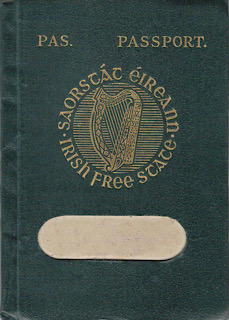
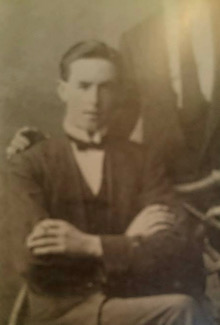
On September 6, 1929, diplomat John V. Fahy criticizes the administrative requirement that Irish Free Statepassports in the United States be issued via Britain, highlighting early challenges in the Irish Free State’s foreign affairs and consular administration.
Following the establishment of the Irish Free State in 1922, the new state faces significant administrative and diplomatic challenges. One such issue involves the issuance of passports to Irish citizens abroad, particularly in the United States. Despite Ireland’s independence, Irish Free State passports have to be processed through Britain, reflecting lingering complexities in recognition and administrative capacity.
At this time, questions of citizenship are intertwined with the status of Irish citizens as British subjects, and the British Foreign Office insists that passports clearly indicate whether holders are considered British subjects. This creates practical difficulties for the Irish government, which seeks to assert its sovereignty and provide proper documentation to its citizens internationally.
John V. Fahy, an Irish diplomat stationed in the United States, documents his concerns in a memorandum noting that the requirement to route passports through Britain is problematic. The memorandum decries the lack of an independent Irish passport issuance process in the United States, emphasizing the tension between Ireland’s formal independence and the residual administrative dependence on Britain. This memorandum reflects both the everyday bureaucratic hurdles faced by the Free State and the broader issue of Irish identity and sovereignty in international affairs.
Fahy’s memorandum is historically important for several reasons. It illustrates the early difficulties the Irish Free State faces in exercising full consular authorityoverseas. It highlights the ongoing legal ambiguities surrounding Irish citizenship and the status of Irish Free State passport holders during this period. It provides insight into diplomatic pressures on the emerging Irish state as it navigates recognition and procedural independence from Britain.
In summary, John V. Fahy’s memorandum serves as a notable record of the challenges that confronts Irish diplomats and administrators in asserting the Free State’s sovereignty and managing the practicalities of international travel in the early years of Ireland’s independence.
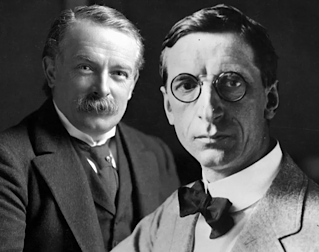
On August 30, 1921, Éamon de Valera sends a sharp reply to British Prime MinisterDavid Lloyd George as the two sides move closer to formal peace negotiations. The letter comes during a tense period when the British have presented their “Proposals of the British Government for the Irish Settlement” — offering Ireland “within the Empire…in allegiance to His Majesty’s throne” with Northern Ireland’s Unionist government remaining in place, full British naval access, and other imperial arrangements.
De Valera’s response is a stinging rebuke to Lloyd George’s approach. He reiterates Ireland’s determination to be “free from Imperialistic entanglements,” while still offering “reasonable guarantees not inconsistent with Irish sovereignty.” He makes clear that Ireland could enter a treaty of free association with the British Commonwealth but could not accept the British government’s right to “mutilate our country.” This is a direct challenge to the British insistence on loyalty to the Crown and continued imperial ties.
The exchange reflects the core conflict in the talks. The British position requires that Ireland must remain part of the Empire, with some form of association and recognition of the King’s sovereignty. The Irish position maintains that Ireland must be fully independent, with no coercion of Northern Ireland, and with sovereignty intact.
By August 30, both sides have softened their initial positions enough for Lloyd George to send a revised invitation to negotiate in person. De Valera’s letter is part of the diplomatic back-and-forth that culminates in his acceptance of the conference on September 30, 1921, marking the start of the most consequential peace talks in Irish history.
In essence, the August 30 letter is both a political statement and a diplomatic signal — asserting Irish sovereignty while leaving room for a negotiated settlement, and setting the tone for the negotiations that would soon begin.
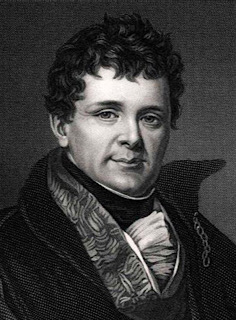
Prime Minister of the United KingdomArthur Wellesley and Home Secretary Sir Robert Peel, who had previously opposed Catholic participation in Parliament, fear that denying O’Connell his seat will provoke outrage and potentially another rebellion in Ireland — a country then about 85% Catholic. This political pressure directly leads to the Roman Catholic Relief Act 1829, which allows Catholics to become MPs, and the Parliamentary Elections (Ireland) Act 1829, which raises the property qualification for voting from £2 to £10.
With the new law in place, O’Connell stands again. The by‑election is unopposed, meaning he is returned without contest. This is significant because the higher property qualification could have disenfranchised many tenant farmers, but in Clare, O’Connell is the only candidate.
In summary, the July 30, 1829, Clare by‑election is a symbolic victory for Catholic emancipation, marking the first time a Catholic MP is elected under the new laws, and cementing O’Connell’s role as “The Liberator” of Irish political rights.
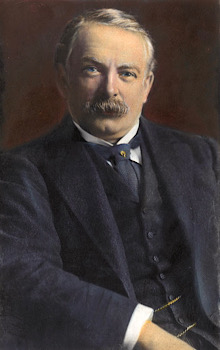
The Coalition Government, led by Prime MinisterDavid Lloyd George, is in power from 1918 to 1922 following the end of World War I, continuing the wartime alliance that has included Liberals and Conservatives. By 1920, the Cabinet is navigating Spain’s post-war reconstruction, the political unrest in Ireland, social welfare issues, and economic stabilization following wartime disruption. This period also sees preparation for negotiations over Germany’s reparations and engagement with international diplomacy after the Treaty of Versailles.
The Coalition Cabinet keeps detailed minutes and memoranda, which are recorded in the CAB 23 series as “Cabinet Conclusions,” starting from November 1919 into the interwar years. These records summarize discussions and decisions but are not verbatim transcriptions.
While the specific agenda for July 23 is not directly cited in the sources, relevant Cabinet business during July 1920 includes:
Reconstruction and Post-War Economy: Addressing unemployment, social welfare of returning servicemen, and government budgetary priorities.
International Diplomacy and Reparations: Review of ongoing negotiations concerning German reparations after World War I, potentially preparing for discussions later in London and Paris.
Regarding Ireland, the Cabinet is divided on how to proceed. Some Liberal ministers and Dublin Castle officials are in favour of offering dominion status to Ireland. Conservative ministers argue that the Government must crush the insurgency and proceed with the Government of Ireland Bill. Debate continues after the meeting, with Walter Long warning of “the gravest consequences in Ulster” if the Government changes course.
In summary, the Coalition Cabinet convenes on July 23, 1920, in the context of post-war governance, with ministers like Lloyd George, Bonar Law, Curzon, Balfour, and Churchill participating. While exact meeting details require consulting official CAB series records, the issues at hand involve post-World War I economic recovery, Irish affairs, and international obligations stemming from the Treaty of Versailles.
(Pictured: Prime Minister of the United Kingdom David Lloyd George)
In 2002, the Irish tourism sector faces weaker-than-expected visitor figures. To address this and stimulate short-term revenue, O’Donoghue reallocates €3 million specifically for front-line marketing activities targeted at both domestic and international audiences. At the time, he has recently been appointed Minister for Arts, Sport, and Tourism, a role he holds from June 2002 to 2007.
The funds are intended to bolster promotional campaigns abroad, particularly in major overseas markets such as Britain, France, and the United States, support domestic marketing efforts to encourage local travel and spending, and focus on aggressively promoting Ireland in the British market, identified as having the highest potential return on investment for tourism.
Tourism Ireland, which operates as the official agency promoting the island of Ireland as a tourist destination, welcomes the additional funding. Chief Executive Paul O’Toole emphasizes that the investment will ensure maximum returns for the Irish tourism industry.
Before this funding boost, Irish tourism is a major economic sector. According to governmental reports from 2002, foreign exchange earnings in 2001 reach approximately €3.7 billion, domestic tourism earnings exceed €1.2 billion, and the industry supports nearly 140,000 jobs. The €3 million marketing allocation is part of a strategic effort to enhance Ireland’s international competitiveness and stimulate both short-term visitor numbers and longer-term growth.
While immediate tangible effects of this specific €3 million investment are not detailed in the sources, it reflects Ireland’s broader commitment to tourism promotion. By investing in strategic marketing campaigns in key international markets, the government aims to recover visitor numbers and strengthen Ireland’s profile as a tourist destination.
In conclusion, the July 15, 2002, announcement by Minister John O’Donoghue is a targeted move to energize Irish tourism through immediate marketing action, especially in international markets, during a period of lower-than-expected tourist arrivals.
O’Conor is an active member of parliament, an effective though not an eloquent speaker, and a leading exponent of Catholic opinion. He is deeply involved in the education question, being a critic of the queen’s colleges. In 1867 he introduces a measure to extend the industrial schools act to Ireland, which becomes law the following year. He opposes William Ewart Gladstone‘s university bill of 1873, is appointed to the intermediate education board in 1878, and in May 1879 proposes the transformation of St. Patrick’s College, Maynooth, into a chartered Catholic university. He withdraws this in July, following a government bill creating the Royal University of Ireland. He is on the senate of the university for many years, and is conferred with the honorary degree of LL.D. in 1892. A leading exponent of the Irish language, in 1878 he proposes that it be introduced into secondary schools.
O’Conor is a supporter of Isaac Butt and a keen advocate of land law reform, which leads to his proposing in 1870 the extension of Ulster tenant right to the rest of the country. His brother Denis, MP for County Sligo 1868–83, is a home ruler, but Charles is only ever described as a camp follower. The Nation (October 18, 1873) observes that he “achieved the feat of speaking for two hours at a home rule meeting in Roscommon without telling his audience if he was a home ruler.” He has concrete criticisms such as the hostility of the northern counties, and wants to be allowed to take an independent stance, but Butt strongly deprecates his ambiguity. He does stand on the home rule platform in 1874 and 1880, but his tentative sympathy does nothing to protect him from the drive by Charles Stewart Parnell to establish the Irish Parliamentary Party (IPP). In March 1880, Parnell goes to Roscommon to support his candidate James O’Kelly against O’Conor, who is a popular representative. Parnell calls him a “sample of West Britonism in Ireland . . . if you deprive him of the representation of Roscommon you strike the greatest blow that has been struck against English misgovernment in Ireland since Isaac Butt was elected for the city of Limerick,” which successfully leads to O’Conor’s being ousted. Ironically, he had briefly been Parnell’s landlord when in 1860 he rented a house near Kingstown (now Dún Laoghaire) to the recently widowed Delia Parnell and her family, including the 13-year-old Charles Stewart.
Appointed to the Bessborough commission into the workings of the 1870 land act some months later, O’Conor answers Parnell by going even further than the commission’s proposal to reform land law on the basis of the “three Fs.” He supports outright peasant proprietorship as the only effective and lasting remedy. In 1883, he makes an attempt to return to parliament as a liberal candidate for Wexford Borough, but is defeated by the home ruler Willie Redmond. Always an inveterate committee member, he spends the last twenty-five years of his life on various committees, including the parliamentary committee of 1885 and the royal commission of 1894 on the financial relations between Great Britain and Ireland. He is elected to Roscommon County Council in 1899 and is Lord Lieutenant of Roscommon from 1888 until his death. In 1881 he is sworn to the Privy Council of Ireland.
An ancestor is Charles O’Conor, the noted antiquarian, and O’Conor has his own interest in this area. He is a member of the Royal Irish Academy (RIA) from 1867 and joins the Royal Society of Antiquaries of Ireland (RSAI) in 1869, is a fellow in 1888, and president 1897–9. His antiquarian research is largely confined to his own family. In 1891, he publishes The O’Conors of Connaught, an historical memoir compiled from the manuscripts of John O’Donovan. He first marries Georgina Mary, daughter of Thomas Perry of Warwickshire, England, on April 21, 1868. Secondly he marries Ellen, daughter of John Lewis More O’Ferrall of County Longford, on September 16, 1879. He has four sons by his first marriage.
O’Conor dies at Clonalis, Castlerea, County Roscommon, on June 30, 1906. He is buried in St. Joseph’s Cemetery in Castlerea.
(From: “O’Conor, Charles Owen” by Bridget Hourican, Dictionary of Irish Biography, http://www.dib.ie, October 2009)
Currie becomes an active member in the Northern Ireland Civil Rights Association (NICRA). He later speaks about the effect of partition on Catholics in Northern Ireland: “Partition was used to try to cut us off from the rest of the Irish nation. Unionists did their best to stamp out our nationalism and, the educational system, to the extent it could organise it, was oriented to Britain and we were not even allowed to use names such as Séamus or Seán. When my brothers’ godparents went to register their birth, they were told no such names as Séamus or Seán existed in Northern Ireland and were asked for the English equivalent.”
Currie contests the 1979 United Kingdom general election and 1986 by-election in the Fermanagh and South Tyrone seat, but is unsuccessful on both attempts. He also is elected to the Northern Ireland Assembly in 1982 for the same seat. That Assembly, which is an attempt by the Government of the United Kingdom to reintroduce devolved power-sharing, collapses in 1986 without executive ministerial functions ever being transferred to it from the UK Secretary of State for Northern Ireland as no political agreement can be reached on power-sharing between the parties owing to nationalists abstentionism over the constituency boundaries used to elect members, and unionist opposition to the Anglo-Irish Agreement of 1985.
Following his decision to quit Northern Ireland politics, and relocate his family to County Kildare, Currie becomes actively involved in politics in the Republic of Ireland. Partly due to his long-standing doubts about the commitment of politicians in the Republic to the plight of northern nationalists, he join the Fine Gael party in 1989. He is elected as a Fine Gael TD for Dublin West at the 1989 Irish general election.
In 1990, Fine Gael selects Currie as their candidate for the 1990 Irish presidential election, running against Tánaiste and Fianna Fáil TD, Brian Lenihan Sr, and Senator Mary Robinson for the Labour Party. The 1990 election is the first contested election for the Irish Presidency in 17 years. Currie receives 267,902 first-preference votes (approximately 17%) and is eliminated on the first count. The distribution of his votes sees Mary Robinson elected as Ireland’s first female president on the second count, beating Lenihan by more than 86,000 votes.
In his 2004 autobiography All Hell will Break Loose, Currie writes about his experience of running in the presidential election, and the prejudice he faced as a nationalist from Ulster in southern politics: “What annoyed, indeed angered me most was the suggestion that because I came from the North, I was not a real Irishman … what I called the partitionist mentality … [during the election campaign] the [then Fianna Fáil] Minister for Justice [Ray Burke] said Fine Gael leader Alan Dukes ‘had to go to Tyrone to find a candidate for the presidency’ … it was hard to take, particularly from so-called republicans.”
Following his defeat in the presidential election, Currie holds his Dáil seat in Dublin West at the 1992 and 1997 Irish general elections. Following the formation of the so-called Rainbow Coalition between Fine Gael, Labour and Democratic Left, on December 20, 1994, newly appointed TaoiseachJohn Bruton appoints him as a Minister of State with responsibility for Children’s Rights at the Departments of Health, Education and Justice, becoming the first ever minister in an Irish Government with dedicated responsibility for children. He holds this post until the appointment of a new Irish Government on June 26, 1997, following the 1997 Irish general election.
At the 2002 Irish general election Currie contests the new constituency of Dublin Mid-West, and fails to be elected. He immediately announces his retirement from electoral politics. He continues to speak and campaign for civil rights across the island of Ireland and for causes he believes in, such as justice for the families of the Disappeared during the Troubles. He and his wife and family are personal friends of the family of one of the Disappeared, Columba McVeigh, from Donaghmore, County Tyrone. His daughter Emer Currie is elected in his former constituency of Dublin West at the 2024 Irish general election.
Following the deaths of Seamus Mallon and John Hume in January and August 2020 respectively, Currie becomes the last surviving founder of the SDLP.
Currie dies on November 9, 2021, at the age of 82 at his residence in Derrymullen, County Kildare. Following an initial funeral mass in Allentown, County Kildare, his remains are transferred to his original family home in Edendork, near Dungannon, County Tyrone, where a second funeral mass was celebrated at St. Malachy’s Church, Edendork. He is buried alongside his parents in the cemetery adjoining the church.
Rice joins the Irish Volunteers in 1913 but does not take part in the 1916 Easter Rising. For a time, he shares lodgings in Rock Street, Tralee, with Austin Stack, and like Stack he is a Gaelic Athletic Association (GAA) member, playing hurling with Kenmare. At the outbreak of the Irish War of Independence (1919-1921), he becomes Officer Commanding of the 5th Battalion of the Kerry No. 2 Brigade. He also holds the post of second in command of that brigade, under Humphrey Murphy. On April 26, 1921, he attends the meeting in Kippagh, County Tipperary, that sees the establishment of the First Southern Division. After the truce, Murphy is transferred to command Kerry No. 1 Brigade, and Rice becomes commanding officer of Kerry No. 2.
Rice opposes the Anglo-Irish Treaty and leads the brigade throughout the Irish Civil War (1922-1923). When Michael Collins comes to Killarney on April 22, 1922, to speak in favour of the agreement, he is met at the train station by a group of fifty men, led by Rice, who attempt to prevent him from speaking. The meeting goes ahead despite several attempts by the group to stop it. During the civil war he leads his men into Limerick, briefly seizing Rathkeale, but for the most part they are on the defensive. In September he commands a force of seventy republicans to take Kenmare. This is a rare and morale-boosting success. When the First Southern Division council meets on February 26-28, 1923, he is one of only two senior officers, among a group of eighteen, who feel that it is worth fighting on.
Shortly after the civil war, Rice marries Nora Aherne, a Cumann na mBan member; they have one son, George. After the war he continues to be active in the Irish Republican Army (IRA) and Sinn Féin. He attends IRA executive meetings in 1923 and is involved in attempts to reorganise the IRA in 1924. He is a delegate to the Sinn Féin ardfheis in 1926, opposing the proposal of Éamon de Valera that abstention be a matter of policy rather than principle. He is elected as a Sinn Féin TD for the Kerry South constituency at the 1957 Irish general election. He does not take his seat in the Dáil due to the Sinn Féin policy of abstentionism. He is one of four Sinn Féin TDs elected at the 1957 Irish general election, the others being Ruairí Ó Brádaigh, John Joe McGirl and Eighneachán Ó hAnnluain. During his time as a TD, he campaigns against the Special Powers Act, which grants the Irish state extra abilities to deal with and punish suspected members of the IRA. He is defeated at the 1961 Irish general election.
In 1966, Rice and fellow Kerry Republican John Joe Sheehy are expelled from Sinn Féin, as are many others, by the new Marxist-Leninist party leadership that had recently come into power. This move both foreshadows and fuels the split in 1969/1970 of both the IRA and Sinn Féin, which leads to the creation of the Marxist-Leninist Official IRA and the more traditional but still left-wing Provisional IRA, and in parallel Sinn Féin – The Workers’ Party and “Provisional” Sinn Féin. Rice gives his support to the Provisionals.
Rice drives an oil lorry for a time and then becomes manager of the Tralee branch of Messrs Nash, mineral water manufacturers and bottlers. He remains in this position until his retirement in 1965. He dies on July 24, 1970, at his son’s residence in Oakview, Tralee.
Rice’s sister, Rosalie, is a member of Cumann na mBan during the 1916 Easter Rising and is arrested for sending a telegram alerting the Irish Republican Brotherhood (IRB) in the United States to the rising. His cousins Eugene and Timothy Ring are members of the IRB and are also involved with the telegram. His grandfather, Timothy Ring, was a Fenian who fought in the uprising. Two of his cousins are members of the Royal Irish Constabulary (RIC) who both help the republican side during the Irish revolutionary period.
Pilkington is born to John Pilkington and Margaret Mary Pilkington (née Torsney), the second of twelve children born to the couple. Only nine of his siblings survive into adulthood. He receives his education at the local Marist Brothers convent school and the Day Trades Preparatory School. Later he is a student at the Department of Agriculture Forestry College in County Wicklow. When the Irish War of Independence begins, the college is closed and he is forced to return to Sligo. He then gains employment with Wehrly Brothers Ltd., a jewelry and watchmaking store in Sligo.
Several notable incidents occur in Pilkington’s military career. On October 25, 1920, at Moneygold, eight miles from Sligo (between Grange and Cliffoney), IRA men led by him ambush a nine-man Royal Irish Constabulary (RIC) patrol, killing four (Sergeant Patrick Perry, Constables Patrick Keown, Patrick Laffey, Patrick Lynch) and wounding two others (Constables Clarke and O’Rourke). In January 1922, he makes clear his opposition to the IRAs General Headquarters (GHQ) support for the Anglo-Irish Treaty. “We intend to cut away from this headquarters, all of you (pointing to the staff and officers of the GHQ) want to build up a Free State Army so you can march in step into the British Empire. Do it openly. We stand by the Republic.” On April 6, 1922, a meeting addressed by Arthur Griffith in Sligo, is proclaimed illegal by Pilkington, who is the local Anti-Treaty IRA divisional commander. His troops take over a number of buildings in the town. Seán Mac Eoin brings Provisional Government troops from Athlone and on the day of the meeting, he is joined by further troops led by J. J. “Ginger” O’Connell. A tense situation ensues but, at the last minute, Pilkington backs down and the meeting goes ahead. On September 4, 1922, an Anti-Treaty IRA unit under Pilkington takes the Dromhaire barracks in County Sligo after the Free State garrison surrenders.
On August 27, 1923, Pilkington runs unsuccessfully in the general election for the 4th Dáil as a Republican candidate, polling 2,089 first preference votes.
Pilkington is a prominent member of the Anti-Treaty IRA for many years, but his most important role as part of the Anti-Treaty IRA comes on April 20, 1923. The Executive of the Anti-Treaty IRA meets in Poulacappal (four miles southwest of Callan and three miles from Mullinahone). Present in addition to Pilkington (who is replacing Liam Lynch) are Frank Aiken, Sean Hyde, Sean Dowling, Bill Quirke, Tom Barry, Tom Ruane (replacing Michael Kilroy), Tom Sullivan (replacing Sean Lehane), Sean McSwiney, Tom Crofts, P. J. Ruttledge and Sean O’Meara (substitute for Séumas Robinson). Frank Aiken is elected Chief-of-Staff and an Army Council of Aiken, Pilkington and Barry is appointed. Aiken proposes that peace should be made with the Pro-Treaty Government on the basis that “the sovereignty of the Irish Nation and the integrity of its territory is inalienable.” This is passed by nine votes to two.
Pilkington becomes a Catholic priest after his foray into politics and due to the disillusionment of the Irish War of Independence. He joins the Redemptorist Order and becomes known as Father William Pilkington CSsR. He serves as a priest in the Archdiocese of Cape Town, South Africa, priest of Monmouthshire, Wales, and retires to Bishop Eton Monastery, Liverpool.
In 1954, Pilkington is guest of honour at a dinner sponsored by Clan na Gael and the IRA Veterans of America in New York City where he says he is returning to the mission fields of Africa, but he remains faithful to the All Ireland Republic. He dies at Bishop Eton Monastery on March 26, 1977, and is buried in Liverpool.
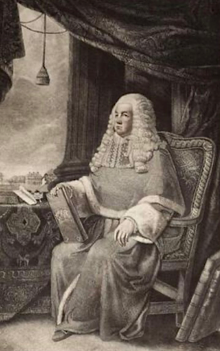
Yelverton is the eldest son of Francis Yelverton of Kanturk, County Cork, and Elizabeth Barry, daughter of Jonas Barry of Kilbrin (now Ballyclogh, County Cork). His father dies when he is only ten. His mother reaches a great age, dying only a year before her son. He goes to school in Charleville and Midleton College, and attends Trinity College Dublin, where he takes a degree of Bachelor of Arts in 1757 and of Bachelor of Laws in 1761. His family lacks wealth and social position and he is for some years an assistant master under Andrew Buck in the Hibernian Academy. This menial occupation is later a source of great embarrassment to him, as his enemies love to ridicule him as “Buck’s usher.”
In 1761, Yelverton marries Mary Nugent, daughter of William Nugent of Clonlost, County Westmeath, and his wife Ursula Aglionby, a lady of some fortune, and is thus enabled to read for the Irish Bar, entering the Middle Temple. He is called to the Bar in 1764. Despite his lack of family connections, his success in his profession is rapid, due to his legal ability, charm and remarkable eloquence, and he takes silk eight years afterward.
Yelverton is elected to the Irish House of Commons as member for Donegal Borough from 1774 to 1776. In the latter year, he is elected for both Belfast and Carrickfergus. He chooses to sit for the latter constituency and represents Carrickfergus until 1784. Although few examples of his oratory survive, all contemporaries agree on his eloquence, which gives him a dominant position in the Commons. He also serves as Recorder of Carrickfergus from 1778 until his death. This is not a Crown appointment as the Recorder is elected by a vote of the entire town corporation.
Yelverton gives his support to Henry Grattan and the Whigs during the greater part of his parliamentary career. He is a strong supporter of the demand for an independent Irish Parliament, but later changes his stance.
Yelverton plays a crucial role in the reforms which are collectively called the Irish Constitution of 1782. In particular he sponsors the Act 21 and 22 of George III, An Act to regulate the manner of passing bills and to prevent delays in summoning of Parliaments – which is popularly known as “Yelverton’s Act.” This radically modifies Poynings’ Law of 1495 by which all legislation to be passed by the Irish Parliament has to be drafted by the Privy Council of Ireland, then sent to the English privy council for approval. Under Yelverton’s Act, the role of the Irish Privy Council is abolished and legislation is commenced in the normal way in the Irish Parliament, which for the last 17 years of its existence enjoys a wide measure of independence.
In his latter days, Yelverton becomes identified with the court party and votes for the Act of Union 1800, for which his viscounty is a reward. For this he is never forgiven by many of his former friends. Sir Jonah Barrington, who continues to regard Yelverton with affection and respect, regrets that this action should have destroyed his reputation forever, but he argues that such a mistake of judgment is understandable in a man who lacks worldly wisdom, and despite his many good qualities, does not have a strong moral sense.
Yelverton becomes Attorney-General for Ireland in 1782, and is elevated to the bench as Lord Chief Baron of the Irish Exchequer in 1783. He is created Baron Yelverton in 1795, and in 1800 Viscount Avonmore in the Peerage of Ireland. As Chief Baron, he leads the opposition to the proposal to increase the number of judges in each of the courts of common law from three to four, on the practical ground that four-judge courts often divide evenly and thus cannot reach an effective decision. Despite this common-sense view, the new judges are eventually appointed.
In 1797, Yelverton attains a degree of infamy for presiding over what is widely regarded as a “show trial” which leads to the execution of the United Irishman, William Orr, although he is said to have shed tears when passing the death sentence on Orr. Orr is charged with administering the United Irish oath to a soldier called Hugh Wheatly. This had recently become a capital offence. In fact, it is generally believed that another man, William McKeever, administered the oath. Wheatly, who is the principal witness for the prosecution, later confesses that he had perjured himself, but despite a superb defence by John Philpot Curran, Orr is found guilty and hanged. Yelverton may have formed an early impression of Orr’s guilt and acted on it – even his admirers admitted that as a judge he lacks impartiality.
Peter Finnerty, a journalist, is later convicted of seditious libel for publishing an attack on Yelverton over his conduct of Orr’s trial and this does nothing to enhance the judge’s reputation.
Yelverton dies on August 19, 1805, at his mansion, Fortfield House, Terenure, County Dublin, which he had built at great expense around 1785. He is buried nearby in Rathfarnham.