Devine, also known as “Red Mickey” because of his red hair, is born into a family from the Springtown Camp, on the outskirts of Derry, a former United States military base from the World War II. In 1960, when he is six years of age, the Devine family, including his grandmother, sister Margaret and parents Patrick and Elizabeth, move to the then newly built Creggan estate to the north of Derry city centre. He is educated at Holy Child Primary School and St. Joseph’s Boy’s School, both in the Creggan.
After British soldiers shoot dead two unarmed civilians, Dessie Beattie and Raymond Cusack, Devine joins the James Connolly Republican Club in Derry in July 1971. Bloody Sunday has a deep impact on him. In the early 1970s, he joins the Irish Labour Party and Young Socialists.
Devine helps found the Irish National Liberation Army (INLA) in 1975. In 1976, after an arms raid in County Donegal in the Republic of Ireland, he is arrested in Northern Ireland. He is convicted and sentenced to twelve years in prison. He joins the blanket protest before joining the hunger strike.
Devine participates in a brief hunger strike in 1980, which is called off without fatalities. On June 22, 1981, he joins Joe McDonnell, Kieran Doherty, Kevin Lynch, Martin Hurson, Thomas McElwee and Paddy Quinn on hunger strike at the Maze Prison. He dies on August 20, after sixty days on hunger strike.
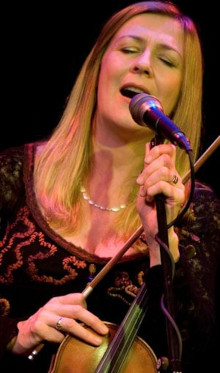
Ní Mhaonaigh’s father, Proinsias Ó Maonaigh, is a noted fiddler, song writer and school teacher and is her first main influence. Her mother, Kitty Rua is also raised in a musical house that holds frequent house dances. It is no surprise that she and her siblings, Gearóid and Anna, all play music together.
In the early 1980s, Ní Mhaonaigh qualifies as a Primary school teacher and teaches in Saint Oliver Plunkett National School in Malahide, County Dublin. She and her husband, Frankie Kennedy, record Ceol Aduaidh (Music from the North) for Irish label Gael Linn in 1983. This timeless recording is the genesis of what later becomes Altan. The recording features her brother Gearóid Ó Maonaigh on guitar, Fintan Mc Manus on bouzouki, Ciaran Curran on bouzouki and Eithne Ní Bhraonáin (now known as Enya) on keyboards. The album quietly gains praise among enthusiasts of traditional Irish music worldwide, which leads the way for a career in music.
Ní Mhaonigh’s teaching career comes to a halt after she and her husband take a career break in 1987 and formed Altan. The band goes on to become one of the most acclaimed Irish traditional bands touring the world. They record for Green Linnet Records in the United States and tour North America extensively.
In 1994, Frankie Kennedy passes away to cancer, which is a tremendous loss to Ní Mhaonigh. She continues with the band at her late husband’s request and signs to multinational record label Virgin Records London in late 1994. This marks the first traditional Irish band to be signed to a major record label and propels Altan and Ní Mhaonigh into a wider audience of followers.
Ní Mhaonaigh, along with fronting Altan, remains close her roots between touring and returns to her native County Donegal to play, sing and teach her music to a new generation. She helps set up Cairdeas na bhFidléirí (The Fellowship / Friendship of Fiddlers) in the early 1980s to promote and preserve the fiddle music of County Donegal.
In 2009, Ní Mhaonaigh releases her first solo album, Imeall (Edge/Theshold), as a limited edition. After many years of playing with the band and numerous requests for a solo recording she finally gets time to record the album after parting with her second husband Dermot Byrne, with whom she has her daughter Nia. She tours the album between Altan commitments with her co-producer and recording engineer Manus Lunny.
The album prompts one reviewer, Paul O’Connor, to remark, “Her identified success as the leader of Altan has dominated our sense of her to the point that we aren’t cognisant of how good she is as an artist, musician, composer in her own right.”
This new focus on Ní Mhaonaigh as an artist in her own right, prompts The Donegal Association in Dublin to grant her “Donegal Person of the Year 2009” at a gala dinner in Dublin’s prestigious Burlington Hotel.
Ní Mhaonaigh is awarded the top recognition in traditional Irish music by her fellow peers in 2018, when she is awarded TG4Gradam Ceoil’s Traditional Musician of the Year. The following year, she is honoured in her own county at the now world famous “Cup o’Tae Festival” which is held annually in Ardara, County Donegal.
Ní Mhaonaigh is also a member of String Sisters, which is a Grammy listed folk supergroup of six of the world’s leading female fiddlers. Together they have released two albums – the Grammy-longlisted Live and Between Wind and Water. She is a member of T with the Maggies, which is a vocal supergroup of Donegal singers comprised of Maighread and Tríona Ní Dhomhnaill and Moya Brennan of Clannad fame.
Recently Ní Mhaonaigh has recorded with a group of thirteen County Donegal-based female fiddlers which is called ‘SíFiddlers.’
Haliday is the son of the Rev. Samuel Haliday (1637–1724), who is ordained presbyterian minister of Convoy, County Donegal, in 1664. He then moves to Omagh in 1677, leaving for Scotland in 1689, where he is successively minister of Dunscore, Drysdale, and New North Church, Edinburgh. He returns to Ireland in 1692, becoming minister of Ardstraw, where he continues until his death.
Haliday enters Glasgow College, enrolled among the students of the first class under John Loudon, professor of logic and rhetoric. He graduates M.A. and goes to Leiden University to study theology in November 1705.
In 1706 Haliday is licensed at Rotterdam and in 1708 receives ordination at Geneva, choosing to be ordained there because of its tolerance. He becomes chaplain to the 26th (Cameronian) Regiment of Foot, serving under John Churchill, 1st Duke of Marlborough in Flanders. He is received by the Synod of Ulster in 1712 as an ordained minister without charge and declared capable of being settled in any of its congregations. For some time, however, he lives in London, where he associates with the Whig faction, in and out of the government, and uses his influence to promote the interests of his fellow-churchmen. He opposes the extension of the Schism Act 1714 to Ireland. In 1718 he takes a leading part in obtaining an increase in the regium donum and the synod of Ulster thanks him. He introduces two historians, Laurence Echard and Edmund Calamy, in a London social meeting with Sir Richard Ellys, 3rd Baronet.
In 1719 Haliday is present at the Salters’ Hall debates, and in the same year receives a call from the first congregation of Belfast, vacant by the death of the Rev. John McBride. He is at this time chaplain to Colonel Anstruther’s regiment of foot. It being rumoured that he holds Arian views, the synod in June 1720 considers the matter, and clears him. His accuser, the Rev. Samuel Dunlop of Athlone, is rebuked.
On July 28, 1720, the day appointed for his installation in Belfast, Haliday refuses to subscribe the Westminster Confession of Faith, making instead a declaration to the presbytery. The presbytery proceeds with the installation, in violation of the law of the church, and in the face of a protest and appeal from four members. The case comes before the synod in 1721, but though Haliday still refuses to sign the Confession, the matter is allowed to drop. A resolution is, however, carried after long debate that all members of synod who are willing to subscribe the confession might do so, with which the majority comply. Hence arises the terms “subscribers” and “non-subscribers.” He continues to be identified with the latter until his death. A number of members of his congregation are so dissatisfied with the issue of the case that they refuse to remain under his ministry. After much opposition they are erected by the synod into a new charge.
The subscription controversy rages for years. Haliday continues to take a major part in it, both in the synod and through the press. To end the conflict, the synod in 1725 adopts the expedient of placing all the non-subscribing ministers in one presbytery, that of Antrim, which in the following year is excluded from the body.
Haliday is a lifelong friend to the philosopher Francis Hutcheson. In 1736 Thomas Drennan is installed as his colleague in Belfast. Haliday dies at the age of 54 on March 5, 1739.
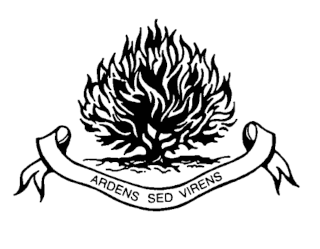
(Pictured: The burning bush is a common symbol used by Presbyterian churches; here as used by the Presbyterian Church in Ireland. The Latin inscription underneath translates as “burning but flourishing”. In Presbyterianism, alternative versions of the motto are also used such as “burning, yet not consumed”.)
British troops are the target of sporadic rioting in the RepublicanBogside area of Derry in the four days leading up to the rioting.
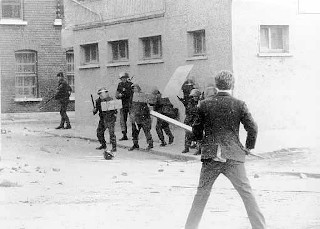
At about 1:00 AM on the morning of July 8, 1971, in the Bogside area of Derry, Seamus Cusack, 28, a local man who is a welder and former boxer, is shot in the upper part of the leg by a soldier of the Crown Forces. He dies about forty minutes later in Letterkenny Hospital in the Republic of Ireland.
Cusack’s death gives rise to further disturbances in the city. Troops open fire, initially with rubber bullets and CS gas, but they fail to disperse the crowd. The rioters retaliate by throwing three nail bombs. The army returns fire. During this exchange, George Desmond Beattie, 19, is shot in the stomach by a soldier and dies instantly at about 3:15 PM. Five soldiers are reportedly injured during the skirmishes.
There is a lull in the violence after Beattie is shot and a group of factory girls march in silence through the area carrying black bags.
Army marksmen claim one of the men they shot was armed with a rifle and another was about to throw a petrol or nail bomb. It is unclear which incident Cusack is involved in, but an inquest hears that he could have been saved if he had gone to a local hospital instead of one 20 miles south of the border in County Donegal. Apparently, his rescuers fear they would be arrested by police if he had been taken to the local hospital.
In the evening the Ministry of Defence announces that an additional 500 men from the First King’s Own Scottish Borderers are to be sent to Northern Ireland the following day. This brings to 1,400 the total number of men drafted to Northern Ireland over the previous ten days in preparation for the upcoming traditional The Twelfth celebrations on July 12.
The disappearance is the most notorious incident to occur in Clonmany during the Irish War of Independence. Both men are stationed at the RIC Barracks in Clonmany. They go on patrol in the evening but are kidnapped near Straid in County Antrim. Both men are shot and their bodies are dumped in the sea near Binion.
Clarke’s body washes up on the seashore near Binion the following day. Constable Murdock reportedly survives the initial attack despite being thrown into the sea. He swims to the shore and seeks refuge among the residents of Binion. However, he is betrayed to the IRA who murder him. His body has never been found. Local tradition suggests that he is buried in a bog near Binion hill.
In June 1921, a military court is held in Clonmany to conduct a postmortem for Clarke. The court finds that Clarke had died from gunshot wounds to the heart, jaw and neck and that his firearm and ammunition were missing. At the time of his death, Clarke is 23 years old and unmarried.
A few weeks later, on July 10, 1921 Crown Forces raid a number of houses in Clonmany looking for Sinn Féinactivists. Three unnamed young men from the village are arrested but are released shortly afterwards and allowed to return home.
De Paor is born Máire MacDermott to Eamonn MacDermott and Delia MacVeigh. She is educated in the Convent of Mercy in Buncrana before going to University College Dublin, where she completes a master’s degree and a doctorate on early Christian archaeology and metalwork.
De Paor works in the Department of Archeology at UCD from 1946 to 1958. She marries Liam de Paor in 1946, and they have a daughter and four boys. They collaborate on a number of publications. She publishes her papers in the Proceedings of the Royal Irish Academy, Archaeologia, Seanchas Armagh and Comhar. Her husband also works at the university and, as a result of policies about married women, she is forced to leave. Initially she lectures in the United States, Canada, Scandinavia, France and the United Kingdom. She works as lecturer in archaeology at Trinity College, Dublin. The de Paors spend a year in Nepal on a UNESCO project in 1963.
De Paor works as a freelance researcher for Raidió Teilifís Éireann until she is given a full-time position in the 1970s.
De Paor is elected a member of the Royal Irish Academy in 1960 and is a member of the Arts Council from 1973. She becomes a member of Conradh na Gaeilge from 1962. From 1968 she is working with Cumann Merriman, the Irish cultural organisation named after Brian Merriman, working with the group as a director of the schools and spends four years as chairperson. In 1992 she is appointed to the board of Amharclann de hÍde.
Máire de Paor dies on December 6, 1994, at the age of 69.
University College Dublin has created the Dr. Máire de Paor Award for best PhD thesis. Her biographer identifies her as a committed republican, socialist and feminist.
Micheal O’Siadhail, poet and linguist, is born in Dublin on January 12, 1947. Among his awards are The Marten Toonder Prize and The Irish American Culture Institute Prize for Literature.
O’Siadhail is born into a middle-class Dublin family. His father, a chartered accountant, is born in County Monaghan and works most of his life in Dublin, and his mother is a Dubliner with roots in County Tipperary. Both of them are portrayed in his work in several poems such as “Kinsmen” and “Promise”. From the age of twelve, he is educated at the Jesuit boarding school Clongowes Wood College, an experience he is later to describe in a sequence of poems “Departure” (The Chosen Garden).
At Clongowes O’Siadhail is influenced by his English teacher, the writer Tom MacIntyre, who introduces him to contemporary poetry. At thirteen he first visits the Aran Islands. This pre-industrial society with its large-scale emigration has a profound impact on him. His earlier work reflects this tension between his love of his native Dublin and his emotional involvement with those outlying communities and which features in the sequence “Fists of Stone” (The Chosen Garden).
In 1970 O’Siadhail marries Bríd Ní Chearbhaill, who is born in Gweedore, County Donegal. She is for most of her life a teacher and later head mistress in an inner-city Dublin primary school until her retirement in 1995 due to Parkinson’s disease. She is a central figure in his oeuvre celebrated in the sequence “Rerooting” in The Chosen Garden and in Love Life, which is a meditation on their lifelong relationship. One Crimson Thread travels with the progression of her Parkinson’s Disease. She dies on June 17, 2013.
For seventeen years, O’Siadhail earns his living as an academic; firstly, as a lecturer at Trinity College (1969–73) where he is awarded a Master of Letters degree in 1971 and then as a research professor at the Dublin Institute for Advanced Studies. During these years he gives named lectures in Dublin and at Harvard University and Yale University and is a visiting professor at the University of Iceland in 1982. In 1987 he resigns his professorship to devote himself to writing poetry which he describes as “a quantum leap.”
During his years as an academic, O’Siadhail, writing under the Irish spelling of his name, published works on the linguistics of Irish and a textbook for learners of Irish.
O’Siadhail serves as a member of the Arts Council of the Republic of Ireland (1987–93), of the Advisory Committee on Cultural Relations (1989–97) and is editor of Poetry Ireland Review. He is the founding chairman of ILE (Ireland Literature Exchange). As a founder member of Aosdána (Academy of Distinguished Irish Artists) he is part of a circle of artists and works with his friend the composer Seóirse Bodley, the painters Cecil King and Mick O’Dea and in 2008 gives a reading as part of Brian Friel‘s eightieth birthday celebration.
David Fulton, the fourth and final mayor of the Town of Little Rock, Arkansas, before it is incorporated, is born in the Parish of Templemore, County Donegal on January 2, 1771. He serves as mayor from January 1835 through November 1835, his term cut short by the transition of Little Rock from town to city status. Once that occurs in November 1835, a new election has to be held.
Fulton is also proprietor of the Tan Yard, a tanning operation in Little Rock. He later serves as a judge and is appointed as Surveyor General of Public Lands in Arkansas by U.S. PresidentMartin Van Buren in 1838.
Fulton marries Elizabeth Savin in June 1795 in Maryland. She dies in November 1829, while they reside in Alabama. One of their children, William Savin Fulton (for whom Fulton County, Arkansas is named), serves as the fourth Territorial Governor of Arkansas in 1835 and 1836 and is one of Arkansas’ first United States Senators upon statehood in 1836. Fulton is serving as Mayor at the same time his son is Governor.
Fulton comes to Little Rock in 1833. His daughter, Jane Juliet Shall, and her four children come to Little Rock as well. The family makes the move to be nearer to the future governor. The Fultons and Shalls rent the Hinderliter House, now part of Historic Arkansas Museum, in 1834. One of his descendants, Louise Loughborough, is the person who saves the Hinderliter House from destruction and is founder of what is now Historic Arkansas Museum.
In addition to serving as Mayor, Fulton is president of the Anti-Gambling Society and a Pulaski CountyJustice of the Peace. From 1836 until 1838, he is County Judge of Pulaski County.
David Fulton dies in Little Rock on August 7, 1843 and is buried at Mount Holly Cemetery as are several other members of his family.
(From: “Little Rock Look Back: David Fulton, LR’s 4th Mayor” by Scott Whiteley Carter, Little Rock Culture Vulture blog, January 2, 2019)
Harrison goes to Westminster School and then to Balliol College, Oxford. While there he develops an admiration for Charles Stewart Parnell and becomes secretary of the Oxford University Home Rule League. At this time, the Land War is in progress and in 1889 he goes to Ireland to visit the scene of the evictions in Gweedore, County Donegal. He becomes involved in physical confrontations with the Royal Irish Constabulary and as a result becomes a Nationalist celebrity overnight. The following May, Parnell offers the vacant parliamentary seat of Mid Tipperary to Harrison, who leaves Oxford at age 22, to take it up, unopposed.
Only six months later, following the divorce case involving Katharine O’Shea, the Irish Parliamentary Party splits over Parnell’s leadership. Harrison strongly supports Parnell, acts as his bodyguard and aide-de-camp, and after Parnell’s death devotes himself to the service of his widow Katharine. From her he hears a completely different version of the events surrounding the divorce case from that which had appeared in the press, and this is to form the seed of his later books.
Harrison then makes a return to Irish politics, working with Sir Horace Plunkett as Secretary of the Irish Dominion League, an organisation campaigning for dominion status for Ireland within the British Empire. He is a lifelong opponent of Irish partition. He is Irish correspondent of The Economist from 1922 to 1927 and owner-editor of Irish Truth from 1924 to 1927.
Harrison’s two books defending Parnell are published in 1931 and 1938. They have had a major impact on Irish historiography, leading to a more favourable view of Parnell’s role in the O’Shea affair. F. S. L. Lyons comments that he “did more than anyone else to uncover what seems to have been the true facts” about the Parnell-O’Shea liaison. The second book, Parnell, Joseph Chamberlain and Mr Garvin, is written in response to J. L. Garvin‘s biography of Joseph Chamberlain, which had ignored his first book, Parnell Vindicated: The Lifting of the Veil. Later, he successfully repulses an attempt in the official history of The Times to rehabilitate that newspaper’s role in using forged letters to attack Parnell in the late 1880s. In 1952 he forces The Times to publish a four-page correction written by him as an appendix to the fourth volume of the history.
During the difficult years of the Anglo-Irish Trade War over the land purchase annuities, declaration of the Republic, Irish neutrality during World War II, and departure from the Commonwealth, Harrison works to promote good relations between Britain and Ireland. He publishes various books and pamphlets on the issues in dispute and writes numerous letters to The Times. He also founds, with General Sir Hubert Gough, the Commonwealth Irish Association in 1942.
At the time of his death on February 20, 1954, Harrison is the last survivor of the Irish Parliamentary Party led by Parnell, and as a member of the pre-1918 Irish Parliamentary Party, he seems to have been outlived only by John Patrick Hayden, who dies a few months after him in 1954 and by Patrick Whitty and John Lymbrick Esmonde who are only MPs for a very short time during World War I. He is buried in Holywood, County Down.
Stopford Augustus Brooke, churchman, royal chaplain and writer, is born in the rectory of Glendoen, near Letterkenny, County Donegal on November 14, 1832. His maternal grandfather, Joseph Stopford, is then rector of the parish.
Brooke is the eldest son of the Rev. Richard Sinclair Brooke, later incumbent of the Mariners’ Church, Kingstown (now Dún Laoghaire), and is educated at Trinity College, Dublin. He is ordained in the Church of England in 1857 and holds various charges in London. From 1863 to 1865 he is chaplain to Victoria, Princess Royal in Berlin. In 1869, with his brother Edward, he makes long tours of Counties Donegal and Sligo, and spends much time at Kells, County Meath studying Irish antiquities. Between 1866 and 1875 he is the minister at St. James’s Chapel, a Proprietary Chapel. After it closes, he takes services at Bedford Chapel, Bloomsbury where he continues to attract large congregations. In 1875, he becomes chaplain in ordinary to Queen Victoria. But in 1880 he secedes from the Church, being no longer able to accept its leading dogmas, and officiates as an independent preacher for some years at Bedford chapel, Bloomsbury.
Bedford chapel is pulled down about 1894, and from that time Brooke has no church of his own, but his eloquence and powerful religious personality continues to make themselves felt among a wide circle. A man of independent means, he is always keenly interested in literature and art, and a fine critic of both. The two-volume Life and Letters of Stopford Brooke, written by his son-in-law L. P. Jacks and published in 1917, contains many details of different facets of his life.
In 1890-1891 Brooke takes the lead in raising the funds to purchase Dove Cottage, William Wordsworth’s home in Grasmere from 1800 to 1808, and establishing it “for the eternal possession of those who love English poetry all over the world.” Dove Cottage is now administered by the Wordsworth Trust.
Brooke publishes in 1865 his Life and Letters of FW Robertson (of Brighton), and in 1876 writes an admirable primer of English Literature, followed in 1892 by The History of Early English Literature down to the accession of Alfred the Great, and English Literature from the Beginnings to the Norman Conquest (1898).
Brooke gives the inaugural lecture to the Irish Literary Society, London, on “The Need and Use of Getting Irish Literature into the English Tongue” at Bloomsbury House, March 11, 1893. He delivers a sermon on “The Kingdom of God Within” to the International Council of Unitarian and Other Liberal Religious Thinkers and Workers, meeting in London in May 1901.