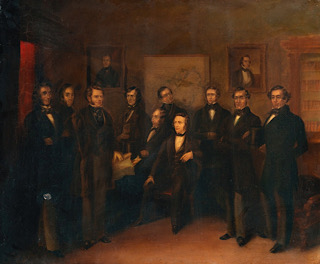
In June 1846, Sir Robert Peel‘s Tory Ministry falls, and the Whigs under Lord John Russell comes to power. Daniel O’Connell, founder of the Repeal Association which campaigns for a repeal of the Acts of Union 1800 between Great Britain and Ireland, simultaneously attempts to move the Association into supporting the Russell administration and English Liberalism.
The intention is that Repeal agitation is to be damped down in return for a profuse distribution of patronage through Conciliation Hall, home of the Repeal Association. On June 15, 1846, Thomas Francis Meagher denounces English Liberalism in Ireland saying that there is a suspicion that the national cause of Repeal will be sacrificed to the Whig government and that the people who are striving for freedom will be “purchased back into factious vassalage.” Meagher and the other “Young Irelanders” (an epithet of opprobrium used by O’Connell to describe the young men of The Nation newspaper), as active Repealers, vehemently denounce in Conciliation Hall any movement toward English political parties, be they Whig or Tory, so long as Repeal is denied.
The “Tail” as the “corrupt gang of politicians who fawned on O’Connell” are named, and who hope to gain from the government places decide that the Young Irelanders must be driven from the Repeal Association. The Young Irelanders are to be presented as revolutionaries, factionists, infidels and secret enemies of the Church. For this purpose, resolutions are introduced to the Repeal Association on July 13 which declare that under no circumstances is a nation justified in asserting its liberties by force of arms. The Young Irelanders, as members of the association, have never advocated the use of physical force to advance the cause of repeal and oppose any such policy. Known as the “Peace Resolutions,” they declare that physical force is immoral under any circumstances to obtain national rights. Meagher agrees that only moral and peaceful means should be adopted by the Association, but if it is determined that Repeal cannot be carried by those means, a no less honourable one he would adopt though it be more perilous. The resolutions are again raised on July 28 in the Association and Meagher then delivers his famous “Sword Speech.”
Addressing the Peace Resolutions, Meagher holds that there is no necessity for them. Under the existing circumstances of the country, any provocation to arms will be senseless and wicked. He dissents from the Resolutions because by assenting to them he would pledge himself to the unqualified repudiation of physical force “in all countries, at all times, and in every circumstance.” There are times when arms will suffice, and when political amelioration calls for “a drop of blood, and many thousand drops of blood.” He then “eloquently defended physical force as an agency in securing national freedom.” Having been at first semi-hostile, Meagher carries the audience to his side and the plot against the Young Irelanders is placed in peril of defeat. Observing this he is interrupted by O’Connell’s son, John, who declares that either he or Meagher must leave the hall. William Smith O’Brien then protests against John O’Connell’s attempt to suppress a legitimate expression of opinion, and leaves with other prominent Young Irelanders, and never returns.
After negotiations for a reunion have failed, the seceders decide to establish a new organisation which is to be called the Irish Confederation. Its founders determine to revive the uncompromising demand for a national Parliament with full legislative and executive powers. They are resolute on a complete prohibition of place-hunting or acceptance of office under the existing Government. They wish to return to the honest policy of the earlier years of the Repeal Association, and are supported by the young men, who have shown their repugnance for the corruption and insincerity of Conciliation Hall by their active sympathy with the seceders. There are extensive indications that many of the previously Unionist class, in both the cities and among land owners, are resentful of the neglect of Irish needs by the British Parliament since the famine began. What they demand is vital legislative action to provide both employment and food, and to prevent all further export of the corn, cattle, pigs and butter which are still leaving the country. On this there is a general consensus of Irish opinion according to Dennis Gwynn, “such as had not been known since before the Act of Union.”
The first meeting of the Irish Confederation takes place in the Rotunda, Dublin, on January 13, 1847. The chairperson for the first meeting is John Shine Lawlor, the honorary secretaries being John Blake Dillon and Charles Gavan Duffy. Duffy is later replaced by Meagher. Ten thousand members are enrolled, but of the gentry there are very few, the middle class stand apart and the Catholic clergy are unfriendly. In view of the poverty of the people, subscriptions are purely voluntary, the founders of the new movement bearing the cost themselves if necessary.
Following mass emigration by Irish people to England, the Irish Confederation then organises there also. There are more than a dozen Confederate Clubs in Liverpool and over 700 members of 16 clubs located in Manchester and Salford.
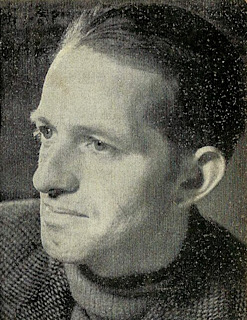
Patrick Pollen, a British stained glass artist who spends most of his life working in Ireland, is born Patrick La Primaudaye Pollen in London on January 12, 1928.
In 1952, Pollen’s father takes him to see Evie Hone‘s “Crucifixion and Last Supper” window in Eton College Chapel. Upon seeing it he announces, “That’s what I want to do.” He moves to Dublin to study with the stained glass cooperative Evie Hone is a member of, An Túr Gloine, which is run by Catherine O’Brien and she and Hone become his mentors. When Hone dies in 1955, she leaves him her brushes.
Following the Second Vatican Council, newly designed churches feature less stained glass, and Pollen finds he is receiving less commissions. As a consequence he and his family move to the United States in 1981. They settle in Winston-Salem, North Carolina but there is very little work there and in 1997 they return in Ireland, living in his wife’s native County Wexford.
Pollen marries sculptor Nell Murphy in 1963, with the couple buying a house in Dublin in which Pollen had his studio. Murphy works in plaster, clay and stone, her works often featured in churches with those of her husband. They hav four sons, Peter, Ciaran, Laurence and Christopher, and a daughter, Brid.
Pollen dies on November 30, 2010, in Enniscorthy, County Wexford. His remains are cremated and the location of his ashes is unknown.
European Movement Ireland (EM Ireland) (Irish: Gluaiseacht na hEorpa in Éirinn) is founded in Dublin on January 11, 1954. EM Ireland is an independent not-for-profit organisation that campaigns for every Irish person to get involved in the European Union (EU) and by doing so, help shape it. It is the oldest Irish organisation dealing with the EU, pre-dating Ireland’s membership of the European Economic Community (EEC) in 1973 by almost twenty years. The organisation is headed by Chief Executive Officer (CEO), Noelle Connell. Julie Sinnamon acts as Chair of the EM Ireland Board.
These seven signatories lay the first stone paving Ireland’s way to full membership of the EU. The aim of the Irish Council is to inform Irish individuals and organisations about the EU. One of its primary objectives is for Ireland to gain membership of the European Communities (EC) (principally the European Economic Community (EEC), as the EU is then known). Former TaoisighGarret FitzGerald and Jack Lynch, and former PresidentMary Robinson back the initiative. After a referendum is held on the Third Amendment of the Irish Constitution, which is overwhelmingly approved by voters in May 1972, Ireland joins the European Communities as a full member state on January 1, 1973.
The Irish Council later becomes European Movement Ireland. Today the organisation claims to act as source of information for Irish citizens regarding the work of the EU and its stated aim is to promote reasoned robust and fair debate about EU in Ireland.
EM Ireland is part of a pan-European network. European Movement International is a lobbying association that coordinates the efforts of associations and national councils with the goal of promoting European integration, and disseminating information about it. It seeks to encourage and facilitate the active participation of citizens and civil society organisations in the European Union as it develops. The European Movement network is represented in over 41 countries and has over 20 international organisations as members. The current President of European Movement is the former MEP from Belgium, Guy Verhofstadt. For a full list of all European Movement offices, and an outline of the history of the international network visit the EM International website at http://www.europeanmovement.eu/
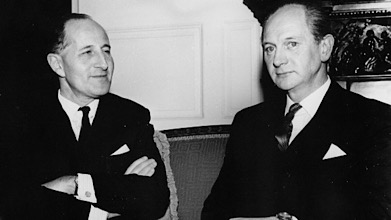
The official statement at the end of the four-hour meeting states that progress has been made in “areas of consultation and co-operation.” The Taoiseach says they discussed industry, tourism, electricity supply, and trade, as well as tariff concessions, and “measures taken by both governments to prevent the spread of foot-and-mouth disease from Britain.”
Afterward, O’Neill returns to Northern Ireland by a different route in order to avoid any possible demonstration. Paisley has been developing a high profile for himself with his attacks on O’Neill in recent months. But he misses the opportunity to protest on this occasion. The next day he issues a statement regretting O’Neill’s return home. “I would advise Mr. Lynch to keep him,” Paisley announces.
Five years earlier, in 1963, O’Neill becomes Prime Minister of Northern Ireland. From very early on, he tries to break down sectarian barriers between the two Northern communities. He also seeks to improve relations with the Republic of Ireland by eradicating the impasse in relations that has existed since the 1920s. He invites then-Taoiseach Seán Lemass to meet him at Stormont on January 14, 1965. Lemass courageously accepts the invitation. At their initial meeting, when they are briefly alone, Lemass says to O’Neill, ”I shall get into terrible trouble for this!” The Northern premier replies, ”No, Mr. Lemass, it is I who will get into terrible trouble.”
O’Neill makes his return visit to Dublin on February 9, 1965, and the two leaders agree to co-operate on tourism and electricity. It is Lemass who makes the most significant concessions, because the Constitution of Ireland does not recognise the existence of the North. Article 2 of the Constitution actually claims sovereignty over the whole island. Thus, by formally meeting the Prime Minister of Northern Ireland, O’Neill claims that Lemass accorded him “a de facto recognition.”
The Taoiseach then bolsters this at their follow-up meeting in Iveagh House, Dublin, three weeks later. ”The place card in front of me at Iveagh House bore the inscription, Prime Minister of Northern Ireland,” O’Neill proudly explains. Surely this is tantamount to formal recognition. But many Unionists still have grave reservations about dealing with the Republic of Ireland.
In 1966, Ian Paisley establishes the Protestant Unionist Party (PUP) to oppose O’Neill. He rouses sectarian tension by holding mass demonstrations at which he brands O’Neill as the “Ally of Popery.” Nevertheless, public opinion polls indicate support for O’Neill’s leadership from both communities in the North.
After Jack Lynch replaced Lemass as Taoiseach in late 1966, O’Neill continues with his efforts to improve relations with the Dublin government by inviting Lynch to Stormont Castle. The Taoiseach travels to Belfast by car on December 11, 1967. There is no formal announcement of his visit, but word is leaked to Paisley after the Taoiseach’s car crosses the border.
Paisley arrives at Stormont with his wife and a handful of supporters, just minutes before the Taoiseach. With snow on the ground, two of Paisley’s church ministers, Rev. Ivan Foster and Rev. William McCrea, begin throwing snowballs at Lynch’s car. The Royal Ulster Constabulary (RUC) promptly grabs the two ministers. While they are being bundled into a police car, Paisley is bellowing, “No Pope here!” Lynch asks his traveling companion, T. K. Whitaker, “Which one of us does he think is the Pope?”
Paisley demands to be arrested by the RUC, and actually tries to get into the police car with his two colleagues, but he is pulled away. The two clergymen are taken to an RUC station and quickly released. Lynch ridicules the protest. “It was a seasonal touch,” he says. “It reminds me of what happens when I go through a village at home and the boys come and throw snowballs.”
Paisley says he had come to protest against “the smuggling” of Lynch into Stormont. If he had known about the visit earlier, he says that he would have brought along 10,000 people to protest. Denouncing O’Neill, as a “snake in the grass,” he goes on to accuse Lynch of being “a murderer of our kith and kin.” In an editorial, the Unionist Newsletter proclaims that ”there is no doubt that Capt. O’Neill has the full support of his colleagues and of the country.”
O’Neill’s four formal meetings with Lynch and his predecessor contribute to a thaw in relations at the summit between Belfast and Dublin, but the whole process is exploited by others to fan the flames of Northern sectarianism.
People do not realise it in early 1968, but Northern Ireland is about to explode. On October 5, 1968, people gather in Derry for a civil rights march that has been banned by Stormont. When the march begins, it is viciously attacked by the RUC. This ignites a series of further protests, which ultimately leads to Bloody Sunday, and the eruption of the Troubles for the next quarter of a century.
(From: “Meetings helped thaw relations before the North exploded,” Irish Examiner, http://www.irishexaminer.com, January 8, 2018)
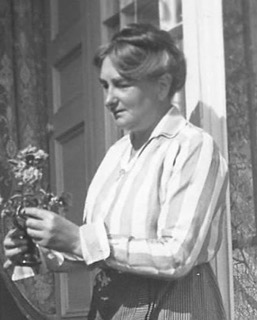
Louisa (Louie) Bennett, suffragette, trade unionist, and peace activist, is born on January 7, 1870, in Garville Avenue, Rathgar, Dublin, the eldest daughter of James Cavendish Bennett, a prosperous auctioneer, and his wife Susan (née Bolger). She is brought up at Temple Hill, Blackrock, and educated at Alexandra College, and at an academy for young ladies in London, where she and her sisters form an Irish League. She goes on to study singing in Bonn, Germany. Already as a teenager she shows an interest in writing, her first literary effort being Memoirs of the Temple Road in the 80s. Afterward she publishes two unsuccessful romantic novels, The Proving of Priscilla (1902) and A Prisoner of His Word (1908), the latter set in County Down in the aftermath of the Irish Rebellion of 1798.
Bennett turns her attention to women’s issues and by 1910 has become involved in the suffrage movement, initially through her reading of the suffrage monthly TheIrish Citizen. In 1911, she co-founds, with her life-long friend and colleague Helen Chenevix, the Irish Women’s Suffrage Federation, an umbrella organisation, which by 1913 has connected fifteen Irish suffrage societies and has established links with Europe and the United States. She and Chenevix are the organisation’s first honorary secretaries. She is also associated with the Irish Women’s Franchise League, for which she runs public speaking classes. However, as the divide between militants and opponents of the use of violence become more pronounced, Bennett, as a confirmed pacifist, who endorses what she calls “constructive, rather than destructive action,” distances herself from the league, and through her involvement in the production of TheIrish Citizen seeks to sideline the militants.
Bennett’s concerns are not limited to the question of women’s franchise. As founder of the Irish Women’s Reform League, she not only addressea the suffrage question, but examines many social issues concerning women. The league focuses on working conditions, monitors court cases involving women, and demands school meals and better education. She is among those who assist in the relief effort at Liberty Hall during the 1913 strike and lockout in Dublin, and she appeals for funds for strikers’ families through TheIrish Citizen. In the period that follows she maintains her links with the labour movement. She often opposes the direct, uncompromising approach of both James Connolly and Helena Molony, and argues that labour and women’s issues can only be hampered by any affiliation with nationalist politics. The aftermath of the Easter Rising, and in particular, the murder of Francis Sheehy-Skeffington, causes her to revise some of her views on nationalism. In late 1916 she accepts an invitation to reorganise the Irish Women Workers’ Union (IWWU), on the understanding that she would have complete independence from Liberty Hall. Assisted by Chenevix and Father John Flanagan, she re-creates the union along professional lines, and by 1918 its membership has risen dramatically from a few hundred to 5,300. She consistently defends its separatist stance, arguing that women’s concerns in a male-dominated union will always be of secondary importance.
Throughout World War I Bennett campaigns for peace, and she is selected as the Irish representative to the Women’s International League for Peace and Freedom. She leads the IWWU in its opposition to the attempted introduction of conscription in 1918, and in 1920 she travels to the United States to highlight Black and Tan atrocities (she later meets David Lloyd George and demands the removal of the Black and Tans from Ireland). As a member of the Women’s Peace Committee, she acts as a mediator during the Irish Civil War.
In 1925, Bennett is appointed to an Irish Trades Union Congress (ITUC) committee to promote a scheme of working class education with the assistance of the labour movement. Her interest in adult education later leads to her involvement with The People’s College. A member of the national executive of the ITUC (1927–32, 1944–50), she becomes the first female president of the congress in 1932. She serves a second presidential term in 1947. Her knowledge of labour issues is officially acknowledged by the Irish government in 1932, when she is sent as a representative to Geneva to put forward the case of Irish women workers. In 1938 she delivers a paper entitled Industrialism in an Agrarian Country to the International Relations Institute in the Netherlands.
Despite the depth of Bennett’s involvement with the union movement, she has ambitions outside trade unionism, and in 1938 she lets her name be put forward by the IWWU as a congress candidate for election to the senate, but this comes to nothing. In that year she is appointed to the government commission on vocational organisation (1938–43). In 1943, she is elected as a Labour Party member of the Dún Laoghaire borough council. As a councillor she consistently lobbies for improved housing and is instrumental in the establishment of Dún Laoghaire’s housing council in 1949. She had refused a labour nomination in the 1918 general election, but she stands for Dublin County Council and Dáil Éireann in 1944, in both cases unsuccessfully. She is the only Labour Party member to criticise the party’s support for the Fianna Fáil minority government of 1932, arguing that it is “never right or wise to co-operate with another party with fundamentally different principles.” As an elected member of the Labour Party executive, she represents Ireland at the International Labour Organization in Europe. She is also a representative at the League of Nations.
Throughout her public career Bennett consistently condemns colonialism, fascism, and armaments expenditure. She is possibly best remembered for her leadership in the laundry workers’ strike of 1945, during which IWWU members successfully fight for a fortnight‘s paid holiday. Her management of the IWWU, which lasts until 1955, is marked by determination and diplomacy, though she often uses threatened resignations as a means of controlling her colleagues. She died, unmarried, on November 25, 1956, in Killiney, County Dublin.
(From: “Bennett, Louisa (‘Louie’)” by Frances Clarke, Dictionary of Irish Biography, October 2009)
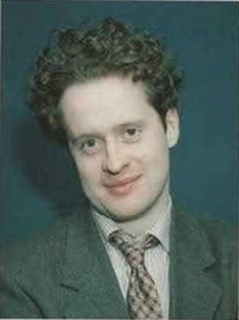
Bowman works mostly as a freelance journalist. He co-presents a radio show, The Rude Awakening, on Dublin’s FM104 with Scott Williams, George Hellis and Margaret Callanan for two years between 1993 and 1994 before joining the Sunday Independent newspaper as a columnist. He later presents television programmes on RTÉ, such as the quiz show Dodge the Question.
Bowman dies in a fall at his home on Fitzgerald Street in Harold’s Cross, Dublin, on March 6, 2000. He is found lying in the kitchen near the foot of the stairs. His death is believed to be the result of a fall down the stairs or from a stool, which is found nearby. He is buried in Glasnevin Cemetery, Glasnevin, County Dublin. Tributes are paid to him by party political leaders. He is survived by his parents, his sister Emma, his brothers Abie and Daniel and his only son Saul Philbin Bowman.
TaoiseachBertie Ahern says that he is deeply saddened on learning the news of Bowman’s death. His thoughts and prayers he says are with his family at this very sad time.
The leader of the Labour Party, Ruairi QuinnTD, expresses his shock and sadness on hearing of the death. He says that Bowman was without doubt one of the bright lights of Irish journalism. He extends his deepest sympathies to Bowman’s son, Saul, and to his parents John and Eimer.
The Fine Gael leader, John Bruton, says that few people he knew brought a smile to the face of anyone they met more readily. He says that his infectious good humour and iconoclastic attitude to life conveyed itself to all with whom he came into contact. He adds that Bowman will be missed for many years to come.
The editor of the Sunday Independent, Aengus Fanning, says that Bowman was one of the most brilliant journalists of his generation.
Ó Cuinneagáin Is the third child of Sean Cunningham and his wife Caitlín. He is educated in Belfast, at St. Brigid’s school, Malone Road, and the St. Patrick’s Christian Brothers school on Donegall Street. His political views are permanently influenced by memories of the sectarian violence of 1920–22. In 1927, he enters the Irish civil service as a tax clerk, stationed first at Athlone and then at Castlebar. He is promoted to junior executive officer in the Department of Defence, but resigns in July 1932 after his superiors refuse to allow him six months unpaid leave to study the Irish language in the Donegal Gaeltacht. He turns down a promotion to the Department of Finance, a decision partly motivated by disillusion with Fianna Fáil. He subsequently works as an accountant and lives in the south Dublin suburbs. In 1934, he establishes his own publishing company, Nuachtáin Teoranta, which he boasts is the first company to be registered in the Irish language, and he also contributes to an Irish language socialist paper, An t-Éireannach, under the pen name “Bruinneal gan Smal.”
In 1940–41, Ó Cuinneagáin is active in the Friends of Germany, a pro-Nazi organisation which disintegrates after some of its leading members are interned. On September 26, 1940, he founds Craobh na h-Aiséirighe, a branch of the Gaelic League aimed at attracting dynamic young enthusiasts frustrated by the older activists who dominate established branches. It makes a point of using modern publicity methods to get its message across, a trait which is carried over into Ailtirí na hAiséirghe (Architects of Resurrection), a political movement made up of branch members, which Ó Cuinneagáin founds in 1942. This move leads to the expulsion of Craobh na h-Aiséirighe from the Gaelic League and the establishment of Glún na Buaidhe by branch members who disapprove of his political ambitions and wish to concentrate on the promotion of the Irish language.
Members of Ailtirí wear an informal uniform of a green shirt, tweed suit, and báinín jacket. In private Ó Cuinneagáin reveals that the organisation is modeled on the Hitler Youth. His own title of “ceannaire” (leader) equates with “Führer” and “duce.” Features of the movement copied from Nazism include an emphasis on propaganda based on a few simple concepts and phrases. The claim that party politics allow statesmen to evade individual responsibility, whereas a single leader is necessarily more responsive to public opinion; and the belief that all difficulties can be overcome through willpower.
Ó Cuinneagáin takes to extremes contemporary Catholic advocacy of a corporate state based on vocational principles as the solution to the problems of modernity. While venerating António de Oliveira Salazar‘s Portugal as a role model, he believes that Ireland can surpass it and create a Catholic social model that will redeem the whole world. He takes a quasi-racial view of Irishness and comes close to saying that the only true Irish Catholics are of Gaelic race. When Seán Ó’Faoláin comments acidly in The Bell on the paradox of “Celtophiles” who bear such Celtic names as Blackham and Cunningham, Ó Cuinneagáin protests that he can prove his pure Gaelic descent. The Ailtirí state forces all male citizens to undertake a year’s compulsory military service, which is also used as a means of Gaelicisation, and the resulting citizen army of 250,000 would mount a lightning invasion of Northern Ireland, modeled on the blitzkrieg, with a favourite slogan being “Six Counties, Six Divisions, Sixty Minutes.” In 1943, the Stormont government excludes Ó Cuinneagáin from Northern Ireland.
Ailtirí attracts considerable attention. Its leaders address numerous meetings around the country, attracting large crowds to demonstrations at Dublin and Cork. Ó Cuinneagáin, who is by no means unintelligent, is capable of shrewd observations on the restrictions imposed on most Irish-language bodies by government subsidies, and the impact of the snobbery shown toward the poor by their middle class co-religionists. Several of his lieutenants are academics or engineers. In the 1970s he praises modernist architecture as breaking with the hated Georgian past, and denounces conservationists who oppose plans to build an oil refinery in Dublin Bay. Bilingual pamphlets produced by the group sell thousands of copies. Ó Cuinneagáin is the author of several, including Ireland’s twentieth century destiny (1942), Aiséirí says . . .(1943), Partition: a positive policy (1945), and Aiséirí for the worker (1947). Hus attempts to launch a party paper are stifled until the end of the war. Some of the interest attracted by the group is derived from curiosity or amusement. It also functions to some extent as a front organisation for the banned Irish Republican Army (IRA), with Ó Cuinneagáin declaring that Jews and freemasons should be locked up instead of IRA men. Aiséirí members are involved in the bombing of the Gough memorial in Phoenix Park in July 1957, with the stolen head concealed for a time in the party’s offices.
The party runs four candidates, including Ó Cuinneagáin in Dublin North-West, in the 1943 Irish general election and seven in 1944, but all lose their deposits. Ó Cuinneagáin does not actually vote for himself. Throughout his life he demands Irish language ballot papers. When given English language ones he tears them up, claiming that they disenfranchise him and that this invalidates the election. In 1946, Ailtirí na h-Aiséirí elects eight members to local bodies in counties Louth and Cork. This helps to bring about the decline of the party, as the Cork activists rebell against the rigid Führerprinzip upheld by the electorally unsuccessful ceannaire and his Dublin acolytes. Most of the party’s local support is absorbed by Clann na Poblachta. Ó Cuinneagáin retains a small group of followers centred on his newspaper Aiséirighe.
Ó Cuinneagáin keeps himself in the public gaze by driving around the country in a van painted with slogans, and by regularly appearing in court for refusing to respond to official documents (rates demands, car insurance, court summonses) unless they are supplied in Irish. He enjoys some success in securing the provision of Irish language versions of such documents, and he contrasts the state’s niggardliness on this point with its professed commitment to the revival of Irish. In 1954, he founds an Irish language women’s artistic and social paper, Deirdre, which operates successfully for over a decade without government subsidy.
Ó Cuinneagáin continues to write sympathetically about IRA activities, at one point offering a £1,000 reward for the capture of the Prime Minister of Northern Ireland, Basil Brooke. He maintains surprisingly extensive international neo-fascist contacts. He regularly reprints in Aiséirighe material by the American antisemite and racial segregationistGerald L. K. Smith. He cites praise for Aiséirighe from Der Stahlhelm, a far-right German veterans’ paper, and notes Oswald Mosley‘s support for Irish reunification. He denounces Hugh Trevor-Roper‘s Last days of Hitler as typical British slander of a fallen enemy. He compares the sacrificial ideology of the Hungarian Nazi collaborator Ferenc Szálasi to that of Patrick Pearse. He praises Juan Perón as a model whom Ireland should imitate and he follows the electoral fortunes of Italian neo-fascism with interest. He also maintains contacts with the radical right-wing fringes of Breton, Scottish, and Welsh nationalism. He declares that Ireland’s grievance is against England alone and bemoans the Dublin government’s failure to encourage the break-up of the United Kingdom.
Ó Cuinneagáin denounces the Soviet Union and United States alike as controlled by Zionists and freemasons. He points to illegitimacy and divorce rates in the United States as proof of the folly of those who regard “progressive” American education as superior to the sound Irish teaching methods embodied by the Christian Brothers, and bemoans the increasing flow of “immoral” American comics and paperback books into Ireland. While noting with pride that he has been described as “Ireland’s foremost Jew-baiter,” He claims that his frequent diatribes against Robert Briscoe and the state of Israel are merely anti-Zionist, and that he has nothing against Jews, whom he defines as ultra-Orthodox anti-Zionists. He hopes that a Europe united on national–Christian principles might fend off the influence of the super powers. He echoes Mosleyite calls for European unity and is an early and determined advocate of Irish membership of the European Community. However, he dissents from the Mosleyite view that such a union should be based on African empire. He is generally anti-imperialist, though somewhat more lenient toward Portuguese than British imperialism, and from 1956 the President of Egypt, Gamal Abdel Nasser, becomes one of his heroes. While supporting European unity as a defensive strategy, he also warns that unless Ireland adopts mass conscription the country might be conquered by a regiment of Russian paratroopers landing on Dollymount Strand. Throughout the 1950s and 1960s he regularly calls for the Irish Army to mount a military coup, hinting that it should install him as leader in the same way that the Portuguese army had installed Salazar.
Ó Cuinneagáin gives up contesting elections but regularly cites those who do not vote in elections as indicating the extent of political support for Ailtirí na hAiséirghe. He regularly laments that the safety valve of emigration had taken the steam out of radical politics. In his later years he notes the growth of anti-clericalism and the beginnings of a permissive society in Dublin. He attributes this to the church’s failure to implement its own social teaching and its encouragement of West British snobbery at the expense of the truly Catholic traditions of the Gael.
On April 4, 1945, Ó Cuinneagáin marries Sile Ní Chochláin. They have four sons and two daughters, some of whom become active in left-wing politics. He dies on June 13, 1991. He tends to be remembered as a figure of fun, but this view demands some qualification. He possesses genuine abilities and dedication. His fantasies are an extreme development of the official ideology of the state, and part of his appeal stems from his ability to point out the hypocrisy involved in paying it lip service while failing to push it to its logical conclusion. The blindness and cruelty involved in imposing his world view at a personal level has their counterparts in the institutions of official Ireland. Ailtirí na hAiséirghe may have been a marginal millennial cult, but in Europe during the 1940s such groups were often raised to power by circumstances. Had the World War II taken a different direction after 1940, he might be remembered not as a parody of Pearse but as an Irish Szálasi.
(From: “ÓCuinneagáin, Gearóid Seán Caoimhín” by Patrick Maume, Dictionary of Irish Biography, http://www.dib.e, October 2009)
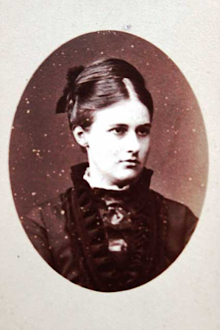
Mitchel is born Jane Verner around 1820 near Newry, County Down. At the time she, her brother and her mother, Mary Ward, are living with Captain James Verner (1777–1847), who is from a prominent Armagh family, and is involved in the Orange Order, going on to become Orange deputy grandmaster of Ireland in 1824. Although James Verner raises Mitchel, she is not believed to be his child. She attends Miss Bryden’s School for Young Ladies in Newry.
Mitchel meets her husband, John Mitchel, when she is fifteen. The couple elopes in November 1836, but do not marry as James Verner pursues them to Chester and brings her home to Ireland. They elope again in 1837, and are married at Drumcree Church, County Armagh, on February 3. At this point, Mitchel is disowned by James Verner, and goes to live with her in-laws at Dromalane, County Down. They then move to Banbridge in 1839 where her husband practises law. The couple goes on to have six children, three daughters and three sons.
The couple moves to Dublin in October 1845 when John Mitchel becomes the assistant editor of The Nation. They live at 8 Ontario Terrace, Rathmines, where they meet Young Irelanders. She is a full supporter of her husband’s nationalism. She aids in his work with The Nation, reading other newspapers, keeping and filing reference clippings, going on to become an editor and anonymous contributor to the United Irishman from February 1848. John Mitchel is convicted of treason for inciting insurrection in May 1848, and is sentenced to fourteen years’ transportation. Mitchel urges his fellow Young Irelanders to fight his removal, and denounces them when they fail to come out in support of him.
Due to her standing in the nationalist community, £1,450 is raised to support her and her family. For three years, Mitchel lives in Newry and Dublin, before she joins her husband in Van Diemen’s Land (Tasmania) in June 1851, where they settle in the village of Bothwell. Their youngest child, Isabel, is born there in 1853.
The Mitchels travel around the island with her husband, visiting fellow Irish exiles, becoming fond of William Smith O’Brien in particular.
When John Mitchel escapes in July 1853, Mitchel travels with her children to join him in Sydney, from where they sail to the United States. They live for a time in Brooklyn, New York, from 1853 to 1855, rekindling friendships with old friends who are fellow Young Ireland exiles.
In May 1855, the family moves to a remote farm at Tucaleechee Cove in Tennessee. She fears that the isolation and life in a primitive log cabin will be detrimental to their children’s education, and at her behest the family moves to Knoxville, Tennessee, in September 1856. From here, John Mitchel runs a pro-slavery newspaper, the Southern Citizen.
The family moves again in December 1858 to Washington, D.C. Mitchel supports her husband in the Southern cause, albeit with some reservation. Nothing, she says, will induce her “to become the mistress of a slave household.” Her objection to slavery is “the injury it does to the white masters.”
Mitchel accompanies her husband to Paris in September 1860, and in opposition to some of the family, she supports her daughter Henrietta’s conversion to Catholicism and entrance into a convent. She remains in Paris and Ireland with her daughters, while her husband and sons assist the Confederacy during the American Civil War. Without letting her husband know, she resolves to return to America when she hears of her youngest son, William’s, death at Gettysburg in July 1863. She sails with her daughters, Mary and Isabel, as Henrietta had died earlier the same year. While their ship runs a blockade by the Union, the ship is shelled, runs aground, and catches fire near the coast of North Carolina. She and her daughters are unhurt, but lose all of their possessions. By December 1863, she has joined her husband in Richmond, Virginia, remaining their for the rest of the Civil War. Their eldest son, John, is killed in action in July 1864.
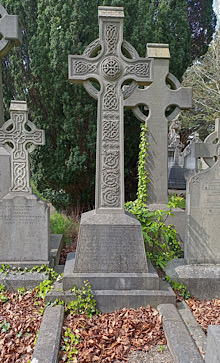
The family returns to New York after the war, and John Mitchel sets up another paper, The Irish Citizen (1867–72). Due to lack of funding for the Irish American press and her husband’s ill health results in the family falling into poverty. This is alleviated by a testimonial raised by William and John Dillon in 1873. Mitchel is widowed in March 1875, going on to receive $30,000 from nationalist sympathisers. She invests this money in a photolithographic firm she and her son, James, run. She dies at home in Bedford Park, New York, on December 31, 1899. She is buried in Woodlawn Cemetery, Bronx, New York, with her plot marked with a large Celtic cross. She is survived by two of her children, James (1840–1908) and Mary (1846–1910).
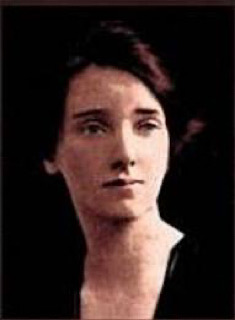
Macardle is born in Dundalk, County Louth, on March 7, 1889, into a wealthy brewing family famous for producing Macardle’s Ale. Her father, Sir Thomas Callan Macardle, is a Catholic who supports John Redmond and the Irish Home Rule movement, while her mother, Lucy “Minnie” Macardle, comes from an English Anglican background and is politically a unionist. Lucy converts to Catholicism upon her marriage to Thomas. Macardle and her siblings are raised as Catholics, but Lucy, who is politically isolated in Ireland, “inculcated in her children an idealised view of England and an enthusiasm for the British empire“. She receives her secondary education in Alexandra College, Dublin—a school under the management of the Church of Ireland—and later attends University College Dublin (UCD). Upon graduating, she returns to teach English at Alexandra where she had first encountered Irish nationalism as a student. This is further developed by her first experiences of Dublin’s slums, which “convinced her that an autonomous Ireland might be better able to look after its own affairs” than the Dublin Castle administration could.
Between 1914 and 1916, Macardle lives and works in Stratford-upon-Avon in Warwickshire, England. There, her encounters with upper-class English people who express anti-Irish sentiment and support keeping Ireland in the British Empire by force further weakens her Anglophilia. Upon the outbreak of World War I, she supports the Allies, as does the rest of her family. Her father leads the County Louth recruiting committee while two of her brothers volunteer for the British Army. Her brother, Lieutenant Kenneth Callan Macardle, is killed at the Battle of the Somme, while another brother, Major John Ross Macardle, survives the war and earns the Military Cross. While Macardle is a student, the Easter Rising occurs, an experience credited for a further divergence of her views regarding republicanism and her family.
On January 19, 1919, Macardle is in the public gallery for the inaugural meeting of the First Dáil and witnesses it declare unilateral independence from the United Kingdom, which is ultimately the catalyst for the Irish War of Independence.
By 1919 Macardle has befriended Maud Gonne MacBride, the widow of the 1916 Easter Rising participant John MacBride, and together the two work at the Irish White Cross, attending to those injured in the war. It is during this period she also becomes a propagandist for the nationalist side.
Following the signing of the Anglo-Irish Treaty in December 1921, Macardle takes the anti-treaty side in the ensuing Irish Civil War. Alongside Gonne MacBride and Despard, she helps found the Women Prisoners’ Defence League, which campaigns and advocates for republicans imprisoned by the newly established Irish Free State government. It is also during this same time that she begins working alongside Erskine Childers in writing for anti-treaty publications An Phoblacht and Irish Freedom.
In October 1922, Despard, Gonne MacBride and Macardle are speaking at a protest on O’Connell Street, Dublin against the arrest of Mary MacSwiney, a sitting Teachta Dála, by the Free State when Free State authorities move to break it up. Rioting follows and Free State forces open fire, resulting in 14 people being seriously wounded while hundreds of others are harmed in the subsequent stampede to flee. Following the event, Macardle announces she is going to pursue support of the Anti-treaty side full-time in a letter to Alexandra College, which ultimately leads to her dismissal on November 15, 1922. In the following days Macardle is captured and imprisoned by the Free State government and subsequently serves time in both Mountjoy Prison and Kilmainham Gaol, with Rosamond Jacob as her cellmate. During one point at her time in Kilmainham, Macardle is beaten unconscious by male wardens. She becomes close friends with Jacob and shares a flat with her in Rathmines later in the 1920s.
The Irish Civil War concludes in the spring of 1923, and Macardle is released from prison on May 9.
Following the Irish Civil War, Macardle remains active in Sinn Féin and is drawn into the camp of its leader Éamon de Valera and his wife Sinéad. She travels alongside the de Valeras as they tour the country and she is a frequent visitor to their home. As the trust between Macardle and de Valera develops, de Valera asks her to travel to County Kerry to investigate and document what later becomes known as the Ballyseedy massacre of March 1923, in which a number of unarmed republican prisoners are reportedly killed in reprisals. She obliges, and by May 1924 she has compiled a report that is released under the title of The Tragedies of Kerry.” Immediately upon the release of the report, the Minister for DefenceRichard Mulcahy sets up an inquiry in June 1924 to carry out a separate investigation by the government. However, the government’s inquiry comes to the conclusion there had been no wrongdoing committed. Her book The Tragedies of Kerry remains in print and is the first journalistic historical account of the Irish Civil War from those on the republican side detailing Ballyseedy, Countess Bridge and various other incidents that occur in Kerry during this time.
In 1926, Éamon de Valera resigns as President of Sinn Féin and walks out of the party following a vote against his motion that members of the party should end their policy of abstentionism against Dáil Éireann. De Valera and his supporters, including Macardle, form the new political party Fianna Fáil in May 1926, with Macardle immediately elected to the party’s National Executive|Ard Chomhairle, one of six female members out of twelve on the original party National Executive, the others being Hanna Sheehy-Skeffington, Kathleen Clarke, Countess Constance Markievicz and Linda Kearns. Macardle is made the party’s director of publicity. However, she resigns from Fianna Fáil in 1927 when the new party endorses taking their seats in Dáil Eireann. Nevertheless, her views remain relatively pro-Fianna Fáil and pro-de Valera.
Macardle recounts her civil war experiences in Earthbound: Nine Stories of Ireland (1924). She continues as a playwright for the next two decades. In her dramatic writing, she uses the pseudonymMargaret Callan. In many of her plays a domineering female character is always present. This is thought to be symbolic of her own relationship with her own mother. Her parents’ marriage had broken up as her mother returned to England and her father raised the children with servants in Cambrickville and they were sent away for school. This female character holds back the growth and development of the younger female character in Dorothy’s plays and writings.
By 1931, Macardle takes up work as a writer for The Irish Press, which is owned by de Valera and leans heavily toward supporting Fianna Fáil and Irish republicanism in general. In addition to being a theatre and literary critic for the paper, she also occasionally writes pieces of investigative journalism such as reports on Dublin’s slums. In the mid-1930s she also becomes a broadcaster for the newly created national radio station Radio Éireann.
In 1937, Macardle writes and publishes the work by which she is best known, The Irish Republic, an in-depth account of the history of Ireland between 1919 until 1923. Because of the book, political opponents and some modern historians consider her to have been a hagiographer toward de Valera’s political views. In 1939 she admits, “I am a propagandist, unrepentant and unashamed.” Overall, however, the book is well-received, with reviews ranging from “glowing” to measured praise. She is widely praised for her research, thorough documentation, range of sources and narration of dramatic events, alongside reservations about the book’s political slant. The book is reprinted several times, most recently in 2005. Éamon de Valera considers The Irish Republic the only authoritative account of the period from 1916 to 1926, and the book is widely used by de Valera and Fianna Fáil over the years and by history and political students. She spends seven years writing the book in a cottage in Delgany, County Wicklow, and it is a day-by-day account of the history of the events in Ireland from 1919 to 1923 recorded in painstaking detail together with voluminous source material.
In 1937, de Valera’s Fianna Fáil government is able to create a new Constitution of Ireland following a successful referendum. However, there is widespread criticism of the new Constitution from women, particularly republican women, as the language of the new Constitution emphasises that a woman’s place should be in the home. Macardle is among them, deploring what she sees as the reduced status of women in this new Constitution. Furthermore, she notes that the new Constitution drops the commitment of the 1916 Proclamation of the Irish Republic to guarantee equal rights and opportunities “without distinction of sex” and writes to de Valera questioning how anyone “with advanced views on the rights of women” can support it. DeValera also finds her criticising compulsory Irish language teaching in schools.
While working as a journalist with the League of Nations in the late 1930s, Macardle acquires a considerable affinity with the plight of Czechoslovakia being pressed to make territorial concessions to Nazi Germany. Believing that “Hitler‘s war should be everybody’s war,” she disagrees with de Valera’s policy of neutrality. She goes to work for the BBC in London, develops her fiction and, in the war’s aftermath, campaigns for refugee children – a crisis described in her book Children of Europe (1949). In 1951, she becomes the first president of the Irish Society of Civil Liberties.
Macardle dies of cancer on December 23, 1958, in a hospital in Drogheda, at the age of 69. Though she is somewhat disillusioned with the new Irish State, she leaves the royalties from The Irish Republic to her close friend Éamon de Valera, who had written the foreword to the book. De Valera visits her when she is dying. She is accorded a state funeral, with de Valera giving the oration. She is buried in Sutton, Dublin.
Dwyer runs a off-licence/grocery shop in Rathmines and is a member of the Rathmines Urban Council. He marries Marie Molloy in 1914, they have no children. He is a member of the Peace Committee of ten men which sit in May 1922 and bring about the agreement between Michael Collins and Éamon de Valera.
On December 20, 1922, Dwyer is shot dead in his shop at 5 Rathmines Road, Dublin, by anti-Treaty IRA Volunteer Robert Bonfield. At about 4:50 p.m., Dwyer is talking to a customer when a young man enters the shop. Addressing Dwyer, the young man asks “Are you Mr. O’Dwyer?” Dwyer replies yes and the young man says that he has a note for him. The young man reaches into the pocket of his overcoat a draws a revolver. He fires twice at Dwyer at point-blank range and he dies instantly. The customer and a shop assistant give chase but are unable to catch the assassin. Two republicans, Frank Lawlor and the actual assassin, Robert Bonfield, are later killed by Free State forces in revenge for the shooting of Dwyer.