When the war breaks out, one of the Boers’ early targets is the diamond-mining centre of Kimberley, which stands not far from the point where the borders of the Boer republics of the Transvaal and the Orange Free State, and the British-controlled Cape Colony meet. Although their forces surround the town, they do not press home any immediate assault. Nor do they attempt to cross the Orange River on this front to invade Cape Colony.
Meanwhile, British reinforcements are on their way to South Africa. Their commander, General Sir Redvers Buller, detaches the 1st Division under Lieutenant General Lord Methuen to relieve the Siege of Kimberley. This decision is made partly for reasons of prestige, as the capture of Kimberley, which contains the famous Imperialist and former Prime Minister of Cape Colony, Cecil Rhodes, would be a major propaganda victory for the British.
During November, Methuen’s force advances north along the Western Cape Railway. They fight and win two engagements against Boers from the Orange Free State under General Prinsloo at the Battle of Belmont and at the Battle of Graspan. At least one American, Lance Corporal Hollon Bush of the 7th Company, First Battalion Coldstream Guards is present and wounded at the Battle of Modder River. His journey to enlist from departure in New Orleans to England is not without many pitfalls before beginning service at the Tower of London, then on to Gibraltar and South Africa.
Methuen’s force consists of two infantry brigades, the Guards Brigade under Major-General Sir Henry Edward Colville and the 9th Brigade under Major-General Reginald Pole-Carew, two mounted regiments, three batteries of field artillery (18th, 62nd and 75th) and four guns of the Naval Brigade. Further reinforcements are arriving up the railway.
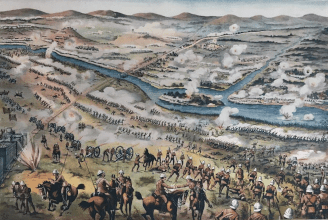
The British cavalry (the 9th Queen’s Royal Lancers and a unit recruited in Cape Town, Rimington’s Guides) make some attempts to scout the ground ahead of the army but fail entirely to detect General Koos de la Rey‘s trenches and other preparations. For example, the Boers had whitewashed stones on the veld or had placed biscuit tins as range markers. At 4:30 a.m. on November 28, Methuen’s force rouses itself, deploys into line and begins advancing toward the Modder River, with no plans other than to cross the river before having breakfast on the far side.
As the British troops come within 1,200 yards of the river, Methuen remarks to Colville, “They’re not here.” Colville replies, “They’re sitting uncommonly tight if they are.” At this point the Boers open fire. Most of the British troops are forced to throw themselves flat. Some try to advance in short rushes but can find no cover on the veld. Few British troops get closer than 1,000 yards to the Boers. The Guards try to outflank the Boer left but are unable to ford the Riet River. The British guns pound the buildings near Modder River Station and the line of poplar trees which mark the north bank of the Modder River, and entirely miss the enemy trenches on the south bank. Meanwhile, the Boer guns maintain a galling fire and are kept in action by repeatedly moving their positions.
The battle becomes a day-long stalemate. Most of the British infantry lay prone on the veld, tortured by heat and thirst, but safe from enemy fire unless they move. Many stoically smoke pipes or even sleep. Methuen gallops about the field trying to renew the advance and is himself wounded. At midday, some of Pole-Carew’s 9th Brigade find the open Boer right flank at Rosmead drift (ford) downstream. British infantry infiltrates across the ford and at about 1:00 p.m. drives the Boers out of Rosmead. The attack is disjointed and suffers casualties when a British field artillery battery which had just arrived on the field shells them by mistake. By nightfall, De la Rey has driven them back into a small insecure bridgehead.
Nevertheless, the Boers fear that they are now vulnerable to being outflanked and withdraw during the night.
Methuen reports that the battle had been “one of the hardest and most trying fights in the annals of the British army.” Although casualties are not cripplingly heavy (between 450 and 480), mainly because the Boers opened fire prematurely, it is clear that any simple frontal attack by infantry only against an enemy using bolt action rifles, is effectively impossible. The British are forced to pause for ten days, to evacuate their casualties, receive further reinforcements and repair their lines of communications. The delay allows the Boers to construct the entrenchments which they are to defend in the Battle of Magersfontein.
On the Boer side, there are about 80 casualties, including, Adriaan, the eldest son of Koos de la Rey, mortally wounded by a shell.
(Pictured: An illustration of the Battle of Modder River during the Second Boer War. This illustration is more dramatic than the actual battle, and is meant to amplify the British side of the war, Bacon’s South Africa War Prints, G. W. Bacon & Co. London)
Blair urges Protestant waverers to keep the Good Friday Agreement alive and insists that IRA disarmament, which the pro-British unionists are demanding, is “part of the agreement.”
Britain says two monitors, former President of FinlandMartti Ahtisaari and South AfricanCyril Ramaphosa, have reported to the province’s disarmament commission. “We and the Irish government understand from the decommissioning commission that a second inspection of IRA dumps has now taken place, and they have received a report to that effect from President Ahtisaari and Mr. Ramaphosa,” a Northern Ireland Office statement says.
The IRA discloses the inspection, aimed to show that arms from its long anti-British war are no longer being used, as tension grows ahead of a crucial October 28 conference of the Protestant Ulster Unionist Party (UUP). “We specifically announced that we would repeat the inspection of a number of arms dumps by third parties to confirm that our weapons are secure,” the IRA says. “We now wish to confirm that this re-inspection has taken place and thank those involved for their co-operation.”
Ramaphosa and Ahtisaari first examine arms stockpiles in June 2000.
The IRA is observing a ceasefire following a 30-year war against British rule in Northern Ireland.
U.S. PresidentBill Clinton joins Britain and Ireland in applauding the IRA’s decision that it will permit a fresh look at some of its hidden arsenal.
However, as Blair arrives three bomb alerts underline the fragility of a peace that has been shaken by sporadic attacks by armed dissidents who oppose the 1998 Good Friday Agreement. A detective escapes injury when a bomb under his car fails to explode in a carpark at Antrim, north Belfast. A police spokesman blames Protestant “loyalistparamilitaries.” Army bomb experts also deal with two “suspicious objects” found in other parts of the province, police say.
Blair’s visit is seen as a bid to garner support for First MinisterDavid Trimble, who is under pressure from within his Ulster Unionist Party over his decision to share power with Sinn Féin, even though the IRA has not disarmed.
Blair appeals to unionists ahead of their conference not to squander the accord’s hard-won political advances. He warns that disarmament will be out of reach if the coalition falls. “This is the only way forward for the future. If the Executive collapses and the Assembly then collapses, which must automatically happen, you don’t have a process at all, you don’t have decommissioning,” he tells reporters.
Confirmation of the second inspection is seen as a lift for the peace process which might ease pressure on Trimble.
UUP hardliners on Saturday, October 28, plan to urge grassroots members to back their demand for Trimble to pull out of the ruling coalition by November 30 if the IRA has not disarmed by that time. However, Trimble, at a news conference, dismisses the five-week deadline as “a crude device.”
(From: “IRA confirms arms dump inspections,” CNN.com, October 26, 2000 | Pictured: David Trimble, Seamus Mallon and Tony Blair at Stormont. Photograph: Eric Luke/The Irish Times)
Adebari arrives in Dublin with his wife and two children in 2000. After he converts from Islam to Christianity, he flees Nigeria in 2000, and makes a claim for asylum on the grounds of religious persecution. His application is rejected because of a lack of evidence that he had personally suffered persecution. He does however gain automatic residency when his wife gives birth to a son in Ireland shortly after their arrival.
Adebari and his family settle in County Laois. He completes his master’s degree in intercultural studies at Dublin City University (DCU) and sets up a firm called Optimum Point Consultancy.
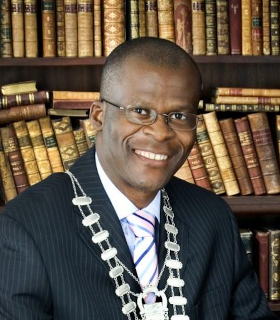
In 2004, Adebari is elected as a town councilor in local elections. On June 27, 2007, at the age of 43, he is elected mayor of the 9-member Portlaoise Town Council, by a vote of six to three and with support from Fine Gael, Sinn Féin and an Independent councilor. At a meeting attended by officials from the Nigerian, South African, and the United States embassies, the new mayor is quoted as saying his election is proof that “Ireland is not just a country of a thousand welcomes, but it is a country of equal opportunity.” In the 2009 local elections he is re-elected to the town council and also to Laois County Council for the Portlaoise electoral area.
In 2007, Adebari denies claims that he was a train operator in London who worked out of the Queen’s Park station on the Bakerloo line. Multiple London Underground employees, including Paddy Clarke, a retired tube driver from County Louth, state that Adebari worked as a train driver in London during the late 1990s before moving to Ireland. Clarke states, “at the very least fifty drivers and six or more managers will remember him. His photograph and signature are on file with London Underground’s personnel office which were used in the issue of his free travel-pass and identity card.” Adebari asserts he traveled to Ireland directly from Nigeria via Paris, and never worked or lived in London at any time.
Lucas is commissioned as a second lieutenant into 2nd Battalion, the Royal Berkshire Regiment, on May 7, 1898. He serves with the battalion in South Africa during the Second Boer War from 1899 to 1902, taking part in operations in the Orange Free State from February to July 1900, in Transvaal from July to November 1900, and later in Cape Colony south of the Orange River. He is promoted to lieutenant on August 1, 1900, while in South Africa. After the end of the war in June 1902, he and the rest of the 2nd battalion is sent to Egypt, where they arrive on the SS Dominion in November 1902. He later serves in the Egyptian Army and Sudan Civil Service.
On June 30, 1919, Lucas is appointed a deputy lieutenant of Hertfordshire. He is made Commander of 17th Infantry Brigade in Ireland, and of Fermoy Barracks, on October 30, 1919. On June 26, 1920, during the Irish War of Independence, he is captured by the IRA while he is fishing on the Munster Blackwater near Fermoy along with Colonels Tyrell and Danford. After Danford is wounded during an unsuccessful attempt to escape from a moving car the same day, the volunteers free Tyrell to attend to Danford’s wounds. Both Colonels are subsequently taken to a military hospital at Fermoy.
Lucas is subsequently held in West Limerick and East Clare.
A letter from his wife, announcing the birth of their child, and addressed simply “to the IRA”, is delivered to him and his captors allow a subsequent exchange of letters between the couple. His letters home remain in the possession of his descendants and are shown on an episode of the BBC Television programme Antiques Roadshow.
The IRA moves Lucas to East Limerick from where he escapes four weeks later. It is believed his captors purposely relax the guard to allow him to escape rather than be faced with the possibility of executing him. While being transferred from Pallas Royal Irish Constabulary (RIC) barracks to Tipperary military barracks in a routine army patrol they are ambushed, and Lucas receives a slight injury.
Lucas becomes Assistant Adjutant General at Aldershot Command in 1924 and serves with the staff at General Headquarters, British Army of the Rhine from 1927 before he retires to Stevenage in 1932. He dies on April 7, 1956, and is buried in Graveley, Hertfordshire. His wife, Joan Holdsworth, whom he marries in October 1917, dies on September 6, 1979, and is also buried in Graveley, Hertfordshire.
In 2014, Barbara Scully, a granddaughter of George Power, one of the IRA volunteers involved, publishes his recollections to his family of the kidnap in The Irish Times. This brings a friendly reply from Lucas’ granddaughter, Ruth Wheeler, in which she states that Lucas risked a court-martial for stating that during his kidnap and time in captivity he was treated as “a gentleman by gentlemen” and was held by “delightful people.”
Ireland’s Defence Forces have published online Bureau of Military History witness statements by the IRA volunteers involved in the kidnap, as well as those who guarded General Lucas while he was held as a prisoner of war.
In 2020 Lucas’s granddaughter, Ruth Wheeler, and other members of the Lucas family publish online the letters he wrote and received while in captivity. Limerick Councillor Emmett O’Brien and other local people in March 2019 announce an intent to re-enact the capture, imprisonment, and release of Lucas on the anniversary in 2020.
(Pictured: Cuthbert Henry Tindall Lucas, bromide print by Walter Stoneman, 1919, National Portrait Gallery)
Stoney is born into an old-established Anglo-Irish scientific family at 40 Wellington Road, Ballsbridge, Dublin, on January 6, 1869. The daughter of George Johnstone Stoney, FRS, an eminent physicist who coins the term “electron” in 1891 as the “fundamental unit quantity of electricity,” and his wife and cousin, Margaret Sophia Stoney. One of her two brothers, George Gerald, is an engineer and a Fellow of the Royal Society (FRS). One of her two sisters, Florence Stoney, is a radiologist and receives an OBE. Her cousin is the Dublin-based physicist George Francis FitzGerald FRS (1851–1901), and her uncle Bindon Blood Stoney FRS is Engineer of Dublin Port, renowned for building a number of the main Dublin bridges and developing the Quayside.
Stoney demonstrates considerable mathematical talent and gains a scholarship at Newnham College, Cambridge, where she achieves a First in the Part I Tripos examination in 1893. However, she is not awarded a University of Cambridge degree as women are excluded from graduation until 1948. During her time at Newnham, she is in charge of the College telescope. She is later awarded a BA and an MA from Trinity College Dublin, after they accept women in 1904.
Following the 1876 Medical Act, it is illegal for academic institutions to prevent access to medical education based on gender. The first medical school for women in Britain is established in 1874 by Dr. Sophia Jex-Blake in anticipation of this law. The London School of Medicine for Women quickly becomes part of the University of London, with clinical teaching at the Royal Free Hospital. Stoney’s sister Florence is a student at the school, graduates in medicine with honours in 1895 (MB BS) and obtains her MD in 1898. Meanwhile, Stoney gains an appointment as a physics lecturer at the school in 1899. Her first tasks are to set up a physics laboratory and design the physics course. The laboratory is planned for 20 students, and the course content is pure physics, as required by university regulations. It includes mechanics, magnetism, electricity, optics, sound, heat and energy. In her obituary in The Lancet, an ex-student of hers notes: “Her lectures on physics mostly developed into informal talks, during which Miss Stoney, usually in a blue pinafore, scratched on a blackboard with coloured chalks, turning anxiously at intervals to ask ‘Have you taken my point?’. She was perhaps too good a mathematician … to understand the difficulties of the average medical student, but experience had taught her how distressing these could be”.
In 1901, the Royal Free Hospital appoints Florence into a new part-time position of medical electrician. The following April, the two sisters open a new x-ray service in the electrical department. During their time at the Royal Free Hospital, the two sisters actively support the women’s suffrage movement, though oppose the direct violent action with which it is later associated.
During her time at the school, Stoney also plays a central role in the British Federation of University Women (BFUW). She is elected treasurer, in her absence, at the first executive meeting on October 9, 1909, a position she holds until the end of May 1915. She becomes increasingly engaged with the political lobbying of the Federation. At the executive meeting on October 19, 1912, she proposes the names of two members for a subcommittee to secure the passing into law of a bill to enable women to become barristers, solicitors or parliamentary agents. The legislation is eventually enacted after the war within the Sex Disqualification (Removal) Act 1919.
Stoney resigns her post at the school in March 1915 and it is recorded that “with due regret and most unwillingly a change is desirable in the physics lectureship.” She is offered £300 on tendering her resignation.
Both Stoney and Florence offer their services to the British Red Cross at the War Office in London, to provide a radiological service to support the troops in Europe, on the day Britain declares war. Their offer is refused, because they are women. Florence sets up her own unit with the Women’s Imperial Service League and spends the next 6 months in Europe. Stoney organises supplies from London where she also serves on the League’s committee. Florence returns to London at the time Stoney resigns from the London School of Medicine for Women. She contacts the Scottish Women’s Hospitals (SWH), an organisation formed in 1914 to give medical support in the field of battle and financed by the women’s suffrage movement. The organisation has gained agreement to set up a new 250-bed tented hospital at Domaine de Chanteloup, Sainte-Savine, near Troyes (France), funded by the Cambridge women’s colleges of Girton and Newnham and it becomes her role to plan and operate the x-ray facilities. She establishes stereoscopy to localise bullets and shrapnel and introduces the use of x-rays in the diagnosis of gas gangrene, interstitial gas being a mandate for immediate amputation to give any chance of survival.
The hospital is near the front line and, in her own words, by September 1915, “the town had been evacuated, the station had been mined, and we heard the heavy guns ever going at nighttime.” The unit is entirely female, except for two part-time male drivers, and her technical assistant, Mr. Mallett.
They are assigned to the Corps Expéditionnaire d’Orient and ordered to move to Serbia. After boarding the steamship Mossoul in Marseille, they reach Salonika (known as Thessaloniki in modern Greece) on November 3, where they take the night train north to Ghevgheli (now Gevgelija in modern North Macedonia), on the Serbian side of the Greek border. They set up a hospital in an unused silk factory where they treat 100 patients with injuries ranging from frostbite to severe lung and head wounds. Following defeats at the hands of Bulgarian forces, Stoney and her staff retreat to Salonika by December 6, 1916. Eleven days later, they have re-established the hospital on a drained low swamp by the sea, and by New Year’s Day 1917 she has the lights on and the x-rays working. Despite the lack of equipment and resources, she establishes an electrotherapy department and various equipments for the muscular rehabilitation of the soldiers in their care. She also assists with problems on two British hospital ships, on which the x-ray systems have been damaged during a storm and gives support to the SWH unit in Ostrovo (now Arnissa on Lake Vegoritida formerly lake Ostrovo in Northern Greece), which arrives during September 1916. She has a break for sick leave in December 1917 and returns the following summer. She applies for an appointment as an army camp radiologist in Salonika, but her demand is blocked by the War Office.
In October 1917, Stoney returns to France to lead the x-ray departments at the SWH hospitals of Royaumont and Villers-Cotterêts. In March 1918, she has to supervise a camp closure and retreat for the third time, when Villers-Cotterêts is overrun by the German troops. During the final months of the war the fighting intensifies and there is a steep increase in workload. In the month of June alone the x-ray workload peaks at over 1,300, partly because of an increased use of fluoroscopy.
On returning to England, Stoney takes a post as lecturer in physics in the Household and Social Science department at King’s College for Women which she holds until retirement in 1925. After leaving King’s she moves to Bournemouth, where she lives with her sister Florence, who is suffering from spinal cancer, dying in 1932.
During her retirement, Stoney resumes her work with the BFUW for which she had acted as the first treasurer before the war. She becomes one of the earliest (and oldest) members of the Women’s Engineering Society and plays an active part in the organisation until shortly before her death. She travels widely and, in 1934, she speaks to the Australian Federation of University Women on the subject of women in engineering, highlighting the contribution made by women workers during the war. In 1936, she establishes the Johnstone and Florence Stoney Studentship in the BFUW, for “research in biological, geological, meteorological or radiological science undertaken preferably in Australia, New Zealand or South Africa.” The studentship is now administered by Newnham College, Cambridge, and supports clinical medical students going abroad for their elective period. The declaration of Trust is dated February 11, 1942 and the Johnstone And Florence Stoney Studentship Fund Charity is registered on March 25, 1976.
Stoney dies on June 25, 1938, at age 69, and obituaries are printed in both the scientific and medical press – Nature, The Lancet, The Woman Engineer and national newspapers in England, The Times and Australia.
Stoney is remembered for her considerable bravery and resourcefulness in the face of extreme danger, and her imagination in contributing to clinical care under the most difficult conditions of war. As a strong advocate of education for women, she enables young graduate women to spend time on research overseas and another to enable physicists to enter medical school thanks to the fund she created. Through her work and engagements, she is remembered as a pioneer of medical physics.
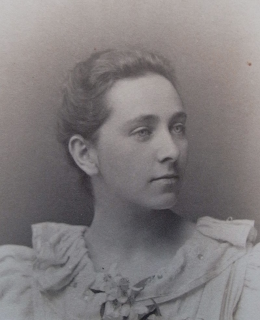
(Pictured: Edith Anne Stoney during her time in Cambridge in the early 1890s)
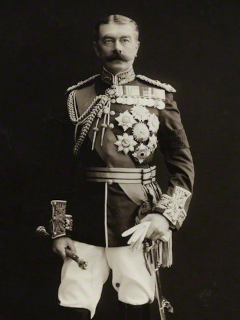
Kitchener is the second son of Lieutenant Colonel Henry Horatio Kitchener and his first wife, Frances Anne (née Chevallier), daughter of clergyman John Chevallier. Col. Kitchener resigns his commission in 1849 and purchases Ballygoghlan House estate near Tarbert, County Kerry, in early 1850 under the provisions of the Encumbered Estates Act of 1849. Ballygoghlan House is in a state of disrepair, however, and the family lives in Gunsborough Villa until the end of 1850. In 1857, Col. Kitchener purchases Crotta House, near Kilflynn, County Kerry, and the Kitcheners divide their time between the two residences. While innovative and successful in his agricultural methods, Col. Kitchener is harsh towards his tenants and, after carrying out many evictions, becomes extremely unpopular in the area. He is a rigid disciplinarian and occasionally punishes his son severely.
Although Kitchener attends Ballylongford village school, his education is largely neglected. When examined by his cousin Francis Elliot Kitchener, fellow of Trinity College Dublin (TCD), he is found to have only the most rudimentary knowledge of grammar and arithmetic. Education by private tutors follows. In 1864, his father sells his Irish estates and moves to Switzerland for the sake of his wife’s health. After further private tuition, he passes into the Royal Military Academy, Woolwich, in 1868, and is commissioned into the Royal Engineers in December 1870.
Kitchener begins his career on survey missions and carries out such work in Palestine (1874–78) and Cyprus (1878–82). He then enters the Egyptian Army and takes part in the Sudan campaign of 1883–85, organised to relieve Genral Charles George Gordon. Subsequent appointments include governor of Suakin (1886–88), adjutant-general of the Egyptian Army (1888–92), and Sirdar (Commander-in-Chief) of the Egyptian Army (1892–96). After the Dongola Expedition in 1896, he is promoted to major-general. He commands the Khartoum Expedition of 1898, defeating Mahdist forces at Atbara and Omdurman, and is raised to the peerage.
At the outbreak of the Second Boer War in 1899, he is appointed chief of staff to Frederick Roberts, 1st Earl Roberts, and assumes total command, with the rank of lieutenant-general, in 1900. While acting as commander-in-chief in South Africa he reorganises the British forces and, using new tactics, manages finally to defeat the Boers. He is severely criticised in the world press for the conditions in the concentration camps where Boer families are confined, but is made a viscount, promoted to general, and awarded £50,000 by parliament at the end of the war.
Kitchener serves as commander-in-chief in India beginning in 1902, is promoted to Field Marshal in 1909, and is a member of the Committee of Imperial Defence (1910) and consul-general in Egypt (1911–14). At the outbreak of World War I he is made Secretary of State for War and begins to reorganise the British Army, an immense achievement, raising 1,700,000 men in service battalions by May 1915, creating an army of volunteers to reinforce the depleted regular army in Belgium and France. An archconservative, he totally opposes Home Rule for Ireland, and initially blocks plans by John Redmond for the formation of a southern Irish division from members of the National Volunteers. Convinced that an all-Irish brigade or division would be a security risk, he rejects Redmond’s suggestions in a meeting of August 1915 and originally proposes dispersing Irish recruits through the numerous regiments in the army. Impressed by Redmond’s persistence, and impelled by the recruiting crisis of late 1915, he finally reverses his decision and sanctions the establishment of the 16th (Irish) Division.
On June 5, 1916, Kitchener is making his way to Russia on HMS Hampshire to attend negotiations with Tsar Nicholas II when in bad weather the ship strikes a German mine 1.5 miles (2.4 km) west of Orkney, Scotland, and sinks. He is among 737 who perish. He is the highest-ranking British officer to die in action in the entire war.
Although he only spends his early years in Kerry, Kitchener occasionally returns to Ireland. While on leave in June 1910 he goes on a tour of County Kerry, visiting places connected to his childhood. There are numerous portraits and memorials to him in England, including a marble effigy by W. Reid Dick in St. Paul’s Cathedral in London and a statue by John Tweed in Horse Guards Parade, London. There is a commemorative bible in the Church of Ireland church at Kilflynn, County Kerry, where he regularly attended Sunday service as a boy. There are some Kitchener letters in the John Redmond papers in the National Library of Ireland.
(From: “Kitchener, Horatio Herbert” by David Murphy, Dictionary of Irish Biography, http://www.dib.ie, October 2009)
In 1990, Cusack, in the role of Masha, joins two of her sisters, Niamh (as Irina) and Sorcha (as Olga), and her father, Cyril Cusack (as Chebutykin) for a well-received production of Anton Chekhov‘s tragicomedy Three Sisters in a new version by Frank McGuinness, directed by Adrian Noble at the Gate Theatre, Dublin, before transferring to the Royal Court Theatre in London. The production also features Niamh’s husband, Finbar Lynch, as Solenyi and Lesley Manville as Natasha. The production wins the three real-life sisters the Irish Life Award in 1992.
One of Cusack’s best known stage roles is Our Lady of Sligo by Sebastian Barry in 1998, in which she plays the principal role of Mai O’Hara in performances in Ireland, on Broadway and at the National Theatre. For this she wins the 1998 Evening Standard Theatre Award for Best Actress, the 1998 Critics’ Circle Theatre Award for Best Actress and her fourth Olivier Award nomination for Best Actress. In 2006-07 she stars with Rufus Sewell in Tom Stoppard‘s Rock ‘n’ Roll at the Royal Court Theatre in London which transfers to the West End and Broadway, winning Cusack her fifth Olivier Award nomination and her second Tony Award nomination.
In 2015, Cusack returns to Ireland’s Abbey Theatre, where she begins her theatre career. She appears in the world première of Mark O’Rowe‘s play Our Few and Evil Days, acting opposite long-time collaborator Ciarán Hinds. She wins the Irish Times Irish Theatre Award for Best Actress.
Cusack stars with Peter Sellers in the film Hoffman (1970). She guest stars in an episode of The Persuaders! (1971), a TV series starring Tony Curtis and Roger Moore, as Jenny Lindley, a wealthy heiress who suspects that a man claiming to be her dead brother is in fact an impostor. In 1975, she makes three appearances in the TV series Quiller as the character Roz.
Further starring roles include lead roles in Oliver’s Travels (1995), Have Your Cake and Eat It (1997) for which Cusack wins the Royal Television Society‘s RTS Award for Best Actress and Frank McGuinness’s The Hen House (1989) for BBC Television. She stars in the title role of George du Maurier‘s Trilby (1976), in an adaptation for the BBC’s Play of the Month, with Alan Badel as Svengali. She also stars in the BBC mini-series North & South (2004, from the novel by Elizabeth Gaskell) as Mrs. Thornton. She stars in the BBC sitcom Home Again (2006) and appears in the TV series Camelot (2011), which runs for one season. She has featured roles in the mini-series The Deep (2014) and the series Marcella (2016), an eight-episode murder mystery.
Along with other actresses, including Paola Dionisotti, Fiona Shaw, Juliet Stevenson and Harriet Walter, Cusack contributes to a book by Carol Rutter called Clamorous Voices: Shakespeare’s Women Today (1994). The book analyses modern acting interpretations of female Shakespearean roles.
Cusack marries British actor Jeremy Irons in 1978, and they have two sons, Samuel James and Maximilian Paul. Prior to marrying Irons, she gives birth to a son in 1967 and places the boy for adoption. In 2007, a journalist for the Irish Sunday Independent, Daniel McConnell, reveals that Cusack is the mother of left-wing general election candidate and now member of Irish parliament Richard Boyd Barrett. The two have since been reunited.
Cusack is a patron of the Burma Campaign UK, the London-based group campaigning for human rights and democracy in Burma. In 1998, she is named, along with her husband, in a list of the biggest private financial donors to the British Labour Party. In August 2010, she signs the “Irish artists’ pledge to boycott Israel” initiated by the Palestine Solidarity Campaign.
(Pictured: Sinéad Cusack reciting poetry for the British Library in October 2021)
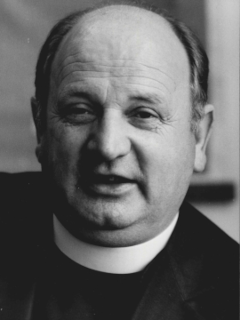
Eamonn Casey, Irish Catholicprelate who serves as bishop of Galway and Kilmacduagh from 1976 until his resignation 1992, returns to Ireland on February 5, 2006, following fourteen years in exile. He fled Ireland after he admitted to fathering his son, Peter.
Casey holds this position until 1976, when he is appointed Bishop of Galway and Kilmacduagh and apostolic administrator of Kilfenora. While in Galway, he is seen as a progressive. It is a significant change in a diocese that had been led for nearly forty years by the very conservative Michael Browne, bishop from 1937 to 1976. He is highly influential in the Irish Catholic hierarchy and a friend and colleague of another highly prominent Irish priest, Father Michael Cleary.
In 1992 it is reported that, despite the vow of chastity undertaken by Catholic clergy, Casey has a sexual relationship in the early 1970s with American woman Annie Murphy. When Murphy becomes pregnant, he is determined that the child should be given up for adoption in order to avoid any scandal for himself or the Catholic church. By contrast, Murphy is determined to accept responsibility for her child, and she returns to the United States with their son, Peter, who is born in 1974 in Dublin. He makes covert payments for the boy’s maintenance, fraudulently made from diocesan funds and channeled through intermediaries. In order to continue the cover up of his affair with Murphy and his fraudulent activities, he refuses to develop a relationship with his son, or acknowledge him. Murphy is very disappointed by this, and in the early 1990s contacts The Irish Times to tell the truth about Casey’s hypocrisy and deception. Having been exposed, he reluctantly admits that he had “sinned” and wronged the boy, his mother and “God, his church and the clergy and people of the dioceses of Galway and Kerry,” and his embezzlement of church funds. He is forced to resign as bishop and flees the country under a cloud of scandal. He is succeeded by his secretary, James McLoughlin, who serves in the post until his own retirement on July 3, 2005.
Murphy publishes a book, Forbidden Fruit, in 1993 revealing the truth of their relationship and the son she bore by Casey, exposing the institutional level of hypocrisy, moral corruption and misogyny within the Irish Catholic Church.
Casey is ordered by the Vatican to leave Ireland and become a missionary alongside members of the Missionary Society of St. James in a rural parish in Ecuador, whose language, Spanish, he does not speak. During this time, he travels long distances to reach the widely scattered members of his parish but does not travel to meet his own son. After his missionary position is completed, he takes a position in the parish of St. Pauls, Haywards Heath, West Sussex, England.
In 2005, Casey is investigated in conjunction with the sexual abuse scandal in Galway, Kilmacduagh and Kilfenora diocese, and cleared of any wrongdoing. In 2019, it emerges that he had faced at least three accusations of sexual abuse before his death, with two High Court cases being settled. The Kerry diocese confirms that it had received allegations against him, that Gardaí and health authorities had been informed and that the person concerned was offered support by the diocese.
Casey returns to Ireland on February 5, 2006, with his reputation in tatters, and is not permitted to say Mass in public.
In August 2011, Casey, in poor health, is admitted to a nursing home in County Clare. He dies on March 13, 2017, a month before his 90th birthday. He is interred in Galway cathedral’s crypt.
Casey is the subject of Martin Egan’s song “Casey,” sung by Christy Moore. He is also the subject of The Saw Doctors‘ song “Howya Julia.”
Hamilton begins his commentary career with BBC Sport, before joining RTÉ eight years later in 1984. He had previously worked for RTÉ during the 1978 FIFA World Cup. Since 2003, he works for RTÉ lyric fm, Ireland’s classical radio station, on Saturday mornings. For many years, he fronts a popular weekly quiz show on RTÉ, Know Your Sport, alongside fellow commentator Jimmy Magee.
Hamilton is chief commentator for RTÉ Sport‘s coverage of the 2010 FIFA World Cup in South Africa, the ninth one in which he has been involved. He is RTÉ’s chief commentator at UEFA Euro 2012 and commentates on all of Ireland’s matches in the competition. He is involved in the coverage of the Olympic Games since the 1980 Summer Olympics in Moscow.
Hamilton is known for his use of colourful phrases and memorable quotes when commentating on games, his phrase describing David O’Leary‘s penalty against Romania in the 1990 FIFA World Cup, “The nation holds its breath,” is used for a book of Irish football quotations, compiled by Eoghan Corry, for which Hamilton writes the foreword.
The sports humour website, DangerHere.com, takes its title from another quote by Hamilton: “And Bonner has gone 165 minutes of these championships without conceding a goal. Oh, danger here…”
Remaining active during the interwar years, Dill serves as chief assistant to the commandant of the Staff College (1919–22) before commanding the Welsh Border Brigade, TA (1922–23), and 2nd Infantry Brigade at Aldershot (1923–26). In late 1926, he is appointed army instructor at the newly established Imperial Defence College. A period in India follows as general staff officer of the Western Command (1929–31), based at Quetta. On return to England, he is promoted to major general and made commandant of the Staff College. Appointments as commander of the British forces in Palestine and Transjordan (1936–37) and the Aldershot Command (1937–39) follow. During this period, he shows a remarkable ability to both train and inspire those under his command. Most of his colleagues expect him to become the new chief of the Imperial General Staff and are surprised when Major General Lord Gort, junior to Dill in both rank and seniority, is appointed to the post.
At the outbreak of World War II Dill commands I CorpsBritish Expeditionary Force (BEF) in France and is made a full general. In April 1940, he is made vice-CIGS and in May takes over as CIGS. His initial period in office is not a happy one, and he has to inform the public of setbacks in both Norway and France. His workload is enormous, and after the evacuation at Dunkirk in late May he devotes himself to preparing the defences of Britain against invasion. He clashes with Winston Churchill throughout 1941, advocating a more cautious and realistic approach to the situations in North Africa, Greece, and Crete.
The workload begins to affect his health adversely, and in November 1941 it is announced that he will resign as CIGS on reaching the age of 60 and serve as governor-designate of Bombay with the rank of field marshal. He seeks to be more actively involved in the war effort, however, and in December 1941 he visits the United States with Churchill, remaining there as head of the British joint staff mission in Washington, D.C. He plays a significant role in promoting Anglo–American military cooperation and attends the Casablanca, Quebec, and Tehran conferences.
Dill first marries (1907) Ada Maud Le Mottée, daughter of Col. William Le Mottée of the 18th Regiment. Their son, Major John de Guerin Dill, serves as an artillery officer throughout World War II. In October 1941, Dill marries Nancy Isabelle Charrington, widow of Brigadier Denis Walter Furlong. Dill’s honours include a GCB (1942), an honorary degree from Princeton University (1944), the Howland Memorial Prize of Yale University (1944), and a posthumous Distinguished Service Medal (DSM) from the United States government. There are portraits of him in Cheltenham College and the Imperial War Museum, and a statue in Washington, D.C.
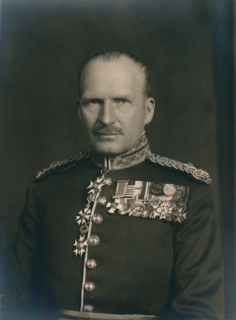
(From: “Dill, Sir John Greer” by David Murphy, Dictionary of Irish Biography, http://www.dib.ie, October 2009 | Pictured: Sir John Greer Dill, bromide print, 1932, by Walter Stoneman, National Portrait Gallery, London)





 seamus dubhghaill