On December 9, 1994, Sinn Féin, the political wing of the Irish Republican Army (IRA), holds its first formal talks with the British Government in over 70 years. The negotiations take place in Belfast, almost one year after Britain and Ireland began an uncertain program to try to resolve the conflict in Northern Ireland. The first session is held at Stormont, a gigantic, columned edifice on top of a hill on the outskirts of Belfast that houses the old Northern Ireland parliament.
Although the announcement of the negotiations is not a surprise, it still sets off an exciting ripple that history is in the making. British officials have conducted secret talks with Sinn Féin leaders in the past, but never before have they sat down openly at the same table with them.
In both a letter to the Sinn Féin leader, Gerry Adams, and in a three-paragraph statement, Downing Street pointedly refers to the meeting as “exploratory dialogue.” This is in keeping with London‘s position that it is simply joining in “talks about talks,” not a full negotiating session, which must involve all parties to the conflict.
For 25 years the IRA has been fighting in the name of the Roman Catholic minority of 650,000 in Northern Ireland. It wants to link Ulster, the six counties of Northern Ireland that remain British after partition, to the Irish Republic, a move opposed by most of the province’s 950,000 Protestants.
The announcement of talks evoke a predictable pattern of responses across Northern Ireland’s political spectrum. Adams, who works to persuade the IRA to go along with a unilateral cease-fire that was declared on September 1, welcomes it. “The opportunity to realize a lasting peace, which will benefit all of the people of Ireland, has never been greater,” he says in a statement. Adams had been accusing London of foot-dragging on the peace effort. Now, he says, it is time to move on to “the next phase of dialogue — multilateral talks led by both Governments.”
The Ulster Unionist Party (UUP), the main Protestant political group in Northern Ireland, is skeptically accepting, as it has been all along. John Taylor, a UnionistMember of Parliament, says the talks will at least establish whether “Sinn Féin really is to become a normal political party.”
The Rev. Ian Paisley, a Member of Parliament whose Democratic Unionist Party (DUP) has become a rejectionist front, continues to oppose talks or any move smacking of compromise. He tells the House of Commons that “a vast majority of people” resent the decision to talk to “the men of blood.”
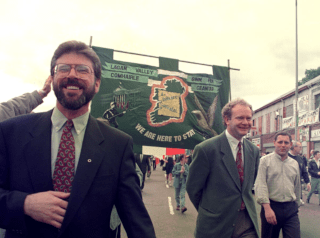
Sinn Féin is represented at the talks by Martin McGuinness, a veteran IRA political leader who took part in secret contacts that broke up the previous year. In 1972, together with Adams, he was flown to London for a meeting with William Whitelaw, who was then Secretary of State for Northern Ireland. Those talks eventually failed.
Adams is in Washington, D.C. on Wednesday, December 7. He attends a meeting at the White House, his first one there, with Anthony Lake, President Bill Clinton‘s National Security Advisor. Seven weeks earlier, Britain protests vigorously at the thought of Adams visiting the White House. But events moved so swiftly that he gains a kind of legitimacy that is hard for Whitehall to deny. His visa to the United States, good for three months, allows several visits.
The Government team of civil servants, in contrast to higher-level ministers, are led by Quentin Thomas, deputy secretary of the British administration called the Northern Ireland Office.
Going into the negotiations, the key question is what will be discussed. On the British side, the top of the agenda is how to get the IRA to turn over its considerable stash of 100 tons of arms and explosives. There is nothing, of course, that Sinn Féin is less likely to agree to at the outset. So should the British make this a condition for multilateral talks to begin, the two sides will meet an obstacle right away.
McGuinness says that the issue of IRA weapons has to be considered “in the context of us removing the causes of conflict, the reason why people use armed force in our society.”
From its side, Adams says Sinn Féin wants to discuss being treated with “a parity of esteem” with the other parties, and “the release of all political prisoners.”
The British Government says that it will soon hold talks with the so-called loyalist paramilitaries on the Protestant side. And it indicates it will have no objection if elected Sinn Féin councillors attend a major international investment conference in Belfast on December 13 and 14.
(From: “Britain and I.R.A. Group to Begin Talks in Northern Ireland” by John Darnton, The New York Times, December 2, 1994 | Pictured: Gerry Adams and Martin McGuinness lead a Republican parade in Belfast, commemorating 25 years of British troops on the streets of Northern Ireland in 1994)
The Northern state consists of the six northeastern counties of Ulster with a unionist majority. They are Antrim, Down, Armagh, Derry, Tyrone, and Fermanagh. Belfast is to be the seat of a government and hold limited devolved powers. The counties of Donegal, Cavan, and Monaghan are to be absorbed within the Irish Free State controlled from parliament in Dublin.
Irish nationalists are dismayed with the plan. Protestant Unionists, particularly those living within the boundaries of the new state, accept and start to implement the Act. Sectarian attacks are launched upon Catholic homes in Belfast, Derry, Banbridge, Lisburn, and Dromore. Catholics are driven from Belfast shipyards and from various engineering works in the city. Supposedly these attacks are in revenge for Irish Republican Army (IRA) assassinations.
The IRA continues the campaign to establish a republic with the Irish War of Independence. By the middle of 1921, both sides are exhausted, and a truce is called on June 9.
In July 1921, Éamon DeValera, the president of Dáil Éireann, goes to London to meet with Prime Minister Lloyd George. They agree an Irish delegation will come to London to discuss terms in the autumn.
During the debate, Lloyd George insists Ireland remain part of the Commonwealth and Dáil Éireann members take the oath of allegiance to the British throne. After a delay of two months, Lloyd George delivers the ultimatum on December 5, sign a treaty within three days or there will be war.
The Anglo-Irish Treaty is to give Ireland a 26 county Free State with Dominion status. The right to raise taxes, regulate foreign trade, independence in internal affairs, own an army, and the oath of allegiance is changed to one of fidelity.
The British are to retain three naval bases within the jurisdiction of the Free State, at Cobh, Lough Swilly, and Berehaven. The Northern Ireland boundary is to be determined by a commission. This gives false hope to large tracts of Tyrone, Fermanagh, Down, Armagh, and Derry City would be given to the Free State as they have Catholic majorities.
Just after 2:00 AM on December 6, 1921, the Irish delegation, without consulting the Dáil, finally sign a treaty with the British. Collins writes, prophetically, later on the day of the signing, “early this morning I signed my death warrant.”
The Treaty displeases the Catholics in the north and the unionists in the south. Meanwhile, many of those involved in the conflict are abhorred at the fact that not all of Ireland is to leave the United Kingdom.
(From: “The Anglo-Irish Treaty (1921)” by Brian O’Neill, Your Irish Culture, http://www.yourirish.com, May 20, 2020)
In January 2007, Purvis succeeds the late David Ervine as leader of the Progressive Unionist Party and Member of the Legislative Assembly (MLA) for Belfast East. Commenting on her new role she says, “I am deeply honoured to have been made the leader of the PUP. However, this is also tinged with sadness given the huge loss of David. It is a huge challenge to step into this role, especially after the good work he did. But this gives us an opportunity to rebuild and continue to serve working class loyalists and unionist communities.”
In her maiden speech in the Assembly, Purvis says “As long as there is poverty, and as long as there is inequality in education, health and gender, it will be my duty to articulate the needs of the working and workless classes in East Belfast.”
Purvis is re-elected in the constituency at the Northern Ireland Assembly election held on March 7, 2007, on the tenth and final round of counting.
In June 2010, Purvis resigns as leader, and as a member, of the Progressive Unionist Party because of its relationship with the UVF and the murder of Bobby Moffet which is attributed to that group by the Independent Monitoring Commission.
In the 2011 Northern Ireland Assembly election Purvis defends her seat as an independent candidate with Progressive Unionist Party leader Brian Ervine running against her. In the end neither candidate is elected and instead the Alliance Party of Northern Ireland gains a second Belfast East seat.
Purvis is now the director of the Marie Stopes clinic in Belfast. In November 2014 Bernadette Smyth, founder of the Precious Life organisation, is found guilty of the harassment of Purvis, but the verdict is later quashed.
Henry’s legal career flourishes. He becomes Queen’s Counsel in 1896, a Bencher of the King’s Inns in 1898 and ultimately Father of the North-West Circuit – but his interest in politics does not diminish. In March 1905, he is a delegate at the inaugural meeting of the Ulster Unionist Council and in the 1907 North Tyrone by-election he is the Unionist candidate, losing by a mere seven votes.
On May 23, 1916, Henry is elected as an MP in the South Londonderry by-election, the first by-election to be held in Ireland after the Easter Rising, which occurred a month earlier. The rebellion has had no discernible impact on the contest.
Henry marries Violet Holmes, daughter of Hugh Holmes, a judge of the Court of Appeal in Ireland, and Olivia Moule. They have five children, including James Holmes Henry, who succeeds as second baronet. It is a mixed marriage as Violet is and remains a staunch member of the Church of Ireland. Despite their religious differences, the marriage is said to be happy.
Henry dies in Belfast on October 1, 1925, aged 61, and is buried near his native Draperstown.
(Pictured: Sir Denis Stanislaus Henry, 1st Baronet, bromide print by Walter Stoneman, 1920, National Portrait Gallery, London)
The Maze Prison escape, known to Irish republicans as the Great Escape, takes place on September 25, 1983, in County Antrim, Northern Ireland. HM Prison Maze, also known as Long Kesh, is a maximum-security prison considered to be one of the most escape-proof prisons in Europe, and holds prisoners suspected of taking part in armed paramilitary campaigns during the Troubles. In the biggest prison escape in UK history, 38 Provisional Irish Republican Army (IRA) prisoners escaped from H-Block 7 (H7) of the prison. One prison officer dies of a heart attack during the escape and twenty others are injured, including two who are shot with guns that had been smuggled into the prison. The escape is a propaganda coup for the IRA, and a British government minister faces calls to resign. The official inquiry into the escape places most of the blame onto prison staff, who in turn blame the escape on political interference in the running of the prison.
IRA volunteers regard themselves as prisoners of war with a duty to escape. During the Troubles, Irish republican prisoners escape from custody en masse on several occasions between 1971 and 1981.
Prisoners had been planning the 1983 escape for several months. Bobby Storey and Gerry Kelly start working as orderlies in H7, which allows them to identify weaknesses in the security systems. Six handguns are also smuggled into the prison. Shortly after 2:30 PM on September 25, prisoners seize control of H7 by simultaneously taking the prison officers hostage at gunpoint in order to prevent them from triggering an alarm. One officer is stabbed with a craft knife, and another is knocked down by a blow to the back of the head. One officer who attempts to prevent the escape is shot in the head by Gerry Kelly but survives. By 2:50 PM the prisoners are in control of H7 without an alarm being raised. A dozen prisoners also take uniforms from the officers, and the officers are forced to hand over their car keys and details of where their cars are, for possible later use during the escape. A rearguard is left behind to watch over hostages and keep the alarm from being raised until they believe the escapees are clear of the prison, at which time they return to their cells. At 3:25 PM, a lorry delivering food supplies arrives at the entrance to H7, whereupon Brendan McFarlane and other prisoners take the occupants hostage at gunpoint and move them inside H7. The lorry driver is told the lorry is being used in the escape, and he is instructed what route to take and how to react if challenged.
At 3:50 PM the prisoners leave H7, and the driver and a prison orderly are taken back to the lorry. Thirty-seven prisoners climb into the back of the lorry, while Gerry Kelly lay on the floor of the cab with a gun pointed at the driver, who is also told the cab has been booby trapped with a hand grenade. At nearly 4:00 PM the lorry drives toward the main gate of the prison, where the prisoners intend to take over the gatehouse. Ten prisoners dressed in guards’ uniforms and armed with guns and chisels dismount from the lorry and enter the gatehouse, where they take the officers hostage.
At 4:05 PM the officers begin to resist, and an officer presses an alarm button. When other staff respond via an intercom, a senior officer says while being held at gunpoint that the alarm had been triggered accidentally. By this time the prisoners are struggling to maintain control in the gatehouse due to the number of hostages. Officers arriving for work are entering the gatehouse from outside the prison, and each is ordered at gunpoint to join the other hostages. Officer James Ferris runs from the gatehouse toward the pedestrian gate attempting to raise the alarm, pursued by Dermot Finucane. Ferris had already been stabbed three times in the chest, and before he can raise the alarm he collapses.
Finucane continues to the pedestrian gate where he stabs the officer controlling the gate, and two officers who had just entered the prison. This incident is seen by a soldier on duty in a watchtower, who reports to the British Army operations room that he has seen prison officers fighting. The operations room telephones the prison’s Emergency Control Room (ECR), which replies that everything is all right and that an alarm had been accidentally triggered earlier.
At 4:12 PM the alarm is raised when an officer in the gatehouse pushes the prisoner holding him hostage out of the room and telephones the ECR. However, this is not done soon enough to prevent the escape. After several attempts the prisoners open the main gate and are waiting for the prisoners still in the gatehouse to rejoin them in the lorry. At this time two prison officers block the exit with their cars, forcing the prisoners to abandon the lorry and make their way to the outer fence which is 25 yards away.
Four prisoners attack one of the officers and hijack his car, which they drive toward the external gate. They crash into another car near the gate and abandon the car. Two escape through the gate, one is captured exiting the car, and another is captured after being chased by a soldier. At the main gate, a prison officer is shot in the leg while chasing the only two prisoners who have not yet reached the outer fence. The prisoner who fires the shot is captured after being shot and wounded by a soldier in a watch tower, and the other prisoner is captured after falling. The other prisoners escape over the fence, and by 4:18 PM the main gate is closed and the prison secured, after 35 prisoners had breached the prison perimeter. The escape is the biggest in British history, and the biggest in Europe since World War II.
Outside the prison the IRA has planned a logistical support operation involving 100 armed members, but due to a miscalculation of five minutes, the prisoners find no transport waiting for them and are forced to flee across fields or hijack vehicles. The British Army and Royal Ulster Constabulary immediately activate a contingency plan and by 4:25 PM a cordon of vehicle checkpoints are in place around the prison, and others are later in place in strategic positions across Northern Ireland, resulting in the recapture of one prisoner at 11:00 PM. Twenty prison officers are injured during the escape, thirteen are kicked and beaten, four stabbed, and two shot. One prison officer, James Ferris, who had been stabbed, dies after suffering a heart attack during the escape.
The escape is a propaganda coup and morale boost for the IRA, with Irish republicans dubbing it the “Great Escape.” Leading unionist politician Ian Paisley calls on Nicholas Scott, the Parliamentary Under-Secretary of State for Northern Ireland, to resign. The British Prime MinisterMargaret Thatcher makes a statement in Ottawa during a visit to Canada, saying “It is the gravest [breakout] in our present history, and there must be a very deep inquiry.” The day after the escape, Secretary of State for Northern IrelandJames Prior announces an inquiry to be headed by Her Majesty’s Chief Inspector of Prisons, James Hennessy. The Hennessy Report is published on January 26, 1984, placing most of the blame for the escape on prison staff, and making a series of recommendations to improve security at the prison. The report also places blame with the designers of the prison, the Northern Ireland Office and successive prison governors who had failed to improve security. Prior announces that the prison’s governor has resigned, and that there will be no ministerial resignations as a result of the report’s findings. Four days after the Hennessy Report is published, the Minister for Prisons Nicholas Scott dismisses allegations from the Prison Governors Association and the Prison Officers Association that the escape is due to political interference in the running of the prison.
Fifteen escapees are captured on the day, including four who are discovered hiding underwater in a river near the prison using reeds to breathe. Four more escapees are captured over the next two days, including Hugh Corey and Patrick McIntyre who are captured following a two-hour siege at an isolated farmhouse. Out of the remaining 19 escapees, 18 end up in the republican stronghold of South Armagh where two members of the IRA’s South Armagh Brigade are in charge of transporting them to safehouses and given the option of either returning to active service in the IRA’s armed campaign or a job and new identity in the United States.
On October 25, 1984, nineteen prisoners appear in court on charges relating to the death of prison officer James Ferris, sixteen charged with his murder. A pathologist determines that the stab wounds Ferris suffered would not have killed a healthy man. The judge acquits all sixteen as he cannot correlate the stabbing to the heart attack.
Hamilton is born in Hamilton Place, Piccadilly, London, on November 30, 1869. Styled Marquess of Hamilton between 1885 and 1913, he is a British peer and Unionist politician. He serves as the first Governor of Northern Ireland, a post he holds between 1922 and 1945. He is a great-grandfather of Diana, Princess of Wales.
In early 1901 he accompanies his father on a special diplomatic mission to announce the accession of King Edward to the governments of Denmark, Sweden and Norway, Russia, Germany, and Saxony.
Hamilton dies at his London home on September 12, 1953, and is buried at Baronscourt in County Tyrone.
(Pictured: “James Albert Edward Hamilton, 3rd Duke of Abercorn” by Alexander Bassano, Collodion Negative, 1894, Photographs Collection, National Portrait Gallery, London)
Leading the way in a return to the past is Ahern’s Dublin government, which has introduced the toughest anti-terrorist legislation in the history of the Irish Republic. He concedes that the measures are draconian but says that his government is determined to do everything in its power, “working closely with the British government to defeat and suppress this murderous conspiracy against the people of Ireland.”
Prime Minister Blair promises that he too plans to introduce extreme measures. “We will bring in similar measures to those proposed by the Irish government, so we will then have the toughest anti-terrorist measures for the whole of Ireland, the Republic and Northern Ireland, that we have ever seen.”
With no plans to recall the British parliament, it is thought that existing legislation will be applied, since it already includes measures similar to those announced by the Irish government.
Oppressive British legislation has sustained British rule in Ireland for decades. This includes internment without trial, non-jury courts, entry and search of homes without a warrant, seven-day detention with unrecorded and unsupervised interrogation, denial of access to lawyers, exclusion orders and more. Most of these are still in use in 1998.
The Ahern package includes withdrawal of a suspect’s right to silence — refusal to answer questions can be used as evidence that a suspect is a member of an illegal organisation, the seizure of property that has been used for storing weapons or making bombs, and the creation of a new offence of directing an unlawful organisation. This is expected to carry the penalty of life imprisonment.
Omagh is 75% nationalist, with good cross-community relations, and has largely escaped the worst of the conflict. Although Republican dissidents have carried out a spate of similar bombings in the previous year, the towns targeted are mainly Unionist and further east.
The group that claims responsibility for the Omagh bombing is the Real IRA, which was formed in protest at the IRA’s 1997 cease-fire. Irish police have insisted that the Real IRA is the military wing of the recently formed 32 County Sovereignty Movement (32CSM), although this is denied by that organisation.
Although both the INLA and the Real IRA have declared a unilateral cease-fire since the Omagh bombing, media focus has settled on Bernadette Sands McKevitt, sister of the 1980s IRA hunger strikerBobby Sands, who is a leading figure in the 32 County Sovereignty Movement. Sands-McKevitt has condemned the Omagh bombing, but her home in Blackrock, County Louth, has since been targeted by local townspeople who have staged protests against her and her family. She has also been denied a visa to enter the United States on a speaking tour.
The Omagh bombing could not have come at a better time for Britain. With the war formally over and Sinn Féin penned, the bombing delivers an opportunity to smash the Republican left once and for all and wrench it from any semblance of ongoing support in Ireland.
All nationalist opponents of the Good Friday Agreement must now cope with being stained by the blood of Omagh. With the massive referendum vote in favour of peace to back them up, the British and Irish governments can be satisfied that the Good Friday Agreement now looks more in place than at any other time. As one nationalist describes the situation, “If the Good Friday Agreement was a defeat for the cause of Irish nationalism, the Omagh bombing has turned it into a rout.”
(From: “Blair, Ahern make the most of Omagh bomb” by Dave Riley, Green Left (www.greenleft.org), August 26, 1998)
Nationalist residents of Belfast’s Lower Ormeau Road vote overwhelmingly on August 4, 2000, against allowing Orange Order parades through the flashpoint district. Results indicate that over 90% of those polled in a secret vote on the mainly nationalist lower Ormeau area of south Belfast want such parades rerouted.
The nationalist residents’ group, the Lower Ormeau Concerned Community (LOCC), which organised the ballot, says the majority of the 600 people who voted want the parades rerouted. In a statement it says it welcomes the result as “an overwhelming and democratic expression of our community’s desire to live free from sectarian harassment”.
LOCC spokesman Gerard Rice says, “We do not claim to speak for loyalist residents.” He adds that the loyal orders will now have to listen to the people of the area. “The whole point in this exercise was not to vindicate our position, but to set out clearly an informed position as to what exactly the opinion in our community is and has been for many years,” he tells BBC Radio Ulster.
“The Orange Order and other loyal institutions have said for many, many years that really people living on the Ormeau Road want parades. That they are actually a colourful event that people can enjoy. We have said that many people within our community would say parades by the loyal institutions were seen as sectarian, coat trailing exercises, the institutions were seen as anti-Catholic and sectarian organisations. Now we can actually say that 95.9% of our community believe that to be true.”
However, the Belfast County Grand Master of the Orange Order rejects the results of the poll. Dawson Baillie says the vote was unrepresentative because it did not include the staunchly loyalist Donegall Pass area and the Ballynafeigh district above the Ormeau Bridge. “We believe that it’s our right and everyone’s right to walk down a main thoroughfare. We’re not going into side streets on the right-hand side of that part of the Ormeau Road or the left-hand side. We go straight down the main thoroughfare. Our parade at any given point would take no more than three to four minutes to pass.”
Unionists question the validity of the poll as it excludes nearby loyalist areas. Dawn Purvis of the Progressive Unionist Party says the poll would not help to resolve the situation. “You don’t get people to enter into talks on the basis of no parade. You get people to enter into talks on the basis of an accommodation,” she says. “If that poll had been held to show what concerns the people of Lower Ormeau have over loyal order parades, that would have been better, that would have been a way forward, trying to address the concerns of the residents of the Lower Ormeau Road. LOCC have not been forthcoming with those concerns, so the talks haven’t moved forward.”
Reverend Martin Smyth, the Belfast SouthMP, says it had been “a stage-managed exercise” to show how well the group could conduct their business in that area and “to gather support from those who don’t want a procession down that road.”
However, Rice rejects the suggestions that it is unrepresentative because loyalist areas had been left out. Another LOCC representative, John Gormley, says they would welcome equivalent ballots from the loyalist part of the Ormeau area.
Local parish priest Father Anthony Curran says he is satisfied with the conduct of the vote. “A large number of people seem to have come out, a very broad section of the community, elderly young middle-aged, sick. They came free from fear and intimidation.”
A similar poll was last conducted in the Lower Ormeau area in 1995 by management consultants Coopers & Lybrand, when a large majority voted against allowing loyalist marches in the area.
Bord Fáilte, the Irish Tourist Board, is founded on July 3, 1952, and is the predecessor organization of Fáilte Ireland (Ireland’s Welcome), which is the operating name of the National Tourism Development Authority of Ireland.
After the foundation of the Irish Free State in 1922, hoteliers and others create local tourism boards in various regions, which combine in 1924 into the Irish Tourism Association (ITA), a private organisation “promoting tourism to the benefit of the nation.” (An earlier, unionist-led, ITA existed from 1895 to 1921.) ITA lobbying leads to the Irish Tourist Board being established by the Tourist Traffic Act 1939. This is renamed An Bord Fáilte by the Tourist Traffic Act 1952, which creates a separate body, Fógra Fáilte, to handle publicity. The Tourist Traffic Act 1955 remerges the two as Bord Fáilte Éireann (BFÉ or “Bord Fáilte”). An Tóstal, a summer cultural festival held from 1953 to 1959, takes up the bulk of the authority’s work during this period. In 1963 the Council of Education, Recruitment and Training (CERT) is created to take over training of workers in the hospitality industry.
In 1964, eight regional tourist organisations (RTOs) are established which are intended to supersede the ITA. An extraordinary general meeting (EGM) called in 1964 to dissolve the ITA votes not to do so, but it nevertheless soon becomes defunct. The RTOs reduce in number to six in the 1980s, and are renamed regional tourist associations (RTAs) in 1996. In 1989 the Dublin RTO loses a High Court action to prevent BFÉ dissolving it. It is reconstituted as Dublin Tourism and more closely controlled by BFÉ.
In 2003 CERT and BFÉ merge to form Fáilte Ireland, to better co-ordinate with Tourism Ireland, the all-island body established under the Good Friday Agreement. The advent of travel websites reduces the usefulness of the RTAs and a 2005 PricewaterhouseCoopers report recommends substantial reorganisation. As a consequence all are dissolved in 2006, except Dublin Tourism, which is made a direct subsidiary of Fáilte Ireland. Dublin Tourism’s separate status ends in 2012 in line with a 2011 report by Grant Thornton International.
Fáilte Ireland played a leading role in The Gathering Ireland 2013, a year-long programme of events encouraging members of the Irish diaspora to visit their region of origin.
The legal name of the body is the National Tourism Development Authority, according to the National Tourism Development Authority Act 2003 which established it. The 2003 act also empowers the body to use the trading name of Fáilte Ireland. The word fáilte is Irish for “welcome.” In official Irish-language texts the form Fáilte Éireann has been used.
Eames spends his early years in Larne, with the family later moving to Belfast. He is educated at the city’s Belfast Royal Academy and Methodist College Belfast before going on to study at Queen’s University Belfast, graduating LL.B. (Upper Second Class Honours) in 1960 and earning a Ph.D. degree in canon law and history in 1963. During his undergraduate course at Queen’s, one of his philosophy lecturers is his future Roman Catholic counterpart, Cahal Daly.
Turning his back on legal studies for ordination in the Church of Ireland, Eames embarks on a three-year course at the divinity school of Trinity College, Dublin in 1960, but finds the course “intellectually unsatisfying.” In 1963 he is appointed curate assistant at Bangor Parish Church, becoming rector of St. Dorothea’s in Belfast in 1966, the same year he marries Christine Daly.
During his time at St. Dorothea’s, in the Braniel and Tullycarnet area of east Belfast, Eames develops a “coffee bar ministry” among young people but is interrupted by the Troubles. He turns down the opportunity to become dean of Cork and in 1974 is appointed rector of St. Mark’s in Dundela in east Belfast, a church with strong family links to C. S. Lewis.
On May 9, 1975, at the age of 38, Eames is elected bishop of the cross-border Diocese of Derry and Raphoe. Five years later, on May 30, 1980, he is translated to the Diocese of Down and Dromore. He is elected to Down and Dromore on April 23 and that election is confirmed on May 20, 1980. In 1986, he becomes the 14th Archbishop of Armagh and Primate of All Ireland since the Church of Ireland’s break with Rome. It is an appointment that causes some level of astonishment among other church leaders.
Drumcree Church, a rural parish near Portadown, becomes the site of a major political incident in 1996, when the annual Orangemen‘s march is banned by the Chief Constable of the Royal Ulster Constabulary from returning to the centre of Portadown via the nationalist Garvaghy Road after attending worship at Drumcree Church. Public unrest and violence escalate over the next three summers as other parades come under first police and later commission sanction.
Eames, as diocesan bishop and civil leader finds himself immersed in the search for a resolution to the issue. Within the wider Church of Ireland there is unease as it is a broad church in theology and politics including within its congregations nationalists in the south and unionists in the north. Eames, along with the rector of Drumcree, has to navigate this political and social controversy and seeks political assistance to diffuse tension. Some bishops in the Republic of Ireland call for Eames to close the parish church, including Bishop John Neill who later becomes Archbishop of Dublin. He refuses to do so, believing this action could precipitate greater unrest and possible bloodshed.
Eames is, for many years, a significant figure within the general Anglican Communion. In 2003, the self-styled ‘divine optimist’ is appointed Chairman of the Lambeth Commission on Communion, which examines significant challenges to unity in the Anglican Communion. The Commission publishes its report, the Windsor Report, on October 18, 2004.
At the Church of Ireland General Synod in 2006 Eames announces his intention to retire on December 31, 2006. Church law permits him to continue as primate until the age of 75 but he resigns, in good health, at the age of 69. On January 10, 2007, the eleven serving bishops of the Church of Ireland meet at St. Patrick’s Cathedral in Dublin and elect Alan Harper, Bishop of Connor, as Eames’s successor.