Valerie Place, Irish nurse and overseas aid worker, is killed on February 22, 1993, while serving in Somalia. She is the second western aid worker to be killed there during the conflict and famine in the early 1990s.
Place is born at 20 St. Brendan’s Crescent, Walkinstown, Dublin, on March 24, 1969. She is the third child of Patrick Place, coachbuilder, and his wife Margaret (née Byrne). She has three brothers and two sisters. She attends St. Paul’s secondary school, Greenhills, Dublin, and is trained as a nurse at St. James’s Hospital, Dublin, from 1987 to 1990. She works for a period with Caring and Sharing Association (CASA).
Place goes to Somalia in September 1992 as a volunteer worker on a two-year contract with Concern Worldwide, Ireland’s largest aid and humanitarian agency. Concern has been part of the international emergency response in Somalia since May 1992. She is one of seventy Irish aid workers based in seventeen locations across Somalia. She is the supervisor of a feeding station for 2,500 children and an adjoining school in Mogadishu. The aid workers work with local guards, and later the Unified Task Force (UNITAF) of 30,000 troops to secure the areas for the distribution of humanitarian relief. The task force struggles to protect the aid convoys from attacks from armed groups.
Place is traveling in a party, which includes Rev. Aengus Finucane, on February 22, 1993, to attend the opening of a school in Wanlewein for 1,200 when the party is ambushed. She is fatally wounded when her car, the last in the convoy, is ambushed at Afgooye. She is airlifted to a military hospital in Mogadishu by a United States Air Forcehelicopter but dies within minutes of her arrival there. Her funeral at the Church of the Holy Spirit, Greenhills, Dublin, is attended by 2,000 people, including Irish PresidentMary Robinson, who had met Place during her visit to Somalia in October 1992.
At the time of her death, Place is the second western aid worker killed in Somalia, after the death of Sean Devereux in January 1993. Her death causes demands that the task force do more to protect aid workers and to disarm the Somali factions, as well as prompting fresh criticism of the United Nations mandate in its failure to support military intervention with political initiatives. As the situation worsens, American troops withdraw in March 1994, and the United Nations disengages in March 1995.
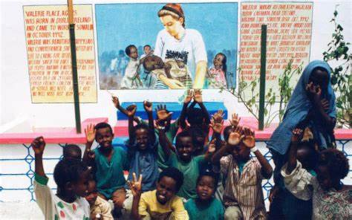
The Irish Department of Foreign Affairs founds the Valerie Place commemorative scholarship in March 1993, which brings Somali teachers and nurses to train in Ireland. In June 1997, St. James’s Hospital school of nursing unveils a portrait and a classroom dedicated to her memory. There is also a mural to Place in Mogadishu (pictured above).
Rice is born to Johnny Rice and his wife Nell (née Hayes). Her mother can sing, and her father is a master mason. Her mother’s singing brings in extra money after her father is posted overseas during World War II. She goes to Methodist College Belfast and by the age of fourteen is living in the family home with lodgers as her parents are in Africa where her father is working. She is not academic and takes only a passing interest in becoming a secretary. A school friend says that all she wants to do is draw.
The artist Gerard Dillon comes from Belfast. He helps Rice after they are introduced to each other by her piano teacher in 1951. He is friends with the painter George Campbell. They both share “an interest in bohemian characters.” She regards both Dillon and Campbell as her mentors for decades and her work is of a similar surrealistic and primitive style.
In 1956, Rice completes her first solo exhibition at the British Council in Hong Kong. She had been there since 1954 doing typing and practicing her painting. Her father is working there, and she stays in Hong Kong until the following year. When she returns, she earns money working night shifts in the BBC newsroom.
Gerard Dillon and his sister, Mollie, have a property on London‘s Abbey Road in 1958. They rent part of the house to artist Arthur Armstrong, and they rent a flat to Rice and her brother. Dillon and Rice would tour junk yards to find objects like leather and string that they include in their artwork. The house is known for its ex-pat Irish artists which also include Aidan Higgins and Gerry Keenan.
In 1963, Rice goes to the United States to exhibit, and she has to be persuaded to find time to meet President Kennedy. This is three weeks before he is killed in Dallas. In 1967, she is in Paris learning lithography and marries the German contemporary artist Haim Kern. Their child Tristran is born, and the marriage soon ends, and she leaves for Switzerland.
Rice marries again after she returns to Ireland to live in County Fermanagh. They have a daughter who is named Trasna. She exhibits twice in Belfast. In 1997, a large collaboration with Felix Anaut results in images of Adam and Eve which is prepared for a Spanish arts festival near Zaragoza. Another large commission is to decorate the shutters of Pushkin House at Baronscourt for Alexandra Hamilton, Duchess of Abercorn, in 2005.
Rice dies in County Monaghan on March 23, 2015, where she had lived for twenty years. She completes her last exhibition in 2009, over fifty years after her first in Hong Kong. She has exhibited and had her work in notable collections including the United Nations. She is noted for only creating art when she wanted to, she had never conformed, Aeneas Bonner says in her obituary “Normality was a not a close acquaintance.”
Hume does not complete his clerical studies but does obtain an M.A. degree in French and history from the college in 1958. He then returns home to his native Derry, where he becomes a teacher at his alma mater, St. Columb’s College. He is a founding member of the Credit Union movement in the city and is chair of the University for Derry Committee in 1965, an unsuccessful fight to have Northern Ireland’s second university established in Derry in the mid-1960s.
Hume becomes the youngest ever President of the Irish League of Credit Unions at age 27. He serves in the role from 1964 to 1968. He once says that “all the things I’ve been doing, it’s the thing I’m proudest of because no movement has done more good for the people of Ireland, north and south, than the credit union movement.”
Hume becomes a leading figure in the civil rights movement in the late 1960s along with people such as Hugh Logue. He is a prominent figure in the Derry Citizens’ Action Committee. The DCAC is set up in the wake of the October 5, 1968, march through Derry which had caused much attention to be drawn towards the situation in Northern Ireland. The purpose of the DCAC is to make use of the publicity surrounding recent events to bring to light grievances in Derry that had been suppressed by the Unionist Government for years. The DCAC, unlike the Northern Ireland Civil Rights Association (NICRA), is aimed specifically at a local campaign, improving the situation in Derry for everyone, and maintaining a peaceful stance. The committee also has a Stewards Association that is there to prevent any violence at marches or sit-downs.
In October 1971, Hume joins four Westminster MPs in a 48-hour hunger strike to protest at the internment without trial of hundreds of suspected Irish republicans. State papers that have been released under the 30-year rule that an Irish diplomat eight years later in 1979 believes Hume supported the return of internment.
Hume is directly involved in secret talks with the British government and Sinn Féin, in an effort to bring Sinn Féin to the discussion table openly. The talks are speculated to lead directly to the Anglo-Irish Agreement in 1985.
The vast majority of unionists reject the agreement and stage a massive and peaceful public rally in Belfast City Centre to demonstrate their distaste. Many Republicans and nationalists also reject it, as they see it as not going far enough. Hume, however, continues dialogue with both governments and Sinn Féin. The “Hume–Adams process” eventually delivers the 1994 Irish Republican Army (IRA) ceasefire which ultimately provides the relatively peaceful backdrop against which the Good Friday agreement is brokered.
In 2015, Hume is diagnosed with Alzheimer’s disease, of which he had first displayed symptoms in the late 1990s. He dies in the early hours of August 3, 2020, at a nursing home in Derry, at the age of 83. On his death, former Labour Party leader and prime ministerTony Blair says, “John Hume was a political titan; a visionary who refused to believe the future had to be the same as the past.” The Dalai Lama says on Twitter, “John Hume’s deep conviction in the power of dialogue and negotiations to resolve conflict was unwavering… It was his leadership and his faith in the power of negotiations that enabled the 1998 Good Friday Agreement to be reached. His steady persistence set an example for us all to follow.”
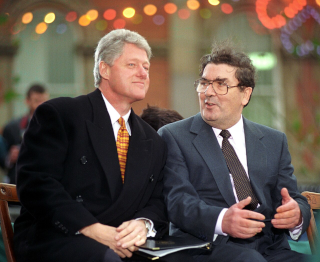
(Pictured: John Hume with U.S. President Bill Clinton in 1995)
The 32CSM has been described as the “political wing” of the now defunct Real Irish Republican Army (RIRA), but this is denied by both organisations. The group originates in a split from Sinn Féin over the Mitchell Principles.
Those present at the initial meeting are opposed to the direction taken by Sinn Féin and other mainstream republican groups in the Northern Ireland peace process, which leads to the Belfast Agreement (also known as the Good Friday Agreement) the following year. The same division in the republican movement leads to the paramilitary group now known as the Real IRA breaking away from the Provisional Irish Republican Army at around the same time.
Most of the 32CSM’s founders had been members of Sinn Féin. Some had been expelled from the party for challenging the leadership’s direction, while others felt they had not been properly able to air their concerns within Sinn Féin at the direction its leadership had taken. Bernadette Sands McKevitt, wife of Michael McKevitt and a sister of hunger strikerBobby Sands, is a prominent member of the group until a split in the organisation.
The name refers to the 32 counties of Ireland which are created during the Lordship and Kingdom of Ireland. With the partition of Ireland in 1920–22, twenty-six of these counties form the Irish Free State which is abolished in 1937 and is now known as Ireland since 1949. The remaining six counties of Northern Ireland remain part of the United Kingdom. Founder Bernadette Sands McKevitt says in a 1998 interview with the Irish Mirror that people did not fight for “peace” – “they fought for independence” – and that the organisation reaffirms to the republican position in the 1919 Irish Declaration of Independence.
Before the referendums on the 1998 Good Friday Agreement, the 32CSM lodges a legal submission with the United Nations challenging British sovereignty in Ireland. The referendums are opposed by the 32CSM but are supported by 71% of voters in Northern Ireland and by 94% in the Republic of Ireland. It is reported in February 2000 that the group established a “branch” in Kilburn, London.
In November 2005, the 32CSM launches a political initiative titled Irish Democracy, A Framework for Unity.
On May 24, 2014, Gary Donnelly, a member of the 32CSM, is elected to the Derry City and Strabane District Council. In July 2014, a delegation from the 32CSM travels to Canada to take part in a six-day speaking tour. On arrival the delegation is detained and refused entry into Canada.
In 2015, the 32CSM organises a demonstration in Dundee, Scotland, in solidarity with the men convicted of shooting Constable Stephen Carroll, the first police officer to be killed in Northern Ireland since the formation of the PSNI. The organisation says the “Craigavon Two” are innocent and have been victims of a miscarriage of justice.
The group is currently considered a Foreign Terrorist Organization (FTO) in the United States, because the group is considered to be inseparable from the Real IRA, which is designated as an FTO. At a briefing in 2001, a spokesman for the U.S. Department of State states that “evidence provided by both the British and Irish governments and open-source materials demonstrate clearly that the individuals who created the Real IRA also established these two entities to serve as the public face of the Real IRA. These alias organizations engage in propaganda and fundraising on behalf of and in collaboration with the Real IRA.” The U.S. Department of State’s designation makes it illegal for Americans to provide material support to the Real IRA, requires U.S. financial institutions to block the group’s assets and denies alleged Real IRA members visas into the U.S.
The 32CSM also operates outside of the island of Ireland to some extent. The Gaughan/Stagg Cumann covers England, Scotland and Wales, and has an active relationship of mutual promotion with a minority of British left-wing groups and anti-fascist organisations. The James Larkin Republican Flute Band in Liverpool, and the West of Scotland Band Alliance, the largest section of which is the Glasgow-based Parkhead Republican Flute Band, are also supporters of the 32CSM. As of 2014, the 32CSM’s alleged paramilitary wing, the Real IRA, is reported to have been still involved in attempts to perpetrate bombings in Britain as part of the Dissident Irish Republican campaign, which has been ongoing since 1998.
Costello is the younger son of John Costello senior, a civil servant, and Rose Callaghan. He is educated at St. Joseph’s, Fairview, and then moves to O’Connell School, for senior classes, and later attends University College Dublin (UCD), where he graduates with a degree in modern languages and law. He studies at King’s Inns to become a barrister, winning the Victoria Prize there in 1913 and 1914. He is called to the Irish Bar in 1914, and practises as a barrister until 1922.
In 1922, Costello joins the staff at the office of the Attorney General in the newly established Irish Free State. Three years later he is called to the inner bar, and the following year, 1926, he becomes Attorney General of Ireland, upon the formation of the Cumann na nGaedheal government, led by W. T. Cosgrave. While serving in this position he represents the Free State at Imperial Conferences and League of Nations meetings.
Costello is also elected a Bencher of the Honourable Society of King’s Inns. He loses his position as Attorney General of Ireland when Fianna Fáil comes to power in 1932. The following year, however, he is elected to Dáil Éireann as a Cumann na nGaedheal TD. Cumann na nGaedheal soon merges with other parties to form Fine Gael.
During the Dáil debate on the Emergency Powers Act 1939, Costello is highly critical of the Act’s arrogation of powers, stating that “We are asked not merely to give a blank cheque, but to give an uncrossed cheque to the Government.” He loses his seat at the 1943 Irish general election but regains it when Éamon de Valera calls a snap election in 1944. From 1944 to 1948, he is the Fine Gael front-bench Spokesman on External Affairs.
In 1948, Fianna Fáil has been in power for sixteen consecutive years and has been blamed for a downturn in the economy following World War II. The 1948 Irish general election results show Fianna Fáil short of a majority, but still by far the largest party, with twice as many seats as the nearest rival, Fine Gael. It appears that Fianna Fáil is headed for a seventh term in government. However, the other parties in the Dáil realise that between them, they have only one seat fewer than Fianna Fáil, and if they band together, they would be able to form a government with the support of seven Independent deputies. Fine Gael, the Labour Party, the National Labour Party, Clann na Poblachta and Clann na Talmhan join to form the first inter-partygovernment in the history of the Irish state.
While it looks as if cooperation between these parties will not be feasible, a shared opposition to Fianna Fáil and Éamon de Valera overcomes all other difficulties, and the coalition government is formed.
Since Fine Gael is the largest party in the government, it has the task of providing a suitable candidate for Taoiseach. Naturally, it is assumed that its leader, Richard Mulcahy, will be offered the post. However, he is an unacceptable choice to Clann na Poblachta and its deeply republican leader, Seán MacBride. This is due to Mulcahy’s record during the Irish Civil War. Instead, Fine Gael and Clann na Poblachta agree on Costello as a compromise candidate. Costello had never held a ministerial position nor was he involved in the Civil War. When told by Mulcahy of his nomination, Costello is appalled, content with his life as a barrister and as a part-time politician. He is persuaded to accept the nomination as Taoiseach by close non-political friends.
During the campaign, Clann na Poblachta had promised to repeal the Executive Authority (External Relations) Act 1936 but does not make an issue of this when the government is being formed. However, Costello and his Tánaiste, William Norton of the Labour Party, also dislike the act. During the summer of 1948, the cabinet discusses repealing the act, however, no firm decision is made.
In September 1948, Costello is on an official visit to Canada when a reporter asks him about the possibility of Ireland leaving the British Commonwealth. For the first time, he declares publicly that the Irish government is indeed going to repeal the External Relations Act and declare Ireland a republic. It has been suggested that this is a reaction to offence caused by the Governor General of Canada at the time, Harold Alexander, 1st Earl Alexander of Tunis, who is of Northern Irish descent and who allegedly arranges to have placed symbols of Northern Ireland in front of Costello at an official dinner. Costello makes no mention of these aspects on the second reading of the Republic of Ireland Bill on November 24 and, in his memoirs, claims that Alexander’s behaviour had in fact been perfectly civil and could have had no bearing on a decision which had already been made.
The news takes the Government of the United Kingdom and even some of Costello’s ministers by surprise. The former had not been consulted and following the declaration of the Republic in 1949, the UK passes the Ireland Act that year. This recognises the Republic of Ireland and guarantees the position of Northern Ireland within the United Kingdom for so long as a majority there want to remain in the United Kingdom. It also grants full rights to any citizens of the Republic living in the United Kingdom. Ireland leaves the Commonwealth on April 18, 1949, when The Republic of Ireland Act 1948 comes into force. Frederick Henry Boland, Secretary of the Department of External Affairs, says caustically that the affair demonstrates that “the Taoiseach has as much notion of diplomacy as I have of astrology.” The British envoy, John Maffey, 1st Baron Rugby, is equally critical of what he calls a “slipshod and amateur” move.
Many nationalists now see partition as the last obstacle on the road to total national independence. Costello tables a motion of protest against partition on May 10, 1949, without result.
In 1950, the independent-minded Minister for Health, Noël Browne, introduces the Mother and Child Scheme. The scheme would provide mothers with free maternity treatment and their children with free medical care up to the age of sixteen, which is the normal provision in other parts of Europe at that time. The bill is opposed by doctors, who fear a loss of income, and Roman Catholic bishops, who oppose the lack of means testing envisaged and fear the scheme could lead to birth control and abortion. The cabinet is divided over the issue, many feeling that the state cannot afford such a scheme priced at IR£2,000,000 annually. Costello and others in the cabinet make it clear that in the face of such opposition they will not support the Minister. Browne resigns from the government on April 11, 1951, and the scheme is dropped. He immediately publishes his correspondence with Costello and the bishops, something which had hitherto not been done. Derivatives of the Mother and Child Scheme are introduced in Public Health Acts of 1954, 1957 and 1970.
The Costello government has a number of noteworthy achievements. A new record is set in housebuilding, the Industrial Development Authority and Córas Tráchtála are established, and the Minister for Health, Noel Browne, with the then new Streptomycin, bring about an advance in the treatment of tuberculosis. Ireland also joins a number of organisations such as the Organization for European Economic Co-operation and the Council of Europe. However, the government refuses to join NATO, allegedly because the British remain in Northern Ireland. The scheme to supply electricity to even the remotest parts of Ireland is also accelerated.
While the “Mother and Child” incident does destabilise the government to some extent, it does not lead to its collapse as is generally thought. The government continues; however, prices are rising, a balance of payments crisis is looming, and two TDs withdraw their support for the government. These incidents add to the pressure on Costello and so he decides to call a general election for June 1951. The result is inconclusive but Fianna Fáil returns to power. Costello resigns as Taoiseach. It is at this election that his son Declan is elected to the Dáil.
Over the next three years while Fianna Fáil is in power a dual-leadership role of Fine Gael is taking place. While Richard Mulcahy is the leader of the party, Costello, who has proved his skill as Taoiseach, remains as parliamentary leader of the party. He resumes his practice at the Bar. In what is arguably his most celebrated case, the successful defence of The Leader against a libel action brought by the poet Patrick Kavanagh, dates from this period. Kavanagh generously praises Costello’s forensic skill, and the two men become friends.
At the 1954 Irish general election Fianna Fáil loses power. A campaign dominated by economic issues results in a Fine Gael-Labour Party-Clann na Talmhan government coming to power. Costello is elected Taoiseach for the second time.
The government can do little to change the ailing nature of Ireland’s economy, with emigration and unemployment remaining high, and external problems such as the Suez Crisis compounding the difficulty. Measures to expand the Irish economy such as export profits tax relief introduced in 1956 would take years have sizable impact. Costello’s government does have some success with Ireland becoming a member of the United Nations in 1955, and a highly successful visit to the United States in 1956, which begins the custom by which the Taoiseach visits the White House each St. Patrick’s Day to present the U.S. President with a bowl of shamrock. Although the government has a comfortable majority and seems set for a full term in office, a resumption of Irish Republican Army (IRA) activity in Northern Ireland and Great Britain causes internal strains. The government takes strong action against the republicans.
In spite of supporting the government from the backbenches, Seán MacBride, the leader of Clann na Poblachta, tables a motion of no confidence, based on the weakening state of the economy and in opposition to the government’s stance on the IRA. Fianna Fáil also tables its own motion of no confidence, and rather than face almost certain defeat, Costello again asks PresidentSeán T. O’Kelly to dissolve the Oireachtas. The general election which follows in 1957 gives Fianna Fáil an overall majority and starts another sixteen years of unbroken rule for the party. Some of his colleagues questioned the wisdom of his decision to call an election. The view is expressed that he was tired of politics and depressed by his wife’s sudden death the previous year.
Following the defeat of his government, Costello returns to the bar. In 1959, when Richard Mulcahy resigns the leadership of Fine Gael to James Dillon, he retires to the backbenches. He could have become party leader had he been willing to act in a full-time capacity. He remains as a TD until 1969, when he retires from politics, being succeeded as Fine Gael TD for Dublin South-East by Garret FitzGerald, who himself goes onto to become Taoiseach in a Fine Gael-led government.
During his career, Costello is presented with a number of awards from many universities in the United States. He is also a member of the Royal Irish Academy from 1948. In March 1975, he is made a freeman of the city of Dublin, along with his old political opponent Éamon de Valera. He practises at the bar until a short time before his death at the age of 84, in Ranelagh, Dublin, on January 5, 1976. He is buried at Dean’s Grange Cemetery in Dublin.
To seek to achieve unity among the Irish people on the issue of restoring national sovereignty and to promote the revolutionary ideals of republicanism and to this end involve itself in resisting all forms of colonialism and imperialism.
To seek the immediate and unconditional release of all Irish republican prisoners throughout the world.
The 32CSM does not contest elections but acts as a pressure group, with branches, or cumainn, organised throughout the traditional counties of Ireland. It has been described as the “political wing” of the now defunct Real Irish Republican Army (Real IRA or RIRA), but this is denied by both organisations. The group originates in a split from Sinn Féin over the Mitchell Principles.
The organisation is founded on December 7, 1997, at a meeting of like-minded Irish republicans in the Dublin suburb of Finglas. Those present are opposed to the direction taken by Sinn Féin and other mainstream republican groups in the Northern Ireland peace process, which eventually leads to the Good Friday Agreement, also known as the Belfast Agreement, the following year. The same division in the republican movement leads to the paramilitary group now known as the Real IRA breaking away from the Provisional Irish Republican Army at around the same time.
Most of the 32CSM’s founders had been members of Sinn Féin, with some having been expelled from the party for challenging the leadership’s direction, while others felt they had not been properly able to air their concerns within Sinn Féin at the direction its leadership had taken. Bernadette Sands McKevitt, wife of Michael McKevitt and a sister of hunger strikerBobby Sands, is a prominent member of the group until a split in the organisation.
The name refers to the 32 counties of Ireland which were created during the Lordship of Ireland and Kingdom of Ireland. With the partition of Ireland in 1920–22, twenty-six of these counties form the Irish Free State which is abolished in 1937 and is now known as Ireland since 1949. The remaining six counties of Northern Ireland remain part of the United Kingdom. Founder Bernadette Sands McKevitt says in a 1998 interview with The Mirror that people did not fight for “peace” – “they fought for independence” – and that the organisation reaffirms to the republican position in the 1919 Irish Declaration of Independence.
Before the referendums on the 1998 Good Friday Agreement, the 32CSM lodges a legal submission with the United Nations challenging British sovereignty in Ireland. The referendums are opposed by the 32CSM but are supported by 71% of voters in Northern Ireland and by 94% in the Republic of Ireland. It is reported in February 2000 that the group had established a “branch” in Kilburn, London.
In November 2005, the 32CSM launches a political initiative titled Irish Democracy, A Framework for Unity.
On May 24, 2014, Gary Donnelly, a member of the 32CSM, is elected to the Derry and Strabane super council. In July 2014, a delegation from the 32CSM travels to Canada to take part in a six-day speaking tour. On arrival the delegation is detained and refused entry into Canada.
In 2015, the 32CSM organises a demonstration in Dundee, Scotland, in solidarity with the men convicted of shooting Constable Stephen Carroll, the first police officer to be killed in Northern Ireland since the formation of the PSNI. The organisation says the “Craigavon Two” are innocent and are victims of a miscarriage of justice.
The 32CSM also operates outside of the island of Ireland to some extent. The Gaughan/Stagg Cumann covers England, Scotland and Wales, and has an active relationship of mutual promotion with a minority of British left-wing groups and anti-fascist organisations. The James Larkin Republican Flute Band in Liverpool and the West of Scotland Band Alliance, the largest section of which is the Glasgow-based Parkhead Republican Flute Band, are also supporters of the 32CSM. As of 2014, the 32CSM’s alleged paramilitary wing, the Real IRA, is reported to still be involved in attempts to perpetrate bombings in Britain as part of the dissident Irish republican campaign, which has been ongoing since 1998.
The 32CSM is currently considered a foreign terrorist organization (FTO) in the United States, because it is considered to be inseparable from the Real IRA, which is designated as an FTO. At a briefing in 2001, a spokesman for the U.S. Department of State states that “evidence provided by both the British and Irish governments and open-source materials demonstrate clearly that the individuals who created the Real IRA also established these two entities to serve as the public face of the Real IRA. These alias organizations engage in propaganda and fundraising on behalf of and in collaboration with the Real IRA.” The U.S. Department of State’s designation makes it illegal for Americans to provide material support to the Real IRA, requires U.S. financial institutions to block the group’s assets and denies alleged Real IRA members travel visas into the United States.
Margaret Hassan, Irish-born aid worker also known as “Madam Margaret,” is born Margaret Fitzsimons in Dalkey, County Dublin on April 18, 1945. She works in Iraq for many years until she is abducted and murdered by unidentified kidnappers in Iraq in 2004. Her remains have never been recovered.
Soon after the end of World War II Hassan’s family moves to London, where she spends most of her early life and where her younger siblings are born. At the age of 27, she marries Tahseen Ali Hassan, a 29-year-old Iraqi studying engineering in the United Kingdom. She moves to Iraq with him in 1972, where she begins work with the British Council of Baghdad, teaching English. Eventually she learns Arabic and becomes an Iraqi citizen.
During the early 1980s, Hassan becomes the assistant director of studies at the British Council, later becoming director. Meanwhile, her husband works as an economist. She remains in Baghdad during the 1991 Gulf War, although the British Council suspends operations in Iraq, and she is left jobless at the end of it.
Hassan joins humanitarian relief organisation CARE International in 1991. Sanitation, health, and nutrition become major concerns in the sanctioned Iraq. She is crucially involved in bringing leukemia medicine to child cancer victims in Iraq in 1998. She becomes a vocal critic of the United Nations restrictions. She is opposed to the United States invasion of Iraq in 2003, arguing that the Iraqis are already “living through a terrible emergency. They do not have the resources to withstand an additional crisis brought about by military action.”
By 2004, Hassan is head of Iraqi operations for CARE. Well known in many of Baghdad’s slums and other cities, she is especially interested in Iraq’s young people, whom she calls “the lost generation.” Her presence draws large crowds of locals.
Hassan is kidnapped in Baghdad on October 19, 2004, and is killed some weeks later on November 8. In a video released of her in captivity she pleads for help and begs British Prime MinisterTony Blair to remove British troops from Iraq. She adds that she does not “want to die like Mr. Bigley,” a reference to Kenneth Bigley, who had been executed in Iraq only weeks earlier.
Patients of an Iraqi hospital take to the streets in protest against the hostage takers’ actions. On October 25, between 100 and 200 Iraqis protest outside CARE’s offices in Baghdad, demanding her release. Prominent elements of the Iraqi insurgency and Iraqi political figures condemn the kidnapping and call for her release. On November 2, Al Jazeera reports that the kidnappers threatened to hand her over to the group led by Abu Musab al-Zarqawi and who is responsible for the execution of Bigley. On November 6, a statement purportedly from al-Zarqawi appears on an Islamist website calling for the release of Hassan unless the kidnappers have information she is aligned with the invading coalition. The statement cannot be authenticated and Hassan’s whereabouts in the video are unknown.
On 15 November, U.S. Marines in Fallujah uncover the body of an unidentified blonde- or grey-haired woman with her legs and arms cut off and throat slit. The body cannot be immediately identified, but is thought unlikely to be Hassan, who has brown hair. There is one other western woman known missing in Iraq at the time the body is discovered, Teresa Borcz Khalifa, a Polish-born long-time Iraqi resident. Khalifa is released by her hostage takers on November 20.
On November 16, CNN reports that CARE has issued a statement indicating that the organisation is aware of a videotape showing Hassan’s execution. Al-Jazeera reports that it has received a tape showing Hassan’s murder but is unable to confirm its authenticity. The video shows Hassan being shot with a handgun by a masked man. It is not known who is responsible for Hassan’s abduction and murder. The group holding her never identifies itself in the hostage videos.
CARE International suspends operations in Iraq because of Hassan’s kidnapping. At least eight other women kidnapped by insurgents during the conflict are released unharmed by their captors. It is unclear why Hassan, who was opposed to the war, lived in Iraq for many years, held Iraqi citizenship, was married to an Arab Muslim and spoke fluent Arabic was killed.
On May 1, 2005, three men are questioned by Iraqi police in connection with the murder. On June 5, 2006, news reports emerge that an Iraqi man by the name of Mustafa Salman al-Jubouri has been sentenced to life imprisonment for “aiding and abetting the kidnappers” but two other men are acquitted. Al-Jubouri appeals this sentence and is given a shorter imprisonment.
An Iraqi man named Ali Lutfi Jassar al-Rawi, also known as Abu Rasha, an architect from Baghdad, is arrested by Iraqi and U.S. forces in 2008 after contacting the British Embassy in Baghdad and attempting to extort 1 million dollars in return for disclosing the location of Hassan’s body. Though Jassar signs statements confessing to the charges, he pleads not guilty, stating he was forced to sign them after receiving beatings and electrical shocks during questioning.
On June 2, 2009, the Press Association reports that Jassar is given a life sentence by Baghdad’s Central Criminal Court for being involved in Hassan’s abduction and murder, and for attempting to blackmail the British Embassy. Hassan’s family welcomes the court’s decision but pleads with Jassar to tell them where her body is so they can return her to Britain for burial. On July 14, 2010, a day before Jassar is due to appear in court for retrial, it is reported that he could not be located in the prison facility where he was being held. He had been missing for a month.
Robinson describes the resources available to her office as inadequate and says there was a striking contrast between the fine words used at the annual United Nations Commission on Human Rights meeting in Geneva and the realities on the ground.
Robinson’s announcement comes as a surprise to senior staff and diplomats who had believed she might follow the example of other UN chiefs and seek a second term. Only the second person to serve in the post, she is scheduled to step down in September at the conclusion of her four-year term.
“I will continue to work wholeheartedly for human rights in the way that I know best, as an advocate,” Robinson says. “I believe that I can, at this stage, achieve more outside of the constraints that a multilateral organisation inevitably imposes.”
Robinson tells the 53-member nation commission at the start of its six-week session, “I know some will feel that I should have sought to continue working from within the United Nations and I ask them to respect my decision.”
“Racism and xenophobia, manifesting themselves through discrimination and all forms of intolerance, are the wellspring of many of the world’s conflicts,” Robinson says in her address to the commission.
The 2001 forum in Geneva focuses on alleged human rights abuses in hotspots including China, the breakaway Russian republic of Chechnya as well as the West Bank and Gaza Strip.
Robinson has been a high-profile and outspoken UN commissioner, on occasion angering governments with criticism of their human rights record. She says Secretary-General of the United Nations, Kofi Annan, had advised her to “stay an outsider” while working within the organisation in as far as she could. And this, she says, had at times made her “an awkward voice,” both for colleagues in the UN and governments. “I make no apology for this,” she adds.
O’Shea’s father, a banker, moves the family to Dublin when he is age 11. He is schooled in CBC Monkstown and is a sports fanatic playing rugby at school and a keen golfer and tennis player in Monkstown. He remains a keen fan of rugby, tennis and golf, playing tennis every Saturday and also giving opinions on Irish sports to radio and newspapers. He goes on to study Economics, English and Philosophy at University College Dublin (UCD) and has a career as a sports journalist in the Evening Press for many years after meeting Tim Pat Coogan while studying.
In 1977, O’Shea begins his charitable organisation with a 10,000 punts donation for a feeding project in Calcutta after which he founds GOAL. The charity has a major sporting backbone. John McEnroe, Pat Cash and Gordon D’Arcy are amongst the sport stars to have become “Goalies”(volunteers).
In its 36 years of operation, GOAL has distributed €790 million and has had over 1,400 volunteers. It has operated in over 50 countries worldwide. O’Shea cites watching the “Goalies” working around the world as the best part of his years involved in the charity. He believes that governments of developed countries should be far more involved in the distribution of aid.
A sometimes controversial figure, O’Shea is known for his forthright public statements, particularly when he feels political correctness is getting in the way of assisting those in need, and a hands on approach to tackling poverty related issues. He has been criticised by some in the INGO community for advocating military invasion and intervention in Sudan by the United States, UK and NATO, under the guise of humanitarian intervention. He has also been critical of perceived inaction by the UN in humanitarian crises in conflict zones and of governmental aid agencies in giving aid directly to allegedly corrupt African governments. He has advocated using private companies to provide aid and military forces to directly force aid on countries. Most other Irish Aid agencies disagree stating that every type of aid channels must be used and have described his policies as recolonisation.
In 2012, O’Shea is asked to slow down by his doctor. In November 2012, former Fianna Fáil politician, Barry Andrews, is appointed chief executive of GOAL.
O’Shea currently gives talks at NUI Galway and interpersonal skills class UCD. He has become involved with the university for a few years where he shares his story. He is an advocate for social (non-profit) entrepreneurs and tries to convince students to go down that path.
Rising from a domestic Irish political career, MacBride founds or participates in many international organisations of the 20th century, including the United Nations, the Council of Europe and Amnesty International. In addition to the Nobel Peace Prize, he receives the Lenin Peace Prize for 1975–76 and the UNESCO Silver Medal for Service in 1980.
MacBride, nevertheless, has had a violent past. His father is executed following the Easter Rising of 1916, the Irish struggle for liberation from Great Britain. He is only 13 when he joins the Irish Republican Army (IRA). He takes part in the concluding battles of the Irish War of Independence against the British before the Irish Republic is founded in 1921, and in the Irish Civil War that follows. He backs Éamon de Valera in the latter’s refusal to accept Northern Ireland‘s continuing union with England. In the 1930s, he breaks with the IRA and qualifies in law. He defends IRA prisoners in Irish prisons who had been condemned to death.
After World War II he is for a few years Minister for External Affairs for Ireland. He plays a leading part in the establishment of the Council of Europe, and in the preparation of the European Convention on Human Rights of 1950.
MacBride dies in Dublin on January 15, 1988, eleven days before his 84th birthday. He is buried in Glasnevin Cemetery in a grave with his mother and wife, who died in 1976.




 seamus dubhghaill