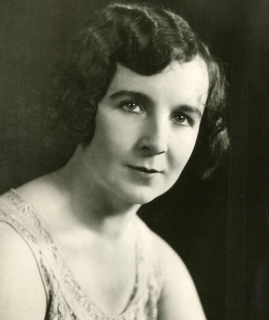
Sheridan is born in Castlebar, County Mayo, on October 15, 1889. She has her early vocal training while at school at the Dominican Convent in Eccles Street, Dublin, with additional lessons from Vincent O’Brien. In 1908, she wins a gold medal at the Feis Ceoil. From 1909 to 1911 she studies at the Royal Academy of Music in London, during which time she is introduced to the Italian inventor Guglielmo Marconi, who is instrumental in arranging further studies for her in opera in Rome.
Sheridan returns to Italy, where her career continues to grow, with performances at the Teatro Dal Verme in Milan and at the Teatro di San Carlo in Naples, primarily in Puccini roles. In 1922 she first sings at La Scala, Milan, in La Wally by Alfredo Catalani under the direction of Arturo Toscanini. For the next few years, she sings at La Scala with great success. Perhaps her greatest role is Madama Butterfly, which she sings extensively in Italy and at Covent Garden. When she plays the part of Madama Butterfly, Puccini is said to be spellbound.
Despite her successes, Sheridan’s career is short. Suffering vocal difficulties, she goes into retirement around 1930 except for a few concerts. Bríd Mahon, in her 1998 book While Green Grass Grows, states that “It was rumoured that an Italian whose overtures she had rejected had blown his brains out in a box in La Scala, Milan, while she was on stage and that after the tragedy, she never sang in public again.”
Margaret Sheridan dies in relative obscurity on April 16, 1958, having lived in Dublin for many years, and her remains are buried in Glasnevin Cemetery, Dublin.
(Pictured: Margaret Burke Sheridan meets Italian conductor Vincenzo Bellezza in London, 1938. Photograph by Erich Salomon)
Henry is the third of four sons of the Rev. Robert Mitchell Henry, minister of the Reformed Presbyterian Church, and his wife Kate Ann Berry, eldest of four daughters of Thomas Berry, minister of the Baptist church, Athlone. His father becomes a Baptist in 1858 and pastor of Great Victoria Street Baptist Church, Belfast, resigning in 1875 to join the Plymouth Brethren.
Henry marries the painter Emily Grace Mitchell on September 17, 1903, in London at St Peter’s Anglican church, Bayswater. He returns to Ireland in 1910. From then until 1919 he lives on Achill Island, where he learns to capture the peculiar interplay of light and landscape specific to the west of Ireland. In 1919, he moves to Dublin and in 1920 he is one of the founders of the Society of Dublin Painters, originally a group of ten artists. He designs several railway posters, some of which, notably Connemara Landscape, achieves considerable sales. He separates from his wife in 1929. His second wife is the artist Mabel Young.
In the 1920s and 1930s, Henry is Ireland’s best-known artist, one who has a considerable influence on the popular image of the west of Ireland. Although he seems to cease experimenting with his technique after leaving Achill and his range is limited, he creates a large body of fine images whose familiarity is a testament to its influence.
Henry’s use of colour is affected by his red-green colour blindness. He loses his sight in 1945 and does not regain his vision before his death.
A commemorative exhibition of Henry’s work is held at Trinity College, Dublin, in 1973 and the National Gallery of Ireland holds a major exhibition of his work in 2004.
A painting by Henry is featured on an episode of the BBC‘s Antiques Roadshow, broadcast on November 12, 2006. The painting is given a value of approximately £40,000–60,000 by the Roadshow. However, due to the buoyancy of the Irish art market at the time, it sells for €260,000 on December 5, 2006, in James Adams’ and Bonhams’ joint Important Irish Art sale.
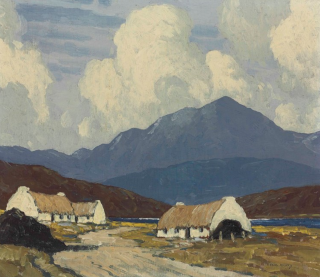
Pictured: “Roadside Cottages, below Mweelrea Mountain” by Paul Henry, RHA, oil on panel, 1940)
Kelly is raised in Ireland until he moves to England with his parents in 1969.
Kelly is an electronics student while performing part-time in the progressive/psychedelic band Chemical Alice, who releases their EPCuriouser and Curiouser in 1981. He is invited to join Marillion when they supported Chemical Alice, replacing founding keyboardist Brian Jelliman. His first performance with the band is at the Great Northern at Cambridge on December 1, 1981. He appears on every Marillion studio album. He also appears on John Wesley‘s album Under the Red and White Sky in 1994 and on Jump’s album Myth of Independence in 1995 on production and keyboards.
Kelly plays keyboards with Travis for their headlining set at the Isle of Wight Festival (June 10-12, 2005), and at T in the Park in 2005. He plays keyboards for Edison’s Children‘s new album In the Last Waking Moments…, featuring fellow Marillion member Pete Trewavas and Eric Blackwood, for the song “The ‘Other’ Other Dimension” as well as performing vocals with Steve Hogarth and Andy Ditchfield (DeeExpus) on the Edison’s Children track “The Awakening” in 2011.
Kelly is credited with inventing online crowdfunding to fund the recording of Marillion’s 2001 album Anoraknophobia, following a fan funded Marillion tour of the United States in 1997, and pioneers many of the ideas copied by other music artists since. He is made Co-CEO of the Featured Artists’ Coalition (FAC), an organization which represents the interests of music artists in the digital age. He stands down as a director of the FAC in 2018. From 2009 until 2020 he is an elected performer-director of Phonographic Performance Limited (PPL).
In 2016, Kelly is cast as a guest keyboardist in Ayreon‘s 2017 album The Source.
In September 2020, Kelly releases a single “Amelia” with his new solo band, Mark Kelly’s Marathon. The debut album is released in November 2020.
Warfield is raised in the Dublin suburb Inchicore, the second born in a family of four boys. Today, he and his wife June Warfield (née Radburn) reside in Blessington, County Wicklow.
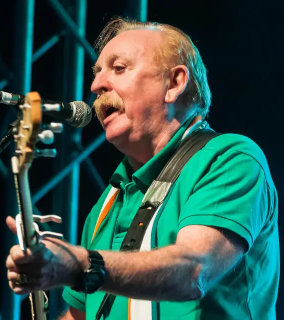
Warfield is one of the founding members and lead singers of the Irish Folk band, The Wolfe Tones. He has written many songs for the band, notably “Up and Away (The Helicopter Song),” “Irish Eyes” and “My Heart is in Ireland.” “Let the People Sing” is written in dedication to those Irish ballad singers who were banned from singing Irish songs. It has been performed by many Celtic and Irish Rebel bands, including Celtic band Charlie and the Bhoys. The song is popular among fans of Celtic F.C. and a version is performed by The Malleys, omitting the second verse, at Celtic Park on match days.
Warfield’s affiliation with Celtic F.C. leads to him being asked to write a song for the club to celebrate its 100th anniversary. As a result, “Celtic Symphony” is composed. It is a song popular with many Celtic fans, but controversial due to its chorus, which features the words “ooh, ah, up the RA.” This is often seen as being a pro-Irish Republican Army (IRA) stance, but according to Warfield, the words were included in the balladic tradition of writing what is observed at the time.
As a songwriter, Warfield’s writing is typically a social commentary on Ireland and its issues. For the 2012 album, Child of Destiny, Warfield composes “Swing A Banker,” which is a comical ballad referring to Irish bankers as chickens. The music video is recorded outside the Treasury Building in Dublin.
The Wolfe Tones continue to tour but have announced that they are set to retire in 2024, after 60 years of performing together. In addition to gigs in the United States, there will be concerts at Galway Airport, Castlebar, County Mayo, and in the 3Arena in Dublin, with the band’s final gig taking place in Belfast in October 2024.
As of January 2024, Warfield has not communicated with his brother Derek Warfield since he left The Wolfe Tones in 2001.
Mac Liammóir is born Alfred Willmore on October 25, 1899. He is born to a Protestant family living in the Kensal Green district of London.
As Alfred Willmore, he is one of the leading child actors on the English stage, in the company of Noël Coward. He appears for several seasons in Peter Pan. He studies painting at London’s Slade School of Fine Art, continuing to paint throughout his lifetime. In the 1920s he travels all over Europe. He is captivated by Irish culture and learns the Irish language which he speaks and writes fluently. He changes his name to an Irish version, presenting himself in Ireland as a descendant of Irish Catholics from Cork. Later in his life, he writes three autobiographies in Irish and translates them into English.
While acting in Ireland with the touring company of his brother-in-law Anew MacMaster, Mac Liammóir meets the man who becomes his partner and lover, Hilton Edwards. Their first meeting takes place in the Athenaeum, Enniscorthy, County Wexford. Deciding to remain in Dublin, where they live at Harcourt Terrace, the pair assists with the inaugural production of Galway‘s Irish language theatre, An Taibhdhearc. The play is Mac Liammóir’s version of the mythical story Diarmuid agus Gráinne, in which Mac Liammóir plays the lead role as Diarmuid.
Mac Liammóir and Edwards then throw themselves into their own venture, co-founding the Gate Theatre in Dublin in 1928. The Gate becomes a showcase for modern plays and design. Mac Liammóir’s set and costume designs are key elements of the Gate’s success. His many notable acting roles include Robert Emmet/The Speaker in Denis Johnston‘s The Old Lady Says “No!” and the title role in Hamlet.
In 1948, Mac Liammóir appears in the NBC television production of Great Catherine with Gertrude Lawrence. In 1951, during a break in the making of Othello, he produces Orson Welles‘s ghost-story Return to Glennascaul which is directed by Hilton Edwards. He plays Iago in Welles’s film version of Othello (1951). The following year, he goes on to play ‘Poor Tom’ in another Welles project, the TV film of King Lear (1953) for CBS.
Mac Liammóir claims when talking to Irish playwright Mary Manning, to have had a homosexual relationship with General Eoin O’Duffy, former Garda Síochána Commissioner and head of the paramilitary Blueshirts in Ireland, during the 1930s. The claim is revealed publicly by RTÉ in a documentary, The Odd Couple, broadcast in 1999. However, Mac Liammóir’s claims have not been substantiated.
Mac Liammóir’s life and artistic development are the subject of a major study by Tom Madden, The Making of an Artist. Edwards and Mac Liammóir are the subject of a biography, titled The Boys by Christopher Fitz-Simon.
Micheál Mac Liammóir dies at his and Edwards’s Dublin home, 4 Harcourt Terrace, at the age of 78 on March 6, 1978. Edwards and Mac Liammóir are buried alongside each other at St. Fintan’s Cemetery, Sutton, Dublin.
Born Alice Izabella, she is one of ten children born to grocer Moses Crowe and Therese Eglinton. From an early age, she shows an interest in the theatre, and regularly attends productions in both the Gaiety and Abbey theatres. Having completed her education, she joins a convent but soon after abandons the idea of becoming a nun. In October 1921, she enters the Abbey School of Acting. She has a career with the Abbey Theatre from 1921 to 1970.
Upon her entry to the Abbey School of Acting, Crowe makes her debut in 1921 in the play The Revolutionist, taking the lead role of Nora Mangan. She plays her last role of Miss Hatty in Grogan and the Ferret, after which she retires. During nearly five decades, she stars in many plays, some of which include The Marriage of Columbine (1921) and Juno and the Paycock (1924). Between 1931 and 1953, she appears in the Abbey Theatre productions of plays by Irish playwrightTeresa Deevy including A Disciple (1931), Katie Roche (1936, 1937, 1949, 1953), Temporal Powers (1932, 1937) and The Reapers (1930).
Also in 1964, Crowe appears in the Aldwych Theatre‘s production of Juno and the Paycock in London. She works in the Abbey for the vast majority of her career, except for when she is on a six-month tour for Peg O’ My Heart, touring Northern Ireland and England.
In 1924, when the play Grasshopper is being produced, Crowe meets her husband, Peter Judge, also known as F. J. McCormick. They are married in 1925 and the marriage produces a daughter and a son.
Rice is born to Johnny Rice and his wife Nell (née Hayes). Her mother can sing, and her father is a master mason. Her mother’s singing brings in extra money after her father is posted overseas during World War II. She goes to Methodist College Belfast and by the age of fourteen is living in the family home with lodgers as her parents are in Africa where her father is working. She is not academic and takes only a passing interest in becoming a secretary. A school friend says that all she wants to do is draw.
The artist Gerard Dillon comes from Belfast. He helps Rice after they are introduced to each other by her piano teacher in 1951. He is friends with the painter George Campbell. They both share “an interest in bohemian characters.” She regards both Dillon and Campbell as her mentors for decades and her work is of a similar surrealistic and primitive style.
In 1956, Rice completes her first solo exhibition at the British Council in Hong Kong. She had been there since 1954 doing typing and practicing her painting. Her father is working there, and she stays in Hong Kong until the following year. When she returns, she earns money working night shifts in the BBC newsroom.
Gerard Dillon and his sister, Mollie, have a property on London‘s Abbey Road in 1958. They rent part of the house to artist Arthur Armstrong, and they rent a flat to Rice and her brother. Dillon and Rice would tour junk yards to find objects like leather and string that they include in their artwork. The house is known for its ex-pat Irish artists which also include Aidan Higgins and Gerry Keenan.
In 1963, Rice goes to the United States to exhibit, and she has to be persuaded to find time to meet President Kennedy. This is three weeks before he is killed in Dallas. In 1967, she is in Paris learning lithography and marries the German contemporary artist Haim Kern. Their child Tristran is born, and the marriage soon ends, and she leaves for Switzerland.
Rice marries again after she returns to Ireland to live in County Fermanagh. They have a daughter who is named Trasna. She exhibits twice in Belfast. In 1997, a large collaboration with Felix Anaut results in images of Adam and Eve which is prepared for a Spanish arts festival near Zaragoza. Another large commission is to decorate the shutters of Pushkin House at Baronscourt for Alexandra Hamilton, Duchess of Abercorn, in 2005.
Rice dies in County Monaghan on March 23, 2015, where she had lived for twenty years. She completes her last exhibition in 2009, over fifty years after her first in Hong Kong. She has exhibited and had her work in notable collections including the United Nations. She is noted for only creating art when she wanted to, she had never conformed, Aeneas Bonner says in her obituary “Normality was a not a close acquaintance.”
In 1990, Cusack, in the role of Masha, joins two of her sisters, Niamh (as Irina) and Sorcha (as Olga), and her father, Cyril Cusack (as Chebutykin) for a well-received production of Anton Chekhov‘s tragicomedy Three Sisters in a new version by Frank McGuinness, directed by Adrian Noble at the Gate Theatre, Dublin, before transferring to the Royal Court Theatre in London. The production also features Niamh’s husband, Finbar Lynch, as Solenyi and Lesley Manville as Natasha. The production wins the three real-life sisters the Irish Life Award in 1992.
One of Cusack’s best known stage roles is Our Lady of Sligo by Sebastian Barry in 1998, in which she plays the principal role of Mai O’Hara in performances in Ireland, on Broadway and at the National Theatre. For this she wins the 1998 Evening Standard Theatre Award for Best Actress, the 1998 Critics’ Circle Theatre Award for Best Actress and her fourth Olivier Award nomination for Best Actress. In 2006-07 she stars with Rufus Sewell in Tom Stoppard‘s Rock ‘n’ Roll at the Royal Court Theatre in London which transfers to the West End and Broadway, winning Cusack her fifth Olivier Award nomination and her second Tony Award nomination.
In 2015, Cusack returns to Ireland’s Abbey Theatre, where she begins her theatre career. She appears in the world première of Mark O’Rowe‘s play Our Few and Evil Days, acting opposite long-time collaborator Ciarán Hinds. She wins the Irish Times Irish Theatre Award for Best Actress.
Cusack stars with Peter Sellers in the film Hoffman (1970). She guest stars in an episode of The Persuaders! (1971), a TV series starring Tony Curtis and Roger Moore, as Jenny Lindley, a wealthy heiress who suspects that a man claiming to be her dead brother is in fact an impostor. In 1975, she makes three appearances in the TV series Quiller as the character Roz.
Further starring roles include lead roles in Oliver’s Travels (1995), Have Your Cake and Eat It (1997) for which Cusack wins the Royal Television Society‘s RTS Award for Best Actress and Frank McGuinness’s The Hen House (1989) for BBC Television. She stars in the title role of George du Maurier‘s Trilby (1976), in an adaptation for the BBC’s Play of the Month, with Alan Badel as Svengali. She also stars in the BBC mini-series North & South (2004, from the novel by Elizabeth Gaskell) as Mrs. Thornton. She stars in the BBC sitcom Home Again (2006) and appears in the TV series Camelot (2011), which runs for one season. She has featured roles in the mini-series The Deep (2014) and the series Marcella (2016), an eight-episode murder mystery.
Along with other actresses, including Paola Dionisotti, Fiona Shaw, Juliet Stevenson and Harriet Walter, Cusack contributes to a book by Carol Rutter called Clamorous Voices: Shakespeare’s Women Today (1994). The book analyses modern acting interpretations of female Shakespearean roles.
Cusack marries British actor Jeremy Irons in 1978, and they have two sons, Samuel James and Maximilian Paul. Prior to marrying Irons, she gives birth to a son in 1967 and places the boy for adoption. In 2007, a journalist for the Irish Sunday Independent, Daniel McConnell, reveals that Cusack is the mother of left-wing general election candidate and now member of Irish parliament Richard Boyd Barrett. The two have since been reunited.
Cusack is a patron of the Burma Campaign UK, the London-based group campaigning for human rights and democracy in Burma. In 1998, she is named, along with her husband, in a list of the biggest private financial donors to the British Labour Party. In August 2010, she signs the “Irish artists’ pledge to boycott Israel” initiated by the Palestine Solidarity Campaign.
(Pictured: Sinéad Cusack reciting poetry for the British Library in October 2021)
St. John is the eldest of six children born to Tommy and Lottie Mooney. He is educated at Scoil Muire Gan Smál and Synge Street CBS. He emigrates to Ontario, Canada in 1958 where he takes what labouring jobs he can find. Within six months he meets a woman named Gert Gorman who has an electrical contracting company in the United States. She and her husband sponsor him to move to Washington, D.C., where he is able to work as an electrician. He marries his sweetheart, Susie Bourke, who is from a well-known Dublin theatrical family with links to both the Gaiety and the Olympia theatres. They have two sons, Kieron and Brian. He travels widely and becomes involved in the peace movement and the civil rights movement. He remains in the United States until 1970, returning to settle in Collins Avenue in north Dublin.
The Dublin city that St. John returns to is a changed place from the one he had grown up in and proves to be the spur that inspires his songwriting. He chooses “St. John” as his nom de plume, inspired by a middle name he had been given while at school when all the boys in his class were assigned saints’ names. In 1975, he is running a theatre in Petticoat Lane on Marlborough Street, and while fixing an alarm outside a window on the first floor, the ledge on which he is leaning gives way, resulting in a bad fall. He breaks his elbow and hip and spends six months in the hospital recuperating. It is during this time that he takes to songwriting in earnest.
St. John is an extrovert who loves people. He is a voracious reader with a particular interest in Irish history. His son Kieron recalls his father writing “The Rare Aul Times” during this recovery period and singing it to his family. The Dublin City Ramblers is the first band to cover the song, but it is Danny Doyle’s version that achieves a real breakthrough, spending eleven weeks in the Irish Singles Chart, reaching No. 1 in 1978.
In 1978, St. John writes “The Fields of Athenry,” a tale of a man exiled to Botany Bay for stealing food to feed his family during the Famine. It has been recorded by several artists, charting in the Irish Singles Chart on a number of occasions. A recording by Paddy Reilly, which is released in 1982, remains in the Irish charts for 72 weeks.
St. John pays close attention to the melding of lyric and melody and has particular form in writing memorable melodies that sound timeless, resonating deeply with listeners across all walks of life. His songs sometime express regret for the loss of old certainties, for example, the loss of Nelson’s Pillar and the Metropole Ballroom, two symbols of old Dublin, as progress makes a “city of my town.”
St. John describes his chosen craft with affection. “Songs are magic carpets. They can tell a story over and over again without boring the pants off the listener and maybe take us out of ourselves for a few moments of peaceful escapism. With easy to remember melody lines, the words can tell of times and events in our daily lives that are worth noting or remembering.”
St. John’s songbook consists of hundreds of compositions, including “The Ferryman,” “Waltzing on Borrowed Time” and “The Furey Man” and are recorded by over 2,500 artists. He is a founding member of the Irish Music Rights Organisation (IMRO) and is always generous and supportive of younger writers, some of whom he continues to mentor well into his 80s.
St. John is surprised and delighted at the affiliation that emerges between “The Fields of Athenry” and rugby and football sporting events. He is present in Croke Park in 2007 when Ireland beats England in the Six Nations, and where the song is sung three times over. It is a song often heard in Anfield in Liverpool, and at Glasgow Celtic games, and reverberates around the stadium at Chicago’s Soldier Field when Ireland beats the All Blacks on November 5, 2016.
St. John wins several awards, including the Irish Music Rights Organisation “Irish Songwriter of the Year.”
St. John lives life to the fullest, and while he suffers ill health in his later years with both diabetes and Parkinson’s disease, he never loses his zest for life. His son Kieron describes his father with affection as a man who had nine lives and lived them all to the fullest. He lives independently at home until his admission to Beaumont Hospital in Dublin. He dies peacefully there at the age of 90 on March 12, 2022. After his funeral, Paddy Reilly and Glen Hansard perform “The Fields of Athenry” at Beaumont House in Dublin as a tribute.
Ervine is born in Ballymacarrett, Belfast on December 28, 1883. He is considered to be the founding father of modern Northern Irish drama.
Although accepted to study at Trinity College, Dublin, circumstances force Ervine to leave school at the age of 15 to begin working in an insurance office.
Two years later, Ervine immigrates to London, where he discovers a love for the theatre. He begins his writing career with Mixed Marriage (1911), an Ulster tragedy, and produces three plays between 1911 and 1915. In 1915, after a meeting with William Butler Yeats in London, he becomes the director of the Abbey Theatre in Dublin. It is, however, not a happy appointment as his personality and politics clash with the management of the theatre.
Ervine then joins the Royal Dublin Fusiliers and fights in Flanders, losing a leg in the conflict. Returning home, he feels increasingly alienated by nationalism and more attracted to the unionism of his family background. He becomes a vehement detractor of the south, describing Ireland in a letter to George Bernard Shaw as brimming with “bleating Celtic Twilighters, sex-starved Daughters of the Gael, gangsters and gombeen men.”
Ervine is a distinctively Ulster orientated writer, focusing on a naturalistic portrayal of rural and urban life. His most famous and popular work amongst his Northern Irish audience is Boyd’s Shop (1936), which becomes one of the Ulster Group Theatre’s stalwart productions. The play is a classic of the homely yet sincere Ulster genre and centres around the struggles of the folk that Ervine grew up with in his grandmother’s shop on the Albertbridge Road. Ervine creates in Boyd’s Shop a template for Ulster theatre that is to dominate until the advent of Samuel Thompson‘s Over the Bridge.
Ervine’s reactionary unionism and anti-southern hatred becomes more pronounced as he ages and eclipses his more subtle characteristics and abilities as a writer. Although many of his novels and plays are at times clouded by his prejudices, they are also very often capable of tremendous feeling and humanity showing he is a writer of note.
St. John Greer Ervine dies at the age of 87 at Fitzhall, Ipling, Sussex on January 24, 1971.






 seamus dubhghaill