O’Hanrahan is the son of Richard Hanrahan, a cork cutter, and Mary Williams. His father appears to have been involved in the 1867 Fenian rising. The family moves to Carlow, County Carlow, where he is educated at Carlow Christian Brothers School and Carlow College Academy. On leaving school he works various jobs including a period alongside his father in the cork-cutting business. In 1898, he joins the Gaelic League and in 1899 founds the League’s first Carlow branch and becomes its secretary. Also in 1899 he helps found a working men’s club in Carlow. By 1903 he is in Dublin, where he is working as a proofreader for the Gaelic League printer An Cló Cumann. He publishes journalism under the by-lines “Art” and “Irish Reader” in several nationalist newspapers, including Sinn Féin and the Irish Volunteer. He is the author of two novels, A Swordsman of the Brigade (1914) and When the Norman Came (published posthumously in 1918).
In 1903, O’Hanrahan becomes involved in Maud Gonne’s and Arthur Griffith‘s campaign against the visit of King Edward VII to Ireland. The encounter with Griffith leads O’Hanrahan to join the newly formed Sinn Féin. He also becomes a member of the Irish Republican Brotherhood (IRB). In November 1913, he joins the Irish Volunteers. He is later employed as an administrator on the Volunteers headquarters staff. He is made quartermaster general of the 2nd Battalion. He and the commandant of the 2nd Battalion, Thomas MacDonagh, become close friends.
During the Easter Rising O’Hanrahan is second in command of Dublin’s 2nd Battalion under MacDonagh. He fights at Jacob’s Biscuit Factory, though the battalion sees little action other than intense sniping throughout Easter week, as the British Army largely stays clear of the impregnable factory dominating the road from Portobello Barracks on one side and Dublin Castle on the other. When the situation becomes desperate O’Hanrahan tells MacDonagh they “were inviting destruction of the factory by incendiary shells, and also of the surrounding thickly populated area.” MacDonagh orders a break-out amidst the chaos and confusion. O’Hanrahan leads “with some difficulty” the garrison out of the factory through New Bride Street gate.
O’Hanrahan is executed by firing squad on May 4, 1916 at Kilmainham Gaol. His brother, Henry O’Hanrahan, is sentenced to penal servitude for life for his role in the Easter Rising. After his execution, his mother and three sisters open a shop near Mountjoy Prison where they develop a secret line of communications between prisoners and their visitors.
Boland is born in Manchester, Lancashire, England, on October 6, 1856. His parents, Patrick Boland and Eliza Boland (née Kelly), are both Great Famine emigrants from Connacht in Ireland. His father is reputed to be a member of the IRB and his mother is a first cousin of ColonelThomas J. Kelly.
Patrick and his brothers may have been involved in the IRB campaign to rescue Kelly and Timothy Deasy from a Manchester police van. Ten-year-old Boland is believed to have been a scout for the party that attacks the van and kills a police officer. As he grows older, he becomes more involved in the movement himself.
Boland moves to Dublin in around 1881 and becomes a foreman with a company paving the streets of Smithfield, Dublin. He is transferred from the Manchester Fenians to the Dublin section. He marries Kate Woods in 1882.
Boland is awarded the Royal Humane Society‘s medal in the same year for “jumping off the Metal Bridge” to save a life.
Boland’s involvement in the Invincibles and the Phoenix Park Murders remains unclear. He works with Joe Brady and is named by informers as a member of the IRB’s Dublin Directory in 1882, while another informer names him as a member of the Invincibles and claims that he gave orders to Brady. He is questioned at Dublin Castle, but when a warrant is issued for his arrest on January 25, 1883, he and Kate had fled to New York.
Boland finds work as an engineer with De Castro & Donner, a sugar-refining company in Brooklyn. He also becomes involved in Clan na Gael and gets to know John Devoy very well. He possibly secretly returns to Ireland in 1883 as he reputedly takes part in IRB meetings that are believed to lead to the formation of the Gaelic Athletic Association (GAA). According to his grandson, Kevin Boland, he is in attendance as a member of the already established General Council at the historic meeting in Hayes’ Hotel in Thurles, County Tipperary.
Boland’s first child, Nellie, is born in the United States, while his second child, Gerald is conceived there, but is born in Manchester in May 1885.
The Boland family returns to Dublin in 1885 where Boland resumes work with the Dublin Corporation, this time directly employed and, by 1891, has been promoted from foreman to overseer. He is a leading figure in the Paviors’ Society. He is also under continuous surveillance by the police as his IRB role continues. He is named number 59 of 63 “dangerous Fenians” in the Dublin Metropolitan Police District in September 1886.
The Bolands’ third child, Harry, is born in 1887. Boland’s involvement in the nationalist movement increases and, after the split over Charles Stewart Parnell‘s leadership of the Irish Parliamentary Party (IPP), he becomes one of the main Parnellite organisers in Dublin. At Parnell’s funeral procession in 1891, he and seven colleagues head a contingent of 2,000, each wielding a camán (hurley) draped in black. He also organises the funeral of his friend Pat Nally, a former member of the IRB’s Supreme Council with whom Boland had originally conspired in Manchester.
In 1892, Boland is brought before the courts charged with keeping drink for the purposes of sale without a license. In court, he is able to show that, in fact, the premises is the new premises of the Nally Branch of the GAA and that the bar is attached to the club. The case is dismissed.
Boland is elected President of the Dublin County Committee of the GAA in 1892 and to the Dublin seat of GAA Central Council for the next two years. The Bolands have two more children, Kathleen in 1889 and Ned in 1893.
In 1894, Boland is elected to the Supreme Council of the IRB.
Boland falls ill in October 1894 with a serious brain disorder. He has received head injuries at two previous incidents. According to accounts, he is hit in the head protecting Parnell from assailants before his last trip to Wicklow and suffers a concussion. The injury also causes an undetected skull fracture. He is also involved in a bombing of the offices of the Parnell’s newspaper United Ireland in 1891 following an attempted takeover by Healyites, during which he is struck in the head.
Boland fails to recover and dies in Dublin on March 11, 1895. Around 1,500 mourners on foot follow his open hearse at his funeral. The group includes three members of parliament, eight city councillors and prominent Nationalists, including Arthur Griffith, James Bermingham and Fred Allan. He is buried at Glasnevin Cemetery, Glasnevin, County Dublin. Following his death, two funds are raised to save his wife and young family from destitution. Enough money is raised to acquire a tobacconists business for Kate Boland.
O’Hegarty is born to John and Katherine (née Hallahan) Hegarty. His parents’ families emigrate to the United States after the Great Famine, and his parents are married in Boston, Massachusetts. His father is a member of the Irish Republican Brotherhood (IRB).
O’Hegarty is educated at North Monastery CBS, where he forms an enduring friendship with Terence MacSwiney. In 1888, his father dies of tuberculosis at the age of 42. Left destitute, his mother pawns her wedding ring to pay for an advertisement looking for work, and eventually becomes a cook.
O’Hegarty serves at the main Postal Sorting Office in Mount Pleasant, London, from 1902 to 1913. Along with J. J. Walsh, he spends three years at King’s College London, studying for the Secretary’s Office. While he succeeds in his studies, Walsh does not and returns to Ireland. O’Hegarty becomes the IRB representative for South East England and joins the Gaelic League and Sinn Féin and becomes a strong advocate of the Irish language. In 1905, he is elected secretary of the local Dungannon Club, which draws in as members Robert Lynd, Herbert Hughes and George Cavan. In 1907, as Sinn Féin’s London Secretary, he approves and signs the membership card of Michael Collins, later becoming friend and mentor to Collins.
O’Hegarty has to return to Ireland for a break due to overwork in 1909 and gives up some of his work for the Gaelic League. However, he takes over as editor of the IRB publication, Irish Freedom. It is in this publication that he famously writes, concerning the visit of King George V to Ireland in 1911: “Damn your concessions, England: we want our country!” In 1912, at the height of the Playboy riots, he writes four articles entitled “Art and the Nation” in Irish Freedom, which take a very liberal and inclusionist approach to Anglo-Irish literature and art in general but invokes the wrath of many of the paper’s readers.
In 1913, he is re-posted to Queenstown (present-day Cobh) as postmaster. He continues editing nationalist newspapers such as Irish Freedom (founded in 1910 and suppressed in December 1914 on account of its seditious content) and An tÉireannach and joins the Irish Volunteers. At the outbreak of war he is moved to Shrewsbury, probably on account of his political activities. In 1915, he marries Wilhelmina “Mina” Smyth, a schoolteacher and suffragist, and is then moved to Welshpool, Montgomeryshire. In the aftermath of the 1916 Easter Rising, he is opposed to physical force. In 1918, he refuses to take the British Oath of Allegiance and resigns his position in the Post Office.
O’Hegarty feels that the Abbey Theatre is “doing good for Ireland” and supports W. B. Yeats against attacks from Arthur Griffith and like-minded Nationalists. He opposes the extremist views of D. P. Moran, who seeks a Roman Catholic Irish-speaking Ireland.
O’Hegarty is Secretary of the Irish Department of Post and Telegraphs from 1922 to 1945. He is elected a member of the Irish Academy of Letters in 1954.
O’Hegarty’s son, Seán Ó hÉigeartaigh, is a founder of the Irish-language publishing house Sáirséal agus Dill. His daughter Gráinne, a harpist, marries Senator Michael Yeats, son of W. B. Yeats.
Plunkett is educated expensively: at a primary school in Nice, making him fluent in French and Italian, then at Clongowes Wood College, and, from 1872, at Trinity College Dublin (TCD), where his generous allowance allows him to study renaissance and medieval art. He enrolls at King’s Inns in 1870 and the Middle Temple in 1874, but is not called to the bar until 1886. While there he befriends Oscar Wilde and Jeremiah O’Donovan Rossa. In 1877, he endows a university gold medal for Irish speakers and publishes a book of poems, God’s Chosen Festival, and the following year he issues a pamphlet, The Early Life of Henry Grattan. He also writes articles for magazines, editing a short-lived one, Hibernia, for eighteen months from 1882. In 1883, he donates funds and property to the nursing order of the Little Company of Mary (Blue Sisters), and on April 4, 1884, Pope Leo XIII makes him a count.
On June 26, 1884, Plunkett marries Mary Josephine Cranny (1858–1944). The couple has seven children: Philomena (Mimi) (b. 1886), Joseph (b. 1887), Mary Josephine (Moya) (b. 1889), Geraldine (b. 1891), George Oliver (b. 1894), Fiona (b. 1896), and Eoin (Jack) (b. 1897).
In 1894, Plunkett part-edits Charles O’Kelly‘s memoir The Jacobite War in Ireland. By 1900, when he publishes the standard biography Sandro Botticelli, he is supplementing his income by renewed artistic studies, which until 1923 finances his lease of Kilternan Abbey, County Dublin. His Pinelli (1908) is followed by Architecture of Dublin, and, in 1911, by his revised edition of Margaret McNair Stokes‘s Early Christian Art in Ireland. In 1907, he becomes director of the National Museum of Ireland, where he increases annual visits from 100 to 3,000.
Joseph Plunkett swears his father into the Irish Republican Brotherhood (IRB) in April 1916, sending him secretly to seek German aid and a papal blessing for the projected Easter rising. After its defeat, Plunkett is sacked by the National Museum of Ireland and deported with the countess to Oxford, and the following January he is expelled by the Royal Dublin Society (RDS). This earns him nomination as the surviving rebels’ candidate in the North Roscommon by-election. He returns to Ireland illegally on January 31, 1917, and wins the seat easily three days later. Pledging abstention from attendance at Westminster in accordance with Sinn Féin policy, he initiates a Republican Liberty League, which coalesces with similar groups such as Sinn Féin. In October this front becomes the new Sinn Féin, committed to Plunkett’s republic rather than to the “king, lords and commons“ of Arthur Griffith. Plunkett and Griffith become the new party’s vice-presidents, under Éamon de Valera.
On May 18, 1918, Plunkett is interned again. Released after Sinn Féin’s general election landslide (in which he is returned unopposed), he presides, Sinn Féin’s oldest MP, at the planning meeting for Dáil Éireann on January 17, 1919, and at its opening session on January 21. On the 22nd he is made foreign affairs minister by Cathal Brugha, an appointment reaffirmed by de Valera on April 10. He criticises his president for advocating a continuing Irish external relationship with Britain, and fails to organise an Irish foreign service. In February 1921, de Valera makes Robert Brennan his departmental secretary and a ministry takes shape, while Plunkett publishes a book of poems, Ariel. After uncontested “southern Irish“ elections to the Second Dáil, de Valera moves his implacable foreign minister from the cabinet to a tailor-made portfolio of fine arts. Plunkett’s Dante sexcentenary commemoration is overshadowed by news of the Anglo–Irish Treaty. Opposing this, Plunkett cites his oath to the republic and its martyrs including his son. He leaves his ministry on January 9, 1922.
Plunkett chairs the anti-treaty Cumann na Poblachta, which loses the June general election, though he is returned again unopposed. In the Irish Civil War the treatyites intern him and the republicans appoint him to their council of state. In the August 1923 Irish general election, his first electoral contest since 1917, the interned count tops the poll in County Roscommon. He is released in December.
When de Valera forms Fianna Fáil in 1926, Plunkett stays with Sinn Féin, and loses his deposit in the June 1927 Irish general election. A year later he publishes his last poetry collection, Eros. He runs for a new Cumann Poblachta na hÉireann in a County Galway by-election in 1936, but loses his deposit again. On December 8, 1938, with the other six surviving abstentionist Second Dáil TDs, he transfers republican sovereignty to the IRA Army Council.
Plunkett is a big man with a black beard which whitens steadily after his fiftieth birthday. He is always formally pleasant and courteous. His oratory is described by M. J. MacManus as “level, cultured tones . . . [more] used to addressing the members of a learned society than to the rough and tumble of the hustings” (The Irish Press, March 15, 1948). Theoretically and practically, he is more scholar than politician. His portrait is on display at the Royal Society of Antiquaries of Ireland (RSAI).
Plunkett dies from cancer on March 12, 1948, and is buried in Glasnevin Cemetery, survived by his children Geraldine (wife of Thomas Dillon), Fiona, and Jack. His grandson Joseph (1928–66), son of George Oliver Plunkett, inherits the title.
(From: “Plunkett, Count George Noble” by D. R. O’Connor Lysaght, Dictionary of Irish Biography, http://www.dib.ie, October 2009)
Power is born to Henry Power, a watchmaker, and Mary (née Atkins), an embroideress. He has one older brother, and one younger sister. He attends a Christian Brothersnational school in North Brunswick Street. As a child he plays in local clay brickyards and sculpts busts of his friends. After finishing his primary school education, he trains with a firm of sculptors run by Edward Smyth. In 1884, he enrolls as an evening pupil at the Dublin Metropolitan School of Art (DMSA), later attending as a full-time student from 1906 to 1911. During his time at the DMSA he is taught and strongly influenced by John Hughes, Oliver Sheppard and William Orpen. He wins a number of prizes during his time at the DMSA, including medals, three scholarships, book prizes, and the national gold medal for the best modeling of a nude figure, in Ireland, Scotland, and the Channel Islands in 1911.
Power marries Agnes Kelly in 1903. The couple has ten children, four daughters and six sons, including May and James who also become sculptors.
Power establishes his own stone-carving business in 1912 from his new home at 18 Geraldine Street, Phibsborough, Dublin. As the firm grows, it moves to premises nearby at 15 Berkeley Street from 1930. He executes a wide range of works, including monuments and architectural features in bronze, marble, and stone. Among his notable works are the figure of “Science” designed by Sheppard from the façade of the new Royal College of Science for Ireland (later Government Buildings) on Merrion Street, Dublin, carved motifs and sphinxes for the Gresham Hotel, O’Connell Street, and four statues on the dome of Christ the King church, Carndonagh, County Donegal.
Power is considered the leading Irish sculptor of the 1920s and 1930s. He is a nationalist and promotes the use of Irish materials such as limestone from Durrow and Connemara marble. He is noted for his academic realist style. He exhibits regularly with the Royal Hibernian Academy from 1906, becoming an associate member in 1911, and a full member in 1919. Among those he models sculptures for are James Stephens (1913), W. B. Yeats (1918), and Lord Dunsany (1920). Among his patrons are Oliver St. John Gogarty, and through Gogarty he is commissioned to model a number of prominent Irish nationalists. Gogarty asks him to carve a portrait of Terence MacSwiney in 1920, while MacSwiney is on hunger strike in HM Prison Brixton, London. Smuggled into the prison to do a thumbnail sketch, Power then carves a portrait in the form of a life mask.
On Gogarty’s recommendation, Power is commissioned by the Irish Free State government to create portraits of a number of leading politicians including Arthur Griffith (1922), Michael Collins (1936), and Austin Stack (1939). He is also privately commissioned to execute a portrait of Éamon de Valera in 1944. Among his monumental works are sculptures of Tom Kettle (1919) at St. Stephen’s Green, Dublin, Christ the King in Gort, County Galway, (1933), Pádraic Ó Conaire (1935) at Eyre Square, Galway, and W. B. Yeats (1939) at Sandymount Green, Dublin. He is one of the artists invited to submit designs for the new coinage of the Irish Free State in 1928.
Power dies in Dublin on July 10, 1945, following complications from a double hernia. His is buried in Glasnevin Cemetery, Dublin.
Whelan is awarded many prizes in the Royal Dublin Society (RDS) Taylor art competitions, including one in 1912 for a portrait of his sister Lena, entitled On the Moors, rendered in a strongly academic technique. In 1916, he wins the Taylor scholarship for the Royal Hibernian Academy (RHA) schools for his finest early work, The Doctor’s Visit, an adroitly executed composition of contrasting shadows and light. Typical of many of his genre interiors, the painting depicts a room in the family home, with relatives as models: Whelan’s mother sits by the bed watching over his ill cousin, while his sister, dressed in a Mater hospital nurse’s uniform, is in the background opening the door for the doctor. The subtly evoked atmosphere of restrained emotion foreshadowed a hallmark of his mature style.
Whelan exhibits annually at the RHA for forty-five years (1911–56), averaging six works per year. He is elected an RHA associate in 1920, becoming a full member in 1924. He participates in the Exposition d’art irlandais at the Galerie Barbazanges in Paris in 1922. A visiting teacher at the RHA schools in 1924, he also teaches in the DMSA for a time. He has studios at 64 Dawson Street (1914–27) and 7 Lower Baggot Street (1931–56). Beginning in the 1910s, he receives regular commissions for portraits, constituting his primary source of income. Having become the family’s main breadwinner following his parents’ deaths in the 1920s, he concentrates most of his production on this lucrative activity, portraying numerous leading figures in the spheres of politics, academia, religion, society, medicine, and law.
Situated securely in the academic tradition, in most of his portraits Whelan favours a sombre, restricted palette, with the sitter placed, in grave demeanour, against a monotone background with few accessories. In a 1943 interview he asserts that twentieth-century portraiture suffers from the drabness of modern costume, for which the artist must compensate by careful rendition of the subject’s hands. He tends to depart from his prevailing portrait style when painting women, whom he characteristically depicts in meticulously observed interiors, a notable example being his portrait of Society hostess Gladys Maccabe (c.1946; NGI).
Whelan’s commercial concentration on portraiture notwithstanding, he expresses his true talent in genre compositions, especially kitchen interiors, in which he emulates the technique of the Dutch painter Johannes Vermeer. Two of the most accomplished of these depict his sister Frances in the basement kitchen of the family home: The Kitchen Window (1927; Crawford Art Gallery, Cork) demonstrates a particularly skillful use of light, while Interior of a Kitchen (1935) is notable for the dexterous handling of objects of varied shapes and textures. His genre works include both urban and rural scenes, with a distinctive interest in portraying occupations and other activities. Gypsy (1923), an Orpenesque composition of a shawled woman in a west-of-Ireland landscape with a caravan in the background, receives wide contemporary critical acclaim. Jer (c.1925), depicting a man seated by the fire in a cottage interior, is reproduced in J. Crampton Walker’s Irish Art and Landscape (1927). The Fiddler (c.1932), a naturalistic, sensitively characterised study, is first shown at an Ulster Academy exhibition at Stranmillis, Belfast. A Kerry Cobbler is reproduced in Twelve Irish Artists (1940), introduced by Thomas Bodkin, as among the works denoting the development of a distinctively Irish school of painting.
In 1929, Whelan designs the first Irish Free State commemorative stamp, a portrait of Daniel O’Connell for the centenary of Catholic emancipation. Commissioned by the Thomas Haverty trust to paint an incident from the life of Saint Patrick for the 1932 Eucharistic Congress, he executes The Baptism by St. Patrick of Ethna the Fair and Fedelmia the Ruddy, Daughters of the Ard Rí Laoghaire, a work highly conservative in style. He rapidly completes an oil study of the papal legate, Lorenzo Lauri, also for the Eucharistic Congress. He is represented in the art competitions at the 1932 Summer Olympics in Los Angeles. His depiction of Saint Brigid, shown at the Academy of Christian Art exhibition (1940), becomes a familiar image owing to the wide circulation of reproductions.
Whelan’s political portraits are influential in creating a strong, assured image of the newly formed Irish state, and thus retain an historical significance. His posthumous portrait, The Late General Michael Collins, exhibited at the RHA in 1943 and now held in Leinster House, is an iconic, heroic image of the fallen leader. His portraits of Arthur Griffith and Kevin O’Higgins – commissioned posthumously, as is the Collins, by Fine Gael – also hang in Leinster House, while that of John A. Costello, exhibited at the RHA in 1949, is now held in the King’s Inns, Dublin. He paints two presidents, Douglas Hyde and Seán T. O’Kelly, both works currently in Áras an Uachtaráin. A portrait of Éamon de Valera, painted in 1955 when the sitter is Leader of the Opposition, is in Leinster House. In 1954, he designs a second commemorative stamp, picturing a reproduction of a portrait bust of John Henry Newman, to mark the centenary of the Catholic University of Ireland.
Whelan is elected an honorary academician of both the Ulster Academy of Arts (1931), and the Royal Ulster Academy (1950). He becomes a member of the United Arts Club in 1934. As a representative of the RHA, he sits on the board of governors of the National Gallery of Ireland for many years, and is on the advisory committee of the Municipal Gallery of Modern Art. Unmarried, he resides until his death at the Eccles Street address, with two sisters who continue to manage the family hotel. He dies on November 6, 1956, from leukemia at the Mater private nursing home in Dublin. He is buried in Glasnevin Cemetery.
(From: “Whelan, (Michael) Leo,” by Carmel Doyle, Dictionary of Irish Biography, http://www.dib.ie, October 2009)
A serious interest in poetry and literature begins to manifest itself during his years at TCD. In 1900, he makes the acquaintance of W. B. Yeats and George Moore and begins to frequent Dublin literary circles. In 1904 and 1905 he publishes several short poems in the London publication The Venture and in John Eglinton‘s journal Dana. His name also appears in print as the renegade priest Fr. Oliver Gogarty in George Moore’s 1905 novel The Lake.
In 1905, Gogarty becomes one of the founding members of Arthur Griffith‘s Sinn Féin, a non-violent political movement with a plan for Irish autonomy modeled after the Austro-Hungarian dual monarchy.
In July 1907, his first son, Oliver Duane Odysseus Gogarty, is born, and in autumn of that year he leaves for Vienna to finish the practical phase of his medical training. Returning to Dublin in 1908, he secures a post at Richmond Hospital, and shortly afterward purchases a house in Ely Place opposite George Moore. Three years later, he joins the staff of the Meath Hospital and remains there for the remainder of his medical career.
Gogarty maintains close friendships with many of the Dublin literati and continues to write poetry in the midst of his political and professional duties. He also tries his hand at playwriting, producing a slum drama in 1917 under the pseudonym “Alpha and Omega,” and two comedies in 1919 under the pseudonym “Gideon Ouseley,” all three of which are performed at the Abbey Theatre. He devotes less energy to his medical practice and more to his writing during the twenties and thirties.
With the onset of World War II, Gogarty attempts to enlist in the Royal Air Force (RAF) and the Royal Army Medical Corps (RAMC) as a doctor. He is denied on grounds of age. He then departs in September 1939 for an extended lecture tour in the United States, leaving his wife to manage Renvyle House, which has since been rebuilt as a hotel. When his return to Ireland is delayed by the war, he applies for American citizenship and eventually decides to reside permanently in the United States. Though he regularly sends letters, funds, and care-packages to his family and returns home for occasional holiday visits, he never again lives in Ireland for any extended length of time.
Gogarty suffers from heart complaints during the last few years of his life, and in September 1957 he collapses in the street on his way to dinner. He dies on September 22, 1957. His body is flown home to Ireland and buried in Cartron Church, Moyard, near Renvyle, County Galway.
(Pictured: 1911 portrait of Oliver St. John Gogarty painted by Sir William Orpen, currently housed at the Royal College of Surgeons in Ireland)
Gifford is the youngest of twelve children of Frederick and Isabella Gifford. Isabella Gifford (née Burton), is a niece of the artist Frederic William Burton, and is raised with her siblings in his household after the death of her father, Robert Nathaniel Burton, a rector, during the Great Famine.
Gifford’s parents—her father is Catholic and her mother Anglican—are married in St. George’s Church, a Church of Ireland church on the north side of Dublin, on April 27, 1872. She grows up in Rathmines and is raised as a Protestant, as are her siblings.
Gifford is educated in Alexandra College in Earlsfort Terrace. After leaving school she studies music at the Leinster House School of Music. It is her music teacher, in her teens, who first gives her her first Irish national newspaper, The Leader. She begins reading this secretly and then starts reading Arthur Griffith’s newspaper, Sinn Féin.
Gifford is a member of Inghinidhe na hÉireann, a women’s political organisation active from the 1900s. It is founded by Maud Gonne and a group of working-class and middle-class women to promote Irish culture and help to alleviate the shocking poverty of Dublin and other cities at a time when Dublin’s slums are unfavourably compared with Calcutta‘s. Gifford, who is already writing under the name “John Brennan” for Sinn Féin, is asked to write for its newspaper Bean na h-Éireann. Her articles vary from those highlighting poor treatment of women in the workplace to fashion and gardening columns, some written under the pseudonym Sorcha Ní hAnlúan.
She also works, along with her sisters, in Maud Gonne’s and Constance Markievicz‘s dinner system in St. Audoen’s Church, providing good solid dinners for children in three Dublin schools – poor Dublin schoolchildren often arrive at school without breakfast, go without a meal for the day, and if their father has been given his dinner when they arrive home, might not eat or might only have a crust of bread that night.
In 1911, Gifford is elected (as John Brennan) to the executive of the political group Sinn Féin.
Gifford is a member of Cumann na mBan (The Irish Women’s Council) from its foundation in Dublin on April 2, 1914. Its members learn first aid, drilling and signalling and rifle shooting, and serve as an unofficial messenger and backup service for the Irish Volunteers. During the fight for Irish Independence the women carry messages, store and deliver guns and run safe houses where men on the run can eat, sleep and pick up supplies.
In 1914, Gifford moves to the United States to work as a journalist. Through her connection with Padraic Colum and Mary Colum, whom she had met through her brother-in-law Thomas MacDonagh, she meets influential Irish Americans such as Thomas Addis Emmet and Irish exiles like John Devoy, and marries a Hungarian lawyer, Arpad Czira, a former prisoner of war who is said to have escaped and fled to America. Their son, Finian, is born in 1922.
Czira writes both for traditional American newspapers and for Devoy’s newspaper, TheGaelic American. She and her sister Nellie found the American branch of Cumann na mBan, and she acts as its secretary. Both sisters tour and speak about the Easter Rising and those involved. She is an active campaigner for Irish independence and against the United States joining the war against Germany, seen as a war for profit and expansion of the British Empire, and so to the disadvantage of the work for Irish independence. She helps Nora Connolly O’Brien to contact German diplomats in the United States.
In 1922, Czira returns to Ireland with her son. As a member of the Women’s Prisoners’ Defence League, she is an activist against the ill-treatment of Republican prisoners during the Irish Civil War. She continues to work as a journalist, though she is stymied in her work, as are the women of her family and many of those who had taken the anti-Free State side. In the 1950s her memoirs are published in The Irish Times, and she moves into work as a broadcaster and produces a series of historical programmes.
Douglas is the eldest of nine children of John Douglas, proprietor of John Douglas & Sons Ltd, drapers and outfitters of Wexford Street and originally of Grange, County Tyrone, and his wife, Emily, daughter of John and Mary Mitton of Gortin, Coalisland, County Tyrone. The genealogy of the Douglas family to which he belongs can be traced to Samuel Douglas of Coolhill, Killyman, County Tyrone.
Douglas attends (1895–98) a small school for Quaker children and is a boarder (1898–1902) in the Friends’ School, Lisburn. In 1902, he begins a three-year apprenticeship in his father’s business.
On February 14, 1911, Douglas marries Georgina (Ena) Culley (1883–1959), originally of Tirsogue, Lurgan, County Armagh, whom he meets during his apprenticeship. Their children are John Harold Douglas, who succeeds to the family business and replaces his father as senator, and James Arthur Douglas, who becomes a well-known architect.
From an early age Douglas is fascinated by politics and influenced by the newspapers edited by Arthur Griffith. He becomes a member of the Dublin Liberal Association, whose members for the most part are Protestanthome rulers. After the 1916 Easter Rising, with George Russell and others, who also regard themselves as neither unionists nor nationalists, he sets out to promote what they term “full dominion status” for Ireland. This paves the way for the Irish Convention (1917–18), which, however, fails to reconcile the polarised political attitudes of the time.
Douglas goes on to become a very active member of Seanad Éireann between 1922 and 1936 under the constitution he had helped to prepare. In 1922, he is elected as the first vice-chairman of the Senate. The Senate is abolished in 1936 and re-established under the terms of the 1937 Constitution of Ireland. He is again an active Senator between 1938 and 1943, and from 1944 to 1954. The topics most associated with him during his work as Senator are international refugees and the League of Nations.
For some thirty years he runs the family business, and is also a director of Aspro (Ireland) Ltd, Nugent & Cooper Ltd, Philips Lamps (Ireland) Ltd, and the Greenmount & Boyne Linen Co. Ltd. In addition, he serves as president of the Linen and Cotton Textile Manufacturers Association and as a member of the council of the Federated Union of Employers.
Thrift was born in Halifax, West Yorkshire, England, on February 28, 1870, one of at least two sons and two daughters of Henry George Thrift, civil servant, and Sarah Anne Thrift (née Smith). The family moves in his childhood to Dublin, where his father is an officer in the Inland Revenue.
He is educated at The High School, Dublin, and enters Trinity College Dublin in 1889 with a second sizarship in mathematics, and commences a highly distinguished university career, scoring firsts in several examinations and winning numerous prizes. Elected fellow in mathematics and experimental science, and in mental and moral philosophy in 1896, he becomes Erasmus Smith’s Professor of Natural and Experimental Philosophy at TCD from 1901 to 1929. He is awarded a Doctor of Science (DSc) in 1936. He is appointed Provost of Trinity College Dublin in 1937, serving until his death in 1942.
While rarely speaking on controversial issues, Thrift opposes the 1925 legislation banning divorce, which he describes as an infringement of individual and minority rights, and a betrayal of commitments made by Arthur Griffith during the Anglo-Irish Treaty debates. His capable service on various Dáil committees is recognised by his election as Leas-Ceann Comhairle (deputy speaker). A long-serving council member of the Royal Dublin Society (RDS) (1902–42), he is a commissioner of charitable donations and bequests, and financial adviser to the General Synod of the Church of Ireland. He sits on the governing boards of the Erasmus Smith schools and of the Incorporated Society for Promoting Protestant Schools in Ireland.
Thrift’s portrait is painted by Leo Whelan. He marries Etta Robinson, a daughter of C. H. Robinson, a medical doctor, and they have three sons and three daughters. He dies at the provost’s house, Trinity College Dublin, on April 23, 1942. He is buried at Mount Jerome Cemetery, Harold’s Cross, County Dublin.


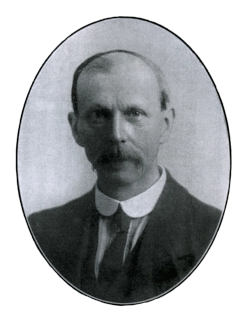
 seamus dubhghaill