Mayhew is knighted in 1983. On June 1997, he is given a life peerage as Baron Mayhew of Twysden, of Kilndown in the County of Kent. He retires from the House of Lords on June 1, 2015.
Mayhew suffers from cancer and Parkinson’s disease in his later years. He dies at the age of 86 on June 25, 2016, in his home in Kent.
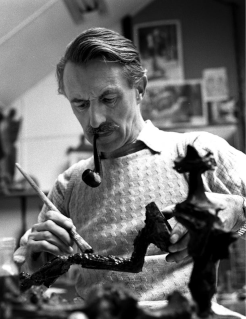
Frederick Edward McWilliamCBERA, Northern Irish surrealistsculptor, is born in Banbridge, County Down, on April 30, 1909. He works chiefly in stone, wood and bronze. His style of work consists of sculptures of the human form contorted into strange positions, often described as modern and surreal.
McWilliam is the son of Dr. William McWilliam, a local general practitioner. Growing up in Banbridge has a great influence on his work. He makes references to furniture makers such as Carson the Cooper and Proctors in his letters to his friend, Marjorie Burnett.
McWilliam attends Campbell College in Belfast and later attends Belfast College of Art from 1926. After 1928, he continues to study at the Slade School of Fine Art in London. He originally intends to become a painter, but influenced by Alfred Horace Gerrard, head of the sculpture department at the Slade, and by Henry Moore whom he meets there, he turns to sculpture. He receives the Robert Ross Leaving Scholarship which enables him and his wife, Beth (née Crowther), to travel to Paris where he visits the studio of Constantin Brâncuși.
During the first year of World War II, he joins the Royal Air Force and is stationed in England for four years where he is engaged in interpreting aerial reconnaissance photographs. He is then posted to India. While there he teaches art in the Hindu Art School in New Delhi.
After his return from India, McWilliam teaches for a year at the Chelsea School of Art. He is then invited by A. H. Gerrard to teach sculpture at the Slade. He continues in this post until 1968.
During the Northern IrelandTroubles McWilliam produces a series of bronzes in 1972 and 1973 known as Women of Belfast in response to the bombing at the Abercorn Tea-Rooms.
In 1964 McWilliam is awarded an Honorary Doctor of Letters from Queen’s University Belfast. In 1966 he is appointed CBE and in 1971 he wins the Oireachtas Gold Medal. He is represented in many public collections, including the Museum of Modern Art in New York City and Tate Britain in London. In 1984 the National Self-Portrait Gallery purchases a McWilliam self-portrait amongst acquisitions from fellow Northerners Brian Ballard, Brian Ferran and T. P. Flanagan.
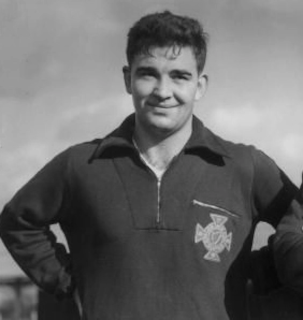
Nicholas “Nicky” Rackard, Irish hurler whose league and championship career with the Wexford senior team spans seventeen years from 1940 to 1957, is born on April 28, 1922, in Killanne, County Wexford. He establishes many championship scoring records, including being the top championship goal-scorer of all time with 59 goals. He is widely regarded as one of the greatest hurlers in the history of the game.
Rackard is the eldest son of five boys and four girls born to Robert (Bob) Rackard and Anastasia Doran, who had been married in 1918. He is introduced to sport by his father who had hoped he would become a cricketer. His uncle, John Doran, won an All-Ireland medal as a Gaelic footballer with Wexford in 1918 and it is hurling and Gaelic football that Rackard develops a talent for.
Rackard plays his club hurling with his local Rathnure club and enjoys much success. He wins his first senior county title in 1948. It was Rathnure’s first ever championship triumph. Two years later in 1950 he captures a second county title, a victory which allows him to take over the captaincy of the county senior team for the following year. He wins his third and final county medal in 1955.
Rackard makes his debut on the inter-county scene when he is selected for the Wexford minor panel. He is just out of the minor grade when he is selected for the Wexford senior team in 1940. Over the course of the next seventeen years, he wins two All-Ireland medals as part of the Wexford hurling breakthrough in 1955 and 1956. He also wins four Leinster Senior Hurling Championship medals, one National Hurling League medal and one Leinster Senior Football Championship medal as a Gaelic footballer. He plays his last game for Wexford in August 1957.
By the late 1940s, Rackard is a regular in the full-forward line on the Leinster inter-provincial team. Success comes in the twilight of his career and he claims his sole Railway Cup medal in 1956.
Rackard’s brothers, Billy and Bobby, also experience All-Ireland success with Wexford.
In retirement from playing Rackard becomes involved in team management and coaching. It is with the Wexford senior team that he enjoys his greatest successes as a selector when he helps the team secure the 1968 All-Ireland Senior Hurling Championship title.
Rackard is most famous for his scoring prowess and is the all-time top championship scorer at the time of his retirement from hurling. His private life is marred by periods of excessive drinking, which had started during his university studies, and eventually develops into alcoholism. After quitting drinking completely in 1970, he travels the country as a counsellor with Alcoholics Anonymous. In an interview in The Irish Press in 1975, he details his life as a recovering alcoholic and becomes one of the first sportspeople to break the taboo of alcoholism in Ireland.
Rackard death from cancer at St. Vincent’s Hospital in Dublin on April 10, 1976, sees a huge outpouring of grief amongst the hurling community. He is posthumously honoured by being named on the Hurling Team of the Century in 1984, however, he is sensationally omitted from the Hurling Team of the Millennium in favour of Ray Cummins. His scoring prowess has also earned him a place on the top ten list of all-time scoring greats. In 2005 the GAA further honours him by naming the Nicky Rackard Cup, the hurling competition for Division 3 teams, in his honour.
In 2006, a Wexford author, Tom Williams, writes a long-overdue biography of Rackard entitled Cuchulainn’s Son – The Story of Nickey Rackard. The same author also pens a now well-known song about Rackard many years earlier. It too is called Cuchulainn’s Son and has been recorded by various artists over the last 20 years and is a lament for the great sportsman.
In Wexford town, there is a statue to commemorate Rackard, erected in 2012.
Wilde is born in March 1815 at Kilkeevin, near Castlerea, County Roscommon, the youngest of the three sons and two daughters of a prominent local medical practitioner, Thomas Wills Wilde, and his wife, Amelia Flynne. His family are members of the Church of Ireland, and he is descended from a Dutchman, Colonel de Wilde, who came to Ireland with King William of Orange‘s invading army in 1690, and numerous Anglo-Irish ancestors. He receives his initial education at the Elphin Diocesan School in Elphin, County Roscommon. In 1832, he is bound as an apprentice to Abraham Colles, the pre-eminent Irish surgeon of the day, at Dr. Steevens’ Hospital in Dublin. He is also taught by the surgeons James Cusack and Sir Philip Crampton and the physician Sir Henry Marsh. He also studies at the private and highly respected school of anatomy, medicine, and surgery in Park Street (later Lincoln Place), Dublin. In 1837, he earns his medical degree from the Royal College of Surgeons in Ireland. In the same year, he embarks on an eight-month-cruise to the Holy Land with a recovering patient, visiting various cities and islands throughout the Mediterranean. Porpoises are flung on board the ship, Crusader, and Wilde dissects them. Taking notes, he eventually composes a two-volume book on the nursing habits of the creatures. Among the places he visits on this tour is Egypt. In a tomb he finds the mummified remains of a dwarf and salvages the torso to bring back to Ireland. He also collects embalmed ibises.
Wilde runs his own hospital, St. Mark’s Ophthalmic Hospital for Diseases of the Eye and Ear, in Dublin and is appointed to serve as Oculist-in-ordinary to Queen Victoria. At one point, he performs surgery on the father of another famous Irish dramatist, George Bernard Shaw.
Wilde had a very successful medical practice and is assisted in it by his natural son, Henry Wilson, who had been trained in Dublin, Vienna, Heidelberg, Berlin, and Paris. Wilson’s presence enables him to travel, and he visits Scandinavia, where he receives an honorary degree from Uppsala University, and is welcomed in Stockholm by Anders Retzius, among others. King Charles XV of Sweden confers on him the Nordstjärneorden (Order of the Polar Star). In 1853, he is appointed Surgeon Occulist in Ordinary to the Queen in Ireland, the first position of its kind, probably created for him.
Wilde is awarded a knighthood in a ceremony at Dublin Castle on January 28, 1864, more for his involvement with the Irish census than for his medical contributions, although he had been appointed medical commissioner to the Irish census in 1841. In 1845, he becomes editor of the Dublin Journal of Medical & Chemical Science, to which he contributes many articles.
Wilde marries the poet Jane Francesca Agnes Elgee on November 12, 1851, who writes and publishes under the pen name of Speranza. The couple has two sons, William (Willie) and Oscar, and a daughter, Isola Francesca, who dies in childhood.
In addition to his children with his wife, Wilde is the father of three children born out of wedlock before his marriage: Henry Wilson, born in 1838, and Emily and Mary Wilde, born in 1847 and 1849, respectively, of different parentage to Henry. He acknowledges paternity of his illegitimate children and provides for their education, but they are reared by his relatives rather than with his wife and legitimate children. Emily and Mary both die in 1871 following a Halloween party at which their dresses accidentally catch fire.
From 1855 until his death in 1876, Wilde lives at 1 Merrion Square, now the headquarters of American College Dublin. The building is named Oscar Wilde House after William Wilde’s son, who also lives at the address from 1855 until 1878. There is a plaque at 1 Merrion Square dedicated to him.
Wilde’s reputation suffers when Mary Travers, a long-term patient of his and the daughter of a colleague, claims that he had seduced her two years earlier. She writes a pamphlet crudely parodying Wilde and Lady Wilde as Dr. and Mrs. Quilp, and portraying Dr. Quilp as the rapist of a female patient anaesthetised under chloroform. She distributes the pamphlets outside the building where Wilde is about to give a public lecture. Lady Wilde complains to Mary’s father, Robert Travers, which results in Mary bringing a libel case against her. Mary Travers wins her case but is awarded a mere farthing in damages by the jury. Legal costs of £2,000 are awarded against Lady Wilde. The case is the talk of all Dublin, and Wilde’s refusal to enter the witness box during the trial is widely held against him as ungentlemanly behaviour.
From this time onwards, Wilde begins to withdraw from Dublin to the west of Ireland, where he had started in 1864 to build what becomes Moytura, his house overlooking Lough Corrib in Connemara, County Galway. His health deteriorates in 1875. He dies, likely of cancer, at the age of 61 on April 19, 1876. He is buried in Mount Jerome Cemetery in Dublin.
(Pictured: Sketch of William Wilde by J.H. Maguire, 1847)
Blanchflower’s first appearance in a professional game is for Manchester United on November 24, 1951, against Liverpool, away at Anfield. He becomes a regular first team player in the 1953–54 season, when he plays in 27 out of 42 league games and scores 13 goals as an inside-forward.
Blanchflower helps the club win the league title in 1956 and again in 1957. Nicknamed “Twiggy” by his teammates, he is renowned for his versatility. He begins his career as a left-half before the emergence of Duncan Edwards in this position, at which time he switches to the forward positions. The Manchester United manager, Matt Busby, recognises his intelligent positioning sense and aerial power and chooses to play him at centre-half by the 1955–56 season, with John Doherty and Billy Whelan now competing for his former position. He faces fierce competition for the solitary centre-half place due to the presence of Mark Jones. He covers in goal in the 1957 FA Cup Final while Ray Wood receives treatment for an injury suffered in a collision with Peter McParland, who scores both of Aston Villa‘s goals as United loses 2–1. Blanchflower also plays in some of United’s first European Cup fixtures.
Blanchflower scores 27 goals during his time with Manchester United, most of them during his time as a forward.
On February 6, 1958, the Manchester United team that had travelled to Belgrade for the second leg of a European cup tie have their chartered plane stop in Munich to refuel. Weather conditions cause the plane to crash when the pilot attempts to take-off from Munich airport and 23 of the 44 people on board are killed. Blanchflower is severely injured, suffering from a fractured pelvis and arms and legs, and crushed kidneys, and his right arm is nearly severed. He is in hospital for two months and, although not a Catholic, is read the last rites but survives.
Blanchflower tries to return to football, but never makes a full recovery. Doctors advise him not to return to football because of fears he would damage his kidney and, a year later, he retires from football. The Munich air disaster means that he had played his last game of football when still only 24 years old, having earned 12 caps for Northern Ireland, played well over 100 times for Manchester United and won two league championship medals.
Blanchflower marries his wife Jean in 1956 and eventually pursues studies in finance and begins a career as an accountant. He later becomes an after-dinner speaker and is a regular on the after-dinner circuits until his death from cancer on September 2, 1998. He is 65 years old, and just two weeks prior to his death he attended the Munich air disaster testimonial match at Old Trafford.
He is survived by his three children; Krista, Senior (born 1958), Laurie (born 1961) and Andrew (born 1963), as well as his wife, Jean, who dies in 2002 following a long illness.
With her distinctive, sensual mezzo soprano sound, she is an important blue-eyed soul singer and, at her peak, is one of the most successful British female performers, with six top 20 singles on the United StatesBillboard Hot 100 and sixteen on the United Kingdom Singles Chart from 1963 to 1989. She is a member of both the U.S. Rock and Roll Hall of Fame and UK Music Hall of Fame. International polls name Springfield among the best female rock artists of all time. Her image, supported by a peroxide blonde bouffant hairstyle, evening gowns, and heavy make-up, as well as her flamboyant performances on the black and white television of the 1960s, make her an icon of the Swinging Sixties.
As a fan of U.S. pop music, she brings many little-known soul singers to the attention of a wider UK record-buying audience by hosting the first national TV performance of many top-selling Motown artists beginning in 1965. Although she is never considered a Northern Soul artist in her own right, her efforts contribute a great deal to the formation of the genre.
Partly owing to these efforts, a year later she eventually becomes the best-selling female singer in the world and tops a number of popularity polls, including Melody Maker‘s Best International Vocalist. She is the first UK singer to top the New Musical Express readers’ poll for Female Singer.
To boost her credibility as a soul artist, Springfield goes to Memphis, Tennessee to record Dusty in Memphis, an album of pop and soul music with the Atlantic Records main production team. Released in 1969, it has been ranked among the greatest albums of all time by the U.S. magazine Rolling Stone and in polls by VH1 artists, New Musical Express readers, and Channel 4 viewers. The album is also awarded a spot in the Grammy Hall of Fame. Despite its current recognition, the album does not sell well and after its release Springfield experiences a career slump for several years. However, in collaboration with Pet Shop Boys, she returns to the Top 10 of the UK and U.S. charts in 1987 with “What Have I Done to Deserve This?” Two years later, she has two other UK hits on her own with “Nothing Has Been Proved” and “In Private.” Subsequently in the mid-1990s, owing to the inclusion of “Son of a Preacher Man” on the Pulp Fiction soundtrack, interest in her early output is revived.
In January 1994, while recording her penultimate album, A Very Fine Love, in Nashville, Springfield falls ill. When she returns to the UK a few months later, her physicians diagnose breast cancer. She receives months of chemotherapy and radiation treatment, and the cancer goes into remission. In 1995, in apparent good health, she sets about promoting the album, which is released that year. By mid-1996, the cancer returns, and, in spite of vigorous treatments, she dies in Henley-on-Thames on March 2, 1999. Her induction into the Rock and Roll Hall of Fame in Cleveland, Ohio, is scheduled just two weeks after her death. Her friend Elton John helps induct her into the Hall of Fame, declaring, “I’m biased but I just think she was the greatest white singer there ever has been … Every song she sang, she claimed as her own.”
Springfield is cremated and some of her ashes are buried at Henley-on-Thames, while the rest are scattered by her brother, Tom Springfield, at the Cliffs of Moher, County Clare, Ireland.
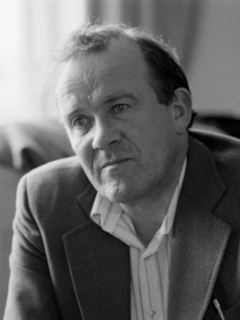
Ó hEithir’s parents are national school teachers, Pádraic Ó hEithir and Delia Ní Fhlaithearta. He is a nephew of Aran Islands authors Liam Ó Flaithearta and Tom Maidhc Ó Flaithearta, the brothers of his mother. He attends the Kilronan national school where his parents teach. He receives his secondary school education at Coláiste Éinde (St. Enda’s College), Galway. He attends University College Galway for three years, finishing his university course in 1952 but leaves without sitting his final examinations. He writes in both Irish and English and is highly regarded for the originality and liveliness of his journalism, especially his work in Irish.
Ó hEithir marries Catherine von Hildebrand, a young student recently arrived in Dublin from Colombia, in 1957 and they have five children: Ruairí, Máirín, Brian, Aindriú, and Rónán. Catherine is born in Paris, the daughter of Deirdre Mulcahy from Sligo and Franz von Hildebrand from Munich, son of the noted philosopher and theologian Dietrich von Hildebrand.
After college, Ó hEithir spends a number of years working as an itinerant bookseller for Comhdháil Náisiúnta na Gaeilge. He serves as an editor at Sáirséal agus Dill, the Irish language publishing house, and as Irish language editor for The Irish Press from 1957 to 1963. He also writes a column for The Sunday Press. He is a regular columnist with the journal Comhar and also contributes a weekly column to The Irish Times. He also serves as a staff journalist with Raidió Teilifís Éireann (RTÉ), working on the current affairs programmes Cúrsaí and Féach.
In 1975 the Irish American Cultural Institute awards Ó hEithir a scholarship of £2,000 to allow him to devote more time to writing. The following year his first novel, Lig sinn i gcathú (1976), loosely based on his student days in Galway, becomes a best-seller. He and Catherine move to Paris in 1986, where most of his second novel, Sionnach ar mo Dhuán (1988), is written. Hopes of having produced his definitive novel are soon dashed by a series of devastating reviews.
Ó hEithir visits Colombia with his wife in the summer of 1990. On his return, he is presented with the Butler literary award of $10,000 in further recognition of his writing in Irish. A month later, after a very short illness, he dies of cancer in St. Vincent’s University Hospital in Dublin on October 26, 1990. He is survived by his wife, Catherine, daughter Máirín, and sons Ruairí, Brian, and Aindriú.
Marmion is born April 1, 1858, in Dublin, the seventh of nine children of William Marmion and Herminie Marmion (née Cordier). He attends St. Laurence O’Toole’s, a primary school run by the Augustinian Fathers of John’s Lane. On January 11, 1869, he transfers to Belvedere College, where he receives an excellent grounding in Greek and Latin from the Jesuit Fathers. From there, he proceeded in January 1874 to Clonliffe College, where he remains until December 1879, when the new Archbishop of Dublin, Dr. Edward MacCabe, selects him for further theological studies in Rome.
Marmion is in Rome at the Pontifical Irish College, studying theology at the Propaganda College, for eighteen months (December 1879 – July 1881). Although invited by the authorities at Propaganda to present himself for the doctorate degree, he turns down the offer for health reasons, on account of the necessary extra year in Rome which this would entail. On returning to Dublin, he spends the first year as curate in Dundrum parish. This is followed by four years (1882–86) as professor of philosophy at Clonliffe. On October 25, 1886, he receives from the newly appointed Archbishop of Dublin, Dr. William Walsh, his dimissorial letters, granting him permission to join the Benedictine order. On November 21, 1886, he enters the newly founded BelgianMaredsous Abbey, with which, by virtue of the Benedictine vow of stability, he is to be associated for the rest of his life.
The first thirteen years of his monastic life (1886–99) are spent at Maredsous Abbey itself. After an unsuccessful start in the abbey school as a kind of housemaster to the junior boys, he finds his feet within the community through congenial work, notably the teaching of Thomistic philosophy to the junior monks. He also gradually builds up a reputation as a spiritual guide through the exercise of ministry on a small scale in the surrounding area. The next decade (1899–1909) finds him in Leuven as prior and professor of dogmatic theology at Mont César Abbey, which is founded and staffed by Maredsous. This decade provides a wide outlet for his matured spiritual doctrine through his lectures on dogmatic theology in Mont César, his retreats to priests and religious, and his private correspondence. The third and final phase of his monastic life begins when the chapter of Maredsous elects him as its third abbot in 1909.
An invitation is received from the Belgian government from December 1909 to April 1910 to undertake a Benedictine foundation in Katanga, part of the Belgian Congo. In spite of pressure from government quarters the chapter of Maredsous refuses the offer, and Marmion accepts this negative decision. In 1913 the entire community of Anglican Benedictines of Caldey Island, Wales, transfer their allegiance from Canterbury to Rome. Marmion becomes deeply involved in the spiritual and canonical process of the reception of the community into the Catholic church.
The outbreak of World War I ushers in four years of grave anxiety for Marmion. Belgium is not completely occupied but retains sovereignty over an area extending inland about twenty miles to the Ypres Salient. This enables the young monks of Maredsous, for whom Marmion had found a temporary home in Edermine, County Wexford, to travel to and from the Western Front, where they are being called up to serve as stretcher bearers in the Belgian army. He does his utmost to maintain the unity of his community between those who had remained in Maredsous and the Edermine group.
The first of Marmion’s great spiritual books, Christ, the Life of the Soul, appears in 1916, and its phenomenal success has been described as a silent plebiscite. This is followed by Christ in His Mysteries (1919), Christ the Ideal of the Monk (1922), and Sponsa Verbi (1923). The books are able to appear in rapid succession since they are compiled from his existing conference notes.
One final piece of important monastic and ecclesiastical and even political business absorbs much of Marmion’s energies, although strictly speaking it is not of his remit. His strenuous efforts to install Belgian monks in the Abbey of the Dormition on Mount Zion in Jerusalem following the internment (November 1918) of the original German Benedictine community by the victorious British forces are of no avail, the question being finally settled by the reinstallation of the German (Beuronese) monks in 1921.
Marmion dies at Maredsous on January 30, 1923, following a brief illness which originates in a chill and is aggravated by influenza.
Marmion is beatified by Pope John Paul II on September 3, 2000. This is the outcome of a popular reputation for holiness which had increased steadily since his death and the procedures for beatification prompted in 1954 by Mgr. Montini, the future Pope Paul VI. The canonical steps are: diocesan process at Namur (1957–61); examination at Rome of Marmion’s writings (1960–73); a critical biography (1987–94), written by Mark Tierney, OSB, for the Roman process on the ‘heroicity’ of Marmion’s virtues which concluded in June 1999; and finally, an inexplicable cure of cancer through Marmion’s intercession, judged as miraculous by Rome on January 25, 2000.
The originality of Marmion’s spiritual doctrine lay in his truly central emphasis on the doctrine of our adoption as the children of God in baptism. Many of his predecessors had also emphasised this doctrine, but few had made it the focus from which everything radiated and to which everything returned. The second characteristic of Marmion’s teaching, a much more personal trait, is the conviction of authenticity communicated by his writings, of the greatness of our sharing in the sonship of the Word. This makes a deep and lasting impression on the reader and gives an infinitely sacred meaning to the title ‘children of God’ and thereby to the whole of life. The third characteristic of Marmion’s teaching is the simplicity with which the deepest theological truths are presented – truths which preachers often feel their people cannot ‘take,’ and hence are left unsaid. Marmion presents these truths directly from St. John and St. Paul, and not merely in familiar extracts but in the whole sweep of their texts.
(From: “Marmion, Dom Columba” by Placid Murray, Dictionary of Irish Biography, http://www.dib.ie)
Lemass is the second of nine children born to John T. Lemass and his wife Frances (née Phelan) Lemass. He is educated at O’Connell School, where he is described as studious (his two best subjects being history and mathematics).
Lemass is persuaded to join the Irish Volunteers. He becomes a member of the A Company of the 3rd Battalion of the Dublin Brigade. The battalion adjutant is Éamon de Valera, future Taoiseach and President of Ireland. While out on a journey in the Dublin mountains during Easter 1916, he is informed of the Easter Rising that is taking place in Dublin. On April 25, Seán and his brother Noel are allowed to join the Volunteer garrison at the General Post Office (GPO). He is equipped with a shotgun and was positioned on the roof. He also is involved in fighting on Moore Street. However, the Rising ends in failure and all involved are imprisoned. He is held for a month in Richmond Barracks but, due to his age, he is released. Following this, his father wants his son to continue with his studies and be called to the Irish Bar.
Lemass opposes the establishment of the Irish Free State as a dominion under the Anglo-Irish Treaty of 1921 and becomes a member of the headquarters staff of the Irish Republican Army in the Irish Civil War (1922–23). He plays a key role in persuading de Valera to found a new republican party, Fianna Fáil, in 1926. After de Valera rises to the premiership in 1932, Lemass holds portfolios in all his cabinets for 21 of the next 27 years, notably as Minister of Industry and Commerce and then as Tánaiste.
When de Valera becomes President of Ireland in 1959, Lemass is appointed Taoiseach on June 23, 1959, on the nomination for Dáil Éireann. Under him the country takes a more outward-looking approach, and he especially presses for Ireland’s entry into the European Economic Community (EEC), now the European Communities, embedded in the European Union, and for reconciliation with Northern Ireland. His greatest legacy, Ireland’s membership in the EEC, is not secured until 1973, after his death.
In 1966, Ireland celebrates the 50th anniversary of the 1916 Easter Rising. Éamon de Valera comes within 1% of defeat in that year’s Irish presidential election, less than two months after the celebrations in which he played such a central part. On November 10, 1966, Lemass announces to the Dáil his decision to retire as Fianna Fáil leader and Taoiseach with his usual penchant for efficiency, “I have resigned.” He retires to the backbenches and remains a TD until 1969. On the day of his retirement, Jack Lynch becomes the new leader of Fianna Fáil and Taoiseach.
During the last few years of his leadership, Lemass’s health begins to deteriorate. He had been a heavy pipe smoker all his life, smoking almost a pound of tobacco a week in later life. At the time of his retirement, it is suspected that he has cancer, but this assumption is later disproved. In February 1971, while attending a rugby game at Lansdowne Road, he becomes unwell. He is rushed to hospital and is told by his doctor that one of his lungs is about to collapse.
Russell is the second son of Thomas Russell and Mary Armstrong. His father, the son of a small farmer, becomes an employee of Thomas Bell and Co., a prosperous firm of linen drapers. The family relocates to Dublin, where his father has a new offer of employment, when he is eleven years old.
Following his time at the Metropolitan School of Art, Russell becomes an accounts clerk in a drapery store but leaves in 1897 to organize agricultural cooperatives. Eventually he becomes editor of the periodicals Irish Homestead (1905–23) and The Irish Statesman (1923–30). In 1894 he publishes the first of many books of verse, Homeward: Songs by the Way, which establishes him in what is known as the Irish Literary Revival. His first volume of Collected Poems appears in 1913 and a second in 1926. He maintains a lifelong interest in theosophy, the origins of religion, and mystical experience. Candle of Vision: Autobiography of a Mystic (1918) is the best guide to his religious beliefs.
At the turn of the 20th century, Russell is considered by many to be the equal of Yeats, but he does not continue to grow and develop as Yeats does. He is prolific and versatile, but many critics find his poetry facile, vague, and monotonous, with “rather too much of the Celtic Twilight” in it.
Russell, who had become increasingly unhappy in the Irish Free State which, according to Yeats, he called “a country given over to the Devil,” moves to England soon after his wife’s death in 1932. Despite his failing health he goes on a final lecture tour in the United States but returns home utterly exhausted. He dies of cancer in Bournemouth, England, on July 17, 1935. His body is brought back to Ireland, and he is interred in Mount Jerome Cemetery, Dublin.







 seamus dubhghaill