The 860-ruling Unionist Party council had been scheduled to meet on Saturday, May 13, but postponed the session for a week to allow Trimble to broaden his support among unionists still opposed to the deal. The council is expected to vote on resuming participation in a joint executive, which had been suspended on February 11 after the Irish Republican Army (IRA) failed to initiate disarmament.
The postponement of the unionist council meeting means a scheduled restart of devolution two days later will also be postponed. Great Britain and Ireland had offered to restore the Northern Ireland Assembly and a power-sharing executive composed of unionist, nationalist and republican members by May 22.
Great Britain and Ireland are co-sponsors of the 1998 Good Friday Agreement on reconciliation between the Catholic and Protestant communities. Trimble tells news media he is ready to support a return to sharing power with Sinn Féin, the IRA’s political wing, after receiving assurances on the arms issue.
Earlier in the month, the IRA broke the stalemate with an offer to put its arms arsenals beyond use under international supervision. The IRA offer fell short of a pledge to submit its weapons to destruction, as was understood from previous talks on the issue, but both Great Britain and Ireland back the compromise and press for its acceptance by unionists and nationalists as well.
Great Britain’s Northern Ireland SecretaryPeter Mandelson describes the postponement as the “correct decision.” He says, “David Trimble has been clarifying some issues and driving a hard bargain over others. Now he needs time to present the outcome to his party.” He says he is confident that Trimble will be successful and the way will then be paved for the return to power-sharing.
However, hard-line Ulster Unionist leader Jeffrey Donaldson says he does not believe that weapons will be put beyond use. “What we actually need to know and hear from the IRA is are they going to decommission their weapons?” Donaldson, a member of the British parliament, says in a BBC interview. “We haven’t had any clarification from the IRA.”
British Prime MinisterTony Blair says in parliament on Wednesday, May 17, the IRA offer to put its weapons “beyond use” is “an important confidence-building measure” but only the start of a process of silencing the guns. “We need to make progress until the time when these weapons are indeed completely, verifiably, beyond use,” Blair says.
(From: “Unionist leader says he will back Ulster deal,” UPI Archives, http://www.upi.com/archives, May 18, 2000)
Although born in Dublin, Tynan’s family home is in Johnstown, County Kilkenny. He is born with phocomelia, causing both of his lower legs to be underdeveloped. Although now 6’4″ tall, his legs are unusually short, his feet are splayed outward, and he has three toes on each foot. He is one of a set of twins, his twin brother Edmond dying at 11 months old. At age 20, he has his legs amputated below the knee following a back injury in a car accident. The injury to his back makes it impossible for him to continue using prosthetic legs without the amputation. Within weeks of the accident, he is climbing stairs at his college dormitory on artificial legs. Within a year, he is winning in international competitions in track and field athletics. He represents Ireland in the 1984 and 1988 Summer Paralympics, winning four golds, two silvers, and one bronze medal. Between 1981 and 1984, he wins 18 gold medals from various competitions and sets 14 world records.
In the following years, Tynan becomes the first person with a disability to be admitted to the National College of Physical Education in Limerick. He works for about two years in the prosthetics industry, then goes to Trinity College, Dublin, becomes a physician specialising in Orthopedic Sports Injuries, and graduates in 1993. Encouraged to also study voice by his father Edmund, Tynan wins a series of voice competition awards and joins The Irish Tenors.
Tynan sings for George H. W. Bush at Bush’s Houston home on the day of the president’s death on November 30, 2018. The first song is “Silent Night,” while the second is a Gaelic song. Bush’s friend and former aide James Baker says that while Tynan is singing “Silent Night,” “believe it or not, the president was mouthing the words.”
While a real estate agent and prospective buyer Dr. Gabrielle Gold-von Simson are looking at an apartment in Tynan’s building on Manhattan‘s East Side, Tynan makes what is construed to be an anti-semitic remark. Shortly after this, the New York Yankees cancel Tynan’s performance of “God Bless America” for Game 1 of the 2009 American League Championship Series on October 16, 2009 because of the incident.
According to Tynan’s version of the event, two Jewish women came to view an apartment in his building. Some time afterwards, another real estate agent shows up with a potential client. The agent jokes to Tynan “at least they’re not (Boston) Red Sox fans.” Tynan replies, “As long as they’re not Jewish,” referring to the exacting women he had met earlier. The prospective client, Jewish pediatrician Dr. Gabrielle Gold-Von Simson, takes umbrage and says, “Why would you say that?” Tynan replies, “That would be scary,” and laughs, referring to the previous incident. He subsequently apologises for his remark. The Anti-Defamation League (ADL) accepts his apology. He performs at an ADL event in Manhattan soon thereafter.
Only July 4, 2010 Tynan performs “God Bless America” for the Boston Red Sox at Fenway Park with the support of some in the local Jewish community.
Rolleston is the youngest child among three sons and a daughter of Charles Rolleston-Spunner, barrister and county court judge for Tipperary, and his wife Elizabeth, daughter of John Richards, judge and baron of the Court of Exchequer, Ireland. He attends St. Columba’s College, Rathfarnham, where he is head boy, and Trinity College Dublin (TCD), graduating with an MA in 1878. His literary ambitions first emerge at university, where he wins the vice-chancellor’s prize for English verse in 1876.
In 1879 Rolleston marries Edith Caroline, daughter of Rev. William de Burgh of Naas, County Kildare. She suffers from rheumatism, and this encourages the couple to live in Germany from 1879 to 1883. During this period, he develops a fascination for German philosophy and literature and begins a correspondence with the American poet Walt Whitman, whose work he knows through Edward Dowden. In 1881 he offers to translate into German, with S. K. Knortz, Whitman’s Leaves of Grass. This is published as Grashalme in 1889. In that year he also publishes a biography of the German philosopher Gotthold Lessing, and in 1892 delivers the Taylorian Lectures at the University of Oxford on this subject.
In the meantime, Rolleston has returned to Ireland and co-founds the Dublin University Review (DUR) with Charles Hubert Oldham in February 1885. In March 1885, under their stewardship the DUR is the first to publish W. B. Yeats. The poetry of Katharine Tynan and the first English translations of Ivan Turgenev also appear in the magazine. He has a fondness for clubs and at this time is associated with the Contemporary Club, where he becomes friendly with fellow member Douglas Hyde, and the Young Ireland Society, where he is vice-president and a disciple of John O’Leary. He writes the dedication to O’Leary in Poems and ballads of Young Ireland (1888) and is encouraged by the older man in his editing of The prose writing of Thomas Davis (1890). Under O’Leary’s influence he flirts with Fenianism, perhaps even joining the Irish Republican Brotherhood (IRB) for a time and is strongly critical of the prominent involvement of Catholic clergy in the home rule movement.
After the demise of the DUR in December 1886 Rolleston moves to London but remains involved in Irish literary activity. Although unenthusiastic in his assessment of The Wanderings of Oisín (1889), he is friendly with Yeats, and they instigate the Rhymers’ Club (1890). He is a much better critic and organiser than poet but contributes to The Book of the Rhymers’ Club (1892) and The Second Book of the Rhymers’ Club (1894). His work appears in a number of contemporary journals and anthologies, and he has one collection published, Sea Spray (1909).
Rolleston is first secretary of the Irish Literary Society (1892) and attends the foundation of its sister organisation in Dublin, the National Literary Society. These societies are soon riven by a dispute for control between Yeats and Charles Gavan Duffy, centred on the political and literary agenda of the movement. Rolleston at least acquiesces in, if not actively contributes to, Yeats’s defeat. They remain on reasonable terms, but Yeats is resentful. Rolleston edits the famous anthology, Treasury of Irish Poetry (1900), with the Rev. Stopford Augustus Brooke, whose daughter, Maud, he had married in October 1897. They have four children. His first marriage also produces four children, and he is godfather to Robert Graves, whose father, Alfred Perceval Graves, is a friend.
In 1894 Rolleston returns to Dublin, becoming managing director and secretary of the Irish Industries Association (1894–7) and honorary secretary of the Arts and Crafts Society of Ireland (1898–1908). A central figure in the latter as an organiser, propagandist, and critic rather than a practitioner, lecturing regularly and editing the journal of the society, he seeks to integrate the arts and crafts revival with other contemporary developments, cooperating with the Congested Districts Board for Ireland to organise classes. He is a supporter of the co-operative movement of Horace Plunkett, and a member of the Recess Committee. On the foundation of the Department of Agriculture and Technical Instruction (DATI), he is employed by Plunkett and T. P. Gill as organiser of lectures (1900–05). In this capacity he manages the Irish historic collection at the St. Louis exhibition of 1904 and publicly supports Plunkett in his dispute with the DATI in 1908. Convinced that the development of Irish industry is central to national progress, he believes that the Irish Parliamentary Party (IPP) failed to offer a clear practical programme for Irish nationalism. By 1900, however, his own nationalism is tempered by a belief in the importance of the imperial connection, and he opposes the pro-Boer stance taken by many Irish nationalists. In later years he publishes pamphlets urging economic development as a means of quelling Irish demands for home rule.
Rolleston is a sporadic member of the Gaelic League, writing the lyrics for the ‘Deirdre cantata,’ which wins first prize at the first Feis Ceoil in Dublin in 1897. At one point he suggests the foundation of a separate Gaelic League for Protestants and provokes controversy in 1896 by suggesting that scientific ideas cannot be represented in the Irish language. Later, he concedes that he is wrong. In 1909 he settles in London when offered the job of editor of the German language and literature section of The Times Literary Supplement, a position he holds until his death. He reinvolves himself in the Irish Literary Society and publishes a number of volumes based on Irish myth, including the influential Myths and Legends of the Celtic Race (1911), and Richard Wagner‘s Der Ring des Nibelungen. He is a founder of the India Society of London (1910). During the World War I he is librarian for the ministry of information and utilises his knowledge of Irish in the Obscure Languages section of the censor’s department.
Like many involved in cultural activities at this time Rolleston is satirised by George Moore in Hail and Farewell, but he remains very friendly with Moore, who dedicates the 1920 edition of Esther Waters to him. Rolleston dies suddenly on December 5, 1920, at his home in Hampstead, London. His widow donates many of his books to Cork Public Library.
(From: “Rolleston, Thomas William Hazen (T. W.)” contributed by William Murphy, Dictionary of Irish Biography, http://www.dib.ie)
Kearney is the third daughter of farmer Michael Kearney and Teresa Kearney. Three months prior to her birth, her father dies in an accident. Following his death, her mother remarries and has three more children. When she is ten years old, her mother dies. Her maternal grandmother, Grannie Grenell, then raises her in Curranstown, County Wicklow. Grannie Grenell has a profound impact on her spiritual beliefs and deep faith. When she is 17, Grannie Grenell dies.
Kearney attends the local convent school in Arklow following her mother’s death. In 1889, following her grandmother’s death, she goes to convent of Mercy at Rathdrum, to train as an assistant teacher. She does not have the finances to pay for training, and becomes a Junior Assistant Mistress. A year later, she goes to teach in a school run by the Sisters of Charity in Essex.
Following the death of her grandmother, Kearney turns toward thoughts of religious life. She believes that God is calling her to be a sister, and she applies for admission to the Franciscan Missionary Sisters of the Five Wounds at Mill Hill, London. In 1895, she enters the St. Mary’s Abbey, Mill Hill. On April 21, 1898 she takes the name Sister Mary Kevin of the Sacred Passion. Her motto is “For Thee, Lord.” She volunteers to work with African Americans in London. She waits three years for a posting to the American mission, but when the call from a foreign mission comes, it comes from Africa.
On December 3, 1902, Kearney and five other sisters leave London for Nsambya, Uganda. They are chosen at the request of Bishop Henry Hanlon of the Mill Hill Fathers. The sisters arrive on January 15, 1903 and establish a dispensary and school in the Buganda. Their task is to care for the women and girls and to further weaken the association of Catholicism with French missionaries and Protestantism with British missionaries in the then British Protectorate. Among the sisters are three Irish, one American, one English, and one Scottish woman.
Kearney starts her first clinic under a mango tree near the convent. The first seven years of missionary work are tough for the sisters. Various diseases, from smallpox to malaria, ravage Buganda. The infant mortality rate is also relatively high due to the high frequency of maternal deaths. In 1906, she expands the missionary and sets up a hospital in Nagalama, twenty-three miles away. She is appointed the new superior of the convent following Sister Paul’s illness and return to the United States in 1910. In 1913, three more sisters arrive, which allows her to establish a third mission station in Kamuli, Busoga. All three stations focus on medicine and education for the local population with a focus on primary and secondary education, training of nurses, and the founding of clinics, hospitals and orphanages.
During World War I, the Nsambya Hospital is used to treat the Native Carrier Corp, porters for European troops. At times, Kearney is outraged by the treatment Europeans give to the African porters. She works to uphold the rights of African people caught up in the European war. On December 25, 1918 she is awarded the Member of Order of the British Empire (MBE) for her services to the wounded during the war years.
Kearney is credited for promoting higher education in Catholic African women in her mission. In 1923, she founds the Little Sisters of St. Francis, a community of African nuns for teaching and nursing. This program starts with only eight local girls. A year later, she and Dr. Evelyn Connolly, a lay missionary, found a nursing and midwifery school in Nsambya. Their goal is to promote the education of women throughout Uganda.
In September 1928, Kearney returns to England to establish a novitiate exclusively for training sisters for African missions. The novitiate is officially opened in 1929 in Holme Hall, Yorkshire. Many women from England, Scotland and Ireland travel to Holme Hall to assist the missionary efforts. This creates a shortage for the Mill Hill Fathers, who also need sisters for their school in England and American missions. Upon realization of this divide, Kearney and the Mill Hill Fathers break off from each other. On June 9, 1952 she founds the new congregation of the Franciscan Missionary Sisters for Africa. She is appointed the first superior general. Mount Oliver, Dundalk, becomes the motherhouse for this new congregation. With the formation of the FMSA, she expands the missionary work to Uganda, Kenya, Zambia, the United States, Scotland, and South Africa.
Kearney retires in 1955 at age 80. During retirement, she is appointed Superior of a convent in Boston, Massachusetts and raises funds for African projects. She travels and talks to donors to garner support for projects in Africa.
On October 17, 1957, Kearney dies at the age of 82 in Brighton, Massachusetts. Her remains are flown to Ireland and buried at Mount Oliver. Ugandan Catholics rally to have her body flown to Uganda to be buried. On December 3, 1957, her body is buried in the cemetery at Nkokonjeru, the motherhouse of the Little Sisters of St. Francis.
Kearney’s legacy is evident today. In Uganda, the word Kevina means “hospital” or “charitable institute.” The Mother Kevin Postgraduate Medical School is named after her. The Little Sisters of St. Francis has over 500 members throughout Africa, while the Franciscan Missionary Sisters for Africa currently works in Uganda, Kenya, Zambia, Zimbabwe, and South Africa.
Finucane contributes humanitarian aid during the Nigerian Civil War (also known as the “Nigerian-Biafran War”), from 1967 to 1970. The Nigerian government had blocked food supplies to the successionist state of Biafra causing starvation in the country. This is reported on international television stations and receives worldwide condemnation.
In an effort to save the population from starvation, Finucane organizes food to be sent through makeshift airstrips, including one at Uli, Bafaria, and cargo trips with other Dublin-based workers. This leads to the formation of the organisation Concern Worldwide in 1968. He works with Concern for 41 years and views his mission as “love in action.”
Finucane dies of cancer at the age of 77 on October 6, 2009, in a Dublin Spiritan Fathers’ nursing home in Kimmage Manor. His funeral is held at the Church of the Holy Spirit, Kimmage and is attended by hundreds. The Minister for Foreign Affairs, Micheál Martin, and Minister for Overseas Development, Peter Power, dub him as a “tireless force for good across the globe for more than four decades.” He is buried at Dardistown Cemetery, in the Spiritan plot.
Finucane’s biography, Aengus Finucane: In the Heart of Concern, written by Deirdre Purcell is published by New Island Books in January 2015.
Emmet is a son of Dr. Robert Emmet from County Tipperary (later to become State Physician of Ireland) and Elizabeth Mason of County Kerry, both of whose portraits are today displayed at Cork’s Crawford Art Gallery. He is the elder brother of Robert Emmet, who is executed for leading the Irish Rebellion of 1803, becoming one of Ireland’s most famous republican martyrs. His sister, Mary Anne Holmes, holds similar political beliefs.
Emmet is a man of liberal political sympathies and becomes involved with a campaign to extend the democratic franchise for the Irish Parliament and to end discrimination against Catholics. He is called to the Irish bar in 1790 and quickly obtains a practice, principally as counsel for prisoners charged with political offenses. He also becomes the legal adviser of the Society of the United Irishmen.
When the Dublin Corporation issues a declaration of support of the Protestant Ascendancy in 1792, the response of the United Irishmen is their nonsectarian manifesto which is largely drawn up by Emmet. In 1795 he formally takes the oath of the United Irishmen, becoming secretary in the same year and a member of the executive in 1797. As by this time the United Irishmen had been declared illegal and driven underground, any efforts at peaceful reform of government and Catholic emancipation in Ireland are abandoned as futile, and their goal is now the creation of a non-sectarian Irish republic, independent from Britain and to be achieved by armed rebellion. Although Emmet supports this policy, he believes that the rebellion should not commence until French aid has arrived, differing from more radical members such as Lord Edward FitzGerald.
British intelligence infiltrates the United Irishmen and manages to arrest most of their leaders on the eve of the rebellion. Though not among those taken at the house of Oliver Bond on March 12, 1798, Emmet is arrested about the same time and is one of the leaders imprisoned initially at Kilmainham Gaol and later in Scotland at Fort George until 1802. Upon his release he goes to Brussels where he is visited by his brother Robert in October 1802 and is informed of the preparations for a fresh rising in Ireland in conjunction with French aid. However, at that stage France and Britain are briefly at peace, and the Emmets’ pleas for help are turned down by Napoleon.
Emmet receives news of the failure of his brother’s rising in July 1803 in Paris, where he is in communication with Napoleon Bonaparte. He then emigrates to the United States and joins the New York bar where he obtains a lucrative practice.
After the death of Matthias B. Hildreth, Emmet is appointed New York State Attorney General in August 1812 but is removed from office in February 1813 when the opposing Federalist Party obtains a majority in the Council of Appointment.
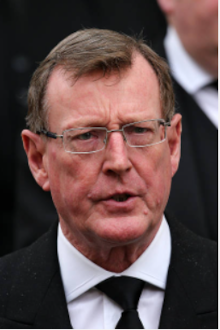
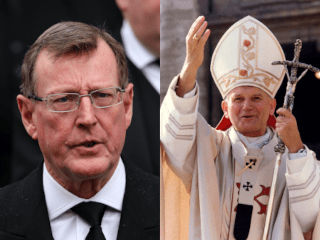
David Trimble becomes the first Ulster Unionist leader to meet a Pope when his historic meeting with John Paul II takes place in Rome on April 21, 1999. The meeting is widely welcomed as a sign that old prejudices are ending but Trimble is hotly criticised by both Protestants and Catholics in his Upper Bann constituency.
The First Minister is one of 54 Nobel Peace Prizelaureates who meets Pope John Paul II briefly at the Vatican, as part of a two-day trip organised by former Russian leader Mikhail Gorbachev. The Nobel Prize winners meet the Pope as a group and are then introduced and shake hands individually. There is a group photograph but no filming of the event. Careful stage-management ensures there are no public photographs of the two men close together.
A spokesman for Trimble says the UUP leader told the Pope he hopes this will be the year when peace will be secured in Northern Ireland. The Pope recalls his visit to Ireland and says murder cannot be condoned or called by another name.
Although the meeting is welcomed on both sides of the North divide, it does little to enhance Trimble’s standing in Upper Bann, particularly in troubled Portadown. In Portadown’s loyalist estates, there is open hostility toward Trimble. Many residents accusing their MP of “putting his personal status above the interests of his constituents.” The response is typified by one angry woman who says, “The loyalist people of this town and Drumcree, put David Trimble into office. Now he has turned his back on us. That’s a fatal mistake, this town and Drumcree will now destroy Trimble.”
“It’s unbelievable that this meeting is actually taking place,” says Orangeman Ivor Young. “It totally contradicts the oath that David Trimble took when he joined the Orange Order. We all knew Trimble was a traitor, this latest escapade puts the final nail in his political coffin here in Upper Bann. There is no way that he will ever be elected here again.”
Trimble also comes in for further criticism from Portadown Orange District, whose Drumcree protest has continued for the past 288 days. David Jones, the District’s press officer says that the people of Portadown once again see their local MP on “a world stage,” instead of being involved locally. “There are a lot of people around Portadown who aren’t very impressed that David Trimble has gone off to meet the Pope and hasn’t got more involved in trying to get the situation here solved,” says Jones.
On Portadown’s Garvaghy Road, Catholics are also critical of Trimble’s visit to Rome. “It’s amazing how he can travel to Rome to meet and talk to strangers,” says one nationalist resident, “yet he can’t be bothered to travel less than 30 miles to meet us, to talk about the serious issues that confront this community. After all we are as much his constituents as are the loyalists in this town.”
The meeting is the first time that the First Minister of Northern Ireland or the head of the Ulster Unionist Party has met the Pope in Rome. It also represents a rare appearance by an Orangeman at the heart of the Roman Catholic Church. Trimble and his entourage meet the Pope in the sumptuous surroundings of the Consistory Hall, the same room where the Cardinals of the Church gather to advise the Pope.
Earlier in the morning Trimble says in an interview with the Vatican radio that besides giving an update on developments in Northern Ireland, he wishes to “express to his Holiness the Pope that he and the Church will do what it can to persuade the paramilitaries to commit themselves irrevocably to peaceful means.”
Lawless, a Catholic, is the confidant of Lord Edward FitzGerald, and Professor of Anatomy and Physiology in the Royal College of Surgeons in Ireland, Dublin. Closely connected with John Sheares in the direction of affairs in the spring of 1798, a warrant for his arrest is issued on May 20 with a reward of £300. Timely notice is, however, given him of the fact by Mr. Stewart, the Surgeon-General, and he escapes to France, where his abilities and spirit recommend him to the special favour of Napoleon. While in Paris, he spends time with other United Irishmen in exile, including Myles Byrne and William James MacNeven.
Lawless is placed on half-pay in 1800, but in 1803 is appointed captain of the Irish Legion, and in July 1806 is ordered to Vlissingen, then besieged by the English, to command the Irish battalion. To reach his post he has to pass in a small open boat through the English fleet. He is dangerously wounded in a sortie, and when General Monet capitulates without stipulating for the treatment of the Irish as prisoners of war, Lawless escapes from the town with the eagle of his regiment, conceals himself for two months in a doctor’s house, and at length finds an opportunity of getting to Antwerp by night in a fishing boat. MarshallJean Baptiste Jules Bernadotte welcomes him, extols him in general orders, and reports his exploits to Napoleon, who summons him to Paris, decorates him with the Legion of Honour, and promotes him to be lieutenant-colonel. In 1812 he gains a colonelcy, and on August 21, 1813, he loses a leg at the Battle of Dresden. He retires to his country house in Tours.
After the restoration of the Bourbons, Lawless is returned, in October 1814, to half-pay with the rank of brigadier general. He dies in Paris at the age of 52 on December 25, 1824. His remains are buried at Père Lachaise Cemetery in Paris. He is one of the best officers of the last large French unit of The Wild Geese. Thomas Moore describes him as “a person of that mild and quiet exterior which is usually found to accompany the most determined spirit.”
(Pictured: Gravesite of General William Lawless in Père Lachaise Cemetery in Paris, France)
After some years as curate at St. Paul’s Church in Dublin, Murray is transferred to Arklow and is there in 1798 when the rebellion breaks out. The yeomanry shoots the parish priest in bed and Murray, to escape a similar fate, flees to the city where for two years he serves as curate at St. Andrew’s Chapel on Hawkins Street. As a preacher, he is said to be particularly effective, especially in appeals for charitable causes, such as the schools. He is then assigned to the Chapel of St. Mary in Upper Liffey Street where Archbishop John Troy is the parish priest.
Murray is an uncompromising opponent of a proposal granting the British government a “veto” over Catholic ecclesiastical appointments in Ireland, and in 1814 and 1815, makes two separate trips to Rome concerning the controversy.
Murray becomes Archbishop of Dublin in 1825 and on November 14, 1825, celebrates the completion of St. Mary’s Pro-Cathedral. He enjoys the confidence of successive popes and is held in high respect by the British government. His life is mainly devoted to ecclesiastical affairs, the establishment and organisation of religious associations for the education and relief of the poor. With the outbreak of cholera in the 1830s, in 1834 he and Mother Aikenhead found St. Vincent’s Hospital. He persuades Edmund Rice to send members of the Christian Brothers to Dublin to start a school for boys. The first is opened in a lumber yard on the city-quay. He assists Catherine McAuley in founding the Sisters of Mercy, and in 1831 professes the first three members.
Edward Bouverie Pusey has an interview with Murray in 1841, and bears testimony to his moderation, and John Henry Newman has some correspondence with him prior to Newman’s conversion from the Anglican Church to the Roman Catholic Church in 1845. A seat in the privy council at Dublin, officially offered to him in 1846, is not accepted. He takes part in the synod of the Roman Catholic clergy at Thurles in 1850.
Towards the end of his life, Murray’s eyesight is impaired, and he reads and writes with difficulty. Among his last priestly functions is a funeral service for Richard Lalor Sheil who had died in Italy, and whose body had been brought back to Ireland for burial. Murray dies in Dublin on February 26, 1852, at the age of eighty-four. He is interred in the St. Mary’s Pro-Cathedral, Dublin, where a marble statue of him has been erected in connection with a monument to his memory, executed by James Farrell, president of the Royal Hibernian Academy of Fine Arts.
(Pictured: Portrait of Daniel Murray, Archbishop of Dublin, by unknown 19th century Irish portrait painter)
Hopkirk is raised as a Catholic, and educated at Clongowes Wood College in County Kildare from 1945 to 1949 before attending Trinity College, Dublin until 1953. His academic career, however, is held back by his dyslexia. He first learns the basics of car control at the age of nine, when a local clergyman leaves him his invalid carriage in his will. He later graduates to a motorcycle with a sidecar, which is added at the insistence of his father who feels it would be safer, and upon attending Trinity to study engineering, acquires an Austin 7 “Chummy” Tourer which he uses to make his rally debut. Now bitten by the car bug, he drops out of university to start working for Dublin‘s Volkswagen assembler’s retail operation in Ballsbridge, where he purchases a string of used Volkswagen Beetles to enter in competitions.
Hopkirk’s first win comes in 1953 at the Cairncastle hillclimb at the wheel of a VW Beetle. He is offered a free Beetle for the 1953 Circuit of Ireland by Isaac Agnew of Belfast. It is the first of many Circuit entries. The following year he leads the Circuit on the first day of the competition.
Hopkirk starts his winning career in professional racing and rally driving in 1955, taking a class win at that year’s Circuit of Ireland Rally, and clinching his first Hewison Trophy, awarded to the most successful Irish rally driver of the year. He goes on to win the Trophy for three consecutive years. By this time he has graduated to a Triumph TR2. His success in the Triumph is noticed by the Standard Motor Company, who offers him his first factory drive in a Standard Ten at the 1956 RAC Rally in March of that year, where he takes the early lead before suffering problems later on. Two months later he takes a Standard Eight to third place in the Tulip Rally in the Netherlands, his first trip outside of Britain and Ireland. However he loses his drive with Standard in 1958, after overdriving his car at the Alpine Rally in an effort to make up time lost due to a puncture on the Stelvio Pass, damaging the engine and forcing him to retire from the competition.
In 1959 Hopkirk joins the Rootes Group as a works driver, initially picking up a drive in a Hillman Husky at the Safari Rally after reigning F1 World Champion Mike Hawthorn, who is originally meant to drive the car, is killed in a road accident. Later that year he places third overall and takes a class win at the Alpine Rally in a Sunbeam Rapier, and he leads the 1960 Safari Rally until his Rapier suffers a differential failure. He takes two Circuit of Ireland Rally wins in 1961 and 1962 and another third at the Alpine Rally in 1961. While at Rootes he also takes part in circuit racing, winning his class in a Rapier in the touring car race supporting the 1960 British Grand Prix.
Hopkirk finishes third at the 1962 Monte Carlo Rally in a Sunbeam Rapier. However, he becomes frustrated by the Rapier’s lack of reliability, culminating in all three works cars blowing their engines within the space of a kilometre at that year’s Acropolis Rally. After being impressed by a test drive of Pat Moss‘ Austin-Healey 3000, he sets his mind on a move, joining the British Motor Corporation and making his debut in a 3000 at the Liège-Sofia-Liège rally in August. In his second competition with the 3000, the RAC Rally, he finishes in second despite having to complete two miles of a special stage with a shredded tyre after a puncture. He first competes in a Mini at the 1963 Monte Carlo Rally, where he finishes sixth. That season he also finishes second on the Tulip Rally, sixth on Liège-Sofia-Liège, and fourth on the RAC Rally. In addition he takes the Mini to third place in the Tour de France Automobile‘s Touring Category behind two 3.8-litre Jaguars, winning his class and the overall on handicap.
Hopkirk also travels to Australia during his career to drive for the BMC Works Team in the annual Bathurst 500 race for standard production cars at the Mount Panorama Circuit. He drives at Bathurst in a Morris Cooper S from 1965 to 1967, obtaining a best result of 6th outright and 3rd in class in the 1965 Armstrong 500 when paired with Mäkinen. In 1965, he wins a Coupe d’Argent at the Alpine Rally. He wins the 1965 and 1967 Circuit of Ireland Rally, the 1966 and 1967 Alpine Rally, and the 1967 Rally Acropolis.
Hopkirk is elected as a life member of the British Racing Drivers’ Club in 1967, and is also president of the Historic Rally Car Register, and a patron of disability charity WheelPower.
In 1968 Hopkirk finishes second at the second edition of the Rally de Portugal. The following year, he finishes second in the Circuit of Ireland Rally and the RAC Rally, then fourth at the 1970 London to Mexico World Cup Rally with teammates Tom Nash and Neville Johnston in a Triumph 2.5 PI. He elects to step away from full-time competition at the end of that year, coinciding with British Leyland head Lord Stokes‘ decision to close down BL’s competition department.
In 1977, with co-driver Taylor Mike, Hopkirk takes part once again in a revived edition of the London-Sydney Marathon, the Singapore Airlines London to Sydney Rally, this time driving a Citroën CX 2400, taking third place overall in front of another CX driven by Claude Laurent and Jean-Claude Ogier.
In 1982, Hopkirk wins the RAC Golden 50, a historical anniversary race celebrating the 50th RAC Rally, with co-driver Brian Culcheth in the Mini Cooper with which Timo Mäkinen had won the 1965 Monte Carlo Rally. In 1990, he wins the Pirelli Classic Marathon with co-driver Alec Poole. In 1994, he enters the Monte Carlo Rally again, driving a current Mini Cooper, very similar to the original car, but now produced by Rover Group. He and his co-pilot Ron Crellin finish the race in 60th place against much more modern and powerful machines.
In 2010, Hopkirk is among the first four inductees into the Rally Hall of Fame, along with Timo Mäkinen, Rauno Aaltonen and Erik Carlsson.






 seamus dubhghaill