Twomey is born on November 5, 1919, on Marchioness Street in Belfast, and lives at 6 Sevastopol Street in the Falls district. Known as “Thumper” owing to his short temper and habit of banging his fist on tables, he receives little education and is a bookmaker‘s “runner.” His father is a volunteer in the 1920s. In Belfast he lives comfortably with his wife, Rosie, whom he marries in 1946. Together they have sons and daughters.
Twomey begins his involvement with the Irish Republican Army in the 1930s and is interned in Northern Ireland during the 1940s on the prison ship HMS Al Rawdah and later in Crumlin Road Gaol in Belfast. Rosie, his wife, is also held prisoner at the women prison, Armagh Jail, in Northern Ireland. He opposes the left-wing shift of Cathal Goulding in the 1960s, and in 1968, helps set up the breakaway Andersonstown Republican Club, later the Roddy McCorley Society.
In 1969, Twomey is prominent in the establishment of the Provisional Irish Republican Army. By 1972, he is Officer Commanding (OC) of the Provisional IRA Belfast Brigade when it launches its bomb campaign of the city, including Bloody Friday when nine people are killed. During the 1970s, the leadership of the Belfast Brigade of the IRA is largely in the hands of Twomey and Ivor Bell.
In March 1973, Twomey is first appointed IRA Chief of Staff after the arrest of Joe Cahill. He remains in this position until his arrest in October 1973 by the Garda Síochána. Three weeks later, on October 31, 1973, the IRA organises the helicopter escape of Twomey and his fellow IRA members J. B. O’Hagan and Kevin Mallon, when an active service unit hijacks and forces the pilot at gunpoint to land the helicopter in the training yard of Mountjoy Prison. After his escape, he returns to his membership of IRA Army Council.
By June/July 1974, Twomey is IRA Chief of Staff for a second time. He takes part in the Feakle talks between the IRA and Protestant clergymen in December 1974. In the IRA truce which follows in 1975, he is largely unsupportive and wants to fight on in what he sees as “one big push to finish it once and for all.”
IRA informer Sean O’Callaghan claims that on January 5, 1976, Twomey and Brian Keenan give the go-ahead for the sectarian Kingsmill massacre, when ten unarmed Ulster Protestant workmen are executed by the Provisional IRA in retaliation for a rash of loyalist killings of Catholics in the area. It is Keenan’s view, O’Callaghan claims, that “The only way to knock the nonsense out of the Prods is to be ten times more savage.”
Twomey is dedicated to paramilitarism as a means of incorporating Northern Ireland into the Republic of Ireland. In an interview with French television on July 11, 1977, he declares that although the IRA had waged a campaign for seven years at that point, it can fight on for another 70 against the British state in Northern Ireland and in England. He supports the bombing of wealthy civilian targets, which he justifies on class lines. On October 29, 1977, for example, a no-warning bomb at an Italian restaurant in Mayfair kills one diner and wounds 17 others. Three more people are killed in similar blasts in Chelsea and Mayfair the following month. He says, “By hitting Mayfair restaurants, we were hitting the type of person that could bring pressure to bear on the British government.”
In December 1977, Twomey is captured in Sandycove, Dublin, by the Garda Síochána, who had been tipped off by Belgian police about a concealed arms shipment, to be delivered to a bogus company with an address in the area. They swoop on a house in Martello Terrace to discover Twomey outside in his car, wearing his trademark dark glasses. After a high-speed pursuit, he is recaptured in the centre of Dublin. The Gardaí later find documents in his possession outlining proposals for the structural reorganisation of the IRA according to the cell system. His arrest ends his tenure as IRA chief of staff. In the 1986 split over abstentionism, Twomey sides with the Gerry Adams leadership and remains with the Provisionals.
After a long illness from a heart condition, Twomey dies in Dublin on September 12, 1989. He is buried in the family plot in Milltown Cemetery, Belfast. His funeral is attended by about 2,000 people.
In 1971, during the Troubles, after two years engaged in violence based on a defensive strategy in Irish communal districts of Northern Ireland, the Provisional IRA launches an offensive against the United Kingdom. At a meeting of the IRA Army Council in June 1972 the organization’s Chief of Staff, Seán Mac Stíofáin, first proposes making bombing attacks in England. The Army Council does not at first agree to the suggestion, but in early 1973 after its negotiations with the British Government for a truce the previous year had failed to advance the political objective of the removal of Northern Ireland from the United Kingdom by the application of the threat of violence, it re-engages its paramilitary campaign and sanctions Mac Stíofáin’s proposal. Mac Stíofáin had put the strategy forward on the basis that extending the urban paramilitary violence of the Northern Ireland state into England would help to relieve pressure being exerted by the British Army on the IRA’s strongholds of Irish communal support in districts in the province, such as west Belfast and Derry, by diverting British security strength from them back into England, while at the same time increasing strategic pressure upon the British Government to resolve the conflict by political concessions to the IRA’s demands. He also believes that a successful bombing campaign in London, as the capital city of the United Kingdom, will offer substantial propaganda value for paramilitary Irish Republicanism, and provide a morale boost to its supporters.
The effects of the previous 1973 Old Bailey bombing appear to give some credence to the idea of the propaganda value of extending violence into London as, although it is considered almost routine in Northern Ireland by the mid-1970s and draws only brief media notice, being carried out instead in London, a global capital city, makes the event world news headlines. However, although the bombing of the Old Bailey is successfully carried out, and gains media attention, increasing political pressure upon the British Government to address the issue of the conflict in Northern Ireland with more urgency, it is costly to the IRA, as 10 out of the 11-man active service unit that carry it out are arrested by the British police while trying to leave England before the bombs they had planted detonate. Drawing the tactical lesson that large teams are a security liability, for the second wave of bombings in England later in 1973, instead of sending a large team to carry it out with orders to withdraw back to Ireland immediately afterwards, smaller detached “cell” units of 3-4 personnel are sent to carry out the operation, with instructions to remain in England afterward and wage a campaign of bombings around England upon a variety of targets.
There are bombings on September 8, 1973, including one at London Victoria station which injures four civilians.
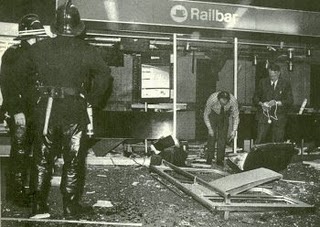
On September 10, 1973, a bomb (with no warning issued beforehand) explodes at King’s Cross railway station in the booking hall at 12:24 p.m. when a youth of around 16 to 17 years of age walks up to the entrance of the station’s old booking hall and throws a bag into it which contains a 3 lb. (1.4 kg) device, which detonates, shattering glass throughout the hall and throwing a baggage trolley several feet into the air. The youth then flees into the station’s crowd and escapes the scene.
Approximately 45 minutes after the attack at King’s Cross, after a telephone call warning to the Press Association five minutes beforehand by a man with an Irish accent, a second bomb detonates in a snack bar at Euston railway station, injuring another eight civilians. One witness at Euston says, “I saw a flash and suddenly people were being thrown through the air – it was a terrible mess, they were bleeding and screaming.” A total of 13 civilians are injured in the two attacks. The Metropolitan Police issue a photofit picture of a 5 ft. 2 in. (157 cm) tall youth they are seeking in regard to the King’s Cross attack.
On September 12, 1973, two more bombs explode, one in Oxford Street and another in Sloane Square, targeting retail shopping centres. Police subsequently announce that they are looking for five people in connection with this second wave of bomb attacks in England.
Judith Ward is later wrongly convicted of having been involved in the late 1973 London bombings, along with the M62 coach bombing. She is later acquitted. No one else is brought to trial for this IRA bombing campaign.
McGarrity is born on March 28, 1874, in Carrickmore, County Tyrone. His family grows up in poverty, motivating his need to immigrate later in life. He grows up hearing his father discussing Irish politics, including topics such as the Fenians, the Irish Parliamentary Party (IPP), and Irish Home Rule. By the time he is an adult, he has developed a keen interest in politics himself.
McGarrity immigrates to the United States in 1892 at the age of 18. He is reputed to have walked to Dublin before boarding a cattle boat to Liverpool disguised as a drover, and then sailing to the United States using a ticket belonging to someone else. He settles in Philadelphia, Pennsylvania and becomes successful in the liquor business. His business fails, however, on three occasions, twice due to embezzlement by his business partner.
In 1893 McGarrity joins Clan na Gael, an Irish organisation based in the United States committed to aiding the establishment of an independent Irish state. Clan na Gael had been heavily involved with the Fenian Brotherhood that McGarrity had grown up hearing about, and by the latter half of the 19th century had become a sister organisation of the Irish Republican Brotherhood (IRB). In the decade just before McGarrity joins, Clan na Gael and the Fenian movement had waged the Fenian dynamite campaign, where they attempted to force the British state to make concessions in Ireland by bombing British infrastructure. However, this had caused a split within Clan na Gael that is not mended until seven years after McGarrity joins when, in 1900, the factions reunite and plead to support “the complete independence of the Irish people, and the establishment of an Irish republic.” In the years that follow the 1880s and 1890s, he is, amongst others, credited with helping to stitch the organisation back together and bring it renewed strength.
McGarrity helps sponsor several Irish Race Conventions and founds and runs a newspaper called The Irish Press from 1918-22 that supports the Irish War of Independence. He is the founder of the Philadelphia chapter of Clan Na Gael.
When Éamon de Valera arrives in the United States in 1919 they strike up an immediate rapport and McGarrity manages de Valera’s tour of the country. He persuades de Valera of the benefits of supporting him and the Philadelphia branch against the New York branch of the Friends of Irish Freedom organisation led by John Devoy and Judge Daniel F. Cohalan. He becomes president of the American Association for the Recognition of the Irish Republic. He christens his newborn son Éamon de Valera McGarrity, although their relationship becomes strained upon de Valera’s entry back into Dáil Éireann in the Irish Free State.
The Irish Civil War sees a split in Clan na Gael just as it had split Sinn Féin back in Ireland. McGarrity and a minority of Clan na Gael members support the anti-treaty side but a majority support the pro-treaty side, including John Devoy and Daniel Cohalan. Furthermore, in October 1920 Harry Boland informs the Clan na Gael leadership that the IRB will be cutting their ties to the Clan unless the IRB is given more influence over their affairs. Devoy and Cohalan resist this, but McGarrity sees the Clan’s connection with the IRB as vital. While McGarrity’s faction is initially labelled “Reorganised Clan na Gael,” they are able to inherit total control of the Clan na Gael name as Devoy is not able to keep effective organisation of the group. In general, however, the in-fighting amongst the Irish on both sides of the Atlantic is quite disheartening for Irish Americans and in the years to come neither pro nor anti-treaty sides of Clan na Gael see much in the way of donations.
With the scope of Clan na Gael now narrowed, and Devoy and Cohalan removed from the picture, McGarrity becomes chairman of the organisation. He does not support the founding of Fianna Fáil in 1926 and opposes the party’s entry into the Dáil in 1927. Even after the Irish Civil War, he still supports the idea that a 32-county Irish Republic can be achieved through force. in the spring of 1926, he receives Chief of Staff of the Irish Republican ArmyAndrew Cooney to the United States. Cooney and Clan na Gael formally agree that each organisation will support the other and that Clan na Gael will raise funds, purchase weapons and build support for the IRA in the United States.
Going into the late 1920s though Clan na Gael, as are most Irish American organisations, is struggling. Having limped past the split caused by the Irish Civil War, the rejection of Fianna Fáil has caused a second split in the membership. Many Irish Americans see the IRA and Fianna Fáil as one and the same at that point and Clan na Gael and McGarrity’s hostility to them causes much friction.
By July 1929, the Clan’s membership in one of its strongholds, New York City, is down to just 620 paid members. Then in October of that same year Wall Street crashes and the Great Depression hits. In 1933 McGarrity is left almost bankrupt after he is found guilty of “false bookkeeping entries.” His livelihood is saved when he becomes one of the main ticket agents in the United States for the Irish Hospitals’ Sweepstake. He is a personal friend of Joseph McGrath, one of the founders of the Sweepstake. The sweepstakes allow him to turn his fortunes around.
Despite the trying times of both Clan na Gael and his personal life, McGarrity holds fast in his belief in physical force Irish Republicanism. In 1939 he supports the demand from Seán Russell for the “S-Plan” bombing campaign in Britain, which proves disastrous. He allegedly meets Hermann Göring in Berlin in 1939 to ask for aid for the IRA, which leads indirectly to “Plan Kathleen.”
McGarrity is a lifelong friend of fellow Carrickmore native and avid Republican, Patrick McCartan. When he dies on September 4, 1940 a mass is held in the St. Mary’s Pro-Cathedral in Dublin. He remains an unrepentant physical force republican all his life. A number of McGarrity’s papers are in the National Library of Ireland. He donates his personal Library to Villanova University.
The IRA signs all its statements ‘J.J. McGarrity’ until 1969 when the organisation splits into the ‘Official‘ and ‘Provisional‘ movements. Thereafter the term continues to be used by the Officials while the Provisionals adopt the moniker ‘P.O’Neill.’
Accused by The Sunday Times of directing an IRA bombing campaign in Britain, in 1987 Murphy unsuccessfully sues the paper for libel in Dublin. The original verdict is overturned by the court of appeal because of omissions in the judge’s summing up and there is a retrial, which he also loses. At the retrial, both Sean O’Callaghan and Eamon Collins, former members of the Provisional Irish Republican Army, testify against Murphy, as do members of the Gardaí, Irish customs officials, British Army and local TDBrendan McGahon. Collins, who had also written a book about his experiences, Killing Rage, is beaten and killed by having a spike driven through his face near his home in Newry eight months later. In 1998, a Dublin court dismisses Murphy’s case after a high-profile trial, during which Murphy states that he has “never been a member of the IRA, no way” and claims not to know where the Maze prison is located. The jury rules, however, that he is an IRA commander and a smuggler.
The Sunday Times subsequently publishes statements given by Adrian Hopkins, the skipper who ferries weapons from Libya to the IRA, to the French authorities who intercept the fifth and final Eksund shipment. Hopkins details how Murphy met a named Libyan agent in Greece, paid for the weapons to be imported, and helped unload them when they arrived in Ireland. According to A Secret History of the IRA by Ed Moloney, Murphy has been the IRA Army Council’s chief of staff since 1997. Toby Harnden’s Bandit Country: The IRA & South Armagh also details Murphy’s IRA involvement.
On September 20, 2016, the BBC‘s Spotlight airs a programme in which an alleged British spy who had infiltrated the IRA claims that in 2006, Murphy had demanded the killing of Denis Donaldson, an IRA member and British informer, in order to maintain discipline. The BBC says it had tried to contact Murphy but had received no reply. He has yet to respond to the allegation. On September 23, 2016, the Donaldson family’s solicitor says that the allegation is “absolute nonsense.”
In October 2005, officers of the British Assets Recovery Agency and the Irish Criminal Assets Bureau carry out raids on a number of businesses in Manchester and Dundalk. It is extensively reported in the media that the investigation is aimed at damaging the suspected multi-million-pound empire of Murphy, who according to the BBC’s Underworld Rich List, has accumulated up to £40 million through smuggling oil, cigarettes, grain and pigs, as well as through silent or partial ownership in legitimate businesses and in property.
A large, purpose-built underground chamber that Gardaí believes the IRA used for interrogation is discovered close to Murphy’s home.
In his first-ever press release, issued on October 12, 2005, Murphy denies he owned any property and denies that he had any links with co-accused Cheshire businessman Dermot Craven. Furthermore, he claims that he had to sell property to cover his legal fees after his failed libel case against The Sunday Times, and that he made a living from farming.
On March 9, 2006, police, soldiers and customs officials from both sides of the Irish border launch a large dawn raid on Murphy’s house and several other buildings in the border region. Three persons are arrested by the Gardaí but are released three days later. A fleet of tankers, computers, documents, two shotguns, more than 30,000 cigarettes and the equivalent of 800,000 euros in sterling bank notes, euro bank notes and cheques are seized. Four diesel laundering facilities attached to a major network of storage tanks, some of which are underground, are also found. The Irish Criminal Assets Bureau later obtains seizure orders to take possession of euro cash and cheques and sterling cash and cheques, together worth around one million Euros.
Sinn Féin President Gerry Adams makes a public statement in support of Murphy following the March 2006 raids. Under political and media pressure over allegations of the IRA’s continued presence in South Armagh, Adams says, “Tom Murphy is not a criminal. He’s a good republican and I read his statement after the Manchester raids, and I believe what he says and also and very importantly he is a key supporter of Sinn Féin’s peace strategy and has been for a very long time.” He adds, “I want to deal with what is an effort to portray Tom Murphy as a criminal, as a bandit, as a gang boss, as someone who is exploiting the republican struggle for his own ends, as a multimillionaire. There is no evidence to support any of that.”
Murphy is arrested in Dundalk, County Louth, on November 7, 2007, by detectives from the Criminal Assets Bureau, on charges relating to alleged revenue offences. The following day, he is charged with tax evasion under the Tax Consolidation Act. He is later released on his own bail of €20,000 with an independent surety of €50,000.
On October 17, 2008, in an agreed legal settlement, Murphy and his brothers pay over £1 million in assets and cash to the authorities in Britain and the Republic in settlement of a global crime and fraud investigation relating to proceeds of crime associated with smuggling and money laundering. After an investigation involving the Irish Criminal Assets Bureau and the UK’s Serious Organised Crime Agency, more than 625,000 euros (£487, 000) in cash and cheques is confiscated by the Republic’s courts, while nine properties in North West England worth £445,000 are confiscated by British courts. Murphy is still fighting a claim in the Republic’s courts for tax evasion, relating to non-completion of tax returns for eight years from 1996. On April 26, 2010, he is further remanded on bail.
In 2011, there are claims that Murphy had become disillusioned with the Northern Ireland peace process and that he had fallen out with Sinn Féin. However, there is no evidence to support he is sympathetic to any dissident republican groups. In March 2013, the Garda and the Police Service of Northern Ireland (PSNI), along with members of the Irish Customs Authority and HM Revenue and Customs (HMRC), raid his farm on the Louth-Armagh border. The Sunday World reports that two hours prior to the raid, at approximately 4:00 a.m., fire is seen coming from Murphy’s yard. There are serious concerns within the Garda and PSNI that a mole may have tipped off Murphy about the raid hours earlier as laptops, computer disks and a large amount of documentation is destroyed in the fires. As a result, an internal Garda investigation takes place.
On December 17, 2015, Murphy is found guilty on nine charges of tax evasion by a three-judge, non-jury Special Criminal Court trial sitting in Dublin, lasting nine weeks. He is tried under anti-terrorist legislation due to the belief by the Director of Public Prosecutions (DPP) that there would not be a fair trial because of the potential of the intimidation of prosecution witnesses and jurors, and the security surrounding the trial.
Murphy is found guilty on all charges of failing to furnish tax returns on his income as a “cattle farmer” between 1996 and 2004. He is prosecuted following a 14-year-long Criminal Assets Bureau investigation, which during a raid of his property uncovers bags with more than €250,000 and more than £111,000 sterling in cash, along with documents, diaries and ledgers. He is remanded on bail until early 2016 for sentencing.
On February 26, 2016, Murphy is sentenced to 18 months in prison. None of the jail term is suspended. Following sentencing, he is immediately transferred from court to Ireland’s highest-security prison, Portlaoise Prison, reserved for terrorists, dissident republicans and serious gangland criminals, under a heavily armed Garda and Irish Army escort due to security concerns.
Murphy appeals the conviction in November 2016. His lawyer, John Kearney, claims that the tax Murphy had not paid had in fact been paid by his brother, Patrick. The Court of Appeal dismisses the appeal on all grounds in January 2017.
Cooney is the second of three children of John Cooney and Mary Ann Cooney (née Gleeson), middling farmers. While his grandfather, Patrick Cooney, from nearby Garrykennedy, is reputed to have been a member of the Irish Republican Brotherhood (IRB) and an Irish National Land League activist, his father does not have any inclination towards radical politics. He is educated at Lissenhall national school and St. Joseph’s CBS, Nenagh. In October 1916, he commences studies in medicine at University College Dublin (UCD) just as the Irish War of Independence is getting underway. He plays briefly with the College’s hurling club.
In 1917, Cooney joins the Third Battalion of the Dublin Brigade of the Irish Republican Army (IRA). A year later he is jailed for two months in Mountjoy Prison and Crumlin Road Gaol, Belfast, for illegal drilling. Joining the IRB at the end of 1918, he assists in the December 1918 election by protecting candidates and acts as a guard at sittings of the First Dáil. On June 26, 1920, he plays a major role in the attack on BorrisokaneRoyal Irish Constabulary (RIC) barracks. He takes part in the Bloody Sunday operations of November 21, 1920, at 28 Upper Pembroke Street where a number of British agents are killed and attends Croke Park afterwards. He then goes on the run as a full-time Volunteer and serves with the Dublin Brigade active service unit (ASU).
After the Anglo-Irish truce of July 1921, Cooney is appointed Officer Commanding (O/C) of the 1st Kerry Brigade, IRA, reorganising it and forming a flying column. Opposing the Anglo-Irish Treaty of 1921, he does not immediately break with GHQ, who sends him to organise the 1st Eastern Division. Later in January 1922, the Chief of Staff, Eoin O’Duffy, asks him to become O/C of the 3rd Eastern Division, but later rescinds the appointment. In March 1922 he is appointed O/C of the 1st Eastern Division of the anti-Treaty IRA during the Irish Civil War.
That same year he is captured by Free State forces and interned in Mountjoy Prison, where he becomes O/C of the prisoners in C Wing. He accepts responsibility for an attempted escape bid on October 10, 1922, in which a fellow prisoner, Peadar Breslin, is killed and another man is wounded. After sojourns in Newbridge and Arbour Hill Prison, he is moved with the other leaders to Kilmainham Gaol, where he spends forty-one days on hunger strike. Removed to Harepark Camp, the Curragh, on January 1, 1924, he is among the last to be released on May 29, 1924.
Cooney succeeds Frank Aiken as Chief of Staff of the IRA on November 18, 1925. Central to the reorganisation scheme he puts in place is the need to secure American funds for the IRA and to combat Frank Aiken’s fundraising work in the United States since December 1925 on behalf of the embryo Fianna Fáil organisation. Receiving permission on April 21, 1926, he departs on a fund-raising trip to the United States but returns to Ireland in October. He resigns as chief of staff in favour of Maurice Twomey but retains his position as chairman of the IRA executive until November 21, 1927, when he obtains leave to complete his medical studies.
After internship in the Mater Hospital, Dublin, Cooney finds temporary employment in London, but remains in touch with GHQ. On September 27, 1929, he marries the German-educated Frances (‘Frank’) Brady, daughter of a wealthy Belfast linen family and former Cumann na mBan activist and hunger-striker. The marriage is not a success. Failing to secure employment due to police harassment and the loyalty test then in force, he and his wife are obliged to emigrate to London, where he practises as a GP, still maintaining his IRA links. Their only child, Seán, is born there in 1931. He returns to Ireland in August 1932, after Fianna Fáil’s accession to power.
An intimate friend of Maurice Twomey, who is still Chief of Staff, Cooney remains in the upper echelons of the IRA and attends its conventions. Signifying his standing in republican circles, he is chosen to unveil, inter alia, the Fenian memorial in Glasnevin Cemetery and the Seán Treacy plaque in Talbot Street, Dublin, and is a regular speaker at commemorations. In March 1940, he attempts to intercede with Éamon de Valera on behalf of hunger-striking republicans, and is later arrested, but released.
After the discovery of a German spy ring in the hospitals commission’s subsidiary, the Dublin Hospitals Bureau, Cooney is forced to resign in April 1942 on refusing to take a loyalty pledge to the state. He returns to private practice. He becomes active in the unsuccessful campaign to save Charlie Kerins, Chief of Staff, from being hanged in 1944. In anticipation of emigrating, he finally resigns from the IRA in 1944, though military and police surveillance continue until March 1945.
In August 1945, Cooney joins the United Nations Relief and Rehabilitation Administration, working with displaced persons in the American zone in Germany, and gains rapid promotion. After joining the International Refugee Organisation (UNRRA’s successor) on July 1, 1947, he becomes the chief medical officer of an area including the American sector of Berlin and containing 150,000 displaced persons. He later holds a similar post in Bavaria.
Appointed a part-time member of the hospitals commission by the inter-party government in September 1949 and in severe financial straits, Cooney emigrates alone to the United States on December 2, 1950, and never returns. While employed in a tuberculosissanatorium in New Jersey, he obtains by examination his licence to practise medicine in Maryland on January 14, 1954. Admitted a member of the American College of Chest Physicians, again by examination, on November 23, 1954, he secures, at the age of 57, his first ever permanent post in medicine, in a similar hospital in Pikesville, Maryland. His republican activities continue through Clan na Gael during his U.S. years, and he is a frequent speaker at commemorative events.
(Pictured: Liam Lynch with some of his Divisional Staff and Officers of the Brigades, including the 1st Southern Division, who attend as delegates to the Army Convention at the Mansion House, Dublin, on April 9, 1922. Cooney is first on the right in the 3rd row back.)
Lynch is born on November 9, 1893, in Barnagurraha, Anglesboro, County Limerick, the fifth child among six sons and a daughter of Jeremiah Lynch, farmer, and Mary Lynch (neé Kelly). The family is politically active. His father’s brother, John, had taken part in the Fenian Rising of 1867 and his mother had been joint secretary of the Ballylanders branch of the Ladies’ Land League.
Lynch attends Anglesboro national school (1898–1909). In 1910 he moves to Mitchelstown, County Cork, to take up a three-year apprenticeship in the hardware store of P. O’Neill on Baldwin Street. He remains there until the autumn of 1915. While in Mitchelstown he is a member of the Gaelic League and the Ancient Order of Hibernians. He also joins the Irish Volunteers. In 1914, when that organisation splits, he does not immediately join the militant rump. He then moves to Fermoy, County Cork, where he works in the store of Messrs J. Barry & Sons Ltd. His move coincides with a period of inactivity as neither Volunteer faction is very active nor is he known. Consequently, he does not take part in the 1916 Easter Rising, but it is a turning point for him. On May 2, 1916, he watches as the Kent family are led through Fermoy, having been captured by British soldiers. Richard Kent dies from a wound sustained that day and Thomas Kent is executed a week later. Lynch becomes a committed Volunteer at this point.
Once committed, Lynch’s enthusiasm and aptitude ensures that he quickly attains positions of responsibility. From early 1917 he is first lieutenant in the small Fermoy company. In September 1917, the Irish Volunteers in east Cork are reorganised. Nine local companies are formed into the Fermoy battalion, and he is elected adjutant. In April 1918, at the height of the conscription crisis, he briefly quits his job to concentrate on organising the Volunteers. In May he is lucky to escape arrest during the sweep that accompanies the “German plot.” When the immediate danger ends, he returns to Barry & Sons.
In January 1919, at the beginning of the Irish War of Independence, the Volunteer organisation in Cork undergoes a major restructuring. Three brigades are established, and Lynch becomes brigade commandant of Cork No. 2. In April he visits Irish Republican Army GHQ in Dublin to discuss plans and to seek arms. It is a frustrating experience as the GHQ has few guns and are cautious about action. Throughout the summer of 1919 he presses GHQ to authorise attacks on British targets as a method of acquiring arms and to prevent boredom and stagnation setting in among his men. Finally, GHQ sanctions attacks if the primary aim is the capture of arms. In response, on September 7, 1919, twenty-five men from the Fermoy company, led by Lynch, ambush fourteen British soldiers on their way to service in the Wesleyan church in Fermoy. Fifteen rifles are captured, one soldier killed, and three wounded. Lynch is shot in the shoulder, probably by one of his own men. As a result, he has to leave his job and hides out in Waterford for a time. A series of arrests follow, among those is Lynch’s close friend, Michael Fitzgerald, who dies on hunger strike in Cork County Gaol in 1920.
Lynch spends the early months of 1920 at GHQ in Dublin. During this time, he is offered the position of deputy chief of staff, but turns it down, preferring to return to Cork. Although not an articulate speaker, he impresses those he meets. His organisational talents, attention to detail, ability to inspire, and intolerance for those who waste meetings endlessly discussing side issues, are noted. He has a low tolerance for politicians and at all times considers the military wing of the movement to be of primary importance. He is engaged to Bridie Keyes, but marriage is postponed pending a final settlement of hostilities.
On June 26, 1920, Lynch, Seán Moylan, and two colleagues capture Major-GeneralCuthbert Lucas while he is fishing on the Munster Blackwater. He gives a false name when he is arrested on August 12, 1920, at City Hall, Cork, with Terence MacSwiney, Lord Mayor of Cork, and ten others. All but MacSwiney are released four days later. He then sets about organising a flying column within the brigade. Ernie O’Malley arrives from headquarters to train the men. This column achieves a major coup on September 28, 1920, when they briefly capture the British Army barracks at Mallow, leaving with a large booty of rifles, ammunition, and two machine guns. The British respond to this increase in activity and the war settles into a pattern of ambush and counter-ambush. The Mallow battalion suffers severe losses in February 1921 and Lynch himself narrowly escapes when four are killed during an encounter at Nadd in March 1921.
In early 1921 Lynch seeks to encourage greater cooperation between the various brigades in the south. Senior brigade officers meet on three occasions to discuss cooperation and a plan to import arms from Italy. The importation project fails, but the First Southern Division is formed on April 26, 1921, bringing eight brigades from Cork, Kerry, Waterford, and west Limerick together. He is elected divisional commandant, making him the most powerful officer outside GHQ. His influence is further increased by his appointment as Southern Divisional Centre and Supreme Council member of the clandestine Irish Republican Brotherhood (IRB) in March 1921.
Lynch is wary when the truce is called in July 1921. He works hard to maintain order in his division and to achieve a state of readiness in case the negotiations fail. For him the Anglo-Irish Treaty is a failure. When the Supreme Council of the IRB meets on December 10, 1921, he is the only voice against the agreement. He is among the officers who insist that an army convention should be called to discuss the treaty, effectively asserting that the army no longer accepts a position subordinate to the Dáil. The army, he believes, is the army of the Republic, and no civilian body can order it to abandon the Republic. The provisional government tries to ban this convention, but it goes ahead on March 26, 1922, and elects an army executive. Lynch is elected Chief of Staff. Between March and June, he works hard to prevent a civil war. He believes unity can be maintained, even under the Treaty, if a republican constitution can be enacted. He also cooperates with Michael Collins in promoting Irish Republican Army (IRA) activity in Ulster. In his adherence to the idea of a republic, the practicalities of politics have little impact on his consciousness, and he is dismissive of the popular support for the Treaty. He is horrified at the thought of civil war but fails to see that his position is leading almost inexorably in that direction. Distrusted as too moderate by Liam Mellows and Rory O’Connor, he is locked out of the Four Courts for a time.
When the Four Courts are attacked, Lynch immediately leaves his headquarters at the Clarence Hotel to travel south. He is briefly detained, before reaching Kingsbridge Station, and has a meeting with Eoin O’Duffy. He is disgusted when Free State figures later claim that he was released, having promised not to take arms against the government. The most plausible explanation of the incident appears to be that O’Duffy interpreted Lynch’s comments, merely indicating disappointment that a war had started, as constituting a statement of intent not to involve himself.
Lynch’s initial actions seem designed to avoid full-scale conflict. He does not order an attack on Dublin, nor does he attempt to seize Limerick. He chooses a containment strategy, seeking to hold a line from Limerick to Waterford for the republican forces. This fails, as the government sends troops in from the rear by sea. The republicans have no urban base when Lynch abandons Fermoy on August 11, 1922. He continues to meet individuals who seek a way to end the war, but intransigence has set in, and he insists that armed struggle will only end with a republic or absolute defeat. As early as August many republicans believe the war is lost and urge a reassessment of tactics, but Lynch rejects all such calls. Operating from secret headquarters in Santry, he orders the shooting of pro-Treaty politicians in retaliation for the execution of republican prisoners.
Under war conditions it is impossible for the army executive to meet regularly, and this leaves Lynch in almost complete control. As the pro-surrender lobby grows within the republican forces, he delays a meeting of the executive, claiming with some justification that it is too dangerous. He leaves Santry and attends a meeting of the Southern Division Council in the last days of February 1923. Sixteen of the eighteen officers there tell him that the military position is hopeless. This forces the calling of an executive meeting on March 6, 1923. No agreement is reached. He strongly favours fighting on, but a motion from Tom Barry, calling for an immediate end to hostilities, is barely rejected. Another meeting is arranged for April 10. On that morning a group, including Lynch and Frank Aiken, suddenly find themselves in danger of capture in a farmhouse on the slopes of the Knockmealdown Mountains in County Tipperary. They flee and are pursued. During the chase Lynch is shot in the abdomen. It seems clear that he is shot by the pursuing Free State soldiers, although Irish historian Meda Ryan has considered the theory that he may have been shot by one of his own in order to remove the major stumbling block to surrender. His colleagues are forced to abandon him, and he is captured. Initially the Free State troops believe they have caught Éamon de Valera. He is taken first to a public house in Newcastle, County Tipperary, and then to St. Joseph’s Hospital in Clonmel, but dies from his wound at 8:45 p.m. that evening. His last request is to be buried beside Michael Fitzgerald in Kilcrumper Cemetery, Fermoy, County Cork. On hearing of Lynch’s death, Ernie O’Malley writes, “You who were a living force are now a battle cry.” O’Malley is wrong, however, as the peace faction within republicanism is strengthened by his death and Aiken orders the suspension of activities on April 27.
In 1935, a massive memorial, consisting of a 60-foot-tall round tower, guarded by four bronze Irish Wolfhounds, is erected at Goatenbridge, County Tipperary, near the site of his capture. It is unveiled on April 7, 1935. Separate annual commemorations are held at Goatenbridge and Kilcrumper. Three biographies have been written and the Liam Lynch memorial pipe band is based in his native Anglesboro. The Lynch family possess a substantial collection of private correspondence.
Plant is born into a Church of Ireland farming family in Fethard, County Tipperary, on January 5, 1904, the second eldest child and son in a family of six children. His parents are John William Albert Plant, a farmer, and Catherine Hayden.
One Sunday in 1916, George and his older brother Jimmy are arrested by the Royal Irish Constabulary (RIC) after being seen speaking to two well-known republicans, Seán Hayes and Dan Breen. In custody the two brothers are beaten and mistreated resulting in a hatred of the RIC. He serves with the Irish Republican Army during the Irish War of Independence and with the Anti-Treaty IRA in the Irish Civil War.
In 1923, George and Jimmy leave Ireland for Canada and the United States but continue as active IRA members. In 1929 they return to Ireland and carry out a bank raid in Tipperary on behalf of the IRA. They are arrested two days later at the family farm and subsequently sentenced to seven years in prison. They are released in a general amnesty after the Fianna Fáil and Éamon de Valera election victory in 1932. He is a strong supporter of Seán Russell. In 1939 following the outbreak of World War II, known in Ireland as The Emergency, de Valera is determined to maintain Irish neutrality and is not going to allow the IRA to jeopardize this. The IRA links with Germany and campaign in Britain are severely straining Anglo-Irish relations so emergency legislation is introduced.
Russell, the IRA Chief of Staff, dies in August 1940 after taking ill on board a U-boat and Stephen Hayes from County Wexford becomes IRA Chief of Staff. In late August 1940 an address on Lansdowne Road, Dublin, is raided by the Garda Síochána. Among the men arrested is Michael Devereux, a 24-year-old married truck driver from County Wexford who is also Quartermaster of the IRAs Wexford Brigade. He is released after three days without charge. Shortly afterwards Gardaí in County Wexford find an IRA arms dump. Many in the IRA suspect that Devereux had turned informer, so Stephen Hayes orders Devereux’s execution. George Plant and another man, Michael Walsh from County Kilkenny, are ordered to carry out the order. Devereux meets Plant and Walsh who tell Devereux that Tom Cullimore, the Wexford Brigade’s OC is blamed for the arms dump and that they have shot him. They order Devereux to drive them to an IRA safe house at Grangemockler in south County Tipperary. Devereux, believing he is the prime suspect in a murder, stays willingly at the safe house. A week later, on September 27, 1940, Devereux is invited to go for a walk with Plant and Paddy Davern, the owner of the safe house. Somewhere along the walk Plant accuses Devereux of being an informer and shoots him dead. Plant is arrested nine weeks later on suspicion of IRA membership and brought before the Special Criminal Court in Dublin. On February 10, 1941, Radio Éireann broadcasts a radio appeal for Michael Devereux on behalf of his wife.
In September 1941, Stephen Hayes is accused of being an informer by a group of Northern IRA members led by Seán McCaughey. He manages to escape to a garda station. Shortly afterwards a large force of Garda Síochána and Irish Army descend on the area around the Davern farmhouse where they find Devereux’s car buried under an onion bed and eventually discover Devereux’s body, a year to the day after his death. Two weeks later, Plant, already in prison on IRA membership charges, is charged with Devereux’s murder. A trial is held with a senior IRA officer, Joseph O’Connor, also charged with Devereux’s murder. The first trial collapses after two days when Paddy Davern and Micheal Walsh, two of the prosecution witnesses, refuse to give evidence. This result leads to the court issuing a nolle prosequi order which should have meant the end of the affair, however both men are rearrested and recharged with the same offence, under Emergency Order 41f. Minister for JusticeGerald Boland transfers the case to a Special Military Court with army officers acting as judges. In addition to Plant, Paddy Davern and Michael Walsh are also now charged with Devereux’s murder. The second trial begins at Collins Barracks, Dublin in February 1942 with Seán MacBride, a former IRA Chief of Staff and future government minister as the defendant’s barrister. Davern states his original statement was given at gunpoint but under the new order even statements given under duress are admissible. The court only has two sentencing options – death or acquittal. Joseph O’Connor is acquitted and despite MacBride’s best efforts the other three are sentenced to death. Davern and Walsh have their sentences commuted to life imprisonment and are both released in 1946.
Just one week after sentence is passed, Plant is executed on March 5, 1942, in Portlaoise Prison by a six-man firing squad drawn from the Irish Army. Much bitterness is caused by the treatment of Plant’s relatives. Neither his wife or mother or infant son are allowed to visit him in the week before his execution. Censorship ensures there is little mention in the newspapers, so his family only learns of his execution from a brief radio broadcast shortly before they receive a telegram. He is buried in the grounds of Portlaoise Prison, but is reinterred in 1948, when he is buried with full IRA military honours in his local church St. Johnstown in County Tipperary, and a Celtic cross is erected over his grave.
Plant’s wife moves to the United States where she remarries. His brother Jimmy dies in London in 1978. The Plant’s family farm is now part of the Coolmore Estate.
In 1940, Kerins is sworn into the IRA and is appointed to the GHQ staff in May 1942. At the time, the Fianna Fáil government of Éamon de Valera is determined to preserve Irish neutrality during World War II. Therefore, the IRA’s bombing campaign in England, its attacks against targets in Northern Ireland, and its ties to the intelligence services of Nazi Germany are regarded as severe threats to Ireland’s national security. IRA men who are captured by the Gardaí are interned for the duration of the war by the Irish Army in the Curragh Camp in County Kildare.
On the morning of September 9, 1942, Garda Detective Sergeant Denis O’Brien is leaving his home in Ballyboden, Dublin. He is between his front gate and his car when he is cut down with Thompson submachine guns. O’Brien, an Anti-Treaty veteran of the Irish Civil War, had enlisted in the Garda Síochána in 1933. He is one of the most effective Detectives of the Special Branch division, which has its headquarters at Dublin Castle. The shooting greatly increases public feeling against the IRA, particularly as the murder is carried out in full view of his wife.
Following the arrest of Hugh McAteer in October 1942, Kerins is named Chief of Staff of the IRA. Despite a massive manhunt by Gardaí, he remains at large for two years. He stays at a County Waterford home for two weeks while he is on the run, having given his name as Pat Carney. He is captured several months after he leaves the home.
Kerins had previously left papers and guns hidden at Kathleen Farrell’s house in the Dublin suburb of Rathmines. He telephones the house, as he intends to retrieve them. However, Farrell’s telephone had been tapped by the Gardaí. On June 15, 1944, he is arrested in an early morning raid. He is sleeping when the Gardaí enter his bedroom and does not have an opportunity to reach the Thompson submachine gun which is hidden under his bed.
At a trial before the Special Criminal Court in Collins Barracks, Dublin, Kerins is formally charged on October 2, 1944, for the “shooting at Rathfarnham of Detective Dinny O’Brien.” At the end of his trial, the president of the Military Court delays sentence until later in the day to allow Kerins, if he wishes, to make an application whereby he might avoid a capital sentence. When the court resumes, he says, “You could have adjourned it for six years as far as I am concerned, as my attitude towards this Court will always be the same.” He thus deprives himself of the right to give evidence, to face cross-examination, or to call witnesses.
Kerins is the last IRA member to be executed in the Republic of Ireland. He is buried in the prison yard. In September 1948, his remains are exhumed and released to his family. He is buried in the Republican plot at Rath Cemetery, Tralee, County Kerry.
Mulcahy is born in Manor Street, Waterford, County Waterford, on May 10, 1886, the son of post office clerk Patrick Mulcahy and Elizabeth Slattery. He is educated at Mount Sion Christian Brothers School and later in Thurles, County Tipperary, where his father is the postmaster.
Mulcahy is second-in-command to Thomas Ashe in an encounter with the armed Royal Irish Constabulary (RIC) at Ashbourne, County Meath, during the 1916 Easter Rising, one of the few stand-out victories won by republicans in that week and generally credited to Mulcahy’s grasp of tactics. In his book on the Rising, Charles Townshend principally credits Mulcahy with the defeat of the RIC at Ashbourne, for conceiving and leading a flanking movement on the RIC column that had engaged with the Irish Volunteers. Arrested after the Rising, he is interned at Knutsford and at the Frongoch internment camp in Wales until his release on December 24, 1916.
Mulcahy and Michael Collins are largely responsible for directing the military campaign against the British during the Irish War of Independence. During this period of upheaval in 1919, he marries Mary Josephine (Min) Ryan, sister of Kate and Phyllis Ryan, the successive wives of Seán T. O’Kelly. Her brother is James Ryan. O’Kelly and Ryan both later serve in Fianna Fáil governments.
Mulcahy supports the Anglo-Irish Treaty of December 1921. Archive film shows that Mulcahy, as Minister of Defence, is the Irish officer who raises the Irish tricolour at the first hand-over of a British barracks to the National Army in January 1922. He is defence minister in the Provisional Government on its creation and succeeds Collins, after the latter’s assassination, as Commander-in-Chief of the Provisional Government’s forces during the subsequent Irish Civil War.
Mulcahy earns notoriety through his order that anti-Treaty activists captured carrying arms are liable for execution. A total of 77 anti-Treaty prisoners are executed by the Provisional Government. He serves as Minister for Defence in the new Free State government from January 1924 until March 1924, but resigns in protest because of the sacking of the Army Council after criticism by the Executive Council over the handling of the “Army Mutiny,” when some National Army War of Independence officers almost revolt after he demobilises many of them at the end of the Irish Civil War. He re-enters the cabinet as Minister for Local Government and Public Health in 1927.
After the resignation of W. T. Cosgrave as Leader of Fine Gael in 1944, Mulcahy becomes party leader while still a member of the Seanad. Thomas F. O’Higgins is parliamentary leader of the party in the Dáil at the time and Leader of the Opposition. Facing his first general election as party leader, Mulcahy draws up a list of 13 young candidates to contest seats for Fine Gael. Of the eight who run, four are elected. He is returned again to the 12th Dáil as a TD for Tipperary at the 1944 Irish general election. While Fine Gael’s decline had been slowed, its future is still in doubt.
Following the 1948 Irish general election Mulcahy is elected for Tipperary South, but the dominant Fianna Fáil party finishes six seats short of a majority. However, it is 37 seats ahead of Fine Gael, and conventional wisdom suggests that Fianna Fáil is the only party that can possibly form a government. Just as negotiations get underway, however, Mulcahy realises that if Fine Gael, the Labour Party, the National Labour Party, Clann na Poblachta and Clann na Talmhan band together, they would have only one seat fewer than Fianna Fáil and, if they can get support from seven independents, they will be able to form a government. He plays a leading role in persuading the other parties to put aside their differences and join forces to consign the then Taoiseach and Fianna Fáil leader Éamon de Valera, to the opposition benches.
Mulcahy initially seems set to become Taoiseach in a coalition government. However, he is not acceptable to Clann na Poblachta’s leader, Seán MacBride. Many Irish republicans had never forgiven him for his role in the Irish Civil War executions carried out under the Cosgrave government in the 1920s. Consequently, MacBride lets it be known that he and his party will not serve under Mulcahy. Without Clann na Poblachta, the other parties would have 57 seats between them — 17 seats short of a majority in the 147-seat Dáil. According to Mulcahy, the suggestion that another person serve as Taoiseach comes from Labour leader William Norton. He steps aside and encourages his party colleague John A. Costello, a former Attorney General of Ireland, to become the parliamentary leader of Fine Gael and the coalition’s candidate for Taoiseach. For the next decade, Costello serves as the party’s parliamentary leader while Mulcahy remained the nominal leader of the party.
Mulcahy goes on to serve as Minister for Education under Costello from 1948 until 1951. Another coalition government comes to power at the 1954 Irish general election, with Mulcahy once again stepping aside to become Minister for Education in the Second Inter-Party Government. The government falls in 1957, but he remains as Fine Gael leader until October 1959. In October the following year, he tells his Tipperary constituents that he does not intend to contest the next election.
Mulcahy dies from natural causes at the age of 85 in Dublin on December 16, 1971. He is buried in Littleton, County Tipperary.
Twomey lives at 6 Sevastopol Street in the Falls district. Known as “Thumper” owing to his short temper and habit of banging his fist on tables, he receives little education and is a bookmaker‘s “runner.” His father is a volunteer in the 1920s. In Belfast he lives comfortably with his wife, Rosie, whom he marries in 1946. Together they have sons and daughters.
Twomey begins his involvement with the Irish Republican Army in the 1930s and is interned in Northern Ireland during the 1940s on the prison ship HMS Al Rawdah and later in Crumlin Road Jail in Belfast. Rosie, his wife, is also held prisoner at the women prison, Armagh Jail, in Northern Ireland. He opposes the left-wing shift of Cathal Goulding in the 1960s, and in 1968, helps set up the breakaway Andersonstown Republican Club, later the Roddy McCorley Society.
In 1969, Twomey is prominent in the establishment of the Provisional Irish Republican Army. By 1972, he is Officer Commanding (OC) of the Provisional IRA Belfast Brigade when it launches its bomb campaign of the city, including Bloody Friday when nine people are killed. During the 1970s, the leadership of the Belfast Brigade of the IRA is largely in the hands of Twomey and Ivor Bell.
In March 1973, Twomey is first appointed IRA Chief of Staff after the arrest of Joe Cahill. He remains in this position until his arrest in October 1973 by the Garda Síochána. Three weeks later, on October 31, 1973, the IRA organises the helicopter escape of Twomey and his fellow IRA members J. B. O’Hagan and Kevin Mallon, when an active service unit hijacks and forces the pilot at gunpoint to land the helicopter in the training yard of Mountjoy Prison. After his escape, he returns to his membership of IRA Army Council.
By June/July 1974, Twomey is IRA Chief of Staff for a second time. He takes part in the Feakle talks between the IRA and Protestant clergymen in December 1974. In the IRA truce which follows in 1975, he is largely unsupportive and wants to fight on in what he sees as “one big push to finish it once and for all.”
IRA informer Sean O’Callaghan claims that on January 5, 1976, Twomey and Brian Keenan give the go-ahead for the sectarian Kingsmill massacre, when ten unarmed Ulster Protestant workmen are executed by the Provisional IRA in retaliation for a rash of loyalist killings of Catholics in the area. It is Keenan’s view, O’Callaghan claims, that “The only way to knock the nonsense out of the Prods is to be ten times more savage.”
Twomey is dedicated to paramilitarism as a means of incorporating Northern Ireland into the Republic of Ireland. In an interview with French television on July 11, 1977, he declares that although the IRA had waged a campaign for seven years at that point, it can fight on for another 70 against the British state in Northern Ireland and in England. He supports the bombing of wealthy civilian targets, which he justifies on class lines. On October 29, 1977, for example, a no-warning bomb at an Italian restaurant in Mayfair kills one diner and wounds 17 others. Three more people are killed in similar blasts in Chelsea and Mayfair the following month. He says, “By hitting Mayfair restaurants, we were hitting the type of person that could bring pressure to bear on the British government.”
In December 1977, Twomey is captured in Sandycove, Dublin, by the Garda Síochána, who had been tipped off by Belgian police about a concealed arms shipment, to be delivered to a bogus company with an address in the area. They swoop on a house in Martello Terrace to discover Twomey outside in his car, wearing his trademark dark glasses. After a high-speed pursuit, he is recaptured in the centre of Dublin. The Gardaí later find documents in his possession outlining proposals for the structural reorganisation of the IRA according to the cell system. His arrest ends his tenure as IRA chief of staff. In the 1986 split over abstentionism, Twomey sides with the Gerry Adams leadership and remains with the Provisionals.
After a long illness from a heart condition, Twomey dies in Dublin on September 12, 1989. He is buried in the family plot in Milltown Cemetery, Belfast. His funeral is attended by about 2,000 people.