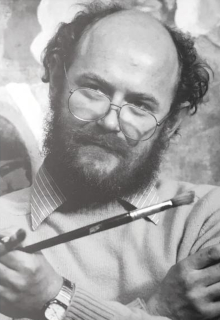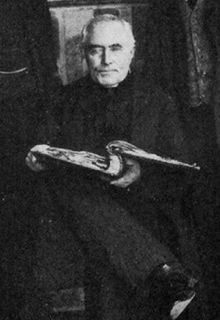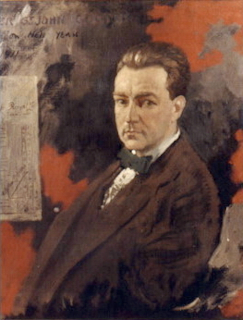
Paul Funge, internationally respected painter and arts enthusiast, dies at Loughlinstown Hospital in the south Dublin suburb of Loughlinstown on February 21, 2011, after a short illness.
A native of Gorey, County Wexford, Funge is a founder of the Project Arts Centre in Dublin and the founder of Gorey Arts Centre in 1970. He is also a founder of the Belltable Arts Centre in Limerick while the regional arts officer for the midwest. In addition, he establishes the Gorey Arts Festival, a three-week summer arts festival, and runs it for more than fifteen years. He is remembered as the man who brought U2 to play at the Gorey Arts Festival in the days before they became an international success.
Funge suffers a fall before Christmas 2010, badly fracturing his leg and he is admitted to St. Vincent’s Hospital. On January 6, he transfers from Vincent’s to recuperate at a nursing home in Bray. In early February he takes a turn and develops chest problems. His condition deteriorates and he is admitted to the ICU in Loughlinstown Hospital. Initially he appears to be making a reasonable recovery, but his condition deteriorates again in the days prior to his death.
Following Funge’s death, Eamon Carter, director of Gorey School of Art, pays tribute to him as a visionary who felt passionate about decentralising the arts to areas outside of Dublin.
Carter adds that it had just been announced that the Gorey School of Art is linking up with NCAD to provide a masters in fine arts and it is sad that in the week it receives such good news it also receives the sad news of Funge’s death. “I’m saddened that he wasn’t here to see that because he would have been chuffed obviously,” he said.
Micheal O’Siadhail, poet and linguist, is born in Dublin on January 12, 1947. Among his awards are The Marten Toonder Prize and The Irish American Culture Institute Prize for Literature.
O’Siadhail is born into a middle-class Dublin family. His father, a chartered accountant, is born in County Monaghan and works most of his life in Dublin, and his mother is a Dubliner with roots in County Tipperary. Both of them are portrayed in his work in several poems such as “Kinsmen” and “Promise”. From the age of twelve, he is educated at the Jesuit boarding school Clongowes Wood College, an experience he is later to describe in a sequence of poems “Departure” (The Chosen Garden).
At Clongowes O’Siadhail is influenced by his English teacher, the writer Tom MacIntyre, who introduces him to contemporary poetry. At thirteen he first visits the Aran Islands. This pre-industrial society with its large-scale emigration has a profound impact on him. His earlier work reflects this tension between his love of his native Dublin and his emotional involvement with those outlying communities and which features in the sequence “Fists of Stone” (The Chosen Garden).
In 1970 O’Siadhail marries Bríd Ní Chearbhaill, who is born in Gweedore, County Donegal. She is for most of her life a teacher and later head mistress in an inner-city Dublin primary school until her retirement in 1995 due to Parkinson’s disease. She is a central figure in his oeuvre celebrated in the sequence “Rerooting” in The Chosen Garden and in Love Life, which is a meditation on their lifelong relationship. One Crimson Thread travels with the progression of her Parkinson’s Disease. She dies on June 17, 2013.
For seventeen years, O’Siadhail earns his living as an academic; firstly, as a lecturer at Trinity College (1969–73) where he is awarded a Master of Letters degree in 1971 and then as a research professor at the Dublin Institute for Advanced Studies. During these years he gives named lectures in Dublin and at Harvard University and Yale University and is a visiting professor at the University of Iceland in 1982. In 1987 he resigns his professorship to devote himself to writing poetry which he describes as “a quantum leap.”
During his years as an academic, O’Siadhail, writing under the Irish spelling of his name, published works on the linguistics of Irish and a textbook for learners of Irish.
O’Siadhail serves as a member of the Arts Council of the Republic of Ireland (1987–93), of the Advisory Committee on Cultural Relations (1989–97) and is editor of Poetry Ireland Review. He is the founding chairman of ILE (Ireland Literature Exchange). As a founder member of Aosdána (Academy of Distinguished Irish Artists) he is part of a circle of artists and works with his friend the composer Seóirse Bodley, the painters Cecil King and Mick O’Dea and in 2008 gives a reading as part of Brian Friel‘s eightieth birthday celebration.
Mahony is born to Martin Mahony and Mary Reynolds. He is educated at the JesuitClongowes Wood College, in County Kildare, and later in the Abbey of Saint-Acheul, a similar school in Amiens, France and then at Rue de Sèvres, Paris, and later in Rome. He begins teaching at the Jesuit school of Clongowes as master of rhetoric but is soon after expelled. He then goes to London and becomes a leading contributor to Fraser’s Magazine, under the signature of “Father Prout” (the original Father Prout, whom Mahony knew in his youth, born in 1757, was parish priest of Watergrasshill, County Cork). At one point he is director of this magazine.
Mahony is witty and learned in many languages. One form which his humour takes is the professed discovery of the originals in Latin, Greek, or mediaeval French of popular modern poems and songs. Many of these jeux d’esprit are collected as Reliques of Father Prout. He pretends that these poems had been found in Fr. Prout’s trunk after his death. He wittily describes himself as “an Irish potato seasoned with Attic salt.” Later he acts as foreign correspondent to various newspapers, and during the last eight years of his life his articles form a main attraction of The Globe.
In his native Cork Mahoney is best remembered for his poem “The Bells of Shandon” and his penname is synonymous with the city and the Church of St. Anne, Shandon.
Mahony spends the last two years of his life in a monastery and dies on May 18, 1866, in Paris reconciled to the Church.
The Reliques of Father Prout originally appear in two volumes in 1836 with illustrations by Maclise. They are reissued in Henry George Bohn‘s Bohn’s Libraries in 1860. Another volume, Final Reliques, is edited by Douglas Jerrold and published in 1876. The Works of Father Prout, edited by Charles Kent, is published in 1881. Facts and Figures from Italy (1847) is made from his Rome letters to London’s The Daily News.
Meagher is educated at Roman Catholicboarding schools. When he is eleven, his family sends him to the Jesuits at Clongowes Wood College in County Kildare. It is at Clongowes that he develops his skill of oratory, becoming at age 15 the youngest medalist of the Debating Society. After six years, he leaves Ireland for the first time, to study in Lancashire, England, at Stonyhurst College, also a Jesuit institution. He returns to Ireland in 1843, with undecided plans for a career in the Austrian army, a tradition among a number of Irish families.
Meagher becomes a member of the Young Ireland Party in 1845 and in 1847 is one of the founders of the Irish Confederation, dedicated to Irish independence. In 1848 he is involved, along with William Smith O’Brien, in an abortive attempt to mount an insurrection against English rule. Arrested for high treason, he is condemned to death, but his sentence is commuted to life imprisonment in Van Diemen’s Land, now Tasmania.
Meagher escapes in 1852 and makes his way to the United States. After a speaking tour of U.S. cities, he settles in New York City, studies law and is admitted to the bar in 1855. He soon becomes a leader of the Irish in New York and, from 1856, edits the Irish News.
At the close of the war, Meagher is appointed secretary of Montana Territory where, in the absence of a territorial governor, he serves as acting governor.
In the summer of 1867, Meagher travels to Fort Benton, Montana, to receive a shipment of guns and ammunition sent by General William Tecumseh Sherman for use by the Montana Militia. On the way to Fort Benton, the Missouri River terminus for steamboat travel, he falls ill and stops for six days to recuperate. When he reaches Fort Benton, he is reportedly still ill.
Sometime in the early evening of July 1, 1867, Meagher falls overboard from the steamboatG. A. Thompson, into the Missouri River. His body is never recovered. Some believe his death to be suspicious and many theories circulate about his death. Early theories included a claim that he was murdered by a Confederate soldier from the war, or by Native Americans. In 1913 a man claims to have carried out the murder of Meagher for the price of $8,000 but then recants. In the same vein, American journalist and novelist Timothy Egan, who publishes a biography of Meagher in 2016, claims Meagher may have been murdered by Montana political enemies or powerful and still active vigilantes. On the frontier men are quick to kill rather than adjudicate. A similar theory shown on Death Valley Days (1960) has him survive the assassination attempt because his aide had been mistakenly murdered when he accepted one of his trademark cigars, and Meagher uses his apparent death as leverage over his political opponents.
Joyce is one of the ten children of Mary Jane “May” Murray and John Stanislaus Joyce, a professional singer and later rate-collector from a bourgeois Catholic family. He attends Clongowes Wood College, a Jesuit boarding school, until 1891, when his father’s financial worries mean they can no longer afford to send him there. He is temporarily home-schooled and spends a short time at a Christian Brothers school, before starting at Belvedere College, a Jesuit day school run by his old Clongowes headmaster, Father John Conmee.
Much of Joyce’s childhood is influenced by his charismatic, but increasingly alcohol-dependent and difficult father, whose ongoing financial troubles led to regular domestic upheaval. However, John Joyce’s passions, eccentricities, as well as his gift as a singer are celebrated in his son’s work. The death of the Irish Home Rule movement leader Charles Stewart Parnell in 1891 is a watershed moment in Joyce’s life and is the subject of an inflammatory argument during a Christmas dinner, in which John Joyce and his friend John Kelly passionately defend Parnell from the accusations of the pious Elizabeth Conway. Joyce recreates the scene in A Portrait of the Artist as a Young Man, portraying Kelly’s character, Mr. Casey, crying loudly with a “sob of pain,” “Poor Parnell! … My dead king!”
Joyce attends University College Dublin in 1899-1902, where he studies modern languages, with Latin and logic. In 1902 he goes to Paris with an intent of studying medicine but discovers, on arrival, that he does not have the necessary qualifications. He constantly struggles for money, relying on irregular work as a teacher, bank employee, cinema-owner and tweed-importer, and on patrons and supporters such as Harriet Shaw Weaver and Ezra Pound.
Joyce returns to Ireland in 1903 after his mother falls ill. She dies in August 1903. He refuses to take the sacraments or kneel at her deathbed, and the guilt he later feels is depicted in Ulysses when the ghost of Stephen’s mother returns to haunt him. On June 16, 1904, he meets Nora Barnacle, the woman with whom he spends the rest of his life. By autumn, he is convinced of the impossibility of remaining in Ireland and persuades Nora to travel with him. They arrive in Paris on October 9, 1904. He would not return to Ireland to live. He cultivates a sense of himself as an exile, living in Trieste, Zürich, Rome and Paris.
Joyce’s first publication in 1907 is the poetry collection Chamber Music. When he sends Pound a revised first chapter of Portrait of an Artist as a Young Man, along with the manuscript of his short story collection Dubliners, Pound arranges for Portrait to be published serially in the modernist magazine The Egoist between 1914 and 1915. His short story collection, Dubliners, had been delayed by years of arguments with printers over its contents, but is also published in 1914.
Joyce then begins work on Ulysses, an experimental account of a single day in Dublin. The novel is serialised between 1918 and 1920, but full publication is delayed due to problems with American obscenity laws. The work is finally published in book form by his friend Sylvia Beach in Paris in 1922. His play Exiles is first performed in German in 1919, and English in 1926. His last novel, Finnegans Wake (1939), is an innovative language experiment that contains over 40 languages and a huge variety of popular and arcane references.
On January 11, 1941, Joyce undergoes surgery in Zürich for a perforated duodenal ulcer. He falls into a coma the following day. He awakes at 2:00 AM on January 13, 1941, and asks a nurse to call his wife and son, before losing consciousness again. They are en-route when he dies 15 minutes later, less than a month short of his 59th birthday. He is buried in the Fluntern Cemetery, Zürich.
Hogan’s works include Distinguished Irishmen of the 16th Century (1894), the Irish Phrase Book (1899) and Onomasticon Goedelicum: An Index to Irish Names of Places and Tribes (1910), a standard reference based on the research of John O’Donovan, The Irish Wolfhound, A Description of Ireland in 1598 and Chronological list of the Irish members of the Society of Jesus, 1550-1814. He also contributes to the editing and compilation of other works in his field.
During the subsequent Irish War of Independence (1919-1921) O’Connor is made Director of Engineering of the Irish Republican Army (IRA) – a military organisation descended from the Irish Volunteers.
O’Connor does not accept the Anglo-Irish Treaty of 1921, which establishes the Irish Free State and abolishes the Irish Republic declared in 1916, which he and his comrades had sworn to uphold. On March 26, 1922, the anti-treaty officers of the IRA hold a convention in Dublin in which they reject the Treaty compromise and repudiate the authority of the Dáil, the elected Irish Parliament. Asked by a journalist if this means they are proposing a military dictatorship in Ireland, O’Connor replies, “you can take it that way if you want.”
On April 14, 1922, O’Connor, with 200 other hardline anti-treaty IRA men under his command, takes over the Four Courts building in the centre of Dublin in defiance of the new Irish government. They want to provoke the British troops, who are still in the country, into attacking them, which they believe will restart the war with Britain and re-unite the IRA against their common enemy. Michael Collins tries desperately to persuade O’Connor and his men to leave the building before fighting breaks out.
On June 28, 1922, after the Four Courts garrison has kidnapped JJ “Ginger” O’Connell, a general in the new Free State Army, Collins shells the Four Courts with borrowed British artillery. O’Connor surrenders after two days of fighting and is arrested and held in Mountjoy Prison. This incident sparks the Irish Civil War as fighting breaks out around the country between pro and anti-treaty factions.
On December 8, 1922, along with Liam Mellows, Richard Barrett and Joe McKelvey, three other republicans captured with the fall of the Four Courts, Rory O’Connor is executed by firing squad in reprisal for the anti-treaty IRA’s killing of Free State member of parliament Sean Hales. The execution order is given by Kevin O’Higgins, who less than a year earlier had appointed O’Connor to be best man at his wedding, symbolising the bitterness of the division that the Treaty has caused. O’Connor, one of 77 republicans executed by the Cumann na nGaedheal government of the Irish Free State, is seen as a martyr by the Republican movement in Ireland.
Fagan is the eldest of the five children of Sir James Fagan, a surgeon at the Belfast Royal Hospital and an inspector of Irish reformatories, and Mary Catherine Fagan, née Hughes. He attends Clongowes Wood College near Clane, County Kildare and then moves to England. Initially interested in a career in the church, he begins studying law at Trinity College, Oxford in 1892 but leaves in 1893 without a degree. He works for a time in the Indian Civil Service but abandons this career for the stage.
Fagan begins his career as an actor with the company of Sir Frank Benson for two years, then joining, from 1895 to 1899, the company of Herbert Beerbohm Tree at Her Majesty’s Theatre. There he appears in Katherine and Petruchio, A Man’s Shadow, Julius Caesar, The Musketeers and Carnac Sahib. He starts writing plays in 1899, with The Rebels, for the time forsaking acting. In 1913 he returns to the stage touring as the Rt Hon. Denzil Trevena in his own play, The Earth. He next writes The Fourth of August (1914) and Doctor O’Toole (1917). In 1917 he produces his first play, his own adaptation of the Brieux play Damaged Goods at St. Martin’s Theatre. He next produces The Wonder Tales and The Little Brother at the Ambassadors Theatre in London.
Fagan takes over the Court Theatre in London’s Sloane Square as a Shakespearean playhouse in 1920. The Times calls his revivals of Twelfth Night, The Merchant of Venice, Henry the Fourth (Part Two) and A Midsummer Night’s Dream “memorable for their freshness, sanity and distinction, and [deserving of] a place in theatrical history.” At the Court, he revives Damaged Goods and, in 1921, with the assistance of the author, produces George Bernard Shaw‘s Heartbreak House, with Edith Evans as “Lady Utterwood.” In 1922 he produces his play The Wheel at the Apollo Theatre. Its success allows him to repay his creditors. Even more successful is his adaptation of Treasure Island at the Savoy Theatre with Arthur Bourchier as “Long John Silver,” which opens December 26, 1922. It is revived every Christmas until the outbreak of World War II.
Fagan is persuaded by Jane Ellis, the actress who with Alfred Ballard founds the Oxford Playhouse “Red Barn” in 1923, to be its first manager. His first production at the Oxford Playhouse is a restaging of Shaw’s Heartbreak House and numbered Shaw among the audience. He produces The Cherry Orchard, at various theatres, to favourable reviews, popularising Anton Chekhov in Britain. From November 16, 1925, with Dennis Eadie, he presents Juno and the Paycock at the Royalty Theatre, thus bringing Seán O’Casey to the attention of London’s theatre-going public. O’Casey’s The Plough follows the next year.
Fagan receives little support from the University of Oxford or the play-going public and resigns in 1929. His successor is Stanford Holme, who broadens its appeal and, despite the straitened times, makes it financially viable. In 1929, he is a director of the Festival Theatre, Cambridge, where his friend Terence Gray is director. He also produces many works for the Irish Players.
Beginning in the 1920s, several of Fagan’s plays are adapted for film. He moves to Hollywood in 1929 for the filming by Paramount Pictures of his play The Wheel as The Wheel of Life. Other film work includes his co-adaptation of the screenplay for the 1932 film Smilin’ Through, and he co-writes Paramount’s Forgotten Commandments the same year. His play Bella Donna is filmed four times, including posthumously in 1946, and a 1936 film, The Improper Duchess is based on his 1931 play of the same name.
James Bernard Fagan dies in Hollywood, California, on February 17, 1933, at the age of 59 of a heart attack following a bout of influenza.
During McGilligan’s period in opposition from 1932 to 1948 he builds up a law practice and becomes professor of constitutional and international law at University College, Dublin. When the National University of Ireland representation is transferred to Seanad Éireann in 1937, he is elected as TD for the Dublin North-West constituency.
In 1948 McGilligan is appointed Minister for Finance in the first Inter-Party Government. As Minister he undertakes some major reforms. He instigates a new approach where Government invests radically in capital projects. Colleagues however complain of his frequent absence from the Cabinet table and the difficulty of contacting him at the Department of Finance. Between 1954 and 1957 he serves as Attorney General. He retires from Dáil Éireann at the 1965 general election, having served for over 40 years.
Patrick McGilligan dies in Dublin on November 15, 1979. Despite his well-known fondness for predicting that he would die young, he reaches the age of ninety. A later Attorney General, John M. Kelly, in the preface to his definitive text, The Irish Constitution (1980), notes the remarkable number of senior judges who are former students of McGilligan and suggests that, given his own firm belief in the value of judicial review, he deserves much of the credit for the remarkable development of Irish law in this field since the early 1960s.
Coveney is interested in yachting throughout most of his adult life. His yacht Golden Apple of The Sun, designed by Cork-based designer Ron Holland, is a successful competitor in the Admiral’s Cup in the 1970s. A later 50-foot yacht, Golden Apple, is used by the family for the “Sail Chernobyl” project. The family sails around the world to raise €650,000 for Chernobyl Children’s Project International, a charity which offers assistance to children affected by the 1986 Chernobyl disaster.
In March 1998 it becomes publicly known that the Moriarty Tribunal has questioned Coveney about whether he had a secret offshore account with Ansbacher Bank, a bank which had become notorious for facilitating tax evasion. Ten days later, on March 13, 1998, Coveney visits his solicitor to change his will. The following day, he dies in a fall from a seaside cliff while out walking alone. His son, Simon Coveney, insists that his father had never held an Ansbacher account. It later emerges that Hugh Coveney had $175,000 on deposit in the secret Cayman Islands-based bank. The account was closed in 1979.
Simon Coveney is later elected to succeed his father in the resulting by-election on November 3, 1998.