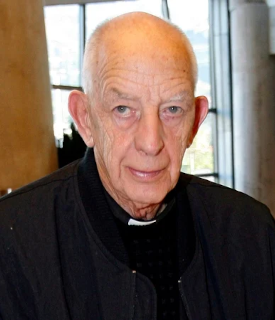
Flannery edits the Dominican bi-monthly journal entitled Doctrine and Life from 1958 to 1988, while at St. Saviour’s Priory, Dublin, where he also serves as prior from 1957 to 1960. He also edits the Religious Life Review. During and after the Second Vatican Council he makes available in English all the documents from the event.
From August 1969, Flannery is a member of the executive committee of the Northern Relief Coordination Committee, raising funds on behalf of the families of those interned without trial in Northern Ireland during the early 1970s.
Flannery embodies the post-Vatican II conception of the priest as a social catalyst engaged by the gospel, closer to his flock than to the clerical hierarchy. He has a great gift for friendship, is indefatigably interested in people, and courts religious affairs commentators and journalists at a time when the hierarchy ignores them, magnifying his influence.
Flannery dies of a heart attack on October 21, 2008, at Kiltipper Woods Care Centre, Dublin. Following a funeral mass at St. Saviour’s Priory, he is buried in the Dominican plot at Glasnevin Cemetery, Dublin, on October 24, 2008.
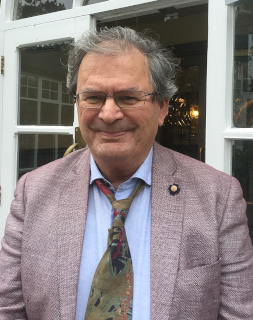
Rosenstock’s father, George, is a doctor and writer from Schleswig-Holstein, Germany, who serves as a medical officer with the Wehrmacht in World War II. His mother is a nurse from County Galway. He is the third of six children and the first born in Ireland. He is educated locally in Kilfinane, then in Mount Sackville, County Dublin.
Rosenstock works for some time on the television series Anois is Arís on RTÉ, then on the weekly newspaper Anois. Until his retirement he works with An Gúm, the publications branch of Foras na Gaeilge, the North-South body which promotes the Irish language.
Although he has worked in prose, drama and translation, Rosenstock is primarily known as a poet. He has written or translated over 180 books.
Rosenstock also writes for children, in prose and verse. Haiku Más É Do Thoil É! (An Gúm) wins the Children’s Books Judges’ Special Prize in 2015.
Rosenstock appears in the anthology Best European Fiction 2012, edited by Aleksandar Hemon, with a preface by Nicole Krauss (Dalkey Archive Press). He gives the keynote address to Haiku Canada in 2015.
Rosenstock has worked with American photographer Ron Rosenstock, Indian Photographer Debiprasad Mukherjee, Greek photographer Kon Markogiannis, Dublin photographer Jason Symes, French photographer Jean-Pierre Favreau and many more to create the new guise of a photo-haiku (or a haiga) – the interplay of visual aesthetic and literature.
Ryan attributes to Pearse the saying “[G]ive me a hundred men and I will free Ireland!” He becomes part of a group of former students lodging in St. Enda’s while they go to university who join the Irish Republican Brotherhood (IRB). They meet in a safe house at Rathfarnham in 1911. The men take the tram from Rathfarnham to Nelson’s Pillar in central Dublin. Pearse once told his friend, “Let them talk! I am the most dangerous revolutionary of the whole lot of them!” In 1911, the Dungannon Clubs revive the Volunteers Militia movement. These clubs are not initially successful in Dublin but are more so in Belfast amongst nationalists. One of the northern members is the Dubliner Oscar Traynor, in his youth a professional footballer with Belfast Celtic F.C., later a war hero and later again a politician and Minister for Posts and Telegraphs.
Eoin MacNeill is appointed leader of the Irish Volunteers. Ryan writes that Pearse, a risk-taker and idealist, tells him MacNeill is “too tactful.” MacNeill is prepared to entertain the Irish Parliamentary Party with negotiations. Ryan quotes Pearse as saying, “[MacNeill] has the reputation of being tactful, but his tact consists in bowing to the will of the Redmondites every time. He never makes a fight except when they assail his personal honour, when he bridles up at once… very delicate position… he is weak, hopelessly weak.”
Pearse tells Ryan that MacNeill is “a Grattan come to life again.” Henry Grattan is a constitutional orator and MP in the Protestant-only 18th-century Irish House of Commons, but one of those who fiercely opposes the notorious Acts of Union 1800, secured by massive bribery (which is then repaid out of Irish taxes), making Ireland part of the United Kingdom. Moreover, MacNeill is an “inconclusive ditherer.” He wants the Irish Volunteers to be apolitical.
The Easter Rising is preceded by the revelation of the “Castle Document,” a plan by the British government to arrest the leaders of the Irish Volunteers and Irish Citizen Army and other radicals. Ryan claims that this document, presented to MacNeill on the Wednesday before the Rising and said to have been stolen from high-ranking British staff in Dublin Castle, is a forgery. Some claim that it is concocted by Joseph Plunkett with the implicit approval of Catholic Archbishop Cullen of Dublin, a sympathiser with Dublin Castle and Redmond’s war stratagem. “Forgery is a strong word,” Ryan says, “but that in its final form the document was a forgery no doubt can exist whatever.” Modern interpretation from Charles Townshend has judged the document to be genuine, and the opinion attributed to the Archbishop’s Palace as circumstantial. Grace Gifford, Plunkett’s widow, says that she was with Plunkett when he deciphered it at Larkfield House. Prior to his execution, Seán Mac Diarmada is met by a priest, and makes the assumptive response that it is a fraudulent document.
Ryan fights through the Easter Rising from April 24, 1916, in the General Post Office (GPO) under murderous artillery fire and describes the battle vividly in his witness statement to the Bureau of Military History. He describes the garrison retreating to Moore Street and quotes Pearse’s sculptor brother Willie Pearse, who is executed a few days later, as saying “Connolly has been asked out to negotiate. They have decided to go to save the men from slaughter, for slaughter it is.”
Ryan fights in the Irish War of Independence and afterwards writes about his experiences. However, the Irish Civil War which follows from June 1922 to April 1923 repels him. He cannot accept that Irishmen would fight Irishmen.
Ryan marries Sarah Hartley in 1933. In 1939 they return to Ireland, where he edits the Torch, a Labour paper. Finding his views at odds with the Labour Party‘s official line, publication ceases in 1944. He and his wife then move to Swords in north County Dublin, where they operate a poultry farm.
In the late 1980s, Reid facilitates a series of meetings between Gerry Adams and John Hume, in an effort to establish a “Pan-Nationalist front” to enable a move toward renouncing violence in favour of negotiation. Reid, himself a staunch nationalist who favours a united Ireland and the withdrawal of British forces from Northern Ireland, then acts as their contact person with the Irish Government in Dublin from a 1987 meeting with Charles Haughey up to the signing of the Good Friday Agreement in 1998. In this role, which is not public knowledge at the time, he holds meetings with various Taoisigh, and particularly with Martin Mansergh, advisor to various Fianna Fáil leaders. After the eventual success of the peace negotiations, Gerry Adams says, “there would not be a peace process at this time without [Father Reid’s] diligent doggedness and his refusal to give up.”
After he moves to Dublin, Reid is involved in peace efforts in the Basque Country. In January 2003, he is awarded the Sabino Arana 2002 “World Mirror” prize, by the Sabino Arana Foundation in Bilbao, in recognition of his efforts at promoting peace and reconciliation. He and a Methodist minister, the Rev. Harold Good, announce that the IRA has decommissioned their arms at a news conference in September 2005.
Reid is involved in controversy in November 2005 when he makes comments during a meeting in Fitzroy Presbyterian Church concerning the Unionist community in Northern Ireland. When the loyalist activist Willie Frazer makes remarks that Catholics had butchered Protestants during the Troubles, Reid angrily responds, “You don’t want to hear the truth. The reality is that the nationalist community in Northern Ireland were treated almost like animals by the unionist community. They were not treated like human beings. They were treated like the Nazis treated the Jews.” Reid later apologises, saying his remarks had been made in the heat of the moment. In an interview with CNN, he says that “The IRA were, if you like, a violent response to the suppression of human rights.”
Reid dies in a Dublin hospital on November 22, 2013. He is survived by two sisters and an aunt, and is buried in Milltown Cemetery, Belfast.
A major at the outbreak of the Second Boer War in 1899, Hickie serves on the staff of Lieutenant-Colonel P. W. J. Le Gallais, commanding officer of the mounted infantry. On November 6, 1900, he is involved in an attempt to capture General Christiaan De Wet at the Battle of Bothaville, when a force led by Le Gallais and Lieutenant-Colonel Wally Ross storm De Wet’s camp. De Wet escapes, while a rearguard of 100 men engages the British force. In a fierce fight Le Gallais is killed, and Wally Ross is badly wounded. Hickie decides to charge the Boer position and leads his small force forward just as reinforcements under Major-General C. E. Knox arrive. The Boers immediately surrender, and some are found with explosive bullets. He wants to execute them immediately, but Knox insists that they be tried. Exasperated with the whole affair, Hickie gives a highly critical interview after the action which is later published in The TimesHistory of the War in South Africa (7 vols, 1900–09), edited by Leo Amery.
Hickie is promoted to brevetlieutenant colonel in 1901 and appointed deputy-assistant adjutant general of the 8th division (1903–06). In 1906, he is given command of the 1st battalion of the Royal Fusiliers. Promoted to colonel in 1912, he serves as assistant quartermaster general of the Irish command (1912–14) and is appointed a Companion of the Order of the Bath in 1914. On the outbreak of World War I, he is promoted to brigadier general and serves in Belgium and France in command of the adjutant’s and quartermaster-general’s department of II Corps. In this capacity, he is involved in the retreat following the Battle of Mons and during the First Battle of the Marne (September 1914). In December 1915, he is appointed to command the 16th (Irish) Division, with the rank of major general, replacing General Sir Lawrence W. Parsons. The division is based around a core of Redmondite National Volunteers, and Hickie, a Catholic and a home ruler, is an acceptable commander to John Redmond and other Irish nationalists.
Hickie is professional, politically adept, and popular with his men, and under his leadership the 16th is renowned for its aggressive fighting spirit. He commands the division during the Battle of the Somme in 1916 and, while proud of his men’s success in capturing Guillemont and Ginchy (September 1916), is appalled by their losses. When the division is ordered to capture Messines (now Mesen) in June 1917, he gives Major Willie Redmond permission to advance as far as the first objective and, following Redmond’s death, reproaches himself bitterly. After this attack the division is transferred to the fifth army and provides assault troops for future attacks. During the Third Battle of Ypres, and especially during the attack on Langemarck in August 1917, the division suffers horrendous casualties, losing 221 officers and 4,064 men. Among the casualties is Fr. Willie Doyle, who Hickie unsuccessfully recommends for a Victoria Cross. The division’s losses at Langemarck are highlighted by Irish MPs in the House of Commons, and Hickie’s handling of the attack is criticised. By this time, nationalist disillusionment with the war means that few Irish replacements are available, and Hickie is forced to accept increasing numbers of non-Irish conscripts into the division. Worn down by years of command, his health finally breaks, and, in February 1918, he is sent home on sick leave, being replaced by Major-General Sir Richard Amyatt Hull.
In 1918, Hickie is created a Knight Commander of the Order of the Bath (KCB) and is also awarded the French Croix de Guerre. During the Irish War of Independence (1919–21), he is critical of the methods used by Crown forces, denouncing in particular the indiscipline of the Black and Tans. In 1921 he retires from the army and becomes a prominent figure in the Royal British Legion in Ireland, tirelessly campaigning on behalf of ex-servicemen. In the 1920s he is involved with the Irish battlefield memorial committee, which erects memorial crosses at Wytschaete, Guillemont, and Salonika, commemorating the 10th and 16th divisions. He later serves as a senator of the Irish Free State (1925–36). Retiring from public life in 1936 to his residence at Terryglass, County Tipperary, he devotes his last years to gardening and reading.
Hickie dies on November 3, 1950, in Dublin, and is buried at Terryglass. He marries a daughter of the novelist Rev. J. O. Hannay, who predeceases him. There is a small collection of his papers in the National Library of Ireland (NLI).
(From: “Hickie, Sir William Bernard” by David Murphy, Dictionary of Irish Biography, http://www.dib.ie, October 2009)
Eleanor Charlotte Butler, recluse of Llangollen, is born in Cambrai, France, on May 11, 1739.
Butler is the youngest daughter of Walter Butler of Garryricken, County Tipperary, and his wife, Ellen (née Morres), of Latargh, County Tipperary. Her family are members of the old Catholic gentry, and her father is the sole lineal representative of James Butler, 2nd Duke of Ormonde. In 1740 her family returns to the Garryricken estate, where she spends part of her childhood. She is educated by the English Benedictine nuns of the convent of Our Lady of Consolation in Cambrai, where her Jacobite grand-aunt is a pensioner. Reared in the liberal and anti-clerical environment at Cambrai, she is open about her opposition to Irish Catholicism. She is also well read in literature.
By the time Butler returns to Ireland, her brother John had claimed the family titles and was recognised as 16th Earl of Ormond. Though he never uses the title, his sisters are recognised as the daughters of an earl. As the family is impoverished, and she is not disposed to marriage, a decade is passed in unhappiness. Then, in 1768, the thirteen-year-old Sarah Ponsonby arrives in Kilkenny to attend a local school. Following her visit to the Butler home at Kilkenny Castle, and despite the difference in age, the two form an immediate friendship and corresponded secretly, having discovered their mutual interest in the arts and Rousseau‘s ideal of pastoral retirement.
Ponsonby, upon finishing school, is sent to live with relatives at nearby Woodstock Estate, and there is subject to the uninvited attention of a middle-aged guardian. Butler is discontented with her life and the prospects of her family’s wish to send her back to Cambrai, so the two plan to leave their difficulties behind and settle in England. In their first attempt to flee in March 1778, they leave for Waterford disguised as men and wielding pistols, but their families manage to catch up with them. Butler is then sent to the home of her brother-in-law, Thomas ‘Monarch’ Kavanagh of Borris, County Carlow, but makes a second, successful attempt and runs away to find Ponsonby at Woodstock Estate. Her persistence wins out when both families finally capitulate and accepted their plans to live together.
Butler and Ponsonby set out for Wales in May 1778 and, after an extensive tour of Wales and Shropshire, eventually settle in Llangollen Vale, where they rent a cottage which is renamed Plas Newydd. They are accompanied by Mary Carryll, a former servant of the Woodstock household, who remains in their service until her death in 1809. Having made a deliberate decision to retire from the world, they spend the greater part of their days corresponding with friends, reading, building up a large library and making alterations to Plas Newydd, which takes on a fashionable Gothic look. Their garden, landscaped under their direction, becomes a popular attraction for visitors. Butler meticulously records their daily routine in a series of journals, some of which are now lost.
Their seclusion, eccentricities, semi-masculine dress and short-cropped powdered hair gain them notoriety, and it becomes fashionable to call on them. Their numerous and illustrious visitors include Hester Lynch Piozzi, Charles and Erasmus Darwin, Sir Walter Scott, Sir Arthur Wellesley, the Duke of Gloucester and Josiah Wedgwood. In 1792 they entertain Stéphanie Caroline Anne Syms, later that year to become the wife of Lord Edward FitzGerald, and her mother, Madame de Genlis. Following the arrest of Edward FitzGerald in 1798, Stéphanie and her suite flee to London and on May 27 pass through Llangollen, where the events in Dublin are already known. On hearing that she is staying in the local inn, Butler and Ponsonby invite her to call in. However, when she wishes to stay for the day, their apprehension of Jacobinism leads them to persuade her “principally for her own sake and a little for [our] own to proceed as fast and as incognito as possible for London.”
Both Anna Seward and William Wordsworth, who stay at Plas Newydd, write poems celebrating their friendship, and Lord Byron sends them a copy of The Corsair. Owing to her support of the Bourbons, Butler is sent the Croix St. Louis, which she wears about her neck. Though generally considered a hospitable couple, Seward, who is a good friend, admits that the “incessant homage” they received could make Butler “haughty and imperious,” while Lady Lonsdale thinks her “very clever, very odd.” Their celebrity does have its drawbacks: an article in the General Evening Post of July 24, 1790, entitled “Extraordinary female affection,” suggests indirectly that their relationship is unnatural. Butler is particularly angered by this publicity and appeals to Edmund Burke for legal advice. Their retirement is also continually dogged by financial difficulties. They live mainly off their respective allowances and Butler’s royal pension (granted through the influence of Lady Frances Douglas), but spend beyond their means and are often in debt. To add to their problems, Butler receives no mention in her father’s will. However, the Gothic eccentricities of their cottage, which they succeed over time in purchasing, and garden attract even the interest of Queen Charlotte.
Though it is claimed that neither woman spends a night away from Plas Newydd, in January 1786 they stay with their friends, the Barretts of Oswestry, and that September they visit Sir Henry Bridgeman of Weston Park, near Staffordshire. In June 1797 they take their only holiday, at the coastal resort of Barmouth. Despite their isolation they are well informed about international events and society gossip. The Irish serjeant-at-law Charles Kendal Bushe recalls how they gave him all the news of Dublin, London, Cheltenham, and Paris.
In later years Butler’s eyesight deteriorates, preventing her from keeping her journal. She is secretly painted as an old woman with Ponsonby by Lady Mary Leighton and sketched by Lady Henrietta Delamere. A distinctive, anonymous silhouette shows the two generously proportioned women in traditional riding habits (National Portrait Gallery, London). Butler dies on June 2, 1829, and is buried alongside Carryll at Llangollen church. Sarah Ponsonby is subsequently buried with them.
(From: “Butler, Lady (Charlotte) Eleanor” by Frances Clarke, Dictionary of Irish Biography, http://www.dib.ie)
Cooney is the second of three children of John Cooney and Mary Ann Cooney (née Gleeson), middling farmers. While his grandfather, Patrick Cooney, from nearby Garrykennedy, is reputed to have been a member of the Irish Republican Brotherhood (IRB) and an Irish National Land League activist, his father does not have any inclination towards radical politics. He is educated at Lissenhall national school and St. Joseph’s CBS, Nenagh. In October 1916, he commences studies in medicine at University College Dublin (UCD) just as the Irish War of Independence is getting underway. He plays briefly with the College’s hurling club.
In 1917, Cooney joins the Third Battalion of the Dublin Brigade of the Irish Republican Army (IRA). A year later he is jailed for two months in Mountjoy Prison and Crumlin Road Gaol, Belfast, for illegal drilling. Joining the IRB at the end of 1918, he assists in the December 1918 election by protecting candidates and acts as a guard at sittings of the First Dáil. On June 26, 1920, he plays a major role in the attack on BorrisokaneRoyal Irish Constabulary (RIC) barracks. He takes part in the Bloody Sunday operations of November 21, 1920, at 28 Upper Pembroke Street where a number of British agents are killed and attends Croke Park afterwards. He then goes on the run as a full-time Volunteer and serves with the Dublin Brigade active service unit (ASU).
After the Anglo-Irish truce of July 1921, Cooney is appointed Officer Commanding (O/C) of the 1st Kerry Brigade, IRA, reorganising it and forming a flying column. Opposing the Anglo-Irish Treaty of 1921, he does not immediately break with GHQ, who sends him to organise the 1st Eastern Division. Later in January 1922, the Chief of Staff, Eoin O’Duffy, asks him to become O/C of the 3rd Eastern Division, but later rescinds the appointment. In March 1922 he is appointed O/C of the 1st Eastern Division of the anti-Treaty IRA during the Irish Civil War.
That same year he is captured by Free State forces and interned in Mountjoy Prison, where he becomes O/C of the prisoners in C Wing. He accepts responsibility for an attempted escape bid on October 10, 1922, in which a fellow prisoner, Peadar Breslin, is killed and another man is wounded. After sojourns in Newbridge and Arbour Hill Prison, he is moved with the other leaders to Kilmainham Gaol, where he spends forty-one days on hunger strike. Removed to Harepark Camp, the Curragh, on January 1, 1924, he is among the last to be released on May 29, 1924.
Cooney succeeds Frank Aiken as Chief of Staff of the IRA on November 18, 1925. Central to the reorganisation scheme he puts in place is the need to secure American funds for the IRA and to combat Frank Aiken’s fundraising work in the United States since December 1925 on behalf of the embryo Fianna Fáil organisation. Receiving permission on April 21, 1926, he departs on a fund-raising trip to the United States but returns to Ireland in October. He resigns as chief of staff in favour of Maurice Twomey but retains his position as chairman of the IRA executive until November 21, 1927, when he obtains leave to complete his medical studies.
After internship in the Mater Hospital, Dublin, Cooney finds temporary employment in London, but remains in touch with GHQ. On September 27, 1929, he marries the German-educated Frances (‘Frank’) Brady, daughter of a wealthy Belfast linen family and former Cumann na mBan activist and hunger-striker. The marriage is not a success. Failing to secure employment due to police harassment and the loyalty test then in force, he and his wife are obliged to emigrate to London, where he practises as a GP, still maintaining his IRA links. Their only child, Seán, is born there in 1931. He returns to Ireland in August 1932, after Fianna Fáil’s accession to power.
An intimate friend of Maurice Twomey, who is still Chief of Staff, Cooney remains in the upper echelons of the IRA and attends its conventions. Signifying his standing in republican circles, he is chosen to unveil, inter alia, the Fenian memorial in Glasnevin Cemetery and the Seán Treacy plaque in Talbot Street, Dublin, and is a regular speaker at commemorations. In March 1940, he attempts to intercede with Éamon de Valera on behalf of hunger-striking republicans, and is later arrested, but released.
After the discovery of a German spy ring in the hospitals commission’s subsidiary, the Dublin Hospitals Bureau, Cooney is forced to resign in April 1942 on refusing to take a loyalty pledge to the state. He returns to private practice. He becomes active in the unsuccessful campaign to save Charlie Kerins, Chief of Staff, from being hanged in 1944. In anticipation of emigrating, he finally resigns from the IRA in 1944, though military and police surveillance continue until March 1945.
In August 1945, Cooney joins the United Nations Relief and Rehabilitation Administration, working with displaced persons in the American zone in Germany, and gains rapid promotion. After joining the International Refugee Organisation (UNRRA’s successor) on July 1, 1947, he becomes the chief medical officer of an area including the American sector of Berlin and containing 150,000 displaced persons. He later holds a similar post in Bavaria.
Appointed a part-time member of the hospitals commission by the inter-party government in September 1949 and in severe financial straits, Cooney emigrates alone to the United States on December 2, 1950, and never returns. While employed in a tuberculosissanatorium in New Jersey, he obtains by examination his licence to practise medicine in Maryland on January 14, 1954. Admitted a member of the American College of Chest Physicians, again by examination, on November 23, 1954, he secures, at the age of 57, his first ever permanent post in medicine, in a similar hospital in Pikesville, Maryland. His republican activities continue through Clan na Gael during his U.S. years, and he is a frequent speaker at commemorative events.
(Pictured: Liam Lynch with some of his Divisional Staff and Officers of the Brigades, including the 1st Southern Division, who attend as delegates to the Army Convention at the Mansion House, Dublin, on April 9, 1922. Cooney is first on the right in the 3rd row back.)
Lynch is born on November 9, 1893, in Barnagurraha, Anglesboro, County Limerick, the fifth child among six sons and a daughter of Jeremiah Lynch, farmer, and Mary Lynch (neé Kelly). The family is politically active. His father’s brother, John, had taken part in the Fenian Rising of 1867 and his mother had been joint secretary of the Ballylanders branch of the Ladies’ Land League.
Lynch attends Anglesboro national school (1898–1909). In 1910 he moves to Mitchelstown, County Cork, to take up a three-year apprenticeship in the hardware store of P. O’Neill on Baldwin Street. He remains there until the autumn of 1915. While in Mitchelstown he is a member of the Gaelic League and the Ancient Order of Hibernians. He also joins the Irish Volunteers. In 1914, when that organisation splits, he does not immediately join the militant rump. He then moves to Fermoy, County Cork, where he works in the store of Messrs J. Barry & Sons Ltd. His move coincides with a period of inactivity as neither Volunteer faction is very active nor is he known. Consequently, he does not take part in the 1916 Easter Rising, but it is a turning point for him. On May 2, 1916, he watches as the Kent family are led through Fermoy, having been captured by British soldiers. Richard Kent dies from a wound sustained that day and Thomas Kent is executed a week later. Lynch becomes a committed Volunteer at this point.
Once committed, Lynch’s enthusiasm and aptitude ensures that he quickly attains positions of responsibility. From early 1917 he is first lieutenant in the small Fermoy company. In September 1917, the Irish Volunteers in east Cork are reorganised. Nine local companies are formed into the Fermoy battalion, and he is elected adjutant. In April 1918, at the height of the conscription crisis, he briefly quits his job to concentrate on organising the Volunteers. In May he is lucky to escape arrest during the sweep that accompanies the “German plot.” When the immediate danger ends, he returns to Barry & Sons.
In January 1919, at the beginning of the Irish War of Independence, the Volunteer organisation in Cork undergoes a major restructuring. Three brigades are established, and Lynch becomes brigade commandant of Cork No. 2. In April he visits Irish Republican Army GHQ in Dublin to discuss plans and to seek arms. It is a frustrating experience as the GHQ has few guns and are cautious about action. Throughout the summer of 1919 he presses GHQ to authorise attacks on British targets as a method of acquiring arms and to prevent boredom and stagnation setting in among his men. Finally, GHQ sanctions attacks if the primary aim is the capture of arms. In response, on September 7, 1919, twenty-five men from the Fermoy company, led by Lynch, ambush fourteen British soldiers on their way to service in the Wesleyan church in Fermoy. Fifteen rifles are captured, one soldier killed, and three wounded. Lynch is shot in the shoulder, probably by one of his own men. As a result, he has to leave his job and hides out in Waterford for a time. A series of arrests follow, among those is Lynch’s close friend, Michael Fitzgerald, who dies on hunger strike in Cork County Gaol in 1920.
Lynch spends the early months of 1920 at GHQ in Dublin. During this time, he is offered the position of deputy chief of staff, but turns it down, preferring to return to Cork. Although not an articulate speaker, he impresses those he meets. His organisational talents, attention to detail, ability to inspire, and intolerance for those who waste meetings endlessly discussing side issues, are noted. He has a low tolerance for politicians and at all times considers the military wing of the movement to be of primary importance. He is engaged to Bridie Keyes, but marriage is postponed pending a final settlement of hostilities.
On June 26, 1920, Lynch, Seán Moylan, and two colleagues capture Major-GeneralCuthbert Lucas while he is fishing on the Munster Blackwater. He gives a false name when he is arrested on August 12, 1920, at City Hall, Cork, with Terence MacSwiney, Lord Mayor of Cork, and ten others. All but MacSwiney are released four days later. He then sets about organising a flying column within the brigade. Ernie O’Malley arrives from headquarters to train the men. This column achieves a major coup on September 28, 1920, when they briefly capture the British Army barracks at Mallow, leaving with a large booty of rifles, ammunition, and two machine guns. The British respond to this increase in activity and the war settles into a pattern of ambush and counter-ambush. The Mallow battalion suffers severe losses in February 1921 and Lynch himself narrowly escapes when four are killed during an encounter at Nadd in March 1921.
In early 1921 Lynch seeks to encourage greater cooperation between the various brigades in the south. Senior brigade officers meet on three occasions to discuss cooperation and a plan to import arms from Italy. The importation project fails, but the First Southern Division is formed on April 26, 1921, bringing eight brigades from Cork, Kerry, Waterford, and west Limerick together. He is elected divisional commandant, making him the most powerful officer outside GHQ. His influence is further increased by his appointment as Southern Divisional Centre and Supreme Council member of the clandestine Irish Republican Brotherhood (IRB) in March 1921.
Lynch is wary when the truce is called in July 1921. He works hard to maintain order in his division and to achieve a state of readiness in case the negotiations fail. For him the Anglo-Irish Treaty is a failure. When the Supreme Council of the IRB meets on December 10, 1921, he is the only voice against the agreement. He is among the officers who insist that an army convention should be called to discuss the treaty, effectively asserting that the army no longer accepts a position subordinate to the Dáil. The army, he believes, is the army of the Republic, and no civilian body can order it to abandon the Republic. The provisional government tries to ban this convention, but it goes ahead on March 26, 1922, and elects an army executive. Lynch is elected Chief of Staff. Between March and June, he works hard to prevent a civil war. He believes unity can be maintained, even under the Treaty, if a republican constitution can be enacted. He also cooperates with Michael Collins in promoting Irish Republican Army (IRA) activity in Ulster. In his adherence to the idea of a republic, the practicalities of politics have little impact on his consciousness, and he is dismissive of the popular support for the Treaty. He is horrified at the thought of civil war but fails to see that his position is leading almost inexorably in that direction. Distrusted as too moderate by Liam Mellows and Rory O’Connor, he is locked out of the Four Courts for a time.
When the Four Courts are attacked, Lynch immediately leaves his headquarters at the Clarence Hotel to travel south. He is briefly detained, before reaching Kingsbridge Station, and has a meeting with Eoin O’Duffy. He is disgusted when Free State figures later claim that he was released, having promised not to take arms against the government. The most plausible explanation of the incident appears to be that O’Duffy interpreted Lynch’s comments, merely indicating disappointment that a war had started, as constituting a statement of intent not to involve himself.
Lynch’s initial actions seem designed to avoid full-scale conflict. He does not order an attack on Dublin, nor does he attempt to seize Limerick. He chooses a containment strategy, seeking to hold a line from Limerick to Waterford for the republican forces. This fails, as the government sends troops in from the rear by sea. The republicans have no urban base when Lynch abandons Fermoy on August 11, 1922. He continues to meet individuals who seek a way to end the war, but intransigence has set in, and he insists that armed struggle will only end with a republic or absolute defeat. As early as August many republicans believe the war is lost and urge a reassessment of tactics, but Lynch rejects all such calls. Operating from secret headquarters in Santry, he orders the shooting of pro-Treaty politicians in retaliation for the execution of republican prisoners.
Under war conditions it is impossible for the army executive to meet regularly, and this leaves Lynch in almost complete control. As the pro-surrender lobby grows within the republican forces, he delays a meeting of the executive, claiming with some justification that it is too dangerous. He leaves Santry and attends a meeting of the Southern Division Council in the last days of February 1923. Sixteen of the eighteen officers there tell him that the military position is hopeless. This forces the calling of an executive meeting on March 6, 1923. No agreement is reached. He strongly favours fighting on, but a motion from Tom Barry, calling for an immediate end to hostilities, is barely rejected. Another meeting is arranged for April 10. On that morning a group, including Lynch and Frank Aiken, suddenly find themselves in danger of capture in a farmhouse on the slopes of the Knockmealdown Mountains in County Tipperary. They flee and are pursued. During the chase Lynch is shot in the abdomen. It seems clear that he is shot by the pursuing Free State soldiers, although Irish historian Meda Ryan has considered the theory that he may have been shot by one of his own in order to remove the major stumbling block to surrender. His colleagues are forced to abandon him, and he is captured. Initially the Free State troops believe they have caught Éamon de Valera. He is taken first to a public house in Newcastle, County Tipperary, and then to St. Joseph’s Hospital in Clonmel, but dies from his wound at 8:45 p.m. that evening. His last request is to be buried beside Michael Fitzgerald in Kilcrumper Cemetery, Fermoy, County Cork. On hearing of Lynch’s death, Ernie O’Malley writes, “You who were a living force are now a battle cry.” O’Malley is wrong, however, as the peace faction within republicanism is strengthened by his death and Aiken orders the suspension of activities on April 27.
In 1935, a massive memorial, consisting of a 60-foot-tall round tower, guarded by four bronze Irish Wolfhounds, is erected at Goatenbridge, County Tipperary, near the site of his capture. It is unveiled on April 7, 1935. Separate annual commemorations are held at Goatenbridge and Kilcrumper. Three biographies have been written and the Liam Lynch memorial pipe band is based in his native Anglesboro. The Lynch family possess a substantial collection of private correspondence.
References to Stephens’s early life, according to one of his biographers, Desmond Ryan, are obscure and limited to Stephens’s own vague autobiographical recollections. He is born at Lilac Cottage, Blackmill Street, Kilkenny, County Kilkenny, on January 26, 1825, and spends his childhood there. No birth records have ever been located, but a baptismal record from St. Mary’s Parish is dated July 29, 1825. There is reason to believe that he is born out of wedlock in late July 1825. However, according to Stephens, his exact date of birth is January 26. He is educated at St. Kieran’s College, Kilkenny, for at least one quarter in 1838. He is later apprenticed to a civil engineer, and from 1844 onwards works for the Waterford–Limerick Railway Company.
When the Young Irelanders split from Daniel O’Connell‘s Repeal Association and found the Irish Confederation in January 1847, Stephens becomes involved in the activities of the Kilkenny Confederate clubs. After the government suspends habeas corpus and issues warrants of arrest against the Confederate leaders, William Smith O’Brien appears in Kilkenny on July 23, 1848, seeking support for a popular insurrection, and two days later Stephens joins him. For four days he follows O’Brien’s wanderings and takes part in all his encounters with government forces, including the affray at the home of Widow McCormack on July 29 when O’Brien’s followers besiege a party of policemen in a house near Ballingarry, County Tipperary. They are finally dispersed by gunfire and the arrival of reinforcements, thus ending O’Brien’s revolutionary efforts. Stephens reportedly receives two bullet wounds but manages to hide and evade arrest.
Three days later, Stephens proceeds to Ballyneale, near Carrick-on-Suir, County Tipperary, in search of John O’Mahony. He accompanies O’Mahony to meet Michael Doheny, and for six weeks Stephens and Doheny avoid arrest by roaming around the south of Ireland, an adventure that Doheny records in The Felon’s Track (1849). On September 12, Stephens is smuggled out of Ireland by the family of the Skibbereen attorney McCarthy Downing, and four days later manages to reach Paris. O’Mahony and Doheny join him shortly afterwards, although Doheny soon emigrates to the United States.
From their exile Stephens and O’Mahony watch the failure of the ’49 conspiracy of James Fintan Lalor and Philip Gray and witness the barricades against Louis Napoleon’s coup d’état in 1851. Stephens later claims to have joined the French republican insurgents, but according to O’Mahony this is merely a frustrated intention. Equally without foundation is the rumour that Stephens and O’Mahony at this time join a republican secret society as a training ground for their future Irish enterprise.
Stephens remains in Paris from 1848 to 1855, supporting himself by teaching English. He attends Sorbonne University and has plans to obtain a professorship that never materialises. Towards the close of his exile, he is employed by the Le Moniteur Universel, for which he allegedly translates Charles Dickens‘s Martin Chuzzlewit. Late in 1855 he returns to Ireland and undertakes a series of tours throughout the island. He later magnifies the venture as “the 3,000 miles’ walk” and reformulates it as an attempt to measure the country’s nationalist temperature. However, his primary intention at the time is to collect information for a book he is planning to write. The following autumn he returns to Dublin, becomes tutor of French to the children of several well-to-do families including that of the Young Irelander John Blake Dillon, and joins the nationalist circle of Thomas Clarke Luby, Philip Gray, and other veterans of the ’49 conspiracy.
When Gray dies in January 1857, Stephens asks O’Mahony, then living in New York, to collect funds for a funeral monument. This evidence of nationalist activity, coupled with the prospect of “England’s difficulty” awakened by the recent Crimean War and the insurrection in India, give life to O’Mahony’s and Doheny’s Emmet Monument Association (EMA). That autumn the EMA sends an envoy to Ireland with a proposal for Stephens to prepare the country for the arrival of a military expedition. Stephens offers to organise 10,000 men in three months, provided he is given at least £80 a month and absolute authority over the enterprise. On March 17, 1858, Saint Patrick’s Day, he receives the first installment and his appointment as “chief executive” of the Irish movement. The same day he and his associates take an oath to make Ireland “an independent democratic republic.” The nameless secret society thereby inaugurated eventually becomes known as the Irish Republican Brotherhood (IRB). It is organised in cells, each led by a “centre” with Stephens being known as the “head centre.”
The EMA’s failure to send a second installment prompts Stephens to travel to New York in October 1858. While in America he attempts, and fails, to engage the support of the Young Irelanders John Mitchel and Thomas Francis Meagher, but succeeds in establishing a solid partnership with Irish nationalists based in New York. Late in 1858 the surviving members of the EMA reorganise themselves into a modified replica of the IRB, and under John O’Mahony’s inspiration adopt the name of the Fenian Brotherhood (FB). Eventually the label “Fenian” comes to be applied to the members of both organisations. As part of the new arrangements, Stephens obtains a new appointment as head of the movement “at home and abroad.”
Despite Stephens’s success, his labours in America and the secrecy of his own activities in Ireland are almost spoiled in December by the arrest of Jeremiah O’Donovan Rossa and other members of the Phoenix National and Literary Society of Skibbereen, which had been incorporated into the IRB the previous May. On his return from America in March 1859 Stephens takes refuge in Paris and delegates management of the organisation to Luby. He only returns to Dublin in April 1861 when O’Mahony, then on a tour of inspection, suggests establishing an executive council to share Stephens’s power. Stephens succeeds in frustrating this plan, but from the time of O’Mahony’s visit the tension between the two leaders never subsides.
In the autumn of 1861 Stephens takes lodgings on Charlemont Street at the house of John and Rossanna Hopper, owners of a small tailoring establishment, and soon falls in love with their daughter Jane, almost twenty years his junior. The two are married on January 24, 1864, at the church of SS Michael and John, Exchange Street. The marriage produces no children.
The first success for Stephens’s IRB comes on November 10, 1861, when the IRB-dominated National Brotherhood of Saint Patrick stages the funeral for the Young Irelander Terence MacManus after an intense tug-of-war with both the Catholic church and constitutional nationalism. Stephens plays a central role in promoting IRB control of the funeral arrangements and although the event lacks the mythical nationalist significance claimed by Fenian apologists, it serves to boost Fenian self-assertion and hasten the divorce between middle-class nationalist elites and a new militant republican working class which has different interests at stake in an independent Ireland.
Despite the McManus funeral success, the IRB continues to endure financial difficulties throughout 1862. In 1863, Stephens resolves to address these difficulties and consolidate the movement’s position by founding a newspaper. The Irish People is first issued on November 28, 1863. He contributes leading articles to its first three numbers but finally abandons his literary efforts in favour of Luby, John O’Leary, and Charles J. Kickham, thereafter the paper’s leading writers and guiding spirits.
In the meantime, the relationship between Stephens and O’Mahony continues to deteriorate. In November 1863 O’Mahony has turned the tables and persuaded the FB to acknowledge Stephens merely as “its representative in Europe.” In March 1864 Stephens again travels to the United States in order to stimulate the flow of funds towards the IRB and regain some hold on the FB. As part of his new policies, he makes the sensational announcement that 1865, at latest, is to be the movement’s “year of action.” After the end of the American Civil War in April 1865, Fenian activity increases spectacularly, and demobilised soldiers travel to Ireland. However, on September 15, 1865, the government takes action, suppresses The Irish People, and arrests most of Stephens’s closest collaborators, including Luby, O’Leary and O’Donovan Rossa. Stephens himself is arrested on November 11 but, in a daring operation that proves a propaganda coup for the Fenians, is rescued from Richmond Bridewell penitentiary thirteen days later and eventually makes his way to America via Britain and France. By the time he arrives in the United States, the FB has split into two “wings,” the partisans of John O’Mahony and those of William R. Roberts, the president of the Fenian “senate,” who advocate shifting military efforts towards invading Canada. The split ends Stephens’s already slender chances of launching a successful rising before the end of December, and he calls a postponement.
On February 17, 1866, the government suspends habeas corpus in Ireland and arrests multiply. Stephens braves the members’ impatience, calls a new postponement, and in May travels to New York in order to try and solve the American crisis in the IRB’s favour. He accepts O’Mahony’s resignation, takes control of his wing, and starts an intensive campaign of propaganda and fund-raising. Again, he proclaims 1866 as the “year of action,” but by December the movement is weaker than ever, and he tries to call a new postponement. This time his lieutenants, led by Col. Thomas J. Kelly, lose patience, depose him from leadership and prepare to launch the insurrection themselves. The result is the ill-fated Fenian Rising of March 5-6, 1867.
After his deposition, Stephens spends most of his remaining years in France, in dire financial distress, but still hoping against hope to regain his position at the head of the movement. However, the IRB is now under the control of the anti-Stephens supreme council, and the FB is quickly losing its influence to the newly emerged Clan na Gael. His reputation, always tainted by his controversial personality and autocratic management, had been ruined forever by the 1866 events and his repeated failure to order the rising. With the exception of a small core of diehard partisans, the majority of his former associates and followers have grown resentful of his leadership and are vehemently opposed to his return.
Apart from occasional English tutoring and a ruinous venture as a wine merchant that takes him to the United States from 1871 to 1874, Stephens’s post-Fenian years are mainly spent in poverty while awaiting the next opportunity to resume leadership of the IRB. In 1880, after a last unsuccessful trip to the United States and a crushing defeat by John Devoy and Clan na Gael, he gives up hope, returns to Paris, and settles down to earn a living as an occasional newspaper contributor. In 1885 he is expelled from France under the unfounded suspicion of involvement in dynamiting activities with his cousins Joseph and Patrick Casey and the journalist Eugene Davis. He then takes up residence in Brussels but is able to return to Paris two years later. Finally, through Charles Stewart Parnell‘s intervention in 1891, he is allowed to return to Ireland. He moves into a cottage in Sutton, near Howth, and settles into retirement. After his wife’s death in 1895 he moves to the house of his in-laws in Blackrock, County Dublin, where he dies on March 29, 1901. Two days later he is given a solemn nationalist funeral and is interred in Glasnevin Cemetery.
Stephens’s controversial historical reputation never accords him a comfortable place in the post-independence nationalist pantheon. His egotism and defects as a leader overshadow the credit he is given as a founder and organiser. Yet his notorious personality is arguably the key to his success and ultimate historical significance. His obsessive self-confidence and single-mindedness turn the EMA’s half-matured proposal into a solid partnership that inaugurates an enduring pattern of American involvement in Irish nationalism. At the same time, by impressing the IRB with his own assertiveness he enables it to break the tacit monopoly of the middle classes on Irish political life. By the time of his downfall, Irish republicanism has acquired a definite shape and a marginal but stable position in the Irish political scene.
Stephens’s name has been incorporated into Kilkenny local heritage in institutions as diverse as a swimming pool, a military barracks, and a hurling team. In 1967 a plaque is unveiled at the site of his childhood home on Blackmill Street. The main collections of his documents are the James Stephens papers, MSS 10491–2, in the National Library of Ireland, and the Michael Davitt papers addenda, MS 9659d, in Trinity College Dublin.
(From: “Stephens, James” by Marta Ramón, Dictionary of Irish Biography, http://www.dib.ie, last revised March 2021)
James Stephens formally establishes the Irish Republican Brotherhood (IRB) in Peter Lanigan’s timber yard, Lombard Street, Dublin, on Saint Patrick’s Day, March 17, 1858. It is originally named the Irish Revolutionary Brotherhood, but soon comes to be known as the Irish Republican Brotherhood. At the same time, John O’Mahoney is founding the American branch of the revolutionary group. O’Mahoney gives the organization the better-known name Fenians, in honor of the Fianna, the soldiers led by Fionn mac Cumhaill, the heroic warrior of Irish legend.
The IRB is a small, secret, revolutionary body whose sole object is to “establish and maintain a free and independent Republican Government in Ireland.” Stephens is a Young Irelander and is a lieutenant to William Smith O’Brien at the Battle of Widow McCormack’s Cabbage Patch in Ballingary, County Tipperary, in August 1848. He is wounded three times and is smuggled onto a ship to England and then to France, where he spends the next eight years. Upon his return to Dublin in 1856, he determines to organise a revolutionary movement and that leads to the founding of the IRB.
The IRB becomes known as the Fenian movement in the 1850s and 1860s and is committed to the use of force to establish an independent Irish republic. After organising an abortive rising in March 1867, it suffers deep internal divisions over its leadership and strategy in both the United States and Ireland—whether it is best to strike at England, in Ireland or in Canada. The issue is resolved after a series of failed interventions in Canada in 1866, 1867 and 1871, and after bombings in England that do not lead Ireland closer to independence. The IRB is unable to exploit the weaknesses and divisions in the constitutional movement following Charles Stewart Parnell’s divorce scandal (1890–91).
The IRB is eventually rejuvenated in Ireland about 1907, led by Bulmer Hobson and Tom Clarke, thus preparing the way for all that follows.The governing body is the Supreme Council. Before 1916 this consists of eleven members, and after the 1917 reorganisation it contains fifteen members. When not in session, all powers of the Supreme Council, except for declaring war, devolve onto an executive of three: the president, secretary and treasurer.
The constitution provides for the establishment of a military council, subordinate to the Supreme Council. The seven signatories of the 1916 Proclamation of the Irish Republic constitute the entire military council at the time. The constitution is dedicated to the use of force against England at any favourable opportunity, but this is to be a democratic decision: “The IRB shall await the decision of the Irish Nation as expressed by a majority of the Irish people as to the fit hour of inaugurating a war against England and shall, pending such an emergency, lend its support to every movement calculated to advance the cause of Irish independence, consistent with the preservation of its own integrity,” a clause adopted in 1873 in response to the controversies arising from the 1867 Fenian Rising.
The IRB plans the 1916 Easter Rising but the Irish Volunteers and the Irish Citizen Army make it possible. The establishment of the Irish Volunteers gives the IRB the great opportunity to train and equip its members as a military body for the purpose of securing independence for Ireland by force of arms and securing the cooperation of all Irish military bodies in the accomplishment of its objectives. Numerically the IRB probably never exceeds 2,000 members, but they are all extremely loyal and well trained, and there is very tight security. The executions of 1916 just about wipe out the Supreme Council, and after the prisoners are released, the IRB has to reconstitute itself.
Following the Easter Rising some republicans—notably Éamon de Valera and Cathal Brugha—leave the organization, which they view as no longer necessary, since the Irish Volunteers now perform its function. The IRB, during the Irish War of Independence (1919-21), is under the control of Michael Collins, who is secretary, and subsequently president, of the Supreme Council. Volunteers such as Séumas Robinson say afterwards that the IRB by then is “moribund where not already dead,” but there is evidence that it is an important force during the war.
When the Anglo-Irish Treaty is signed on December 6, 1921, it is debated by the Supreme Council, which votes to accept it by eleven votes to four. Those on the Supreme Council who oppose the Treaty include former leader Harry Boland, Austin Stack and Liam Lynch. Anti-Treaty republicans like Ernie O’Malley, who fought during the Irish Civil War against the Treaty, sees the IRB as being used to undermine the Irish Republic. The IRB becomes quiescent during the Irish Civil War, which ends in May 1923, but it emerges again later that year as a faction within the National Army that supports Minister for Defence Richard Mulcahy against the “Old IRA,” which fought against the recruitment of ex-British Army personnel and the demobilization of old IRA men. This comes to a head with the Irish Army Mutiny of 1924, in the wake of which Mulcahy resigns and other IRB members of the army are dismissed by acting President of the Executive CouncilKevin O’Higgins. The IRB subsequently dissolves itself, although it is not known whether a formal decision is taken, or it simply ceases to function.