Christened as William O’Brien, the seventh child of Arthur O’Brien, clerk, and Mary O’Brien (née Christie), who is from County Meath, Ó Briain takes an interest in the Irish language from an early age and begins learning Irish by himself from a grammar book, as it is not encouraged by his teachers at the Christian Brothers’ O’Connell School nor spoken by his parents. While still at the O’Connell School, he starts using the Irish version of his name. He also attends meetings of the Gaelic League, then attends University College Dublin (UCD) on a scholarship, where he studies French, English and Irish, receiving a BA (1909) and an MA (1910).
UCD decides to start awarding one annual scholarship for overseas travel in 1911, and Ó Briain wins the first one, using it to visit Germany and study under Kuno Meyer and Rudolf Thurneysen. After three years, he returns home, where he rejoins the Gaelic League and begins teaching French at UCD. He also joins the Irish Volunteers then, the following year, Seán T. O’Kelly convinces him to join the Irish Republican Brotherhood (IRB).
Around this time, Ó Briain joins Sinn Féin, and he stands unsuccessfully for the party in Mid Armagh at the 1918 United Kingdom general election in Ireland, taking 5,689 votes. His campaign leads, indirectly, to his arrest and three months in jail in Belfast. In 1920, following his release, he is appointed a judge in the then-illegal republican court system in Galway, and visits both France and Italy to try to source weapons for the Irish Republican Army (IRA). In November 1920, he is arrested in the UCG dining room by Black and Tans, and is imprisoned for thirteen months, first in Galway and then in the Curragh camp in County Kildare, thereby missing the conclusion of the Irish War of Independence. By the time he is released, the Anglo-Irish Treaty has been signed. He supports the treaty and takes no further part in militant activity.
In the newly independent Ireland, Ó Briain remains a professor at Galway. He also stands in the 1925 Seanad election, although he is not successful. He is the founding secretary of the Taibhdhearc na Gaillimhe theatre, also acting in many of its productions, and spends much time translating works from English and the Romance languages into Irish. He stands to become president of UCG in 1945, but is not elected, and in the 1940s and 1950s is best known for his many appearances on television and radio.
From his retirement in 1959, Ó Briain lives in Dublin. In 1974, the National University of Ireland (NUI) confers an honorary doctorate on him. He dies on August 12, 1974, at St. Gabriel’s Hospital, Cabinteely, County Dublin. His funeral to Glasnevin Cemetery is almost a state occasion, with a huge attendance of public figures, and a military firing party at the graveside, where the oration is given by Micheál Mac Líammóir and a lesson is read by Siobhán McKenna. For days after his death, the newspapers carry tributes to his many-sided career and personality. On the one hundredth anniversary of his birth, Proinsias Mac Aonghusa and Art Ó Beoláin write commemorative articles in Feasta.
On September 1, 1921, Ó Briain marries Helen Lawlor, of Dublin, who dies two years before him. The couple’s only child is Eibhlín Ní Bhriain, who is a journalist for The Irish Times and other periodicals.
Janet McNeill, prolific Irish novelist and playwright, is born on September 14, 1907, in Dublin. Author of more than 20 children’s books, as well as adult novels, plays, and two opera libretti, she is best known for her children’s comic fantasy series My Friend Specs McCann.
McNeill is born to Rev. William McNeill, a minister at Adelaide Road Presbyterian Church, and Jeannie Patterson (Hogg) McNeill. In 1913, the family moves to Birkenhead, Merseyside, England, where her father becomes minister at Trinity Road Church. She attends public school in Birkenhead and studies classics at the University of St. Andrews in St. Andrews, Scotland, completing a MA degree in 1929. While at university, she is involved in writing and acting with the College Players. In 1924, the family returns to Ireland due to her father’s failing health, and Rev. McNeill becomes the minister of a village church in Rostrevor, County Down, Northern Ireland, while Janet joins the Belfast Telegraph as a secretary.
In 1933, McNeill marries Robert Alexander, the chief engineer in the Belfast city surveyor’s department, and the couple settles in Lisburn, where they raise their four sons. One son is the zoologist Professor Robert McNeill Alexander, CBE, FRS. Though she plans to write her first novel early on, she finds it impossible to write seriously until the children grow up, saying, “It was four years before I had a baby and twenty-five before I produced the book.”
In 1946, McNeill wins a prize in a BBC competition for her play Gospel Truth. She begins writing radio dramas, which are broadcast by the BBC. She suffers an intracerebral hemorrhage in 1953. During her recovery, she begins writing novels both for adults and children, producing a large body of work between 1955 and 1964. Her popular children’s character, Specs McCann, who debuts in a 1955 book and makes several reappearances, also inspires a newspaper cartoon strip by Rowel Friers, a Belfast artist and friend of hers.
Her 1944 novel The Maiden Dinosaur is her first to be published in the United States, twenty-two years later. She also has three writing credits on television with series and plays. Several of her plays are staged at the Ulster Group Theatre.
In 1964, McNeill’s husband retires, and the couple moves to Bristol, South West England. She writes one more novel after she leaves Northern Ireland but continues to write children’s books for another decade. During this time, she writes her only children’s play, published as Switch On, Switch Off, and other plays (1968), which presents different moral themes in scenes set in “domestic and workplace settings in contemporary England.” Her children’s book The Battle of St. George Without is televised by the BBC in 1969.
In her adult fiction, McNeill focuses on the lifestyle and social mores of Belfast and Ulster in the mid-twentieth century. Her characters are primarily “menopausal, middle-aged, middle-class Protestants.” She depicts the “dreary, Ulster religiosity” of ministers and laymen alike, and the class conventions and sexual repression of middle-aged, upper-middle-class women. The theme of suppressing self-identity and goals, both by wives in deference to their husbands and parents on behalf of their children, pervades her adult novels.
McNeill has a number of health problems and dies in Bristol in October 1994.
Campbell is the eldest son of Thomas Campbell and Jane Campbell (née Corneigle), who marry in 1787 and later have four daughters and two younger sons. His father, the son of soldier Archibald Campbell and his wife Alice McNally, is born on February 1, 1763, at Sheepbridge, near Newry, County Down. The Presbyterian minister William Campbell may have been a relation.
Archibald Campbell is born Catholic but joins the Church of Ireland, while his son joins the seceding branch of the Presbyterian church and studies at the University of Glasgow, graduating with a Master of Arts degree in 1786, although he does not appear in the published records of the university. He becomes a teacher but is determined to become a minister, and studies in the Anti-Burgher Divinity Hall in Whitburn, West Lothian (or the Seceder Theological Seminary in Whithorn, Wigtownshire, according to another source) for two months each year for five years. He is ordained a minister in the seceding congregation of Ahorey, County Armagh, probably in 1798. Although at first a member of the Anti-Burgher party in his church, Thomas Campbell begins to believe that divisions between and within denominations are prejudicial to true Christianity. He writes a report in 1804 suggesting that Burgher and Anti-Burgher Presbyterians in Ireland should unite. When this is vetoed in 1805 by the General Associate Synod of Scotland, Thomas Campbell, then moderator of the Irish Seceding Synod, initiates an unsuccessful move to seek independence from Scottish control. His experiences with church authorities undoubtedly increase his belief in the need to rediscover the scriptural basis of religion, freed from man-made creeds.
In 1804, Thomas Campbell sets up an academy at Richhill, County Armagh. In 1798, he is one of the founders of the Evangelical Society of Ulster in which clergymen from differing sects cooperate but resigns when this enterprise is frowned on by seceding authorities.
In poor health in 1806, Thomas Campbell resigns from Ahorey, and goes to the United States in 1807, where he preaches in small congregations around Washington, Pennsylvania. He is soon accused of doctrinal unsoundness, of disciplinary laxity and of administering the sacraments to non-Presbyterians. His appeal to the Associate Synod of North America is unsuccessful, and in 1809 he ceases to be a minister of the seceder church. His liberal views on Christian unity and on the paramount importance of the Bible attract supporters, and in 1809 they found the Christian Association of Washington. He publishes a declaration and address in which he sets out the principles of this body. His followers claim it represents a “second reformation” or a “restoration.” It forms the basis of the doctrine of what becomes America’s most important indigenous religious development, and is regarded as significant in the history of the wider ecumenical movement. He publishes a great many other tracts and articles. Thomas Campbell dies in Bethany, West Virginia, on January 4, 1854.
Thomas had married Jane Corneigle in 1787 and their eldest son Alexander is born on September 12, 1788, in Broughshane, County Antrim, where his father is teaching. His parents intend him for the ministry, and he receives a good education, partly from his father, and religious training from both parents. He is greatly influenced by his strongminded and pious mother. In October 1808 his family sets sail for America to join his father. The ship is wrecked on the island of Islay, off Scotland. All on board are saved, partly thanks to Alexander’s strength and leadership. Rather than continuing the voyage by other means, Alexander spends eight months in the University of Glasgow to prepare himself for the ministry.
In the summer of 1809, the family finally arrives in Pennsylvania, among many emigrants from Ulster. On January 1, 1812, Campbell is ordained as a minister by his father’s Brush Run Church, and quickly takes over the leadership of the fledgling church. By 1812, most of their followers, thenceforth often called Campbellites, have undergone baptism by immersion; a union with the Baptist denomination results, but does not survive after 1830, by which date Campbell’s work on a translation of the Greek New Testament has convinced him that baptism is unscriptural. Controversy between the two groups continues for many years.
A very able preacher and debater, whose public discussions attract much attention, Campbell attacks the creeds and governance of established churches. In 1823, he founds the journal the Christian Baptist. Subsequently in 1830, after the break with the Baptists, he starts the Millennial Harbinger. Both periodicals are largely written by Campbell and his father, Thomas, and are widely influential. He is convinced that church unity will usher in a millennial age of peace and harmony. Primitive Christianity is thus to bring about a utopian future. His book Christianity Restored (1835) is widely read, in Britain as well as in the United States. In 1826, a translation of the Greek New Testament is printed by Campbell’s press in Bethany, West Virginia. Largely based on recent translations by others, it nonetheless contains variant readings by Campbell and furthers his aim of providing followers with authoritative texts on which to base their beliefs. In 1841, he founds Bethany College, West Virginia, and is its president until his death in Bethany on March 4, 1866, when he leaves it $10,000 and a large library.
In 1832, several fledgling churches join the Campbellites, and form a new body called the Christian Church, or Disciples of Christ, which today has over 3,000 congregations in the United States. The two guiding principles of the lifelong beliefs of the Campbells are in the end irreconcilable. An emphasis on the literal interpretation of scripture allows believers to form beliefs at variance from those of co-religionists, and neither Alexander Campbell’s great authority in the denomination nor Thomas Campbell’s emphasis on the need for church unity are enough to prevent the fissions inevitable in a church that so strongly opposes man-made creeds. There are now at least six major divisions of the Church of Christ, one of several alternative names.
On March 2, 1811, Campbell marries Margaret Brown, and thenceforth derives his income from the large farm that had belonged to her family. They have eight children, who all die in their father’s lifetime. Margaret Brown Campbell dies on October 22, 1827. On July 31, 1828, in fulfilment of his wife’s dying request, the widower marries the English-born Selina Huntington Bakewell, and has six children with her. Four of those children survive him. Selina Campbell writes a memoir of her husband, published in 1882, and lives until 1897.
(From: “Campbell, Alexander” by Linde Lunney, Dictionary of Irish Biography, http://www.dib.ie, last revised May 2021)
Cox is the younger of two sons of Dr. Michael Cox, physician originally of Roscommon and Sligo, and Elizabeth Cox (née Nolan). Like his father, he supports the Irish Parliamentary Party (IPP) and maintains an interest in a wide range of subjects outside his chosen career throughout his life. He attends Belvedere College (1900-09), where he often obtains first place in his class and wins the Union prize for essay writing three years in a row (1905–07). He is the first auditor of the Belvedere Debating Society and is succeeded in the post by George O’Brien, who remains his lifelong friend. In 1909, he wins both a Royal University of Ireland (RUI) scholarship and an entrance exhibition to University College Dublin (UCD), a college of the new National University of Ireland (NUI).
Working for an arts degree at UCD, then housed at 86 St. Stephen’s Green, Cox overcomes an innate shyness to cultivate a reputation as a skillful and humorous orator in the Literary and Historical Society (L&H), where he befriends both Kevin O’Higgins and John A. Costello. He has immense respect for both men, and they remain firm friends. The respect is reciprocal, and during their subsequent careers O’Higgins and Costello often have occasion to seek Cox’s wise counsel. In 1912, Cox defeats Costello for the auditorship of the L&H by 112 votes to 63, and in the same year attains a first-class honours BA. His role as auditor means that he is involved with UCD for a further year. He attends lectures at the Incorporated Law Society while at the same time he pursues both the LL. B course, a one-year postgraduate law degree, and an MA at UCD. By the end of 1913 he has achieved first place in the LL. B and first-class honours in his MA. In addition, he has become auditor of the Solicitors’ Apprentices’ Debating Society.
After university Cox is apprenticed to a solicitor, Francis Joseph Scallan, who runs a firm in partnership with his brother, John Louis Scallan. On qualifying in 1915, he remains with the firm as an assistant solicitor until 1920, when he forms a partnership with another solicitor, John McAreavey. The firm is called Arthur Cox & Co. and has its offices at 5 St. Stephen’s Green. Initially the new firm’s clients are predominantly made up of those for whom he worked at his previous firm, and friends from his university days. Through George O’Brien he meets Sir Horace Plunkett, president of the Irish Agricultural Organisation Society (IAOS), a connection of enormous benefit, which sees the firm both become solicitor to the IAOS and gain a large number of clients through its membership.
Despite his relative youth, Cox is held in high esteem by those attempting to construct the apparatus of the newly independent Irish Free State in 1922. This is clear when he provides Hugh Kennedy, law officer to the provisional government and future Chief Justice of Ireland, with a lengthy opinion on the status of the Anglo–Irish Treaty, in the context of drafting a constitution for the new state. He is conscious of the need to counter claims that the treaty does not go far enough in acknowledging Irish nationhood; and he advises that the first article of the new constitution should explicitly state that the sovereignty of the new state derives from the Irish people. This is ultimately done in the preamble of the Constitution of the Irish Free State (1922).
In 1923, Cox is appointed solicitor to Siemens-Schuckert, the German engineering firm, and helps to negotiate the terms of an agreement with the Irish government for the construction of a hydro-electric station at Ardnacrusha, County Clare. In 1926, the Electricity (Supply) Act is passed, on which he advises. Although he experiences much success in these years, he is very much affected by the death of his friend Kevin O’Higgins, who is shot and dies from his injuries on July 10, 1927. He visits O’Higgins on his deathbed. Arthur Cox & Co. expands rapidly in its early years, and in 1926 Cox and McAreavey purchase new premises at 42–3 St. Stephen’s Green. Four years later he buys his partner out of the firm.
Given his friendships with various members of the original Free State administration, and the amount of work he receives from it, government work for Cox dries up when Fianna Fáil comes to power in 1932. However, the protectionist corporate policies and implementing legislation of the new administration bring new opportunities. The legislation places severe restrictions on foreign companies owning and operating enterprises in Ireland. He develops a reputation for assisting corporate clients to circumnavigate the restrictive laws. Along with his friend James Beddy, chief executive of the Industrial Credit Corporation, he realises that foreign investment is essential to the growth of the Irish economy. He introduces many clients to Beddy, and between them they find ways to assist the firms in investing in various enterprises without breaching the law. During this period, he cements his reputation as the foremost corporate lawyer in Ireland. This is evident when James Marmion Gilmor Carroll appoints him, as one of only two non-family members, to the board of the tobacco manufacturers P. J. Carroll & Co. He plays a key role in transforming the archaic practices of the firm by persuading Carroll to recruit Kevin McCourt as executive director. He and McCourt later convince Carroll to employ his nephew, Don Carroll, who plays a key role in the modernisation and diversification of the firm. In 1960 He and Carroll negotiate the sale of 40 per cent of the company to Rothmans International.
Despite his reputation as a corporate lawyer, Cox also represents non-corporate clients, some of whom include well-known personalities. In 1946, he agrees to assist Hungarian film-maker Gabriel Pascal in attempting to persuade the Irish government to establish an Irish film studio, with a view to filming the plays of George Bernard Shaw. He puts much time and energy into trying to convince the government to provide finance for the venture, but to no avail.
In 1942, Cox is elected to the council of the Incorporated Law Society and becomes president of the society for the 1951-52 term, presiding over the celebrations to commemorate the centenary of the society’s charter of incorporation. In 1951, he also becomes chairman of the company law reform committee, which produces its report, known as “the Cox report,” in 1958. Renowned for his eccentricities, he is almost as well known for his shabby mode of dress as he is for his incisive mind and immense capacity for work. His reputation is also based on a strict adherence to discretion and confidentiality. This is clear in 1948 when his old friend John A. Costello, having been offered the office of Taoiseach in the first inter-party government, turns to him for advice on whether he should accept the post. In 1954, Costello nominates him to the 8th Seanad.
In October 1953, the London firm of Nicholl Manisty & Co. retains him to represent British Prime Minister Sir Winston Churchill in a libel action brought by BrigadierEric Dorman O’Gowan, arising from comments in Churchill’s The Second World War: The Hinge of Fate. Churchill also relies on the advice of his friend Sir Hartley Shawcross, leader of the English bar, who makes several visits to Dublin to meet Cox and counsel (including John A. Costello). Cox and Shawcross believe it necessary to reach some form of settlement to avoid Churchill having to appear in court. The action is therefore withdrawn in return for an undertaking that certain corrections will be made.
On August 5, 1940, Cox marries Brigid O’Higgins (née Cole), widow of his friend Kevin O’Higgins. Prior to this he lives with his mother at 26 Merrion Square. He had purchased Carraig Breac in Howth in 1936 and moves there on his marriage. His commitment to his work means that he often works seven days a week and he therefore keeps a flat on Mespil Road, Dublin, from 1940. In 1959, he sells Carraig Breac and moves to 8 Shrewsbury Road, Dublin.
On February 14, 1961, Brigid Cox dies. Soon after, Cox decides to retire from his profession and study for the priesthood. He is intent on becoming a Jesuit and discusses his intentions with the Archbishop of Dublin, John Charles McQuaid, who agrees to ordain him after two years of private tuition at the Jesuit theologate at Milltown Park, Dublin. On being accepted by the Jesuits, he makes arrangements to settle his worldly affairs by selling his home on Shrewsbury Road and leaving his practice to the existing partners. He enters Milltown Park on October 15, 1961, and is ordained on December 15, 1963. His impact on Irish life over the previous forty years is evident by the presence at his ordination of John A. Costello, W. T. Cosgrave, Seán T. O’Kelly, and James Dillon, among others.
Following ordination Cox is appointed to serve at the Jesuit mission in Monze, Northern Rhodesia (Zambia). He arrives at Monze in August 1964 and is appointed extraordinary chaplain to the local convent and hospital. On June 8, 1965, he suffers head injuries in a car accident while traveling to Namwada in Zambia. Taken to Choma hospital, he initially appears to be relatively unscathed but collapses and dies on June 11, 1965. He is found to have suffered from a cerebral haemorrhage and a fractured skull. He is buried in the grounds of the Jesuit retreat house in Chikuni, Zambia.
Many of the Cox family papers are housed at the UCD archives.
(From: “Cox, Arthur Conor Joseph” by Shaun Boylan, Dictionary of Irish Biography, http://www.dib.ie, October 2009)
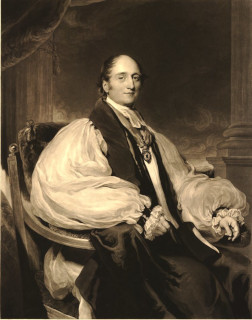
Beresford employs Lewis Nockalls Cottingham, one of the most skilled architects of the time, to restore St. Patrick’s Cathedral, Armagh. Cottingham removes the old, stunted spire and shores up the belfry stages while he rebuilds the piers and arches under it. The arcade walls which had fallen away as much as 21 inches from the perpendicular on the south side and 7 inches on the north side, are straightened by means of heated irons, and the clerestory windows which had long been concealed, are opened out and filled with tracery.
Beresford dies on July 18, 1862, at Woburn, Bedfordshire, England, the home of his niece, in the parish of Donaghadee and is buried in the cathedral. There is a memorial to him in the south aisle at St. Patrick’s Cathedral, Armagh.
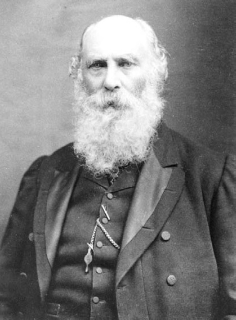
George Johnstone StoneyFRS, Irish physicist, dies on July 5, 1911, at Notting Hill, London, England. He is most famous for introducing the term “electron” as the “fundamental unit quantity of electricity.” He introduces the concept, though not the word, as early as 1874, initially naming it “electrine,” and the word itself comes in 1891. He publishes around 75 scientific papers during his lifetime.
Stoney is born on February 15, 1826, at Oakley Park, near Birr, County Offaly, in the Irish Midlands, the son of George Stoney and Anne (née Bindon Blood). His only brother is Bindon Blood Stoney, who becomes chief engineer of the Dublin Port and Docks Board. The Stoney family is an old-established Anglo-Irish family. During the time of the famine (1845–52), when land prices plummet, the family property is sold to support his widowed mother and family. He attends Trinity College Dublin (TCD), graduating with a BA degree in 1848. From 1848 to 1852 he works as an astronomy assistant to William Parsons, 3rd Earl of Rosse, at Birr Castle, County Offaly, where Parsons had built the world’s largest telescope, the 72-inch Leviathan of Parsonstown. Simultaneously he continues to study physics and mathematics and is awarded an MA by TCD in 1852.
From 1852 to 1857, Stoney is professor of physics at Queen’s College Galway. From 1857 to 1882, he is employed as Secretary of the Queen’s University of Ireland, an administrative job based in Dublin. In the early 1880s, he moves to the post of superintendent of Civil Service Examinations in Ireland, a post he holds until his retirement in 1893. He continues his independent scientific research throughout his decades of non-scientific employment duties in Dublin. He also serves for decades as honorary secretary and then vice-president of the Royal Dublin Society (RDS), a scientific society modeled after the Royal Society of London and, after his move to London in 1893, he serves on the council of that society as well. Additionally, he intermittently serves on scientific review committees of the British Association for the Advancement of Science from the early 1860s.
Stoney publishes seventy-five scientific papers in a variety of journals, but chiefly in the journals of the Royal Dublin Society. He makes significant contributions to cosmic physics and to the theory of gases. He estimates the number of molecules in a cubic millimeter of gas, at room temperature and pressure, from data obtained from the kinetic theory of gases. His most important scientific work is the conception and calculation of the magnitude of the “atom of electricity.” In 1891, he proposes the term “electron” to describe the fundamental unit of electrical charge, and his contributions to research in this area lays the foundations for the eventual discovery of the particle by J. J. Thomson in 1897.
Stoney proposes the first system of natural units in 1881. He realizes that a fixed amount of charge is transferred per chemical bond affected during electrolysis, the elementary chargee, which can serve as a unit of charge, and that combined with other known universal constants, namely the speed of lightc and the Newtonian constant of gravitationG, a complete system of units can be derived. He shows how to derive units of mass, length, time and electric charge as base units. Due to the form in which Coulomb’s law is expressed, the constant 4πε0 is implicitly included, ε0 being the vacuum permittivity.
Like Stoney, Max Planck independently derives a system of natural units (of similar scale) some decades after him, using different constants of nature.
Hermann Weyl makes a notable attempt to construct a unified theory by associating a gravitational unit of charge with the Stoney length. Weyl’s theory leads to significant mathematical innovations, but his theory is generally thought to lack physical significance.
Stoney marries his cousin, Margaret Sophia Stoney, by whom he has had two sons and three daughters. One of his sons, George Gerald Stoney FRS, is a scientist. His daughter Florence StoneyOBE is a radiologist while his daughter Edith is considered to be the first woman medical physicist. His most scientifically notable relative is his nephew, the Dublin-based physicist George Francis FitzGerald. He is second cousin of the grandfather of Ethel Sara Turing, mother of Alan Turing.
After moving to London, Stoney lives first at Hornsey Rise, north London, before moving to 30 Chepstow Crescent, Notting Hill, west London. In his later years illness confines him to a single floor of the house, which is filled with books, papers, and scientific instruments, often self-made. He dies at his home on July 5, 1911. His cremated ashes are buried in St. Nahi’s Church, Dundrum, Dublin.
Born on December 18, 1895, Roe is the daughter of William Ernest Roe and Anne Lambert Sheilds of Mountrath, County Laois. Her grandfather is Francis Henry Sheilds of Parsonstown (now Birr, County Offaly), owner of the King’s County Chronicle. She is sent first to the local primary school and then to the Preston School in Abbeyleix. Although she attends Trinity College Dublin (TCD), she does not begin her career due to the outbreak of World War I. She joins the St. John’s Ambulance Brigade and serves at the Cambridge Military Hospital and at Aldershot Barracks. In the immediate aftermath, she continues her medical career with the Military Hospital in Bray, County Wicklow. She also spends time touring in Europe visiting museums and beginning her appreciation for medieval art. She is raised Protestant and has done her duty as part of the aristocracy by serving in the war. But the soldiers treat her as Irish and abuse her especially during the Easter Rising of 1916. The result is that she supports nationalism from that point forward. She goes back to TCD and completes her degree in modern languages in 1921. She finally completes her MA in 1924 and begins a teaching career. She spends time working in the Royal School, Dungannon, and Alexandra College, Milltown, Dublin.
In 1926, Roe’s parents need her, and she returns home. She then becomes the County Librarian in Laois. While working as a librarian she is able to study further and, as a rare person with a car, she tours sites and visits schools. One result of her presentations to schools is to inspire Ireland’s first female archaeologist, Ellen Prendergast. In 1940, she retires from the library and moves to Dublin where she is able to buy a house and garden. Apart from her antiquarian work, she is a regular supporter of charities and is honorary secretary of The Queen’s County Protestant Orphan’s Society and actively involved in The Dublin University Mission to Chota Nagpur, India.
Roe becomes a regular contributor to various journals and newspapers including Journal of the Royal Society of Antiquaries of Ireland, An Leabharlann, Béaloideas, Seanchas Ard Mhacha, Carloviana, the The Irish Press and the Leinster Express. From 1965 until 1968 she serves as the president of the Royal Society of Antiquaries of Ireland, the first woman to be elected to the position. She is elected to be a member of the Royal Irish Academy in 1984. She continues touring and lecturing into her nineties.
Roe lives at Santry, Dublin, and later at Oak House, Sussex Road, Dublin. She dies on May 28, 1988, at Grove Nursing Home, Killiney, County Dublin, and is buried beside her parents at St. Peter’s Churchyard, Mountrath, County Laois.
The Royal Society of Antiquaries of Ireland have an annual lecture in her honour and have named one of their lecture rooms after her.
Seán Proinsias Ó Faoláin, short story writer of international repute and one of the most influential figures in 20th-century Irish culture, dies in Dublin on April 20, 1991. He is also a leading commentator and critic.
Ó Faoláin writes his first stories in the 1920s, eventually completing ninety stories over a period of sixty years. From 1929 to 1933 he lectures at the Catholic college, St. Mary’s College, at Strawberry Hill, London, during which period he writes his first two books. His first book, Midsummer Night Madness, is published in 1932. It is a collection of stories partly based on his Civil War experiences. He afterward returns to Ireland. He publishes four novels, seven additional volumes of short stories, six biographies, three travel books, a play, a memoir, a history book, translations and literary criticism, including one of the rare full-length studies of the short story, The Short Story (1948). He also writes a cultural history, The Irish, in 1947. His last short story volume, Foreign Affairs, is published in 1976. His Collected Stories is published in 1983.
Ó Faoláin produces critical studies of the novel and the short-story form, introduces texts of historical and literary merit, and contributes scores of articles, reviews, and uncollected stories to periodicals in Ireland, Britain, and the United States.
Ó Faoláin is a founder member and editor of the Irish literary periodical The Bell from 1940 to 1946. Under his editorship, The Bell participates in many key debates of the day. It also provides a crucial outlet for established and emerging writers during the lean war years. The list of contributors to The Bell include many of Ireland’s foremost writers, among them Patrick Kavanagh, Patrick Swift, Flann O’Brien, Frank O’Connor and Brendan Behan.
A recurring thread in Ó Faoláin’s work is the idea that national identities are historically produced and culturally hybrid; an additional thesis is that Irish history should be conceived in international terms, and that it should be read, in particular, in the context of social and intellectual developments across Europe.
Ó Faoláin marries Eileen Gould, a children’s book writer who publishes several books of Irish folk tales, in 1929. They have two children: Julia (1932–2020), who becomes a Booker-nominated novelist and short story writer, and Stephen (b. 1938).
Ó Faoláin dies in Dublin at the age of 91 on April 20, 1991.
Ó Faoláin is a controversial figure in his own lifetime and two of his books are banned for “indecency” in Ireland — his debut collection of short stories and his second novel, Bird Alone (1936). His legacy has proven divisive. If some consider him a social liberal cosmopolitan who challenges “proscriptive” definitions of Irish culture, others see him as a chauvinistic snob who paradoxically restricts the development of Irish writing. Proto-revisionist or nascent postcolonial, O’Faoláin has been considered both, sometimes within the same critical survey. Either way, his work is central to the evolution of a post–Literary Revival aesthetic, and his voice is one of the most prominent, and eloquent, in the fight against censorship in Ireland.
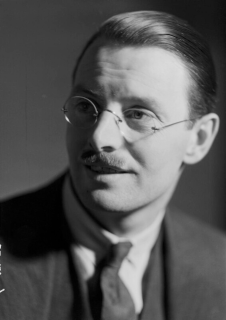
(Pictured: Portrait of Seán Ó Faoláin by Howard Coster, 1930s, National Portrait Gallery)
Boland is born on September 16, 1870, at 135 Capel Street, Dublin, to Patrick Boland, businessman, and Mary Donnelly. Following the death of his mother in 1882, he is placed with his six siblings under the guardianship of his uncle, Nicholas Donnelly, auxiliary bishop of Dublin.
Boland is educated at two private Catholic schools, the Catholic University School, Dublin, and Birmingham Oratory in Birmingham, England, where he becomes head boy. His secondary education at the two schools help give him the foundation and understanding to play an influential role in the politics of Great Britain and Ireland at the beginning of the 20th century, when he is a member of the Irish Parliamentary Party, which pursues constitutional Home Rule.
In 1892, Boland graduates with a BA from London University. He studies for a semester in Bonn, Germany, where he is a member of Bavaria Bonn, a student fraternity that is member of the Cartellverband. He studies law at Christ Church, Oxford, graduating with a BA in 1896 and MA in 1901. Although called to the Bar in 1897, he never practises.
Boland is the first Olympic champion in tennis for Great Britain and Ireland at the first modern Olympics, which take place in Athens in 1896. He visits his friend Thrasyvoulos Manos in Athens during the Olympics, and Manos, a member of the organising committee, enters Boland in the tennis tournament. He promptly wins the singles tournament, defeating Friedrich Traun of Germany in the first round, Evangelos Rallis of Greece in the second, Konstantinos Paspatis of Greece in the semifinals, and Dionysios Kasdaglis of Greece in the final.
Boland then enters the doubles event with Traun, the German runner whom he had defeated in the first round of the singles. Together, they win the doubles event. They defeat Aristidis and Konstantinos Akratopoulos of Greece in the first round, have a bye in the semifinals, and defeat Demetrios Petrokokkinos of Greece and Dimitrios Kasdaglis in the final. When the Union Jack and the German flag are run up the flagpole to honour Boland and Traun’s victory, Boland points out to the man hoisting the flags that he is Irish, adding “It [the Irish flag]’s a gold harp on a green ground, we hope.” The officials agreed to have an Irish flag prepared.
Following a visit to County Kerry, Boland becomes concerned about the lack of literacy among the native population. He also has a keen interest in the Irish Language.
Boland’s patriotic stand is well received in nationalist circles in Ireland. This and a lifelong friendship with John Redmond gain for him an invitation to stand as a candidate for the Irish Parliamentary Party in the safe seat of South Kerry, which he holds from 1900 to 1918. He is unopposed in the general elections of 1900 and 1906, and the first of 1910. In the second election of 1910 he is challenged by a local man, T. B. Cronin, who stands as an independent nationalist in the interest of William O’Brien. Boland stands down at the 1918 United Kingdom general election.
In 1908, Boland is appointed a member of the commission for the foundation of the National University of Ireland (NUI). From 1926 to 1947, he is General Secretary of the Catholic Truth Society. He receives a papal knighthood, becoming a Knight of St. Gregory in recognition for his work in education. In 1950, he is awarded an honorary Doctor of Law by the NUI.
Boland marries Eileen Moloney at SS Peter and Edward, Palace Street, Westminster, on October 22, 1902, the daughter of an Australian Dr. Patrick Moloney. They have one son and five daughters. His daughter Honor Crowley succeeds her husband Frederick Crowley upon his death sitting as Fianna FáilTD for South Kerry from 1945 until her death in 1966. His daughter Bridget Boland is a playwright who notably writes The Prisoner and co-writes the script for Gaslight, and, among other books, co-authors Old Wives’ Lore for Gardeners with her sister, Maureen Boland.
Earley first joins the Roscommon minor football team in 1963, at the age of fifteen. In that year, his side reaches the Connacht minor final, losing to Mayo. Two years later, in 1965, he lines out in a second Connacht minor decider. Five-in-a-row hopefuls Mayo are beaten by Roscommon, giving him a Connacht Minor Football Championship title. Roscommon are later defeated in the All-Ireland semi-final. He also plays under-21 hurling with Roscommon. In 1969, he plays in the All-Ireland under-21 final where Roscommon faces Kildare, however Kildare wins on the day.
Earley is only seventeen years-old when he makes his senior debut for Roscommon in 1965. Over the next fifteen years, Roscommon wins four Connacht Senior Football Championship titles. In 1985, he sustains a fractured jaw in the Connacht semi-final against Galway, with many expecting it to end his career. He confounds everybody and lines out in the Connacht final against Mayo two weeks later. In spite of kicking six points, Mayo still triumphs by 2–11 to 0–8. At the age of thirty-seven, he decides to retire from inter-county football.
After completing his Leaving Certificate in 1965, Earley joins the Defence Forces as a cadet and is commissioned in 1967. His first posting is as a platoon commander in the Recruit Training Depot at the Curragh Camp and, in 1969, he is appointed an Instructor at the Army School of Physical Culture (ASPC). Two years later, in 1971, he obtains a specialist diploma in physical education at St. Mary’s College, Twickenham.
Earley’s service record includes overseas service with the United Nations Truce Supervision Organization (UNTSO) in 1975, Adjutant to the 52nd Infantry Battalion of the United Nations Interim Force in Lebanon (UNIFIL). From 1987 to 1991, he serves as deputy military adviser to UN secretary general Javier Pérez de Cuéllar and Battalion Commander of the 81st Infantry Battalion UNIFIL in 1997. While serving with the UN up to 1991 he is a member of negotiating teams dealing with the Iraqis and Kuwaitis and is a key adviser during the setting up of the UN’s mission in Kuwait – Unikom. He is involved in negotiating an end to the Angolan Civil War. He is a graduate of the Royal College of Defence Studies, London (2001), and holds a Master of Arts (Hons) in peace and development studies from the University of Limerick (1999). He undertakes the Ranger Course in the Defence Forces, which leads to the establishment of special operations training and the establishment of the Army Ranger Wing (ARW). He is the last serving member of that course.
Earley is appointed school commandant of the ASPC. In 1991, he is appointed an instructor at the Command and Staff School of the Military College and in 1994-95 he helps establish the United Nations Training School Ireland (UNTSI) in the Military College.
Earley is promoted to lieutenant colonel in 1995. He commands the 27 Infantry Battalion on the Irish border. He is promoted to colonel in 2001. In December 2003, he is made brigadier general and is appointed major general in March 2004 when he receives his final appointment. He replaces Lieutenant General James Sreenan. He becomes chief of staff in April 2007, leading the Army, Air Corps and Naval Service.
On April 18, 2010, Earley indicates he plans to retire from the Defence Forces due to ill health. He is awarded a Distinguished Service Medal with Honour from TaoiseachBrian Cowen. His resignation is accepted on June 9, 2010, and one of his previous deputies, Major General Sean McCann, is appointed Chief of Staff.
Earley dies of Creutzfeldt–Jakob disease (CJD) on June 23, 2010, at the age of 62. His Newbridge funeral on June 24, 2010, is attended by Taoiseach Brian Cowen, Irish government ministers and leading GAA figures, while former Taoiseach Liam Cosgrave issues a statement calling him “one of the great figures of this country.”