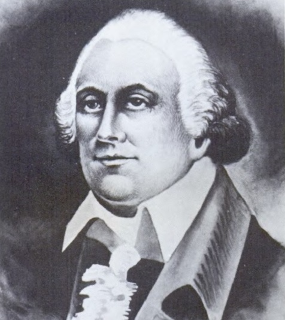
In the mid-1750s, Fitzsimons’s family immigrates to Philadelphia, Pennsylvania, where his father dies soon thereafter. He has enough education that he begins work as a clerk in a mercantile house. He marries Catherine Meade on November 23, 1761, and forms a business partnership with her brother George. Their firm, which specializes in the West Indies trade, operates successfully for over 41 years.
The firm is soon hit by the new revenue measures created to help support the finances of the British Empire, including the much reviled Stamp Act of 1765. Concerned with these ideas, Fitzsimons becomes active in the Irish merchant community in Philadelphia. He is a founding member of the Friendly Sons of St. Patrick in 1771 and later, in 1774, a steering committee organized to protest the Coercive Acts.
When Pennsylvania begins mobilizing and organizing a militia to fight the British, Fitzsimons is soon involved. He serves as captain of a company of home guards under the command of Colonel John Caldwalader. Initially his company serves as part of the soldiers who man posts along the New Jersey coast. His unit later serves as part of the reserve at the Battle of Trenton in 1776. Later in the war, he serves on the Pennsylvania Council of Safety and heads a board to oversee the newly formed Pennsylvania Navy.
Fitzsimons enters active politics as a delegate to the Continental Congress in 1782 and 1783. He is a member of the Pennsylvania House of Representatives from 1786 until 1795. He is also a delegate to the U.S. Constitutional Convention in 1787. Although not a leading member of that convention, he supports a strong national government, the end of slavery, the United States Congress‘s powers to impose a tariff on imports and exports, the granting the House of Representatives, and power in equal to the United States Senate in making treaties. He is one of only two Catholic signers of the Constitution of the United States, the other being Daniel Carroll of Maryland.
After the Constitution is established, Fitzsimons serves in the first three sessions of the House of Representatives as a Federalist, where he favors protective tariffs and a strong navy, co-drafting the Naval Act of 1794 authorizing the original six frigates of the United States Navy. He fails to win re-election in 1794. This is partially attributed to public opinion turning against the Federalist Party over the forceful suppression of the Whiskey Rebellion. Although he never holds elective office again, he serves in 1798 as head of the committee of merchants overseeing the subscription-loan to build a warship at private expense for use in the Quasi-War.
In 1796, Fitzsimons, along with James Innes of Virginia, is appointed by President John Adams to serve as one of two American members on the five-man debt commission charged under Article VI of the Jay Treaty with examining the claims of British subjects unable to collect debts incurred by Americans prior to the American Revolution. Fitzsimons, Innes and Samuel Sitgreaves, who replaces Innes upon the latter’s death, become annoyed with the arguments used by their British counterparts to inflate the claims total. Fitzsimons and Sitgreaves angrily and permanently secede from the board in July 1799. The claims are eventually disposed of by a lump-sum payment, agreed upon by United States Minister to BritainRufus King with British Foreign SecretaryRobert Banks Jenkinson and approved by PresidentThomas Jefferson and the Senate in 1802.
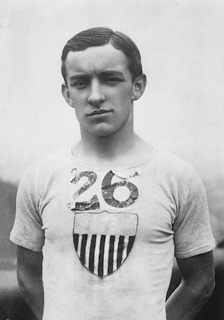
Born in New York City on April 10, 1886, to a family of Irish emigrants from Nenagh, County Tipperary, Hayes is probably best known for winning the controversial marathon race at the London Olympics. He is one of only three male American athletes to win the Olympic Marathon, the other two being Thomas Hicks in 1904 and Frank Shorter in 1972.
In 1905, Hayes joins Bloomingdale Brothers as an assistant to the manager of the sporting goods department. At night, he trains on a cinder track on the roof of the Bloomingdale’s building in New York. He is promoted to manager of the department after returning from his Olympic victory.
Hayes starts his athletics career with a fifth-place finish at the 1906 Boston Marathon, running for the St. Bartholemew Athletic Club in a time of 2:55:38. He improves on that the following year by finishing third in Boston with a time of 2:30:38 and winning the inaugural Yonkers Marathon. In 1908, he finishes second, 21 seconds behind Thomas Morrissey in the Boston Marathon with a time of 2:26:04 and thus qualifies for the Olympic Games held in London that same year.
The British Olympic Association wants to start the race in front of Windsor Castle and finish in front of the royal reviewing stand at the White City Stadium. As a result, the distance is 26 miles and 385 yards (42.195 km). It takes until 1921 for the IAAF to codify that distance as the official length of the marathon. Prior to this, races are usually about 25 miles (40 km).
At the race itself, Dorando Pietri from Italy is the first to enter the stadium. But Pietri has depleted himself to open a more than 10 minute lead over the field and is suffering extreme fatigue and dehydration. When he enters the stadium, he takes the wrong path, and when umpires redirect him, he falls down for the first time. He gets up with their help in front of 75,000 spectators.
Pietri falls four more times, and each time, the umpires help him up. He manages to finish the race first, with a time of 2 hours, 54 minutes, 46 seconds. During all these stumbles and the direct aid from the officials, Hayes has now entered the stadium, finishing the race second, with a time of 2 hours, 55 minutes, 18 seconds.
Pietri is disqualified after the U.S. officials file a protest. Despite the official result, Pietri achieves much more fame than Hayes when Queen Alexandra awards him a special silver cup.
All of the Olympic officials are British, and the Pietri incident joins a list of other controversial calls in the 1908 Olympics, prompting the International Olympic Committee to start appointing judges from a wide variety of countries instead of only the host country.
After the dramatic Olympic battle between Pietri and Hayes, public interest is such that a match race is organized by professional promoters in November 1908 at Madison Square Garden. Pietri wins the race by 75 yards. A second match race is held on March 15, 1909, and again Pietri wins. Both Pietri and Hayes turn professional after the Olympics and achieve great fame.
Hayes is a trainer for the U.S. team for the 1912 Summer Olympics. He later teaches physical education and is a food broker. Hayes dies on August 25, 1965, in Englewood, New Jersey.
The Shore Athletic Club of New Jersey (Shore AC) holds the Johnny Hayes collection as lifetime trustees. Included in the collection are numerous trophies, as well as the 1908 Olympic gold medal for the marathon. This represents the first Olympic gold medal to be won at the modern marathon distance of 26 miles, 385 yards.
Hayes is a guest on the television show I’ve Got a Secret as one of five former Olympic champions, which airs on October 13, 1954.
In 2002, three statues honoring Olympic champions with links to Nenagh, Matt McGrath, Johnny Hayes and Bob Tisdall, are unveiled in front of the Nenagh Courthouse.
Moylan is born to a Catholic family in Cork, County Cork, in 1737. His father, John Moylan, is a well-to-do merchant in Shandon, County Cork. His older brother Francis becomes Bishop of Cork. His family sends him to be educated in Paris. He then works in Lisbon for three years in the family shipping firm. He settles in Philadelphia in 1768 to organize his own firm. He is one of the organizers of the Friendly Sons of St. Patrick, an Irish American fraternal organization, and serves as its first president.
Moylan joins the American Continental Army in 1775 and upon the recommendation of John Dickinson, is appointed Muster-Master General on August 11, 1775. His brother John acts as United States Clothier General during the war. His experience in the shipping industry affords the United States a well-qualified ship outfitter, who helps fit out the first ships of the Continental Navy. On March 5, 1776, he becomes secretary to General George Washington with the rank of lieutenant colonel. He is appointed Quartermaster General in the American Continental Army on June 5, 1776, succeeding Thomas Mifflin. He resigns from this office on September 28, 1776. However, he continues to serve as a volunteer of General Washington’s staff through December 1776.
In January 1776, Moylan writes a letter using the term “United States of America,” the earliest known use of that phrase.
Moylan then raises a troop of light dragoons, the 4th Continental Light Dragoons, also known as Moylan’s Horse, on January 3, 1777, at Philadelphia, and is appointed colonel in the Continental Army on January 5. The regiment is be noted for taking the field in captured British red coats. However, they see action in green coats at the Battle of Brandywine on September 11, 1777, and the Battle of Germantown on October 4, 1777, and end the year by protecting the Cantonment at Valley Forge. He succeeds General Casimir Pulaski as Commander of the Cavalry in March 1778. Moylan’s Horse sees action at the Battle of Monmouth on June 28, 1778.
In the campaign of 1779 Moylan and the 4th Dragoons are stationed at Pound Ridge, New York, and see action when the British raid Norwalk, Connecticut, on July 11, 1779. He and the 4th Dragoons take part in the Battle of Springfield in New Jersey, on June 23, 1780, and General Anthony Wayne‘s expedition at Bull’s Ferry, New Jersey, on July 20, 1780. He commands his Dragoons at the Siege of Yorktown in October 1781, after which he is to take the cavalry to the Southern Campaign. However, his failing health causes him to leave the field and return to Philadelphia, where he constantly appeals to the Continental Congress to man, equip and maintain the Continental Dragoon Regiments.
Moylan is married to Mary Ricketts Van Horne on September 12, 1778, and has two daughters, Elizabeth Catherine, and Maria. His two sons die as children. He dies in Philadelphia on April 11, 1811, and is buried there in the churchyard at St. Mary’s Roman Catholic Church.
Jack “Legs” Diamond, an Irish Americangangster in Philadelphia and New York City during the Prohibition era also known as John Nolan and Gentleman Jack, is born in Philadelphia on July 10, 1897, to Sara and John Moran, who emigrated from Ireland to Philadelphia in 1891. A bootlegger and close associate of gambler Arnold Rothstein, he survives a number of attempts on his life between 1916 and 1931, causing him to be known as the “clay pigeon of the underworld.” In 1930, his nemesis Dutch Schultz remarks to his own gang, “Ain’t there nobody that can shoot this guy so he don’t bounce back?”
In 1899, Diamond’s younger brother Eddie is born. He and Eddie both struggle through grade school, and their mother suffers from severe arthritis and other health problems. She passes away on December 24, 1913, following complications brought on by a bacterial infection and a high fever. John Moran then moves his family to Brooklyn, New York.
Diamond soon joins a Manhattan street gang called the Hudson Dusters. His first arrest for burglary occurs when he breaks into a jewelry store on February 4, 1914. He serves in the United States Army in World War I but is convicted and jailed for desertion in 1918 or 1919. He serves two years of a three- to five-year sentence at Leavenworth Military Prison. After being released in 1921, he becomes a hired thug and later personal bodyguard for crime boss Arnold Rothstein.
Diamond is known for leading a rather flamboyant lifestyle. He is an energetic individual, his nickname “Legs” derived either from his being a good dancer or from how fast he could escape his enemies. His wife Alice is never supportive of his life of crime but does not do much to dissuade him from it. He is a womanizer, with his best-known mistress being a showgirl and dancer, Marion “Kiki” Roberts.
In the late 1920s, Prohibition is in force, and the sale of beer and other alcoholic beverages is illegal in the United States. Diamond travels to Europe to acquire beer and narcotics but fails. However, he does obtain liquor, which is dumped overboard in partially full barrels that float to Long Island as ships enter New York Harbor. He pays children a nickel for every barrel they bring to his trucks.
Following the death of Jacob “Little Augie” Orgen, Diamond oversees illegal alcohol sales in downtown Manhattan via the Hotsy Totsy Club, an establishment partly owned by Diamond on Broadway. This work brings him into conflict with Dutch Schultz, who wants to move beyond his base in Harlem. He also runs into trouble with other gangs in the city. On July 14, 1929, he and fellow gang member Charles Entratta shoot three drunken brawlers in the Hotsy Totsy Club. Two of the brawlers, William Cassidy and Simon Walker, are killed, while the survivor, Peter Cassidy, is severely wounded. The club’s bartender, three waiters, and the hat check girl vanish, with one of them being found shot dead in New Jersey. He is not charged but is forced to close the club.
In 1930, Diamond and two henchmen kidnap truck driver Grover Parks in Cairo, New York, demanding to know where he had obtained his load of hard cider. When Parks denies carrying anything, Diamond and his men beat and tortured Parks, eventually letting him go. A few months later, he is charged with the kidnapping of James Duncan. He is sent to Catskill, New York, for his first trial, but is acquitted. However, he is convicted in a federal case on related charges and sentenced to four years in jail. He is tried in December 1931 in Troy, New York, also for kidnapping, and is once again acquitted.
On August 23, 1930, Diamond, under the false name John Nolan, boards the ocean liner SS Belgenland, bound for Europe. The New York City Police Department (NYPD) suspect that he might have left the U.S. aboard RMS Olympic or RMS Baltic, but he is not found on either ship when they reach Europe. The NYPD then sends a wireless telegraph message to the crew of SS Belgenland, who reply that a man similar to Diamond’s description is among the passengers. Diamond spends much of the voyage in the ship’s smoking-room playing poker, with one report claiming that he won thousands of dollars in this game. The SS Belgenland‘s officers, however, refute this, saying his winnings were small.
The NYPD telegraphs police in England, France and Belgium with the warning that Diamond is an undesirable character. When SS Belgenland reaches Plymouth on August 31, Scotland Yard officers tell Diamond he will not be allowed to land in England. He tells reporters that he wants to travel to the French spa town of Vichy for “the cure.” He disembarks in Antwerp on September 1, where Belgian police take him to their headquarters. Eventually, he agrees to voluntarily leave Belgium and is put on a train to Germany. When his train reaches Aachen, German police arrest him. On September 6, the German government decides to deport Diamond. He is driven to Hamburg and put on the cargo ship Hannover for passage to Philadelphia.
On September 23, Hannover arrives in Philadelphia, and Diamond is immediately arrested by the Philadelphia police. At a court hearing that day, the judge says he will release him if he leaves Philadelphia within the hour. Diamond agrees.
On October 24, 1924, Diamond is shot and wounded by shotgun pellets, reportedly after trying to hijack liquor trucks belonging to a rival crime syndicate.
On October 16, 1927, Diamond tries to stop the murder of “Little Augie” Orgen. His brother Eddie is Orgen’s bodyguard, but Diamond substitutes for Eddie that day. As Orgen and he are walking down a street on Manhattan’s Lower East Side, three young men approach them and start shooting. Orgen is fatally wounded, and Diamond is shot twice below the heart. He is taken to Bellevue Hospital, where he eventually recovers. Police interview him in the hospital, but he refuses to identify any suspects or help the investigation in any way. Police initially suspect that he is an accomplice and charge him with homicide, but the charge is dropped. The assailants are supposedly hired by Lepke Buchalter and Jacob “Gurrah” Shapiro, who are seeking to encroach on Orgen’s garment-district labor rackets.
On October 12, 1930, Diamond is shot and wounded at the Hotel Monticello on Manhattan’s West Side. Two men force their way into his room and shoot him five times. Still in his pajamas, he staggers into the hallway and collapses. When asked later by the police commissioner how he managed to walk out of the room, he says he drank two shots of whiskey first. He is rushed to the Polyclinic Hospital, where he eventually recovers. He is discharged from Polyclinic on December 30, 1930.
On April 21, 1931, Diamond is arrested in Catskill on assault charges for the Parks beating in 1930. Two days later, he is released from the county jail on $25,000 bond. Five days later, he is again shot and wounded at the Aratoga Inn, a roadhouse near Cairo. After eating in the dining room with three companions, he is shot three times and collapses by the front door. A local resident drives him to a hospital in Albany, where he eventually recovers. On May 1, while he is still in the hospital, the New York State Police seize over $5,000 worth of illegal beer and alcohol from his hiding places in Cairo and at the Aratoga Inn.
In August 1931, Diamond and Paul Quattrocchi go on trial for bootlegging. The same month, he is convicted and sentenced to four years in state prison. In September 1931, he appeals his conviction.
On December 18, 1931, Diamond’s enemies finally catch up with him. He is staying in a rooming house on Dove Street in Albany while on trial for kidnapping in Troy. On the night of his acquittal, December 17, he and his family and friends visit a restaurant in Albany. At 1:00 a.m., he and mistress, Marion “Kiki” Roberts, entertain themselves at the Rain-Bo Room of the Kenmore Hotel on North Pearl Street.
At 4:30 a.m., Diamond drunkenly goes back to the rooming house and passes out on his bed. Two gunmen enter his room about an hour later. One man holds Diamond down and the other shoots him three times in the back of the head.
There is much speculation as to who is responsible for the murder. Likely candidates include Schultz, the Oley Brothers, the Albany Police Department, and relatives of Red Cassidy, another Irish American gangster at the time. According to author William Kennedy in his book O Albany, Dan O’Connell, who runs the local Democraticpolitical machine, orders Diamond’s execution, which is carried out by the Albany police.
Given the power that the O’Connell machine holds in Albany and its determination to prevent organized crime, other than their own, from threatening their monopoly of vice in the city, some accept this account of the story. For those believing this theory, William Fitzpatrick’s promotion to chief of police is said to be a reward for executing Diamond. In 1945, Chief Fitzpatrick is shot and killed in his own office by John McElveney, an Albany police detective. McElveney is sentenced to 20 years to life in prison. He is released in 1957 when his sentence is commuted by GovernorW. Averell Harriman.
On December 23, 1931, Diamond is buried at Mount Olivet Cemetery in Maspeth, Queens. There is no church service or graveside ceremony. Family and spectators numbering 200 attend the interment. No criminal figures are spotted.
On July 1, 1933, Alice Kenny Diamond, Diamond’s 33-year-old widow, is found shot to death in her Brooklyn apartment. It is speculated that she is shot by Diamond’s enemies to keep her quiet.
Flanagan is born to Patrick and Elizabeth (née Mulligan) Flanagan, who are strongly nationalist and republican, and support the Republican Anti-Treaty during the Irish Civil War, both serving as Lord Mayor of Sligo. Her paternal family, originally from County Fermanagh, are driven out by anti‐Catholicpogroms and resettle in Sligo, where her parents manage a retail business. She is good friends with fellow Irish actresses Joan O’Hara and Paddy Croft. She spends much of the early 1950s touring with Anew McMaster, where she meets Harold Pinter at the Gate’s Pinter Festival.
In 1997, Flanagan wins the Barclays Theatre Awards for Best Actress in a Supporting Role for her role in Jennifer Johnston‘s The Desert Lullaby: A Play in Two Acts, at the Lyric Theatre, Belfast. The Barclays Theatre Awards are for outstanding regional theatre (including opera and dance) in the United Kingdom.
A resident of Glen Rock, New Jersey, Flanagan dies at The Valley Hospital in Ridgewood, New Jersey, on June 28, 2003, one day before her 78th birthday, of heart failure following a battle with lung cancer. She is survived by her husband, George Vogel (whom she married in 1958), a sister, Maura McNally, and her daughters Melissa Brown and Jane Holtzen.
O’Connor is born on June 7, 1874, at Worcester, Massachusetts, the eldest of three sons and two daughters of Andrew O’Connor, a stonecutter from Lanarkshire, Scotland, who becomes a professional sculptor, and Marie Anne O’Connor (née McFadden), of County Antrim. Educated in Worcester public schools, at the age of 14 he becomes apprenticed to his father, helping him to design monuments for cemeteries. He is employed in the early 1890s on sculptural work for the World’s Columbian Exposition (Chicago World’s Fair), being active in the studio of William Ordway Partridge, and assisting Daniel Chester French on his colossal Statue of the Republic, a landmark of the 1893 Columbian exposition.
Moving to London (1894–98), O’Connor works on bas-reliefs in the studio of the painter John Singer Sargent, who uses him as a model for his mural Frieze of Prophets for the Boston Public Library. His first independent work, Sea Dreams, a relief of a head, is exhibited at the Royal Academy of Arts in 1896. Returning to the United States (1898–1903), he becomes a studio assistant of French, through whom he receives his first public commission, for the Vanderbilt Memorial Doors for St. Bartholomew’s Episcopal Church, Manhattan, New York, a project completed in 1902 to wide critical acclaim. He also executes the tympanum and lateral friezes.
Around 1900, O’Connor marries an artist’s model named Nora, by whom he has a daughter. In 1902, he hires as studio model Jessie Phoebe Brown from New Jersey and of County Down parentage. The following year he elopes with her to Paris, where they marry and have four sons, the youngest of whom, Patrick O’Connor, becomes an artist and gallery curator. Jessie continues for many years as his primary model, sitting for the heads of both female and male figures, O’Connor coarsening the features for the latter.
During his years in Paris (1903–14), O’Connor is influenced by the work of Auguste Rodin, whom he befriends. Among his pupils in Paris is the American sculptor and heiress Gloria Vanderbilt Whitney. He continues to fulfil numerous commissions for funerary and public monuments in the United States, an example of the former being the Recuillement in Sleepy Hollow Cemetery, near Tarrytown, New York. From 1906 he exhibits annually at the Salon in Paris, where he is the first foreigner to win a second-class medal, for his bronze statue of Gen. Henry Lawton. Included in his only exhibition at the Royal Hibernian Academy (1907) is a bronze relief of the prophet Nehemiah adapted from a panel of the Vanderbilt doors. The relief is subsequently included in his one-man show at the Galerie Hébrard, Paris in 1909.
In 1909, O’Connor wins a competition open to sculptors of Irish descent to execute a monument to Commodore John Barry, the County Wexford-born “father of the American navy,” for Washington, D.C. His design includes a frieze depicting events in Irish history, flanked by a group of three nude Irish emigrants entitled Exile from Ireland, and another group representing the Genius of Ireland, which includes a female figure of the “Motherland.” Probably owing to opposition from the Barry family to the depiction of their ancestor as a rough-and-ready sailor, the commission is not completed. His marble statue of Gen. Lew Wallace (author of Ben-Hur: A Tale of the Christ), a plaster of which is exhibited at the Salon in Paris in 1909, is placed by the state of Indiana in the National Statuary Hall in the United States Capitol, Washington, D.C. Another marble, Peace by Justice, is commissioned as a gift from the United States to the Peace Palace in The Hague in 1913.
Returning to Paris in the mid-1920s, O’Connor becomes the first foreigner to win a gold medal at the Salon des Artistes in 1928, for the marble sculpture Tristan and Iseult, now held in the Brooklyn Museum, New York. The French government makes him a Chevalier of the National Order of the Legion of Honour in 1929. In 1926 he had exhibited a plaster group, Monument aux morts de la Grande Guerre, at the Salon in Paris. The sculpture is requested in 1932 by the people of Dún Laoghaire, County Dublin, as a memorial to Christ the King, O’Connor obligingly altering the interpretation of his iconography. Imposed on a “Tree of life” are three figures of Christ, representing in turn “Desolation,” “Consolation” and “Triumph.” Cast in bronze, throughout World War II the statue remains hidden in Paris to avoid its being melted down for the valuable metal. Transported to Dún Laoghaire in 1949, due to clerical opposition to its unconventional iconography, it is not at first erected, but for years lay on its side in a garden in Rochestown Avenue until its eventual unveiling in 1978 as Triple Cross in Haigh Terrace, where it stands in Moran Park. His other chief work in Ireland is a bronze statue of Daniel O’Connell in the Bank of Ireland, College Green, Dublin. Inspired by Rodin’s famous Monument to Balzac, the work is executed at his studio in a converted stable at Leixlip Castle, County Kildare in 1931–32.
During the 1930s, O’Connor lives and works in London and Ireland, where he has residences at Glencullen House, County Wicklow, and 77 Merrion Square, Dublin. He dies at the latter address on June 9, 1941, and is buried in Glasnevin Cemetery. His own bronze relief, Le feu sacré, marks the grave. A portrait painting, executed by his son Patrick in 1940, is in Dublin City Gallery The Hugh Lane, which also holds twenty-six sculptures presented by O’Connor late in his life, and posthumously by his family. The collection includes a marble self-portrait bust of 1940, a bronze of the Lafayette cast by the gallery in 1984 from a reduced plaster model presented by the artist, and a bronze group entitled The Victim, on view in Merrion Square Park, from an uncommissioned and uncompleted war memorial conceived by O’Connor under the general title Le Débarquement. The National Gallery of Ireland has the Desolation maquette for the Triple Cross. A centenary exhibition of his work is held at Trinity College Dublin in 1974. His widow dies in Dublin in 1974.
(From: “O’Connor, Andrew” by Lawrence William White and Carmel Doyle, Dictionary of Irish Biography, http://www.dib.ie, October 2009)
Brenan is born in Cork, County Cork, on November 17, 1828. He begins to write verse at an early age and is one of the genuine poets of the Young Ireland movement. His earlier poems are published under the initials “J. B., Cork,” or “J. B—n,” and some of his American verses under the pseudonym “Gondalez.” He is also an able prose writer.
Brenan is an active member of the Cork Historical Society, and is one of the editors of the Cork Magazine, which appears in November 1847, and continues to be published until the end of 1848, when the journal ceases publication. Some of its contributors, who include Frazer, Martin MacDermott, Fitz James O’Brien, Mulchinock and Mary Savage, later either end up in jail or in exile.
In January 1848, John Mitchel visits Cork and, according to Michael Cavanagh, who publishes a sketch of Brenan’s life in Young Ireland, Dublin, in June and July 1885, Brenan for the first time “beheld the man he most admired on earth, and with whose future destiny, whether for weal or woe, he felt his own was bound up. Never had the archenemy of England a more faithful or earnest follower.”
Brenan contributes to the Mitchel’s United Irishman and sells his rifle to obtain train fare so he can take up his residence in Dublin, the headquarters of the revolutionary movement. He later publishes articles in John Martin‘s The Irish Felon urging the Confederate Clubs members, many of whom have arms, to be in readiness for action. “The sooner you realise the fact,” he writes in a letter addressed to the Members of the Provincial Confederate Clubs, “that the Confederation was got up for the purpose of doing something, the better for us all. Just think what it undertook to do. It undertook to defeat the strongest Government and to liberate the most degraded country that ever existed. It undertook to give – to a province—to strike the chains off millions of slaves and, if necessary, to wash out the iron moulds in blood.”
In another letter to “the Young Men of Ireland” on July 22, 1848, he writes, “On you I principally rely. You realise that you are very ‘rash,’ rather inclined to be ‘violent,’ and have exceedingly little prudence to spare. Brothers, let your watchword be ‘Now or never—now and forever’ rashly.”
Brenan is associated with John Savage and John O’Mahony while Savage is operating on the slopes of the Comeragh Mountains. He is arrested and kept in prison for seven months alternately in Newgate Prison, Carrickfergus and Kilmainham Gaols. During his confinement he writes some fine poems, according to T. F. O’Sullivan, one, entitled Yearnings, evidently addressed to Mary Savage, sister of John.
After his release without trial in March 1849, Brenan becomes editor of the Irishman which had been started in Dublin by Bernard Fulham, and for six months attempts to rekindle the insurrectionary flame in the country. He is implicated in the attack on the Cappoquin police barracks on September 16, 1848, and in October escapes to the United States.
In America Brenan becomes associated with a number of journals, including Horace Greeley‘s New-York Tribune, Devin Reilly’s People, The Enquirer of Newark, New Jersey, and the New Orleans Delta in which he writes a series of papers under the pen-name Ben Fox. On August 27, 1851, he marries Mary Savage, in her parents’ house, on Thirteenth Street, New York.
Brenan writes some articles and poems for John Mitchel’s Irish Citizen in 1854. He is an enthusiastic supporter of the Southern cause and founds the New Orleans Times.
Brenan dies on May 27, 1857, at the early age of twenty-nine and is buried in the old French cemetery of New Orleans. During the last year of his life, he is almost totally blind. He is attended in his last illness by Dr. Dalton Williams. There are seven children of his and Mary’s marriage, only one of whom, Florence, survives their parents. She possesses her father’s literary ability but devotes her life to religion as a member of the Mercy Order.
Brenan’s best-known poem, “Come to Me, Dearest,” is addressed to Mary Savage before their marriage. The love story of Brenan and Mary is told in the sketch by Ellen Mary Patrick Downing, afterwards Sister Mary Alphonsus.
Tone is born Martha Witherington in Dublin on June 17, 1769. She is the eldest daughter of merchant William Witherington and his wife Catherine (née Fanning). Her father is listed as a woolen draper on Grafton Street, Dublin, from 1768 to 1784, as a wine merchant from 1784 to 1788, and finally as a merchant from 1788 to 1793. It is claimed that he is a lieutenant in the Royal Navy and sits on the merchants’ guild on Dublin’s common council from 1777 to 1783. Her mother is a housekeeper to her father after he is widowed.
Tone receives a good education and maintains an interest in drama and literature throughout her life. Katherine Wilmot visits her in Paris in 1802 and comments on the books she has by French, Italian and English authors. When she is fifteen years old, she gets to know Wolfe Tone through her older brother. He is still a student in Trinity College Dublin, and it is he that renames her Matilda. They marry when she is just sixteen, on July 21, 1785, in St. Ann’s Church, Dublin, honeymooning in Maynooth. Upon their return they live with the Witheringtons, though they are not on good terms, and then with Wolfe Tone’s parents in Bodenstown, County Kildare.
The Tone’s first child, Maria, is born before October 1786. She is followed by a son, Richard, who is named for their neighbour Richard Griffith, who dies in infancy. Tone stays with her husband’s family while he is studying for the bar in London from 1787 to 1788. When he returns, the couple has two more sons: William Theobald Wolfe Tone, born on April 29, 1791, and Francis Rawdon Tone, born on June 23, 1793. Francis is known as Frank and is named after Francis Rawdon-Hastings. William is born in Dublin and Frank is probably born in Bodenstown. By this time, the family has a cottage in Bodenstown which Wolfe Tone had inherited from his uncle Jonathan Tone, which the family jokingly refers to as Château Boue. They live there until May 1795, when they leave for Princeton, New Jersey, due to political reasons.
Tone and her children come back to Europe to join Wolfe Tone in France eighteen months later. The family settles in Paris, at first living with Colonel Henry Shee at Nanterre, later moving to the suburb, Chaillot. She educates her children at home. Very few of her letters survive, but many of her husband’s letters and diaries are addressed or intended for her. From these and her letter to her friend Eliza Fletcher, it is clear she shares her husband’s interest in politics. Following her husband’s death in November 1798, she moves to a small apartment at 51 Rue Saint-Jacques in the Latin Quarter of Paris. This is to be close to her son William, who is attending Lycée Louis-le-Grand. She is awarded a pension of 1,200 francs for herself and 400 for each of her children after the expiration of the Treaty of Amiens on May 1, 1803.
Tone’s daughter Maria dies in April 1803, and then her son Frank dies in 1807, both of tuberculosis. William is displaying symptoms of the disease as well, which prompts her to move to the United States in 1807. From there, they attempt to sort out her husband’s affairs, which had been entrusted to James Reynolds. They retrieve only a few of Wolfe Tone’s pre-1795 diaries, and all of the post-1795 letters and diaries, which they add to the autobiography she already has in her possession. When William enters the Cavalry School at Saint-Germain-en-Laye in November 1810 as a cadet, she moves to be close to him, living at the Hôtel de la Surintendance. By approaching Napoleon in 1811, who knew Wolfe Tone, she ensures that her son receives French citizenship and the privileged status of “élève du gouvernement.” In January 1813, when William begins his service, she returns to Paris to live on the Rue de Lille and later moves to the Latin Quarter.
Following the defeat of Napoleon in June 1815, William is refused entry to Ireland or to visit Britain. This leads to both mother and son returning to the United States. Before she leaves Paris, she marries her old friend Thomas Wilson on August 19, 1816. Wilson is a Scottish businessman and advocate who has taken care of her financial affairs after the death of her husband. The couple visit Scotland, and then move to New York City in 1817, and finally to Georgetown, District of Columbia, around 1820. She lives there until her death and calls herself Matilda Tone-Wilson.
Starting in 1824, The New Monthly Magazine begins the unauthorised publication of extracts from Wolfe Tone’s autobiography. In response, Tone decides to publish all of Wolfe Tone’s papers and writing, including the autobiography, pamphlets and diaries, edited by their son William. What results is two large volumes entitled the Life of Theobald Wolfe Tone, published in May 1826. She adds a memoir of her own life in Paris following his death in 1798. The book is a best-seller, and ensures the legacy of Wolfe Tone, as well as being an important contemporary document of both Irish and French revolutionary politics.
William Tone dies in 1828, after which Tone lives more privately. She dies in Georgetown on March 18, 1849. Thomas Wilson predeceases her in 1824. Just two weeks prior to her death she is interviewed by a Young Irelander, Charles Hart. She is initially buried near William Tone at Marbury burying-ground, Georgetown. After that cemetery is sold, she is reinterred in Green-Wood Cemetery, Brooklyn, New York, on October 31, 1891, by her great-grandchildren. A new monument is dedicated to her, which is later restored in 1996.
Luby is born in Dublin on January 16, 1822, the son of a Church of Ireland clergyman from Templemore, County Tipperary, his mother being a Catholic. He is educated at Trinity College Dublin where he studies law and puts in the necessary number of terms in London and Dublin where he acquires a reputation as a scholar and takes his degree. He goes on to teach at the college for a time.
In 1851 Luby travels to France, where he hopes to join the French Foreign Legion to learn infantry tactics but finds the recruiting temporarily suspended. From France he goes to Australia for a year before returning to Ireland. From the end of 1855 he edits the Tribune newspaper founded by John E. Pigot who had been a member of The Nation group. During this time, he remains in touch with the small group of ’49 men including Philip Gray and attempts to start a new revolutionary movement. Luby’s views on social issues grow more conservative after 1848 which he makes clear to James Stephens whom he meets in 1856.
In the autumn of 1857 Owen Considine arrives with a message signed by four Irish exiles in the United States, two of whom are John O’Mahony and Michael Doheny. The message conveys the confidence they have in Stephens and asks him to establish an organisation in Ireland to win national independence. Considine also carries a private letter from O’Mahony to Stephens which is a warning, and which is overlooked by Luby and Stephens at the time. Both believe that there is a strong organisation behind the letter, only later to find it is rather a number of loosely linked groups. On December 23, Stephens dispatches Joseph Denieffe to America with his reply which is disguised as a business letter dated and addressed from Paris. In his reply, Stephen’s outlines his conditions and his requirements from the organisation in America.
On March 17, 1858, Denieffe arrives in Dublin with the acceptance of Stephens’s terms by the New York Committee and the eighty pounds. On that very evening the Irish Republican Brotherhood is established in Peter Langan’s timberyard in Lombard Street.
In mid-1863 Stephens informs his colleagues he wishes to start a newspaper, with financial aid from O’Mahony and the Fenian Brotherhood in America. The offices are established at 12 Parliament Street, almost at the gates of Dublin Castle. The first issue of the Irish People appears on November 28, 1863. The staff of the paper along with Luby are Charles J. Kickham and Denis Dowling Mulcahy as the editorial staff. Jeremiah O’Donovan Rossa and James O’Connor have charge of the business office, with John Haltigan being the printer. John O’Leary is brought from London to take charge in the role of Editor.
On July 15, 1865, American-made plans for a rising in Ireland are discovered. Superintendent Daniel Ryan, head of the G Division of the Dublin Metropolitan Police at Dublin Castle, has an informer within the offices of the Irish People who supplies him with an “action this year” message on its way to the IRB unit in Tipperary. With this information, Ryan raids the offices of the Irish People on Thursday, September 15, followed by the arrests of Luby, O’Leary and O’Donovan Rossa. Kickham is caught after a month on the run. Stephens is also caught with the support of Fenian prison warders. The last number of the paper is dated September 16, 1865.
After his arrest and the suppression of the Irish People, Luby is sentenced to twenty years of penal servitude. He is released in January 1871, but is compelled to remain away from Ireland until the expiration of his sentence.
Upon his release Luby goes first to the Continent and later settles in New York City. He lectures all over the country for years and writes for a number of Irish newspapers on political topics. At the memorial meeting on the death of John Mitchel, he delivers the principal address in Madison Square Garden.
Thomas Clarke Luby dies at 109½ Oak Street, Jersey City, New Jersey of paralysis, on November 29, 1901, and is buried in a grave shared with his wife in Bayview Cemetery in Jersey City. His epitaph reads: “Thomas Clarke Luby 1822–1901 He devoted his life to love of Ireland and quest of truth.”
Cooney is encouraged to become a professional fighter by his father. His brother, Tommy Cooney, is also a boxer and reaches the finals of the New York Golden Gloves Sub-Novice Heavyweight division. His grandparents lived in Placentia, Newfoundland, in Canada.
Fighting as an amateur, Cooney wins international tournaments in England, Wales, and Scotland, as well as the New York Golden Gloves titles. He wins two New York Golden Gloves Championships, defeating Larry Derrick to win the 1973 160-lb Sub-Novice Championship and Earlous Tripp to win the 1976 Heavyweight Open Championship. In 1975 he reaches the finals of the 175-lb Open division, but is defeated by Johnny Davis. He trains at the Huntington Athletic Club in Long Island, New York, where his trainer is John Capobianco. His amateur record consists of 55 wins and 3 losses.
When Cooney turns professional, he signs with co-managers Mike Jones and Dennis Rappaport. He is trained by Victor Valle. Known for his big left-hook and his imposing size, he has his first paid fight on February 15, 1977, beating Billy Jackson by a knockout in one round. Nine wins follow and he gains attention as a future contender, although his opponents are carefully chosen. He moves up a weight class and fights future world cruiserweight champion S. T. Gordon in Las Vegas, winning by a fourth round disqualification. He has eleven more wins, spanning 1978 and 1979. Among those he defeats are Charlie Polite, former U.S. heavyweight champion Eddie Lopez, and Tom Prater. These are not rated contenders, however.
By 1980, Cooney is being featured on national television. Stepping up, he beats one-time title challengers Jimmy Young and Ron Lyle, both by knockout. The Young fight is stopped because of cuts sustained by Young. By then Cooney is ranked number 1 by the World Boxing Council (WBC) and eager for a match with champion Larry Holmes.
In 1981, Cooney defeats former world heavyweight champion Ken Norton by knockout just 54 seconds into the first round with a blisteringly powerful attack. This ties the record set in 1948 by Lee Savold for the quickest knockout in a main event in Madison Square Garden. Since his management team is unwilling to risk losing a big future pay day with Holmes by having him face another viable fighter, Cooney does not fight for 13 months after defeating Norton.
The following year, Holmes agrees to fight Cooney with the fight held on June 11, 1982. With a purse of ten million dollars for the challenger, it is the richest fight in boxing history to that time. The promotion of the fight takes on racial overtones that are exaggerated by the promoters, something Cooney does not agree with. He believes that skill, not race, should determine if a boxer is good. However, if he wins, he would become the first Caucasian world heavyweight champion since SwedeIngemar Johansson defeated Floyd Patterson 23 years earlier. Don King calls Cooney “The Great White Hope.” The bout draws attention worldwide, and Larry Holmes vs. Gerry Cooney is one of the biggest closed-circuit/pay-per-view productions in history, broadcast to over 150 countries.
Cooney fights bravely after he is knocked down briefly in the second round. He is fined three points for repeated low blows. After 12 rounds, the more skillful and experienced Holmes finally wears him down. In round 13, his trainer, Victor Valle, steps into the ring, forcing the referee to stop the fight. Two of the three judges would have had Cooney ahead after the 12th round if it were not for the point deductions. He and Holmes become friends after the fight, a relationship that endures for them. On December 14, 1982, he fights Harold Rice, the heavyweight champion of Connecticut, in a four-round bout. No winner is declared, so he tells the crowd following the bout, “This is only an exhibition. I’m sorry if I disappointed anybody. I’m trying to work myself back in shape so I can knock out Larry Holmes. Everything is OK. I felt a little rusty, but that is normal. It has been a while. I felt good in front of the people.”
After a long layoff, Cooney fights in September 1984, beating Phillip Brown by a 4th-round knockout in Anchorage, Alaska. He fights once more that year and wins, but personal problems keep him out of the ring.
Although Cooney fights only three official bouts in five years following his loss to Holmes, in 1987 he challenges former world heavyweight and world light heavyweight champion Michael Spinks in a title bout. He appears past his prime and Spinks, boxing carefully with constant sharp counters, knocks him out in the fifth round. His last fight is in 1990. He is knocked out in a match-up of power-punching veterans in two rounds by former world champion George Foreman. He does stagger Foreman in the first round, but he is over-matched, and Foreman knocks him out two minutes into the second round.
The losses to Holmes, Spinks, and Foreman exposes Cooney’s Achilles’ heel: his inability to clinch and tie up his opponent when hurt. In the Foreman fight, he rises from a second-round knockdown and stands in the center of the ring as Foreman delivers the coup de grâce.
Cooney compiles a professional record of 28 wins and 3 losses, with 24 knockouts. Not a single one of his fights ever goes the distance in a 12 or 15-round match. He is ranked number 53 on The Ring‘s list of “100 Greatest Punchers of All Time.”
Cooney founds the Fighters’ Initiative for Support and Training, an organization which helps retired boxers find jobs. He is deeply involved in J.A.B., the first union for boxers. He becomes a boxing promoter for title bouts featuring Roberto Durán, Héctor Camacho, and George Foreman. He is a supporter of the “hands are not for hitting” program, which tries to prevent domestic violence. He guides young fighters in the gym. In June 2010, he becomes the co-host of “Friday Night at the Fights” on Sirius XM radio.
Cooney resides in Fanwood, New Jersey, with his wife Jennifer and two of their three children, Jackson and Sarah. His son Chris resides in New York. He has been inducted into the Hall of Fame at Walt Whitman High School (New York), where he graduated.




 seamus dubhghaill