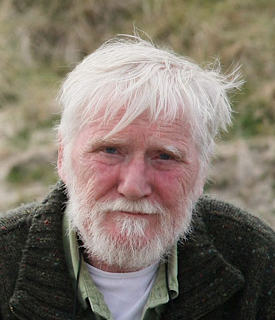
Dermot Healy, Irish novelist, playwright, poet and short story writer, dies at his home in Ballyconnell, Sligo, County Sligo, on June 29, 2014. A member of Aosdána, he is also part of its governing body, the Toscaireacht. He is described variously as a “master,” a “Celtic Hemingway” and as “Ireland’s finest living novelist.”
Healy is born in Finnea, County Westmeath, on November 9, 1947, the son of a Guard. As a child the family moves to Cavan, County Cavan, where he attends the local secondary school. In his late teens he moves to London and works in a succession of jobs, including barman, security man and as a labourer. He later returns to Ireland, settling in Ballyconnell, County Sligo, a small settlement on the Atlantic coast.
Often overlooked due to his relatively low public profile, Healy’s work is admired by his Irish literary predecessors, peers and successors alike, many of whom idolise him. Among the writers to have spoken highly of him are Seamus Heaney, Eugene McCabe, Roddy Doyle, Patrick McCabe and Anne Enright.
Healy dies at his home in Ballyconnell on June 29, 2014, while awaiting an ambulance after suddenly being taken ill. He is laid to rest at Carrigans Cemetery following funeral mass by Fr. Michael Donnelly at St. Patrick’s Church in Maugherow, County Sligo.
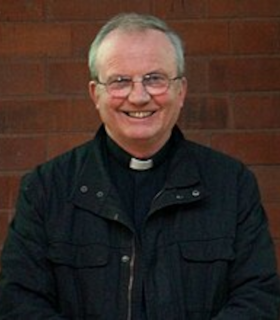
McKeown is ordained to the priesthood on July 3, 1977.
Following ordination, McKeown’s first pastoral assignment is as chaplain at Mater Infirmorum Hospital, before returning to Rome to complete his licentiate. He returns to the Diocese of Down and Connor in 1978, where he is appointed as a teacher at Our Lady and St. Patrick’s College, Knock, while also serving as assistant priest in Derriaghy. He returns to St. MacNissi’s College in 1983, where he continues his involvement with youth ministry and is given responsibility for organising the annual diocesan pilgrimage to Lourdes.
McKeown subsequently returns to St. Malachy’s College in 1987, where he teaches and serves as dean of the adjoining seminary, before succeeding Canon Noel Conway as president in 1995. During his presidency, he completes a Master of Business Administration at the University of Leicester in 2000, specialising in educational management.
McKeown has completed the Belfast Marathon on two occasions: as a priest with a team of 48 from Derriaghy in 1982, and as a bishop fundraising for a minibus for St. Malachy’s College in 2001.
In response to a 2007 decision by Amnesty International to campaign for the legalisation of abortion in certain circumstances, McKeown supports the decision of Catholic schools in the diocese to disband their Amnesty International support groups, on the grounds that it is no longer appropriate to promote the organisation in their schools.
It is reported in an article in The Irish News that the mention of McKeown as a possible successor to Walsh as Bishop of Down and Connor is actively opposed by some priests in the diocese, who regard him as being “too soft” on the issue of integrated education. This opposition is branded a “Stop Donal” campaign.
McKeown also serves as a member of the Irish Catholic Bishops’ Conference and its committee on education and chairs its committees on vocations and youth. He leads the youth of the diocese to World Youth Day in 2002 and 2005 and also travels to Rome with his brother bishops for their quinquennial visit ad limina in 2006. He is also a regular contributor on Thought for the Day on BBC Radio Ulster.
McKeown starts a 33-day journey of prayer toward the Consecration to Jesus Christ through Mary on January 9, 2025. The prayer takes place online each evening at 7:00 p.m. The 33 days of prayer take place the week following the Baptism of the Lord until the Feast of Our Lady of Lourdes on February 11.
In April 1916, Germany offers the Irish 20,000 Mosin–Nagant 1891 rifles, ten machine guns and accompanying ammunition, but no German officers. It is a fraction of the quantity of the arms Casement had hoped for, with no military expertise on offer. The weapons leave Germany bound for Ireland on a German cargo vessel named the SS Libau, disguised as a Norwegian vessel, Aud-Norge.
Casement confides his personal papers to Dr. Charles Curry, with whom he has stayed at Riederau on the Ammersee, before leaving Germany. He departs with Robert Monteith and Sergeant Daniel Beverley (Bailey) of the Irish Brigade in a submarine, initially the SM U-20, which develops engine trouble, and then the SM U-19, shortly after the Aud sails. According to Monteith, Casement believes the Germans are toying with him from the start and providing inadequate aid that will doom a rising to failure. He wants to reach Ireland before the shipment of arms and to convince Eoin MacNeill, who he believes is still in control, to cancel the rising.
Casement sends John McGoey, a recently arrived Irish American, through Denmark to Dublin, ostensibly to advise what military aid is coming from Germany and when, but with Casement’s orders “to get the Heads in Ireland to call off the rising and merely try to land the arms and distribute them.” McGoey does not reach Dublin, nor does his message. His fate is unknown until recently. Evidently abandoning the Irish Nationalist cause, he joins the Royal Navy in 1916, survives the war, and later returns to the United States, where he dies in an accident on a building site in 1925.
About 2:00 a.m. on the morning of April 21, 1916, three days before the rising begins, Robert Monteith, Daniel Bailey (calling himself Beverly), and Casement climb into a small boat for the trip to shore at Banna Strand in Tralee Bay, County Kerry. Their boat, now in the Imperial War Museum in London, capsizes before they reach shore.
Monteith helps an exhausted Casement to safety on shore. Casement is convinced that the Rising cannot be successful without a large number of German troops, and the best he has been able to obtain is one boatload of arms. Suffering from a recurrence of the malaria that had plagued him since his days in the Congo, and too weak to travel, Monteith and Bailey leave Casement at the ruins of McKenna’s Fort, an ancient ring fort in Rahoneen, Ardfert, now renamed Casement’s Fort, and head for Tralee.
About 1:30 p.m., Casement is discovered by two Royal Irish Constabulary (RIC) officers. He nearly talks his way out of being arrested, but a 12-year-old boy at the scene points out a piece of paper Casement had tossed away as the police approach. On that paper is a German code list. He is arrested on charges of high treason, sabotage and espionage against the Crown. He manages to send word to Dublin about the inadequate German assistance.
The Kerry Brigade of the Irish Volunteers might have tried to rescue Casement over the next three days, but its leadership in Dublin holds that not a shot is to be fired in Ireland before the Easter Rising is in train and therefore orders the Brigade to “do nothing.” A subsequent internal inquiry attaches “no blame whatsoever” to the local Volunteers for failing to attempt a rescue. Casement is taken to Brixton Prison and placed under special observation for fear of an attempt of suicide as there is no staff at the Tower of London to guard suicidal cases.
On the day of his execution by hanging at Pentonville Prison, August 3, 1916, Casement is received into the Catholic Church at his request. He is attended by two Catholic priests, Dean Timothy Ring and Father James Carey, from the East London parish of SS Mary and Michael. The latter, also known as James McCarroll, says of Casement that he was “a saint … we should be praying to him [Casement] instead of for him.” At the time of his death he is 51 years old.
Casement’s body is buried in quicklime in the prison cemetery at the rear of Pentonville Prison, though his last wish was to be buried at Murlough Bay on the north coast of County Antrim, in present-day Northern Ireland. Finally, in 1965, his remains are repatriated to Ireland. His remains lay in state at the Garrison Church, Arbour Hill (now Arbour Hill Prison) in Dublin for five days, close to the graves of other leaders of the 1916 Easter Rising, although he would not be buried beside them. After a state funeral, the remains are buried with full military honours in the republican plot in Glasnevin Cemetery in Dublin, alongside other Irish republicans and nationalists. The President of Ireland, Éamon de Valera, who is then in his mid-eighties and the last surviving leader of the Easter Rising, attends the ceremony, along with an estimated 30,000 others.
Remaining active during the interwar years, Dill serves as chief assistant to the commandant of the Staff College (1919–22) before commanding the Welsh Border Brigade, TA (1922–23), and 2nd Infantry Brigade at Aldershot (1923–26). In late 1926, he is appointed army instructor at the newly established Imperial Defence College. A period in India follows as general staff officer of the Western Command (1929–31), based at Quetta. On return to England, he is promoted to major general and made commandant of the Staff College. Appointments as commander of the British forces in Palestine and Transjordan (1936–37) and the Aldershot Command (1937–39) follow. During this period, he shows a remarkable ability to both train and inspire those under his command. Most of his colleagues expect him to become the new chief of the Imperial General Staff and are surprised when Major General Lord Gort, junior to Dill in both rank and seniority, is appointed to the post.
At the outbreak of World War II Dill commands I CorpsBritish Expeditionary Force (BEF) in France and is made a full general. In April 1940, he is made vice-CIGS and in May takes over as CIGS. His initial period in office is not a happy one, and he has to inform the public of setbacks in both Norway and France. His workload is enormous, and after the evacuation at Dunkirk in late May he devotes himself to preparing the defences of Britain against invasion. He clashes with Winston Churchill throughout 1941, advocating a more cautious and realistic approach to the situations in North Africa, Greece, and Crete.
The workload begins to affect his health adversely, and in November 1941 it is announced that he will resign as CIGS on reaching the age of 60 and serve as governor-designate of Bombay with the rank of field marshal. He seeks to be more actively involved in the war effort, however, and in December 1941 he visits the United States with Churchill, remaining there as head of the British joint staff mission in Washington, D.C. He plays a significant role in promoting Anglo–American military cooperation and attends the Casablanca, Quebec, and Tehran conferences.
Dill first marries (1907) Ada Maud Le Mottée, daughter of Col. William Le Mottée of the 18th Regiment. Their son, Major John de Guerin Dill, serves as an artillery officer throughout World War II. In October 1941, Dill marries Nancy Isabelle Charrington, widow of Brigadier Denis Walter Furlong. Dill’s honours include a GCB (1942), an honorary degree from Princeton University (1944), the Howland Memorial Prize of Yale University (1944), and a posthumous Distinguished Service Medal (DSM) from the United States government. There are portraits of him in Cheltenham College and the Imperial War Museum, and a statue in Washington, D.C.
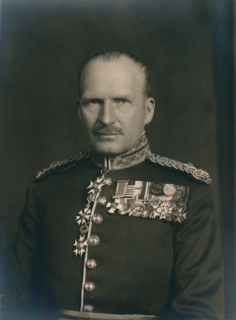
(From: “Dill, Sir John Greer” by David Murphy, Dictionary of Irish Biography, http://www.dib.ie, October 2009 | Pictured: Sir John Greer Dill, bromide print, 1932, by Walter Stoneman, National Portrait Gallery, London)
Williams’s father works as a butcher and her mother is a housewife. She receives her primary education from St. Teresa Primary School in Belfast and attends St. Dominic’s Grammar School for Girls for her secondary school studies. Upon completing her formal education, she takes up a job of office receptionist.
Rare for the time in Northern Ireland, Williams’s father is Protestant and her mother is Catholic, a family background from which she later says she derived religious tolerance and a breadth of vision that motivated her to work for peace. Early in the 1970s she joins an anti-violence campaign headed by a Protestant priest. She credits this experience for preparing her to eventually found her own peace movement, which focuses on creating peace groups composed of former opponents, practicing confidence-building measures, and the development of a grassroots peace process.
Williams is drawn into the public arena after witnessing the death of three children on August 10, 1976, when they are hit by a car whose driver, an Irish Republican Army (IRA) paramilitary named Danny Lennon, had been fatally shot in return fire by a soldier of the King’s Own Royal Border Regiment. As she turns the corner to her home, she sees the three Maguire children crushed by the swerving car and rushes to help. Their mother, Anne Maguire, who is with the children, dies by suicide in January 1980.
Williams is so moved by the incident that within two days of the tragic event, she obtains 6,000 signatures on a petition for peace and gains wide media attention. With Mairead Corrigan, she co-founds the Women for Peace which, with Ciaran McKeown, later becomes the Community of Peace People.
Williams soon organises a peace march to the graves of the slain children, which is attended by 10,000 Protestant and Catholic women. However, the peaceful march is violently disrupted by members of the IRA, who accuse them of being “dupes of the British.” The following week, she leads another march in Ormeau Park that concludes successfully without incident – this time with 20,000 participants.
In recognition of her efforts for peace, Williams, together with Corrigan, become joint recipients of the Nobel Peace Prize for 1976.
The Peace Prize money is divided equally between Williams and Corrigan. Williams keeeps her share of the money, stating that her intention is to use it to promote peace beyond Ireland, but faces criticism for her decision. She and Corrigan have no contact after 1976. In 1978, Williams breaks off links with the Peace People movement and becomes instead an activist for peace in other areas around the world.
Williams receives the People’s Peace Prize of Norway in 1976, the Golden Plate Award of the American Academy of Achievement in 1977, the Schweitzer Medallion for Courage, the Martin Luther King, Jr. Award, the Eleanor Roosevelt Award in 1984, and the Frank Foundation Child Care International Oliver Award. In 1995, she is awarded the Rotary International “Paul Harris Fellowship” and the Together for Peace Building Award.
At the 2006 Earth Dialogues forum in Brisbane, Williams tells an audience of schoolchildren during a speech on Iraq War casualties that “Right now, I would like to kill George W. Bush.” From September 17 to 20, 2007, she gives a series of lectures in Southern California. On September 18, she presents a lecture to the academic community of Orange County entitled “Peace in the World Is Everybody’s Business” and on September 20 she gives a lecture to 2,232 members of the general public, including 1,100 high school sophomores, at Soka University of America. In 2010, she gives a lecture at WE DayToronto, a WE Charity event that empowers students to be active within their communities, and worldwide.
Speaking at the University of Bradford before an audience of 200 in March 2011, Williams warns that young Muslim women on campus are vulnerable to attacks from angry family members, while the university does little to help protect them. “If you had someone on this campus these young women could go to say, ‘I am frightened’ – if you are not doing that here, you are dehumanising them by not helping these young women, don’t you think?”
At the time she receives the Nobel Prize, Williams works as a receptionist and is raising her two children with her first husband Ralph Williams. This marriage is dissolved in 1981. She marries businessman James Perkins in December 1982 and they live in Florida in the United States.
In 2004, Williams returns to live in Northern Ireland. She dies on March 17, 2020, at the age of 76 in Belfast.
MacBride has nevertheless had a violent past. He is born in Paris on January 26, 1904, the son of Major John MacBride and Maud Gonne. His father is executed by the British in the Irish struggle for liberation from Great Britain. He is only 15 years old when he lies about his age to join the Irish Volunteers, which fight as part of the Irish Republican Army (IRA). He takes part in the concluding battles against the British in the Irish War of Independence before the Irish Republic is founded in 1921, and in the Irish Civil War that follows. He backs Éamon de Valera in the latter’s refusal to accept Northern Ireland‘s continuing union with England. In the 1930s, he breaks with the IRA and qualifies in law. He defends IRA prisoners in Irish prisons who had been condemned to death.
In addition to the Nobel Peace Prize, MacBride also receives the Lenin Peace Prize for 1975–1976, the Golden Plate Award of the American Academy of Achievement in 1978, and the UNESCO Silver Medal for Service in 1980.
MacBride dies in Dublin on January 15, 1988, eleven days before his 84th birthday. He is buried in Glasnevin Cemetery in a grave with his mother and his wife, who died in 1976.
William of Orange, King of Holland, and recently declared King William III of England, arrives with his fleet in Belfast on June 14, 1690. He remains for twelve days, departing on June 26. For his part he likes what he sees. “This country is worth fighting for,” he says.
William’s departure from London is held up by parliamentary business until the end of May, when he announces that he can wait no longer and adjourns Parliament. He sets out early in the morning of June 4, reaching Northampton before nightfall. On Sunday, June 8, he attends divine service in Chester Cathedral and goes on to inspect the ships at Hoylake on the tip of the Wirral Peninsula.
For two days the wind is contrary, but on June 11 he embarks on board the yacht “Mary” with a fleet escorted by Sir Cloudesley Shovell‘s squadron. On June 14 the hills of Ireland come in sight and in the afternoon the fleet casts anchor off Carrickfergus. He is rowed ashore in the Rear Admiral’s barge and at about 3:30 p.m. lands at the Old Quay under the shadow of the great Norman Castle.
The Garrison of the Castle has drawn up a Guard of Honour and the townspeople add their applause. The chosen spokesman is a Quaker, whose principles forbid him to doff his hat or use such titles as Sir and Majesty. He gets around the difficulty by taking off his hat and laying it on a stone and then stepping forward and saying “William, thou art welcome to thy Kingdom” which pleases the King so much that he replies, “You are the best-bred gentleman I have met since I came to England.” With these words he mounts his horse and sets off for Belfast.
Halfway along the shore is the little port of Whitehouse, where most of the army disembarks. The Commander-in-Chief, Frederick Schomberg, 1st Duke of Schomberg, and his senior commanders are waiting here to welcome the King. To cover the disembarkation, earthworks have been thrown up by the engineers at Fort William and garrisoned by troops ready for action.
In 1690 Belfast consists of about 300 houses in five streets. It has two churches, the Parish Church, where St. George’s Church still stands in the High Street, and the Presbyterian Meeting House in Rosemary Lane. The town had been surrounded by a rampart in 1642 and had been captured by Colonel Robert Venebles for Oliver Cromwell after a four-day siege and an assault on the North Gate in 1649.
It is at the North Gate that King William enters Belfast where North Street now crosses Royal Avenue. Here he is welcomed by the magistrates and burgesses in their robes and by the Rev. George Walker, now Bishop-elect of Derry. A Royal Salute is fired from the Castle and is echoed and re-echoed by the guns which Schomberg had placed at wide intervals for the purpose of conveying signals from post to post. Wherever it is heard it is known that King William has come. Before midnight all the heights of Antrim and Down are blazing with bonfires.
The next day being Sunday, William attends church at the Corporation Church, now St. George’s Church. On Monday, June 16, addresses of loyalty are presented on behalf of the Church of Ireland and Presbyterian Church clergy, the civic authorities of the city of Londonderry, the town of Belfast and by the Sheriffs, Justices of the Peace and Gentlemen of the Counties of Down and Antrim. The next two days are spent in military preparation.
In the previous season Schomberg had conducted a slow and cautious campaign but William says he has not come to Ireland to let the grass grow under his feet. He orders a general muster of the army in the Parish of Aghaderg which includes Scarvagh and on Thursday, June 19, begins his southward march from Belfast Castle.
The line of march continues along Upper Malone by the Old Coach Road and past the ruins of both Drumbeg and Lambeg Parish Churches which had been burned down in 1641. William reaches Schomberg’s headquarters in Lisburn Castle for lunch on the same day that he left Belfast Castle. The afternoon and evening are spent inspecting troops on Blaris Moor, and then on to Hillsborough Castle for the night.
The cavalcade moves on through the little round hills of County Down, crosses the Upper Bann between Huntly and Ballievey by ford over the hill of Banbridge and on to the rendezvous on the northwest of Loughbrickland.
After the disappointments of the previous season and the appalling loss of life through disease, Schomberg had dispersed his army into winter quarters all over Ulster. The Derry and Enniskillen men had gone home to pick up the threads of their lives. Now the farmers among them have the crop in and are recalled to the colours and ready to be reviewed. There are four regiments of Enniskillen men – Wynns, Tiffins, Lloyds and Cunninghams, one of foot and three of horse. There is only one regiment of Derry men, St. John’s, commanded by Mitchelburne with Rev. George Walker as chaplain.
On June 22, William sits in the saddle for hours reviewing his 36,000 men. Marching past are 10,000 Danes, some of whom came from Norway and Sweden, and even Finland, 7,000 Dutch and Brandenburgers, 2,000 French Huguenots, 11,000 English and Scots, 800 Derrymen, 4,500 Inniskilleners and two companies from Bandon, County Cork.
On June 24, an advance party reaches beyond Newry to the edge of Dundalk and brings intelligence that the deposed King James II has fallen back on Ardee. The following day the main army advances to Newry and camps on the side of a hill. On June 25, with the King at their head, wearing an Orange colour sash, they go through the Moyry Gap and pass out of Ulster en route to the Boyne.
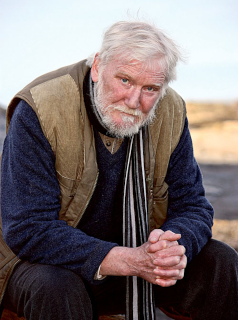
Healy is the son of a Guard. As a child the family moves to Cavan, where he attends the local secondary school. In his late teens he moves to London and works in a succession of jobs, including barman, security man and as a labourer. He later returns to Ireland, settling in Ballyconnell, County Sligo, a small settlement on the Atlantic coast.
Often overlooked due to his relatively low public profile, Healy’s work is admired by his Irish literary predecessors, peers and successors alike, many of whom idolise him. Among the writers to have spoken highly of him are Seamus Heaney, Eugene McCabe, Roddy Doyle, Patrick McCabe and Anne Enright.
Healy dies at his home in Ballyconnell on June 29, 2014, while awaiting an ambulance after suddenly being taken ill. He is laid to rest at Carrigans Cemetery following funeral mass by Fr. Michael Donnelly at St. Patrick’s Church in Maugherow.
Guinness is born Hermione Maria-Gabrielle von Urach, the only child of the marriage of Albrecht von Urach, from Lichtenstein Castle, a member of the royal house of Wurtemberg, and Rosemary Blackadder (1901–1975) from Berwickshire in Scotland, a journalist and artist, who are married in Oslo, Norway in 1931. For the first few months of her life, she is very ill. In 1934, her parents, both working as journalists, move the family to Venice. They later move again to Japan. Her mother develops depression, and in 1937 tries to gain uninvited access to Emperor Hirohito‘s palace with her daughter. This results in her mother being arrested, sedated, and deported, which is the beginning of a decline in her mental health which culminates in a lobotomy in 1941 and spending the rest of her life in private mental institutions. Urach is returned to Europe, where she is raised by her godmother, Hermione Ramsden, in Surrey and Norway. She is educated by as many as seventeen governesses, with brief spells in boarding schools. Until the age of eighteen she is known as Gabrielle.
Urach meets Desmond Guinness in 1951, when she is nineteen, and they are married in Oxford in 1954. They have two children, Patrick (born 1956) and Marina (born 1957).
The couple moves to Ireland in 1955 where they rent Carton House, County Kildare. They share a love of Georgian architecture which results in them buying Leixlip Castle in 1958 and establishing the Irish Georgian Society on February 21 of the same year. Through the society they campaign for the restoration and protection of architectural sites such as Mountjoy Square, the gateway to the Dromana estate in County Waterford, the Tailors’ Hall in Dublin, and Conolly’s Folly in County Kildare. In 1967 they purchase Castletown House, also in County Kildare, with a plan to restore it, and make it a base for the Irish Georgian Society.
During the 1960s Leixlip Castle is a hub for those interested in architecture and conservation, and the Guinnesses work hands-on on a range of projects. By 1969, their marriage is in difficulties and Guinness moves to London. She later moves to Glenarm, County Antrim to live with Hugh O’Neill, and when that relationship ends, she returns to Leixlip Castle, but a divorce is finalised in 1981. Having lived in Dublin for a time, she rents Tullynisk House, the dower house of Birr Castle in County Offaly in 1983. Guinness becomes isolated and develops a problem with alcohol. While returning to Ireland from Wales on a car ferry on May 8, 1989, she has a massive heart attack which is compounded by a reaction to an injection of penicillin. She is buried at Conolly’s Folly.
Through Patrick, Guiness becomes grandmother of the fashion model Jasmine Guinness. Her daughter Marina is a patron of the arts and of Irish musicians including Glen Hansard, Damien Rice, and the band Kíla. Marina has three children of her own: Patrick (by Stewart Copeland of The Police), Violet (by photographer Perry Ogden), and Finbar (by record producer Denny Cordell).
In 2020, a new film on Guinness’s life and work, entitled Memory of Mariga, receives its United States premiere as part of the Elizabethtown Film Festival on Saturday, September 19, at the Crowne Pointe Theatre in Elizabethtown, Kentucky. In 2021, the same film receives its Irish premiere at the Fastnet Film Festival.
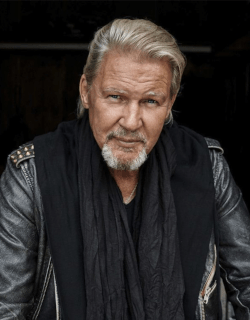
Seán Patrick Michael Sherrard, Irish singer and composer better known by his stage name Johnny Logan, is born in the Melbourne suburb of Frankston, Victoria, Australia on May 13, 1954. He is known as being the only performer to have won the Eurovision Song Contest twice, in 1980 and 1987. He also composes the winning song in 1992.
Logan is born while his father, Charles Alphonsus Sherrard, is a Derry-born Irish tenor known by the artistic name Patrick O’Hagan, is touring Australia. The family moves back to Ireland when he is three years old. He learns the guitar and begins composing his own songs by the age of thirteen. On leaving school he apprentices as an electrician, while performing in pubs and cabaret. His earliest claim to fame is starring as “Adam” in the 1977 Irish musical Adam and Eve and “Joseph” in Joseph and the Amazing Technicolor Dreamcoat.
Logan adopts the stage name Johnny Logan after the main character of the film Johnny Guitar and releases his first single in 1978. He first attempts to participate in the Eurovision Song Contest in 1979, when he places third in the Irish National Final with the song “Angie.” Readers of The Connaught Telegraph in Ireland vote him as “Best New Male Artist.”
In 1980, Logan again enters the Irish National selection for the Eurovision Song Contest with the Shay Healy song “What’s Another Year,” winning the Irish final on March 9 in Dublin. Representing Ireland in the Netherlands, he wins the Eurovision Song Contest on April 19. The song becomes a hit all over Europe and reaches number one in the UK.
In 1987, Logan makes another attempt at Eurovision and with his self-penned song, “Hold Me Now,” representing Ireland at the Eurovision Song Contest in Belgium. The song wins the contest, and he becomes the first person to win the contest twice.
Having composed the Irish Eurovision Song Contest 1984 entry for Linda Martin, “Terminal 3” (which finishes in second place), Logan repeats the collaboration in 1992 when he gives Martin another of his songs, “Why Me?” The song becomes the Irish entry at the finals in Sweden. The song takes the title and cements Logan as the most successful artist in Eurovision history with three wins.
Logan continues to perform and write songs. He is sometimes referred to as “Mister Eurovision” by fans of the contest and the media at large. He has continued his love of participating in musical theatre, having toured Norway with Which Witch, an opera-musical originating in that country. He continues to have success, particularly in the Scandinavian countries. His 2007 album, The Irish Connection, goes platinum in Denmark, twice platinum in Norway and gold in Sweden. He performs in the Celtic rock opera Excalibur from 2009 to 2011.




 seamus dubhghaill