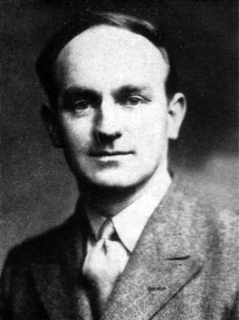
McLaverty is born on July 5, 1904, at Magheross, near Carrickmacross, County Monaghan, the son of Michael McLaverty, a waiter, and Kathleen McLaverty (née Brady). His father works in a hotel in the town until they move to Rathlin Island, and later to Belfast, when he is five years old. He attends St. Malachy’s College in the city, where an inspiring teacher instills in him a love of William Shakespeare‘s writings. He entered Queen’s University Belfast (QUB) in October 1924 and studies physics. He obtains a B.Sc. in 1928 and immediately takes his H.Dip.Ed., completing his teaching practice in St. Mary’s University College, Strawberry Hill, London. The following year he begins teaching at St. John’s Primary School in Colinward Street, west Belfast. He is admitted to the degree of M.Sc. at QUB in 1933.
In 1933, McLaverty marries Mary Conroy (formerly Giles), a young widow and fellow teacher at St. John’s. They have two sons and two daughters.
During his time at St. John’s, McLaverty writes his first five novels and fifteen short stories. In the 1930s he has developed a distinctive style in precise, unsentimental, but compassionate short stories. By the late 1930s, however, he switches his energies from short stories to the novel. Call My Brother Back (1939) contrasts the traditional world of Rathlin Island with the northern troubles in a family context. Another novel, Lost Fields (1941), and his collection of short stories, The White Mare (1943), explore the Belfast of his childhood and deal with the underlying tensions in Irish rural life. In the period 1949–55 he publishes five other novels: Three Brothers (1948), Truth in the Night (1951), School for Love (1954), The Choice (1958), and Brightening Day (1965). These novels deal with ordinary people and the dilemmas they encounter in their families and communities. His writings are influenced by Anton Chekhov, Leo Tolstoy, Katherine Mansfield, Gerard Manley Hopkins, and the Irish short story writers Liam O’Flaherty and Daniel Corkery.
As headmaster of St. Thomas’s intermediate school, a large school for boys in Ballymurphy, off the Falls Road, McLaverty gives his first job to the young Seamus Heaney, in whom he cultivates an interest in the writings of Chekhov and Tolstoy and the Irish writers Mary Lavin and Patrick Kavanagh. He deems Heaney to be the only genius he has ever met, and his work and success are a great source of pride and joy to him. His encouragement of the young John McGahern is of as much benefit to McLaverty himself, as their short but intense correspondence give him the energy to resume his writings.
Between his resignation from St. Thomas’s in 1963 and the early 1970s he teaches part-time at St. Joseph’s training college and St. Dominic’s High School, one of Belfast’s best-known grammar schools. In 1981 his old alma mater recognises his contribution to literature by awarding him an honorary master’s degree. In the same year he wins the American Irish literary fellowship, a prestigious literary award of $10,000, in recognition of his “impressive body of work as a short story writer and novelist.”
McLaverty dies on March 22, 1992, in County Down, Northern Ireland.
(From: “McLaverty, Michael” by Éamonn Ó Ciardha, Dictionary of Irish Biography, http://www.dib.ie, October 2009)
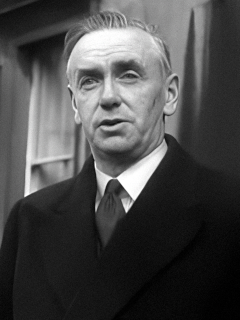
Costello is born on June 20, 1891, in Fairview, Dublin, the younger son of John Costello senior, a civil servant, and Rose Callaghan. He is educated at St. Joseph’s, Fairview, and then moves to O’Connell School, for senior classes, and later attends University College Dublin (UCD), where he graduates with a degree in modern languages and law. He studies at King’s Inns to become a barrister, winning the Victoria Prize there in 1913 and 1914. He is called to the Irish Bar in 1914, and practises as a barrister until 1922.
In 1922, Costello joins the staff at the office of the Attorney General in the newly established Irish Free State. Three years later he is called to the inner bar, and the following year, 1926, he becomes Attorney General of Ireland, upon the formation of the Cumann na nGaedheal government, led by W. T. Cosgrave. While serving in this position he represents the Free State at Imperial Conferences and League of Nations meetings.
Costello is also elected a Bencher of the Honourable Society of King’s Inns. He loses his position as Attorney General of Ireland when Fianna Fáil comes to power in 1932. The following year, however, he is elected to Dáil Éireann as a Cumann na nGaedheal TD. Cumann na nGaedheal soon merges with other parties to form Fine Gael.
During the Dáil debate on the Emergency Powers Act 1939, Costello is highly critical of the Act’s arrogation of powers, stating that “We are asked not merely to give a blank cheque, but to give an uncrossed cheque to the Government.” He loses his seat at the 1943 Irish general election but regains it when Éamon de Valera calls a snap election in 1944. From 1944 to 1948, he is the Fine Gael front-bench Spokesman on External Affairs.
In 1948, Fianna Fáil has been in power for sixteen consecutive years and has been blamed for a downturn in the economy following World War II. The 1948 Irish general election results show Fianna Fáil short of a majority, but still by far the largest party, with twice as many seats as the nearest rival, Fine Gael. It appears that Fianna Fáil is headed for a seventh term in government. However, the other parties in the Dáil realise that between them, they have only one seat fewer than Fianna Fáil, and if they band together, they would be able to form a government with the support of seven Independent deputies. Fine Gael, the Labour Party, the National Labour Party, Clann na Poblachta and Clann na Talmhan join to form the first inter-partygovernment in the history of the Irish state.
While it looks as if cooperation between these parties will not be feasible, a shared opposition to Fianna Fáil and Éamon de Valera overcomes all other difficulties, and the coalition government is formed.
Since Fine Gael is the largest party in the government, it has the task of providing a suitable candidate for Taoiseach. Naturally, it is assumed that its leader, Richard Mulcahy, will be offered the post. However, he is an unacceptable choice to Clann na Poblachta and its deeply republican leader, Seán MacBride. This is due to Mulcahy’s record during the Irish Civil War. Instead, Fine Gael and Clann na Poblachta agree on Costello as a compromise candidate. Costello had never held a ministerial position nor was he involved in the Civil War. When told by Mulcahy of his nomination, Costello is appalled, content with his life as a barrister and as a part-time politician. He is persuaded to accept the nomination as Taoiseach by close non-political friends.
During the campaign, Clann na Poblachta had promised to repeal the Executive Authority (External Relations) Act 1936 but does not make an issue of this when the government is being formed. However, Costello and his Tánaiste, William Norton of the Labour Party, also dislike the act. During the summer of 1948, the cabinet discusses repealing the act, however, no firm decision is made.
In September 1948, Costello is on an official visit to Canada when a reporter asks him about the possibility of Ireland leaving the British Commonwealth. For the first time, he declares publicly that the Irish government is indeed going to repeal the External Relations Act and declare Ireland a republic. It has been suggested that this is a reaction to offence caused by the Governor General of Canada at the time, Harold Alexander, 1st Earl Alexander of Tunis, who is of Northern Irish descent and who allegedly arranges to have placed symbols of Northern Ireland in front of Costello at an official dinner. Costello makes no mention of these aspects on the second reading of the Republic of Ireland Bill on November 24 and, in his memoirs, claims that Alexander’s behaviour had in fact been perfectly civil and could have had no bearing on a decision which had already been made.
The news takes the Government of the United Kingdom and even some of Costello’s ministers by surprise. The former had not been consulted and following the declaration of the Republic in 1949, the UK passes the Ireland Act that year. This recognises the Republic of Ireland and guarantees the position of Northern Ireland within the United Kingdom for so long as a majority there want to remain in the United Kingdom. It also grants full rights to any citizens of the Republic living in the United Kingdom. Ireland leaves the Commonwealth on April 18, 1949, when The Republic of Ireland Act 1948 comes into force. Frederick Henry Boland, Secretary of the Department of External Affairs, says caustically that the affair demonstrates that “the Taoiseach has as much notion of diplomacy as I have of astrology.” The British envoy, John Maffey, 1st Baron Rugby, is equally critical of what he calls a “slipshod and amateur” move.
Many nationalists now see partition as the last obstacle on the road to total national independence. Costello tables a motion of protest against partition on May 10, 1949, without result.
In 1950, the independent-minded Minister for Health, Noël Browne, introduces the Mother and Child Scheme. The scheme would provide mothers with free maternity treatment and their children with free medical care up to the age of sixteen, which is the normal provision in other parts of Europe at that time. The bill is opposed by doctors, who fear a loss of income, and Roman Catholic bishops, who oppose the lack of means testing envisaged and fear the scheme could lead to birth control and abortion. The cabinet is divided over the issue, many feeling that the state cannot afford such a scheme priced at IR£2,000,000 annually. Costello and others in the cabinet make it clear that in the face of such opposition they will not support the Minister. Browne resigns from the government on April 11, 1951, and the scheme is dropped. He immediately publishes his correspondence with Costello and the bishops, something which had hitherto not been done. Derivatives of the Mother and Child Scheme are introduced in Public Health Acts of 1954, 1957 and 1970.
The Costello government has a number of noteworthy achievements. A new record is set in housebuilding, the Industrial Development Authority and Córas Tráchtála are established, and the Minister for Health, Noel Browne, with the then new Streptomycin, bring about an advance in the treatment of tuberculosis. Ireland also joins a number of organisations such as the Organization for European Economic Co-operation and the Council of Europe. However, the government refuses to join NATO, allegedly because the British remain in Northern Ireland. The scheme to supply electricity to even the remotest parts of Ireland is also accelerated.
While the “Mother and Child” incident does destabilise the government to some extent, it does not lead to its collapse as is generally thought. The government continues; however, prices are rising, a balance of payments crisis is looming, and two TDs withdraw their support for the government. These incidents add to the pressure on Costello and so he decides to call a general election for June 1951. The result is inconclusive but Fianna Fáil returns to power. Costello resigns as Taoiseach. It is at this election that his son Declan is elected to the Dáil.
Over the next three years while Fianna Fáil is in power a dual-leadership role of Fine Gael is taking place. While Richard Mulcahy is the leader of the party, Costello, who has proved his skill as Taoiseach, remains as parliamentary leader of the party. He resumes his practice at the Bar. In what is arguably his most celebrated case, the successful defence of The Leader against a libel action brought by the poet Patrick Kavanagh, dates from this period. Kavanagh generously praises Costello’s forensic skill, and the two men become friends.
At the 1954 Irish general election Fianna Fáil loses power. A campaign dominated by economic issues results in a Fine Gael-Labour Party-Clann na Talmhan government coming to power. Costello is elected Taoiseach for the second time.
The government can do little to change the ailing nature of Ireland’s economy, with emigration and unemployment remaining high, and external problems such as the Suez Crisis compounding the difficulty. Measures to expand the Irish economy such as export profits tax relief introduced in 1956 would take years have sizable impact. Costello’s government does have some success with Ireland becoming a member of the United Nations in 1955, and a highly successful visit to the United States in 1956, which begins the custom by which the Taoiseach visits the White House each Saint Patrick’s Day to present the U.S. President with a bowl of shamrock. Although the government has a comfortable majority and seems set for a full term in office, a resumption of Irish Republican Army (IRA) activity in Northern Ireland and Great Britain causes internal strains. The government takes strong action against the republicans.
In spite of supporting the government from the backbenches, Seán MacBride, the leader of Clann na Poblachta, tables a motion of no confidence, based on the weakening state of the economy and in opposition to the government’s stance on the IRA. Fianna Fáil also tables its own motion of no confidence, and rather than face almost certain defeat, Costello again asks PresidentSeán T. O’Kelly to dissolve the Oireachtas. The general election which follows in 1957 gives Fianna Fáil an overall majority and starts another sixteen years of unbroken rule for the party. Some of his colleagues questioned the wisdom of his decision to call an election. The view is expressed that he was tired of politics and depressed by his wife’s sudden death the previous year.
Following the defeat of his government, Costello returns to the bar. In 1959, when Richard Mulcahy resigns the leadership of Fine Gael to James Dillon, he retires to the backbenches. He could have become party leader had he been willing to act in a full-time capacity. He remains as a TD until 1969, when he retires from politics, being succeeded as Fine Gael TD for Dublin South-East by Garret FitzGerald, who himself goes onto to become Taoiseach in a Fine Gael-led government.
During his career, Costello is presented with a number of awards from many universities in the United States. He is also a member of the Royal Irish Academy from 1948. In March 1975, he is made a freeman of the city of Dublin, along with his old political opponent Éamon de Valera. He practises at the bar until a short time before his death at the age of 84, in Ranelagh, Dublin, on January 5, 1976. He is buried at Dean’s Grange Cemetery in Dublin.
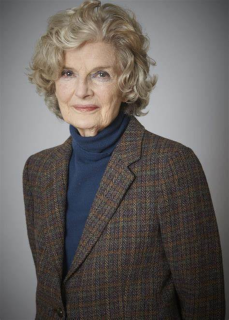
O’Faolain does not begin school until she is eight years old as her mother, Irish writer and teacher Eileen Gould, has little time for nuns. Following her schooling, she completes an arts degree at University College Dublin (UCD) and then further studies at the Sapienza University of Rome and the Sorbonne in Paris. A formidable student and strikingly beautiful, she makes a strong impression on those who meet her.
In search of love, literature and freedom from 1950s Ireland, the young O’Faolain remains abroad working variously as a translator, language teacher, editor and writer in London. She makes lifelong friends who speak highly of her generosity, loyalty and kindness. As well as maintaining a strong interest in politics throughout her life, she attains a black belt in karate and attends karate classes until her early 70s.
In her 2013 memoir, O’Faolain recounts a number of her adult loves before she meets and marries Lauro Martines in Florence in 1957. The couple lives in Florence for a year while Martines completes a travelling fellowship from Harvard University. They then move to Portland, Oregon, where their son Lucien is born in 1959. While in the United States, she teaches French at Reed College in Portland. The family returns to live in Florence from 1962-66 while her husband carries out research. When he is offered a professorship at the University of California, Los Angeles in 1966, they move back to the United States. However, not keen to live full-time in the United States, they purchase a house in Hampstead in 1970 and later in central London where she spends a good deal of time. From the 1990s onwards, she and Lauro spend more and more time in London, and they visit Ireland more during these years. Lucian, a painter and picture repairer, lives in London.
O’Faolain’s novels include No Country for Young Men, which is nominated for the Booker Prize in 1980, Women in the Wall (1975), The Obedient Wife (1982) and The Judas Cloth (1992) which is set in 19th-century Italy. Her first collection of short stories, We Might See Sights and Other Stories, is published in 1968, followed by Man in the Cellar (1974), Melancholy Baby (1978) and Daughters of Passion (1982). And with her husband, she edits Not in God’s Image: Women in History from the Greeks to the Victorians (1973).
O’Faolain’s writings are suffused with themes of clerical intrigue, women’s role in society, power, faith and sexuality. She says once that she is more detached from her characters than her father was. “He was fond of his characters whereas I was more impatient of mine… The fact that he often forgave their foolishness showed that he was fond of Ireland itself, where he lived for the most of his life. I instead left it and found I was happier elsewhere.”
As a writer, O’Faolain is not particularly well-known in Ireland. Following the publication of her memoir in 2013, she is asked by The Irish Times journalist Arminta Wallace if it bothers her that her name does not often figure in lists of famous Irish writers, perhaps because she did not live here. She replies, “Not only do I not live here but when my last book came out someone wrote an article naming me as a ‘forgotten writer’… which was not a cheerful read. It wasn’t in any way offensive, but it wasn’t very comforting…I suppose I didn’t write enough. You mustn’t let too many years go by between books – and I did that.”
O’Faolain dies at the age of 88 in London on October 27, 2020, following a long illness. Her papers, which include manuscripts of her writing and a significant correspondence between her and her father, are donated to UCD in 2018. At the time, archivists expect them to be available to researchers by 2022.
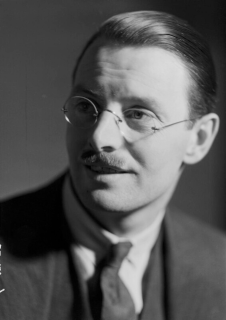
Seán Proinsias Ó Faoláin, short story writer of international repute and one of the most influential figures in 20th-century Irish culture, dies in Dublin on April 20, 1991. He is also a leading commentator and critic.
Ó Faoláin writes his first stories in the 1920s, eventually completing ninety stories over a period of sixty years. From 1929 to 1933 he lectures at the Catholic college, St. Mary’s College, at Strawberry Hill, London, during which period he writes his first two books. His first book, Midsummer Night Madness, is published in 1932. It is a collection of stories partly based on his Civil War experiences. He afterward returns to Ireland. He publishes four novels, seven additional volumes of short stories, six biographies, three travel books, a play, a memoir, a history book, translations and literary criticism, including one of the rare full-length studies of the short story, The Short Story (1948). He also writes a cultural history, The Irish, in 1947. His last short story volume, Foreign Affairs, is published in 1976. His Collected Stories is published in 1983.
Ó Faoláin produces critical studies of the novel and the short-story form, introduces texts of historical and literary merit, and contributes scores of articles, reviews, and uncollected stories to periodicals in Ireland, Britain, and the United States.
Ó Faoláin is a founder member and editor of the Irish literary periodical The Bell from 1940 to 1946. Under his editorship, The Bell participates in many key debates of the day. It also provides a crucial outlet for established and emerging writers during the lean war years. The list of contributors to The Bell include many of Ireland’s foremost writers, among them Patrick Kavanagh, Patrick Swift, Flann O’Brien, Frank O’Connor and Brendan Behan.
A recurring thread in Ó Faoláin’s work is the idea that national identities are historically produced and culturally hybrid; an additional thesis is that Irish history should be conceived in international terms, and that it should be read, in particular, in the context of social and intellectual developments across Europe.
Ó Faoláin marries Eileen Gould, a children’s book writer who publishes several books of Irish folk tales, in 1929. They have two children: Julia (1932–2020), who becomes a Booker-nominated novelist and short story writer, and Stephen (b. 1938).
Ó Faoláin dies in Dublin at the age of 91 on April 20, 1991.
Ó Faoláin is a controversial figure in his own lifetime and two of his books are banned for “indecency” in Ireland — his debut collection of short stories and his second novel, Bird Alone (1936). His legacy has proven divisive. If some consider him a social liberal cosmopolitan who challenges “proscriptive” definitions of Irish culture, others see him as a chauvinistic snob who paradoxically restricts the development of Irish writing. Proto-revisionist or nascent postcolonial, O’Faoláin has been considered both, sometimes within the same critical survey. Either way, his work is central to the evolution of a post–Literary Revival aesthetic, and his voice is one of the most prominent, and eloquent, in the fight against censorship in Ireland.
(Pictured: Portrait of Seán Ó Faoláin by Howard Coster, 1930s, National Portrait Gallery)
Cronin is known as an arts activist as well as a writer. He is Cultural Adviser to TaoiseachCharles Haughey and briefly to Garret FitzGerald. He involves himself in initiatives such as Aosdána, the Irish Museum of Modern Art and the Heritage Council. He is a founding member of Aosdána, and is a member of its governing body, the Toscaireacht, for many years. He is elected Saoi, a distinction for exceptional artistic achievement, in 2003. He is also a member of the governing bodies of the Irish Museum of Modern Art and the National Gallery of Ireland, of which he is for a time Acting Chairman.
His first collection of poems, called simply Poems (Cresset Press, London), is published in 1958. Several collections follow and his Collected Poems (New Island Books, Dublin) is published in 2004. The End of the Modern World (New Island Books, 2016), written over several decades, is his final publication.
Cronin’s novel, The Life of Riley, is a satire on Bohemian life in Ireland in the mid-20th century, while his memoir Dead as Doornails addresses the same subject.
Cronin knows Samuel Beckett from when they do some work for the BBC during the 1950s and 1960s. He gives a prefatory talk to Patrick Magee‘s reading of The Unnamable on the BBC Third Programme. Beckett is not impressed, saying, “Cronin delivered his discourse… It was all right, not very exciting.” Cronin later publishes a biography of him, Samuel Beckett: The Last Modernist (1996), followed on from No Laughing Matter: The Life and Times of Flann O’Brien (1989).
In his later years, Cronin suffers from failing health, which prevents him from traveling abroad, thus limiting his dealings to local matters. He dies in Dublin on December 27, 2016, one day short of his 93rd birthday.
Cronin firstly marries Thérèse Campbell, from whom he separates in the mid-1980s. She dies in 1999. They have two daughters, Iseult and Sarah. Iseult is killed in a road accident in Spain. He secondly marries the writer Anne Haverty who, along with daughter Sarah, survives him.
Greacen is the only child of Henry Greacen and his wife Elizabeth (née McCrea). His father comes from a Presbyterian farming background in County Monaghan and, at one time, holds a position as a creamery manager, but is a heavy drinker and fails in several businesses. Most of his childhood is spent with his maternal grandmother and aunts when his parents temporarily separate. He briefly attends two local primary schools in Belfast, but when his father receives insurance compensation after his Belfast business burned down, he takes his family to the Castleblayney area in County Monaghan and for a short time goes back to farming. He goes to a national school there, but after another fire destroys the farmhouse, the Greacens return to Belfast to run the Kenilworth, a tobacconist’s shop on the Newtownards Road. He attends Templemore primary school and then enters Methodist College Belfast in 1933.
Greacen mostly enjoys school, though he is too short-sighted to participate with success in any sport, and sometimes, because of his background, feels out of his depth among middle-class children. He is always ashamed of his father’s drunken outbursts and is terrified of the violent temper which accompanies them. Literature provides both a temporary escape and the promise of future success. His first poems are published in school magazines, and he decides at a young age to try to make a career as a writer. He fails examinations and interviews for positions in a bank and an insurance company and instead starts studying history and English at Queen’s University Belfast.
At Queen’s, as earlier at Methodist College, the interests which characterise Greacen’s later career are apparent. Largely thanks to meeting John Boyd, he develops sympathies with left-wing political ideas, as well as a deepened commitment to poetry. His youthful 1930s enthusiasm for Marxism disappears after the Molotov-Ribbentrop Pact of 1939 between the Soviet Union and Nazi Germany, but up to his later years he describes himself as a socialist. The formation of enduring friendships and mutually supportive coteries, a phenomenon particularly characteristic of the Ulster literary scene of the period, continues to be of great importance throughout his life. He makes friends with almost all the significant figures in Belfast, especially Roy McFadden, John Hewitt and Sam Hanna Bell. At Queen’s, he and a friend take over in 1940 the editing of a student magazine, The Northman. They try with short-lived, limited success to make it a literary journal for the whole region, so as to enable aspiring poets to get work into print. His own early poems appear in The Bell, and he writes some pieces for the left-wing Irish Democrat newspaper. His poem The Bird (1941) is well reviewed and later appears in anthologies. In 1942 he publishes Poems from Ulster, a small anthology including work by his friends.
For several months, Greacen worships from afar a fellow student named Irene. When he fails to form a relationship with her, he stops going to lectures so that he does not have to see her and does not finish his degree. His McCrea relatives pay for him to go to Trinity College Dublin in 1943 to take a diploma in social work. He is glad to get away from wartime Belfast and never lives there again. At first, he enjoys Dublin, and again makes many friends, among them Brendan and Beatrice Behan, Blanaid Salkeld, Cecil ffrench Salkeld, Joseph and Mary O’Neill, Douglas Gageby, Arland Ussher and Hubert Butler. He and Patrick Kavanagh live in the same boarding house on Raglan Road for several months in 1945, but Kavanagh takes offence at a review in Horizon by Greacen of his poem The Great Hunger and calls him a “Protestant bastard.” Greacen is upset, as he had thought the review favourable, and is disappointed but not surprised when Kavanagh refuses to allow any of his poems to appear in the prestigious Faber and Faber book Contemporary Irish Poetry, edited by Greacen and Valentin Iremonger in 1949.
The collaborative compilation of anthologies of poetry is Greacen’s characteristic way of working. In 1942, he and Alex Comfort edit Lyra: An Anthology of New Lyric. With Roy McFadden, he edits Ulster Voices in 1943. He is sole editor of Northern Harvest in 1944 and, in the same year, he, Bruce Williamson and Valentin Iremonger publish their own work in On the Barricades. His own first solo collection, One Recent Evening, is also a 1944 imprint. In 1946, with support from Maurice Fridberg, a Jewish Dublin and London bookseller, his publishing company, New Frontiers Press, produces Irish Harvest, which, though designed on more ambitious lines, still consists chiefly of poems by his friends. He feels much more affinity with the modernism and social protest that he finds in contemporary English poetry, especially in the “new apocalypse” movement associated with Herbert Read, and later the “new romantics,” than with what he regards as the outmoded Celtic nationalism of W. B. Yeats and his followers. Like others of his contemporaries, he comes to resent the unquestioned shibboleths of life in Ireland, and particularly objects to the censorship of literature and film.
Consequently, when Greacen’s second small volume of poems, The Undying Day (1948), sells badly, and other avenues seem unpromising, he and his wife give up on Dublin and move to London. He finds a job with the United Nations Association, which suits his outlook and ideals. However, when he is made redundant, he has to take various jobs in adult education, in creative-writing courses, and in teaching English as a foreign language, in the City of London College, the City Literary Institute, and West London College. He retires in 1986. His involvement with the London literary world continues throughout his career, as he gets to know many of the leading figures, including Stephen Spender and T. S. Eliot, and he organises poetry readings and other projects, though he himself writes no poetry for more than twenty years. At one time he considers taking up journalism and continues to produce book reviews and articles in journals, as well as many letters to newspapers. He writes several, well-received short works of criticism, in particular, The Art of Noël Coward (1953) and The World of C. P. Snow (1962). After returning to Dublin in 1986, he writes an interesting memoir about his many friends and acquaintances, Brief Encounters: Literary Dublin and Belfast in the 1940s (1991) and Rooted in Ulster: Nine Northern Writers (2000).
Greacen marries Patricia Hutchins in Fisherwick Presbyterian Church in Belfast on April 10, 1946. She is from a Protestant family who has a small estate at Ardnagashel, near Bantry, County Cork, and is related to the botanist Ellen Hutchins. They have one daughter, Arethusa, but, after four years of separation, the marriage ends in divorce in 1966. He resents his wife’s conversion to vegetarianism and seems also to disapprove of her desire to achieve her own career goals. Probably also the depression he experiences throughout the 1950s contributes to the breakdown of the marriage, but he feels that twelve experiences in the early 1960s with the hallucinogenic drug LSD, under the guidance of a psychiatrist, had cured him. After the LSD treatments he feels that he is ready to begin working on an autobiography, Even Without Irene, published several years later in 1969. This comes out again in an enlarged version in 1995, and, still further augmented, as The Sash My Father Wore (1997).
Greacen begins to publish poetry again in his fifties, in A Garland for Captain Fox (1975). Poems about the career and friends of an imaginary, sophisticated adventurer do not always strike the exactly right note but are popular and mark a new beginning for him, who increasingly writes elegiacally about personalities, real and fictional, in more restrained diction and with careful irony. In interviews, he denies that Captain Fox is his own alter ego, but the interplay between the character of Fox and elements of his creator’s own life suggests a metaphor for the poet’s creative process, as well as reminding the reader of the poet friends whose support means much to his writing in real life. At the very least, Captain Fox becomes what could be called a character of virtual reality for his creator.
Greacen’s later poetry collections include Young Mr. Gibbon (1979), A Bright Mask (1985), Carnival at the River (1990), Collected Poems 1944–1994 (1995; awarded The Irish Times Literature Prize for Poetry in that year), Protestant Without a Horse (1997), Captain Fox: A Life (2000), Lunch at the Ivy (2002), Shelley Plain (2002), and Selected and New Poems (2006).
On his return to Dublin in 1986, Greacen for a time shares a flat on Anglesea Road with Beatrice Behan, until he finds her dead in her bed in 1993. In later years he lives in a flat in Sandymount. He is elected to membership of Aosdána in 1986, and during his later years in Dublin enjoys the status of a senior figure in the world of literature. He gives readings in the United States, appears often on RTÉ radio programmes, and has poems republished in anthologies. There was even one poem displayed on the Dublin Dart suburban rail network, St. Andrew’s Day: An Elegy for Patricia Hutchins, perhaps his best work. Perhaps only a few of his poems have been lodged in the public memory, but it is appropriate, given the themes of his career, that his work will be read with most attention by poets and by scholars, and that his reputation in the future may largely be based on his friendships with other poets.
Carroll marries clothing designer Helena Reilly in Glasgow in 1923. They have four children, actress Helena Carroll, musician and producer Theresa Perez, journalist Kathleen Carroll and son Brian Carroll who resides in London. He is grandfather to Helena Perez Reilly and great grandfather to Paul Vincent Reilly. His brother, Niall Carroll, is a film critic.
Carroll founds two theater groups in Glasgow: the Curtain Theatre company, with Grace Ballantine and Molly Urquhart, in 1933 and the Glasgow Citizens Theatre in 1943. He remains the director and playwright in residence of the Citizens Theatre until his death.
The Wayward Saint is made into an opera in Germany in the 1960’s and his daughter Theresa commissions and produces an opera of his Beauty is Fled from the collection Plays for My Children which opens at Phoenix Symphony Hall in the 1970s as part of Theresa’s “Children’s Opera Series.”
Carroll dies at the age of 68 from undisclosed causes in Bromley, Kent, England on October 20, 1968.
Costello is the younger son of John Costello senior, a civil servant, and Rose Callaghan. He is educated at St. Joseph’s, Fairview, and then moves to O’Connell School, for senior classes, and later attends University College Dublin (UCD), where he graduates with a degree in modern languages and law. He studies at King’s Inns to become a barrister, winning the Victoria Prize there in 1913 and 1914. He is called to the Irish Bar in 1914, and practises as a barrister until 1922.
In 1922, Costello joins the staff at the office of the Attorney General in the newly established Irish Free State. Three years later he is called to the inner bar, and the following year, 1926, he becomes Attorney General of Ireland, upon the formation of the Cumann na nGaedheal government, led by W. T. Cosgrave. While serving in this position he represents the Free State at Imperial Conferences and League of Nations meetings.
Costello is also elected a Bencher of the Honourable Society of King’s Inns. He loses his position as Attorney General of Ireland when Fianna Fáil comes to power in 1932. The following year, however, he is elected to Dáil Éireann as a Cumann na nGaedheal TD. Cumann na nGaedheal soon merges with other parties to form Fine Gael.
During the Dáil debate on the Emergency Powers Act 1939, Costello is highly critical of the Act’s arrogation of powers, stating that “We are asked not merely to give a blank cheque, but to give an uncrossed cheque to the Government.” He loses his seat at the 1943 Irish general election but regains it when Éamon de Valera calls a snap election in 1944. From 1944 to 1948, he is the Fine Gael front-bench Spokesman on External Affairs.
In 1948, Fianna Fáil has been in power for sixteen consecutive years and has been blamed for a downturn in the economy following World War II. The 1948 Irish general election results show Fianna Fáil short of a majority, but still by far the largest party, with twice as many seats as the nearest rival, Fine Gael. It appears that Fianna Fáil is headed for a seventh term in government. However, the other parties in the Dáil realise that between them, they have only one seat fewer than Fianna Fáil, and if they band together, they would be able to form a government with the support of seven Independent deputies. Fine Gael, the Labour Party, the National Labour Party, Clann na Poblachta and Clann na Talmhan join to form the first inter-partygovernment in the history of the Irish state.
While it looks as if cooperation between these parties will not be feasible, a shared opposition to Fianna Fáil and Éamon de Valera overcomes all other difficulties, and the coalition government is formed.
Since Fine Gael is the largest party in the government, it has the task of providing a suitable candidate for Taoiseach. Naturally, it is assumed that its leader, Richard Mulcahy, will be offered the post. However, he is an unacceptable choice to Clann na Poblachta and its deeply republican leader, Seán MacBride. This is due to Mulcahy’s record during the Irish Civil War. Instead, Fine Gael and Clann na Poblachta agree on Costello as a compromise candidate. Costello had never held a ministerial position nor was he involved in the Civil War. When told by Mulcahy of his nomination, Costello is appalled, content with his life as a barrister and as a part-time politician. He is persuaded to accept the nomination as Taoiseach by close non-political friends.
During the campaign, Clann na Poblachta had promised to repeal the Executive Authority (External Relations) Act 1936 but does not make an issue of this when the government is being formed. However, Costello and his Tánaiste, William Norton of the Labour Party, also dislike the act. During the summer of 1948, the cabinet discusses repealing the act, however, no firm decision is made.
In September 1948, Costello is on an official visit to Canada when a reporter asks him about the possibility of Ireland leaving the British Commonwealth. For the first time, he declares publicly that the Irish government is indeed going to repeal the External Relations Act and declare Ireland a republic. It has been suggested that this is a reaction to offence caused by the Governor General of Canada at the time, Harold Alexander, 1st Earl Alexander of Tunis, who is of Northern Irish descent and who allegedly arranges to have placed symbols of Northern Ireland in front of Costello at an official dinner. Costello makes no mention of these aspects on the second reading of the Republic of Ireland Bill on November 24 and, in his memoirs, claims that Alexander’s behaviour had in fact been perfectly civil and could have had no bearing on a decision which had already been made.
The news takes the Government of the United Kingdom and even some of Costello’s ministers by surprise. The former had not been consulted and following the declaration of the Republic in 1949, the UK passes the Ireland Act that year. This recognises the Republic of Ireland and guarantees the position of Northern Ireland within the United Kingdom for so long as a majority there want to remain in the United Kingdom. It also grants full rights to any citizens of the Republic living in the United Kingdom. Ireland leaves the Commonwealth on April 18, 1949, when The Republic of Ireland Act 1948 comes into force. Frederick Henry Boland, Secretary of the Department of External Affairs, says caustically that the affair demonstrates that “the Taoiseach has as much notion of diplomacy as I have of astrology.” The British envoy, John Maffey, 1st Baron Rugby, is equally critical of what he calls a “slipshod and amateur” move.
Many nationalists now see partition as the last obstacle on the road to total national independence. Costello tables a motion of protest against partition on May 10, 1949, without result.
In 1950, the independent-minded Minister for Health, Noël Browne, introduces the Mother and Child Scheme. The scheme would provide mothers with free maternity treatment and their children with free medical care up to the age of sixteen, which is the normal provision in other parts of Europe at that time. The bill is opposed by doctors, who fear a loss of income, and Roman Catholic bishops, who oppose the lack of means testing envisaged and fear the scheme could lead to birth control and abortion. The cabinet is divided over the issue, many feeling that the state cannot afford such a scheme priced at IR£2,000,000 annually. Costello and others in the cabinet make it clear that in the face of such opposition they will not support the Minister. Browne resigns from the government on April 11, 1951, and the scheme is dropped. He immediately publishes his correspondence with Costello and the bishops, something which had hitherto not been done. Derivatives of the Mother and Child Scheme are introduced in Public Health Acts of 1954, 1957 and 1970.
The Costello government has a number of noteworthy achievements. A new record is set in housebuilding, the Industrial Development Authority and Córas Tráchtála are established, and the Minister for Health, Noel Browne, with the then new Streptomycin, bring about an advance in the treatment of tuberculosis. Ireland also joins a number of organisations such as the Organization for European Economic Co-operation and the Council of Europe. However, the government refuses to join NATO, allegedly because the British remain in Northern Ireland. The scheme to supply electricity to even the remotest parts of Ireland is also accelerated.
While the “Mother and Child” incident does destabilise the government to some extent, it does not lead to its collapse as is generally thought. The government continues; however, prices are rising, a balance of payments crisis is looming, and two TDs withdraw their support for the government. These incidents add to the pressure on Costello and so he decides to call a general election for June 1951. The result is inconclusive but Fianna Fáil returns to power. Costello resigns as Taoiseach. It is at this election that his son Declan is elected to the Dáil.
Over the next three years while Fianna Fáil is in power a dual-leadership role of Fine Gael is taking place. While Richard Mulcahy is the leader of the party, Costello, who has proved his skill as Taoiseach, remains as parliamentary leader of the party. He resumes his practice at the Bar. In what is arguably his most celebrated case, the successful defence of The Leader against a libel action brought by the poet Patrick Kavanagh, dates from this period. Kavanagh generously praises Costello’s forensic skill, and the two men become friends.
At the 1954 Irish general election Fianna Fáil loses power. A campaign dominated by economic issues results in a Fine Gael-Labour Party-Clann na Talmhan government coming to power. Costello is elected Taoiseach for the second time.
The government can do little to change the ailing nature of Ireland’s economy, with emigration and unemployment remaining high, and external problems such as the Suez Crisis compounding the difficulty. Measures to expand the Irish economy such as export profits tax relief introduced in 1956 would take years have sizable impact. Costello’s government does have some success with Ireland becoming a member of the United Nations in 1955, and a highly successful visit to the United States in 1956, which begins the custom by which the Taoiseach visits the White House each St. Patrick’s Day to present the U.S. President with a bowl of shamrock. Although the government has a comfortable majority and seems set for a full term in office, a resumption of Irish Republican Army (IRA) activity in Northern Ireland and Great Britain causes internal strains. The government takes strong action against the republicans.
In spite of supporting the government from the backbenches, Seán MacBride, the leader of Clann na Poblachta, tables a motion of no confidence, based on the weakening state of the economy and in opposition to the government’s stance on the IRA. Fianna Fáil also tables its own motion of no confidence, and rather than face almost certain defeat, Costello again asks PresidentSeán T. O’Kelly to dissolve the Oireachtas. The general election which follows in 1957 gives Fianna Fáil an overall majority and starts another sixteen years of unbroken rule for the party. Some of his colleagues questioned the wisdom of his decision to call an election. The view is expressed that he was tired of politics and depressed by his wife’s sudden death the previous year.
Following the defeat of his government, Costello returns to the bar. In 1959, when Richard Mulcahy resigns the leadership of Fine Gael to James Dillon, he retires to the backbenches. He could have become party leader had he been willing to act in a full-time capacity. He remains as a TD until 1969, when he retires from politics, being succeeded as Fine Gael TD for Dublin South-East by Garret FitzGerald, who himself goes onto to become Taoiseach in a Fine Gael-led government.
During his career, Costello is presented with a number of awards from many universities in the United States. He is also a member of the Royal Irish Academy from 1948. In March 1975, he is made a freeman of the city of Dublin, along with his old political opponent Éamon de Valera. He practises at the bar until a short time before his death at the age of 84, in Ranelagh, Dublin, on January 5, 1976. He is buried at Dean’s Grange Cemetery in Dublin.
Bardwell is born to Irish parents William Hone and Mary Collise and moves to Ireland at the age of two. Her father’s family are of the Anglo-IrishHone family. She has a difficult childhood growing up in Leixlip, County Kildare. She is educated at Alexandra College and briefly studies in Switzerland. She works in a variety of jobs in Ireland and later Scotland, where, in 1948, she meets poet Michael Bardwell. The couple has two children and later separate.
Bardwell becomes a part of the literary scene of Soho in London, where she socialises with fellow writers, including Anthony Cronin, Francis Bacon, Patrick Kavanagh and Anthony Burgess. In the 1950s, she meets Fintan McLachlan, with whom she has three children, including the composer, John McLachlan. The family moves back to Dublin, where she works as a reviewer for Hibernia magazine and as a poetry editor.
From 1970 onward, Bardwell’s work is published regularly, starting with her first volume of poetry, The Mad Cyclist, which is later followed by her first novel, Girl on a Bicycle. She writes a number of plays and short stories, such as Outpatients, and her works are produced for RTÉ and the BBC. In 1984, she writes a musical play, No Regrets, based on the life of Édith Piaf. It opens at the Gaiety Theatre starring Anne Bushnell, and later tours across Ireland.
Bardwell’s work is heavily influenced by her difficult upbringing and her experiences in London and Dublin. In her memoir, A Restless Life, she describes her life as “a crescendo of madness.” She is considered an important poet by her contemporaries, who include Patrick Kavanagh, John Jordan, Paul Durcan, Macdara Woods and Michael Hartnett. On the publication of her fourth collection of poetry, The White Beach, Eilean Ni Chuilleanain states “it is good to see her work of the decades collected – it has inspired many Irish poets, male and female, and should be much more widely known,” adding that her work is “witty, full of sharp intimate honesty, full of truth and surprises.”
In 1975, Bardwell co-founds the long running literary magazine Cyphers with Eiléan Ní Chuilleanáin and Macdara Woods, and acts as a co-editor until 2012. She is the recipient of the Marten Toonder Award in 1993, and the Dede Korkut Short Story Award from Turkish PEN in 2010.
In later life, Bardwell moves to Annamakarraig in County Monaghan and later to Cloonagh in County Sligo, where in 1993 she co-founds the Scríobh Literary Festival. She is a member of the Irish artists’ association Aosdána and acts as one of Patrick Kavanagh’s literary executors.
Bardwell dies at the age of 94 in Sligo, County Sligo, on June 28, 2016.
Higgins is born on April 24, 1896, on the west coast of Ireland in Foxford, County Mayo. He is the eldest son of Joseph, a policeman stationed in Foxford at the time of his son’s birth, and Annie Higgins. His poem “Father and Son” is a loving tribute to his father. He grows up in Ballivor, County Meath, where his family has farmed for several generations. He spends the largest part of his adult life in Dublin, in a house he has built beside the River Dodder in Rathfarnham. His health is poor, and though his friends are inclined to regard him as a hypochondriac, his frequent predictions that he would die young prove to be accurate.
Higgins marries Beatrice May Moore in 1921. The marriage is a happy one. Even Frank O’Connor, who dislikes him, praises him as a kind and considerate husband. He is however reputed to have had a number of affairs, notably with the actress Ria Mooney.
Higgins is a student of William Butler Yeats and serves on the board of the Abbey Theatre from 1935 until his death. His best-known book of poetry is The Gap of Brightness (1940). He is also well known for his poem “Father and Son.” He writes a moving elegy for his fellow poet Pádraic Ó Conaire. He is generally acknowledged to be a fine poet but is less successful in his Abbey Theatre work. Frank O’Connor says unkindly that Higgins could not direct a children’s poetry recitation.
In 1937 Higgins is tour manager of the Abbey Theatre production of Teresa Deevy‘s Katie Roche, which tours to the Ambassador Theatre in New York City. There are five performances from October 2-6. His Abbey career can be seen in the Abbey Theatre archives.
Higgins is a popular and convivial man. Even O’Connor, who comes to regard him with deep suspicion, admits that he is a delightful person to know. His circle of friends includes many of the leading Irish literary figures of his time, including Yeats, Padraic O Conaire, George William Russell, Lennox Robinson, and for a time O’Connor. O’Connor, however, comes to regard him as untrustworthy and a troublemaker, and describes him unflatteringly in his memoir My Father’s Son. For Yeats, Higgins seems to feel a genuine affection, once remarking that he never left Yeats’ house without “feeling like a thousand dollars.” He is also capable of great kindness and generosity to younger writers like Patrick Kavanagh.
(Pictured: “F. R. Higgins,” Oil on Canvas by Sean O’Sullivan, courtesy of the Abbey Theatre, Dublin)




 seamus dubhghaill