Conor is born on May 9, 1881, in Fortingale Street, Belfast, the third son and fourth child of William Connor, a tinsmith and sheet metal worker, who later becomes a gas fitter, and Mary Connor (née Wallace). He is educated at the Clifton Park central national school, where his artistic abilities are noticed by his music teacher. In 1894, he enrolls at the Belfast government school of design. He is a very successful student, and by 1903 has become an assistant teacher. He completes his studies in 1904, and begins an apprenticeship with the Belfast firm of lithographers, David Allen and Son. Through his work in the poster design department he develops an enthusiasm for using crayons on a textured surface. This becomes a characteristic feature of his later drawings. In these early years he first starts recording images of Belfast life, often sketched from behind a folded newspaper in the street. Influenced by the Gaelic revival, in the years 1907–9 he signs his name in several different ways such as “Liam” and “Liam Conor.” In later years he signs himself simply “Conor.”
Having abandoned his career as a lithographer around 1910, Conor concentrates his efforts on painting professionally. He begins exhibiting with the Belfast Art Society in 1910, and in the period that follows he spends time in Craigavad, County Down, the Blasket Islands in County Kerry, Dublin, and Donegal. During a visit to Paris, which he later recalls as being in 1912 and 1913, he meets the painter André Lhote. After his return to Belfast he is elected to the committee of the Belfast Art Society in 1913. On the outbreak of World War I, he is commissioned by the British government to record the everyday activities of munitions workers and soldiers in Ulster. His pictures mostly show soldiers in training and various scenes from the home front, including the work of women in munitions factories and hospitals. Described as “vigorous and personable, if rather folksy . . . effectively uniformed versions of the tinkers and shipyard workers for which he subsequently became known,” these paintings are exhibited and subsequently, in 1916, auctioned for the Ulster Volunteer Patriotic Fund. His long association with the Royal Hibernian Academy (RHA) begins in 1918 and he shows up to 200 works at the academy over the next forty-nine years.
In 1921, Conor moves to London, where he becomes acquainted with, among others, Sir William Orpen, Sir John Lavery, and Augustus John. He becomes a member of the Chelsea Arts Club, and contributes four paintings to the National Portrait Society as part of its spring exhibition in 1921. His friendship with Lavery is significant. Through him Conor receives a commission to paint the opening of the first Northern Ireland parliament in June 1921. He goes on to exhibit with a variety of influential bodies, including the Royal Academy of Arts, the Société Nationale des Beaux-Arts in Paris, and the Royal Society of Portrait Painters. In 1922, The Twelfth, executed c.1918, is shown in the Galerie Barbazanges in Paris, under the title Le cortège Orangiste à Belfast, as part of the World Congress of the Irish Race. He is represented at the Paris salon in 1923 and the following year he has a successful exhibition at the St. Stephen’s Green Gallery, Dublin.
In 1926, Conor travels to Philadelphia and New York, where, during his nine-month stay, he receives numerous commissions for portraits and has work shown in the Babcock Galleries, the Brooklyn Art Gallery, and the American Irish Historical Society. In 1932, he designs the costumes for the principals in the Pageant of St. Patrick, which marks the 1,500th anniversary of the saint’s coming to Ireland. That year also sees the unveiling of his muralUlster Past and Present at the Belfast Municipal Museum and Art Gallery. Measuring 2.8 by 7.4 metres, it is at the time the largest mural in the country. During World War II he is again appointed an official war artist and his work is represented at the exhibition of war artists at the National Gallery, London, in 1941. His book The Irish Scene is published in 1944, and though it sells well, the subsequent bankruptcy of his publishers mean that Conor receives no royalties. He also provides the illustrations for books by Lynn C. Doyle, the pseudonym of his friend Leslie Montgomery.
Although Conor is best known for his depictions of the everyday life of people in his native Belfast, in which he attempts to capture the “flash of humour which lightens their daily toil,” he also produces landscapes and portraits. His sitters included Douglas Hyde, St. John Greer Ervine, Charles D’Arcy, and Charles Vane-Tempest-Stewart, 7th Marquess of Londonderry. The Council for the Encouragement of Music and the Arts organises several successful Conor exhibitions. Their one-man show of 1945 becomes the first to tour the province, while their exhibition of his work in 1954 has an attendance in excess of 2,800. Conor closes his long-established studio on Stranmillis Road in 1960 but continuea to exhibit, notably with the Bell Gallery in 1964, 1966, and 1967.
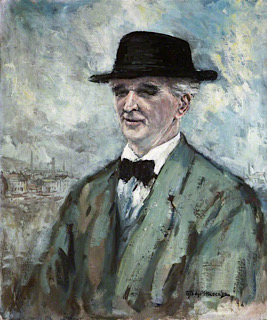
(From: “Conor, William” by Frances Clarke, Dictionary of Irish Biography, http://www.dib.ie, October 2009 | Pictured: “William Conor,” oil on canvas by Gladys Maccabe, Ulster Folk Museum)
Colin MiddletonMBE, Northern Irishlandscape artist, figure painter, and surrealist, is born on January 29, 1910, in Victoria Gardens in north Belfast. Hus prolific output in an eclectic variety of modernist styles is characterised by an intense inner vision, augmented by his lifelong interest in documenting the lives of ordinary people. He has been described as “Ireland’s greatest surrealist.”
Middleton is the only child of damask designer Charles Middleton. He attends the nearby Belfast Royal Academy until 1927 and then continues his studies with night classes at Belfast School of Art where he trains in design under the Cornish artist Newton Penprase. However, he finds the college too traditional in outlook, as his first influence, his father, had been a follower of European Modernism, particularly the Impressionists.
Middleton shows his first works with the Ulster Academy of Arts in 1931, where he exhibits frequently until the late nineteen-forties. He first comes to public attention with the inclusion of his works in the groundbreaking inaugural exhibition of the Ulster Unit at Locksley Hall, Belfast, in December 1933. The Ulster Unit is a short-lived grouping of Ulster artists who take their inspiration from Paul Nash’s Unit One formed earlier in the same year. Just two years thereafter in the same year, he marries Maye McLain, also an artist and a domestic science teacher, who unfortunately dies four years later. He is also a poet and writer, whom along with his wife, is an active member of the Northern Drama League in the 1930s, with whom he designs sets. After the death of his first wife he destroys all of his early paintings and enters a period of seclusion at his mother’s home outside Belfast. He becomes a follower of Vincent van Gogh and James Ensor after viewing exhibitions in London and Belgium respectively. On his return to Ulster he begins to experiment with styles derived from European Modernism, the antithesis to traditional academism. Throughout the 1930s he is also a keen follower of Paul Nash, Tristam Hillier and Edward Wadsworth. After exposure to the works of Salvador Dalí, he declares himself “the only surrealist painter working in Ireland.”
Middleton’s work first appears at the Royal Hibernian Academy in 1938 where he shows intermittently until the final year of his life. He participates in an exhibition at 36 Arthur Street, Belfast, with the Czech artist Otakar Gregor, Joan Loewenthal and Sidney Smith in aid of the war effort at the end of 1940. He completes three paintings immediately after the Belfast Blitz and the trauma of the events prevent him from working for six months before his work is included in a portfolio of lithographs published by the Ulster Academy in December 1941 to raise money for rebuilding the Ulster Children’s and Women’s Hospital which had been destroyed in the Blitz earlier in the year.
Middleton’s first solo exhibition is given by the Belfast Municipal Museum and Art Gallery in 1943. It is the first exhibition staged at the gallery when it re-opens after the Belfast Blitz. At the time it is the largest one-person show the gallery has staged comprising one hundred fifteen works and it is also the first solo exhibition accorded to a local contemporary artist by the gallery. In an interview with Patrick Murphy in 1980, he says that the paintings represent “a first endeavour to harmonize the seemingly opposed and conflicting tendencies in human nature.” Dickon Hall says of this period that “Middleton’s painting is dominated by the female form; it is only rarely that men appear in his work. In part these women reflect his experience of Belfast and the difficult conditions that so many lived through.” This can be seen in the three female figures of The Poet’s Garden (1943), and even more so in The Conspirators (1942), both of which are featured in the 1943 exhibition. “The female form, pictorially and symbolically, becomes the landscape and the life force.”
The Belfast exhibition is followed by his first one-man show at the Grafton Galleries, Dublin, in 1944. In the following year he debuts at the Irish Exhibition of Living Art where he returns on a number of occasions, particularly in the periods 1949–55 and 1963–71. In 1945, he is married for the second time, to Kate Giddens, after both are named co-respondents at the Belfast High Court a few months earlier, in civil servant Lionel P. Barr’s application for a decree nisi. The suit is undefended and the couple has costs awarded against them. In the same year Middleton returns to the Belfast Museum for a solo exhibition arranged by the Council for the Encouragement of Music and the Arts. He is a founding member of the Northern Ireland branch of the Artists’ International Association, who show at the Belfast Municipal Gallery in spring 1945. Other members include Joan Loewenthal, Kathleen Crozier, Pat Hicking, Trude Neu, Sidney Smith, Nevill Johnston, George Campbell and Gerard Dillon.
Middleton’s work is displayed in New York‘s Associated American Artists gallery in 1947 with a selection of works chosen by Dublin art critic Theodore Goodman that includes paintings by his Northern contemporaries Daniel O’Neill, George Campbell, Gerard Dillon and Patrick Scott. He also retires from the family business that year to devote his time to painting, having worked at the business since his father’s death in 1933. He then takes his wife and child to live and work on John Middleton Murry’sSuffolk commune for a short period, before returning to Belfast in 1948. Their life in Suffolk is not a success as the family suffers from ill health, but the experience of working the land is to prove a profound influence on his future work.
In 1949, Middleton shows his first works at the Oireachtas na Gaeilge, where he returns periodically until 1977. Upon their return from Suffolk, his wife sends Victor Waddington photos of his work whereupon Waddington comes to represent him for a period of five years, until the Waddington Galleries face financial hardship in 1958. It is Waddington’s patronage that enables the Middleton family to live and work in Ardglass, County Down, for four years from 1949, which Middleton later describes as the happiest time of his life. When his works are displayed at Victor Waddington’s Dublin gallery in that same year, it acts as a springboard that opens Middleton’s work to an international audience. Group exhibitions in Boston and London follow in 1950 and 1951 respectively.
Middleton’s first solo show at London’s Tooth Gallery takes place in 1952, where his work had been shown in the previous year.
In 1953, Middleton moves to Bangor, County Down, where he designs for Marjery Mason‘s The Repertory Theatre. He later designs sets for the Circle Theatre and the Lyric Theatre, including the sets for a series of W. B. Yeats’s plays in 1970, and Seán O’Casey‘s Red Roses for Me in 1972, both at the latter. In 1952, he exhibits alongside Daniel O’Neill, Nevill Johnson, Gerard Dillon and Thurloe Connolly at the Tooth Galleries in London. He begins his career as an art teacher by the invitation of James Warwick who offers him a one year part-time post at the Belfast College of Art in 1954. That year he shows forty-two works at the Belfast Municipal Gallery under the auspices of the Council for the Encouragement of Music and the Arts. In the following year he delivers full-time classes at the Coleraine Technical School, before becoming head of art at Friends’ School, Lisburn in 1961 where he remains until 1970. He lives on Plantation Avenue in Lisburn for nine years next door to fellow artist and pedagogueDennis Osborne, who presents a portrait of Middleton at the annual exhibition of the Royal Ulster Academy in 1965.
A poet and musician, Middleton also produces murals, mosaics and posters. One such mural is commissioned for a house in Ballymena designed by the architect Noel Campbell in an international modernist style in 1951, and other works include a mosaic for a school in Lisburn, and a mural in a health clinic. He shows in many group shows throughout the fifties including the Royal Academy of Arts in 1955, in addition to more solo exhibitions at the Waddington Galleries in 1955, and his first showing at the Richie Hendricks Gallery in 1958. Of the Waddington exhibition TheDublin Magazine writes: “Apart from the brilliance of his paint, he has one rare quality in his inexhaustible capacity for wonder.”
Middleton shows in the Arts Council of Northern Ireland‘s gallery in 1965 with additional works at the Bell Gallery and his Bruges Series is shown at Alice Berger Hammerschlag’s New Gallery upon his return from a Belgian trip in 1966. The Arts Council of Northern Ireland suffers an extensive fire at their storage facility in south Belfast in autumn 1967 which decimates their collection of contemporary art and theatre costumes. Losses include several of Middleton’s paintings, in addition to the works of many other leading Ulster artists such as William Conor and T. P. Flanagan. He Is among the prizewinners at the Arts Council of Northern Ireland’s 4th Open Painting Exhibition in 1968. In the same year, John Hewitt curatea a joint exhibition of his paintings with T. P. Flanagan at the Herbert Art Gallery and Museum in Coventry.
The Arts Council hosts a joint retrospective of Middleton’s work in co-operation with the Scottish Arts Council in 1970. A major retrospective is to follow at the Ulster Museum and the Hugh Lane Municipal Gallery of Modern Art in Dublin in 1976. Comprising almost three hundred exhibits, the show is accompanied by a monograph written by Middleton’s lifelong friend, the patron and poet John Hewitt. Hewitt later bequeaths his art collection, including several of Middleton’s paintings to the Ulster Museum.
The Royal Mail uses Middleton’s painting of Slieve na Brock in the Mourne Mountains to commemorate the Ulster ’71 exhibition in a series of postage stamps that also feature the work of Thomas Carr and T. P. Flanagan. In 1972, Middleton tours extensively with his wife visiting Australia for two months and shows his works from the trip at the McClelland International Galleries on Belfast’s Lisburn Road the following year. In 1973 he also visits Barcelona and later shows a series of surrealist works inspired by the two trips at the Tom Caldwell Gallery in Belfast.
Middleton lives the last twelve years of his life in Bangor, County Down.
Middleton dies of leukemia in Belfast City Hospital on December 23, 1983. He is survived by his wife Kate, their daughter and a step-daughter. His son predeceases him by a year. Christie’s of London is entrusted with the sale of his studio works in 1985. The works are displayed before auction in both Dublin and Belfast during August 1985. In 2005, the Ulster History Circle unveils a commemorative blue plaque at his former home on Victoria Road in Bangor.
In September 2023, eighty years since the ground-breaking exhibition Middleton held at the Belfast Museum and Art Gallery, now the Ulster Museum, and forty years after his death, the Ulster Museum holds a new exhibition of his works, celebrating his association with Belfast, the city of which he says, “I belong here as I never belonged anywhere else in the country.” This exhibition brings together works held in the public collection with those from private lenders to provide a full picture of the artist’s talent and life.
Middleton wins the Royal Dublin Society‘s Taylor Scholarship worth £50 in 1932, and two further awards of £10 in 1933. In 1935, he is elected associate of the Ulster Academy, inducted alongside Helen Brett, Kathleen Bridle, Patrick Marrinan, Maurice Wilks, Romeo Toogood and William St. John Glenn,and in 1948 he becomes an elected Academician at the same.
In 1968, Middleton is appointed MBE in the Queen’s birthday honours list, and in 1969 he is elected an associate at the Royal Hibernian Academy with full membership conferred just a year later. He is awarded an honoraryMaster of Arts degree from Queen’s University Belfast in 1972. The Arts Council of Northern Ireland grants him a substantial subsistence award in 1970 which covers two years enabling him to retire from teaching to concentrate on painting full-time. In the same year, the Arts Council of Northern Ireland also commissions him to paint a portrait of their director, Kenneth Jamison.
Henderson is born to James Douglas Alexander Henderson, who manages the family business of Henderson & Eadie, and Doris Josephine (née Watson). He attends Portora Royal School in Enniskillen, where the art master, Angus Bryson, spots him as an exceptional student.
From 1972 to 1973 Henderson studies an Arts Foundation course at Ulster University. From 1973 to 1976 he studies Fine Art at Kingston University, London, achieving a Bachelor of Artsfirst class honours degree under the tutelage of Terry Jones, returning in 1977 as Artist-in-Residence. In the same year he becomes the first recipient of the Stanley Picker Fellowship Award in Painting. Between 1978 and 1979 he completes a MA postgraduate in Fine Art at Chelsea School of Art under the tutelage of the artist John Hoyland.
In 1980, Henderson starts his professional artistic journey, developing abstract techniques, creating large canvases with complex layers of overlaid and inter-worked paint. He lives and paints in London for twenty years before relocating back to Ireland. In the mid-1980s he works in a studio adjacent to the house he shares with his partner, Jenni Stone, with whom he has a daughter named Emerald.
During the mid-1980s Henderson’s work becomes recognised by private and public collectors, including Bono, leader of the Irish rock band U2. During this period he sells his first work to the National Art Collection (1986). Cuilcagh Under A Renaissance Sky is purchased for Fermanagh County Museum with a grant from the Arts Council of Northern Ireland during his first solo exhibition “Around a Border” in Ireland. This is followed by three more acquisitions via the Arts Council during the 1980s, who continue to support his work into the new millennium acquiring If Hobbema had Seen Ireland (1989) in 2004 via Art Fund with support from the Esmée Fairbairn Foundation. His work is exhibited by Arts Council England.
In 1990 Henderson moves to the Cooperage Studio, Brick Lane, London, sharing the top floor with sculptor David Fusco and artist Bryan Benge, a friend from Kingston University. Benge says “Every summer the studios in the East End became part of the open studios programme. . . . . He was an intelligent and incredibly accomplished Painter.” It is here, separated from his partner and virtually penniless, he devotes himself entirely to his work, living in a tent, donated by Benge’s parents, inside the studio.
Henderson begins Palinurus in Soho in 1991, a series of twelve paintings depicting night time rooftop scenes across London, painted from an attic in Kingly Street. Exhibited at the Anna Bornholt Gallery in 1992, ten of the series are acquired by a single private collector.
Around 2000, Henderson becomes more influenced by Greek and Irish symbolism, in particular White Island, the Book of Kells and Sheela na gig, reflected in much of the art produced from this time onward. In 2001, he creates a set of enamel manuscripts for The Clinton Centre in Enniskillen, inaugurated by U.S. PresidentBill Clinton in 2002, in commemoration of the Remembrance Day bombing of 1987. He is interested in enameling because of the possibilities that it offers to him as a colourist and in the behaviour of gestural mark-making. The process is made possible when he is introduced to Andrew Morley, the authority on enamel sign making.
Henderson’s artistic influences include Hans Hofmann, Barnett Newman, Mark Rothko, and John Hoyland. Frequently associated with Samuel Beckett and Jack Butler Yeats, he is influenced by his homeland; his early environment, growing up around weaving, yarns and dyeing, the regions political turmoil, symbolism, and in later life his chronic illness, expressed in his more sombre paintings.
John Hutchinson, critic and director of the Douglas Hyde Gallery writes in the Sunday Independent that Henderson’s paintings “demonstrate the fruitfulness of the no man’s land between abstraction and representation,” and “His images deliberately evoke the picturesque and romantic landscape conventions that originated in the late 18th century…..as well as the expressionist subjectivity of painters such as Jack B. Yeats.” Due to Henderson’s disinterest in the commercialisation of his work, he is sometimes referred to as Ireland’s Invisible Genius.
Henderson describes the evolution of his work, after returning to Ireland in 1993, saying, “Since returning to Ireland my work has become less concerned with resting landscape painting in a cultural context more appropriate to our times, but has come full circle towards an internalised organic abstraction which characterised my more intuitive approach until the early eighties.”
Henderson is married once, in 1995 to the actress Patricia Martinelli with whom he subsequently has a daughter in 1997, Bella-Lucia. He remains married, living in the remote village of Boho, County Fermanagh, Northern Ireland, until his death, brought on by a brain tumour, on April 28, 2009. He remains a prolific artist throughout his life.
Whelan is awarded many prizes in the Royal Dublin Society (RDS) Taylor art competitions, including one in 1912 for a portrait of his sister Lena, entitled On the Moors, rendered in a strongly academic technique. In 1916, he wins the Taylor scholarship for the Royal Hibernian Academy (RHA) schools for his finest early work, The Doctor’s Visit, an adroitly executed composition of contrasting shadows and light. Typical of many of his genre interiors, the painting depicts a room in the family home, with relatives as models: Whelan’s mother sits by the bed watching over his ill cousin, while his sister, dressed in a Mater hospital nurse’s uniform, is in the background opening the door for the doctor. The subtly evoked atmosphere of restrained emotion foreshadowed a hallmark of his mature style.
Whelan exhibits annually at the RHA for forty-five years (1911–56), averaging six works per year. He is elected an RHA associate in 1920, becoming a full member in 1924. He participates in the Exposition d’art irlandais at the Galerie Barbazanges in Paris in 1922. A visiting teacher at the RHA schools in 1924, he also teaches in the DMSA for a time. He has studios at 64 Dawson Street (1914–27) and 7 Lower Baggot Street (1931–56). Beginning in the 1910s, he receives regular commissions for portraits, constituting his primary source of income. Having become the family’s main breadwinner following his parents’ deaths in the 1920s, he concentrates most of his production on this lucrative activity, portraying numerous leading figures in the spheres of politics, academia, religion, society, medicine, and law.
Situated securely in the academic tradition, in most of his portraits Whelan favours a sombre, restricted palette, with the sitter placed, in grave demeanour, against a monotone background with few accessories. In a 1943 interview he asserts that twentieth-century portraiture suffers from the drabness of modern costume, for which the artist must compensate by careful rendition of the subject’s hands. He tends to depart from his prevailing portrait style when painting women, whom he characteristically depicts in meticulously observed interiors, a notable example being his portrait of Society hostess Gladys Maccabe (c.1946; NGI).
Whelan’s commercial concentration on portraiture notwithstanding, he expresses his true talent in genre compositions, especially kitchen interiors, in which he emulates the technique of the Dutch painter Johannes Vermeer. Two of the most accomplished of these depict his sister Frances in the basement kitchen of the family home: The Kitchen Window (1927; Crawford Art Gallery, Cork) demonstrates a particularly skillful use of light, while Interior of a Kitchen (1935) is notable for the dexterous handling of objects of varied shapes and textures. His genre works include both urban and rural scenes, with a distinctive interest in portraying occupations and other activities. Gypsy (1923), an Orpenesque composition of a shawled woman in a west-of-Ireland landscape with a caravan in the background, receives wide contemporary critical acclaim. Jer (c.1925), depicting a man seated by the fire in a cottage interior, is reproduced in J. Crampton Walker’s Irish Art and Landscape (1927). The Fiddler (c.1932), a naturalistic, sensitively characterised study, is first shown at an Ulster Academy exhibition at Stranmillis, Belfast. A Kerry Cobbler is reproduced in Twelve Irish Artists (1940), introduced by Thomas Bodkin, as among the works denoting the development of a distinctively Irish school of painting.
In 1929, Whelan designs the first Irish Free State commemorative stamp, a portrait of Daniel O’Connell for the centenary of Catholic emancipation. Commissioned by the Thomas Haverty trust to paint an incident from the life of Saint Patrick for the 1932 Eucharistic Congress, he executes The Baptism by St. Patrick of Ethna the Fair and Fedelmia the Ruddy, Daughters of the Ard Rí Laoghaire, a work highly conservative in style. He rapidly completes an oil study of the papal legate, Lorenzo Lauri, also for the Eucharistic Congress. He is represented in the art competitions at the 1932 Summer Olympics in Los Angeles. His depiction of Saint Brigid, shown at the Academy of Christian Art exhibition (1940), becomes a familiar image owing to the wide circulation of reproductions.
Whelan’s political portraits are influential in creating a strong, assured image of the newly formed Irish state, and thus retain an historical significance. His posthumous portrait, The Late General Michael Collins, exhibited at the RHA in 1943 and now held in Leinster House, is an iconic, heroic image of the fallen leader. His portraits of Arthur Griffith and Kevin O’Higgins – commissioned posthumously, as is the Collins, by Fine Gael – also hang in Leinster House, while that of John A. Costello, exhibited at the RHA in 1949, is now held in the King’s Inns, Dublin. He paints two presidents, Douglas Hyde and Seán T. O’Kelly, both works currently in Áras an Uachtaráin. A portrait of Éamon de Valera, painted in 1955 when the sitter is Leader of the Opposition, is in Leinster House. In 1954, he designs a second commemorative stamp, picturing a reproduction of a portrait bust of John Henry Newman, to mark the centenary of the Catholic University of Ireland.
Whelan is elected an honorary academician of both the Ulster Academy of Arts (1931), and the Royal Ulster Academy (1950). He becomes a member of the United Arts Club in 1934. As a representative of the RHA, he sits on the board of governors of the National Gallery of Ireland for many years, and is on the advisory committee of the Municipal Gallery of Modern Art. Unmarried, he resides until his death at the Eccles Street address, with two sisters who continue to manage the family hotel. He dies on November 6, 1956, from leukemia at the Mater private nursing home in Dublin. He is buried in Glasnevin Cemetery.
(From: “Whelan, (Michael) Leo,” by Carmel Doyle, Dictionary of Irish Biography, http://www.dib.ie, October 2009)
Morrow is born on April 26, 1863, in Comber, County Down, the second son of George Morrow, a painter and decorator from Clifton Street in west Belfast. Of his seven brothers, four, George, Jack, Edwin, and Norman, are also illustrators and all but one are artists. He is a keen ornithologist in his youth. In later life he is a keen walker and paints landscapes for leisure.
While studying under T. M. Lindsay at the Government School of Art in 1880, Morrow is awarded a £10 prize for drawing from the eminent publishers Cassell, Petter and Galpin. In 1881, while still learning his trade, he paints a mural of Belfast for the Working Men’s Institute in Rosemary Street, where his father is chairman. Later in that same year he exhibits a watercolour sketch of a standing figure entitled Meditative at the gallery of Rodman & Company, Belfast.
Morrow then wins a three-year scholarship worth £52 per year which he takes to the National Art Training School at South Kensington in 1882, where he begins a lifelong friendship with the British sculptor Albert Toft. In 1883, while still attending South Kensington, he joins the staff of The English Illustrated Magazine in preparation for the launch of the first edition. Two of his works are published in the Sunday at Home magazine in September of the same year.
J. Comyns Carr, first editor of TheEnglish Illustrated Magazine, commissions Morrow to complete a series on English industry when he has yet to complete his studies at South Kensington.
In 1890, Morrow begins illustrating for Bits and Good Words. He exhibits nine works at the Royal Academy of Arts between 1890 and 1904, all of which are watercolours, and another in 1917, and an offering in chalk at the 159th Exhibition, in the year of his death.
Morrow becomes a member of the Belfast Art Society in 1895, exhibiting with them in the same year. In 1896, a Morrow print is published in Volume 2 of the limited-edition print-collection Les Maîtres de l’Affiche selected by “Father of the Poster” Jules Chéret. In the same year he shows a watercolour of a Gurkha at the Earls Court in the Empire of India and Ceylon exhibition. In 1900, he exhibits with two Ulster artists, Hugh Thomson and Arthur David McCormick, at the Linen Hall Library in Belfast, who along with Morrow had contributed to the early success of TheEnglish Illustrated Magazine.
Morrow is one of the founders of the Ulster Arts Club in November 1902 along with five of his brothers, an organisation that has a nonsectarian interest in Celtic ideas, language and aesthetics. In November 1903, he exhibits at the first annual exhibition of the Club when he shows alongside John Lavery, Hans Iten, James Stoupe and F. W. Hull. He exhibits The Itinerant Musician, a watercolour that he had previously shown at the Royal Academy in 1902. Honorary membership is conferred upon him the following year. Three years later he is honoured with a solo exhibition of sketches and posters in conjunction with the Ulster Arts Club, at the Belfast Municipal Gallery.
In 1908, Morrow joins his brothers in an exhibition at 15 D’Olier Street, Dublin, an address which is later registered to the family business in 1913. Among his contributions to the family exhibition is his painting of Brandon Thomas, The Clarionette Player, which had previously been exhibited at the Royal Academy, and a poster entitled Irving in Dante.
In 1917, Morrow joins his brother George and 150 artists and writers, in petitioning the British Prime MinisterDavid Lloyd George to find a way of enacting the unsigned codicil to Hugh Lane’s will and establish a gallery to house Lane’s art collection in Dublin. Among the 32 notable artists who sign this petition are Jack B. Yeats, Sir William Orpen, Sir John Lavery, and Augustus John.
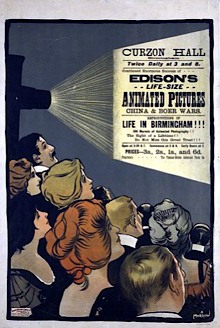
Morrow illustrates books for children and adults, but he is best known for the hundreds of posters he designs for the theatre, with the bulk of his commissions coming from just one lithographical printer, David Allen and Sons. As a cartoonist he draws for children’s annuals, and contributes three cartoons to Punch in 1923, 1925 and posthumously in 1931.
Morrow dies at his home in West Hoathly, West Sussex, on October 26, 1927, at the age of 64. He is survived by his wife and two children. His headstone in the local churchyard at All Saints Church, Highbrook is designed by his friend, the sculptor and architect, Albert Toft.
Born on March 13, 1831, in Lisburn, County Antrim, McCloy is the youngest of five children, born to Peter McCloy, a painter, and his wife Martha Phelan. He studies at the School of Design in Belfast from 1850 to 1851 while serving an apprenticeship in engraving, with J and T Smyth. He then spende a year at the Central School, Somerset House in London before being appointed Master at the Waterford School of Art around 1853, when he also becomes a visiting instructor to several other institutions. In the spring of 1865 he marries his student, the Waterford artist Ellen Lucy Harris, the fourth daughter of a banker named Richard Harris. The dismembered corpse of McCloy’s mother is recovered from the River Suir in September of the same year. She had been missing since the previous November.
McCloy shows just once at the Royal Academy of Arts with a work entitled The Haunt of Meditation in 1859. He exhibits infrequently at the Royal Hibernian Academy between 1862 and 1882, where he displays sixteen works in that time. He displays eleven works in the 1876 Industrial Exhibition at Belfast’s Ulster Hall. In 1880, he shows at Rodman and Company in London where the writer in the Belfast Telegraph indicates that McCloy is becoming a popular artist and is receiving extensive patronage.
After a year-long illness that prevents him from working, McCloy dies in Balham, South London, on October 4, 1904. He is survived by his wife, Ellen, and nine daughters. The Lisburn Museum in his hometown offers a belated retrospective of his work in 1981 to mark the one-hundred fiftieth anniversary of his birth. The exhibition is the first known solo display of McCloy’s work and consists of 58 works. The catalogue for this show is written by Eileen Black and funded by the Arts Council of Northern Ireland.
Dickey is the son of Edward O’Rorke Dickey. He later marries Eunice Emmeline Howard and they have one son, Daniel. He is educated at Wellington College and Trinity College, Cambridge. He studies painting under Harold Gilman at the Westminster School of Art.
Dickey becomes the first curator of The Minories in Colchester, Essex, a post he holds for five years from 1957 to 1962.
Dickey is a founder member of the Society of Wood Engravers in 1920, and exhibits with them from 1920 to 1924. He is at his most active in the early 1920s and virtually all his engravings date from this period.
In 1922 Dickey contributes a wood engraving to Contemporary English Woodcuts, an anthology of wood engravings produced by Thomas Balston, a director at Gerald Duckworth and Company and an enthusiast for the new style of wood engravings. Campbell Dodgson, Keeper of Prints and Drawings at the British Museum, writes about him in his introduction to the book Mr. Hagreen and Mr. Dickey are among the engravers who rely very much upon the effective use of white lines and spaces. This is a limited edition of 550 copies, as is the only book that he illustrates with wood engravings, Workers by the Irish writer Richard Rowley, published by Balston at Duckworth in 1923.
Davidson is the sixth of ten children of clerk of petty session, Edward Ellice Davidson, and Lucy Rising Davidson (née Doe). Her mother dies in 1888, and it is presumed that she receives a private education but as the family are not affluent, the details are unclear. She goes on to attend the Dublin Metropolitan School of Art (DMSA) from 1895 to 1905. While at the DMSA, she wins prizes in 1895 and 1896 and is awarded a scholarship and free studentship at the Royal Dublin Society (RDS) in 1897, the same year her father dies. She completes her studies in 1905. In the early 1910s, she is living in Rathmines and spends some time in England and Wales.
Davidson is commissioned by Switzer’s department store on Grafton Street to draw costumes in 1899. In 1909, her painting After Rain is exhibited by the Dublin Sketching Club, with her continuing to show work there until 1920. She exhibits The Bonfire with the Water Colour Society of Ireland in 1912, becoming a committee member in 1934 and continuing to exhibit with them until 1954. In 1914, she is one of the artists included in a sale of paintings to aid Belgian refugees. She is first exhibited at the Royal Hibernian Academy (RHA) in 1914, with The Student. Her painting exhibited by the RHA in 1916, The Harbour, St. Ives, demonstrates an influence from Stanhope Forbes and the Newlyn School, with a bright palette and contrasting illumination, which become characteristic of her work. She illustrates C. H. Bretherton’s collection of humorous poems and recollections about London Zoo, A Zoovenir (1919).
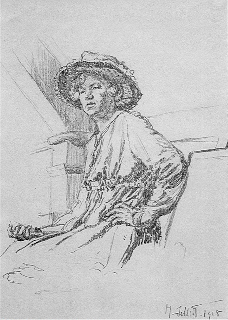
Davidson holds a joint exhibition with Mainie Jellett in 1920, at Mill’s Hall, Merrion Row, Dublin. Jellett produces a pencil portrait of Davison (pictured above), which shows her in a straw hat she frequently wears. The RHA exhibits Davidson’s oil painting, The Flax Pullers, in 1921. This work shows an influence from Paul Henry and French Impressionism in her use of colour-blocking. In the early 1920s, she travels to Switzerland, Belgium, and France, producing works such as Fish Market, Bruges. She lives in Paris in the late 1920s, exhibiting at the Salon de la Societé Nationale in 1924 and 1930. She places a self-portrait in her depiction of a peasant gathering, The Country Races. Reproductions of her drawing of Leinster House and Christ Church Cathedral by Bulmer Hobson are included in A Book of Dublin (1929). Her landscape, Low Tide, Wicklow, which is exhibited at the RHA in 1934, and Boats at Wicklow, Dusk show her ability to depict reflections in water. She continues to paint scenes of rural life, including Cottages – Keel, Achill, which shows an influence from Jack Butler Yeats in her use of space and colour. The fact that her family is not wealthy likely influences her choice of poorer people as her subjects, depicting them in a sympathetic manner. Her work is part of the painting event in the art competitions at the 1928 Summer Olympics.
Davidson’s paintings are exhibited at the Contemporary Picture Galleries, Dublin in 1930, alongside Yeats, Evie Hone, and Harry Kernoff. She is a member of the Picture Hire Club, 24 Molesworth Street, Dublin from 1941 to 1942, and is a frequent contributor to the Munster Fine Arts Club. Her work is exhibited at the Salon des Beaux Arts, Paris, the Royal Academy of Arts, London, and in Amsterdam. A large number of her works from the 1930s show the Irish-speaking area of Galway, Claddagh, such as Night in Claddagh, exhibited with the RHA in 1933. Her Irish landscapes, such as Claddagh Cottages, are included in the Oireachtas Art Exhibitions from 1932 to 1946. From around 1934, she is a member of the Society of Dublin Painters, exhibiting with them from 1939 to 1954. She influences the Society’s move toward the avant-garde in the 1940s. She is elected associate to the RHA in 1940 and continues to exhibit there until her death. Her 1946 work, Gorta, shows influence from Zola, Rilke, Dostoyevsky and Picasso.
Davidson teaches drawing at her studio at 1 Earlsfort Terrace, Dublin. Her pupils include Bea Orpen, Anne Yeats, and Mo Irwin. She also is a teacher at a number of Dublin schools, such as Belgrave school, Rathmines, Wesley College, St. Stephen’s Green, and Castle Park School, Dalkey. She travels to Abbeyleix, County Laois, once a week to teach at Glenbawn boarding school.
As well as painting, Davidson writes a number of plays, short stories, and monologues under a pseudonym, “Ulick Burke.” In 1927, a collection of her poems and Donegal rhymes is published. In 1931, Hilton Edwards directs her stage play Bride, at the Gate Theatre. Her short story, Her Only Son, is published in The Bell under a pseudonym in 1942. In 1935, she is a founder-member of the Torch Theatre, Dublin. She designs scenery, and is the co-director with Hugh Hyland in 1936, under the stage name “Jennifer Maude.”
Davidson dies at her home at 4 Wilton Terrace, Dublin on March 29, 1954. She is buried in an unmarked grave in Mount Jerome Cemetery. The National Gallery of Ireland (NGI) holds her 1938 portrait of Yeats, as well as her crayon drawing of Sarah Purser. She is a regular attendee at Purser’s “Second Tuesdays” gatherings. The Abbey Theatre holds her portrait of Joseph Holloway. She bequeaths The Golden Shawl to the Hugh Lane Gallery, which is a large self-portrait. Two of her works are included in the NGI’s 1987 exhibition, Irish Women Artists from the Eighteenth Century to the Present Day.
The youngest daughter of Captain Henry Butler, a grandson of the Edmund Butler, 11th Viscount Mountgarret, and Clara Butler (née Taylor) of the Newarke, Leicester, England. Her father is himself an enthusiastic painter, known for his publication South African sketches: illustrative of the wildlife of a hunter on the frontier of Cape Colony (1841). Her early artistic efforts are mainly copies of romantic subjects, but the influence of the London artist Paul Jacob Naftel, with whom she begins corresponding in the early 1880s, proves to be crucial to her artistic development. Studies with William Frank Calderon, an expert in animal painting, are also significant. She subsequently spends the summers of 1894 and 1895 in Newlyn, Cornwall, England, with the Irish artist Norman Garstin, who introduces her to contemporary French painting.
In 1885, Butler makes her first visit to the continent, traveling through France, Switzerland, and Italy. From 1905 to 1914 she travels regularly to Europe, most particularly Aix-les-Bains and Wiesbaden, during which time she produces genre views of French and German villages. After 1914 her life at the family home is interrupted only by visits to London exhibitions. She is best known for her paintings of Kilmurry and its environs, many of which display an interest in botany. Much of her work is dominated by detailed representations of animals and birds, often drawn from photographs and stuffed specimens.
Butler’s career as an exhibitor begins in 1882 with the Irish Fine Arts Society, later known as the Water Colour Society of Ireland (WCSI), with which she has a long association. She exhibits regularly with the society from 1892 onward and is a member of its committee for many years. She is also closely associated with the Dudley Museum and Art Gallery in London. Her work is first shown there in 1888, and on this evidence, she is elected to their society. The purchase by the Chantrey bequest for the Tate Gallery of The Morning Bath for £50 in 1896 is a high point in her career. The first painting by a woman to be selected by the council, its purchase is followed by almost consistently good press reviews for her work. The Athenaeum of May 5, 1897, writes: “The young lady knows how to look at her subjects with the eyes of a well-trained artist.”
Butler also comes to the attention of the American artistic press. She contributes to the portfolio of drawings given by the Society of Lady Artists to Princess May on her marriage to the Duke of York in 1893, while in 1922 her work is included in the portfolio presented to Princess Mary on her marriage. Her patrons include Queen Alexandra, and the grand duke of Hesse, who purchases two of her paintings after she is invited to exhibit in Hesse Darmstadt in 1911. In 1914 she is made a member of the Union Internationale des Beaux Arts, and in 1921 her paintings are shown in Japan. She regularly exhibits with the Belfast Ramblers, the Royal Ulster Academy, the Royal Academy of Arts (RA), the Royal Hibernian Academy (RHA), the Society of Lady Artists, and the Royal Watercolour Society, of which she is made an associate member in 1896, and a full member in 1937.
In her later years, severe rheumatism prevents Butler from painting. She has a keen interest in music. She survives all five of her siblings, and inherits Kilmurry, where she dies on October 11, 1941. She is buried at Thomastown, County Kilkenny. Her paintings are represented in the collections of the National Gallery of Ireland, Dublin City Gallery the Hugh Lane, the Ulster Museum, and the Tate, London.
(From: “Butler, Mildred Anne” by Frances Clarke, Dictionary of Irish Biography, http://www.dib.ie, October 2009)
Orpen is the fourth and youngest son of Arthur Herbert Orpen (1830–1926), a solicitor, and his wife, Anne Caulfield (1834–1912), the eldest daughter of the Right Rev. Charles Caulfield (1804–1862), the Bishop of Nassau. Both his parents are amateur painters, and his eldest brother, Richard Caulfield Orpen, becomes a notable architect. His nieces are Bea Orpen and Kathleen Delap. The historian Goddard Henry Orpen is his second cousin. The family lives at “Oriel,” a large house with extensive grounds containing stables and a tennis court. He appears to have a happy childhood there.
Orpen is a naturally talented painter, and six weeks before his thirteenth birthday is enrolled at the Dublin Metropolitan School of Art. During his six years at the college, he wins every major prize there, plus the British Isles gold medal for life drawing, before leaving to study at the Slade School of Fine Art in London between 1897 and 1899. At the Slade he masters oil painting and begins to experiment with different painting techniques and effects.
While at the Slade, Orpen becomes engaged to Emily Scobel, a model and the subject of his painting The Mirror (1900). She ends their relationship in 1901, and he marries Grace Knewstub, the sister-in-law of Sir William Rothenstein. He and Knewstub have three daughters together, but the marriage is not a happy one. By 1908, he has begun a long-running affair with Evelyn Saint-George, a well-connected American millionairess based in London, with whom he also has a child.
Orpen first exhibits at the New English Art Club (NEAC) in 1899, becoming a member in 1900. In 1901, he holds a solo exhibition at the Carfax Gallery in central London. His portraits, which establish his reputation, show the influence of the Realist artist Édouard Manet. He also becomes known as a painter of group portraits such as Homage to Manet (1909), in which he portrays members of the contemporary English art world sitting in conversation beneath a famous portrait by that artist.
At the start of World War I, a number of Irish people living in England return to Ireland to avoid conscription. Among them is Orpen’s studio assistant and former pupil, Seán Keating. Keating encourages him to do likewise, but he refuses and commits himself to supporting the British war effort. In December 1915, he is commissioned into the Royal Army Service Corps and reports for clerical duty at London’s Kensington Barracks in March 1916. Throughout 1916 he continues painting portraits, most notably one of a despondent Winston Churchill, but soon starts using both his own contacts and those of Evelyn Saint-George, to secure a war artist posting.
He is the official painter of the Paris Peace Conference after World War I. Throughout 1919 he paints individual portraits of the delegates to the Conference and these form the basis of his two large paintings, A Peace Conference at the Quai d’Orsay and The Signing of Peace in the Hall of Mirrors. In both pictures, the architecture overwhelms the gathered politicians and statesmen who’s political wranglings and vainglory diminish them in Orpen’s eyes.
Orpen becomes seriously ill in May 1931, and, after suffering periods of memory loss, dies at the age of 52 on September 29, 1931, in South Kensington, London, of liver and heart failure. He is buried at Putney Vale Cemetery in southwest London. A stone tablet in the Island of Ireland Peace Park Memorial at Mesen, Belgium, commemorates him. He is posthumously regarded as a facile and prolific, but somewhat superficial, artist who nevertheless achieves great popularity in his day.
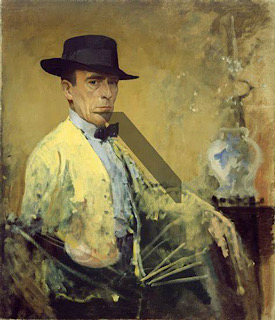
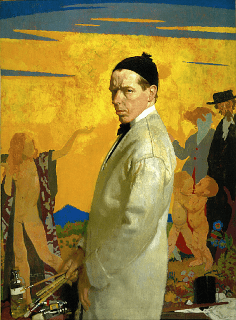
(Pictured: “Self-portrait” (1913), oil on canvas by William Orpen, Saint Louis Art Museum)




 seamus dubhghaill