seamus dubhghaill

Promoting Irish Culture and History from Little Rock, Arkansas, USA


Leave a comment

Death of Irish Writer Denis Johnston

Irish writer (William) Denis Johnston dies on August 8, 1984, at Ballybrack, County Dublin. He writes mostly plays, but also works of literary criticism, a book-length biographical essay of Jonathan Swift, a memoir and an eccentric work on cosmology and philosophy. He also works as a war correspondent and as both a radio and television producer for the BBC.

Johnston is born in Dublin on June 18, 1901, the only child of William John Johnston from Magherafelt, a barrister and later an Irish Supreme Court judge, and his wife Kathleen (née King), a teacher and singer from Belfast. They are Presbyterians and liberal home rulers. He sees the family home in Dublin occupied by rebels during the 1916 Easter Rising.

Johnston is educated at St. Andrew’s College, Dublin (1908–15, 1917–19), and Merchiston Castle School, Edinburgh (1915–16). In 1918, he attempts to join Sinn Féin, offering to supply the party with weapons taken from his Officers’ Training Corps. In 1922, while reading history and law at Christ’s College, Cambridge (1919–23) he tries to enlist in the civil war Free State army. He goes on to study at the Harvard Law School (1923–24) and enters King’s Inns in Dublin and the Inner Temple in London.

In London, developing his interest in the theatre, Johnston abandons plans for a legal and political career.

Johnston is a protégé of W. B. Yeats and George Bernard Shaw, and has a stormy friendship with Seán O’Casey. He is a pioneer of television and war reporting. He works as a lawyer in the 1920s and 1930s before joining the BBC as a writer and producer, first in radio and then in the fledgling television service. His broadcast dramatic work includes both original plays and adaptation of the work of many different writers.

Johnston’s first play, The Old Lady Says “No!”, helps establish the worldwide reputation of Dublin’s Gate Theatre. His second play, The Moon in the Yellow River, has been performed around the globe in numerous productions featuring such storied names as James Mason, Jack Hawkins, Claude Rains, Barry Fitzgerald, James Coco and Errol Flynn. Later plays deal with the life of Jonathan Swift, the 1916 Rebellion, the pursuit of justice, and the fear of death. He writes two opera libretti and a pageant.

“Passionate in his radical skepticism and loathing of what he saw as the pernicious influence of the Roman Catholic Church,” at the end of 1933, Johnston joins the trade unionist John Swift, the Dublin novelist Mary Manning, and fellow northerner, the libertarian socialist Jack White, in forming The Secular Society of Ireland. “Convinced that clerical domination in the community is harmful to advance,” the society seeks “to establish in this country complete freedom of thought, speech and publication, liberty for mind, in the widest toleration compatible with orderly progress and rational conduct.” Among other things it aims to terminate the clerically-dictated ban on divorce, the Censorship of Publications Act and the system of clerical management, and consequent sectarian teaching, in schools.

This is at a time of heightened clerical militancy and as soon the meeting place of the Society (from which it distributed the British journal The Freethinker) is exposed, it has to shift to private houses outside of Dublin. In 1936, Johnston and the other members disband the society and donate the proceeds to the government of the beleaguered Spanish Republic. He has become a recognised man of the left. In 1930 he joins the Irish Friends of Soviet Russia, and though never a party member, until as late as the 1950s he professes faith in a communist future.

During World War II he serves as a BBC war correspondent, reporting from El Alamein, through the Italian campaign, to Buchenwald and Adolf Hitler‘s Berghof. For this he is awarded an OBE, a mention in dispatches, and the Yugoslav Partisans Medal. He then becomes Director of Programmes for the television service.

Johnston later moves to the United States and teaches at Mount Holyoke College, Smith College and other universities. He keeps extensive diaries throughout his life, now deposited in the Library of Trinity College, Dublin, and these together with his many articles and essays give a distinctive picture of his times and the people he knew. Another archive of his work is held at the library of Ulster University at Coleraine. He receives honorary degrees from Ulster University and Mount Holyoke College and is a member of Aosdána.

Johnston and actress Shelah Richards are the parents of Jennifer Johnston, a respected novelist and playwright, and a son, Micheal. His second wife is the actress Betty Chancellor, with whom he has two sons, Jeremy and Rory.

Johnston dies on August 8, 1984, at Ballybrack, County Dublin, and is buried in St. Patrick’s Cathedral close. His epitaph is a quotation from The Old Lady Says “No!” – Emmet’s lines praising Dublin “the strumpet city.”

Johnston’s war memoir, Nine Rivers from Jordan, reaches The New York Times‘ Best Seller list and is cited in the World Book Encyclopedia‘s 1950s article on World War II under “Books to Read,” along with Winston Churchill, Dwight D. Eisenhower, et al. Joseph Ronsley cites an unnamed former CBS Vietnam War correspondent who called the book the “Bible,” carrying it with him constantly, “reading it over and over in the field during his tour of duty.” In a profile in The New Yorker in 1938, Clifford Odets is quoted as saying that the only playwrights he admires are John Howard Lawson, Sean O’Casey, and Denis Johnston.

The Denis Johnston Playwriting Prize is awarded annually by Smith College Department of Theatre for the best play, screenplay or musical written by an undergraduate at Smith College, Mount Holyoke College, Amherst College, Hampshire College and the University of Massachusetts Amherst. The prize is endowed by his former student at Smith, Carol Sobieski.


Leave a comment

Birth of Rosie Hackett, Trade Union Leader & Insurgent

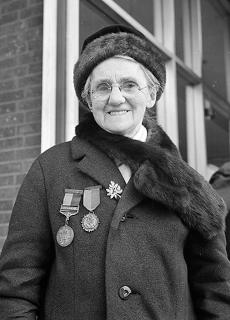
Rosanna “Rosie” Hackett, Irish insurgent and trade union leader, is born into a working-class family in Dublin on July 25, 1893. She is a founder-member of the Irish Women Workers’ Union (IWWU) and supports strikers during the 1913 Dublin lock-out. She later becomes a member of the Irish Citizen Army and is involved in the 1916 Easter Rising. In the 1970s, the labour movement awards her a gold medal for decades of service, and in 2014 a Dublin city bridge is named in her memory.

Hackett is the daughter of John Hackett, a hairdresser, and Roseanna Dunne. According to the 1901 census, she is living with her widowed mother and five other family members in a tenement building on Bolton Street in Dublin. The available documents suggest that her father dies when she is still very young. She joins the Irish Transport and General Workers’ Union (ITGWU) when it is established in 1909 by James Larkin, which marks the beginning of her lifelong activity in trade unionism. By 1911 she is living with her family in a cottage on Old Abbey Street, and her mother has remarried to Patrick Gray.

Hackett fights for many decades for the rights of workers. Through her affiliation and work with the ITGWU, the IWWU and the Irish Citizen Army, she helps carve out and secure modern-day working conditions. Her career begins as a packer in a paper store, then becoming a messenger for Jacob’s biscuits. At that time the working conditions in the factory are poor.

On August 22, 1911, Hackett helps organise the withdrawal of women’s labour in Jacob’s factory to support their male colleagues who are already on strike. With the women’s help, the men secure better working conditions and a pay rise. Two weeks later, at the age of eighteen, she co-founds the IWWU with Delia Larkin. During the 1913 lock-out she helps mobilise the Jacob’s workers to come out in solidarity with other workers. They, in turn, are locked out by their own employers. This does not stop her work to help others, and she, along with several of her IWWU colleagues, set up soup kitchens in Liberty Hall to help feed the strikers. However, in 1914 her Jacob’s employers sack her over her role in the lock-out.

Hackett begins work as a clerk in the printshop in Liberty Hall, and it is here she becomes involved with the Irish Citizen Army. She is involved in preparations for the 1916 Rising, working in a union shop, helping with printers, and making first-aid kits and knap-sacks.

If other members of the ITGWU were looking for James Connolly, Hackett aids in bringing them to him. She “worked as canvasser and traveller and was called on to carry out many confidential jobs.”

Hackett takes up first aid training provided by Dr. Kathleen Lynn for six months before the Rising and attends night marches organised by the Irish Citizen Army. According to her own account, she says, “A week before Easter, I took part in the ceremony of hoisting the challenge flag over Hall.” Like other girls and women who are involved in the Rising, she carries messages and guns and prepares uniforms and food for Irish Republican Army (IRA) members “and sometimes risky work.”

Three weeks before the Easter Rising, the Royal Irish Constabulary (RIC) raid a shop where Hackett is working. She is alone when they come, and they are looking for a copy of “Gael.” She says to them, “wait until I get the head” and she calls for Connolly. The police are stopped by Connolly and Helena Molony who are armed, and Hackett immediately hides everything, so that when the police come back, they cannot get anything.

Through her experience of working in the printshop, Hackett helps to print the Proclamation of the Irish Republic. She is in the printing room in Liberty Hall as a trusted messenger in 1916 when the Proclamation is printed, and it is the first time she is allowed in. Three men are there when she enters the room and one comes over to her, shakes her hand and congratulates her. It makes her very proud, especially since no one else is allowed to get in. She subsequently tells family members of handing it still wet to James Connolly before it is read by Patrick Pearse outside the entrance to the General Post Office (GPO).

Hackett is an active member of the Irish Citizen Army. On Easter Tuesday, under the command of Constance Markievicz, she takes part in the 1916 Rising and is located in the area of St. Stephen’s Green and the Royal College of Surgeons in Ireland. This position is heavily attacked with guns, short of first aid and “looked like a death trap.” However, after moving from an initially overlooked position in St. Stephen’s Green, it is one of the last positions to surrender. In the Royal College, as a first-aid practitioner, she is allowed entry to the lecture room sanctioned to the Red Cross only. Another first-aider, Aider Nora O’Daily, later reports that during those days, “I have a very kind remembrance of Little Rosie Hackett of the Citizen Army, always cheerful and always willing; to see her face about the place was a tonic itself.”

After surrendering, the rebels are taken to Dublin Castle. Hackett is imprisoned in Kilmainham Gaol for ten days.

In 1917, on the anniversary of Connolly’s death, Hackett, together with Helena Molony, Jennie Shanahan and Brigid Davis, print and hang a poster detailing the anniversary. After the first poster displayed by the ITGWU members is taken down by the police, they work to ensure that their poster will stay on Liberty Hall much longer by staying on top of the roof to defend it. They barricade the door using a ton of coal and nails on the windows. The poster is hanging there until 6:00 p.m. and thousands of people can see it.

After the Rising, Hackett returns to the IWWU which, at its strongest, organises over 70,000 women. After the 1945 laundry strike, they win an extra week of paid holidays for the workers. She attends many important labour union events such as the opening of the new Liberty Hall on May 2, 1965, and Arbour Hill memorial services. Until her retirement, she runs the trade union shops resulting in over five decades of active participation in the Irish trades union movement work to improve conditions for Irish workers. In 1970 she is awarded a gold medal for fifty years of ITGWU membership.

In the 1970s, Walter McFarlane, then branch secretary of the ITGWU, awards an honorary badge for Hackett’s fifty years contribution to the union.

Hackett never marries and lives in Fairview, Dublin, with her brother Tommy until her death on July 4, 1976. She is buried at St. Paul’s plot in Glasnevin Cemetery next to her mother and stepfather. At her burial, she is honoured with a military salute and her coffin is covered with the Irish flag. After her passing, her legacy is remembered in the union’s newspaper, a tale of the strife of Hackett together with the rest of Dublin’s working class, for which she fought to change.

In May 2014, the Rosie Hackett Bridge is officially opened by the Lord Mayor of Dublin. The Hackett Bridge Campaign began in October 2012, led by three women Angelina Cox, an active member of Labour Youth, Jeni Gartland and Lisa Connell. The final shortlist of contending names for the new bridge were Rosie Hackett, Kathleen Mills, Willie Bermingham, Bram Stoker and Frank Duff.

In April 2015, a plaque is unveiled on Foley Street by the North Inner City Folklore Project to commemorate the women of the Irish Citizen Army. The plaque lists Hackett as a member of the St. Stephens Green/College of Surgeons garrison during the 1916 Easter Rising.


Leave a comment

Birth of Denis “Denny” Barry, Irish Volunteer & Trade Unionist

Denis “Denny” Barry, Irish Volunteer, commandant of the Cork No. 1 Brigade and trade unionist, is born into a farming family on July 15, 1883, in Riverstick, Cullen, County Cork.

Barry learns Irish from a young age. He attends Ballymartle National School but is unable to attend secondary school due to a lack of facilities in the area. He begins work on the family farm after primary school. In 1903, he moves to Cork to work as a draper‘s apprentice with the firm O’Sullivan and Howard, where he becomes involved in the Gaelic League and the Ancient Order of Hibernians. A successful athlete, he also plays for the Blackrock National Hurling Club and wins four senior county hurling championships between 1910–13.

In 1913, Barry joins the newly formed Irish Volunteers. In 1915, he moves to Kilkenny to take up employment there, where he continues his volunteer activities. Shortly after the 1916 Easter Rising, he is arrested in Kilkenny in a British Government crackdown, and sent to Frongoch internment camp in North Wales. In 1919, he returns to Cork, where he is Commandant of the Irish Republican Police (IRP) in Cork during the Irish War of Independence. In the Cork No. 1 Brigade of the Irish Republican Army (IRA), he helps with prisoner escapes and returning looted goods after the burning of Cork by Black and Tans. After the Anglo-Irish Treaty and the split that follows, he chooses the anti-Treaty branch of the IRA. He is captured by Irish Free State troops and is sent to Newbridge internment camp on October 6, 1922. He is not charged or convicted of any crime.

Irish Republican prisoners in Mountjoy Prison begin the 1923 Irish hunger strikes, protesting being interned without charges or trial and poor prison conditions. The strike quickly spreads to other camps and prisons, and Barry takes part starting on October 16. He dies 35 days later on November 20, 1923, at the hospital at Curragh Camp. IRA Volunteers Joseph Whitty from Newbawn, County Wexford, dies on September 2, 1923 and Andy O’Sullivan from Denbawn, County Cavan, dies as a result of hunger on November 22, 1923, in Mountjoy Prison. The 41-day hunger strike is called off the following day, November 23. Whitty, Barry and O’Sullivan are three of the 22 Irish Republicans who die on hunger-strike during the twentieth century. Barry is initially buried by the Free State army in the Curragh, but three days later, following a court order, his remains are disinterred. He is buried in the Republican plot at St. Finbarr’s Cemetery, Cork.

Prior to Barry’s body arriving in County Cork, the Bishop of Cork, Daniel Cohalan, issues a letter to the Catholic churches which forbids them to open their doors to his body. Bishop Cohalan expresses far different opinions on the 1920 death, also by hunger strike, of the Lord Mayor of Cork Terence MacSwiney. “Terence MacSwiney takes his place among the martyrs in the sacred cause of the Freedom of Ireland. We bow in respect before his heroic sacrifice. We pray that God may have mercy on his soul.”

In Barry’s hometown of Riverstick there stands a stone memorial, unveiled in 1966, in his honor and he is remembered with a wreath-laying commemoration every November.


Leave a comment

Birth of Thomas Johnson, Politician & Trade Unionist

Thomas Ryder Johnson, Irish Labour Party politician and trade unionist who serves as Leader of the Opposition from 1922 to 1927 and Leader of the Labour Party from 1917 to 1927, is born on May 17, 1872, in Liverpool, England. He serves as a Teachta Dála (TD) for Dublin County from 1922 to 1927. He is a Senator for the Labour Panel from 1928 to 1934.

Johnson works on the docks for an Irish fish merchant, spending much of his time in Dunmore East and Kinsale. It is this way that he picks up ideas about socialism and Irish nationalism, joining a Liverpool branch of the Independent Labour Party in 1893. In 1900 he starts work as a commercial traveller, then moves in 1903 with his family to Belfast where he becomes involved in trade union and labour politics.

In 1907 Johnson helps James Larkin organise a strike in the port, but has to watch in dismay as the strike, which begins with remarkable solidarity between labour, Orange, and nationalist supporters, collapses in sectarian rioting. At various times he is the president, treasurer and secretary of the Irish Trades Union Congress (ITUC) which is, at the time, also the Labour Party in Ireland, until officially founded in 1912 by James Connolly and James Larkin. Johnson becomes Vice-president of the ITUC in 1913, and President in 1915.

Johnson sympathizes with the Irish Volunteers, many of whom are sacked from their jobs, for illegal activities. During the Easter Rising, he notes in his diary that people in Ireland paid little heed to the fate of the defeated revolutionaries. He succeeds as leader of the Labour Party from 1917, when the party does not contest the 1918 Irish general election. When the British government tries to enforce conscription in Ireland in 1918, he leads a successful strike in conjunction with other members of the Irish anti-conscription movement.

Johnson is later elected a TD for Dublin County to the Third Dáil at the 1922 Irish general election and remains leader of the Labour Party until 1927. As such, he is Leader of the Opposition in the Dáil of the Irish Free State, as the anti-treaty faction of Sinn Féin refuses to recognise the Dáil as constituted. He issues a statement of support for the Government of the 4th Dáil when the Irish Army Mutiny threatens civilian control in March 1924.

Johnson is the only Leader of the Labour Party who serves as Leader of the Opposition in the Dáil. He loses his Dáil seat at the September 1927 Irish general election, and the following year he is elected to Seanad Éireann, where he serves until the Seanad’s abolition in 1936.

In 1896 he meets Marie Tregay, then a teacher in St. Multose’s National school, outside Kinsale. A native of Cornwall, she has advanced political views. They marry in 1898 in Liverpool. Their only son, Frederick Johnson, is born in 1899, and becomes a well-known actor. Johnson dies on January 17, 1963, at 49 Mount Prospect Avenue, Clontarf, Dublin.

Each summer, Labour Youth holds the “Tom Johnson Summer School” to host panel discussions, debates and workshops.


Leave a comment

Birth of George Colley, Fianna Fáil Politician

George Colley, an Irish Fianna Fáil politician, is born in the Dublin suburb of Fairview on October 18, 1925.

Colley is the son of Harry and Christina Colley. His father is a veteran of the 1916 Easter Rising and a former adjutant in the Irish Republican Army (IRA), who is elected to Dáil Éireann in 1944, as a Fianna Fáil candidate. He is educated at St. Joseph’s Secondary C.B.S. in Fairview, where one of his classmates and closest friends is Charles Haughey, who later becomes his political archrival. He studies law at University College Dublin (UCD) and qualifies as a solicitor in the mid-1940s. He remains friends with Haughey after leaving school and, ironically, encourages him to become a member of Fianna Fáil in 1951. Haughey is elected to Dáil Éireann in the 1957 Irish general election, ousting Colley’s father in the process. This puts some strain on the relationship between the two young men.

Colley is elected to the Dáil at the 1961 Irish general election, reclaiming his father’s old seat in the Dublin North-East constituency. Furthermore, he is elected in the same constituency as Haughey, thereby accentuating the rivalry. Thereafter, he progresses rapidly through the ranks of Fianna Fáil. He becomes a member of the Dáil at a time when a change from the older to the younger generation is taking place, a change facilitated by Taoiseach Seán Lemass.

Colley is active in the Oireachtas as chairman of some of the Joint Labour Committees, which are set up under the Labour Court, to fix legally enforceable wages for groups of workers who have not been effectively organised in trade unions. He is also leader of the Irish parliamentary delegation to the Consultative Assembly of the Council of Europe. His work as a backbencher is rewarded by his appointment as Parliamentary Secretary to the Minister for Lands in October 1964.

Following the return of Lemass’s government at the 1965 Irish general election, Colley joins the cabinet as Minister for Education. He introduces a plan to establish comprehensive schools, set up an advisory council on post-primary school accommodation in Dublin, and introduces a school psychological service.

Colley is promoted as Minister for Industry and Commerce in a cabinet reshuffle in July 1966, and he continues the government policy of economic expansion that had prevailed since the late 1950s.

In November 1966, Seán Lemass resigns suddenly as party leader. Colley contests the subsequent leadership election. He is the favoured candidate of party elders such as Seán MacEntee and Frank Aiken, the latter managing Colley’s campaign. Charles Haughey and Neil Blaney also declare their interest in the leadership; however, both withdraw when the Minister for Finance, Jack Lynch, announces his candidacy. Colley does not back down, and the leadership issue goes to a vote for the first time in the history of the Fianna Fáil party. The leadership election takes place on November 9, 1966, and Lynch beats Colley by 59 votes to 19. When the new Taoiseach announces his cabinet, Colley retains the Industry and Commerce portfolio.

In the wake of the Arms Crisis in 1970, a major reshuffle of the cabinet takes place, with four Ministers either removed, or resigned, or simply retired from the government due to the scandal. Colley remains loyal to the party leader and is rewarded by his appointment as Minister for Finance, the second most important position in government.

In 1973, Fianna Fáil are ousted after sixteen years in government when the national coalition of Fine Gael and the Labour Party come to power. Colley is appointed opposition Spokesman on Finance, in the new Fianna Fáil front bench. As the 1977 Irish general election approaches, Colley and Martin O’Donoghue are the main architects of Fianna Fáil’s election manifesto.

Fianna Fáil sweeps to power at the 1977 Irish general election, with a 20-seat Dáil majority, contrary to opinion polls and political commentators. Colley is re-appointed as Minister for Finance and Minister for the Public Service, and is also appointed as Tánaiste, establishing him firmly as the heir apparent to Taoiseach Jack Lynch.

In December 1979, Jack Lynch resigns unexpectedly as Taoiseach and as Fianna Fáil leader. Colley and Charles Haughey seek the leadership position and are evenly matched. A secret ballot is taken on December 7, 1979. The Minister for Foreign Affairs, Michael O’Kennedy, announces his support for Haughey on the eve of the election. This apparently swings the vote, and Haughey beats Colley by 44 votes to 38. Colley remains as Tánaiste but demands and receives a veto on Haughey’s ministerial appointments to the departments of Justice and Defence.

Fianna Fáil loses power at the 1981 Irish general election. Haughey delays naming a new opposition front bench, but Colley remains a key member of the Fianna Fáil hierarchy. The party regains office at the February 1982 Irish general election. He demands the same veto as before on Haughey’s Defence and Justice appointments but is refused. When it is revealed that Ray MacSharry is to be appointed Tánaiste in his stead, he declines another ministerial position. This effectively brings his front bench political career to an end, but he remains a vocal critic of the party leadership from the backbenches.

When the Fianna Fáil government collapses and are replaced by another coalition government after the November 1982 Irish general election, a number of TDs and Senators express lack of confidence in Haughey’s leadership once again. Several unsuccessful leadership challenges take place in late 1982 and early 1983, with Colley now supporting Desmond O’Malley and the Gang of 22 who oppose Haughey.

Colley dies suddenly on September 17, 1983, aged 57, while receiving treatment for a heart condition at Guy’s Hospital, Southwark, London. He is survived by his wife, three sons, and four daughters, one of whom, Anne Colley, becomes a TD as a member of the Progressive Democrats party.


Leave a comment

Birth of Mike Quill, Irish-American Trade Unionist

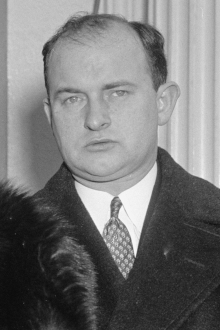
Michael Joseph “Red Mike” Quill, one of the founders of the Transport Workers Union of America (TWU), a union founded by subway workers in New York City that expands to represent employees in other forms of transit, is born on September 18, 1905, in Gortloughera, near Kilgarvan, County Kerry.

Quill is the seventh among five sons and three daughters of John Daniel Quill, farmer, of Gortloughera, and Margaret Quill (née Lynch), of Ballyvourney, County Cork. He attends Kilgarvan national school until early adolescence. The family has strong republican sympathies, and he serves with an Irish Republican Army (IRA) flying column during the Irish Civil War.

In 1926, Quill emigrates to New York City. After a series of brief jobs, in 1929 he secures employment with the Interborough Rapid Transit Company (IRT) as a subway station change-maker. Attracted to socialism and militant industrial unionism by his reading of James Connolly, in 1933 he is one of a small group of workers seeking to initiate a trade union independent of the IRT’s complacent company union. Comprised largely of ex-IRA men linked by membership of Clan na Gael and the leftist Irish Workers’ Clubs, his group soon joins forces with a New York transit-industry organising effort by the Communist Party, resulting in the launch in April 1934 of the Transport Workers Union (TWU).

With a convivial personality and a flair for oratory, Quill quickly emerges as one of the union’s most effective organisers. During 1935 he leaves his IRT job to work full-time as union organiser. In December 1935 he is elected TWU president, a position he holds until his death. By autumn 1936 the TWU has established a solid base on the IRT and intensifies organisation on New York’s other transit lines: subways, buses, elevated trains, and trolleys. In May 1937 the TWU affiliates with the incipient Congress of Industrial Organizations (CIO). After winning, mostly by large majorities, a series of union representation elections in May–June 1937, the TWU negotiates closed-shop contracts with various New York transit companies, obtaining for its 30,000 members substantial wage increases and benefits and a work-week reduction to forty-eight hours. The ethnic profile of the TWU, which is colloquially nicknamed “the Irish union,” reflects that of New York’s transit workforce, about half of which is Irish born.

First elected to the New York City Council in November 1937 as candidate of the American Labor Party, Quill serves on the body intermittently until 1949. After 1940 he leads the TWU into expansion outside New York, organising in mass transit in other cities, in airlines, and in railroads. Despite modest membership numbers (135,000 by the mid-1960s), the TWU is the United States‘ largest transit union, and Quill maintains a high public profile, owing to his union’s situation in a key economic sector, its base in the country’s largest city, and the colourful and the controversial features of his personality and politics. The 1940 municipal buy-out of New York’s private subway companies and subsequent evolution of a unified civically operated transport system precipitates a lengthy TWU struggle to establish collective bargaining rights and procedures for the transport workforce as public employees. This campaign, by setting precedents for public-sector union organisation nation-wide, marks Quill’s most enduring legacy to the American labour movement.

Quill denies repeated charges that he is a Communist, while retorting that he would “rather be called a Red by the rats than a rat by the Reds.” Communists hold influential positions at all levels in the TWU until the union’s December 1948 convention, when, after months of rancorous conflict over policy, he secures the expulsion from union office of all Communist Party members. His own politics, nevertheless, remain conspicuously leftist in the America of the 1950s and 1960s, as he condemns both the McCarthyite anti-Red witch-hunt and the Vietnam War. Elected a CIO vice-president in 1950, he eschews redefinition as “a labour statesman,” and advocates a national labour party and nationalisation of major industries. A strenuous opponent of racial discrimination by employers and within trade-union structures, he actively supports the black civil rights movement. He is the only top CIO official to oppose its 1955 merger with the conservative, craft-dominated American Federation of Labor (AFL), which he accuses of “the three Rs” of raiding, racketeering, and racism.

Quill’s final battle is his most dramatic. On January 1, 1966, he defies public-sector anti-strike legislation and a court injunction and leads TWU Local 100 into the first total subway-and-bus strike in New York City history, paralysing traffic for twelve days. Arrested on January 4, Quill, who has a history of serious heart disease, collapses during admission to prison and is transferred to hospital under police custody. On January 13 the strike is settled with a 15 percent wage increase, the highest of Quill’s TWU presidency. On January 28, several days after discharge from hospital, he dies of heart failure in his home. He is interred at Gate of Heaven Cemetery in Hawthorne, New York, after a funeral Mass at St. Patrick’s Cathedral, his casket draped by the Irish tricolor.

Speaking after his death, Martin Luther King Jr. eulogises Quill with the following: “Mike Quill was a fighter for decent things all his life—Irish independence, labor organization, and racial equality. He spent his life ripping the chains of bondage off his fellowman. When the totality of a man’s life is consumed with enriching the lives of others, this is a man the ages will remember—this is a man who has passed on but who has not died. Negroes had desperately needed men like Mike Quill who fearlessly said what was true even when it offended. That is why Negroes shall miss Mike Quill.”

Quill marries Maria Theresa O’Neill of Cahersiveen, County Kerry, in 1937. They have one son. Maria dies in 1959. He then marries Shirley Garry (née Uzin) of Brooklyn, New York, his long-serving administrative assistant, in 1961. They have no children. The Michael J. Quill Centre at Ardtully, Kilgarvan, County Kerry, houses a commemorative museum.

(From: “Quill, Michael Joseph” by Lawrence William White, Dictionary of Irish Biography, http://www.dib.ie | Pictured: Irish-American Trade Unionist Mike Quill during a visit to the White House in 1938)


Leave a comment

Birth of Poet Francis Edward Ledwidge

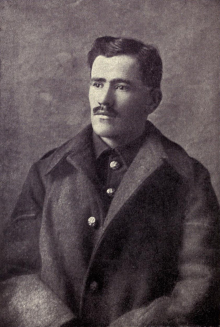
Francis Edward Ledwidge, Irish poet sometimes known as the “poet of the blackbirds,” is born on August 19, 1887, to a poor family in Slane, County Meath. He is later also known as a World War I war poet.

Ledwidge starts writing at an early age and is first published in a local newspaper at the age of fourteen. Finding work as a labourer and miner, he is also a trade union activist and a keen patriot and nationalist, associated with Sinn Féin. He becomes friendly with a local landowner, the writer Lord Dunsany, who gives him a workspace in the library of Dunsany Castle and introduces him to literary figures including William Butler Yeats and Katharine Tynan, with whom he has a long-term correspondence. He is elected to a local authority post and helps organise the local branch of the Irish Volunteers, while Dunsany edits and helps him secure publication for a first volume of his poetry.

Having sided with the faction of the Irish Volunteers which oppose participation in the war, he enlists in the Royal Inniskilling Fusiliers in October 1914, and continues to write poetry on assignment, sending work to Lord Dunsany and to family and other friends. The poems he writes on active service reveal his pride at being a soldier, as he believes, in the service of Ireland. He often wonders whether he would find a soldier’s death.

On July 31, 1917, a group from Ledwidge’s battalion of the Royal Inniskilling Fusiliers are road-laying in preparation for an assault during the Third Battle of Ypres, near the village of Boezinge, Ypres Salient, Belgium.

According to Irish author and lecturer Alice Curtayne, “Ledwidge and his comrades had been toiling since the early morning at roadmaking. The army’s first need was men; their second, guns; their third roads. These latter consisted mainly of heavy beech planks bolted together, which could be rapidly laid down. No advance could be supported in that sodden land without a sufficiency of these communications tracks, six or seven feet wide. Supplies were conveyed by pack mules over the wooden paths. Survivors concur in placing the road work done by B Company that day one mile northeast of Hellfire Corner, so called because it was very exposed to German shelling. There was a violent rainstorm in the afternoon, shrouding the region in a gray monochrome. Sullenly, the enemy’s long-range guns continued to fling their shells far behind the lines. Roadwork could not be suspended, however, as the tracks were in use as fast as they were laid down. Tea was issued to the men and drenched to the skin, they stopped to swallow it. A shell exploded beside Ledwidge, and he was instantly killed.”

A Roman Catholic military chaplain, Father Devas, is the first on the scene. That night, Father Devas writes in his diary, “Crowds at Holy Communion. Arranged for service but washed out by rain and fatigues. Walk in rain with dogs. Ledwidge killed, blown to bits, at Confession yesterday and Mass and Holy Communion this morning. R.I.P.”

Ledwidge is first buried at Carrefour de Rose, and later re-interred in the nearby Artillery Wood Military Cemetery, at Boezinge, where the Welsh poet Hedd Wyn, who was killed in action on the same day, also lies buried.

Dunsany arranges for the publication of more of Ledwidge’s poems, and a collected edition in 1919. Further poems, from the archives at Dunsany Castle and some material held by family, are later published by Ledwdige’s biographer, Alice Curtayne, and by one of the Ledwidge memorial societies. Ledwidge is selected as one of twelve prominent war poets for the exhibition Anthem for Doomed Youth at the Imperial War Museum in London in 2002, and memorialised at an event in Inchicore, Dublin, in 2017, with his work set to music by Anúna. A museum of his life and work is opened in his birthplace cottage in 1982. Some of his manuscripts are held in the National Library of Ireland and more in the archives of Dunsany Castle.


Leave a comment

Birth of Margaret (May) Tennant, Promoter of Workers’ Rights & Public Health

Margaret Mary Edith (May) Tennant (née Abraham), promoter of workers’ rights and public health, is born April 5, 1869 at Rathgar, County Dublin, the only daughter of Dr. George Whitley Abraham, a lawyer in the civil service, and his wife, Margaret, daughter of Cornelius Curtain.

Abraham is educated at home by her father. Following his death in 1887, finding herself in financial straits, she moves to London, where she takes lodgings in Bloomsbury and works for Lady Emilia Dilke. Dilke is a social reformer and an advocate of trade unions for women, and as her secretary Margaret gains first-hand experience of the exploitative and unsanitary conditions afflicting women working in industry, a cause that she devotes the next decade to ameliorating. She is treasurer of the Womens’ Trade Union League, where she negotiates with employers on behalf of league members, organises meetings, and sends deputations to the House of Commons. From 1881 she coordinates a successful campaign to render regular government inspections of laundries mandatory (legislation is passed to this effect in 1908).

Abraham’s dedication to her work soon attracts wider recognition, and in 1891 she is appointed an assistant commissioner to undertake field inquiries for the Royal Labour Commission. In this capacity she travels incessantly throughout England and Ireland, gathering information and writing reports on often appalling working conditions. It is mainly because of this work that in 1893 the home secretary appoints her the first female factory inspector in England. Her new position marks a career shift from agitator to skillful and effective administrator. Traveling incessantly, the inspectors target illegal overtime, poor sanitation, and dangerous trades. In her first year alone she brings eighty prosecutions for illegal overtime.

In 1895 Abraham serves on a departmental committee at the Home Office on dangerous trades, where she meets Harold John Tennant, liberal MP for Berwickshire. The couple are married the following year, and have four sons and one daughter.

By 1896 Tennant is the superintending inspector of five more women inspectors, and her extensive experience in workers’ rights and public health is reflected in the book she publishes in that year, The law relating to factories and workshops, which runs to six editions. She finds it increasingly difficult to balance the pressures of her work with the demands of her private life, and she resigns her post soon after her marriage. However, she remains a committed social activist, serving as chairman of the Industrial Law Committee and on the Royal Commission on Divorce (1909). She is also an original member and treasurer of the Central Committee on Women’s Employment (1914–39).

During the World War I Tennant is chief adviser on women’s welfare to the Ministry of Munitions and director of the Women’s Department of the National Service Department. In recognition of her services the British government awards her the Companion of Honour in 1917, the same year that her eldest son, Harry, dies while on active service. Between the wars she turns her attention to women’s health, campaigning to improve maternal mortality and nursing care.

During the World War II, despite her failing health, Tennant works for the RAF Benevolent Fund. She is a member of the Central Consultative Council of Voluntary Organisations and the National Association for Prevention of Tuberculosis, chairman of the maternal health committee, governor of Bedford College, and a JP. She is also a director of the Mysore and Champion Reef Gold Mines, an enterprise of her husband’s family, and in this capacity travels to India and New Zealand in the mid-1920s.

The Tennants have homes in Edinglasserie, Aberdeenshire, and at 12 Victoria Square, London, as well as a restored country house, Great Maytham, at Rolvenden in Kent. She is a noted authority on gardening, and is director of The Gardener’s Chronicle (other interests included fishing, tennis, and gambling). After her husband’s death in 1935 she moves to a smaller house named Cornhill at Great Maytham, where she dies on July 11, 1946. Some of her correspondence is in the British Library, London.

(From: “Tennant (née Abraham), Margaret Mary Edith (May),” contributed by Sinéad Sturgeon and Georgina Clinton, Dictionary of Irish Biography, http://www.dib.ie)


Leave a comment

Birth of Charles McCarthy, Trade Unionist & Academic

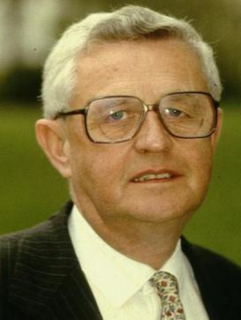
Charles McCarthy, trade unionist and academic, is born on January 25, 1924, at 12 Annmount, Friars Walk, Cork, County Cork.

McCarthy is the second child of John George McCarthy of Cork, plumber, and Agnes Abina McCarthy (née O’Donoghue). He is educated at Presentation Brothers College, Cork, University College Dublin (UCD), and King’s Inns, where he enrolls in 1948. He is called to the bar in 1956.

On June 7, 1951, McCarthy marries Muriel, daughter of Liam Breslin. She becomes (1989) keeper of Marsh’s Library, Dublin, receives an honorary LL.D from National University of Ireland (NUI), and is also made an honorary lay canon of St. Patrick’s Cathedral, Armagh. They live at 367 Howth Road, Raheny, Dublin, and have one son and two daughters.

After graduating from UCD McCarthy briefly works as a clerk on a building site and as an insurance agent before becoming an actor with the Radio Éireann Repertory in 1947. During his time with Radio Éireann he also writes four plays, one of which, entitled Jericho’s trumpets, is based on his experiences in the insurance industry. He is later employed as a speech and drama teacher by Cork vocational educational committee. At the same time, he develops an interest in industrial relations as treasurer of the actors’ trade union Equity and then as secretary of the Civil Service Alliance. In 1956 he becomes full-time general secretary of the Vocational Teacher’s Association, which later becomes the Teachers’ Union of Ireland (TUI). Through this post he eventually becomes president (1963–64) of the Irish Congress of Trade Unions (ICTU) and sits on the executive committee for ten years. As secretary to the International Committee of Technical Teachers he organises conferences around the world and develops countless international contacts.

In 1968 McCarthy publishes his first book, The distasteful challenge. A damning indictment of the static nature of Irish society at the time, it stresses the need to face up to change, particularly in the areas of education, the civil service, and local government. This is followed in 1971 by Industrial democracy. The following year he takes a leave of absence from the TUI to become a research fellow at Trinity College Dublin (TCD). In 1973 his dedication to the arts is rewarded with a seat (1973–76) on the RTÉ Authority and in the same year he publishes Decade of upheaval, which documents the experiences of the trade union movement during the turbulent era of the 1960s. In 1977 he becomes a lecturer in industrial relations at TCD and his 670-page magnum opus, Trade unions in Ireland, 1894–1960, is published to critical acclaim. In 1979 he is appointed to the chair in industrial relations at TCD and becomes head of the school of business and administrative studies. He is later appointed dean of the faculty of economic and social studies and made a fellow of TCD.

McCarthy is a firm believer in resolving industrial relations problems through negotiation. Both unions and management alike respect his views and abilities and he is frequently called on by the private and public sectors, as well as governments, to use his expertise to bring an end to protracted disputes. He sits on numerous public bodies including the National Industrial & Economic Council and the Irish National Productivity Committee. In 1985 his ability to bridge the divide between management and unions is recognised with his election to the council of the Irish Management Institute. Despite his career in industrial relations he maintains his interest in drama and is an original shareholder in the new Abbey Theatre. In 1973 he is appointed to the board of the theatre, serving as chairman from 1982–85. He is also a member of the board of governors and guardians of Dr. Steevens’ Hospital, Dublin.

McCarthy dies on September 8, 1986 in Dublin of atherosclerosis of the coronary arteries.

(From: “McCarthy, Charles” contributed by Shaun Boylan, Dictionary of Irish Biography, http://www.dib.ie)


Leave a comment

Death of Irish Poet Francis Edward Ledwidge

Francis Edward Ledwidge, Irish poet from County Meath, sometimes known as the “poet of the blackbirds,” is killed in action He was later also known as a World War I war poet. He was killed in action on July 31, 1917, at the Battle of Pilckem Ridge near Boezinge, Ypres Salient, Belgium.

Born on August 19, 1887, to a poor family in Slane, County Meath, Ledwidge starts writing at an early age, and is first published in a local newspaper at the age of fourteen. Finding work as a labourer and miner, he is also a trade union activist and a keen patriot and nationalist, associated with Sinn Féin. He becomes friendly with a local landowner, the writer Lord Dunsany, who gives him a workspace in the library of Dunsany Castle and introduces him to literary figures including William Butler Yeats and Katherine Tynan, with whom he has a long-term correspondence. He is elected to a local authority post and helps organise the local branch of the Irish Volunteers, while Dunsany edits and helps him secure publication for a first volume of his poetry.

Having sided with the faction of the Irish Volunteers which oppose participation in the war, he enlists in the Royal Inniskilling Fusiliers in October 1914, and continues to write poetry on assignment, sending work to Lord Dunsany and to family and other friends. The poems he writes on active service reveal his pride at being a soldier, as he believes, in the service of Ireland. He often wonders whether he would find a soldier’s death.

On July 31, 1917, a group from Ledwidge’s battalion of the Royal Inniskilling Fusiliers are road-laying in preparation for an assault during the Third Battle of Ypres, near the village of Boezinge, northwest of Ypres.

According to Irish author and lecturer Alice Curtayne, “Ledwidge and his comrades had been toiling since the early morning at roadmaking. The army’s first need was men; their second, guns; their third roads. These latter consisted mainly of heavy beech planks bolted together, which could be rapidly laid down. No advance could be supported in that sodden land without a sufficiency of these communications tracks, six or seven feet wide. Supplies were conveyed by pack mules over the wooden paths. Survivors concur in placing the road work done by B Company that day one mile northeast of Hellfire Corner, so called because it was very exposed to German shelling. There was a violent rainstorm in the afternoon, shrouding the region in a gray monochrome. Sullenly, the enemy’s long-range guns continued to fling their shells far behind the lines. Roadwork could not be suspended, however, as the tracks were in use as fast as they were laid down. Tea was issued to the men and, drenched to the skin, they stopped to swallow it. A shell exploded beside Ledwidge and he was instantly killed.”

A Roman Catholic military chaplain, Father Devas, is the first on the scene. That night, Father Devas writes in his diary, “Crowds at Holy Communion. Arranged for service but washed out by rain and fatigues. Walk in rain with dogs. Ledwidge killed, blown to bits; at Confession yesterday and Mass and Holy Communion this morning. R.I.P.”

Ledwidge is first buried at Carrefour de Rose, and later re-interred in the nearby Artillery Wood Military Cemetery, at Boezinge, where the Welsh poet Hedd Wyn, who was killed in action on the same day, also lies buried.

Dunsany arranges for the publication of more of Ledwidge’s poems, and a collected edition in 1919. Further poems, from the archives at Dunsany Castle and some material held by family, are later published by Ledwdige’s biographer, Alice Curtayne, and by one of the Ledwidge memorial societies. Ledwidge is selected as one of twelve prominent war poets for the exhibition Anthem for Doomed Youth at the Imperial War Museum in London in 2002, and memorialised at an event in Inchicore, Dublin, in 2017, with his work set to music by Anúna. A museum of his life and work is opened in his birthplace cottage in 1982. Some of his manuscripts are held in the National Library of Ireland and more in the archives of Dunsany Castle.