seamus dubhghaill

Promoting Irish Culture and History from Little Rock, Arkansas, USA


Leave a comment

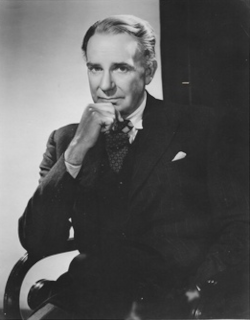
Birth of Irish Folk Singer Patsy Watchorn

Patsy Watchorn, Irish folk singer notable for being a member of the Dublin City Ramblers and later The Dubliners, is born in Crumlin, Dublin, on October 16, 1944.

Watchorn first comes to prominence in 1969 as the lead singer of The Quare Fellas, a Dublin-based ballad group. They evolve into the Dublin City Ramblers in the early 1970s and with Watchorn as their lead singer they have hits with songs such as “The Rare Ould Times” and “The Ferryman,” both of which are written by Pete St. John.

Watchorn also writes and sings the Irish Football Team anthem, “We are the Boys in Green” (Home & Away album), with The Dublin City Ramblers for the teams European Championship campaign in Germany and again for the 1990 FIFA World Cup in Italy. The lyrics change slightly in both releases in 1988 and 1990.

In 1995, Watchorn leaves The Dublin City Ramblers and makes a number of solo albums. He joins The Dubliners in 2005, taking Paddy Reilly‘s place. He is well received throughout Ireland, the United Kingdom, Europe, Australia and the United States. He appears on their Tour Sampler EP in 2005, as well as the double album Live at Vicar Street (2006). He plays the banjo, bodhrán and spoons. He cites Luke Kelly, former lead singer with The Dubliners, as his favourite singer.

When The Dubliners announce their retirement in 2012 after finishing their 50 Years Anniversary Tour, Watchorn decides to keep on touring with former band members Seán Cannon and Eamonn Campbell and banjo player Gerry O’Connor under the name of “The Dublin Legends.”

On April 28, 2014, Watchorn posts a message on his website, stating that he has “decided to take a break from the music business for a while” and will not be touring the rest of 2014 with The Dublin Legends. He later admits this is due to ill health and that doctors had advised him that touring would do further damage to his health.

Watchorn’s distinctive and passionate vocals have made him a huge rock on the Irish folk scene. In his solo projects in the mid- and late-1990s, after his departure from The Dublin City Ramblers, he has session men who used to play alongside him and he uses the stage name “Patsy Watchorn, agus a Cháirde” (which means “and his Friends” in Irish).


Leave a comment

Birth of Irish Playwright Jimmy Murphy

Irish playwright Jimmy Murphy is born to Irish parents in Salford, Lancashire, England, on September 30, 1962. He is a former writer-in-residence at the National University of Ireland, Maynooth (2000–01), a member of the Abbey Theatre’s Honorary Advisory Council, a recipient of three bursaries in literature from the Arts Council (Irish: An Chomhairle Ealaíon) and is elected a member of Aosdána in 2004.

When Murphy is six, his family returns to Dublin, settling in the South inner-city district of Islandbridge. He first goes to school in nearby Inchicore, attending the Oblate Fathers’ primary school there, then moves to Ballyfermot, a working-class heartland of suburban Dublin, in his teens. There, he attends secondary school at St. John’s De La Salle College. After failing the Irish Intermediate Certificate he leaves school to pursue an apprenticeship in painting and decorating, taking his Junior and Senior Irish Trade Certificates, and the City and Guilds of London exams at the Dublin Institute of Technology, Bolton Street.

Murphy’s stage plays include Brothers of the Brush (Dublin, The Peacock, Dublin Theatre Festival 1993), which is awarded best new Irish play; A Picture of Paradise (The Peacock, 1997); The Muesli Belt (Dublin, The Abbey Theatre, 2000); Aceldama (1998); The Kings of the Kilburn High Road (Waterford, Red Kettle Theatre Company, 2000); The Castlecomer Jukebox (Red Kettle, 2004); and What’s Left of The Flag (Theatre Upstairs at The Plough, 2010), nominated for The Irish Times Best New Play Award. His last play, with an all-female cast, The Hen Night Epiphany, premieres at the Focus Theatre, Dublin, in September 2011 and is published by Oberon Books. It has recently been translated into Hebrew.

Plays for radio include Mandarin Lime (BBC Radio 4, 1995), Peel’s Brimstone (BBC Radio 4, 1995), and The Jangle of the Keys (BBC Radio 4 1997). His awards include the Stewart Parker Trust Award in 1994. The play The Kings of the Kilburn High Road is adapted by Tommy Collins as the Irish language film Kings, and is selected as Ireland’s entry for best foreign-language film for the Academy Awards by the Irish Film & Television Academy.

Three of Murphy’s plays have been presented at the Acting Irish International Theatre Festival: Brothers of the Brush (2001 Festival, presented by the Tara Players of Winnipeg), The Kings of the Kilburn High Road (2005 Festival, first North American production, presented by the Irish Players of Rochester), and The Muesli Belt (2008 Festival, presented by the Toronto Irish Players).

A one act play, Perfida, premieres at Theatre Upstairs in July 2012. In October 2012, The Muesli Belt receives its United States premiere at the Banshee Theater, Burbank, California, and in 2013 The Hen Night Epiphany receives its U.S. premiere at the Wade James Theater, Edmonds, Washington. In June 2013 a new production of Perfidia is staged by Red Kettle Theatre Company at their new theatre in Waterford. In May 2017 his second Verabtim piece for the Abbey, looking at police corruption, A Whisper Anywhere Else, is produced at the Peacock theatre. His first Verbatim play for the Abbey, Of This Brave Time, commissioned to commemorate the 1916 Easter Rising, tours the United Kingdom in 2016 and later returns to the Peacock stage for a short run. A new full length play, The Cartographer’s Pen, commissioned to mark the centenary of the drawing of the Irish border, opens at the Town Hall Theatre, Cavan, in May 2022.

Murphy is currently living in Dublin.


Leave a comment

Bombings of King’s Cross and Euston Railway Stations

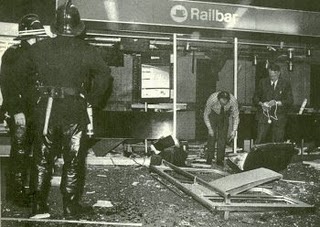
On September 10, 1973, the Provisional Irish Republican Army (IRA) bombs the King’s Cross railway station and Euston railway station, two mainline railway stations in Central London. The blasts wound 13 civilians, some of whom are seriously injured, and also causes large-scale but superficial damage. This is a second wave of bombing attacks launched by the IRA in England in 1973 after the Old Bailey car bombing earlier in the year which had killed one and injured around 200 civilians.

In 1971, during the Troubles, after two years engaged in violence based on a defensive strategy in Irish communal districts of Northern Ireland, the Provisional IRA launches an offensive against the United Kingdom. At a meeting of the IRA Army Council in June 1972 the organization’s Chief of Staff, Seán Mac Stíofáin, first proposes making bombing attacks in England. The Army Council does not at first agree to the suggestion, but in early 1973 after its negotiations with the British Government for a truce the previous year had failed to advance the political objective of the removal of Northern Ireland from the United Kingdom by the application of the threat of violence, it re-engages its paramilitary campaign and sanctions Mac Stíofáin’s proposal. Mac Stíofáin had put the strategy forward on the basis that extending the urban paramilitary violence of the Northern Ireland state into England would help to relieve pressure being exerted by the British Army on the IRA’s strongholds of Irish communal support in districts in the province, such as west Belfast and Derry, by diverting British security strength from them back into England, while at the same time increasing strategic pressure upon the British Government to resolve the conflict by political concessions to the IRA’s demands. He also believes that a successful bombing campaign in London, as the capital city of the United Kingdom, will offer substantial propaganda value for paramilitary Irish Republicanism, and provide a morale boost to its supporters.

The effects of the previous 1973 Old Bailey bombing appear to give some credence to the idea of the propaganda value of extending violence into London as, although it is considered almost routine in Northern Ireland by the mid-1970s and draws only brief media notice, being carried out instead in London, a global capital city, makes the event world news headlines. However, although the bombing of the Old Bailey is successfully carried out, and gains media attention, increasing political pressure upon the British Government to address the issue of the conflict in Northern Ireland with more urgency, it is costly to the IRA, as 10 out of the 11-man active service unit that carry it out are arrested by the British police while trying to leave England before the bombs they had planted detonate. Drawing the tactical lesson that large teams are a security liability, for the second wave of bombings in England later in 1973, instead of sending a large team to carry it out with orders to withdraw back to Ireland immediately afterwards, smaller detached “cell” units of 3-4 personnel are sent to carry out the operation, with instructions to remain in England afterward and wage a campaign of bombings around England upon a variety of targets.

There are bombings on September 8, 1973, including one at London Victoria station which injures four civilians.

On September 10, 1973, a bomb (with no warning issued beforehand) explodes at King’s Cross railway station in the booking hall at 12:24 p.m. when a youth of around 16 to 17 years of age walks up to the entrance of the station’s old booking hall and throws a bag into it which contains a 3 lb. (1.4 kg) device, which detonates, shattering glass throughout the hall and throwing a baggage trolley several feet into the air. The youth then flees into the station’s crowd and escapes the scene.

Approximately 45 minutes after the attack at King’s Cross, after a telephone call warning to the Press Association five minutes beforehand by a man with an Irish accent, a second bomb detonates in a snack bar at Euston railway station, injuring another eight civilians. One witness at Euston says, “I saw a flash and suddenly people were being thrown through the air – it was a terrible mess, they were bleeding and screaming.” A total of 13 civilians are injured in the two attacks. The Metropolitan Police issue a photofit picture of a 5 ft. 2 in. (157 cm) tall youth they are seeking in regard to the King’s Cross attack.

On September 12, 1973, two more bombs explode, one in Oxford Street and another in Sloane Square, targeting retail shopping centres. Police subsequently announce that they are looking for five people in connection with this second wave of bomb attacks in England.

Judith Ward is later wrongly convicted of having been involved in the late 1973 London bombings, along with the M62 coach bombing. She is later acquitted. No one else is brought to trial for this IRA bombing campaign.


Leave a comment

Birth of Desmond Ryan, Revolutionary, Writer & Historian

Desmond Ryan, Irish writer, historian, and in his earlier life a revolutionary in Sinn Féin, is born in London on August 27, 1893.

Ryan is the son of the Templemore, County Tipperary-born London journalist William Patrick Ryan, editor of the Peasant and Irish Nation and assistant editor of the London Daily Herald, and his wife, Elizabeth. He comes to Ireland in 1906, aged 13, with his mother and sister, and studies at St. Enda’s School, Rathfarnham, under headmaster and founder Patrick Pearse. He later teaches in the school and is briefly Pearse’s secretary.

Ryan attributes to Pearse the saying “[G]ive me a hundred men and I will free Ireland!” He becomes part of a group of former students lodging in St. Enda’s while they go to university who join the Irish Republican Brotherhood (IRB). They meet in a safe house at Rathfarnham in 1911. The men take the tram from Rathfarnham to Nelson’s Pillar in central Dublin. Pearse once told his friend, “Let them talk! I am the most dangerous revolutionary of the whole lot of them!” In 1911, the Dungannon Clubs revive the Volunteers Militia movement. These clubs are not initially successful in Dublin but are more so in Belfast amongst nationalists. One of the northern members is the Dubliner Oscar Traynor, in his youth a professional footballer with Belfast Celtic F.C., later a war hero and later again a politician and Minister for Posts and Telegraphs.

At this stage, according to Ryan, Pearse is a constitutional nationalist who speaks for Home Rule from a platform shared with Tom Kettle and John Redmond and refuses to hear any criticism of the Irish Parliamentary Party (IPP). But on the foundation of the Ulster Volunteer Force (UVF) by Edward Carson and the approach of World War I, Pearse becomes increasingly sure that Ireland cannot achieve independence except by force, and begins with Thomas MacDonagh, Éamonn Ceannt, Joseph Plunkett, Tom Clarke, Bulmer Hobson and others to plan the Easter Rising.

Eoin MacNeill is appointed leader of the Irish Volunteers. Ryan writes that Pearse, a risk-taker and idealist, tells him MacNeill is “too tactful.” MacNeill is prepared to entertain the Irish Parliamentary Party with negotiations. Ryan quotes Pearse as saying, “[MacNeill] has the reputation of being tactful, but his tact consists in bowing to the will of the Redmondites every time. He never makes a fight except when they assail his personal honour, when he bridles up at once… very delicate position… he is weak, hopelessly weak.”

Pearse tells Ryan that MacNeill is “a Grattan come to life again.” Henry Grattan is a constitutional orator and MP in the Protestant-only 18th-century Irish House of Commons, but one of those who fiercely opposes the notorious Acts of Union 1800, secured by massive bribery (which is then repaid out of Irish taxes), making Ireland part of the United Kingdom. Moreover, MacNeill is an “inconclusive ditherer.” He wants the Irish Volunteers to be apolitical.

The Easter Rising is preceded by the revelation of the “Castle Document,” a plan by the British government to arrest the leaders of the Irish Volunteers and Irish Citizen Army and other radicals. Ryan claims that this document, presented to MacNeill on the Wednesday before the Rising and said to have been stolen from high-ranking British staff in Dublin Castle, is a forgery. Some claim that it is concocted by Joseph Plunkett with the implicit approval of Catholic Archbishop Cullen of Dublin, a sympathiser with Dublin Castle and Redmond’s war stratagem. “Forgery is a strong word,” Ryan says, “but that in its final form the document was a forgery no doubt can exist whatever.” Modern interpretation from Charles Townshend has judged the document to be genuine, and the opinion attributed to the Archbishop’s Palace as circumstantial. Grace Gifford, Plunkett’s widow, says that she was with Plunkett when he deciphered it at Larkfield House. Prior to his execution, Seán Mac Diarmada is met by a priest, and makes the assumptive response that it is a fraudulent document.

Ryan fights through the Easter Rising from April 24, 1916, in the General Post Office (GPO) under murderous artillery fire and describes the battle vividly in his witness statement to the Bureau of Military History. He describes the garrison retreating to Moore Street and quotes Pearse’s sculptor brother Willie Pearse, who is executed a few days later, as saying “Connolly has been asked out to negotiate. They have decided to go to save the men from slaughter, for slaughter it is.”

Ryan fights in the Irish War of Independence and afterwards writes about his experiences. However, the Irish Civil War which follows from June 1922 to April 1923 repels him. He cannot accept that Irishmen would fight Irishmen.

Ryan returns to his studies in University College Dublin (UCD), and after taking his BA follows his father into journalism, working for the Freeman’s Journal. In 1922, he moves to London to work on the Daily Herald. He writes books on Pearse, James Connolly, Éamon de Valera, Seán Treacy and John Devoy, and on Fenianism as well as writing on the Rising and the War of Independence.

Ryan marries Sarah Hartley in 1933. In 1939 they return to Ireland, where he edits the Torch, a Labour paper. Finding his views at odds with the Labour Party‘s official line, publication ceases in 1944. He and his wife then move to Swords in north County Dublin, where they operate a poultry farm.

Desmond Ryan dies on December 23, 1964.


Leave a comment

Death of Anew McMaster, Touring Shakespearean Actor & Manager

Anew McMaster, the last of the touring actor-managers who presents William Shakespeare’s plays throughout the United Kingdom, Ireland, Australia and the United States, dies in Dublin on August 24, 1962. For almost 35 years he tours as actor-manager of his own theatrical company performing the works of Shakespeare and other playwrights.

McMaster is born as Andrew McMaster on December 24, 1891, the son of Liverpool-born Andrew McMaster, a master stevedore, and Alice Maude (née Thompson). A number of sources make the erroneous claims, based on details supplied by McMaster himself, that he is born in 1893 or 1894 or even 1895 in County Monaghan in Ireland, but according to the Birth Register and the 1901 Census he is actually born in 1891 in Birkenhead, England. Like his future brother-in-law, Micheál Mac Liammóir, who is born in London as Alfred Willmore but who claims to have been born in Cork to Gaelic-speaking parents, McMaster reinvents himself as Irish and claims for himself the town of Monaghan as his birthplace, and Warrenpoint, County Down, as the scene of his earliest memories.

At the age of 19, McMaster gives up a career in banking to pursue one on the stage. He moves to Ireland and tours the country with the O’Brien-Ireland theatrical company from 1910 to 1914. Success quickly follows with his appearance as Jack O’Hara in Paddy the Next Best Thing at the Savoy Theatre in 1920. From 1921 he tours Australia in this and other plays, and in 1925 forms his own company, the McMaster Intimate Theatre Company, a “fit-up” company to tour in the works of Shakespeare, mainly in Ireland but also in Britain and Australia, touring with his theatrical company until 1959. One of the last actor-managers “of the old school – and an epitome of the type,” on occasions McMaster persuades a “big name” to act with his company as a draw for audiences, and Frank Benson (1928), Sara Allgood (1929) and Mrs. Patrick Campbell appear with him.

In 1933 at the Shakespeare Memorial Theatre in Stratford-upon-Avon McMaster appears as Hamlet opposite Esme Church as Gertrude, Coriolanus, Macduff in Macbeth, Leonato in Much Ado About Nothing, Prince Escalus in Romeo and Juliet, and Petruchio in The Taming of the Shrew. His greatest roles are as Othello and as Shylock in The Merchant of Venice, to which he adds King Lear in 1952. Just before World War II he and his company appear at the Chiswick Empire in a Shakespeare season. He tours the United States as James Tyrone in Eugene O’Neill‘s Long Day’s Journey into Night in 1956. Having “a great organ voice,” Harold Pinter, who acts in his company in Ireland from 1951 to 1953 and calls him “Perhaps the greatest actor-manager of his time,” later describes McMaster as “evasive, proud, affectionate, shrewd, merry.” In his brief biography Mac (1968), Pinter recalls, “Mac gave about a half dozen magnificent performances of Othello while I was with him… At his best he was the finest Othello I have seen. [He] stood dead in the centre of the role, and the great sweeping symphonic playing would begin, the rare tension and release within him, the arrest, the swoop, the savagery, the majesty and repose.”

McMaster’s only film role is an uncredited appearance as the Judge in Sword of Sherwood Forest (1960).

In 1924 McMaster marries the actress and designer Marjorie Willmore, the sister of Micheál Mac Liammóir. They have two children, the actors John Christopher McMaster and Mary-Rose McMaster.

McMaster dies at the age of 70 at his home in Dublin on August 24, 1962. He is buried with his wife in Dean’s Grange Cemetery in County Dublin.

McMaster trains a generation of actors who tour with his company and go on to achieve success as actors. These include Pauline Flanagan, Milo O’Shea, T. P. McKenna, Kenneth Haigh, Henry Woolf, Harold Pinter, Donal Donnelly and Patrick Magee. It is while they are touring with McMaster’s company that the actor and dramatist Micheál Mac Liammóir and the actor and producer Hilton Edwards first meet and begin their lifelong partnership.

McMaster’s biography, A Life Remembered: A Memoir of Anew McMaster, by his daughter Mary-Rose McMaster, is published in 2017. Harold Pinter also publishes a short biography, Mac, in 1968.


Leave a comment

Birth of Seán MacEntee, Fianna Fáil Politician

Seán Francis MacEntee (Irish: Seán Mac an tSaoi), Fianna Fáil politician, is born as John McEntee at 47 King Street, Belfast, on August 23, 1889. He serves as Tánaiste (1959-65), Minister for Social Welfare (1957-61), Minister for Health (1957-65), Minister for Local Government and Public Health (1941-48), Minister for Industry and Commerce (1939-41), and Minister for Finance (1932-39 and 1951-54). He serves as a Teachta Dála (TD) from 1918 to 1969.

MacEntee is the son of James McEntee, a publican, and his wife, Mary Owens, both of whom are from Monaghan. James McEntee is a prominent Nationalist member of Belfast Corporation and a close friend of Joseph Devlin MP.

MacEntee is educated at St. Mary’s Christian Brothers’ Grammar School, St. Malachy’s College and the Belfast Municipal College of Technology where he qualifies as an electrical engineer. His early political involvement is with the Irish Socialist Republican Party in Belfast. He quickly rises through the ranks of the trade union movement becoming junior representative in the city’s shipyards. Following his education, he works as an engineer in Dundalk, County Louth, and is involved in the establishment of a local corps of the Irish Volunteers in the town. He mobilises in Dundalk and fights in the General Post Office garrison in the Easter Rising in 1916. He is sentenced to death for his part in the rising. This sentence is later commuted to life imprisonment. He is released in the general amnesty in 1917 and is later elected a member of the National Executives of both Sinn Féin and the Irish Volunteers in October 1917. He is later elected Sinn Féin Member of Parliament (MP) for South Monaghan at the 1918 Irish general election.

An attempt to develop MacEntee’s career as a consulting engineer in Belfast is interrupted by the Irish War of Independence in 1919. He serves as Vice-Commandant of the Belfast Brigade of the Irish Republican Army (IRA). He is also a member of the Volunteer Executive, a sort of Cabinet and Directory for the Minister for Defence and the HQ Staff, however, he remains one of the few Sinn Féiners from the north. On August 6, 1920, he presents ‘a Memorial’ lecture to the Dáil from the Belfast Corporation. He tells the Dáil it is the only custodian of public order, that a Nationalist pogrom is taking place, and he advises them to fight Belfast. The Dáil government’s policy is dubbed Hibernia Irredenta or “Greening Ireland.” He is asked to resign his South Monaghan seat after voting against a bunting celebration in Lurgan to mark the signing of the Anglo-Irish Treaty.

In April 1921 MacEntee is transferred to Dublin to direct a special anti-partition campaign in connection with the May general election. It remains Michael Collins‘s policy, he declares, that the largely Protestant shipyard workers of Belfast are being directed by the British, urging all Irishmen to rejoin the Republic. Correspondingly the Ulster Unionist Council rejects the call for a review of the boundary commission decision made on Northern Ireland. But when Ulstermen choose James Craig as Premier, Collins denounces democracy in the north as a sham. It is on the partition of Ireland issue that MacEntee votes against the Anglo-Irish Treaty of 1921. During the subsequent Irish Civil War, he commands the IRA unit in Marlboro Street Post Office in Dublin. He later fights with Cathal Brugha in the Hamman Hotel and is subsequently interned in Kilmainham and Gormanstown until December 1923.

After his release from prison, MacEntee devotes himself more fully to his engineering practice, although he unsuccessfully contests the Dublin County by-election of 1924. He becomes a founder-member of Fianna Fáil in 1926 and is eventually elected a TD for Dublin County at the June 1927 Irish general election.

MacEntee founds the Association of Patent Agents in 1929, having gained his interest in Patents when he worked as an assistant engineer in Dundalk Urban District Council. He values his status as a Patent Agent as he maintains his name on the Register for over 30 years while he holds Ministerial rank in the Irish Government, although he is not believed to have taken any active part in the patent business, which is carried on by his business partners.

In 1932, Fianna Fáil comes to power for the very first time, with MacEntee becoming Minister for Finance. In keeping with the party’s protectionist economic policies his first budget in March of that year sees the introduction of new duties on 43 imports, many of them coming from Britain. This sees retaliation from the British government, which in turn provokes a response from the Irish government. This is the beginning of the Anglo-Irish Trade War between the two nations, however, a treaty in 1938, signed by MacEntee and other senior members brings an end to the issue.

In 1939, World War II breaks out and a cabinet reshuffle results in MacEntee being appointed as Minister for Industry and Commerce, taking over from his rival Seán Lemass. During his tenure at this department, he introduces the important Trade Union Act (1941). In 1941, another reshuffle of ministers takes place, with him becoming Minister for Local Government and Public Health. The Health portfolio is transferred to a new Department of Health in 1947. Following the 1948 Irish general election, Fianna Fáil returns to the opposition benches for the first time in sixteen years.

In 1951, Fianna Fáil are back in government, although in minority status, depending on independent deputies for survival. MacEntee once again returns to the position of Minister for Finance where he feels it is vital to deal with the balance of payments deficit. He brings in a harsh budget in 1951 which raises income tax and tariffs on imports. His chief aim is to cut spending and reduce imports, however, this comes at a cost as unemployment increases sharply. The increases are retained in his next two budgets in 1952 and 1953. It is often said that it is his performance during this period that costs Fianna Fáil the general election in 1954. The poor grasp on economics also does his political career tremendous damage as up to that point he is seen as a likely successor as Taoiseach. Seán Lemass, however, is now firmly seen as the “heir apparent.”

In 1957, Fianna Fáil returns to power with an overall majority with MacEntee being appointed Minister for Health. The financial and economic portfolios are dominated by Lemass and other like-minded ministers who want to move away from protection to free trade. He is credited during this period with the reorganisation of the health services, the establishment of separate departments of health and social welfare, and the fluoridation of water supplies in Ireland. In 1959, he becomes Tánaiste when Seán Lemass is elected Taoiseach.

Following the 1965 Irish general election, MacEntee is 76 years old and retires from the government. He re-emerges in 1966 to launch a verbal attack on Seán Lemass for deciding to step down as party leader and Taoiseach. The two men, however, patch up their differences shortly afterwards. MacEntee retires from Dáil Éireann in 1969 at the age of 80, making him the oldest TD in Irish history.

MacEntee dies in Dublin on January 9, 1984, at the age of 94. He is buried in Glasnevin Cemetery, Dublin. At the time of his death, he is the last surviving member of the First Dáil.


Leave a comment

Death of Annie Horniman, Theatre Patron & Manager

Annie Elizabeth Fredericka Horniman CH, English theatre patron and manager, dies on August 6, 1937, while visiting friends in Shere, Surrey, England. She establishes the Abbey Theatre in Dublin and founds the first regional repertory theatre company in Britain at the Gaiety Theatre in Manchester. She encourages the work of new writers and playwrights, including W. B. Yeats, George Bernard Shaw and members of what become known as the Manchester School of dramatists.

Horniman is born at Surrey Mount, Forest Hill, London, on October 3, 1860, the elder child of Frederick John Horniman and his first wife Rebekah (née Emslie). Her father is a tea merchant and the founder of the Horniman Museum. Her grandfather is John Horniman who founds the family tea business of Horniman and Company. She and her younger brother Emslie are educated privately at their home. Her father is opposed to the theatre, which he considers sinful, but their German governess takes her and Emslie secretly to a performance of The Merchant of Venice at The Crystal Palace when she is fourteen years old.

Horniman’s father allows her to enter the Slade School of Fine Art in 1882. Here she discovers that her talent in art is limited but she develops other interests, particularly in the theatre and opera. She takes great pleasure in Richard Wagner‘s Der Ring des Nibelungen and in Henrik Ibsen‘s plays. She cycles in London and twice over the Alps, smokes in public and explores alternative religions. The “lonely rich girl” has become “an independent-minded woman.” In 1890 she joins the occult society, the Hermetic Order of the Golden Dawn, where she remains a member until disagreements with its leaders lead to her resignation in 1903. During this time she meets and becomes a friend of W. B. Yeats, acting as his amanuensis for some years. Their friendship endures. Frank O’Connor recalls that on the day Yeats hears of her death, he spends the entire evening speaking of his memories of her.

Horniman’s first venture into the theatre is in 1894 and is made possible by a legacy from her grandfather. She anonymously supports her friend Florence Farr in a season of new plays at the Royal Avenue Theatre, London. This includes a new play by Yeats, The Land of Heart’s Desire, and the première of George Bernard Shaw’s play Arms and the Man. In 1903 Yeats persuades her to go to Dublin to back productions by the Irish National Theatre Society. Here she discovers her skill as a theatre administrator. She purchases a property and develops it into the Abbey Theatre, which opens in December 1904. Although she moves back to live in England, she continues to support the theatre financially until 1910. Meanwhile, in Manchester she purchases and renovates the Gaiety Theatre in 1908 and develops it into the first regional repertory theatre in Britain.

At the Gaiety, Horniman appoints Ben Iden Payne as the director and employs actors on 40-week contracts, alternating their work between large and small parts. The plays produced include classics such as Euripides and Shakespeare, and she introduces works by contemporary playwrights such as Ibsen and Shaw. She also encourages local writers who form what becomes known as the Manchester School of dramatists, the leading members of which are Harold Brighouse, Stanley Houghton and Allan Monkhouse. The Gaiety company undertakes tours of the United States and Canada in 1912 and 1913. Horniman becomes a well-known public figure in Manchester, lecturing on subjects which include women’s suffrage and her views about the theatre. In 1910 she is awarded the honorary degree of MA by the University of Manchester. During World War I the Gaiety continues to stage plays but financial difficulties lead to the disbandment of the permanent company in 1917, following which productions in the theatre are by visiting companies. In 1921 she sells the theatre to a cinema company.

As a result of her tea connection, Horniman is known as “Hornibags.” She holds court at the Midland Hotel, wearing exotic clothing and openly smoking cigarettes, which is considered scandalous at the time. She introduces Manchester to what is called at the time “the play of ideas.” The theatre critic James Agate notes that her high-minded theatrical ventures have “an air of gloomy strenuousness” about them.

Horniman moves to London where she keeps a flat in Portman Square. In 1933 she is made a Companion of Honour. She and Algernon Blackwood might be the only past or present members of an occult society to receive a United Kingdom honour.

Horniman dies, unmarried, on August 6, 1937, while visiting friends in Shere, Surrey. Her estate amounts to a little over £50,000. The Annie Horniman Papers are held in the John Rylands Research Institute and Library at the University of Manchester. Her portrait, painted by John Butler Yeats in 1904, hangs in the public area of the Abbey Theatre.


Leave a comment

Birth of Terry Wogan, Irish-British Radio & Television Broadcaster

Sir Michael Terence Wogan KBE DL, Irish-British radio and television broadcaster who works for the BBC in the United Kingdom (UK) for most of his career, is born at Cleary’s Nursing Home, Elm Park, Limerick, County Limerick, on August 3, 1938. Between 1993 and his semi-retirement in December 2009, his BBC Radio 2 weekday breakfast programme Wake Up to Wogan regularly draws an estimated eight million listeners. He is believed at the time to be the most listened-to radio broadcaster in Europe.

Wogan is the elder of two children. He is the son of the manager of Leverett & Frye, a high-class grocery store in Limerick, and is educated at Crescent College, a Jesuit school, from the age of eight. He experiences a strongly religious upbringing, later commenting that he had been brainwashed into believing by the threat of going to hell. Despite this, he often expresses his fondness for the city of his birth, commenting on one occasion that “Limerick never left me, whatever it is, my identity is Limerick.”

At the age of 15, after his father is promoted to general manager, Wogan moves to Dublin with his family. While living there he attends Crescent College’s sister school, Belvedere College. He participates in amateur dramatics and discovers a love of rock and roll. After leaving Belvedere in 1956, he has a brief career in the banking profession, joining the Royal Bank of Ireland. Still in his twenties, he joins the national broadcaster of Ireland, Raidió Teilifís Éireann (RTÉ), as a newsreader and announcer, after seeing a newspaper advertisement inviting applicants.

Wogan conducts interviews and presents documentary features during his first two years at RTÉ, before moving to the light entertainment department as a disc jockey and host of TV quiz and variety shows such as Jackpot, a top-rated quiz show on RTÉ in the 1960s.

Wogan is a leading media personality in Ireland and Britain from the late 1960s, and is often referred to as a “national treasure.” In addition to his weekday radio show, he is known for his work on television, including the BBC One chat show Wogan, presenting Children in Need, the game show Blankety Blank and Come Dancing. He is the BBC’s commentator for the Eurovision Song Contest from 1971 to 2008 (radio in 1971, 1974–1977; television in 1973, 1978, 1980–2008) and the Contest’s host in 1998. From 2010 to 2015 he presents Weekend Wogan, a two-hour Sunday morning show on BBC Radio 2.

In 2005, Wogan acquires British citizenship in addition to his Irish nationality and is awarded a knighthood in the same year and is therefore entitled to use the title “Sir” in front of his name.

Wogan’s health declines after Christmas 2015. He does not present Children in Need in November 2015, citing back pain as the reason for his absence from the long-running annual show. One of his friends, Father Brian D’Arcy, visits him during January and notices he is seriously ill. He dies of cancer at the age of 77 on January 31, 2016 at his home.

British Prime Minister David Cameron says, “Britain has lost a huge talent.” President of Ireland Michael D. Higgins praises Wogan’s career and his frequent visits to his homeland. Taoiseach Enda Kenny and Tánaiste Joan Burton remember Wogan for his role in helping Anglo-Irish relations during the Troubles. D’Arcy speculates that a public funeral would be logistically difficult, as there would be too many people wanting to pay their respects.

After Wogan’s death and his private funeral a few weeks later, a public memorial service is held on September 27 the same year. This is held at Westminster Abbey and is opened by a recording of Wogan himself, and features a number of his celebrity friends making speeches, such as Chris Evans and Joanna Lumley. The service is broadcast live on BBC Radio 2.

On November 16, 2016, the BBC renames BBC Western House, home of BBC Radio 2, in his memory, to BBC Wogan House.


Leave a comment

Birth of John Costello, Taoiseach and Fine Gael Politician

John Aloysius Costello, Fine Gael politician who serves as Taoiseach from 1948 to 1951 and from 1954 to 1957, Leader of the Opposition from 1951 to 1954 and from 1957 to 1959, and Attorney General of Ireland from 1926 to 1932, is born on June 20, 1891, in Fairview, Dublin. He serves as a Teachta Dála (TD) from 1933 to 1943 and from 1944 to 1969.

Costello is the younger son of John Costello senior, a civil servant, and Rose Callaghan. He is educated at St. Joseph’s, Fairview, and then moves to O’Connell School, for senior classes, and later attends University College Dublin (UCD), where he graduates with a degree in modern languages and law. He studies at King’s Inns to become a barrister, winning the Victoria Prize there in 1913 and 1914. He is called to the Irish Bar in 1914, and practises as a barrister until 1922.

In 1922, Costello joins the staff at the office of the Attorney General in the newly established Irish Free State. Three years later he is called to the inner bar, and the following year, 1926, he becomes Attorney General of Ireland, upon the formation of the Cumann na nGaedheal government, led by W. T. Cosgrave. While serving in this position he represents the Free State at Imperial Conferences and League of Nations meetings.

Costello is also elected a Bencher of the Honourable Society of King’s Inns. He loses his position as Attorney General of Ireland when Fianna Fáil comes to power in 1932. The following year, however, he is elected to Dáil Éireann as a Cumann na nGaedheal TD. Cumann na nGaedheal soon merges with other parties to form Fine Gael.

During the Dáil debate on the Emergency Powers Act 1939, Costello is highly critical of the Act’s arrogation of powers, stating that “We are asked not merely to give a blank cheque, but to give an uncrossed cheque to the Government.” He loses his seat at the 1943 Irish general election but regains it when Éamon de Valera calls a snap election in 1944. From 1944 to 1948, he is the Fine Gael front-bench Spokesman on External Affairs.

In 1948, Fianna Fáil has been in power for sixteen consecutive years and has been blamed for a downturn in the economy following World War II. The 1948 Irish general election results show Fianna Fáil short of a majority, but still by far the largest party, with twice as many seats as the nearest rival, Fine Gael. It appears that Fianna Fáil is headed for a seventh term in government. However, the other parties in the Dáil realise that between them, they have only one seat fewer than Fianna Fáil, and if they band together, they would be able to form a government with the support of seven Independent deputies. Fine Gael, the Labour Party, the National Labour Party, Clann na Poblachta and Clann na Talmhan join to form the first inter-party government in the history of the Irish state.

While it looks as if cooperation between these parties will not be feasible, a shared opposition to Fianna Fáil and Éamon de Valera overcomes all other difficulties, and the coalition government is formed.

Since Fine Gael is the largest party in the government, it has the task of providing a suitable candidate for Taoiseach. Naturally, it is assumed that its leader, Richard Mulcahy, will be offered the post. However, he is an unacceptable choice to Clann na Poblachta and its deeply republican leader, Seán MacBride. This is due to Mulcahy’s record during the Irish Civil War. Instead, Fine Gael and Clann na Poblachta agree on Costello as a compromise candidate. Costello had never held a ministerial position nor was he involved in the Civil War. When told by Mulcahy of his nomination, Costello is appalled, content with his life as a barrister and as a part-time politician. He is persuaded to accept the nomination as Taoiseach by close non-political friends.

During the campaign, Clann na Poblachta had promised to repeal the Executive Authority (External Relations) Act 1936 but does not make an issue of this when the government is being formed. However, Costello and his Tánaiste, William Norton of the Labour Party, also dislike the act. During the summer of 1948, the cabinet discusses repealing the act, however, no firm decision is made.

In September 1948, Costello is on an official visit to Canada when a reporter asks him about the possibility of Ireland leaving the British Commonwealth. For the first time, he declares publicly that the Irish government is indeed going to repeal the External Relations Act and declare Ireland a republic. It has been suggested that this is a reaction to offence caused by the Governor General of Canada at the time, Harold Alexander, 1st Earl Alexander of Tunis, who is of Northern Irish descent and who allegedly arranges to have placed symbols of Northern Ireland in front of Costello at an official dinner. Costello makes no mention of these aspects on the second reading of the Republic of Ireland Bill on November 24 and, in his memoirs, claims that Alexander’s behaviour had in fact been perfectly civil and could have had no bearing on a decision which had already been made.

The news takes the Government of the United Kingdom and even some of Costello’s ministers by surprise. The former had not been consulted and following the declaration of the Republic in 1949, the UK passes the Ireland Act that year. This recognises the Republic of Ireland and guarantees the position of Northern Ireland within the United Kingdom for so long as a majority there want to remain in the United Kingdom. It also grants full rights to any citizens of the Republic living in the United Kingdom. Ireland leaves the Commonwealth on April 18, 1949, when The Republic of Ireland Act 1948 comes into force. Frederick Henry Boland, Secretary of the Department of External Affairs, says caustically that the affair demonstrates that “the Taoiseach has as much notion of diplomacy as I have of astrology.” The British envoy, John Maffey, 1st Baron Rugby, is equally critical of what he calls a “slipshod and amateur” move.

Many nationalists now see partition as the last obstacle on the road to total national independence. Costello tables a motion of protest against partition on May 10, 1949, without result.

In 1950, the independent-minded Minister for Health, Noël Browne, introduces the Mother and Child Scheme. The scheme would provide mothers with free maternity treatment and their children with free medical care up to the age of sixteen, which is the normal provision in other parts of Europe at that time. The bill is opposed by doctors, who fear a loss of income, and Roman Catholic bishops, who oppose the lack of means testing envisaged and fear the scheme could lead to birth control and abortion. The cabinet is divided over the issue, many feeling that the state cannot afford such a scheme priced at IR£2,000,000 annually. Costello and others in the cabinet make it clear that in the face of such opposition they will not support the Minister. Browne resigns from the government on April 11, 1951, and the scheme is dropped. He immediately publishes his correspondence with Costello and the bishops, something which had hitherto not been done. Derivatives of the Mother and Child Scheme are introduced in Public Health Acts of 1954, 1957 and 1970.

The Costello government has a number of noteworthy achievements. A new record is set in housebuilding, the Industrial Development Authority and Córas Tráchtála are established, and the Minister for Health, Noel Browne, with the then new Streptomycin, bring about an advance in the treatment of tuberculosis. Ireland also joins a number of organisations such as the Organization for European Economic Co-operation and the Council of Europe. However, the government refuses to join NATO, allegedly because the British remain in Northern Ireland. The scheme to supply electricity to even the remotest parts of Ireland is also accelerated.

While the “Mother and Child” incident does destabilise the government to some extent, it does not lead to its collapse as is generally thought. The government continues; however, prices are rising, a balance of payments crisis is looming, and two TDs withdraw their support for the government. These incidents add to the pressure on Costello and so he decides to call a general election for June 1951. The result is inconclusive but Fianna Fáil returns to power. Costello resigns as Taoiseach. It is at this election that his son Declan is elected to the Dáil.

Over the next three years while Fianna Fáil is in power a dual-leadership role of Fine Gael is taking place. While Richard Mulcahy is the leader of the party, Costello, who has proved his skill as Taoiseach, remains as parliamentary leader of the party. He resumes his practice at the Bar. In what is arguably his most celebrated case, the successful defence of The Leader against a libel action brought by the poet Patrick Kavanagh, dates from this period. Kavanagh generously praises Costello’s forensic skill, and the two men become friends.

At the 1954 Irish general election Fianna Fáil loses power. A campaign dominated by economic issues results in a Fine Gael-Labour Party-Clann na Talmhan government coming to power. Costello is elected Taoiseach for the second time.

The government can do little to change the ailing nature of Ireland’s economy, with emigration and unemployment remaining high, and external problems such as the Suez Crisis compounding the difficulty. Measures to expand the Irish economy such as export profits tax relief introduced in 1956 would take years have sizable impact. Costello’s government does have some success with Ireland becoming a member of the United Nations in 1955, and a highly successful visit to the United States in 1956, which begins the custom by which the Taoiseach visits the White House each St. Patrick’s Day to present the U.S. President with a bowl of shamrock. Although the government has a comfortable majority and seems set for a full term in office, a resumption of Irish Republican Army (IRA) activity in Northern Ireland and Great Britain causes internal strains. The government takes strong action against the republicans.

In spite of supporting the government from the backbenches, Seán MacBride, the leader of Clann na Poblachta, tables a motion of no confidence, based on the weakening state of the economy and in opposition to the government’s stance on the IRA. Fianna Fáil also tables its own motion of no confidence, and rather than face almost certain defeat, Costello again asks President Seán T. O’Kelly to dissolve the Oireachtas. The general election which follows in 1957 gives Fianna Fáil an overall majority and starts another sixteen years of unbroken rule for the party. Some of his colleagues questioned the wisdom of his decision to call an election. The view is expressed that he was tired of politics and depressed by his wife’s sudden death the previous year.

Following the defeat of his government, Costello returns to the bar. In 1959, when Richard Mulcahy resigns the leadership of Fine Gael to James Dillon, he retires to the backbenches. He could have become party leader had he been willing to act in a full-time capacity. He remains as a TD until 1969, when he retires from politics, being succeeded as Fine Gael TD for Dublin South-East by Garret FitzGerald, who himself goes onto to become Taoiseach in a Fine Gael-led government.

During his career, Costello is presented with a number of awards from many universities in the United States. He is also a member of the Royal Irish Academy from 1948. In March 1975, he is made a freeman of the city of Dublin, along with his old political opponent Éamon de Valera. He practises at the bar until a short time before his death at the age of 84, in Ranelagh, Dublin, on January 5, 1976. He is buried at Dean’s Grange Cemetery in Dublin.


Leave a comment

Birth of Robert Stewart, 2nd Marquess of Londonderry

Robert Stewart, 2nd Marquess of Londonderry, KG, GCH, PC, PC (Ire), Anglo-Irish politician and statesman usually known as Lord Castlereagh, derived from the courtesy title Viscount Castlereagh by which he is styled from 1796 to 1821, is born in Dublin on June 18, 1769. As secretary to the Viceroy of Ireland, he works to suppress the Irish Rebellion of 1798 and to secure passage in 1800 of the Irish Act of Union. As the Foreign Secretary of the United Kingdom from 1812, he is central to the management of the coalition that defeats Napoleon and is British plenipotentiary at the Congress of Vienna. In the post-war government of Lord Liverpool, he is seen to support harsh measures against agitation for reform.

Stewart is born in 28 Henry Street, in Dublin’s Northside. He is the second and only surviving child of Robert Stewart (the elder) and his wife Sarah Frances Seymour-Conway. His parents marry in 1766. He has recurring health problems throughout his childhood, and is sent to The Royal School, Armagh, rather than to England for his secondary education. At the encouragement of Charles Pratt, 1st Earl Camden, who takes a great interest in him and treats him as if he is a grandson by blood, he later attends St. John’s College, Cambridge (1786–87), where he applies himself with greater diligence than expected from an aristocrat and excels in his first-year examinations. But he then withdraws, pleading an illness that he admits to Camden is something “which cannot be directly acknowledged before women,” i.e. something sexually transmitted.

Early in his career in Ireland, and following a visit to revolutionary France, Stewart recoils from the democratic politics of his Presbyterian constituents in Ulster. Crossing the floor of the Irish House of Commons in support of the government, he takes a leading role in detaining members of the republican conspiracy, the United Irishmen, his former political associates among them. After the 1798 Rebellion, as Chief Secretary for Ireland, he pushes the Act of Union through the Irish Parliament. But it is without the Catholic Emancipation that both he and British Prime Minister William Pitt believe should have accompanied the creation of a United Kingdom.

From 1805 Stewart serves under Pitt and then the Duke of Portland as Secretary of State for War. In 1809 he is obliged to resign after fighting a duel with the Foreign Secretary, George Canning, in a dispute over the Walcheren Campaign. In 1812 he returns to government serving Lord Liverpool as Foreign Secretary and as Leader of the House of Commons.

Stewart organises and finances the alliance that defeats Napoleon, bringing the powers together at the Treaty of Chaumont in 1814. After Napoleon’s second abdication in 1815, he works with the European courts represented at the Congress of Vienna to frame the territorial, and broadly conservative, continental order that holds until mid-century. He blocks harsh terms against France believing that a treaty based on vengeance and retaliation will upset a necessary balance of powers. France is restored to the frontiers of 1791, and her British-occupied colonies are returned. In 1820 Stewart enunciates a policy of non-intervention, proposing that Britain hold herself aloof from continental affairs.

After 1815, at home, Stewart supports repressive measures that link him in public opinion to the Peterloo Massacre of 1819. Widely reviled in both Ireland and Great Britain, overworked, and personally distressed, he commits suicide on August 12, 1822. He is found in a dressing room seconds after he has cut his own throat using a small knife. He collapses and dies almost instantly.

(Pictured: “Robert Stewart, 2nd Marquess of Londonderry,” oil on canvas by Thomas Lawrence, National Portrait Gallery)