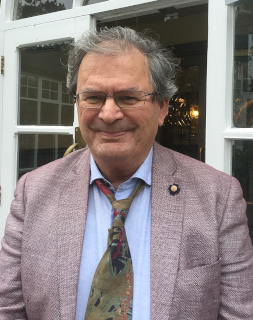
Matthew Gerard Sweeney, Irish poet, is born at Lifford, County Donegal, on October 6, 1952. His work has been translated into Dutch, Italian, Hebrew, Japanese, Latvian, Mexican Spanish, Romanian, Slovakian and German.
Sweeney meets Rosemary Barber in 1972 and they marry in 1979. Two offspring – daughter Nico and son Malvin – are produced before the couple goes their separate ways in the early 21st century. Having lived in London for many years until 2001, he separates from Rosemary and goes to live in Timișoara, Romania and Berlin. In 2007, he meets his partner, Mary Noonan, and in early 2008 he moves to Cork to live with her there.
Sweeney produces numerous collections of poetry for which he wins several awards. His novels for children include The Snow Vulture (1992) and Fox (2002). He authors a satirical thriller, co-written with John Hartley Williams, and entitled Death Comes for the Poets (2012).
As Bill Swainson, Sweeney’s editor at Allison & Busby in the 1980s, recalls: “As well as writing his own poetry, Matthew was a great encourager of poetry in others. The workshops he animated, and later the residencies he undertook, were famous for their geniality and seriousness and fun. Sometime in the late 1980s I attended one of these workshops in an upstairs room of a pub in Lamb’s Conduit Street, Bloomsbury, where the poems were circulated anonymously and carefully read and commented on by all. Around the pushed-together tables were Ruth Padel, Eva Salzman, Don Paterson, Maurice Riordan, Jo Shapcott, Lavinia Greenlaw, Michael Donaghy, Maura Dooley and Tim Dooley.” Sweeney later has residencies at the University of East Anglia and Southbank Centre, among many others. He reads at three Rotterdam Poetry Festivals, in 1998, 2003 and 2009.
According to the poet Gerard Smyth: “I always sensed that in the first instance [Sweeney] regarded himself as a European rather than an Irish poet – and rightly so: like the German Georg Trakl whom he admired he apprehended the world in a way that challenged our perceptions and commanded our attention.” Sweeney’s work has been considered “barely touched by the mainstream of English writing” and more so by the German writers Heinrich von Kleist, Georg Büchner, Franz Kafka, Günter Grass and Heinrich Böll, as well as the aforementioned Georg Trakl. According to Poetry International Web, he would be among the top five most famous Irish poets on the international scene.
Having been diagnosed with motor neuron disease the previous year, Sweeney dies at the age of 65 at Cork University Hospital in Wilton, Cork, on August 5, 2018, surrounded by family and friends. He continues writing up until three days before his death. In an interview shortly before his death he is quizzed on his legacy, to which he gives the response, “Mostly what awaits the poet is posthumous oblivion. Maybe there will be a young man in Hamburg, or Munich, or possibly Vienna, for whom my German translations will be for a while important – and might just contribute to him becoming a German language poet with Irish leanings.”
Among those attending a special ceremony on August 8, 2018, at the Triskel Arts Centre in Cork to celebrate Sweeney’s life are fellow poets Jo Shapcott, Thomas McCarthy, Gerry Murphy, Maurice Riordan and Padraig Rooney. On August 9, 2018, he is buried in Clonmany New Cemetery in County Donegal.
Rosenstock’s father, George, is a doctor and writer from Schleswig-Holstein, Germany, who serves as a medical officer with the Wehrmacht in World War II. His mother is a nurse from County Galway. He is the third of six children and the first born in Ireland. He is educated locally in Kilfinane, then in Mount Sackville, County Dublin.
Rosenstock works for some time on the television series Anois is Arís on RTÉ, then on the weekly newspaper Anois. Until his retirement he works with An Gúm, the publications branch of Foras na Gaeilge, the North-South body which promotes the Irish language.
Although he has worked in prose, drama and translation, Rosenstock is primarily known as a poet. He has written or translated over 180 books.
Rosenstock also writes for children, in prose and verse. Haiku Más É Do Thoil É! (An Gúm) wins the Children’s Books Judges’ Special Prize in 2015.
Rosenstock appears in the anthology Best European Fiction 2012, edited by Aleksandar Hemon, with a preface by Nicole Krauss (Dalkey Archive Press). He gives the keynote address to Haiku Canada in 2015.
Rosenstock has worked with American photographer Ron Rosenstock, Indian Photographer Debiprasad Mukherjee, Greek photographer Kon Markogiannis, Dublin photographer Jason Symes, French photographer Jean-Pierre Favreau and many more to create the new guise of a photo-haiku (or a haiga) – the interplay of visual aesthetic and literature.
Smithson is christened Margaret Anne Jane but takes the names Anne Mary Patricia on her conversion to Catholicism. Her mother and father are first cousins, and her father dies when she is young. About 1881 her mother marries her second husband, Peter Longshaw, who owns a chemical factory in Warrington, Lancashire, England. She dislikes her stepfather and refers to him always as Mr. Longshaw. There are five children of the second marriage.
Smithson abandons her ambition to become a journalist in order to train as a nurse and a midwife. She trains in London and Edinburgh, before returning to Dublin in 1900. In 1901 she takes up a post as district nurse in Millton, County Down. There she falls in love with her colleague Dr. James Manton, a married man. Deciding that a relationship is impossible, she leaves Millton in 1906. They keep up a correspondence until her conversion, when she burns his letters.
Smithson takes the Republican side in the Irish Civil War and nurses participants in the siege at Moran’s Hotel. In 1922 she is imprisoned by Irish Free State forces and is rescued from Mullingar prison by Linda Kearns McWhinney and Muriel MacSwiney, posing as a Red Cross delegation. Her political views lead to her resignation from the Queen’s Nurses Committee and a move into private nursing. In 1924 she writes a series of articles on child welfare work for the Evening Mail newspaper, based on her work in tenements in the Dublin Liberties, one of the poorest areas of the city, where she continues to work until 1929.
Smithson is Secretary and Organiser of the Irish Nurse Organisation from 1929 to 1942. She writes for the Irish Nurses’ Magazine and edits the Irish Nurses Union Gazette.
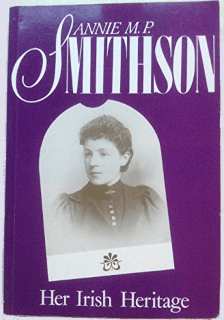
In 1917 Smithson publishes her first novel, Her Irish Heritage, which becomes a best-seller. It is dedicated to those who died in the Easter Rising of 1916. In all, she publishes twenty novels and two short story collections. Other successful novels include By Strange Paths and The Walk of a Queen. Many of her works are highly romantic and draw on her own life experiences, with nationalism and Catholicism featured as recurrent themes. In 1944 she publishes her autobiography, Myself – and Others.
From 1932 onwards Smithson shares a house in Rathmines, Dublin, with her stepsister and her stepsister’s family. She dies of heart failure on February 21, 1948, at 12 Richmond Hill, Dublin, and is buried in Whitechurch, Dublin.
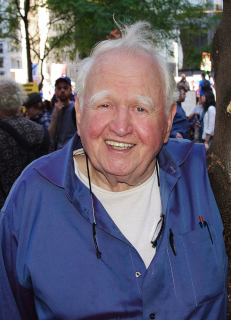
McCourt is the son of Irish parents Angela (née Sheehan) and Malachy McCourt. He is the last survivor of their seven offspring, following the death of his younger brother Alphonsus in 2016. He is raised in Limerick, County Limerick, and returns to the United States in 1952. He has four children: Siobhán, Malachy III, Conor, and Cormac, the latter two by his second wife, Diana. He also has a stepdaughter, Nina. He is portrayed by Peter Halpin in the film version of his brother’s memoir Angela’s Ashes. He is also one of the four founding members of the Manhattan Rugby Football Club in 1960. He appears in Frank McCourt’s memoirs.
In 1970, McCourt releases an album, And the Children Toll the Passing of the Day. Also, in the 1970s he hosts a talk show on WMCA.
In recent years McCourt occasionally appears on various programs on New York City’s political radio station, WBAI. Among the shows on which he appears is Radio Free Éireann. He is also a regular guest artist at the Scranton Public Theatre in Pennsylvania, having performed in Inherit the Wind, Love Letters and A Couple of Blaguards, which he co-wrote with brother Frank McCourt. Currently, he has been hosting a call-in radio forum on WBAI, airing on Sunday mornings at 11:00 a.m. He also has a short-lived role as a Catholic priest on the HBO prison drama Oz. He is the owner of Malachy’s, a bar on Third Avenue in New York City. One of his frequent patrons was actor, and friend, the late Richard Harris, who although famous works for a short time behind the bar for McCourt. He plays Francis Preston Blair in Gods and Generals (2003).
McCourt has written two memoirs titled, respectively, A Monk Swimming and Singing My Him Song, detailing his life in Ireland and his later return to the United States. He has also authored a book on the history of the ballad Danny Boy, and put together a collection of Irish writings, called Voices of Ireland.
On April 18, 2006, McCourt announces that he will run as a Green Party candidate to become governor of New York in the November 2006 election. Running under the slogan “Don’t waste your vote, give it to me,” he promises to recall the New York National Guard from Iraq, to make public education free through college, and to institute a statewide comprehensive “sickness care” system. He polls at 5% in an October 10 Zogby poll, versus 25% for RepublicanJohn Faso and 63% for Democrat Eliot Spitzer. He is endorsed by Cindy Sheehan, mother of a fallen soldier in the Iraq War. The League of Women Voters exclude him from the gubernatorial debate. He comes in a distant third in the general election, receiving 40,729 votes (or just under 1%), 9,271 votes short of what is required to gain automatic access in the 2010 election.
O’Grady’s father is the Reverend Thomas O’Grady, the scholarly Church of Ireland minister of Castletown Berehaven, County Cork, and his mother Susanna Doe (or Dowe). The Glebe, his childhood home, lies a mile west of Castletownbere near a famine mass grave and ruined Roman Catholic chapel. He is a cousin of Standish Hayes O’Grady, another noted figure in Celtic literature, and of Standish O’Grady, 1st Viscount Guillamore. After a rather severe education at Tipperary Grammar School, he follows his father to Trinity College, Dublin, where he wins several prize medals and distinguishes himself in several sports.
O’Grady is a paradox for his times, proud of his Gaelic heritage, he is also a member of the Church of Ireland, a champion of aristocratic virtues (particularly decrying bourgeois values and the uprooting cosmopolitanism of modernity) and at one point advocates a revitalised Irish people taking over the British Empire and renaming it the Anglo-Irish Empire.
O’Grady proves too unconventional of mind to settle into a career in the church, and takes a job as a schoolmaster at Midleton College, then in a period of expansion. He also qualifies as a barrister, while earning much of his living by writing for the Irish newspapers. Reading Sylvester O’Halloran’s A general history of Ireland (1778) sparks an interest in early Irish history. After an initial lukewarm response to his writing on the legendary past in History of Ireland: The Heroic Period (1878) and Early Bardic Literature of Ireland (1879), he realises that the public wants romance, and so follows the example of James Macpherson in recasting Irish legends in literary form, producing historical novels including Finn and his Companions (1891), The Coming of Cuculain (1894), The Chain of Gold (1895), Ulrick the Ready (1896) and The Flight of the Eagle (1897), and The Departure of Dermot (1913).
O’Grady also studies Irish history of the Elizabethan period, presenting in his edition of Sir Thomas Stafford‘s Pacata Hibernia (1896) the view that the Irish people had made the Tudors into kings of Ireland to overthrow their unpopular landlords, the Irish chieftains. His The Story of Ireland (1894) is not well received, as it sheds too positive a light on the rule of Oliver Cromwell for the taste of many Irish readers. He is also active in social and political campaigns in connection with such issues as unemployment and taxation.
Until 1898, O’Grady works as a journalist for the Daily Express of Dublin, but in that year, finding Dublin journalism in decline, he moves to Kilkenny to become editor of the Kilkenny Moderator, which is printed at 28 High Street. It is here he becomes involved with Ellen Cuffe, Countess of Desart, and Captain Otway Cuffe. He engages in the revival of the local woolen and woodworking industries. In 1900 he founds the All-Ireland Review and returns to Dublin to manage it until it ceases publication in 1908. He also contributes to James Larkins‘ The Irish Worker paper.
O’Grady’s influence crosses the divide of the Anglo-Irish and Irish-Ireland traditions in literature. His influence is explicitly stated by the Abbey Theatre set with Lady Gregory, W. B. Yeats and George William Russell attributing their interest in the Fenian Cycle of Gaelic tradition in part to him. This leads to him being known as the “Father of the Celtic Revival.” Some of the figures associated with the political party Sinn Féin, including its founder Arthur Griffith, have positive things to say about his efforts in helping to retrieve from the past the Gaelic heroic outlook.
O’Grady marries Margaret Allen Fisher, daughter of William Allen Fisher, and they have three sons. Advised to move away from Ireland for the sake of his health, they leave Ireland in 1918. After living in the north of France and Northamptonshire, they move to the Isle of Wight. He is working on a final exposition of his ideas when he dies suddenly on May 18, 1928.
In London, developing his interest in the theatre, Johnston abandons plans for a legal and political career.
Johnston is a protégé of W. B. Yeats and George Bernard Shaw, and has a stormy friendship with Seán O’Casey. He is a pioneer of television and war reporting. He works as a lawyer in the 1920s and 1930s before joining the BBC as a writer and producer, first in radio and then in the fledgling television service. His broadcast dramatic work includes both original plays and adaptation of the work of many different writers.
Johnston’s first play, The Old Lady Says “No!”, helps establish the worldwide reputation of Dublin’s Gate Theatre. His second play, The Moon in the Yellow River, has been performed around the globe in numerous productions featuring such storied names as James Mason, Jack Hawkins, Claude Rains, Barry Fitzgerald, James Coco and Errol Flynn. Later plays deal with the life of Jonathan Swift, the 1916 Rebellion, the pursuit of justice, and the fear of death. He writes two opera libretti and a pageant.
“Passionate in his radical skepticism and loathing of what he saw as the pernicious influence of the Roman Catholic Church,” at the end of 1933, Johnston joins the trade unionistJohn Swift, the Dublin novelistMary Manning, and fellow northerner, the libertarian socialistJack White, in forming The Secular Society of Ireland. “Convinced that clerical domination in the community is harmful to advance,” the society seeks “to establish in this country complete freedom of thought, speech and publication, liberty for mind, in the widest toleration compatible with orderly progress and rational conduct.” Among other things it aims to terminate the clerically-dictated ban on divorce, the Censorship of Publications Act and the system of clerical management, and consequent sectarian teaching, in schools.
This is at a time of heightened clerical militancy and as soon the meeting place of the Society (from which it distributed the British journal The Freethinker) is exposed, it has to shift to private houses outside of Dublin. In 1936, Johnston and the other members disband the society and donate the proceeds to the government of the beleaguered Spanish Republic. He has become a recognised man of the left. In 1930 he joins the Irish Friends of Soviet Russia, and though never a party member, until as late as the 1950s he professes faith in a communist future.
Johnston dies on August 8, 1984, at Ballybrack, County Dublin, and is buried in St. Patrick’s Cathedralclose. His epitaph is a quotation from The Old Lady Says “No!” – Emmet’s lines praising Dublin “the strumpet city.”
The Denis Johnston Playwriting Prize is awarded annually by Smith College Department of Theatre for the best play, screenplay or musical written by an undergraduate at Smith College, Mount Holyoke College, Amherst College, Hampshire College and the University of Massachusetts Amherst. The prize is endowed by his former student at Smith, Carol Sobieski.
Plunkett’s only grown sibling, a younger brother, from whom he is estranged from about 1916, for reasons not fully clear but connected to his mother’s will, is the noted British naval officer Sir Reginald Drax. Another younger brother dies in infancy.
The title passes to Plunkett at his father’s death in 1899 at a fairly young age. The young Lord Dunsany returns to Dunsany Castle in 1901 after war duty. In that year he is also confirmed as an elector for the Representative Peers for Ireland in the House of Lords.
In 1903, Plunkett meets Lady Beatrice Child Villiers (1880–1970), youngest daughter of Victor Child Villiers, 7th Earl of Jersey, who is then living at Osterley Park. They marry in 1904. Their one child, Randal, is born in 1906. Lady Beatrice is supportive of her husband’s interests and helps him by typing his manuscripts, selecting work for his collections, including the 1954 retrospective short story collection, and overseeing his literary heritage after his death.
The Plunketts are socially active in Dublin and London and travel between homes in Meath, London and Kent, other than during the First and Second World Wars and the Irish War of Independence. He circulates with many literary figures of the time. To many of these in Ireland he is first introduced by his uncle, the co-operative pioneer Sir Horace Plunkett, who also helps to manage his estate and investments for a time. He is friendly, for example, with George William Russell, Oliver St. John Gogarty, and for a time, W. B. Yeats. He also socialises at times with George Bernard Shaw and H. G. Wells and is a friend of Rudyard Kipling.
In 1910 Plunkett commissions a two-story extension to Dunsany Castle, with a billiard room, bedrooms and other facilities. The billiard room includes the crests of all the Lords Dunsany up to the 18th.
Plunkett serves as a second lieutenant in the Coldstream Guards in the Second Boer War. Volunteering in World War I and appointed Captain in the Royal Inniskilling Fusiliers, he is stationed for a time at Ebrington Barracks in Derry, Northern Ireland. Hearing while on leave of disturbances in Dublin during the Easter Rising of 1916, he drives in to offer help and is wounded by a bullet lodged in his skull. After recovery at Jervis Street Hospital and what is then the King George V Hospital (now St. Bricin’s Military Hospital), he returns to duty. His military belt is lost in the episode and later used at the burial of Michael Collins. Having been refused forward positioning in 1916 and listed as valuable as a trainer, he serves in the later war stages in the trenches and in the final period writing propaganda material for the War Office with MI7b. There is a book at Dunsany Castle with wartime photographs, on which lost members of his command are marked.
During the Irish War of Independence, Plunkett is charged with violating the Restoration of Order in Ireland Act 1920, tried by court-martial on February 4, 1921, convicted, and sentenced to pay a fine of 25 pounds or serve three months in prison without labour. The Crown Forces had searched Dunsany Castle and had found two double-barrelled shotguns, two rook rifles, four Very pistols, an automatic pistol and a large quantity of pistol ammunition, along with shotgun and rifle ammunition.
During World War II, Plunkett signs up for the Irish Army Reserve and the British Home Guard, the two countries’ local defence forces, and is especially active in Shoreham, Kent, the English village bombed most during the Battle of Britain.
Plunkett’s fame arises chiefly from his prolific writings. He is involved in the Irish Literary Revival. Supporting the Revival, he is a major donor to the Abbey Theatre, and he moves in Irish literary circles. He is well acquainted with W. B. Yeats, Lady Gregory, Percy French, George “AE” Russell, Oliver St. John Gogarty, Padraic Colum and others. He befriends and supports Francis Ledwidge, to whom he gives the use of his library, and Mary Lavin.
Plunkett makes his first literary tour to the United States in 1919 and further such visits up to the 1950s, in the early years mostly to the eastern seaboard and later, notably, to California. His own work and contribution to the Irish literary heritage are recognised with an honorary degree from Trinity College Dublin.
In 1940, Plunkett is appointed Byron Professor of English in the University of Athens in Greece. Having reached Athens by a circuitous route, he is so successful that he is offered a post as Professor of English in Istanbul. However, he has to be evacuated due to the German invasion of Greece in April 1941, returning home by an even more complex route, his travels forming a basis for a long poem published in book form (A Journey, in 5 cantos: The Battle of Britain, The Battle of Greece, The Battle of the Mediterranean, Battles Long Ago, The Battle of the Atlantic, special edition January 1944). Olivia Manning‘s character Lord Pinkrose in her novel sequence the Fortunes of War is a mocking portrait of Dunsany in that period.
In 1947, Plunkett transfers his Meath estate in trust to his son and heir and settles in Kent at his Shoreham house, Dunstall Priory, not far from the home of Rudyard Kipling. He visits Ireland only occasionally thereafter and engages actively in life in Shoreham and London. He also begins a new series of visits to the United States, notably California, as recounted in Hazel Littlefield-Smith’s biographical Dunsany, King of Dreams.
In 1957, Plunkett becomes ill while dining with the Earl and Countess of Fingall at Dunsany, in what proves to be an attack of appendicitis. He dies in hospital in Dublin, at the age of 79, on October 25, 1957. He is buried in the churchyard of the ancient church of St. Peter and St. Paul, Shoreham, Kent. His funeral is attended by many family members, representatives of his old regiment and various bodies in which he had taken an interest, and figures from Shoreham. A memorial service is held at Kilmessan in County Meath, with a reading of “Crossing the Bar,” which coincides with the passing of a flock of geese.
Beatrice survives Plunkett, living mainly at Shoreham and overseeing his literary legacy until her death in 1970. Their son Randal succeeds to the barony and is in turn succeeded by his grandson, the artist Edward Plunkett. Plunkett’s literary rights pass from Beatrice to Edward.
McCarthy’s debut novel, The Orchard Keeper, is published in 1965. Awarded literary grants, he is able to travel to southern Europe, where he writes his second novel, Outer Dark (1968). Suttree (1979), like his other early novels, receives generally positive reviews, but is not a commercial success. A MacArthur Fellowship enables him to travel to the American Southwest, where he researches and writes his fifth novel, Blood Meridian (1985). Although it initially garners a lukewarm critical and commercial reception, it has since been regarded as his magnum opus, with some labeling it the Great American Novel.
McCarthy dies of natural causes at his home in Santa Fe, New Mexico, on June 13, 2023, aged 89. Stephen King says McCarthy is “maybe the greatest American novelist of my time … He was full of years and created a fine body of work, but I still mourn his passing.”
Russell is born on April 10, 1867, in Lurgan, County Armagh, in what is now Northern Ireland. He writes with the pseudonym Æ (often written AE or A.E.). He is also a writer on mysticism, and a central figure in the group of devotees of theosophy which meets in Dublin for many years. He takes his pseudonym from a proofreader’s query about his earlier pseudonym, “AEon.”
Russell is the second son of Thomas Russell and Mary Armstrong. His father, the son of a small farmer, becomes an employee of Thomas Bell and Co., a prosperous firm of linen drapers. The family relocates to Dublin, where his father has a new offer of employment, when he is eleven years old.
Following his time at the Metropolitan School of Art, Russell becomes an accounts clerk in a drapery store but leaves in 1897 to organize agricultural cooperatives. Eventually he becomes editor of the periodicals Irish Homestead (1905–23) and The Irish Statesman (1923–30). In 1894 he publishes the first of many books of verse, Homeward: Songs by the Way, which establishes him in what is known as the Irish Literary Revival. His first volume of Collected Poems appears in 1913 and a second in 1926. He maintains a lifelong interest in theosophy, the origins of religion, and mystical experience. Candle of Vision: Autobiography of a Mystic (1918) is the best guide to his religious beliefs.
At the turn of the 20th century, Russell is considered by many to be the equal of Yeats, but he does not continue to grow and develop as Yeats does. He is prolific and versatile, but many critics find his poetry facile, vague, and monotonous, with “rather too much of the Celtic Twilight” in it.
Russell, who had become increasingly unhappy in the Irish Free State which, according to Yeats, he called “a country given over to the Devil,” moves to England soon after his wife’s death in 1932. Despite his failing health he goes on a final lecture tour in the United States but returns home utterly exhausted. He dies of cancer in Bournemouth, England, on July 17, 1935. His body is brought back to Ireland, and he is interred in Mount Jerome Cemetery, Dublin.
Born to Irish emigrants in Scotland, McCabe moves with his family to Ireland in the early 1940s. He lives on a farm near Lackey Bridge, just outside Clones, County Monaghan. He is educated at Castleknock College.
McCabe’s play King of the Castle causes a minor scandal when first staged in 1964, and is protested by the League of Decency. He writes his award-winning trilogy of television plays, consisting of Cancer, Heritage and Siege, because he feels he has to make a statement about the Troubles. His 1992 novel Death and Nightingales is hailed by Irish writer Colm Tóibín as “one of the great Irish masterpieces of the century” and a “classic of our times” by Kirkus Reviews.
McCabe defends fellow novelist Dermot Healy, who had been negatively reviewed by Eileen Battersby in The Irish Times in 2011, using the Joycean invective “shite and onions”, provoking controversy in the Irish literary community.
Fintan O’Toole notes how living in Monaghan, just across the border from County Fermanagh, informed McCabe’s writing, and described him as “the great laureate of…indeterminacy, charting its inevitably tragic outcomes while holding somehow to the notion that it might someday become a blessing.”
McCabe dies at the age of 90 on August 27, 2020, in Cavan, County Cavan. He is survived by his wife Margot, his four children, Ruth, Marcus, Patrick and Stephen, and thirteen grandchildren.