Lyons is born in to Margaret (née Sullivan) and Timothy Lyons senior, who is listed on his birth certificate as a cottier. He is the oldest of six siblings. Prior to the Irish Civil War, he works as a labourer. He fights with the IRA’s Kilflynn Company during the Irish War of Independence. He is described as being slight, “adventurous” as a column leader and a marksman who shoots at small birds. He shoots a British officer in an ambush led by captain George O’Shea at Shannow Bridge where the Kilflynn road joins the R557, forcing a retreat. He gains the nickname “Aeroplane” or “Aero” because of the way he suddenly appears and his last-minute escapes. Because of regular searches by Black and Tans, his father fears the family home will be burnt out and asks him to leave.
After the ratification of the Anglo-Irish Treaty, Lyons fights against Free State forces . At the time of his death he is commandant. He is involved in fighting in Listowel and Limerick, is captured near Athea, jailed in Limerick and released in late 1922 with an undertaking not to rejoin the fight. Notwithstanding this, the column continues to operate, generally around Causeway and Ballyduff.
On April 15, 1923, Lyons’ column attacks a Free State raiding party in Meenoghane, County Kerry. The raiding party receives reinforcements. He and his men are eventually surrounded at nearby Clashmealcon on April 16 by Michael Hogan’s 1st Western Division. They descend the rugged, Atlantic cliffs to the caves and hide in Dumfort’s Cave. He shoots out searchlights with his Lee-Enfield rifle and two Free State soldiers are shot dead from the cave. The situation is under Army Emergency Powers. With no escape for the men hiding, troops try to blast them out by dropping mines and smoke them out with petrol-soaked turf.
On April 16, James McGrath, the brother of Thomas McGrath, one of Lyons’s men, is arrested and taken to the cliffs in order to enter the cave and persuade the men to surrender. On the night of April 17-18, Thomas McGrath and Patrick O’Shea, his first cousin, fall trying to scale the cliffs to escape and drown. After offering to surrender himself on the morning of the April 18, Lyons falls several metres onto rocks from a rope that is provided by National Army troops. He is then shot multiple times by troops from the cliff top and is not recovered.
Three of Lyons’ men who surrender, Edmond Greaney, James McEnery and British deserter-turned-republican Reginald Stephen Hathaway, are executed in Ballymullen Barracks by gunshot on April 25, for breaking their undertaking not to take up arms against the Free State, attacking troops at Clashmealcon, burning the Civic Guard station at Ballyheigue, stripping the same Civic Guards and robbing the post office at Ballyduff.
Lyons’ decomposing body, minus a leg, is washed up on May 5, identifiable by a boot. He is buried alongside George O’Shea and Timothy Tuomey (both killed at Ballyseedy) in the Republican plot at Kilflynn Church (now St. Columba’s Heritage Centre).
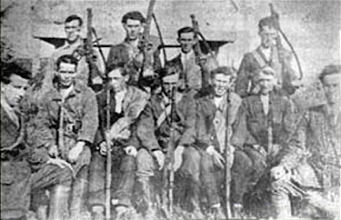
(Pictured: Kilflynn IRA Flying Column, 1922. Back (L to R): Denis O’Connell (Lixnaw), Stephen Fuller (Kilflynn), William Hartnett (Mountcoal), Tim Twomey (Kilflynn). Front (L to R): Terry Brosnan (Lixnaw), John McElligott (Leam, Kilflynn), Danny O’Shea (Kilflynn), Timothy (Aero) Lyons (Garrynagore), Tim Sheehy (Lyre), Pete Sullivan (Ballyduff), Paddy Mahony (Ballyegan, Battalion O.C.).)
Dermot Healy, Irish novelist, playwright, poet and short story writer, dies at his home in Ballyconnell, Sligo, County Sligo, on June 29, 2014. A member of Aosdána, he is also part of its governing body, the Toscaireacht. He is described variously as a “master,” a “Celtic Hemingway” and as “Ireland’s finest living novelist.”
Healy is born in Finnea, County Westmeath, on November 9, 1947, the son of a Guard. As a child the family moves to Cavan, County Cavan, where he attends the local secondary school. In his late teens he moves to London and works in a succession of jobs, including barman, security man and as a labourer. He later returns to Ireland, settling in Ballyconnell, County Sligo, a small settlement on the Atlantic coast.
Often overlooked due to his relatively low public profile, Healy’s work is admired by his Irish literary predecessors, peers and successors alike, many of whom idolise him. Among the writers to have spoken highly of him are Seamus Heaney, Eugene McCabe, Roddy Doyle, Patrick McCabe and Anne Enright.
Healy dies at his home in Ballyconnell on June 29, 2014, while awaiting an ambulance after suddenly being taken ill. He is laid to rest at Carrigans Cemetery following funeral mass by Fr. Michael Donnelly at St. Patrick’s Church in Maugherow, County Sligo.
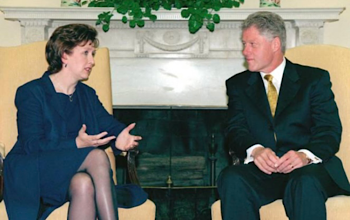
As this is not a state visit, there is no formal welcome for President McAleese or official functions at the White House as there was for President Mary Robinson‘s state visit two years earlier. McAleese arrives the previous day by government jet, accompanied by her husband, Dr. Martin McAleese, and the Minister for Foreign Affairs, David Andrews, and his wife. The McAleese’s son, thirteen-year-old Justin McAleese, travels to the United States separately and joined his parents in Washington, D.C..
Within hours of her arrival, McAleese attends a reception in the Four Seasons Hotel mainly for the Irish American community and hosted by the Irish ambassador, Sean O Huiginn, and his wife. In her remarks to the several hundred guests, President McAleese praises the role of President Clinton in the Northern Ireland peace process and of former Senator George Mitchell. She says Clinton’s contribution has been “remarkable.” She says, “He was prepared to take risks for peace: without his courage and leadership we could not have made the progress we have.”
McAleese says many of those present “have descended from some of the first settlers of the early colonies – some of whom, like myself, come from the northern part of the island of Ireland. I am deeply honoured that all of you have retained such a close bond and pride in your Irish heritage and that you demonstrated your affection by the strength of the many vibrant organisations in this area.”
McAleese says when our forebears crossed the Atlantic Ocean they retained a yearning that someday the Ireland they left would be a better place. “Regrettably, they did not live to see a new Ireland but it is now a reality in the economic, cultural and social progress of the last number of years.” Arranging the meeting at the White House is a problem for U.S. and Irish officials because of Clinton’s extremely busy schedule, as he prepares for his China visit. But the fact that he makes time for it is an indication of the importance he attaches to U.S.-Irish relations.
In the evening, McAleese attends a dinner in her honour at the Irish Embassy residence, to which leading political and administration figures are invited. On June 24, following a press conference at the National Press Club and a lunch on Capitol Hill with members of Congress, she flies to New York. There she pays a courtesy visit on the UN Secretary-General, Kofi Annan, and later attends a trade show organised by the Irish Business Organisation. In the evening she attends the “Dreamer of Dreams” awards ceremony organised by the Irish Voice newspaper.
On Thursday, June 25, McAleese has more engagements and prior to her return to Ireland on Friday, June 26.
(From: “McAleese for courtesy call on Clinton today” by Joe Carroll, The IrishTimes, http://www.irishtimes.com, July 23, 1998)
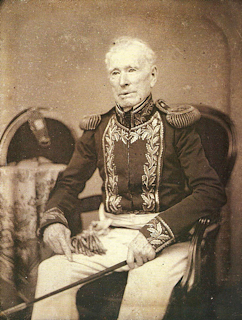
Comparatively little is known of his early life, and it has been suggested that he was illegitimate and took his mother’s surname and that his father’s surname was actually Gannon. He emigrates with his father to Baltimore, Maryland, in 1793, eventually settling in Philadelphia, Pennsylvania. A short time after their arrival, the friend who had invited them and offered them food and hospitality dies of yellow fever. Several days later, his father also succumbs to the same disease.
One morning, while Brown is wandering along the banks of the Delaware River, he meets the captain of a ship then moored in port. The captain inquires if he wants employment and Brown agrees. The captain engages him as a cabin boy, thereby setting him on the naval promotion ladder, where he works his way to the captaincy of a merchant ship. After ten years at sea, where he develops his skills as a sailor and reaches the rank of captain, Brown is press-ganged into a Royal Navy warship. British impressment of American sailors is one of the primary issues leading to the War of 1812.
During the Napoleonic Wars, Brown escapes the ship he is serving on, a galley, and scuttles the vessel. However, the French do not believe he had assisted them and imprison him in Lorient. On being transferred to Metz, he escapes, disguised in a French officer’s uniform. However, he is recaptured and is imprisoned in the fortress of Verdun. In 1809, he escapes from there in the company of a British Army officer named Clutchwell, and eventually reaches German territory.
Returning to England, Brown renounces his maritime career and on July 29, 1809, he marries Elizabeth Chitty, daughter of an English shipping magnate, in Kent. As he is a Catholic and she a Protestant, they agree to raise their sons as Catholics and their daughters as Protestants. Despite lengthy periods of enforced separation, they have nine children. He leaves the same year for the Río de la Plata on board Belmond and sets himself up as a merchant in Montevideo, Uruguay.
Late in 1811 Brown settles in Buenos Aires just as a criollo rebellion against Spanish colonial rule in Argentina is gaining strength. By April 1812, he is developing a coastal shipping business in fruit and hides. As the Spanish naval blockade of 1812–14 begins to choke trade, he is first commissioned by the patriot government as a privateer licensed to raid Spanish merchantmen, and then, on March 1, 1814, invited to take charge of a small rebel naval squadron to contest Spanish control of the Río de la Plata estuary. Leading a fleet of nineteen ships, he fixes with great speed on a set of wartime naval routines and signaling methods, and organises a system of discipline, founding the navy on principles that pay exceptional attention to the welfare of ordinary seamen.
In early March 1814, Brown shows personal courage and incisive skill in outwitting and defeating a more powerful Spanish force near Martín García Island, thereby dividing the Spanish blockade. A Spanish attempt in May 1814 to break his blockade of Montevideo is decisively crushed by him and his makeshift navy, and the Spanish strongholds on the Atlantic coast collapse, ending open war. In 1815 and 1816, however, he carries out skirmishing raids on military and commercial targets belonging to Spanish South American possessions, until detained by a British colonial governor in Barbados in July 1816 for alleged infringements of international rules of trade.
Illness, and a tortuous but ultimately successful appeal process, take up most of 1817–18, but when Brown returns to Argentina in October 1818, political enemies set in motion a prosecution for alleged disobedience of orders. Cashiered in August 1819, then restored in rank but forced to retire, he attempts suicide the following month. Convalescence and resumption of his trading concern occupies him for several years.
A repentant government renews Brown’s command of the navy in December 1825, when war breaks out with Brazil. Though vastly outnumbered by the Brazilian fleet, he shows audacity and great finesse in a number of successful engagements in the Plate estuary in 1826, roving up the Brazilian coast on occasion to create great confusion. In February 1827, he triumphs in a series of actions known as the Battle of Juncal. After another year of commercial privateering against the Brazilian merchant fleet, he is one of two delegates selected to sign peace terms with Brazil in October 1828.
Retiring from active service that month, Brown tries to remain neutral as civil war erupts in Argentina, but reluctantly accepts the post of governor of Buenos Aires under General Juan Lavalle from December 1828 to May 1829, when he resigns in disgust at government excesses. During 1829–37 he holds aloof from the despotic government of Juan Manuel de Rosas. After French and British encroachments on the region in the later 1830s, he offers to take charge of the navy again to protect national independence and is available to defend Argentine interests when war breaks out with a French-backed Uruguay in early 1841. Though exasperated by a long and “stupid war,” he blockades the Uruguayan navy effectively until French and British fleets intervene in July 1845 with overwhelming force to capture his squadron and bring the war to an end.
Idolised by the Argentinian population for his high-principled and humane advocacy of independent democracy, Brown passes his last years trading and farming a country estate. In late 1847, he journeys to Ireland, hoping to find relations in Mayo, and is shocked by the hunger and destitution of the Great Famine.
Brown dies on March 3, 1857, at his home in Buenos Aires and is buried with full military honours. The Argentine government issues a comuniqué: “With a life of permanent service to the national wars that our homeland has fought since its independence, William Brown symbolized the naval glory of the Argentine Republic.” During his burial, General Bartolomé Mitre famously says: “Brown in his lifetime, standing on the quarterdeck of his ship, was worth a fleet to us.” His grave is currently located in the La Recoleta Cemetery in Buenos Aires.
Madden is born at Wormwood Gate, Dublin, on August 22, 1798, to Edward Madden, a silk manufacturer, and his wife Elizabeth (née Corey). His father marries twice and fathers twenty-one children.
In 1828, Madden marries Harriet Elmslie, daughter of John Elmslie of Jamaica, a slave-owner. He then practises medicine in Mayfair, London, for the next five years.
Madden becomes a recruit to the abolitionist cause. The transatlantic slave trade has been illegal in the British Empire since 1807, but slavery itself remains legal.
From 1833, Madden is employed in the British civil service, first as a justice of the peace in Jamaica, where he is one of six Special Magistrates sent to oversee the eventual liberation of Jamaica’s slave population, according to the terms of the Slavery Abolition Act 1833. From 1835 he is Superintendent of the freed Africans in Havana, Cuba. In 1839 he leaves Cuba for New York, where he provides important evidence for the defense of the former slaves who had taken over the slave ship La Amistad.
In 1840 Madden becomes Her Majesty’s Special Commissioner of Inquiry into the British Settlements on the West Coast of Africa. His task is to investigate how the slave trade is continuing to operate on the west coast of Africa, despite the shipping of African slaves across the Atlantic Ocean now being illegal. He finds that London-based merchants (including WhigMPMatthew Forster) are actively helping the slave traders, and that crudely disguised forms of slavery exist in all the coast settlements. He particularly condemns the actions of George Maclean, the Governor of Gold Coast.
In 1847 Madden becomes the Colonial Secretary of Western Australia and arrives in the colony in 1848. After receiving news of their oldest son’s death back in Ireland, he and Harriet return to Dublin in 1849. In 1850 he is named secretary of the Office for Loan Funds in Dublin.
Madden also campaigns against slavery in Cuba, speaking to the General Anti-Slavery Convention in London on the topic of slavery in Cuba.
Madden dies at his home in Booterstown, just south of Dublin, on February 5, 1886, and is interred in Donnybrook Cemetery.
Besides several travel diaries (Travels in Turkey, Egypt etc. in 1824–27, 1829, and others (1833)), his works include the historically significant book The United Irishmen, their lives and times (1842-1860, 11 Vols.), which contains numerous details on the Irish Rebellion of 1798, including testimonies collected from veteran rebels and from family members of deceased United Irishmen.
O’Brien is a ship builder and designer, and his notable boats include the Kelpie (used for gun running in 1914), the Saoirse (in which he circumnavigates the globe) and the Ilen (a Falkland Islands service ship).
O’Brien is credited with two buildings in his lifetime: the Co-operative Hall in County Donegal and the People’s Hall in County Limerick. He is also known as a naval architect, having designed two ships, the Saoirse and the llen. He later captains both of these ships himself.
In Saoirse, a 20-ton, 42-foot ketch designed and built in 1922 in Baltimore, County Cork, he and three crew members circumnavigate the globe between 1923 and 1925 – the first recorded by an amateur skipper from west to east, the first yacht circumnavigation by way of the three great capes: Cape Horn, Cape of Good Hope and Cape Leeuwin, and the first boat flying the Irish tri-colour to enter many of the world’s ports and harbours. His voyage begins and ends at the Port of Foynes, County Limerick, where he lives. His account of the voyage, Across Three Oceans, (1927) becomes one of the classics of maritime literature.
Up until O’Brien’s circumnavigation, this route is the preserve of square-rigged grain ships taking part in the grain race from Australia to England via Cape Horn (also known as the clipper route).
O’Brien’s seagoing experiences are put to use in his design of the Ilen, which is built for the Falkland Islands as a service boat and launched in the spring of 1926. In 1998, Ilen returns to the site where she was first built, on the River Ilen near Baltimore, County Cork, where she undergoes a full restoration and is re-launched in May 2018. This task provides work-based learning for the students of the Ilen School.
O’Brien has some involvement with gun running in 1914 on behalf of the Irish Volunteers, for political reasons and because he has experience in sailing. On July 26, 1914, nine hundred guns are brought to Howth harbour aboard Erskine Childers‘ yacht Asgard. As part of the same operation, O’Brien transports arms on his yacht, Kelpie. The guns on Kelpie are transshipped to another yacht, Chotah, owned by Sir Thomas Myles, before being landed at Kilcoole in County Wicklow on August 1, 1914. After the gun running incidents, he serves in the Royal Naval Volunteer Reserve.
In 1928, O’Brien marries a well-known artist, Kathleen Francis, the youngest daughter of Sir George Clausen, RA. The couple thereafter moves to Ibiza, where they live on the Saoirse until Kathleen’s death in 1936. They have no children. Relocating to Cornwall, where he lives with his sister, he writes books on sailing and works of fiction for children. Although too old for active service when war with Germany breaks out in 1939, he assists the British war effort by serving in the Small Ships Pool, which delivers support vessels across the Atlantic and brings food supplies from the United States in private yachts.
In 1940 O’Brien sells Saoirse to the Royal Cornwall Yacht Club. The boat remains in use until 1980, when it is lost off the Jamaican coast. After the war he retires to another sister’s home in Foynes, County Limerick, where he lives and continues to write books for children until his death on April 18, 1952.
When the authorities in Quebec hear the news of ships arriving with sick passengers, they quickly set up Grosse Île as a port of entry and quarantine station at which all ships are required to dock before moving on to the mainland. The island had dealt with epidemics before. In 1830, about 30,000 immigrants arrived in Quebec, and two-thirds were Irish. These huge waves of immigration were concurrent with cholera epidemics in Great Britain and Europe.
Areas in the west of Ireland – mostly Mayo, Donegal, and Galway – are experiencing potato crop failure. In fact, the crop fails to various degrees all over the country throughout the 1830s, though no one is sure exactly when the blight that caused the successive crop failures of 1845-49 arrived in Ireland. In 1847, 100,000 Irish people travel to Grosse Île to escape starvation, unaware of the hardships they will encounter upon arrival.
The Syria, the first “coffin ship,” named for their crowded and deadly conditions, arrives on May 17, 1847, the ice still an inch thick on the river. Of the ship’s 241 passengers, 84 are stricken with fever and 9 died on board during the Atlantic crossing. The first victim dies on the day the Syria arrives. Her name is Ellen Kane, a four-year-old from Kilmore, County Mayo.
With the hospital equipped for only 150 cases of fever, the situation quickly spins out of control. More and more ships arrive at Grosse Île each day, sometimes lining up for miles down the St. Lawrence River throughout the summer. On these coffin ships the number of passengers stricken by fever increases exponentially.
The island is ill-equipped, to say the least. Hastily built, the quarantine hospitals lack proper sanitation, supplies, and space to accommodate all the sick patients. Many of the doctors dispatched to Grosse Île have never even seen the effects of cholera let alone treated it, and all are overworked. Being taken to a quarantine hospital is soon viewed as more of a death sentence than an opportunity to get better.
Between 1832 and 1937, Grosse Île’s term of operation, the official register lists 7,480 burials on the island. In 1847 alone, 5,424 burials take place, the majority are Irish immigrants. In that same year, over 5,000 Irish people on ships bound for Canada are listed as having been buried at sea.
Today, the island is a National Historic Site that serves as a Famine memorial. It is dedicated in 1996 after a four-year-long campaign to protect the mass gravesite.
The Grosse Île Celtic Cross, erected by the Ancient Order of Hibernians in 1909, bears an inscription in Irish commemorating the victims of the epidemic and condemning colonial rule. In English, it reads: “Children of the Gael died in their thousands on this island having fled from the laws of foreign tyrants and an artificial famine in the years 1847-48. God’s blessing on them. Let this monument be a token and honor from the Gaels of America. God Save Ireland.”
(From: “When 40 Irish Famine ships anchored at Grosse Île quarantine station in 1847” by Aliah O’Neill, IrishCentral, http://www.irishcentral.com, May 31, 2023)
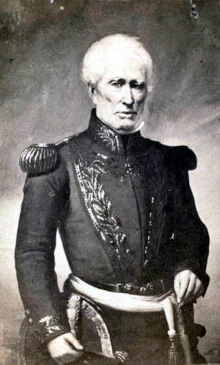
Brown is born on June 22, 1777, in Foxford, County Mayo. Comparatively little is known of his early life, and it has been suggested that he was illegitimate and took his mother’s surname and that his father’s surname was actually Gannon. He emigrates with his father to Baltimore, Maryland, in 1793, eventually settling in Philadelphia, Pennsylvania. A short time after their arrival, the friend who had invited them and offered them food and hospitality dies of yellow fever. Several days later, his father also succumbs to the same disease.
One morning, while Brown is wandering along the banks of the Delaware River, he meets the captain of a ship then moored in port. The captain inquires if he wants employment and Brown agrees. The captain engages him as a cabin boy, thereby setting him on the naval promotion ladder, where he works his way to the captaincy of a merchant ship. After ten years at sea, where he develops his skills as a sailor and reaches the rank of captain, Brown is press-ganged into a Royal Navy warship. British impressment of American sailors is one of the primary issues leading to the War of 1812.
During the Napoleonic Wars, Brown escapes the ship he is serving on, a galley, and scuttles the vessel. However, the French do not believe he had assisted them and imprison him in Lorient. On being transferred to Metz, he escapes, disguised in a French officer’s uniform. However, he is recaptured and is imprisoned in the fortress of Verdun. In 1809, he escapes from there in the company of a British Army officer named Clutchwell, and eventually reaches German territory.
Returning to England, Brown renounces his maritime career and on July 29, 1809, he marries Elizabeth Chitty, daughter of an English shipping magnate, in Kent. As he is a Catholic and she a Protestant, they agree to raise their sons as Catholics and their daughters as Protestants. Despite lengthy periods of enforced separation, they have nine children. He leaves the same year for the Río de la Plata on board Belmond and sets himself up as a merchant in Montevideo, Uruguay.
Late in 1811 Brown settles in Buenos Aires just as a criollo rebellion against Spanish colonial rule in Argentina is gaining strength. By April 1812, he is developing a coastal shipping business in fruit and hides. As the Spanish naval blockade of 1812–14 begins to choke trade, he is first commissioned by the patriot government as a privateer licensed to raid Spanish merchantmen, and then, on March 1, 1814, invited to take charge of a small rebel naval squadron to contest Spanish control of the Río de la Plata estuary. Leading a fleet of nineteen ships, he fixes with great speed on a set of wartime naval routines and signaling methods, and organises a system of discipline, founding the navy on principles that pay exceptional attention to the welfare of ordinary seamen.
In early March 1814, Brown shows personal courage and incisive skill in outwitting and defeating a more powerful Spanish force near Martín García Island, thereby dividing the Spanish blockade. A Spanish attempt in May 1814 to break his blockade of Montevideo is decisively crushed by him and his makeshift navy, and the Spanish strongholds on the Atlantic coast collapse, ending open war. In 1815 and 1816, however, he carries out skirmishing raids on military and commercial targets belonging to Spanish South American possessions, until detained by a British colonial governor in Barbados in July 1816 for alleged infringements of international rules of trade.
Illness, and a tortuous but ultimately successful appeal process, take up most of 1817–18, but when Brown returns to Argentina in October 1818, political enemies set in motion a prosecution for alleged disobedience of orders. Cashiered in August 1819, then restored in rank but forced to retire, he attempts suicide the following month. Convalescence and resumption of his trading concern occupies him for several years.
A repentant government renews Brown’s command of the navy in December 1825, when war breaks out with Brazil. Though vastly outnumbered by the Brazilian fleet, he shows audacity and great finesse in a number of successful engagements in the Plate estuary in 1826, roving up the Brazilian coast on occasion to create great confusion. In February 1827, he triumphs in a series of actions known as the Battle of Juncal. After another year of commercial privateering against the Brazilian merchant fleet, he is one of two delegates selected to sign peace terms with Brazil in October 1828.
Retiring from active service that month, Brown tries to remain neutral as civil war erupts in Argentina, but reluctantly accepts the post of governor of Buenos Aires under General Juan Lavalle from December 1828 to May 1829, when he resigns in disgust at government excesses. During 1829–37 he holds aloof from the despotic government of Juan Manuel de Rosas. After French and British encroachments on the region in the later 1830s, he offers to take charge of the navy again to protect national independence and is available to defend Argentine interests when war breaks out with a French-backed Uruguay in early 1841. Though exasperated by a long and “stupid war,” he blockades the Uruguayan navy effectively until French and British fleets intervene in July 1845 with overwhelming force to capture his squadron and bring the war to an end.
Idolised by the Argentinian population for his high-principled and humane advocacy of independent democracy, Brown passes his last years trading and farming a country estate. In late 1847, he journeys to Ireland, hoping to find relations in Mayo, and is shocked by the hunger and destitution of the Great Famine.
Brown dies on March 3, 1857, at his home in Buenos Aires and is buried with full military honours. The Argentine government issues a comuniqué: “With a life of permanent service to the national wars that our homeland has fought since its independence, William Brown symbolized the naval glory of the Argentine Republic.” During his burial, General Bartolomé Mitre famously says: “Brown in his lifetime, standing on the quarterdeck of his ship, was worth a fleet to us.” His grave is currently located in the La Recoleta Cemetery in Buenos Aires.
Deane is born on December 2, 1879, in New Ross, County Wexford, and grows up in Clontarf, a suburb of Dublin. His family lives close to the families of both Bram Stoker and his wife, Florence Balcombe, and his mother had been acquainted with Bram Stoker in her youth.
Deane enters the theater as a young man, first appearing in 1899 with the Henry Irving Company, of which Stoker is stage manager for many years. Even before he forms his own troupe in the early 1920s, he has been thinking about bringing Dracula to the stage. Stoker had attempted this in 1897 but the verdict from Irving consigned it to the waste-paper basket. Unable to find a scriptwriter to take on the project, Deane writes the play himself in a four-week period of inactivity while he is suffering with a severe cold. He then contacts Florence Stoker, Bram’s widow, and negotiates a deal for the dramatic rights.
To stage the production, Deane is required to submit the completed script to the Lord Chamberlain for a license under the Theatres Act 1843. The play is censored to limit violence – for example, the count’s death cannot be shown to the audience – but is approved on May 15, 1924.
Deane re-imagines Count Dracula as a more urbane and theatrically acceptable character who could plausibly enter London society. It is Deane’s idea that the count should wear a tuxedo and stand-up collar, and a flowing cape which conceals Dracula while he slips through a trap-door in the stage floor, giving the impression that he has disappeared. He also arranges to have a uniformed nurse available at performances, ready to administer smelling salts should anyone faint.
Deane’s play premieres on August 5, 1924, at the Grand Theatre in Derby, England. Despite critics’ misgivings, the audiences love it. Although he originally intended to play the title role himself, Raymond Huntley plays the role of the Count and Deane fills the role of Van Helsing. It is a huge success and the production tours England for three years before settling in London, where it opens at the Little Theatre in the Adelphi on February 14, 1927. It later transfers to the Duke of York’s Theatre and then the Prince of Wales Theatre to accommodate larger audiences.
When the play crosses the Atlantic in 1927, the role of Dracula is taken by the then-unknown Hungarian-American actor Bela Lugosi. For its United States debut, Dracula is rewritten by the American playwright John L. Balderston. The show runs for a year on Broadway and for two more years on tour, breaking all previous records for any show put on tour in the United States. It is the Deane/Balderston interpretation upon which the classic Tod Browning film Dracula (1931) is based.
McGarrity is born on March 28, 1874, in Carrickmore, County Tyrone. His family grows up in poverty, motivating his need to immigrate later in life. He grows up hearing his father discussing Irish politics, including topics such as the Fenians, the Irish Parliamentary Party (IPP), and Irish Home Rule. By the time he is an adult, he has developed a keen interest in politics himself.
McGarrity immigrates to the United States in 1892 at the age of 18. He is reputed to have walked to Dublin before boarding a cattle boat to Liverpool disguised as a drover, and then sailing to the United States using a ticket belonging to someone else. He settles in Philadelphia, Pennsylvania and becomes successful in the liquor business. His business fails, however, on three occasions, twice due to embezzlement by his business partner.
In 1893 McGarrity joins Clan na Gael, an Irish organisation based in the United States committed to aiding the establishment of an independent Irish state. Clan na Gael had been heavily involved with the Fenian Brotherhood that McGarrity had grown up hearing about, and by the latter half of the 19th century had become a sister organisation of the Irish Republican Brotherhood (IRB). In the decade just before McGarrity joins, Clan na Gael and the Fenian movement had waged the Fenian dynamite campaign, where they attempted to force the British state to make concessions in Ireland by bombing British infrastructure. However, this had caused a split within Clan na Gael that is not mended until seven years after McGarrity joins when, in 1900, the factions reunite and plead to support “the complete independence of the Irish people, and the establishment of an Irish republic.” In the years that follow the 1880s and 1890s, he is, amongst others, credited with helping to stitch the organisation back together and bring it renewed strength.
McGarrity helps sponsor several Irish Race Conventions and founds and runs a newspaper called The Irish Press from 1918-22 that supports the Irish War of Independence. He is the founder of the Philadelphia chapter of Clan Na Gael.
When Éamon de Valera arrives in the United States in 1919 they strike up an immediate rapport and McGarrity manages de Valera’s tour of the country. He persuades de Valera of the benefits of supporting him and the Philadelphia branch against the New York branch of the Friends of Irish Freedom organisation led by John Devoy and Judge Daniel F. Cohalan. He becomes president of the American Association for the Recognition of the Irish Republic. He christens his newborn son Éamon de Valera McGarrity, although their relationship becomes strained upon de Valera’s entry back into Dáil Éireann in the Irish Free State.
The Irish Civil War sees a split in Clan na Gael just as it had split Sinn Féin back in Ireland. McGarrity and a minority of Clan na Gael members support the anti-treaty side but a majority support the pro-treaty side, including John Devoy and Daniel Cohalan. Furthermore, in October 1920 Harry Boland informs the Clan na Gael leadership that the IRB will be cutting their ties to the Clan unless the IRB is given more influence over their affairs. Devoy and Cohalan resist this, but McGarrity sees the Clan’s connection with the IRB as vital. While McGarrity’s faction is initially labelled “Reorganised Clan na Gael,” they are able to inherit total control of the Clan na Gael name as Devoy is not able to keep effective organisation of the group. In general, however, the in-fighting amongst the Irish on both sides of the Atlantic is quite disheartening for Irish Americans and in the years to come neither pro nor anti-treaty sides of Clan na Gael see much in the way of donations.
With the scope of Clan na Gael now narrowed, and Devoy and Cohalan removed from the picture, McGarrity becomes chairman of the organisation. He does not support the founding of Fianna Fáil in 1926 and opposes the party’s entry into the Dáil in 1927. Even after the Irish Civil War, he still supports the idea that a 32-county Irish Republic can be achieved through force. in the spring of 1926, he receives Chief of Staff of the Irish Republican ArmyAndrew Cooney to the United States. Cooney and Clan na Gael formally agree that each organisation will support the other and that Clan na Gael will raise funds, purchase weapons and build support for the IRA in the United States.
Going into the late 1920s though Clan na Gael, as are most Irish American organisations, is struggling. Having limped past the split caused by the Irish Civil War, the rejection of Fianna Fáil has caused a second split in the membership. Many Irish Americans see the IRA and Fianna Fáil as one and the same at that point and Clan na Gael and McGarrity’s hostility to them causes much friction.
By July 1929, the Clan’s membership in one of its strongholds, New York City, is down to just 620 paid members. Then in October of that same year Wall Street crashes and the Great Depression hits. In 1933 McGarrity is left almost bankrupt after he is found guilty of “false bookkeeping entries.” His livelihood is saved when he becomes one of the main ticket agents in the United States for the Irish Hospitals’ Sweepstake. He is a personal friend of Joseph McGrath, one of the founders of the Sweepstake. The sweepstakes allow him to turn his fortunes around.
Despite the trying times of both Clan na Gael and his personal life, McGarrity holds fast in his belief in physical force Irish Republicanism. In 1939 he supports the demand from Seán Russell for the “S-Plan” bombing campaign in Britain, which proves disastrous. He allegedly meets Hermann Göring in Berlin in 1939 to ask for aid for the IRA, which leads indirectly to “Plan Kathleen.”
McGarrity is a lifelong friend of fellow Carrickmore native and avid Republican, Patrick McCartan. When he dies on September 4, 1940 a mass is held in the St. Mary’s Pro-Cathedral in Dublin. He remains an unrepentant physical force republican all his life. A number of McGarrity’s papers are in the National Library of Ireland. He donates his personal Library to Villanova University.
The IRA signs all its statements ‘J.J. McGarrity’ until 1969 when the organisation splits into the ‘Official‘ and ‘Provisional‘ movements. Thereafter the term continues to be used by the Officials while the Provisionals adopt the moniker ‘P.O’Neill.’




 seamus dubhghaill