Thornley is the youngest child of Welshman Frederick Edward Thornley and Dublin-born Maud Helen Thornley (née Browne). His parents, both civil servants, meet while working in Inland Revenue in Dublin in the 1910s.
Thornley receives a BA and PhD at Trinity College Dublin. His PhD is entitled “Isaac Butt and the creation of an Irish Parliamentary Party (1868–1879)” and is written under the supervision of Theodore William Moody. Working as a presenter on 7 Days since 1963, he is appointed Associate professor of Trinity in 1968. In 1964, he publishes the book Isaac Butt and Home Rule.
In December 1972, Thornley calls for the immediate release of Seán Mac Stíofáin, then leader of the Provisional Irish Republican Army. He is re-elected at the 1973 Irish general election. In April 1976, he loses the Labour Party whip after appearing on a Sinn Féin platform during Easter Rising commemorations. In September 1976, he votes for the Criminal Justice (Jurisdiction) Bill despite misgivings. He tells The Irish Times, “When I get very depressed, I drink too much. When I voted for the Criminal Justice (Jurisdiction Bill) I went on the batter for a forthnight [sic].” In February 1977, he is re-admitted to the Labour Parliamentary Party. He loses his seat at the 1977 Irish general election.
In 1978, Thornley joins the newly formed Socialist Labour Party (SLP) stating that he has done so because “There is no man in politics that I respect more than Noël Browne, despite our occasional differences. If the SLP is good for him, it’s good enough for me.”
Overweight, afflicted with undiagnosed diabetes, his judgement increasingly erratic, from the early 1970s Thornley suffers a steady deterioration of health, compounded by his heavy drinking, on which he relies to cope with stress and emotional depression. On one occasion he collapses in the Dáil and is attended by party colleague Dr. John O’Connell. He dies at the age of 42 on June 18, 1978, one week after admission into Jervis Street private nursing home. After a sung Latin Requiem Mass in St. Andrew’s Church, Westland Row, Dublin, he is buried in Bohernabreena Cemetery, County Dublin.
The Trinity College Labour Branch is formerly named the David Thornley Branch in his honour.
The Provisional IRA, officially known as the Irish Republican Army (Irish: Óglaigh na hÉireann) and informally as the Provos, is an Irish republicanparamilitary force that seeks to end British rule in Northern Ireland, facilitate Irish reunification and bring about an independent republic encompassing all of Ireland. It is the most active republican paramilitary group during the Troubles. It argues that the all-island Irish Republic continues to exist, and it sees itself as that state’s army, the sole legitimate successor to the original IRA from the Irish War of Independence (1919-21). It is designated a terrorist organisation in the United Kingdom and an unlawful organisation in the Republic of Ireland, both of whose authority it rejects.
The Provisional IRA emerges in December 1969, due to a split within the previous incarnation of the IRA and the broader Irish republican movement. It is initially the minority faction in the split compared to the Official IRA but becomes the dominant faction by 1972. The Troubles begin shortly before when a largely Catholic, nonviolent civil rights campaign is met with violence from both Ulster loyalists and the Royal Ulster Constabulary (RUC), culminating in the August 1969 riots and deployment of British soldiers. The IRA initially focuses on defence of Catholic areas, but it begins an offensive campaign in 1970 that is aided by external sources, including Irish diaspora communities within the Anglosphere, and the Palestine Liberation Organization (PLO) and Libyan leader Muammar Gaddafi. It uses guerrilla tactics against the British Army and RUC in both rural and urban areas and carries out a bombing campaign in Northern Ireland and England against military, political and economic targets, and British military targets in mainland Europe. They also target civilian contractors to the British security forces. The IRA’s armed campaign, primarily in Northern Ireland but also in England and mainland Europe, kills over 1,700 people, including roughly 1,000 members of the British security forces and 500–644 civilians.
The Provisional IRA issues the following statement to news media on the morning of July 19, 1997:
“On August 31, 1994, the leadership of Oglaigh na hEireann (Gaelic for Irish Republican Army) announced a complete cessation of military operations as our contribution to the search for a lasting peace.
After 17 months of cessation, in which the British government and the (pro-British Protestant) unionists blocked any possibility of real or inclusive negotiations, we reluctantly abandoned the cessation.
It is the root cause of division and conflict in our country. We want a permanent peace and therefore we are prepared to enhance the search for a democratic peace settlement through real and inclusive negotiations.
So, having assessed the current political situation, the leadership of Oglaigh na hEireann are announcing a complete cessation of military operations from 12 o’clock midday on Sunday the 20th, July 1997.
We have ordered the unequivocal restoration of the ceasefire of August 1994. All IRA units have been instructed accordingly.”
Gray is the third son of John and Elizabeth Gray of Mount Street. He is educated at Trinity College Dublin and obtains the degree of M.D. and Master of Surgery at the University of Glasgow in 1839. Shortly before his marriage in the same year, he settles in Dublin and takes up a post at a hospital in North Cumberland Street. He is admitted as a licentiate of the Royal College of Physicians in due course.
Gray is publicly minded and contributes to periodicals and the newspaper press. In 1841, he becomes joint proprietor of the Freeman’s Journal, a nationalist paper which is then published daily and weekly. He acts as political editor of the Journal for a time, before becoming sole proprietor in 1850. As owner, he increases the newspaper’s size, reduces its price and extends its circulation.
Gray enters politics at a relatively young age and attaches himself to Daniel O’Connell‘s Repeal Association. As a Protestant Nationalist, he supports the movement for the repeal of the Acts of Union with Britain. In October 1843, he is indicted with O’Connell and others in the Court of the Queen’s Bench in Dublin on a charge of sedition and “conspiracy against the queen.” The following February, he, together with O’Connell, is condemned to nine months imprisonment, but in early September 1844 the sentence is remitted on appeal. The trial has a strong element of farce, as the hot-tempered Attorney-General for Ireland, Sir Thomas Cusack-Smith, challenges Gray’s counsel, Gerald Fitzgibbon, to a duel, for which he is sternly reprimanded by the judges. From then on Gray is careful to distance himself from the advocacy of violence in the national cause, though he is sympathetic to the Young Ireland movement without being involved in its 1848 rebellion. Through the growing influence of the Freeman’s Journal, he becomes a significant figure in Dublin municipal politics. He is also active in national politics during an otherwise quiet period of Irish politics up until 1860. With the resurgence of nationalism after the famine, he helps to organise the Tenant’s League founding conference in 1850, standing unsuccessfully as the League’s candidate for Monaghan in the 1852 United Kingdom general election.
Later Gray originates and organises the “courts of arbitration” which O’Connell endeavours to substitute for the existing legal tribunals of the country. Following O’Connell’s death, in 1862 he inaugurates an appeal for subscriptions to build a monument to O’Connell on Sackville Street (now O’Connell Street). Independent from O’Connell, he continues to take a prominent part in Irish politics and in local affairs.
In municipal politics, Gray is elected councillor in 1852 and alderman of Dublin Corporation and takes an interest in the improvement of the city. As chairman of the committee for a new water supply to Dublin, he actively promotes what becomes the “Vartry scheme.” The Vartry Reservoir scheme involves the partial redirection and damming of the River Vartry in County Wicklow, and the building of a series of water piping and filtering systems (and related public works) to carry fresh water to the city. This work is particularly important in the improvement of conditions in the city, and to public health, as it improves sanitation and helps reduce outbreaks of cholera, typhus and other diseases associated with contaminated water. On the opening of the works on June 30, 1863, he is knighted by the Earl of Carlisle, then Lord Lieutenant of Ireland. Partially in recognition of these efforts, he is later be nominated for the position of Lord Mayor of Dublin for the years 1868–69, but he declines to serve.
In national politics, the Liberal government at the time is keen to conciliate an influential representative of the moderate nationalists to support British Liberalism and who will resume O’Connell’s constitutional agitation. In an unusual alliance with the CatholicArchbishop of Dublin, Paul Cullen, a man devoted to O’Connell’s memory, Gray’s newspaper exploits this shift in government policy. It supports the archbishop’s creation, the National Association of Ireland, established in 1864 with the intention of providing a moderate alternative to the revolutionary nationalism of the Fenians. The Freeman’s Journal adopts the aims of the Association as its own: it advocates the disestablishment of the AnglicanChurch of Ireland, reform of the land laws, educational aspirations of Irish Catholicism and free denominal education.
In the 1865 United Kingdom general election Gray is elected MP for Kilkenny City as a Liberal candidate. In this capacity he campaigns successfully at Westminster and in Ireland for the reforms also advocated in his paper. His newspaper’s inquiry into the anomalous wealth of the established church amidst a predominately Catholic population contributes considerably to William Ewert Gladstone‘s Irish Church Act 1869. He helps to furnish the proof that Irish demands are not to be satisfied by anything other than by radical legislation. He fights for the provision in the new Landlord & Tenant (Ireland) Act 1870 for fixity of tenure, which Gladstone eventually concedes. The Act’s other weaknesses, however, result in its failure to resolve the “land question,” the accompanying coercion, the disappointment with Gladstone’s handling of the university question and national education, causing Gray to deflect from the Liberals and become mistrusted in Britain. In the 1874 United Kingdom general election he is re-elected as a Home Rule League MP for Kilkenny, joining its Home Rule majority in the House of Commons, and holds his seat until his death the following year.
Gray dies at Bath, Somerset, England, on April 9, 1875. His remains are returned to Ireland, and he is honoured with a public funeral at Glasnevin Cemetery. Almost immediately afterwards public subscriptions are sought for the erection in O’Connell Street, of a monument to Gray. The monument is completed in 1879 and is dedicated to the “appreciation of his many services to his country, and of the splendid supply of pure water which he secured for Dublin.” His legacy also includes his contributions to the passage of the Irish Church and Land Bills, his advocacy for tenant’s rights and his support of the Home Rule movement.
(Pictured: Statue to Sir John Gray on Dublin’s O’Connell Street, designed by Thomas Farrell and unveiled on June 24, 1879. Photo credit: Graham Hickey)
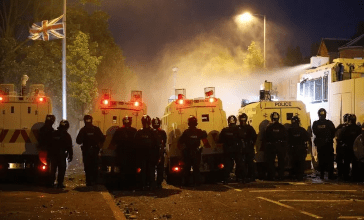
Major rioting and civil disorder break out in Ardoyne, north Belfast, Northern Ireland, on July 12, 2001. In some of the worst rioting in years, 113 police officers are injured in clashes which follow a July 12 parade. Police are attacked when trying clear the path for about 100 Orangemen returning from the parade to go along a main road passing the Catholic Ardoyne area.
In the seven-hour riot which involves about 250 nationalist youth, two blast bombs and 263 petrol bombs are exploded, while a dozen vehicles are hijacked, and 48 plastic bullets are shot by the police. Riot police also use water cannons. There are also incidents in east Belfast, Derry and Ballycastle, but the clashes in Ardoyne are by far the most serious.
The Royal Ulster Constabulary (RUC) says the riots are orchestrated by the Provisional Irish Republican Army, a claim denied by Sinn Féin, who believe the RUC’s heavy response escalates tensions. The incident also intensifies a row over the use of plastic bullets. Forty-eight of them are fired by the RUC in Ardoyne, and Sinn Féin claims fifty of them hit civilians, ten of which are badly injured. Chief ConstableRonnie Flanagan strongly rejects calls from the Northern Ireland Human Rights Commission (NIHRC) to halt its use in riots. Nationalist politicians see the ban on plastic bullets as a vital reform to make Catholics trust the police force more. Gerry Kelly from Sinn Féin says that the RUC “started the riot in Ardoyne. They are a sectarian force, using a very lethal weapon predominantly against nationalists and they should not be allowed to do so.”
A few days later another riot breaks out involving petrol bombs and acid being thrown by loyalists at police in north and west Belfast. Loyalists claim shots are fired at them from the Catholic Short Strand. A buffer zone is created by riot police in North Queen Street. Well-known Ulster Defence Association (UDA) members are spotted. From September 2001 the area sees fresh violence during the Holy Cross dispute and on the 23rd, with rioting also occurring in October and November.
Muriel Enid Gifford is born at 12 Cowper Road, Rathmines, on December 18, 1884. She is the fourth daughter and eighth child of twelve of Frederick and Isabella Gifford. As a child, she suffers at different times from rheumatic fever and phlebitis. She attends Alexandra College and spends a brief time in England training to as a poultry instructor. Returning to Ireland, she trains at Sir Patrick Dun’s Hospital, Dublin, as a student nurse, but her health suffers from the work.
Along with her sisters, MacDonagh is active in the Irish Women’s Franchise League and Inghinidhe na hÉireann, a nationalist organisation. She is involved in the school meals programme of 1910 to 1911, takes part in a 1914 Women’s Franchise League fundraiser, appearing in a tableau vivant as Maeve, the Warrior Queen. Less ardently feminist than her sisters, she takes delight in inviting home activists and artists for a “proper meal.” In an outgoing family, she is shy and reserved, known for her gentle manner. In 1908, she is introduced to Thomas MacDonagh by suffragette journalist Nannie Dryhurst along with her sisters, Grace and Sidney, on a visit to St. Enda’s School. Dryhurst advises Thomas to “fall in love with one of these girls and marry her,” to which he replies laughingly, “That would be easy; the only difficulty would be to decide which one.” The Gifford sisters remain acquaintances with Thomas until the autumn of 1911, when the couple has a short and intense courtship. They meet secretly in galleries and museums and have copious correspondence. When he is appointed assistant lecturer to University College Dublin (UCD) in December 1911, they marry on January 3, 1912. They have one son, Donagh MacDonagh, and one daughter, Barbara MacDonagh Redmond. The family lives first at 32 Baggot Street, and later at 29 Oakley Road, Rathmines.
MacDonagh suffers with poor health and depression, which leads to periods of convalescence and confinement. When her husband is arrested after the Easter Rising, she is unable to see him before his execution on May 3, 1916, which heightens the intensity of her bereavement. Devastated by his death and estranged from her parents due to their disapproval of his involvement in the Rising, she briefly lives with the Plunketts at Larkfield, Kimmage, and then with relatives of her husband in Thurles, County Tipperary. She later returns to Dublin to rent rooms in a Plunkett family property, 50 Marlborough Road. With two young children to support, she is nearly destitute, but like the other widows and orphans of the executed leaders of the Rising, they are aided by the Irish Volunteers Dependents’ Fund, in her case with £250. She also serves as an officer and committee member on this aid association. Her husband had named her as his literary executor, and she prepares a collected edition of his poetry that is published in October 1916. The success of this volume, and his bestselling Literature in Ireland, published at the time he is executed, ease her financial difficulties somewhat.
MacDonagh dies while swimming in the sea during a holiday with other 1916 widows and orphans in Skerries, County Dublin, on July 9, 1917. She almost does not attend the holiday, as her son is in hospital having been injured in a fall. It is believed that she is attempting to swim to Shenick Island from Skerries, possibly to place a tricolour flag on the island’s Martello tower. Her body is found near Loughshinny Beach and, as there is no water in her lungs, it is concluded that she died of heart failure and not drowning. As there is great interest in the 1916 widows and their families, her funeral at Glasnevin Cemetery attracts a large crowd of mourners estimated at 5,000 in the funeral procession.
Following MacDonagh’s death, there is a legal custody battle between the Giffords and the MacDonaghs over Donagh and Barbara. Their aunt Mary MacDonagh, a nun known as Sister Francesca and with whom MacDonagh had grown close, wins custody. Even though several of her siblings offer to take the children, she places them in a foster home.
On the centenary of MacDonagh’s death, a festival takes place in Skerries in her memory.
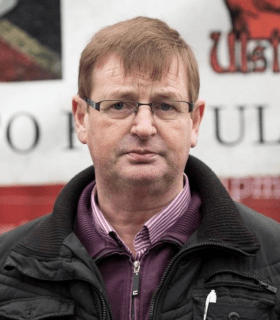
Frazer grows up in the village of Whitecross, County Armagh, Northern Ireland, as one of nine children, with his parents Bertie and Margaret. He is an ex-member of the Territorial Army and a member of the Free Presbyterian Church of Ulster. He attends a local Catholic school and plays Gaelic football up to U14 level. He describes his early years as a “truly cross-community lifestyle.” Growing up, he is a fan of the American actor John Wayne and wrestling. His father, who is a part-time member of the British Army‘s Ulster Defence Regiment (UDR) and a council worker, is killed by the Provisional Irish Republican Army (IRA) on August 30, 1975. The family home had previously been attacked with petrol bombs and gunfire which Frazer claims were IRA men, due to his father’s UDR membership. He states that his family is well respected in the area including by “old-school IRA men” and receives Mass cards from Catholic neighbours expressing their sorrow over his father’s killing. Over the next ten years, four members of Frazer’s family who are members or ex-members of the Royal Ulster Constabulary (RUC) or British Army are killed by the IRA. An uncle who is also a member of the UDR is wounded in a gun attack.
Soon after his father’s death, the IRA begins targeting Frazer’s older brother who is also a UDR member. Like many South Armagh unionists, the family moves north to the village of Markethill. After leaving school, he works as a plasterer for a period before serving in the British Army for nine years. Following this he works for a local haulage company, then sets up his own haulage company, which he later sells.
During the Drumcree conflict, Frazer is a supporter of the PortadownOrange Order who demand the right to march down the Garvaghy Road against the wishes of local residents. He is president of his local Apprentice Boys club at the time.
For a brief period after selling his haulage firm, Frazer runs “The Spot,” a nightclub in Tandragee, County Armagh, which closes down after two Ulster Protestant civilians who had been in the club, Andrew Robb and David McIlwaine, are stabbed to death in February 2000 by the Ulster Volunteer Force (UVF), after one of them had allegedly made derogatory remarks about dead UVF Mid-Ulster Brigade leader Richard Jameson. Frazer is confronted in an interview on BBC Radio Ulster about the murders by the father of one of the victims, Paul McIlwaine. During the Smithwick Tribunal, set up to investigate allegations of collusion in the 1989 Jonesborough ambush, it is alleged by a member of Garda Síochána that Frazer is a part of a loyalist paramilitary group called the Red Hand Commando. Frazer denies this allegation, saying they put his life in danger.
Frazer applies for a licence to hold a firearm for his personal protection and is turned down, a chief inspector says, in part because he is known to associate with loyalist paramilitaries.
FAIR, founded by Frazer in 1998, claims to represent the victims of IRA violence in South Armagh. It has been criticised by some for not doing the same for victims of loyalist paramilitary organisations or for those killed by security forces.
In February 2006, Frazer is an organiser of the Love Ulster parade in Dublin that has to be cancelled due to rioting. In January 2007, he protests outside the Sinn FéinArd Fheis in Dublin that votes to join policing structures in Northern Ireland. He expresses “outrage at the idea that the ‘law-abiding population’ would negotiate with terrorists to get them to support democracy, law and order.”
In January 2007, Frazer dismisses Police OmbudsmanNuala O’Loan‘s report into security force collusion with loyalist paramilitaries.
In March 2010, Frazer claims to have served a civil writ on deputy First MinisterMartin McGuinness, of Sinn Féin, seeking damages arising from the killing of his father by the Provisional IRA. Both Sinn Féin and the courts deny that any such writ had been served, but in June 2010 Frazer announces that he will seek to progress his claim in the High Court. There has since been no report of any such litigation. He previously pickets McGuinness’s home in Derry in 2007 to demand support for calls for Libya to compensate victims of IRA attacks. Accompanied by two other men, he attempts to post a letter to the house but is confronted by local residents and verbally abused. When McGuinness stands for election in the 2011 Irish presidential election, Frazer announces that he and FAIR will picket the main Sinn Féin election events, however, no such pickets take place.
In September 2010, the Special EU Programmes Body (SEUPB) revokes all funding to FAIR due to “major failures in the organisation’s ability to adhere to the conditions associated with its funding allocation” uncovered following a “thorough audit” of the tendering and administration procedures used by FAIR.
In November 2011, the SEUPB announces that it is seeking the return of funding to FAIR and another Markethill victims’ group, Saver/Naver. FAIR is asked to return £350,000 while Saver/Naver is asked to return £200,000. Former Ulster Unionist Party (UUP) leader Reg Empey demands that the conclusions about FAIR’s finances be released into the public domain.
In January 2012, Frazer announces a protest march to be held on February 25 through the mainly Catholic south Armagh village of Whitecross, to recall the killing of ten Protestant workmen by the South Armagh Republican Action Force (SARAF) in January 1976 in the Kingsmill massacre. He also names individuals whom he accuses of responsibility for the massacre. He later announces that the march is postponed “at the request of the Kingsmills families.” A 2011 report by the Historical Enquiries Team finds that members of the Provisional IRA carried out the attack despite the organisation being on ceasefire.
A delegation including Frazer, UUP politician Danny Kennedy and relatives of the Kingsmill families travel to Dublin in September 2012 to seek an apology from the Taoiseach, Enda Kenny. The apology is sought for what they describe as the Irish government‘s “blatant inaction” over the Kingmills killings. The Taoiseach says he cannot apologise for the actions of the IRA but assures the families there is no hierarchy for victims and their concerns are just as important as any other victims’ families. The families express disappointment although Frazer states he is pleased to have met the Taoiseach.
On November 16, 2012, Frazer announces that he is stepping down as director of FAIR, after he had reviewed a copy of the SEUPB audit report which, he claims, shows no grounds for demanding the reimbursement of funding. He adds, “I will still be working in the victims sector.”
In 2019, the BBC investigative journalism programme Spotlight reports that Frazer distributed assault rifles and rocket launchers from Ulster Resistance to loyalist terror groups who used them in more than 70 murders. A police report on the activities of the former Ulster Defence Association (UDA) boss Johnny Adair states he was receiving weapons from Ulster Resistance in the early 1990s and his contact in Ulster Resistance was Frazer.
In addition to his advocacy for Protestant victims, Frazer contests several elections in County Armagh. He is not elected and, on most occasions, loses his deposit. He runs as an Ulster Independence Movement candidate in the 1996 Forum Elections and the 1998 Assembly elections, and as an independent in the 2003 Assembly elections and a council by-election.
In the 2011 Northern Ireland Assembly election Frazer is listed as a subscriber for the Traditional Unionist Voice (TUV) candidate for the Newry and Armagh constituency, Barrie Halliday, who secures 1.8% of the vote. At Newry Crown Court on Wednesday, June 21, 2017, Pastor Barrie Gordon Halliday is sentenced to nine months in prison, suspended for eighteen months, when he pleads guilty to seventeen counts of VAT repayment fraud.
In November 2012, Frazer announces his intention to contest the 2013 Mid Ulster by-election necessitated by Martin McGuinness’s decision to resign the parliamentary seat to concentrate on his Assembly role. He is quoted in The Irish News in January 2013 as stating that he will not condemn any paramilitary gunman who shoots McGuinness.
Despite his earlier advocacy of Ulster nationalism, in 2013 Frazer declares himself in favour of re-establishing direct rule in Northern Ireland.
Frazer dies of cancer in Craigavon, County Armagh, Northern Ireland, on June 28, 2019. Traditional Unionist Voice (TUV) leader Jim Allister and DUP Assembly member Jim Wells pay tribute to his memory.
O’Brien is born in Dublin on May 9, 1871, where he lives all his life. He is an important figure in early 20th-century Irish music. For some, he is mainly known as the first teacher of singers such as John McCormack, Margaret Burke Sheridan and the writer James Joyce.
O’Brien is the eldest child of a Roman Catholic church musician. In 1885, he first appears in a public piano recital and, later in the year, becomes the organist of Rathmines parish church, a position he holds until 1888. He holds another organist’s position at the Dublin Carmelite church from 1897 to 1899 but is chiefly known as organist and choir director of Dublin’s largest Roman Catholic Church, St. Mary’s Pro-Cathedral, between 1903 and 1946. In 1898, he is the founder and first director of the Palestrina Choir, originally all-male, which is still active, and which is financed for many years by Edward Martyn.
O’Brien studies with Robert Prescott Stewart at the Royal Irish Academy of Music (1888-90), where he is the first winner of the Coulson Scholarship and frequently performs as both tenor singer, piano accompanist, and organist in many public concerts during the 1890s. As a church musician, he becomes particularly involved in the Cecilian Movement, conducting works by Michael Haller and others, and also pursuing their artistic ideals in his own sacred choral compositions.
O’Brien is the founding conductor of the Dublin Oratorio Society (1906), the Brisan Opera Company (1916) and conducts at many ad hoc events. In 1925, he becomes the first music director of Radio Éireann (originally called 2RN), a position he holds until 1941. He singles out his work as music director for the 31st International Eucharistic Congress in Dublin (1932) as his most prized personal achievement. As late as 1945, he founds Our Lady’s Choral Society, a large oratorio choir still in existence, which originally is recruited mainly from the various Roman Catholic church choirs in Dublin.
Among his teaching positions, O’Brien teaches at the diocesan seminary at Holy Cross College, is Professor of Gregorian Chant at the missionary seminary of All Hallows College from 1903, and Professor of Music at the Ladies’ Teacher-Training College at Carysfort Park, Blackrock, County Dublin, from 1908 until his death in Dublin on June 21, 1948. As a much-demanded vocal coach, he teaches at his home, his best-known pupils including John McCormack, Margaret Burke Sheridan and James Joyce. He performs the piano accompaniments for McCormack’s first gramophone recordings and accompanies him during his 1913–14 Australasian tour of 60 performances in three months, during which he also gives organ recitals at the Irish-dominated Catholic cathedrals of Sydney and Melbourne.
Of his two sons, Oliver O’Brien (1922–2001) largely follows in his father’s footsteps, as organist and director of the Palestrina Choir, of Our Lady’s Choral Society, music teacher at Carysfort College and as teacher in various Dublin schools. His other son, Colum O’Brien, is organist in the Pro-Cathedral.
Before his work for the Palestrina Choir, O’Brien’s musical interests are very broad, culminating in 1893 in the composition of the full-scale opera Hester. As a church music composer, he follows Cecilian ideals, with a number of hymns, motets and other choral works. He also composes a number of songs for voice and piano, with The Fairy Tree (1930) being a particular favourite of John McCormack’s.
As Governor-General of India, Wellesley uses military force and diplomacy to strengthen and expand British authority. East India Company forces defeat and kill Tipu Sultan, Indian Muslim ruler of the Kingdom of Mysore (present-day Mysuru) and sympathizer for Revolutionary France, in the Fourth Anglo-Mysore War (1799), and he then restores the Hindu dynasty there that had been deposed by Tipu’s father, Hyder Ali. He annexes much territory after his brother Arthur and General Gerard Lake defeat the Maratha Confederacy of states in the Deccan Plateau (peninsular India). In addition, he forces the Oudh State to surrender numerous important cities to the British, and he contracts with other states a series of “subsidiary alliances” by which all parties recognize British preponderance. He receives a barony in the British peerage in 1797 at the time of his appointment as governor-general, and in 1799 he is awarded a marquessate in the Irish peerage for his victory in the Mysore War.
When Wellesley is faced with an invasion by Zaman Shah Durrani, ruler (1793–1800) of Kabul (Afghanistan), he utilizes his envoy, Captain John Malcolm, to induce Fatḥ-Alī Shah Qajar of Qajar Iran to restrain Zaman Shah Durrani and to give British political and commercial interests preference over the French. On receiving a British government order to restore to France its former possessions in India, he refuses to comply. His policy is vindicated when the Treaty of Amiens (1802) is violated, and Great Britain resumes war against Napoleonic France.
Wellesley’s annexations and the vast military expenditure that he had authorized alarms the court of directors of the East India Company. In 1805, he is recalled, and soon afterward he is threatened with impeachment, although two years later he refuses an offer of the foreign secretaryship. In 1809, he goes to Spain to make diplomatic arrangements for the Peninsular War against France and later that year becomes foreign secretary under Prime MinisterSpencer Perceval. In that office he antagonizes his colleagues, who consider him an indolent megalomaniac and welcome his resignation in February 1812. Unlike most of them, however, he had urged a stronger war effort in Spain and had advocated political rights for British Roman Catholics. After Perceval’s assassination on May 11, 1812, he attempts unsuccessfully to form a government at the request of the prince regent (the future King George IV).
As Lord Lieutenant of Ireland, Wellesley disappoints the anti-Catholic George IV, and he is about to be removed when his brother, Arthur, is appointed prime minister in January 1828. He then resigns because his brother is opposed to Roman Catholic emancipation, although the duke is constrained to accept that policy as a political necessity in 1829. His second term as Lord Lieutenant of Ireland (1833–34) ends with the fall of Charles Grey, 2nd Earl Grey’s reform government. When the Whig Party returns to power in April 1835, he is not sent back to Ireland, and in his rage, he threatens to shoot the prime minister, William Lamb, 2nd Viscount Melbourne. He wants to be created Duke of Hindustan so that his rank will equal that of his brother.
Wellesley dies at the age of 82 on September 26, 1842, at Knightsbridge, London. He is buried in Eton College Chapel, at his old school. He and Arthur, after a long estrangement, had been once more on friendly terms for some years. Arthur weeps at the funeral and says that he knows of no honour greater than being Lord Wellesley’s brother.
Wellesley’s library is sold at auction in London by R. H. Evans on January 17, 1843 (and three following days); a copy of the catalogue, annotated with prices and buyers’ names, is held at Cambridge University Library.
Wellesley has several children, including three sons, but none are legitimate. The marquessate thus becomes extinct upon his death. The earldom of Mornington goes to his next surviving brother, William Wellesley-Pole.
(From: “Richard Colley Wellesley, Marquess Wellesley, British statesman,” written and fact-checked by the Editors of Encyclopaedia Britannica, http://www.britannica.com, April 2024 | Pictured: “Richard Colley Wellesley, Marquess of Wellesley (1760-1842),” oil on canvas portrait by Thomas Lawrence, 1812-13)
The treaty had been intended to enter into force on January 1, 2009, but has to be delayed following the Irish rejection. However, the Lisbon treaty is approved by Irish voters when the Twenty-eighth Amendment of the Constitution of Ireland is approved in the second Lisbon referendum, held in October 2009.
The Treaty of Lisbon is signed by the member states of the European Union on December 13, 2007. It is in large part a revision of the text of the Treaty establishing a Constitution for Europe (TCE) after its rejection in referendums in France in May 2005 and in the Netherlands in June 2005. The Treaty of Lisbon preserves most of the content of the Constitution, especially the new rules on the functioning of the European Institutions but gives up any symbolic or terminologic reference to a constitution.
Because of the decision of the Supreme Court of Ireland in Crotty v. An Taoiseach (1987), an amendment to the Constitution is required before it can be ratified by Ireland. Ireland is the only one of the then fifteen EU member states to put the Treaty to the people in a referendum. Ratification of the Treaty in all other member states is decided upon by national parliaments alone.
The government parties of Fianna Fáil and the Progressive Democrats are in favour of the treaty, but the other government party, the Green Party, is divided on the issue. At a special convention on January 19, 2008, the leadership of the Green Party fails to secure a two-thirds majority required to make support for the referendum official party policy. As a result, the Green Party itself does not participate in the referendum debate, although individual members are free to be involved in whatever side they chose. All Green Party members of the Oireachtas support the Treaty. The main opposition parties of Fine Gael and the Labour Party are also in favour. Only one party represented in the Oireachtas, Sinn Féin, is opposed to the treaty, while minor parties opposed to it include the Socialist Party, the Workers’ Party and the Socialist Workers Party. Independent TD’s Tony Gregory and Finian McGrath, Independent MEPKathy Sinnott, and Independent members of the Seanad from the universities David Norris, Shane Ross and Rónán Mullen advocate a “No” vote as well.
The Government sends bilingual booklets written in English and Irish, explaining the Treaty, to all 2.5 million Irish households. However, compendiums of the two previous treaties, of which the Lisbon Treaty is intended to be a series of reforms and amendments, remain unavailable in Ireland. Some commentators argue that the treaty remains essentially incomprehensible in the absence of such a compendium.
On March 12, 2008, the Libertas Institute, a lobby group started by businessman Declan Ganley, launches a campaign called Facts, not politics which advocates a “No” vote in the referendum. A month later, the German Chancellor, Angela Merkel, appeals to Irish people to vote “Yes” in the referendum while on a visit to Ireland. The anti-Lisbon Treaty campaign group accuses the government and Fine Gael of a U-turn on their previous policy of discouraging foreign leaders from visiting Ireland during the referendum campaign. The European Commissioner for Internal MarketCharlie McCreevy admits he had not read the Treaty from cover to cover and says, “he would not expect any sane person to do so.”
At the start of May, the Irish Alliance for Europe launches its campaign for a “Yes” vote in the referendum this consists of trade unionists, business people, academics and politicians. Its members include Garret FitzGerald, Ruairi Quinn, Pat Cox and Michael O’Kennedy. The TaoiseachBrian Cowen states that should any member of the Fianna Fáil parliamentary party campaign against the treaty, they will likely be expelled from the party.
On May 21, 2008, the executive council of the Irish Congress of Trade Unions votes to support a “Yes” vote in the referendum. Rank and file members of the individual unions are not balloted, and the Technical, Engineering and Electrical Union (TEEU) advises its 45,000 members to vote “No.” The Irish bishops conference states the Catholic Church‘s declaration that the treaty will not weaken Ireland’s constitutional ban on abortion, however the conference does not advocate either a “Yes” or “No” vote. By the start of June, Fianna Fáil, Fine Gael and the Labour Party have united in their push for a “Yes” vote despite earlier divisions. The two largest farming organisations, the Irish Creamery Milk Suppliers Association (ICMSA) and the Irish Farmers’ Association call for a “Yes” vote, the latter giving its support after assurances from Taoiseach Brian Cowen that Ireland will use its veto in Europe if a deal on World Trade reform is unacceptable.
There were 3,051,278 voters on the electoral register. The vast majority of voting takes place on Thursday, June 12, between 7:00 a.m. and 10:00 p.m. Counting begins at 9:00 a.m. the following morning. Several groups vote before the standard polling day, with some casting postal votes before June 9. These include members of the Irish Defence Forces serving in United Nations peacekeeping missions, Irish diplomats and their spouses abroad, members of the Garda Síochána, those unable to vote in person due to physical illness or disability, those who are unable to vote in person due to their employment (including students) and prisoners.
Votes are counted separately in each Dáil constituency. The overall verdict is formally announced by the Referendum Returning officer in Dublin Castle by accumulating the constituency totals.
(Pictured: Campaign posters in St. Stephen’s Green, Dublin)
Gwynn spends his early childhood in rural County Donegal, which is to shape his later view of Ireland. He attends Brasenose College, Oxford, where, as scholar, in 1884 he is awarded first-class honours in classical moderations and in 1886 literae humaniores. During term holidays he returns to Dublin, where he meets several of the political and literary figures of the day.
After graduating, Gwynn spends ten years from 1886 tutoring as a schoolmaster, for a time in France, which creates a lifelong interest in French culture, as expressed in his Praise of France (1927). By 1896 he has developed an interest in writing, becoming a writer and journalist in London focused on English themes, until he comes into contact with the emerging Irish literary revival, when he serves as secretary of the Irish Literary Society.
This is the beginning of a long and prolific career as a writer covering a wide range of literary genres, from poetry and biographical subjects to general historical works. The eighteenth century is Gwynn’s particular specialism. He writes numerous books on travel and on the topography of his own homeland, as well as on his other interests: wine, eighteenth-century painting and fishing.
Gwynn returns to Ireland in 1904 when he enters politics. In the 1906 Galway Borough by-election he wins a seat for Galway Borough, which he represents as a member of the Irish Parliamentary Party until 1918. During this period, he is active in the Gaelic League and is one of the few Irish MPs to have close links to the Irish literary revival. Along with Joseph Maunsel Hone and George Roberts he founds the Dublin publishing house of Maunsel and Company. He is opposed to the demand for the Irish language to be a compulsory subject for matriculation. He supports the campaign which wins the establishment of a Catholic university when he serves on the Irish University Royal Commission in 1908. During the debate on the third Home Rule Bill, and at the request of his party leader John Redmond, he writes The case for Home Rule (1911) and is in charge of much of the party’s official publicity and its replies to criticism from Sinn Féin.
On the outbreak of World War I in August 1914, Gwynn strongly supports Redmond’s encouragement of Irish nationalists and the Irish National Volunteers to support the Allied and British war effort by enlisting in Irish regiments of the Irish Divisions, especially as a means to ensure the implementation of the suspended Home Rule Act at the end of an expectedly short war. Now over fifty, he enlists in January 1915 with the 7th Leinster Regiment in the 16th (Irish) Division. In July he is commissioned as a captain in the 6th (Service) Battalion, Connaught Rangers and serves with them on the Western Front at Messines, the Somme and elsewhere.
Gwynn is one of five Irish Nationalist MPs who enlist and serve in the army, the others being John L. Esmonde, Willie Redmond, William Redmond and D. D. Sheehan, as well as former MP Tom Kettle. Together with Kettle and William Redmond, he undertakes a recruitment drive for the Irish divisions, co-operating with Kettle on a collection of ballads called Battle Songs for the Irish Brigade (1915). He is made a chevalier of the Legion of Honour in July 1915. In 1916, he is appointed to the Dardanelles Commission.
Recalled to Ireland in late 1917 to participate in the Irish Convention chaired by Sir Horace Plunkett, Gwynn sides with the Redmondite faction of the Irish Party in supporting a compromise with the southern unionists in an attempt to reach consensus on a Home Rule settlement which would avoid partition. On the death of Redmond in March 1918, he takes over as leader of the moderate nationalists in the Convention. He opposes the threat of compulsory military service during the Conscription Crisis of 1918, though as a member of the Irish Recruiting Council he continues to support voluntary recruitment, encountering intense opposition led by Sinn Féin.
Gwynn forms the Irish Centre Party in 1919 and stands unsuccessfully as an Independent Nationalist for Dublin University in the 1918 Irish general election. The party merges with Plunkett’s Irish Dominion League to press for a settlement by consent on the basis of dominion status, but Gwynn subsequently breaks with Plunkett due to his willingness to accept partition as a temporary compromise. The polarities which divide Ireland during the Irish War of Independence and Irish Civil War increasingly sideline his brand of moderate cultural nationalism. Although he supports the newly emergent nation, he equally condemns some of the excesses, such as the burning of houses belonging to Free State senators.
Gwynn’s personal life also becomes complicated at this stage and around 1920. He has a romantic association with married artist Grace Henry who is perhaps the best-known female artist in Ireland at the time. During this period, he and Grace travel in France and Italy and at various stages in his life she painted portraits of him including a very distinguished looking one of him in his late 60s or early 70s. Their relationship contributes significantly to the separation of Henry from her artist husband Paul Henry in 1930.
During the 1920s, Gwynn also devotes himself to writing, covering political events as Irish correspondent to The Observer and The Times. Later in his career, he writes some substantial works, and together with his son Denis Gwynn (The Life of John Redmond, 1932) does much to shape the retrospective image and self-justification of John Redmond. In the mid-1930s he authors three books with a connecting theme of fishing with the artist Roy Beddington serving as illustrator: The Happy Fisherman (1936), From River to River (1937), and Two in a Valley (1938).
Gwynn is awarded an honorary D.Litt. by the National University of Ireland in 1940, and a Litt.D. by the University of Dublin in 1945. The Irish Academy of Letters awards him the Gregory Medal in April 1950. In his literary writings he stands for a humanism and tolerance, which qualities, due to political upheavals, were relatively rare in the Ireland of his day.
Gwynn dies on June 11, 1950, at his home in Terenure, Dublin, and is buried at Tallaght Cemetery, south County Dublin.
Gwynn marries his cousin Mary Louisa (d. 1941), daughter of Rev. James Gwynn. She later converts to Catholicism. They have three sons and two daughters who are brought up in her religion, of whom Aubrey (1892–1983) becomes a Jesuit priest and professor of medieval history at University College Dublin (UCD). Their second son, Denis Rolleston (1893–1971), is professor of modern Irish history at University College Cork (UCC).
Gwynn’s brother Edward John (1868–1941) becomes provost of Trinity College and another brother Robert Malcolm becomes its senior dean. His sister Lucy Gwynn is the first woman registrar of Trinity. A third brother, Charles, has a successful career in the British Army and retires as a Major General. Younger brothers Lucius and Jack are noted cricketers.





 seamus dubhghaill