O’Connell is selected by Fine Gael for the 2016 Irish general election to “recapture” their seat in Dublin Bay South from Lucinda Creighton, who had left the party in 2013 over her objection to the party’s position on abortion and in 2015 founded Renua, an anti-abortion party. During the campaign, O’Connell called Creighton’s anti-abortion views “incredibly sanctimonious” and suggests that Creighton is an “out of touch career politician” whose views on abortion are borne out of a lack of connection with the real world. The Irish Independent refers to these comments as O’Connell “tearing strips off” of Creighton. In the election, O’Connell is elected, while Creighton loses her seat.
In her time in the Dáil, O’Connell campaigns in favour of abortion rights as well as pushing for more funding for healthcare services in Ireland.
In October 2016, O’Connell responds to comments by the Archbishop of DublinDiarmuid Martin that TDs should remember their faith when legislating for abortion in Ireland by stating, “I don’t see why the archbishop’s views are in any way relevant. I don’t see why Archbishop Martin should be getting involved in women’s health issues. It is the same as asking my four-year-old. They [the Church] are entitled to their opinion, but I don’t put any weight in them. I don’t see what involvement the Catholic Church should have in women’s health issues”.
In November 2017, O’Connell confronts Barry Walsh, a member of Fine Gael’s executive council, with a dossier of tweets documenting that he repeatedly and frequently derogates women politicians, often calling them bitches, including fellow members of Fine Gael. After the leader of Fine Gael and TaoiseachLeo Varadkar comments that Walsh should resign, he does so.
O’Connell loses her seat at the 2020 Irish general election, placing 5th in the 4-seat constituency. In an August 2020 interview, she attributes her loss, in part, to being the running mate of the Minister for Housing, Eoghan Murphy, in an election fought over an ongoing housing crisis in Ireland.
On May 7, 2021, O’Connell declares she will not seek to be the Fine Gael candidate for the 2021 Dublin Bay South by-election. She suggests she will not be able to win a party selection again due to her relationship with the Fine Gael leadership souring in the meantime, partially because of her vocal support of Simon Coveney over Leo Varadkar in the 2017 Fine Gael leadership election. She also suggests many local Fine Gael branch members in Dublin South Bay regard her as an outsider and a “parachute candidate” due to the fact she is originally from County Westmeath, and have turned against her over this. The Phoenix offers the view that O’Connell would not be nominated because she has turned the Fine Gael leadership against her while lobbying for her sister, Mary Newman Julian, to be the party’s candidate in a 2018 Seanad by-election. In particular, a meeting between her and Simon Coveney in which her expectations are read as entitled is cited as hurting her relationships. Fine Gael’s candidate in the by-election is James Geoghegan, who had previously left the party to join Lucinda Creighton in Renua, but returns to Fine Gael after that party collapsed. He loses the by-election to Labour‘s Ivana Bacik, a senator for Dublin University and veteran pro-choice campaigner.
In October 2024, O’Connell leaves Fine Gael to contest the next general election in Dublin Bay South as an independent candidate. She fails to be elected or to achieve the one-quarter of the quota necessary to recoup her election expenses.
O’Connell states her family, the Newmans, have been “involved in Fine Gael since the 1960s,” starting when her maternal grandfather ran for Fine Gael as a councillor. Her father, Michael Newman, is also a Fine Gael councillor while Fine Gael minister Patrick Cooney is considered a family friend. O’Connell states that growing up, she and her family were greatly influenced by the progressive politics of Fine Gael leader Garret FitzGerald. Her sister, Mary Newman Julian, is also active in politics and contests elections for the Dáil in Tipperary and for Seanad Éireann, while another sister, Theresa Newman, works for a period as O’Connell’s political adviser in Leinster House. Her brother-in-law, Hugh O’Connell, is a prominent political journalist and editor who has worked for several Irish publications.
In 2018, during debates in the Dáil regarding abortion, O’Connell discloses personal details of a traumatic pregnancy she herself had experienced. During the pregnancy, she is told her child has only a 10% chance of survival. This prompts her to consider terminating the pregnancy. Ultimately, she decides to continue the pregnancy. The child is born with organs outside of the body but survives the birth. She cites the difficult decisions made during that pregnancy as having greatly informed her views on abortion.
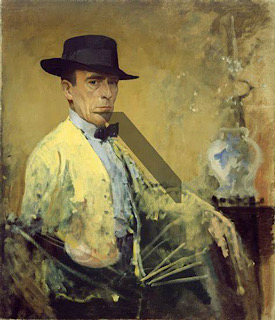
Whelan is awarded many prizes in the Royal Dublin Society (RDS) Taylor art competitions, including one in 1912 for a portrait of his sister Lena, entitled On the Moors, rendered in a strongly academic technique. In 1916, he wins the Taylor scholarship for the Royal Hibernian Academy (RHA) schools for his finest early work, The Doctor’s Visit, an adroitly executed composition of contrasting shadows and light. Typical of many of his genre interiors, the painting depicts a room in the family home, with relatives as models: Whelan’s mother sits by the bed watching over his ill cousin, while his sister, dressed in a Mater hospital nurse’s uniform, is in the background opening the door for the doctor. The subtly evoked atmosphere of restrained emotion foreshadowed a hallmark of his mature style.
Whelan exhibits annually at the RHA for forty-five years (1911–56), averaging six works per year. He is elected an RHA associate in 1920, becoming a full member in 1924. He participates in the Exposition d’art irlandais at the Galerie Barbazanges in Paris in 1922. A visiting teacher at the RHA schools in 1924, he also teaches in the DMSA for a time. He has studios at 64 Dawson Street (1914–27) and 7 Lower Baggot Street (1931–56). Beginning in the 1910s, he receives regular commissions for portraits, constituting his primary source of income. Having become the family’s main breadwinner following his parents’ deaths in the 1920s, he concentrates most of his production on this lucrative activity, portraying numerous leading figures in the spheres of politics, academia, religion, society, medicine, and law.
Situated securely in the academic tradition, in most of his portraits Whelan favours a sombre, restricted palette, with the sitter placed, in grave demeanour, against a monotone background with few accessories. In a 1943 interview he asserts that twentieth-century portraiture suffers from the drabness of modern costume, for which the artist must compensate by careful rendition of the subject’s hands. He tends to depart from his prevailing portrait style when painting women, whom he characteristically depicts in meticulously observed interiors, a notable example being his portrait of Society hostess Gladys Maccabe (c.1946; NGI).
Whelan’s commercial concentration on portraiture notwithstanding, he expresses his true talent in genre compositions, especially kitchen interiors, in which he emulates the technique of the Dutch painter Johannes Vermeer. Two of the most accomplished of these depict his sister Frances in the basement kitchen of the family home: The Kitchen Window (1927; Crawford Art Gallery, Cork) demonstrates a particularly skillful use of light, while Interior of a Kitchen (1935) is notable for the dexterous handling of objects of varied shapes and textures. His genre works include both urban and rural scenes, with a distinctive interest in portraying occupations and other activities. Gypsy (1923), an Orpenesque composition of a shawled woman in a west-of-Ireland landscape with a caravan in the background, receives wide contemporary critical acclaim. Jer (c.1925), depicting a man seated by the fire in a cottage interior, is reproduced in J. Crampton Walker’s Irish Art and Landscape (1927). The Fiddler (c.1932), a naturalistic, sensitively characterised study, is first shown at an Ulster Academy exhibition at Stranmillis, Belfast. A Kerry Cobbler is reproduced in Twelve Irish Artists (1940), introduced by Thomas Bodkin, as among the works denoting the development of a distinctively Irish school of painting.
In 1929, Whelan designs the first Irish Free State commemorative stamp, a portrait of Daniel O’Connell for the centenary of Catholic emancipation. Commissioned by the Thomas Haverty trust to paint an incident from the life of Saint Patrick for the 1932 Eucharistic Congress, he executes The Baptism by St. Patrick of Ethna the Fair and Fedelmia the Ruddy, Daughters of the Ard Rí Laoghaire, a work highly conservative in style. He rapidly completes an oil study of the papal legate, Lorenzo Lauri, also for the Eucharistic Congress. He is represented in the art competitions at the 1932 Summer Olympics in Los Angeles. His depiction of Saint Brigid, shown at the Academy of Christian Art exhibition (1940), becomes a familiar image owing to the wide circulation of reproductions.
Whelan’s political portraits are influential in creating a strong, assured image of the newly formed Irish state, and thus retain an historical significance. His posthumous portrait, The Late General Michael Collins, exhibited at the RHA in 1943 and now held in Leinster House, is an iconic, heroic image of the fallen leader. His portraits of Arthur Griffith and Kevin O’Higgins – commissioned posthumously, as is the Collins, by Fine Gael – also hang in Leinster House, while that of John A. Costello, exhibited at the RHA in 1949, is now held in the King’s Inns, Dublin. He paints two presidents, Douglas Hyde and Seán T. O’Kelly, both works currently in Áras an Uachtaráin. A portrait of Éamon de Valera, painted in 1955 when the sitter is Leader of the Opposition, is in Leinster House. In 1954, he designs a second commemorative stamp, picturing a reproduction of a portrait bust of John Henry Newman, to mark the centenary of the Catholic University of Ireland.
Whelan is elected an honorary academician of both the Ulster Academy of Arts (1931), and the Royal Ulster Academy (1950). He becomes a member of the United Arts Club in 1934. As a representative of the RHA, he sits on the board of governors of the National Gallery of Ireland for many years, and is on the advisory committee of the Municipal Gallery of Modern Art. Unmarried, he resides until his death at the Eccles Street address, with two sisters who continue to manage the family hotel. He dies on November 6, 1956, from leukemia at the Mater private nursing home in Dublin. He is buried in Glasnevin Cemetery.
(From: “Whelan, (Michael) Leo,” by Carmel Doyle, Dictionary of Irish Biography, http://www.dib.ie, October 2009)
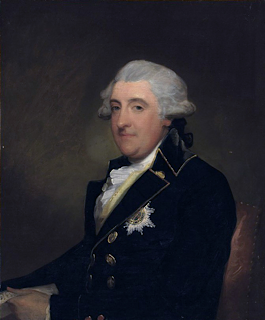
FitzGerald is born on March 13, 1749, in Arlington Place, Piccadilly, London, the second son of nine sons and ten daughters of James Fitzgerald, 20th Earl of Kildare and later 1st Duke of Leinster, and his wife, Lady Emily Lennox. He is educated at Eton College (1758–63). He is the elder brother of the 1790s revolutionary Lord Edward FitzGerald, and is a first cousin of the English liberal politician Charles James Fox.
In November 1775, FitzGerald marries Emilia Olivia Usher, daughter of the 1st Baron Saint George and Elizabeth Dominick and sole grand daughter of Sir Christopher Dominick. They have three sons and six daughters.
In 1770, FitzGerald is chosen Grandmaster of the masonicGrand Lodge of Ireland, a post he holds for two years. He is re-elected for another year in 1777. In 1783, he is among the first knights in the newly created Order of St. Patrick.
In 1788–89, FitzGerald is Master of the Rolls in Ireland. In theory a senior judicial office, it is then largely a sinecure, but so blatant a choice of a man who is wholly unqualified for it gives rise to unfavourable comment, and a few years later it becomes the rule that the Master must be a lawyer of repute.
FitzGerald’s homes are at Carton and Kilkea Castle in County Kildare, and at Leinster House in Dublin (now the home of the Oireachtas). He is a founder member of the Order of St. Patrick in 1783 and of the Royal Irish Academy in 1785, and is a large investor in the Royal Canal company launched in 1790. His family’s estates of 60,000 acres (25,000 Ha) in Kildare are in three main parts, around Maynooth, Rathangan and Athy. He rebuilds the main bridge in Athy over the River Barrow.
FitzGerald dies of strangury, a urinary tract disorder, at Carton House on October 20, 1804. He is buried in Kildare Abbey. His funeral is so well attended that the mourners reach across The Curragh. He is succeeded by his second, but eldest surviving, son, Augustus Frederick Fitzgerald, as 3rd Duke of Leinster.
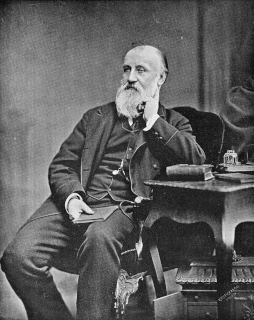
Stewart is born on December 16, 1825, the second of two sons of Charles Frederick Stewart of 6 Pitt Street (now Balfe Street), Dublin, librarian of King’s Inns. Nothing is known of his mother other than that she studies music with one of the Logier family, presumably the noted military musician and piano teacher Johann Bernhard Logier, a resident of Dublin from 1809.
Stewart is educated at Christ Church Cathedral school in Dublin, where he is a chorister. He begins to accompany choral services in his early teens, and in 1844 is appointed organist of Christ Church Cathedral and the Trinity College Dublin (TCD) chapel. In addition, in 1852 he becomes de facto organist of St. Patrick’s Cathedral, and holds all three positions concurrently for the rest of his life.
Stewart’s first conducting appointment is with the Dublin University Choral Society in 1846, to which he later adds similar appointments in Dublin, Bray, and Belfast. He is active as a teacher, both privately and from 1869 at the Royal Irish Academy of Music (RIAM), and as a critic with the Dublin Daily Express. On occupying the University of Dublin‘s chair of music in 1862, he takes steps to formalise requirements for the music baccalaureate, introducing examinations in a modern language, Latin (or a second modern language), English (literature and composition), arithmetic, and music history. As a result, though not until 1878, similar examinations are introduced at the University of Oxford and the University of Cambridge. In his professorial capacity he delivers in the 1870s public lectures on Bach, Handel, Wagner, church music, music education, organology, and, most notably, Irish music, in which he reveals an uncanny knowledge of the wire-strung harp and the uilleann pipes. He also contributes entries on Irish music and musicians to the first edition of George Grove‘s A Dictionary of Music and Musicians.
By all accounts, Stewart is a very adept musician, having perfect pitch, a formidable memory, and astonishing facility in transposition. Apparently an autodidact, he is the first Irish organist to cultivate pedal technique, while in the art of improvisation both Joseph Robinson and Sir John Stainer hold him to be the equal of Mendelssohn.
Intent on broadening his musical horizons, Stewart travels widely. From 1851 he is a regular visitor to London, and from 1857 makes frequent trips to Continental Europe, attending the Beethoven and Schumann festivals at Bonn in 1871 and 1873 respectively and Wagner’s first Bayreuth Festival in 1876. On the initiative of the Dublin University Choral Society, he is conferred with the simultaneous degrees of Mus.B. and Mus.D. at a special ceremony on April 9, 1851. On February 28, 1872, he is knighted at Dublin Castle by John Poyntz Spencer, 5th Earl Spencer, a social climb that Stewart, who has no independent income, can afford only by accumulating professional appointments and by relentless private teaching. In addition to successive townhouses in the vicinity of Merrion Square, he owns a smaller property on Bray Esplanade, named Holyrood.
Among Stewart’s compositions, his disciple James Culwick lists about forty part songs (of which several win prizes), more than twenty solo songs, fifteen anthems, several church services, a quantity of shorter liturgical music, and sixteen choral cantatas with orchestra. Three of the cantatas set texts by John Francis Waller: the 24-movement A Winter Night’s Wake (1858), The Eve of St. John (1860) and Inauguration Ode for the Opening of the National Exhibition of Cork (1852) for the opening of the Irish Industrial Exhibition in Cork. Other occasional pieces are Who Shall Raise the Bell? (The Belfry Cantata) for the inauguration of Trinity College campanile in 1854, Ode to Shakespeare (1870) for the Birmingham Triennial Music Festival, Orchestral Fantasia (1872) for the Boston Peace Festival, How Shall We Close Our Gates? (1873) for the Dublin Exhibition and Tercentenary Ode (1892) for the tercentenary of Trinity College Dublin.
Though Stewart destroys many of his works, his surviving music is consistently well crafted, and the rapid decline in the popularity of the odes is at least partly attributable to the tawdry and ephemeral character of their texts. Yet despite his esteem for Wagner, he never shakes off the conservative stylistic influences of Handel, Beethoven, and Mendelssohn, and the posthumous performance of his music has been restricted almost entirely to the Dublin cathedrals.
In August 1846 Stewart marries Mary Emily Browne, the daughter of Peter Browne of Rahins House, Castlebar, County Mayo. They have four daughters, of whom the eldest dies in 1858. Following Mary’s death on August 7, 1887, he marries on August 9, 1888, Marie Wheeler of Hyde, Isle of Wight, the daughter of Joseph Wheeler of Westlands, Queenstown (now Cobh).
Stewart dies in Dublin on March 24, 1894, and is buried at Mount Jerome Cemetery alongside his first wife and eldest daughter. Portraits of him are in the possession of the Dublin University Choral Society and the Royal Irish Academy of Music (RIAM), and his statue, erected on Leinster Lawn in 1898, still stands.
(From: “Stewart, Sir Robert Prescott” by Andrew Johnstone, Dictionary of Irish Biography, http://www.dib.ie, October 2009)
A series of riots in Dublin on February 25, 2006, is precipitated by a proposed march down O’Connell Street of a unionist demonstration. The disturbances begin when members of the Garda Síochána attempt to disperse a group of counterdemonstrators blocking the route of the proposed march. The situation escalates as local youths join forces with the counterdemonstrators.
The march of this group in Dublin is viewed as provocative by some Irish nationalists and many Irish republicans, particularly in the context of an Orange Order march. The Orange Order is accused of being a sectarian organisation known for its anti-Catholicism. The right to march is supported by the main Irish political parties and the march is authorised by the Garda Síochána. Love Ulster had organised a similar rally in Belfast in October 2005.
At previous FAIR rallies, a picture of an Ulster Volunteer Force (UVF) member who was allegedly involved in the murder of 26 people in Dublin in the 1974 Dublin and Monaghan bombings, and who was himself killed by the Provisional Irish Republican Army in 1976, had been displayed. An organiser of the Love Ulster demonstration tells a republican newspaper that he cannot guarantee that images of the murder suspect will not be displayed during the demonstration.
Sinn Féin, an Irish republican political party, does not organise a protest and says that the march should be allowed to go ahead, calling for republicans to ignore the march. Republican Sinn Féin, a splinter political party no longer affiliated with Sinn Féin, has an organised presence.
Their protest blocks the northeastern junction of O’Connell Street and Parnell Street. The small Republican Sinn Féin group (and some activists from the Irish Republican Socialist Party) are joined by several hundred local youths. Before the violence breaks out, they chant republican chants. Several thousand bystanders are also on the scene but take no part in the subsequent rioting. When the marchers form up at the top of Parnell Square and their bands begin to play in anticipation of the start of the march, gardaí attempt to disperse the protest at around 12:45 p.m. At this point, scuffles break out between protesters and Gardaí.
After the failure of the initial garda effort to disperse the protesters, the violence escalates. The Garda Public Order Unit is deployed, and stones and metal railings are thrown at gardaí by protesters, as are fireworks, bricks, crude petrol bombs, and other missiles. As the rioting continues, the ranks of the rioters are swelled by many local teenagers who had not taken part in the initial protest. Several barricades are constructed from building materials on the street to impede the march and the Gardaí. The march is due to start at 12:30 p.m., but as the violence goes on the gardaí decide against trying to escort the marchers through O’Connell Street. At about 1:30 p.m. the assembled marchers return to the coaches that had brought them to Dublin from Northern Ireland. The three coaches are then driven to Leinster House, where a small parade is carried out, and a letter is handed to Irish Minister for Justice, Michael McDowell. They are then escorted out of the city. One of the coaches is attacked by stone throwers on the way home.
Violence continues sporadically on O’Connell Street for another hour or so. The Gardaí, advancing from the northern end of the street gradually push the rioters back southward. The most sustained violence takes place around the General Post Office building, where the rioters initially sit down in protest and then, after several of them have been batoned, regroup behind burning barricades and throw rocks, paving slabs and one or possibly two petrol bombs at Gardaí. Several Gardaí, protesters and a number of journalists from RTÉ and TV3 are injured.
While the standoff on O’Connell Street is still going on, several hundred rioters follow the Unionist coaches to the Nassau Street area where they set a number of cars on fire and damage several businesses. Further skirmishes break out around the River Liffey at O’Connell Bridge, Aston Quay, Fleet Street and Temple Bar, as the Gardaí retake O’Connell street, before the rioters disperse.
Having dispersed the rioters, the gardaí then closes O’Connell Street to facilitate a cleanup of the scene by building workers. Media reports estimate the cost of the cleanup job at €50,000, and Dublin Chamber of Commerce places loss of earnings for businesses in the city due to the riots at €10,000,000.
Estimates for the number of unionist marchers before the event are predicted to be over 1,000. However, only eight coach loads turn up in Dublin, indicating a far smaller number, possibly 300 to 400. Estimates for the number of counterdemonstrators vary between 300 and 7,000. The number is made much more difficult to determine by the presence of the several thousand bystanders at the scene who do not take part. Most of the rioters appear to be local youths, though some who brandished leaflets and other political literature are clearly political activists.
A total of 14 people, including six gardaí and a small number of journalists and photographers, are hospitalised as a result of the rioting. A further 41 people are arrested, according to RTÉ news. As of February 27, 2006, thirteen have been charged. Twenty-six people are convicted in January 2009 for their part in the disturbances and given sentences of up to five years. Two are described as “alcoholics.” One of them and a teenage boy are “homeless.” Three are not Irish – a Georgian, a Romanian and a Moldovan are convicted of looting shops on O’Connell Street. Two have travelled from County Offaly, one from County Galway and one from County Donegal for the riot. All the rest come from Dublin.
(Pictured: The Public Order Unit on O’Connell Street during the 2006 Dublin Riots)
Davidson is the sixth of ten children of clerk of petty session, Edward Ellice Davidson, and Lucy Rising Davidson (née Doe). Her mother dies in 1888, and it is presumed that she receives a private education but as the family are not affluent, the details are unclear. She goes on to attend the Dublin Metropolitan School of Art (DMSA) from 1895 to 1905. While at the DMSA, she wins prizes in 1895 and 1896 and is awarded a scholarship and free studentship at the Royal Dublin Society (RDS) in 1897, the same year her father dies. She completes her studies in 1905. In the early 1910s, she is living in Rathmines and spends some time in England and Wales.
Davidson is commissioned by Switzer’s department store on Grafton Street to draw costumes in 1899. In 1909, her painting After Rain is exhibited by the Dublin Sketching Club, with her continuing to show work there until 1920. She exhibits The Bonfire with the Water Colour Society of Ireland in 1912, becoming a committee member in 1934 and continuing to exhibit with them until 1954. In 1914, she is one of the artists included in a sale of paintings to aid Belgian refugees. She is first exhibited at the Royal Hibernian Academy (RHA) in 1914, with The Student. Her painting exhibited by the RHA in 1916, The Harbour, St. Ives, demonstrates an influence from Stanhope Forbes and the Newlyn School, with a bright palette and contrasting illumination, which become characteristic of her work. She illustrates C. H. Bretherton’s collection of humorous poems and recollections about London Zoo, A Zoovenir (1919).
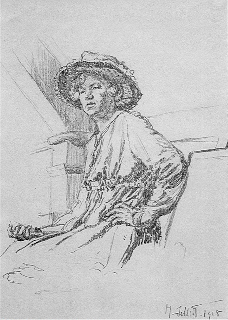
Davidson holds a joint exhibition with Mainie Jellett in 1920, at Mill’s Hall, Merrion Row, Dublin. Jellett produces a pencil portrait of Davison (pictured above), which shows her in a straw hat she frequently wears. The RHA exhibits Davidson’s oil painting, The Flax Pullers, in 1921. This work shows an influence from Paul Henry and French Impressionism in her use of colour-blocking. In the early 1920s, she travels to Switzerland, Belgium, and France, producing works such as Fish Market, Bruges. She lives in Paris in the late 1920s, exhibiting at the Salon de la Societé Nationale in 1924 and 1930. She places a self-portrait in her depiction of a peasant gathering, The Country Races. Reproductions of her drawing of Leinster House and Christ Church Cathedral by Bulmer Hobson are included in A Book of Dublin (1929). Her landscape, Low Tide, Wicklow, which is exhibited at the RHA in 1934, and Boats at Wicklow, Dusk show her ability to depict reflections in water. She continues to paint scenes of rural life, including Cottages – Keel, Achill, which shows an influence from Jack Butler Yeats in her use of space and colour. The fact that her family is not wealthy likely influences her choice of poorer people as her subjects, depicting them in a sympathetic manner. Her work is part of the painting event in the art competitions at the 1928 Summer Olympics.
Davidson’s paintings are exhibited at the Contemporary Picture Galleries, Dublin in 1930, alongside Yeats, Evie Hone, and Harry Kernoff. She is a member of the Picture Hire Club, 24 Molesworth Street, Dublin from 1941 to 1942, and is a frequent contributor to the Munster Fine Arts Club. Her work is exhibited at the Salon des Beaux Arts, Paris, the Royal Academy of Arts, London, and in Amsterdam. A large number of her works from the 1930s show the Irish-speaking area of Galway, Claddagh, such as Night in Claddagh, exhibited with the RHA in 1933. Her Irish landscapes, such as Claddagh Cottages, are included in the Oireachtas Art Exhibitions from 1932 to 1946. From around 1934, she is a member of the Society of Dublin Painters, exhibiting with them from 1939 to 1954. She influences the Society’s move toward the avant-garde in the 1940s. She is elected associate to the RHA in 1940 and continues to exhibit there until her death. Her 1946 work, Gorta, shows influence from Zola, Rilke, Dostoyevsky and Picasso.
Davidson teaches drawing at her studio at 1 Earlsfort Terrace, Dublin. Her pupils include Bea Orpen, Anne Yeats, and Mo Irwin. She also is a teacher at a number of Dublin schools, such as Belgrave school, Rathmines, Wesley College, St. Stephen’s Green, and Castle Park School, Dalkey. She travels to Abbeyleix, County Laois, once a week to teach at Glenbawn boarding school.
As well as painting, Davidson writes a number of plays, short stories, and monologues under a pseudonym, “Ulick Burke.” In 1927, a collection of her poems and Donegal rhymes is published. In 1931, Hilton Edwards directs her stage play Bride, at the Gate Theatre. Her short story, Her Only Son, is published in The Bell under a pseudonym in 1942. In 1935, she is a founder-member of the Torch Theatre, Dublin. She designs scenery, and is the co-director with Hugh Hyland in 1936, under the stage name “Jennifer Maude.”
Davidson dies at her home at 4 Wilton Terrace, Dublin on March 29, 1954. She is buried in an unmarked grave in Mount Jerome Cemetery. The National Gallery of Ireland (NGI) holds her 1938 portrait of Yeats, as well as her crayon drawing of Sarah Purser. She is a regular attendee at Purser’s “Second Tuesdays” gatherings. The Abbey Theatre holds her portrait of Joseph Holloway. She bequeaths The Golden Shawl to the Hugh Lane Gallery, which is a large self-portrait. Two of her works are included in the NGI’s 1987 exhibition, Irish Women Artists from the Eighteenth Century to the Present Day.
Blaney is first elected to Dáil Éireann for the Donegal East constituency in a by-election in December 1948, following the death of his father from cancer. He also becomes a member of the Donegal County Council. He remains on the backbenches for a number of years before he is one of a group of young party members handpicked by Seán Lemass to begin a re-organisation drive for the party following the defeat at the 1954 Irish general election. Within the party he gains fame by running the party’s by-election campaigns throughout the 1950s and 1960s. His dedicated bands of supporters earn the sobriquet “the Donegal Mafia,” and succeed in getting Desmond O’Malley and Gerry Collins elected to the Dáil.
Following Fianna Fáil’s victory at the 1957 Irish general election, Éamon de Valera, as Taoiseach, brings new blood into the Cabinet in the shape of Blaney, Jack Lynch, Kevin Boland and Mícheál Ó Móráin. Blaney is appointed Minister for Posts and Telegraphs however he moves to the position of Minister for Local Government at the end of 1957 following the death of Seán Moylan. He retains the post when Lemass succeeds de Valera as Taoiseach in 1959. During his tenure it becomes possible to pay rates by installment and he also introduces legislation which entitles non-nationals to vote in local elections.
In 1966 Lemass resigns as Taoiseach and Fianna Fáil leader. The subsequent leadership election sees Cork politician Jack Lynch become party leader and Taoiseach. In the subsequent cabinet reshuffle Blaney is appointed Minister for Agriculture and Fisheries.
In 1969, when conflict breaks out in Northern Ireland, Blaney is one of the first to express strong Irish republican views, views which contradict the policy of the Irish Government, in support of Northern nationalists. From around late 1968 onwards, he forms and presides over an unofficial Nationalist group in Leinster House popularly known as “the Letterkenny Table.” The group is dominated by Blaney up until his death.
There is general surprise when, in an incident known as the Arms Crisis, Blaney, along with Charles Haughey, is sacked from Lynch’s cabinet amid allegations of the use of the funds to import arms for use by the IRA. Lynch asks for their resignations but both men refuse, saying they did nothing illegal. Lynch then advises President de Valera to sack Haughey and Blaney from the government. Haughey and Blaney are subsequently tried in court but are acquitted. However, many of their critics refuse to recognise the verdict of the courts. Although Blaney is cleared of wrongdoing, his ministerial career is brought to an end.
Lynch subsequently moves against Blaney so as to isolate him in the party. When Blaney and his supporters try to organise the party’s national collection independently, Lynch acts and in 1972 Blaney is expelled from Fianna Fáil for “conduct unbecoming.”
Following his expulsion from Fianna Fáil, Kevin Boland tries to persuade Blaney to join the Aontacht Éireann party he is creating but Blaney declines. Instead, he contests all subsequent elections for Independent Fianna Fáil – The Republican Party, an organisation that he built up. Throughout the 1970s there are frequent calls for his re-admittance to Fianna Fáil but the most vocal opponents of this move are Fianna Fáil delegates from County Donegal.
Thomas Pelham, the Chief Secretary for Ireland, introduces a bill for the foundation of a Catholic college, and this is enacted by parliament. It is built to hold up to 500 students for the Catholic priesthood of whom up to 90 are to be ordained each year. It is once the largest seminary in the world.
The town of Maynooth is the seat of the FitzGeralds, Earls of Kildare. The ivy-covered tower attached to St. Mary’s Church of Ireland is all that remains of the ancient college of St. Mary of Maynooth, founded and endowed by Gerald FitzGerald, 8th Earl of Kildare, and dedicated to the Blessed Virgin Mary. On October 7, 1515, Henry VIII grants licence for the establishment of a college. In 1518, the 9th Earl presents a petition to the Archbishop of Dublin, William Rokeby, for a license to found and endow a college at Maynooth, the College of the Blessed Virgin Mary. In 1535 the college is suppressed and its endowments and lands confiscated as part of the Reformation.
The present college is created in the 1790s against the background of the upheaval during the French Revolution and the gradual removal of the penal laws. The college is particularly intended to provide for the education of Catholic priests in Ireland, who until this Act had to go to Continental Europe for their formation and theological education. Many are educated in France, and the church and government are concerned at the Dechristianization of France during the French Revolution, and at the same time at the risk of revolutionary thinking arising from training in revolutionary France. A number of the early lecturers in Maynooth, are exiles from France. Also among the first professors is a layman, James Bernard Clinch, recommended by Edmund Burke. Also relevant is the enactment of the Roman Catholic Relief Act 1793.
The college is legally established on June 5, 1795, by the Maynooth College Act 1795 as The Royal College of St. Patrick, by act of the Parliament of Ireland, to provide “for the better education of persons professing the popish or Roman Catholic religion.” The college is originally established to provide a university education for Catholic lay and ecclesiastical students, the lay college is based in Riverstown House on the south campus from 1802. With the opening of Clongowes Wood College in 1814, the lay college is closed and the college functions solely as a Catholic seminary for almost 150 years.
In 1800, John Butler, 12th Baron Dunboyne, dies and leaves a substantial fortune to the college. Butler had been a Roman Catholic, and Bishop of Cork, who had embraced Protestantism in order to marry and guarantee the succession to his hereditary title. However, there are no children to his marriage, and it is alleged that he had been reconciled to the Catholic Church at his death. Were this the case, a Penal Law demands that the will is invalid, and his wealth is to pass to his family. Much litigation follows before a negotiated settlement in 1808 that leads to the establishment of a Dunboyne scholarship fund.
The land is donated by William FitzGerald, 2nd Duke of Leinster, who had argued in favour of Catholic emancipation in the Irish House of Lords. He lives nearby at Carton House and also at Leinster House. The building work is paid for by the British Government with the parliament continuing to give it an annual grant until the Irish Church Act 1869. When this law is passed the college receives a capital sum of £369,000. The trustees invest 75% of this in mortgages to Irish landowners at a yield of 4.25% or 4.75% per annum. This is considered a secure investment at the time but agitation for land reform and the depression of the 1870s erodes this security. The largest single mortgage is granted to the Earl of Granard. Accumulated losses on these transactions reaches £35,000 by 1906.
The first building to go up on the site is designed by, and named after, John Stoyte. Stoyte House, which can still be seen from the entrance to the old campus, is a well-known building to Maynooth students and stands very close to the very historic Maynooth Castle. Over the next 15 years, the site at Maynooth undergoes rapid construction so as to cater for the influx of new students, and the buildings which now border St. Joseph’s Square (to the rear of Stoyte House) are completed by 1824.
The Rev. Laurence F. Renehan (1797–1857), a noted antiquarian, church historian, and cleric, serves as president of St. Patrick’s from 1845 until 1857. Under Renehan, many of the college’s most important buildings are constructed by Augustus Pugin.
In 1876, the college becomes a constituent college of the Catholic University of Ireland, and later offers Royal University of Ireland degrees in arts and science. Even after the granting of the Pontifical Charter in 1896 the college becomes a recognised college of the National University of Ireland in 1910, and from this time its arts and science degrees are awarded by the National University of Ireland. However, during this time the Pontifical University of Maynooth continues to confer its degrees in theology, because until 1997 theology degrees are prohibited by the Royal University of Ireland and its successor the National University of Ireland.
In 1997, the Universities Act, 1997 is passed by the Oireachtas. Chapter IX of the Act provides for the creation of the separate Maynooth University. This new university is created from the college’s faculties of Arts, Celtic Studies and Philosophy, and Science.
In 1994, W. J. Smyth had been appointed to the position of Master of St. Patrick’s College Maynooth (NUI). In 1997, this position is converted into President of Maynooth University. After his 10-year term ends in 2004, he is replaced by John Hughes as president of Maynooth University and a new line of heads for the college.
By 2016, the number of resident seminarians has dropped from several hundreds to just 40 to 60. In August 2016, it is revealed that, due to frequent use of Grindr by college students, the then Archbishop of DublinDiarmuid Martin decides to transfer the students from his diocese to the Irish Pontifical College in Rome. According to Martin, “there are allegations on different sides,” one of which of an “atmosphere that was growing in Maynooth” of a “homosexual, a gay culture, that students have been using an app called Grindr,” which “would be fostering promiscuous sexuality, which is certainly not in any way the mature vision of sexuality one would expect a priest to understand.” Subsequently, the college trustees order a review of the college’s policy on social media use.
Lee is married to Mary Lee (née Kitson) and they have two children, Alison and Harry, and live in Cabinteely. He famously travels to work at RTÉ using a Segway, once giving it a test ride live on Tubridy Tonight.
Lee joins the civil service as an executive officer in the Central Statistics Office (CSO). Two years later he enters University College Dublin where he studies economics under academics such as Brendan Walsh and Peter Neary.
Prior to his move into broadcasting, Lee lectures at NUI Galway and then works as a journalist with The Sunday Business Post. He is also a Senior Economist at Riada Stockbrokers. He also works as Treasury Economist with FTI and as a research economist with the Central Bank of Ireland.
From 1992 to 2009 Lee worked at RTÉ, the public broadcasting service of Ireland. He is appointed Economics Editor with RTÉ in 1996. He is named Irish Journalist of the Year, along with Charlie Bird, in 1998 after they uncover a major tax evasion and overcharging scandal at National Irish Bank. He has devised, researched and presented several television series, including Moneybox, More to Do, Winds of Change, and Beyond the Berlin Wall. He is thought of as an “economics guru.” He leaves RTÉ in the late 1990s to work for BCP Stockbrokers. He leaves the job and returns to his RTÉ post the next day.
Before embarking on his political career, Lee films a four-part series based on the fall of the Berlin Wall in 2008. It is aired on RTÉ One in November 2009.
Lee is parodied in the 1990s comedy Bull Island, where he is seen “menacingly staring down the lens of a camera,” and is also featured on RTÉ 2fm‘s Nob Nation.
On May 5, 2009, on RTÉ News at One on RTÉ Radio 1, Lee announces that he is resigning as Economic Editor with RTÉ and announces his intention to seek the Fine Gael nomination for the Dublin Southby-election in 2009. He takes a year’s unpaid leave from RTÉ in May 2009. On May 6, 2009, he is chosen as the Fine Gael candidate for the by-election. He is the only candidate for the nomination.
Lee is elected on the first count to represent Dublin South on June 6, 2009. He receives over 53% of the 1st preference vote. In total he receives 27,768 1st preference votes. When elected, he is referred to as a “Celebrity TD.” His RTÉ position is filled by Europe editor Sean Whelan, but only as correspondent. Instead, David Murphy is promoted to Business Editor.
Lee highlights the failure of EMPG, the holding company for U.S. publisher Houghton Mifflin Harcourt, and the potential impact on the Irish taxpayers of the loans given by Anglo Irish Bank to the investors in EMPG on January 13, 2010. He sees this as another example for the urgent need of an investigation into the Irish banking crisis.
On February 8, 2010, Lee announces his resignation from Fine Gael and from Dáil Éireann, due to having “virtually no influence or input” into shaping Fine Gael’s economic policies at a time of economic upheaval. It emerges that on February 2, he met with the Fine Gael leader Enda Kenny and told him of his intention to resign. Kenny then offered Lee the frontbench position as spokesman on economic planning. Speaking to reporters outside Leinster House soon after his announcement, Lee says it would have been dishonest of him to accept the position. “I had absolutely no input for nine months. I think I had to be honest with myself and honest with the electorate about that and not pretend.” Asked if his resignation is a vote of no confidence in Kenny, he says there are “certainly lots of large mutterings at the moment in relation to the leader’s position.” He says he had “minimal involvement” with Fine Gael finance spokesman Richard Bruton.
Kenny notes Lee had been appointed chair of the party’s committee on economic policy and also its forum. “I had anticipated a very important role for [George Lee] in the coming period with Fine Gael.” Kenny’s spokesman later dismisses the proposition that the resignation had implications for his leadership. He cited the public endorsement of Kenny by 20 Dáil deputies over the course of the weekend. Former Fine Gael leader Michael Noonan says he is surprised at the decision. “I thought that George Lee was fitting in well,” adding that he believes he would have been a cabinet member in a Fine Gael-led government.
Lee is criticised after his resignation by Senator Eoghan Harris, who is speaking on the Lunchtime programme of Newstalk Radio. Harris suggests financial considerations and long working hours of politicians are the reasons for Lee’s resignation. Fine Gael TDBrian Hayes, who is Lee’s campaign manager in the Dublin South by-election, says that in discussions with Lee, the latter had complained about “a major reduction in his income” since leaving RTÉ to become a Dáil backbencher. Lee denies that financial considerations had anything to do with his decision to quit politics.
RTÉ receives a letter from Lee confirming his intentions to return after his leave of absence. The Sunday Tribune says on February 14, 2010, that he will have to wait for three months before returning to RTÉ. Exactly a year after leaving RTÉ, he returns to the broadcaster on May 5, 2010. He works as an advisor on the RTÉ business desk. He presents Mind Your Business on RTÉ Radio 1 on Saturday Mornings as a summer replacement for The Business.
When John Murray moves to present his own programme, Lee takes over The Business slot on September 4, 2010, on Saturday mornings on RTÉ Radio 1. In addition to the radio edition, he has presented a televised version on RTÉ One, also titled The Business.
Lee has been Environment Correspondent for RTÉ since June 27, 2019.
Ó Brádaigh is born into a middle-class republican family. His father, Matt Brady, is an IRA volunteer who is severely wounded in an encounter with the Royal Irish Constabulary (RIC) in 1919. His mother, May Caffrey, is a Cumann na mBan volunteer and a 1922 graduate of University College Dublin (UCD). His father dies when he is ten and is given a paramilitary funeral led by his former IRA colleagues. His mother, prominent as the Secretary for the County Longford Board of Health, lives until 1974. He is educated at Melview National School at primary level and attends secondary school at St. Mel’s College, leaving in 1950, and graduates from University College Dublin in 1954. That year he takes a job teaching Irish language at Roscommon Vocational School in Roscommon. He is a deeply religious Catholic who refrains from smoking or drinking.
Ó Brádaigh joins Sinn Féin in 1950. While at university, in 1951, he joins the Irish Republican Army. In September 1951, he marches with the IRA at the unveiling of the Seán Russell monument in Fairview Park, Dublin. A teacher by profession, he is also a Training Officer for the IRA. In 1954, he is appointed to the Military Council of the IRA, a subcommittee set up by the IRA Army Council in 1950 to plan a military campaign against Royal Ulster Constabulary (RUC) barracks in Northern Ireland.
On August 13, 1955, Ó Brádaigh leads a ten-member IRA group in an arms raid on Hazebrouck Barracks, near Arborfield, Berkshire, England, a depot for the No. 5 Radar Training Battalion of the Royal Electrical and Mechanical Engineers. It is the biggest IRA arms raid in Britain. Most, if not all, of the weapons are recovered in a relatively short period of time. A van, traveling too fast, is stopped by the police and IRA personnel are arrested. Careful police work leads to weapons that had been transported in a second van and stored in London.
The IRA Border Campaign commences on December 12, 1956. As an IRA General Headquarters Staff (GHQ) officer, Ó Brádaigh is responsible for training the Teeling Column in the west of Ireland. During the Campaign, he serves as second-in-command of the Teeling Column. On December 30, 1956, he partakes in the Teeling Column attack on RUC barracks in Derrylin, County Fermanagh. RUC Constable John Scally is killed in the attack and is the first fatality of the new IRA campaign. Ó Brádaigh and others are arrested by the Garda Síochána across the border in County Cavan the day after the attack. They are tried and jailed for six months in Mountjoy Prison. A leading abstentionist, upon his arrest he refuses to recognize the authority of the Irish government and refuses to renounce violence in exchange for his release.
Upon completing his prison sentence, Ó Brádaigh is immediately interned at the Curragh Camp along with other republicans. On September 27, 1958, he escapes from the camp along with Dáithí Ó Conaill. While a football match is in progress, the pair cuts through a wire fence and escapes from the camp under a camouflage grass blanket. This is an official escape, authorised by the officer commanding (OC) of the IRA internees, Tomás Óg Mac Curtain. He is the first Sinn Féin TD on the run since the 1920s.
In October 1958, Ó Brádaigh becomes the IRA Chief of Staff, a position he holds until May 1959, when Seán Cronin is elected as his replacement. He is arrested in November 1959, refuses to answer questions, and is jailed in Mountjoy Prison under the Offences against the State Act. He is released in May 1960 and, after Cronin is arrested, again becomes Chief of Staff. Although he always emphasises that it is a collective declaration, he is the primary author of the statement ending the IRA Border Campaign in 1962. At the IRA 1962 Convention he indicates that he is not interested in continuing as Chief of Staff.
After Ó Brádaigh’s arrest in December 1956, he takes a leave from teaching at Roscommon Vocational School. He is re-instated and begins teaching again in late 1962, just after he is succeeded by Cathal Goulding in the position of Chief of Staff of the IRA. He remains an active member of Sinn Féin and is also a member of the IRA Army Council throughout the decade.
Ó Brádaigh opposes the decision of the IRA and Sinn Féin to drop abstentionism and to recognise the Westminster parliament in London, the Stormont parliament in Belfast and the Leinster House parliament in 1969/1970. On January 11, 1970, along with Seán Mac Stíofáin, he leads the walkout from the 1970 Sinn Féin Ard Fheis after the majority votes to end the policy of abstentionism, although the vote to change the Sinn Féin constitution fails to receive the required two-thirds majority. The delegates who walk out reconvene at the Kevin Barry Hall in Parnell Square, Dublin, and establish Provisional Sinn Féin.
Ó Brádaigh is voted chairman of the Caretaker Executive of Provisional Sinn Féin. That October, he formally becomes president of the party. He holds this position until 1983. In his presidential address to the 1971 Provisional Sinn Féin Ard Fheis, he says that the first step to achieving a United Ireland is to make Northern Ireland ungovernable. He apparently also serves on the Army Council or the executive of the Provisional Irish Republican Army until he is seriously injured in a car accident on January 1, 1984.
On May 31, 1972, Ó Brádaigh is arrested under the Offences Against the State Act and immediately commences a hunger strike. A fortnight later the charges against him are dropped and he is released. With Dáithí Ó Conaill he develops the Éire Nua policy, which is launched on June 28, 1972. The policy calls for a federal Ireland.
On December 3, 1972, Ó Brádaigh appears on the London Weekend TelevisionWeekend World programme. He is arrested by the Gardaí again on December 29, 1972, and charged in the newly established Special Criminal Court with Provisional IRA membership. In January 1973 he is the first person convicted under the Offences Against the State (Amendment) Act 1972 and is sentenced to six months in the Curragh Camp.
On December 10, 1974, Ó Brádaigh participates in the Feakle talks between the IRA Army Council and Sinn Féin leadership and the leaders of the Protestant churches in Ireland. Although the meeting is raided and broken up by the Gardaí, the Protestant churchmen pass on proposals from the IRA leadership to the British government. These proposals call on the British government to declare a commitment to withdraw, the election of an all-Ireland assembly to draft a new constitution and an amnesty for political prisoners.
The IRA subsequently calls a “total and complete” ceasefire intended to last from December 22, 1974, to January 2, 1975, to allow the British government to respond to proposals. British government officials also hold talks with Ó Brádaigh in his position as president of Sinn Féin from late December to January 17, 1975.
On February 10, 1975, the IRA Army Council, unanimously endorses an open-ended cessation of IRA “hostilities against Crown forces,” which becomes known as the 1975 truce. The IRA Chief of Staff at the time is Seamus Twomey of Belfast. It is reported in some quarters that the IRA leaders mistakenly believe they had persuaded the British Government to withdraw from Ireland and the protracted negotiations between themselves and British officials are the preamble to a public declaration of intent to withdraw. In fact, as British government papers now show, the British entertain talks with the IRA in the hope that this would fragment the movement further and score several intelligence coups during the talks. This bad faith embitters many in the republican movement, and another ceasefire does not happen until 1994.
In late December 1976, along with Joe Cahill, Ó Brádaigh meets two representatives of the Ulster Loyalist Central Co-ordinating Committee (ULCCC), John McKeague and John McClure, at the request of the latter body. Their purpose is to try to find a way to accommodate the ULCCC proposals for an independent Northern Ireland with the Sinn Féin’s Éire Nua programme. It is agreed that if this can be done, a joint Loyalist-Republican approach can then be made to request the British government to leave Ireland. Desmond BoalQC and Seán MacBrideSC are requested and accepted to represent the loyalist and republican positions. For months they have meetings in various places including Paris. The dialogue eventually collapses when Conor Cruise O’Brien, then Minister for Posts and Telegraphs and vociferous opponent of the Provisional IRA, becomes aware of it and condemns it on RTÉ Radio. As the loyalists had insisted on absolute secrecy, they feel unable to continue with the talks as a result.
In the aftermath of the 1975 truce, the Ó Brádaigh/Ó Conaill leadership comes under severe criticism from a younger generation of activists from Northern Ireland, headed by Gerry Adams, who becomes a vice-president of Sinn Féin in 1978. By the early 1980s, Ó Brádaigh’s position as president of Sinn Féin is openly under challenge and the Éire Nua policy is targeted in an effort to oust him. The policy is rejected at the 1981 Sinn Féin Ard Fheis and finally removed from the Sinn Féin constitution at the 1982 Ard Fheis. At the following year’s Ard Fheis, Ó Brádaigh and Ó Conaill resign from their leadership positions, voicing opposition to the dropping of the Éire Nua policy by the party.
On November 2, 1986, the majority of delegates to the Sinn Féin Ard Fheis vote to drop the policy of abstentionism if elected to Dáil Éireann, but not the British House of Commons or the Northern Ireland parliament at Stormont, thus ending the self-imposed ban on Sinn Féin elected representatives from taking seats at Leinster House. Ó Brádaigh and several supporters walk out and immediately assemble at Dublin’s West County Hotel and set up Republican Sinn Féin (RSF). As an ordinary member, he had earlier spoken out against the motion (resolution 162) in an impassioned speech. The Continuity IRA becomes publicly known in 1996. Republican Sinn Féin’s relationship with the Continuity IRA is similar to the relationship between Sinn Féin and the Provisional IRA when Ó Brádaigh was Sinn Féin’s president.
Ó Brádaigh believes RSF to be the sole legitimate continuation of the pre-1986 Sinn Féin, arguing that RSF has kept the original Sinn Féin constitution. RSF readopts and enhances his Éire Nua policy. His party has electoral success in only a few local elections.
Ó Brádaigh remains a vociferous opponent of the Good Friday Agreement, viewing it as a programme to copperfasten Irish partition and entrench sectarian divisions in the north. He condemns his erstwhile comrades in Provisional Sinn Féin and the Provisional IRA for decommissioning weapons while British troops remain in the country. In his opinion, “the Provo sell-out is the worst yet – unprecedented in Irish history.” He condemns the Provisional IRA’s decision to seal off a number of its arms dumps as “an overt act of treachery,” “treachery punishable by death” under IRA General Army Order Number 11.
In July 2005, Ó Brádaigh hands over a portion of his personal political papers detailing discussions between Irish Republican leaders and representatives of the British Government during 1974–1975 to the James Hardiman Library, National University of Ireland, Galway.
In September 2009, Ó Brádaigh announces his retirement as leader of Republican Sinn Féin. His successor is Des Dalton. He is also a long-standing member of the Celtic League, an organization which fosters cooperation between the Celtic people and promotes the culture, identity and eventual self-determination for the people, in the form of six sovereign states, for the Celtic nations – Wales, Cornwall, Brittany, Scotland, Isle of Man and Ireland.
After suffering a period of ill-health, Ó Brádaigh dies on June 5, 2013, at Roscommon County Hospital. His funeral is attended by 1,800 mourners including Fine Gael TD Frank Feighan and is policed by the Garda Emergency Response Unit and Gardaí in riot gear, for “operational reasons,” a show of force believed to have been to deter the republican tradition of firing a three-volley salute of shots over the final place of rest during the graveyard oration. As a result, there are some minor scuffles between gardai and mourners.





 seamus dubhghaill