seamus dubhghaill

Promoting Irish Culture and History from Little Rock, Arkansas, USA


Leave a comment

Birth of David Ford, Northern Irish Politician

David Ford, former Northern Irish politician, is born on February 24, 1951, to Irish and Welsh parents in Orpington, Kent, England. He serves as leader of the Alliance Party of Northern Ireland from October 2001 until October 2016 and is Northern Ireland Minister of Justice from April 2010 until May 2016. He is a Member of the Northern Ireland Assembly (MLA) for South Antrim from 1998 to 2018.

Ford is educated at Warren Road Primary School, Orpington, and Dulwich College, London. He spends summer holidays on his uncle’s farm in Gortin, County Tyrone, and moves to Northern Ireland permanently in 1969 when he goes to study Economics at Queen’s University Belfast (QUB). There he joins the university’s student Alliance Party grouping. After graduating, he takes a year out to work as a volunteer at the ecumenical Corrymeela Community in Ballycastle, County Antrim, before starting work as a social worker in 1973.

Ford stands unsuccessfully for Antrim Borough Council in 1989 and enters politics full-time when he becomes general secretary of the Alliance Party. In that role, he is best known as a strong supporter of the then-leader John Alderdice and an advocate of better political organisation and community politics. He is elected to Antrim Borough Council in 1993, 1997 and – after leaving the Council in 2001 to concentrate on Assembly business – again in 2005.

In 1996, Ford stands unsuccessfully for election to the Northern Ireland Forum in South Antrim. In 1997, he obtains 12% of the vote in the general election in South Antrim, and in 1998 is elected to the Northern Ireland Assembly in the constituency of the same name. He sought South Antrim again in the 2000 South Antrim by-election and in the 2001 and 2005 United Kingdom general elections.

In 2001, Seán Neeson resigns from the Party leadership following poor election results. Ford wins the leadership election on October 6 by 86 votes to 45, ahead of Eileen Bell.

Ford gives Alliance a stability which it has lacked since the departure of John Alderdice, but the Party has declined seriously in the late 1990s and all he can do is stabilise the situation. Within a month of taking over the leadership, however, he has a chance to establish Alliance’s relevancy in the post-Good Friday Agreement environment. On November 6, 2001, the Northern Ireland Executive is to be re-established. Due to defections within his own Ulster Unionist Party (UUP), First Minister David Trimble has insufficient support within the Unionist bloc in the Assembly to be re-elected to his post. Ford and two of his five colleagues re-designate as Unionist for just 22 minutes in order to secure Trimble’s position and thereby enable the devolved institutions to operate for another year. However, Alliance fails to make any political gains from their move, and the UUP and Sinn Féin fail to reach agreement on the decommissioning issue, ensuring that the institutions collapse again in October 2002.

In the 2003 Northern Ireland Assembly election, Ford’s seat in the Assembly is perceived to be under severe threat from Sinn Féin’s Martin Meehan, with many commentators expecting him to lose it. However, his expertise in nuts-and-bolts electioneering stands him in good stead. Although Alliance’s vote almost halved, his own vote in South Antrim increases from 8.6% to 9.1%. Meehan’s vote increases dramatically, from 7.3% to 11.5%, and he starts the election count ahead. Ford has much greater transfer appeal and finishes 180 votes ahead of Meehan at the end of a dramatic three-way fight for the last two seats, with Thomas Burns of the Social Democratic and Labour Party (SDLP) just 14 votes ahead of Ford. Despite the dramatic fall in vote, Alliance holds on to its six seats in the Assembly, which remains suspended.

In 2004, Ford makes good his leadership election pledge to work with other parties, as Alliance joins with the Workers’ Party, Northern Ireland Conservatives and elements of the Northern Ireland Women’s Coalition to support Independent candidate John Gilliland in the European elections, achieving the best result for the centre ground for 25 years.

Ford’s greatest triumph comes in the 2007 Northern Ireland Assembly election, when the party achieves its highest vote share since Alderdice’s departure and picks up a seat in what is an otherwise poor election for the moderates. Despite media predictions once again of his demise, Ford himself is elected third in South Antrim, with over 13% of the poll.

On April 12, 2010, Ford is chosen by the Assembly to become Northern Ireland’s first Justice Minister in 38 years. He is supported in the Assembly by the Democratic Unionist Party (DUP), Sinn Féin, the Alliance Party, the Green Party and the Progressive Unionist Party (PUP). Separate candidates for the position are put forward by both the UUP and the SDLP, being Danny Kennedy and Alban Maginness respectively.

In the 2011 Northern Ireland Assembly election, the Alliance Party manages to increase their vote by 50% gaining an extra seat in Belfast East and surpassing the UUP in Belfast.

Ford announces his resignation as Leader in October 2016 on the fifteenth anniversary of his election as leader noting, “The team is working well, and I think it’s an appropriate time to hand over to a new leader who will lead the party forward in the next stage of its development and growth.”

Ford and his wife Anne have four grown children and live in rural County Antrim. Until the spring of 2013, he is an elder in the Second Donegore congregation of the Presbyterian Church in Ireland. He is removed from his role as a ruling elder over differences with fellow congregants on the subject of same-sex marriage. In a 2016 interview he says he is still hurt by the decision by his fellow elders who chose not to work with him because of his support for equal marriage. “It saddened me that there was, if I may put it, a lack of understanding from some people about the role I had as a legislator, compared to the role I have within the church.”


Leave a comment

The Irish Republican Army Announces Arms Dump Inspections

The Irish Republican Army (IRA) announces a fresh inspection of hidden arms dumps by international monitors on October 26, 2000, as British Prime Minister Tony Blair holds talks in Northern Ireland to bolster the British province’s shaky peace accord.

Blair urges Protestant waverers to keep the Good Friday Agreement alive and insists that IRA disarmament, which the pro-British unionists are demanding, is “part of the agreement.”

Britain says two monitors, former President of Finland Martti Ahtisaari and South African Cyril Ramaphosa, have reported to the province’s disarmament commission. “We and the Irish government understand from the decommissioning commission that a second inspection of IRA dumps has now taken place, and they have received a report to that effect from President Ahtisaari and Mr. Ramaphosa,” a Northern Ireland Office statement says.

The IRA discloses the inspection, aimed to show that arms from its long anti-British war are no longer being used, as tension grows ahead of a crucial October 28 conference of the Protestant Ulster Unionist Party (UUP). “We specifically announced that we would repeat the inspection of a number of arms dumps by third parties to confirm that our weapons are secure,” the IRA says. “We now wish to confirm that this re-inspection has taken place and thank those involved for their co-operation.”

Ramaphosa and Ahtisaari first examine arms stockpiles in June 2000.

The IRA is observing a ceasefire following a 30-year war against British rule in Northern Ireland.

U.S. President Bill Clinton joins Britain and Ireland in applauding the IRA’s decision that it will permit a fresh look at some of its hidden arsenal.

However, as Blair arrives three bomb alerts underline the fragility of a peace that has been shaken by sporadic attacks by armed dissidents who oppose the 1998 Good Friday Agreement. A detective escapes injury when a bomb under his car fails to explode in a carpark at Antrim, north Belfast. A police spokesman blames Protestant “loyalist paramilitaries.” Army bomb experts also deal with two “suspicious objects” found in other parts of the province, police say.

Blair’s visit is seen as a bid to garner support for First Minister David Trimble, who is under pressure from within his Ulster Unionist Party over his decision to share power with Sinn Féin, even though the IRA has not disarmed.

Blair appeals to unionists ahead of their conference not to squander the accord’s hard-won political advances. He warns that disarmament will be out of reach if the coalition falls. “This is the only way forward for the future. If the Executive collapses and the Assembly then collapses, which must automatically happen, you don’t have a process at all, you don’t have decommissioning,” he tells reporters.

Confirmation of the second inspection is seen as a lift for the peace process which might ease pressure on Trimble.

UUP hardliners on Saturday, October 28, plan to urge grassroots members to back their demand for Trimble to pull out of the ruling coalition by November 30 if the IRA has not disarmed by that time. However, Trimble, at a news conference, dismisses the five-week deadline as “a crude device.”

(From: “IRA confirms arms dump inspections,” CNN.com, October 26, 2000 | Pictured: David Trimble, Seamus Mallon and Tony Blair at Stormont. Photograph: Eric Luke/The Irish Times)


Leave a comment

Birth of Arlene Foster, Northern Ireland Politician & Broadcaster

Arlene Isobel Foster (née Kelly), Baroness Foster of Aghadrumsee, DBE, PC, British broadcaster and politician from Northern Ireland, is born in Enniskillen, County Fermanagh, Northern Ireland, on July 17, 1970. She serves as First Minister of Northern Ireland from 2016 to 2017 and 2020 to 2021 and leader of the Democratic Unionist Party (DUP) from 2015 to 2021, the first woman to hold either position. She is a Member of the House of Lords, having previously been a Member of the Legislative Assembly (MLA) for Fermanagh and South Tyrone from 2003 to 2021.

Foster is raised in the townland of Dernawilt, on the outskirts of Aghadrumsee. When she is nine, her family moves to the Castlebalfour Estate, a housing estate in nearby Lisnaskea, following a nighttime attempt by the Provisional Irish Republican Army (IRA) to kill her father, a Royal Ulster Constabulary (RUC) reservist, who is shot and severely injured at their family farm.

As a teenager, Foster is on a school bus that is bombed by the IRA, the vehicle targeted because its driver is a soldier in the Ulster Defence Regiment (UDR). A girl sitting near her is seriously injured. She is a pupil at Enniskillen Collegiate Grammar School in Enniskillen from 1982 to 1989, and attends Queen’s University Belfast (QUB), where she graduates with an LLB degree. Her political career begins at QUB when she joins the Queen’s Unionist Association, part of the Ulster Unionist Party (UUP). She serves as the association’s chair from 1992 to 1993.

After leaving QUB Foster remains active in the UUP, chairing its youth wing, the UYUC, in 1995. In 1996, she becomes an Honorary Secretary of the UUP’s ruling body, the Ulster Unionist Council, a position which she holds until her resignation from the UUP on December 18, 2003. She is a councillor on Fermanagh District Council representing Enniskillen from 2005 to 2010.

Foster serves in the Northern Ireland Executive as Minister of the Environment from 2007 to 2008, Minister for Enterprise and Investment from 2008 to 2015 and Minister for Finance and Personnel from 2015 to 2016. In December 2015, she is elected unopposed to succeed Peter Robinson as leader of the DUP. In January 2016, she becomes First Minister of Northern Ireland and shares power with Martin McGuinness.

McGuinness resigns as deputy First Minister in January 2017 amid the Renewable Heat Incentive scandal, which involves a green energy scheme that Foster set up during her time as Minister for Enterprise and Investment. The scheme is set to cost the taxpayer £490 million and there are allegations of corruption surrounding her role in implementing the scheme. McGuinness asks her to step aside as First Minister while her involvement in the scheme is investigated, but she refuses to step aside or resign and says that the voices calling for her resignation are those of “misogynists and male chauvinists.” Under the terms of the Northern Ireland power-sharing agreement, the First and deputy First Ministers are equal and, therefore, she cannot remain in her post as First Minister and is subsequently removed from office. McGuinness’s resignation causes a 2017 snap assembly election to be held, in which the DUP loses ten seats. After no party receives an outright majority in the 2017 United Kingdom general election, the DUP enters into an agreement with the Conservative Party to support Prime Minister Theresa May‘s government. In January 2020, she becomes First Minister of Northern Ireland again after the Executive is reinstated under the terms of the New Decade, New Approach agreement.

On April 28, 2021, after more than twenty DUP MLAs and four DUP MPs sign a letter “…voicing no confidence in her leadership,” Foster announces that she will resign as party leader and as First Minister. She is succeeded by Edwin Poots as DUP leader on May 28, 2021. She leaves office as First Minister on June 14, 2021, and is succeeded by Paul Givan as First Minister on June 17, 2021. She resigns from the Northern Ireland Assembly in October 2021 and becomes a presenter on GB News.

In May 2024, it is confirmed that Foster will be appointed chairperson of Intertrade UK, a new body to promote trade within the UK which is announced as part of the UK government package to restore devolution.

Foster and her husband, Brian, have three children. They live on the outskirts of Brookeborough, a village in the east of County Fermanagh. In 2008, she is recognised as Assembly member of the year at the Women in Public Life Awards.

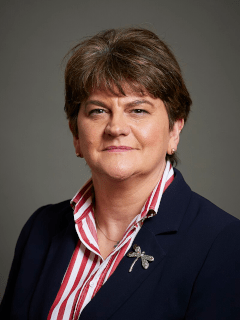
(Pictured: Official portrait of Baroness Foster of Aghadrumsee, January 30, 2024)


Leave a comment

Ahern and Paisley Publicly Shake Hands for the First Time

History is made on April 4, 2007, as Taoiseach Bertie Ahern and Democratic Unionist Party (DUP) leader Ian Paisley shake hands for the first time in public prior to their milestone meeting at Farmleigh, the official Irish state guest house in Dublin.

Ahern is urged by Paisley to ensure that criminals who flee across the Irish border are arrested. The Democratic Unionist leader makes the proposal during a cordial one-and-a-half-hour meeting at Farmleigh in Phoenix Park, where the two leaders exchange their first public handshake.

Afterwards Paisley, who receives an invitation from the taoiseach to visit the Battle of the Boyne site later in the year, says that they had also discussed the need for the new administrations in Northern Ireland and in the Republic of Ireland to work for each other’s best interests. “We can confidently state that we are making progress to ensure our two countries can develop and grow side by side in the spirit of generous cooperation,” he declares. “I trust that old barriers and threats will be removed in my day. Business opportunities are flourishing. Genuine respect for the understanding of each other’s differences and, for that matter, similarities is now developing.”

Earlier the DUP leader, who becomes the First Minister of the new power-sharing government on May 8 alongside Sinn Féin‘s Martin McGuinness as deputy First Minister, firmly shakes the hand of Ahern in public for the first time. As he arrives at Farmleigh, he quips, “I better shake the hands of this man. I’ll give him a firm handshake.”

Paisley, who is accompanied by his son, Ian Paisley, Jr., affectionately grabs the taoiseach by the shoulder. There is another handshake after the meeting at Farmleigh is finished.

Paisley says, “Mr. Ahern has come to understand me as an Ulsterman of plain speech. He didn’t ever need a dictionary to find out what I was saying. We engaged in clear and plain speech about our hopes and our aspirations for the people we both serve. The prime minister kindly congratulated me on my election victory.”

Paisley says that he had raised a number of issues crucial to unionists. “I have taken the opportunity to raise with the prime minister a number of key matters including ensuring that fugitives from justice who seek to use the border to their advantage are quickly apprehended and returned without protracted legal wrangle.” He adds, “I raised other legal issues of interests to unionists, and we discussed cooperation of an economic nature that will be to our mutual benefit.” He also says he had raised the issue of bringing Northern Ireland’s corporation tax into line with that of Ireland.

Regarding the invitation to visit the site of the Battle of the Boyne, Paisley says, “We both look forward to the visit to the battle site at the Boyne… Not to refight it, because that would be unfair, for he would have the home advantage. No Ulsterman ever gives his opponents an advantage. He adds, “Such a visit would help to demonstrate how far we have come when we can celebrate and learn from the past, so the next generation more clearly understands.”

Ahern pays tribute to the leadership shown by Paisley in helping to deliver a better future for the people of Northern Ireland. As Northern Ireland’s politicians continue at great pace to prepare for the return of power sharing, the taoiseach says that the progress has been very encouraging. “At this important time in our history, we must do our best to put behind us the terrible wounds of our past and work together to build a new relationship between our two traditions,” he says. “That new relationship can only be built on a basis of open dialogue and mutual respect. I fervently believe that we move on from here in a new spirit of friendship. The future for this island has never been brighter. I believe that this is a future of peace, reconciliation and rising prosperity for all. We stand ready to work with the new executive. We promise sincere friendship and assured cooperation. I believe that we can and will work together in the interests of everyone on this island.”

Ahern says he believes that the Battle of the Boyne site can be a symbol of the new beginning in the relationship between governments in Belfast and Dublin. “I believe that this site can become a valuable and welcome expression of our shared history and a new point of departure for an island, north and south, which is at ease with itself and respectful of its past and all its traditions,” he declared.

The Battle of the Boyne was fought in 1690 between the followers of England‘s King William of Orange, a Protestant, and the deposed King James, a Catholic, in Drogheda, eastern Ireland. Ireland was at that point under English rule. The battle is commemorated by many Northern Irish loyalists on July 12 each year.

Ministerial posts within the new devolved Stormont government have yet to be finalised. Already Sinn Féin has announced that MPs Michelle Gildernew and Conor Murphy and assembly members Gerry Kelly and Caitríona Ruane will be members of the government. However, the party has not yet indicated which of the four will take the three senior cabinet posts in education, agriculture and regional development and which one will be the junior minister in the Office of First and Deputy First Minister.

The DUP has also yet to name its ministers, but it has chosen finance, economy, environment and culture arts and leisure as the government departments it will head. The DUP’s deputy leader, Peter Robinson, and Nigel Dodds, the Belfast North MP, who both served in the last devolved government, are tipped to be the finance and economy ministers.

The Social Democratic and Labour Party (SDLP) announces the previous day that Margaret Ritchie, the assembly member for South Down, will be its only minister in the executive, taking charge of the Department of Social Development.

The Ulster Unionist Party (UUP) has yet to declare who their two ministers will be at the Departments of Health and Employment and Learning.

(From: “Upbeat Paisley shares first handshake with Irish PM” by Hélène Mulholland and agencies, The Guardian, http://www.theguardian.com, April 4, 2007)


Leave a comment

Birth of Michelle O’Neill, Vice President of Sinn Féin

Michelle O’Neill (née Doris), Irish politician who serves as deputy First Minister of Northern Ireland between 2020 and 2022, is born in Fermoy, County Cork, Republic of Ireland, on January 10, 1977. She has been serving as Vice President of Sinn Féin since 2018 and is the Member of the Legislative Assembly (MLA) for Mid Ulster since 2007.

O’Neill comes from an Irish republican family in Clonoe, County Tyrone, Northern Ireland. Her father, Brendan Doris, was a Provisional Irish Republican Army (IRA) prisoner and Sinn Féin councillor. Her uncle, Paul Doris, is a former national president of the Irish Northern Aid Committee (NORAID). A cousin, Tony Doris, was one of three IRA members killed by the British Army‘s Special Air Service (SAS) in the Coagh ambush in 1991. Another cousin, IRA volunteer Gareth Malachy Doris, was shot and wounded during the 1997 Coalisland attack.

After the death of Brendan Doris in 2006, Martin McGuinness pays tribute to the Doris family as “a well-known and respected republican family [who] have played a significant role in the republican struggle for many years.”

O’Neill attends St. Patrick’s Girls’ Academy, a Catholic grammar school in Dungannon, County Tyrone. She subsequently begins to train as an accounting technician, before pursuing a political career.

O’Neill becomes involved in republican politics in her teens, assisting her father with constituency work in his role as a Dungannon councillor. She joins Sinn Féin after the Good Friday Agreement in 1998, at the age of 21, and starts working as an advisor to Francie Molloy in the Northern Ireland Assembly, holding this role until 2005.

O’Neill serves on the Dungannon and South Tyrone Borough Council from 2005 to 2011. She serves as the first female Mayor of Dungannon and South Tyrone from 2010 to 2011. In the 2007 Northern Ireland Assembly election she is elected to represent Mid Ulster in the Northern Ireland Assembly. In 2011, she is appointed to the Northern Ireland Executive by deputy First Minister Martin McGuinness as Minister for Agriculture and Rural Development. In 2016, she is promoted to Minister of Health. In January 2020, she becomes deputy First Minister of Northern Ireland after the New Decade, New Approach (NDNA) agreement restores the power sharing executive.

O’Neill automatically relinquishes her office following Paul Givan‘s resignation as first minister on February 3, 2022. Sinn Féin becomes the largest party after the 2022 Northern Ireland Assembly election, putting O’Neill in line to become the First Minister of Northern Ireland, and the Democratic Unionist Party (DUP) leader to become the deputy First Minister of Northern Ireland. However, she remains to be officially sworn in as First Minister because, as part of its opposition to the Northern Ireland Protocol, the DUP has refused to nominate a deputy First minister and there is therefore no functioning executive of Northern Ireland.

In August 2022, O’Neill is asked in a BBC interview whether it was right during the Troubles for the Provisional IRA “to engage in violent resistance to British rule.” She is criticised for her response, “I think at the time there was no alternative, but now thankfully we have an alternative to conflict, and that is the Good Friday Agreement – that is why it’s so precious to us all.”

In May 2023, O’Neill attends the coronation of King Charles, saying, “Well obviously I wanted to be here. We live in changing times, and it was the respectful thing to do, to show respect and to be here for all those people at home, who I had said I would be a first minister for all. Attendance here is about honouring that and fulfilling my promise.”

Under O’Neill’s leadership, Sinn Fein has led most opinion polls for the next United Kingdom general election.


Leave a comment

Birth of Naomi Long, Northern Irish Politician

Naomi Rachel Long MLA (née Johnston), a Northern Irish politician who serves as Minister of Justice in the Northern Ireland Executive from January 2020 to October 2022, is born in east Belfast, Northern Ireland, on December 13, 1971. She has served as leader of the Alliance Party of Northern Ireland (APNI) since 2016 and a Member of the Legislative Assembly (MLA) for Belfast East since 2020.

Long attends Mersey Street Primary and Bloomfield Collegiate School. She graduates from Queen’s University Belfast with a degree in civil engineering in 1994, works in a structural engineering consultancy for two years, holds a research and training post at Queen’s University for three years, and then goes back into environmental and hydraulic engineering consultancy for four years.

Long first takes political office in 2001 when she is elected to Belfast City Council for the Victoria ward. In 2003, she is elected to the Northern Ireland Assembly for Belfast East, succeeding her fellow party member John Alderdice. In 2006, she is named deputy leader of her party. In the 2007 Northern Ireland Assembly election, she more than doubles the party’s vote in the constituency, being placed second ahead of the leader of the Ulster Unionist Party (UUP). The overall UUP vote, however, is 22%. At 18.8%, her vote share is higher than that for Alderdice in 1998.

On June 1, 2009, Long is elected as Lord Mayor of Belfast, defeating Democratic Unionist Party (DUP) candidate William Humphrey by 26 votes to 24 in a vote at a council meeting. She becomes the second woman to hold the post, after Grace Bannister (1981–82).

On May 6, 2010, Long defeats Peter Robinson, First Minister of Northern Ireland and leader of the DUP, to become Member of Parliament (MP) for Belfast East in the House of Commons. She becomes the first MP elected to Westminster for the Alliance Party (previously, Stratton Mills, a former Ulster Unionist Party MP, had changed parties to Alliance). She also becomes the first Liberal-affiliated MP elected to Westminster in Northern Ireland since James Brown Dougherty in Londonderry City in 1914. Despite the close relationship between the Alliance Party and the Liberal Democrats, she does not sit with the coalition government nor take the coalition whip and is not a member of the Liberal Democrats.

On December 10, 2012, Long receives a number of death threats, and a petrol bomb is thrown inside an unmarked police car guarding her constituency office. This violence erupts as a reaction by Ulster loyalists to the decision by Alliance Party members of Belfast City Council to vote in favour of restricting the flying of the Union flag at Belfast City Hall to designated days throughout the year, which at the time constitutes 18 specific days.

In 2015, Long loses her seat in the Commons to Gavin Robinson of the DUP, as a result of a five-party unionist pact in the constituency which sees the UUP, UK Independence Party (UKIP), Traditional Unionist Voice (TUV) and Progressive Unionist Party (PUP) all stand aside in favour of Robinson.

In January 2016, Long announces that she will return as an Assembly candidate in the 2016 Northern Ireland Assembly election having been nominated in place of incumbent Judith Cochrane. She is subsequently elected on the first count with 14.7% of first-preference votes. Following her return to the Assembly, she assumes positions on the Committee for Communities, the All-Party Group on Fairtrade, the All-Party Group for Housing, and chairs the All-Party Group on Science, Technology, Engineering and Mathematics.

In August 2016, Long calls for Sinn Féin‘s Máirtín Ó Muilleoir to stand aside as Minister of Finance during an investigation of the Stormont Finance Committee’s handling of its Nama inquiry, while Ó Muilleoir is a committee member. This follows allegations that his party had “coached” loyalist blogger Jamie Bryson prior to his appearance before the committee.

In November 2016, Long criticises Sinn Féin and the DUP for delaying the publication of a working group report on abortion, which recommends legislative changes in cases of fatal foetal abnormality, calling on the Executive “to act without further delay to help women who decide to seek a termination in these very difficult circumstances.”

On October 26, 2016, Long is elected Alliance leader unopposed following the resignation of David Ford. In the first manifesto released under her leadership, she affirms her commitment to building a “united, open, liberal and progressive” society. Her party’s legislative priorities are revealed to include the harmonisation and strengthening of equality and anti-discrimination measures, the introduction of civil marriage equality, development of integrated education and a Northern Ireland framework to tackle climate change.

In the 2017 Northern Ireland Assembly election, Long tops the poll in Belfast East and is returned to the Assembly with 18.9% of first-preference votes. The election is widely viewed as a success for Alliance, with the party increasing its vote share by 2 percentage points and retaining all of its seats in a smaller Assembly. The party subsequently holds the balance of power at Stormont.

Alliance targets two seats in Belfast South and Belfast East in the 2017 United Kingdom general election. During the campaign, Long reaffirms her support for a People’s Vote, marriage equality, Votes at 16 and greater transparency surrounding political donations. She also pledges to oppose any rollback of the Human Rights Act 1998.

Following the collapse of talks to restore devolution in February 2018, Long reiterates her view that the pay of MLAs should be cut in the absence of a functioning Executive. In March 2018, Alliance launches its “Next Steps Forward” paper, outlining a number of proposals aimed at breaking the deadlock and Stormont. At the 2019 Alliance Party Conference, she accuses Secretary of State for Northern Ireland Karen Bradley of an “appalling dereliction of duty” over the ongoing stalemate, saying that she had made “no concerted effort to end this interminable drift despite it allegedly being her top priority.”

In the 2019 Northern Ireland local elections, Alliance sees a 65% rise in its representation on councils. Long hails the “incredible result” as a watershed moment for politics in Northern Ireland.

Long is elected to the European Parliament as a representative for Northern Ireland in May 2019 with 18.5% of first-preference votes, the best ever result for Alliance. She is subsequently replaced in the Assembly by Máire Hendron, a founding member of the party and former deputy lord mayor of Belfast. She then replaces Hendron in the Assembly with effect from January 9, 2020.

In 2019, Long becomes the first Northern Ireland politician to have served at every level of government.

On January 11, 2020, following the restoration of the Northern Ireland Assembly after three years of stalemate, Long is elected Minister of Justice in the Northern Ireland Executive. On January 28, she announces that she will progress new domestic abuse legislation through the Assembly which will make coercive control a criminal offence in Northern Ireland. In June 2020, she commissions a review into the support available for prison officers following concerns about absence rates. That same month, she announces her intention to introduce unexplained wealth orders in Northern Ireland to target paramilitary and criminal finances.

In November 2020, Long says she is seriously reconsidering her position within the Executive following the DUP’s deployment of a cross-community vote to prevent an extension of COVID-19 regulations. She tells BBC News, “I have asked people to desist from this abuse of power because it will make my position in the executive unsustainable.”

In March 2022, Long tells the Alliance Party Conference that “some politicians are addicted to crisis and conflict and simply not up to the job of actually governing.” Long leads Alliance into the 2022 Northern Ireland Assembly election on a platform of integrated education, health reform, a Green New Deal, tackling paramilitarism and reform of the Stormont institutions.

Long is a member of Bloomfield Presbyterian Church. Following the Church’s decision to exclude those in same-sex relationships from being full members, she expresses “great concern” and states that she “didn’t know” if she would remain a member herself. She is married to Michael Long, an Alliance councillor on Belfast City Council and former Lord Mayor of Belfast, and son of the engineer Professor Adrian Long. Long and her husband are the first husband and wife to have both served as Lord Mayors of Belfast.


Leave a comment

28th Summit of the British-Irish Council

The British-Irish Council holds its 28th summit at Cathays Park, Cardiff, Wales, on November 25, 2016, and focuses on the United Kingdom‘s exit from the European Union (EU) and the Council’s Early Years policy.

The meeting is an important opportunity to discuss developments and reflect on the perspectives and priorities of all participants since the last British-Irish Council summit in July 2016. There is specific focus during the EU exit roundtable session on agriculture, agri-food and fisheries, trade, and implications of the UK’s exit from the EU.

UK government ministers also emphasize their continued commitment to work closely with all seven member administrations on the UK’s exit from the EU, using existing structures of bilateral and multilateral engagement.

Secretary of State for Wales, Alun Cairns, says, “The British-Irish Council summit is an important forum as we prepare to leave the European Union. The meeting allows us to maintain and strengthen relations between our governments and ensure we are all in the best position to face challenges and find new opportunities. It’s important to remember the UK is leaving the EU, but we are not leaving Europe. We want the best possible relationship with the EU as a whole. The eight council members will discuss issues including Brexit and provide the best opportunities for our young people as part of Early Years strategy. I look forward to some positive and constructive talks on both topics.”

Secretary of State for Northern Ireland, James Brokenshire, says, “At July’s BIC meeting we established an important commitment to maintain intensive and open dialogue and today’s sessions reflected the kind of mature cooperation that close friends and partners enjoy. There was a strong collective will to continue to work together in order to achieve the best outcomes for the people we represent. The UK wants the strongest possible economic links with our European neighbours, especially with Ireland – our nearest neighbour and the only EU member with which we share a land border. So as we forge a new relationship between the UK and Europe we must also maintain and strengthen the bonds within these islands. The BIC will continue to make a vital contribution to that effort and underlines our commitment to the structures set out in the Belfast Agreement and its successors.”

Minister at the Department for Exiting the European Union, Robin Walker, says, “As we begin the work of leaving the European Union, forums such as the British-Irish Council are an important way of maintaining close cooperation and open dialogue between our governments. This includes maintaining our special and friendly relationship with Ireland which has gone from strength to strength over many years. And we will continue to build on this strong relationship as we make a success of Brexit and maximise the opportunities for both our countries.”

A second session at the council addresses the Early Years policies of the eight administrations and welcomes the latest sector report highlighting progress since the 2012 summit. All in attendance acknowledge the critical importance of investment in early years provision in creating strong foundations for children, families and societies to thrive.

The meeting is hosted by the Welsh government, and First Minister of Wales Carwyn Jones welcomes delegation heads. In addition to the UK government ministerial team, the following representatives attend:

The British-Irish Council is a forum for discussion. It was established by the Belfast Agreement to promote positive, practical relationships among the people of the islands and to provide a forum for consultation and co-operation.

(From: “British-Irish Council Summit: Focus on EU exit and ‘Early Years’ policy” press release by the Government of the United Kingdom, http://www.gov.uk, November 25, 2016)


Leave a comment

The Ballymurphy Massacre

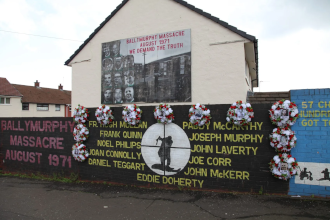
The Ballymurphy massacre is a series of incidents between August 9 and 11, 1971, in which the 1st Battalion, Parachute Regiment of the British Army kills ten civilians in Ballymurphy, Belfast, Northern Ireland, as part of Operation Demetrius. They are indirectly responsible for the death of an eleventh victim. The shootings are later referred to as Belfast’s Bloody Sunday, a reference to the killing of civilians by the same battalion in Derry a few months later. The 1972 inquests return an open verdict on all of the killings, but a 2021 coroner’s report finds that all those killed had been innocent and that the killings were “without justification.”

Belfast is particularly affected by political and sectarian violence during the early part of the Troubles. The British Army is deployed in Northern Ireland in 1969, as events become beyond the control of the Royal Ulster Constabulary (RUC).

On the morning of Monday, August 9, 1971, the security forces launch Operation Demetrius, the main focus of which is to arrest and intern suspected members of the Provisional Irish Republican Army (IRA). The Parachute Regiment is selected to carry out the operation. The operation is chaotic and informed by poor intelligence, resulting in a number of innocent people being interned. By focusing solely on republicans, it excludes violence carried out by loyalist paramilitaries. Some nationalist neighbourhoods attempt to disrupt the army with barricades, petrol bombs and gunfire. In the Catholic district of Ballymurphy, ten civilians are shot and killed between the evening of August 9 and the morning of August 11, while another dies of heart failure.

Members of the Parachute Regiment state that they were shot at by republicans as they entered the Ballymurphy area and returned fire. The press officer for the British Army stationed in Belfast, Mike Jackson, later to become head of the British Army, includes a disputed account of the shootings in his autobiography, stating that those killed in the shootings were republican gunmen. This claim is strongly denied by the families of those killed in the shootings, including in interviews conducted during the documentary film The Ballymurphy Precedent. The claim is found to be without basis by a later coroner’s inquest, which establishes that those killed were “entirely innocent.”

The six civilians killed on August 9 are Francis Quinn (19), shot while going to the aid of a wounded man, Father Hugh Mullan (38), a Catholic priest, shot while going to the aid of a wounded man, reputedly while waving a white cloth to indicate his intentions, Joan Connolly (44), shot by three soldiers as she stands opposite the army base, Daniel Teggart (44), shot fourteen times mostly in the back as he lay injured on the ground, Noel Phillips (20) and Joseph Murphy (41), shot as they stand opposite the army base. Murphy is subsequently taken into army custody and after his release, as he is dying in hospital, he claims that he had been beaten and shot again while in custody. When his body is exhumed in October 2015, a second bullet is discovered in his body, which activists say corroborates his claim.

Edward Doherty (28), is shot and killed on August 10 while walking along Whiterock Road.

Another three civilians are shot on 11 August: John Laverty (20) and Joseph Corr (43) are shot at separate points at the top of the Whiterock Road. Laverty is shot twice, once in the back and once in the back of the leg. Corr is shot several times and dies of his injuries on August 27. John McKerr (49), is shot in the head by an unknown sniper while standing outside a Catholic church and dies of his injuries on August 20. While a number of eyewitnesses state that soldiers were seen shooting toward the area, the 2021 inquest cannot establish who had killed him. The coroner notes that a more specific finding is not possible, in large part, due to an “abject failing by the authorities to properly inquire into the death of [McKerr at the time].”

Paddy McCarthy (44), an eleventh civilian, dies on August 11 following an altercation with a group of soldiers. His family allege that an empty gun is put in his mouth and the trigger pulled, he suffers a heart attack and dies shortly after the alleged confrontation.

In February 2015, the conviction of Terry Laverty, younger brother of John Laverty, one of those killed, is quashed by the Criminal Cases Review Commission. He had been convicted of riotous behaviour and sentenced to six months on the eyewitness evidence of a private in the Parachute Regiment. The case is referred to court because the sole witness retracts his evidence.

In 2016, Sir Declan Morgan, the Lord Chief Justice of Northern Ireland, recommends an inquest into the killings as one of a series of “legacy inquests” covering 56 cases related to the Troubles. These inquests are delayed, as funding has not been approved by the Northern Ireland Executive. The Stormont first minister, Arlene Foster of the Democratic Unionist Party (DUP), defers a bid for extra funding for inquests into historic killings in Northern Ireland, a decision condemned by the human rights group Amnesty International. Foster confirms she has used her influence in the devolved power-sharing executive to hold back finance for a backlog of inquests connected to the conflict. The High Court says her decision to refuse to put a funding paper on the Executive basis is “unlawful and procedurally flawed.”

In January 2018, the coroner’s office announces that the inquest will begin in September 2018. On May 11, 2021, this coroner’s inquest finds that the ten civilians killed were innocent and that the use of lethal force by the British Army was “not justified.” The circumstances of the 11th death are not part of the inquest since Paddy McCarthy died from a heart attack, allegedly after being threatened by a soldier. Following the inquest verdict, Boris Johnson, the British prime minister, apologises for the deaths at Ballymurphy in a phone call to Foster and deputy First Minister Michelle O’Neill. The lack of public apology is criticised by some relatives of the victims and Northern Irish politicians.

In May 2021, families of those shot dead by British soldiers in Ballymurphy urge the Irish government to oppose any attempt to prevent the prosecution of British soldiers alleged to have committed crimes during the Troubles.

The killings are the subject of the August 2018 documentary The Ballymurphy Precedent, directed by Callum Macrae and made in association with Channel 4.


Leave a comment

Ian Paisley Announces Retirement as Northern Ireland’s First Minister

In a March 4, 2008, announcement, the Rev. Ian Paisley signals the end of an era by announcing he will retire as First Minister of Northern Ireland. He also confirms he is stepping down as leader of the Democratic Unionist Party (DUP), the party he founded in the early 1970s. The news represents a huge moment in the politics and recent history of Northern Ireland, removing from the scene as it does one of its most striking figures.

The 81-year-old announces he will quit both posts following an international investment conference in Belfast in May 2008 but will remain as an MP and Assembly member.

“I came to this decision a few weeks ago when I was thinking very much about the conference and what was going come after the conference,” Paisley tells Ulster Television. “I thought that it is a marker, a very big marker and it would be a very appropriate time for me to bow out.”

Paisley denies he is leaving in part over allegations that his son, Ian Paisley Jr., lobbied Downing Street on behalf of a wealthy party member. He says his son has been “wrongly accused.” He is also weakened over defeat in a recent by-election – an indication that a section of the DUP’s electorate is uneasy about his historic decision to share power with Sinn Féin.

Significantly, Paisley does not back any contender in the DUP leadership contest to succeed him. “This is not the Church of Rome. I have no right to say who will succeed me. I will not be like Putin in Russia saying to the president – ‘this is the way you have to go.’ When I make a break it will be [a] break.”

Paisley defends his decision to enter into government with Sinn Féin. “It was the right thing to do because it was the only thing to do to save us from a united Ireland. We were threatened that we would be more Irish in our rulership, that there would be more Dublin say in government. That was what the British government threatened. We managed to put that to a rest.”

“We have laid to rest that and republicans have come to see that they have to put up with Paisley and his clan. We took what was meant for our destruction and turned it into our salvation.”

Speaking from Dubai the previous night, the deputy First Minister, Martin McGuinness, says, “It wasn’t unexpected. It was the right decision to go into sharing power with Sinn Féin which changed the politics of Ireland forever.”

The Sinn Féin MP describes Paisley as “courageous” for agreeing to enter into the power-sharing government. “We have had a positive and constructive working relationship,” McGuinness said.

Paisley’s fiercest critic within unionism, the ex-DUP MEP, Jim Allister, claims opposition to his power-sharing with Sinn Féin and his relationship with McGuinness means that Paisley “jumped before he was pushed.”

Allister’s new party, Traditional Unionist Voice (TUV), split the DUP vote in a by-election in February 2008 and cost the party a council seat in County Down. It was Paisley’s first electoral test since he agreed to share power with Sinn Féin following the St. Andrews Agreement at the end of 2006.

In April 2008, Peter Robinson is chosen to succeed Paisley as leader of the Democratic Unionist Party. The 36 DUP members of the Northern Ireland Assembly unanimously select Robinson, who has been MP for Belfast East since 1979 and Paisley’s deputy since 1980. He is the Minister of Finance and Personnel in the Northern Ireland Executive – Northern Ireland’s power-sharing government – for the previous year.

(From: “Paisley to step down as Ulster’s first minister” by Henry McDonald, Ireland correspondent, The Guardian, March 4, 2008)


Leave a comment

Birth of Peter Robinson, Northern Irish Politician

Peter David Robinson, retired Northern Irish politician, is born on December 29, 1948, in Belfast, Northern Ireland. He serves as First Minister of Northern Ireland from 2008 until 2016 and Leader of the Democratic Unionist Party (DUP) from 2008 until 2015. Until his retirement in 2016, he is involved in Northern Irish politics for over 40 years, being a founding member of the DUP along with Ian Paisley.

Robinson is the son of Sheila and David McCrea Robinson. He is educated at Annadale Grammar School and Castlereagh College, now part of the Belfast Metropolitan College. In 1966 he first hears Ian Paisley speak at a rally at Ulster Hall and shortly afterwards leaves school to devote himself to the Protestant fundamentalist cause. He considers joining the Royal Ulster Constabulary (RUC) but instead joins the Lagan Valley unit of the Ulster Protestant Volunteers (UPV), a paramilitary organisation tied to Ian Paisley’s Free Presbyterian Church of Ulster. He also joins the Ulster Constitution Defence Committee. As a young man he embraces a populist anti-Catholic fundamentalism. A former classmate alleges Robinson and a friend harassed a pair of Catholics nuns in the street in Portrush, County Antrim, yelling “Popehead, Popehead.” He initially gains employment as an estate agent for R.J. McConnell & Co. and later with Alex, Murdoch & Deane in Belfast.

Robinson serves in the role of General Secretary of the DUP from 1975, a position he holds until 1979 and which affords him the opportunity to exert unprecedented influence within the fledgeling party. In 1977, he is elected as a councillor for the Castlereagh Borough Council in Dundonald, County Down, and in 1979, he becomes one of the youngest Members of Parliament (MP) when he is narrowly elected for Belfast East. He holds this seat until his defeat by Naomi Long in 2010, making him the longest-serving Belfast MP since the Acts of Union 1800.

In 1980, Robinson is elected as the deputy leader of the DUP. Following the re-establishment of devolved government in Northern Ireland as a result of the Good Friday Agreement, he is elected in 1998 as the Member of the Legislative Assembly (MLA) for Belfast East. He subsequently serves as Minister for Regional Development and Minister of Finance and Personnel in the Northern Ireland Executive. He is elected unopposed to succeed Ian Paisley as leader of the DUP on April 15, 2008, and is subsequently confirmed as First Minister of Northern Ireland on June 5, 2008.

In January 2010, following a scandal involving his wife Iris (née Collins), Robinson temporarily hands over his duties as First Minister to Arlene Foster under the terms of the Northern Ireland Act 2006. Following a police investigation, which recommends that he should not be prosecuted following allegations made by the BBC in relation to the scandal, he resumes his duties as First Minister. The Official Assembly Commissioner’s Investigation and Report clears Robinson of any wrongdoing.

In September 2015, Robinson again stands aside to allow Arlene Foster to become acting First Minister after his bid to adjourn the assembly is rejected. His action is a response to a murder for which a member of Sinn Féin, a party in the Northern Ireland Executive, had been questioned. He resumes his duties on October 20, 2015. On November 19, 2015, he announces that he will be stepping down as First Minister and as leader of the DUP. He subsequently steps down as First Minister on January 11, 2016 and is now fully retired from frontline politics.

Robinson is the author of a number of books and pamphlets on local politics and history including: Capital Punishment for Capital Crime (1974), Savagery and Suffering (1975), Ulster the Facts (1981), Self-Inflicted (1981), A War to be Won (1983), It’s Londonderry (1984), Carson – Man of Action (1984), Ulster in Peril (1984), Their Cry was no Surrender (1986), Hands Off the UDR (1990), Sinn Féin – A Case for Proscription (1993), The Union Under Fire (1995), Give Me Liberty (no date), Ulster—the Prey (no date).