After lecturing at St. Patrick’s College, Dublin, from 1941 to 1944, Slevin enters the civil service. Despite no prior interest in heraldry, he is selected via competition to assist the newly installed Chief Herald, Dr. Edward MacLysaght, in the genealogical office, Bedford Tower, Dublin Castle. After serving as Deputy Chief Herald (1944–54), he succeeds MacLysaght as Chief Herald of Ireland, becoming the longest-serving occupant of the office (1954–81).
One of three national heralds named to a vexillogical committee to devise a common emblem for the Council of Europe, Slevin persuades his colleagues to eschew religious iconography, such as the Christian cross, as inappropriate. His own design of a circle of twelve golden stars on an azure field is selected by the committee in 1954, and formally accepted by the council in December 1955. With blue chosen as a colour common to the flags of many European countries, the twelve stars represent not individual states but such associations as the zodiac and a clock face, suggesting ideals of universality, harmony, and evolution through time. Adopted in 1985 for the flag of the European Community (latterly the European Union), his design attracts wide acclaim in heraldic circles, leading to his being awarded membership of the Académie Internationale d’Héraldique.
During Slevin’s tenure as Chief Herald, several hundred patents of arms are issued to Irish public bodies, including civic and municipal authorities, and to individuals of Irish descent worldwide. On behalf of the Irish government, he confirms the Irish connections of such notables as United StatespresidentsKennedy, Nixon, and Reagan, French president Charles de Gaulle, and Princess Grace of Monaco. His coat of arms for President Kennedy, combining the ancient arms of the Kennedy and Fitzgerald families, wins renown as a masterpiece of heraldic design. While possessing a keen sense of graphic impact, he is not a great draughtsman, and he employs the noted heraldic painter Myra Maguire to execute the designs that he creates. He oversees expansion of genealogical office services, instituting an advisory service and team of research assistants for the growing numbers – especially within emigrant communities abroad – seeking to trace Irish ancestry. He establishes a committee to catalogue churchyard memorial inscriptions as an archival resource, meant to redress the loss of state records in the 1922 Four Courts fire.
Slevin wins first prize in successive years in the 1950s for entries in the Oireachteas drama competition, both plays being subsequently produced at the Abbey Theatre. He writes a detective novel in Irish, and contributes numerous articles to learned journals, chiefly on medieval heraldry and Anglo-Irish families. Erudite and possessed of great presence, courtesy, and wit, he is an engaging speaker.
Resident in south County Dublin, Slevin is active in amateur dramatics, local history societies, and the ecumenical movement. His recreation is long country walks. He marries Millicent Nolan in 1950 and they have three sons. He dies on January 18, 1997.
(From: “Slevin, (John) Gerard” by Lawrence William White, Dictionary of Irish Biography, http://www.dib.ie, October 2009 (last revised February 2025))
Ó Muirthile is educated at cork, taking a BA in Irish and French at UCC. His Irish is acquired at school and from sojourns in the Gaeltacht of West Kerry. He is a member of a group of poets at UCC in the late 1960s who choose Irish as a creative medium and are closely associated with the modernist poetry journal Innti, founded by fellow poet Michael Davitt. They are influenced by the work of Cork poet Seán Ó Ríordáin, by the musician and composer Seán Ó Riada, and by popular American culture.
Greg Delanty, writing for Poetry International, claims that a fundamental achievement of Ó Muirthile and other members of the Innti group was to adapt the language to a contemporary urban landscape in a way that reflected the counterculture of the sixties.
Ó Muirthile has been described as a poet of immense formal and musical mastery who reads deeply into the classical and neo-classical poetry of the Irish language. He studies French literature as a student and this influences his work. He translates poetry by Guillaume Apollinaire, François Villon, Jacques Prévert and Anne Hébert.
Ó Muirthile’s first collection of poetry is Tine Chnámh (1984). This receives the Irish American Cultural Institute’s literary award and an Oireachtas prize for poetry. He subsequently publishes a number of other collections. In 1996, he receives the Butler Award for his novel Ar Bhruach na Laoi. Several plays by him have been staged. From 1989 to 2003 he writes a weekly column, “An Peann Coitianta,” for The Irish Times. Poems by him have been translated into English, German, French, Italian, Hungarian and Romanian.
Two of Ó Muirthile‘s poems, Meachán Rudaí and Áthas, have been put to music by the Irish/American group The Gloaming and featured on their third studio album The Gloaming 3.
Maurice O’Neill, an Irish Republican Army (IRA) Captain captured in 1942 after a shootout with Irish police (Garda Síochána), is executed on November 12, 1942, one of only two people executed in independent Ireland for a non-murder offence.
O’Neill is a farmer from an Irish republican family in the farming community of Cahersiveen, County Kerry. He and his older brother Sean are dedicated Irish republicans. He fights in the Irish Republican Army’s 1942-44 Northern Campaign and is assigned to the IRA’s General Headquarters (GHQ) at the time of his capture. In the early 1930s, his brother Sean serves in the IRAs Dublin Brigade and serves on GHQ Staff IRA in various capacities from 1945 to 1955.
On October 24, 1942, O’Neill is arrested after a raid by Garda Síochána in which Garda Detective Officer Mordant is shot and killed in Donnycarney, Dublin. The mission of the police raid is the capture of Harry White, the IRA Quartermaster General. White escapes capture and O’Neill is arrested but not charged with the murder of the Detective Officer but with “shooting with intent.” It is thought that Detective Officer Mordant’s death may have been a result of crossfire between Special Branch policemen.
The 25-year-old O’Neill’s execution provokes particularly widespread protests, as he is a popular figure in his native County Kerry. He apparently is stoic and calm when his fate becomes clear. In a letter to his elder brother, Sean, from Arbour Hill Prison, he writes: “I suppose you saw in the papers where I met my Waterloo last Saturday night. Well, such are the fortunes of war…there is only one sentence, death or release. So I believe it is the full penalty for me. There is no good in having false hopes, hard facts must be faced.” In his last letter to his father he writes: “I am glad that I am not being reprieved as the thought of the torture I would have to endure in Portlaoise makes me shudder.”
Many Irish republican prisoners are released in 1948 as is the body of O’Neill (on September 17, 1948). O’Neill is buried in the republican plot at Kilavarnogue Cemetery, Cahersiveen, County Kerry. His name is listed on a monument in Fairview Park, Dublin, with the names other IRA members of that period who lose their lives. The Maurice O’Neill Bridge to Valentia Island is built in 1970 and named in memory of the young farmer who had been executed in 1942. In Kilflynn, County Kerry, the Crotta O’Neill’shurling club is named after him. In 2011, an Irish television documentary focuses on how O’Neill’s execution affected his family.
Henry is born in Belfast on January 15, 1902, the daughter of the tea merchant George Adams Henry. She attends Mount Pottinger National School, and Victoria College, before expanding her studies at night classes at the Belfast School of Art.
Henry completes an apprenticeship at Clokey Stained Glass Studios founded by Walter Francis Clokey where she is to work for over fifty years designing stained glass windows. Her appointment in the autumn of 1919 comes by a chance visit to Victoria College by the firm’s owner who is seeking a suitable apprentice. She retires from the firm at Easter 1972.
Henry exhibits at the Belfast Art Society for the first time in 1928. She exhibits four works, all landscapes in oil, and then a further two works in the following year. In 1931, she shows a further two works with the successor to the Belfast Art Society, the Ulster Academy of Arts. In 1932, she shows A Derbyshire Village, described by one critic as “a delightful English rural scene.” Between 1931 and 1942 she shows with more than twenty paintings at the Ulster Academy of Arts, exhibiting at each annual show in that time.
Henry has a keen interest in photography from an early age and wins various awards for her photographs. In 1934, she wins the August prize from the Photographic Dealers’ Association for a shot of a child playing with toys in the bath, having received a consolation prize of five shillings in September of the previous year for a shot of a traditional market scene in Boulogne. She goes on to write a regular column for Amateur Photographer throughout the 1930s.
In January 1935, Henry is appointed leader of a local sketching group by the Youth Hostel Association. In December 1935, she is commended for a sketch called River Pool, submitted to a competition judged by James Humbert Craig on behalf of the Youth Hostel Association, presented alongside Port Muckin a show with the sketching group. Maurice Canning Wilks contributes Skernaghan Point, Brown’s Bay to the same show.
The Robinson and Cleaver Art Gallery stages a display of works from Four Ulster Artists in 1936 consisting of paintings from Henry, her sister Marjorie, Theo Gracey and F. H. Hummel. She contributes Green Boat, which she had presented earlier in the year to the Ulster Academy of Arts, and includes Off the Scilly Isles among pictures from Brittany and Bavaria. The reviewer in Belfast’s News Letter refers to her style as “Post-Impressionism.”
In 1937, Henry is elected an Associate of the Ulster Academy of Arts and presents three watercolours to the institution the following year. The exhibition is opened by Oliver St. John Gogarty with participants such as John Luke, Maurice Wilks, James Humbert Craig, Rosamund Praeger and Colin Middleton, who shows three Surrealist works including Angelus.
The Royal Hibernian Academy displays two small works, Flight, 1941 and Lakeside, among an unusually large contingent of Ulster artists in the annual exhibition in the spring of 1942. The Ulster Academy of Arts is united in their commitment to raise funds for the bomb damaged Ulster Hospital for Children and Women in their Spring Exhibition of 1942. Henry displays a sense of humour in her use of black-out paint, roadblocks and air raid shelters in one of the watercolours on show.
Henry is a regular exhibitor with the Water Colour Society of Ireland, and contributes more than one hundred works to their exhibitions between 1943 and 1986.
Henry joins Violet McAdoo in a joint exhibition at the Belfast Museum and Art Gallery in 1944. McAdoo presents with watercolours, however, Henry also presents oils. The paintings are primarily of landscapes but included a number urban scenes.
In 1945, Henry and her sister Margaret join Arthur and George Campbell, Colin Middleton, Gladys and Max Maccabe, Thomas Carr, Maurice Wilks, James McIntyre and others, in the only official exhibition from the Ulster branch of the Artists’ International Association sponsored by the Council for the Encouragement of Music and the Arts (NI) at the Belfast Museum.
The MacGaffin Gallery at Pottinger’s Entry is the venue for a group exhibition of experimental and modernist works with Nevill Johnson, Aaron McAfee and the MacCabes in 1946, where Henry exhibits seven paintings. Quayside is one of three pictures that she presents at the Ulster Academy in 1946. She also shows it with the Water Colour Society of Ireland in the following year and at CEMA’s Some Ulster Paintings exhibition in that same year.
In 1946, the Council for the Encouragement of Music and Art (CEMA) purchases a painting by Henry, in addition to works by other contemporary Ulster artists. Twenty-four of the works from the CEMA collection, including her painting, are later presented at their Donegall Place gallery in 1954.
Henry debuts at the 1948 Irish Exhibition of Living Art with one painting and returns in each of the subsequent ten years with a total of 20 paintings. She is also elected as an Honorary Academician of the Ulster Academy of Arts in 1948.
Henry displays one work, Harbour, Northern Ireland, with Violet McAdoo at the 88th exhibition of the Society of Women Artists at the Royal Institute Galleries in London during the summer of 1949. Just a few months later her work is back in London for the United Society of Artists annual exhibition where she shows Gossip and Shell and Sail.
Henry is awarded a travel scholarship from the Soroptomists of Belgium in 1957, which enables her to study stained glass in the country. She is the President of Soroptomist Club of Belfast from 1960 to 1961, where she had been a member since its foundation in 1932.
Upon her return from Belgium, CEMA stages a solo exhibition with thirty-five of Henry’s oils and watercolours at their Belfast gallery. The exhibition is arranged at short notice when another is unexpectedly cancelled. Writer Nesca Robb opens the exhibition where it is claimed a new painting technique, “monopainting,” is revealed, described as paint drawn through a gauze over glass. The exhibition includes a ‘Breton’ series, Kerry Tangle, Ship Pattern, Barrack Shapes, Lough Shapes, and Backs. In addition, she displays In the Park, an oil previously seen at the Royal Ulster Academy in 1955 and at the Irish Exhibition of Living Art in 1956, and a second oil, City Lunch Hour, exhibited at the Royal Ulster Academy in 1956.
The Ulster Society of Women Artists is founded in 1957 by Gladys Maccabe with the support of Henry and a number of others at a time when no arts societies are accepting female artists into their ranks. The main objective is to ensure the development of quality art and women artists in Ulster. The organisation begins with ten invited artists. Henry exhibits with the society throughout her life.
Henry receives a mention in the local press referring to her exhibits in the Royal Ulster Academy show of 1959 with Kenneth Jamison comparing her work with that of Deborah Brown, “Olive Henry is more decadent by instinct, a fine formaliser. Her pictures Man and Ropes and Riviera Port, well defined and carefully abstracted, contrast in form with Deborah Brown’s freer Oil Over Tempra,[sic] 1959.”
A group exhibition in 1964 at the New Gallery in Belfast includes work from Henry alongside Neil Shawcross, Max Maccabe, Kathleen Bell, Richard Croft and Helen Ross. Among other works she shows Easter and Long Garden.
In 1981, the Ulster Society of Womens Artists elects Henry as President. A retrospective of her studio works is hosted by the Shambles Gallery in Hillsborough, County Down in 1986, some thirty years since her last solo exhibition. Henry shows at the Royal Ulster Academy Annual Exhibition in 1987 for the last time.
Henry dies on November 8, 1989, at Crawfordsburn, County Down. Her paintings are held in the collections of the Northern Ireland Civil Service, Ulster Museum, Irish Linen Centre & Lisburn Museum, and the Royal Ulster Academy of Arts Diploma Collection.
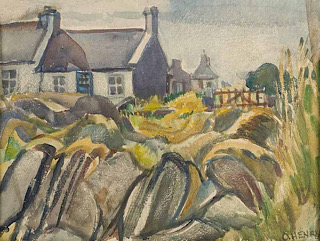
(Pictured: “The Gardener,” watercolour by Olive Henry)
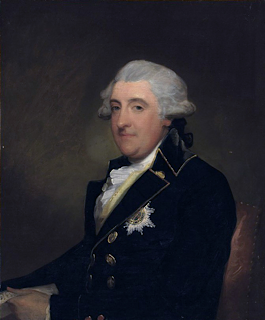
FitzGerald is born on March 13, 1749, in Arlington Place, Piccadilly, London, the second son of nine sons and ten daughters of James Fitzgerald, 20th Earl of Kildare and later 1st Duke of Leinster, and his wife, Lady Emily Lennox. He is educated at Eton College (1758–63). He is the elder brother of the 1790s revolutionary Lord Edward FitzGerald, and is a first cousin of the English liberal politician Charles James Fox.
In November 1775, FitzGerald marries Emilia Olivia Usher, daughter of the 1st Baron Saint George and Elizabeth Dominick and sole grand daughter of Sir Christopher Dominick. They have three sons and six daughters.
In 1770, FitzGerald is chosen Grandmaster of the masonicGrand Lodge of Ireland, a post he holds for two years. He is re-elected for another year in 1777. In 1783, he is among the first knights in the newly created Order of St. Patrick.
In 1788–89, FitzGerald is Master of the Rolls in Ireland. In theory a senior judicial office, it is then largely a sinecure, but so blatant a choice of a man who is wholly unqualified for it gives rise to unfavourable comment, and a few years later it becomes the rule that the Master must be a lawyer of repute.
FitzGerald’s homes are at Carton and Kilkea Castle in County Kildare, and at Leinster House in Dublin (now the home of the Oireachtas). He is a founder member of the Order of St. Patrick in 1783 and of the Royal Irish Academy in 1785, and is a large investor in the Royal Canal company launched in 1790. His family’s estates of 60,000 acres (25,000 Ha) in Kildare are in three main parts, around Maynooth, Rathangan and Athy. He rebuilds the main bridge in Athy over the River Barrow.
FitzGerald dies of strangury, a urinary tract disorder, at Carton House on October 20, 1804. He is buried in Kildare Abbey. His funeral is so well attended that the mourners reach across The Curragh. He is succeeded by his second, but eldest surviving, son, Augustus Frederick Fitzgerald, as 3rd Duke of Leinster.
The Criminal Assets Bureau (CAB) (Irish: An Biúró um Shócmhainní Coiriúla), a law enforcement agency, is established in Ireland on October 15, 1996. The CAB has the powers to focus on the illegally acquired assets of criminals involved in serious crime. The aims of the CAB are to identify the criminally acquired assets of persons and to take the appropriate action to deny such people these assets. This action is taken particularly through the application of the Proceeds of Crime Act 1996. The CAB is established as a body corporate with perpetual succession and is founded on the multi-agency concept, drawing together law enforcement officers, tax officials, social welfare officials as well as other specialist officers including legal officers, forensic analysts and financial analysts. This multi-agency concept is regarded by some as the model for other European jurisdictions.
The CAB is not a division of the Garda Síochána (police) but rather an independent body corporate although it has many of the powers normally given to the Gardaí. The Chief Bureau Officer is drawn from a member of the Garda Síochána holding the rank of Chief Superintendent and is appointed by the Garda Commissioner. The remaining staff of the CAB are appointed by the Minister for Justice, Home Affairs and Migration. CAB members retain their original powers as if they were working within their separate entities and have direct access to information and databases that their original organisations are allowed by law. This ability to share information is described by the Garda Síochána Inspectorate in its Crime Investigation Report of October 2014 as “a good model that could be replicated outside of CAB.”
The CAB reports annually to the Minister through the Commissioner of the Garda Síochána and this report is laid before the Houses of the Oireachtas. The Minister for Justice, in publishing the 2011 CAB Annual Report, states: “The work of the bureau is one of the key law enforcement responses to tackling crime and the Government is very much committed to further strengthening the powers of the bureau through forthcoming legislative proposals.” In publishing the Bureau’s 2012 report, the Minister for Justice sets out: “The Annual Report provides an insight into the workings of the Bureau and highlights the advantage of adopting a multi-agency and multi-disciplinary approach to the targeting of illicit assets. The Bureau is an essential component in the State’s law enforcement response to serious and organised crime and the Government is fully committed to further strengthening its powers through future legislative reform.”
The Minister for Justice sets out that Ireland, through the work of the Bureau, has established itself as a jurisdiction that is responding to that challenge and the work of the Bureau is internationally recognised as a best practice approach to tackling criminality and the illicit monies it generates.
The CAB has been effective against organised criminals, especially those involved in the importation and distribution of drugs. It has also been used against corrupt public officials and terrorists.
Séamus Ennis (Irish: Séamas Mac Aonghusa), Irish musician, singer and Irish music collector, dies in Naul, County Dublin, on October 5, 1982. He is most noted for his uilleann pipe playing and is partly responsible for the revival of the instrument during the twentieth century, having co-founded Na Píobairí Uilleann, a nonprofit organisation dedicated to the promotion of the uilleann pipes and its music. He is recognised for preserving almost 2,000 Irish songs and dance-tunes as part of the work he does with the Irish Folklore Commission. He is widely regarded as one of the greatest uilleann pipers of all time.
Ennis’s father, James, works for the Irish civil service at Naul, County Dublin. In 1908, James Ennis is in a pawn shop in London and purchases a bag containing the pieces of a set of old uilleann pipes. They were made in the mid nineteenth century by Coyne Pipemakers of Thomas Street in Dublin. In 1912, he comes in first in the Oireachtas competition for warpipes and second in the uilleann pipes. He is also a prize-winning dancer. In 1916, he marries Mary Josephine McCabe, an accomplished fiddle player from County Monaghan. They have six children, Angela, Séamus, Barbara, and twins, Cormac and Ursula (Pixie) and Desmond. Séamus is born on May 5, 1919, in Jamestown in Finglas, Dublin. James Ennis is a member of the Fingal trio, which includes Frank O’Higgins on fiddle and John Cawley on flute, and performs regularly with them on the radio. At the age of thirteen, Séamus starts receiving lessons on the pipes from his father. He attends a Gaelscoil, Cholmcille, and a Gaelcholáiste, Coláiste Mhuire, which gives him a knowledge of the Irish language that serves him well in later life. He sits in an exam to become Employment Exchange clerk but is too far down the list to be offered a job. He is twenty and unemployed.
Colm Ó Lochlainn is editor of Irish Street Ballads and a friend of the Ennis family. In 1938, Ennis confides in Colm that he intends to move to England to join the British Army. Colm immediately offers him a job at The Three Candles Press. There Ennis learns all aspects of the printing trade. This includes writing down slow airs for printed scores – a skill which later proves important. Colm is director of an Irish language choir, An Claisceadal, which Ennis joins. In 1942, during The Emergency, shortages and rationing mean that things become difficult in the printing trade. Professor Seamus Ó Duilearge of the Irish Folklore Commission hires the 23-year-old to collect songs. He is given “pen, paper and pushbike” and a salary of three pounds per week. Off he goes to Connemara.
From 1942 to 1947, working for the Irish Folklore Commission, Ennis collects songs in west Munster; counties Galway, Cavan, Mayo, Donegal, Kerry; the Aran Islands and the Scottish Hebrides. His knowledge of Scottish Gaelic enables him to transcribe much of the John Lorne Campbell collection of songs. Elizabeth Cronin of Ballyvourney, County Cork, is so keen to chat to Ennis on his visits that she writes down her own songs and hands them over as he arrives, and then gets down to conversation. He has a natural empathy with the musicians and singers he meets. In August 1947, he starts work as an outside broadcast officer with Raidió Éireann. He is a presenter and records Willie Clancy, Seán Reid and Micho Russell for the first time. There is an air of authority in his voice. In 1951, Alan Lomax and Jean Ritchie arrived from the United States to record Irish songs and tunes. The tables are turned as Ennis becomes the subject of someone else’s collection. There is a photograph from 1952/53 showing Ritchie huddled over the tape recorder while Ennis plays uilleann pipes.
Late in 1951, Ennis joins the BBC. He moves to London to work with producer Brian George. In 1952, he marries Margaret Glynn. They have two children, the organist Catherine Ennis and Christopher. His job is to record the traditional music of England, Scotland, Wales and Ireland and to present it on the BBC Home Service. The programme is called As I Roved Out and runs until 1958. Meeting up with Alan Lomax again, he is largely responsible for the album Folk and Primitive Music (volume on Ireland) on the Columbia Records label.
In 1958, after his contract with the BBC is not renewed, Ennis starts doing freelance work, first in England then back in Ireland, with the new TV station Teilifis Éireann. Soon he is relying totally on his musical ability to make a living. About this time, his marriage breaks down and he returns to Ireland. He suffers from tuberculosis and is ill for some time. In 1964, he performs at the Newport Folk Festival. His father gives him the pipes he had bought in 1908. Although most pipers can be classed as playing in a tight style or an open style, Ennis is in between. He is a master of the slow air, knowing how to decorate long notes with taste and discreet variation.
Two events will live in legend among pipers. The first is in Bettystown, County Meath, in 1968, when the society of Irish pipers, Na Píobairí Uilleann, is formed. Breandán Breathnach is playing a tape of his own piping. Ennis asks, “What year?” Breandán replies, “1948.” Ennis says, “So I thought.” For a couple of hours the younger players perform while Ennis sits in silence. Eventually he is asked to play. Slowly he takes off his coat and rolls up his sleeves. He spends 20 minutes tuning up his 130-year-old pipes. He then asks the gathering whether all the tape recorders are ready and proceeds to play for over an hour. To everyone’s astonishment he then offers his precious pipes to Willie Clancy to play a set. Clancy demurs but eventually gives in. Next, Liam O’Flynn is asked to play them, and so on, round the room. The second unforgettable session is in Dowlings’ Pub in Prosperous, County Kildare. Christy Moore is there, as well as most of the future members of Planxty.
Ennis never runs any school of piping but his enthusiasm infuses everyone he meets. In the early 1970s, he shares a house with Liam O’Flynn for almost three years. Finally, he purchases a piece of land in Naul and lives in a mobile home there. One of his last performances is at the Willie Clancy Summer School in 1982. He dies on October 5, 1982. His pipes are bequeathed to Liam O’Flynn. Radio producer Peter Browne produces a compilation of his performances, called The Return from Fingal, spanning 40 years.
Séamus Ennis Road in his native Finglas is named in his honour. The Séamus Ennis Arts Centre in Naul is opened in his honour, to commemorate his work and to promote the traditional arts. He is also the subject of Christy Moore’s song “The Easter Snow.” This is the title of a slow air Ennis used to play, and one after which he named his final home in Naul.
In March 1917, Ryan passes his final medical examinations. That June he sets up medical practice in Wexford. In 1921, he moves to Dublin where he opens a doctor’s practice at Harcourt Street, specialising in skin diseases at the Skin and Cancer Hospital on Holles Street. He leaves medicine in 1925, after he purchases Kindlestown, a large farm near Delgany, County Wicklow. He lives there and it remains a working farm until his death.
In July 1919, Ryan marries Máirín Cregan, originally from County Kerry and a close friend of Sinéad de Valera throughout her life. Cregan, like her husband, also fought in the Easter Rising and is subsequently an author of children’s stories in Irish. They have three children together.
While studying at university in 1913, Ryan joins the Gaelic League at Clonmel. The company commander recruits the young Catholicnationalist, who becomes a founder-member of the Irish Volunteers and is sworn into the Irish Republican Brotherhood (IRB) the following year. In 1916, he goes first to Cork to deliver a message from Seán Mac Diarmada to Tomás Mac Curtain that the Easter Rising is due to happen on Easter Sunday, then to Cork again in a 12-hour journey in a car to deliver Eoin MacNeill‘s cancellation order, which attempts to stop the rising. When he arrives back on Tuesday, he serves as the medical officer in the General Post Office (GPO) and treats many wounds, including James Connolly‘s shattered ankle, a wound which gradually turns gangrenous. He is, along with Connolly, one of the last people to leave the GPO when the evacuation takes place. Following the surrender of the garrison, he is deported to HM Prison Stafford in England and subsequently Frongoch internment camp. He is released in August 1916.
Ryan rejoins the Volunteers immediately after his release from prison, and in June 1917, he is elected Commandant of the Wexford Battalion. His political career begins the following year when he is elected as a Sinn Féin candidate for the constituency of South Wexford in the 1918 United Kingdom general election in Ireland. Like his fellow Sinn Féin MPs, he refuses to attend the Westminster Parliament. Instead he attends the proceedings of the First Dáil on January 21, 1919. As the Irish War of Independence goes on, he becomes Brigade Commandant of South Wexford and is also elected to Wexford County Council, serving as chairman on one occasion. In September 1919, he is arrested by the British and interned on Spike Island and later Bere Island. In February 1921, he is imprisoned at Kilworth Internment Camp, County Cork. He is later moved on Ballykinlar Barracks in County Down and released in August 1921.
In 1926, Ryan is among the Sinn Féin TDs who follow leader Éamon de Valera out of the party to found Fianna Fáil. They enter the Dáil in 1927 and spend five years on the opposition benches.
In 1947, after spending fifteen years as Minister for Agriculture, Ryan is appointed to the newly created positions of Minister for Health and Minister for Social Welfare. Following Fianna Fáil’s return to power at the 1951 Irish general election, he returns as Minister for Health and Social Welfare. Following the 1954 Irish general election, Fianna Fáil loses power and he moves to the backbenches once again.
Following the 1957 Irish general election, Fianna Fáil are back in office and de Valera’s cabinet has a new look to it. In a clear message that there will be a change to economic policy, Ryan, a close ally of Seán Lemass, is appointed Minister for Finance, replacing the conservative Seán MacEntee. The first sign of a new economic approach comes in 1958, when Ryan brings the First Programme for Economic Development to the cabinet table. This plan, the brainchild of T. K. Whitaker, recognises that Ireland will have to move away from self-sufficiency toward free trade. It also proposes that foreign firms should be given grants and tax breaks to set up in Ireland.
When Lemass succeeds de Valera as Taoiseach in 1959, Ryan is re-appointed as Minister for Finance. Lemass wants to reward him for his loyalty by also naming him Tánaiste. However, the new leader feels obliged to appoint MacEntee, one of the party elders to the position. Ryan continues to implement the First Programme throughout the early 1960s, achieving a record growth rate of 4 percent by 1963. That year an even more ambitious Second Programme is introduced. However, it overreaches and has to be abandoned. In spite of this, the annual growth rate averages five percent, the highest achieved since independence.
Ryan does not stand in the 1965 Irish general election, after which he is nominated by the Taoiseach to Seanad Éireann, where he joins his son, Eoin Ryan Snr. At the 1969 dissolution he retires to his farm at Kindlestown, County Wicklow, where he dies at age 77 on September 25, 1970. He is buried at Redford Cemetery, Greystones, County Wicklow. His grandson, Eoin Ryan Jnr, serves in the Oireachtas from 1989 to 2007 and later in the European Parliament from 2004 to 2009.
Mulcahy is second-in-command to Thomas Ashe in an encounter with the armed Royal Irish Constabulary (RIC) at Ashbourne, County Meath, during the 1916 Easter Rising, one of the few stand-out victories won by republicans in that week and generally credited to Mulcahy’s grasp of tactics. In his book on the Rising, Charles Townshend principally credits Mulcahy with the defeat of the RIC at Ashbourne, for conceiving and leading a flanking movement on the RIC column that had engaged with the Irish Volunteers. Arrested after the Rising, he is interned at Knutsford and at the Frongoch internment camp in Wales until his release on December 24, 1916.
Mulcahy and Michael Collins are largely responsible for directing the military campaign against the British during the Irish War of Independence. During this period of upheaval in 1919, he marries Mary Josephine (Min) Ryan, sister of Kate and Phyllis Ryan, the successive wives of Seán T. O’Kelly. Her brother is James Ryan. O’Kelly and Ryan both later serve in Fianna Fáil governments.
Mulcahy supports the Anglo-Irish Treaty of December 1921. Archive film shows that Mulcahy, as Minister of Defence, is the Irish officer who raises the Irish tricolour at the first hand-over of a British barracks to the National Army in January 1922. He is defence minister in the Provisional Government on its creation and succeeds Collins, after the latter’s assassination, as Commander-in-Chief of the Provisional Government’s forces during the subsequent Irish Civil War.
Mulcahy earns notoriety through his order that anti-Treaty activists captured carrying arms are liable for execution. A total of 77 anti-Treaty prisoners are executed by the Provisional Government. He serves as Minister for Defence in the new Free State government from January 1924 until March 1924, but resigns in protest because of the sacking of the Army Council after criticism by the Executive Council over the handling of the “Army Mutiny,” when some National Army War of Independence officers almost revolt after he demobilises many of them at the end of the Irish Civil War. He re-enters the cabinet as Minister for Local Government and Public Health in 1927.
After the resignation of W. T. Cosgrave as Leader of Fine Gael in 1944, Mulcahy becomes party leader while still a member of the Seanad. Thomas F. O’Higgins is parliamentary leader of the party in the Dáil at the time and Leader of the Opposition. Facing his first general election as party leader, Mulcahy draws up a list of 13 young candidates to contest seats for Fine Gael. Of the eight who run, four are elected. He is returned again to the 12th Dáil as a TD for Tipperary at the 1944 Irish general election. While Fine Gael’s decline had been slowed, its future is still in doubt.
Following the 1948 Irish general election Mulcahy is elected for Tipperary South, but the dominant Fianna Fáil party finishes six seats short of a majority. However, it is 37 seats ahead of Fine Gael, and conventional wisdom suggests that Fianna Fáil is the only party that can possibly form a government. Just as negotiations get underway, however, Mulcahy realises that if Fine Gael, the Labour Party, the National Labour Party, Clann na Poblachta and Clann na Talmhan band together, they would have only one seat fewer than Fianna Fáil and, if they can get support from seven independents, they will be able to form a government. He plays a leading role in persuading the other parties to put aside their differences and join forces to consign the then Taoiseach and Fianna Fáil leader Éamon de Valera, to the opposition benches.
Mulcahy initially seems set to become Taoiseach in a coalition government. However, he is not acceptable to Clann na Poblachta’s leader, Seán MacBride. Many Irish republicans had never forgiven him for his role in the Irish Civil War executions carried out under the Cosgrave government in the 1920s. Consequently, MacBride lets it be known that he and his party will not serve under Mulcahy. Without Clann na Poblachta, the other parties would have 57 seats between them — 17 seats short of a majority in the 147-seat Dáil. According to Mulcahy, the suggestion that another person serve as Taoiseach comes from Labour leader William Norton. He steps aside and encourages his party colleague John A. Costello, a former Attorney General of Ireland, to become the parliamentary leader of Fine Gael and the coalition’s candidate for Taoiseach. For the next decade, Costello serves as the party’s parliamentary leader while Mulcahy remained the nominal leader of the party.
Mulcahy goes on to serve as Minister for Education under Costello from 1948 until 1951. Another coalition government comes to power at the 1954 Irish general election, with Mulcahy once again stepping aside to become Minister for Education in the Second Inter-Party Government. The government falls in 1957, but he remains as Fine Gael leader until October 1959. In October the following year, he tells his Tipperary constituents that he does not intend to contest the next election.
A series of riots in Dublin on February 25, 2006, is precipitated by a proposed march down O’Connell Street of a unionist demonstration. The disturbances begin when members of the Garda Síochána attempt to disperse a group of counterdemonstrators blocking the route of the proposed march. The situation escalates as local youths join forces with the counterdemonstrators.
The march of this group in Dublin is viewed as provocative by some Irish nationalists and many Irish republicans, particularly in the context of an Orange Order march. The Orange Order is accused of being a sectarian organisation known for its anti-Catholicism. The right to march is supported by the main Irish political parties and the march is authorised by the Garda Síochána. Love Ulster had organised a similar rally in Belfast in October 2005.
At previous FAIR rallies, a picture of an Ulster Volunteer Force (UVF) member who was allegedly involved in the murder of 26 people in Dublin in the 1974 Dublin and Monaghan bombings, and who was himself killed by the Provisional Irish Republican Army in 1976, had been displayed. An organiser of the Love Ulster demonstration tells a republican newspaper that he cannot guarantee that images of the murder suspect will not be displayed during the demonstration.
Sinn Féin, an Irish republican political party, does not organise a protest and says that the march should be allowed to go ahead, calling for republicans to ignore the march. Republican Sinn Féin, a splinter political party no longer affiliated with Sinn Féin, has an organised presence.
Their protest blocks the northeastern junction of O’Connell Street and Parnell Street. The small Republican Sinn Féin group (and some activists from the Irish Republican Socialist Party) are joined by several hundred local youths. Before the violence breaks out, they chant republican chants. Several thousand bystanders are also on the scene but take no part in the subsequent rioting. When the marchers form up at the top of Parnell Square and their bands begin to play in anticipation of the start of the march, gardaí attempt to disperse the protest at around 12:45 p.m. At this point, scuffles break out between protesters and Gardaí.
After the failure of the initial garda effort to disperse the protesters, the violence escalates. The Garda Public Order Unit is deployed, and stones and metal railings are thrown at gardaí by protesters, as are fireworks, bricks, crude petrol bombs, and other missiles. As the rioting continues, the ranks of the rioters are swelled by many local teenagers who had not taken part in the initial protest. Several barricades are constructed from building materials on the street to impede the march and the Gardaí. The march is due to start at 12:30 p.m., but as the violence goes on the gardaí decide against trying to escort the marchers through O’Connell Street. At about 1:30 p.m. the assembled marchers return to the coaches that had brought them to Dublin from Northern Ireland. The three coaches are then driven to Leinster House, where a small parade is carried out, and a letter is handed to Irish Minister for Justice, Michael McDowell. They are then escorted out of the city. One of the coaches is attacked by stone throwers on the way home.
Violence continues sporadically on O’Connell Street for another hour or so. The Gardaí, advancing from the northern end of the street gradually push the rioters back southward. The most sustained violence takes place around the General Post Office building, where the rioters initially sit down in protest and then, after several of them have been batoned, regroup behind burning barricades and throw rocks, paving slabs and one or possibly two petrol bombs at Gardaí. Several Gardaí, protesters and a number of journalists from RTÉ and TV3 are injured.
While the standoff on O’Connell Street is still going on, several hundred rioters follow the Unionist coaches to the Nassau Street area where they set a number of cars on fire and damage several businesses. Further skirmishes break out around the River Liffey at O’Connell Bridge, Aston Quay, Fleet Street and Temple Bar, as the Gardaí retake O’Connell street, before the rioters disperse.
Having dispersed the rioters, the gardaí then closes O’Connell Street to facilitate a cleanup of the scene by building workers. Media reports estimate the cost of the cleanup job at €50,000, and Dublin Chamber of Commerce places loss of earnings for businesses in the city due to the riots at €10,000,000.
Estimates for the number of unionist marchers before the event are predicted to be over 1,000. However, only eight coach loads turn up in Dublin, indicating a far smaller number, possibly 300 to 400. Estimates for the number of counterdemonstrators vary between 300 and 7,000. The number is made much more difficult to determine by the presence of the several thousand bystanders at the scene who do not take part. Most of the rioters appear to be local youths, though some who brandished leaflets and other political literature are clearly political activists.
A total of 14 people, including six gardaí and a small number of journalists and photographers, are hospitalised as a result of the rioting. A further 41 people are arrested, according to RTÉ news. As of February 27, 2006, thirteen have been charged. Twenty-six people are convicted in January 2009 for their part in the disturbances and given sentences of up to five years. Two are described as “alcoholics.” One of them and a teenage boy are “homeless.” Three are not Irish – a Georgian, a Romanian and a Moldovan are convicted of looting shops on O’Connell Street. Two have travelled from County Offaly, one from County Galway and one from County Donegal for the riot. All the rest come from Dublin.
(Pictured: The Public Order Unit on O’Connell Street during the 2006 Dublin Riots)




 seamus dubhghaill