Mitchel is born in Camnish, near Dungiven, County Derry, on November 3, 1815, the son of a Presbyterian minister. At the age of four, he is sent to a classical school, run by an old minister named Moor, nicknamed “Gospel Moor” by the students. He reads books from a very early age. When a little over five years old, he is introduced to Latin grammar by his teacher and makes quick progress. In 1830, not yet 15 years old, he enters Trinity College, Dublin (TCD) and obtains a law degree in 1834.
In the spring of 1836, Mitchel meets Jane Verner, the only daughter of Captain James Verner. Though both families are opposed to the relationship, they become engaged in the autumn and are married on February 3, 1837, by the Rev. David Babington in Drumcree Church, the parish church of Drumcree.
Mitchel works in a law office in Banbridge, County Down, where he eventually comes into conflict with the local Orange Order. He meets Thomas Davis and Charles Gavan Duffy during visits to Dublin. He joins the Young Ireland movement and begins to write for The Nation. Deeply affected by the misery and death caused by the Great Famine, he becomes convinced that nothing will ever come of the constitutional efforts to gain Irish freedom. He then forms his own paper, United Irishmen, to advocate passive resistance by Ireland’s starving masses.
In May 1848, the British tire of Mitchel’s open defiance. Ever the legal innovators in Ireland, they invent a crime especially for the Young Irelanders – felony-treason. They arrest him for violating this new law and close down his paper. A rigged jury convicts him, and he is deported first to Bermuda and then to Australia. However, in June 1853, he escapes to the United States.
Mitchel works as a journalist in New York City and then moves to the South. When the American Civil War erupts, he is a strong supporter of the Southern cause, seeing parallels with the position of the Irish. His family fully backs his commitment to the Southern cause. He loses two sons in the war, one at the Battle of Gettysburg in 1863 and another at the Battle of Fort Sumter in 1864, and another son loses an arm. His outspoken support of the Confederacy causes him to be jailed for a time at Fort Monroe, where one of his fellow prisoners is Confederate PresidentJefferson Davis.
In 1874, the British allow Mitchel to return to Ireland and in 1875 he is elected in a by-election to be a member of the Parliament of the United Kingdom representing the Tipperary constituency. However, his election is invalidated on the grounds that he is a convicted felon. He contests the seat again in the resulting by-election and is again elected, this time with an increased vote.
Unfortunately, Mitchel, one of the staunchest enemies to English rule of Ireland in history, dies in Newry on March 20, 1875. He is buried in his parents’ grave in the unitarian cemetery, High Street, Newry, where a monument is later erected by his widow. He is also commemorated by a statue in Newry. Thirty-eight years later, his grandson, John Purroy Mitchel, is elected Mayor of New York City.
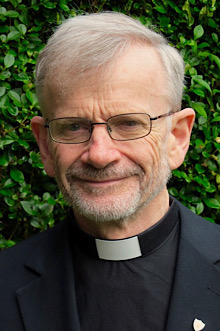
McGuckian is the youngest of six children to Brian McGuckian and his wife Pauline (née McKenna). He is named after his uncle, also Alexander Aloysius McGuckian, who dies five month before he is born. Yet another uncle, Daniel McGuckian, is a priest of the Diocese of Down and Connor and serves as parish priest of Cushendun and then Randalstown until his death in 1980. His father is a successful pig farmer who, alongside his brothers, develops the world’s biggest pig farm.
Two of McGuckian’s brothers are also Jesuit priests, while another brother is a businessman. Both of his sisters predecease him.
McGuckian is ordained to the priesthood on June 22, 1984, and makes his final profession on February 15, 1997.
Following ordination, McGuckian spends four years as a teacher in Clongowes Wood College and vocations director for the Jesuits, before undertaking a six month period of spiritual renewal in southern India and serving in a shanty town in Quezon City, Philippines.
McGuckian returns to Ireland in 1992, where he is appointed director of the Jesuit Communication Centre, during which he develops Sacred Space, a website which allows people to pray at their computer, in 1999, and Catholic news service CatholicIreland.net in 2004.
McGuckian also serves as editor of both An Timire and Foilseacháin Ábhair Spioradálta, later translating the autobiography of Ignatius of Loyola into Irish under the title Scéal an Oilithrigh. He also co-authors the drama 1912 – A Hundred Years On with Presbyterian historian Philip Orr in 2011, which looks at the experiences of the Ulster Covenant and the wider Home Rule movement from both nationalist and unionist perspectives.
McGuckian also serves as chaplain to many of the Gaelscoileanna in the Diocese of Down and Connor, and subsequently as chaplain to Ulster University campuses in Belfast and Jordanstown. Following the publication of the Living Church Report, which outlines the findings of a synodal process within the diocese, he is appointed by Noël Treanor in 2012 to set up and lead the Living Church Office, whose aim is to realise the hopes and aspirations expressed in the report and subsequently in the upcoming diocesan pastoral plan.
McGuckian is also appointed diocesan director of formation for the permanent diaconate in 2014, and also works during his directorship of the Living Church Office to establish pastoral communities across the diocese, through fostering a culture of co-responsibility for the mission of the Church between clergy and lay people.
McGuckian is appointed Bishop-elect of Raphoe by Pope Francis on June 9, 2017. His appointment makes him the first member of the Jesuits to be appointed a bishop in Ireland.
In an interview with The Irish Catholic in September 2019, McGuckian says that having a home is as fundamental as the right to life and education, and that the Government must be “pushed” to enshrine a right to housing in the Constitution of Ireland. He also joins a number of church leaders in the West of Ireland on September 16, 2021, in calling on the Irish government to offer reparations to homeowners whose properties are affected by defective concrete blocks.
In an interview with The Irish Catholic in February 2021, McGuckian takes issue with the view held by political leaders that public worship is deemed to be “non-essential” during the COVID-19 pandemic in the Republic of Ireland. Quoting Pope Francis, who states that “the right to worship must be respected, protected and defended by civil authorities like the right to bodily and physical health,” he expresses a need to let political leaders know that public worship is not only central, but also “utterly essential.”
Following a fatal explosion in Creeslough, County Donegal, on October 7, 2022, McGuckian refers to the explosion as “the darkest day in Donegal,” adding that the local community is “living through a nightmare of shock and horror.” He also concelebrates at the Funeral Masses of each of the victims, describing the fact that the parish church would be holding two funerals in the space of three hours as “surreal.”
McGuckian is appointed Bishop of Down and Connor by Pope Francis on February 2, 2024. In his first address following his appointment, he expresses his hope that the restoring of the Northern Ireland Executive will help the most vulnerable in society.
Hanna is born on February 25, 1821, near Dromara, County Down, the eldest among three sons and two (possibly three) daughters of Peter Hanna, of Dromara farming stock, and his wife Ellen (née Finiston), whose father served in the Black Watch regiment during the Napoleonic Wars. In the 1820s, leaving their children behind, his parents move to Belfast, where his father establishes a business turing out horse–cars. Hanna does not join them until the mid-1830s. His education reflects the modest nature of his upbringing. It is patchy and always combined with paid employment. In the 1830s he attends Bullick’s Academy, a privately run commercial college in Belfast. In the 1840s, seemingly with the intention of preparing for the Presbyterian ministry, he takes classes at Belfast Academical Institution. In 1847, he enters the general assembly’s newly established Theological College and, after some absences, obtains his licence to preach in 1851. During this time he works, first as a woolen draper‘s assistant in High Street and then, after 1844, as a teacher in the national school associated with Townsend Street Presbyterian Church, where he is a member. He resigns his teaching post in January 1852, only a month before being ordained to full-time ministry. On August 25, 1852, he marries Frances (‘Fanny’) Spence Rankin, daughter of James Rankin, a Belfast salesman. Together they have four daughters and two sons.
Hanna’s first, and only, pastorate is in a congregation that emerges out of the evangelistic efforts he and other Townsend Street members had conducted among the working people of north Belfast. In 1852, they begin meeting in the old Berry Street church and quickly grow from 75 to over 750 families. By 1869 a new building is essential and in 1870 the foundation stone for St. Enoch’s church is laid in Carlisle Circus, on property purchased from the Belfast Charitable Society. Opened in 1872 at a cost of nearly £10,000, it seats over 2,000 people and has two galleries. With 800 families and 2,500 Sunday-school scholars, it is one of the largest congregations in Belfast.
Hanna’s influence as the leader of such a large flock is not translated into advancement within the Presbyterian church. Although he serves as the Presbyterian chaplain to the Belfast garrison (1869–91) and as moderator of the presbytery (1879) and synod (1870–71) of Belfast, he does not achieve any position of note within the denomination as a whole. This is most likely because of his penchant for public controversy. Letters to the newspapers, calls for action in presbytery, and public platform debates over issues such as public-house licensing laws, Sabbath observance and property rights, brand him a destablising force. It is no doubt for this reason, rather than for his open-air preaching, of which he does very little, that he acquires his famous sobriquet, “Roaring Hugh.” His aggressive manner in debate is noted by the Belfast News Letter early in his career.
Hanna’s political views contribute to his reputation as an intolerant firebrand. He is part of a small group of Presbyterian clergy, led by the Rev. Henry Cooke, who are staunch defenders of the Protestant interest and active supporters of the conservative cause. He hosts ”anti-popery” lectures in his church and joins the Orange Order, serving briefly, in 1871, as the deputy grand chaplain for Belfast (County Grand Lodge). His determination to uphold the “right” of Protestants to preach in the open air sparks a series of violent sectarian riots and a government inquiry in Belfast in 1857. As the century progresses, and as the Presbyterian community’s political allegiances begin to shift, he becomes one of a group of prominent figures associated with two populist campaigns: opposition in the 1860s to the disestablishment of the Church of Ireland and subsequently to the introduction of home rule. In 1886, as one of the honorary secretaries of the Ulster Constitutional Club, he helps to found the Ulster Loyalist Anti-Repeal Union, a forerunner of what eventually becomes the Ulster Unionist Party.
Such activity overshadows Hanna’s impressive contribution to education. Within St. Enoch’s he establishes an enormous network of Sunday schools and evening classes, including a training institute for teachers. As a former teacher, and later as a commissioner of national education (1880–92), he is a firm advocate of the national system, and sets up six national schools in north and west Belfast.
Hanna receives only two honours: a Doctor of Divinity (DD) from the theological faculty of the Presbyterian Church in Ireland (1885) and a Doctor of Laws (LL.D.) from Galesville University in Galesville, Wisconsin (1888). In good health throughout his life, he dies suddenly of a heart attack on February 3, 1892. Buried with much fanfare in Balmoral Cemetery, Belfast, he is clearly held in high regard by surviving friends and colleagues. In 1892, the Orange Order approves the naming of LOL 1956 as the “Hanna Memorial,” and in 1894 a bronze statue depicting him in full ecclesiastical garb is erected in Carlisle Circus. Since then, his achievements have fallen on hard times. In March 1970, an Irish Republican Army bomb blast topples his statue from its plinth; several high-profile attempts to re-erect it fail. After an arson attack in 1985, and with falling numbers, the decision is taken in 1992 to demolish St. Enoch’s and unite with the neighbouring Duncairn church in a new, much smaller, building on the site.
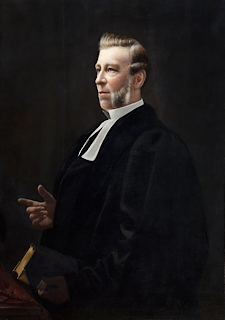
(From: “Hanna, Hugh” by Janice Holmes, Dictionary of Irish Biography, http://www.dib.ie, October 2009 | Pictured: Portrait of Reverend Hugh Hanna by Augustus George Whichelo in 1876, which is part of the collection owned by the National Museums Northern Ireland and is located in the Ulster Museum)
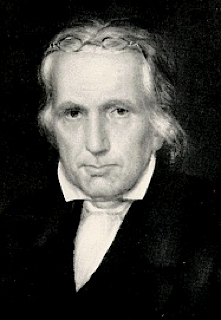
Campbell is born on February 1, 1763, in County Down, Ireland (now Northern Ireland), and is raised as an Anglican. He is ordained a minister in the Scottish Seceder Presbyterian Church sometime after graduating from the University of Glasgow in 1786. He leaves Ireland for the United States in April 1807. This move is prompted by the advice of his physician. Once in America, disagreement arises between him and other Presbyterians over certain points related to Calvinist doctrine and the administration of the Eucharist.
When their study of the New Testament leads the reformers to begin to practice baptism by immersion, the nearby Redstone Baptist Association invites Brush Run Church to join with them for the purpose of fellowship. The reformers agree, provided that they will be “allowed to preach and to teach whatever they learned from the Scriptures.”
Thomas and his son, Alexander, work within the Redstone Baptist Association during the period 1815 through 1824. While both the Campbells and the Baptists share practices of baptism by immersion and congregational polity, it is soon clear that the Campbells and their associates are not traditional Baptists. Within the Redstone Baptist Association, some of the Baptist leaders consider the differences intolerable when Alexander Campbell begins publishing a journal, Christian Baptist, which promotes reform. The Campbells anticipated the conflict and move their membership to a congregation of the Mahoning Baptist Association in 1824.
Campbell is a student of the Enlightenment philosopher John Locke. While he does not explicitly use the term “essentials,” in the Declaration and Address, Campbell proposes the same solution to religious division as had been advanced earlier by Herbert and Locke: “[R]educe religion to a set of essentials upon which all reasonable persons might agree.” The essentials he identifies are those practices for which the Bible provides “a ‘Thus saith the Lord,’ either in express terms or by approved precedent.” Unlike Locke, who sees the earlier efforts by Puritans as inherently divisive, he argues for “a complete restoration of apostolic Christianity.” He believes that creeds serve to divide Christians. He also believes that the Bible is clear enough that anyone can understand it and, thus, creeds are unnecessary.
Campbell combines the Enlightenment approach to unity with the Reformed and Puritan traditions of restoration. The Enlightenment affects the Campbell movement in two ways. First, it provides the idea that Christian unity can be achieved by finding a set of essentials that all reasonable people can agree on. The second is the concept of a rational faith that is formulated and defended on the basis of a set of facts derived from the Bible.
Thomas dies on January 4, 1854, in Bethany, West Virginia, and is buried next to his wife in the Campbell family cemetery.
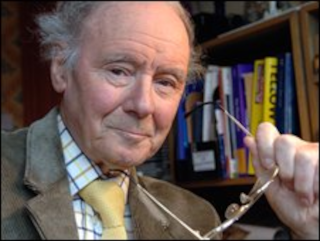
Hammond is the son of Leslie Hammond, a tram driver, and his wife Annie (née Lamont). His parents are not city people; his mother grew up near Ballybogy in the Ballymoney area of County Antrim, and his father, though from a family with roots in south County Londonderry, had lived in Ballymoney as a boy, and had been apprenticed to a blacksmith there. Both have a strong sense of their rural identity and maintain the Ulster Scots dialect of their childhood. They are never quite at home in the Belfast suburb of Cregagh, and in particular do not share the sectarian attitudes that are much more present in 1930s Belfast than they had been in north Antrim, one of the last strongholds of Presbyterian radicalism. Even as a boy, Hammond is interested in the old songs that his mother sang and realises that the traditions in which his parents had been nurtured are disappearing quickly in an increasingly urbanising and modernising world. When he encounters the work of Emyr Estyn Evans in the early 1940s, he is encouraged to document both rural tradition and the street life of the city, and he and a couple of friends, though still just teenagers, ride off on their bicycles to look for folklore in the hinterland of Belfast.
After primary school, Hammond wins a scholarship in 1941 to Methodist College Belfast, where he does well in examinations, and then goes to Stranmillis University College to train as a teacher. In his first job, in Harding Memorial primary school in east Belfast, he proves to be a popular, idealistic teacher, and is remembered by his pupils fifty years later as a fine singer and a teller of ghost stories, who had taken the class on memorable youth-hosteling trips to the Mourne Mountains. Youth hosteling and folklore collecting increases his awareness and understanding of the rich traditions of the whole community in the north of Ireland, and he is never constrained by political or religious barriers. His early career mirrors closely that of James Hawthorne, and their paths are to cross in later life.
Hammond is friendly with many others active in the cultural life of Northern Ireland and makes a name for himself as a song collector and eventually as an expert on all aspects of traditional singing. In 1956, he is awarded a scholarship to travel in the United States to meet the important pioneers of folk-music collecting and performance there. He records his first LP record of Ulster songs, I Am The Wee Falorie Man (1958), in the United States, and becomes friends with Pete Seeger, the Appalachian singer Jean Ritchie, with old blues singers, and notably with Liam Clancy, one of the three Clancy brothers who as a quartet with Tommy Makem are to popularise Irish folk music in the United States and elsewhere.
On returning to Belfast, Hammond takes a job in 1958 in Orangefield secondary school in the east of the city, where the highly regarded headmaster John Malone encourages new approaches to education. Among his pupils at Orangefield is George Ivan “Van” Morrison, who credits him with inspiring his interest in Irish traditional music. Hammond enjoys teaching but is increasingly drawn to folk-song performance and recording. He appears regularly on radio programmes of the BBC and Radio Éireann, and in 1964 joins the school’s department in BBC Northern Ireland. There, with colleagues like Sam Hanna Bell, James Hawthorne and others, he works on programmes such as Today and Yesterday in Northern Ireland, which for the first time introduces pupils (and many adults) to local history and to aspects of tradition. In 1968, with two friends, the poets Seamus Heaney and Michael Longley, he puts on poetry and traditional music events in schools all over the province. The Arts Council funds the Room to Rhyme project, which is immensely influential and inspiring, and is still talked about many years later by those who attended as children.
Hammond is creatively involved with hundreds of hours of broadcasting, in television as well as radio, and eventually for adults as well as children. He writes scripts, produces documentary series such as Ulster in Focusand Explorations, and brings an artistic sensibility to filming, as well as working sympathetically with traditional singers and craftspeople. Dusty Bluebells, a sensitively made film of Belfast children’s street games, wins the prestigious Golden Harp award in 1972. After he leaves the BBC to work as a freelance, and founds Flying Fox Films in 1986, he continues making documentaries on many aspects of Ulster life and heritage. His film called Steel Chest, Nail in the Boot and the Barking Dog (1986), about working in the Belfast shipyards, also wins a Golden Harp award. A companion book of the same name is published. Another book is Belfast, City of Song(1989), with Maurice Leyden. In 1979, he edits a volume of the songs of Thomas Moore. His documentary programmes include films about singers from Boho, County Fermanagh, and about the big houses of the gentry in Ireland. The Magic Fiddle (1991/2) examines the role of the instrument in the folk music of Ireland, Scandinavia, Canada, and the American south, while Another Kind of Freedom (1993) is about the experiences of a former Orangefield pupil, the Beirut hostage Brian Keenan. He also produces and directs the films Something to Write Home About (1998), Where Are You Now? (1999), and Bogland (1999), all of which explore Seamus Heaney’s home region and experiences.
The first poem in Heaney’s collection Wintering Out (1972) is entitled “For David Hammond and Michael Longley.” Their lifelong friendship leads to several other creative collaborations. In particular, after a distressing evening in 1972 when Hammond, affected by the despair and terror unleashed by Irish Republican Army (IRA) bombing of his city, is for once unable to sing, Heaney meditates on the experience in an essay and in an important poem, “The singer’s house” (subsequently included in his 1979 Field Work collection). The poem urges the singer to keep singing, to defend the values of art and friendship in a hostile time. Hammond collaborates with Dónal Lunny and other traditional musicians to bring out an LP also called The Singer’s House(1978), which includes Heaney’s poem on the album sleeve, and features some of the songs that he had made famous, such as “My Aunt Jane” and “Bonny Woodgreen,” from his vast repertoire of songs from Ulster. The album is reissued in 1980.
In 1995, Hammond is one of Heaney’s personal guests at the award of his Nobel prize in Stockholm, characteristically wearing his usual, mustard-yellow, cattle-dealer boots with evening dress. On another formal occasion, when he is awarded an honorary doctorate by Dublin City University in November 2003, he surprises the audience by standing up in his academic robes to sing “My Lagan love,” instead of giving an address. His unique, light mellow voice is an ideal vehicle for the traditional ballads which he knows so well. He records a number of records in the 1960s, including Belfast Street Songs, and publishes the book Songs of Belfast (1978). He also encourages traditional musicians like Arty McGlynn, and collaborates with them on various recording projects. He is well known for live and often impromptu performances at festivals and venues in Ireland and the United States. He also performs at the John F. Kennedy Center for the Performing Arts in Washington, D.C.
Hammond is also a notable collaborator with poets and dramatists, especially in the important Field Day Theatre Company project, of which he is a director, along with Seamus Heaney, Tom Paulin, Seamus Deane, Thomas Kilroy, and the project’s founders, Brian Friel and Stephen Rea. He supports the Field Day search for a “fifth province,” where history and community and culture can intersect, believing that to speak unthinkingly of “two traditions” is to perpetuate superficial political divisions. As he says in an interview in The Irish Times on July 4, 1998, songs can “take you out of yourself” and become bridges to unite people.
Hammond receives many honours. In 1994, he receives the Estyn Evans award for his contribution to mutual understanding, and his work is featured in several major events in his honour: in the University of North Florida (1999), in the Celtic Film Festival in Belfast (2003), and in Belfast’s Linen Hall Library (2005). A Time to Dream, a film about his life and work, is broadcast on BBC Northern Ireland in December 2008.
Hammond dies in hospital in Belfast, after a long illness, on August 25, 2008, survived by his wife Eileen (née Hambleton), whom he marries on July 19, 1954, and by their son and three daughters. His funeral in St. Finnian’s Church is a major cultural event, where friends sing, play and speak in his honour.
In Seamus Heaney’s last collection of poetry, Human Chain (2010), he includes a poignant farewell to Hammond. The poet imagines (or perhaps dreams) of another visit to the singer’s house, but this time “The door was open, and the house was dark.”
(From: “Hammond, David Andrew (‘Davy’)” by Linde Lunney, Dictionary of Irish Biography, http://www.dib.ie, December 2014)
Lyons is a lecturer in history at the University of Hull and then at Trinity College Dublin. He becomes the founding Professor of Modern History at the University of Kent in 1964, serving also as Master of Eliot College from 1969 to 1972.
Lyons principal works include Ireland Since the Famine, the standard university textbook for Irish history from the mid-19th to late-20th century, which The Times calls “the definitive work of modern Irish history” and a biography of Charles Stewart Parnell.
Lyons is critical of Cecil Woodham-Smith‘s much-acclaimed history of the Great Irish Famine and has generally been considered among the “revisionist” historians who reconsiders the role of the British state in events like the Famine.
Lyons marries Jennifer Ann Stuart McAlister in 1954, and has two sons, one of whom, Nicholas, is a former Lord Mayor of London.
On September 15, 1983, Lyons is nominated, unopposed, as chancellor of Queen’s University Belfast (QUB). But less than a week later he is dead, succumbing in Dublin on September 21 to acute pancreatitis, which had struck him in mid-August. He had begun to write the first draft of his W. B. Yeats biography (having accumulated a great archive of material) only a few weeks before. His ashes are buried beside Trinity College chapel.
Warden is born in the townland of Ballycastle, near Newtownards in County Down, the eldest among three sons of Robert Warden, tenant farmer, and Elizabeth Warden (née Bailie). Educated locally, he studies for the Presbyterian ministry, despite being told by a clergyman that he is a “blockhead.” Entering the University of Glasgow, he wins a silver medal for his work on barometers, receives a certificate in midwifery, and graduates MA in April 1797. Returning to Ireland, he accepts a provisional license to preach from the Presbytery of Bangor, County Down, and becomes a popular preacher in the region. A patriot in politics, he joins the United Irishmen. Because of this a warrant was issued for his arrest in 1798 and he surrenders himself to the government. Banished from Ireland, he decides to emigrate to the United States and writes a pamphlet explaining his decision, A farewell address to the junto of the presbytery of Bangor, in which he accuses the church leaders of “meanness, injustice and cruelty.”
On his arrival in New York City in 1799, Warden decides to abandon his career as a clergyman and become a teacher. Interested in mathematics, science and literature, he becomes principal of the Columbia Academy in Kinderhook, New York, and is appointed in 1801 the head tutor at Kingston Academy in Ulster County, New York. Employed by General John Armstrong, Jr. to teach his children, he makes useful connections in American society. He becomes a citizen in 1804 and is asked to accompany Armstrong to France when he is appointed ambassador. Arriving in Paris in 1806, he gives strong support to Armstrong and defends him from criticism in the American press. He is appointed acting consul in 1808, and serves as head of the legation on two occasions when Armstrong is absent. Surprisingly, despite their ties of friendship, Armstrong does not recommend Warden to succeed him permanently, and advises President Thomas Jefferson that although “honest and amiable” he is “not well qualified for business.” Stung by these comments, Warden reacts angrily and his friendship with Armstrong ends acrimoniously. As a result he is swiftly recalled from Paris.
Once back in America, Warden lobbies vigorously to be appointed French consul. Supported by Jefferson, now out of office, he returns to Paris in August 1811 having convinced the government of his credentials. Befriending the new ambassador, Joel Barlow, he soon allows pride to get the better of him. Arrogantly styling himself “consul general” after Barlow dies in December 1812, he provokes much anger and is dismissed from office on June 10, 1814. He never holds a diplomatic appointment again.
Deciding to remain in France, he resumes his scholarly activities and publishes his first book, On the Origin, Nature, Progress and Influence of Consular Establishments in 1813. A friend of many of the leading French writers and intellectuals, he also offers assistance to visiting scholars from America, providing a bridge between the European and American intellectual communities. His reputation increases with the publication of Chorographical and Statistical Description of the District of Columbia (1816) and A Statistical, Political and Historical Account of the United States of North America (3 vols., 1819). The publishers of a series, L’art de vérifier les dates, commissions him to research the volumes on North and South America in 1821. These run to ten volumes and are written over thirteen years.
Beset by financial difficulties, Warden is twice forced to sell part of his vast library to raise money. He dies on October 9, 1845, in Paris, after a long illness. He never marries.
(From: “Warden, David Bailie” by Patrick M. Geoghegan, Dictionary of Irish Biography, http://www.dib.ie, October 2009)
Smyllie is born on March 20, 1893, at Hill Street, Shettleston, Glasgow, Scotland. He is the eldest of four sons and one daughter of Robert Smyllie, a Presbyterian printer originally from Scotland who is working in Sligo, County Sligo, at the time, and Elisabeth Follis, originally from Cork, County Cork. His father marries in Sligo on July 20, 1892, and later becomes proprietor and editor of the unionistSligo Times. Smyllie attends Sligo Grammar School in 1906 and enrolls at Trinity College Dublin (TCD) in 1911.
After two years at TCD, Smyllie’s desire for adventure leads him to leave university in 1913. Working as a vacation tutor to an American boy in Germany at the start of World War I, he is detained in Ruhleben internment camp, near Berlin, during the war. As an internee, he is involved in drama productions with other internees. Following his release at the end of the war, he witnesses the German revolution of 1918–1919. During this period, he encounters revolutionary sailors from Kiel who temporarily make him a representative of the Workers’ and Soldiers’ Council, and he observes key events including the looting of the Kaiser’s Palace and violent clashes between rival factions in Berlin. It is also during this period that he secures a personal interview with David Lloyd George at the Paris Convention of 1919. This helps Smyllie gain a permanent position with TheIrish Times in 1920, where he quickly earns the confidence of editor John Healy. Together, they take part in secret but unsuccessful attempts to resolve the Irish War of Independence.
Smyllie contributes to the Irishman’s Diary column of the paper from 1927. In 1927, he publishes an exclusive report outlining a draft government including both Labour Party and Fianna FáilTDs, signaling the volatile politics of the early state years.
Smyllie’s knowledge of languages (particularly the German he had learned during his internment) led to numerous foreign assignments. His reports on the rise of National Socialism in 1930s Germany are notably prescient and instill in him a lasting antipathy towards the movement.
When Healy dies in 1934, Smyllie becomes editor of TheIrish Times and also takes on the role of Irish correspondent for The Times (London), a position that brings significant additional income. Under Healy’s leadership, The Irish Times shifted from representing the Anglo-Irish ascendancy to becoming an organ of liberal, southern unionism, and eventually becomes a critical legitimising force in the Irish Free State. Smyllie enthusiastically supports this change. He establishes a non-partisan profile and a modern Irish character for the erstwhile ascendancy paper. For example, he drops “Kingstown Harbour” for “Dún Laoghaire.” He also introduces the paper’s first-ever Irish-language columnist. He is assisted by Alec Newman and Lionel Fleming, recruits Patrick Campbell and enlists Flann O’Brien to write his thrice-weekly column “Cruiskeen Lawn” as Myles na gCopaleen. As editor, he introduces a more Bohemian and informal style, establishing a semi-permanent salon in Fleet Street’s Palace Bar. This becomes a hub for journalists and literary figures and a source of material for his weekly column, Nichevo.
One of Smyllie’s early political challenges as editor concerns the Spanish Civil War. At a time when Irish Catholic opinion is strongly pro-Franco, he ensures TheIrish Times coverage is balanced and fair, though advertiser pressure eventually forces the withdrawal of the paper’s young reporter, Lionel Fleming, from the conflict. His awareness of the looming European crisis earns him the Order of the White Lion of Czechoslovakia in 1939. However, during World War II, he clashes with Ireland’s censorship authorities, especially under Minister Frank Aiken. He challenges their views both publicly and privately, though his relationship with the editor of the Irish Independent, Frank Geary, is cold, reducing the effectiveness of their joint opposition to censorship.
During the 1943 Irish general election, Smyllie uses the paper to promote the idea of a national government that could represent Ireland with authority in the postwar world. He praises Fine Gael’s proposal for such a government and criticises Éamon de Valera for dismissing it as unrealistic. This leads to a public exchange between de Valera and Smyllie, with the latter defending The Irish Times’s role as a constructive voice for Ireland’s future rather than a partisan interest.
Following the war, Smyllie’s editorial stance shifts toward defending Ireland’s neutrality and diplomatic position. When Winston Churchill accuses de Valera of fraternising with Axis powers, Smyllie counters by revealing Ireland’s covert collaboration with the Allies, such as military and intelligence cooperation, despite official neutrality. In the same period, he continues to oppose censorship, particularly the frequent banning of Irish writers by the Censorship of Publications Board. This opposition features prominently in a controversy on TheIrish Times letters page in 1950, later published as the liberal ethic. The paper also adopts a critical stance toward the Catholic Church, notably during the 1951 resignation of Minister for HealthNoël Browne amid opposition from bishops and doctors to a national Mother and Child Scheme. His editorials suggest the Catholic Church is effectively the government of Ireland, though he maintains a cordial relationship with Archbishop of Dublin, John Charles McQuaid, who invites him annually for dinner.
Smyllie is also wary of American foreign policy, showing hostility particularly during the Korean War. American diplomats in Dublin allege that Smyllie is “pro-communist“. Despite growing readership among an educated Catholic middle class, TheIrish Times’s circulation in 1950 remains under 50,000, far below the Irish Independent and the Fianna Fáil-aligned The Irish Press.
In later years, Smyllie’s health declines, prompting a quieter lifestyle. He moves from his large house in Pembroke Park, Dublin, to Delgany, County Wicklow. As he does not drive, he becomes less present in the newspaper office in D’Olier Street, contributing to a decline in the paper’s dynamism. His health deteriorates further, resulting in frequent absences from his editorial duties, though he retains his position despite management attempts to limit his authority, especially over finances. He dies of heart failure on September 11, 1954.
In 1925, Smyllie marries Kathlyn Reid, eldest daughter of a County Meath landowner. They have no children.
Smyllie is an eccentric: he hits his tee shots with a nine iron, speaks in a curious mix of Latin phrases and everyday Dublin slang, and weighs 22 stone (308 lbs.; 140 kg) yet still cycles to work wearing a green sombrero.
Geddes is born on her maternal grandparent’s farm at Drumreilly Cottage in Leitrim, County Leitrim, on May 25, 1887. She is the eldest of four children, three girls and a boy, of William Geddes and his wife Eliza Jane Stafford. The family, who migrates to Ireland from Scotland, has mainly been farmers. Her father, a Methodist, who is born near his father’s farm at Tandragee, County Armagh, emigrates to the United States as a young man, working as a labourer for the railway construction business. This serves a useful purpose as he had worked as a site engineer at the Cavan, Leitrim and Roscommon Railway Company. When she is still an infant her parents move to their native home in Belfast, so her father can set up in business as a building contractor.
Geddes begins drawing subjects from life and nature from the age of four. She learns first how to draw from the school mistress in Ayrshire, where her father occasionally goes shooting. She begins her studies at Methodist College Belfast along with her three younger sisters. She later moves to the Belfast School of Art. She is encouraged by Rosamond Praeger, a sculptor from County Down, to continue with her studies. She is accepted as a student to study at the Belfast School of Art, Ulster University. This is where she adapts and improves her style and is introduced to a professional standard of art work.
While still studying at the Belfast School of Art, Geddes takes part in the Arts and Crafts Society of Ireland‘s fourth exhibition. For this exhibition, she contributes a glowingly coloured illustration of the book Cinderella Dressing the Ugly Sister (Dublin City Gallery), which she had created. It is at this exhibition that her work is spotted by Sarah Purser, a well established painter seeking newly trained students to introduce to stained glass artistry. Purser, who goes on to be her lifelong mentor, invites the young Geddes to join her in Dublin, working under the established stained glass artist William Orpen.
Geddes contributes a watercolour illustration of a Ballad Seller with the Belfast Art Society in 1907. She is elected as an Associate of the Belfast Art Society’s successor, the Ulster Academy of Arts, in 1933 before promotion to Honorary Academician in 1935. She shows five illustrations in the 1911 Oireachtas Exhibition. It is some twenty-one years before she returns to the Oireachtas when she exhibits three cartoons and three sketches for stained glass in 1932.
Geddes joins Purser at the acclaimed stained glass workshop called An Túr Gloine in 1910. The workshop is held in Dublin’s Metropolitan School of Art. It is here that she discovers her passion for the craftsmanship of stained glass artistry and creates her most important works.
During her early years at An Túr Gloine, Geddes’s originality shines, and important commissions come from St. Ann’s Church, Dawson Street, Dublin and the Presbyterian church in Rathgar. Dogged by illness, she returns to Belfast before 1916 and lives between there and Dublin until moving in 1925, as she has long wanted, to work in London at The Glass House, Fulham. While working at The Glass House, she instructs the Irish painter and stained glass artist Evie Hone.
Geddes’s work is considered pioneering and represents a rejection of the Late Victorian approach. She creates a new view of men in stained glass windows, portraying them with close-shaven crew cuts. The muscularity and tension of her portraiture is matched by the radical design of her constructions. Ambitious large-scale projects, as at the cathedral in Ypres, are equalled by the drama of smaller-scale work at Wallasey (Lancashire) and Wallsend (Northumberland), or war memorial windows in obscure country churches.
Despite the hardships of living in London during World War II, poverty, and ill health, Geddes designs seventeen full-scale stained glass masterpieces, sixteen of which she completes.
Geddes dies on August 10, 1955 in London of a pulmonary embolism. She is buried in CarnmoneyCemetery, County Antrim, along with her mother and sister Ethel. Even after moving to London, she claims that her native identity never wavered as she says she was always “a Belfast woman.”
Murdoch is the daughter of Irene Alice (née Richardson) and Wills John Hughes Murdoch. Her father, a civil servant, comes from a mainly Presbyterian sheep farming family from Hillhall, County Down. In 1915, he enlists as a soldier in King Edward’s Horse and serves in France during World War I before being commissioned as a second lieutenant. Her mother trains as a singer before Iris is born and is from a middle-class Church of Ireland family in Dublin. Her parents first meet in Dublin when her father is on leave and are married in 1918. Iris is the couple’s only child. When she is a few weeks old the family moves to London, where her father had joined the Ministry of Health as a second-class clerk. She is a second cousin of the Irish mathematician Brian Murdoch.
From 1947 to 1948 Murdoch studies philosophy as a postgraduate at Newnham College, Cambridge. She meets Ludwig Wittgenstein at Cambridge but does not hear him lecture, as he had left his Trinity College professorship before she arrives. In 1948 she becomes a fellow of St. Anne’s College, Oxford, where she teaches philosophy until 1963. From 1963 to 1967 she teaches one day a week in the General Studies department at the Royal College of Art.
In 1956 Murdoch marries John Bayley, a literary critic, novelist, and from 1974 to 1992 Warton Professor of English at Oxford University, whom she had met in Oxford in 1954. The unusual romantic partnership lasts more than forty years until Murdoch’s death. Bayley thinks that sex is “inescapably ridiculous.” She in contrast has “multiple affairs with both men and women which, on discomposing occasions, Bayley witnesses for himself.”
Murdoch’s first novel, Under the Net, is published in 1954 and is selected in 1998 as one of Modern Library’s 100 best English-language novels of the 20th century. She had previously published essays on philosophy, and the first monograph about Jean-Paul Sartre published in English. She goes on to produce 25 more novels and additional works of philosophy, as well as poetry and drama.
Murdoch’s last novel, Jackson’s Dilemma, is published in 1995. She is diagnosed with Alzheimer’s disease in 1997 and dies on February 8, 1999, in Oxford, England. There is a bench dedicated to her in the grounds of Lady Margaret Hall, Oxford, where she enjoyed walking.



 seamus dubhghaill