seamus dubhghaill

Promoting Irish Culture and History from Little Rock, Arkansas, USA


Leave a comment

Death of Frank Duff, Founder of the Legion of Mary in Dublin

Francis Michael Duff, Irish lay Catholic and author known for bringing attention to the role of the Catholic Laity during the Second Vatican Council of the Roman Catholic Church, dies in Dublin on November 7, 1980. He is also the founder of the Legion of Mary in Dublin.

Duff is born in Dublin on June 7, 1889, at 97 Phibsboro Road, the eldest of seven children of John Duff and his wife, Susan Letitia (née Freehill). The wealthy family lives in the city at St. Patrick’s Road, Drumcondra. He attends Blackrock College.

In 1908, Duff enters the Civil Service and is assigned to the Irish Land Commission. In 1913, he joins the Society of Saint Vincent de Paul and is exposed to the real poverty of Dublin. Many who live in tenement squalor are forced to attend soup kitchens for sustenance, and abject poverty, alcoholism, and prostitution are rife in parts of Dublin. He joins and soon rises through the ranks to President of the St. Patrick’s Conference at St. Nicholas of Myra Parish. Having concern for people he sees as materially and spiritually deprived, he gets the idea to picket Protestant soup kitchens as he considers they are giving aid in the form of food and free accommodation at hostels in return for not attending Catholic services. He sets up rival Catholic soup kitchens and, with his friend, Sergeant Major Joe Gabbett, discourages Catholics from patronizing Protestant soup kitchens. They succeeded in closing down two of them over the years.

Duff publishes his first pamphlet, Can we be Saints?, in 1916. In it, he expresses the conviction that all, without exception, are called to be saints, and that through Christian faith, all have the means necessary.

In 1918, a friend gifts Duff a copy of True Devotion to Mary by the seventeenth-century French cleric Louis de Montfort, which influences his views on Mary. He is additionally influenced by the writings of John Henry Newman.

Duff briefly acts as private secretary to Michael Collins, the chairman of the Provisional Government and the commander-in-chief of the National Army. In 1924, he is transferred to the Department of Finance.

On September 7, 1921, Duff is a part of a meeting alongside Fr. Michael Toher and fifteen women which becomes the nucleus of what would become the Legion of Mary. The Legion of Mary is created to organise lay Catholics to perform voluntary work. He models the organisation on Roman legions. Some of the first causes the Legion pursues is to become involved with homelessness and prostitution in Dublin. In 1922, he defies the wishes of the Archbishop of Dublin and the widespread Crypto-Calvinism, or Jansenism, within the Catholic Church in Ireland, which had created an intense hostility towards both prostitutes and other allegedly “fallen women.” Similarly, to St. Vitalis of Gaza before him, he begins an outreach to the prostitutes living in often brutal and inhuman conditions in the “kip houses” of “the Monto,” as Dublin’s red-light district, one of the largest in Europe at the time, is then called. Although middle-class Dubliners dismissively view these women as “whores,” the impoverished but devoutly Catholic residents of the Monto tenements refer to local prostitutes as “unfortunate girls,” and understand that they often turn to prostitution as a last resort. As part of his work, Duff establishes the Sancta Maria hostel, a safe house for former prostitutes who had run away from their “kip keepers.” Following the Irish War of Independence and Irish Civil War, he also persuades the first Catholic Commissioner of the Dublin Metropolitan Police, former Irish Army General W. R. E. Murphy, to launch a crackdown and, even though prostitution in the Republic of Ireland, rooted in human trafficking, still exists, the closure of the Monto’s last “Kip-Houses” is announced on March 12, 1925.

In 1927, Duff establishes the Morning Star hostel for homeless men, followed shortly by the Regina Coeli hostel for homeless women in 1930. Unlike the Magdalen Asylums, the Regina Coeli hostel reflects his view that unwed mothers should be taught how to be able to provide for and raise their children. This defies the norm of the era which holds that the children of unwed mothers should be saved from the stigma of their illegitimacy by being put up for adoption as quickly as possible.

While Duff enjoys the support of W. T. Cosgrave, Ireland’s head of government, and in May 1931 is granted an audience with Pope Pius XI, his efforts are opposed internally in the Dublin diocese. The Archbishop of Dublin Edward Joseph Byrne and his successor John Charles McQuaid seek to censor him because of his involvement with prostitutes. McQuaid also does not approve of his ecumenical efforts. In the 1930s and 1940s Duff creates the Mercier Society, a study group designed to bring together Catholics and Protestants, as well as the Pillar of Fire, a group designed to promote dialogue with Ireland’s Jewish community. In communication with Irish social dissidents Seán Ó Faoláin and Peadar O’Donnell, he suggests he is far more censored than even they are.

Duff does have some supporters amongst the Catholic hierarchy though. With the backing of Cardinal Joseph MacRory and Francis Bourne of Westminster, the Legion is able to expand rapidly and internationally. In 1928 the Legion establishes its first presidium in Scotland. In 1932 he is able to use the occasion of the Eucharistic Congress of Dublin to introduce the concept of the Legion of Mary to several visiting bishops, leading to further international growth.

Duff retires from the Civil Service in 1934 to devote all of his time to the Legion of Mary.

In July 1940, an overseas club for Afro-Asian students in Dublin is created. At that time Ireland is a popular destination for students from Asia and Africa because of its recent anti-imperial, anti-colonial history. Duff personally funds the purchase of a building for the club using funds from an inheritance. The club lasts until 1976 and facilitate many notable students, including Jaja Wachuku.

For the rest of his life, and with the help of many others, Duff guides the Legion’s worldwide extension. Today, the Legion of Mary has an estimated four million active members and 10 million auxiliary members in close to 200 countries in almost every diocese in the Catholic Church.

In 1965, Pope Paul VI invites Duff to attend the Second Vatican Council as a lay observer. When he is introduced to the assembly by the Archbishop of Liverpool, John Heenan, he receives a standing ovation.

Duff makes the promotion of devotion to the Most Sacred Heart of Jesus part of the Legion’s apostolate.

Duff dies in Dublin at the age of 91 on November 7, 1980, and is interred at Glasnevin Cemetery. In July 1996, the cause of his beatification is introduced by Cardinal Desmond Connell.


Leave a comment

William of Orange Arrives in Brixham, England

On November 5, 1688, William of Orange, King of the Netherlands and son-in-law of King James II of England, arrives in Brixham, England, with 40,000 soldiers, sailors and volunteers, prior to marching on London to be crowned King William III as part of the Glorious Revolution.

He has been invited by the Protestant noblemen of the country to come and usurp the English throne. Led by Lord Monmouth, a group of Protestant nobles have unsuccessfully attempted to prevent the Catholic James from ascending to the throne on the death of Charles II in 1685. Since then, James has been disturbing the Protestant noblemen who have remained loyal to him in 1685 by giving Catholics more and more freedoms in both England and Ireland.

On May 7, 1688, James II issues a “Declaration of Indulgence” pledging religious toleration. Still the Protestant nobles are comforted by the fact that all the possible heirs to James are Protestant. Thus the country will be safely returned to a Protestant monarch in time and many of James’ reforms will be reversed. All that changes on June 10, 1688, when the Queen gives birth to a male heir, one who is to be raised as a Catholic.

Soon thereafter, an invitation is sent across to William, who is married to James’ sister Mary, to come and save England for Protestantism. This, William is more than happy to do, for Louis XIV of France is threatening to invade the Netherlands and what better way to ensure the support of England in that coming war than to become the King of that country.

The “Glorious Revolution,” as the British would come to call it, is now underway. In less than two months, James II flees for his life and goes into exile in France, never to return. For the native population of Ireland, the eventual results of this revolution are far from “glorious.” The results are death, destruction, poverty, hundreds of years of second-class citizenship in their own land, and a legacy of hatred between Protestant and Catholic in the north of Ireland that persists to this day.

(Pictured: “William III Landing at Brixham, Torbay, 5 November 1688” by Jan Wyck, National Maritime Museum)


Leave a comment

Birth of Ruairí Ó Brádaigh, Republican Political & Military Leader

Ruairí Ó Brádaigh, Irish republican political and military leader, is born Peter Roger Casement Brady on October 2, 1932, in Longford, County Longford. He is Chief of Staff of the Irish Republican Army (IRA) from 1958 to 1959 and again from 1960 to 1962, president of Sinn Féin from 1970 to 1983, and president of Republican Sinn Féin from 1987 to 2009.

Ó Brádaigh is born into a middle-class republican family. His father, Matt Brady, is an IRA volunteer who is severely wounded in an encounter with the Royal Irish Constabulary (RIC) in 1919. His mother, May Caffrey, is a Cumann na mBan volunteer and a 1922 graduate of University College Dublin (UCD). His father dies when he is ten and is given a paramilitary funeral led by his former IRA colleagues. His mother, prominent as the Secretary for the County Longford Board of Health, lives until 1974. He is educated at Melview National School at primary level and attends secondary school at St. Mel’s College, leaving in 1950, and graduates from University College Dublin in 1954. That year he takes a job teaching Irish language at Roscommon Vocational School in Roscommon. He is a deeply religious Catholic who refrains from smoking or drinking.

Ó Brádaigh joins Sinn Féin in 1950. While at university, in 1951, he joins the Irish Republican Army. In September 1951, he marches with the IRA at the unveiling of the Seán Russell monument in Fairview Park, Dublin. A teacher by profession, he is also a Training Officer for the IRA. In 1954, he is appointed to the Military Council of the IRA, a subcommittee set up by the IRA Army Council in 1950 to plan a military campaign against Royal Ulster Constabulary (RUC) barracks in Northern Ireland.

On August 13, 1955, Ó Brádaigh leads a ten-member IRA group in an arms raid on Hazebrouck Barracks, near Arborfield, Berkshire, England, a depot for the No. 5 Radar Training Battalion of the Royal Electrical and Mechanical Engineers. It is the biggest IRA arms raid in Britain. Most, if not all, of the weapons are recovered in a relatively short period of time. A van, traveling too fast, is stopped by the police and IRA personnel are arrested. Careful police work leads to weapons that had been transported in a second van and stored in London.

The IRA Border Campaign commences on December 12, 1956. As an IRA General Headquarters Staff (GHQ) officer, Ó Brádaigh is responsible for training the Teeling Column in the west of Ireland. During the Campaign, he serves as second-in-command of the Teeling Column. On December 30, 1956, he partakes in the Teeling Column attack on RUC barracks in Derrylin, County Fermanagh. RUC Constable John Scally is killed in the attack and is the first fatality of the new IRA campaign. Ó Brádaigh and others are arrested by the Garda Síochána across the border in County Cavan the day after the attack. They are tried and jailed for six months in Mountjoy Prison. A leading abstentionist, upon his arrest he refuses to recognize the authority of the Irish government and refuses to renounce violence in exchange for his release.

Although a prisoner, Ó Brádaigh is elected a Sinn Féin Teachta Dála (TD) for the Longford–Westmeath constituency at the 1957 Irish general election. Running on an abstentionist ticket, Sinn Féin wins four seats which go to Ó Brádaigh, Eighneachán Ó hAnnluain, John Joe McGirl and John Joe Rice. They refuse to recognise the authority of Dáil Éireann and state they will only take a seat in an all-Ireland parliament. He does not retain his seat at the 1961 Irish general election.

Upon completing his prison sentence, Ó Brádaigh is immediately interned at the Curragh Camp along with other republicans. On September 27, 1958, he escapes from the camp along with Dáithí Ó Conaill. While a football match is in progress, the pair cuts through a wire fence and escapes from the camp under a camouflage grass blanket. This is an official escape, authorised by the officer commanding (OC) of the IRA internees, Tomás Óg Mac Curtain. He is the first Sinn Féin TD on the run since the 1920s.

In October 1958, Ó Brádaigh becomes the IRA Chief of Staff, a position he holds until May 1959, when Seán Cronin is elected as his replacement. He is arrested in November 1959, refuses to answer questions, and is jailed in Mountjoy Prison under the Offences against the State Act. He is released in May 1960 and, after Cronin is arrested, again becomes Chief of Staff. Although he always emphasises that it is a collective declaration, he is the primary author of the statement ending the IRA Border Campaign in 1962. At the IRA 1962 Convention he indicates that he is not interested in continuing as Chief of Staff.

After Ó Brádaigh’s arrest in December 1956, he takes a leave from teaching at Roscommon Vocational School. He is re-instated and begins teaching again in late 1962, just after he is succeeded by Cathal Goulding in the position of Chief of Staff of the IRA. He remains an active member of Sinn Féin and is also a member of the IRA Army Council throughout the decade.

In the 1966 United Kingdom general election, Ó Brádaigh runs unsuccessfully as an Independent Republican candidate in the Fermanagh and South Tyrone constituency.

Ó Brádaigh opposes the decision of the IRA and Sinn Féin to drop abstentionism and to recognise the Westminster parliament in London, the Stormont parliament in Belfast and the Leinster House parliament in 1969/1970. On January 11, 1970, along with Seán Mac Stíofáin, he leads the walkout from the 1970 Sinn Féin Ard Fheis after the majority votes to end the policy of abstentionism, although the vote to change the Sinn Féin constitution fails to receive the required two-thirds majority. The delegates who walk out reconvene at the Kevin Barry Hall in Parnell Square, Dublin, and establish Provisional Sinn Féin.

Ó Brádaigh is voted chairman of the Caretaker Executive of Provisional Sinn Féin. That October, he formally becomes president of the party. He holds this position until 1983. In his presidential address to the 1971 Provisional Sinn Féin Ard Fheis, he says that the first step to achieving a United Ireland is to make Northern Ireland ungovernable. He apparently also serves on the Army Council or the executive of the Provisional Irish Republican Army until he is seriously injured in a car accident on January 1, 1984.

On May 31, 1972, Ó Brádaigh is arrested under the Offences Against the State Act and immediately commences a hunger strike. A fortnight later the charges against him are dropped and he is released. With Dáithí Ó Conaill he develops the Éire Nua policy, which is launched on June 28, 1972. The policy calls for a federal Ireland.

On December 3, 1972, Ó Brádaigh appears on the London Weekend Television Weekend World programme. He is arrested by the Gardaí again on December 29, 1972, and charged in the newly established Special Criminal Court with Provisional IRA membership. In January 1973 he is the first person convicted under the Offences Against the State (Amendment) Act 1972 and is sentenced to six months in the Curragh Camp.

In 1974, Ó Brádaigh testifies in person before the United States Senate Committee on Foreign Relations regarding the treatment of IRA prisoners in Ireland. He also has a meeting with prominent Irish American congressman Tip O’Neill. The same year, the State Department revokes his multiple entry visa. Federal Bureau of Investigation documents in 1975 describe him as a “national security threat” and a “dedicated revolutionary undeterred by threat or personal risk” and show that the visa ban was requested by the British Foreign Office and supported by the Dublin government.

On December 10, 1974, Ó Brádaigh participates in the Feakle talks between the IRA Army Council and Sinn Féin leadership and the leaders of the Protestant churches in Ireland. Although the meeting is raided and broken up by the Gardaí, the Protestant churchmen pass on proposals from the IRA leadership to the British government. These proposals call on the British government to declare a commitment to withdraw, the election of an all-Ireland assembly to draft a new constitution and an amnesty for political prisoners.

The IRA subsequently calls a “total and complete” ceasefire intended to last from December 22, 1974, to January 2, 1975, to allow the British government to respond to proposals. British government officials also hold talks with Ó Brádaigh in his position as president of Sinn Féin from late December to January 17, 1975.

On February 10, 1975, the IRA Army Council, unanimously endorses an open-ended cessation of IRA “hostilities against Crown forces,” which becomes known as the 1975 truce. The IRA Chief of Staff at the time is Seamus Twomey of Belfast. It is reported in some quarters that the IRA leaders mistakenly believe they had persuaded the British Government to withdraw from Ireland and the protracted negotiations between themselves and British officials are the preamble to a public declaration of intent to withdraw. In fact, as British government papers now show, the British entertain talks with the IRA in the hope that this would fragment the movement further and score several intelligence coups during the talks. This bad faith embitters many in the republican movement, and another ceasefire does not happen until 1994.

In late December 1976, along with Joe Cahill, Ó Brádaigh meets two representatives of the Ulster Loyalist Central Co-ordinating Committee (ULCCC), John McKeague and John McClure, at the request of the latter body. Their purpose is to try to find a way to accommodate the ULCCC proposals for an independent Northern Ireland with the Sinn Féin’s Éire Nua programme. It is agreed that if this can be done, a joint Loyalist-Republican approach can then be made to request the British government to leave Ireland. Desmond Boal QC and Seán MacBride SC are requested and accepted to represent the loyalist and republican positions. For months they have meetings in various places including Paris. The dialogue eventually collapses when Conor Cruise O’Brien, then Minister for Posts and Telegraphs and vociferous opponent of the Provisional IRA, becomes aware of it and condemns it on RTÉ Radio. As the loyalists had insisted on absolute secrecy, they feel unable to continue with the talks as a result.

In the aftermath of the 1975 truce, the Ó Brádaigh/Ó Conaill leadership comes under severe criticism from a younger generation of activists from Northern Ireland, headed by Gerry Adams, who becomes a vice-president of Sinn Féin in 1978. By the early 1980s, Ó Brádaigh’s position as president of Sinn Féin is openly under challenge and the Éire Nua policy is targeted in an effort to oust him. The policy is rejected at the 1981 Sinn Féin Ard Fheis and finally removed from the Sinn Féin constitution at the 1982 Ard Fheis. At the following year’s Ard Fheis, Ó Brádaigh and Ó Conaill resign from their leadership positions, voicing opposition to the dropping of the Éire Nua policy by the party.

On November 2, 1986, the majority of delegates to the Sinn Féin Ard Fheis vote to drop the policy of abstentionism if elected to Dáil Éireann, but not the British House of Commons or the Northern Ireland parliament at Stormont, thus ending the self-imposed ban on Sinn Féin elected representatives from taking seats at Leinster House. Ó Brádaigh and several supporters walk out and immediately assemble at Dublin’s West County Hotel and set up Republican Sinn Féin (RSF). As an ordinary member, he had earlier spoken out against the motion (resolution 162) in an impassioned speech. The Continuity IRA becomes publicly known in 1996. Republican Sinn Féin’s relationship with the Continuity IRA is similar to the relationship between Sinn Féin and the Provisional IRA when Ó Brádaigh was Sinn Féin’s president.

Ó Brádaigh believes RSF to be the sole legitimate continuation of the pre-1986 Sinn Féin, arguing that RSF has kept the original Sinn Féin constitution. RSF readopts and enhances his Éire Nua policy. His party has electoral success in only a few local elections.

Ó Brádaigh remains a vociferous opponent of the Good Friday Agreement, viewing it as a programme to copperfasten Irish partition and entrench sectarian divisions in the north. He condemns his erstwhile comrades in Provisional Sinn Féin and the Provisional IRA for decommissioning weapons while British troops remain in the country. In his opinion, “the Provo sell-out is the worst yet – unprecedented in Irish history.” He condemns the Provisional IRA’s decision to seal off a number of its arms dumps as “an overt act of treachery,” “treachery punishable by death” under IRA General Army Order Number 11.

In July 2005, Ó Brádaigh hands over a portion of his personal political papers detailing discussions between Irish Republican leaders and representatives of the British Government during 1974–1975 to the James Hardiman Library, National University of Ireland, Galway.

In September 2009, Ó Brádaigh announces his retirement as leader of Republican Sinn Féin. His successor is Des Dalton. He is also a long-standing member of the Celtic League, an organization which fosters cooperation between the Celtic people and promotes the culture, identity and eventual self-determination for the people, in the form of six sovereign states, for the Celtic nationsWales, Cornwall, Brittany, Scotland, Isle of Man and Ireland.

After suffering a period of ill-health, Ó Brádaigh dies on June 5, 2013, at Roscommon County Hospital. His funeral is attended by 1,800 mourners including Fine Gael TD Frank Feighan and is policed by the Garda Emergency Response Unit and Gardaí in riot gear, for “operational reasons,” a show of force believed to have been to deter the republican tradition of firing a three-volley salute of shots over the final place of rest during the graveyard oration. As a result, there are some minor scuffles between gardai and mourners.


Leave a comment

Death of Thomas McDowell, Former CEO of “The Irish Times”

Thomas Bleakley McDowell, often called T. B. McDowell or simply “the Major,” dies on September 9, 2009. He is a British Army officer and subsequently chief executive of The Irish Times for nearly 40 years.

Born in Belfast, Northern Ireland, on May 18, 1923, the only child of a Protestant and unionist couple, McDowell finishes school at the Royal Belfast Academical Institution in 1941 as World War II is under way. He is dissuaded from enlisting immediately in the British Army by his parents as his father, also named Thomas, had been gassed in World War I and suffers serious lung problems which lead to his early death in 1944. He goes instead to Queen’s University Belfast to study commerce but, a year later and still uncertain about his long-term plans, he joins the Royal Inniskilling Fusiliers, being commissioned in 1943. He goes on to join the Royal Ulster Rifles.

A knee injury during a night training exercise in Omagh makes McDowell ineligible for active military service and he becomes a weapons instructor. The accident also leads to him meeting his future wife, Margaret Telfer, the physiotherapist who treats him in hospital in Bangor, County Down.

McDowell rises to the rank of major and is part of the Allied forces in occupied Austria following the end of the war, taking part in joint patrols in Vienna with Russian, American and French officers. In the post-war period, he is given two years to finish his college course and spends a summer studying law with a tutor before passing the English bar and returning to the British Army.

After a further military posting to Edinburgh, McDowell’s legal qualification brings him to the army legal service in the War Office in London. With little prospect of further promotion and every chance of being posted abroad without his young family, he decides to leave the army. He is offered a job as legal adviser in London to James North Ltd, a company which makes protective clothing. With no experience of industry, he asks to be given a managerial role at first. The company suggests a managing position in its operations in Dublin. He slots easily into the city’s old business establishment, joining the Kildare Street Club, becoming a director of Pim’s department store, and setting his career firmly on a commercial rather than a legal path.

McDowell’s involvement with newspapers comes about through the recognition of his business acumen. He is asked by some acquaintances to take a look at the financial troubles of the Evening Mail, which is bought subsequently by The Irish Times, adding to the latter’s own financial difficulties.

McDowell is asked later by The Irish Times to see if Roy Thomson, the Canadian-born British press baron whom he had met while they both looked separately at the Evening Mail, might be interested in taking it over. Thomson passes and the company then asks McDowell himself to take charge as chief executive in 1962. Among his first actions are to close the Evening Mail and the Sunday Review, a short-lived tabloid that is ahead of its time. A year later, another problem is resolved when Douglas Gageby, who had been hired as managing director of The Irish Times shortly before McDowell’s arrival, takes over as editor.

Thus, what had begun as a slightly awkward relationship, turns into a highly successful partnership as Gageby sets about broadening the newspaper’s editorial appeal and McDowell sets it on a successful commercial course. McDowell always credits Gageby and his successors as editor with the success of the newspaper. Although he has a close relationship with editors, especially Gageby, he does not interfere in the editorial running of the newspaper.

By the early 1970s, the circulation of The Irish Times has almost doubled in a decade to 60,000 and it is making money. Some of the directors indicate an interest in selling the company. McDowell proposes instead that it be turned into a trust. It is a period when several newspapers in Ireland and Britain have changed hands or are seen as being vulnerable to takeovers. His aims are to protect the newspaper’s independence, make it as difficult as possible for anyone to take over, and formalise its aims in a guiding trust.

McDowell works on the trust document for many months, going through 28 drafts before he is satisfied with the result. The five directors of the company, including McDowell and Gageby, transfer their shares in the company to a solicitor in the autumn of 1973 in anticipation of announcing the trust at the end of that year. Further delays in finalising the trust terms result in its announcement in April 1974, on the eve of the introduction of capital gains tax. The timing gives rise to suggestions that the directors are taking their cash (£325,000 each) out of the company before the new tax takes effect. McDowell always denies that this is the case, maintaining that the timing is coincidental. He is also adamant that the motivation behind the formation of the trust itself is altruistic.

The formation of the trust leaves the newspaper with a large bank debt, used to buy out the directors/shareholders, at what turns out to be a difficult economic period after the first oil crisis hits the western world in the autumn of 1974. McDowell successfully guides The Irish Times‘ financial fortunes through the subsequent recession and into further periods of growth throughout the 1980s and 1990s.

McDowell stands down as chief executive of the company in 1997 and retires from the chairmanship of The Irish Times Trust in 2001. He is given the title President for Life in recognition of his huge contribution to the newspaper.

McDowell is a private person and never seeks or exploits the public status or limelight that goes with being a newspaper publisher. During his visit to the new The Irish Times offices on Tara Street in June 2008 for the unveiling of a portrait of him by Andrew Festing, he describes the newspaper and his family as the two loves of his life.

McDowell dies unexpectedly at the age of 87 on September 9, 2009. His funeral takes place in Whitechurch Parish Church, Rathfarnham, followed by burial in the adjoining churchyard.


Leave a comment

Death of Brian Robinson, Loyalist Militant & Member of the UVF

Brian Robinson, loyalist militant from Belfast, Northern Ireland, and member of the Ulster Volunteer Force (UVF), is shot dead by two members of an undercover British Army unit on September 2, 1989. His death is one of the few from the alleged shoot-to-kill policy in Northern Ireland to have involved a loyalist victim.

Robinson is born in Belfast in 1962 to Rab and Margaret Robinson, and brought up a Protestant on Disraeli Street in the staunchly loyalist Woodvale district of the Shankill Road. It is unknown when he becomes a member of the local Ulster Volunteer Force. He holds the rank of volunteer in its B Company, 1st Battalion Belfast Brigade. By the time of his death he has moved to Forthriver Crescent in the Glencairn estate, an area immediately northwest of Woodvale.

On September 2, 1989, Robinson and fellow UVF member Davy McCullough are travelling on a motorbike, with Robinson as the passenger armed with a gun, in Belfast’s Crumlin Road, close to the Irish nationalist area of Ardoyne. Upon seeing Paddy McKenna, a Catholic civilian, walking along the street, Robinson opens fire, hitting McKenna a total of eleven times and killing him. Unbeknownst to the two UVF members, an undercover British Army unit, linked to the Special Air Service, is in the area. Giving chase in a Vauxhall Astra car and a Fiat, the soldiers ram the motorbike, forcing both men off the road. Robinson is shot twice in his torso, then twice more in the back of the head by a female soldier standing over him. He is 27-years-old. Upon hearing the news of her son’s death, Robinson’s mother, Margaret, suffers a fatal heart attack. The two are buried on the same day.

The UVF leadership in west Belfast later claims that the intelligence leading to Robinson’s death had been provided by one of their own men, Colin “Crazy” Craig, who allegedly had been a police informer for several years. Craig is killed by the Irish National Liberation Army (INLA) on June 16, 1994, along with fellow UVF members Trevor King and David Hamilton. A UVF commander is quoted as mourning King and Hamilton, but adding that Craig was in line to be shot by the UVF anyway. Republican sources claim that the security forces infiltration of the UVF is even deeper, including Trevor King and “the most senior UVF figure in the North.”

Robinson’s funeral is well-attended as it leaves his home in Forthriver Crescent. Despite his membership in the UVF there are no paramilitary displays at the funeral, and the coffin is covered in the Union Jack instead of a UVF standard. Robinson is a member of the “Old Boyne Heroes” lodge of the Orange Order, and several members wearing their sashes flank the coffin. The cortege then meets up with Margaret Robinson’s funeral as it leaves her home in Crimea Street. A lorry carrying floral tributes leads the cortege. Both mother and son are buried in Roselawn Cemetery. A death notice from Robinson’s Orange lodge is published in the local press, which causes controversy.

Robinson’s death is commemorated annually in a band parade attended by loyalist bands in the Belfast area. One band, Star of the Shankill, has “In Memory of Brian Robinson” written on its crest and emblazoned upon its bass drum. The band also attracts controversy when it appears at a parade organised by the Apprentice Boys of Derry that passes near the area in which Robinson killed his victim. In 2010, Rab Robinson, the brother of Brian, issues an appeal to the parades organisers to postpone the parade that year, owing to the death of his younger brother earlier that year.

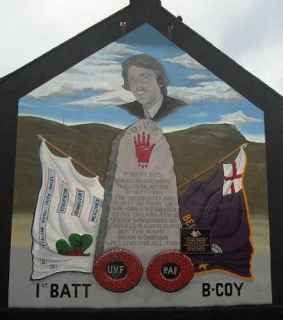
Robinson is commemorated in a mural on Disraeli Street, off Woodvale Road in Belfast.

In 2015, Robinson’s son Robert removes a Special Air Service flag that had been erected by the loyalists at the Twaddell Avenue protest camp. The Shankill UVF is later said to be reviewing its policy of flying the flag.

(Pictured: Mural commemorating Brian Robinson on Disraeli Street, off Woodvale Road in Belfast)


Leave a comment

Birth of Desmond Ryan, Revolutionary, Writer & Historian

Desmond Ryan, Irish writer, historian, and in his earlier life a revolutionary in Sinn Féin, is born in London on August 27, 1893.

Ryan is the son of the Templemore, County Tipperary-born London journalist William Patrick Ryan, editor of the Peasant and Irish Nation and assistant editor of the London Daily Herald, and his wife, Elizabeth. He comes to Ireland in 1906, aged 13, with his mother and sister, and studies at St. Enda’s School, Rathfarnham, under headmaster and founder Patrick Pearse. He later teaches in the school and is briefly Pearse’s secretary.

Ryan attributes to Pearse the saying “[G]ive me a hundred men and I will free Ireland!” He becomes part of a group of former students lodging in St. Enda’s while they go to university who join the Irish Republican Brotherhood (IRB). They meet in a safe house at Rathfarnham in 1911. The men take the tram from Rathfarnham to Nelson’s Pillar in central Dublin. Pearse once told his friend, “Let them talk! I am the most dangerous revolutionary of the whole lot of them!” In 1911, the Dungannon Clubs revive the Volunteers Militia movement. These clubs are not initially successful in Dublin but are more so in Belfast amongst nationalists. One of the northern members is the Dubliner Oscar Traynor, in his youth a professional footballer with Belfast Celtic F.C., later a war hero and later again a politician and Minister for Posts and Telegraphs.

At this stage, according to Ryan, Pearse is a constitutional nationalist who speaks for Home Rule from a platform shared with Tom Kettle and John Redmond and refuses to hear any criticism of the Irish Parliamentary Party (IPP). But on the foundation of the Ulster Volunteer Force (UVF) by Edward Carson and the approach of World War I, Pearse becomes increasingly sure that Ireland cannot achieve independence except by force, and begins with Thomas MacDonagh, Éamonn Ceannt, Joseph Plunkett, Tom Clarke, Bulmer Hobson and others to plan the Easter Rising.

Eoin MacNeill is appointed leader of the Irish Volunteers. Ryan writes that Pearse, a risk-taker and idealist, tells him MacNeill is “too tactful.” MacNeill is prepared to entertain the Irish Parliamentary Party with negotiations. Ryan quotes Pearse as saying, “[MacNeill] has the reputation of being tactful, but his tact consists in bowing to the will of the Redmondites every time. He never makes a fight except when they assail his personal honour, when he bridles up at once… very delicate position… he is weak, hopelessly weak.”

Pearse tells Ryan that MacNeill is “a Grattan come to life again.” Henry Grattan is a constitutional orator and MP in the Protestant-only 18th-century Irish House of Commons, but one of those who fiercely opposes the notorious Acts of Union 1800, secured by massive bribery (which is then repaid out of Irish taxes), making Ireland part of the United Kingdom. Moreover, MacNeill is an “inconclusive ditherer.” He wants the Irish Volunteers to be apolitical.

The Easter Rising is preceded by the revelation of the “Castle Document,” a plan by the British government to arrest the leaders of the Irish Volunteers and Irish Citizen Army and other radicals. Ryan claims that this document, presented to MacNeill on the Wednesday before the Rising and said to have been stolen from high-ranking British staff in Dublin Castle, is a forgery. Some claim that it is concocted by Joseph Plunkett with the implicit approval of Catholic Archbishop Cullen of Dublin, a sympathiser with Dublin Castle and Redmond’s war stratagem. “Forgery is a strong word,” Ryan says, “but that in its final form the document was a forgery no doubt can exist whatever.” Modern interpretation from Charles Townshend has judged the document to be genuine, and the opinion attributed to the Archbishop’s Palace as circumstantial. Grace Gifford, Plunkett’s widow, says that she was with Plunkett when he deciphered it at Larkfield House. Prior to his execution, Seán Mac Diarmada is met by a priest, and makes the assumptive response that it is a fraudulent document.

Ryan fights through the Easter Rising from April 24, 1916, in the General Post Office (GPO) under murderous artillery fire and describes the battle vividly in his witness statement to the Bureau of Military History. He describes the garrison retreating to Moore Street and quotes Pearse’s sculptor brother Willie Pearse, who is executed a few days later, as saying “Connolly has been asked out to negotiate. They have decided to go to save the men from slaughter, for slaughter it is.”

Ryan fights in the Irish War of Independence and afterwards writes about his experiences. However, the Irish Civil War which follows from June 1922 to April 1923 repels him. He cannot accept that Irishmen would fight Irishmen.

Ryan returns to his studies in University College Dublin (UCD), and after taking his BA follows his father into journalism, working for the Freeman’s Journal. In 1922, he moves to London to work on the Daily Herald. He writes books on Pearse, James Connolly, Éamon de Valera, Seán Treacy and John Devoy, and on Fenianism as well as writing on the Rising and the War of Independence.

Ryan marries Sarah Hartley in 1933. In 1939 they return to Ireland, where he edits the Torch, a Labour paper. Finding his views at odds with the Labour Party‘s official line, publication ceases in 1944. He and his wife then move to Swords in north County Dublin, where they operate a poultry farm.

Desmond Ryan dies on December 23, 1964.


Leave a comment

Birth of Seán MacEntee, Fianna Fáil Politician

Seán Francis MacEntee (Irish: Seán Mac an tSaoi), Fianna Fáil politician, is born as John McEntee at 47 King Street, Belfast, on August 23, 1889. He serves as Tánaiste (1959-65), Minister for Social Welfare (1957-61), Minister for Health (1957-65), Minister for Local Government and Public Health (1941-48), Minister for Industry and Commerce (1939-41), and Minister for Finance (1932-39 and 1951-54). He serves as a Teachta Dála (TD) from 1918 to 1969.

MacEntee is the son of James McEntee, a publican, and his wife, Mary Owens, both of whom are from Monaghan. James McEntee is a prominent Nationalist member of Belfast Corporation and a close friend of Joseph Devlin MP.

MacEntee is educated at St. Mary’s Christian Brothers’ Grammar School, St. Malachy’s College and the Belfast Municipal College of Technology where he qualifies as an electrical engineer. His early political involvement is with the Irish Socialist Republican Party in Belfast. He quickly rises through the ranks of the trade union movement becoming junior representative in the city’s shipyards. Following his education, he works as an engineer in Dundalk, County Louth, and is involved in the establishment of a local corps of the Irish Volunteers in the town. He mobilises in Dundalk and fights in the General Post Office garrison in the Easter Rising in 1916. He is sentenced to death for his part in the rising. This sentence is later commuted to life imprisonment. He is released in the general amnesty in 1917 and is later elected a member of the National Executives of both Sinn Féin and the Irish Volunteers in October 1917. He is later elected Sinn Féin Member of Parliament (MP) for South Monaghan at the 1918 Irish general election.

An attempt to develop MacEntee’s career as a consulting engineer in Belfast is interrupted by the Irish War of Independence in 1919. He serves as Vice-Commandant of the Belfast Brigade of the Irish Republican Army (IRA). He is also a member of the Volunteer Executive, a sort of Cabinet and Directory for the Minister for Defence and the HQ Staff, however, he remains one of the few Sinn Féiners from the north. On August 6, 1920, he presents ‘a Memorial’ lecture to the Dáil from the Belfast Corporation. He tells the Dáil it is the only custodian of public order, that a Nationalist pogrom is taking place, and he advises them to fight Belfast. The Dáil government’s policy is dubbed Hibernia Irredenta or “Greening Ireland.” He is asked to resign his South Monaghan seat after voting against a bunting celebration in Lurgan to mark the signing of the Anglo-Irish Treaty.

In April 1921 MacEntee is transferred to Dublin to direct a special anti-partition campaign in connection with the May general election. It remains Michael Collins‘s policy, he declares, that the largely Protestant shipyard workers of Belfast are being directed by the British, urging all Irishmen to rejoin the Republic. Correspondingly the Ulster Unionist Council rejects the call for a review of the boundary commission decision made on Northern Ireland. But when Ulstermen choose James Craig as Premier, Collins denounces democracy in the north as a sham. It is on the partition of Ireland issue that MacEntee votes against the Anglo-Irish Treaty of 1921. During the subsequent Irish Civil War, he commands the IRA unit in Marlboro Street Post Office in Dublin. He later fights with Cathal Brugha in the Hamman Hotel and is subsequently interned in Kilmainham and Gormanstown until December 1923.

After his release from prison, MacEntee devotes himself more fully to his engineering practice, although he unsuccessfully contests the Dublin County by-election of 1924. He becomes a founder-member of Fianna Fáil in 1926 and is eventually elected a TD for Dublin County at the June 1927 Irish general election.

MacEntee founds the Association of Patent Agents in 1929, having gained his interest in Patents when he worked as an assistant engineer in Dundalk Urban District Council. He values his status as a Patent Agent as he maintains his name on the Register for over 30 years while he holds Ministerial rank in the Irish Government, although he is not believed to have taken any active part in the patent business, which is carried on by his business partners.

In 1932, Fianna Fáil comes to power for the very first time, with MacEntee becoming Minister for Finance. In keeping with the party’s protectionist economic policies his first budget in March of that year sees the introduction of new duties on 43 imports, many of them coming from Britain. This sees retaliation from the British government, which in turn provokes a response from the Irish government. This is the beginning of the Anglo-Irish Trade War between the two nations, however, a treaty in 1938, signed by MacEntee and other senior members brings an end to the issue.

In 1939, World War II breaks out and a cabinet reshuffle results in MacEntee being appointed as Minister for Industry and Commerce, taking over from his rival Seán Lemass. During his tenure at this department, he introduces the important Trade Union Act (1941). In 1941, another reshuffle of ministers takes place, with him becoming Minister for Local Government and Public Health. The Health portfolio is transferred to a new Department of Health in 1947. Following the 1948 Irish general election, Fianna Fáil returns to the opposition benches for the first time in sixteen years.

In 1951, Fianna Fáil are back in government, although in minority status, depending on independent deputies for survival. MacEntee once again returns to the position of Minister for Finance where he feels it is vital to deal with the balance of payments deficit. He brings in a harsh budget in 1951 which raises income tax and tariffs on imports. His chief aim is to cut spending and reduce imports, however, this comes at a cost as unemployment increases sharply. The increases are retained in his next two budgets in 1952 and 1953. It is often said that it is his performance during this period that costs Fianna Fáil the general election in 1954. The poor grasp on economics also does his political career tremendous damage as up to that point he is seen as a likely successor as Taoiseach. Seán Lemass, however, is now firmly seen as the “heir apparent.”

In 1957, Fianna Fáil returns to power with an overall majority with MacEntee being appointed Minister for Health. The financial and economic portfolios are dominated by Lemass and other like-minded ministers who want to move away from protection to free trade. He is credited during this period with the reorganisation of the health services, the establishment of separate departments of health and social welfare, and the fluoridation of water supplies in Ireland. In 1959, he becomes Tánaiste when Seán Lemass is elected Taoiseach.

Following the 1965 Irish general election, MacEntee is 76 years old and retires from the government. He re-emerges in 1966 to launch a verbal attack on Seán Lemass for deciding to step down as party leader and Taoiseach. The two men, however, patch up their differences shortly afterwards. MacEntee retires from Dáil Éireann in 1969 at the age of 80, making him the oldest TD in Irish history.

MacEntee dies in Dublin on January 9, 1984, at the age of 94. He is buried in Glasnevin Cemetery, Dublin. At the time of his death, he is the last surviving member of the First Dáil.


Leave a comment

Birth of Fr. Alec Reid, Facilitator in the Northern Ireland Peace Process

Alexander Reid CSsR, Irish Catholic priest noted for his facilitator role in the Northern Ireland peace process, is born in Dublin on August 5, 1931. BBC journalist Peter Taylor subsequently describes Reid’s role as “absolutely critical” to the success of the peace process.

Reid is raised in Nenagh, County Tipperary, from the age of six following the death of his father. He studies English, history and philosophy at University College Galway.

Reid is professed as a Redemptorist in 1950 and ordained a priest seven years later. For the next four years, he gives Parish Missions in Limerick, Dundalk and Galway (Esker), before moving to Clonard Monastery in Belfast, where he spends almost the next forty years. The Redemptorist Monastery at Clonard stands on the interface between the Catholic nationalist Falls Road and the Protestant loyalist Shankill Road areas of west Belfast.

In the late 1980s, Reid facilitates a series of meetings between Gerry Adams and John Hume, in an effort to establish a “Pan-Nationalist front” to enable a move toward renouncing violence in favour of negotiation. Reid, himself a staunch nationalist who favours a united Ireland and the withdrawal of British forces from Northern Ireland, then acts as their contact person with the Irish Government in Dublin from a 1987 meeting with Charles Haughey up to the signing of the Good Friday Agreement in 1998. In this role, which is not public knowledge at the time, he holds meetings with various Taoisigh, and particularly with Martin Mansergh, advisor to various Fianna Fáil leaders. After the eventual success of the peace negotiations, Gerry Adams says, “there would not be a peace process at this time without [Father Reid’s] diligent doggedness and his refusal to give up.”

In 1988 in Belfast, Reid delivers the last rites to two British Army corporals, David Howes and Derek Wood of the Royal Corps of Signals, who are killed by the Provisional Irish Republican Army (IRA) – an event known as the corporals killings – after they drive into the funeral cortège of IRA member Kevin Brady, who had been killed in the Milltown Cemetery attack. A photograph of his involvement in that incident becomes one of the starkest and most enduring images of the Troubles. Unknown until years later, he is carrying a letter from Sinn Féin President Gerry Adams to Social Democratic and Labour Party (SDLP) leader John Hume outlining Adams’ suggestions for a political solution to the Troubles. Adams later tells the BBC in 2019 that Reid also advised U.S Ambassador to Ireland Jean Kennedy Smith during the peace process, stating “He was talking to her on the side and she was talking to her brother Teddy.”

After he moves to Dublin, Reid is involved in peace efforts in the Basque Country. In January 2003, he is awarded the Sabino Arana 2002 “World Mirror” prize, by the Sabino Arana Foundation in Bilbao, in recognition of his efforts at promoting peace and reconciliation. He and a Methodist minister, the Rev. Harold Good, announce that the IRA has decommissioned their arms at a news conference in September 2005.

Reid is involved in controversy in November 2005 when he makes comments during a meeting in Fitzroy Presbyterian Church concerning the Unionist community in Northern Ireland. When the loyalist activist Willie Frazer makes remarks that Catholics had butchered Protestants during the Troubles, Reid angrily responds, “You don’t want to hear the truth. The reality is that the nationalist community in Northern Ireland were treated almost like animals by the unionist community. They were not treated like human beings. They were treated like the Nazis treated the Jews.” Reid later apologises, saying his remarks had been made in the heat of the moment. In an interview with CNN, he says that “The IRA were, if you like, a violent response to the suppression of human rights.”

Reid dies in a Dublin hospital on November 22, 2013. He is survived by two sisters and an aunt, and is buried in Milltown Cemetery, Belfast.


Leave a comment

Preparations Commence for the Plantation of Ulster

On July 19, 1608, preparations commence for the plantation of six Ulster counties of Armagh, Cavan, Coleraine, Donegal, Fermanagh, and Tyrone.

The Plantation of Ulster is the organised colonisation, or plantation, of the Irish province of Ulster by people from Great Britain during the reign of King James I. Most of the settlers, or planters, come from southern Scotland and northern England. Their culture differs from that of the native Irish. Small privately funded plantations by wealthy landowners begin in 1606, while the official plantation begins in 1609. Most of the colonised land had been confiscated from the native Gaelic chiefs, several of whom had fled Ireland for mainland Europe in 1607 following the Nine Years’ War against English rule. The official plantation comprises an estimated half a million acres of arable land in counties Armagh, Cavan, Fermanagh, Tyrone, Donegal, and Coleraine. Land in counties Antrim, Down, and Monaghan is privately colonised with the king’s support.

Among those involved in planning and overseeing the plantation are King James, the Lord Deputy of Ireland, Arthur Chichester, and the Attorney-General for Ireland, John Davies. They see the plantation as a means of controlling, anglicising, and “civilising” Ulster. The province is almost wholly Gaelic, Catholic, and rural and has been the region most resistant to English control. The plantation is also meant to sever Gaelic Ulster’s links with the Gaelic Highlands of Scotland. The colonists, or “British tenants,” are required to be English-speaking, Protestant and loyal to the king. Some of the undertakers and settlers, however, are Catholic. The Scottish settlers are mostly Presbyterian Lowlanders and the English mostly Anglican Northerners. Although some “loyal” natives are granted land, the native Irish reaction to the plantation is generally hostile, and native writers bewail what they see as the decline of Gaelic society and the influx of foreigners.

The Plantation of Ulster is the biggest of the Plantations of Ireland. It leads to the founding of many of Ulster’s towns and creates a lasting Ulster Protestant community in the province with ties to Britain. It also results in many of the native Irish nobility losing their land and leads to centuries of ethnic and sectarian animosity, which at times spills into conflict, notably in the Irish Rebellion of 1641 and, more recently, the Troubles.


Leave a comment

Birth of Bernard “Barney” Hughes, Master Baker & Entrepreneur

Bernard “Barney” Hughes, master baker, entrepreneur, and liberal reformer, is born on July 8, 1808, second among eight children of Peter Hughes, probably a tradesman or labourer, and Catherine Hughes (née Quinn), of Blackwatertown, near Armagh in what is now Northern Ireland.

Hughes is brought up as a devout Roman Catholic and speaks both Irish and English fluently. He starts working at age 12 as a baker’s boy in Armagh and around 1822 tries unsuccessfully to set up his own bakery. To enhance his career prospects, he moves to Belfast in the mid-1820s and becomes a journeyman baker. He soon proves to be a highly skilled and reliable worker and in 1833 is appointed operations manager at the Public Bakery, Church Street.

Hughes is a great admirer of Daniel O’Connell and is part of the delegation that meets him when he visits Belfast in 1840. However, his employer does not share his views on liberal reform, and strained relations lead to Hughes setting up his own bakery in December 1840. At this point he must have already gained a reputation as a highly respected citizen in Belfast, as he is able to borrow £1,400 for the new factory that is built at 71 Donegall Street. This proves a wise investment, as within two years his factory produces more bread than any other bakery in the town. Demand for his loaves and his famous “Belfast bap” is fueled by the thousands of poor Catholics who migrate to the city in search of employment in the two decades before the famine.

Hughes is probably the first entrepreneur in Ireland to appreciate how machinery can create economies of scale in food production. He keeps enlarging his factory by adding ovens (using his own patent design) and dough‐mixing machines, and in 1847 opens another bakery on Donegall Place, which becomes known as the “railway bakery” on account of the rails that are used to transport raw materials by cart between various parts of the site. By using new technology, he is able to produce large quantities of consistently high‐quality bread at prices that are up to 20% cheaper than his local competitors. By 1851 he employs up to a third of those in the Belfast baking trade. He removes much of the human drudgery in the baking process, and higher productivity means that his employees can sleep at home rather than on the bakery floor. The population growth of Belfast continues to increase steeply after the famine years, and in 1858 he opens a third bakery on Divis Street, in the Falls area of the town. Distribution problems during the 1840s had convinced Hughes that he needs tighter control over all elements of the food production chain. By the 1870s his empire includes flour mills, ships to import grain, a brewery, shops, and a fleet of horse‐drawn vans.

Hughes is an enlightened employer and throughout his life he gives generously to the poor in Belfast. During the famine years of the 1840s he keeps the price of bread as low as possible, and on special days such as Christmas gives away thousands of loaves. In July 1842 he confronts a mob of up to 2,000 hungry and agitated weavers who are intent on causing damage to his bakery. He convinces them that he is a friend of the people. This is borne out by the fact that he is the largest single donor to both the Belfast Relief Committee and the Belfast Relief Fund for Ireland during the great famine. Though he is not politically ambitious, he does feel that he can use his status as one of the largest employers in Belfast and the wealthiest Catholic layman to promote the liberal cause. He is particularly appalled by the way in which the members of the conservative‐dominated council are able to indemnify themselves against the £84,000 debt which they had accrued while in office during the 1840s and 1850s.

Hughes is the first Catholic to be elected to the Belfast town council (1855–58, 1871–72) and the first Catholic alderman (1872–78). There are numerous attempts to smear his reputation, and articles in the Belfast News Letter lampoon his thick Armagh accent. As councillor he imprudently remarks on one public occasion that Belfast is “governed by Protestants, but the bone and sinew of the town is Roman Catholic.” This is seized upon by his conservative adversaries as evidence of an anti‐Protestant stance. In reality, he is always even‐handed and against any form of violent action. In his Smithfield ward there are large groups of poor Catholics and Protestants in close proximity to each other and this leads to regular disturbances. As a JP (1867–78) he urges fellow members of the Belfast Home Rule Association to avoid the tactics of the Fenians. In 1878 he is one of a group of magistrates who upholds the right of the Protestant shipyard workers to hold processions in Belfast.

Hughes’s fair mindedness sometimes brings him into collision with his more zealous Catholic friends. In 1876 he is heavily criticised for supporting the campaign to have a statue of the Rev. Henry Cooke, the Presbyterian preacher with strong anti‐Catholic views, erected in a prominent position in Belfast. He contributes funds to the Catholic Institute in Belfast, donates the site for St. Peter’s Church in 1858, and pays for the Lady Chapel. Despite his generosity, Patrick Dorrian, the coadjutor bishop of Down and Connor, vetoes a plan by the Vatican to award him a papal honour.

Hughes dies on September 23, 1878, and is buried privately at Friar’s Bush Graveyard. His son Edward, later appointed the first chairman of The Irish News at its launch in 1891, takes over the business and builds a large “model bakery” on a two‐acre site on the Springfield Road which is one of the largest and most technically sophisticated factories of its kind in Europe.

(From: “Hughes, Bernard (‘Barney’)” by Daniel Beaumont, Dictionary of Irish Biography, http://www.dib.ie, October 2009)