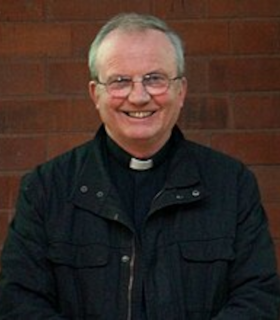
McGuckian is the youngest of six children to Brian McGuckian and his wife Pauline (née McKenna). He is named after his uncle, also Alexander Aloysius McGuckian, who dies five month before he is born. Yet another uncle, Daniel McGuckian, is a priest of the Diocese of Down and Connor and serves as parish priest of Cushendun and then Randalstown until his death in 1980. His father is a successful pig farmer who, alongside his brothers, develops the world’s biggest pig farm.
Two of McGuckian’s brothers are also Jesuit priests, while another brother is a businessman. Both of his sisters predecease him.
McGuckian is ordained to the priesthood on June 22, 1984, and makes his final profession on February 15, 1997.
Following ordination, McGuckian spends four years as a teacher in Clongowes Wood College and vocations director for the Jesuits, before undertaking a six month period of spiritual renewal in southern India and serving in a shanty town in Quezon City, Philippines.
McGuckian returns to Ireland in 1992, where he is appointed director of the Jesuit Communication Centre, during which he develops Sacred Space, a website which allows people to pray at their computer, in 1999, and Catholic news service CatholicIreland.net in 2004.
McGuckian also serves as editor of both An Timire and Foilseacháin Ábhair Spioradálta, later translating the autobiography of Ignatius of Loyola into Irish under the title Scéal an Oilithrigh. He also co-authors the drama 1912 – A Hundred Years On with Presbyterian historian Philip Orr in 2011, which looks at the experiences of the Ulster Covenant and the wider Home Rule movement from both nationalist and unionist perspectives.
McGuckian also serves as chaplain to many of the Gaelscoileanna in the Diocese of Down and Connor, and subsequently as chaplain to Ulster University campuses in Belfast and Jordanstown. Following the publication of the Living Church Report, which outlines the findings of a synodal process within the diocese, he is appointed by Noël Treanor in 2012 to set up and lead the Living Church Office, whose aim is to realise the hopes and aspirations expressed in the report and subsequently in the upcoming diocesan pastoral plan.
McGuckian is also appointed diocesan director of formation for the permanent diaconate in 2014, and also works during his directorship of the Living Church Office to establish pastoral communities across the diocese, through fostering a culture of co-responsibility for the mission of the Church between clergy and lay people.
McGuckian is appointed Bishop-elect of Raphoe by Pope Francis on June 9, 2017. His appointment makes him the first member of the Jesuits to be appointed a bishop in Ireland.
In an interview with The Irish Catholic in September 2019, McGuckian says that having a home is as fundamental as the right to life and education, and that the Government must be “pushed” to enshrine a right to housing in the Constitution of Ireland. He also joins a number of church leaders in the West of Ireland on September 16, 2021, in calling on the Irish government to offer reparations to homeowners whose properties are affected by defective concrete blocks.
In an interview with The Irish Catholic in February 2021, McGuckian takes issue with the view held by political leaders that public worship is deemed to be “non-essential” during the COVID-19 pandemic in the Republic of Ireland. Quoting Pope Francis, who states that “the right to worship must be respected, protected and defended by civil authorities like the right to bodily and physical health,” he expresses a need to let political leaders know that public worship is not only central, but also “utterly essential.”
Following a fatal explosion in Creeslough, County Donegal, on October 7, 2022, McGuckian refers to the explosion as “the darkest day in Donegal,” adding that the local community is “living through a nightmare of shock and horror.” He also concelebrates at the Funeral Masses of each of the victims, describing the fact that the parish church would be holding two funerals in the space of three hours as “surreal.”
McGuckian is appointed Bishop of Down and Connor by Pope Francis on February 2, 2024. In his first address following his appointment, he expresses his hope that the restoring of the Northern Ireland Executive will help the most vulnerable in society.
Dorrian is born in Downpatrick, County Down, on March 29, 1814, one of four sons of Patrick Dorrian and his wife Rose (née Murphy). He is educated first by a Unitarian minister in the classical school in the town, where he excels, and then in St. Patrick’s College, Maynooth, where he is ordained in 1833.
Dorrian’s first appointment is as a curate in the then developing town of Belfast, attached to St Patrick’s Church, Belfast, where he ministers for ten years. At a relatively young age he is appointed parish priest in Loughinisland, County Down, (1847-60) at which time he becomes Bishop of Gabala (Qabala) and Coadjutor Bishop of the Diocese of Down and Connor to assist the ailing, frail and irenic Bishop Cornelius Denvir.
Dorrian is consecrated bishop on August 19, 1860, in St. Malachy’s Church, Belfast, and eventually succeeds as bishop five years later on May 4, 1865. He is known for his authoritarian style of leadership, referred to as “Cullenite“. As the post-famine population of Belfast grows, so too does sectarian attitudes, especially among those moving into the city from rural districts all over Ulster looking for work. He seeks to defend Catholic interests, insisting on the necessity of separate Catholic education and seeking, where possible, to influence the social and political interests of his church.
In this respect, historiansSean Connolly and Gillian McIntosh refer to Dorrian’s “pugnacious” presiding over the rapid expansion in priests, churches and religious houses in contrast to the “scholarly but ineffective” Bishop Denvir.
It is estimated Dorrian is responsible for doubling the number of Catholic churches in the city of Belfast, and in 1866, early in his episcopate, St. Peter’s Cathedral, Belfast in Derby Street in the Lower Falls area is first used as a pro-cathedral. His episcopal chair, placed in that church for the occasion, is still in use by the bishops of the Diocese of Down and Connor. He attends the First Vatican Council and is one of the leading Irish delegation to the event.
Dorrian dies at the Episcopal Palace, Chichester Park, Belfast, at 7:00 a.m., on November 3, 1885. His remains are interred within the chancel of St. Patrick’s Church, Belfast, on Friday, November 6.
At a meeting of the parish priests held in the chapel of St. Malachy’s College, on November 6, 1885, immediately after Dorrian’s funeral, Patrick MacAlister is elected Vicar Capitular of Down and Connor. McAllister is then named by Pope Leo XIII as Dorrian’s successor as the 24th Lord Bishop of Down and Connor.
In November 2017, the historic chapel of Belfast’s Mater Infirmorum Hospital is re-opened after extensive refurbishment. It has, as a result of its connection with Dorrian, become known as the Dorrian Chapel.
Daly studies Classics at Queen’s University Belfast (QUB). He earns his BA with Honours and also the Henry Medal in Latin Studies in 1937 and completes his MA the following year. He enters St. Patrick’s College, Maynooth and is ordained to the priesthood on June 22, 1941. He continues studies in theology in Maynooth, from where he obtains a doctorate in divinity (DD) in 1944. His first appointment is as Classics Master in St. Malachy’s College (1944–45).
In 1945, Daly is appointed Lecturer in Scholastic Philosophy at Queen’s University, Belfast, retaining the post for 21 years. In the academic year 1952–53 QUB grants him sabbatical leave, which he spends studying at the Catholic University of Paris where he receives a licentiate in philosophy. He returns to France at many points, particularly for holidays. He persists with his studies well into his retirement. He is a popular figure with the university and fondly remembered by his students. He is named a Canon of the Cathedral Chapter of Diocese of Down and Connor in 1966.
Daly is a peritus, or theological expert, at the Second Vatican Council (1962–65) to Bishop William Philbin during the first session of the Council and to Cardinal William Conway for the rest of the council. He dedicates himself to scholarship for 30 years, and publishes several books seeking to bring about understanding between the warring factions in Northern Ireland.
Daly is appointed Reader in Scholastic Philosophy at QUB in 1963, a post he holds until 1967, when he is appointed Bishop of Ardagh and Clonmacnoise on May 26.
Daly spends 15 years as bishop in Longford and is diligent about parish visitation and confirmations gradually assume a greater national profile. From 1974 onward, he devotes himself especially to ecumenical activities for the Pontifical Council for Promoting Christian Unity. His pastoral letter to Protestants, written in 1979, pleads for Christian unity.
Daly succeeded William Philbin as the 30th Bishop of Down and Connor when he is installed as bishop of his native diocese at a ceremony in St. Peter’s Cathedral, Belfast, on October 17, 1982.
On November 6, 1990, Daly is appointed Archbishop of Armagh and, as such, Primate of All Ireland. His age makes him an unexpected occupant of the post. Despite this it is requested that he stay in the role for three years before usual age of episcopal retirement at 75. Cardinal Daly takes a notably harder line against the Irish Republican Army (IRA) than his predecessor, Cardinal Tomás Ó Fiaich.
Daly is respectful of Protestant rights and opposes integrated education of Catholics and Protestants. This policy is criticised by those who see segregated education as one of the causes of sectarianism in Northern Ireland, but is seen by the Catholic clergy as important for passing on their faith to future generations. He is utterly orthodox in opposing divorce, contraception, abortion, the ordination of women and any idea of dropping clerical celibacy.
Daly is heckled by the audience on live television during a broadcast of The Late Late Show on RTÉ One on the topic of pedophilia in the 1990s. After his retirement in 1996, he makes no public statement on the issue.
Daly retires as Archbishop of Armagh on his 79th birthday, October 1, 1996, and subsequently suffers ill health. Although it is announced that he will attend the funeral of Pope John Paul II, he stays home on the advice of his doctors. His age makes him ineligible to participate in the 2005 conclave that elects Pope Benedict XVI.
Daly is admitted to the coronary unit of Belfast City Hospital on December 28, 2009. His health has already been declining, leading to prayers being ordered for him. He dies in hospital in Belfast on December 31, 2009, aged 92. His family are at his bedside at the time. His death brings to an end a two-year period during which Ireland has, for the first time in its history, three living Cardinals.
Daly lay in state in Belfast and then his remains are taken to Armagh. Pope Benedict XVI pays tribute at this stage. Large numbers of people travel from as far as County Westmeath to attend Mass at Armagh on January 4, at which Monsignor Liam McEntaggart, the former parish priest of Coalisland, says, “When the history of peace making in Ireland comes to be written, the contribution of Cardinal Daly will be accorded a high place.” Monsignor McEntaggart himself dies on August 22, 2010, aged 81, less than eight months after Cardinal Daly’s passing.
Farquhar is assistant priest at Dunsford and Ardglass Parish. He is a hospital chaplain in 1966. He is later assigned to teach Latin at St. MacNissi’s College, Garron Tower, where he stays as a teacher from 1966 to 1970. From 1970 to 1975 he is assistant chaplain, along with Ambrose Macaulay, to Queen’s University Belfast, and finally as Chaplain/Lecturer at the University of Ulster from 1975 to 1983.
On April 6, 1983, aged 42, Farquhar is appointed Titular Bishop of Hermiana and, with Patrick Walsh, as Auxiliary Bishop of Down and Connor. The principal consecrator is the Bishop of Down and Connor, Cahal Daly, (later Cardinal Archbishop of the Archdiocese of Armagh) and principal co-consecrators are Archbishop Gaetano Alibrandi, the Apostolic Nuncio to Ireland and William J. Philbin (Bishop Emeritus of Down and Connor). During the ordination ceremony, the assistant Priests to Bishop Farquhar are his priest uncles, Canon Walter Larkin and Fr. Thomas Aquinas Larkin O.C.D.
Farquhar’s episcopal motto is “Sapientia Proficere” (“to increase in wisdom”) from Luke 2:52. He takes an active and ongoing interest in interchurch relations and serves as Chairman of the Irish Catholic Bishops’ Conference on Ecumenism.
In December 2007, he officiates at the dedication of the new altar in the Church of the Good Shepherd in his native parish of the Most Holy Rosary, Belfast, following the renovation programme.
A book titled Inter-Church Relations: Developments and Perspectives, published by Veritas Communications to mark the 25th anniversary of Farquhar’s ordination as a bishop, contains contributions by a number of people praising Farquhar’s work. Seán Brady notes he was “engaged actively in promoting bonds of friendship and understanding at times when it has been far from easy to do so.”
On December 3, 2015, Pope Francis accepts Farquhar’s resignation on the grounds of age. He is at the time the longest serving bishop in Ireland.
Farquhar dies in Belfast on November 18, 2023, at the age of 83. His funeral requiem mass is celebrated in the Church of the Good Shepherd, Ormeau Road, Belfast, on November 23 followed by interment in the adjoining cemetery.
Conway is born on January 22, 1913, in Belfast, the eldest of four sons and five daughters of Patrick Joseph Conway and Annie Conway (née Donnelly). His father, a self-employed housepainter, also has a paint shop in Kent Street off Royal Avenue. His mother, who survives her son, is born in Carlingford, County Louth. He attends Boundary Street Primary School, St. Mary’s CBS (now St. Mary’s CBGS Belfast). His academic successes are crowned by a scholarship to Queen’s University Belfast. He decides to study for the diocesan priesthood. In 1933 he is conferred with an honours BA in English literature and goes on to read a distinguished course in theology at St. Patrick’s College, Maynooth.
Conway is ordained on June 20, 1937, and awarded a DD (1938). On November 12, 1938, he enters the Pontifical Irish College in Rome, and in 1941 he receives the DCL degree at the Pontifical Gregorian University. When Italy enters World War II in June 1940, he returns to Belfast to take up duty in the Diocese of Down and Connor. He is appointed to teach English and Latin in St. Malachy’s College in Belfast, but after one year he is named professor of moral theology and canon law in Maynooth. He contributes regular ‘Canon law replies’ to the Irish Ecclesiastical Record, which are later collected as Problems in canon law (1950), the only book published by him.
In 1957 Conway becomes vice-president of Maynooth, and in 1958, he is named Ireland’s youngest bishop, Titular Bishop of Neve, and auxiliary bishop to Cardinal John D’Alton, Archbishop of Armagh and Primate of All Ireland. He is consecrated in St. Patrick’s Cathedral, Armagh on July 27, 1958. He serves as administrator of St. Patrick’s Church, Dundalk, for the next five years, gaining valuable pastoral experience, and also uses these years to familiarise himself with his new diocese, especially its geography. On the death of D’Alton, he is chosen to succeed him in September 1963, and is enthroned on September 25 in St. Patrick’s Cathedral, Armagh by the apostolic nuncio, Archbishop Sensi. At the end of 1964, Pope Paul VI chooses him as Ireland’s seventh residential cardinal, and he receives the red hat in the public consistory of February 22, 1965.
The thirteen-odd years of Conway’s ministry as primate are dominated firstly by the Second Vatican Council and secondly by the Troubles in Northern Ireland. His primary concern is the church, to steer it through testing times. He is a very active bishop in a diocese of 160,000 Catholics, with fifty-seven parishes and some 167 priests. He carries the burden alone until 1974 when he is given an auxiliary in the person of his secretary, Fr. Francis Lenny (1928–78). Two new parishes are created, five new churches are built, and many others are renovated to meet the requirements of liturgical reform. Twenty new schools are also provided. He attends all four sessions of the Vatican council (1962–65), as auxiliary bishop and as primate. On October 9, 1963, he addresses the assembly, making a plea that the council might not be so concerned with weightier matters as to neglect to speak about priests. He also makes contributions on the topics of mixed marriages, Catholic schools, and the laity. On the topic of education, he is convinced that integrated schools will not solve Northern Ireland’s problems.
Conway represents the Irish Catholic Bishops’ Conference at each assembly of the Synod of Bishops in Rome, at first with Bishop Michael Browne of the Diocese of Galway and Kilmacduagh, his former professor in Maynooth, and later with the Archbishop of Dublin, Dermot Ryan. With Cardinals Jean-Marie Villot and Pericle Felici, he is chairman of the first synod in 1969, a signal honour conferred on him by Pope Paul VI. He addresses the assembly, opposing the ordination of married men as a move that would release a flood of applications from around the world for dispensations from priestly celibacy. His experience of violence in Northern Ireland is reflected in contributions he makes to later synod assemblies, especially in 1971 and 1974.
Apart from the synod, Conway travels a few times each year to Rome for meetings of the three Roman congregations on which he is called to serve (those of bishops, catholic education, and the evangelisation of peoples) and the commission for the revision of the code of canon law. He also travels further afield in a representative capacity to the International Eucharistic Congress at Bogotá, also attended by Pope Paul VI, and to Madras (1972), where he acts as papal legate for the centenary celebrations in honour of St. Thomas. In 1966 he is invited by the bishops of Poland to join in celebrations for the millennium of Catholicism in that country but is refused an entry visa by the Polish government. In January 1973 he feels obliged to forgo participation in the Melbourne eucharistic congress because of the troubled situation at home. Within Ireland he accepts invitations to become a freeman of Cork and Galway (1965) and of Wexford (1966). In 1976 the National University of Ireland (NUI) confers on him an honorary LL.D.
Conway is acknowledged as an able and diligent chairman of the Irish Catholic Bishops’ Conference. The core problem in the early years is how to lead the Irish church into the difficult new era that follows the council. He shows exceptional leadership qualities in the manner in which he promotes firm but gentle progress, avoiding sudden trauma and divisions. A major event in his term as Archbishop of Armagh, and one that gives him much satisfaction, is the canonization of Oliver Plunkett, his martyred predecessor, in the holy year 1975. He follows with great interest the final stages of the cause from 1968 and is greatly disappointed when grounded by his doctors six weeks before the event. He does however take part, concelebrating with Pope Paul VI at the ceremony on October 12, 1975. He also presides the following evening at the first mass of thanksgiving in the Lateran Basilica, receiving a tumultuous applause from the thousands of Irish present.
More than anything else, the Troubles in Northern Ireland occupy Conway during the second half of his term as archbishop and primate. He is the leading spokesman of the Catholic cause but never fails to condemn atrocities wherever the responsibility lay. He brands as ‘monsters’ the terrorist bombers on both sides. In 1971 he denounces internment without trial, and the following year he is mainly responsible for highlighting the ill-treatment and even torture of prisoners in Northern Ireland. He repudiates the idea that the conflict is religious in nature, emphasising its social and political dimensions, and is openly critical of the British government over conditions in Long Kesh Detention Centre, and of ‘the cloak of almost total silence’ surrounding violence against the Catholic community.
In January 1977 Conway undergoes surgery in a Dublin hospital, and almost immediately comes to know that he is terminally ill. It is the best-kept secret in Ireland until close to the end. On March 29, he writes to his fellow bishops informing them that the prognosis regarding his health is ‘not good, in fact . . . very bad,’ and that he is perfectly reconciled to God’s will. He is still able to work at his desk until Good Friday, April 8, 1977.
Conway dies in Armagh on Low Sunday night, April 17, 1977. Seven countries are represented at his funeral by six cardinals and many bishops. The apostolic nuncio, the bishops of Ireland, the president and Taoiseach, six Irish government ministers, and the Secretary of State for Northern Ireland are also among the mourners. The cardinal is laid to rest in St. Patrick’s Cathedral Cemetery, Armagh. The red hat received from Pope Paul VI is suspended from the ceiling of the Lady chapel, joining those of his four immediate predecessors.
(From: “Conway, John William,” Dictionary of Irish Biography, http://www.dib.ie, contributed by J. J. Hanley)
McKeown is ordained to the priesthood on July 3, 1977.
Following ordination, McKeown’s first pastoral assignment is as chaplain at Mater Infirmorum Hospital, before returning to Rome to complete his licentiate. He returns to the Diocese of Down and Connor in 1978, where he is appointed as a teacher at Our Lady and St. Patrick’s College, Knock, while also serving as assistant priest in Derriaghy. He returns to St. MacNissi’s College in 1983, where he continues his involvement with youth ministry and is given responsibility for organising the annual diocesan pilgrimage to Lourdes.
McKeown subsequently returns to St. Malachy’s College in 1987, where he teaches and serves as dean of the adjoining seminary, before succeeding Canon Noel Conway as president in 1995. During his presidency, he completes a Master of Business Administration at the University of Leicester in 2000, specialising in educational management.
McKeown has completed the Belfast Marathon on two occasions: as a priest with a team of 48 from Derriaghy in 1982, and as a bishop fundraising for a minibus for St. Malachy’s College in 2001.
In response to a 2007 decision by Amnesty International to campaign for the legalisation of abortion in certain circumstances, McKeown supports the decision of Catholic schools in the diocese to disband their Amnesty International support groups, on the grounds that it is no longer appropriate to promote the organisation in their schools.
It is reported in an article in The Irish News that the mention of McKeown as a possible successor to Walsh as Bishop of Down and Connor is actively opposed by some priests in the diocese, who regard him as being “too soft” on the issue of integrated education. This opposition is branded a “Stop Donal” campaign.
McKeown also serves as a member of the Irish Catholic Bishops’ Conference and its committee on education and chairs its committees on vocations and youth. He leads the youth of the diocese to World Youth Day in 2002 and 2005 and also travels to Rome with his brother bishops for their quinquennial visit ad limina in 2006. He is also a regular contributor on Thought for the Day on BBC Radio Ulster.
McKeown starts a 33-day journey of prayer toward the Consecration to Jesus Christ through Mary on January 9, 2025. The prayer takes place online each evening at 7:00 p.m. The 33 days of prayer take place the week following the Baptism of the Lord until the Feast of Our Lady of Lourdes on February 11.
Father Des Wilson, Irish Catholic priest and church dissident who in the course of the Northern IrelandTroubles embraces ideas and practice associated, internationally, with liberation theology, dies in his native Belfast on November 5, 2019. He believes the Word of God can never be silent in the face of oppression, injustice and suffering. He seeks to apply the ideas of liberation theology to the North, supporting and empowering marginalised communities, and acting as a voice for the voiceless.
Wilson is born in Belfast on July 8, 1925, the youngest of five sons to William Wilson, a publican and native of County Cavan, and his wife Emma (née McAvoy), a native of south County Down. He spends his earliest years above his father’s pub in Belfast, before the family moves to a house in the suburbs.
Wilson attends primary school locally, then receives secondary education at St. Malachy’s College. During his time there Belfast is blitzed in April and May 1941. Almost 1,000 are killed. The carnage he sees is a factor in his deciding on the priesthood.
After ordination Wilson serves as chaplain in Belfast’s Mater Infirmorum Hospital, then spends 15 years in St. Malachy’s as spiritual director. Former pupils remember him as fair, and able to play jazz excellently on the organ.
Wilson lives out his beliefs, spending half a century in Belfast’s Ballymurphy estate, among the North’s most deprived, and one of the areas which suffers worst from the Troubles. There he plays a role in community development, establishing projects to provide employment in the area. He suffers, finding himself for years outside the official Catholic Church.
Wilson plays a significant role in providing adult education. He wants an education that does not just provide qualifications and open career paths but is psychologically liberating.
Life changes in 1966 when Wilson is moved to St. John’s Parish in West Belfast as a curate. Having come from a comfortable background in Ballymurphy, he is shocked by the poverty, the poor housing and the treatment of women. Unusual for a priest at the time, he moves into a terraced house in the estate. He finds the Catholic Church unable to respond to the multiple problems people are facing. That inability worsens as the Troubles erupt.
Wilson’s personal probity is so recognised that he is accepted as a mediator in feuds between the Provisional Irish Republican Army and Official Irish Republican Army in the 1970s and is able to broker permanent peace. He also helps bring about the ceasefires in the 1990s.
Wilson does not shirk unpopular stances. In the 1970s he refuses to condemn the Irish Republican Army (IRA). Later he says the conviction of former Real Irish Republican Army leader Michael McKevitt for directing terrorism is unsafe. He also publicly visits and supports a Ballymurphy couple which has a very bitter falling out with Sinn Féin, leading to a picket on their home.
By 1975 relations with his bishop has broken down and Wilson resigns but continues ministering in Ballymurphy. Forbidden to say Mass in a church, his pay cut off, he says Mass in his house. He suffers hardship, living from savings, some earnings from writing, broadcasting and lecturing, and help from Quaker and Presbyterian friends. By the early 1980s his Ballymurphy home becomes too small for the many classes he organises. His classes are rehoused and expanded as the Conway Education Centre in a vacant mill. He is able to offer a range of vocational and non-vocational courses with almost 1,000 students. In the mid-1980s his relationship with the Dioceses of Down and Connor is re-established, and he is allowed to continue his ministry.
Personally, Wilson has great gifts of head and heart and is incapable of rancour. A strong belief is that it is important to share food to talk, as happened in Biblical times. Thus, a lunch would last an afternoon.
Wilson dies on November 5, 2019, in Belfast. Instead of wreaths, he asks mourners to donate to the Ballymurphy Massacre Memorial Garden. The garden is dedicated to the victims of the Ballymurphy massacre of August 1971, which saw the killing in the district of eleven civilians by soldiers of the 1st Battalion, Parachute Regiment. The victims include Fr. Hugh Mullan, who had been a student of Wilson’s at St. Malachy’s. He was shot while going to the aid of a wounded man.
Hughes is brought up as a devout Roman Catholic and speaks both Irish and English fluently. He starts working at age 12 as a baker’s boy in Armagh and around 1822 tries unsuccessfully to set up his own bakery. To enhance his career prospects, he moves to Belfast in the mid-1820s and becomes a journeyman baker. He soon proves to be a highly skilled and reliable worker and in 1833 is appointed operations manager at the Public Bakery, Church Street.
Hughes is a great admirer of Daniel O’Connell and is part of the delegation that meets him when he visits Belfast in 1840. However, his employer does not share his views on liberal reform, and strained relations lead to Hughes setting up his own bakery in December 1840. At this point he must have already gained a reputation as a highly respected citizen in Belfast, as he is able to borrow £1,400 for the new factory that is built at 71 Donegall Street. This proves a wise investment, as within two years his factory produces more bread than any other bakery in the town. Demand for his loaves and his famous “Belfast bap” is fueled by the thousands of poor Catholics who migrate to the city in search of employment in the two decades before the famine.
Hughes is probably the first entrepreneur in Ireland to appreciate how machinery can create economies of scale in food production. He keeps enlarging his factory by adding ovens (using his own patent design) and dough‐mixing machines, and in 1847 opens another bakery on Donegall Place, which becomes known as the “railway bakery” on account of the rails that are used to transport raw materials by cart between various parts of the site. By using new technology, he is able to produce large quantities of consistently high‐quality bread at prices that are up to 20% cheaper than his local competitors. By 1851 he employs up to a third of those in the Belfast baking trade. He removes much of the human drudgery in the baking process, and higher productivity means that his employees can sleep at home rather than on the bakery floor. The population growth of Belfast continues to increase steeply after the famine years, and in 1858 he opens a third bakery on Divis Street, in the Falls area of the town. Distribution problems during the 1840s had convinced Hughes that he needs tighter control over all elements of the food production chain. By the 1870s his empire includes flour mills, ships to import grain, a brewery, shops, and a fleet of horse‐drawn vans.
Hughes is an enlightened employer and throughout his life he gives generously to the poor in Belfast. During the famine years of the 1840s he keeps the price of bread as low as possible, and on special days such as Christmas gives away thousands of loaves. In July 1842 he confronts a mob of up to 2,000 hungry and agitated weavers who are intent on causing damage to his bakery. He convinces them that he is a friend of the people. This is borne out by the fact that he is the largest single donor to both the Belfast Relief Committee and the Belfast Relief Fund for Ireland during the great famine. Though he is not politically ambitious, he does feel that he can use his status as one of the largest employers in Belfast and the wealthiest Catholic layman to promote the liberal cause. He is particularly appalled by the way in which the members of the conservative‐dominated council are able to indemnify themselves against the £84,000 debt which they had accrued while in office during the 1840s and 1850s.
Hughes is the first Catholic to be elected to the Belfast town council (1855–58, 1871–72) and the first Catholic alderman (1872–78). There are numerous attempts to smear his reputation, and articles in the Belfast News Letter lampoon his thick Armagh accent. As councillor he imprudently remarks on one public occasion that Belfast is “governed by Protestants, but the bone and sinew of the town is Roman Catholic.” This is seized upon by his conservative adversaries as evidence of an anti‐Protestant stance. In reality, he is always even‐handed and against any form of violent action. In his Smithfield ward there are large groups of poor Catholics and Protestants in close proximity to each other and this leads to regular disturbances. As a JP (1867–78) he urges fellow members of the Belfast Home Rule Association to avoid the tactics of the Fenians. In 1878 he is one of a group of magistrates who upholds the right of the Protestant shipyard workers to hold processions in Belfast.
Hughes’s fair mindedness sometimes brings him into collision with his more zealous Catholic friends. In 1876 he is heavily criticised for supporting the campaign to have a statue of the Rev. Henry Cooke, the Presbyterian preacher with strong anti‐Catholic views, erected in a prominent position in Belfast. He contributes funds to the Catholic Institute in Belfast, donates the site for St. Peter’s Church in 1858, and pays for the Lady Chapel. Despite his generosity, Patrick Dorrian, the coadjutor bishop of Down and Connor, vetoes a plan by the Vatican to award him a papal honour.
Hughes dies on September 23, 1878, and is buried privately at Friar’s Bush Graveyard. His son Edward, later appointed the first chairman of The Irish News at its launch in 1891, takes over the business and builds a large “model bakery” on a two‐acre site on the Springfield Road which is one of the largest and most technically sophisticated factories of its kind in Europe.
(From: “Hughes, Bernard (‘Barney’)” by Daniel Beaumont, Dictionary of Irish Biography, http://www.dib.ie, October 2009)
In his early years, Devlin is active in various local debating societies, where his associates include Cathal O’Byrne, who he retains a personal friendship despite later political differences. A committee member of the Belfast branch of the Irish National League (INL) in 1890, he joins the anti-Parnellite faction during the O’Shea divorce scandal (1891), becoming local secretary of the Irish National Federation (INF). His political model at this time is Thomas Sexton, MP for Belfast West, whose campaign he organises at the 1892 United Kingdom general election.
Although Healyism is strong in CatholicUlster, Devlin aligns himself with the faction led by John Dillon and, from 1899, with the United Irish League (UIL), founded by William O’Brien. From the late 1890s this brings Devlin into conflict with the Belfast Catholic Association of Dr. Henry Henry, bishop of Down and Connor (1895–1908). This organisation, though sometimes regarded as Healyite, is essentially based on the view that mass nationalist political mobilisation in Belfast can only bring trouble and ostracism, and that Catholic interests are best represented by allowing a small group of lay and clerical notables to broker concessions from the unionist majority. After a series of local election contests in Catholic wards and controversies between the pro-Devlin weekly Northern Star and the clerically controlled The Irish News, Devlin succeeds in marginalising the politically maladroit Henry by 1905. In the process, however, he takes on some of the qualities of his “Catholic establishment” opponents. At the same time, he moves onto the national political stage.
Returned unopposed for North Kilkenny (1902–06), Devlin is appointed secretary of the United Irish League of Great Britain in 1903, and of the parent body in Dublin in 1904. A speaking tour of the United States in 1902–03 convinces him of the organisational potential of Catholic fraternal organisations, and in 1905 he takes over the presidency of the Board of Erin faction of the Ancient Order of Hibernians (AOH), a specifically Catholic body which he proceeds to develop as an organisational arm of the Nationalist Party. Under his tutelage the AOH expands from 10,000 members in 1905 to 60,000 in 1909, despite opposition from some Catholic bishops who distrust it because of its close affiliation to Dillonism, its secrecy, and its habit of staging dances and other entertainments without paying what they regard as due deference to local priests. His AOH also faces opposition from a rival separatist body, the Irish-American Alliance AOH. Though far less numerous, this group is able to draw on the support of separatists within the American AOH and hinder Devlin’s attempts to mobilise the American organisation in his support. The AOH expands further after 1910 and is strengthened by becoming an approved society under the National Insurance Act 1911.
Belfast is where Devlin’s political career begins and where it ends. Organisational skill contributes substantially to his hold on the largely working-class seat of Belfast West, which he wins in 1906 on a platform that seeks to transcend religious boundaries by combining labour issues with the home rule demand. A lifelong bachelor, though short in stature, he is apparently highly attractive to women, and takes a special interest in their problems, no doubt mindful of the influence they might have on the political behaviour of their spouses. He founds a holiday home for working-class women. When the scholar Betty Messenger interviews former Belfast linen workers in the late 1960s and early 1970s, she is startled to discover the extent to which Devlin is remembered as a champion of the workers decades after his death. This image persists among Protestant workers as well as Catholics, and he is generally credited with various ameliorations of workplace conditions even when he had not been responsible for them.
Possessed of great oratorical skills and even greater organisational ability, Devlin effectively becomes the key organiser of the Nationalist Party from the early years of the twentieth century, relieving the party leader, John Redmond, of a great deal of the administrative burden of party affairs, and becoming well known abroad through fund-raising trips, especially in North America. His personal geniality makes him a great favourite at Westminster, and Irish socialists are dismayed at the willingness of British Labour Party MPs to accept him as an authentic Labour representative. Several MPs elected after 1906 can be identified as his protégés, and groups of Hibernian strong-arm men uphold the party leadership in such contests as the 1907 North Leitrimby-election and the 1909 “baton convention” which witnesses the final departure of William O’Brien and his supporters from the UIL. He is the only post-Parnellite MP to be admitted to the tight leadership group around Redmond. In 1913 he is a leading organiser of the National Volunteers.
When William O’Brien embarks on his personal initiative to deal with the Ulster problem through conciliation in the early Edwardian period, he finds a stern critic in Devlin and in turn demonises the “Molly Maguires” as sectarian corruptionists. Personally non-sectarian, Devlin, like other party leaders, endorses the shibboleth that home rule will prove a panacea for Ireland’s problems, including Ulster, and uses his credentials as a labour representative to dismiss popular unionism as a mere product of elite manipulation. In a period when the Vatican‘s Ne Temere decree on religiously mixed marriages is heightening Protestant fears about the “tyranny” of Rome, he seems to be oblivious to how his integration of Hibernianism and nationalism is exacerbating that problem. As the third home rule bill passes through Parliament and the Ulster Volunteer Force (UVF) mobilises, he encourages the Irish party leaders in the view that the Ulster unionist campaign is a gigantic bluff, dismissing contrary opinions even when held by other nationalist MPs. During these years the AOH clashes with the Irish Transport and General Workers’ Union (ITGWU) during the Dublin lock-out, and from late 1913 the AOH spearheads the Redmondite attempt to take over and dominate the Irish Volunteers.
Devlin endorses Redmond’s support for the British war effort and engages in extensive recruiting activity. He seems to be motivated, at least in part, by the belief that after the war nationalist ex-soldiers can be used to overawe the Ulster unionists by the threat of force. According to Stephen Gwynn, Devlin wishes to apply for an officer’s commission but is asked not to do so by Redmond on the grounds that the party needs his organisational skills.
Devlin’s career is decisively shaped by his decision to use his influence to persuade northern nationalists to accept temporary partition, in fulfilment of the flawed agreement arrived at between David Lloyd George, Sir Edward Carson, and Redmond in the aftermath of the 1916 Easter Rising. He later claims he has been decisively influenced by the prospect that under this agreement the excluded area would be governed directly from Westminster, rather than by a local, Orange-dominated parliament. He forces the agreement through a Belfast-based convention despite protests from west Ulster nationalists, but the proposal collapses after it transpires that Lloyd George has made incompatible commitments to nationalists and unionists. Northern nationalism immediately splits between west and south Ulster dissidents and Devlin’s loyalists predominant in Belfast and east Ulster, and the next year sees massive secessions of AOH members outside Ulster to Sinn Féin. Although he retains a core of loyal supporters, he is reduced from a national to a sectional leader. As a member of the Irish convention (1917–18) he sides with Bishop Patrick O’Donnell against Redmond on the issue of seeking a compromise settlement with southern unionists on the basis of home rule without fiscal autonomy. He is offered the leadership of the Nationalist Party on Redmond’s death in 1918, but concedes the honour to his long-standing mentor, John Dillon.
Devlin holds Belfast West until 1918 and easily sweeps aside an attempt by Éamon de Valera to displace him from the Falls division of Belfast at the general election of that year, though the electoral decimation of the Nationalist Party elsewhere leaves him leading a rump of only seven MPs. In the ensuing parliament he is an outspoken critic of government policy towards Ireland and highlights sectarian violence against northern nationalists. Clearly discouraged and with boundary changes militating against retention of the Falls seat, he unsuccessfully contests the Liverpool Exchange constituency as an Independent Labour candidate in 1922. Elected for Antrim and Belfast West to the Parliament of Northern Ireland in 1921, he eventually takes his seat in 1925, holding it until 1929, when he combines representation for Belfast Central with that for Fermanagh and South Tyrone at Westminster.
Only after the boundary commission ends the border nationalists’ hopes of speedy incorporation in the Irish Free State is Devlin able to assert leadership of northern nationalism as a whole on the basis of attendance at the northern parliament. Even then he is considerably handicapped by recriminations over the events of 1916–25. He embarks on his last significant political campaign in 1928, when he seeks to unite minority politics through the agency of the National League of the North (NLN). The initiative, emphasising social reform, is unsuccessful. His own political baggage is a hindrance to the unity of the factions that minority politics had thrown up over the previous ten years, while the minority community itself is politically demoralised by the fate that has overtaken it, and the unionist government shows itself unwilling to make concession to him. The project, moreover, coincides with the onset of the gastric illness, exacerbated by heavy smoking, that takes his life on January 18, 1934. For some time before his death he ceases to attend the Northern Ireland parliament.
Devlin’s political career is one of great promise only partially fulfilled, its ultimate realisation undermined firstly by the fallout from the Easter Rising that destroyed the vehicle of his political ambitions, and secondly by the sequence of events that led to the creation of a constitutional entity so constructed that all nationalist politicians, regardless of talent, were effectively denied a route to power. Only at his death does the unionist regime adequately acknowledge his political stature. His funeral is attended by at least three Northern Ireland cabinet ministers, together with representatives of the government of the Irish Free State. Northern nationalism never again produces a leader of his ability in the Stormont era. His ability to use Westminster to promote the interests of Ulster nationalists is comparable to John Hume‘s use of Europe for the same purpose from the mid 1970s. After his death the nationalist party in Belfast grows increasingly reliant on middle-class leadership and is eventually displaced by nationalist labour splinter groups, some of whose prominent activists, such as Harry Diamond, had begun their careers as election workers for Devlin.
Denvir is educated at Dr. Nelson’s Classical School in Downpatrick, being described by peers as an enthusiastic child with a love for sight-seeing. According to one biographer, young Denvir also shows interest in the catechism by attending local visits from the then Bishop of Down and Connor, Dr. Patrick MacMullan, who is resident in Downpatrick. In September 1808, he enrolls at Maynooth College, and is appointed chair of Natural Philosophy and Mathematics there in August 1813.
As chair of mathematics and natural philosophy at Maynooth College, Denvir is noted for changing the style of education at the college from pure logic-based reasoning in Mathematics to a more holistic, topical approach. He is also noted for emphasising experimentation and the importance of the scientific method in teaching natural philosophy, with several sources noting his well-stocked labs.
While at Maynooth College Denvir teaches both Nicholas Callan, the inventor and physicist, and Dominic Corrigan, the noted Irish physician. According to several accounts, both speak fondly of their old professor, to the point of Callan gifting Denvir one of his induction coils in thanks.
Denvir is ordained first as deacon in June 1813, then a priest in May 1814, performing his liturgical duties in conjunction with his academic ones. In 1826, he leaves Maynooth College to become the parish priest of Downpatrick. In 1833 he becomes a professor at the newly founded St. Malachy’s College, teaching classes in Latin, Greek and Mathematics. He continues his duties as parish priest and professor until 1835, when he is appointed Bishop of Down and Connor in succession to Dr. William Crolly.
As 22nd Lord Bishop of Down and Connor, Denvir emphasises the teaching of the Catechism to youth as well as emphasising the importance of scripture to the diocese. In 1841 he helps fund the start of construction of St. Malachy’s Church in Belfast, which is completed in 1845. In his later years, he falls under criticism by other Belfast Catholics, who claim he is neglectful of his duties, especially those relating to expanding and defending Catholicism in the face of growing Protestant influence. Some accounts attribute his shortcomings to poor health and temperament, while others suggest that he backs away from expansion to avoid conflict with Protestant groups.
Denvir suffers from personal finance problems during his time as Bishop. The construction of St. Malachy’s Church puts him into deep personal debt, which he is apparently arrested for some time after 1844. He is also criticised for selling seats in the newly constructed church to offset costs. He is also described as reluctant in asking for funds from parishioners, severely limiting his resources with which to care for the church.
Denvir is appointed Commissioner of National Education in 1853. He is noted for being supportive of non-denominational education and investigating reports of proselytism in public primary education. He later resigns this position in 1857 on request of the Holy See to focus on expanding the local Catholic school system.
In 1860, after years of illness compounded by age, Denvir is assigned Dr. Patrick Dorrian as a coadjutor bishop to assist in his episcopal duties. While ill health is said to be the predominant reason for the appointment of a coadjutor, contemporary newspaper accounts suggest there also might be an ideological reason for the appointment. In The Spectator it is noted in December 1859 “it may be, because he is too liberal for the Cullen epoch.”
In May 1865, Denvir resigns as Bishop and is succeeded by Dorrian. He dies one year later on July 10, 1866, in his residence on Donegall St., after suffering from fainting fits a few days prior. He is buried in Ballycruttle Church.




 seamus dubhghaill