seamus dubhghaill

Promoting Irish Culture and History from Little Rock, Arkansas, USA


Leave a comment

Death of Irish Artist Sarah Henrietta Purser

sarah-purser-by-john-butler-yeats

Sarah Henrietta Purser, Irish artist mainly noted for her work with stained glass, dies in Dublin on August 7, 1943.

The Purser family had come to Ireland from Gloucestershire in the eighteenth century. Purser is born in Kingstown (now Dún Laoghaire) in County Dublin on March 22, 1848. She is raised in Dungarvan, County Waterford, one of the numerous children of Benjamin Purser, a prosperous flour miller and brewer, and his wife Anne Mallet. She is related to Sir Frederic William Burton, RHA (1816-1900), who is a son of Hannah Mallet. Two of her brothers, John and Louis, become professors at Trinity College Dublin. Her niece Olive Purser, daughter of her brother Alfred, is the first woman scholar at Trinity.

At thirteen Purser attends the Moravian school, Institution Evangélique de Montmirail, Switzerland where she learns to speak fluent French and begins painting. In 1873 her father’s business fails and she decides to become a full-time painter. She attends classes at the Dublin Metropolitan School of Art and joins the Dublin Sketching Club, where she is later appointed an honorary member. In 1874 she distinguishes herself in the National Competition. In 1878 she again contributes to the Royal Hibernian Academy (RHA), and for the next fifty years becomes a regular exhibitor, mainly portraits, and shows an average of three works per show.

In 1878-1879, Purser studies at the Académie Julian in Paris where she meets the German painter Louise Catherine Breslau, with whom she becomes a lifelong friend.

Purser becomes wealthy through astute investments, particularly in Guinness, for which several of her male relatives have worked over the years. She is very active in the art world in Dublin and is involved in the setting up of the Municipal Gallery of Modern Art, persuading the Irish government to provide Charlemont House in Parnell Square to house the gallery.

Purser works mostly as a portraitist. Through her talent and energy and owing to her friendship with the Gore-Booths, she is very successful in obtaining commissions. When the Lord Lieutenant of Ireland commissions her to portray his children in 1888, his choice reflects her position as the country’s foremost portraitist. Various portraits painted by Purser are held in the National Gallery of Ireland.

Purser finances An Túr Gloine (The Tower of Glass), a stained-glass cooperative, at 24 Upper Pembroke and runs it from its inauguration in 1903 until her retirement in 1940. Michael Healy is the first of a number of distinguished recruits, such as Catherine O’Brien, Evie Hone, Wilhelmina Geddes, Beatrice Elvery and Ethel Rhind. She is determined the stained-glass workshop should adhere to true Arts and Crafts philosophy. An Túr Gloine archive is held in the Centre for the Study of Irish Art, National Gallery of Ireland.

Purser does not produce many items of stained glass herself. Most of the stained-glass works are painted by other members of the co-operative, presumably under her direction. Two early works are St. Ita (1904) for St. Brendan’s Cathedral, Loughrea and The Good Shepard (1904) for St. Columba’s College, Dublin. Her last stained-glass work is believed to be The Good Shepard and the Good Samaritan (1926) for the Church of Ireland at Killucan, County Westmeath.

Until her death Purser lives for many years in Mespil House, a Georgian mansion with beautiful plaster ceilings on Mespil Road, on the banks of the Grand Canal. Here she is “at home” every Tuesday afternoon to Dublin’s writers and artists. Her afternoon parties are a fixture of Dublin literary life.

Purser dies in Dublin on August 7, 1943, and is buried in Mount Jerome Cemetery beside her brothers John and Louis. Mespil House is demolished after her death and developed into apartments.

Purser is the second woman to sit on the Board of Governors and Guardians, National Gallery of Ireland, 1914-1943. She is made an Honorary Member of the Royal Hibernian Academy in 1890, becoming the first female Associate Member in 1923 and the first female Member in 1924. Also, in 1924 she initiates the movement for the launching of the Friends of the National Collection of Ireland. Archives relating to Sarah Purser are housed in the Centre for the Study of Irish Art, National Gallery of Ireland.

(Pictured: Portrait of Sarah Purser by John Butler Yeats, c. 1880–1885)


Leave a comment

Death of John Dillon, Irish Parliamentary Party Leader

john-dillon

John Dillon, a Member of Parliament (MP) for over 35 years and the last leader of the Irish Parliamentary Party in the struggle to secure Home Rule by parliamentary means, dies in a London nursing home on August 4, 1927. Through the 1880s he is perhaps the most important ally of the greatest 19th-century Irish nationalist, Charles Stewart Parnell, but, following Parnell’s involvement as co-respondent in a divorce case, he repudiates Parnell for reasons of political prudence.

Dillon is born in Blackrock, Dublin, a son of the former “Young IrelanderJohn Blake Dillon (1814–1866). Following the premature death of both his parents, he is partly raised by his father’s niece, Anne Deane. He is educated at Catholic University School, at Trinity College, Dublin and at the Catholic University of Leuven in Belgium. He afterwards studies medicine at the Royal College of Surgeons in Dublin, then ceases active involvement in medicine after he joins Isaac Butt‘s Home Rule League in 1873

Dillon is a member of the British House of Commons during 1880–1883 and 1885–1918. For his vigorous work in the Irish National Land League, which seeks fixed tenure, fair rents, and free sale of Irish land, he is imprisoned twice between May 1881 and May 1882. He is Parnell’s fellow inmate in Kilmainham Gaol in Dublin from October 1881. For six months in 1888 he is imprisoned for aiding William O’Brien, author of the “plan of campaign” against high rent charges by English absentee landlords in Irish farming districts.

When Parnell is named co-respondent in Captain William Henry O’Shea’s divorce suit in 1890, Dillon and O’Brien at first affirm their support of him, but they finally decide that he will thenceforth be a liability as party leader. The party then splits, the anti-Parnellite majority forming the Irish National Federation, of which Dillon serves as chairman from 1896. In 1900, however, he agrees to join a reunited party under the Parnellite John Redmond.

During the prime ministry of Arthur James Balfour (1902–1905), Dillon comes to believe that the British Conservative government intends to grant Irish reforms without independence, thereby “killing Home Rule by kindness.” In 1905 he advises Irishmen to vote for Liberal Party candidates for Parliament, and, after the Liberals had taken office that year, he supports their reform program.

Throughout World War I Dillon vehemently opposes the extension of British military conscription to Ireland, both because that measure would strengthen the agitation by the more extreme nationalist Sinn Féin party and because he never accepted the view that British imperial interests necessarily coincided with those of Ireland. After the Easter Rising in Dublin in 1916, he protests against the harsh measures that ensue and, in the House of Commons, makes a passionate speech in defense of the Irish rebels.

Upon Redmond’s death on March 6, 1918, Dillon, who had broken with him over Irish support for the British war effort, succeeds him as Irish Parliamentary Party leader. By that time, however, the party has been discredited and in the 1918 Irish general election Sinn Féin wins easily. On losing his House of Commons seat to Éamon de Valera, the future president of the Republic of Ireland, he retires from politics.

Dillon dies in a London nursing home at the age of 76, on August 4, 1927. He is buried four days later in Glasnevin Cemetery in Dublin. There is a street named after him in Dublin’s Liberties area, beside the old Iveagh Markets. One of his six children is James Mathew Dillon (1902–1986), a prominent Irish politician and leader of the National Centre Party and of Fine Gael (1957–1966) and also serves as Minister for Agriculture (1954-1957).


Leave a comment

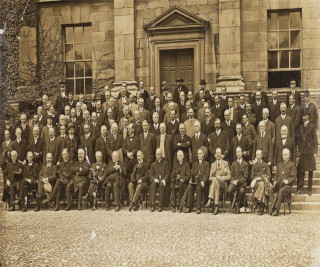
The Irish Convention

irish-convention-1917

The Irish Convention, an attempt by David Lloyd George, Prime Minister of the United Kingdom, to arrive at a political settlement, meets at Regent House, Trinity College Dublin beginning on July 25, 1917. The opposition of Sinn Féin and the Ulster unionists ultimately render it irrelevant.

The Irish Convention is an assembly which sits in Dublin from July 1917 until March 1918 to address the Irish question and other constitutional problems relating to an early enactment of self-government for Ireland, to debate its wider future, discuss and come to an understanding on recommendations as to the best manner and means this goal can be achieved. It is a response to the dramatically altered Irish political climate after the 1916 Easter rebellion and is proposed by Lloyd George in May 1917 to John Redmond, leader of the Irish Parliamentary Party, announcing that “Ireland should try her hand at hammering out an instrument of government for her own people.”

The Convention is publicly called in June 1917, to be composed of representative Irishmen from different political parties and spheres of interest. After months of deliberations, the Convention’s final report, which had been agreed upon in March 1918, is seriously undermined. With the urgent need for military manpower on the Western Front following the German Spring Offensive, the government decides in April 1918 to simultaneously introduce Home Rule and apply conscription to Ireland. This “dual policy” of conscription and devolution heralds the end of a political era.

(Pictured: Group portrait of the members of the Irish Convention at Trinity College, taken on August 21, 1917 | National Library of Ireland, NPA Conv.)


Leave a comment

Birth of Edward Kenealy, Barrister & Writer

edward-kenealy

Edward Vaughan Hyde Kenealy, Irish barrister and writer, is born in Cork, County Cork on July 2, 1819. He is best remembered as counsel for the Tichborne case and the eccentric and disturbed conduct of the trial that leads to his ruin.

Kenealy is the son of a local merchant. He is educated at Trinity College Dublin and is called to the Irish Bar in 1840 and to the English Bar in 1847. He obtains a fair practice in criminal cases. In 1868 he becomes a QC and a bencher of Gray’s Inn. He practises on the Oxford circuit and in the Central Criminal Court.

Kenealy suffers from diabetes and an erratic temperament is sometimes attributed to poor control of the symptoms. In 1850 he is sentenced to one month imprisonment for punishing his six-year-old illegitimate son with undue severity. He marries Elizabeth Nicklin of Tipton, Staffordshire in 1851 and they have eleven children, including novelist Arabella Kenealy (1864–1938). They live in Portslade, East Sussex, from 1852 until 1874. He commutes to London and Oxford for his law practice but returns at weekends and other times to be with his family.

In 1850, Kenealy publishes an eccentric poem inspired by Johann Wolfgang von Goethe, Goethe, a New Pantomime. He also publishes a large amount of poetry in journals such as Fraser’s Magazine. He publishes translations from Latin, Greek, German, Italian, Portuguese, Russian, Irish, Persian, Arabic, Hindustani and Bengali. It is unlikely he is fluent in all these languages.

In 1866, Kenealy writes The Book of God: the Apocalypse of Adam-Oannes, an unorthodox theological work in which he claims that he is the “twelfth messenger of God,” descended from Jesus Christ and Genghis Khan. He also publishes a more conventional biography of Edward Wortley Montagu in 1869.

During the Tichborne trial, Kenealy abuses witnesses, makes scurrilous allegations against various Roman Catholic institutions, treats the judges with disrespect, and protracts the trial until it becomes the longest in English legal history. His violent conduct of the case becomes a public scandal and, after rejecting his client’s claim, the jury censures his behaviour.

Kenealy starts a newspaper, The Englishman, to plead his cause and to attack the judges. His behaviour is so extreme that in 1874 he is disbenched and disbarred by his Inn. He forms the Magna Charta Association and goes on a nationwide tour to protest his cause.

At a by-election in 1875, Kenealy is elected to Parliament for Stoke-upon-Trent with a majority of 2,000 votes. However, no other Member of Parliament will introduce him when he takes his seat. Benjamin Disraeli forces a motion to dispense with this convention.

In Parliament, Kenealy calls for a Royal commission into his conduct in the Tichborne case, but loses a vote on this by 433–3. One vote is Kenealy’s, another that of his teller, George Hammond Whalley. The third “aye” is by Purcell O’Gorman of Waterford City. During this period, he also writes a nine-volume account of the case.

Kenealy gradually ceases to attract attention, loses his seat at the 1880 general election and dies in London on April 16, 1880. He is buried in the churchyard of St. Helen’s Church, Hangleton, East Sussex.


Leave a comment

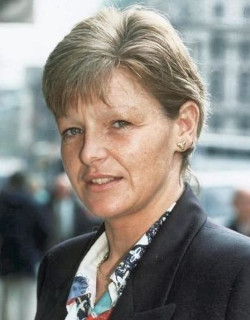
Murder of Irish Crime Reporter Veronica Guerin

veronica-guerin-1

Journalist and crime scene reporter Veronica Guerin is murdered by drug lords in Dublin on June 26, 1996, an event which helped establish the Criminal Assets Bureau (CAB).

Guerin is born in Artane, Dublin on July 5, 1958. She attends Catholic school where she excels in athletics and later studies accountancy at Trinity College, Dublin. She plays for both the Ireland women’s national basketball team and Republic of Ireland women’s national football team, representing the latter in a match against England at Dalymount Park in May 1981.

After she graduates, her father employs her at his company but, following his death three years later, she changes professions and starts a public relations firm in 1983, which she runs for seven years. In 1983–84, she serves as secretary to the Fianna Fáil group at the New Ireland Forum. She serves as Charles Haughey‘s personal assistant, and becomes a family friend, taking holidays with his children. In 1987 she serves as election agent and party treasurer in Dublin North for Seán Haughey.

In 1990, she changes careers again, switching to journalism as a reporter with The Sunday Business Post and Sunday Tribune, working under editor Damien Kiberd. Craving first-hand information, she pursues a story directly to the source with little regard for her personal safety, to engage those she deems central to a story. This allows her to build close relationships with both the legitimate authorities, such as the Garda Síochána, and the criminals, with both sides respecting her diligence by providing highly detailed information. She also reports on Irish Republican Army activities in the Republic of Ireland.

From 1994 onwards, she begins to write about criminals for the Sunday Independent. Using her accountancy knowledge to trace the proceeds of illegal activity, she uses street names or pseudonyms for organized crime figures to avoid Irish libel laws.

When she begins to cover drug dealers, and gains information from convicted drugs criminal John Traynor, she receives numerous death threats. The first violence against her occurs in October 1994, when two shots are fired into her home after her story on murdered crime kingpin Martin Cahill is published. Guerin dismisses the “warning.” The day after writing an article on Gerry “The Monk” Hutch, on January 30, 1995, she answers her doorbell to a man pointing a revolver at her head. The gunman misses and shoots her in the leg. Regardless, she vows to continue her investigations.

On September 13, 1995, convicted criminal John Gilligan, Traynor’s boss, attacks her when she confronts him about his lavish lifestyle with no source of income. He later calls her at home and threatens to kidnap and rape her son and kill her if she writes anything about him.

On the evening of June 25, 1996, Gilligan drug gang members Charles Bowden, Brian Meehan, Kieran ‘Muscles’ Concannon, Peter Mitchell and Paul Ward meet at their distribution premises on the Greenmount Industrial Estate. The following day, while driving her red Opel Calibra, Guerin stops at a red traffic light on the Naas Dual Carriageway near Newlands Cross, on the outskirts of Dublin, unaware she is being followed. She is shot six times, fatally, by one of two men sitting on a motorcycle.

About an hour after Guerin is murdered, a meeting takes place in Moore Street, Dublin, between Bowden, Meehan, and Mitchell. Bowden later denies under oath in court that the purpose of the meeting is the disposal of the weapon but rather that it was an excuse to appear in a public setting to place them away from the incident.

At the time of her murder, Traynor is seeking a High Court order against Guerin to prevent her from publishing a book about his involvement in organised crime. Guerin is killed two days before she is due to speak at a Freedom Forum conference in London.

Guerin’s funeral is attended by Ireland’s Taoiseach John Bruton, and the head of the armed forces. It is covered live by Raidió Teilifís Éireann. On July 4, labour unions across Ireland call for a moment of silence in her memory, which is duly observed by people around the country. Guerin is buried in Dardistown Cemetery, County Dublin.


Leave a comment

Bill Clinton Begins Four Day Irish Visit

clinton-guildhall-square

Former U.S. president Bill Clinton begins a four-day visit to the Republic of Ireland and Northern Ireland on May 20, 2001 to try to advance the peace process. He spends time both north and south of the border, fulfilling engagements in Belfast, Derry, Enniskillen and Dublin.

Clinton’s goal is to use his influence to try to enhance the electoral fortunes of the parties that support the Good Friday Agreement, particularly David Trimble‘s Ulster Unionist Party, who are under pressure from Ian Paisley‘s anti-agreement Democratic Unionist Party (DUP).

Clinton arrives at Farranfore Airport, County Kerry, before heading to a round of golf at Ballybunion Golf Club with the former Irish deputy prime minister and Labour Party leader Dick Spring. He spends the night at Dromoland Castle, County Clare, before two days of public engagements in Dublin.

Trimble has vowed to quit as head of the Stormont Executive, where his party shares power with Sinn Féin, if the Irish Republican Party (IRA) has not started to get rid of its guns by July 1. Paisley, however, has accused Trimble and British Prime Minister Tony Blair of breaking their promises to the people of Northern Ireland by allowing into government a party linked to a terrorist group, without prior arms decommissioning.

While Clinton is no longer the most powerful man in the world, his charisma and his past efforts to keep the peace process moving are still appreciated by many. He receives Northern Ireland political leaders countless times at the White House and gives support and encouragement by phone during difficult periods of the peace talks.

Clinton delivers a lecture at Trinity College Dublin and attends a gala for peace and reconciliation at Dublin Castle, before travelling to Derry and then on to Belfast, where he receives an honorary degree from the former peace talks chairman George Mitchell, now chancellor of Queen’s University Belfast.

The leader of the Social Democratic and Labour Party (SDLP), John Hume, who welcomes Clinton to Derry, says the former president has done a great deal of good for all the people of Ireland. But the Democratic Unionist Party (DUP) deputy leader, Peter Robinson, claims that Clinton and Blair could have a negative effect on Trimble’s campaign. “As a unionist, I wouldn’t like to be sitting next to either of them just before an election,” he said. “Blair’s name is associated with the now-broken pledges he wrote on a board here just before the [Good Friday agreement] referendum, so for him to come over and moralise now won’t do much good. And Clinton is so disgraced and powerless that, while he might prop up the nationalist SDLP and Sinn Féin vote, he’ll have no impact on unionists voters.”

(Pictured: Bill Clinton and SDLP leader John Hume at public address at Guildhall Square in Derry. Sinn Féin leader Gerry Adams and Chelsea Clinton are in the second row.)


Leave a comment

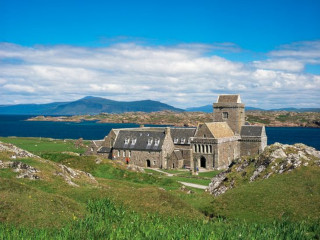
St. Columba Arrives on the Isle of Iona

iona-abbey-isle-of-iona

St. Columba, an Irish monk, and twelve followers arrive on the tiny isle of Iona, barely three miles long by one mile wide, on May 12, 563, establishing a monastic community and building his first Celtic church. Iona has an influence out of all proportion to its size on the establishment of Christianity in Scotland, England and throughout mainland Europe.

Once settled, Columba sets about converting most of pagan Scotland and northern England to the Christian faith. Iona’s fame as a missionary centre and outstanding place of learning eventually spreads throughout Europe, turning it into a place of pilgrimage for several centuries to come. Iona becomes a sacred isle where kings of Scotland, Ireland and Norway are buried.

Columba is born of royal blood in 521 AD in Ireland, or Scotia as it is then called. He is the grandson of the Irish King Niall. He leaves Ireland for Scotland not as a missionary but as an act of self-imposed penance for a bloody mess he had caused at home. He had upset the king of Ireland by refusing to hand over a copy of the Gospel he had illegally copied, leading to a pitched battle in which Columba’s warrior family prevailed. Full of remorse for his actions and the deaths he had ultimately caused, he flees, ultimately settling on Iona as it is the first place he finds from which he is unable to see his native Ireland. One of the features on the island is even called “The Hill with its back to Ireland.”

Columba, however, is not the shy retiring type and sets about building Iona’s original abbey from clay and wood. In this endeavour he displays some strange idiosyncrasies, including banishing women and cows from the island. The abbey builders have to leave their wives and daughters on the nearby Eilean nam Ban (Woman’s Island). Stranger still, he also banishes frogs and snakes from Iona, although how he accomplishes this feat is not well documented.

The strangest claim of all however is that Columba is prevented from completing the building of the original chapel until a living person has been buried in the foundations. His friend Oran volunteers for the job and is duly buried. It is said that Columba later requests that Oran’s face be uncovered so he can bid a final farewell to his friend. Oran’s face is uncovered and he is found to be still alive but utters such blasphemous descriptions of Heaven and Hell that Columba orders that he be covered up immediately.

Over the centuries the monks of Iona produce countless elaborate carvings, manuscripts and Celtic crosses. Perhaps their greatest work is the exquisite Book of Kells, which dates from 800 AD, currently on display in Trinity College, Dublin. Shortly after this, in 806 AD, come the first of the Viking raids and many of the monks are slaughtered and their work destroyed.

The Celtic Church, lacking central control and organisation, diminishes in size and stature over the years to be replaced by the much larger and stronger Roman Church. Even Iona is not exempt from these changes and in 1203 a nunnery for the Order of the Black Nuns is established and the present-day Benedictine abbey, Iona Abbey, is built. The abbey is a victim of the Reformation and lay in ruins until 1899 when restoration is started.

No part of Columba’s original buildings have survived, however on the left hand side of the abbey entrance can be seen a small roofed chamber which is claimed to mark the site of the Columba’s tomb.

(From: “St. Columba and the Isle of Iona” by Ben Johnson, historic-uk.com, pictured is the Iona Abbey and Nunnery)


Leave a comment

Birth of Máire de Paor, Historian & Archaeologist

maire-de-paor

Máire de Paor, Irish historian and archaeologist who also works as a researcher and presenter for national broadcaster RTÉ, is born on May 6, 1925, in Buncrana, County Donegal.

De Paor is born Máire MacDermott to Eamonn MacDermott and Delia MacVeigh. She is educated in the Convent of Mercy in Buncrana before going to University College Dublin, where she completes a master’s degree and a doctorate on early Christian archaeology and metalwork.

De Paor works in the Department of Archeology at UCD from 1946 to 1958. She marries Liam de Paor in 1946, and they have a daughter and four boys. They collaborate on a number of publications. She publishes her papers in the Proceedings of the Royal Irish Academy, Archaeologia, Seanchas Armagh and Comhar. Her husband also works at the university and, as a result of policies about married women, she is forced to leave. Initially she lectures in the United States, Canada, Scandinavia, France and the United Kingdom. She works as lecturer in archaeology at Trinity College, Dublin. The de Paors spend a year in Nepal on a UNESCO project in 1963.

De Paor works as a freelance researcher for Raidió Teilifís Éireann until she is given a full-time position in the 1970s.

De Paor is elected a member of the Royal Irish Academy in 1960 and is a member of the Arts Council from 1973. She becomes a member of Conradh na Gaeilge from 1962. From 1968 she is working with Cumann Merriman, the Irish cultural organisation named after Brian Merriman, working with the group as a director of the schools and spends four years as chairperson. In 1992 she is appointed to the board of Amharclann de hÍde.

Máire de Paor dies on December 6, 1994, at the age of 69.

University College Dublin has created the Dr. Máire de Paor Award for best PhD thesis. Her biographer identifies her as a committed republican, socialist and feminist.


Leave a comment

Birth of Poet James Clarence Mangan

Mangan bust

James Clarence Mangan, Irish poet, is born on May 1, 1803, in Dublin. His poetry fits into a variety of literary traditions. Most obviously, and frequently, his work is read alongside such nationalist political authors as John Mitchel, as they appear in The Nation, The Vindicator and the United Irishman newspapers or as a manifestation of the 19th-century Irish Cultural Revival. He is also frequently read as a Romantic poet.

Mangan is the son of James Mangan, a former hedge school teacher and native of Shanagolden, County Limerick, and Catherine Smith from Kiltale, County Meath. Following his marriage to Smith, James Mangan takes over a grocery business in Dublin owned by the Smith family, eventually becoming bankrupt as a result. Mangan describes his father as having “a princely soul but no prudence,” and attributes his family’s bankruptcy to his father’s suspect business speculations and tendency to throw expensive parties. Thanks to poor record keeping, inconsistent biographies, and his own semi-fictional and sensationalized autobiographical accounts, his early years are the subject of much speculation. However, despite the popular image of him as a long-suffering, poor poet, there is reason to believe that his early years are spent in middle class comfort.

Mangan is educated at a Jesuit school where he learns Latin, Spanish, French, and Italian. He attends three schools before the age of fifteen. Obliged to find a job in order to support his family, he then becomes a lawyer’s clerk, and is later an employee of the Ordnance Survey and an assistant in the library of Trinity College, Dublin.

Mangan’s first verses are published in 1818. From 1820 he adopts the middle name Clarence. In 1830 he begins producing translations – generally free interpretations rather than strict transliterations – from German, a language he had taught himself. Of interest are his translations of Johann Wolfgang von Goethe. From 1834 his contributions begin appearing in the Dublin University Magazine. In 1840 he begins producing translations from Turkish, Persian, Arabic and Irish. He is also known for literary hoaxes as some of his “translations” are in fact works of his own, like Twenty Golden Years Ago, attributed to a certain Selber.

Mangan is friends with the patriotic journalists Thomas Davis and John Mitchel, who ultimately writes his biography. His poems are published in their newspaper The Nation.

Although Mangan’s early poetry is often apolitical, after the Great Famine he begins writing patriotic poems, including influential works such as Dark Rosaleen, a translation of “Róisín Dubh,” and A Vision of Connaught in the Thirteenth Century.

Mangan’s best known poems include Dark Rosaleen, Siberia, Nameless One, A Vision of Connaught in the Thirteenth Century, The Funerals, To the Ruins of Donegal Castle, Pleasant Prospects for the Land-eaters and Woman of Three Cows. He writes a brief autobiography, on the advice of his friend Charles Patrick Meehan, which ends mid-sentence. This is apparently written in the last months of his life, since he mentions his narrative poem of the Italian Gasparo Bandollo, which is published in the Dublin University Magazine in May 1849.

Mangan is a lonely and often difficult man who suffers from mood swings, depression and irrational fears, and becomes a heavy drinker and opium user. His appearance grows eccentric, and he is described by the artist WF Wakeman as frequently wearing “a huge pair of green spectacles,” padded shirts to hide his malnourished figure and a hat which “resembled those which broomstick-riding witches are usually represented with.” On June 20, 1849, weakened by poverty, alcoholism and malnutrition, he succumbs to cholera at the age of 46. He is buried in Glasnevin Cemetery in Dublin.

(Pictured: Memorial bust of James Mangan in St. Stephen’s Green, sculpted by Oliver Sheppard)


Leave a comment

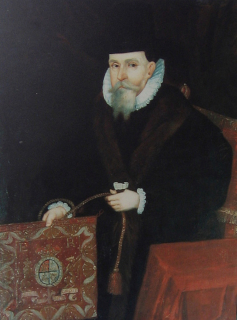
Death of Adam Loftus, First Provost of Trinity College, Dublin

adam-loftus

Adam Loftus, Archbishop of Armagh, and later Dublin, and Lord Chancellor of Ireland from 1581, dies in Dublin on April 5, 1605. He is also the first Provost of Trinity College, Dublin.

Loftus is born in 1533, the second son of a monastic bailiff, Edward Loftus, in the heart of the English Yorkshire Dales. He embraces the Protestant faith early in his development. He is an undergraduate at Trinity College, Cambridge, where he reportedly attracts the notice of the young Queen Elizabeth, as much by his physique as through the power of his intellect. Although this encounter may never have happened, Loftus certainly meets with the Queen more than once, and she becomes his patron for the rest of her reign. At Cambridge Loftus takes holy orders as a Catholic priest and is appointed rector of Outwell St. Clement in Norfolk. He comes to the attention of the Catholic Queen Mary, who names him vicar of Gedney, Lincolnshire. On Elizabeth’s accession in 1558 he declares himself Anglican.

Loftus makes the acquaintance of the Queen’s favourite Thomas Radclyffe, 3rd Earl of Sussex and serves as his chaplain in Ireland in 1560. In 1561 he becomes chaplain to Alexander Craike, Bishop of Kildare and Dean of St. Patrick’s Cathedral in Dublin. Later that year he is appointed rector of Painstown in Meath and evidently earns a reputation as a learned and discreet advisor to the English authorities in Dublin. In 1563, he is consecrated Archbishop of Armagh at the unprecedented age of 28 by Hugh Curwen, Archbishop of Dublin.

Following a clash with Shane O’Neill, the real power in Ulster during these years, he comes to Dublin in 1564. To supplement the meager income of his troubled archbishopric he is temporarily appointed to the Deanery of St. Patrick’s Cathedral by the queen in the following year. He is also appointed president of the new commission for ecclesiastical causes. This leads to a serious quarrel with the highly respected Bishop of Meath, Hugh Brady.

In 1567 Loftus, having lobbied successfully for the removal of Hugh Curwen, who becomes Bishop of Oxford, and having defeated the rival claims of the Bishop of Meath, is appointed Archbishop of Dublin, where the queen expects him to carry out reforms in the Church. On several occasions he temporarily carries out the functions of Lord Keeper of the Great Seal, and in August 1581 he is appointed Lord Chancellor of Ireland after an involved dispute with Nicholas White, Master of the Rolls in Ireland. He is constantly occupied in attempts to improve his financial position by obtaining additional preferment and is subject to repeated accusations of corruption in public office.

In 1582 Loftus acquires land and builds a castle at Rathfarnham, which he inhabits from 1585. In 1569–1570 the divisions in Irish politics take on a religious tinge with the First Desmond Rebellion in Munster and Pope Pius V‘s 1570 papal bull Regnans in Excelsis. The bull questions Elizabeth’s authority and thereafter Roman Catholics are suspected of disloyalty by the official class unless they are discreet.

Loftus takes a leading part in the execution of Dermot O’Hurley, Archbishop of Cashel. When O’Hurley refuses to give information, Francis Walsingham suggests he should be tortured. Although the Irish judges repeatedly decide that there is no case against O’Hurley, on June 19, 1584, Loftus and Sir Henry Wallop write to Walsingham “We gave warrant to the knight-marshal to do execution upon him, which accordingly was performed, and thereby the realm rid of a most pestilent member.”

Between 1584 and 1591 Loftus has a series of clashes with Sir John Perrot on the location of an Irish University. Perrot wants to use St. Patrick’s Cathedral, Dublin as the site of the new University, which Loftus seeks to preserve as the principal place of Protestant worship in Dublin, as well as a valuable source of income for himself. The archbishop wins the argument with the help of his patron, Queen Elizabeth I, and Trinity College, Dublin is founded at its current location, named after his old college at Cambridge, leaving the Cathedral unaffected. Loftus is named as its first Provost in 1593.

The issue of religious and political rivalry continues during the two Desmond Rebellions (1569–83) and the Nine Years’ War (1594–1603), both of which overlap with the Anglo-Spanish War (1585–1604), during which some rebellious Irish nobles are helped by the Papacy and by Elizabeth’s arch-enemy Philip II of Spain. Due to the unsettled state of the country Protestantism makes little progress, unlike in Celtic Scotland and Wales at that time. It comes to be associated with military conquest and is therefore hated by many. The political-religious overlap is personified by Loftus, who serves as Archbishop and as Lord Chancellor of Ireland. An unlikely alliance forms between Gaelic Irish families and the Norman “Old English“, who had been enemies for centuries but who now mostly remain Roman Catholic.

Adam Loftus dies in Dublin on April 5, 1605, and is interred in the building he had helped to preserve for future generations, while many of his portraits hang today within the walls of the University which he helped found. Having buried his wife Jane (Purdon) and two sons (of their 20 children) in the family vault at St. Patrick’s, Loftus dies at his Episcopal Palace in Kevin Street “worn out with age” and joins his family in the same vault. His zeal and efficiency are commended by James I upon the king’s accession.