Johnson is born on May 17, 1872, in Liverpool, England. He works on the docks for an Irish fish merchant, spending much of his time in Dunmore East and Kinsale. It is this way that he picks up ideas about socialism and Irish nationalism, joining a Liverpool branch of the Independent Labour Party in 1893. In 1900 he starts work as a commercial traveller, then moves in 1903 with his family to Belfast where he becomes involved in trade union and labour politics.
In 1907, Johnson helps James Larkin organise a strike in the port, but has to watch in dismay as the strike, which begins with remarkable solidarity between labour, Orange, and nationalist supporters, collapses in sectarian rioting. At various times he is the president, treasurer and secretary of the Irish Trades Union Congress (ITUC) which is, at the time, also the Labour Party in Ireland, until officially founded in 1912 by James Connolly and James Larkin. Johnson becomes Vice-President of the ITUC in 1913, and President in 1915.
Johnson sympathizes with the Irish Volunteers, many of whom are sacked from their jobs, for illegal activities. During the Easter Rising, he notes in his diary that people in Ireland paid little heed to the fate of the defeated revolutionaries. He succeeds as leader of the Labour Party from 1917, when the party does not contest the 1918 Irish general election. When the British government tries to enforce conscription in Ireland in 1918, he leads a successful strike in conjunction with other members of the Irish anti-conscription movement.
Johnson is later elected a TD for Dublin County to the Third Dáil at the 1922 Irish general election and remains leader of the Labour Party until 1927. As such, he is Leader of the Opposition in the Dáil of the Irish Free State, as the anti-treaty faction of Sinn Féin refuses to recognise the Dáil as constituted. He issues a statement of support for the Government of the 4th Dáil when the Irish Army Mutiny threatens civilian control in March 1924.
Johnson is the only Leader of the Labour Party who serves as Leader of the Opposition in the Dáil. He loses his Dáil seat at the September 1927 Irish general election, and the following year he is elected to Seanad Éireann, where he serves until the Seanad’s abolition in 1936.
In 1896 he meets Marie Tregay, then a teacher in St. Multose’s National school, outside Kinsale. A native of Cornwall, she has advanced political views. They marry in 1898 in Liverpool. Their only son, Frederick Johnson, is born in 1899, and becomes a well-known actor. Johnson dies on January 17, 1963, at 49 Mount Prospect Avenue, Clontarf, Dublin.
Each summer, Labour Youth holds the “Tom Johnson Summer School” to host panel discussions, debates and workshops.
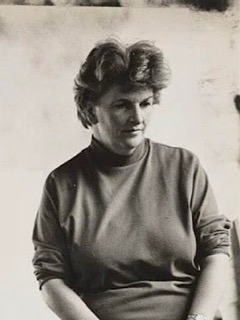
Mary Esperance (“Nancy”) Wynne-Jones is born on December 10, 1922, in Penmaenucha, Wales, to landowner Charles Llewellyn Wynne-Jones and Sybil Mary Gella Scott. The family spends half the year in Wales and half the year in Thornhill, Stalbridge, Dorset. She has two brothers, Andrew and Ronald (“Polly”), both of whom die in Africa during World War II.
Wynne-Jones is educated at home. Her skill in art leads to her getting lessons in Sherborne from a children’s book illustrator. Her music is encouraged by the family doctor and she begins to compose and study the violin, receiving lessons in Bournemouth with the first violinist of the symphony orchestra. After the start of World War II, she continues in Aberystwyth. She goes on to study the violin and composition at the Royal Academy of Music, London (1940–43). While in London she also serves as a Voluntary Aid Detachment nurse until 1943 and later as a draughtswoman at the Ordnance Survey.
After the war, Wynne-Jones purchases and manages a bookshop on the King’s Road in Chelsea, but it is not a financial success. She returns to painting, studying at the Heatherley School of Fine Art, London, from 1951 to 1952 and the Chelsea School of Art from 1952 to 1955. She travels extensively through Portugal and Italy painting landscapes. An interest in completing landscapes in an abstract manner leads her to study with Peter Lanyon in St. Ives, Cornwall.
In 1962, Wynne-Jones purchases Trevaylor House near Penzance and provides accommodation for other artists including renowned Irish painter Tony O’Malley, sculptor Conor Fallon and English poet and writer W. S. ‘Sydney’ Graham. In the 1970s she exhibits in Ireland at the Project Arts Centre, Dublin (1970) and at the Emmet Gallery, Dublin (1975 and 1977). During the 1980s she exhibits at the Lincoln and Hendricks galleries in Dublin before joining the Taylor Gallery, run by John and Patrick Taylor. She is elected an honorary member of the Royal Hibernian Academy (RHA) in 1994 and becomes a member of Aosdána in 1996. Originally an abstract artist, her contact with the Irish countryside slowly transforms her work to that of a landscape artist, albeit with an influence of abstraction attached to it. She becomes well-known in Irish art circles as an eminent Irish landscape artist.
Wynne-Jones is involved with artist Derek Middleton before moving to Cornwall. There she becomes romantically involved with Graham who is in an open marriage, however, it is the death of her mentor Peter Lanyon which devastates her. She meets the sculptor Conor Fallon through their mutual friend, Tony O’Malley. Fallon had arrived in Cornwall ostensibly to meet Lanyon. They marry in 1966. Their honeymoon in Provence is immortalised in expressionist paintings done by her. The couple adopts a boy and a girl, siblings, John and Bridget. In 1972, she moves with her family to Kinsale, County Cork. It is in the area around here that a number of her paintings are created. Later she paints the mountain visible from her Wicklow home after the family moves in the late 1980s. She moves to Ballard House, near Rathdrum, County Wicklow in 1987.
Wynne-Jones dies on November 9, 2006, and is buried in Ballinatone (Church of Ireland), Rathdrum.
The youngest daughter of Captain Henry Butler, a grandson of the Edmund Butler, 11th Viscount Mountgarret, and Clara Butler (née Taylor) of the Newarke, Leicester, England. Her father is himself an enthusiastic painter, known for his publication South African sketches: illustrative of the wildlife of a hunter on the frontier of Cape Colony (1841). Her early artistic efforts are mainly copies of romantic subjects, but the influence of the London artist Paul Jacob Naftel, with whom she begins corresponding in the early 1880s, proves to be crucial to her artistic development. Studies with William Frank Calderon, an expert in animal painting, are also significant. She subsequently spends the summers of 1894 and 1895 in Newlyn, Cornwall, England, with the Irish artist Norman Garstin, who introduces her to contemporary French painting.
In 1885, Butler makes her first visit to the continent, traveling through France, Switzerland, and Italy. From 1905 to 1914 she travels regularly to Europe, most particularly Aix-les-Bains and Wiesbaden, during which time she produces genre views of French and German villages. After 1914 her life at the family home is interrupted only by visits to London exhibitions. She is best known for her paintings of Kilmurry and its environs, many of which display an interest in botany. Much of her work is dominated by detailed representations of animals and birds, often drawn from photographs and stuffed specimens.
Butler’s career as an exhibitor begins in 1882 with the Irish Fine Arts Society, later known as the Water Colour Society of Ireland (WCSI), with which she has a long association. She exhibits regularly with the society from 1892 onward and is a member of its committee for many years. She is also closely associated with the Dudley Museum and Art Gallery in London. Her work is first shown there in 1888, and on this evidence, she is elected to their society. The purchase by the Chantrey bequest for the Tate Gallery of The Morning Bath for £50 in 1896 is a high point in her career. The first painting by a woman to be selected by the council, its purchase is followed by almost consistently good press reviews for her work. The Athenaeum of May 5, 1897, writes: “The young lady knows how to look at her subjects with the eyes of a well-trained artist.”
Butler also comes to the attention of the American artistic press. She contributes to the portfolio of drawings given by the Society of Lady Artists to Princess May on her marriage to the Duke of York in 1893, while in 1922 her work is included in the portfolio presented to Princess Mary on her marriage. Her patrons include Queen Alexandra, and the grand duke of Hesse, who purchases two of her paintings after she is invited to exhibit in Hesse Darmstadt in 1911. In 1914 she is made a member of the Union Internationale des Beaux Arts, and in 1921 her paintings are shown in Japan. She regularly exhibits with the Belfast Ramblers, the Royal Ulster Academy, the Royal Academy of Arts (RA), the Royal Hibernian Academy (RHA), the Society of Lady Artists, and the Royal Watercolour Society, of which she is made an associate member in 1896, and a full member in 1937.
In her later years, severe rheumatism prevents Butler from painting. She has a keen interest in music. She survives all five of her siblings, and inherits Kilmurry, where she dies on October 11, 1941. She is buried at Thomastown, County Kilkenny. Her paintings are represented in the collections of the National Gallery of Ireland, Dublin City Gallery the Hugh Lane, the Ulster Museum, and the Tate, London.
(From: “Butler, Mildred Anne” by Frances Clarke, Dictionary of Irish Biography, http://www.dib.ie, October 2009)
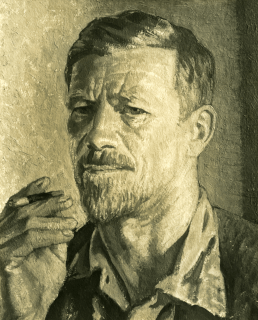
O’Brien is a ship builder and designer, and his notable boats include the Kelpie (used for gun running in 1914), the Saoirse (in which he circumnavigates the globe) and the Ilen (a Falkland Islands service ship).
O’Brien is credited with two buildings in his lifetime: the Co-operative Hall in County Donegal and the People’s Hall in County Limerick. He is also known as a naval architect, having designed two ships, the Saoirse and the llen. He later captains both of these ships himself.
In Saoirse, a 20-ton, 42-foot ketch designed and built in 1922 in Baltimore, County Cork, he and three crew members circumnavigate the globe between 1923 and 1925 – the first recorded by an amateur skipper from west to east, the first yacht circumnavigation by way of the three great capes: Cape Horn, Cape of Good Hope and Cape Leeuwin, and the first boat flying the Irish tri-colour to enter many of the world’s ports and harbours. His voyage begins and ends at the Port of Foynes, County Limerick, where he lives. His account of the voyage, Across Three Oceans, (1927) becomes one of the classics of maritime literature.
Up until O’Brien’s circumnavigation, this route is the preserve of square-rigged grain ships taking part in the grain race from Australia to England via Cape Horn (also known as the clipper route).
O’Brien’s seagoing experiences are put to use in his design of the Ilen, which is built for the Falkland Islands as a service boat and launched in the spring of 1926. In 1998, Ilen returns to the site where she was first built, on the River Ilen near Baltimore, County Cork, where she undergoes a full restoration and is re-launched in May 2018. This task provides work-based learning for the students of the Ilen School.
O’Brien has some involvement with gun running in 1914 on behalf of the Irish Volunteers, for political reasons and because he has experience in sailing. On July 26, 1914, nine hundred guns are brought to Howth harbour aboard Erskine Childers‘ yacht Asgard. As part of the same operation, O’Brien transports arms on his yacht, Kelpie. The guns on Kelpie are transshipped to another yacht, Chotah, owned by Sir Thomas Myles, before being landed at Kilcoole in County Wicklow on August 1, 1914. After the gun running incidents, he serves in the Royal Naval Volunteer Reserve.
In 1928, O’Brien marries a well-known artist, Kathleen Francis, the youngest daughter of Sir George Clausen, RA. The couple thereafter moves to Ibiza, where they live on the Saoirse until Kathleen’s death in 1936. They have no children. Relocating to Cornwall, where he lives with his sister, he writes books on sailing and works of fiction for children. Although too old for active service when war with Germany breaks out in 1939, he assists the British war effort by serving in the Small Ships Pool, which delivers support vessels across the Atlantic and brings food supplies from the United States in private yachts.
In 1940 O’Brien sells Saoirse to the Royal Cornwall Yacht Club. The boat remains in use until 1980, when it is lost off the Jamaican coast. After the war he retires to another sister’s home in Foynes, County Limerick, where he lives and continues to write books for children until his death on April 18, 1952.
Mitchell is the younger son of David William Mitchell, owner of a Dublin ironmongery and furniture business, and Francis Elizabeth Mitchell (née Kirby). His elder brother David becomes president of the Royal College of Physicians of Ireland (RCPI) and his sister Lillias is a noted weaver and teacher. He is educated at The High School, Dublin, and Trinity College Dublin (TCD), where he is a scholar in 1933 and receives a gold medal the following year. In 1934 he is appointed assistant to the professor of geology at TCD, and later is lecturer in geology (1940), reader in Irish archaeology (1959) and professor of Quaternary studies – a personal chair (1965). He is an efficient administrator and serves TCD successively as registrar, senior lecturer, and tutor, and after retirement is briefly a pro-chancellor of the university.
Mitchell’s major research focuses on the evolution of Ireland during the last two million years, particularly during the Quaternary since the retreat of the glacial ice over Ireland, and the effect man has had on this landscape. His interest in Quaternary studies begins in 1934, when he is appointed by the Royal Irish Academy (RIA) as an assistant to the Danish botanist and Quaternary geologistKnud Jessen, who uses the distribution of ancient pollen grains to reconstruct vegetational history. From 1940 he publishes a series of papers on topics such as the distribution of Irish giant deer and reindeer remains in Ireland, lacustrine deposits in County Meath, interglacial deposits in southeast Ireland, the palynology of Irish raised bogs, cave deposits, fossil pingos in County Wexford, bog flows, and the deposits of the older Pleistocene period in Ireland. His major study in this field is the documentation (1965) of the vegetational history of Littleton bog, County Tipperary, which has given its name to the present interglacial – the Littletonian warm stage.
Mitchell does not confine his studies to Ireland but also carries out work in Glasgow, Cornwall, and the Isle of Man. In 1957, he helps organise the British Association for the Advancement of Science meeting in Dublin and is later chairman of the Geological Society of London sub-commission on British and Irish Quaternary stratigraphy, which produces a comprehensive report in 1973. He is a frequent broadcaster on radio and a prolific author of academic papers, and in later life writes several acclaimed books, including The Irish Landscape (1976), which goes through two further editions as Reading the Irish Landscape (1986, 1997), and a volume of semi-autobiography, The Way That I Followed (1990).
In 1940, Mitchell marries Lucy Margaret (‘Pic’) (1911–87), daughter of E. J. Gwynn, provost of TCD. They have two daughters. For many years they live at Townley Hall, near Drogheda, County Louth, which had been TCD’s agricultural facility. A 1985 portrait by David Hone is displayed at Trinity College Dublin.
(From: “Mitchell, George Francis (‘Frank’)” by Patrick N. Wyse Jackson, Dictionary of Irish Biography, http://www.dib.ie, October 2009)
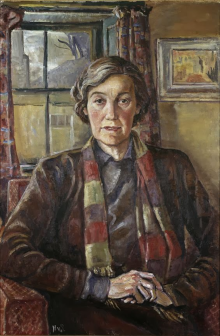
Shortly before her twelfth birthday, Hone suffers from polio (infant paralysis), suffering a fall while helping to decorate the Taney parish church for Easter. Her resulting ill health leads to her seeking treatment in Harley Street, Marylebone, Central London. She is educated by a governess, continuing her education in Switzerland, and goes on tours to Spain and Italy before moving to London in 1913. Her three sisters all marry British Army officers, and all are widowed in World War I.
Hone is extremely devout. She spends time in an Anglican Convent in 1925 at Truro in Cornwall and converts to Catholicism in 1937. This possibly influences her decision to begin working in stained glass. Initially, she works as a member of the An Túr Gloine stained glass co-operative before setting up a studio of her own in Rathfarnham.
Hone’s most important works are probably the East Window, depicting the Crucifixion, for the Chapel at Eton College, Windsor (1949–1952) and My Four Green Fields, now located in Government Buildings, Dublin. This latter work, commissioned for the Irish Government’s Pavilion, wins first prize for stained glass in the 1939 New York World’s Fair. It graces CIÉ‘s Head Office in O’Connell Street from 1960 to about 1983. The East Window of Eton College is commissioned following the destruction of the building after a bomb is dropped in 1940 on the school during World War II. She is commissioned to design the East Window in 1949, and the new window is inserted in 1952. This work is featured on an Irish postage stamp in 1969. From December 2005 to June 2006, an exhibition of her work is on display at the National Gallery of Ireland. Saint Mary’s church in Clonsilla also features her stained glass windows.
Despite ill health, Hone continues to produce a huge number of small stained glass panels as well as oils, watercolours, and gouache landscapes. In 1953, she is represented at the Contemporary Irish Art exhibition at Aberystwyth, Wales, and at the Tate gallery in London, receiving as well an honorary LLD from Trinity College Dublin (TCD). In 1954, she is elected an honorary member of the Royal Hibernian Academy (RHA).
Unmarried, Hone dies on March 13, 1955, while entering her parish church at Rathfarnham. She is survived by two of her sisters. Over 20,000 people visit a memorial exhibition of her work at University College Dublin (UCD), Earlsfort Terrace, Dublin, in 1958.
(Pictured: Portrait of Evie Hone by Hilda van Stockum)
Captain Otway Cuffe, benefactor, Gaelic revivalist, twice mayor of Kilkenny and a founder of businesses and organisations to profit the local people, is born in London on January 11, 1853.
Cuffe is born the Honourable Otway Frederick Seymour Cuffe to John Cuffe, 3rd Earl of Desart, and Lady Elizabeth Lucy Campbell. He has an older sister and two older brothers. After the death of his eldest brother William Ulick, 4th Earl of Desart, his seecond eldest brother, Hamilton, becomes the 5th Earl of Desart. As the 5th Earl has no male heirs himself, Cuffe is nominally his heir. However, as he also dies without heirs, the line becomes extinct upon the death of the 5th Earl.
Dedicated to ensuring a strong Irish identity in the area, Cuffe works with his sister-in-law, Ellen Cuffe, Countess of Desart. He joins Conradh na Gaeilge soon after his arrival in Kilkenny. He is elected president of its Kilkenny branch in 1904 and remains so until his death. He is replaced by Lady Desart. Together they open the theatre in Kilkenny in 1902 and he is the first President of the Kilkenny Drama Club. He also performs on stage.
Cuffe is first elected Mayor of Kilkenny in 1907 and again in 1908. With Lady Desart, he builds the Kilkenny Woollen Mills, Desart Hall, the Talbot’s Inch model village and the Kilkenny Woodworkers factory. He lays the foundation stone for Kilkenny’s Carnegie library. He is also President of the Irish Industrial Association.
Cuffe is a friend of William Morris whom he had met on a trip to Iceland. He believes in the Arts and Crafts movement and tries to implement it in the projects which he drives. He is also a friend and supporter of Standish James O’Grady and helps him found the weekly radical conservative paper The All-Ireland Review and runs it between 1900 and 1906.
In 1911, Cuffe becomes ill and is forced to move to warmer climates until he recovers. He decides to go to the south of Europe but then a visit to Australia seems appropriate. However, on the journey there he contracts pneumonia and dies at Fremantle in Western Australia on January 3, 1912. He is buried at Perth, carried to his grave by Kilkenny hurlers. The Kilkenny Moderator calls his death “a thunderbolt to the people of Kilkenny.” He is remembered as a visionary who made a permanent impact on the physical landscape of Kilkenny.
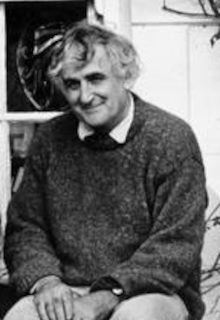
Fallon is born at Holles Street Hospital, Dublin, on January 30, 1939, the third of six sons of Padraic Fallon, the Irish poet and playwright, and Dorothea Maher. The family moves to Clonard, County Wexford, where he grows up. He has three surviving brothers, Brian, Ivan and Padraic, who have all had journalism careers. His early interest in literature and the arts is nourished by his father and elder brothers, and by contact with the cultured circle of writers, artists, musicians and intellectuals within which his father moves.
Fallon is educated at St. Peter’s College, Wexford, and Trinity College, Dublin. He begins painting in 1957 while at Trinity College, where he is studying natural science but is advised to pay more attention to his art. His interest in painting is probably inspired by the example of Tony O’Malley, a close family friend. As a compromise with his father, who does not see his talent, he also studies accountancy at night.
Largely self-taught in painting, he learns fundamentals of technique from Richard Kingston, to whom he is introduced by O’Malley. He largely paints landscapes in acrylic and gouache, in a manner heavily influenced by that of Jack Butler Yeats.
In 1964, Fallon visits O’Malley in St. Ives, Cornwall, where he had emigrated several years earlier, intending also to meet the Cornish abstract landscape painter Peter Lanyon, the chief creative force in the thriving artists’ colony centred on St. Ives. His arrival, however, coincides with Lanyon’s death from injuries suffered in a gliding accident. A gently sympathetic stranger amid the bereaved artistic community, he finds an immediate empathy and rapport with Nancy Wynne-Jones, a Welsh-born painter sixteen years his senior who had studied under Lanyon. They marry in 1966. They adopt two children in 1970, siblings John and Bridget.
Encouraged to take up sculpture, English sculptor Denis Mitchell becomes Fallon’s mentor in Cornwall, and with Breon O’Casey, he develops his sculpting. He becomes notable for his cast steel and bronze work, especially birds, horses and hares. He has his first solo exhibition in Newlyn in 1972, showing both painting and sculpture.
In May 1972, Fallon moves with his family back to Ireland, settling at Scilly House, on a hillside overlooking the harbour at Kinsale, County Cork. Removed from any centre of artistic activity, he devotes himself fulltime to a solitary development of his sculpture, refining his methodology and technique, and his skills in working various metals, beginning in 1974 to work in steel. In 1975, he first exhibits in Ireland at a solo show at the Emmet Gallery, Dublin, again showing both painting and sculpture, including his first steel sculptures to be exhibited.
Beginning in 1983, Fallon exhibits regularly with the Taylor Galleries, Dublin. Desiring closer proximity to Dublin art activities, and with their children attending university in the city, Fallon and his wife move in 1987 to Ballard House, Ballinaclash, Rathdrum, County Wicklow.
In the summer of 2007, some six months after his wife’s death, Fallon wis diagnosed with advanced metastatic lung cancer. He dies on October 3, 2007, at the Blackrock Clinic, County Dublin, and is buried beside his wife in Ballinatone churchyard, Greenan, Rathdrum, County Wicklow.
Ó Brádaigh is born into a middle-class republican family. His father, Matt Brady, is an IRA volunteer who is severely wounded in an encounter with the Royal Irish Constabulary (RIC) in 1919. His mother, May Caffrey, is a Cumann na mBan volunteer and a 1922 graduate of University College Dublin (UCD). His father dies when he is ten and is given a paramilitary funeral led by his former IRA colleagues. His mother, prominent as the Secretary for the County Longford Board of Health, lives until 1974. He is educated at Melview National School at primary level and attends secondary school at St. Mel’s College, leaving in 1950, and graduates from University College Dublin in 1954. That year he takes a job teaching Irish language at Roscommon Vocational School in Roscommon. He is a deeply religious Catholic who refrains from smoking or drinking.
Ó Brádaigh joins Sinn Féin in 1950. While at university, in 1951, he joins the Irish Republican Army. In September 1951, he marches with the IRA at the unveiling of the Seán Russell monument in Fairview Park, Dublin. A teacher by profession, he is also a Training Officer for the IRA. In 1954, he is appointed to the Military Council of the IRA, a subcommittee set up by the IRA Army Council in 1950 to plan a military campaign against Royal Ulster Constabulary (RUC) barracks in Northern Ireland.
On August 13, 1955, Ó Brádaigh leads a ten-member IRA group in an arms raid on Hazebrouck Barracks, near Arborfield, Berkshire, England, a depot for the No. 5 Radar Training Battalion of the Royal Electrical and Mechanical Engineers. It is the biggest IRA arms raid in Britain. Most, if not all, of the weapons are recovered in a relatively short period of time. A van, traveling too fast, is stopped by the police and IRA personnel are arrested. Careful police work leads to weapons that had been transported in a second van and stored in London.
The IRA Border Campaign commences on December 12, 1956. As an IRA General Headquarters Staff (GHQ) officer, Ó Brádaigh is responsible for training the Teeling Column in the west of Ireland. During the Campaign, he serves as second-in-command of the Teeling Column. On December 30, 1956, he partakes in the Teeling Column attack on RUC barracks in Derrylin, County Fermanagh. RUC Constable John Scally is killed in the attack and is the first fatality of the new IRA campaign. Ó Brádaigh and others are arrested by the Garda Síochána across the border in County Cavan the day after the attack. They are tried and jailed for six months in Mountjoy Prison. A leading abstentionist, upon his arrest he refuses to recognize the authority of the Irish government and refuses to renounce violence in exchange for his release.
Upon completing his prison sentence, Ó Brádaigh is immediately interned at the Curragh Camp along with other republicans. On September 27, 1958, he escapes from the camp along with Dáithí Ó Conaill. While a football match is in progress, the pair cuts through a wire fence and escapes from the camp under a camouflage grass blanket. This is an official escape, authorised by the officer commanding (OC) of the IRA internees, Tomás Óg Mac Curtain. He is the first Sinn Féin TD on the run since the 1920s.
In October 1958, Ó Brádaigh becomes the IRA Chief of Staff, a position he holds until May 1959, when Seán Cronin is elected as his replacement. He is arrested in November 1959, refuses to answer questions, and is jailed in Mountjoy Prison under the Offences against the State Act. He is released in May 1960 and, after Cronin is arrested, again becomes Chief of Staff. Although he always emphasises that it is a collective declaration, he is the primary author of the statement ending the IRA Border Campaign in 1962. At the IRA 1962 Convention he indicates that he is not interested in continuing as Chief of Staff.
After Ó Brádaigh’s arrest in December 1956, he takes a leave from teaching at Roscommon Vocational School. He is re-instated and begins teaching again in late 1962, just after he is succeeded by Cathal Goulding in the position of Chief of Staff of the IRA. He remains an active member of Sinn Féin and is also a member of the IRA Army Council throughout the decade.
Ó Brádaigh opposes the decision of the IRA and Sinn Féin to drop abstentionism and to recognise the Westminster parliament in London, the Stormont parliament in Belfast and the Leinster House parliament in 1969/1970. On January 11, 1970, along with Seán Mac Stíofáin, he leads the walkout from the 1970 Sinn Féin Ard Fheis after the majority votes to end the policy of abstentionism, although the vote to change the Sinn Féin constitution fails to receive the required two-thirds majority. The delegates who walk out reconvene at the Kevin Barry Hall in Parnell Square, Dublin, and establish Provisional Sinn Féin.
Ó Brádaigh is voted chairman of the Caretaker Executive of Provisional Sinn Féin. That October, he formally becomes president of the party. He holds this position until 1983. In his presidential address to the 1971 Provisional Sinn Féin Ard Fheis, he says that the first step to achieving a United Ireland is to make Northern Ireland ungovernable. He apparently also serves on the Army Council or the executive of the Provisional Irish Republican Army until he is seriously injured in a car accident on January 1, 1984.
On May 31, 1972, Ó Brádaigh is arrested under the Offences Against the State Act and immediately commences a hunger strike. A fortnight later the charges against him are dropped and he is released. With Dáithí Ó Conaill he develops the Éire Nua policy, which is launched on June 28, 1972. The policy calls for a federal Ireland.
On December 3, 1972, Ó Brádaigh appears on the London Weekend TelevisionWeekend World programme. He is arrested by the Gardaí again on December 29, 1972, and charged in the newly established Special Criminal Court with Provisional IRA membership. In January 1973 he is the first person convicted under the Offences Against the State (Amendment) Act 1972 and is sentenced to six months in the Curragh Camp.
On December 10, 1974, Ó Brádaigh participates in the Feakle talks between the IRA Army Council and Sinn Féin leadership and the leaders of the Protestant churches in Ireland. Although the meeting is raided and broken up by the Gardaí, the Protestant churchmen pass on proposals from the IRA leadership to the British government. These proposals call on the British government to declare a commitment to withdraw, the election of an all-Ireland assembly to draft a new constitution and an amnesty for political prisoners.
The IRA subsequently calls a “total and complete” ceasefire intended to last from December 22, 1974, to January 2, 1975, to allow the British government to respond to proposals. British government officials also hold talks with Ó Brádaigh in his position as president of Sinn Féin from late December to January 17, 1975.
On February 10, 1975, the IRA Army Council, unanimously endorses an open-ended cessation of IRA “hostilities against Crown forces,” which becomes known as the 1975 truce. The IRA Chief of Staff at the time is Seamus Twomey of Belfast. It is reported in some quarters that the IRA leaders mistakenly believe they had persuaded the British Government to withdraw from Ireland and the protracted negotiations between themselves and British officials are the preamble to a public declaration of intent to withdraw. In fact, as British government papers now show, the British entertain talks with the IRA in the hope that this would fragment the movement further and score several intelligence coups during the talks. This bad faith embitters many in the republican movement, and another ceasefire does not happen until 1994.
In late December 1976, along with Joe Cahill, Ó Brádaigh meets two representatives of the Ulster Loyalist Central Co-ordinating Committee (ULCCC), John McKeague and John McClure, at the request of the latter body. Their purpose is to try to find a way to accommodate the ULCCC proposals for an independent Northern Ireland with the Sinn Féin’s Éire Nua programme. It is agreed that if this can be done, a joint Loyalist-Republican approach can then be made to request the British government to leave Ireland. Desmond BoalQC and Seán MacBrideSC are requested and accepted to represent the loyalist and republican positions. For months they have meetings in various places including Paris. The dialogue eventually collapses when Conor Cruise O’Brien, then Minister for Posts and Telegraphs and vociferous opponent of the Provisional IRA, becomes aware of it and condemns it on RTÉ Radio. As the loyalists had insisted on absolute secrecy, they feel unable to continue with the talks as a result.
In the aftermath of the 1975 truce, the Ó Brádaigh/Ó Conaill leadership comes under severe criticism from a younger generation of activists from Northern Ireland, headed by Gerry Adams, who becomes a vice-president of Sinn Féin in 1978. By the early 1980s, Ó Brádaigh’s position as president of Sinn Féin is openly under challenge and the Éire Nua policy is targeted in an effort to oust him. The policy is rejected at the 1981 Sinn Féin Ard Fheis and finally removed from the Sinn Féin constitution at the 1982 Ard Fheis. At the following year’s Ard Fheis, Ó Brádaigh and Ó Conaill resign from their leadership positions, voicing opposition to the dropping of the Éire Nua policy by the party.
On November 2, 1986, the majority of delegates to the Sinn Féin Ard Fheis vote to drop the policy of abstentionism if elected to Dáil Éireann, but not the British House of Commons or the Northern Ireland parliament at Stormont, thus ending the self-imposed ban on Sinn Féin elected representatives from taking seats at Leinster House. Ó Brádaigh and several supporters walk out and immediately assemble at Dublin’s West County Hotel and set up Republican Sinn Féin (RSF). As an ordinary member, he had earlier spoken out against the motion (resolution 162) in an impassioned speech. The Continuity IRA becomes publicly known in 1996. Republican Sinn Féin’s relationship with the Continuity IRA is similar to the relationship between Sinn Féin and the Provisional IRA when Ó Brádaigh was Sinn Féin’s president.
Ó Brádaigh believes RSF to be the sole legitimate continuation of the pre-1986 Sinn Féin, arguing that RSF has kept the original Sinn Féin constitution. RSF readopts and enhances his Éire Nua policy. His party has electoral success in only a few local elections.
Ó Brádaigh remains a vociferous opponent of the Good Friday Agreement, viewing it as a programme to copperfasten Irish partition and entrench sectarian divisions in the north. He condemns his erstwhile comrades in Provisional Sinn Féin and the Provisional IRA for decommissioning weapons while British troops remain in the country. In his opinion, “the Provo sell-out is the worst yet – unprecedented in Irish history.” He condemns the Provisional IRA’s decision to seal off a number of its arms dumps as “an overt act of treachery,” “treachery punishable by death” under IRA General Army Order Number 11.
In July 2005, Ó Brádaigh hands over a portion of his personal political papers detailing discussions between Irish Republican leaders and representatives of the British Government during 1974–1975 to the James Hardiman Library, National University of Ireland, Galway.
In September 2009, Ó Brádaigh announces his retirement as leader of Republican Sinn Féin. His successor is Des Dalton. He is also a long-standing member of the Celtic League, an organization which fosters cooperation between the Celtic people and promotes the culture, identity and eventual self-determination for the people, in the form of six sovereign states, for the Celtic nations – Wales, Cornwall, Brittany, Scotland, Isle of Man and Ireland.
After suffering a period of ill-health, Ó Brádaigh dies on June 5, 2013, at Roscommon County Hospital. His funeral is attended by 1,800 mourners including Fine Gael TD Frank Feighan and is policed by the Garda Emergency Response Unit and Gardaí in riot gear, for “operational reasons,” a show of force believed to have been to deter the republican tradition of firing a three-volley salute of shots over the final place of rest during the graveyard oration. As a result, there are some minor scuffles between gardai and mourners.
Garstin is born on August 28, 1847, in Caherconlish, County Limerick, to Captain William Garstin and Mary Moore Garstin. He is raised by aunts and grandparents following his father’s suicide and his mother’s incapacitating disabilities.
Garstin attends Victoria College on the island of Jersey and then he works in architecture and engineering for brief periods. He then travels to South Africa where he befriends Cecil Rhodes, works as a journalist and is involved in government in Cape Town.
In 1886, Garstin marries Louisa Jones, also known as Dochie. Many of Garstin’s friends from school in Antwerp had settled in Newlyn. He and Dochie move to Mount Vernon in Newlyn by 1886. They have three children: Crosbie, Denis and Alethea. The boys take up journalism and Alethea becomes an artist. The family moves to Penzance by 1895.
In 1888 Garstin becomes a member of the New English Art Club (NEAC). He becomes a member of the Newlyn Society of Artists (NSA) and is on the Newlyn Art Gallery‘s Provisional Committee for its opening in 1895. Regarding the plein-air approach used by St. Ives and Newlyn artists he says they are “filled with this idea of a fresh unarranged nature to be studied in her fields, and by her streams, and on the margin of her great seas – in these things they were to find the motives of their art.”
Garstin is a teacher and takes groups to “his favorite painting haunts on the Continent.” For instance, Frances Hodgkins, a New Zealand artist, attends Garstin’s 1901 and 1902 summer sketching classes in France. He teaches Harold Harvey, the only Cornish Newlyn School painter, and his daughter, Alethea.
Garstin’s work consists primarily of small oil panels in the plein air style, something he had picked up from the French Impressionists, like Édouard Manet. He is also fascinated by Japanese prints and admires the work of the American painter James Abbott McNeill Whistler. Some of his works are at Tate and Penlee House.
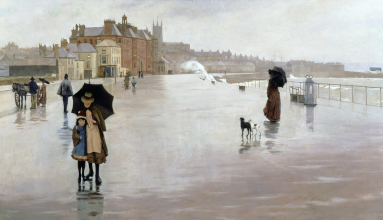
One of Garstin’s best and most famous works is his 1889 painting The Rain, It Raineth Every Day of the Penzance promenade. The title of the work comes from William Shakespeare‘s King Lear and Twelfth Night. “The composition of this painting demonstrates Garstin’s admiration for Japanese art,” says Penlee House.
Garstin dies in Penzance on June 22, 1926.
(Pictured: “The Rain It Raineth Every Day” oil on canvas by Norman Garstin, 1889, Penlee House)






 seamus dubhghaill