seamus dubhghaill

Promoting Irish Culture and History from Little Rock, Arkansas, USA


Leave a comment

Birth of John Gray, Physician, Journalist & Politician

Sir John Gray JP, Irish physician, surgeon, newspaper proprietor, journalist and politician, is born in Claremorris, County Mayo, on July 13, 1815. He is active both in municipal and national government for much of his life and has nationalist ideals, which he expresses as owner of the Freeman’s Journal, chairman of the Dublin Corporation Water Works Committee between 1863 and 1875, and Member of Parliament in the House of Commons of the United Kingdom of Great Britain and Ireland for Kilkenny City from 1865 until his death.

Gray is the third son of John and Elizabeth Gray of Mount Street. He is educated at Trinity College Dublin and obtains the degree of M.D. and Master of Surgery at the University of Glasgow in 1839. Shortly before his marriage in the same year, he settles in Dublin and takes up a post at a hospital in North Cumberland Street. He is admitted as a licentiate of the Royal College of Physicians in due course.

Gray is publicly minded and contributes to periodicals and the newspaper press. In 1841, he becomes joint proprietor of the Freeman’s Journal, a nationalist paper which is then published daily and weekly. He acts as political editor of the Journal for a time, before becoming sole proprietor in 1850. As owner, he increases the newspaper’s size, reduces its price and extends its circulation.

Gray enters politics at a relatively young age and attaches himself to Daniel O’Connell‘s Repeal Association. As a Protestant Nationalist, he supports the movement for the repeal of the Acts of Union with Britain. In October 1843, he is indicted with O’Connell and others in the Court of the Queen’s Bench in Dublin on a charge of sedition and “conspiracy against the queen.” The following February, he, together with O’Connell, is condemned to nine months imprisonment, but in early September 1844 the sentence is remitted on appeal. The trial has a strong element of farce, as the hot-tempered Attorney-General for Ireland, Sir Thomas Cusack-Smith, challenges Gray’s counsel, Gerald Fitzgibbon, to a duel, for which he is sternly reprimanded by the judges. From then on Gray is careful to distance himself from the advocacy of violence in the national cause, though he is sympathetic to the Young Ireland movement without being involved in its 1848 rebellion. Through the growing influence of the Freeman’s Journal, he becomes a significant figure in Dublin municipal politics. He is also active in national politics during an otherwise quiet period of Irish politics up until 1860. With the resurgence of nationalism after the famine, he helps to organise the Tenant’s League founding conference in 1850, standing unsuccessfully as the League’s candidate for Monaghan in the 1852 United Kingdom general election.

Later Gray originates and organises the “courts of arbitration” which O’Connell endeavours to substitute for the existing legal tribunals of the country. Following O’Connell’s death, in 1862 he inaugurates an appeal for subscriptions to build a monument to O’Connell on Sackville Street (now O’Connell Street). Independent from O’Connell, he continues to take a prominent part in Irish politics and in local affairs.

In municipal politics, Gray is elected councillor in 1852 and alderman of Dublin Corporation and takes an interest in the improvement of the city. As chairman of the committee for a new water supply to Dublin, he actively promotes what becomes the “Vartry scheme.” The Vartry Reservoir scheme involves the partial redirection and damming of the River Vartry in County Wicklow, and the building of a series of water piping and filtering systems (and related public works) to carry fresh water to the city. This work is particularly important in the improvement of conditions in the city, and to public health, as it improves sanitation and helps reduce outbreaks of cholera, typhus and other diseases associated with contaminated water. On the opening of the works on June 30, 1863, he is knighted by the Earl of Carlisle, then Lord Lieutenant of Ireland. Partially in recognition of these efforts, he is later be nominated for the position of Lord Mayor of Dublin for the years 1868–69, but he declines to serve.

In national politics, the Liberal government at the time is keen to conciliate an influential representative of the moderate nationalists to support British Liberalism and who will resume O’Connell’s constitutional agitation. In an unusual alliance with the Catholic Archbishop of Dublin, Paul Cullen, a man devoted to O’Connell’s memory, Gray’s newspaper exploits this shift in government policy. It supports the archbishop’s creation, the National Association of Ireland, established in 1864 with the intention of providing a moderate alternative to the revolutionary nationalism of the Fenians. The Freeman’s Journal adopts the aims of the Association as its own: it advocates the disestablishment of the Anglican Church of Ireland, reform of the land laws, educational aspirations of Irish Catholicism and free denominal education.

In the 1865 United Kingdom general election Gray is elected MP for Kilkenny City as a Liberal candidate. In this capacity he campaigns successfully at Westminster and in Ireland for the reforms also advocated in his paper. His newspaper’s inquiry into the anomalous wealth of the established church amidst a predominately Catholic population contributes considerably to William Ewert Gladstone‘s Irish Church Act 1869. He helps to furnish the proof that Irish demands are not to be satisfied by anything other than by radical legislation. He fights for the provision in the new Landlord & Tenant (Ireland) Act 1870 for fixity of tenure, which Gladstone eventually concedes. The Act’s other weaknesses, however, result in its failure to resolve the “land question,” the accompanying coercion, the disappointment with Gladstone’s handling of the university question and national education, causing Gray to deflect from the Liberals and become mistrusted in Britain. In the 1874 United Kingdom general election he is re-elected as a Home Rule League MP for Kilkenny, joining its Home Rule majority in the House of Commons, and holds his seat until his death the following year.

Gray dies at Bath, Somerset, England, on April 9, 1875. His remains are returned to Ireland, and he is honoured with a public funeral at Glasnevin Cemetery. Almost immediately afterwards public subscriptions are sought for the erection in O’Connell Street, of a monument to Gray. The monument is completed in 1879 and is dedicated to the “appreciation of his many services to his country, and of the splendid supply of pure water which he secured for Dublin.” His legacy also includes his contributions to the passage of the Irish Church and Land Bills, his advocacy for tenant’s rights and his support of the Home Rule movement.

Gray marries Mary Anna Dwyer of Limerick in 1839, and they have five children, three sons and two daughters. One of his sons, Edmund Dwyer Gray, takes over the management of the Freeman’s Journal. Edmund also follows his father into politics, eventually becoming MP for Dublin St. Stephen’s Green, Lord Mayor of Dublin (1880–1881), and a supporter of Charles Stewart Parnell. Edmund John Chisholm Dwyer-Gray, Edmund Dwyer Gray’s son and John Gray’s grandson, becomes Premier of Tasmania.

(Pictured: Statue to Sir John Gray on Dublin’s O’Connell Street, designed by Thomas Farrell and unveiled on June 24, 1879. Photo credit: Graham Hickey)


Leave a comment

Death of Physicist George Johnstone Stoney

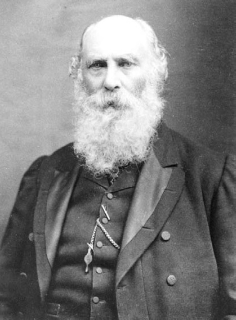
George Johnstone Stoney FRS, Irish physicist, dies on July 5, 1911, at Notting Hill, London, England. He is most famous for introducing the term “electron” as the “fundamental unit quantity of electricity.” He introduces the concept, though not the word, as early as 1874, initially naming it “electrine,” and the word itself comes in 1891. He publishes around 75 scientific papers during his lifetime.

Stoney is born on February 15, 1826, at Oakley Park, near Birr, County Offaly, in the Irish Midlands, the son of George Stoney and Anne (née Bindon Blood). His only brother is Bindon Blood Stoney, who becomes chief engineer of the Dublin Port and Docks Board. The Stoney family is an old-established Anglo-Irish family. During the time of the famine (1845–52), when land prices plummet, the family property is sold to support his widowed mother and family. He attends Trinity College Dublin (TCD), graduating with a BA degree in 1848. From 1848 to 1852 he works as an astronomy assistant to William Parsons, 3rd Earl of Rosse, at Birr Castle, County Offaly, where Parsons had built the world’s largest telescope, the 72-inch Leviathan of Parsonstown. Simultaneously he continues to study physics and mathematics and is awarded an MA by TCD in 1852.

From 1852 to 1857, Stoney is professor of physics at Queen’s College Galway. From 1857 to 1882, he is employed as Secretary of the Queen’s University of Ireland, an administrative job based in Dublin. In the early 1880s, he moves to the post of superintendent of Civil Service Examinations in Ireland, a post he holds until his retirement in 1893. He continues his independent scientific research throughout his decades of non-scientific employment duties in Dublin. He also serves for decades as honorary secretary and then vice-president of the Royal Dublin Society (RDS), a scientific society modeled after the Royal Society of London and, after his move to London in 1893, he serves on the council of that society as well. Additionally, he intermittently serves on scientific review committees of the British Association for the Advancement of Science from the early 1860s.

Stoney publishes seventy-five scientific papers in a variety of journals, but chiefly in the journals of the Royal Dublin Society. He makes significant contributions to cosmic physics and to the theory of gases. He estimates the number of molecules in a cubic millimeter of gas, at room temperature and pressure, from data obtained from the kinetic theory of gases. His most important scientific work is the conception and calculation of the magnitude of the “atom of electricity.” In 1891, he proposes the term “electron” to describe the fundamental unit of electrical charge, and his contributions to research in this area lays the foundations for the eventual discovery of the particle by J. J. Thomson in 1897.

Stoney’s scientific work is carried out in his spare time. A heliostat he designed is in the Science Museum Group collection. He is elected a Fellow of the Royal Society in June 1861.

Stoney proposes the first system of natural units in 1881. He realizes that a fixed amount of charge is transferred per chemical bond affected during electrolysis, the elementary charge e, which can serve as a unit of charge, and that combined with other known universal constants, namely the speed of light c and the Newtonian constant of gravitation G, a complete system of units can be derived. He shows how to derive units of mass, length, time and electric charge as base units. Due to the form in which Coulomb’s law is expressed, the constant 4πε0 is implicitly included, ε0 being the vacuum permittivity.

Like Stoney, Max Planck independently derives a system of natural units (of similar scale) some decades after him, using different constants of nature.

Hermann Weyl makes a notable attempt to construct a unified theory by associating a gravitational unit of charge with the Stoney length. Weyl’s theory leads to significant mathematical innovations, but his theory is generally thought to lack physical significance.

Stoney marries his cousin, Margaret Sophia Stoney, by whom he has had two sons and three daughters. One of his sons, George Gerald Stoney FRS, is a scientist. His daughter Florence Stoney OBE is a radiologist while his daughter Edith is considered to be the first woman medical physicist. His most scientifically notable relative is his nephew, the Dublin-based physicist George Francis FitzGerald. He is second cousin of the grandfather of Ethel Sara Turing, mother of Alan Turing.

After moving to London, Stoney lives first at Hornsey Rise, north London, before moving to 30 Chepstow Crescent, Notting Hill, west London. In his later years illness confines him to a single floor of the house, which is filled with books, papers, and scientific instruments, often self-made. He dies at his home on July 5, 1911. His cremated ashes are buried in St. Nahi’s Church, Dundrum, Dublin.

Stoney receives an honorary Doctor of Science (D.Sc.) from the University of Dublin in June 1902. Also in 1902, he is elected as a member to the American Philosophical Society. The street that he lived on in Dundrum is later renamed Stoney Road in his memory.

Craters on Mars and the Moon are named in his honour.


Leave a comment

Death of Lord George Augusta Hill

Lord George Augusta Hill, Anglo-Irish military officer, politician and landowner, dies in Ramelton, County Donegal, on April 6, 1879.

Hill is the posthumous son of Arthur Hill, 2nd Marquess of Downshire, and his wife Mary, Marchioness of Downshire, granddaughter of Samuel Sandys, 1st Baron Sandys. He is born on December 9, 1801, three months after his father’s death by suicide.

Hill enters the British Army in May 1817, initially a cornet in the Royal Horse Guards, promoted to lieutenant in 1820. He transfers to the 4th Royal Irish Dragoon Guards as a captain in 1825. In April 1830, he becomes aide-de-camp to Sir John Byng, Commander-in-Chief of the forces in Ireland, at the rank of major, but on July 6 he takes half-pay.

Hill is proposed as a candidate for MP for Carrickfergus in the 1826 United Kingdom general election, but withdraws in favor of Sir Arthur Chichester, stating that he had been unaware of the nomination. In the 1830 United Kingdom general election, he is elected MP for Carrickfergus, unseating Chichester. His brother, Arthur Hill, 3rd Marquess of Downshire, is a minor landowner in Carrickfergus.

Although Hill is considered a friend of the Tory government of Arthur Wellesley, 1st Duke of Wellington, when elected, he is absent from the vote of confidence on November 15, 1830, which causes the government to fall. Thereafter he supports the government of Charles Grey, 2nd Earl Grey, and its Reform Bill, like his brothers. Due to ill health, he does not contest the 1832 United Kingdom general election, instead supporting his brother, Lord Marcus Hill, who is elected for Newry.

Hill serves as Comptroller of the Household to the Lord Lieutenant of Ireland, 1833–34, and as High Sheriff of Donegal in 1845.

In 1838, Hill purchases land in Gweedore (Irish: Gaoth Dobhair), a “district” in northwest County Donegal in the west of Ulster, and, over the next few years, he expands his holdings to 23,000 acres. He himself describes the condition of the local population as “more deplorable than can well be conceived.” According to the schoolmaster, Patrick McKye, they are in the “most needy, hungry and naked condition of any people.” Among other improvements, he builds a port, Bunbeg Harbour, to encourage fishing, improves the roads and other infrastructure, and constructs The Gweedore Hotel to attract wealthy tourists.

However, Hill’s attempts to reform local farming practices, in particular, his suppression of the rundale system of shared landholding, proves unpopular and controversial. While his reforms may have protected Gweedore from the worst effects of the Great Famine of the 1840s, as the local population did not decrease, as it did elsewhere in Ireland, his attitude to the famine is uncompromising and unsympathetic:

“The Irish people have profited much by the Famine, the lesson was severe; but so were they rooted in old prejudices and old ways, that no teacher could have induced them to make the changes which this Visitation of Divine Providence has brought about, both in their habits of life and in their mode of agriculture.”

Hill’s book Facts from Gweedore (1845) provides an account of conditions in Gweedore and seeks to explain and justify Hill’s agricultural reforms. It runs to five editions and plays a large part in the bitter public debates about the effects of Irish landlordism. In June 1858, he gives evidence to a House of Commons select committee on Irish poverty. The committee is critical of his actions.

Hill is twice married, to two sisters, daughters of Edward Austen Knight, brother of Jane Austen. On October 21, 1834, he marries Cassandra Jane Knight (1806–42). They have four children:

  • Norah Mary Elizabeth Hill (December 12, 1835 – April 24, 1920)
  • Captain Arthur Blundell George Sandys Hill (May 13, 1837 – June 16, 1923)
  • Augustus Charles Edward Hill (March 9, 1839 – December 9, 1908)
  • Cassandra Jane Louisa Hill (March 12, 1842 – August 16, 1901)

On May 11, 1847, Hill marries Louisa Knight (1804–89), niece and goddaughter of Jane Austen. She had moved to Ulster after Cassandra’s death to look after the children. The marriage prompts a parliamentary investigation into the legality of a marriage between a widower and his deceased wife’s sister. They have one son:

  • George Marcus Wandsbeck Hill (April 9, 1849 – March 22, 1911)

Hill dies at his residence, Ballyare House, in Ramelton, County Donegal, on April 6, 1879. He is buried at Conwal Parish Church in Letterkenny, alongside his first wife.


Leave a comment

Birth of Seán O’Hegarty, Member of the IRA’s Cork No. 1 Brigade

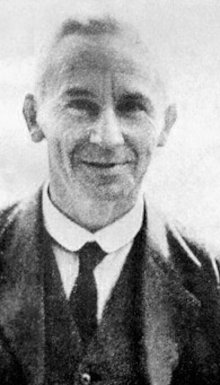
Seán O’Hegarty, a prominent member of the Irish Republican Army (IRA) in County Cork during the Irish War of Independence, is born on March 21, 1881, in Cork, County Cork. He serves as O/C of the Cork No. 1 Brigade of the IRA after the deaths of Tomás Mac Curtain and Terence MacSwiney.

O’Hegarty comes from a family with strong nationalist roots. His parents are John, a plasterer and stucco worker, and Katherine (née Hallahan) Hegarty. His elder brother is Patrick Sarsfield O’Hegarty, the writer. His parents’ families emigrated to the United States after the Great Famine, and his parents married in Boston. His father is a member of the Irish Republican Brotherhood (IRB). In 1888, his father dies of tuberculosis at the age of 42, and his mother has to work to support the family.

O’Hegarty is educated at the Christian Brothers North Monastery school in Cork. By 1902, he has left school to work as a sorter in the local post office, rising to post office clerk. He is a supporter of the Gaelic revival, Irish traditional music, and Gaelic games. A committed sportsman, in his twenties he is captain of the Post Office HQ’s hurling team. He follows his brother Patrick into Conradh na Gaeilge and eventually the Irish Volunteers and the Irish Republican Brotherhood. He is a member of the Celtic Literary Society by 1905 and founds the Growney branch of Conradh na Gaeilge in 1907. A puritanical character by nature, he is a non-smoker and never drinks.

O’Hegarty is a founder of the local branch of the Irish Volunteers in Cork in December 1913. In June of the following year, he is appointed to the Cork section of the Volunteer Executive, and then to the Military Council. In October, the Dublin government discovers his illegal activities, and he is dismissed. Excluded from Cork under the Defence of the Realm Act (DORA) regulations, he moves to Ballingeary, where he works as a labourer. From there he moves to Enniscorthy, County Wexford, where he lives with Larry de Lacy. On February 24, 1915, he is arrested and tried under the Defence of the Realm Act for putting up seditious posters. But for this and a second charge of “possession of explosives” he is discharged. The explosives belonged to de Lacy.

The Volunteers appoint O’Hegarty as Commandant of Ballingeary and Bandon. During the Easter Rising, he is stationed in Ballingeary when visited by Michael McCarthy of Dunmanway to propose an attack on a Royal Irish Constabulary (RIC) post at Macroom. But their strength is fatally weakened and, having no reserves, they call off the attempt. In 1917, he becomes Vice-commandant of No.1 Cork Brigade. He works as a storekeeper at the workhouse but is intimidating, and clashes with the Poor Law Guardians.

During the Irish War of Independence, O’Hegarty is one of the most active in County Cork. Like others, he is exasperated with Tomás Mac Curtain’s inactivity and refusal to be more bellicose. One such is battalion commander Richard Langford, who joins with O’Hegarty’s unit to make an unauthorized raid on the RIC post at Macroom. Langford is court-martialed, but O’Hegarty continues to rise in the ranks. When a RIC Inspector is murdered, Mac Curtain condemns the shootings and calls for their end. On March 19, 1920, Mac Curtain is shot and killed in his home in Cork. The coroner blames the British establishment in Dublin, but the police never make any attempt to investigate the killings. Shortly after these events General Hugh Tudor begins the policy of official reprisals.

In January 1920, an inquiry is held into corruption alleged against “Hegarty’s Mob” or “Hegarty’s Crowd” running Cork City. O’Hegarty blames the former mayors for the charges of incompetence but remains on good terms with them.

In a raid on Cork City Hall on August 12, 1920, the British manage to net all the top brass of the IRA in Cork. In an incredible failure of intelligence, they do not identify the leadership as their prisoners. They are all released, including Liam Lynch, and O’Hegarty. Only Terence MacSwiney, the new Lord Mayor of Cork, is kept in custody and sent to England.

On February 25, 1921, the Coolavokig ambush is carried out by the 1st Cork Brigade under O’Hegarty at Ballyvourney village, on the road between Macroom and Ballyvourney. The IRA suffers no casualties; however, the number of British casualties has been disputed to this day.

The brigade commanders in the southern division retain a residual lingering resentment of Dublin GHQ’s lack of leadership and supplies. Seán Moylan, commandant of No. 2 Cork Brigade, thinks good communications with No.1 Brigade are to be vital, but little of this is seen via the organizer, Ernie O’Malley, at GHQ. At a meeting set up for April 26, 1921, when the manual of Infantry Training 1914 is produced, the document raises great anger. The meeting ends in uproar when O’Hegarty, who is “a master of invective, tore the communication and its authors to ribbons.”

O’Malley and Liam Lynch, the general, meet with O’Hegarty in the mountains of West Cork, near a deserted farmhouse, just off the main road. In the retreat that follows, the Irish take heavy casualties and leave their wounded to the good care of the British. These are the “Round-ups” in which the Irish sleep outside in order to avoid being at home when the Army calls. They are told by the Brigade to learn the national anthem of England to avoid arrest.

In East Cork brigade, O’Hegarty uncovers a spy ring. He is ruthless in the treatment of Georgina Lindsay and her chauffeur, who give away information to the Catholic clergy, but is remarkably lenient on brigade traitors within. He is allegedly not too bothered about evidence but is reminded that all executions of a traitor have to be approved by Dublin first.

O’Hegarty becomes more and more aggressive toward the establishment, using tough language to impose his will over the area. He attempts to force the civilian Teachtai Dála (TDs) for Cork to stand down, to give way to military candidates, telling the Dáil in December 1921, that any TD voting for the treaty will be guilty of treason. But Éamon de Valera is decided and overrules any interference with the Civil Government. Like the commanders, de Valera rejects the treaty but has already been defeated in the Dáil on a vote by W. T. Cosgrave‘s majority.

On February 1, 1922, O’Hegarty marries Maghdalen Ni Laoghaire, a prominent member of Cumann na mBan.

O’Hegarty is on the IRA’s Executive Council, but when there is a meeting on April 9, 1922, it is proposed that the Army should oppose the elections by force. As a result, Florence O’Donoghue and Tom Hales join him in resigning. In May, he and Dan Breen enter into negotiations with Free Stater Richard Mulcahy. A statement is published in the press asking for unity and acceptance of the Treaty. During this time, the republicans become very demoralized and ill-disciplined, but they have to gain strength before announcing independence from Dublin. The debate amongst the anti-Treaty IRA command is increasingly rancorous.

The bitter divisions split the anti-treatyites into two camps. Two motions are debated at the Army Convention on June 18, 1922. At first, the motion to oppose the treaty by force is passed. These men include Tom Barry, Liam Mellows, and Rory O’Connor, who are all in favour of continuing the fight until the British are driven out of Ireland altogether. However, one brigade’s votes have to be recounted, and then the motion is narrowly defeated. Joe McKelvey is appointed the new chief of staff, but the IRA is in chaos. While he strongly opposes the Anglo-Irish Treaty, O’Hegarty takes a neutral role in the Irish Civil War and tries to avert hostilities breaking out into full-scale civil war. He emerges as a leader of the “Neutral IRA” with O’Donoghue. This is a “loose” confederation of 20,000 men who have taken part in the pre-truce wars but have remained neutral during the Civil War from January 1923. Over 150 persons attend its convention in Dublin on February 4, 1923. By April 1923, O’Malley is imprisoned in Mountjoy Prison. In a letter to Seamus O’Donovan on April 7, he blames Hegarty for all this compromise and “peace talk.”

It has been alleged by the author Gerard Murphy that O’Hegarty had a role in the assassination of the Commander-in-Chief, Michael Collins, in August 1922, along with Florrie O’Donoghue and Joe O’Connor. It is alleged that as members of the 1st Southern Division Cork, they are actually feigning claims of neutrality but remain part of the IRB in order to set up talks towards peace and the cessation of hostilities at the start of the Irish Civil War.

Although probably an atheist during the Irish War of Independence, O’Hegarty returns to the Catholic church later in life. On forming the Neutral Group of the IRA in December 1922, he tries to unify differences in the volunteers between Republicans and the Free Staters. He communicates with the Papal Nuncio during the inter-war years in an attempt to have Bishop of Cork Daniel Cohalan‘s excommunication bill lifted. Instead, he turns to commemoration as a way to earn favour in Rome, with the dedication of a Catholic church at St. Finbarr’s Cemetery. After his wife’s passing, he becomes a close friend with Florence O’Donoghue until his own death.

O’Hegarty dies on May 31, 1963, at Bon Secours Hospital, Cork.


Leave a comment

Death of William Brown, Commander in the Argentine Navy

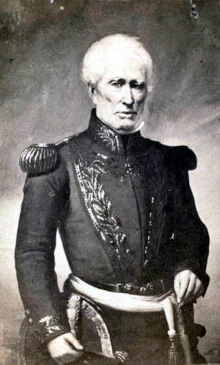
William Brown, Irish sailor, merchant, and naval commander who serves in the Argentine Navy during the wars of the early 19th century, dies in Buenos Aires, Argentina, on March 3, 1857. He is also known in Spanish as Guillermo Brown or Almirante Brown.

Brown is born on June 22, 1777, in Foxford, County Mayo. Comparatively little is known of his early life, and it has been suggested that he was illegitimate and took his mother’s surname and that his father’s surname was actually Gannon. He emigrates with his father to Baltimore, Maryland, in 1793, eventually settling in Philadelphia, Pennsylvania. A short time after their arrival, the friend who had invited them and offered them food and hospitality dies of yellow fever. Several days later, his father also succumbs to the same disease.

One morning, while Brown is wandering along the banks of the Delaware River, he meets the captain of a ship then moored in port. The captain inquires if he wants employment and Brown agrees. The captain engages him as a cabin boy, thereby setting him on the naval promotion ladder, where he works his way to the captaincy of a merchant ship. After ten years at sea, where he develops his skills as a sailor and reaches the rank of captain, Brown is press-ganged into a Royal Navy warship. British impressment of American sailors is one of the primary issues leading to the War of 1812.

During the Napoleonic Wars, Brown escapes the ship he is serving on, a galley, and scuttles the vessel. However, the French do not believe he had assisted them and imprison him in Lorient. On being transferred to Metz, he escapes, disguised in a French officer’s uniform. However, he is recaptured and is imprisoned in the fortress of Verdun. In 1809, he escapes from there in the company of a British Army officer named Clutchwell, and eventually reaches German territory.

Returning to England, Brown renounces his maritime career and on July 29, 1809, he marries Elizabeth Chitty, daughter of an English shipping magnate, in Kent. As he is a Catholic and she a Protestant, they agree to raise their sons as Catholics and their daughters as Protestants. Despite lengthy periods of enforced separation, they have nine children. He leaves the same year for the Río de la Plata on board Belmond and sets himself up as a merchant in Montevideo, Uruguay.

Late in 1811 Brown settles in Buenos Aires just as a criollo rebellion against Spanish colonial rule in Argentina is gaining strength. By April 1812, he is developing a coastal shipping business in fruit and hides. As the Spanish naval blockade of 1812–14 begins to choke trade, he is first commissioned by the patriot government as a privateer licensed to raid Spanish merchantmen, and then, on March 1, 1814, invited to take charge of a small rebel naval squadron to contest Spanish control of the Río de la Plata estuary. Leading a fleet of nineteen ships, he fixes with great speed on a set of wartime naval routines and signaling methods, and organises a system of discipline, founding the navy on principles that pay exceptional attention to the welfare of ordinary seamen.

In early March 1814, Brown shows personal courage and incisive skill in outwitting and defeating a more powerful Spanish force near Martín García Island, thereby dividing the Spanish blockade. A Spanish attempt in May 1814 to break his blockade of Montevideo is decisively crushed by him and his makeshift navy, and the Spanish strongholds on the Atlantic coast collapse, ending open war. In 1815 and 1816, however, he carries out skirmishing raids on military and commercial targets belonging to Spanish South American possessions, until detained by a British colonial governor in Barbados in July 1816 for alleged infringements of international rules of trade.

Illness, and a tortuous but ultimately successful appeal process, take up most of 1817–18, but when Brown returns to Argentina in October 1818, political enemies set in motion a prosecution for alleged disobedience of orders. Cashiered in August 1819, then restored in rank but forced to retire, he attempts suicide the following month. Convalescence and resumption of his trading concern occupies him for several years.

A repentant government renews Brown’s command of the navy in December 1825, when war breaks out with Brazil. Though vastly outnumbered by the Brazilian fleet, he shows audacity and great finesse in a number of successful engagements in the Plate estuary in 1826, roving up the Brazilian coast on occasion to create great confusion. In February 1827, he triumphs in a series of actions known as the Battle of Juncal. After another year of commercial privateering against the Brazilian merchant fleet, he is one of two delegates selected to sign peace terms with Brazil in October 1828.

Retiring from active service that month, Brown tries to remain neutral as civil war erupts in Argentina, but reluctantly accepts the post of governor of Buenos Aires under General Juan Lavalle from December 1828 to May 1829, when he resigns in disgust at government excesses. During 1829–37 he holds aloof from the despotic government of Juan Manuel de Rosas. After French and British encroachments on the region in the later 1830s, he offers to take charge of the navy again to protect national independence and is available to defend Argentine interests when war breaks out with a French-backed Uruguay in early 1841. Though exasperated by a long and “stupid war,” he blockades the Uruguayan navy effectively until French and British fleets intervene in July 1845 with overwhelming force to capture his squadron and bring the war to an end.

Idolised by the Argentinian population for his high-principled and humane advocacy of independent democracy, Brown passes his last years trading and farming a country estate. In late 1847, he journeys to Ireland, hoping to find relations in Mayo, and is shocked by the hunger and destitution of the Great Famine.

Brown dies on March 3, 1857, at his home in Buenos Aires and is buried with full military honours. The Argentine government issues a comuniqué: “With a life of permanent service to the national wars that our homeland has fought since its independence, William Brown symbolized the naval glory of the Argentine Republic.” During his burial, General Bartolomé Mitre famously says: “Brown in his lifetime, standing on the quarterdeck of his ship, was worth a fleet to us.” His grave is currently located in the La Recoleta Cemetery in Buenos Aires.


Leave a comment

Daniel O’Connell Addresses British House of Commons About Great Hunger

Daniel O’Connell, a prominent political leader in Ireland, is known for his strong advocacy for Irish independence and his efforts to bring about reforms in the British government‘s treatment of Ireland. On February 17, 1846, he takes to the floor of Britain’s House of Commons to warn of the dangers of Ireland’s Great Hunger, also known as the Potato Famine.

In 1846, Ireland is in the midst of one of its greatest disasters – the Great Hunger, a period of mass starvation caused by the failure of the potato crop, the staple food of the Irish population. The conditions in Ireland are dire, with widespread poverty, disease, and death. In response to this crisis, O’Connell takes to the floor of Britain’s House of Commons to deliver a speech warning of the dangers of the situation in Ireland.

O’Connell begins his speech by pointing out the stark reality of the situation in Ireland, where people are dying of starvation on a daily basis. He draws the attention of the House to the fact that the Irish people are suffering because of a lack of food, and that this is due to the failure of the potato crop, which is the only source of sustenance for the majority of the population. He then goes on to argue that the British government is failing in its duty to provide relief to the Irish people and that they are turning a blind eye to the suffering of the Irish people.

O’Donnell then goes on to make a passionate plea for the British government to take action to alleviate the suffering of the Irish people. He argues that the government has a moral obligation to help the Irish people and that their failure to do so will be a stain on their reputation. He also warns that the situation in Ireland is rapidly deteriorating and that unless the British government takes action soon, the situation could become much worse.

O’Connell ends his speech by calling on the British government to take immediate action to provide food and assistance to the Irish people. He argues that the government should do everything in its power to prevent further starvation and death in Ireland and that the British people have a duty to help their fellow citizens in Ireland.

O’Connell’s speech in the House of Commons is an important moment in the history of Ireland and its relationship with Britain. It is a powerful reminder of the suffering of the Irish people and a call to action for the British government to take responsibility for the crisis in Ireland. The speech is significant in that it brings attention to the plight of the Irish people and highlights the moral obligation of the British government to help those in need.

O’Connell’s speech is also significant in that it demonstrates his strong leadership skills and his ability to effectively advocate for the rights of the Irish people. His passion and commitment to helping the Irish people inspires many others to join the cause and fight for justice for the Irish people.

(From: “On This Day: Daniel O’Connell addressed British government warning of Great Hunger” by IrishCentral Staff, http://www.IrishCentral.com, February 17, 2023)


Leave a comment

Birth of Pete St. John, Irish Folk Singer-Songwriter

Peter Mooney, Irish folk singer-songwriter known professionally as Pete St. John, is born in Inchicore, Dublin on January 31, 1932. He is best known for composing “The Fields of Athenry.”

St. John is the eldest of six children born to Tommy and Lottie Mooney. He is educated at Scoil Muire Gan Smál and Synge Street CBS. He emigrates to Ontario, Canada in 1958 where he takes what labouring jobs he can find. Within six months he meets a woman named Gert Gorman who has an electrical contracting company in the United States. She and her husband sponsor him to move to Washington, D.C., where he is able to work as an electrician. He marries his sweetheart, Susie Bourke, who is from a well-known Dublin theatrical family with links to both the Gaiety and the Olympia theatres. They have two sons, Kieron and Brian. He travels widely and becomes involved in the peace movement and the civil rights movement. He remains in the United States until 1970, returning to settle in Collins Avenue in north Dublin.

The Dublin city that St. John returns to is a changed place from the one he had grown up in and proves to be the spur that inspires his songwriting. He chooses “St. John” as his nom de plume, inspired by a middle name he had been given while at school when all the boys in his class were assigned saints’ names. In 1975, he is running a theatre in Petticoat Lane on Marlborough Street, and while fixing an alarm outside a window on the first floor, the ledge on which he is leaning gives way, resulting in a bad fall. He breaks his elbow and hip and spends six months in the hospital recuperating. It is during this time that he takes to songwriting in earnest.

St. John is an extrovert who loves people. He is a voracious reader with a particular interest in Irish history. His son Kieron recalls his father writing “The Rare Aul Times” during this recovery period and singing it to his family. The Dublin City Ramblers is the first band to cover the song, but it is Danny Doyle’s version that achieves a real breakthrough, spending eleven weeks in the Irish Singles Chart, reaching No. 1 in 1978.

In 1978, St. John writes “The Fields of Athenry,” a tale of a man exiled to Botany Bay for stealing food to feed his family during the Famine. It has been recorded by several artists, charting in the Irish Singles Chart on a number of occasions. A recording by Paddy Reilly, which is released in 1982, remains in the Irish charts for 72 weeks.

St. John pays close attention to the melding of lyric and melody and has particular form in writing memorable melodies that sound timeless, resonating deeply with listeners across all walks of life. His songs sometime express regret for the loss of old certainties, for example, the loss of Nelson’s Pillar and the Metropole Ballroom, two symbols of old Dublin, as progress makes a “city of my town.”

St. John describes his chosen craft with affection. “Songs are magic carpets. They can tell a story over and over again without boring the pants off the listener and maybe take us out of ourselves for a few moments of peaceful escapism. With easy to remember melody lines, the words can tell of times and events in our daily lives that are worth noting or remembering.”

St. John’s songbook consists of hundreds of compositions, including “The Ferryman,” “Waltzing on Borrowed Time” and “The Furey Man” and are recorded by over 2,500 artists. He is a founding member of the Irish Music Rights Organisation (IMRO) and is always generous and supportive of younger writers, some of whom he continues to mentor well into his 80s.

St. John is surprised and delighted at the affiliation that emerges between “The Fields of Athenry” and rugby and football sporting events. He is present in Croke Park in 2007 when Ireland beats England in the Six Nations, and where the song is sung three times over. It is a song often heard in Anfield in Liverpool, and at Glasgow Celtic games, and reverberates around the stadium at Chicago’s Soldier Field when Ireland beats the All Blacks on November 5, 2016.

St. John wins several awards, including the Irish Music Rights Organisation “Irish Songwriter of the Year.”

St. John lives life to the fullest, and while he suffers ill health in his later years with both diabetes and Parkinson’s disease, he never loses his zest for life. His son Kieron describes his father with affection as a man who had nine lives and lived them all to the fullest. He lives independently at home until his admission to Beaumont Hospital in Dublin. He dies peacefully there at the age of 90 on March 12, 2022. After his funeral, Paddy Reilly and Glen Hansard perform “The Fields of Athenry” at Beaumont House in Dublin as a tribute.


Leave a comment

Birth of John Hogan, the “Greatest of Irish Sculptors”

Irish sculptor John Hogan, described in some sources as the “greatest of Irish sculptors,” is born in Tallow, County Waterford, on October 14, 1800. According to the Dictionary of Irish Biography he is responsible for “much of the most significant religious sculpture in Ireland” during the 19th century. Working primarily from Rome, among his best-known works are three versions of The Dead Christ, commissioned for churches in Dublin, Cork, and the Basilica of St. John the Baptist in St. John’s, Newfoundland and Labrador, Canada.

Hogan is the third child of John Hogan, a carpenter and builder of Cove Street, Cork, County Cork, and Frances Cos, the great-granddaughter of Sir Richard Cox, Lord Chancellor of Ireland from 1703 to 1707. As the family feels that she had married beneath her station, she is disinherited.

At the age of fourteen, Hogan is placed as clerk to an attorney, where he spends much of his time carving figures in wood. After two years, he chooses to be apprenticed to the architect Sir Thomas Deane, where his talents for drawing and carving are developed. He carves balusters, capitals, and ornamental figures for Deane’s buildings. At the completion of his apprenticeship in March 1820, Deane encourages him to consider taking up sculpture as a profession. For the next three years, he attends lectures on anatomy, copies casts of classic statuary in the Gallery of the Cork Society of Arts, and makes anatomical studies in wood of feet, hands, and legs. Among the first of his works to attract notice is a life-size figure of Minerva for an insurance building built by Deane.

In 1821, Hogan carves twenty-seven statues in wood for the North Chapel in Cork for the reredos behind the high altar. After subsequent cathedral renovations, these are now positioned in decorative plasterwork over the nave. He also does a bas-relief of the “Last Supper” for the altar. This work keeps him employed for about a year.

In 1823, the engraver William Paulet Carey visits Cork, and impressed with Hogan’s talent, begins to publicise his work in order to raise subscriptions for him to study in Italy. Hogan arrives in Rome, by way of Dublin and Liverpool, in 1824. He works in the galleries of the Vatican but cannot afford a studio. Additional subscriptions allow him to improve his situation, rent a studio, purchase marble, and hire models. Danish sculptor Bertel Thorvaldsen says to him, “My son, you are the best sculptor I leave after me in Rome.”

In 1829, Hogan visits Ireland, bringing several works with him. The Royal Arts Society provides a venue for an exhibition. The Royal Dublin Society awards him a gold medal.

Hogan’s best-known work and masterpiece are the three versions of the statue of The Dead Christ or The Redeemer in Death. Created in flawless Carrara marble, the first version (1829) is located in St. Therese’s Church, Dublin, the second (1833) in St. Finbarr’s (South) Church, Cork, and the third and final version (1854) is located in the Basilica of St. John the Baptist, Newfoundland. His other works include the Sleeping Shepherd and The Drunken Faun. He assures his international reputation in 1829 with The Dead Christ. Thereafter, his creations are snapped up by Irish bishops visiting his Rome studio.

In 1837 Hogan is elected a member of the Virtuosi del Pantheon. During the next several years, he has several works in hand, including a marble statue of Daniel O Connell, for the Repeal Association. The statue stands today at City Hall, Dublin, the same spot where O’Connell gave his first speech against the Acts of Union in 1800.

In 1840, a monumental group in memory of Bishop James Warren Doyle, founder of the Cathedral of the Assumption in Carlow, is brought to Dublin and exhibited at the Royal Exchange. The statue of Bishop Doyle is in the Cathedral of the Assumption, as is a second Hogan work depicting the Holy Family.

Hogan marries Cornelia Bevignani in Rome in 1838. The figure of Hibernia, in Hogan’s work Hibernia with the Bust of Lord Cloncurry (1844), is reportedly modelled on his wife. A representation of this work is later used as the watermark on all Series A banknotes printed in Ireland from the 1920s to the 1970s. The couple has four sons and eight daughters.

With the revolutionary movement growing in Italy during the 1840s, and after spending twenty-four years in Rome, Hogan returns with his family to Ireland in 1848. At first, he finds little work in the aftermath of the Great Famine, but gradually commissions increase. He can be impatient with ignorance, intolerant of professional inferiority, and independent. He holds aloof from other artists and refuses to join the Royal Hibernian Academy.

Hogan has a stroke in 1855 and, though he recovers somewhat, his health begins to fail. By the year prior to his death, he can no longer work and his sons, John Valentine Hogan and James Cahill, assist at his studio and complete some of the work.

Hogan dies at his home at 14 Wentworth Place (later renamed Hogan Place), Dublin, on March 27, 1858. He is buried at Glasnevin Cemetery in Dublin.

(Pictured: Scan of a drawing depicting the Irish sculptor John Hogan with his sculpture The Drunken Faun in background, published in the Dublin University Magazine, January 1850)


Leave a comment

Birth of Standish James O’Grady, Author, Journalist & Historian

Standish James O’Grady (Irish: Anéislis Séamus Ó Grádaigh), Irish author, journalist, and historian, is born in Castletownbere, County Cork, on September 18, 1846. He is inspired by Sylvester O’Halloran and plays a formative role in the Celtic Revival, publishing the tales of Irish mythology, as the History of Ireland: Heroic Period (1878), arguing that the Gaelic tradition has rival only from the tales of Homeric Greece.

O’Grady’s father is the Reverend Thomas O’Grady, the scholarly Church of Ireland minister of Castletown Berehaven, County Cork, and his mother Susanna Doe (or Dowe). The Glebe, his childhood home, lies a mile west of Castletownbere near a famine mass grave and ruined Roman Catholic chapel. He is a cousin of Standish Hayes O’Grady, another noted figure in Celtic literature, and of Standish O’Grady, 1st Viscount Guillamore. After a rather severe education at Tipperary Grammar School, he follows his father to Trinity College, Dublin, where he wins several prize medals and distinguishes himself in several sports.

O’Grady is a paradox for his times, proud of his Gaelic heritage, he is also a member of the Church of Ireland, a champion of aristocratic virtues (particularly decrying bourgeois values and the uprooting cosmopolitanism of modernity) and at one point advocates a revitalised Irish people taking over the British Empire and renaming it the Anglo-Irish Empire.

O’Grady proves too unconventional of mind to settle into a career in the church, and takes a job as a schoolmaster at Midleton College, then in a period of expansion. He also qualifies as a barrister, while earning much of his living by writing for the Irish newspapers. Reading Sylvester O’Halloran’s A general history of Ireland (1778) sparks an interest in early Irish history. After an initial lukewarm response to his writing on the legendary past in History of Ireland: The Heroic Period (1878) and Early Bardic Literature of Ireland (1879), he realises that the public wants romance, and so follows the example of James Macpherson in recasting Irish legends in literary form, producing historical novels including Finn and his Companions (1891), The Coming of Cuculain (1894), The Chain of Gold (1895), Ulrick the Ready (1896) and The Flight of the Eagle (1897), and The Departure of Dermot (1913).

O’Grady also studies Irish history of the Elizabethan period, presenting in his edition of Sir Thomas Stafford‘s Pacata Hibernia (1896) the view that the Irish people had made the Tudors into kings of Ireland to overthrow their unpopular landlords, the Irish chieftains. His The Story of Ireland (1894) is not well received, as it sheds too positive a light on the rule of Oliver Cromwell for the taste of many Irish readers. He is also active in social and political campaigns in connection with such issues as unemployment and taxation.

Until 1898, O’Grady works as a journalist for the Daily Express of Dublin, but in that year, finding Dublin journalism in decline, he moves to Kilkenny to become editor of the Kilkenny Moderator, which is printed at 28 High Street. It is here he becomes involved with Ellen Cuffe, Countess of Desart, and Captain Otway Cuffe. He engages in the revival of the local woolen and woodworking industries. In 1900 he founds the All-Ireland Review and returns to Dublin to manage it until it ceases publication in 1908. He also contributes to James LarkinsThe Irish Worker paper.

O’Grady’s influence crosses the divide of the Anglo-Irish and Irish-Ireland traditions in literature. His influence is explicitly stated by the Abbey Theatre set with Lady Gregory, W. B. Yeats and George William Russell attributing their interest in the Fenian Cycle of Gaelic tradition in part to him. This leads to him being known as the “Father of the Celtic Revival.” Some of the figures associated with the political party Sinn Féin, including its founder Arthur Griffith, have positive things to say about his efforts in helping to retrieve from the past the Gaelic heroic outlook.

O’Grady marries Margaret Allen Fisher, daughter of William Allen Fisher, and they have three sons. Advised to move away from Ireland for the sake of his health, they leave Ireland in 1918. After living in the north of France and Northamptonshire, they move to the Isle of Wight. He is working on a final exposition of his ideas when he dies suddenly on May 18, 1928.

O’Grady’s eldest son, Hugh Art O’Grady, is for a time editor of the Cork Free Press before he enlists in World War I in early 1915. He becomes better known as Dr. Hugh O’Grady, later Professor of the Transvaal University College, Pretoria (later the University of Pretoria), who writes the biography of his father in 1929.


Leave a comment

Birth of Valentine Browne Lawless, 2nd Baron Cloncurry

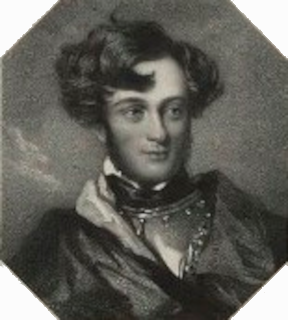
Valentine Browne Lawless, 2nd Baron Cloncurry, Irish peer, politician and landowner, is born in Merrion Square in Dublin on August 19, 1773.

Lawless is the only surviving son of Nicholas Lawless, wool merchant, brewer, and banker, who becomes 1st Baron Cloncurry in 1789, and Margaret Lawless (née Browne), only daughter and heiress of Valentine Browne of Mount Browne, County Limerick. He is educated privately at Portarlington, Queen’s County (now County Laois), and at Blackrock, County Dublin. He enters Trinity College Dublin (TCD) in 1789, graduating BA in 1792. After completing a tour of Europe (1792–95) he returns to Ireland, where he joins the Society of United Irishmen and the loyalist yeomanry. Pressurized by his father, he decides to study law, and is at Middle Temple from 1795 to 1798. He later claims that at a dinner party in the spring of 1797 he hears the prime minister, William Pitt, discuss his plans for a legislative union with Ireland, prompting him to write an anti-union pamphlet in response. Like many of the claims in his published recollections, the story is unreliable.

During 1797 Lawless helps Arthur O’Connor form his United Irishman newspaper The Press, and Leonard McNally informs Dublin Castle that Lawless is its principal shareholder. In October 1797 Lawless attends a meeting of the executive directory of the United Irishmen, of which he is elected a member. Throughout this period and after his return to London he is carefully watched by the British secret service. His friendship with O’Connor, and the fact that he provides funds for Fr. James Coigly, arouse deep suspicion. After the outbreak of open rebellion in Ireland he is arrested at his lodgings in Pall Mall on May 31, 1798, on suspicion of high treason, and imprisoned for six weeks in the Tower of London. Arabella Jefferyes, sister of the Earl of Clare, apparently tries to extort money from Lawless in return for pleading his case to the Duke of Portland. He refuses the offer. On his release he tours England on horseback but is rearrested on April 14, 1799, and held until March 1801. His father votes for the Act of Union, hoping to secure his son’s release, and dies on August 28, 1799. Lawless succeeds him as 2nd Baron Cloncurry. His grandfather and his fiancée, Mary Ryal, also die while he is imprisoned.

Embittered by his experience, Lawless tours the Continent from 1801 to 1805 before returning to his family estate at Lyons Hill, Ardclough, County Kildare. Throwing himself into improving his estates and into local concerns, he founds the County Kildare Farming Society in 1814. He is also involved in canal developments and agricultural improvements in the country. Opposed to the rural constabulary bill of 1822, he supports Catholic emancipation and the attempts of Daniel O’Connell to repeal the Act of Union. He breaks with O’Connell in the 1830s when his friend, Henry Paget, 1st Marquess of Anglesey, is viceroy, because he believes repeal can now be achieved through official means. The rift is never healed.

In 1831, Lawless is admitted to the Privy Council of Ireland (PC) and an English peer but rarely attends the House of Lords. Involved in anti-tithe campaigns, he retires from politics in 1840. Travelling on the Continent in 1841 and 1842, he returns to defend O’Connell’s planned Clontarf meeting in the privy council but refuses to attend any further meetings after his advice on dealing with the Great Famine is ignored in 1846. In 1849 he publishes his personal reminiscences, which appear to have been ghost-written.

Lawless’s health begins to fail in 1851. He dies at the older family home, Maretimo House, Blackrock, on October 28, 1853, and is buried in the family vault at Lyons Hill.

Lawless first marries Elizabeth Georgiana, youngest daughter of Lieutenant-General Charles Morgan, at Rome on April 16, 1803. They have one son and one daughter. The marriage ends in divorce in 1811 after her adultery with Sir John Piers. In 1811, he then marries Emily, daughter of Archibald Douglas of England, and widow of Joseph Leeson. They have two sons and a daughter. The elder son, Edward, succeeds as 3rd Baron Cloncurry. He commits suicide in 1869 by throwing himself out of a third-floor window at Lyons Hill. The younger, Cecil-John, is an MP, but catches a chill at his father’s funeral and dies on November 5, 1853.

(From: “Lawless, Valentine Browne” by Patrick M. Geoghegan, Dictionary of Irish Biography, http://www.dib.ie, October 2009 | Pictured: Lyons House, Lyons Hill, Ardclough, County Kildare)