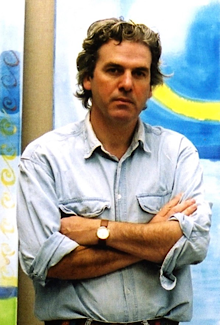
Henderson is born to James Douglas Alexander Henderson, who manages the family business of Henderson & Eadie, and Doris Josephine (née Watson). He attends Portora Royal School in Enniskillen, where the art master, Angus Bryson, spots him as an exceptional student.
From 1972 to 1973 Henderson studies an Arts Foundation course at Ulster University. From 1973 to 1976 he studies Fine Art at Kingston University, London, achieving a Bachelor of Artsfirst class honours degree under the tutelage of Terry Jones, returning in 1977 as Artist-in-Residence. In the same year he becomes the first recipient of the Stanley Picker Fellowship Award in Painting. Between 1978 and 1979 he completes a MA postgraduate in Fine Art at Chelsea School of Art under the tutelage of the artist John Hoyland.
In 1980, Henderson starts his professional artistic journey, developing abstract techniques, creating large canvases with complex layers of overlaid and inter-worked paint. He lives and paints in London for twenty years before relocating back to Ireland. In the mid-1980s he works in a studio adjacent to the house he shares with his partner, Jenni Stone, with whom he has a daughter named Emerald.
During the mid-1980s Henderson’s work becomes recognised by private and public collectors, including Bono, leader of the Irish rock band U2. During this period he sells his first work to the National Art Collection (1986). Cuilcagh Under A Renaissance Sky is purchased for Fermanagh County Museum with a grant from the Arts Council of Northern Ireland during his first solo exhibition “Around a Border” in Ireland. This is followed by three more acquisitions via the Arts Council during the 1980s, who continue to support his work into the new millennium acquiring If Hobbema had Seen Ireland (1989) in 2004 via Art Fund with support from the Esmée Fairbairn Foundation. His work is exhibited by Arts Council England.
In 1990 Henderson moves to the Cooperage Studio, Brick Lane, London, sharing the top floor with sculptor David Fusco and artist Bryan Benge, a friend from Kingston University. Benge says “Every summer the studios in the East End became part of the open studios programme. . . . . He was an intelligent and incredibly accomplished Painter.” It is here, separated from his partner and virtually penniless, he devotes himself entirely to his work, living in a tent, donated by Benge’s parents, inside the studio.
Henderson begins Palinurus in Soho in 1991, a series of twelve paintings depicting night time rooftop scenes across London, painted from an attic in Kingly Street. Exhibited at the Anna Bornholt Gallery in 1992, ten of the series are acquired by a single private collector.
Around 2000, Henderson becomes more influenced by Greek and Irish symbolism, in particular White Island, the Book of Kells and Sheela na gig, reflected in much of the art produced from this time onward. In 2001, he creates a set of enamel manuscripts for The Clinton Centre in Enniskillen, inaugurated by U.S. PresidentBill Clinton in 2002, in commemoration of the Remembrance Day bombing of 1987. He is interested in enameling because of the possibilities that it offers to him as a colourist and in the behaviour of gestural mark-making. The process is made possible when he is introduced to Andrew Morley, the authority on enamel sign making.
Henderson’s artistic influences include Hans Hofmann, Barnett Newman, Mark Rothko, and John Hoyland. Frequently associated with Samuel Beckett and Jack Butler Yeats, he is influenced by his homeland; his early environment, growing up around weaving, yarns and dyeing, the regions political turmoil, symbolism, and in later life his chronic illness, expressed in his more sombre paintings.
John Hutchinson, critic and director of the Douglas Hyde Gallery writes in the Sunday Independent that Henderson’s paintings “demonstrate the fruitfulness of the no man’s land between abstraction and representation,” and “His images deliberately evoke the picturesque and romantic landscape conventions that originated in the late 18th century…..as well as the expressionist subjectivity of painters such as Jack B. Yeats.” Due to Henderson’s disinterest in the commercialisation of his work, he is sometimes referred to as Ireland’s Invisible Genius.
Henderson describes the evolution of his work, after returning to Ireland in 1993, saying, “Since returning to Ireland my work has become less concerned with resting landscape painting in a cultural context more appropriate to our times, but has come full circle towards an internalised organic abstraction which characterised my more intuitive approach until the early eighties.”
Henderson is married once, in 1995 to the actress Patricia Martinelli with whom he subsequently has a daughter in 1997, Bella-Lucia. He remains married, living in the remote village of Boho, County Fermanagh, Northern Ireland, until his death, brought on by a brain tumour, on April 28, 2009. He remains a prolific artist throughout his life.
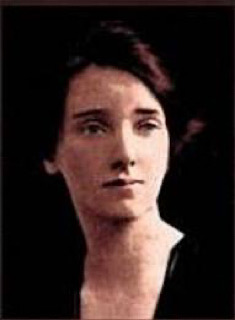
Macardle is born in Dundalk, County Louth, on March 7, 1889, into a wealthy brewing family famous for producing Macardle’s Ale. Her father, Sir Thomas Callan Macardle, is a Catholic who supports John Redmond and the Irish Home Rule movement, while her mother, Lucy “Minnie” Macardle, comes from an English Anglican background and is politically a unionist. Lucy converts to Catholicism upon her marriage to Thomas. Macardle and her siblings are raised as Catholics, but Lucy, who is politically isolated in Ireland, “inculcated in her children an idealised view of England and an enthusiasm for the British empire“. She receives her secondary education in Alexandra College, Dublin—a school under the management of the Church of Ireland—and later attends University College Dublin (UCD). Upon graduating, she returns to teach English at Alexandra where she had first encountered Irish nationalism as a student. This is further developed by her first experiences of Dublin’s slums, which “convinced her that an autonomous Ireland might be better able to look after its own affairs” than the Dublin Castle administration could.
Between 1914 and 1916, Macardle lives and works in Stratford-upon-Avon in Warwickshire, England. There, her encounters with upper-class English people who express anti-Irish sentiment and support keeping Ireland in the British Empire by force further weakens her Anglophilia. Upon the outbreak of World War I, she supports the Allies, as does the rest of her family. Her father leads the County Louth recruiting committee while two of her brothers volunteer for the British Army. Her brother, Lieutenant Kenneth Callan Macardle, is killed at the Battle of the Somme, while another brother, Major John Ross Macardle, survives the war and earns the Military Cross. While Macardle is a student, the Easter Rising occurs, an experience credited for a further divergence of her views regarding republicanism and her family.
On January 19, 1919, Macardle is in the public gallery for the inaugural meeting of the First Dáil and witnesses it declare unilateral independence from the United Kingdom, which is ultimately the catalyst for the Irish War of Independence.
By 1919 Macardle has befriended Maud Gonne MacBride, the widow of the 1916 Easter Rising participant John MacBride, and together the two work at the Irish White Cross, attending to those injured in the war. It is during this period she also becomes a propagandist for the nationalist side.
Following the signing of the Anglo-Irish Treaty in December 1921, Macardle takes the anti-treaty side in the ensuing Irish Civil War. Alongside Gonne MacBride and Despard, she helps found the Women Prisoners’ Defence League, which campaigns and advocates for republicans imprisoned by the newly established Irish Free State government. It is also during this same time that she begins working alongside Erskine Childers in writing for anti-treaty publications An Phoblacht and Irish Freedom.
In October 1922, Despard, Gonne MacBride and Macardle are speaking at a protest on O’Connell Street, Dublin against the arrest of Mary MacSwiney, a sitting Teachta Dála, by the Free State when Free State authorities move to break it up. Rioting follows and Free State forces open fire, resulting in 14 people being seriously wounded while hundreds of others are harmed in the subsequent stampede to flee. Following the event, Macardle announces she is going to pursue support of the Anti-treaty side full-time in a letter to Alexandra College, which ultimately leads to her dismissal on November 15, 1922. In the following days Macardle is captured and imprisoned by the Free State government and subsequently serves time in both Mountjoy Prison and Kilmainham Gaol, with Rosamond Jacob as her cellmate. During one point at her time in Kilmainham, Macardle is beaten unconscious by male wardens. She becomes close friends with Jacob and shares a flat with her in Rathmines later in the 1920s.
The Irish Civil War concludes in the spring of 1923, and Macardle is released from prison on May 9.
Following the Irish Civil War, Macardle remains active in Sinn Féin and is drawn into the camp of its leader Éamon de Valera and his wife Sinéad. She travels alongside the de Valeras as they tour the country and she is a frequent visitor to their home. As the trust between Macardle and de Valera develops, de Valera asks her to travel to County Kerry to investigate and document what later becomes known as the Ballyseedy massacre of March 1923, in which a number of unarmed republican prisoners are reportedly killed in reprisals. She obliges, and by May 1924 she has compiled a report that is released under the title of The Tragedies of Kerry.” Immediately upon the release of the report, the Minister for DefenceRichard Mulcahy sets up an inquiry in June 1924 to carry out a separate investigation by the government. However, the government’s inquiry comes to the conclusion there had been no wrongdoing committed. Her book The Tragedies of Kerry remains in print and is the first journalistic historical account of the Irish Civil War from those on the republican side detailing Ballyseedy, Countess Bridge and various other incidents that occur in Kerry during this time.
In 1926, Éamon de Valera resigns as President of Sinn Féin and walks out of the party following a vote against his motion that members of the party should end their policy of abstentionism against Dáil Éireann. De Valera and his supporters, including Macardle, form the new political party Fianna Fáil in May 1926, with Macardle immediately elected to the party’s National Executive|Ard Chomhairle, one of six female members out of twelve on the original party National Executive, the others being Hanna Sheehy-Skeffington, Kathleen Clarke, Countess Constance Markievicz and Linda Kearns. Macardle is made the party’s director of publicity. However, she resigns from Fianna Fáil in 1927 when the new party endorses taking their seats in Dáil Eireann. Nevertheless, her views remain relatively pro-Fianna Fáil and pro-de Valera.
Macardle recounts her civil war experiences in Earthbound: Nine Stories of Ireland (1924). She continues as a playwright for the next two decades. In her dramatic writing, she uses the pseudonymMargaret Callan. In many of her plays a domineering female character is always present. This is thought to be symbolic of her own relationship with her own mother. Her parents’ marriage had broken up as her mother returned to England and her father raised the children with servants in Cambrickville and they were sent away for school. This female character holds back the growth and development of the younger female character in Dorothy’s plays and writings.
By 1931, Macardle takes up work as a writer for The Irish Press, which is owned by de Valera and leans heavily toward supporting Fianna Fáil and Irish republicanism in general. In addition to being a theatre and literary critic for the paper, she also occasionally writes pieces of investigative journalism such as reports on Dublin’s slums. In the mid-1930s she also becomes a broadcaster for the newly created national radio station Radio Éireann.
In 1937, Macardle writes and publishes the work by which she is best known, The Irish Republic, an in-depth account of the history of Ireland between 1919 until 1923. Because of the book, political opponents and some modern historians consider her to have been a hagiographer toward de Valera’s political views. In 1939 she admits, “I am a propagandist, unrepentant and unashamed.” Overall, however, the book is well-received, with reviews ranging from “glowing” to measured praise. She is widely praised for her research, thorough documentation, range of sources and narration of dramatic events, alongside reservations about the book’s political slant. The book is reprinted several times, most recently in 2005. Éamon de Valera considers The Irish Republic the only authoritative account of the period from 1916 to 1926, and the book is widely used by de Valera and Fianna Fáil over the years and by history and political students. She spends seven years writing the book in a cottage in Delgany, County Wicklow, and it is a day-by-day account of the history of the events in Ireland from 1919 to 1923 recorded in painstaking detail together with voluminous source material.
In 1937, de Valera’s Fianna Fáil government is able to create a new Constitution of Ireland following a successful referendum. However, there is widespread criticism of the new Constitution from women, particularly republican women, as the language of the new Constitution emphasises that a woman’s place should be in the home. Macardle is among them, deploring what she sees as the reduced status of women in this new Constitution. Furthermore, she notes that the new Constitution drops the commitment of the 1916 Proclamation of the Irish Republic to guarantee equal rights and opportunities “without distinction of sex” and writes to de Valera questioning how anyone “with advanced views on the rights of women” can support it. DeValera also finds her criticising compulsory Irish language teaching in schools.
While working as a journalist with the League of Nations in the late 1930s, Macardle acquires a considerable affinity with the plight of Czechoslovakia being pressed to make territorial concessions to Nazi Germany. Believing that “Hitler‘s war should be everybody’s war,” she disagrees with de Valera’s policy of neutrality. She goes to work for the BBC in London, develops her fiction and, in the war’s aftermath, campaigns for refugee children – a crisis described in her book Children of Europe (1949). In 1951, she becomes the first president of the Irish Society of Civil Liberties.
Macardle dies of cancer on December 23, 1958, in a hospital in Drogheda, at the age of 69. Though she is somewhat disillusioned with the new Irish State, she leaves the royalties from The Irish Republic to her close friend Éamon de Valera, who had written the foreword to the book. De Valera visits her when she is dying. She is accorded a state funeral, with de Valera giving the oration. She is buried in Sutton, Dublin.
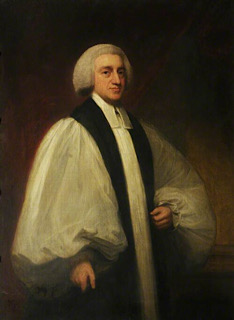
Agar is known to have held particularly marked Calvinistic positions. He serves as Dean of Kilmore from 1765 to 1768, and then as Bishop of Cloyne until 1779.
In 1794, Agar is raised to the Peerage of Ireland as Baron Somerton. In 1801, he is translated to become Archbishop of Dublin and is created Viscount Somerton. In 1806, he is further honoured when he is made Earl of Normanton. These titles are all in the Peerage of Ireland. He remains as Archbishop of Dublin until his death in 1809, and from the beginning of 1801 onward, sits in the House of Lords as one of the twenty-eight original Irish representative peer, following the Acts of Union 1800 which unites Ireland and Great Britain.
Agar dies on July 14, 1809, aged 72, and is succeeded in his secular titles by his son Welbore Ellis Agar. He is buried in the north transept of Westminster Abbey. His widow Jane, Countess of Normanton, is buried alongside him following her death in 1826. His tomb dates from 1815 and is created by John Bacon.
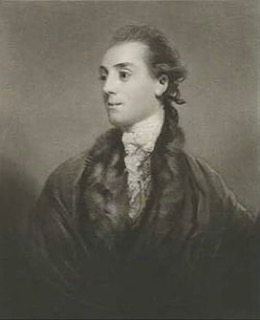
Luttrell was a captain in the Royal Navy but retires in 1789. He is returned to Parliament for Stockbridge in 1774, a seat he holds until 1775, and again between 1780 and 1785. Between 1785 and 1826 he is a commissioner of HM Customs and Excise. He succeeds his elder brother to the earldom in 1821. This is an Irish peerage and does not entitle him to an automatic seat in the House of Lords.
In 1766, Lord Carhampton marries the Honorable Elizabeth Olmius (1742-97), daughter of John Olmius, 1st Baron Waltham. In 1787, out of respect after the death of his father-in-law, he assumes by Royal Licence the additional surname of “Olmius.” In 1798, he sells the Olmius family seat of Newhall to the founding nuns of New Hall School. There are three children from his first marriage (however only his daughter survives to adulthood):
Lady Frances Maria Luttrell (b. 1768), married Sir Simeon Stuart, 4th Baronet
James Luttrell (d. 1772)
John Luttrell (d. 1769)
Lord Carhampton marries secondly Maria Morgan, daughter of John Morgan, in 1798. They have one child:
Lady Maria Anne Luttrell (1799–1857), married Lieutenant-Colonel Hardress Robert Saunderson
Marrinan becomes ill with infantile paralysis at the age of five, and as a result is tutored privately. He has no formal training in art but is largely influenced by his reading matter, particularly the American comic strips of Bud Fisher. The variety of facial expressions that Fisher can achieve, with only a pencil, intrigues and inspires him. Likewise, the images evoked by Celtic mythology and religious art also contributes to his visual language, and many hours are spent in the Belfast Museum and Art Gallery studying the paintings in their collection.
Marrinan exhibits with the Ulster Academy of Arts from an address at 524 Donegall Road, Belfast, entering “The Wee Gate, Earl Street, Belfast” (1931) and “The Painter’s Father” and the “Apache” (1934), which is judged “picture of the year.” He last exhibits with a landscape, “Connemara,” along with four other works in 1949.
Marrinan paints and sketches portraits of many notable Irish figures, among which is the charcoal drawing of northern Fenian Robert Johnston (1934; National Gallery of Ireland) and a sketch of the Donegal storyteller Niall Duffy (University College Dublin). His literary portraits include one of Brian Friel. He holds a one-man show in 1951 at 55a Donegall Place, Belfast, where he exhibits a bust of John McLaverty. He takes an interest in sculpture although painting and drawing remain his preferred form of expression. Important commissions are for a memorial portrait (completed 1952) of Éamonn Ceannt for Ceannt Barracks officers’ mess, Curragh Camp, County Kildare, and for a portrait of Vice-brigadier Peadar Clancy for Clancy Barracks, Dublin. He paints two memorial portraits of PresidentJohn F. Kennedy, one of which is in the Irish Club, London.
Marrinan is an honorary member of the Royal Ulster Academy and exhibits with them every year from 1950 onward, showing a portrait of Mrs. Padraig Marrinan in 1967 (no other details of his marriage are known). He is preparing for an exhibition to be held at the Irish Club, London, in 1974, but dies on October 25, 1973, at Tyrone County Hospital in Omagh. He is then living at James Street, Omagh.
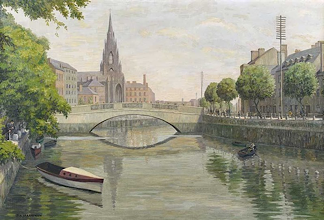
(From: “Marrinan, Padraig H.” by Ruth Devine, Dictionary of Irish Biography, http://www.dib.ie, October 2009 | Pictured: “The River Lee, Cork City, Ireland” by Padraig Marrinan, oil on canvas)
Shackleton is the daughter of Richard Shackleton (1726–92) by his second wife, Elizabeth Carleton (1726–66), and granddaughter of Abraham Shackleton, schoolmaster of Edmund Burke. Her parents are Quakers. She keeps a personal diary for most of her life, beginning at the age of eleven and writing in it almost daily. There 55 extant volumes of her diaries in the National Library of Ireland.
Shackleton is educated, and her literary studies are aided by Aldborough Wrightson, a man who had been educated at Ballitore school and had returned to die there. In 1784, she travels to London with her father and pays several visits to Burke’s town house, where she meets Sir Joshua Reynolds and George Crabbe. She also goes to Beaconsfield, and on her return writes a poem in praise of the place and its owner, which is acknowledged by Burke on December 13, 1784, in a long letter. On her way home she visits, at Selby, North Yorkshire, some primitive Quakers whom she describes in her journal.
On January 6, 1791, Shackleton marries William Leadbeater, a former pupil of her father and a descendent of the Huguenot Le Batre and Gilliard families. He becomes a prosperous farmer and landowner in Ballitore. She spends many years working in the village post office and also works as a bonnet-maker and a herbal healer for the village. The couple lives in Ballitore and have six children. Their daughter Jane dies at a young age from injuries sustained after an accident with a wax taper. Another daughter, Lydia, is a friend and possible patron of the poet and novelist Gerald Griffin.
On her father’s death in 1792, Leadbeater receives a letter of consolation from Burke. Besides receiving letters from Burke, she corresponds with, among others, Maria Edgeworth, George Crabbe, and Melesina Trench. On May 28, 1797, Burke writes one of his last letters to her.
Leadbeater describes in detail the effects of the Irish Rebellion of 1798 on the lives of her family and neighbours in Ballitore. She is in Carlow on Christmas Day 1796 attending a Quaker meeting when the news arrives that the French fleet has been seen off Bantry. She describes the troops marching out of the town and the ensuing confusion in Carlow and Ballitore.
Leadbeater’s first literary work, Extracts and Original Anecdotes for the Improvement of Youth, is published anonymously in 1794 in Dublin. It contains an account of the history of Quakerism and several poems on secular and religious subjects.
In 1808, Leadbeater publishes Poems with a metrical version of her husband’s prose translation of Maffeo Vegio‘s Thirteenth Book of the Æneid. She next publishes in 1811 Cottage Dialogues among the Irish Peasantry, of which four editions, with some alterations and additions, appear by 1813. In 1813, she tries to instruct the rich on a similar plan in The Landlord’s Friend. Intended as a sequel to Cottage Dialogues, in which persons of quality are made to discourse on such topics as beggars, spinning-wheels, and Sunday in the village, Tales for Cottagers, which she brings out in 1814 in conjunction with Elizabeth Shackleton, is a return to the original design. The tales illustrate perseverance, temper, economy, and are followed by a moral play, Honesty is the Best Policy.
In 1822, Leadbeater concludes this series with Cottage Biography, being a Collection of Lives of the Irish Peasantry. The lives are those of real persons, and contain some interesting passages, especially in the life of James Dunn, a pilgrim to Lough Derg. Many traits of Irish country life appear in these books, and they preserve several of the idioms of the English-speaking inhabitants of the Pale. Memoirs and Letters of Richard and Elizabeth Shackleton … compiled by their Daughter is also issued in 1822. Her Biographical Notices of Members of the Society of Friends who were resident in Ireland appears in 1823, and is a summary of their spiritual lives, with a scanty narrative of events. Her last work is The Pedlars, a Tale, published in 1824.
Leadbeater’s best known work, the Annals of Ballitore, is not printed until 1862, when it is brought out with the general title of The Leadbeater Papers (2 vols.) by Richard Davis Webb, a printer who wants to preserve a description on rural Irish life. It tells of the inhabitants and events of Ballitore from 1766 to 1823, and few books give a better idea of the character and feelings of Irish cottagers, of the premonitory signs of the rebellion of 1798, and the Rebellion itself. The second volume includes unpublished letters of Burke and the correspondence with Mrs. Richard Trench and with Crabbe.
Leadbeater dies at Ballitore on June 27, 1826, and is buried in the Quaker burial-ground there.
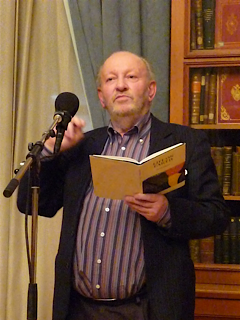
Norman Derek Mahon, Irish poet, is born in Belfast, Northern Ireland, on November 23, 1941, but lives in a number of cities around the world. At his death it is noted that his “influence in the Irish poetry community, literary world and society at large, and his legacy, is immense.” President of IrelandMichael D. Higgins says of Mahon, “he shared with his northern peers the capacity to link the classical and the contemporary but he brought also an edge that was unsparing of cruelty and wickedness.”
At Inst Mahon encounters fellow students who share his interest in literature and poetry. The school produces a magazine in which he produces some of his early poems. According to the critic Hugh Haughton, his early poems are highly fluent and extraordinary for a person so young. His parents cannot see the point of poetry, but he sets out to prove them wrong after he wins his school’s Forrest Reid Memorial Prize for the poem ”The power that gives the water breath.”
At times expressing anti-establishment values, Mahon describes himself as an “aesthete” with a penchant “for left-wingery […] to which, perhaps naively, I adhere.”
In March 2020, at the beginning of the COVID-19 pandemic, RTÉ News ends its evening broadcast with Mahon reading his poem Everything Is Going to Be All Right.
Mahon dies in Cork, County Cork, on October 1, 2020, after a short illness, aged 78. He is survived by his partner, Sarah Iremonger, and his three children, Rory, Katy, and Maisie. His papers are held at Emory University.
Mahon features on the Irish Leaving Certificate course with ten of his poems (Grandfather, Day Trip to Donegal, Ecclesiastes, After the Titanic, As It Should Be, A Disused Shed in Co. Wexford, Rathlin, The Chinese Restaurant in Portrush, Kinsale and Antarctica)
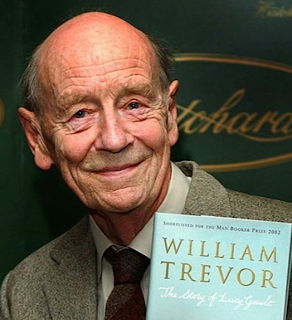
Trevor wins the 2008 International Nonino Prize in Italy. In 2014, he is bestowed with the title of Saoi within Aosdána. He resides in England from 1954 until his death in 2016, at the age of 88.
Trevor is educated at a succession of schools including St Columba’s College, Dublin (where he is taught by Oisín Kelly) and at Trinity College Dublin (TCD), from which he receives a degree in history. He works as a sculptor under the name Trevor Cox following his graduation from TCD, supplementing his income by teaching.
Trevor marries Jane Ryan in 1952 and emigrates to England, working as a teacher, a sculptor and then as a copywriter for an advertising agency. During this time he and his wife have their first son. In 1952, he becomes an art teacher at Bilton Grange, a prep school near Rugby. He is commissioned to carve reliefs for several churches, including All Saints’ Church, Braunston, Northamptonshire. In 1956, he moves to Somerset to work as a sculptor and carries out commissions for churches. He stops wood carving in 1960.
Trevor’s first novel, A Standard of Behaviour, is published in 1958 by Hutchinson & Co. of London, but receives little critical success. He later disowns this work, and, according to his obituary in The Irish Times, “refused to have it republished.” It is, in fact, republished in 1982 and in 1989.
In 1964, at the age of 36, Trevor is awarded the Hawthornden Prize for The Old Boys. This success encourages him to become a full-time writer.
In 1971, he and his family move from London to Devon in South West England, first to Dunkeswell, then in 1980 to Shobrooke, where he lives until his death. Despite having spent most of his life in England, he considers himself to be “Irish in every vein”.
Trevor dies peacefully in his sleep, at the age of 88, at Crediton, Devon, England, on November 20, 2016.
Josephine McNeill, Irish diplomat, dies in Dublin on November 19, 1969. She is the first Irish female diplomat appointed to represent Ireland abroad in a ministerial capacity.
McNeill is born Josephine Ahearne on March 31, 1895, in Fermoy, County Cork, the daughter of shopkeeper and hotelier, James Ahearne, and his wife Ellen Ahearne (née O’Brien). She attends the Loretto Convent, Fermoy, and goes on to graduate from University College Dublin (UCD) with a BA, H.Dip.Ed. in French and German. With this she begins a teaching career, at St. Louis’ Convent, Kiltimagh, at the Ursuline Convent, Thurles, and at Scoil Íde. Scoil Íde, the female counterpart to St. Enda’s School, had been established by her friend, Louise Gavan Duffy. She is fluent in the Irish language and takes an active part in the cultural elements of the Irish independence movement, such as literature and music. She is a member of Cumann na mBan, serving as a member of the executive committee in 1921.
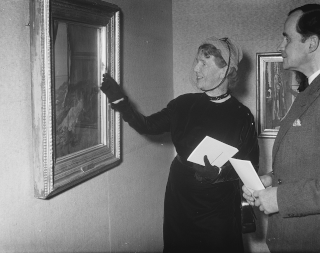
After the death of her husband in 1938, McNeill becomes the honorary secretary of the council of the Friends of the National Collections, as well as serving as chair of the executive committee of the Irish Countrywomen’s Association until 1950. As a member of the Department of External Affairs advisory committee on cultural relations, she writes on economic, social and cultural issues. She represents Ireland at the UNESCO general assembly in Paris in 1949.
McNeill is an active member of Clann na Poblachta from its foundation in 1946. She is appointed the minister to the Netherlands in 1950 by Seán MacBride, making her the first Irish female diplomat to represent the Republic of Ireland abroad in a ministerial capacity. This appointment is not well received by diplomats in the Department of External Affairs. Her reports from The Hague focus on the issues the Netherlands faces with decolonisation. In 1955, she becomes the minister to Sweden, going on to hold the joint appointment to Austria and Switzerland from 1956 to 1960, after which she retires. While serving in Switzerland she puts aside the resentment she feels towards Éamon de Valera based on how he had treated her husband, to sit with him during a convalescence while de Valera recovers from an eye operation.
McNeill is an amateur pianist and collects paintings and porcelains. In 1933, she publishes the Irish language book, Finnsgéalta ó India.
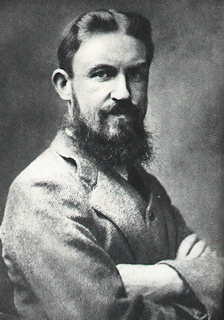
On November 18, 1926, George Bernard Shaw refuses to accept the Nobel Prize in Literature prize money of £7,000 awarded to him a year earlier. He says, “I can forgive Alfred Nobel for his invention of the explosive but only the devil can think of the Nobel Prize.”
Shaw is born in Dublin on July 26, 1856, the third child of George Carr Shaw, a civil servant who later turns to a failed grain business to become an alcoholic, and Lucinda Elizabeth Shaw, a professional singer and sister of the famous opera singer Lucinda Frances. He is initially poor but is gifted with music and soon understands and loves the work of famous musicians and learns more about painting in Dublin. At the age of 15, he works as an apprentice and cashier for a real estate firm.
In 1876, Shaw follows his mother and two sisters to London. There he writes music reviews for newspapers to earn money, self-studies and actively participates in social activities. In 1884, he joins the founding of Fabian Society, an organization of British intellectuals advocating transition from capitalism to socialism by way of peace. From 1879 to 1883, he writes his first novel, Immaturity, and five other works that are not printed. An Unsocial Socialist is the first novel to be printed in 1887. Considered the father of “conceptual drama,” he begins writing plays in 1885, but achieves initial fame with Widowers’ Houses (1892). By 1903, his drama takes over the American and German stage, and in 1904 dominates the domestic stage. He becomes even more famous when Edward VII, the King of England, attends the performance of John Bull’s Other Island (1904), after which his drama spreads to European countries.
In addition, Shaw is also considered the best playwright in Britain at the time. He wants to use art to awaken people first to require changing the bourgeoisie order with all its institutions and customs. He emphasizes the educational function of the theater, but seeing the function of education is not an imposition from the playwright but arousing the aesthetic needs of the audience. The harsh problems of contemporary society such as the island’s predominant power, exploitative patterns, and the poverty of the people lead to social evils clearly reflected in his drama. His drama style tends to be satirical, sarcastic, finding its way to truth through paradoxes.
Shaw’s youngest dream is to earn a sum of money, then marry a wealthy wife. However, before becoming so wealthy that he can spend $ 35,000 on charity and enough money to travel around the world, he goes through many years of hardship. In the first nine years of his career, he receives only $30 USD in royalties. He is so poor that he does not even have the toll to get his manuscript to publishers. His clothes are tattered, his shoes open. All of his spending comes from his mother’s allowance. When he gets his name and remembers the miserable days, he often frowns, “I should have supported my family, the results are the opposite. I have never done anything for my family, and my mother has to work, raising me even though I was an adult.” Shaw, however, decides not to give up writing.
Realizing that, Shaw looks at the real royalties by publishing novels and the journey to the desired destination seems far away. He then turns to writing plays. He calculates that if the script is made public, the author will have revenue through the number of tickets issued and the number of shows. At the same time, the name of the author is also quickly known to the public. On the other hand, he says, only theater can “awaken people before the change of modern social order with all its institutions and customs.” He also judges that in addition to entertainment functions, the drama also contains the function of education, through arousing the aesthetic needs of the audience. He does not hesitate to bring to the stage all the most pressing issues of contemporary society such as the money’s inertia, the poverty of the people, and the social evils.
Saint Joan (1923) is judged to be the culmination of Shaw’s writing career. It is performed throughout European stages and is very popular. Two years after the release of Saint Joan, he is awarded the Nobel Prize for “the ideological and highly humanistic compositions, especially the spectacular satirical plays, combined with looks. Strange beauty of poetry.” When notified of his winning of the Nobel Prize, he humorously says, “The Nobel Prize for literature is like a float thrown to a swimmer.” Although he thinks he is the “swimmer to the shore,” he never leaves the pen. Thirteen years after receiving the Nobel Prize, Pygmalion, a script he wrote in 1912, is made into a film and receives the Academy Award for Best Adapted Screenplay.
In terms of scenario remuneration, Shaw receives an average of $100,000 a year, enough to spend on life, “reproduce” writing and traveling. It is only possible to marry a wealthy wife until the age of 40 years old. He always thinks that he “has no marriage status because he always worries others.” In terms of form, he is not very attractive because of his skinny body, but watching as the sisters do not allow him to carry out his intention to preserve his “absolute freedom.” Many beautiful female actors actively proclaim marriage proposal to Shaw, but he always uses humorous sentences to refuse.
Describing the George Bernard Shaw, Albert Einstein‘s physical genius after having met him has to say, “There are rare people who are so independent that they can see the weaknesses and absurdities of contemporaries. and at the same time do not let me get into it, but even so, when I encounter the hardships of life, these lonely people often lose their courage in helping humanity, with subtle humor and gentleness, can enthrall contemporaries and deserve to be torchbearers on the way of art’s unfavorable ways, today, with a passionate affection, I salute celebrate the biggest teacher on that path – the one who taught us and made us all feel happy.” It is a rare meeting of two great people in London in the fall of 1930.
(From: “November 18, 1926 – George Bernard Shaw refuses to receive a Nobel prize,” ScienceInfo.net, updated December 17, 2018)


 seamus dubhghaill