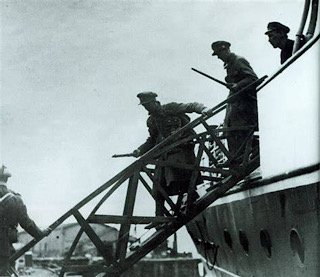
By mid-July 1922, the Free State has re-taken counties Limerick and Waterford, but the IRA still controls counties Cork and Kerry, as well as much of the west under Liam Lynch’s command. A purely land-based advance into these areas risks long, attritional battles. Dalton’s plan is to create a second front by landing troops along the County Kerry and County Cork coasts, isolating republican strongholds like Tralee.
The SS Lady Wicklow carries 450 soldiers of the Dublin Guardbrigade under Paddy Daly, along with a field gun and an armoured car nicknamed the Ex-Mutineer. The Dublin Guards are considered the most disciplined and politically reliable unit in the Army, and Daly is one of Michael Collins’ trusted lieutenants. The landing is intended to secure Fenit as a base for an amphibious assault on Tralee, a key republican stronghold.
The surprise attack catches the IRA forces off guard, taking their left flank in the rear. The Free State quickly advances, and by the following days, much of County Kerry is freed from republican control. The operation is part of a broader offensive that culminates in the capture of Tralee on August 2, one of the bloodiest single days of combat for the National Army.
While the initial landings are successful, the IRA mounts counterattacks over August and September, regaining some ground. However, the Free State’s superior resources, better equipment, and lack of popular support for the republicans allows them to consolidate control in County Kerry over time. The Fenit landing is a turning point, shifting the momentum in favour of the Free State and contributing to the eventual republican defeat in the Irish Civil War.
In summary, the August 2, 1922, naval landing at Fenit is a bold, surprise amphibious operation that disrupts republican defenses, opens County Kerry to Free State advance, and alters the course of the Irish Civil War.
(Pictured: Free State troops landing at Fenit, County Kerry, on August 2, 1922)
At the start of the Irish Civil War in June 1922, the Free State controls only Dublin. Anti‑Treaty forces, forming the so‑called Munster Republic, hold Cork, Limerick, and Waterford, along with much of the west. Waterford’s republican garrison has fortified the city, dismantled the drawbridge’s control equipment, and isolated the port by removing wireless and other communications.
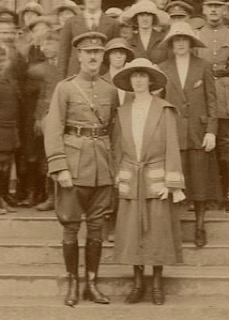
On July 16, republican forces learn that Free State troops ae moving toward Waterford. They raise the drawbridge early and move vessels from the Kilkenny side to the Waterford side. On July 18, Prout’s column is spotted from Sallypark Hill, prompting republican machine gun and rifle fire. A Free State volunteer, Costeloe, is wounded and later dies.
From July 19, sniping continues across the River Suir. On July 19, the Free State brings the 18‑pounder artillery into position overlooking the city, bombarding republican positions. The republicans hold key buildings such as the Adelphia Hotel, Country Club, and Reginald’s Tower.
By July 21, Free State forces cross the River Suir downstream at Gyles Quay, enter the city, and drive out republican troops from their positions. The drawbridge on Redmond Bridge is lowered by hand, and republican reinforcements from Cork and Tipperary either withdraw or do not engage. The Free State takes Waterford on July 21, 1922, ending the republican hold on the city.
Two anti‑Treaty volunteers, Maurice McGrath and John “Bonny” Boyle, are killed. Two Free State soldiers, Sergeant James Howlett and Michael Costelloe, are killed. At least six civilians are killed, including Joseph Dwan, William Long, and a 10‑year‑old girl. Many civilians are wounded.
The fall of Waterford marks a key Free State victory in the conventional phase of the Irish Civil War, contributing to the re‑capture of major southern cities and paving the way for the later guerrilla phase.
(Pictured: John T. Prout at his wedding to Limerick native Mary Conba at St. John the Evangelist Church (O’Loughlin Memorial Church), Kilkenny, July 12, 1922)
The Irish Civil War (June 1922–May 1923) pits pro-Treaty Free State forces against anti-Treaty IRA units who oppose the Treaty’s terms. Aiken is a key republican commander, and Dundalk is a stronghold for his forces. By mid-July 1922, Free State troops have taken several towns, and Dundalk is next in line for reoccupation.
General Hogan’s forces enter Dundalk, engaging republican snipers and irregulars. The attack targets the Gaol, where Aiken and many of his men are held. The Free State troops overpower the defenders, leading to Aiken’s arrest and the capture of a significant portion of the Fourth Northern Division.
Aiken and about 104 other prisoners escape on July 27, 1922, through a narrow gap in the jail wall, later dubbed the “Hole in the Wall.” This escape is a major republican success, temporarily reoccupying Dundalk. However, Free State forces retake the town on August 14, 1922, and the jail remains under military control until 1924.
The capture is significant as it marks a turning point in the Free State’s campaign in County Louth, weakening republican resistance in the area. Aiken’s arrest underscores the Free State’s determination to dismantle anti-Treaty leadership. The events in Dundalk become a symbol of republican resilience, as the escape through the “Hole in the Wall” is widely reported and commemorated.
In summary, the July 16, 1922, capture of Frank Aiken in Dundalk is a decisive Free State action in the Irish Civil War, leading to a notable republican escape and a prolonged military standoff in the town.
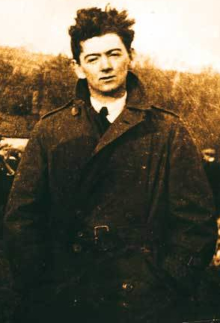
(Pictured: Frank Aiken and the 4th Northern Division)
Wexford had been relatively quiet during the Irish War of Independence, but the Treaty split in 1921 creates deep divisions. The South Wexford Brigade under Thomas O’Sullivan is overwhelmingly anti-Treaty, while the North Wexford Brigade under Joseph Cummins is nominally pro-Treaty but contains a significant anti-Treaty minority. This division means that when the Irish Civil War breaks out on June 28, 1922, Wexford becomes one of the most violent counties, with Republican forces rapidly moving to secure strategic towns.
On July 4, anti-Treaty IRA units, including Tipperary volunteers and escaped Four Courts fighters, move into Enniscorthy, take over key positions and force the surrender of Free State troops. In the opening fighting, three combatants are killed — two IRA and one National Army — marking the first major Republican gains in the county. James Roche, an IRA member, is fatally wounded in an accident outside Newtownbarry (now Bunclody) on the same day, one of several accidental deaths among IRA personnel in Wexford during the Irish Civil War.
The capture of Enniscorthy is part of a broader Republican offensive in County Wexford in early July 1922. However, the balance of power shifts quickly. By July 6, a large relief force of government troops sets out from Dublin to retake the town. This marks the beginning of a protracted and bloody campaign in County Wexford, which sees the county become one of the most violent in the Irish Civil War.
In summary, the capture of Enniscorthy on July 4, 1922, is a significant Republican victory in County Wexford, driven by the Treaty split and reinforced by external IRA units. It reflects the rapid escalation of violence in the county and sets the stage for a prolonged and destructive phase of the Irish Civil War in County Wexford.
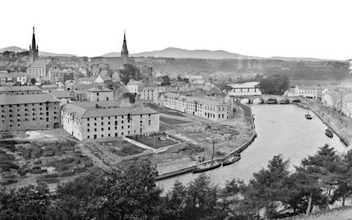
(Pictured: Enniscorthy at the turn of the last century, National Library of Ireland collections)
Barry returns to Bandon in early 1919. He describes in his guerilla days in Ireland a Damascus-like conversion to Irish nationalism on hearing of the Easter Rising while with the Mesopotamian expeditionary force, but he is only accepted into the IRA with considerable caution. Initially tested in intelligence and training work, in mid-1920 he takes charge of the new brigade flying column, which is used both to train officers and to stage offensive actions.
Barry adapts his military experience successfully to the demands of guerrilla warfare, becoming the most famed of column leaders during the Irish War of Independence. In his memoirs, he pours scorn on the obsession of many with military titles and orthodox procedure, complaining of a “paper army.” He stresses the need for spontaneity, initiative, and knowledge of local conditions. “The reality,” he writes, “was a group of fellows, mostly in caps and not-too-expensive clothing, wondering how to tackle their job and where they would sleep that night or get their supper.” (The Reality of the Anglo–Irish War (1974)). He well realises that the war’s character does not permit any close control from the IRA’s GHQ in Dublin, hence increasing the importance of local leaders. His tactics put strong emphasis on speed of movement and on the need to attack the enemy at his weakest point. The column’s ambush successes are small in number but among the best-remembered of the war. He admits, however, that his own and his column’s lack of experience with mines frequently weakened their offensives.
The column’s first successful ambush is at Tooreen on October 22, 1920, followed on November 28 by the dramatic ambushing of a patrol of auxiliaries at Kilmichael while traveling from their Macroom base. A column of thirty-six men, divided into three sections, kill sixteen auxiliaries, with one captured and later shot, suffering two fatalities of their own. Controversy has raged since over whether a false surrender by the British force caused the brutality of some of the deaths. Together with the Bloody Sunday killings of a week earlier in Dublin, Kilmichael has a profound effect on the British military and political establishment, with the declaration in December of martial law for much of Munster and the implementation of wide-ranging internment, together with the authorisation of official reprisals.
After a short period in hospital with a heart condition, in early 1921 Barry leads unsuccessful attacks on Kilbrittain, Innishannon, Drimoleague, and Bandon barracks. The seizure of Burgatia House, outside Rosscarbery, in early February, and the successful resistance made there to British troops, wins much publicity but has little military significance. He is a leading figure in the brutal final stage of the war in the first six months of 1921, which sees widespread shooting of suspected spies and destruction of loyalist property. By March 1921, his flying column, with 104 men, is easily the largest in Ireland, and an explosives expert, Capt. McCarthy, has joined them.
The protracted engagement between Barry’s column and encircling British forces at Crossbarry on March 19, 1921, comes at a time when large-scale sweeps are making life increasingly difficult for the IRA. It consists of a daring and courageous breakout. Crossbarry is the largest action of the war, and Barry is to regard it as even more important than Kilmichael. Soon afterwards, Rosscarbery barracks is successfully attacked by a Barry-led party, representing one of the few successful such initiatives in 1921. Isolated triumphs, however, cannot hide the fact that pressure is increasing on the column, and he becomes increasingly critical of inactive regions. He is later to say that all County Kerry does during the war is to shoot one decent police inspector at Listowel Racecourse and a colleague of his. He is strongly critical also of the lack of assistance from GHQ and of the divisionalisation policy. He visits Dublin in May, travels around with Michael Collins, and is present when two American officers demonstrate the Thompson submachine gun. He is more aware than most of his 1st Southern Division colleagues of the scarcity of arms and ammunition at the war’s end.
During the truce, Barry becomes liaison officer for Munster, riling the British by insisting on his military rank, and criticising the IRA liaison men in Dublin for being overly deferential. He joins the overwhelming majority of the Cork IRA in opposing the Anglo–Irish Treaty but plays a characteristically maverick role throughout the treaty split. His independent attitude is heightened by his dislike of Liam Lynch, the republican IRA’s Chief of Staff, and his continuing respect for Michael Collins. He shows impatience at the long-drawn-out peace initiatives. In March 1922, therefore, he advocates armed confrontation with pro-treaty units over the occupation of barracks in Limerick, and on June 18 he submits a resolution, which only narrowly fails, at the army convention, giving British troops seventy-two hours to leave Dublin.
At the beginning of the Irish Civil War, Barry is arrested entering the Four Courts disguised as a woman. He escapes from an internment camp at Gormanston in early September 1922. For the rest of the war his actions mirror its confused nature. In late October 1922, he leads successful raids on the small towns of Ballineen and Enniskean, and later on Inchigeelagh and Ballyvourney. In December his column takes Carrick-on-Suir, demonstrating the weakness of the Free State army, but his talk of advancing on the Curragh and of large-scale actions does not materialise. There is no evidence that he is acting in accordance with any coordinated plan. By February 1923, he realises that the Republican IRA cause is hopeless and he is involved with Fr. Tom Duggan in efforts to get 1st Southern Division to declare a ceasefire. He journeys to Dublin to put pressure on the intransigent Lynch in this connection, telling Lynch, “I did more fighting in one week than you did in your whole life.”
Barry avoids capture in roundups after the war, remaining on the run until 1924. Unlike many republicans, he does not turn to constitutionalism, remaining strongly militaristic. He is always an unreconstructed republican, though by no means a naive one. In 1924 he becomes attached to Cleeves Milk Co., based in Limerick and Clonmel, and from 1927 to retirement in 1965 is general superintendent with the Cork harbour commissioners. He strongly advocates preserving the independence of the IRA army executive during the republican split of 1925–27. He is instrumental in continuing the drilling of IRA members and is a strong supporter of armed opposition to the Blueshirts.
During the 1930s Barry is arrested at various times for possession of arms and seditious utterances. He promotes an attack against a Freemasons’ meeting in Cork in 1936 and gives the orders for the killing on March 4 of that year of Vice-AdmiralHenry Boyle Somerville. He is opposed to the use by Frank Ryan of IRA volunteers to support the republican cause in the Spanish Civil War and to the proposals of Seán Russell for a bombing campaign in England. To maintain the link with traditional republicanism, he is elected IRA chief of staff in 1937. His plan, however, for the seizure of Armagh city, as part of a direct northern offensive, quickly collapses due to a leak of information, and he soon resigns his position. He forcefully attacks the bombing of English cities in 1938, regarding attacks on innocent civilians as immoral and counterproductive. He enlists in the National Army on July 12, 1940, only to be demobilised a month later. In 1946, he stands as an independent candidate in a by-election in the Cork Borough constituency, finishing at the bottom of the poll. He is more comfortable the following year touring the United States on an anti-partition platform.
In 1949 his Guerilla Days in Ireland is published. It proves a best-seller and has frequently been reprinted. It is well written in a forceful and direct style, one memoir needing no assistance from a ghost writer. Age does not mellow him: lawyers and bank managers are threatened by him over matters relating to his own column, and in 1974 he publishes a fierce pamphlet, angry at perceived slights in the Irish War of Independence memoir of Liam Deasy. He does strive to achieve a public reconciliation with Collins’s memory by unveiling the memorial to Collins at Sam’s Cross in 1966. On the outbreak of the Northern Ireland crisis in the late 1960s, he takes a militant line, castigating the argument that the Six Counties can be brought into the Republic by peaceful means, and asking when had peaceful means existed there. At the memorial meeting in Carrowkennedy, County Mayo, in 1971, he claims that there is a perfect right at the opportune time to take the Six Counties by force. He remains opposed to IRA bombing of civilian targets.
Barry dies in Cork on July 2, 1980. He is buried in St. Finbarr’s Cemetery, Cork. Early in the truce of 1921 he marries Leslie Price, one of the most active of Cumann na mBan members during and after the rising. They have no children.
While Barry always remains an influential figure in republican circles, he will be remembered best as the pioneer of guerrilla warfare, the hero of Kilmichael and Crossbarry. His military flair, individualism, and ruthlessness are well suited to the 1919–21 conflict. After that, his strained relations with colleagues and his lack of flexibility reduce his importance. While his life after the revolutionary era appears anti-climactic, he retains much of his charisma. In later years, he is ever willing to remind politicians and historians how far Ireland has retreated from republican ideals. He is often prickly and autocratic yet could be generous to old colleagues of either side of the treaty split. He is arguably the most intelligent but also the most intolerant of the revolutionary leaders.
(From: “Barry, Thomas Bernadine (‘Tom’)” by M. A. Hopkinson, Dictionary of Irish Biography, http://www.dib.ie, October 2009)
Pilkington is born to John Pilkington and Margaret Mary Pilkington (née Torsney), the second of twelve children born to the couple. Only nine of his siblings survive into adulthood. He receives his education at the local Marist Brothers convent school and the Day Trades Preparatory School. Later he is a student at the Department of Agriculture Forestry College in County Wicklow. When the Irish War of Independence begins, the college is closed and he is forced to return to Sligo. He then gains employment with Wehrly Brothers Ltd., a jewelry and watchmaking store in Sligo.
Several notable incidents occur in Pilkington’s military career. On October 25, 1920, at Moneygold, eight miles from Sligo (between Grange and Cliffoney), IRA men led by him ambush a nine-man Royal Irish Constabulary (RIC) patrol, killing four (Sergeant Patrick Perry, Constables Patrick Keown, Patrick Laffey, Patrick Lynch) and wounding two others (Constables Clarke and O’Rourke). In January 1922, he makes clear his opposition to the IRAs General Headquarters (GHQ) support for the Anglo-Irish Treaty. “We intend to cut away from this headquarters, all of you (pointing to the staff and officers of the GHQ) want to build up a Free State Army so you can march in step into the British Empire. Do it openly. We stand by the Republic.” On April 6, 1922, a meeting addressed by Arthur Griffith in Sligo, is proclaimed illegal by Pilkington, who is the local Anti-Treaty IRA divisional commander. His troops take over a number of buildings in the town. Seán Mac Eoin brings Provisional Government troops from Athlone and on the day of the meeting, he is joined by further troops led by J. J. “Ginger” O’Connell. A tense situation ensues but, at the last minute, Pilkington backs down and the meeting goes ahead. On September 4, 1922, an Anti-Treaty IRA unit under Pilkington takes the Dromhaire barracks in County Sligo after the Free State garrison surrenders.
On August 27, 1923, Pilkington runs unsuccessfully in the general election for the 4th Dáil as a Republican candidate, polling 2,089 first preference votes.
Pilkington is a prominent member of the Anti-Treaty IRA for many years, but his most important role as part of the Anti-Treaty IRA comes on April 20, 1923. The Executive of the Anti-Treaty IRA meets in Poulacappal (four miles southwest of Callan and three miles from Mullinahone). Present in addition to Pilkington (who is replacing Liam Lynch) are Frank Aiken, Sean Hyde, Sean Dowling, Bill Quirke, Tom Barry, Tom Ruane (replacing Michael Kilroy), Tom Sullivan (replacing Sean Lehane), Sean McSwiney, Tom Crofts, P. J. Ruttledge and Sean O’Meara (substitute for Séumas Robinson). Frank Aiken is elected Chief-of-Staff and an Army Council of Aiken, Pilkington and Barry is appointed. Aiken proposes that peace should be made with the Pro-Treaty Government on the basis that “the sovereignty of the Irish Nation and the integrity of its territory is inalienable.” This is passed by nine votes to two.
Pilkington becomes a Catholic priest after his foray into politics and due to the disillusionment of the Irish War of Independence. He joins the Redemptorist Order and becomes known as Father William Pilkington CSsR. He serves as a priest in the Archdiocese of Cape Town, South Africa, priest of Monmouthshire, Wales, and retires to Bishop Eton Monastery, Liverpool.
In 1954, Pilkington is guest of honour at a dinner sponsored by Clan na Gael and the IRA Veterans of America in New York City where he says he is returning to the mission fields of Africa, but he remains faithful to the All Ireland Republic. He dies at Bishop Eton Monastery on March 26, 1977, and is buried in Liverpool.
Boland is enrolled in the IRB along with his younger brothers Harry in 1904, following in the footsteps of his father. He and his brothers Harry and Ned subsequently join the Irish Volunteers when that organisation is established in 1913, serving in the same company as Arthur Griffith. When news breaks out of the Easter Rising in 1916 he immediately leaves his job, however, he is bitterly disappointed when he finds out that the order has been countermanded. When the rebellion begins in earnest on Easter Monday, he makes his way to Jacob’s Mill where he fights under Thomas MacDonagh. Following the official surrender, he is arrested and interned at Frongoch internment camp in Wales, where he comes into contact with other notable revolutionary leaders, including his brother Harry’s friend Michael Collins.
Boland is released after a general amnesty in December 1916, however, he remains involved in revolutionary circles, although he declines to rejoin the IRB, believing the organisation is no longer needed. He is arrested and imprisoned in Belfast from May to December 1918 for practising military drills in the Dublin Mountains. Meanwhile, a number of his colleagues secure their release by winning seats in the 1918 United Kingdom general election.
Boland and his brothers are opposed to the Anglo-Irish Treaty of 1921. He is Battalion Commandant of 3 Battalion, 2 Dublin Brigade (South Dublin) in Blessington, County Wicklow, but is captured early on in the Irish Civil War on July 7, 1922, and is interned until his release in July 1924. On the outside, his brother Harry dies some days after being shot, in August 1922, after two National Army officers attempt to arrest him at the Grand Hotel in Skerries, County Dublin. Boland applies to the Irish government for a service pension under the Military Service Pensions Act of 1934 and is awarded 11 and 5/12 years of service at Grade C for his service with the Irish Volunteers and the IRA between April 1, 1916 and September 30, 1923.
Following the end of the Irish Civil War, Boland helps to build up Sinn Féin as the main Republican party. While still imprisoned, he is selected to stand for Dáil Éireann as the Teachta Dála (TD) for Roscommon, Harry’s old seat, for the 1923 Irish general election, in which he is successful. He is among those in Kilmainham Gaol who go on hunger strike in October 1923. The hunger strike does not result in his release and he credits his practice of yoga with keeping him alive at the time.[3]
Boland is eventually released from the custody of the state in July 1924. Upon his release, he becomes secretary of Sinn Féin and stands on the executive of the party.
Boland is among the first in Sinn Féin to call for an end to the party’s abstentionism from DáilÉireann, believing it to be a political dead end. Party leader Éamon de Valera proposes that the party abandon this policy and take their seats in the Dáil if changes are made to the oath of allegiance to the British monarch. His proposal is defeated and de Valera and his supporters, including Boland, leave Sinn Féin. Shortly after this split, a new party emerges called Fianna Fáil, with de Valera acting as leader and the other disillusioned Republican TDs joining. Boland is vital in transferring many members from Sinn Féin to Fianna Fáil. Fianna Fáil briefly also has an abstentionist policy but in 1927 a new law forces Fianna Fáil TDs to take the oath of allegiance and take their seats in the Dáil. Fianna Fáil dismisses the oath as “an empty formula.”
Boland works alongside Seán Lemass in building up Fianna Fáil’s grassroots support and organisation, giving particular attention to the party’s rural apparatus. In the September 1927 Irish general election Fianna Fáil comes within four seats of the ruling Cumann na nGaedheal party. The latter forms a coalition of sorts with the Farmers’ Party and returns to government.
Following the 1932 Irish general election, Fianna Fáil forms a new government. Boland is appointed Government Chief Whip, a position which allows him to attend cabinet meetings but not vote at them.
Fianna Fáil remains in power with an increased mandate following the 1933 Irish general election and Boland is promoted to the position of Minister for Posts and Telegraphs. Despite being the Minister in charge of the postal service, he does not own a telephone until some time later. During his tenure, the postal service makes considerable progress. It is also during this time that the Post Office becomes a paying concern. During his time as minister, he oversees a major expansion of the telephone service in Ireland, improvements in the transmission capacity of Radio Éireann, and construction of new provincial post offices and a new central postal sorting office.
Boland is acting Minister for Justice briefly for a time when P. J. Ruttledge is ill. It is during this time that he declares the Irish Republican Army a proscribed organisation.
A cabinet reshuffle in 1936 sees Boland become Minister for Lands. The Land Act 1939 reforms land distribution, broadening the criteria by which the state can take control over undeveloped land while offering the tenant of the land more favourable terms of compensation. He is critical of the policy of the Minister for Industry and Commerce, Seán Lemass, of centralising industrial development in Dublin. He instead wishes to see a more decentralised economy based around food production. The differing viewpoint causes a rift between Boland and Lemass, but despite this Boland favoured Lemass’s policy of state intervention in the economy over Seán MacEntee‘s more laissez-faire approach.
In 1937 Boland is highly vocal during the drafting of a new constitution of Ireland by Fianna Fáil against any word which would give the Catholic Church special status, something heavily considered at the time. He declares that if the constitution elevates the position of the Catholic Church above others, it would be sectarian, anti-republican, and a hindrance to any prospects of Irish reunification. As a compromise, the term “special position” is used in the approved text of the Constitution.
Following the outbreak of World War II in 1939, known in Ireland as the Emergency, there is a cabinet reshuffle, and Boland is appointed as Minister for Justice. He takes over at a time when the IRA has once again declared war against the British state and has begun their Sabotage Campaign. He is charged with the task of crushing the organisation and preventing the IRA from drawing the Irish state into conflict with the United Kingdom. Although he always considers himself a republican, he takes a hardline against the IRA and uses his powers to order the internment of hundreds of IRA members before introducing military courts and special criminal courts.
In 1940, several imprisoned IRA members go on hunger strike but Boland refuses to grant their release. Two of the men eventually die, one of whom is the nephew of one of his Fianna Fáil colleagues. Tony D’Arcy dies at the age of 32 on April 16, 1940, as a result of a 52-day hunger strike, and Jack McNeela dies three days later after 55 days on hunger strike. These deaths spark reprisals by the IRA on the Garda Síochána. Boland subsequently introduces tougher measures by setting up a military court with the death penalty and no provision for appeal except for a review by the government. In all, twelve men are found guilty with six of them facing death and the remaining six having their sentences changed to imprisonment. Among those executed is Charlie Kerins, an acting Chief of Staff of the IRA.
As Minister of Justice, Boland is also asked to enforce policies of wartime censorship, however, finding the idea of the state censorship distasteful he establishes a censorship board to avoid accusations of bias.
During the Emergency, Boland is also responsible for the detention of several foreign agents in pursuit of Ireland’s strict policy of neutrality. During this time some 500 individuals are interned and 600 are sentenced under the newly introduced Offences against the State Act, 1939. By 1943 the IRA is in disarray, particularly after the Chief of Staff is arrested and imprisoned, leaving the organisation without leadership. Boland and Fianna Fáil feel their hardline is backed by the electorate following strong returns for the party at the 1944 Irish general election.
In 1947, Boland is among four leading Fianna Fáil figures (including de Valera) involved in the “Locke’s Distillery Scandal”, an accusation brought by Oliver J. Flanagan that foreign businessmen are bribing members of Fianna Fáil to gain the right to purchase the distillery. A tribunal of inquiry finds no evidence to support the claims, but the event taints the public’s view of Fianna Fáil.
By 1948, Fianna Fáil has been in government for an uninterrupted 16 years. With World War II finally over, the electorate seeks change and a fresh start. Arising to meet this desire is the new political party Clann na Poblachta. Led by Seán MacBride, this new party seeks to kick off a new post-war political era in Ireland, and to do this means removing Fianna Fáil from power. Many in Clann na Poblachta have republican backgrounds and in some ways, the party can be partially described as an organic reaction to Fianna Fáil and Boland’s hardline stance during the war years. Many in political circles, including inside Fianna Fáil, believe Clann na Poblachta can be a new force to reckon with.
However, de Valera always holds a reputation for being cunning in selecting the dates of general elections, and he once again cements that notion, when he calls for a general election in early 1948 before Clann na Poblachta is completely ready to contest a national election. At the 1948 Irish general election Clann na Poblachta and other Fianna Fáil opponents do well, but not as well as expected. To remove Fianna Fáil from government, every single party in the Dáil and several independents have to form the unwieldy “First Inter-Party Government.” The coalition sees Clann na Poblachta forced to work with Fine Gael, considered the traditional “enemy” of Irish republicanism. By 1951, the coalition collapses and Fianna Fáil returns to government following that year’s election, with Boland re-appointed Minister for Justice.
Boland does not seek ministerial office in 1957 when Fianna Fáil returns to power after its defeat in 1954. However, his son, Kevin, is appointed to the cabinet as Minister for Defence at the beginning of his first term in the Dáil. By this stage, Boland is beginning to be seen as an aging warhorse, with his base in Roscommon starting to slip and Fianna Fáil unhappy that he is unable to get a Fianna Fáil running mate elected alongside himself.
At the 1961 Irish general election, Boland is defeated for the first time in fourteen general election campaigns. Despite losing his Dáil seat, he subsequently secures election to Seanad Éireann. Four years later in 1965, he returns to the Seanad, this time as a nominee by the Taoiseach Seán Lemass.
In 1970, the outbreak of the Arms Crisis sees Kevin Boland resign as a Minister and as Secretary of Fianna Fáil in protest at the government’s policy on Northern Ireland and in response to the sackings of Charles Haughey and Neil Blaney from the cabinet over allegations they had arranged for weapons to be provided to the Provisional IRA. Gerald Boland, in a similar protest, resigns as a vice president and as a trustee of Fianna Fáil, although he remains a member of the party. He also articulates his loss of confidence in the leadership of TaoiseachJack Lynch.
Boland dies in Dublin at the age of 87 on January 5, 1973. He is buried in the republican plot in Glasnevin Cemetery, Glasnevin, County Dublin. His wife, Annie Boland, predeceases him in 1970. He is survived by his three daughters and four sons.
Twaddell’s death precipitates a clamp-down on the IRA in Northern Ireland and 350 IRA members are interned. Seamus Woods, who is interned on HMS Argenta during the clampdown, is charged with his murder. Woods, who had joined the Irish National Army, is trying to control irregular elements within the IRA. By agreement with the government of Northern Ireland, two officers of the Irish National Army are given permission to travel to the trial. General J. J. “Ginger” O’Connell and Commandant Charles McAlister give evidence and Woods is found not guilty. A total of 724 people are interned in Northern Ireland up to the end of 1924.
Twaddell was buried at Drumcree Church cemetery, Portadown, County Armagh, Northern Ireland, where his headstone says that he was “foully murdered in Belfast.”
MacNeill is one of five children born to Archibald McNeill, a Roman Catholic working-class baker, sailor and merchant, and his wife, Rosetta McNeill (née McAuley), also a Catholic. He is raised in Glenarm, an area which “still retained some Irish-language traditions.” His niece is nationalist and teacher, Máirín Beaumont.
MacNeill marries Agnes Moore on April 19, 1898. The couple has eight children, four sons and four daughters (though the 1911 census entry for MacNeill notes eleven children, seven of whom are still alive).
The Gaelic League is from the start strictly non-political, but in 1915, a proposal is put forward to abandon that policy and become a semi-political organisation. MacNeill strongly supports this and rallies to his side a majority of delegates at the 1915 Oireachtas. Douglas Hyde, a non-political Protestant, who had co-founded the League and been its president for 22 years, resigns immediately afterward.
Through the Gaelic League, MacNeill meets members of Sinn Féin, the Irish Republican Brotherhood (IRB), and other nationalists and republicans. One such colleague, The O’Rahilly, runs the league’s newspaper An Claidheamh Soluis, and in October 1913 asks MacNeill to write an editorial for it on a subject broader than Irish language issues. He submits a piece called “The North Began,” encouraging the formation of a nationalist volunteer force committed to Irish Home Rule, much as the unionists had done earlier in the year with the Ulster Volunteers to thwart Home Rule in Ireland. In July 1915, he comments on the threat that the unarmed nationalists in Ulster might face: “…a demented…English driven Orange Army would be let loose upon the helpless Catholic people of Ulster, who would be driven out of the province or massacred where they stood.”
Bulmer Hobson, a member of the IRB, approaches MacNeill about bringing the idea to fruition, and, through a series of meetings, MacNeill becomes chair of the council that forms the Irish Volunteers, later becoming its chief of staff. Unlike the IRB, he is opposed to the idea of an armed rebellion, except in resisting any suppression of the Volunteers, seeing little hope of success in open battle against the British army.
The Irish Volunteers have been infiltrated by the Irish Republican Brotherhood, which plan on using the organisation to stage an armed rebellion, to separate Ireland from the United Kingdom and establishing an Irish Republic. The entry of the UK into World War I is, in their view, a perfect opportunity to do that. With the cooperation of James Connolly and the Irish Citizen Army, a secret council of IRB officials plan a general rising at Easter 1916. On the Wednesday before Easter, they present MacNeill with a letter, allegedly stolen from high-ranking British staff in Dublin Castle, indicating that the British are going to arrest him and all the other nationalist leaders. Unbeknownst to MacNeill, the letter—called the Castle Document—is a forgery.
When MacNeill learns about the IRB’s plans, and when he is informed that Roger Casement is about to land in County Kerry with a shipment of German arms, he is reluctantly persuaded to go along with them, believing British action is now imminent and that mobilization of the Irish Volunteers will be justified as a defensive act. However, after learning that the German arms shipment has been intercepted and Casement arrested, and having confronted Patrick Pearse, who refuses to relent, MacNeill countermands the order for the Rising by sending written messages to leaders around the country, and placing a notice in the Sunday Independent cancelling the planned “manoeuvres.” This greatly reduces the number of volunteers who report for duty on the day of the Easter Rising.
Pearse, Connolly and the others agree that the uprising will go ahead anyway, but it begins one day later than originally intended to ensure that the authorities are taken by surprise. Beginning on Easter Monday, April 24, 1916, the Rising lasts less than a week. After the surrender of the rebels, MacNeill is arrested although he has taken no part in the insurrection. The rebel leader Tom Clarke, according to his wife Kathleen, warns her on the day before his execution, “I want you to see to it that our people know of his treachery to us. He must never be allowed back into the National life of this country, for so sure as he is, so sure will he act treacherously in a crisis. He is a weak man, but I know every effort will be made to whitewash him.”
In 1923, MacNeill, a committed internationalist, is also a key member of the diplomatic team that oversees Ireland’s entry to the League of Nations.
MacNeill’s family is split on the treaty issue. One son, Brian, takes the anti-Treaty side and is killed in disputed circumstances near Sligo by Free State troops during the Irish Civil War in September 1922. Two other sons, Niall and Turloch, as well as nephew Hugo MacNeill, serve as officers in the Free State Army. One of his brothers, James McNeill, is the second and penultimate Governor-General of the Irish Free State.
In 1924, the three-man Irish Boundary Commission is set up to settle the border between Northern Ireland and the Irish Free State. MacNeill represents the Irish Free State. He is the only member of the Commission without legal training and has been described as being “pathetically out of his depth.” However, each of the Commissioners is selected out of political expediency rather than for any established competence or insight into boundary making. On November 7, 1925, a conservative British newspaper, The Morning Post, publishes a leaked map showing a part of eastern County Donegal (mainly The Laggan district) that is to be transferred to Northern Ireland, the opposite of the main aims of the commission. Perhaps embarrassed by that, especially since he said that it had declined to respect the terms of the Treaty, MacNeill resigns from the commission on November 20. Hus performance in the Boundary Commission has been deemed highly negative in a 2025 study The Root of All Evil: The Irish Boundary Commission.
On November 24, 1925, MacNeill also resign as Minister for Education, a position unrelated to his work on the commission.
On December 3, 1925, the Free State government agrees with the governments in London and Belfast to end its onerous treaty requirement to pay its share of the United Kingdom’s “imperial debt” and, in exchange, agrees that the 1920 boundary will remain as it is, overriding the commission. This angers many nationalists and MacNeill is the subject of much criticism, but in reality, he and the commission have been sidestepped by the intergovernmental debt renegotiation. In any case, despite his resignations, the intergovernmental boundary deal is approved by a Dáil vote of 71–20 on December 10, 1925, and MacNeill is listed as voting with the majority in favour. He loses his Dáil seat at the June 1927 Irish general election.
MacNeill is an important scholar of Irish history and among the first to study Early Irish law, offering both his interpretations, which at times are coloured by his nationalism, and translations into English. He is also the first to uncover the nature of succession in Irish kingship, and his theories are the foundation for modern ideas on the subject.
MacNeill is a contributor to the Royal Irish Academy‘s Clare Island Survey, recording the Irish place names of the island. His disagreements and disputes with Goddard Henry Orpen, particularly over the latter’s book Ireland under the Normans, generate controversy.
MacNeill retires from politics completely and becomes Chair of the Irish Manuscripts Commission. In his later years he devotes his life to scholarship and publishes several books on Irish history. He dies in Dublin of natural causes, aged 78, on October 15, 1945. He is buried in Kilbarrack Cemetery.
On the morning of February 5, 1923, at about 7:00 a.m., fifty well-armed anti-Treaty Irish Republican Army (IRA) fighters descend on Ballyconnell, County Cavan, from the hills in a military lorry and several cars. The guerrillas, armed with rifles and three machine guns, stop the train to nearby Ballinamore so that word will not get out to adjacent Irish Free Stategarrisons and then go in search of those they hold responsible for the death of anti-Treaty IRA volunteer Michael Cull during a raid on Ballyconnell on January 6.
At Oven’s grocery, the proprietor, William Ovens, is shot through the thigh and badly wounded. One of his employees, William Ryan, is dragged out and shot dead. According to the local press, the guerrillas shout “was it you who shot Cull?” at Ryan before they shoot him. His 80 year old father follows the fighters through the streets, shouting “murder, murder.”
Sean McGrath, an Irish language teacher, originally from Galway, is also dragged out of bed and shot dead, apparently for no other reason than that he is lodging at the home of Free State supporter, John Dunn.
The guerrillas proceed to bomb and burn out three shops, including the car dealership and the Post Office, and to smash the windows of the other premises with shots and rifle butts. The Ulster Bank branch is robbed of £200 and two Ford cars are seized. After a rampage of 35 minutes, the IRA column re-mounts their vehicles and heads back toward the Arigna hills, leaving the little town partially in flames, pockmarked with bullet holes and mourning the death of two of its citizens.
According to the pro-Treaty National Army, “Our troops in Belturbet got word of the raid, and immediately set out in all their transport. They were joined en route by two Fords of troops from Cavan, and all proceeded to Ballyconnell, where they arrived shortly after 9 o’clock. They followed the Irregulars past Ballinamore, but failed to get in touch with them.”
The ruthlessness of the reprisal at Ballyconnell – the premeditated assault on civilians – shocks pro-Treaty opinion. For the Free State government it exemplifies the irrationality and criminality of what they called the “Irregulars.” Such madness justifies the government’s repressive measures, particularly the executions of republican prisoners which had been going on since November of the previous year.
Kevin O’Higgins, Minister for Home Affairs and hard-line supporter of the executions policy, says, “I want to combat the view that it was a natural thing to expect that a body of Irishmen would descend upon this little town and proceed to murder their fellow-citizens. It was not a natural thing. It is perhaps the most unnatural thing that has happened since this unnatural strife began.”
Within a week, a National Army expedition is dispatched to the West Cavan/ Leitrim area in considerable strength to root out Ned Bofin’s anti-Treaty column, which had carried out the Ballyconnell raid. They report that “the people are delighted at our presence and their only fear is that we might leave” but are afraid to give information. “Our only concern,” they report, “is the remarkable agility of the Irregulars in retreating from an engagement with us.”
If one is to believe the National Army version, the Irregulars are simply cowardly bandits without any public support and the conflict in the border region would evaporate with the presence in strength of government troops. And if one is to take the Ballyconnell reprisal alone, this would appear to make sense. However, looked at a little more closely, it is clear that the Irish Civil War in this region is a complex web of national and local conflicts, that the Ballyconnell incident is only the culmination of the collapse of Free State authority in the area over several months.
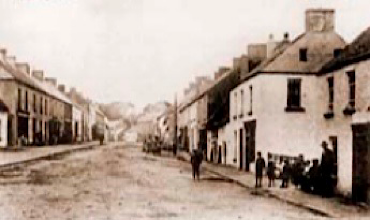
(From: “The Tragedies of Ballyconnell” by John Dorney, The Irish Story, http://www.theirishstory.com, June 2014 | Pictured: The main street in Ballyconnell in the early 20th century)