seamus dubhghaill

Promoting Irish Culture and History from Little Rock, Arkansas, USA


Leave a comment

Death of Francis Ysidro Edgeworth, Philosopher & Political Economist

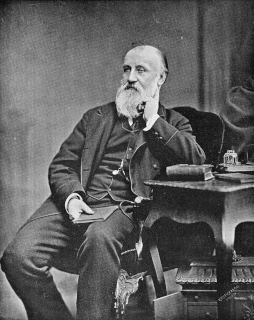
Francis Ysidro Edgeworth, Anglo-Irish philosopher and political economist who makes significant contributions to the methods of statistics during the 1880s, dies in Oxford, Oxfordshire, England on February 13, 1926.

Edgeworth is born on February 8, 1845, at Edgeworthstown, County Longford, the fifth of six sons of Francis Beaufort Edgeworth and his Spanish wife Rosa Florentina Eroles, daughter of exiled Catalan general Antonio Eroles. He is a grandson of Richard Lovell Edgeworth. His father dies when he is two years old, followed by his aunt Maria Edgeworth two years later. He is educated at home by tutors until he enters Trinity College Dublin (TCD) at the age of seventeen. Leaving to become a scholar at Magdalen Hall, he then proceeds to Balliol College, Oxford, where he takes a first-class degree in literae humaniores. After studying law at the Inner Temple, he is called to the bar in 1877, but never practises, choosing instead to lecture in logic at King’s College, London, where in 1888 he is appointed Professor of Political Economy, and in 1890 Tooke Professor of Economic Science and Statistics.

In 1891, Edgeworth becomes Drummond Professor of Political Economy at Oxford and is elected a fellow of All Souls College, Oxford, where he resides principally for the remainder of his career. In the same year he is appointed the founding editor of The Economic Journal and is credited with its success by the economist (and later joint editor) John Maynard Keynes. He writes seven small books and numerous articles and reviews but does not develop a systematic approach to economics. Thus, he never produces a treatise, once informing Keynes that it is for the same reason he never married – large-scale enterprises do not appeal to him. Instead, he applies a highly abstract, mathematical approach to economics, a methodology that is not helped by a difficult writing style. Although his work is sometimes controversial, he makes many original contributions to economics and statistics, which are still recognised. For example, in his own lifetime he is the finest exponent of what he himself calls “mathematical psychics,” the application of quasi-mathematical methods to the social sciences. His career, however, never quite fulfills its promise.

In 1911, Edgeworth inherits the Edgeworthstown estate, and shortly afterward becomes president of the Royal Economic Society (1912–14) and Fellow of the British Academy. Ahead of his time in many areas, he argues against the inequality of men’s and women’s wages. He has an eccentric character and is, according to Keynes, a difficult mixture of reserve, pride, kindness, modesty, courtesy, and stubbornness. His friend and fellow economist Alfred Marshall once says, “Francis is a charming fellow, but you must be careful with Ysidro.” He is never particularly happy, and dies a bachelor, although Keynes admits that it is not from want of susceptibility to women.

Edgeworth resigns his chair in 1922 and is appointed emeritus professor. In 1925, his essays are published in three volumes as his Collected Economic Papers, and for the first time his reputation is properly established throughout the world. He dies at Oxford on February 13, 1926.

(From: “Edgeworth, Francis Ysidro” by Patrick M. Geoghegan, Dictionary of Irish Biography, http://www.dib.ie, October 2009)

Leave a comment

Death of Sir Dominic Corrigan, 1st Baronet, Irish Physician

Sir Dominic John Corrigan, 1st Baronet, an Irish physician known for his original observations in heart disease, dies in Dublin on February 1, 1880, following a stroke. The abnormal “collapsing” pulse of aortic valve insufficiency is named Corrigan’s pulse after him.

Corrigan is born in Thomas Street, Dublin, on December 2, 1802, the son of a dealer in agricultural tools. He is educated in St. Patrick’s College, Maynooth, which then has a department for secular students apart from the ecclesiastical seminary. He is attracted to the study of medicine by the physician in attendance and spends several years as an apprentice to the local doctor, Edward Talbot O’Kelly. He studies medicine in Dublin later transferring to Edinburgh Medical School where he receives his degree as MD in August 1825.

Corrigan returns to Dublin in 1825 and sets up a private practice at 11 Ormond Street. As his practice grows, he moves to 12 Bachelors Walk in 1832, and in 1837 to 4 Merrion Square West. Apart from his private practice, he holds many public appointments; he is a physician to St. Patrick’s College, Maynooth, the Sick Poor Institute, the Charitable Infirmary Jervis Street (1830–43) and the House of Industry Hospitals (1840–66). His work with many of Dublin’s poorest inhabitants leads to him specialising in diseases of the heart and lungs, and he lectures and publishes extensively on the subject. He is known as a very hard-working physician, especially during the Great Famine. At the 1870 Dublin City by-election he is elected a Liberal Member of Parliament for Dublin City. In parliament he actively campaigns for reforms to education in Ireland and the early release of Fenian prisoners. He does not stand for re-election in 1874. His support for temperance and Sunday closing of pubs apparently antagonises his constituents and alcohol companies.

In 1847, Corrigan is appointed physician-in-ordinary to the Queen in Ireland. Two years later he is given an honorary MD from Trinity College Dublin (TCD). In 1846 his application to become a fellow of the Royal College of Physicians of Ireland (RCPI) is blocked. In 1855 he gets around this opposition by sitting the college’s entrance exam with the newly qualified doctors. He becomes a fellow in 1856, and in 1859 is elected president, the first Catholic to hold the position. He is re-elected president an unprecedented four times. There is a statue of him in the Graves’ Hall of the college by John Henry Foley.

Corrigan is President of the Royal Zoological Society of Dublin, the Dublin Pathological Society, and the Dublin Pharmaceutical Society. From the 1840s he is a member of the senate of the Queen’s University and in 1871 becomes its vice-chancellor. In 1866 he is created a baronet, of Cappagh and Inniscorrig in the County of Dublin and of Merrion Square in the City of Dublin, partly as a reward for his services as Commissioner of Education for many years. He is a member of the board of Glasnevin Cemetery and a member of the Daniel O’Connell Memorial Committee. Armand Trousseau, the French clinician, proposes that aortic heart disease should be called Corrigan’s disease.

Corrigan marries Joanna Woodlock, the daughter of a wealthy merchant, and sister of the Bishop Dr. Bartholomew Woodlock, in 1827. They have six children, three girls and three boys. His eldest son, Captain John Joseph Corrigan, Dragoon Guards, dies on January 6, 1866, and is interred at the Melbourne General Cemetery, Melbourne, Australia.

Corrigan dies at Merrion Square, Dublin, on February 1, 1880, having suffered a stroke the previous December. He is buried in the crypt of St. Andrew’s Church, Westland Row, Dublin. His grandson succeeds him to the baronetcy.

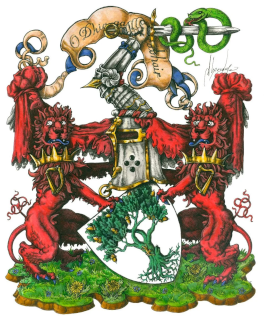
The Corrigan Ward, a cardiology ward in Beaumont Hospital, Dublin, is named in his honour. Part of his family crest is also part of the Beaumont Hospital crest.


Leave a comment

Death of Gordon Lambert, Businessman, Senator & Art Collector

Charles Gordon Lambert, Irish businessman, senator and art collector, dies in a Dublin hospital on January 27, 2005.

Lambert is born on April 9, 1919, in the family home at Highfield Road, Rathmines, Dublin, the youngest of four sons of Robert James Hamilton Lambert, a veterinarian and renowned cricketer, and his wife Nora (née Mitchell). His eldest brother, Noel Hamilton “Ham” Lambert, is a versatile sportsman and noted veterinary practitioner.

Lambert is educated at Sandford Park School, Dublin, and at Rossall School, Lancashire. He is steered by his mother toward a career in accountancy for which he prepares by studying commerce at Trinity College Dublin (TCD). Graduating in 1940, he joins the accounting firm Stokes Brothers and Pim, qualifying Associate Chartered Accountant in 1943. In 1944, after auditing biscuit manufacturers W. & R. Jacob and Co. Ltd, one of Ireland’s largest and most prestigious industrial companies, he is offered and accepts a £300 a year job at Jacob’s as assistant accountant.

In 1953, Lambert becomes Jacob’s chief accountant as the management grooms him for an executive career. During 1948–56, Jacob’s suffers from profit and price controls, lack of capital investment and complacency brought about by the absence of competition. The entry of Boland’s Bakery into the Irish biscuit market in 1957 is exploited by Lambert who urges the alarmed board, which has long regarded advertising as vulgar, to market its products more vigorously. This assertiveness yields his advancement to the position of commercial manager in 1958. A year later he becomes the first non-member of the Bewley and Jacob families to be appointed to the board.

Between 1959 and 1970, biscuit consumption in Ireland doubles for which Lambert can claim much credit. Recognising that the advent of self-service stores means that manufacturers can no longer rely on retailers to sell their products, he pioneers advanced promotional techniques in Ireland, particularly the use of marketing surveys and of mass advertising in newspapers, on radio and on the emerging medium of television. To further accord with retailers’ preferences, Jacob’s drives the widespread packaging of biscuits in airtight packets rather than tins and also introduces a striking red flash logo for its packets. His interest in contemporary art enables him to contribute directly to Jacob’s packaging designs.

Lambert is appointed to the board of the Electricity Supply Board (ESB) in 1964, a position he holds until 1977, and serves as president of the National Agricultural and Industrial Development Association (NAIDA) in 1964–65, spearheading a “Buy Irish” campaign. His involvement with NAIDA dates to the mid-1950s and leads to his friendship with Jack Lynch, Minister for Industry and Commerce. This relationship and his admiration for Seán Lemass incline him toward Fianna Fáil. He also believes the party is the one most likely to deliver economic growth.

In 1977, Lambert is appointed to Seanad Éireann by Taoiseach Jack Lynch. He sits as an independent but assures Lynch he will broadly support the government. Dismayed by Ireland’s economic uncompetitiveness, he uses this platform to bemoan the state’s financial profligacy and failure to control inflation, and the indifference of Irish politicians towards the business community, contending that Irish industrialists suffer and need to learn from the expert lobbying of the indigenous agricultural sector and of large multi-national companies based in Ireland. He also articulates his social liberalism, desire for peaceful reconciliation in Northern Ireland and support for cultural and environmental causes. But his commitment to the Seanad wanes as he grasps its irrelevance. When Lynch resigns in December 1979, Lambert joins the Fianna Fáil party in a futile bid to preserve his political influence.

Following Jacob’s takeover of Boland’s Bakery in 1966, Lambert becomes joint managing director of a new entity, Irish Biscuits Ltd, the manufacturing and trading company for the Boland’s and Jacob’s biscuits operations. W. & R. Jacob and Co. Ltd becomes a holding company. In 1968, he becomes the sole managing director. From 1977 he begins withdrawing from the active administration of the company, relinquishing his managing directorship in 1979 to become chairman.

Initially, Lambert views art as a hobby but he comes to see it as a calling, drawing inspiration from Sir William Basil Goulding, his predecessor as Ireland’s leading collector and advocate of modern art. From the late 1970s he serves as head of the Contemporary Irish Art Society (CIAS) and on the Arts Council of Northern Ireland, the advisory committee of the Dublin Municipal Gallery, the board of the National Gallery of Ireland, the editorial board of the Irish Arts Review and the international council of the Museum of Modern Art (MoMA) in New York City.

The Irish Museum of Modern Art (IMMA) opens in 1991 and receives through the medium of the Gordon Lambert Trust some 212 works, which form the centerpiece of its collection. Thereafter Lambert gifts another 100 works to IMMA. He sits on IMMA’s board from 1991, and the west wing of the museum is named after him in 1999.

Despite being diagnosed with Parkinson’s disease in 1988, Lambert remains relatively active and plays golf into his 80s. In 1999 he receives an honorary LLD from TCD. From 1997, he relies increasingly on Anthony Lyons, an acquaintance of longstanding, to care for him. His last years are overshadowed by the collapse in autumn 2002 of his close but complex relationship with his family. Thereafter he shuns his relations and changes his will, granting Lyons a substantial portion of his estate while curtailing the amount to be received by his family. He dies in a Dublin hospital on January 27, 2005. Relatives challenge his final will in the High Court in 2009, but it is upheld.

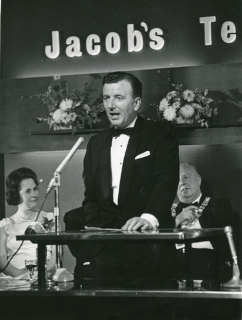
(Pictured: Photograph of director of Jacob’s Biscuits, Gordon Lambert, speaking from a podium at the first Jacob’s Television Awards. The Lord Mayor of Dublin, James O’Keefe, is sitting behind Lambert. The awards ceremony takes place at the Bishop Street factory, Dublin.)


Leave a comment

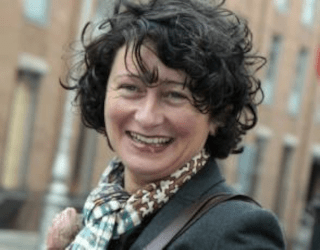
Birth of Fiona O’Malley, Former Irish Politician

Fiona O’Malley, Irish former politician, is born in Limerick, County Limerick, on January 19, 1968. She serves as a Senator from 2007 to 2011, after being nominated by the Taoiseach. She serves as a Teachta Dála (TD) for the Dún Laoghaire constituency from 2002 to 2007.

O’Malley comes from a political family. Her father, Desmond O’Malley, is a former Fianna Fáil cabinet minister and founder of the Progressive Democrats. Her granduncle, Donogh O’Malley, is a Fianna Fáil minister in the 1960s. She is also a cousin of another former Progressive Democrats TD, Tim O’Malley.

A graduate of Trinity College Dublin and City, University of London, O’Malley works as an Arts Administrator before entering politics and as a personal assistant to Liz O’Donnell from 1998 to 2000. Her first political position is as elected member of the Dún Laoghaire–Rathdown County Council from 1999. She is elected to Dáil Éireann for the Dún Laoghaire constituency at the 2002 Irish general election. She resigns her council seat in 2003 when the dual mandate comes into effect.

O’Malley is a member of the Oireachtas Committee on Arts, Sports and Tourism and the Oireachtas Committee on Health and Children. She is also a member of the Dáil All-Party group concerned with matters of sexual and reproductive health. She has traveled to South America and South Africa with the United Nations Population Fund and has spoken extensively of the need for a clear safe sex message both in Ireland and in the developing world.

O’Malley loses her Dáil seat at the 2007 Irish general election, but is nominated by the Taoiseach, Bertie Ahern, to the Seanad in August 2007. She is narrowly defeated in the race to become the leader of the Progressive Democrats by Ciarán Cannon.

O’Malley is an independent politician from the dissolution of the Progressive Democrats in 2009. She is an independent candidate at the 2011 Seanad election for the Dublin University constituency but is not elected.


Leave a comment

Birth of Donogh O’Malley, Fianna Fáil Politician & Rugby Union Player

Donogh Brendan O’Malley, Irish Fianna Fáil politician and rugby union player, is born on January 18, 1921, in Limerick, County Limerick. He serves as Minister for Education (1966-68), Minister for Health (1965-66) and Parliamentary Secretary to the Minister for Finance (1961-65). He also serves as a Teachta Dála (TD) for the Limerick East constituency (1954-68). He is best remembered as the Minister who introduces free secondary school education in the Republic of Ireland.

O’Malley is one of eight surviving children of Joseph O’Malley, civil engineer, and his wife, Mary “Cis” (née Tooher). Born into a wealthy middle-class family, he is educated by the Jesuits at Crescent College and later at Clongowes Wood College, County Kildare. He later studies at University College Galway (UCG), where he is conferred with a degree in civil engineering in 1943. He later returns to Limerick, where he works as an engineer before becoming involved in politics.

O’Malley plays rugby at provincial level for Munster, Leinster and Connacht and at club level for Bohemians and Shannon RFC. His chances at an international career are ruined by the suspension of international fixtures during World War II. It is at a rugby match in Tralee that he first meets Dr. Hilda Moriarty, who he goes on to marry in August 1947.

Although O’Malley runs as a Fianna Fáil candidate, he is born into a politically active family who supports Cumann na nGaedheal until a falling-out with the party in the early 1930s. He first becomes involved in local politics as a member of Limerick Corporation. He becomes Mayor of Limerick in 1961, the third O’Malley brother to hold the office (Desmond from 1941-43 and Michael from 1948-49). He is a strong electoral performer, topping the poll in every general election he runs in.

O’Malley is first elected to Dáil Éireann as a Fianna Fáil TD for Limerick East at the 1954 Irish general election. Fianna Fáil is not returned to government on that occasion. He spends the rest of the decade on the backbenches. However, his party is returned to power in 1957. Two years later, the modernising process begins when Seán Lemass takes over from Éamon de Valera as Taoiseach. Lemass introduces younger cabinet ministers, as the old guard who has served the party since its foundation in 1926 begin to retire.

In 1961, O’Malley joins the government as Parliamentary Secretary to the Minister for Finance. He is part of a new, brasher style of politician that emerges in the 1960s, sometimes nicknamed “the men in the mohair suits.” It is expected that this generation of politician, born after the Irish Civil War, will be a modernising force in post-de Valera Ireland.

Although his sporting background is in rugby and swimming, it is association football which O’Malley gets involved in at a leadership level, becoming President of the Football Association of Ireland despite never having played the sport.

Following Fianna Fáil’s retention of power in the 1965 Irish general election, O’Malley joins the cabinet as Minister for Health. He spends just over a year in this position before he is appointed Minister for Education, a position in which he displays renowned dynamism. Having succeeded Patrick Hillery, another dynamic young minister, he resolves to act swiftly to introduce the recommendations of an official report on education.

As Minister for Education, O’Malley extends the school transport scheme and commissions the building of new non-denominational comprehensive and community schools in areas where they are needed. He introduces Regional Technical Colleges (RTCs), now called Institutes of Technology, in areas where there is no third level college. The best example of this policy is the University of Limerick, originally an Institute of Higher Education, where O’Malley is credited with taking the steps to ensure that it becomes a university. His plan to merge Trinity College Dublin and University College Dublin arouses huge controversy, and is not successful, despite being supported by his cabinet colleague Brian Lenihan. Access to third-level education is also extended, the old scholarship system being replaced by a system of means-tested grants that give easier access to students without well-off parents.

Mid-twentieth century Ireland experiences significant emigration, especially to the neighbouring United Kingdom where, in addition to employment opportunities, there is a better state provision of education and healthcare. Social change in Ireland and policies intending to correct this deficit are often met with strong resistance, such as Noël Browne‘s proposed Mother and Child Scheme. As a former Health Minister, O’Malley has first-hand experience of running the department which had attempted to introduce this scheme and understood the processes that caused it to fail, such as resistance from Department of Finance and John Charles McQuaid. This influences his strategy in presenting the free-education proposal.

Shortly after O’Malley is appointed, he announces that from 1969 all education up to Intermediate Certificate level will be without cost, and free buses will bring students in rural areas to their nearest school, seemingly making this decision without consulting other ministers. However, he does discuss it with Lemass. Jack Lynch, who, as Minister for Finance, has to find the money to pay for the programme, is not consulted and is dismayed at the announcement.

By announcing the decision first to journalists and on a Saturday (during a month when the Dáil is in recess), the positive public reaction tempers resistance to the idea before the next cabinet meeting. O’Malley’s proposals are hugely popular with the public, and it is impossible for the government to go back on his word.

Some Irish commentators consider that O’Malley’s extension of education, changing Ireland from a land where the majority are schooled only to the age of 14 to a country with universal secondary-school education, indirectly leads to the Celtic Tiger boom of the 1990s-2000s when it is followed for some years by an extension of free education to primary degree level in university, a scheme that is launched in 1996 by the Labour Party and axed in 2009 by Fianna Fáil’s Batt O’Keeffe.

In 1967, O’Malley appoints Justice Eileen Kennedy to chair a committee to carry out a survey and report on the reformatory and industrial school systems. The report, which is published in 1970, is considered ground-breaking in many areas and comes to be known as the Kennedy Report. The Report makes recommendations about a number of matters, including the Magdalene laundries, in relation to which they are not acted upon. The report recommends the closure of a number of reformatories, including the latterly infamous reformatory at Daingean, County Offaly.

O’Malley’s reforms make him one of the most popular members of the government. He is affectionately known as “the School Man” for his work in education. His sudden death in Limerick on March 10, 1968, before his vision for the education system is completed, comes as a shock to the public. He is buried with a full Irish state funeral.

Following O’Malley’s death, his widow, Hilda O’Malley, does not run in the subsequent by-election for the seat he has left vacant. It is won narrowly by their nephew Desmond O’Malley. Hilda seeks the Fianna Fáil nomination for the 1969 Irish general election, but Fianna Fáil gives the party nomination to Desmond, as the sitting TD. Hilda runs as an Independent candidate in that election. After what proves a bitter campaign against her nephew, she fails to get the fourth seat in Limerick East by just 200 votes.


Leave a comment

Death of Pearse Hutchinson, Poet, Broadcaster & Translator

Pearse Hutchinson, Irish poet, broadcaster and translator, dies of pneumonia in Dublin on January 14, 2012.

Hutchinson is born in Glasgow, Scotland, on February 16, 1927. His father, Harry Hutchinson, a Scottish printer whose own father had left Dublin to find work in Scotland, is Sinn Féin treasurer in Glasgow and is interned in Frongoch internment camp in 1919–21. His mother, Cathleen Sara, is born in Cowcaddens, Glasgow, of emigrant parents from County Donegal. She is a friend of Constance Markievicz. In response to a letter from Cathleen, Éamon de Valera finds work in Dublin for Harry as a clerk in the Labour Exchange, and later he holds a post in Stationery Office.

Hutchinson is five years old when the family moves to Dublin and is the last to be enrolled in St. Enda’s School before it closes. He then goes to school at Synge Street CBS where he learns Irish and Latin. One of his close friends there is the poet and literary critic John Jordan. In 1948 he attends University College Dublin (UCD) where he spends a year and a half, learning Spanish and Italian.

Having published some poems in The Bell in 1945, Hutchinson’s poetic development is greatly influenced by a 1950 holiday in Spain and Portugal. A short stop en route at Vigo brings him into contact for the first time with the culture of Galicia. Later, in Andalusia, he is entranced by the landscape and by the works of the Spanish poets Federico García Lorca, Emilio Prados and Luis Cernuda.

In 1951 Hutchinson leaves Ireland again, determined to live in Spain. Unable to get work in Madrid, as he had hoped, he travels instead to Geneva, where he gets a job as a translator with the International Labour Organization, which brings him into contact with Catalan exiles, speaking a language then largely suppressed in Spain. An invitation by a Dutch friend leads to a visit to the Netherlands, in preparation for which he teaches himself the Dutch language.

Hutchinson returns to Ireland in 1953 and becomes interested in the Irish language poetry of writers such as Piaras Feiritéar and Aonghus Fionn Ó Dálaigh and publishes a number of poems in Irish in the magazine Comhar in 1954. The same year he travels again to Spain, this time to Barcelona, where he learns the Catalan and Galician languages, and gets to know Catalan poets such as Salvador Espriu and Carles Riba. With the British poet P. J. Kavanagh, he organises a reading of Catalan poetry in the British Institute.

Hutchinson goes home to Ireland in 1957 but returns to Barcelona in 1961 and continues to support Catalan poets. An invitation by the publisher Joan Gili to translate some poems by Josep Carner leads to the publication of his first book, a collection of thirty of Carner’s poems in Catalan and English, in 1962. A project to publish his translation of Espriu’s La Pell de brau (The Bull-skin), falls through some years later. Some of the poems from this project are included in the collection Done into English.

In 1963, Hutchinson’s first collection of original poems in English, Tongue Without Hands, is published by Dolmen Press in Ireland. In 1967, having spent nearly ten years altogether in Spain, he returns to Ireland, making a living as a poet and journalist writing in both Irish and English. In 1968, a collection of poems in Irish, Faoistin Bhacach (A Lame Confession), is published. Expansions, a collection in English, follows in 1969. Friend Songs (1970) is a new collection of translations, this time of medieval poems originally written in Galician-Portuguese. In 1972 Watching the Morning Grow, a new collection of original poems in English, comes out, followed in 1975 by another, The Frost Is All Over.

In October 1971, Hutchinson takes up the Gregory Fellowship in Poetry at the University of Leeds, on the recommendation of Professor A. Norman Jeffares. There is some controversy around the appointment following accusations, later retracted, that Jeffares had been guilty of bias in the selection because of their joint Irish heritage. He holds tenure at the University for three years, and during that time contributes to the University’s influential poetry magazine Poetry & Audience.

From 1977 to 1978 Hutchinsonn compiles and presents Oró Domhnaigh, a weekly radio programme of Irish poetry, music and folklore for Ireland’s national network, RTÉ. He also contributes a weekly column on the Irish language to the station’s magazine RTÉ Guide for over ten years. A collaboration with Melita Cataldi of Old Irish lyrics into Italian is published in 1981. Another collection in English, Climbing the Light (1985), which also includes translations from Irish, Italian and Galician, is followed in 1989 by his last Irish collection, Le Cead na Gréine (By Leave of the Sun). The Soul that Kissed the Body (1990) is a selection of his Irish poems translated into English. His most recent English collection is Barnsley Main Seam (1995). His Collected Poems is published in 2002 to mark his 75th birthday. This is followed in 2003 by Done into English, a selection of many of the translated works he produced over the years.

A co-editor and founder of the literary journal Cyphers, Hutchinson receives the Butler Award for Irish writing in 1969. He is a member of Aosdána, the state-supported association of artists, from which he receives a cnuas (stipend) to allow him to continue writing. He describes this as “a miracle and a godsend” as he is fifty-four when invited to become a member and is at the end of his tether. A two-day symposium of events is held at Trinity College Dublin, to celebrate his 80th birthday in 2007, with readings from his works by writers including Macdara Woods, Eiléan Ní Chuilleanáin, Paul Durcan and Sujata Bhatt. His most recent collection, At Least for a While (2008), is shortlisted for the Poetry Now Award.

Hutchinson lives in Rathgar, Dublin, and dies of pneumonia in Dublin on January 14, 2012. His extensive archive is in the library of Maynooth University. Its opening on May 24, 2015, is accompanied by the inauguration of an annual Pearse Hutchinson seminar and the launch of a collection of unpublished Hutchinson poems, Listening to Bach.

Some critics argue that Hutchinson’s concern with simplicity and Ireland’s place in the comparative history of human oppression too often deteriorates into banality, didacticism, and regurgitation of sentimental revivalist tropes. Even these, however, acknowledge his occasional greatness, while his champions argue that his achievement has not yet been fully recognised and absorbed.


Leave a comment

Birth of Edmund Henry Pery, 1st Earl of Limerick

Edmund Henry Pery, 1st Earl of Limerick PC, Irish peer and politician styled Lord Glentworth between 1794 and 1800 and Viscount Limerick until 1803, is born in Limerick, County Limerick, on January 8, 1758.

Pery is the son of William Cecil Pery, 1st Baron Glentworth, and his first wife, Jane Walcott, daughter of John Minchin Walcott. He is educated at Trinity College Dublin (TCD). He marries Alice Mary Ormsby, the daughter of Henry Ormsby of County Mayo, by his wife Mary Hartstonge, in 1783, and they have at least eight children. Alice Mary is the heiress of her uncle, Sir Henry Hartstonge, 3rd Baronet, who leaves her substantial property in the south of Ireland.

Pery is elected to the Parliament of Ireland as the Member of Parliament for Limerick City in 1786 and holds the seat until 1794, when he inherits his father’s barony and takes his seat in the Irish House of Lords. As a politician, he is a vocal Unionist. He holds the office of Keeper of the Signet and Privy Seal of Ireland between 1795 and 1797. In 1797, he is invested as a Privy Counsellor. He subsequently holds the office of Clerk of the Crown and Hanaper of Ireland between 1797 and 1806. In 1800, he is created Viscount Limerick of the City of Limerick.

Following the Acts of Union 1800, Pery becomes an Irish representative peer, sitting in the House of Lords between 1801 and 1844. He is created Earl of Limerick in the Peerage of Ireland on January 1, 1803, in recognition of his vocal and persistent support for the Union. In addition, he is created Baron Foxford of Stackpole Court in the Peerage of the United Kingdom on August 11, 1815, giving him and his descendants a permanent seat in the House of Lords. During this part of his life, he lives at South Hill Park, Berkshire, England.

Pery dies on December 7, 1844, at Bracknell, Bracknell Forest Borough, Berkshire, England. He is buried at St. Mary’s Cathedral, Limerick. His wife, Alice Mary, dies on June 13, 1850, in Marylebone, City of Westminster, Greater London, England. She is buried alongside her husband in Limerick.

Pery’s eldest son and heir, Henry Hartstonge Pery, Viscount Glentworth, predeceases him on August 7, 1834, and thus Pery is succeeded in his titles by Henry’s eldest son, William Henry Tenison Pery. One of Pery’s daughters, Theodosia, marries the Whig politician and Chancellor of the Exchequer, Thomas Spring Rice, 1st Baron Monteagle of Brandon.


Leave a comment

Death of Justin Keating, Politician, Broadcaster & Journalist

Justin Pascal Keating, Irish Labour Party politician, broadcaster, journalist, lecturer and veterinary surgeon, dies at Ballymore Eustace, County Kildare, on December 31, 2009. In later life he is president of the Humanist Association of Ireland.

Keating is twice elected to Dáil Éireann and serves in Liam Cosgrave‘s cabinet as Minister for Industry and Commerce from 1973 to 1977. He also gains election to Seanad Éireann and is a Member of the European Parliament (MEP). He is considered part of a “new wave” of politicians at the time of his entry to the Dáil.

Keating is born in Dublin on January 7, 1930, a son of the noted painter Seán Keating and campaigner May Keating. He is educated at Sandford Park School, and then at University College Dublin (UCD) and the University of London. He becomes a lecturer in anatomy at the UCD veterinary college from 1955 until 1960 and is senior lecturer at Trinity College Dublin from 1960 until 1965. He is RTÉ‘s head of agricultural programmes for two years before returning to Trinity College in 1967. While at RTÉ, he scripts and presents Telefís Feirme, a series for the agricultural community, for which he wins a Jacob’s Award in 1966.

In the 1950s and 1960s Keating is a member of the communist Irish Workers’ Party. He is first elected to the Dáil as a Labour Party Teachta Dála (TD) for the Dublin County North constituency at the 1969 Irish general election. From 1973 to 1977 he serves in the National Coalition government under Liam Cosgrave as Minister for Industry and Commerce. In 1973 he is appointed a Member of the European Parliament from the Oireachtas, serving on the short-lived first delegation.

During 1975 Keating introduces the first substantial legislation for the development of Ireland’s oil and gas. The legislation is modelled on international best practice and intended to ensure the Irish people would gain substantial benefit from their own oil and gas. Under his legislation the state could by right acquire a 50% stake in any viable oil and gas reserves discovered. Production royalties of between 8% and 16% with corporation tax of 50% would accrue to the state. The legislation specifies that energy companies would begin drilling within three years of the date of the issue of an exploration license.

Keating loses his Dáil seat at the 1977 Irish general election but is subsequently elected to Seanad Éireann on the Agricultural Panel, serving there until 1981. He briefly serves again in the European Parliament from February to June 1984 when he replaces Séamus Pattison.

In the aftermath of President of Iran Mahmoud Ahmadinejad‘s “World Without Zionism” speech in 2005, Keating publishes an op-ed in The Dubliner magazine, expressing his views on Israel. The article starts by claiming that “the Zionists have absolutely no right in what they call Israel.” He then proceeds to explain why he thinks Israel has no right to exist, claiming that the Ashkenazi Jews are descended from Khazars.

Keating dies at Ballymore Eustace, County Kildare, on December 31, 2009, at the age of 79, one week before his 80th birthday. Tributes come from the leaders of the Labour Party and Fine Gael at the time of his death, Eamon Gilmore and Enda Kenny, as well as former Fine Gael leader and Taoiseach John Bruton.


Leave a comment

Birth of Richard Orpen, Architect, Painter & Illustrator

Richard Francis Caulfield Orpen, Irish architect, painter, illustrator and designer, is born on December 24, 1863.

Orpen is born to Anne (née Caulfield) and Arthur Herbert Orpen, a solicitor of Oriel, Blackrock, Dublin. His maternal grandfather is the Bishop of Nassau, Charles Caulfield. He is the eldest of four brothers and two sisters. His youngest brother is William, the painter. He attends St. Columba’s College in Whitechurch, Dublin, and graduates from Trinity College Dublin (TCD) with a BA in 1885. While attending St. Columba’s, he publishes an Irish comic alphabet for the present times in 1881, which is a mix of cartoons and verse mocking Charles Stewart Parnell and the home rule movement.

Orpen wants to pursue painting, but “for family reasons” he becomes an architect. He spends eleven years with Thomas Drew, initially as a pupil, and later as a managing assistant from 1885 to 1892. From around 1884, he attends the annual excursions of the English Architectural Association. Around 1890, he establishes his own architectural practice in Drew’s offices at 22 Clare Street, Dublin. In 1896, he moves his office to 7 Leinster Street. In 1888 he is elected as a member of the Royal Institute of the Architects of Ireland (RIAI), serving as a council member from 1902 to 1910, as honorary secretary from 1903 to 1905, and as president from 1914 to 1917. He designs the institute’s official seal in 1909. In 1904, the Irish Builder describes him as the “originator of the bungalow in Ireland.”

From 1888, Orpen exhibits with the Royal Hibernian Academy (RHA), with watercolours and architectural drawings. He continues to exhibit with them until 1936. He collaborates with Percy French on a number of projects, including illustrating Racquetry Rhymes (1888) and The First Lord Liftinant and Other Tales (1890). He provides cartoons for French’s periodical, The Jarvey. His architectural illustrations are included in H. Goldsmith Whitton’s Handbook of the Irish Parliament Houses… (1891). He is one of the original members of the Architectural Association of Ireland, serving as its first president in 1896, and as vice-president in 1910.

Orpen is appointed the architect to St. Columba’s from 1897 to 1938, following a fire at the college in 1896. He becomes a fellow of the college, and the sanatorium becomes known as the Orpen building. He is an active member of the Arts and Crafts Society of Ireland, serving as secretary in 1895, on the committee in 1904, and in 1917 sits on the organising committee for the fifth exhibition. In 1906, he is a founding member of the Arts Club. In 1906 he moves his architectural practice to 13 South Frederick Street, and moves into a house he designed, Coologe, Carrickmines, County Dublin.

At the 1907 Irish International Exhibition, Dublin, Orpen exhibits a number of chalk drawings. The same year he designs the cover of a satirical pamphlet, The Abbey row, not edited by W. B. Yeats, which mocks The Arrow and the riots at the first production of The Playboy of the Western World. He unveils a bust of Hugh Lane at the opening of the Municipal Gallery of Modern Art on Harcourt Street in 1908. He is appointed secretary to the municipal gallery committee by Lane. In 1910, he is appointed architect to Christ Church Cathedral, as well as architect to St. Canice’s Cathedral, Kilkenny, and St. Patrick’s Cathedral, Dublin. In 1911 he is elected an associate of the Royal Hibernian Academy, a full member in 1912, and was the academy’s secretary from 1925 to 1937.

From 1910 to 1914, Orpen is in an architectural partnership with Page Dickinson, with the two collaborating on plans for the new Dublin municipal gallery and conversion of the Turkish Baths, Lincoln Place. Lane rejects his and Dickinson’s gallery plans, leading to him refusing to work with Lane’s choice of architect, Sir Edwin Lutyens. In 1914, he is appointed a guardian of the National Gallery of Ireland, and lectures at the Dublin Metropolitan School of Art on architectural history in 1914 and 1915. He is involved in the design of a number of memorials including the setting for a bronze relief by Beatrice Campbell for the members of the Royal Irish Regiment killed in the Second Boer War and the war memorial at the Rathgar Methodist church. He serves as president of the arts and crafts section of the Royal Dublin Society (RDS). He is also a governor of the Royal National Hospital for Consumption for Ireland in Newcastle, County Wicklow.

Orpen marries Violet Caulfield in 1900. They are both descended from William Caulfeild, 1st Viscount Charlemont. He dies on March 27, 1938, at his home, Coologe, and is buried in Dean’s Grange Cemetery.

Orpen features as one of the many portraits in Seán Keating‘s Homage to Sir Hugh Lane. St. Columba’s College holds a portrait of Orpen by his brother, William, as well as a memorial stained-glass window to him by Catherine O’Brien.


Leave a comment

Death of Lucius Gwynn, Academic & Sportsman

Lucius Henry Gwynn, Irish academic and sportsman who is noted for his prowess in both rugby union football and cricket, dies in Davos Platz, Switzerland, on December 23, 1902.

Gwynn is born in Ramelton, County Donegal, on May 5, 1873. He is a member of a family well known in Dublin at the time for its academic and sporting achievements. He is the fourth son of the Very Rev. John Gwynn, Regius Professor of Divinity at Trinity College Dublin (TCD), and Lucy Josephine, daughter of the Irish patriot William Smith O’Brien. He and his three immediate younger brothers, Arthur, Robin and Jack, all in turn captain their school and university cricket teams and play the game at first class level. He is also a talented rugby player.

Gwynn’s academic career outshines even his sporting achievements. He enters Trinity College Dublin as a foundation Scholar and achieves a double first in his degree finals. In 1899 he is elected a Fellow of Trinity College and commences what promises to be a distinguished academic career.

At school Gwynn is mainly a bowler, his brother Arthur being the superior bat, though this inequality is ironed out at university. He is captain of the Dublin University Cricket Club XI for two seasons, 1894 and 1895, then plays under Arthur’s captaincy. The three brothers make up a formidable threesome in those years.

Primarily noted for his bowling prowess during early outings with the Dublin University XI, Gwynn takes 44 wickets at an average of 8.14 in Trinity’s annus mirabilis of 1893, a season which witnesses victories over Leicestershire, Oxford University, Warwickshire (dismissed for a paltry total of 15 runs) and a draw against Essex.

Gwynn, a right-handed batsman, who records the highest first-class average (56.87) among those batsmen who complete ten innings or more during the English season of 1895, enjoys another remarkably productive season in 1896, plundering over a thousand runs in Trinity flannels, a superlative effort complemented by a haul of 93 wickets at 9.37. His irrepressible form reputedly earns him an invitation to represent England against Australia in the second Ashes Test at Old Trafford in July 1896. However, concurrent university examinations render him unable to participate. Instead, English cricket is introduced to the wizardry of K. S. Ranjitsinhji, who takes Gwynn’s place.

Gwynn makes his debut for Ireland against I Zingari in July 1892 and goes on to play for Ireland 13 times, his last game coming in May 1902 against Marylebone. Two of his matches for Ireland have first-class status.

Gwynn also plays first-class cricket in two Gentlemen v Players matches, representing the gentlemen, and four matches for Dublin University in 1895, for whom he makes his top score of 153 not out against Leicestershire. In all, he amasses 3,195 runs and 311 wickets for Dublin University, in addition to 499 runs and 14 wickets for Ireland.

Remarkably, Gwynn also represents Ireland seven times at rugby union, debuting against Scotland at Belfast in February 1893. He features in all three legs of Ireland’s 1894 Triple Crown-winning campaign.

In 1901 Gwynn marries Katharine Rawlins of Bristol. He is already suffering from persistent symptoms of debility and fatigue. A few months later a Harley Street physician diagnoses tuberculosis. He is admitted to a sanatorium at Davos Platz in Switzerland, but the illness has progressed too far for any treatment to succeed. He dies on December 23, 1902, at the age of 29. The couple’s only child, a daughter named Rhoda, is born in September 1902, just three months before his death.