The passage of the Bill through Parliament causes acrimony between the House of Commons and the House of Lords. Queen Victoria personally intervenes to mediate. While the Lords extort from the Commons more compensation to alleviate the disestablished churchmen, in the end, the will of the Commons prevail.
The Irish Church Act is a key move in dismantling the Protestant Ascendancy which had dominated Ireland for several centuries previously.
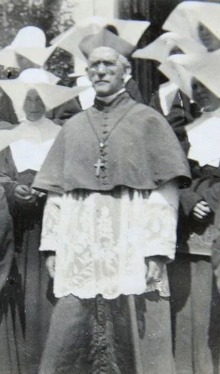
Cohalan is an outspoken critic during the Irish War of Independence, condemning acts of violence on both sides. In particular, he denounces the policy of reprisals. In July 1920, he pronounces an interdict on the killers of a Royal Irish Constabulary (RIC) sergeant, shot dead in the church porch in Bandon. He declares that anyone killing from ambush will be excommunicated. On December 12, 1920, Cohalan issues a decree saying that “anyone within the diocese of Cork who organises or takes part in ambushes or murder, or attempted murder, shall be excommunicated.” In turn, his life is threatened by the Irish Republican Army (IRA). In August 1928, he condemns the British government which had allowed Terence MacSwiney to die on hunger strike in 1920.
The Bessborough Home in Cork is run by the Sisters of the Sacred Hearts of Jesus and Mary and when the department “sought a change of superior in Bessborough because of the appallingly high death rate, he [Catholic Bishop of Cork Dr. Daniel Cohalan] denounced the request. The replacement of the Bessborough superior was delayed for four years after the department requested it, and many infants died during that time. It seems probable that the bishop’s intervention was elicited by the congregation.” In general, the report finds that the major causes of infant mortality in the homes were respiratory infections and gastroenteritis, while “public attention has focused on marasmus [malnutrition]” suggesting “willful neglect.” However, it says that “the term marasmus is best seen as indicating that a child was failing to thrive, but medical experts suggest that this was due to an underlying, undiagnosed medical condition.”
Cohalan dies in office at the age of 94 at Bon Secours Hospital, Cork, on August 24, 1952. A story, current at the time in Cork, refers to his antipathy towards bishops of the Church of Ireland who styled themselves “Bishop of Cork.” A month before his death, and on his deathbed, word is brought to him of the death of the Church of Ireland Bishop of Cork, Cloyne and Ross, Robert Hearn. The response of Cohalan, known “affectionately” as “Danny Boy”, is reputedly, “now he knows who’s Bishop of Cork.”
Lawless’s grandfather is Valentine Lawless, 2nd Baron Cloncurry, a member of the Society of United Irishmen and son of a convert from Catholicism to the Church of Ireland. Her father is Edward Lawless, 3rd Baron Cloncurry, thus giving her the title of “The Honourable.” In contrast, her brother Edward Lawless is a landowner with strong Unionist opinions, a policy of not employing Roman Catholics in any position in his household, and chairman of the Property Defence Association set up in 1880 to oppose the Irish National Land League and “uphold the rights of property against organised combination to defraud.” The prominent Anglo-Irish unionist and later nationalist, Home Rule politician Horace Plunkett is a cousin. Lord Castletown, Bernard FitzPatrick, 2nd Baron Castletown is also a cousin. It is widely believed that she is a lesbian and that Lady Sarah Spencer, dedicatee of A Garden Diary (1901) is her lover.
Lawless spends part of her childhood with the Kirwans of Castle Hackett, County Galway, her mother’s family, and draws on West of Ireland themes for many of her works. She occasionally writes under the pen name “Edith Lytton.”
Lawless writes nineteen works of fiction, biography, history, nature studies and poetry, many of which are widely read at the time. She is most famous today for her Wild Geese poems (1902).
Some critics identify a theme of noble landlord and noble peasant in her fourth book, Hurrish, a Land War story set in The Burren of County Clare which is read by William Ewart Gladstone and said to have influenced his policy. It deals with the theme of Irish hostility to English law. In the course of the book a landlord is assassinated, and Hurrish’s mother, Bridget, refuses to identify the murderer, a dull-witted brutal neighbour. The book is criticised by Irish-Ireland journals for its “grossly exaggerated violence,” it’s embarrassing dialect, staid characters.
Her reputation is damaged by William Butler Yeats who accuses her in a critique of having “an imperfect sympathy with the Celtic nature” and for adopting “theory invented by political journalists and forensic historians.” Despite this, Yeats includes her novels With Essex in Ireland (1890) and Maelcho (1894) in his list of the best Irish novels.
Doyle is born close to New Ross, County Wexford in 1786, the posthumous son of a respectable Catholic farmer. His mother, Anne Warren, of Quaker extraction, is living in poverty at the time of his birth. At the age of eleven he witnesses the horrors of the Battle of New Ross between the United Irishmen and British Crown forces supplemented by the militia and yeomanry.
Doyle receives his early education at Clonleigh, at Rathconrogue at the school of a Mr. Grace, and later at the Augustinian College, New Ross under the care of an Augustinian monk, Rev. John Crane.
Doyle joins the Augustinian friars in 1805 at Grantstown, County Wexford, and then studies for his doctorate at Coimbra in Portugal (1806–08). His studies are disturbed by the Peninsular War, during which he serves as a sentry in Coimbra. Later, he accompanies the British Army with Arthur Wellesley‘s forces to Lisbon as an interpreter.
Following Doyle’s return to Ireland, he is ordained to the priesthood on October 1, 1809, at Enniscorthy. He teaches logic at the Augustinian College, New Ross. In 1813, he is appointed to a professorship at St. Patrick’s, Carlow College, holding the Chair of Rhetoric and in 1814, the Professorship of Theology.
Michael Corcoran, Bishop of Kildare and Leighlin, dies on February 22, 1819. Doyle is a popular choice of the clergy and bishops of the Archdiocese of Dublin and is chosen by the Holy See as Corcoran’s successor. He is formally named in August 1819 and is duly consecrated in Carlow Parish Church on November 14. During his fifteen-year tenure as Bishop of Kildare and Leighlin, he earns respect nationwide for his polemics in furtherance of the Catholic position in both Irish and British society, and in supporting the work of the Catholic Association. His books on pastoral, political, educational and inter-denominational matters provide a rich source of material for social and religious historians. He is a close ally of Daniel O’Connell in the political campaign for Catholic emancipation which is finally passed in 1829 by the Wellington government.
In 1830, the new tithe-proctor of Graigue, a parish of 4,779 Catholics and 63 Protestants, decides to break with the tradition of Doyle’s predecessor and to enforce seizure orders for the collection of arrears of Tithes. Tithes provide financial support of the established AnglicanChurch of Ireland. Some of the recalcitrant Catholics habitually transfer ownership of their livestock to Doyle in order to avoid seizure at the town fair. The new proctor requests their priest’s cooperation in handing over the assets. Doyle refuses, and the proctor, aided by the Royal Irish Constabulary, seize some of the livestock. A mass riot breaks out at the fair and there is several casualties. A civil disobedience campaign follows, peppered with sporadic violence mostly at county fairs over the seizure of livestock. A period of instability that becomes known as the Tithe War follows.
Doyle is a leader of nonviolent resistance to the Tithe, devoting himself both to strengthening the nonviolent resistance and to discouraging like paramilitary secret societies who have taken to using violence to drive out tithe-collectors and to intimidate collaborators. He says, “I maintain the right which [Irish Catholics] have of withholding, in a manner consistent with the law and their duty as subjects, the payment of tithe in kind or in money until it is extorted from them by the operation of the law.”
Given Doyle’s prior experience in education, his major contribution is arguably in helping the establishment of National Schools across Ireland from 1831, the initiative of Edward Smith-Stanley, Chief Secretary for Ireland, which are initially started with a UK government grant of £30,000. The proposed system is ahead of state provision for education in England or Scotland at that time. This Model School prototype is, in some respects, experimental. His involvement is a sign of his practicality and foresight.
Doyle makes statements on other issues: the theological status of ‘non-Catholic’ Christians, freedom to convert to Protestantism, mixed marriages and, as already mentioned, on the union of Catholics and Anglicans. On this last issue he is asked to resign by Rome and is eventually allowed to continue after agreeing not to speak on the issue again.
The construction of Carlow Cathedral of the Assumption crowns Doyle’s career, being started in 1828 and finished at the end of November 1833. He falls ill for a number of months before dying on June 15, 1834. He is buried in his new cathedral. A sculpture, by John Hogan, in memorial to Doyle is finished in 1839.
Several biographies are written on Doyle before 1900 and his influence on the later Irish Catholic bishops in the period 1834-1900 is considerable. He had proved that negotiations with government could be beneficial to his church, his congregation, and its finances.
William of Orange, King of Holland, and recently declared King William III of England, arrives with his fleet in Belfast on June 14, 1690. He remains for twelve days, departing on June 26. For his part he likes what he sees. “This country is worth fighting for,” he says.
William’s departure from London is held up by parliamentary business until the end of May, when he announces that he can wait no longer and adjourns Parliament. He sets out early in the morning of June 4, reaching Northampton before nightfall. On Sunday, June 8, he attends divine service in Chester Cathedral and goes on to inspect the ships at Hoylake on the tip of the Wirral Peninsula.
For two days the wind is contrary, but on June 11 he embarks on board the yacht “Mary” with a fleet escorted by Sir Cloudesley Shovell‘s squadron. On June 14 the hills of Ireland come in sight and in the afternoon the fleet casts anchor off Carrickfergus. He is rowed ashore in the Rear Admiral’s barge and at about 3:30 p.m. lands at the Old Quay under the shadow of the great Norman Castle.
The Garrison of the Castle has drawn up a Guard of Honour and the townspeople add their applause. The chosen spokesman is a Quaker, whose principles forbid him to doff his hat or use such titles as Sir and Majesty. He gets around the difficulty by taking off his hat and laying it on a stone and then stepping forward and saying “William, thou art welcome to thy Kingdom” which pleases the King so much that he replies, “You are the best-bred gentleman I have met since I came to England.” With these words he mounts his horse and sets off for Belfast.
Halfway along the shore is the little port of Whitehouse, where most of the army disembarks. The Commander-in-Chief, Frederick Schomberg, 1st Duke of Schomberg, and his senior commanders are waiting here to welcome the King. To cover the disembarkation, earthworks have been thrown up by the engineers at Fort William and garrisoned by troops ready for action.
In 1690 Belfast consists of about 300 houses in five streets. It has two churches, the Parish Church, where St. George’s Church still stands in the High Street, and the Presbyterian Meeting House in Rosemary Lane. The town had been surrounded by a rampart in 1642 and had been captured by Colonel Robert Venebles for Oliver Cromwell after a four-day siege and an assault on the North Gate in 1649.
It is at the North Gate that King William enters Belfast where North Street now crosses Royal Avenue. Here he is welcomed by the magistrates and burgesses in their robes and by the Rev. George Walker, now Bishop-elect of Derry. A Royal Salute is fired from the Castle and is echoed and re-echoed by the guns which Schomberg had placed at wide intervals for the purpose of conveying signals from post to post. Wherever it is heard it is known that King William has come. Before midnight all the heights of Antrim and Down are blazing with bonfires.
The next day being Sunday, William attends church at the Corporation Church, now St. George’s Church. On Monday, June 16, addresses of loyalty are presented on behalf of the Church of Ireland and Presbyterian Church clergy, the civic authorities of the city of Londonderry, the town of Belfast and by the Sheriffs, Justices of the Peace and Gentlemen of the Counties of Down and Antrim. The next two days are spent in military preparation.
In the previous season Schomberg had conducted a slow and cautious campaign but William says he has not come to Ireland to let the grass grow under his feet. He orders a general muster of the army in the Parish of Aghaderg which includes Scarvagh and on Thursday, June 19, begins his southward march from Belfast Castle.
The line of march continues along Upper Malone by the Old Coach Road and past the ruins of both Drumbeg and Lambeg Parish Churches which had been burned down in 1641. William reaches Schomberg’s headquarters in Lisburn Castle for lunch on the same day that he left Belfast Castle. The afternoon and evening are spent inspecting troops on Blaris Moor, and then on to Hillsborough Castle for the night.
The cavalcade moves on through the little round hills of County Down, crosses the Upper Bann between Huntly and Ballievey by ford over the hill of Banbridge and on to the rendezvous on the northwest of Loughbrickland.
After the disappointments of the previous season and the appalling loss of life through disease, Schomberg had dispersed his army into winter quarters all over Ulster. The Derry and Enniskillen men had gone home to pick up the threads of their lives. Now the farmers among them have the crop in and are recalled to the colours and ready to be reviewed. There are four regiments of Enniskillen men – Wynns, Tiffins, Lloyds and Cunninghams, one of foot and three of horse. There is only one regiment of Derry men, St. John’s, commanded by Mitchelburne with Rev. George Walker as chaplain.
On June 22, William sits in the saddle for hours reviewing his 36,000 men. Marching past are 10,000 Danes, some of whom came from Norway and Sweden, and even Finland, 7,000 Dutch and Brandenburgers, 2,000 French Huguenots, 11,000 English and Scots, 800 Derrymen, 4,500 Inniskilleners and two companies from Bandon, County Cork.
On June 24, an advance party reaches beyond Newry to the edge of Dundalk and brings intelligence that the deposed King James II has fallen back on Ardee. The following day the main army advances to Newry and camps on the side of a hill. On June 25, with the King at their head, wearing an Orange colour sash, they go through the Moyry Gap and pass out of Ulster en route to the Boyne.
St. Mary’s Church, Belfast, a Roman Catholic church located in Chapel Lane/Smithfield area of Belfast, Northern Ireland, opens for public worship on May 30, 1784. It is mother church for the city. At the time, it is the only Roman Catholic church in the then town of Belfast after the relaxation of some of the Penal Laws. The church grounds contain an undistinguished grotto dedicated to Our Lady of Lourdes.
In the census of 1782, there are only 365 Catholics recorded living in Belfast. Following a collection from the local Church of Ireland and Presbyterian congregations, funds are donated to the building of St. Mary’s Church.
The first Mass is celebrated on Sunday, May 30, 1784, by Father Hugh O’Donnell, the first Parish Priest of Belfast. In the opening ceremony, a company of the Irish Volunteers line the chapel yard and escort Father O’Donnell into the building.
In 1813, the church’s pulpit is donated by the Anglican Vicar of Belfast, Canon Turner, continuing the positive relationship between the Roman Catholic church and the local Protestant congregations. Later, in 1815, St. Patrick’s Church is built to accommodate the growing Catholic population of the city.
As Belfast’s Catholic population grows after the famine, the church is deemed too small and thus architect John O’Neill is contracted to design a church big enough for the burgeoning congregation. Although none of the original church can be seen, in 1868 the church is enlarged and renovated into a new Romanesque style building.
In the Marian Year of 1954 a Grotto to Our Lady of Lourdes is established under the auspices of the then Administrator, Fr. Bernard MacLaverty, an uncle of the Belfast novelist of the same name. The grotto is created in the gardens surrounding the church by the Belfast architect Padraic Gregory.
To mark the bicentenary the sanctuary is renovated in 1983 with work by artist Roy Carroll, a favourite of Cahal Daly. Much of this timber furniture is later removed after Daly’s departure from the Diocese of Down and Connor.
In May–August 2017, the church undergoes substantial renovation work to repair the roof and walls, and to repave the grotto area.
For almost forty years the church is served by clergy from the Mill Hill Fathers, the last of whom leave in 2019. The current Administrator is Fr. Timothy Bartlett assisted by a range of retired clergy. The church holds two masses a day on Sunday and Monday, and three a day on Friday and Saturday. The 6:00 p.m. Mass on both Friday and Saturday are held in the Irish language.
Keane is born Mary Nesta Skrine on July 20, 1904 in Ryston Cottage, Newbridge, County Kildare. Her mother is a poet who writes under the pseudonym Moira O’Neill. Her father is a fanatic for horses and hunting. She grows up at Ballyrankin House on the banks of the River Slaney, a few miles southeast of Bunclody, County Wexford and refuses to go to boarding school in England as her siblings had done. She is educated by her mother, governesses, and at a boarding school in Bray, County Wicklow. Relationships between her and her parents are cold and she states that she had no fun in her life as a child. Her own passion for hunting and horses is born out of her need for fun and enjoyment. Reading does not feature much in her family, and, although her mother writes poetry, it is of a sentimental nature, “suitable to a woman of her class.”
Keane claims she had never set out to be a writer, but at seventeen she is bed bound due to suspected tuberculosis, and turns to writing out of sheer boredom. It is then she writes her first book, The Knight of Cheerful Countenance, which is published by Mills & Boon. She writes under the pseudonym “M. J. Farrell,” a name over a pub that she had seen on her return from hunting. She explains writing anonymously because “for a woman to read a book, let alone write one was viewed with alarm: I would have been banned from every respectable house in County Carlow.”
In her teenage years Keane spends much of her time in the Perry household in Woodruff, County Tipperary. Here she befriends the two children of the house, Sylvia and John Perry. She later collaborates with John in writing a number of plays. Among them is Spring Meeting, directed by John Gielgud in 1938, and one of the hits of the West End that year. She and Gielgud become life long friends.
It is through the Perry family that Keane meets Bobby Keane, whom she marries in 1938. He belongs to a Waterford squirearchical family, the Keane baronets. The couple goes on to have two daughters, Sally and Virginia.
Keane loves Jane Austen, and like Austen’s, her ability lay in her talent for creating characters. This, with her wit and astute sense of what lay beneath the surface of people’s actions, enables her to depict the world of the big houses of Ireland in the 1920s and 1930s. She “captured her class in all its vicious snobbery and genteel racism.” She uses her married name for her later novels, several of which (including Good Behaviour and Time After Time) have been adapted for television. Between 1928 and 1956, she writes eleven novels, and some of her earlier plays, under the pseudonym “M. J. Farrell.” She is a member of Aosdána.
Keane’s husband dies suddenly in 1946, and, following the failure of a play, she publishes nothing for twenty years. In 1981 Good Behaviour comes out under her own name. The manuscript, which had languished in a drawer for many years, is loaned to a visitor, the actress Peggy Ashcroft, who encourages Keane to publish it. The novel is warmly received and is short-listed for the Booker Prize.
Following the death of her husband, Keane moves to Ardmore, County Waterford, a place she knows well, and lives there with her two daughters. She dies on April 22, 1996 in her Cliffside home in Ardmore at the age of 91. She is buried beside the Church of Ireland church, near the centre of the village.
O’Brien is born Ellen Lucy O’Brien on June 4, 1864, at Cahirmoyle, County Limerick. She is the eldest child of Edward William O’Brien and Mary O’Brien (née Spring Rice). Her siblings are Lucy and Dermod, with Dermod also becoming an artist. Her father is a landowner, and her mother is a sculptor and painter and sister of Thomas Spring Rice. Her grandfather is William Smith O’Brien.
While a young child, O’Brien spends two years living on the French Riviera from 1866 to 1868. Her mother later dies of tuberculosis, and the three children are raised by their aunt, the writer and nationalist, Charlotte Grace O’Brien. Their father remarries in 1880, to Julia Marshall, with whom he has two sons and two daughters.
O’Brien attends school in England from 1879, and later enrolls to study painting at the Slade School of Fine Art. She meets Walter Osborne through her brother Dermod, and considers herself engaged to him, but Osborne dies on April 24, 1903. A portrait of O’Brien by Osborne is held in the Hugh Lane Gallery.
O’Brien returns to Ireland and begins to paint miniatures on ivory using a magnifying glass. She also paints watercolour landscapes. Her first exhibition with the Royal Hibernian Academy (RHA) is in 1896, where she shows three works including Sketch near Malahide. She exhibits with the RHA on and off until 1922. During some of her time in Dublin, she lives with her half-brother, Edward Conor Marshall O’Brien, on Mount Street.
As part of an exhibition of Irish painters, O’Brien exhibits a number of portrait miniatures at the London Guildhall in 1904. The 1906 Oireachtas na Gaeilge features a number of her paintings, and in the same year she becomes honorary secretary of a newly established art committee. At the Munster–Connacht exhibition in Limerick of 1906, she exhibits a miniature of William Smith O’Brien amongst her 12 works on show. She produces many portraits, including one of Douglas Hyde, which is exhibited by the RHA in 1916.
O’Brien is an early member of the Gaelic League, being present at its first Oireachtas na Gaeilge in 1897 and founding the Craobh na gCúig gCúigí (Branch of the Five Provinces). In 1905, she writes a long letter in defence of Douglas Hyde and the Gaelic League in The Church of Ireland Gazette. She holds meetings of Craobh na gCúig gCúigí in her flat at 7 St. Stephen’s Green every Saturday night in 1907. In 1911, she founds Coláiste Eoghain Uí Chomhraí (O’Curry Irish College) in Carrigaholt, County Clare, which is named in honour of Eugene O’Curry, with the help of her cousin and friend Mary Spring Rice.
One of her ultimate goals is to create a national Irish church, which would unite Protestants and Catholics through the Irish language. To this end, she establishes the Irish Guild of the Church with Seoirse de Rút in 1914. The aim of the organisation is to provide a communal union for members of the Church of Ireland who are dedicated to “Irish Ireland” ideals.
Acting as a representative for the Gaelic League, she travels to the United States with Fionan MacColuim in 1914 to 1915, to fund raise and promote Irish art and industries. At Coláiste Eoghain Uí Chomhraí, she stresses the importance of the Irish language in the home, as well as the skills of housewives and those in domestic service in strengthening the language and Irish culture.
O’Brien notes that she initially thought that the 1916 Easter Rising was “in the nature a demonstration against conscription as it had been announced that the volunteers would resist disarmament.” She is staying with the Hydes at 1 Earlsfort Place during the Rising, as her flat at College Park Chambers had been destroyed. She protests the conscription bill in Ireland as a mass meeting of women at the Mansion House in 1918. She launches the Gaelic Churchman in 1919 as the official publication of the Irish Guild of the Church. In one article entitled A plea for the Irish services, she promotes her campaign for Irish language services in Protestant churches. In her capacity of vice-president of the guild, she invites Éamon de Valera to attend one of their meetings in 1921.
O’Brien dies suddenly on April 1, 1925, while visiting Dermod at 66 Elm Park Gardens, London. She is buried at the family plot in Cahirmoyle.
(Pictured: Nelly O’Brien by Sir Joshua Reynolds, 1723-1792)
Bullock is born on May 17, 1865 at Inisherk, County Fermanagh just outside the County Cavan border near Belturbet, in what is now Northern Ireland. His father, Thomas Bullock, is a strict man who has eleven children and drives several to emigration because of his stern demeanour. Thomas Bullock works on the Crom Castle estate which runs along the Cavan/Fermanagh border and has both Catholic and Protestant workers. Protestant workers have the prime jobs and are employed as craftsmen and supervisors while Catholics work in the outer area of the estate at unskilled jobs. Folk memories of the Battle of Newtownbutler in 1689 remain long in the memory in the area where up to 1,500 Jacobite troops are hacked down or drowned in Upper Lough Erne when pursued by the Williamite cavalry. Many of the Williamite army is drawn from the local Protestant population.
Bullock is educated at Crom estate primary school run by the Church of Ireland and Farra School near Bunbrosna, County Westmeath. He fails the entrance exams at the University of Dublin. He tries his hand at farming but finds he is not suited. He moves to London in 1883 and becomes a Civil Service clerk. He takes to journalism to supplement his salary and publishes his first book of stories, The Awkward squads, in 1893. His stories are centered on Irish Catholic and Protestant small farmers and labourers and their struggles and tensions. He marries Emma Mitchell in 1899 and they have a son and daughter.
Bullock is well respected in literary circles but his books are never successful enough for him to become a full time writer. He says that the English are not interested in Irish stories and that there is no reading public in Ireland. He dislikes Orangesectarianism and is ambivalent to Irish nationalism. His novel The Red Leaguers looks at sectarianism conflict and Robert Thorne examines the lives of London clerks which is a popular theme at the time. His last and best novel The Loughsiders is published in 1924 and is the story of a conniving smallholder based on William Shakespeare’s Richard III.
Bullock’s wife dies in 1922. He spends the final years of his life in Sutton, Surrey and dies there on February 27, 1935.
Bullock’s daughter presents his literary papers, including two unpublished novels, two plays, numerous short stories and essays, and some correspondence to the Queen’s University Belfast library in the 1960s. A portrait of Bullock by Dermod O’Brien, RHA, is also at Queen’s University Belfast. His correspondence with Sir Horace Plunkett is in the archives of the Plunkett Foundation, Long Hanborough Business Park, Woodstock, Oxfordshire. Enniskillen public library has a collection of cuttings on Bullock, including some photocopied letters.
Jellett marries his cousin on his mother’s side, Dorothea Charlotte Morris Morgan, daughter of James Morgan, on July 7, 1855. The marriage produces seven children. His son, William Morgan Jellett, is a member of the Parliament of the United Kingdom and is the father of the celebrated artist Mainie Jellett, and of Dorothea Jellett, director of the orchestra of the Gaiety Theatre, Dublin. Another son Henry Holmes Jellett is a civil engineer in British India. His daughter Harriette Mary Jellett is the wife of the noted Irish physicistGeorge Francis FitzGerald. Another daughter Eva Jellett is the first woman to graduate with a degree in medicine from Trinity and goes on to practice as a doctor in India.
Jellett graduates B.A. in mathematics in 1837, M.A. 1843, B.D. 1866, and D.D. 1881. He is ordained a priest in 1846. In 1848 he is elected to the chair of natural philosophy at TCD, and in 1868 he receives the appointment of commissioner of Irish national education.
In 1851 Jellett is awarded the Cunningham Medal of the Royal Irish Academy for his work on the “Calculus of Variations.” The society later elects him their president, a position he holds from 1869 to 1874.
In 1870, on the death of Dr. Thomas Luby, Jellett is co-opted a Senior Fellow, and thus a member of the Board of TCD. William Ewart Gladstone‘s government in February 1881 appoints him provost of Trinity. In the same year he is awarded a Royal Medal by the Royal Society.
After the disestablishment of the Church of Ireland by the Irish Church Act 1869, Jellett takes an active part in the deliberations of the general synod and in every work calculated to advance its interests. He is an able mathematician and writes A Treatise of the Calculus of Variations (1850), and A Treatise on the Theory of Friction (1872), as well as several papers on pure and applied mathematics, articles in the Transactions of the Royal Irish Academy. He also writes some theological essays, sermons, and religious treatises, of which the principals are An Examination of some of the Moral Difficulties of the Old Testament (1867), and The Efficacy of Prayer (1878).
Jellett dies of blood poisoning at the provost’s house, TCD, on February 19, 1888, and is buried in Mount Jerome Cemetery on February 23. The funeral procession is the largest that ever left Trinity.
(Pictured: “John Hewitt Jellett,” oil on canvas by Sarah Purser)