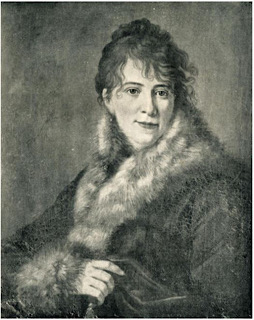
Katherine Wilmot, Irish traveler and diarist, dies in Paris, France, on March 28, 1824. She makes a Grand Tour from 1801 to 1803 and documents her experiences through letters, including encounters with notable figures like Napoleon Bonaparte. She later travels to Russia to join her sister Martha Wilmot and lives there from 1805 to 1807. She later moves to France and dies in Paris in 1824. Her writings, letters, and diaries provide insight into the Napoleonic era, on Russian society and on travel in the 19th century. Her works also include her sister’s transcript of the memoirs of Princess Yekaterina Vorontsova-Dashkova.
Wilmot is born around 1773 in Drogheda, County Louth, to Edward and Martha Wilmot (née Moore). She is the eldest daughter of six daughters and three sons. Her father is the port surveyor in Drogheda, having previously served as captain in the 40th Regiment of Foot. He is transferred to a similar post in County Cork in 1775, where Wilmot is raised. The family settles in Glanmire, near the seat of the Earl Mount Cashell in Moore Park. The earl’s family uses the surname Moore.
Wilmot is friendly with Lady Mountcashell, formerly Margaret King, an early and eager pupil of Mary Wollstonecraft. She is invited to accompany the party of Stephen Moore, 2nd Earl Mount Cashell, and his wife on a grand tour of the continent. Her letters from the time survive, in France from November 1801 to October 1802, and in Italy until July 1803. The Mount Cashells entertain lavishly, especially during the first nine months in Paris, and through them she meets Napoleon Bonaparte, and becomes friends with the Austrian painter Angelica Kauffman. She also meets the French diplomat and politician Charles Maurice de Talleyrand-Périgord, and the Irish republicanRobert Emmet fleetingly. She recounts her meeting in Rome with the English aristocrat Frederick Augustus Hervey, and her audience with Pope Pius VII. She returns to London from Italy in October 1803, via Germany and Denmark, after England and France resume hostilities.
Wilmot then goes to Russia to bring home her sister Martha, and ends up spending two years there. Martha is in the country as a favourite of Princess Dashkova, one of the key figures of the Russian Enlightenment and a close friend of Catherine the Great. Martha is living at the Princess’s estate in Troitskoe on the Oka River, about 100 km from Moscow. Wilmot arrives on August 4, 1805, having set out from Cork on June 5. Her writings from this time record the Russian aristocracy‘s opulence and attitudes to the servile classes (the serfs). The sisters come to know the customs of the Russian elite, as well as the festivals and religious rites of the country people. She leaves Moscow on July 4, 1807, a combination of passport problems, wars and storms at sea, resulting in delays and in her reaching Yarmouth on September 7, 1807, and returning to Ireland in October 1807.
Wilmot moves to France to live in a warmer, drier climate than Ireland. Her health declines when she moves to Paris, and she dies there on March 28, 1824. Her nephew by Martha, Wilmot Henry Bradford, lives to be “Father of the Army.”
Wilmot had taken Martha’s transcript of the memoirs of the Princess Dashkova when she left Russia. These are published by Martha in 1840, as she had burned the original manuscript before her departure from Russia in 1808.
Wilmot’s letters are published a century later, and have been described as a unique portrayal of the Napoleonic period. They describe the social scene, as well as the experience of traveling by coach and ship at that time. The family makes transcriptions of the letters. The collection belonging to Martha is donated to the library of the Royal Irish Academy by Elisabeth van Dedem Lecky, the historian and writer. Among these Russian letters are a number written by Eleanor Cavanagh, who describes the lives of servants. Wilmot’s diaries are published in 1920 by Thomas Sadleir, and later by H. Montgomery Hyde and Edith Vane-Tempest-Stewart, Marchioness of Londonderry.
TheGrand Tours of Katherine Wilmot, France 1801-1803, and Russia 1805-07(Weidenfeld & Nicolson, 1992)
An Irish Peer on the Continent, 1801-03 (1920)
The Russian Journals of Martha and Catherine Wilmot (1934)
More letters from Martha Wilmot; Vienna 1819-29 (1935)
Pack is born on October 7, 1775 in Kilkenny, County Kilkenny, the younger son of Rev. Thomas Pack, Dean of Ossory, and Catherine Pack (née Sullivan), of St. Andrew’s parish, Dublin. In June 1790, he enters Trinity College Dublin (TCD), aged 15, but does not take his degree. His elder brother, Thomas Pack, previously attends TCD, but dies in December 1786.
Promoted to lieutenant colonel in December 1800, Pack commands the 71st (Highland) Regiment of Foot and takes part in the expedition to the Cape of Good Hope in 1806. He then takes part in General John Whitelocke‘s expedition to South America and is captured after an unsuccessful attack on Montevideo. His fellow-prisoner is William Carr Beresford, later 1st Viscount Beresford, and the two men remain friends for the rest of their lives. Refusing to give their parole to General Santiago de Liniers, they escape from La Plata in a boat, meeting a British cruiser at sea. Pack later takes part in the successful attack on Montevideo on February 9, 1807.
Pack is posted to Portugal in 1808 and is present at the Battle of Roliça on August 17 and the Battle of Vimeiro on August 21. In 1809, he takes part in the Walcheren Campaign and, promoted to colonel in July 1810, he is made aide-de-camp to George III. Returning to Portugal in 1810, he serves under Beresford, commanding a Portuguese brigade, and takes part in the Battle of Bussaco on September 27, 1810. Promoted to brigadier general in January 1812, he takes part in the Siege of Ciudad Rodrigo and is present at the Battle of Salamanca on July 22, 1812. In June 1813, he is promoted to major general and later is present at the battles of Vitoria (June 21, 1813), Nivelle (November 10, 1813), Nive (December 10-13, 1813), Orthez (February 27, 1814) and the final French defeat at Toulouse (April 10, 1814). In January 1815, he is made a Knight Commander of the Order of the Bath (KCB) in recognition of his services in the Peninsula.
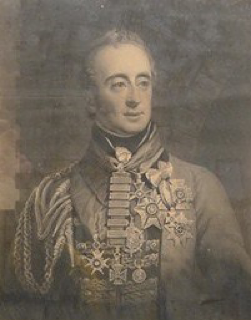
In July 1816, Pack marries Lady Elizabeth Louisa de la Poer Beresford, daughter of George Beresford, 1st Marquess of Waterford. They have two sons and two daughters. His descendants adopted “Pack-Beresford” as their family name. He dies on July 24, 1823, at Lord Beresford’s house in Upper Wimpole Street, London. A monument to him is later erected in St. Canice’s Cathedral, Kilkenny. A portrait by G. L. Saunders is in family possession; another by Charles Turner, showing Pack wearing his numerous orders and decorations, is in the National Portrait Gallery, London. A collection of his papers is held by the University of Southampton.
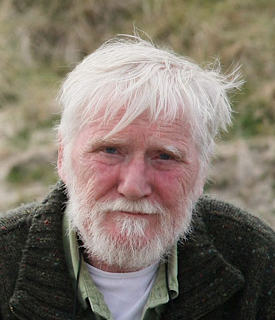
Dermot Healy, Irish novelist, playwright, poet and short story writer, dies at his home in Ballyconnell, Sligo, County Sligo, on June 29, 2014. A member of Aosdána, he is also part of its governing body, the Toscaireacht. He is described variously as a “master,” a “Celtic Hemingway” and as “Ireland’s finest living novelist.”
Healy is born in Finnea, County Westmeath, on November 9, 1947, the son of a Guard. As a child the family moves to Cavan, County Cavan, where he attends the local secondary school. In his late teens he moves to London and works in a succession of jobs, including barman, security man and as a labourer. He later returns to Ireland, settling in Ballyconnell, County Sligo, a small settlement on the Atlantic coast.
Often overlooked due to his relatively low public profile, Healy’s work is admired by his Irish literary predecessors, peers and successors alike, many of whom idolise him. Among the writers to have spoken highly of him are Seamus Heaney, Eugene McCabe, Roddy Doyle, Patrick McCabe and Anne Enright.
Healy dies at his home in Ballyconnell on June 29, 2014, while awaiting an ambulance after suddenly being taken ill. He is laid to rest at Carrigans Cemetery following funeral mass by Fr. Michael Donnelly at St. Patrick’s Church in Maugherow, County Sligo.
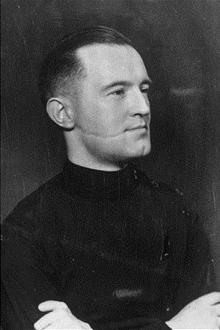
Joyce is the eldest of three sons of Michael Joyce, an Irish Catholic from a family of tenant farmers in Ballinrobe, County Mayo, and his wife, Gertrude (née Brooke), who although born in Shaw and Crompton, Lancashire, is from a well-off AnglicanAnglo-Irish family of physicians associated with County Roscommon. The Joyces return to Ireland in 1909. William, a precocious child, attends Coláiste Iognáid SJ, a Jesuit school in County Galway, from 1915 to 1921. At the age of fourteen, he abandons Catholicism for Anglicanism, apparently after being told that all non-Catholics, including his mother, would be damned. In adult life he is nominally anglican, though his adherence to Christianity is tenuous.
The Joyces are unionists and teach their children fervent imperialism. During the Irish War of Independence, Joyce openly associates with the Black and Tans and acts as a scout for them. An acquaintance claims that his views are so extreme even loyalists dislike him. On December 9, 1921, he flees to England to join the Worcestershire Regiment and is followed to England in 1923 by the rest of the family. When he enlists, he claims to be eighteen, but after he contracts rheumatic fever, his age is discovered, and he is discharged in March 1922. For a time, he studies mathematics and chemistry at Battersea Polytechnic Institute as a pre-medical student (1922–23), but he leaves of his own accord, with a reputation for laziness and violent political views. His studies in English and history at Birkbeck College are more successful. He is a brilliant linguist and mathematician and graduates BA with first-class honours in 1927. He publishes an academic article on philology and considers progressing to an MA. He later falsely claims that his research had been plagiarised by a Jewish academic. In 1932, he enrolls at King’s College, London, for a Ph.D. in educational psychology.
Joyce is disturbed by the difference between depressed post-war Britain and the imperial ideal that he had imbibed in Galway and is mocked for his outspoken patriotism and obvious Irishness. He identifies strongly with Thomas Carlyle, an earlier angry anti-liberal from the provinces. His life is marked by repeated episodes of hero worship, followed by disillusion and bitter denunciation. In 1923, he joins the British Fascists, an organisation that has a significant Irish loyalist membership, and in 1924 he allies himself with a militant splinter group, the National Fascists. Most British fascists see themselves as Tory auxiliaries, and they often provide a security presence at conservative meetings. On October 22, 1924, while stewarding a meeting addressed by a Jewish conservative candidate, he has his face slashed and is left with a prominent scar across his right cheek. He joins the Conservative Party in 1928 and is active in the Chelsea constituency until 1930, when he is forced out because of his eccentricities and sexual misbehaviour. On April 30, 1927, he marries Hazel Kathleen Barr. They have two daughters but separate in 1935, largely because of his infidelities, heavy drinking, and temper. The marriage is dissolved in 1937.
In November 1933, Joyce abandons his Ph.D. studies to work for Sir Oswald Mosley‘s British Union of Fascists (BUF). By early 1934 he has become its paid publicity director, traveling throughout Britain to organise meetings. He is a powerful, rabble-rousing speaker, driven by an instinctive awareness that vitriolic verbal abuse gives speaker and audience a sense of power and solidarity. MI5 sees him as a compelling, though deranged, personality. On February 8, 1937, he marries Margaret Cairns White, a BUF activist from Lancashire, with whom he had cohabited since 1936.
Joyce leads a BUF faction that favours a recruitment strategy based on uncompromising ideological assertion. This is challenged by populists who prioritise marches and displays and hold that indoctrination should follow membership. In February 1937, he is BUF candidate for the London County Council in Shoreditch. The party wins 14 percent of the vote. In March 1937, he, along with many full-time BUF staff, are sacked when the BUF cuts expenses. But his dismissal also reflects Mosley’s awareness that his obsessive rhetoric repels “respectable” recruits and that he is no longer a biddable, slavish admirer of “the Leader.” He later falsely claims near-exclusive credit for the BUF’s escalating antisemitism, a view that Mosley eventually finds it convenient to adopt in order to evade his own responsibility.
In April 1937, Joyce founds the National Socialist League, helped by a wealthy patron. He supports himself as a private tutor, refusing to take Jewish pupils. He is active in various antisemitic and pro-Nazi groups such as the Right Club and engages in “peace” campaigns based on the view that British interests lay with Germany against Russia. Political marginalisation intensifies his admiration for Nazi Germany and hero worship of Adolf Hitler. By the time of the Munich crisis in 1938, he has decided that if war comes, he will go to Germany, though he also considers moving to Ireland. He renews his British passport for one-year terms in August 1938 and August 1939.
On August 26, 1939, Joyce and his wife leave London for Berlin. He is allegedly tipped off about his impending arrest and internment by an MI5 officer, to whom he had supplied information on communists. His siblings, whom he recruited into his fascist organisations, are variously penalised for his activities. At a loose end in Berlin, he is persuaded by a British associate to become a radio announcer with the English-language service of the Reichs-Rundfunk-Gesellschaft (RRG). He makes his first broadcast on September 6, 1939, and receives a contract in October. He finds in radio an outlet for his forceful style and delight in saying the unsayable, and in the early years of the war takes an exultant pride in recounting Nazi victories. His performances are admired by Joseph Goebbels, whom Joyce, to his regret, never meets. On September 26, 1940, he acquires German citizenship.
The novel experience of hearing the enemy in one’s own living room attracts wide audiences in Britain. Joyce’s practice of naming newly captured prisoners of war in his broadcasts is also a compelling motive for listening. In fact, he tries to recruit British prisoners of war as collaborators. The name “Lord Haw-Haw,” invented by the Daily Express radio critic in September 1939, initially applies to several English-language broadcasters but in time becomes associated with Joyce. He is initially a figure of fun, imitated by comedians, but there are sinister undercurrents of terrifying omnipotence, intensified by his sneering, gloating delivery and his delighted deployment of the “big lie” technique. It is widely believed that British-based fifth columnists supply him with information, that he predicts air raids, and shows minute local knowledge. In time, fear and his growing notoriety feed popular hatred of him in Britain, though his anti-British taunts allegedly win appreciative Irish audiences. He exults that he is daily committing treason and rendering himself liable to the death penalty.
In 1940, Joyce publishes a commissioned self-justifying propaganda work, Twilight over England. His representation of himself echoes that of Hitler in Mein Kampf – the provincial patriot, whose martial sacrifices are betrayed by corrupt elites, learning through poverty the hollowness of bourgeois patriotism and the need to synthesise socialism with nationalism. He shares with his hero a paranoid belief in his own ability to create an alternative reality through language and obstinacy. He dreams of becoming the English Führer.
In Berlin, the Joyces’ marriage comes under increasing strain, marked by drunken rows, domestic violence, and infidelity on both sides, though they retain a fierce mutual fascination. They divorce on August 12, 1941, but remarry on February 11, 1942, while continuing their previous behaviour. As the Axis powers begin to fail, his broadcasts become more defensive, focusing on the Soviet threat. On October 14, 1944, he is awarded the German War Merit Cross, first class. On October 22, he is sworn into the Volkssturm (territorial army) and begins drilling. The Joyces are evacuated from Berlin in March 1945, initially to Apen near the Dutch border and then to Hamburg, where he makes a last, drunken, defiant broadcast on April 30, 1945, the day of Hitler’s death. After an unsuccessful attempt to escape to Sweden, the Joyces hide at Flensburg near the Danish border. On May 28, 1945, he is shot and captured while gathering firewood.
Joyce is brought back to Britain on June 16 after Parliament passed legislation simplifying treason trial procedures. At his September 17-20 trial, he proves his American citizenship, but the court holds that his illegally acquired British passport incurred duties of allegiance. His appeals are rejected by the Court of Appeal and the House of Lords. His fate is influenced by British public opinion, and possibly by a desire to avoid antagonising the Soviet Union. In his death cell he blames the defeat of national socialism on German limitations. He also fantasises that he could have saved Hitler from his incompetent subordinates.
Joyce is hanged by Albert Pierrepoint at Wandsworth Prison on January 3, 1946. Unlike most of his fellow Nazis, he proclaims to the end his allegiance to national socialism and hatred of Jews. He corresponds cheerfully with Margaret, joking evasively about the death camps and expressing a belief that his spirit will survive, watch over her, and continue his work. To neo-Nazis he becomes a martyr. Even among those to whom his activities had been repellent, a significant body of opinion holds he should not have been condemned on a questionable and innovative technicality. The historian A. J. P. Taylor maintains that Joyce was executed for making a false declaration to obtain a passport, a misdemeanour that normally incurs a £2 fine.
In 1976, Joyce is reinterred in Galway as it is feared that a grave in England might become a fascist shrine. Thomas Kilroy‘s play Double Cross (1986) juxtaposes Joyce and Brendan Bracken as Irishmen who reinvented themselves through fantasies of Britishness. The BBC Sound Archive has recordings of some of Joyce’s broadcasts and transcripts of others, collected during the war as evidence for a future treason trial.
(From: “Joyce, William Brooke (‘Lord Haw-Haw’)” by Patrick Maume, Dictionary of Irish Biography, http://www.dib.ie, October 2009)
Connolly travels to Russia on several occasions in 1920 and 1921 and forms a close association with Vladimir Lenin and is hugely influenced by the Soviet leader. He is a delegate to the Second Congress of the Communist International (Comintern) as a delegate of the Industrial Workers of the World (IWW) in June 1920. It is here he meets Lenin at just 19 years of age following an introduction from journalistJohn Reed. According to Connolly, Lenin speaks English with a Rathmines accent which he acquired from his Irish tutor.
Connolly helps form and becomes President of the first Communist Party of Ireland (CPI) in October 1921. He is editor of the CPI newspaper, The Workers’ Republic. He opposes the 1921 Anglo-Irish Treaty between the representatives of the Irish Republic and the British state, and fights in the Irish Civil War on the anti-treaty side. The CPI is the first Irish political party to oppose the Treaty and urges the Irish Republican Army (IRA) to adopt socialist policies to defeat the new Irish Free State government. The CPI is dissolved in 1924 by the Comintern but in 1926, Connolly helps set up a second Marxist party, the Irish Workers’ Party. He is the party leader and editor of its journal, The Hammer and Plough. This party too is dissolved in 1927.
Connolly enters a semi-retirement between the mid-1950s and mid-1960s, but in the late 1960s, he begins a comeback. He is elected as party chairman in 1971 and holds this position until 1978. During his time as chairman, he oversees the expulsion of the Socialist Labour Alliance in 1971, some of whose members go on to form the Socialist Workers Network (SWN), which in turn eventually establishes People Before Profit (PBP).
In 1921, Connolly marries Jessica Maidment, a socialist activist in England and chartered accountant, who from 1928 works for Russian Oil Products in Dublin. She dies in 1930 from blood poisoning arising from an operation. He is survived by his second wife, Peggy, whom he marries in 1937, sons, and daughters. His recreations include chess and bridge; highly adept at both, he learns the former from Seán Mac Diarmada as prisoners after the Easter rising and is international bridge correspondent for the Irish Independent.
(Pictured: Roddy Connolly during an interview conducted for the RTÉ Television project “Portraits 1916” on January 9, 1966)
William Corbet, an Anglo-Irish soldier in the service of France, is born in Ballythomas, County Cork, on August 17, 1779. In September 1798, he accompanies James Napper Tandy in an aborted French mission to Ireland in support of the United Irish insurrection. After two years of incarceration, he escapes from Ireland and serves in the campaigns of Napoleon reaching the rank of colonel. In 1831, under the July Monarchy, he is employed in the Morea expedition to Greece. He returns to France in 1837, retiring with the rank of Major-General.
Corbet is born into a branch of the Corbet family, an Anglo-Irish Protestant family. In 1798, as a member of the Society of United Irishmen, he is expelled from Trinity College Dublin with Robert Emmet and others for treasonable activities and goes instead to Paris. In September of the same year, he joins a French military force under James Napper Tandy with the rank of Captain and sails from Dunkirk with arms and ammunition for Ireland. The expedition has to turn back following the defeat of General Jean Joseph Amable Humbert and arriving in Hamburg they are handed over to the British authorities and taken to Ireland, where they are imprisoned in Kilmainham Gaol.
Corbet escapes in 1803 and returns to France. He is appointed professor of English at the military college of Saint-Cyr. Later that year he becomes a captain in the Irish Legion. Following the death of his brother Thomas (who was also in the Legion) in a duel with another officer, he is transferred to the 70th Regiment of the line, where he serves in André Masséna‘s expedition to Portugal, and distinguishes himself in the retreat from Torres Vedras and the Battle of Sabugal. After the Battle of Salamanca, he is appointed chef de bataillon of the 47th regiment and serves until 1813 when he is summoned to Germany to join the staff of MarshalAuguste de Marmont. He serves at the battles of Lützen, Bautzen, Dresden and others and is made a commander of the Legion of Honour. In December 1814, he is naturalised as a French citizen. In 1815, after the abdication of Napoleon, he is promoted to colonel and chief of staff to General Louis-Marie-Celeste d’Aumont at Caen.
In 1837, Corbet returns to France where, with the rank of Major-General, he is commander in the region of Calvados. He dies at Saint-Denis on August 12, 1842.
The Irish novelist Maria Edgeworth bases the main theme of her novel Ormond on Corbet’s 1803 escape from Kilmainham Gaol.
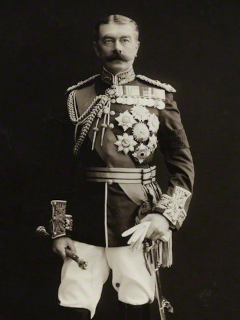
Kitchener is the second son of Lieutenant Colonel Henry Horatio Kitchener and his first wife, Frances Anne (née Chevallier), daughter of clergyman John Chevallier. Col. Kitchener resigns his commission in 1849 and purchases Ballygoghlan House estate near Tarbert, County Kerry, in early 1850 under the provisions of the Encumbered Estates Act of 1849. Ballygoghlan House is in a state of disrepair, however, and the family lives in Gunsborough Villa until the end of 1850. In 1857, Col. Kitchener purchases Crotta House, near Kilflynn, County Kerry, and the Kitcheners divide their time between the two residences. While innovative and successful in his agricultural methods, Col. Kitchener is harsh towards his tenants and, after carrying out many evictions, becomes extremely unpopular in the area. He is a rigid disciplinarian and occasionally punishes his son severely.
Although Kitchener attends Ballylongford village school, his education is largely neglected. When examined by his cousin Francis Elliot Kitchener, fellow of Trinity College Dublin (TCD), he is found to have only the most rudimentary knowledge of grammar and arithmetic. Education by private tutors follows. In 1864, his father sells his Irish estates and moves to Switzerland for the sake of his wife’s health. After further private tuition, he passes into the Royal Military Academy, Woolwich, in 1868, and is commissioned into the Royal Engineers in December 1870.
Kitchener begins his career on survey missions and carries out such work in Palestine (1874–78) and Cyprus (1878–82). He then enters the Egyptian Army and takes part in the Sudan campaign of 1883–85, organised to relieve Genral Charles George Gordon. Subsequent appointments include governor of Suakin (1886–88), adjutant-general of the Egyptian Army (1888–92), and Sirdar (Commander-in-Chief) of the Egyptian Army (1892–96). After the Dongola Expedition in 1896, he is promoted to major-general. He commands the Khartoum Expedition of 1898, defeating Mahdist forces at Atbara and Omdurman, and is raised to the peerage.
At the outbreak of the Second Boer War in 1899, he is appointed chief of staff to Frederick Roberts, 1st Earl Roberts, and assumes total command, with the rank of lieutenant-general, in 1900. While acting as commander-in-chief in South Africa he reorganises the British forces and, using new tactics, manages finally to defeat the Boers. He is severely criticised in the world press for the conditions in the concentration camps where Boer families are confined, but is made a viscount, promoted to general, and awarded £50,000 by parliament at the end of the war.
Kitchener serves as commander-in-chief in India beginning in 1902, is promoted to Field Marshal in 1909, and is a member of the Committee of Imperial Defence (1910) and consul-general in Egypt (1911–14). At the outbreak of World War I he is made Secretary of State for War and begins to reorganise the British Army, an immense achievement, raising 1,700,000 men in service battalions by May 1915, creating an army of volunteers to reinforce the depleted regular army in Belgium and France. An archconservative, he totally opposes Home Rule for Ireland, and initially blocks plans by John Redmond for the formation of a southern Irish division from members of the National Volunteers. Convinced that an all-Irish brigade or division would be a security risk, he rejects Redmond’s suggestions in a meeting of August 1915 and originally proposes dispersing Irish recruits through the numerous regiments in the army. Impressed by Redmond’s persistence, and impelled by the recruiting crisis of late 1915, he finally reverses his decision and sanctions the establishment of the 16th (Irish) Division.
On June 5, 1916, Kitchener is making his way to Russia on HMS Hampshire to attend negotiations with Tsar Nicholas II when in bad weather the ship strikes a German mine 1.5 miles (2.4 km) west of Orkney, Scotland, and sinks. He is among 737 who perish. He is the highest-ranking British officer to die in action in the entire war.
Although he only spends his early years in Kerry, Kitchener occasionally returns to Ireland. While on leave in June 1910 he goes on a tour of County Kerry, visiting places connected to his childhood. There are numerous portraits and memorials to him in England, including a marble effigy by W. Reid Dick in St. Paul’s Cathedral in London and a statue by John Tweed in Horse Guards Parade, London. There is a commemorative bible in the Church of Ireland church at Kilflynn, County Kerry, where he regularly attended Sunday service as a boy. There are some Kitchener letters in the John Redmond papers in the National Library of Ireland.
(From: “Kitchener, Horatio Herbert” by David Murphy, Dictionary of Irish Biography, http://www.dib.ie, October 2009)
Pat Falvey, Irish high-altitude mountaineer, expedition leader, polar explorer, entrepreneur, author, corporate/personal trainer/coach, and motivational speaker, is born in Cork, County Cork, on June 2, 1957. He is the first person to complete the Seven Summits twice, with the summiting of Mount Everest reached from both the Tibetan (1996) and Nepalese sides (2004). He is expedition leader of the team that sees Clare O’Leary become the first Irish woman to reach the summit of Mount Everest in 2004. Other extreme expeditions that he makes include walking to the South Pole, crossing South Georgia island, and traversing the Greenland ice sheet. He starts his first business at 15 years of age and has since had businesses in property development, finance, construction, insurance, tourism, and film production. He has been a motivational speaker since the 1990s.
Raised on the north side of Cork city, Falvey starts mountain climbing in his late twenties, having worked as a builder and property developer from his late teens onward. Following the economic recession of the mid-1980s in Ireland, he loses most of his wealth and discovers mountaineering in his late 20s.
Falvey begins his climbing career with hill walking and climbing on the MacGillycuddy’s Reeks in County Kerry. He then devotes himself to training to become a high-altitude mountaineer. He trains initially with the Cork Mountaineering Club, at Tiglin in County Wicklow and becomes a member of Kerry Mountain Rescue, climbing very frequently in Ireland, Scotland, France and the Himalayas.
In June 1994, Falvey climbs Denali, also known as Mount McKinley, in Alaska, reaching the first summit in his Seven Summits attempt. This is followed by Mount Kilimanjaro in Tanzania (January 1995), Mount Everest via the Northeast Ridge (June 1995), Aconcagua in Argentina (December 1995), Mount Elbrus in Russia (March 1996), Vinson Massif in Antarctica (January 1997) and Mount Kosciusko in Australia (February 1997). He is the first Irish man (and the 32nd person in the world) to complete the Seven Summits.
Falvey is the expedition leader of the first Irish team to reach the summit of Cho Oyu in China and Nepal without oxygen, on May 20, 1998. He reaches the summit of Ama Dablam in Nepal on November 3, 1999. In 2003, he is the expedition leader of the first Irish team to reach the summit of Mount Everest via the South-Southeast Ridge, with team members Ger McDonnell and Mick Murphy reaching the summit. On May 18, 2004, he reaches the summit of Everest via the South-Southeast Ridge, and leads the expedition that sees the first Irish woman, Dr. Clare O’Leary, reach the top of Everest.
Falvey and O’Leary complete the Seven Summits on December 16, 2005, when he becomes the first person to complete the Seven Summits twice by climbing Mount Everest from both the Tibetan and Nepalese sides.
In 2006, Falvey leads a group of 32 across the South Georgia Traverse on South Georgia island in honour of Polar explorers Sir Ernest Shackleton and Kerryman Tom Crean, in the Beyond Endurance Antarctic expedition. He leads the first Irish traverse of Greenland in 2006. In January 2008, he leads a four-person Irish expedition to the South Pole. In April 2009, he and O’Leary do a “symbolic” walk to the North Pole, completing the final four-day trek to the Pole.
Falvey joins the Kerry county football team as a “sports performance coach” in 2021. Manager Peter Keane says, “You take us in this country with five million people and we have had some unbelievable adventurers like Shackleton and Crean; you look at someone like Pat who has climbed Everest twice from two different sides, managed to climb the Seven Summits twice, and I am looking to see if he can bring something different in here.”
Falvey’s publications include Reach for the Sky (The Collins Press, 1997), A Journey to Adventure: Stories I never thought I’d tell (The Collins Press, 2007), The Summit: How Triumph Turned to Tragedy on K2’s Deadliest Days (Beyond Endurance Publishing with The O’Brien Press, 2013), You Have the Power: Explore the Mindset You Need to Realise Your Dreams (Beyond Endurance Publishing, 2016) and Accidental Rebel (Beyond Endurance Publishing, 2018).
Doheny receives a rudimentary education from an itinerant scholar while labouring on his father’s holding, and in 1826 attends Maher’s classical academy near Emly for nine months. Educating himself in the late 1820s and early 1830s while teaching the children of local farmers, he determines on a career in law to help secure political redress for the disenfranchised poor. He is admitted to Gray’s Inn in November 1834, enters the King’s Inns, Dublin, in 1835 and is called to the Irish bar in 1838. Settling later that year in Cashel, County Tipperary, he first practises in the local courts and then on the southern circuit. Appointed legal assessor to the borough of Cashel under the Municipal Corporations (Ireland) Act 1840, he successfully prosecutes former borough officers for misappropriation of funds and fraudulent transfer of property, winning wider attention. He had supported the campaign for repeal in the early 1830s, and in 1841 joins Daniel O’Connell‘s Repeal Association, becoming active in forming temperance bands and setting up town meetings. By May 1841 he is on the association’s general committee. O’Connell finds him less tractable than most and is ruffled by his queries into the association’s financial management.
During 1842 Doheny begins to associate with the more militant members of the repeal movement such as Thomas Davis. There is a marked gap in age and class between Doheny and most of this group and some look down on his lack of refinement. Others, however, admire his zeal and sincerity, and an anonymous colleague describes him as “rough, generous, bold, a son of the soil, slovenly in dress, red-haired and red-featured, but a true personification of the hopes, passions, and traditions of the people.” Assisting in the launch of The Nation in October 1842, he is chagrined to find most of his articles rejected as unfit for publication, although fifteen are published between January 1843 and September 1844. He also publishes a competent History of the American Revolution (1846) for The Nation‘s “Library of Ireland” series. More impressive as a speaker than a writer, he contributes regularly to repeal meetings at Conciliation Hall, Burgh Quay, Dublin. He enthuses at the apparent martial potential of the immense, ordered crowds attending the “monster” repeal meetings of 1843, and is one of the main organisers of the Cashel meeting of May 31, 1843, at which he is loudly cheered. However, his later claim to have deliberately set up these meetings, with Davis and John Blake Dillon, on quasi-military lines in order to prepare the peasantry for a future war with Britain, is far-fetched. His opposition to O’Connell’s decision to submit to proclamation of the proposed meeting of October 8, 1843, at Clontarf again greatly irritates O’Connell.
An active member of the Repeal Association parliamentary committee from February 1844, in February and March 1845 Doheny chairs a sub-committee of five senior barristers investigating the legality of withdrawal from the House of Commons by the body of repeal MPs, coming “reluctantly” to the verdict that such an action is open to criminal prosecution. O’Connell’s gruff dismissal of his report testifies to their awkward relationship. He further vexes O’Connell by his advocacy of non-denominational university education during debates over the Maynooth College Act 1845. Irrevocable divisions between the Young Irelanders and O’Connell open up between April and July 1846 when Doheny leads calls for endorsement of the conduct of William Smith O’Brien – imprisoned for a month for refusal to serve on a parliamentary committee – and voices Young Ireland’s martial convictions in a speech at Liverpool. After the secession of the Young Irelanders from the Repeal Association in July 1846, he opposes attempts at reconciliation and is one of the founders of the Irish Confederation on January 13, 1847.
During the summer of 1847, Doheny begins setting up “Confederate Clubs” in east Tipperary and aids James Fintan Lalor in organising a failed tenant league meeting at Holycross, County Tipperary, on September 19. He is one of the few Young Irelanders attracted to Lalor’s revolutionary agrarian philosophy, but supports Smith O’Brien against John Mitchel in January 1848, deploring irresponsible demands for insurrection. However, after Mitchel’s conviction for treason felony in May, he supports armed action. Arrested for seditious speechmaking at Cashel on July 12, he is bailed on July 20. During the confused period of “rebellion” in late July, he attempts to organise the peasantry in Tipperary but is frustrated by O’Brien’s vacillation.
After the collapse of the armed adventure at Ballingarry on July 31, Doheny takes refuge near Slievenamon and, with James Stephens, eludes pursuit for nearly two months, until he finally escapes, disguised as a clergyman, on a cattle-ship from Cork to Bristol. Some days later he reaches Paris, where he stays for two months with Stephens and John O’Mahony before leaving for New York City. Practising law in New York, he dedicates himself to the development of an Irish Americanrepublican movement. Tensions between conservative and radical Young Ireland exiles, perhaps aggravated by social snobbery, surface by late 1849, when he is arrested for attempting to push Thomas D’Arcy McGee into an open cellar on a New York street, angered by accusations of boasting, drunkenness, and incompetence. Similar criticisms are made by John Blake Dillon and appear to have some foundation.
Doheny finds time to write The Felon’s Track (1849), a polemical account of the repeal agitation and the 1848 insurrection that is highly critical of O’Connell. Despite a rambling narrative, it becomes a popular work and is reprinted several times. He also gives several lectures on historical and literary subjects to Irish American societies and contributes a memoir on Geoffrey Keating to O’Mahony’s translation (1857) of Foras Feasa ar Éirinn.
Involved with the New York Irish militia from his arrival, he is elected lieutenant colonel of the 69th Infantry Regiment in November 1851, and in September 1852 becomes colonel of a new regiment, the Irish Republican Rifles. These formations are often wracked by dissension over strategy and leadership, and in February 1856 he and O’Mahony found the Emmet Monument Association, planning to mobilise an Irish American force to invade Ireland. Efforts to acquire Russian backing fails on the close of the Crimean War in March 1857.
In autumn 1857, Doheny and O’Mahony make overtures to James Stephens to reorganise the republican movement in Ireland, and in March 1858 they accept Stephens’s demands for undisputed authority there, though by the winter of 1858–59 Doheny shows increasing distrust of Stephens’s ambitions. Adopting the organisational structure set out by Stephens in establishing the IRB in 1858, he and O’Mahony found the American equivalent, the Fenian Brotherhood, in early 1859, although he plays a subordinate part. In July 1859, he founds and edits a short-lived newspaper in New York, The Phoenix, to promote Fenian ideals. Active in opposing the national petition for self-government of 1860–61, he argues that Britain will only yield to force. He assists in making preparations for the funeral of Terence Bellew MacManus in Ireland and acts as one of the pallbearers in New York. Travelling to Ireland in October 1861, he appears to argue for using the excitement engendered by the funeral to spark an insurrection in Dublin but is thwarted by Stephens.
Doheny dies suddenly on April 1, 1862, in New York and is buried in Calvary Cemetery in the city’s borough of Queens.
(From: “Doheny, Michael” by James Quinn and Desmond McCabe, Dictionary of Irish Biography, http://www.dib.ie, October 2009)
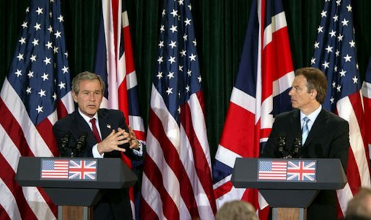
The two leaders meet at Hillsborough Castle and begin their sessions on April 7 with a half-hour walk through the gardens before dinner. The following day they hold a press conference and further talks, including a session on the Northern Ireland peace effort.
Bush and Blair, Bush’s closest ally in confronting Saddam Hussein, come together to discuss questions made increasingly urgent by the rapid military progress American and British forces have made and to plan for a postwar Iraq. They seek to bridge their differences over how much of a role to give the United Nations in rebuilding the country and putting together a new government.
Blair has been under pressure at home and from much of Europe to support giving the United Nations a strong role in stabilizing Iraq. The White House, however, has consistently signaled that it wants the United States and Britain to play the lead role in creating a new Iraqi government.
United States Secretary of StateColin L. Powell tells reporters traveling with the president that the United States is sending officials to the region to begin assembling a group of Iraqis who will constitute an interim governing authority and will be put in place alongside the American-led military and civilian authorities. In a sign of the speed with which the maneuvering for power in post-Hussein Iraq is unfolding, Ahmed Chalabi, the leader of the main Iraqi exile opposition group, the Iraqi National Congress (INC), is reported to be heading to Baghdad from southern Iraq.
“The hostilities phase is coming to a conclusion,” Powell says. “It’s time for all of us to think about the post-hostilities phase, how we create a representative government consisting of all elements of Iraqi society.”
Powell and British officials play down the magnitude of the differences between the United States and Britain over the United Nations role. The United Nations, Powell says, will have “an endorsing role to play to the interim authority to give it legitimacy,” a formulation that appears to reserve for the United States and Britain the right to select the leaders of the temporary postwar administration. A spokesman for Blair uses similar language, referring to the United Nations’ being involved “in a way that endorses that new Iraqi authority” as a step toward establishing a full-fledged Iraqi government.
Initially, primary responsibility for administering Iraq would rest with a team led by a retired United States Armylieutenant general, Jay Garner, and the interim Iraqi authority would be likely to begin assuming power after that, perhaps 90 days later, the British spokesman says.
Clearly wary of getting into another diplomatic squabble with other members of the United Nations Security Council, Powell and other administration officials have emphasized in recent days that the United States and Britain, having waged the war and paid for it with blood and money, will not be drawn into a negotiation with countries like France and Germany over the immediate postwar period.
Powell emphasizes, however, that part of his focus will now be on “healing” diplomatic wounds and granting the United Nations an important role once Iraq is stabilized.
At the United Nations, Secretary-GeneralKofi Annan says he will travel to Britain, France, Germany and Russia in the coming week to test whether the Security Council might be able to agree on a postwar plan. He announces that he has been working on post-conflict issues with a special adviser, Rafeeuddin Ahmed. He says he expects the United Nations to play an important role, whether as a political facilitator or dealing with issues like reconstruction or human rights. “Above all, the U.N. involvement does bring legitimacy, which is necessary, necessary for the country, for the region and for the peoples around the world,” Annan says.
Bush’s trip to see Blair here is the third British-American summit meeting in as many weeks. It coincides with news that American forces are attacking the presidential palaces and other symbols of the Iraqi government in the heart of Baghdad and that British soldiers have taken control of Iraq’s second-largest city, Basra.
The presence of the two leaders draws crowds of antiwar protesters and set off a local debate about whether this city, which has been trying to put behind it a history of sectarian violence, is an appropriate location for a war council.
The city authorities in Belfast have to divert traffic and clear public buildings in various locations following a series of bomb scares. The scenes are reminiscent of the conflicted time before the Northern Ireland peace agreement in 1998 put an end to organized sectarian violence that cost the lives of more than 3,600 people over three decades.
In the conversations about Iraq, Blair plays his customary role of trying to bridge trans-Atlantic differences. He hopes to placate criticism at home and ease relations with his European neighbors by pushing for a United Nations resolution authorizing an interim governing authority.
He had earlier envisaged a more prominent role for the United Nations, but he emerged from his last meeting with Bush, at Camp David on March 27, emphasizing the need for the United Nations to endorse the transition plans rather than play a central part in the plans, as he had advocated at the first summit meeting, in the Azores on March 16.
Europeans express alarm at what they see as the marginalization of the United Nations. At the same time, European critics of the war, like France, Germany and Russia, may object to Blair’s compromise proposal on grounds that it legitimizes a war they oppose. Even in Britain, the one European country where the war has majority support, there is great resistance to American domination of the postwar running of Iraq. An opinion poll in The Daily Telegraph shows that while Britons’ enthusiasm for the war has grown to a high of 60 percent and their approval of Blair’s conduct has also risen, there is only 2 percent approval of an American-controlled administration of Iraq.
Powell says the United States is only trying to lay out a plan under which military control of Iraq can give way to a mix of civilian and military control, including substantial involvement by Iraqis, and then to a full-fledged government. He says United Nations involvement might be necessary to convince banks and financial markets that they can safely and legally lend money to Iraq. Asked about peacekeeping duties, he says NATO is open to the possibility of helping to provide postwar security or assisting in the search for weapons of mass destruction.
Planning for the peace has exposed differences not only between the United States and Britain, but also within the Bush administration and between the administration and Congress.
Blair chose to hold his meeting with Bush in Northern Ireland in part so that the president can lend his support to the long-running efforts by Britain and Ireland to find a peaceful solution to the strife between Catholics and Protestants in the province. The White House, however, seems not to be paying much attention to Northern Ireland diplomacy. The schedules and credentials it distributes to reporters list the site as “Belfast, Ireland.”
(From: “Bush Meets With Blair to Discuss Postwar Iraq” by Richard W. Stevenson and Warren Hoge, The New York Times, http://www.nytimes.com, April 8, 2003)




 seamus dubhghaill