Marrinan becomes ill with infantile paralysis at the age of five, and as a result is tutored privately. He has no formal training in art but is largely influenced by his reading matter, particularly the American comic strips of Bud Fisher. The variety of facial expressions that Fisher can achieve, with only a pencil, intrigues and inspires him. Likewise, the images evoked by Celtic mythology and religious art also contributes to his visual language, and many hours are spent in the Belfast Museum and Art Gallery studying the paintings in their collection.
Marrinan exhibits with the Ulster Academy of Arts from an address at 524 Donegall Road, Belfast, entering “The Wee Gate, Earl Street, Belfast” (1931) and “The Painter’s Father” and the “Apache” (1934), which is judged “picture of the year.” He last exhibits with a landscape, “Connemara,” along with four other works in 1949.
Marrinan paints and sketches portraits of many notable Irish figures, among which is the charcoal drawing of northern Fenian Robert Johnston (1934; National Gallery of Ireland) and a sketch of the Donegal storyteller Niall Duffy (University College Dublin). His literary portraits include one of Brian Friel. He holds a one-man show in 1951 at 55a Donegall Place, Belfast, where he exhibits a bust of John McLaverty. He takes an interest in sculpture although painting and drawing remain his preferred form of expression. Important commissions are for a memorial portrait (completed 1952) of Éamonn Ceannt for Ceannt Barracks officers’ mess, Curragh Camp, County Kildare, and for a portrait of Vice-brigadier Peadar Clancy for Clancy Barracks, Dublin. He paints two memorial portraits of PresidentJohn F. Kennedy, one of which is in the Irish Club, London.
Marrinan is an honorary member of the Royal Ulster Academy and exhibits with them every year from 1950 onward, showing a portrait of Mrs. Padraig Marrinan in 1967 (no other details of his marriage are known). He is preparing for an exhibition to be held at the Irish Club, London, in 1974, but dies on October 25, 1973, at Tyrone County Hospital in Omagh. He is then living at James Street, Omagh.
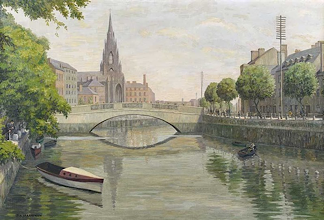
(From: “Marrinan, Padraig H.” by Ruth Devine, Dictionary of Irish Biography, http://www.dib.ie, October 2009 | Pictured: “The River Lee, Cork City, Ireland” by Padraig Marrinan, oil on canvas)
Hammond is the son of Leslie Hammond, a tram driver, and his wife Annie (née Lamont). His parents are not city people; his mother grew up near Ballybogy in the Ballymoney area of County Antrim, and his father, though from a family with roots in south County Londonderry, had lived in Ballymoney as a boy, and had been apprenticed to a blacksmith there. Both have a strong sense of their rural identity and maintain the Ulster Scots dialect of their childhood. They are never quite at home in the Belfast suburb of Cregagh, and in particular do not share the sectarian attitudes that are much more present in 1930s Belfast than they had been in north Antrim, one of the last strongholds of Presbyterian radicalism. Even as a boy, Hammond is interested in the old songs that his mother sang and realises that the traditions in which his parents had been nurtured are disappearing quickly in an increasingly urbanising and modernising world. When he encounters the work of Emyr Estyn Evans in the early 1940s, he is encouraged to document both rural tradition and the street life of the city, and he and a couple of friends, though still just teenagers, ride off on their bicycles to look for folklore in the hinterland of Belfast.
After primary school, Hammond wins a scholarship in 1941 to Methodist College Belfast, where he does well in examinations, and then goes to Stranmillis University College to train as a teacher. In his first job, in Harding Memorial primary school in east Belfast, he proves to be a popular, idealistic teacher, and is remembered by his pupils fifty years later as a fine singer and a teller of ghost stories, who had taken the class on memorable youth-hosteling trips to the Mourne Mountains. Youth hosteling and folklore collecting increases his awareness and understanding of the rich traditions of the whole community in the north of Ireland, and he is never constrained by political or religious barriers. His early career mirrors closely that of James Hawthorne, and their paths are to cross in later life.
Hammond is friendly with many others active in the cultural life of Northern Ireland and makes a name for himself as a song collector and eventually as an expert on all aspects of traditional singing. In 1956, he is awarded a scholarship to travel in the United States to meet the important pioneers of folk-music collecting and performance there. He records his first LP record of Ulster songs, I Am The Wee Falorie Man (1958), in the United States, and becomes friends with Pete Seeger, the Appalachian singer Jean Ritchie, with old blues singers, and notably with Liam Clancy, one of the three Clancy brothers who as a quartet with Tommy Makem are to popularise Irish folk music in the United States and elsewhere.
On returning to Belfast, Hammond takes a job in 1958 in Orangefield secondary school in the east of the city, where the highly regarded headmaster John Malone encourages new approaches to education. Among his pupils at Orangefield is George Ivan “Van” Morrison, who credits him with inspiring his interest in Irish traditional music. Hammond enjoys teaching but is increasingly drawn to folk-song performance and recording. He appears regularly on radio programmes of the BBC and Radio Éireann, and in 1964 joins the school’s department in BBC Northern Ireland. There, with colleagues like Sam Hanna Bell, James Hawthorne and others, he works on programmes such as Today and Yesterday in Northern Ireland, which for the first time introduces pupils (and many adults) to local history and to aspects of tradition. In 1968, with two friends, the poets Seamus Heaney and Michael Longley, he puts on poetry and traditional music events in schools all over the province. The Arts Council funds the Room to Rhyme project, which is immensely influential and inspiring, and is still talked about many years later by those who attended as children.
Hammond is creatively involved with hundreds of hours of broadcasting, in television as well as radio, and eventually for adults as well as children. He writes scripts, produces documentary series such as Ulster in Focusand Explorations, and brings an artistic sensibility to filming, as well as working sympathetically with traditional singers and craftspeople. Dusty Bluebells, a sensitively made film of Belfast children’s street games, wins the prestigious Golden Harp award in 1972. After he leaves the BBC to work as a freelance, and founds Flying Fox Films in 1986, he continues making documentaries on many aspects of Ulster life and heritage. His film called Steel Chest, Nail in the Boot and the Barking Dog (1986), about working in the Belfast shipyards, also wins a Golden Harp award. A companion book of the same name is published. Another book is Belfast, City of Song(1989), with Maurice Leyden. In 1979, he edits a volume of the songs of Thomas Moore. His documentary programmes include films about singers from Boho, County Fermanagh, and about the big houses of the gentry in Ireland. The Magic Fiddle (1991/2) examines the role of the instrument in the folk music of Ireland, Scandinavia, Canada, and the American south, while Another Kind of Freedom (1993) is about the experiences of a former Orangefield pupil, the Beirut hostage Brian Keenan. He also produces and directs the films Something to Write Home About (1998), Where Are You Now? (1999), and Bogland (1999), all of which explore Seamus Heaney’s home region and experiences.
The first poem in Heaney’s collection Wintering Out (1972) is entitled “For David Hammond and Michael Longley.” Their lifelong friendship leads to several other creative collaborations. In particular, after a distressing evening in 1972 when Hammond, affected by the despair and terror unleashed by Irish Republican Army (IRA) bombing of his city, is for once unable to sing, Heaney meditates on the experience in an essay and in an important poem, “The singer’s house” (subsequently included in his 1979 Field Work collection). The poem urges the singer to keep singing, to defend the values of art and friendship in a hostile time. Hammond collaborates with Dónal Lunny and other traditional musicians to bring out an LP also called The Singer’s House(1978), which includes Heaney’s poem on the album sleeve, and features some of the songs that he had made famous, such as “My Aunt Jane” and “Bonny Woodgreen,” from his vast repertoire of songs from Ulster. The album is reissued in 1980.
In 1995, Hammond is one of Heaney’s personal guests at the award of his Nobel prize in Stockholm, characteristically wearing his usual, mustard-yellow, cattle-dealer boots with evening dress. On another formal occasion, when he is awarded an honorary doctorate by Dublin City University in November 2003, he surprises the audience by standing up in his academic robes to sing “My Lagan love,” instead of giving an address. His unique, light mellow voice is an ideal vehicle for the traditional ballads which he knows so well. He records a number of records in the 1960s, including Belfast Street Songs, and publishes the book Songs of Belfast (1978). He also encourages traditional musicians like Arty McGlynn, and collaborates with them on various recording projects. He is well known for live and often impromptu performances at festivals and venues in Ireland and the United States. He also performs at the John F. Kennedy Center for the Performing Arts in Washington, D.C.
Hammond is also a notable collaborator with poets and dramatists, especially in the important Field Day Theatre Company project, of which he is a director, along with Seamus Heaney, Tom Paulin, Seamus Deane, Thomas Kilroy, and the project’s founders, Brian Friel and Stephen Rea. He supports the Field Day search for a “fifth province,” where history and community and culture can intersect, believing that to speak unthinkingly of “two traditions” is to perpetuate superficial political divisions. As he says in an interview in The Irish Times on July 4, 1998, songs can “take you out of yourself” and become bridges to unite people.
Hammond receives many honours. In 1994, he receives the Estyn Evans award for his contribution to mutual understanding, and his work is featured in several major events in his honour: in the University of North Florida (1999), in the Celtic Film Festival in Belfast (2003), and in Belfast’s Linen Hall Library (2005). A Time to Dream, a film about his life and work, is broadcast on BBC Northern Ireland in December 2008.
Hammond dies in hospital in Belfast, after a long illness, on August 25, 2008, survived by his wife Eileen (née Hambleton), whom he marries on July 19, 1954, and by their son and three daughters. His funeral in St. Finnian’s Church is a major cultural event, where friends sing, play and speak in his honour.
In Seamus Heaney’s last collection of poetry, Human Chain (2010), he includes a poignant farewell to Hammond. The poet imagines (or perhaps dreams) of another visit to the singer’s house, but this time “The door was open, and the house was dark.”
(From: “Hammond, David Andrew (‘Davy’)” by Linde Lunney, Dictionary of Irish Biography, http://www.dib.ie, December 2014)
According to Sam Smyth in the Irish Independent, Mac Mathúna is “on a mission to collect songs and stories, music, poetry and dance before they were buried under the coming tsunami of pop music.”
Mac Mathúna presents the radio programme, Mo Cheol Thú, for 35 years. Upon his retirement in 2005, the managing director of RTÉ Radio, Adrian Moynes, describes him as “inseparable from RTÉ Radio.” Upon his death in 2009, the Irish Independent describes him as “a national treasure.”
After college Mac Mathúna works as a teacher and later at the Placenames Commission. In 1954, he joins Radio Éireann where his job is to record Irish traditional musicians playing in their own locales. This entails visiting such places as Sliabh Luachra, County Clare and County Sligo, and the resulting recordings feature in his radio programmes: Ceolta Tire, A Job of Journeywork and Humours of Donnybrook.
Mac Mathúna’s long-running Sunday morning radio series, Mo Cheol Thú (You are my music), begins in 1970 and continues until November 2005, when he retires from broadcasting. Each 45-minute programme offers a miscellany of archive music, poetry and folklore, mainly of Irish origin. It is one of radio’s longest running programmes. The last episode is broadcast on November 27, 2005, at 8:10 a.m.
Mac Mathúna wins two Jacob’s Awards, in 1969 and 1990, for his RTÉ Radio programmes promoting Irish traditional music. He receives the Freedom of Limerick city in June 2004. He is also awarded honorary doctorates by NUI Galway and the University of Limerick. In 2007, he receives the Musicians Award at the 10th annual TG4 Traditional Music Awards.
Joe Kennedy in the Sunday Independent in 2007 compares Mac Mathúna to “an amiable rock, rolling gently along, still picking up some moss and morsels of music that he may have missed.”
Mac Mathúna‘s wife, Dolly MacMahon (using the English version of her surname), is a singer of traditional songs. She comes from Galway and meets her husband in 1955. He has two sons named Padraic and Ciarán, one daughter named Déirdre, and four grandchildren at the time of his death: Eoin, Colm, Conor and Liam.
Musicians performing at the ceremony include Peadar Ó Riada, Cór Cúil Aodha and members of The Chieftains and Planxty. The corpse is then taken to Mount Jerome Crematorium. Journalist Kevin Myers says Mac Mathúna’s legacy will be the “rebirth of Irish music,” adding, “Well, if Ciarán Mac Mathúna can die, I suppose anyone can. Actually, I had always thought that he was immortal. He certainly appeared to have all the ingredients.”
On November 18, 1926, George Bernard Shaw refuses to accept the Nobel Prize in Literature prize money of £7,000 awarded to him a year earlier. He says, “I can forgive Alfred Nobel for his invention of the explosive but only the devil can think of the Nobel Prize.”
Shaw is born in Dublin on July 26, 1856, the third child of George Carr Shaw, a civil servant who later turns to a failed grain business to become an alcoholic, and Lucinda Elizabeth Shaw, a professional singer and sister of the famous opera singer Lucinda Frances. He is initially poor but is gifted with music and soon understands and loves the work of famous musicians and learns more about painting in Dublin. At the age of 15, he works as an apprentice and cashier for a real estate firm.
In 1876, Shaw follows his mother and two sisters to London. There he writes music reviews for newspapers to earn money, self-studies and actively participates in social activities. In 1884, he joins the founding of Fabian Society, an organization of British intellectuals advocating transition from capitalism to socialism by way of peace. From 1879 to 1883, he writes his first novel, Immaturity, and five other works that are not printed. An Unsocial Socialist is the first novel to be printed in 1887. Considered the father of “conceptual drama,” he begins writing plays in 1885, but achieves initial fame with Widowers’ Houses (1892). By 1903, his drama takes over the American and German stage, and in 1904 dominates the domestic stage. He becomes even more famous when Edward VII, the King of England, attends the performance of John Bull’s Other Island (1904), after which his drama spreads to European countries.
In addition, Shaw is also considered the best playwright in Britain at the time. He wants to use art to awaken people first to require changing the bourgeoisie order with all its institutions and customs. He emphasizes the educational function of the theater, but seeing the function of education is not an imposition from the playwright but arousing the aesthetic needs of the audience. The harsh problems of contemporary society such as the island’s predominant power, exploitative patterns, and the poverty of the people lead to social evils clearly reflected in his drama. His drama style tends to be satirical, sarcastic, finding its way to truth through paradoxes.
Shaw’s youngest dream is to earn a sum of money, then marry a wealthy wife. However, before becoming so wealthy that he can spend $ 35,000 on charity and enough money to travel around the world, he goes through many years of hardship. In the first nine years of his career, he receives only $30 USD in royalties. He is so poor that he does not even have the toll to get his manuscript to publishers. His clothes are tattered, his shoes open. All of his spending comes from his mother’s allowance. When he gets his name and remembers the miserable days, he often frowns, “I should have supported my family, the results are the opposite. I have never done anything for my family, and my mother has to work, raising me even though I was an adult.” Shaw, however, decides not to give up writing.
Realizing that, Shaw looks at the real royalties by publishing novels and the journey to the desired destination seems far away. He then turns to writing plays. He calculates that if the script is made public, the author will have revenue through the number of tickets issued and the number of shows. At the same time, the name of the author is also quickly known to the public. On the other hand, he says, only theater can “awaken people before the change of modern social order with all its institutions and customs.” He also judges that in addition to entertainment functions, the drama also contains the function of education, through arousing the aesthetic needs of the audience. He does not hesitate to bring to the stage all the most pressing issues of contemporary society such as the money’s inertia, the poverty of the people, and the social evils.
Saint Joan (1923) is judged to be the culmination of Shaw’s writing career. It is performed throughout European stages and is very popular. Two years after the release of Saint Joan, he is awarded the Nobel Prize for “the ideological and highly humanistic compositions, especially the spectacular satirical plays, combined with looks. Strange beauty of poetry.” When notified of his winning of the Nobel Prize, he humorously says, “The Nobel Prize for literature is like a float thrown to a swimmer.” Although he thinks he is the “swimmer to the shore,” he never leaves the pen. Thirteen years after receiving the Nobel Prize, Pygmalion, a script he wrote in 1912, is made into a film and receives the Academy Award for Best Adapted Screenplay.
In terms of scenario remuneration, Shaw receives an average of $100,000 a year, enough to spend on life, “reproduce” writing and traveling. It is only possible to marry a wealthy wife until the age of 40 years old. He always thinks that he “has no marriage status because he always worries others.” In terms of form, he is not very attractive because of his skinny body, but watching as the sisters do not allow him to carry out his intention to preserve his “absolute freedom.” Many beautiful female actors actively proclaim marriage proposal to Shaw, but he always uses humorous sentences to refuse.
Describing the George Bernard Shaw, Albert Einstein‘s physical genius after having met him has to say, “There are rare people who are so independent that they can see the weaknesses and absurdities of contemporaries. and at the same time do not let me get into it, but even so, when I encounter the hardships of life, these lonely people often lose their courage in helping humanity, with subtle humor and gentleness, can enthrall contemporaries and deserve to be torchbearers on the way of art’s unfavorable ways, today, with a passionate affection, I salute celebrate the biggest teacher on that path – the one who taught us and made us all feel happy.” It is a rare meeting of two great people in London in the fall of 1930.
(From: “November 18, 1926 – George Bernard Shaw refuses to receive a Nobel prize,” ScienceInfo.net, updated December 17, 2018)
Power is born to Henry Power, a watchmaker, and Mary (née Atkins), an embroideress. He has one older brother, and one younger sister. He attends a Christian Brothersnational school in North Brunswick Street. As a child he plays in local clay brickyards and sculpts busts of his friends. After finishing his primary school education, he trains with a firm of sculptors run by Edward Smyth. In 1884, he enrolls as an evening pupil at the Dublin Metropolitan School of Art (DMSA), later attending as a full-time student from 1906 to 1911. During his time at the DMSA he is taught and strongly influenced by John Hughes, Oliver Sheppard and William Orpen. He wins a number of prizes during his time at the DMSA, including medals, three scholarships, book prizes, and the national gold medal for the best modeling of a nude figure, in Ireland, Scotland, and the Channel Islands in 1911.
Power marries Agnes Kelly in 1903. The couple has ten children, four daughters and six sons, including May and James who also become sculptors.
Power establishes his own stone-carving business in 1912 from his new home at 18 Geraldine Street, Phibsborough, Dublin. As the firm grows, it moves to premises nearby at 15 Berkeley Street from 1930. He executes a wide range of works, including monuments and architectural features in bronze, marble, and stone. Among his notable works are the figure of “Science” designed by Sheppard from the façade of the new Royal College of Science for Ireland (later Government Buildings) on Merrion Street, Dublin, carved motifs and sphinxes for the Gresham Hotel, O’Connell Street, and four statues on the dome of Christ the King church, Carndonagh, County Donegal.
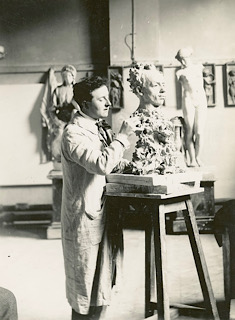
Power is considered the leading Irish sculptor of the 1920s and 1930s. He is a nationalist and promotes the use of Irish materials such as limestone from Durrow and Connemara marble. He is noted for his academic realist style. He exhibits regularly with the Royal Hibernian Academy from 1906, becoming an associate member in 1911, and a full member in 1919. Among those he models sculptures for are James Stephens (1913), W. B. Yeats (1918), and Lord Dunsany (1920). Among his patrons are Oliver St. John Gogarty, and through Gogarty he is commissioned to model a number of prominent Irish nationalists. Gogarty asks him to carve a portrait of Terence MacSwiney in 1920, while MacSwiney is on hunger strike in HM Prison Brixton, London. Smuggled into the prison to do a thumbnail sketch, Power then carves a portrait in the form of a life mask.
On Gogarty’s recommendation, Power is commissioned by the Irish Free State government to create portraits of a number of leading politicians including Arthur Griffith (1922), Michael Collins (1936), and Austin Stack (1939). He is also privately commissioned to execute a portrait of Éamon de Valera in 1944. Among his monumental works are sculptures of Tom Kettle (1919) at St. Stephen’s Green, Dublin, Christ the King in Gort, County Galway, (1933), Pádraic Ó Conaire (1935) at Eyre Square, Galway, and W. B. Yeats (1939) at Sandymount Green, Dublin. He is one of the artists invited to submit designs for the new coinage of the Irish Free State in 1928.
Power dies in Dublin on July 10, 1945, following complications from a double hernia. His is buried in Glasnevin Cemetery, Dublin.
Mary Esperance (“Nancy”) Wynne-Jones is born on December 10, 1922, in Penmaenucha, Wales, to landowner Charles Llewellyn Wynne-Jones and Sybil Mary Gella Scott. The family spends half the year in Wales and half the year in Thornhill, Stalbridge, Dorset. She has two brothers, Andrew and Ronald (“Polly”), both of whom die in Africa during World War II.
Wynne-Jones is educated at home. Her skill in art leads to her getting lessons in Sherborne from a children’s book illustrator. Her music is encouraged by the family doctor and she begins to compose and study the violin, receiving lessons in Bournemouth with the first violinist of the symphony orchestra. After the start of World War II, she continues in Aberystwyth. She goes on to study the violin and composition at the Royal Academy of Music, London (1940–43). While in London she also serves as a Voluntary Aid Detachment nurse until 1943 and later as a draughtswoman at the Ordnance Survey.
After the war, Wynne-Jones purchases and manages a bookshop on the King’s Road in Chelsea, but it is not a financial success. She returns to painting, studying at the Heatherley School of Fine Art, London, from 1951 to 1952 and the Chelsea School of Art from 1952 to 1955. She travels extensively through Portugal and Italy painting landscapes. An interest in completing landscapes in an abstract manner leads her to study with Peter Lanyon in St. Ives, Cornwall.
In 1962, Wynne-Jones purchases Trevaylor House near Penzance and provides accommodation for other artists including renowned Irish painter Tony O’Malley, sculptor Conor Fallon and English poet and writer W. S. ‘Sydney’ Graham. In the 1970s she exhibits in Ireland at the Project Arts Centre, Dublin (1970) and at the Emmet Gallery, Dublin (1975 and 1977). During the 1980s she exhibits at the Lincoln and Hendricks galleries in Dublin before joining the Taylor Gallery, run by John and Patrick Taylor. She is elected an honorary member of the Royal Hibernian Academy (RHA) in 1994 and becomes a member of Aosdána in 1996. Originally an abstract artist, her contact with the Irish countryside slowly transforms her work to that of a landscape artist, albeit with an influence of abstraction attached to it. She becomes well-known in Irish art circles as an eminent Irish landscape artist.
Wynne-Jones is involved with artist Derek Middleton before moving to Cornwall. There she becomes romantically involved with Graham who is in an open marriage, however, it is the death of her mentor Peter Lanyon which devastates her. She meets the sculptor Conor Fallon through their mutual friend, Tony O’Malley. Fallon had arrived in Cornwall ostensibly to meet Lanyon. They marry in 1966. Their honeymoon in Provence is immortalised in expressionist paintings done by her. The couple adopts a boy and a girl, siblings, John and Bridget. In 1972, she moves with her family to Kinsale, County Cork. It is in the area around here that a number of her paintings are created. Later she paints the mountain visible from her Wicklow home after the family moves in the late 1980s. She moves to Ballard House, near Rathdrum, County Wicklow in 1987.
Wynne-Jones dies on November 9, 2006, and is buried in Ballinatone (Church of Ireland), Rathdrum.
Henry is born in Belfast on January 15, 1902, the daughter of the tea merchant George Adams Henry. She attends Mount Pottinger National School, and Victoria College, before expanding her studies at night classes at the Belfast School of Art.
Henry completes an apprenticeship at Clokey Stained Glass Studios founded by Walter Francis Clokey where she is to work for over fifty years designing stained glass windows. Her appointment in the autumn of 1919 comes by a chance visit to Victoria College by the firm’s owner who is seeking a suitable apprentice. She retires from the firm at Easter 1972.
Henry exhibits at the Belfast Art Society for the first time in 1928. She exhibits four works, all landscapes in oil, and then a further two works in the following year. In 1931, she shows a further two works with the successor to the Belfast Art Society, the Ulster Academy of Arts. In 1932, she shows A Derbyshire Village, described by one critic as “a delightful English rural scene.” Between 1931 and 1942 she shows with more than twenty paintings at the Ulster Academy of Arts, exhibiting at each annual show in that time.
Henry has a keen interest in photography from an early age and wins various awards for her photographs. In 1934, she wins the August prize from the Photographic Dealers’ Association for a shot of a child playing with toys in the bath, having received a consolation prize of five shillings in September of the previous year for a shot of a traditional market scene in Boulogne. She goes on to write a regular column for Amateur Photographer throughout the 1930s.
In January 1935, Henry is appointed leader of a local sketching group by the Youth Hostel Association. In December 1935, she is commended for a sketch called River Pool, submitted to a competition judged by James Humbert Craig on behalf of the Youth Hostel Association, presented alongside Port Muckin a show with the sketching group. Maurice Canning Wilks contributes Skernaghan Point, Brown’s Bay to the same show.
The Robinson and Cleaver Art Gallery stages a display of works from Four Ulster Artists in 1936 consisting of paintings from Henry, her sister Marjorie, Theo Gracey and F. H. Hummel. She contributes Green Boat, which she had presented earlier in the year to the Ulster Academy of Arts, and includes Off the Scilly Isles among pictures from Brittany and Bavaria. The reviewer in Belfast’s News Letter refers to her style as “Post-Impressionism.”
In 1937, Henry is elected an Associate of the Ulster Academy of Arts and presents three watercolours to the institution the following year. The exhibition is opened by Oliver St. John Gogarty with participants such as John Luke, Maurice Wilks, James Humbert Craig, Rosamund Praeger and Colin Middleton, who shows three Surrealist works including Angelus.
The Royal Hibernian Academy displays two small works, Flight, 1941 and Lakeside, among an unusually large contingent of Ulster artists in the annual exhibition in the spring of 1942. The Ulster Academy of Arts is united in their commitment to raise funds for the bomb damaged Ulster Hospital for Children and Women in their Spring Exhibition of 1942. Henry displays a sense of humour in her use of black-out paint, roadblocks and air raid shelters in one of the watercolours on show.
Henry is a regular exhibitor with the Water Colour Society of Ireland, and contributes more than one hundred works to their exhibitions between 1943 and 1986.
Henry joins Violet McAdoo in a joint exhibition at the Belfast Museum and Art Gallery in 1944. McAdoo presents with watercolours, however, Henry also presents oils. The paintings are primarily of landscapes but included a number urban scenes.
In 1945, Henry and her sister Margaret join Arthur and George Campbell, Colin Middleton, Gladys and Max Maccabe, Thomas Carr, Maurice Wilks, James McIntyre and others, in the only official exhibition from the Ulster branch of the Artists’ International Association sponsored by the Council for the Encouragement of Music and the Arts (NI) at the Belfast Museum.
The MacGaffin Gallery at Pottinger’s Entry is the venue for a group exhibition of experimental and modernist works with Nevill Johnson, Aaron McAfee and the MacCabes in 1946, where Henry exhibits seven paintings. Quayside is one of three pictures that she presents at the Ulster Academy in 1946. She also shows it with the Water Colour Society of Ireland in the following year and at CEMA’s Some Ulster Paintings exhibition in that same year.
In 1946, the Council for the Encouragement of Music and Art (CEMA) purchases a painting by Henry, in addition to works by other contemporary Ulster artists. Twenty-four of the works from the CEMA collection, including her painting, are later presented at their Donegall Place gallery in 1954.
Henry debuts at the 1948 Irish Exhibition of Living Art with one painting and returns in each of the subsequent ten years with a total of 20 paintings. She is also elected as an Honorary Academician of the Ulster Academy of Arts in 1948.
Henry displays one work, Harbour, Northern Ireland, with Violet McAdoo at the 88th exhibition of the Society of Women Artists at the Royal Institute Galleries in London during the summer of 1949. Just a few months later her work is back in London for the United Society of Artists annual exhibition where she shows Gossip and Shell and Sail.
Henry is awarded a travel scholarship from the Soroptomists of Belgium in 1957, which enables her to study stained glass in the country. She is the President of Soroptomist Club of Belfast from 1960 to 1961, where she had been a member since its foundation in 1932.
Upon her return from Belgium, CEMA stages a solo exhibition with thirty-five of Henry’s oils and watercolours at their Belfast gallery. The exhibition is arranged at short notice when another is unexpectedly cancelled. Writer Nesca Robb opens the exhibition where it is claimed a new painting technique, “monopainting,” is revealed, described as paint drawn through a gauze over glass. The exhibition includes a ‘Breton’ series, Kerry Tangle, Ship Pattern, Barrack Shapes, Lough Shapes, and Backs. In addition, she displays In the Park, an oil previously seen at the Royal Ulster Academy in 1955 and at the Irish Exhibition of Living Art in 1956, and a second oil, City Lunch Hour, exhibited at the Royal Ulster Academy in 1956.
The Ulster Society of Women Artists is founded in 1957 by Gladys Maccabe with the support of Henry and a number of others at a time when no arts societies are accepting female artists into their ranks. The main objective is to ensure the development of quality art and women artists in Ulster. The organisation begins with ten invited artists. Henry exhibits with the society throughout her life.
Henry receives a mention in the local press referring to her exhibits in the Royal Ulster Academy show of 1959 with Kenneth Jamison comparing her work with that of Deborah Brown, “Olive Henry is more decadent by instinct, a fine formaliser. Her pictures Man and Ropes and Riviera Port, well defined and carefully abstracted, contrast in form with Deborah Brown’s freer Oil Over Tempra,[sic] 1959.”
A group exhibition in 1964 at the New Gallery in Belfast includes work from Henry alongside Neil Shawcross, Max Maccabe, Kathleen Bell, Richard Croft and Helen Ross. Among other works she shows Easter and Long Garden.
In 1981, the Ulster Society of Womens Artists elects Henry as President. A retrospective of her studio works is hosted by the Shambles Gallery in Hillsborough, County Down in 1986, some thirty years since her last solo exhibition. Henry shows at the Royal Ulster Academy Annual Exhibition in 1987 for the last time.
Henry dies on November 8, 1989, at Crawfordsburn, County Down. Her paintings are held in the collections of the Northern Ireland Civil Service, Ulster Museum, Irish Linen Centre & Lisburn Museum, and the Royal Ulster Academy of Arts Diploma Collection.
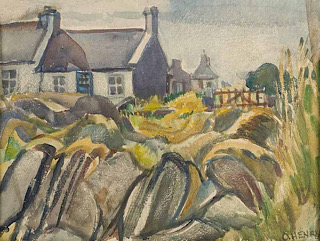
(Pictured: “The Gardener,” watercolour by Olive Henry)
Whelan is awarded many prizes in the Royal Dublin Society (RDS) Taylor art competitions, including one in 1912 for a portrait of his sister Lena, entitled On the Moors, rendered in a strongly academic technique. In 1916, he wins the Taylor scholarship for the Royal Hibernian Academy (RHA) schools for his finest early work, The Doctor’s Visit, an adroitly executed composition of contrasting shadows and light. Typical of many of his genre interiors, the painting depicts a room in the family home, with relatives as models: Whelan’s mother sits by the bed watching over his ill cousin, while his sister, dressed in a Mater hospital nurse’s uniform, is in the background opening the door for the doctor. The subtly evoked atmosphere of restrained emotion foreshadowed a hallmark of his mature style.
Whelan exhibits annually at the RHA for forty-five years (1911–56), averaging six works per year. He is elected an RHA associate in 1920, becoming a full member in 1924. He participates in the Exposition d’art irlandais at the Galerie Barbazanges in Paris in 1922. A visiting teacher at the RHA schools in 1924, he also teaches in the DMSA for a time. He has studios at 64 Dawson Street (1914–27) and 7 Lower Baggot Street (1931–56). Beginning in the 1910s, he receives regular commissions for portraits, constituting his primary source of income. Having become the family’s main breadwinner following his parents’ deaths in the 1920s, he concentrates most of his production on this lucrative activity, portraying numerous leading figures in the spheres of politics, academia, religion, society, medicine, and law.
Situated securely in the academic tradition, in most of his portraits Whelan favours a sombre, restricted palette, with the sitter placed, in grave demeanour, against a monotone background with few accessories. In a 1943 interview he asserts that twentieth-century portraiture suffers from the drabness of modern costume, for which the artist must compensate by careful rendition of the subject’s hands. He tends to depart from his prevailing portrait style when painting women, whom he characteristically depicts in meticulously observed interiors, a notable example being his portrait of Society hostess Gladys Maccabe (c.1946; NGI).
Whelan’s commercial concentration on portraiture notwithstanding, he expresses his true talent in genre compositions, especially kitchen interiors, in which he emulates the technique of the Dutch painter Johannes Vermeer. Two of the most accomplished of these depict his sister Frances in the basement kitchen of the family home: The Kitchen Window (1927; Crawford Art Gallery, Cork) demonstrates a particularly skillful use of light, while Interior of a Kitchen (1935) is notable for the dexterous handling of objects of varied shapes and textures. His genre works include both urban and rural scenes, with a distinctive interest in portraying occupations and other activities. Gypsy (1923), an Orpenesque composition of a shawled woman in a west-of-Ireland landscape with a caravan in the background, receives wide contemporary critical acclaim. Jer (c.1925), depicting a man seated by the fire in a cottage interior, is reproduced in J. Crampton Walker’s Irish Art and Landscape (1927). The Fiddler (c.1932), a naturalistic, sensitively characterised study, is first shown at an Ulster Academy exhibition at Stranmillis, Belfast. A Kerry Cobbler is reproduced in Twelve Irish Artists (1940), introduced by Thomas Bodkin, as among the works denoting the development of a distinctively Irish school of painting.
In 1929, Whelan designs the first Irish Free State commemorative stamp, a portrait of Daniel O’Connell for the centenary of Catholic emancipation. Commissioned by the Thomas Haverty trust to paint an incident from the life of Saint Patrick for the 1932 Eucharistic Congress, he executes The Baptism by St. Patrick of Ethna the Fair and Fedelmia the Ruddy, Daughters of the Ard Rí Laoghaire, a work highly conservative in style. He rapidly completes an oil study of the papal legate, Lorenzo Lauri, also for the Eucharistic Congress. He is represented in the art competitions at the 1932 Summer Olympics in Los Angeles. His depiction of Saint Brigid, shown at the Academy of Christian Art exhibition (1940), becomes a familiar image owing to the wide circulation of reproductions.
Whelan’s political portraits are influential in creating a strong, assured image of the newly formed Irish state, and thus retain an historical significance. His posthumous portrait, The Late General Michael Collins, exhibited at the RHA in 1943 and now held in Leinster House, is an iconic, heroic image of the fallen leader. His portraits of Arthur Griffith and Kevin O’Higgins – commissioned posthumously, as is the Collins, by Fine Gael – also hang in Leinster House, while that of John A. Costello, exhibited at the RHA in 1949, is now held in the King’s Inns, Dublin. He paints two presidents, Douglas Hyde and Seán T. O’Kelly, both works currently in Áras an Uachtaráin. A portrait of Éamon de Valera, painted in 1955 when the sitter is Leader of the Opposition, is in Leinster House. In 1954, he designs a second commemorative stamp, picturing a reproduction of a portrait bust of John Henry Newman, to mark the centenary of the Catholic University of Ireland.
Whelan is elected an honorary academician of both the Ulster Academy of Arts (1931), and the Royal Ulster Academy (1950). He becomes a member of the United Arts Club in 1934. As a representative of the RHA, he sits on the board of governors of the National Gallery of Ireland for many years, and is on the advisory committee of the Municipal Gallery of Modern Art. Unmarried, he resides until his death at the Eccles Street address, with two sisters who continue to manage the family hotel. He dies on November 6, 1956, from leukemia at the Mater private nursing home in Dublin. He is buried in Glasnevin Cemetery.
(From: “Whelan, (Michael) Leo,” by Carmel Doyle, Dictionary of Irish Biography, http://www.dib.ie, October 2009)
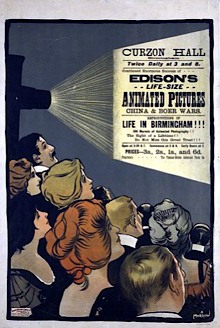
Morrow is born on April 26, 1863, in Comber, County Down, the second son of George Morrow, a painter and decorator from Clifton Street in west Belfast. Of his seven brothers, four, George, Jack, Edwin, and Norman, are also illustrators and all but one are artists. He is a keen ornithologist in his youth. In later life he is a keen walker and paints landscapes for leisure.
While studying under T. M. Lindsay at the Government School of Art in 1880, Morrow is awarded a £10 prize for drawing from the eminent publishers Cassell, Petter and Galpin. In 1881, while still learning his trade, he paints a mural of Belfast for the Working Men’s Institute in Rosemary Street, where his father is chairman. Later in that same year he exhibits a watercolour sketch of a standing figure entitled Meditative at the gallery of Rodman & Company, Belfast.
Morrow then wins a three-year scholarship worth £52 per year which he takes to the National Art Training School at South Kensington in 1882, where he begins a lifelong friendship with the British sculptor Albert Toft. In 1883, while still attending South Kensington, he joins the staff of The English Illustrated Magazine in preparation for the launch of the first edition. Two of his works are published in the Sunday at Home magazine in September of the same year.
J. Comyns Carr, first editor of TheEnglish Illustrated Magazine, commissions Morrow to complete a series on English industry when he has yet to complete his studies at South Kensington.
In 1890, Morrow begins illustrating for Bits and Good Words. He exhibits nine works at the Royal Academy of Arts between 1890 and 1904, all of which are watercolours, and another in 1917, and an offering in chalk at the 159th Exhibition, in the year of his death.
Morrow becomes a member of the Belfast Art Society in 1895, exhibiting with them in the same year. In 1896, a Morrow print is published in Volume 2 of the limited-edition print-collection Les Maîtres de l’Affiche selected by “Father of the Poster” Jules Chéret. In the same year he shows a watercolour of a Gurkha at the Earls Court in the Empire of India and Ceylon exhibition. In 1900, he exhibits with two Ulster artists, Hugh Thomson and Arthur David McCormick, at the Linen Hall Library in Belfast, who along with Morrow had contributed to the early success of TheEnglish Illustrated Magazine.
Morrow is one of the founders of the Ulster Arts Club in November 1902 along with five of his brothers, an organisation that has a nonsectarian interest in Celtic ideas, language and aesthetics. In November 1903, he exhibits at the first annual exhibition of the Club when he shows alongside John Lavery, Hans Iten, James Stoupe and F. W. Hull. He exhibits The Itinerant Musician, a watercolour that he had previously shown at the Royal Academy in 1902. Honorary membership is conferred upon him the following year. Three years later he is honoured with a solo exhibition of sketches and posters in conjunction with the Ulster Arts Club, at the Belfast Municipal Gallery.
In 1908, Morrow joins his brothers in an exhibition at 15 D’Olier Street, Dublin, an address which is later registered to the family business in 1913. Among his contributions to the family exhibition is his painting of Brandon Thomas, The Clarionette Player, which had previously been exhibited at the Royal Academy, and a poster entitled Irving in Dante.
In 1917, Morrow joins his brother George and 150 artists and writers, in petitioning the British Prime MinisterDavid Lloyd George to find a way of enacting the unsigned codicil to Hugh Lane’s will and establish a gallery to house Lane’s art collection in Dublin. Among the 32 notable artists who sign this petition are Jack B. Yeats, Sir William Orpen, Sir John Lavery, and Augustus John.
Morrow illustrates books for children and adults, but he is best known for the hundreds of posters he designs for the theatre, with the bulk of his commissions coming from just one lithographical printer, David Allen and Sons. As a cartoonist he draws for children’s annuals, and contributes three cartoons to Punch in 1923, 1925 and posthumously in 1931.
Morrow dies at his home in West Hoathly, West Sussex, on October 26, 1927, at the age of 64. He is survived by his wife and two children. His headstone in the local churchyard at All Saints Church, Highbrook is designed by his friend, the sculptor and architect, Albert Toft.
Wexford Festival Opera (Irish: Féile Ceoldráma Loch Garman), an opera festival that takes place in the town of Wexford in southeastern Ireland, first takes place on October 21, 1951.
Tom Walsh, an avid opera lover, dreamed of staging an opera production in his hometown Wexford. He starts the Wexford Opera Study Circle in 1950, and invites Sir Compton Mackenzie, the founder of the magazine Gramophone and a writer on music, for the inaugural lecture for the circle. Mackenzie and Walsh discuss the idea of a local opera festival, and Mackenzie becomes the first President of the Wexford Festival of Music and the Arts.
The result is that a group of opera lovers, including Dr. Tom Walsh who becomes the festival’s first artistic director, plan a “Festival of Music and the Arts” (as the event is first called) from October 21 to November 4, 1951. The highlight is a production of the 19th century Irish composer Michael William Balfe‘s 1857 The Rose of Castille, a little-known opera whose composer had lived in Wexford.
Setting itself aside from the well-known operas during its early years places Wexford in a unique position in the growing world of opera festivals, and this move is supported by well-known critics such as the influential Desmond Shawe-Taylor of The Sunday Times, who communicates what is happening each autumn season.
Albert Rosen, a young conductor from Prague, begins a long association with the company in 1965, and he goes on to conduct eighteen Wexford productions. He is later appointed Principal Conductor of the RTÉ Symphony Orchestra and is Conductor Laureate at the time of his death in 1997.
In 1967, Walter Legge, the EMI recording producer and founder of the Philharmonia Orchestra is asked to take over the running of the festival, but within a month of the appointment he suffers a severe heart attack and is obliged to withdraw. The 26-year-old former Trinity College Dublin (TCD) student Brian Dickie takes over the running of the Festival. A new era of outstanding singing emerges, with the first operas in Russian and Czech plus a new emphasis on the French repertory as represented by Léo Delibes’ Lakmé in 1970 and Georges Bizet‘s Les pêcheurs de perles in 1971.
In subsequent years the festival is run by Adrian Slack (1979-81), Elaine Padmore (1982-94), Luigi Ferrari (1995-2004), David Agler (2005-19) and Rosetta Cucchi (2020-present).
The festival’s home of so many years, the Theatre Royal, is demolished and replaced by the Wexford Opera House on the same site. The opera house is officially opened on September 5, 2008, in a ceremony with the TaoiseachBrian Cowen, followed by a live broadcast of RTÉ‘s The Late Late Show from the O’Reilly Theatre. The first opera in the new building opens on October 16, 2008. Wexford Opera House provides the festival with a modern venue with a 35% increase in capacity by creating the 771-seat O’Reilly Theatre and a second, highly flexible Jerome Hynes Theatre, with a seating capacity up to 176. The architect is Keith Williams with the Office of Public Works. The acoustics and structure are designed by Arup.
In 2006, because of the closure of the Theatre Royal, a reduced festival takes place in the Dún Mhuire Hall on Wexford’s South Main Street. Only two operas are staged over a period of two weeks, instead of the usual three operas over three weeks. In 2007, the festival takes place in the summer in a temporary theatre on the grounds of Johnstown Castle, a stately home roughly 5 km from the town centre.