John McCredy McAlery, an Irish association football pioneer, is born in Rathfriland, County Down, on November 29, 1848. His accomplishments include organizing the first ever properly organized football match in the history of Irish football in 1878, founding the first Irish football club in 1879, helping found the Irish Football Association in 1880, and wearing the captain‘s armband in Ireland‘s first ever international match in 1882. He is known as the “father of Irish association football.”
McAlery moves to Belfast to learn the drapery business and soon becomes very successful, opening the Irish Tweed House gentleman’s outfitters on Royal Avenue. A talented cricketer in his youth, his first involvement in the Belfast sport scene is helping in the formation of the Cliftonville Cricket Club in 1870, later serving as club treasurer. In 1878, during his honeymoon in Scotland, he witnesses his first ever association football match, and enjoys it so much he decides to introduce the sport back home.
The first match of organized association football on Irish soil is played on October 24, 1878, between Caledonian and Queen’s Park. McAlery invites the Scottish sides to play in the exhibition match at the Ulster Cricket Ground in an attempt to showcase the game to the Belfast crowd. Queen’s Park achieves a 3–2 victory, and more importantly, the demonstration is well received by the locals.
On September 20, 1879, less than a year later, McAlery places an advertisement in both the News Letter and the Northern Whig soliciting for individuals interested in becoming members of the Cliftonville Association Football Club.
The newly formed Cliftonville F.C. side plays their first match just nine days later, losing 2–1 to a team of rugby players called Quidnunces. They achieve their first victory on November 1 with a 2–0 defeat of Knock F.C., a team of former lacrosse players.
On November 18, 1880, McAlery organizes a meeting at the Queen’s Hotel in Belfast between the seven Irish football clubs that have been established at the time: Alexander, Avoniel, Cliftonville, Lisburn Distillery, Knock, Moyola Park and Oldpark. These teams become the founding members of the Irish Football Association (IFA), with Lord Spencer Chichester serving as its president and McAlery as secretary. In an appendix to the minutes of the meeting, McAlery writes: “If the spirit which pervaded from those present be acted upon the result will be a strong Association for promoting the game which we have espoused.”
The meeting also provides for Ireland’s first official football competition, the Irish FA Cup. In the first Cup final of the inaugural competition, played on April 9, 1881, Cliftonville is defeated by Moyola Park. They suffer the same fate the following year, losing to Queen’s Island in the final of the 1881–82 edition. McAlery, who captains Cliftonville while playing at fullback, wins his first trophy on his third try, as his club defeats Ulster to win the 1882–83 Irish Cup.
McAlery does not play much after this, deciding to focus on his administrative role in Irish football. He referees international matches until 1887, and remains the Irish FA secretary until 1888.
McAlery captains Ireland’s first ever international match on February 18, 1882, playing at right back. On a “bittery cold” Belfast night with occasional rain and hail, Ireland loses to the far more experienced England team by a score of 13–0. A week later, he makes his second and final international appearance, captaining his team again as they lose 7–1 to Wales in Wrexham.
O’Connor is a well-known intellectual figure in contemporary Irish affairs and expresses strong opinions against censorship and the war on drugs. He contributes a regular poetry column to the Irish daily, the Evening Herald, also writes a column for the Sunday Mirror and a sporting column for TheSunday Times, as well as broadcasting on RTÉ.
O’Connor is also known for the autobiographical The Ulick O’Connor Diaries 1970-1981: A Cavalier Irishman (2001), which details his encounters with well-known Irish and international figures, ranging from political (Jack Lynch and Paddy Devlin) to the artistic (Christy Brown and Peter Sellers). It also documents the progress of the Northern Ireland peace process during the same time, and the progress of the Northern Ireland Assembly. Although he travels extensively, he lives in his parental home in Dublin’s Rathgar. He is a member of Aosdána.
Gwynn is educated at St. Columba’s College, Dublin, and Trinity College Dublin. In 1896 he heads the list of Foundation Scholars in Classics at TCD. In 1898 he graduates Bachelor of Arts, gaining a “first of firsts” with gold medals in Classics and Modern Literature.
In 1900, along with his brother Edward Gwynn and others, Gwynn founds the Social Services (Tenements) Company to provide housing for poor families in Dublin. He subsequently spends many periods working with the poor in Dublin’s slums. He is instrumental in founding the Trinity Mission, which serves slum dwellers in Belfast, and is for many years actively involved in the Dublin University Fukien Mission (later the Dublin University Far Eastern Mission), eventually becoming its chairman and president.
He is ordained deacon in 1906, achieving full priesthood two years later. He is the only one of Rev. John Gwynn’s sons to be ordained, and he never serves in a parish. That same year, he proceeds to MA and is elected a Fellow of Trinity College Dublin.
In 1907 Gwynn is appointed Lecturer in Divinity and Tutor. He remains Lecturer in Divinity until 1919 and continues as Tutor until 1937. He is appointed Chaplain of TCD in 1911, retaining that post until 1919.
In January 1909 he is appointed Acting Warden of his old school, St. Columba’s College, which is facing a major financial crisis. He keeps the institution afloat until a new warden is appointed.
Horrified by the brutality of the Dublin Metropolitan Police (DMP) toward strikers during the lockout in 1913, Gwynn becomes a prominent advocate of the workers’ cause and joins the Industrial Peace Committee. On November 12, 1913, when the committee is barred from holding its meeting at the Mansion House, he invites the members to his college rooms at No. 40, New Square. It is this meeting that leads to the foundation of the Irish Citizen Army (ICA). In their history of Trinity College McDowell and Webb observe, “Gwynn’s support for the ‘army’ concept was based simply on the idea that military-style discipline would keep unemployed men fit and give them self-respect. ‘Sancta simplicitas!'”
In 1914 Gwynn marries Dr. Eileen Gertrude Glenn, a rector’s daughter from Pomeroy, County Tyrone. They have six children.
In 1916 Gwynn is appointed Professor of Biblical Greek, a post he holds for forty years (1916-56). During those four decades, he holds a number of other, often overlapping, academic appointments at the university, including Professor of Hebrew (1920-37), Registrar (1941), Vice-Provost (1941-43), Senior Lecturer (1944-50), and Senior Tutor (1950-56). In 1937 he is co-opted to Senior Fellowship. He is made an honorary fellow in 1958.
When the Dublin University Fabian Society is formed. Gwynn becomes one of its vice-presidents.
Like several of his brothers, Gwynn is a fine cricket player, in his youth captaining both his school XI and the Dublin University XI. A right-handed batsman and right-arm slow bowler, he plays once for the Ireland cricket team in 1901. He also plays four first-class matches for Dublin University in 1895. He retains a lifelong interest in the sport, and John V. Luce portrays him as President of the Dublin University Cricket Club, with his “tall rangy figure … a familiar sight at matches in College Park.”
Gwynn is tall and athletic, but in later life suffers from deafness. To aid his hearing he carries a large ear trumpet with him and this, together with his height and glowing white hair, makes him an impressive and instantly recognizable figure around Trinity College. In character, he is patient, kind and wise, but at the same time resolute and tough. His nephew-in-law, the late Archbishop of Armagh, George Simms, remarks that his “gentle humility inspired trust and drew confidences, his stubborn integrity brought surprises for those who mistook charity for easy-going indifference,” and spoke of his “Athanasian courage.”
Gwynn dies in Dublin at the age of 85 on June 25, 1962. He is buried in Whitechurch churchyard.
While at West Ham, Cantwell features in the London XI side that competes in the 1955–58 Inter-Cities Fairs Cup final on May 1, 1958. He captains the Hammers to winning the Division Two championship in the 1957–58 season thereby leading the club into the topflight for the first time since 1932.
In November 1960, Cantwell joins Manchester United for £29,500 which at the time is a record for a full-back. He helps the club win the 1965 and 1967 league titles and captains United when winning the 1963 FA Cup Final – just as his fellow countryman Johnny Carey had done in United’s previous FA Cup win fifteen years earlier.
During his International career (1953-67), Cantwell wins 36 full International caps for the Republic of Ireland, typically playing at left full-back and on several occasions at centre-forward. He makes his debut against Luxembourg in October 1953, with his final appearance coming away to Turkey in February 1967. He scores fourteen goals including five from penalties and also captains the Republic on several occasions including a match against England at Wembley Stadium.
In his first managerial role at Coventry City, Cantwell has the onerous task of following Jimmy Hill who had taken the club into the First Division for the first time in their history. He narrowly keeps the Sky Blues in the top in his first two seasons before taking them to a sixth-place finish in 1969–70, earning them qualification for the Inter-Cities Fairs Cup (a year before it is replaced by the UEFA Cup).
Cantwell returns to Peterborough on November 19, 1986, for a second stint as manager, remaining in this role until he becomes general manager on July 12, 1988. He is general manager at London Road for a year until he quits football to become licensee of the New Inn at Peterborough, where he remains for ten years until he retires in 1999. He also is landlord of the Bull and Swan in Stamford, Lincolnshire.
Cantwell also plays cricket for Cork Bohemians Cricket Club and Ireland as a left-handed batsman and a right-arm medium bowler. He plays five times for Ireland, making his debut in what is his sole first-class match versus Scotland at Edinburgh in 1956, scoring 31 and 17. His last match for Ireland is against Lancashire in July 1959.
Cantwell dies from cancer at Addenbrooke’s Hospital, Cambridge, not far from his home in Peterborough, on September 8, 2005. He is survived by his wife Maggie, a native of Belfast, and two daughters, Liz and Kate. A 22-year-old son, John Robert, is killed in a car crash thirteen years earlier.
Cantwell’s former teams each hold a moment of silence for him before their next matches.
Thomas “Tom” Michael Kettle, parliamentarian, writer, and soldier, is born on February 9, 1880, in Artane, Dublin, the seventh among twelve children of Andrew Kettle, farmer and agrarian activist, and his wife, Margaret (née McCourt). His father’s record in nationalist politics and land agitation, including imprisonment in 1881, is a valuable political pedigree.
The family is prosperous. Kettle and his brothers attend Christian Brothers’ O’Connell School in Richmond Street, Dublin, before being sent to board at Clongowes Wood College, County Kildare. Popular, fiery, and something of a prankster, he soon proves to be an exceptional scholar and debater, as well as a keen athlete, cyclist, and cricketer. He enrolls in 1897 at University College Dublin (UCD), his contemporaries including Patrick Pearse, Oliver St. John Gogarty and James Joyce. He thrives in student politics, where his rhetorical genius soon wins him many admirers and is recognised in his election as auditor of the college’s Literary and Historical Society. He also co-founds the Cui Bono Club, a discussion group for recent graduates. In 1899, he distributes pro-Boer propaganda and anti-recruitment leaflets, arguing that the British Empire is based on theft, while becoming active in protests against the Irish Literary Theatre‘s staging of The Countess Cathleen by W. B. Yeats. In 1900, however, he is prevented from taking his BA examinations due to a mysterious “nervous condition” – very likely a nervous breakdown. Occasional references in his private diaries and notes suggest that he is prone to bouts of depression throughout his life. He spends the following two years touring in Europe, including a year at the University of Innsbruck, practising his French and German, before taking a BA in mental and moral science of the Royal University of Ireland (RUI) in 1902. He continues to edit the college newspaper, remaining active in student politics. He participates, for example, in protests against the RUI’s ceremonial playing of “God Save the King” at graduations as well as its senate’s apparent support for government policy, threatening on one occasion to burn publicly his degree certificate.
In 1903, Kettle is admitted to the Honourable Society of King’s Inns to read law and is called to the bar two years later. Nonetheless, he soon decides on a career in political journalism. Like his father, he is a keen supporter of the Irish Parliamentary Party (IPP), and in 1904 is a co-founder of the resonantly titled Young Ireland Branch of the United Irish League. Here he comes to the notice of John Redmond, who offers him the prospect of a parliamentary seat, but he chooses instead to put his energies into editing the avowedly pro-Irish-party paper, The Nationist, in which he promises that a home rule administration will uphold women’s rights, industrial self-sufficiency, and Gaelic League control of Irish education. He hopes that the paper will offer a corrective alternative to The Leader, run by D. P. Moran, but in 1905 he is compelled to resign the editorship due to an article thought to be anti-clerical. In July 1906, he is persuaded to stand in a by-election in East Tyrone, which he wins with a margin of only eighteen votes. As one of the youngest and most talented men in an ageing party, he is already tipped as a potential future leader. His oratory is immediately put to good use by the party in a propaganda and fund-raising tour of the United States, as well as on the floor of the House of Commons, where his oratorical skills earn him a fearsome reputation. He firmly advocates higher education for Catholics and the improvement of the Irish economy, while developing a close alliance with Joseph Devlin and the Ancient Order of Hibernians (AOH).
Kettle meanwhile makes good use of his connections to ArchbishopWilliam Walsh, the UCD Sodality of the Blessed Virgin Mary, and the Catholic Graduates and Undergraduates Association, as well as political support, to secure the professorship of national economics. T. P. Gill, of the Department of Agriculture and Technical Instruction, exceptionally acts as his referee. His detractors regard the appointment as a political sinecure and Kettle as a somewhat dilettantish “professor of all things,” who frequently neglects his academic duties. However, he takes a keen interest in imperial and continental European economies. He does publish on fiscal policy, even if always taking a pragmatic interest in wider questions, greatly impressing a young Kevin O’Higgins, later Vice-President of the Executive Council of the Irish Free State. He has little time for what he regards as the abstract educational and economic idealism of D. P. Moran. He acknowledges that the “Hungarian policy” of Arthur Griffith has contributed significantly to a necessary debate about the economy, but argues that the Irish are “realists,” that Ireland’s natural resources ought to be scientifically measured, and that the imperial connection is crucial to Ireland’s future development. The achievement of home rule would, he asserts, encourage a healthy self-reliance as opposed to naive belief in self-sufficiency.
Kettle is encouraged by the heightened atmosphere of the constitutional crisis over the 1909 David Lloyd Georgebudget, culminating in the removal of the House of Lords veto, which has been an obstacle to home rule. He is also a supporter of women’s enfranchisement, while stressing that the suffragist cause should not delay or deflect attention from the struggle for home rule. He holds his East Tyrone seat in the January 1910 United Kingdom general election but decides not to stand at the general election in December of the same year. Returning to an essentially journalistic career, he publishes a collection of essays outlining his constitutional nationalist position. He opposes suffragette attacks on private property, but, in contrast, supports the Dublin strikers in 1913, highlighting their harsh working and living conditions. He tries without success to broker an agreement between employers and workers though a peace committee he has formed, on which his colleagues include Joseph Plunkett and Thomas P. Dillon. His efforts are not assisted, however, by an inebriated appearance at a crucial meeting. Indeed, by this time his alcoholic excesses are widely known, forcing him to attend a private hospital in Kent.
In spite of deteriorating health, Kettle becomes deeply involved in the Irish Volunteers formed in November 1913 to oppose the Ulster Volunteers. His appraisal of Ulster unionism is somewhat short-sighted, dismissing it as being “not a party [but] merely an appetite,” and calling for the police to stand aside and allow the nationalists to deal with unionists, whose leaders should be shot, hanged, or imprisoned. These attitudes are mixed in with a developing liberal brand of imperialism based on dominion federalism and devolution, warmly welcoming a pro-home-rule speech by Winston Churchill with a Saint Patrick’s Day toast to “a national day and an empire day.” Nevertheless, he uses his extensive language skills and wide experience of Europe to procure arms for the Irish Volunteers. He is in Belgium when the Germans invade, and the arms he procured are confiscated by the Belgian authorities, to whom they were donated by Redmond on the outbreak of war.
On his return to Dublin, Kettle follows Redmond’s exhortation to support the war effort. He is refused an immediate commission on health grounds, but is eventually granted the rank of lieutenant, with responsibilities for recruitment in Ireland and England. He makes further enemies among the advanced nationalists of Sinn Féin, taunting the party for its posturing and cowardly refusal to confront Ulster unionists, the British Army, and German invaders alike. Coming from a staunchly Parnellite tradition, he is no clericalist, yet he is a devout if liberal Catholic, imbued by his Jesuit schooling with a cosmopolitan admiration for European civilisation which has been reinforced by his European travels, and in particular has been outraged by the German destruction of the ancient university library of Louvain. Despite a youthful flirtation with the philosophy of Friedrich Nietzsche, he comes to regard “Prussianism” as the deadliest enemy of European civilisation and the culture of the Ten Commandments, there not being “room on earth for the two.” He increasingly believes that the German threat is so great that Irish farmers’ sons ought to be conscripted to defend Ireland. He also believes that considerable good might come out of the conflict, exhorting voters in East Galway to support what is practically a future home rule prime minister, cabinet, and Irish army corps. He unsuccessfully seeks nomination as nationalist candidate in the 1914 East Galway by-election in December. Nevertheless, he continues to work tirelessly on behalf of the party, publishing reviews, translations, and treatises widely in such journals as the Freeman’s Journal, The Fortnightly Review, and the Irish Ecclesiastical Record.
As a recruiting officer based far from the fighting, Kettle is stung by accusations of cowardice from advanced nationalists. He had tried repeatedly to secure a front-line position, but was rejected, effectively because of his alcoholism. He is appalled by trench conditions and the prolongation of the war, a disillusionment further encouraged by the Easter Rising, in which his brother-in-law, Francis Sheehy-Skeffington, is murdered by a deranged Anglo-Irish officer, J. C. Bowen-Colthurst. He senses that opinion in Ireland is changing, anticipating that the Easter insurgents will “go down in history as heroes and martyrs,” while he will go down, if at all, as “a bloody British officer.” Nevertheless, he regards the cause of European civilisation as greater than that of Ireland, remaining as determined as ever to secure a combat role. Despite his own poor health and the continuing intensity of the Somme campaign, he insists on returning to his unit, the 9th Battalion, Royal Dublin Fusiliers.
Kettle’s writings demonstrate the mortal danger he is placing himself in, evident not least in his frequently quoted poem, “To my daughter, Betty, the gift of God,” as well as letters settling debts, apologising for old offences, and providing for his family – his wealth at death being less than £200. He has no death wish, wearing body armour frequently, but as Patrick Maume notes, “As with Pearse, there is some self-conscious collusion with the hoped-for cult.” He is killed on September 9, 1916, during the Irish assault on German positions at Ginchy.
Kettle marries Mary Sheehy, alumna of UCD, student activist, suffragist, daughter of nationalist MPDavid Sheehy, and sister-in-law of his friend Francis Sheehy Skeffington, on September 8, 1909. In 1913 the couple has a daughter, Elizabeth.
Kettle is commemorated by a bust in St. Stephen’s Green, Dublin, and in the House of Commons war memorial in London. He is a man of great passions and proven courage. George William Russell put his sacrifice on a par with Thomas MacDonagh and the Easter insurgents:
“You proved by death as true as they, In mightier conflicts played your part, Equal your sacrifice may weigh, Dear Kettle, of the generous heart (quoted in Summerfield, The myriad minded man, 187).
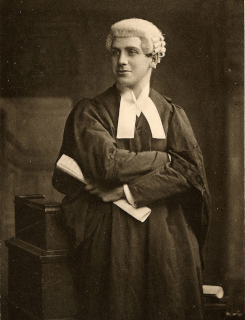
(From: “Kettle, Thomas Michael (‘Tom’)” by Donal Lowry, Dictionary of Irish Biography, http://www.dib.ie, October 2009 | Pictured: Tom Kettle as a barrister when called to the Irish law bar in 1905)
Charles Gordon Lambert, Irish businessman, senator and art collector, dies in a Dublin hospital on January 27, 2005.
Lambert is born on April 9, 1919, in the family home at Highfield Road, Rathmines, Dublin, the youngest of four sons of Robert James Hamilton Lambert, a veterinarian and renowned cricketer, and his wife Nora (née Mitchell). His eldest brother, Noel Hamilton “Ham” Lambert, is a versatile sportsman and noted veterinary practitioner.
Lambert is educated at Sandford Park School, Dublin, and at Rossall School, Lancashire. He is steered by his mother toward a career in accountancy for which he prepares by studying commerce at Trinity College Dublin (TCD). Graduating in 1940, he joins the accounting firm Stokes Brothers and Pim, qualifying Associate Chartered Accountant in 1943. In 1944, after auditing biscuit manufacturers W. & R. Jacob and Co. Ltd, one of Ireland’s largest and most prestigious industrial companies, he is offered and accepts a £300 a year job at Jacob’s as assistant accountant.
In 1953, Lambert becomes Jacob’s chief accountant as the management grooms him for an executive career. During 1948–56, Jacob’s suffers from profit and price controls, lack of capital investment and complacency brought about by the absence of competition. The entry of Boland’s Bakery into the Irish biscuit market in 1957 is exploited by Lambert who urges the alarmed board, which has long regarded advertising as vulgar, to market its products more vigorously. This assertiveness yields his advancement to the position of commercial manager in 1958. A year later he becomes the first non-member of the Bewley and Jacob families to be appointed to the board.
Between 1959 and 1970, biscuit consumption in Ireland doubles for which Lambert can claim much credit. Recognising that the advent of self-service stores means that manufacturers can no longer rely on retailers to sell their products, he pioneers advanced promotional techniques in Ireland, particularly the use of marketing surveys and of mass advertising in newspapers, on radio and on the emerging medium of television. To further accord with retailers’ preferences, Jacob’s drives the widespread packaging of biscuits in airtight packets rather than tins and also introduces a striking red flash logo for its packets. His interest in contemporary art enables him to contribute directly to Jacob’s packaging designs.
Lambert is appointed to the board of the Electricity Supply Board (ESB) in 1964, a position he holds until 1977, and serves as president of the National Agricultural and Industrial Development Association (NAIDA) in 1964–65, spearheading a “Buy Irish” campaign. His involvement with NAIDA dates to the mid-1950s and leads to his friendship with Jack Lynch, Minister for Industry and Commerce. This relationship and his admiration for Seán Lemass incline him toward Fianna Fáil. He also believes the party is the one most likely to deliver economic growth.
In 1977, Lambert is appointed to Seanad Éireann by Taoiseach Jack Lynch. He sits as an independent but assures Lynch he will broadly support the government. Dismayed by Ireland’s economic uncompetitiveness, he uses this platform to bemoan the state’s financial profligacy and failure to control inflation, and the indifference of Irish politicians towards the business community, contending that Irish industrialists suffer and need to learn from the expert lobbying of the indigenous agricultural sector and of large multi-national companies based in Ireland. He also articulates his social liberalism, desire for peaceful reconciliation in Northern Ireland and support for cultural and environmental causes. But his commitment to the Seanad wanes as he grasps its irrelevance. When Lynch resigns in December 1979, Lambert joins the Fianna Fáil party in a futile bid to preserve his political influence.
Following Jacob’s takeover of Boland’s Bakery in 1966, Lambert becomes joint managing director of a new entity, Irish Biscuits Ltd, the manufacturing and trading company for the Boland’s and Jacob’s biscuits operations. W. & R. Jacob and Co. Ltd becomes a holding company. In 1968, he becomes the sole managing director. From 1977 he begins withdrawing from the active administration of the company, relinquishing his managing directorship in 1979 to become chairman.
The Irish Museum of Modern Art (IMMA) opens in 1991 and receives through the medium of the Gordon Lambert Trust some 212 works, which form the centerpiece of its collection. Thereafter Lambert gifts another 100 works to IMMA. He sits on IMMA’s board from 1991, and the west wing of the museum is named after him in 1999.
Despite being diagnosed with Parkinson’s disease in 1988, Lambert remains relatively active and plays golf into his 80s. In 1999 he receives an honorary LLD from TCD. From 1997, he relies increasingly on Anthony Lyons, an acquaintance of longstanding, to care for him. His last years are overshadowed by the collapse in autumn 2002 of his close but complex relationship with his family. Thereafter he shuns his relations and changes his will, granting Lyons a substantial portion of his estate while curtailing the amount to be received by his family. He dies in a Dublin hospital on January 27, 2005. Relatives challenge his final will in the High Court in 2009, but it is upheld.
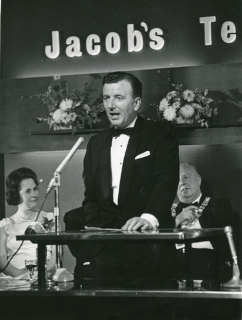
(Pictured: Photograph of director of Jacob’s Biscuits, Gordon Lambert, speaking from a podium at the first Jacob’s Television Awards. The Lord Mayor of Dublin, James O’Keefe, is sitting behind Lambert. The awards ceremony takes place at the Bishop Street factory, Dublin.)
Gwynn is born in Ramelton, County Donegal, on May 5, 1873. He is a member of a family well known in Dublin at the time for its academic and sporting achievements. He is the fourth son of the Very Rev. John Gwynn, Regius Professor of Divinity at Trinity College Dublin (TCD), and Lucy Josephine, daughter of the Irish patriot William Smith O’Brien. He and his three immediate younger brothers, Arthur, Robin and Jack, all in turn captain their school and university cricket teams and play the game at first class level. He is also a talented rugby player.
Gwynn’s academic career outshines even his sporting achievements. He enters Trinity College Dublin as a foundation Scholar and achieves a double first in his degree finals. In 1899 he is elected a Fellow of Trinity College and commences what promises to be a distinguished academic career.
At school Gwynn is mainly a bowler, his brother Arthur being the superior bat, though this inequality is ironed out at university. He is captain of the Dublin University Cricket Club XI for two seasons, 1894 and 1895, then plays under Arthur’s captaincy. The three brothers make up a formidable threesome in those years.
Primarily noted for his bowling prowess during early outings with the Dublin University XI, Gwynn takes 44 wickets at an average of 8.14 in Trinity’s annus mirabilis of 1893, a season which witnesses victories over Leicestershire, Oxford University, Warwickshire (dismissed for a paltry total of 15 runs) and a draw against Essex.
Gwynn, a right-handed batsman, who records the highest first-class average (56.87) among those batsmen who complete ten innings or more during the English season of 1895, enjoys another remarkably productive season in 1896, plundering over a thousand runs in Trinity flannels, a superlative effort complemented by a haul of 93 wickets at 9.37. His irrepressible form reputedly earns him an invitation to represent England against Australia in the second Ashes Test at Old Trafford in July 1896. However, concurrent university examinations render him unable to participate. Instead, English cricket is introduced to the wizardry of K. S. Ranjitsinhji, who takes Gwynn’s place.
Gwynn makes his debut for Ireland against I Zingari in July 1892 and goes on to play for Ireland 13 times, his last game coming in May 1902 against Marylebone. Two of his matches for Ireland have first-class status.
Gwynn also plays first-class cricket in two Gentlemen v Players matches, representing the gentlemen, and four matches for Dublin University in 1895, for whom he makes his top score of 153 not out against Leicestershire. In all, he amasses 3,195 runs and 311 wickets for Dublin University, in addition to 499 runs and 14 wickets for Ireland.
Remarkably, Gwynn also represents Ireland seven times at rugby union, debuting against Scotland at Belfast in February 1893. He features in all three legs of Ireland’s 1894 Triple Crown-winning campaign.
In 1901 Gwynn marries Katharine Rawlins of Bristol. He is already suffering from persistent symptoms of debility and fatigue. A few months later a Harley Street physician diagnoses tuberculosis. He is admitted to a sanatorium at Davos Platz in Switzerland, but the illness has progressed too far for any treatment to succeed. He dies on December 23, 1902, at the age of 29. The couple’s only child, a daughter named Rhoda, is born in September 1902, just three months before his death.
On January 25, 1947, Mullen makes his formal Irish debut in a 12–8 loss to France. He plays as hooker, winning 25 caps for Ireland from 1947 to 1952. A year later, on January 31, 1948, he plays his first game for Barbarian F.C. in a 9–6 victory over Australia in Cardiff, Wales. After helping Ireland to victory over France on January 1, 1948, at the age of 21, he captains Ireland for the first time, on February 14, 1948, leading them to an 11–10 victory over England at Twickenham Stadium.
Mullen captains the Irish team to their first Grand Slam in the 1948 Five Nations Championship and is one of eight players from that team who live to see the country’s next Grand Slam in 2009.
Ireland retains the triple crown in 1949 by beating Wales 5–0 in Swansea, ending a run of defeats on Welsh soil lasting fourteen years. The following season Ireland suffers from injuries and loses to both England and Wales, the latter securing the triple crown.
Mullen is selected to captain the 1950 Lions Tour to Australia and New Zealand. After appearing in the first two tests against New Zealand, a 9–9 draw and an 8–0 loss, he sustains an ankle injury in the latter game and concedes his place to Dai Davies of Wales. Returning for the second test against Australia, a resounding 24–3 victory, he also plays in a semi-official “British Isles RFU” team against Ceylon during their return journey in September.
Under Mullen’s captaincy Ireland regains the international championship in 1951. His last cap comes in a 14–3 loss to Wales at Lansdowne Road on March 8, 1952. In twenty-five successive appearances (fifteen as captain), he secured three international championships and two triple crowns for Ireland in four seasons, their most successful haul of the twentieth century.
Mullen is one of eight surviving members of the 1948 team to witness Ireland’s second grand slam on March 21, 2009. Only weeks later, having suffered from a long illness, he dies on April 27, 2009, at his home, Gilltown Lodge, in Kilcullen.
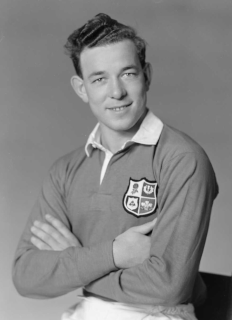
(Pictured: Karl Mullen, captain of the British Lions rugby union team, 1950)
Gwynn spends his early childhood in rural County Donegal, which is to shape his later view of Ireland. He attends Brasenose College, Oxford, where, as scholar, in 1884 he is awarded first-class honours in classical moderations and in 1886 literae humaniores. During term holidays he returns to Dublin, where he meets several of the political and literary figures of the day.
After graduating, Gwynn spends ten years from 1886 tutoring as a schoolmaster, for a time in France, which creates a lifelong interest in French culture, as expressed in his Praise of France (1927). By 1896 he has developed an interest in writing, becoming a writer and journalist in London focused on English themes, until he comes into contact with the emerging Irish literary revival, when he serves as secretary of the Irish Literary Society.
This is the beginning of a long and prolific career as a writer covering a wide range of literary genres, from poetry and biographical subjects to general historical works. The eighteenth century is Gwynn’s particular specialism. He writes numerous books on travel and on the topography of his own homeland, as well as on his other interests: wine, eighteenth-century painting and fishing.
Gwynn returns to Ireland in 1904 when he enters politics. In the 1906 Galway Borough by-election he wins a seat for Galway Borough, which he represents as a member of the Irish Parliamentary Party until 1918. During this period, he is active in the Gaelic League and is one of the few Irish MPs to have close links to the Irish literary revival. Along with Joseph Maunsel Hone and George Roberts he founds the Dublin publishing house of Maunsel and Company. He is opposed to the demand for the Irish language to be a compulsory subject for matriculation. He supports the campaign which wins the establishment of a Catholic university when he serves on the Irish University Royal Commission in 1908. During the debate on the third Home Rule Bill, and at the request of his party leader John Redmond, he writes The case for Home Rule (1911) and is in charge of much of the party’s official publicity and its replies to criticism from Sinn Féin.
On the outbreak of World War I in August 1914, Gwynn strongly supports Redmond’s encouragement of Irish nationalists and the Irish National Volunteers to support the Allied and British war effort by enlisting in Irish regiments of the Irish Divisions, especially as a means to ensure the implementation of the suspended Home Rule Act at the end of an expectedly short war. Now over fifty, he enlists in January 1915 with the 7th Leinster Regiment in the 16th (Irish) Division. In July he is commissioned as a captain in the 6th (Service) Battalion, Connaught Rangers and serves with them on the Western Front at Messines, the Somme and elsewhere.
Gwynn is one of five Irish Nationalist MPs who enlist and serve in the army, the others being John L. Esmonde, Willie Redmond, William Redmond and D. D. Sheehan, as well as former MP Tom Kettle. Together with Kettle and William Redmond, he undertakes a recruitment drive for the Irish divisions, co-operating with Kettle on a collection of ballads called Battle Songs for the Irish Brigade (1915). He is made a chevalier of the Legion of Honour in July 1915. In 1916, he is appointed to the Dardanelles Commission.
Recalled to Ireland in late 1917 to participate in the Irish Convention chaired by Sir Horace Plunkett, Gwynn sides with the Redmondite faction of the Irish Party in supporting a compromise with the southern unionists in an attempt to reach consensus on a Home Rule settlement which would avoid partition. On the death of Redmond in March 1918, he takes over as leader of the moderate nationalists in the Convention. He opposes the threat of compulsory military service during the Conscription Crisis of 1918, though as a member of the Irish Recruiting Council he continues to support voluntary recruitment, encountering intense opposition led by Sinn Féin.
Gwynn forms the Irish Centre Party in 1919 and stands unsuccessfully as an Independent Nationalist for Dublin University in the 1918 Irish general election. The party merges with Plunkett’s Irish Dominion League to press for a settlement by consent on the basis of dominion status, but Gwynn subsequently breaks with Plunkett due to his willingness to accept partition as a temporary compromise. The polarities which divide Ireland during the Irish War of Independence and Irish Civil War increasingly sideline his brand of moderate cultural nationalism. Although he supports the newly emergent nation, he equally condemns some of the excesses, such as the burning of houses belonging to Free State senators.
Gwynn’s personal life also becomes complicated at this stage and around 1920. He has a romantic association with married artist Grace Henry who is perhaps the best-known female artist in Ireland at the time. During this period, he and Grace travel in France and Italy and at various stages in his life she painted portraits of him including a very distinguished looking one of him in his late 60s or early 70s. Their relationship contributes significantly to the separation of Henry from her artist husband Paul Henry in 1930.
During the 1920s, Gwynn also devotes himself to writing, covering political events as Irish correspondent to The Observer and The Times. Later in his career, he writes some substantial works, and together with his son Denis Gwynn (The Life of John Redmond, 1932) does much to shape the retrospective image and self-justification of John Redmond. In the mid-1930s he authors three books with a connecting theme of fishing with the artist Roy Beddington serving as illustrator: The Happy Fisherman (1936), From River to River (1937), and Two in a Valley (1938).
Gwynn is awarded an honorary D.Litt. by the National University of Ireland in 1940, and a Litt.D. by the University of Dublin in 1945. The Irish Academy of Letters awards him the Gregory Medal in April 1950. In his literary writings he stands for a humanism and tolerance, which qualities, due to political upheavals, were relatively rare in the Ireland of his day.
Gwynn dies on June 11, 1950, at his home in Terenure, Dublin, and is buried at Tallaght Cemetery, south County Dublin.
Gwynn marries his cousin Mary Louisa (d. 1941), daughter of Rev. James Gwynn. She later converts to Catholicism. They have three sons and two daughters who are brought up in her religion, of whom Aubrey (1892–1983) becomes a Jesuit priest and professor of medieval history at University College Dublin (UCD). Their second son, Denis Rolleston (1893–1971), is professor of modern Irish history at University College Cork (UCC).
Gwynn’s brother Edward John (1868–1941) becomes provost of Trinity College and another brother Robert Malcolm becomes its senior dean. His sister Lucy Gwynn is the first woman registrar of Trinity. A third brother, Charles, has a successful career in the British Army and retires as a Major General. Younger brothers Lucius and Jack are noted cricketers.
Nicholas “Nicky” Rackard, Irish hurler whose league and championship career with the Wexford senior team spans seventeen years from 1940 to 1957, is born on April 28, 1922, in Killanne, County Wexford. He establishes many championship scoring records, including being the top championship goal-scorer of all time with 59 goals. He is widely regarded as one of the greatest hurlers in the history of the game.
Rackard is the eldest son of five boys and four girls born to Robert (Bob) Rackard and Anastasia Doran, who had been married in 1918. He is introduced to sport by his father who had hoped he would become a cricketer. His uncle, John Doran, won an All-Ireland medal as a Gaelic footballer with Wexford in 1918 and it is hurling and Gaelic football that Rackard develops a talent for.
Rackard plays his club hurling with his local Rathnure club and enjoys much success. He wins his first senior county title in 1948. It was Rathnure’s first ever championship triumph. Two years later in 1950 he captures a second county title, a victory which allows him to take over the captaincy of the county senior team for the following year. He wins his third and final county medal in 1955.
Rackard makes his debut on the inter-county scene when he is selected for the Wexford minor panel. He is just out of the minor grade when he is selected for the Wexford senior team in 1940. Over the course of the next seventeen years, he wins two All-Ireland medals as part of the Wexford hurling breakthrough in 1955 and 1956. He also wins four Leinster Senior Hurling Championship medals, one National Hurling League medal and one Leinster Senior Football Championship medal as a Gaelic footballer. He plays his last game for Wexford in August 1957.
By the late 1940s, Rackard is a regular in the full-forward line on the Leinster inter-provincial team. Success comes in the twilight of his career and he claims his sole Railway Cup medal in 1956.
Rackard’s brothers, Billy and Bobby, also experience All-Ireland success with Wexford.
In retirement from playing Rackard becomes involved in team management and coaching. It is with the Wexford senior team that he enjoys his greatest successes as a selector when he helps the team secure the 1968 All-Ireland Senior Hurling Championship title.
Rackard is most famous for his scoring prowess and is the all-time top championship scorer at the time of his retirement from hurling. His private life is marred by periods of excessive drinking, which had started during his university studies, and eventually develops into alcoholism. After quitting drinking completely in 1970, he travels the country as a counsellor with Alcoholics Anonymous. In an interview in The Irish Press in 1975, he details his life as a recovering alcoholic and becomes one of the first sportspeople to break the taboo of alcoholism in Ireland.
Rackard death from cancer at St. Vincent’s Hospital in Dublin on April 10, 1976, sees a huge outpouring of grief amongst the hurling community. He is posthumously honoured by being named on the Hurling Team of the Century in 1984, however, he is sensationally omitted from the Hurling Team of the Millennium in favour of Ray Cummins. His scoring prowess has also earned him a place on the top ten list of all-time scoring greats. In 2005 the GAA further honours him by naming the Nicky Rackard Cup, the hurling competition for Division 3 teams, in his honour.
In 2006, a Wexford author, Tom Williams, writes a long-overdue biography of Rackard entitled Cuchulainn’s Son – The Story of Nickey Rackard. The same author also pens a now well-known song about Rackard many years earlier. It too is called Cuchulainn’s Son and has been recorded by various artists over the last 20 years and is a lament for the great sportsman.
In Wexford town, there is a statue to commemorate Rackard, erected in 2012.




 seamus dubhghaill