Humbert crosses the River Shannon at Ballintra Bridge on September 7, destroying it behind them, and continues to Drumshanbo where they spend the night – halfway between his landing-point and Dublin. News reaches him of the defeat of the Westmeath and Longford rebels at Wilson’s Hospital School at Multyfarmham and Granard from the trickle of rebels who have survived the slaughter and reached his camp. With Cornwallis’ huge force blocking the road to Dublin, facing constant harassment of his rearguard and the pending arrival of General Gerard Lake‘s command, Humbert decides to make a stand the next day at the townland of Ballinamuck on the Longford/Leitrim county border.
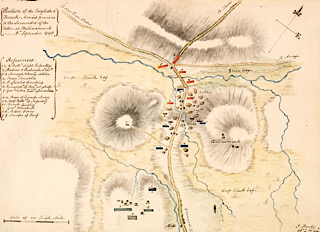
Humbert faces over 12,000 Irishmen and English forces. General Lake is close behind with 14,000 men, and Cornwallis is on his right at Carrick-on-Shannon with 15,000. The battle begins with a short artillery duel followed by a dragoon charge on exposed Irish rebels. There is a brief struggle when French lines are breached which only ceases when Humbert signals his intention to surrender and his officers order their men to lay down their muskets. The battle lasts little more than an hour.
While the French surrender is being taken, the 1,000 or so Irish allies of the French under Colonel Bartholomew Teeling, an Irish officer in the French army, hold onto their arms without signaling the intention to surrender or being offered terms. An attack by infantry followed by a dragoon charge breaks and scatters the Irish who are pursued into a bog where they are either bayoneted or drowned.
A total of 96 French officers and 746 men are taken prisoner. British losses are initially reported as 3 killed and 16 wounded or missing, but the number of killed alone is later reported as twelve. Approximately 500 French and Irish lay dead on the field. Two hundred Irish prisoners are taken in the mopping-up operations, almost all of whom are later hanged, including Matthew Tone, brother of Wolfe Tone. The prisoners are moved to the Carrick-on-Shannon Gaol. The French are given prisoner or war status however the Irish are not and some are hanged and buried in St. Johnstown, today known as Ballinalee, where most are executed in a field that is known locally as Bully’s Acre.
Humbert and his men are transported by canal to Dublin and exchanged for British prisoners of war. Government forces subsequently slowly spread out into the rebel-held “Irish Republic,” engaging in numerous skirmishes with rebel holdouts. These sweeps reach their climax on September 23 when Killala is captured by government forces. During these sweeps, suspected rebels are frequently summarily executed while many houses thought to be housing rebels are burned. French prisoners of war are swiftly repatriated, while United Irishmen rebels are executed. Numerous rebels take to the countryside and continue guerrilla operations, which take government forces some months to suppress. The defeat at Ballinamuck leaves a strong imprint on Irish social memory and features strongly in local folklore. Numerous oral traditions are later collected about the battle, principally in the 1930’s by historian Richard Hayes and the Irish Folklore Commission.
(Pictured: Watercolour plan by an I. Hardy of the Battle of Ballinamuck in County Longford on September 8, 1798, showing position of the English & French Armies previous to the surrender of the latter at Balinamuck)
Cronin is the only son among three children of Con Cronin, a member of the Irish Republican Army (IRA), and his wife Kate. After his father’s death, his mother works as a cook in a boarding school while the children are brought up by relatives in Ballinskelligs in the County KerryGaeltacht. Educated locally, he is deeply influenced by his Gaeltacht childhood; his later writings often refer to the hypocrisy of a state that romanticises the Gaeltacht while neglecting its social problems.
During World War II, Cronin’s sisters emigrate to England to train as nurses while he works as a labourer for Kerry County Council. In December 1941, he joins the Irish Army and is selected in 1943 for an officers’ training course, on which he forms a lifelong friendship with the future theatre directorAlan Simpson. He is commissioned and remains in the army until 1948.
Shortly thereafter Cronin emigrates to New York City, where he finds work as a journalist writing for The Advocate, an Irish American newspaper. He is strongly influenced by interviewing 1916 veterans for The Advocate and by contact with left-wing Irish American associates of Michael Quill, who played leading roles in the foundation of the Transport Workers Union of America. He becomes active in the semi-secret separatist organisation Clan na Gael, and in autumn 1955 returns to Ireland with the aim of helping the IRA to prepare for another military campaign.
Cronin begins work as a sub-editor with the Evening Press and also contributes summaries of world affairs to The Irish Times.
Cronin establishes contact with the IRA, and his military experience leads to his rapid assignment to GHQ staff. He is initially placed in charge of training and instruction, composing a manual on guerrilla warfare and twelve lectures on battlefield training. He teaches new military techniques and new recruits, such as the future IRA Chief of Staff Ruairí Ó Brádaigh, find him deeply impressive.
Cronin becomes a leading advocate of an early IRA campaign against Northern Ireland and becomes the chief strategist for Operation Harvest, a campaign which sees the carrying out of a range of military operations from direct attacks on security installations to disruptive actions against infrastructure. He is arrested on January 8, 1957, near the border in County Cavan. He is imprisoned several times over the course of the campaign (1956–1962).
Most of the IRA and Sinn Féin leadership are interned by the Dublin government on July 6, 1957. Cronin, one of the few to escape, becomes IRA Chief of Staff. He also acts for a time as editor of the movement’s newspaper, United Irishman. He tries to secure weapons from various sources, leading an unsuccessful raid on a British Army base at Blandford Camp in Dorset on February 16, 1958, and through contacts with Spanish republican exiles in Paris. The Irish American community remains the IRA’s main source of external support.
Cronin is arrested on September 30, 1958, and interned, causing considerable disarray, as he had been running much of the campaign single-handed. When the internees are released in March 1959, he resumes his position as Chief of Staff after a factional dispute causes the resignations of Tomás Óg Mac Curtain and the former Chief of Staff Tony Magan. He continues to argue that a sustained guerrilla campaign might yet succeed, but in June 1960 is again arrested and imprisoned for six months.
In November 1960, the Irish Freedom Committee (IFC), a Clan na Gael splinter group, accuses Cronin of being a communist and a “Free State agent,” supposedly implicated in the 1944 execution of Charlie Kerins. The IRA supports Cronin, but he nevertheless decides to resign successively as Chief of Staff, as a member of the Army Council, and as an IRA volunteer, on the grounds that his presence endangers the American support necessary for the continuance of the campaign. He then secures a job as a journalist on the Irish Independent. He withdraws his resignation in November 1961 after the Irish government reinstates military tribunals to try suspected IRA men. He is subsequently sentenced to six months’ imprisonment by a military tribunal and is in prison when the border campaign ends on February 26, 1962. Released on amnesty on April 19, 1962, he finally resigns from the IRA the next day.
By February 1966, Cronin has returned to the United States, where he resides for the remainder of his life, with regular visits to Ireland. He works as a journalist on the Newark Evening News and the Dow Jones News Service and is the U.S. correspondent of The Irish Times from 1967 to 1991, becoming that paper’s first Washington, D.C. correspondent.
In the 1970s Cronin takes a degree at New York University, then teaches and studies for a doctorate at The New School for Social Research in New York under Hans Morgenthau. His dissertation forms the basis for his magnum opus, Irish nationalism: its roots and ideology (1980). Although limited by its colonial model and socialist-republican intellectual framework, this historically oriented account draws on his extensive research and personal contacts to some effect.
Cronin is the author of a dozen books and pamphlets, including a biography of republican Frank Ryan, Washington’s Irish Policy 1916-1986: independence, partition, neutrality (1987), an authoritative account of Irish-US relations, Our Own Red Blood: The Story of the 1916 Rising (1966), and a number of works on guerrilla strategy, including an early Sinn Féin pamphlet Resistance under the pseudonym of J. McGarrity.
After the death of his first wife in 1974, Cronin marries Reva Rubinstein, a toxicologist. In 1980 they move to Washington, D.C. He has no children by either marriage, though his second wife brings him a stepson. After several years of illness, he dies in Baltimore, Maryland, on March 9, 2011. He is survived by his second wife, Reva Rubenstein Cronin.
In Enniskillen, armed Williamite civilians drawn from the local Protestant population organise a formidable irregular military force. The armed civilians of Enniskillen ignore an order from Robert Lundy that they should fall back to Derry and instead launch guerrilla attacks against the Jacobites. Operating with Enniskillen as a base, they carry out raids against the Jacobite forces in Connacht and Ulster, plundering Trillick, burning Augher Castle, and raiding Clones.
A Jacobite army of about 3,000 men, led by Justin McCarthy, Viscount Mountcashel (in the Jacobite peerage), advance on them from Dublin. Lord Mountcashel’s men consist of three regiments of infantry and two of dragoons. The regiments include his own regiment, Mountcashel (approx. 650 men in 13 companies), The O’Brien regiment (also 13 companies of 650 men), and the Lord Bophin (Burke) regiment. He also has the dragoon regiments of Cotter and Clare, each with seven companies of about 350 dragoons. On July 28, 1689, Mountcashel’s force encamps near Enniskillen and bombards the Williamite outpost of Crom Castle to the southeast of Enniskillen. Crom Castle is almost 20 miles (32 km) from Enniskillen by road and about 5 miles (8.0 km) from Newtownbutler.
Two days later, they are confronted by about 2,000 Williamite ‘Inniskilliniers’ under Colonel Berry, Colonel William Wolseley and Gustave Hamilton. The Jacobite dragoons under Antoine Hamilton stumble into an ambush laid by Berry’s men near Lisnaskea and are routed, taking 230 casualties. Mountcashel manages to drive off Berry’s cavalry with his main force but is then faced with the bulk of the Williamite strength under Wolseley. There is some debate in the sources over troop numbers, though it is believed that Mountcashel has a large number of poorly armed conscripts. Unwisely, Mountcashel halts and draws up his men for battle about a mile south of Newtownbutler.
Williamite histories claim that many of the Jacobite troops flee as the first shots are fired. Up to 1,500 of them are hacked down or drowned in Upper Lough Erne when pursued by the Williamite cavalry. Of the 500 men who try to swim across the Lough, only one survives. Approximately 400 Jacobite officers, along with Lord Mountcashel, the Jacobite commander, are captured and later exchanged for Williamite prisoners, with the other Jacobites being killed. These claims seem unlikely, for several reasons. Each Irish regiment includes approximately 40 officers. The entire force, therefore, would include only about 200 officers. Many of these officers are accounted for in an October 1689 roll call, which shows approximately a 15–20% change in the officer roll call since July for the infantry regiments and 5% for the dragoons. This totals some 20–30 officers in all. Also, the Mountcashel regiment’s roll call for October shows that companies which would normally have 50–60 men, have around 25, which results in a loss of approximately 300–400 men for this regiment. The Cotter and Clare dragoons who ride away from the battle do not have significant losses, based on the October 1689 roll call. Assuming the other two infantry regiments suffer similar losses, gives a total loss of 1,200–1,300. Given their officers are recorded in the October roll and show fewer losses than the Mountcashel regiment among officers, there may be fewer losses in the ranks as well. The Williamite histories acknowledge that they captured approximately 400, including men who are later sent to Derry, which would indicate a total loss of killed, wounded, and missing of 800–900, and likely less. This number is necessarily an estimate based on the available data but should be contrasted with Williamite claims that they killed and drowned 2,000. It appears likely that a couple of hundred men from Mountcashel’s regiment may have fled into the bogs toward Lough Erne, and some of them who made it to the river tried to swim and were drowned, leading to the story of the hundreds drowned.
The battle is still commemorated by the Orange Order in Ulster and is mentioned in the traditional unionist song, “The Sash.”
The battle is significant in another way: the regiments on both sides go on to have long and famous histories. On the Williamite side, the Innsikilling Regiment (27th Foot), and on the Jacobite side, the Clare and Mountcashel/Lee/Bulkeley regiments of the Irish Brigade. The two Irish regiments face off again at the Battle of Fontenoy in 1745, where the Irish Brigade famously drives the British army from the battlefield with a charge in the final stage of the battle.
Guevara is the eldest of five children in a middle-class family of Spanish-Irish descent and leftist leanings. Although suffering from asthma, he excels as an athlete and a scholar, completing his medical studies in 1953. He spends many of his holidays traveling in Latin America, and his observations of the great poverty of the masses contributes to his eventual conclusion that the only solution lay in violent revolution. He comes to look upon Latin America not as a collection of separate nations but as a cultural and economic entity, the liberation of which would require an intercontinental strategy.
In particular, Guevara’s worldview is changed by a nine-month journey he begins in December 1951, while on hiatus from medical school, with his friend Alberto Granado. That trip, which begins on a motorcycle they call “the Powerful” (which breaks down and is abandoned early in the journey), takes them from Argentina through Chile, Peru, Colombia, and on to Venezuela, from which Guevara travels alone on to Miami, returning to Argentina by plane. During the trip he keeps a journal that is posthumously published under his family’s guidance as The Motorcycle Diaries: Notes on a Latin American Journey (2003) and adapted to film as The Motorcycle Diaries (2004).
In 1953 Guevara goes to Guatemala, where Jacobo Árbenz heads a progressive regime that is attempting to bring about a social revolution. It is about this time he acquires his nickname, from a verbal mannerism of Argentines who punctuate their speech with the interjection “che.” The overthrow of the Árbenz regime in 1954 in a coup supported by the United StatesCentral Intelligence Agency (CIA) persuades him that the United States will always oppose progressive leftist governments. This becomes the cornerstone of his plans to bring about socialism by means of a worldwide revolution. It is in Guatemala that he becomes a dedicated Marxist.
Guevara leaves Guatemala for Mexico, where he meets the Cuban brothers Fidel and Raúl Castro, political exiles who are preparing an attempt to overthrow the dictatorship of Fulgencio Batista in Cuba. He joins Fidel Castro’s 26th of July Movement, which lands a force of 81 men (including Guevara) in the Cuban Oriente Province on December 2, 1956. Immediately detected by Batista’s army, they are almost wiped out. The few survivors, including the wounded Guevara, reach the Sierra Maestra, where they become the nucleus of a guerrilla army. The rebels slowly gain in strength, seizing weapons from Batista’s forces and winning support and new recruits. Guevara had initially come along as the force’s doctor, but he has also trained in weapons use, and he becomes one of Castro’s most-trusted aides. Indeed, the complex Guevara, though trained as a healer, also, on occasion, acts as the executioner (or orders the execution) of suspected traitors and deserters.
After Castro’s victorious troops enter Havana on January 8, 1959, Guevara serves for several months at La Cabaña prison, where he oversees the executions of individuals deemed to be enemies of the revolution. He becomes a Cuban citizen, as prominent in the newly established Marxist government as he had been in the revolutionary army, representing Cuba on many commercial missions. He also becomes well known in the West for his opposition to all forms of imperialism and neocolonialism and for his attacks on U.S. foreign policy. He serves as chief of the Industrial Department of the National Institute of Agrarian Reform, president of the National Bank of Cuba (famously demonstrating his disdain for capitalism by signing currency simply “Che”), and Minister of Industries.
During the early 1960s, Guevara defines Cuba’s policies and his own views in many speeches and writings, notably “El socialismo y el hombre en Cuba” (1965; “Man and Socialism in Cuba,” 1967), an examination of Cuba’s new brand of communism, and a highly influential manual, La guerra de guerrillas (1960; Guerrilla Warfare, 1961). The last book includes his delineation of his foco theory (foquismo), a doctrine of revolution in Latin America drawn from the experience of the Cuban Revolution and predicated on three main tenets: 1) guerrilla forces are capable of defeating the army; 2) all the conditions for making a revolution do not have to be in place to begin a revolution, because the rebellion itself can bring them about; and 3) the countryside of underdeveloped Latin America is suited for armed combat.
Guevara expounds a vision of a new socialist citizen who would work for the good of society rather than for personal profit, a notion he embodies through his own hard work. Often he sleeps in his office, and, in support of the volunteer labour program he had organized, he spends his day off working in a sugarcane field. He grows increasingly disheartened, however, as Cuba becomes a client state of the Soviet Union, and he feels betrayed by the Soviets when they remove their missiles from the island without consulting the Cuban leadership during the Cuban Missile Crisis of 1962. He begins looking to the People’s Republic of China and its leader Mao Zedong for support and as an example.
In December 1964 Guevara travels to New York City, where he condemns U.S. intervention in Cuban affairs and incursions into Cuban airspace in an address to the United Nations General Assembly. Back in Cuba, increasingly disillusioned with the direction of the Cuban social experiment and its reliance on the Soviets, he begins focusing his attention on fostering revolution elsewhere. After April 1965 he drops out of public life. His movements and whereabouts for the next two years remain secret. It is later learned that he had traveled to what is now the Democratic Republic of the Congo with other Cuban guerrilla fighters in what proved to be a futile attempt to help the Patrice Lumumba battalion, which was fighting a civil war there. During that period he resigns his ministerial position in the Cuban government and renounces his Cuban citizenship. After the failure of his efforts in the Congo, he flees first to Tanzania and then to a safe house in a village near Prague.
In the autumn of 1966 Guevara goes to Bolivia, incognito (beardless and bald), to create and lead a guerrilla group in the region of Santa Cruz. After some initial combat successes, he and his guerrilla band find themselves constantly on the run from the Bolivian army. On October 9, 1967, the group is almost annihilated by a special detachment of the Bolivian army aided by CIA advisers. Guevara, who is wounded in the attack, is captured and shot. Before his body disappears to be secretly buried, his hands are cut off. They are preserved in formaldehyde so that his fingerprints can be used to confirm his identity.
In 1995 one of Guevara’s biographers, Jon Lee Anderson, announces that he had learned that Guevara and several of his comrades had been buried in a mass grave near the town of Vallegrande in central Bolivia. In 1997 a skeleton that is believed be that of the revolutionary and the remains of his six comrades are disinterred and transported to Cuba to be interred in a massive memorial and monument in Santa Clara on the 30th anniversary of Guevara’s death. In 2007, a French and a Spanish journalist make a case that the body brought to Cuba is not actually Guevara’s. The Cuban government refutes the claim, citing scientific evidence from 1997 that, it says, proves that the remains are those of Guevara.
Guevara would live on as a powerful symbol, bigger in some ways in death than in life. He is almost always referenced simply as Che — like Elvis Presley, so popular an icon that his first name alone is identifier enough. Many on the political right condemn him as brutal, cruel, murderous, and all too willing to employ violence to reach revolutionary ends. On the other hand, his romanticized image as a revolutionary looms especially large for the generation of young leftist radicals in Western Europe and North America in the turbulent 1960s. Almost from the time of his death, his whiskered face adorns T-shirts and posters. Framed by a red-star-studded beret and long hair, his face frozen in a resolute expression, the iconic image is derived from a photo taken by Cuban photographer Alberto Korda on March 5, 1960, at a ceremony for those killed when a ship that had brought arms to Havana exploded. At first the image of Che is worn as a statement of rebellion, then as the epitome of radical chic, and, with the passage of time, as a kind of abstract logo whose original significance may even have been lost on its wearer, though for some he remains an enduring inspiration for revolutionary action.
William Richard English-Murphy, DSOMC, Irish soldier and policeman known as W. R. E. Murphy, dies on March 5, 1975, in Ardee, County Louth. He serves as an officer with the British Army in World War I and later in the National Army. In the Irish Civil War, he is second in overall command of the National Army from January to May 1923. He is first Irish Commissioner of the Dublin Metropolitan Police (DMP) and the last Commissioner of the force before its merger with the Garda Síochána in 1925. Thereafter he is the Deputy Commissioner of the Gardaí until his retirement in 1955.
Murphy is born in Danecastle, Bannow, County Wexford, on January 26, 1890. His parents die when he is four years old. His grandparents also die during his childhood. He and his sister Mae (Mary Sarah) are separately raised by relatives in Belfast and Waterford. He is completing his master’s degree at Queens University Belfast (QUB) when he follows the call of John Redmond to join the war effort and ensure Irish independence. Ulster regiments reject him because he is Catholic. Seeking a regiment that treats Irish volunteers with respect, he joins the British Army in Belfast in 1915 as an officer cadet in the South Staffordshire Regiment.
Murphy serves in the Battle of Loos in 1915 and is wounded but returns to action for the start of the Battle of the Somme in July 1916. He becomes commanding officer of the 1st Battalion, the South Staffordshire Regiment in August 1918, reaching the rank of temporary lieutenant colonel. In 1918, his regiment is posted to the Italian Front, at the Piave River, where they are when the armistice is declared on November 4, 1918. He is granted the rank of substantive lieutenant colonel on the retired list on May 16, 1922.
After he returns to Ireland, Murphy resumes his career as a teacher. At some point, he joins the Irish Republican Army (IRA), an organisation fighting to end British rule in Ireland.
In December 1921, the Anglo-Irish Treaty is signed between British and Irish leaders, resulting in the setting up of the Irish Free State. Conflict over the Treaty among Irish nationalists ultimately leads to the outbreak of the Irish Civil War in June 1922. Murphy enlists as a general in the new National Army of the Irish Free State. After the start of the Irish Civil War, he is put in command of troops charged with taking posts held by the anti-Treaty IRA in Limerick.
At the Battle of Kilmallock in July–August 1922, Murphy is second in command to Eoin O’Duffy. His troops successfully dislodge the anti-Treaty IRA from positions around Kilmallock in County Limerick, but he is criticised for his tendency to “dig in” and resort to trench warfare rather than rapid offensive action.
Afterward, Murphy is put in overall command of Free State forces in County Kerry until January 1923. He lobbies Richard Mulcahy, commander in chief, for 250 extra troops, to bring his command up to 1,500 and help to put down the guerrilla resistance there. In the early stages of the guerrilla war, he organises large-scale “sweeps” to break up the republican concentrations in west Cork and east Kerry. These meet with little success, however. He exercises overall command in the county, but day-to-day operations are largely run by Brigadier Paddy Daly, of the Dublin Guard.
In October, in response to continuing guerrilla attacks on his troops, Murphy orders a nightly curfew to be put into place in Tralee.
In December, Murphy writes to Mulcahy that the “Irregular [Anti-Treaty] organisation here is well-nigh broken up,” and suggests the end of the war in the county is in sight. His optimistic prediction, however, proves premature.
On December 20, Murphy sentences four captured republican fighters to death under the fictitious “Public Safety Act” for possession of arms and ammunition. However, the sentences are to be called off if local guerrilla activity ceases. Humphrey Murphy, the local IRA Brigade commander, threatens to shoot eight named government supporters in reprisal if the men are executed. Eventually, their sentence is commuted to penal servitude.
In January 1923, Murphy is promoted from his command in Kerry to “responsibility for operations and organisation at the national level” in the army. Paddy Daly takes over as commanding officer in Kerry. Murphy later voices the opinion that Daly had been a bad choice, given his implication in the Ballyseedy massacre and other events of March 1923, in which up to 30 anti-Treaty prisoners were killed in the county.
Murphy leaves the National Army after the end of the Irish Civil War in May 1923 and becomes the first Irish commissioner of the Dublin Metropolitan Police. He later becomes deputy commissioner of the Garda Síochána, when DMP is merged with the new national police force in 1925. He holds this post until his retirement in 1955.
Murphy is at the forefront of efforts to close down Dublin’s red-light district, the Monto, in the early 1920s. Between 1923 and 1925, religious missions led by Frank Duff of the Legion of Mary, a Roman Catholic organisation, and Fr. R.S. Devane work to close down the brothels. They receive the cooperation of Murphy in his role as Dublin Police Commissioner, and the campaign ends with 120 arrests and the closure of the brothels following a police raid on March 12, 1925.
Murphy lives with his daughter, Joan McMahon, in Ardee, County Louth, after his wife, Mary Agnes Fortune, dies on July 31, 1958. He dies on March 5, 1975, and is buried in St. Peter’s Churchyard, Bray, County Wicklow.
(Pictured: Major-General W. R. E. Murphy, as depicted on a Wills’ Irish Sportsmen cigarette card, from their boxing series)
Sheehy is born in Tralee, County Kerry, on October 16, 1897. In 1914 he joins Fianna Éireann, the republican boy scouts, and later the Irish Volunteers. He commands the Boherbue company of the IRA, and later the Tralee company. His brother Jimmy is killed in the British Army in the Battle of the Somme in 1916.
Sheehy sides against the Anglo-Irish Treaty in 1922, like most of the IRA in Kerry. In the Irish Civil War, when Free State troops land in Kerry as part of a seaborne offensive, he is in command of the Anti-Treaty garrison in Tralee. After the Army takes the town, he retreats, burning the barracks there. As the conflict becomes a guerrilla affair, he finds himself in charge of three flying columns, or around 75 men in total, in the Ballymacthomas area. He and Tom McEllistrim are in charge of an attack on Castlemaine in January 1923.
Just after the Irish Civil War, when Sheehy is still on the run, he manages to play football for Kerry. Kerry captain Con Brosnan, though a member of the Free State army, guarantees his safe passage. He pays into Munster and All-Ireland finals, slips off his street clothes, plays, and then at the final whistle, disappears back into the crowd. In 1936 he is in New York and is able to smuggle a large number of Thompson submachine guns back to Ireland.
In February 1941 Sheehy is arrested and interned in the Curragh Camp for two years. He is arrested again and charged with making “seditious speeches” on May 11, 1946, the day that IRA hunger striker Seán McCaughey dies. He is found guilty and sentenced to four months imprisonment.
Sheehy plays Gaelic football with his local club, John Mitchels, and is a member of the senior Kerry county football team from 1919 until 1930. He also plays hurling with Tralee Parnells. He captains Kerry to the All-Ireland title in 1930. He plays in the Railway Cup hurling final in 1927 and is captain of the football team the same year and wins other medals in 1931. Three of his sons – Seán Óg, Niall and Paudie – all win All-Ireland titles with Kerry in the 1960s.
Sheehy remains a staunch supporter of Sinn Féin and is critical of the moves to end abstention by the party in the late 1960s. He sides with the Provisionals in the split at the 1970 Ardfheis and remains active in Provisional Sinn Féin until his death, supporting the IRA’s guerrilla campaign. He dies in Tralee on January 12, 1980, and is given a republican funeral at his own request. His funeral oration is given by Dáithí Ó Conaill, vice-president of Sinn Féin.
In effect a special extension of the Defence of the Realm Acts, the aim of the Act is to increase convictions of nationalist rebels while averting the need to declare martial law. Under Section 3(6) of the Act, military authorities are empowered to jail any Irish person without charge or trial. Secret courts-martial are established, and lawyers (appointed by Crown agents) can be present only if the death penalty is involved. Inquests of military or police actions are banned.
By the middle of 1920, Ireland is in the throes of a full-fledged rebellion that is barely recognized by the British Government in Ireland headquartered in Dublin Castle. The Irish Republican Army (IRA), the military arm of the Dáil Éireann revolutionary government, is engaged in a guerilla campaign to destroy elements of British power, particularly burning down courthouses and attacking members of the Royal Irish Constabulary (RIC), Britain’s police force in the countryside.
The British response to the increase in violence and the assassination of police officers is twofold. To suppress the IRA “murderers,” Major GeneralHugh Tudor, commander of the RIC and self-styled “Chief of Police,” begins supplementing that body with the employment of World War I veterans known as the “Black and Tans” because of the colour of their surplus World War I uniforms, and an additional temporary force of Auxiliaries. With little discipline and utter indifference to the plight or moral indignation of the Irish population, these groups raid and burn villages, creameries, and farm buildings to intimidate supporters of the IRA.
The second measure is the enactment of the Restoration of Order in Ireland Act (ROIA). The Act is envisioned as a remedy to the problem perceived by Chief Secretary for Ireland Sir Hamar Greenwood that “throughout the greater part of Ireland criminal justice can no longer be administered by the ordinary constitutional process of trial by judge and jury.”
The genesis of the Act may be seen in a Cabinet discussion on May 31, 1920, in which the members focus on the violence in Ireland. Rather than addressing violence as the product of rebellion, Greenwood insists that, “The great task is to crush out murder and arson.” He asserts that the violence is perpetrated by handsomely paid thugs. Commenting on a pending Irish bill, Secretary of State for WarWinston Churchill states, “You should include in the Bill a special tribunal for trying murderers. It is monstrous that we have some 200 murders, and no one hung.” The prime minister agrees that convicted murderers should be hanged but questions whether convictions can be obtained from Catholics. The concern of all is that the civil courts are incapable of strictly administering justice to the revolutionaries because the juries largely consisted of Irish Catholics. The ensuing discussion of possibly imposing court-martial jurisdiction is inconclusive.
After the May 31 meeting, Greenwood investigates the feasibility of imposing martial law in Ireland and raises martial law as the specific subject of a July 23, 1920, conference committee meeting of the Cabinet led by Prime MinisterDavid Lloyd George to which the key members of the Dublin Castle administration are invited. William E. Wylie, the law advisor at Dublin Castle, notes that the RIC is disintegrating through resignations brought on by terrorist attacks, and that with “regard to the Civil Courts, the entire administration of the Imperial Government had ceased.” The civilian participants from Dublin Castle, especially Wylie, maintain that martial law is counter-productive, and will only antagonize the Irish people. As an alternative to martial law, General Tudor argues for the imposition of court-martial jurisdiction. Tudor argues forcefully that court-martial jurisdiction over all crimes will support the Black and Tans and Auxiliaries that he is recruiting. He declaims that “not a single criminal had been brought to justice for murder.” Lloyd George closes the discussion directing the Dublin Castle participants to provide final proposals for enforcement of the laws.
A draft bill to establish military criminal jurisdiction is considered by the Cabinet on July 26. The prime minister’s most telling contribution is his question as to whether a convicted man would be shot or hanged. It appears that he is comforted by the response that the defendant will be tried under the ordinary law which implies death by hanging. The resulting bill is completed by July 30, 1920, and is then quickly pushed through Parliament and receives royal assent on August 9, 1920. The ROIA provides that all crimes punishable under the laws in Ireland can be brought before a court-martial. The court-martial will have the power to impose any punishment authorized by statute or common law including the death penalty. The final step is taken on August 20, 1920, when the final regulations for implementation go into effect.
The combination of growing police and military pressure and recourse to the ROIA lead to increased internments of known or suspected IRA members and a steady increase in convictions to 50-60 per week. This makes it more difficult for IRA soldiers to continue openly working day jobs while carrying on part-time guerrilla activities. As a result, the IRA shifts its approach to guerrilla warfare in the rural counties. Volunteers from IRA units are organized into elite, full-time, mobile flying columns of around 25 men who live off the land and on the run. These flying columns prove to be more suited to ambushes of patrols and convoys and other targets of opportunity, rather than attacks on barracks which had become better defended.
On December 10, 1920, martial law is proclaimed in counties Cork, Kerry, Limerick, and Tipperary. In January 1921 martial law is extended to counties Clare and Waterford.
In a crucial judgement, R (Egan) v Macready, the Irish courts rule that the Act does not give power to impose the death penalty. This would no doubt have proved politically contentious had not hostilities ended the same day.
Despite its name, the courts are of the view that ROIA applies in England as well. Following the creation of the Irish Free State, when the Act is repealed by implication, it is still used to deport ex-members of the Irish Self-Determination League to Ireland.
The 1916 Easter Rising is a watershed in O’Donoghue’s life. In December 1916, he joins the Cork branch of the Irish Volunteers. In early 1917, he is elected unanimously First Lieutenant of the Cyclist Company and as a result devotes all his spare time to Volunteer work. He begins writing weekly for two years for TheIrish World newspaper. By May 1917, he is sworn into the Irish Republican Brotherhood (IRB) and in October, Tomás Mac Curtain appoints him head of communications of the Cork Brigade. He replaces Pat Higgins as Brigade Adjutant in February 1917. He is a key organiser in the sensational jailbreak of Captain Donnchadh Mac Niallghuis on Armistice Day 1918 and takes personal responsibility for his protection. Michael Collins is the last officer from Volunteers General Headquarters to visit Cork shortly after Christmas 1919, until the truce in 1921.
O’Donoghue builds up an intelligence network and agents which includes his future wife, Josephine Marchment. She is head female clerk at the 6th Division Headquarters at Victoria Barracks, Cork, and passes on secret British Army correspondence to him. He recruits people to open letters, tap phone lines and intercept telegrams. The Irish Republican Army has 2,000 active members in Cork which are also used for intelligence gathering. By March 1920, after killing a Royal Irish Constabulary (RIC) Inspector, he is on the run and serving full-time in the IRA. In November of that year, the Cork Brigade kills six British Army officers and executes five Cork civilians on suspicion of spying.
After two and a half years of fighting, a truce is agreed upon on July 11, 1921. When the Dáil approves the Anglo-Irish Treaty, in January 1922, the IRA splits into pro- and anti-Treaty camps. Over the coming months and after being elected to the army’s executive as Adjutant General, O’Donoghue warns of the dangers of an Irish Civil War. In June 1922, he resigns from the army’s national executive and a month later, on July 3, 1922, from the army. Civil war does break out on June 28, 1922, between pro- and anti-Treaty factions, much to his dismay.
During the Irish Civil War, O’Donoghue remains neutral and tries to organise a truce to end the fighting. In December 1922, he forms a group called the “Neutral IRA”, along with Seán O’Hegarty, composed of pro-truce IRA men. He claims he has 20,000 members in this group. He campaigns for a month’s truce between the two sides, so that a political compromise could be reached. However, his efforts come to nothing and in March 1923, he winds up the “Neutral IRA,” judging that its objectives cannot be achieved. The Irish Civil War ends on May 24, 1923.
O’Donoghue serves as major in the Irish Army from 1939-1946. He forms a Supplementary Intelligence Service that is to remain behind enemy lines in the event of an invasion. He also teaches guerrilla warfare tactics to new army recruits.
O’Donoghue marries Josephine Brown (née Marchment) in April 1921, and they have four children. The couple also adopts two children from Josephine’s first marriage, including Reggie Brown, whom O’Donoghue kidnaps from his grandparents in Wales in 1920. He becomes a rate collector and remains outside politics.
In later years O’Donoghue becomes a respected historian. While in the army he edits An Cosantóir, the Irish Army’s magazine. He convinces Éamon de Valera to establish the Bureau of Military History to record personal accounts from the Irish War of Independence. He is a recording officer until 1948. His most famous work is his biography on Liam Lynch, entitled No Other Law.
The Provisional IRA, officially known as the Irish Republican Army (Irish: Óglaigh na hÉireann) and informally as the Provos, is an Irish republicanparamilitary force that seeks to end British rule in Northern Ireland, facilitate Irish reunification and bring about an independent republic encompassing all of Ireland. It is the most active republican paramilitary group during the Troubles. It argues that the all-island Irish Republic continues to exist, and it sees itself as that state’s army, the sole legitimate successor to the original IRA from the Irish War of Independence (1919-21). It is designated a terrorist organisation in the United Kingdom and an unlawful organisation in the Republic of Ireland, both of whose authority it rejects.
The Provisional IRA emerges in December 1969, due to a split within the previous incarnation of the IRA and the broader Irish republican movement. It is initially the minority faction in the split compared to the Official IRA but becomes the dominant faction by 1972. The Troubles begin shortly before when a largely Catholic, nonviolent civil rights campaign is met with violence from both Ulster loyalists and the Royal Ulster Constabulary (RUC), culminating in the August 1969 riots and deployment of British soldiers. The IRA initially focuses on defence of Catholic areas, but it begins an offensive campaign in 1970 that is aided by external sources, including Irish diaspora communities within the Anglosphere, and the Palestine Liberation Organization (PLO) and Libyan leader Muammar Gaddafi. It uses guerrilla tactics against the British Army and RUC in both rural and urban areas and carries out a bombing campaign in Northern Ireland and England against military, political and economic targets, and British military targets in mainland Europe. They also target civilian contractors to the British security forces. The IRA’s armed campaign, primarily in Northern Ireland but also in England and mainland Europe, kills over 1,700 people, including roughly 1,000 members of the British security forces and 500–644 civilians.
The Provisional IRA issues the following statement to news media on the morning of July 19, 1997:
“On August 31, 1994, the leadership of Oglaigh na hEireann (Gaelic for Irish Republican Army) announced a complete cessation of military operations as our contribution to the search for a lasting peace.
After 17 months of cessation, in which the British government and the (pro-British Protestant) unionists blocked any possibility of real or inclusive negotiations, we reluctantly abandoned the cessation.
It is the root cause of division and conflict in our country. We want a permanent peace and therefore we are prepared to enhance the search for a democratic peace settlement through real and inclusive negotiations.
So, having assessed the current political situation, the leadership of Oglaigh na hEireann are announcing a complete cessation of military operations from 12 o’clock midday on Sunday the 20th, July 1997.
We have ordered the unequivocal restoration of the ceasefire of August 1994. All IRA units have been instructed accordingly.”
Barry returns to Bandon in early 1919. He describes in his guerilla days in Ireland a Damascus-like conversion to Irish nationalism on hearing of the Easter Rising while with the Mesopotamian expeditionary force, but he is only accepted into the IRA with considerable caution. Initially tested in intelligence and training work, in mid-1920 he takes charge of the new brigade flying column, which is used both to train officers and to stage offensive actions.
Barry adapts his military experience successfully to the demands of guerrilla warfare, becoming the most famed of column leaders during the Irish War of Independence. In his memoirs, he pours scorn on the obsession of many with military titles and orthodox procedure, complaining of a “paper army.” He stresses the need for spontaneity, initiative, and knowledge of local conditions. “The reality,” he writes, “was a group of fellows, mostly in caps and not-too-expensive clothing, wondering how to tackle their job and where they would sleep that night or get their supper.” (The Reality of the Anglo–Irish War (1974)). He well realises that the war’s character does not permit any close control from the IRA’s GHQ in Dublin, hence increasing the importance of local leaders. His tactics put strong emphasis on speed of movement and on the need to attack the enemy at his weakest point. The column’s ambush successes are small in number but among the best-remembered of the war. He admits, however, that his own and his column’s lack of experience with mines frequently weakened their offensives.
The column’s first successful ambush is at Tooreen on October 22, 1920, followed on November 28 by the dramatic ambushing of a patrol of auxiliaries at Kilmichael while travelling from their Macroom base. A column of thirty-six men, divided into three sections, kill sixteen auxiliaries, with one captured and later shot, suffering two fatalities of their own. Controversy has raged since over whether a false surrender by the British force caused the brutality of some of the deaths. Together with the Bloody Sunday killings of a week earlier in Dublin, Kilmichael has a profound effect on the British military and political establishment, with the declaration in December of martial law for much of Munster and the implementation of wide-ranging internment, together with the authorisation of official reprisals.
After a short period in hospital with a heart condition, in early 1921 Barry leads unsuccessful attacks on Kilbrittain, Innishannon, Drimoleague, and Bandon barracks. The seizure of Burgatia House, outside Rosscarbery, in early February, and the successful resistance made there to British troops, wins much publicity but has little military significance. He is a leading figure in the brutal final stage of the war in the first six months of 1921, which sees widespread shooting of suspected spies and destruction of loyalist property. By March 1921, his flying column, with 104 men, is easily the largest in Ireland, and an explosives expert, Capt. McCarthy, has joined them.
The protracted engagement between Barry’s column and encircling British forces at Crossbarry on March 19, 1921, comes at a time when large-scale sweeps are making life increasingly difficult for the IRA. It consists of a daring and courageous breakout. Crossbarry is the largest action of the war, and Barry is to regard it as even more important than Kilmichael. Soon afterwards, Rosscarbery barracks is successfully attacked by a Barry-led party, representing one of the few successful such initiatives in 1921. Isolated triumphs, however, cannot hide the fact that pressure is increasing on the column, and he becomes increasingly critical of inactive regions. He is later to say that all County Kerry does during the war is to shoot one decent police inspector at Listowel Racecourse and a colleague of his. He is strongly critical also of the lack of assistance from GHQ and of the divisionalisation policy. He visits Dublin in May, travels around with Michael Collins, and is present when two American officers demonstrate the Thompson submachine gun. He is more aware than most of his 1st Southern Division colleagues of the scarcity of arms and ammunition at the war’s end.
During the truce, Barry becomes liaison officer for Munster, riling the British by insisting on his military rank, and criticising the IRA liaison men in Dublin for being overly deferential. He joins the overwhelming majority of the Cork IRA in opposing the Anglo–Irish Treaty but plays a characteristically maverick role throughout the treaty split. His independent attitude is heightened by his dislike of Liam Lynch, the republican IRA’s Chief of Staff, and his continuing respect for Michael Collins. He shows impatience at the long-drawn-out peace initiatives. In March 1922, therefore, he advocates armed confrontation with pro-treaty units over the occupation of barracks in Limerick, and on June 18 he submits a resolution, which only narrowly fails, at the army convention, giving British troops seventy-two hours to leave Dublin.
At the beginning of the Irish Civil War, Barry is arrested entering the Four Courts disguised as a woman. He escapes from an internment camp at Gormanston in early September 1922. For the rest of the war his actions mirror its confused nature. In late October 1922, he leads successful raids on the small towns of Ballineen and Enniskean, and later on Inchigeelagh and Ballyvourney. In December his column takes Carrick-on-Suir, demonstrating the weakness of the Free State army, but his talk of advancing on the Curragh and of large-scale actions does not materialise. There is no evidence that he is acting in accordance with any coordinated plan. By February 1923, he realises that the Republican IRA cause is hopeless and he is involved with Fr. Tom Duggan in efforts to get 1st Southern Division to declare a ceasefire. He journeys to Dublin to put pressure on the intransigent Lynch in this connection, telling Lynch, “I did more fighting in one week than you did in your whole life.”
Barry avoids capture in roundups after the war, remaining on the run until 1924. Unlike many republicans, he does not turn to constitutionalism, remaining strongly militaristic. He is always an unreconstructed republican, though by no means a naive one. In 1924 he becomes attached to Cleeves Milk Co., based in Limerick and Clonmel, and from 1927 to retirement in 1965 is general superintendent with the Cork harbour commissioners. He strongly advocates preserving the independence of the IRA army executive during the republican split of 1925–27. He is instrumental in continuing the drilling of IRA members and is a strong supporter of armed opposition to the Blueshirts.
During the 1930s Barry is arrested at various times for possession of arms and seditious utterances. He promotes an attack against a Freemasons’ meeting in Cork in 1936 and gives the orders for the killing on March 4 of that year of Vice-AdmiralHenry Boyle Somerville. He is opposed to the use by Frank Ryan of IRA volunteers to support the republican cause in the Spanish Civil War and to the proposals of Seán Russell for a bombing campaign in England. To maintain the link with traditional republicanism, he is elected IRA chief of staff in 1937. His plan, however, for the seizure of Armagh city, as part of a direct northern offensive, quickly collapses due to a leak of information, and he soon resigns his position. He forcefully attacks the bombing of English cities in 1938, regarding attacks on innocent civilians as immoral and counterproductive. He enlists in the National Army on July 12, 1940, only to be demobilised a month later. In 1946, he stands as an independent candidate in a by-election in the Cork Borough constituency, finishing at the bottom of the poll. He is more comfortable the following year touring the United States on an anti-partition platform.
In 1949 his Guerilla Days in Ireland is published. It proves a best-seller and has frequently been reprinted. It is well written in a forceful and direct style, one memoir needing no assistance from a ghost writer. Age does not mellow him: lawyers and bank managers are threatened by him over matters relating to his own column, and in 1974 he publishes a fierce pamphlet, angry at perceived slights in the Irish War of Independence memoir of Liam Deasy. He does strive to achieve a public reconciliation with Collins’s memory by unveiling the memorial to Collins at Sam’s Cross in 1966. On the outbreak of the Northern Ireland crisis in the late 1960s, he takes a militant line, castigating the argument that the Six Counties can be brought into the Republic by peaceful means, and asking when had peaceful means existed there. At the memorial meeting in Carrowkennedy, County Mayo, in 1971, he claims that there is a perfect right at the opportune time to take the Six Counties by force. He remains opposed to IRA bombing of civilian targets.
Barry dies in Cork on July 2, 1980. He is buried in St. Finbarr’s Cemetery, Cork. Early in the truce of 1921 he marries Leslie Price, one of the most active of Cumann na mBan members during and after the rising. They have no children.
While Barry always remains an influential figure in republican circles, he will be remembered best as the pioneer of guerrilla warfare, the hero of Kilmichael and Crossbarry. His military flair, individualism, and ruthlessness are well suited to the 1919–21 conflict. After that, his strained relations with colleagues and his lack of flexibility reduce his importance. While his life after the revolutionary era appears anti-climactic, he retains much of his charisma. In later years, he is ever willing to remind politicians and historians how far Ireland has retreated from republican ideals. He is often prickly and autocratic yet could be generous to old colleagues of either side of the treaty split. He is arguably the most intelligent but also the most intolerant of the revolutionary leaders.
(From: “Barry, Thomas Bernadine (‘Tom’)” by M. A. Hopkinson, Dictionary of Irish Biography, http://www.dib.ie, October 2009)





 seamus dubhghaill