Hardebeck is born on December 10, 1869, in Clerkenwell, London, to a German father and Welsh mother. He loses his sight when he is a baby. He attends the Royal Normal School for the Blind in London (1880–92) where, under his teacher Frederick Corder, a professor from the Royal Academy of Music, he shows a marked aptitude for music.
In 1893, at the age of twenty-four, Hardebeck moves to Belfast, where he opens a music store, but the venture fails, and he becomes the organist of a small parish in the city, the Holy Family Church, Wellington Place. He enters an anthem, O God of My Salvation, for contralto and chorus, for the 1897 Dublin Feis Ceoil and wins. On this occasion he hears folk song arrangements of Charles Villiers Stanford and others for the first time. At the 1901 Feis Ceoil, he again wins a prize, this time for a large cantata, The Red Hand of Ulster. In 1914, his wife, Mary Reavy, dies.
In 1919, Hardebeck becomes the director of the music school in Cork and becomes the first professor of Irish music at University College Cork (UCC) in 1922. Ill-suited for administrative tasks, he relinquishes the post after one year and returns to Belfast, which after the Irish Civil War has become the capital of Northern Ireland. In 1932, he finally settles in Dublin, where he works for An Gúm, the Irish government publisher, as arranger of Irish traditional songs for piano and choirs, many of which become teaching material at schools in the nascent Republic of Ireland. He also teaches Irish and traditional music in the Dublin Municipal School of Music for two years. On many occasions he acts as adjudicator in singing and musical competitions across Ireland.
Despite Hardebeck’s mixed German/Welsh/English background, the events of the 1913 Dublin lock-out, the outbreak of World War I, and the 1916 Easter Rising radicalise him, turning him into an Irish nationalist. He is quoted as saying, “I believe in God, Beethoven and Patrick Pearse.” He studies the Irish language and collects folk songs from around the country, making some unique arrangements that bridge the gap between traditional and art song.
At home in Dublin, Hardebeck plays his excellent arrangements of Irish melodies on a Schiedmayerharmonium. The instrument has a “percussion” stop, which he uses to great effect. He also owns a Knauss piano but plays the harmonium by choice. He is quite an authority on plainchant. The noted Irish harpsichord maker Cathal Gannon is a close friend of his for many years. Hardebeck teaches him how to appreciate the structure of the classical symphony and concerto and passes on his enthusiasm and love of Irish melodies.
Following Hardebeck’s death at his home, 14 St. Vincent Street, Berkeley Road, Dublin, on February 10, 1945, a Radio Éireann-sponsored symphony concert, held in the Capitol Theatre in Dublin, begins with a sympathetic performance of his orchestral variations upon Seoithín Seó. A state funeral is held in Saint Joseph’s Church, Berkeley Road, Dublin. The church is packed; various government ministers, the Lord Mayor and representatives of PresidentDouglas Hyde and of Éamon de Valera are there. Hardebeck’s own Kyrie and Agnus Dei are performed at the Requiem Mass. He is interred in Glasnevin Cemetery, where a Benedictus is chanted by the clergy present. A vote of sympathy is issued by the Irish National League of the Blind to Hardebeck’s widow and relatives, in which the hope is expressed “that the nation as a whole would not be unmindful of the important contribution which the late Dr. Hardebeck had made to Irish culture, music and art.”
Unfortunately, very little attention has been given to Hardebeck, who is one of the instigators in the revival of Irish music. Indeed, he is largely forgotten after his death. This is possibly due to his mixed origins and place of birth. His arrangement for orchestra of The Lark in the Clear Air is a fine piece of music, but he is content to sell it to the music publishers Boosey & Hawkes for just six guineas.
In June 2013, a plaque to Hardebeck’s memory is installed at Holy Family Church, Belfast.
(Pictured: “Carl Hardebeck (1869-1945),” oil on canvas, National Museums NI)
Thomas “Tom” Michael Kettle, parliamentarian, writer, and soldier, is born on February 9, 1880, in Artane, Dublin, the seventh among twelve children of Andrew Kettle, farmer and agrarian activist, and his wife, Margaret (née McCourt). His father’s record in nationalist politics and land agitation, including imprisonment in 1881, is a valuable political pedigree.
The family is prosperous. Kettle and his brothers attend Christian Brothers’ O’Connell School in Richmond Street, Dublin, before being sent to board at Clongowes Wood College, County Kildare. Popular, fiery, and something of a prankster, he soon proves to be an exceptional scholar and debater, as well as a keen athlete, cyclist, and cricketer. He enrolls in 1897 at University College Dublin (UCD), his contemporaries including Patrick Pearse, Oliver St. John Gogarty and James Joyce. He thrives in student politics, where his rhetorical genius soon wins him many admirers and is recognised in his election as auditor of the college’s Literary and Historical Society. He also co-founds the Cui Bono Club, a discussion group for recent graduates. In 1899, he distributes pro-Boer propaganda and anti-recruitment leaflets, arguing that the British Empire is based on theft, while becoming active in protests against the Irish Literary Theatre‘s staging of The Countess Cathleen by W. B. Yeats. In 1900, however, he is prevented from taking his BA examinations due to a mysterious “nervous condition” – very likely a nervous breakdown. Occasional references in his private diaries and notes suggest that he is prone to bouts of depression throughout his life. He spends the following two years touring in Europe, including a year at the University of Innsbruck, practising his French and German, before taking a BA in mental and moral science of the Royal University of Ireland (RUI) in 1902. He continues to edit the college newspaper, remaining active in student politics. He participates, for example, in protests against the RUI’s ceremonial playing of “God Save the King” at graduations as well as its senate’s apparent support for government policy, threatening on one occasion to burn publicly his degree certificate.
In 1903, Kettle is admitted to the Honourable Society of King’s Inns to read law and is called to the bar two years later. Nonetheless, he soon decides on a career in political journalism. Like his father, he is a keen supporter of the Irish Parliamentary Party (IPP), and in 1904 is a co-founder of the resonantly titled Young Ireland Branch of the United Irish League. Here he comes to the notice of John Redmond, who offers him the prospect of a parliamentary seat, but he chooses instead to put his energies into editing the avowedly pro-Irish-party paper, The Nationist, in which he promises that a home rule administration will uphold women’s rights, industrial self-sufficiency, and Gaelic League control of Irish education. He hopes that the paper will offer a corrective alternative to The Leader, run by D. P. Moran, but in 1905 he is compelled to resign the editorship due to an article thought to be anti-clerical. In July 1906, he is persuaded to stand in a by-election in East Tyrone, which he wins with a margin of only eighteen votes. As one of the youngest and most talented men in an ageing party, he is already tipped as a potential future leader. His oratory is immediately put to good use by the party in a propaganda and fund-raising tour of the United States, as well as on the floor of the House of Commons, where his oratorical skills earn him a fearsome reputation. He firmly advocates higher education for Catholics and the improvement of the Irish economy, while developing a close alliance with Joseph Devlin and the Ancient Order of Hibernians (AOH).
Kettle meanwhile makes good use of his connections to ArchbishopWilliam Walsh, the UCD Sodality of the Blessed Virgin Mary, and the Catholic Graduates and Undergraduates Association, as well as political support, to secure the professorship of national economics. T. P. Gill, of the Department of Agriculture and Technical Instruction, exceptionally acts as his referee. His detractors regard the appointment as a political sinecure and Kettle as a somewhat dilettantish “professor of all things,” who frequently neglects his academic duties. However, he takes a keen interest in imperial and continental European economies. He does publish on fiscal policy, even if always taking a pragmatic interest in wider questions, greatly impressing a young Kevin O’Higgins, later Vice-President of the Executive Council of the Irish Free State. He has little time for what he regards as the abstract educational and economic idealism of D. P. Moran. He acknowledges that the “Hungarian policy” of Arthur Griffith has contributed significantly to a necessary debate about the economy, but argues that the Irish are “realists,” that Ireland’s natural resources ought to be scientifically measured, and that the imperial connection is crucial to Ireland’s future development. The achievement of home rule would, he asserts, encourage a healthy self-reliance as opposed to naive belief in self-sufficiency.
Kettle is encouraged by the heightened atmosphere of the constitutional crisis over the 1909 David Lloyd Georgebudget, culminating in the removal of the House of Lords veto, which has been an obstacle to home rule. He is also a supporter of women’s enfranchisement, while stressing that the suffragist cause should not delay or deflect attention from the struggle for home rule. He holds his East Tyrone seat in the January 1910 United Kingdom general election but decides not to stand at the general election in December of the same year. Returning to an essentially journalistic career, he publishes a collection of essays outlining his constitutional nationalist position. He opposes suffragette attacks on private property, but, in contrast, supports the Dublin strikers in 1913, highlighting their harsh working and living conditions. He tries without success to broker an agreement between employers and workers though a peace committee he has formed, on which his colleagues include Joseph Plunkett and Thomas P. Dillon. His efforts are not assisted, however, by an inebriated appearance at a crucial meeting. Indeed, by this time his alcoholic excesses are widely known, forcing him to attend a private hospital in Kent.
In spite of deteriorating health, Kettle becomes deeply involved in the Irish Volunteers formed in November 1913 to oppose the Ulster Volunteers. His appraisal of Ulster unionism is somewhat short-sighted, dismissing it as being “not a party [but] merely an appetite,” and calling for the police to stand aside and allow the nationalists to deal with unionists, whose leaders should be shot, hanged, or imprisoned. These attitudes are mixed in with a developing liberal brand of imperialism based on dominion federalism and devolution, warmly welcoming a pro-home-rule speech by Winston Churchill with a Saint Patrick’s Day toast to “a national day and an empire day.” Nevertheless, he uses his extensive language skills and wide experience of Europe to procure arms for the Irish Volunteers. He is in Belgium when the Germans invade, and the arms he procured are confiscated by the Belgian authorities, to whom they were donated by Redmond on the outbreak of war.
On his return to Dublin, Kettle follows Redmond’s exhortation to support the war effort. He is refused an immediate commission on health grounds, but is eventually granted the rank of lieutenant, with responsibilities for recruitment in Ireland and England. He makes further enemies among the advanced nationalists of Sinn Féin, taunting the party for its posturing and cowardly refusal to confront Ulster unionists, the British Army, and German invaders alike. Coming from a staunchly Parnellite tradition, he is no clericalist, yet he is a devout if liberal Catholic, imbued by his Jesuit schooling with a cosmopolitan admiration for European civilisation which has been reinforced by his European travels, and in particular has been outraged by the German destruction of the ancient university library of Louvain. Despite a youthful flirtation with the philosophy of Friedrich Nietzsche, he comes to regard “Prussianism” as the deadliest enemy of European civilisation and the culture of the Ten Commandments, there not being “room on earth for the two.” He increasingly believes that the German threat is so great that Irish farmers’ sons ought to be conscripted to defend Ireland. He also believes that considerable good might come out of the conflict, exhorting voters in East Galway to support what is practically a future home rule prime minister, cabinet, and Irish army corps. He unsuccessfully seeks nomination as nationalist candidate in the 1914 East Galway by-election in December. Nevertheless, he continues to work tirelessly on behalf of the party, publishing reviews, translations, and treatises widely in such journals as the Freeman’s Journal, The Fortnightly Review, and the Irish Ecclesiastical Record.
As a recruiting officer based far from the fighting, Kettle is stung by accusations of cowardice from advanced nationalists. He had tried repeatedly to secure a front-line position, but was rejected, effectively because of his alcoholism. He is appalled by trench conditions and the prolongation of the war, a disillusionment further encouraged by the Easter Rising, in which his brother-in-law, Francis Sheehy-Skeffington, is murdered by a deranged Anglo-Irish officer, J. C. Bowen-Colthurst. He senses that opinion in Ireland is changing, anticipating that the Easter insurgents will “go down in history as heroes and martyrs,” while he will go down, if at all, as “a bloody British officer.” Nevertheless, he regards the cause of European civilisation as greater than that of Ireland, remaining as determined as ever to secure a combat role. Despite his own poor health and the continuing intensity of the Somme campaign, he insists on returning to his unit, the 9th Battalion, Royal Dublin Fusiliers.
Kettle’s writings demonstrate the mortal danger he is placing himself in, evident not least in his frequently quoted poem, “To my daughter, Betty, the gift of God,” as well as letters settling debts, apologising for old offences, and providing for his family – his wealth at death being less than £200. He has no death wish, wearing body armour frequently, but as Patrick Maume notes, “As with Pearse, there is some self-conscious collusion with the hoped-for cult.” He is killed on September 9, 1916, during the Irish assault on German positions at Ginchy.
Kettle marries Mary Sheehy, alumna of UCD, student activist, suffragist, daughter of nationalist MPDavid Sheehy, and sister-in-law of his friend Francis Sheehy Skeffington, on September 8, 1909. In 1913 the couple has a daughter, Elizabeth.
Kettle is commemorated by a bust in St. Stephen’s Green, Dublin, and in the House of Commons war memorial in London. He is a man of great passions and proven courage. George William Russell put his sacrifice on a par with Thomas MacDonagh and the Easter insurgents:
“You proved by death as true as they, In mightier conflicts played your part, Equal your sacrifice may weigh, Dear Kettle, of the generous heart (quoted in Summerfield, The myriad minded man, 187).
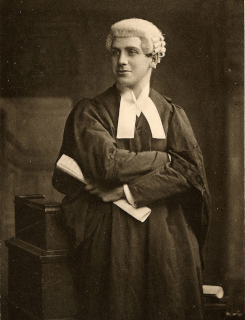
(From: “Kettle, Thomas Michael (‘Tom’)” by Donal Lowry, Dictionary of Irish Biography, http://www.dib.ie, October 2009 | Pictured: Tom Kettle as a barrister when called to the Irish law bar in 1905)
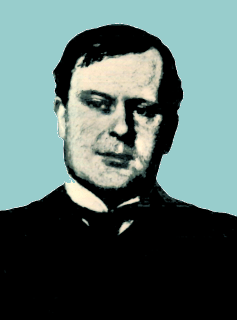
David Patrick Moran (Irish: Dáithí Pádraig Ó Móráin), better known as simply D. P. Moran, Irish journalist, activist and cultural-political theorist, dies on January 31, 1936. He is known as the principal advocate of a specifically Gaelic CatholicIrish nationalism during the early 20th century. Associated with the wider Celtic Revival, he promotes his ideas primarily through his journal, The Leader, and compilations of his articles such as the book The Philosophy of Irish Ireland.
Moran is born in Manor, a townland in Waterford, the youngest of twenty children born to James Moran, a builder, and Elizabeth Moran (née Casey). One of his brothers goes on to serve on the defense team of Patrick O’Donnell.
Despite the failure of the 1893 Home Rule Bill and the division of the Irish Parliamentary Party (IPP) in 1891, nationalists take heart from Douglas Hyde‘s 1892 speech, entitled “The Necessity for De-anglicising Ireland.” Moran builds upon this thesis and provides a wider ideology for enthusiasts, particularly after the re-unification of most of the nationalist parties from 1900.
In his 1905 text The Philosophy of Irish-Ireland, Moran argues that to be Irish requires:
the use of the Irish language
membership in the Roman Catholic Church
an anti-materialist outlook on life
the playing of only Gaelic games
Though a sponsor of the use of Irish, he never becomes fluent in the language himself. He emphasises the use of English in 1908–09 as “an active, vigilant, and merciless propaganda in the English language.” In the longer term, when Irish becomes again the language of the people, its use enables a de facto censorship of any foreign and unwelcome ideas written in English.
While Moran argues that the idea of “the Gael” is one that can assimilate others, he also feels that it will be hard if not impossible for members of the Church of Ireland who support the British Empire to ever qualify as Irish, being “resident aliens.” This extends to Anglo-Irish literature. He rejects the Abbey Theatre and questions Yeats‘ genius. He once speaks out against the influence Britain has over Irish Universities, stating, “We are all Palemen now.” In the matter of religious differences, Daniel O’Connell had said in 1826 that “the [Roman] Catholics of Ireland are a nation.” Moran moves beyond that, affirming in 1901 that “…the Irish Nation is de facto a Catholic nation.” He is virulent in his opposition to female suffrage.
Moran’s articles frequently contrast “Belfast” with “Ireland,” yet hope that Belfast can eventually change and assimilate. He feels that Ulster unionists should “… be grateful to the Irish nation for being willing to adopt them.” His paper publishes numerous articles by the future TDArthur Clery (writing under the pen name “Chanel”), who advocates partition on the grounds that Ulster unionists are a separate nation, but Moran himself disagrees and refuses to concede the legitimacy of a northern Protestant identity.
When Irish republicans initiate the Irish War of Independence in 1919, widescale anti-Catholic rioting breaks out in Belfast in 1920 and 1922. Moran identifies this as being caused by Orangeism, which he describes as “a sore and a cancer” in Ireland. He also alleges that “bigotry on the part of Catholics in the Six Counties is immediately due to Orange bigotry.”
Moran is initially a supporter of the Irish Parliamentary Party, believing that the separatism advocated by Arthur Griffith‘s Sinn Féin is impracticable; however, he opposes John Redmond‘s support of the British World War I effort.
Moran supports the Anglo-Irish Treaty agreed in 1921–22 and sees the partition of Ireland as beneficial for a truly Irish culture in the Irish Free State. This causes a sea-change in his opinions; from now on Northern Ireland can be safely ignored, along with what he sees as the English evils of “free thought, free trade, and free literature.” He claims Irish life and culture has to be protected from foreign influences, including the twin evils of the music hall and the English press. The new jazz music of the 1920s and other imported cultural elements are deprecated as “imported debasement and rot.”
On January 9, 1901, Moran marries Theresa Catherine, daughter of Thomas Francis O’Toole, a former Parnellite mayor of Waterford. They have four sons and one daughter.
Moran dies suddenly at his home in Skerries, Dublin, on January 31, 1936. His daughter, Nuala, who has written for the paper since the early 1920s, generally on artistic and social matters, takes over the running of the paper on his death, though it is then much diminished in size and influence. Nuala, who never marries, retains control of The Leader until it ceases publication in 1971.
Byrne is born on March 20, 1780, at Ballylusk, Monaseed, County Wexford, the eldest son of Patrick Byrne, a middling Catholic farmer, and Mary (née Graham). He joins the United Irishmen in the spring of 1797 and, although only seventeen, becomes one of the organisation’s most active agents in north Wexford.
When rebellion engulfs his home district on May 27, 1798, Byrne assumes command of the local Monaseed corps and rallies them at Fr. John Murphy‘s camp on Carrigrew Hill on June 3. They fight at the rebel victory at Tubberneering on June 4 and the unsuccessful attempt to capture Arklow five days later. After the dispersal of the main rebel camp at Vinegar Hill on June 21, he accompanies Murphy to Kilkenny but begins the retreat to Wexford four days later. Heavily attacked at Scollagh Gap, he is one of a minority of survivors who spurn the proffered amnesty and join the rebel forces in the Wicklow Mountains. He is absent when the main force defeats a cavalry column at Ballyellis on June 30 but protects the wounded who are left in Glenmalure when the rebels launch a foray into the midlands the following week. He takes charge of the Wexfordmen who regain the mountains and fight a series of minor actions in the autumn and winter of 1798 under the militant Wicklow leader Joseph Holt. On November 10, he seizes an opportunity to escape into Dublin, where he works as a timber-yard clerk with his half-brother Edward Kennedy.
Byrne is introduced to Robert Emmet in late 1802 and immediately becomes a prominent figure in his insurrection plot. He is intended to command the many Wexford residents of the city during the planned rising of 1803. On July 23, 1803, he assembles a body of rebels at the city quays, which disperse once news is received that the rising has miscarried. At Emmet’s request, he escapes to Bordeaux in August 1803 and makes his way to Paris to inform Thomas Addis Emmet and William James MacNeven of the failed insurrection. In his Paris diary, the older Emmet recalls passing on “the news brought by the messenger” to Napoleon Bonaparte‘s military advisors.
Byrne enlists in the newly formed Irish Legion in December 1803 as a sub-lieutenant and is promoted to lieutenant in 1804 but only sees garrison duty. The regiment eventually moves to the Low Countries, and is renamed the 3rd Foreign Regiment in 1808, the year he is promoted to captain. He campaigns in Spain until 1812, participating in counterinsurgency against Spanish guerillas. He fights in Napoleon’s last battles and is appointed Chevalier de la Légion d’Honneur on June 18, 1813. With Napoleon’s defeat in 1815, the former Irish Legion, with its undistinguished and somewhat unfortunate history, is disbanded.
Though a supporter of Napoleon during the Hundred Days, Byrne is not involved in his return, yet he is included in an exclusion order from France which he successfully appeals. In November 1816, he swears the oath of loyalty to the now Royal Order of the Legion of Honour and becomes a naturalised French subject by royal decree on August 20, 1817. He becomes a half-pay captain but is recalled for active service in 1828 and serves as a staff officer in the French expeditionary force in Morea in support of Greek independence (1828–1830). His conduct on this campaign leads to his promotion as chef de bataillon (lieutenant-colonel) of the 56th Infantry Regiment in 1830.
After five years of service in garrisons around France, including counterinsurgency duty in Brittany, Byrne retires from the army in 1835. On December 24, 1835, he marries a Scottish woman, Frances “Fanny” Horner, at the British Embassy Chapel in Paris. They live in modest circumstances in various parts of Paris and remain childless. Though it is unclear when he is awarded the Chevalier de St Louis, having initially applied for it unsuccessfully in 1821, this distinction is mentioned in his tomb inscription, under his Legion of Honour. John Mitchel, who visits him regularly in Paris in the late 1850s, recalls Byrne sporting the rosette of the Médaille de Sainte Hélène, awarded in 1857 to surviving veterans of Napoleon’s campaigns.
An early list of Irish Legion officers describes Byrne as an upright and disciplined man, with little formal instruction but aspiring to improve himself. He becomes fully fluent in French but also learns Spanish and his language skills are a useful asset in various campaigns. Because of his suspected Bonapartist leanings, he is under police surveillance for some time after the Bourbon Restoration. He does, however, cultivate a wide social circle in Paris over the years. Various references throughout his writings testify to an inquisitive and cultured mind. He intended publishing a lengthy criticism of Gustave de Beaumont‘s Irlande, sociale, politique et religieuse (1840), claiming that it misrepresented the 1798 rebellion, but he withdraws it after meeting the author, not wishing to prejudice the reception of such an important French work on “the sufferings of Ireland.”
A lifelong nationalist, Byrne acts as Paris correspondent of The Nation in the 1840s and is a well-known figure in the Irish community there. He works in the 1850s on his notably unapologetic and candid Memoirs, an early and significant contribution to the Irish literature of exile. This autobiography is acclaimed by nationalists when published posthumously by his wife in 1863, with a French translation swiftly following in 1864. His detailed testimony of key battles of the 1798 rebellion in the southeast and Emmet’s conspiracy are written with the immediacy of an eyewitness and make them an invaluable contribution to that period of Irish history.
Byrne dies on January 24, 1862, in Paris, and is buried in Montmartre Cemetery. On November 25, 1865, John Martin writes of him: “In truth he was a beautiful example of those natures that never grow old. A finer, nobler, gentler, kindlier, gayer, sunnier nature never was than his, and to the last he had the brightness and quickness and cheeriness of youth”.
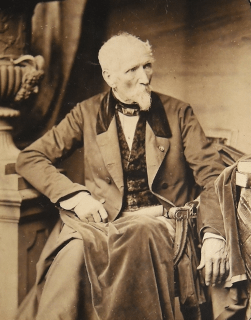
Byrne’s engaging and dispassionate Memoirs have ensured his special status among Irish nationalists. Because of his longevity he is the only United Irishman to have been photographed. His wife had sketched him in profile in middle age, and the photograph taken almost three decades later shows the same, strong features though those of a frail, but dignified man of 79 years.
(From: “Byrne, Miles” by Ruan O’Donnell and Sylvie Kleinman, Dictionary of Irish Biography, http://www.dib.ie, October 2009, last revised August 2024 | Pictured: Photograph of Miles Byrne taken in Paris in 1859)
Blackham is born in London, England, on December 16, 1891. His father, William George Blackham, is an Ulster Protestant from Newry, while his mother is an Englishwoman named Evison Elizabeth Saunders. An uncle is Robert J. Blackham who is the Surgeon-General to the British Army in Ireland. The family are evangelical Protestants, against which he rebels. Having been brought up to take the Bible literally, he suffers a religious crisis upon the realisation his teachers at school do not. He finds the transition to adulthood difficult, particularly due to the early death of his father.
For a time, Blackham moves in socialist circles, under the influence of Ulster socialist Robert Wilson Lynd. However, upon the discovery that his father had been a Protestant who had been in favour of Irish home rule and also had some republican sympathies, he turns toward Irish nationalism.
Blackham becomes involved in the Gaelic League while in London. he Gaelicizes his name to Aodh Sandrach de Blácam or Hugh de Blácam, despite his non-Gaelic ethnic origin. He learns the Irish language from the essayist Robert Wilson Lynd. During this time, he seeks to synthesize his urge to reclaim his sense of Irish nationality with the works and thoughts of hardline Catholic author G. K. Chesterton. It is partially because of Chesterton’s influence that he converts to Catholicism, although the conversion of Protestant Irish Nationalists to Catholicism is common throughout the early 20th century. Another influence upon his decision to convert is his desire to marry Catholic Mary McCarville of County Monaghan.
In May 1914 de Blácam returns to Ireland and begins working as a freelance journalist. He joins the Enniscorthy Echo as a journalist in 1915.
During the Irish War of Independence de Blácam writes nationalist propaganda alongside Arthur Griffith and Herbert Moore Pim. He is interned by the British in 1919. During this time period he writes two political manifestoes: Towards the Republic; a study of new Ireland’s social and political aims (1918) and What Sinn Féin Stands For (1921). The two books argue that at their root, Catholic social teaching (CST) and Bolshevism are essentially identical and that Ireland, having only experienced feudalism and capitalism because of external forces, can skip many of the phrases normally described in the Marxist Trajectory of historical development and go straight to a soviet-type society, an idea not dissimilar to the two-stage theory. He imagines this soviet-type society to be an Irish-speaking decentralised rural cooperative commonwealth. Critics of Sinn Féin frequently cite his works as proof of the infeasibility of Sinn Féin’s aims.
De Blácam opposes the Anglo-Irish Treaty and subsequently aids the Anti-Treaty Irish Republican Army (IRA) during the Irish Civil War. For this he is interned by the newly created Irish Free State in 1922. Following his release, he continues to pin his flag to the mast of Éamon de Valera and his newly formed Fianna Fáil party. He believes De Valera fully embodies his own political ideas.
During the 1920s de Blácam joins The Irish Times, which he later leaves to become editor of The Catholic Standard. For seventeen years he writes a feature in the Fianna Fáil aligned The Irish Press called “Roddy the Rover.”
It was also during the 1920s that de Blácam moves to Dublin, where he begins to move in the same circles as George Bernard Shaw, George Russell, and W. B. Yeats. He hopes all three men might one day convert to Catholicism as he did and is sorely disappointed when each do not. Upon the death of Yeats, he goes so far as to refer to Yeats’ poem as “Demonic.” He has similar hopes for Peadar O’Donnell but is similarly disappointed in his lack of interest in conversion.
In 1938 de Blácam publishes The Black North, a book which carries an introduction by de Valera. In the book he argues that Ulster Protestants are in actuality both Irish and Catholic, but they simply do not realise it. Among his arguments to support this idea are the suggestions that the presbyterian emphasis on self-government is derived from the Gaelic clan tradition, that presbyterian “kailyard” writers of rural nostalgia such as Lydia Mary Foster exemplify the naturally Irish piety and purity of her co-religionists, and that the fact that some workers commute from the Armagh borderland to work in Dundalk factories prove that the south is better off economically than the north.
It is suggested de Blácam is an influence upon de Valera’s 1943 broadcast “The Ireland That We Dreamed Of.” Politically he is highly considered about rural depopulation and is involved in a number of organisations seeking to end it. He advocates more economic autarky and cultural protectionism to combat rural depopulation and lamented urbanisation and industrialisation. He also tries to convince the Fianna Fáil executive that they should ban women from emigration as well as ban women from factories in order to force women to remain in rural Ireland. His ideas fail to impress the executive, with Seán MacEntee in particular standing in strong disagreement.
De Blácam is a member of the Fianna Fáil executive until 1947, when he defects to the upstart Irish Republican party Clann na Poblachta. For this move he is immediately fired from The Irish Press. He stands for Clann na Poblachta in the Louth constituency at the 1948 Irish general election but is not elected.
During the brief period in which Clann na Poblachta is in government, de Blácam serves as an official spokesman for the Department of Health and as a speechwriter to Noël Browne, the embattled Minister for Health.
De Blácam dies while working in the Custom House on January 16, 1951. His funeral is attended by many dignitaries including TaoiseachJohn A. Costello and former Taoiseach Éamon de Valera. He is buried in New Mellifont Abbey, County Louth.
Costello is born on June 20, 1891, in Fairview, Dublin, the younger son of John Costello senior, a civil servant, and Rose Callaghan. He is educated at St. Joseph’s, Fairview, and then moves to O’Connell School, for senior classes, and later attends University College Dublin (UCD), where he graduates with a degree in modern languages and law. He studies at King’s Inns to become a barrister, winning the Victoria Prize there in 1913 and 1914. He is called to the Irish Bar in 1914, and practises as a barrister until 1922.
In 1922, Costello joins the staff at the office of the Attorney General in the newly established Irish Free State. Three years later he is called to the inner bar, and the following year, 1926, he becomes Attorney General of Ireland, upon the formation of the Cumann na nGaedheal government, led by W. T. Cosgrave. While serving in this position he represents the Free State at Imperial Conferences and League of Nations meetings.
Costello is also elected a Bencher of the Honourable Society of King’s Inns. He loses his position as Attorney General of Ireland when Fianna Fáil comes to power in 1932. The following year, however, he is elected to Dáil Éireann as a Cumann na nGaedheal TD. Cumann na nGaedheal soon merges with other parties to form Fine Gael.
During the Dáil debate on the Emergency Powers Act 1939, Costello is highly critical of the Act’s arrogation of powers, stating that “We are asked not merely to give a blank cheque, but to give an uncrossed cheque to the Government.” He loses his seat at the 1943 Irish general election but regains it when Éamon de Valera calls a snap election in 1944. From 1944 to 1948, he is the Fine Gael front-bench Spokesman on External Affairs.
In 1948, Fianna Fáil has been in power for sixteen consecutive years and has been blamed for a downturn in the economy following World War II. The 1948 Irish general election results show Fianna Fáil short of a majority, but still by far the largest party, with twice as many seats as the nearest rival, Fine Gael. It appears that Fianna Fáil is headed for a seventh term in government. However, the other parties in the Dáil realise that between them, they have only one seat fewer than Fianna Fáil, and if they band together, they would be able to form a government with the support of seven Independent deputies. Fine Gael, the Labour Party, the National Labour Party, Clann na Poblachta and Clann na Talmhan join to form the first inter-partygovernment in the history of the Irish state.
While it looks as if cooperation between these parties will not be feasible, a shared opposition to Fianna Fáil and Éamon de Valera overcomes all other difficulties, and the coalition government is formed.
Since Fine Gael is the largest party in the government, it has the task of providing a suitable candidate for Taoiseach. Naturally, it is assumed that its leader, Richard Mulcahy, will be offered the post. However, he is an unacceptable choice to Clann na Poblachta and its deeply republican leader, Seán MacBride. This is due to Mulcahy’s record during the Irish Civil War. Instead, Fine Gael and Clann na Poblachta agree on Costello as a compromise candidate. Costello had never held a ministerial position nor was he involved in the Civil War. When told by Mulcahy of his nomination, Costello is appalled, content with his life as a barrister and as a part-time politician. He is persuaded to accept the nomination as Taoiseach by close non-political friends.
During the campaign, Clann na Poblachta had promised to repeal the Executive Authority (External Relations) Act 1936 but does not make an issue of this when the government is being formed. However, Costello and his Tánaiste, William Norton of the Labour Party, also dislike the act. During the summer of 1948, the cabinet discusses repealing the act, however, no firm decision is made.
In September 1948, Costello is on an official visit to Canada when a reporter asks him about the possibility of Ireland leaving the British Commonwealth. For the first time, he declares publicly that the Irish government is indeed going to repeal the External Relations Act and declare Ireland a republic. It has been suggested that this is a reaction to offence caused by the Governor General of Canada at the time, Harold Alexander, 1st Earl Alexander of Tunis, who is of Northern Irish descent and who allegedly arranges to have placed symbols of Northern Ireland in front of Costello at an official dinner. Costello makes no mention of these aspects on the second reading of the Republic of Ireland Bill on November 24 and, in his memoirs, claims that Alexander’s behaviour had in fact been perfectly civil and could have had no bearing on a decision which had already been made.
The news takes the Government of the United Kingdom and even some of Costello’s ministers by surprise. The former had not been consulted and following the declaration of the Republic in 1949, the UK passes the Ireland Act that year. This recognises the Republic of Ireland and guarantees the position of Northern Ireland within the United Kingdom for so long as a majority there want to remain in the United Kingdom. It also grants full rights to any citizens of the Republic living in the United Kingdom. Ireland leaves the Commonwealth on April 18, 1949, when The Republic of Ireland Act 1948 comes into force. Frederick Henry Boland, Secretary of the Department of External Affairs, says caustically that the affair demonstrates that “the Taoiseach has as much notion of diplomacy as I have of astrology.” The British envoy, John Maffey, 1st Baron Rugby, is equally critical of what he calls a “slipshod and amateur” move.
Many nationalists now see partition as the last obstacle on the road to total national independence. Costello tables a motion of protest against partition on May 10, 1949, without result.
In 1950, the independent-minded Minister for Health, Noël Browne, introduces the Mother and Child Scheme. The scheme would provide mothers with free maternity treatment and their children with free medical care up to the age of sixteen, which is the normal provision in other parts of Europe at that time. The bill is opposed by doctors, who fear a loss of income, and Roman Catholic bishops, who oppose the lack of means testing envisaged and fear the scheme could lead to birth control and abortion. The cabinet is divided over the issue, many feeling that the state cannot afford such a scheme priced at IR£2,000,000 annually. Costello and others in the cabinet make it clear that in the face of such opposition they will not support the Minister. Browne resigns from the government on April 11, 1951, and the scheme is dropped. He immediately publishes his correspondence with Costello and the bishops, something which had hitherto not been done. Derivatives of the Mother and Child Scheme are introduced in Public Health Acts of 1954, 1957 and 1970.
The Costello government has a number of noteworthy achievements. A new record is set in housebuilding, the Industrial Development Authority and Córas Tráchtála are established, and the Minister for Health, Noel Browne, with the then new Streptomycin, bring about an advance in the treatment of tuberculosis. Ireland also joins a number of organisations such as the Organization for European Economic Co-operation and the Council of Europe. However, the government refuses to join NATO, allegedly because the British remain in Northern Ireland. The scheme to supply electricity to even the remotest parts of Ireland is also accelerated.
While the “Mother and Child” incident does destabilise the government to some extent, it does not lead to its collapse as is generally thought. The government continues; however, prices are rising, a balance of payments crisis is looming, and two TDs withdraw their support for the government. These incidents add to the pressure on Costello and so he decides to call a general election for June 1951. The result is inconclusive but Fianna Fáil returns to power. Costello resigns as Taoiseach. It is at this election that his son Declan is elected to the Dáil.
Over the next three years while Fianna Fáil is in power a dual-leadership role of Fine Gael is taking place. While Richard Mulcahy is the leader of the party, Costello, who has proved his skill as Taoiseach, remains as parliamentary leader of the party. He resumes his practice at the Bar. In what is arguably his most celebrated case, the successful defence of The Leader against a libel action brought by the poet Patrick Kavanagh, dates from this period. Kavanagh generously praises Costello’s forensic skill, and the two men become friends.
At the 1954 Irish general election Fianna Fáil loses power. A campaign dominated by economic issues results in a Fine Gael-Labour Party-Clann na Talmhan government coming to power. Costello is elected Taoiseach for the second time.
The government can do little to change the ailing nature of Ireland’s economy, with emigration and unemployment remaining high, and external problems such as the Suez Crisis compounding the difficulty. Measures to expand the Irish economy such as export profits tax relief introduced in 1956 would take years have sizable impact. Costello’s government does have some success with Ireland becoming a member of the United Nations in 1955, and a highly successful visit to the United States in 1956, which begins the custom by which the Taoiseach visits the White House each Saint Patrick’s Day to present the U.S. President with a bowl of shamrock. Although the government has a comfortable majority and seems set for a full term in office, a resumption of Irish Republican Army (IRA) activity in Northern Ireland and Great Britain causes internal strains. The government takes strong action against the republicans.
In spite of supporting the government from the backbenches, Seán MacBride, the leader of Clann na Poblachta, tables a motion of no confidence, based on the weakening state of the economy and in opposition to the government’s stance on the IRA. Fianna Fáil also tables its own motion of no confidence, and rather than face almost certain defeat, Costello again asks PresidentSeán T. O’Kelly to dissolve the Oireachtas. The general election which follows in 1957 gives Fianna Fáil an overall majority and starts another sixteen years of unbroken rule for the party. Some of his colleagues questioned the wisdom of his decision to call an election. The view is expressed that he was tired of politics and depressed by his wife’s sudden death the previous year.
Following the defeat of his government, Costello returns to the bar. In 1959, when Richard Mulcahy resigns the leadership of Fine Gael to James Dillon, he retires to the backbenches. He could have become party leader had he been willing to act in a full-time capacity. He remains as a TD until 1969, when he retires from politics, being succeeded as Fine Gael TD for Dublin South-East by Garret FitzGerald, who himself goes onto to become Taoiseach in a Fine Gael-led government.
During his career, Costello is presented with a number of awards from many universities in the United States. He is also a member of the Royal Irish Academy from 1948. In March 1975, he is made a freeman of the city of Dublin, along with his old political opponent Éamon de Valera. He practises at the bar until a short time before his death at the age of 84, in Ranelagh, Dublin, on January 5, 1976. He is buried at Dean’s Grange Cemetery in Dublin.
In February 1975, the Provisional Irish Republican Army and the British Government enter into a truce and restart negotiations. For the duration of the truce, the IRA agrees to halt its attacks on the British security forces, and the security forces mostly end their raids and searches. However, there are dissenters on both sides. There is a rise in sectarian killings during the truce, which “officially” lasts until February 1976.
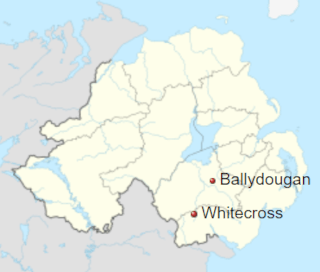
At about 6:10 p.m., at least three masked men enter the home of the Reaveys, a Catholic family, in Whitecross, through a door that had been left unlocked. Brothers John (24), Brian (22) and Anthony Reavey (17) are alone in the house and are watching television in the sitting room. The gunmen open fire on them with two 9mm Sterling submachine guns, a 9mm Luger pistol and a .455 Webley revolver. John and Brian are killed outright. Anthony manages to run to the bedroom and take cover under a bed. He is shot several times and is left for dead. After searching the house and finding no one else, the gunmen leave. Badly wounded, Anthony crawls about 200 yards to a neighbour’s house to seek help. He dies of a brain haemorrhage on January 30. Although the pathologist says the shooting played no part in his death, Anthony is listed officially as a victim of the Troubles. A brother, Eugene Reavey, says “Our entire family could have been wiped out. Normally on a Sunday, the twelve of us would have been home, but that night my mother took everybody [else] out to visit my aunt.” Neighbours claim there had been two Royal Ulster Constabulary (RUC) checkpoints set up — one at either end of the road — around the time of the attack. These checkpoints are to stop passers-by from seeing what is happening. The RUC denies having patrols in the area at the time but says there could have been checkpoints manned by the British Army‘s Ulster Defence Regiment (UDR).
At about 6:20 p.m., three masked men burst into the home of the O’Dowds, another Catholic family, in Ballydougan, about fifteen miles away. Sixteen people are in the house for a family reunion. The male family members are in the sitting room with some of the children, playing the piano. The gunmen spray the room with bullets, killing Joseph O’Dowd (61) and his nephews Barry (24) and Declan O’Dowd (19). All three are members of the Social Democratic and Labour Party (SDLP) and the family believes this is the reason they are targeted. Barney O’Dowd, Barry and Declan’s father, is also wounded by gunfire. The RUC concludes that the weapon used is a 9mm Sterling submachine gun, although Barney believes a Luger pistol with a suppressor was also used. The gunmen had crossed a field to get to the house, and there is evidence that UDR soldiers had been in the field the day before.
The following day, gunmen stop a minibus carrying ten Protestant workmen near Whitecross and shoot them dead by the roadside. This becomes known as the Kingsmill massacre. The South Armagh Republican Action Force (SARAF) claims responsibility, saying it is retaliation for the Reavey and O’Dowd killings. Following the massacre, the British Government declares County Armagh to be a “Special Emergency Area” and announces that the Special Air Service (SAS) is being sent into South Armagh.
Some of the Reavey family come upon the scene of the Kingsmill massacre while driving to the hospital to collect the bodies of John and Brian. Some members of the security forces immediately begin a campaign of harassment against the Reavey family and accuse Eugene Reavey of orchestrating the Kingsmill massacre. On their way home from the morgue, the Reavey family are stopped at a checkpoint. Eugene claims the soldiers assaulted and humiliated his mother, put a gun to his back, and danced on his dead brothers’ clothes. The harassment would later involve the 3rd Battalion, Parachute Regiment. In 2007, the Police Service of Northern Ireland (PSNI) apologises for the “appalling harassment suffered by the family in the aftermath at the hands of the security forces.”
After the killings of the Reavey brothers, their father makes his five surviving sons swear not to retaliate or to join any republican paramilitary group.
In 1999, Democratic Unionist Party (DUP) leader Ian Paisley states in the House of Commons that Eugene Reavey “set up the Kingsmill massacre.” In 2010, a report by the police Historical Enquiries Team clears Eugene of any involvement. The Reavey family seeks an apology, but Paisley refuses to retract the allegation and dies in 2014.
Healy is one of twins, the third son born to Maurice, a Poor Law Union clerk, and Eliza (née Sullivan) Healy. His mother dies during the birth. It is said that the nurse places him in his brother Tim‘s arms and said, “This little boy has no mother now and you will have to be a mother to him.” As he grows up, he becomes very close to his elder brother. The orphaned children are effectively raised by their maternal grandmother, Jane Sullivan. The family moves to Lismore, County Waterford, where he is educated at the local Christian Brothers school. Both brothers marry Sullivans who are first cousins to their husbands and to each other.
Admitted as a solicitor in 1882, Healy practises as such and is returned to parliament four times, first as a member of the Irish Parliamentary Party for Cork City from 1885 to 1900, in which year standing as a Healyite nationalist he is defeated by William O’Brien in a bitter campaign. He is returned again for Cork City in May 1909 to January 1910.
Healy’s force in parliament is land law. He is a close confidant of his brother Tim and although more retiring and stolid than his better-known elder brother, he is considered the more intelligent and often acts as a counterbalance to his brother’s emotionality. On the outbreak of World War I in 1914 a son of each enlists in one of the Irish Divisions.
Maurice (junior) moves to England after the founding of the Irish Free State where he is both a successful lawyer and a broadcaster for the BBC during the early years of World War II. He writes the well-known legal memoir The Old Munster Circuit and the popular Stay Me with Flagons: A Book about Wine and Other Things.
Fay is born on August 30, 1870, at 10 Lower Dorset Street, Dublin, the eldest son of four children of William Patrick Fay, a government clerk, and his wife, Martha Fay (née Dowling). He is educated at Belvedere College, Dublin, where he learns shorthand and typing, before leaving to become a secretary for an accountancy firm in Dublin. From an early age he has a passion for the theatre and immerses himself in books on the subject, becoming a drama expert. His brother, William George Fay, shares his enthusiasm and they take part in many amateur productions, setting up the Ormonde Dramatic Company in 1891.
Fay is an ardent nationalist, and Arthur Griffith appoints him drama critic for his newspaper, the United Irishman (1899–1902), where he develops his ideas on how the theatre should be run. Initially in favour of plays in the Irish language, he soon abandons this as unworkable. In May 1901 he attacks W. B. Yeats for his faulty notions about theatre and even his work as a dramatist, ending with the fiercely nationalistic assertion that “there is a herd of Saxon and other swine fattening on us. They must be swept into the sea with the pestilent breed of West Britons with which we are troubled, or they will sweep us there.” Yeats’s and Lady Gregory‘s next play is Cathleen ni Houlihan.
In 1902, Fay writes a famous article advocating a national theatre company that will “be the nursery of an Irish dramatic literature which, while making a world-wide appeal, would see life through Irish eyes.” He is a member of his brother’s National Dramatic Society, which merges with the Irish Literary Theatre in 1902 to form the Irish National Theatre Society, the originating body of the Abbey Theatre. The following year Yeats declares that the national theatre owes its existence to the two Fay brothers. Fay soon abandons Griffith and begins to champion the cause of Yeats.
An excellent tragic actor, Fay can make audiences forget his less than five feet six-inch stature through the power of his voice. When the Abbey Theatre opens on December 27, 1904, he stars in Yeats’s On Baile’s Strand as Cú Chulainn, a role he makes his own. He spends much time training the other actors. As an elocution teacher he has no equal. One play has Yeats leaving with his “head on fire” because of the quality of the voices on stage. Yeats dedicates his play The King’s Threshold (1904) with the words: “In memory of Frank Fay and his beautiful speaking in the character of Seanchan.”
Fay has a close but turbulent relationship with his brother William, whom he defers to in all theatrical matters except acting. Their heated arguments sometimes lead to blows. His temper is always volatile, and he is prone to histrionics and fits of depression. After 1905, the Abbey Theatre becomes a limited company owing to the patronage of Annie Horniman, and the Fays lose most of their control, which results in much tension and bitterness. In 1907, Fay plays Shawn Keogh in the first production of The Playboy of the Western World by John Millington Synge.
Disagreements with Yeats over the approach to choosing and staging of plays comes to a head late in late 1907 and the Fays resign on January 13, 1908. On March 13 they are suspended from the Irish National Theatre Society. They tour the United States with Charles Frohman before separating. Fay then tours England in minor Shakespearean roles and melodrama. Between 1912 and 1914, Thomas MacDonagh and Joseph Mary Plunkett attempt to persuade him to become actor-manager of an Irish theatre. In 1918 he returns to the Abbey Theatre in two short-lived revivals of Yeats’s The Hour Glass and The King’s Threshold. He retires to Dublin permanently in 1921, teaching elocution and directing plays in local colleges.
Fay marries, in 1912, Freda, known as “Bird.” They live at Upper Mount Street, Dublin, and have one son, Gerard, who becomes a popular writer and memoirist. Fay dies on January 2, 1931, having never really recovered from the death of his wife, and is buried at Glasnevin Cemetery. He is credited with creating the Abbey Theatre style of acting, which becomes internationally known, and influences many other schools of acting. He wanted actors to behave as naturally as possible and to speak the lines as people would in real life, rather than with an exaggerated stage delivery. His training is a major influence on subsequent generations, as actors learned to “speak words with quiet force, like feathers borne on puffs of wind.”
(From: “Fay, Frank J. (Francis John)” by Patrick M. Geoghegan, Dictionary of Irish Biography, http://www.dib.ie, October 2009) | Pictured: Portrait of Frank Fay by John Butler Yeats, commissioned by Annie Horniman for the opening of the Abbey Theatre, December 27, 1904)
Gray is the second son of Sir John Gray and his wife, Anna Dwyer. He has three brothers and two sisters. After receiving his education, he joins his father in managing the Freeman’s Journal, the oldest nationalist newspaper in Ireland. When his father dies in 1875, he takes over proprietorship of the Journal, and his family’s other newspaper properties such as the Belfast Morning News and the Dublin Evening Telegraph.
In 1868, Gray saves five people from drowning in a wrecked schooner at Killiney Bay, an action for which he receives the Tayleur Fund Gold Medal for bravery from the Royal Humane Society. By coincidence, the rescue is witnessed by his future wife, Caroline Agnes Gray, whom he meets shortly afterwards. Agnes is the daughter of Caroline Chisholm, an English humanitarian renowned for her work in female immigrant welfare in Australia, and although Gray is descended from a Protestant family, he converts to Catholicism to marry her. The wedding in London on July 17, 1869, is conducted by the Bishop of Northampton, Francis Amherst. The couple has one son, Edmund Dwyer-Gray, who eventually takes over from his father as proprietor of his newspapers and goes on to become Premier of Tasmania.
From 1875 to 1883, Gray serves as a member of the Dublin Corporation, and in 1880 serves a term as Lord Mayor of Dublin. Unusual for an Irish nationalist politician, he is very much focused on urban rather than rural affairs, and like his father is heavily involved in public health and water provision for Dublin. He also promotes reform in the municipal health system.
Gray is imprisoned for six weeks in 1882 for remarks made in the Freeman’s Journal with regard to the composition of the jury in the case of a murder trial. He is actually Sheriff of Dublin City at the time of his imprisonment and, because of the conflict of office, is taken into custody by the city coroner. The defendant in the case in question is later hanged.
A heavy drinker and asthma sufferer, Gray dies at his home, Pembroke House, Upper Mount Street, Dublin, on March 27, 1888, at the age of 42 following a short illness. He is buried at Glasnevin Cemetery in Dublin.




 seamus dubhghaill