seamus dubhghaill

Promoting Irish Culture and History from Little Rock, Arkansas, USA


Leave a comment

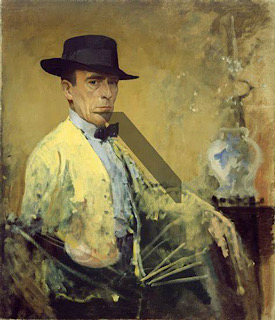
Death of Leo Whelan, Portrait & Genre Painter

(Michael) Leo Whelan, portrait and genre painter, dies from leukemia on November 6, 1956, at the Mater private nursing home in Dublin.

Whelan is born on January 17, 1892, at 20 St. George’s Villas, Fairview, Dublin, one of two sons and three daughters of Maurice Whelan, a draper, of County Kerry ancestry, and Mary Whelan (née Cruise), from County Roscommon. The family subsequently moves to 65 Eccles Street, where his parents operated a small hotel. Educated at Belvedere College, Dublin, he then attends the Dublin Metropolitan School of Art (DMSA) (1908–14), where he is a student of William Orpen, who has a huge influence on his artistic style. His fellow students at the school include Patrick Tuohy and Séan Keating.

Whelan is awarded many prizes in the Royal Dublin Society (RDS) Taylor art competitions, including one in 1912 for a portrait of his sister Lena, entitled On the Moors, rendered in a strongly academic technique. In 1916, he wins the Taylor scholarship for the Royal Hibernian Academy (RHA) schools for his finest early work, The Doctor’s Visit, an adroitly executed composition of contrasting shadows and light. Typical of many of his genre interiors, the painting depicts a room in the family home, with relatives as models: Whelan’s mother sits by the bed watching over his ill cousin, while his sister, dressed in a Mater hospital nurse’s uniform, is in the background opening the door for the doctor. The subtly evoked atmosphere of restrained emotion foreshadowed a hallmark of his mature style.

Whelan exhibits annually at the RHA for forty-five years (1911–56), averaging six works per year. He is elected an RHA associate in 1920, becoming a full member in 1924. He participates in the Exposition d’art irlandais at the Galerie Barbazanges in Paris in 1922. A visiting teacher at the RHA schools in 1924, he also teaches in the DMSA for a time. He has studios at 64 Dawson Street (1914–27) and 7 Lower Baggot Street (1931–56). Beginning in the 1910s, he receives regular commissions for portraits, constituting his primary source of income. Having become the family’s main breadwinner following his parents’ deaths in the 1920s, he concentrates most of his production on this lucrative activity, portraying numerous leading figures in the spheres of politics, academia, religion, society, medicine, and law.

Coming from a family of militant nationalist sympathies, in 1922 he begins a large group portrait, GHQ Staff of the Pre-Treaty IRA, including Michael CollinsRichard MulcahyRory O’ConnorLiam Mellows and nine others, composed from individual studies of the men rendered during clandestine sittings in his home and studio. The painting, which he leaves unfinished, is in McKee Barracks, Dublin. He receives special praise for his portraits of John Henry Bernard, Provost of Trinity College Dublin (TCD) and of Louis Claude Purser, TCD vice-provost. The latter is awarded a medal at the 1926 Tailteann Games. He exhibits seventeen paintings at the Royal Society of Portrait Painters, London, of which he is a member, and shows two works at the Royal Academy of Arts, London. His 1929 portrait of John McCormack, one of his major patrons, is presented by the tenor’s family some fifty years later to the National Concert Hall, Dublin.

Situated securely in the academic tradition, in most of his portraits Whelan favours a sombre, restricted palette, with the sitter placed, in grave demeanour, against a monotone background with few accessories. In a 1943 interview he asserts that twentieth-century portraiture suffers from the drabness of modern costume, for which the artist must compensate by careful rendition of the subject’s hands. He tends to depart from his prevailing portrait style when painting women, whom he characteristically depicts in meticulously observed interiors, a notable example being his portrait of Society hostess Gladys Maccabe (c.1946; NGI).

Whelan’s commercial concentration on portraiture notwithstanding, he expresses his true talent in genre compositions, especially kitchen interiors, in which he emulates the technique of the Dutch painter Johannes Vermeer. Two of the most accomplished of these depict his sister Frances in the basement kitchen of the family home: The Kitchen Window (1927; Crawford Art Gallery, Cork) demonstrates a particularly skillful use of light, while Interior of a Kitchen (1935) is notable for the dexterous handling of objects of varied shapes and textures. His genre works include both urban and rural scenes, with a distinctive interest in portraying occupations and other activities. Gypsy (1923), an Orpenesque composition of a shawled woman in a west-of-Ireland landscape with a caravan in the background, receives wide contemporary critical acclaim. Jer (c.1925), depicting a man seated by the fire in a cottage interior, is reproduced in J. Crampton Walker’s Irish Art and Landscape (1927). The Fiddler (c.1932), a naturalistic, sensitively characterised study, is first shown at an Ulster Academy exhibition at Stranmillis, Belfast. A Kerry Cobbler is reproduced in Twelve Irish Artists (1940), introduced by Thomas Bodkin, as among the works denoting the development of a distinctively Irish school of painting.

In 1929, Whelan designs the first Irish Free State commemorative stamp, a portrait of Daniel O’Connell for the centenary of Catholic emancipation. Commissioned by the Thomas Haverty trust to paint an incident from the life of Saint Patrick for the 1932 Eucharistic Congress, he executes The Baptism by St. Patrick of Ethna the Fair and Fedelmia the Ruddy, Daughters of the Ard Rí Laoghaire, a work highly conservative in style. He rapidly completes an oil study of the papal legate, Lorenzo Lauri, also for the Eucharistic Congress. He is represented in the art competitions at the 1932 Summer Olympics in Los Angeles. His depiction of Saint Brigid, shown at the Academy of Christian Art exhibition (1940), becomes a familiar image owing to the wide circulation of reproductions.

Whelan’s political portraits are influential in creating a strong, assured image of the newly formed Irish state, and thus retain an historical significance. His posthumous portrait, The Late General Michael Collins, exhibited at the RHA in 1943 and now held in Leinster House, is an iconic, heroic image of the fallen leader. His portraits of Arthur Griffith and Kevin O’Higgins – commissioned posthumously, as is the Collins, by Fine Gael – also hang in Leinster House, while that of John A. Costello, exhibited at the RHA in 1949, is now held in the King’s Inns, Dublin. He paints two presidents, Douglas Hyde and Seán T. O’Kelly, both works currently in Áras an Uachtaráin. A portrait of Éamon de Valera, painted in 1955 when the sitter is Leader of the Opposition, is in Leinster House. In 1954, he designs a second commemorative stamp, picturing a reproduction of a portrait bust of John Henry Newman, to mark the centenary of the Catholic University of Ireland.

Whelan is elected an honorary academician of both the Ulster Academy of Arts (1931), and the Royal Ulster Academy (1950). He becomes a member of the United Arts Club in 1934. As a representative of the RHA, he sits on the board of governors of the National Gallery of Ireland for many years, and is on the advisory committee of the Municipal Gallery of Modern Art. Unmarried, he resides until his death at the Eccles Street address, with two sisters who continue to manage the family hotel. He dies on November 6, 1956, from leukemia at the Mater private nursing home in Dublin. He is buried in Glasnevin Cemetery.

(From: “Whelan, (Michael) Leo,” by Carmel Doyle, Dictionary of Irish Biography, http://www.dib.ie, October 2009)
Leave a comment

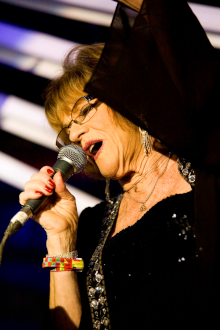
Birth of Anne Bushnell, Jazz & Blues Singer

Anne Bushnell, Irish jazz and blues singer and cabaret performer, is born Anne Kavanagh in the Rotunda Hospital, Dublin, on March 28, 1939.

Bushnell is one of four children of John Kavanagh and Evelyn (née Ledwidge). Her father is a motor mechanic with a business on Arnott Street, Portobello, with the family living in Milltown. She dances on the stage of the Theatre Royal as a child and is a junior Irish champion dancer. She attends the St. Louis convent school in Rathmines, where she performs in plays and musicals and sings in the school choir. The nuns disapprove of her musical influences and try to dissuade her interest in jazz and “the music of the night.” Due to the family’s financial circumstances, she leaves school at the age of 16 and takes a job as a typist. She marries Tony Bushnell in April 1961. He is a salesman who shares her interest in music. The couple moves to Templeogue, and have a daughter, Suzanne, and a son, Paul. Paul is now a session musician based in Los Angeles, and Suzanne sings with a female vocal harmony group, Fallen Angels.

Bushnell continues to perform in amateur musicals, and from the early 1960s she sings with an Irish céilí band. With help from her husband’s musical family, she sings in Dublin jazz clubs from 1967, emerging as a well-respected jazz and blues vocalist and cabaret performer. She competes in the national song contest in 1968 singing Ballad to a Boy and becomes a resident singer in the RTÉ Light Orchestra. By the late 1960s, she is one of the busiest singers in Ireland, singing jingles for radio and TV commercials, and featuring on showband records as a backing singer. She is a regular guest on RTÉ television variety shows from 1970, including hosting Girls, girls, girls.

From 1972 to 1974, Bushnell is part of a group called Family Pride, which is a group of session musicians who record together regularly. They compete in the 1973 national song contest, playing in Dublin venues and on radio shows. The group has two top ten Irish hits. Their 1973 album, Family Pride, is not a chart success, however. She represents Ireland at a number of international contests and festivals as a solo artist, releasing a few singles and an unsuccessful album with CBS Records, Are You Ready (1977). She is a backing singer for two of Ireland’s entries to the Eurovision Song Contest in 1974 and 1980. She is a regular in stage musicals from the mid to late 1970s, in productions such as the tribute shows to Jacques Brel (1974) and Bing Crosby (1978), sometimes performing alongside her brother John Kavanagh. From the late 1970s she appears in pantomimes with Maureen Potter.

In 1984 Bushnell stars in a musical based on the life of Édith Piaf, No Regrets, written specially for her by Leland Bardwell. She is lauded for capturing Piaf’s stage presence and husky voice. The show suffers when it has to move from the Gaiety Theatre to the National Stadium. She reworks it into a successful one-woman show called The Little Sparrow and also devises a one-woman tribute to Judy Garland. Her cabaret act in the late 1980s is highly successful, featuring big numbers by Brel, Garland, and Piaf. Due to her talent at singing blues and jazz, she is awarded the freedom of New Orleans by its mayor in 1986.

Bushnell struggles with depression brought on initially by an underactive thyroid and later exacerbated by her father’s death and her husband’s unemployment in the late 1980s. Disheartened by the lack of recognition in Ireland and her family’s financial difficulties, she considers emigrating or returning to her career as a typist. To aid with her depression, she takes up painting in 1992, holding a number of exhibitions in Dublin. She continues to sing regularly until her death, often at events for charity. She is awarded the Cheshire Foundation award in 1994 for her charitable work. She also appears in the film Agnes Browne.

Bushnell dies of cancer on April 21, 2011, in Tallaght University Hospital, County Dublin, and is cremated at Mount Jerome Crematorium.


Leave a comment

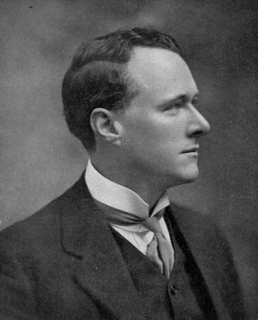
Death of James Bernard Fagan, Actor, Producer & Playwright

James Bernard Fagan, Irish-born actor, theatre manager, producer and playwright in England, dies of a heart attack in Hollywood, Los Angeles, California, on February 17, 1933, following a bout of influenza.

Fagan is born in Belfast on May 18, 1873, the eldest of the five children of Sir James Fagan, a surgeon at the Belfast Royal Hospital and an inspector of Irish reformatories, and Mary Catherine Fagan (née Hughes). He attends Clongowes Wood College near Clane, County Kildare and then moves to England. Initially interested in a career in the church, he begins studying law at Trinity College, Oxford in 1892 but leaves in 1893 without a degree. He works for a time in the Indian Civil Service but abandons this career for the stage.

Fagan begins his career as an actor with the company of Sir Frank Benson for two years, then joining, from 1895 to 1899, the company of Herbert Beerbohm Tree at Her Majesty’s Theatre. There he appears in Katherine and Petruchio, A Man’s Shadow, Julius Caesar, The Musketeers and Carnac Sahib. He starts writing plays in 1899, with The Rebels, for the time forsaking acting. In 1913, he returns to the stage touring as the Rt. Hon. Denzil Trevena in his own play, The Earth. He next writes The Fourth of August (1914) and Doctor O’Toole (1917). In 1917 he produces his first play, his own adaptation of the Eugène Brieux play Damaged Goods at St. Martin’s Theatre. He next produces The Wonder Tales and The Little Brother at the Ambassadors Theatre in London.

Fagan takes over the Court Theatre in London’s Sloane Square as a Shakespearean playhouse in 1920. The Times calls his revivals of Twelfth Night, The Merchant of Venice, Henry the Fourth (Part Two) and A Midsummer Night’s Dream “memorable for their freshness, sanity and distinction, and [deserving of] a place in theatrical history.” At the Court, he revives Damaged Goods and, in 1921, with the assistance of the author, produces George Bernard Shaw‘s Heartbreak House, with Edith Evans as “Lady Utterwood.” In 1922 he produces his play The Wheel at the Apollo Theatre. Its success allows him to repay his creditors. Even more successful is his adaptation of Treasure Island at the Savoy Theatre with Arthur Bourchier as “Long John Silver,” which opens December 26, 1922. It is revived every Christmas until the outbreak of World War II.

Fagan is persuaded by Jane Ellis, the actress who with Alfred Ballard founds the Oxford Playhouse “Red Barn” in 1923, to be its first manager. His first production at the Oxford Playhouse is a restaging of Shaw’s Heartbreak House and numbered Shaw among the audience. He produces The Cherry Orchard, at various theatres, to favourable reviews, popularising Anton Chekhov in Britain. From November 16, 1925, with Dennis Eadie, he presents Juno and the Paycock at the Royalty Theatre, thus bringing Seán O’Casey to the attention of London’s theatre-going public. O’Casey’s The Plough and the Stars follows the next year.

Fagan receives little support from the University of Oxford or the play-going public and resigns in 1929. His successor is Stanford Holme, who broadens its appeal and, despite the straitened times, makes it financially viable. In 1929, he is a director of the Festival Theatre, Cambridge, where his friend Terence Gray is director. He also produces many works for the Irish Players.

Beginning in the 1920s, several of Fagan’s plays are adapted for film. He moves to Hollywood in 1929 for the filming by Paramount Pictures of his play The Wheel as The Wheel of Life. Other film work includes his co-adaptation of the screenplay for the 1932 film Smilin’ Through, and he co-writes Paramount’s Forgotten Commandments the same year. His play Bella Donna is filmed four times, including posthumously in 1946, and a 1936 film, The Improper Duchess is based on his 1931 play of the same name.

James Bernard Fagan dies in Hollywood, California, on February 17, 1933, at the age of 59 of a heart attack following a bout of influenza.


Leave a comment

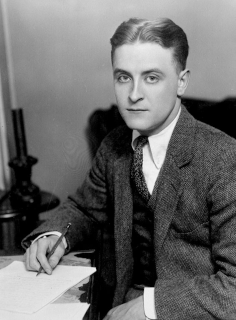
Death of F. Scott Fitzgerald, Novelist, Essayist & Screenwriter

Francis Scott Key Fitzgerald, Irish American novelist, essayist, short story writer and screenwriter, whose works are the paradigmatic writings of the Jazz Age, dies of a heart attack at the age of forty-four on December 21, 1940, in Hollywood, Los Angeles, California.

Fitzgerald is born into an Irish Catholic middle-class family on September 24, 1896, in Saint Paul, Minnesota. His mother, Mary McQuillan Fitzgerald, is of Irish descent and his father, Edward Fitzgerald, has Irish and English ancestry. He is best known for his novels depicting the flamboyance and excess of the Jazz Age, a term he popularized. During his lifetime, he publishes four novels, four collections of short stories, and 164 short stories. Although he achieves temporary popular success and fortune in the 1920s, he receives critical acclaim only after his death and is now widely regarded as one of the greatest American writers of the 20th century.

Fitzgerald is raised primarily in New York. He attends Princeton University but owing to a failed relationship with socialite Ginevra King and a preoccupation with writing, he drops out in 1917 to join the United States Army. While stationed in Alabama, he romances Zelda Sayre, a Southern debutante who belongs to Montgomery‘s exclusive country-club set. Although she rejects Fitzgerald initially, because of his lack of financial prospects, she agrees to marry him after he publishes the commercially successful This Side of Paradise (1920). The novel becomes a cultural sensation and cements his reputation as one of the eminent writers of the decade.

Fitzgerald’s second novel, The Beautiful and Damned (1922), propels him further into the cultural elite. To maintain his affluent lifestyle, he writes numerous stories for popular magazines such as The Saturday Evening Post, Collier’s: The National Weekly, and Esquire. During this period, he frequents Europe, where he befriends modernist writers and artists of the “Lost Generation” expatriate community, including Ernest Hemingway. His third novel, The Great Gatsby (1925), receives generally favorable reviews but is a commercial failure, selling fewer than 23,000 copies in its first year. Despite its lackluster debut, The Great Gatsby is now widely praised, with some labeling it the “Great American Novel.” Following the deterioration of his wife’s mental health and her placement in a mental institute for schizophrenia, he completes his final novel, Tender Is the Night (1934).

Struggling financially because of the declining popularity of his works amid the Great Depression, Fitzgerald turns to Hollywood, writing and revising screenplays. While living in Hollywood, he cohabits with columnist Sheilah Graham, his final companion before his death. After a long struggle with alcoholism, he attains sobriety only to die of a heart attack on December 21, 1940, at the age of 44. His friend Edmund Wilson completes and publishes an unfinished fifth novel, The Last Tycoon (1941), after Fitzgerald’s death.

At the time of his death, the Roman Catholic Church denies the family’s request that Fitzgerald, a non-practicing Catholic, be buried in the family plot in the Catholic St. Mary’s Cemetery in Rockville, Maryland. He is buried instead with a simple Protestant service at Rockville Union Cemetery. When Zelda Fitzgerald dies in a fire at the Highland Mental Hospital in 1948, she is originally buried next to him at Rockville Union. In 1975, Fitzgerald’s daughter, Scottie, successfully petitions to have the earlier decision revisited, and her parents’ remains are moved to the family plot in St. Mary’s Cemetery.


Leave a comment

Birth of Irish Actress Sinéad Cusack

Sinéad Moira Cusack, award winning Irish actress, is born Jane Moira Cusack in Dalkey, County Dublin, on February 18, 1948.

Cusack is the daughter of actress Maureen Cusack and actor Cyril Cusack. She is the sister of actresses Sorcha Cusack, Niamh Cusack, and half-sister to Catherine Cusack. Her father is born in South Africa, to an Irish father and an English mother, and had worked with Micheál Mac Liammóir at Dublin‘s Gate Theatre.

Cusack’s first acting roles are at the Abbey Theatre in Dublin. In 1975, she moves to London and joins the Royal Shakespeare Company (RSC) starring in Dion Boucicault‘s London Assurance in the West End. Her work with the RSC continues with an award-winning performance as Celia in As You Like It which includes the Clarence Derwent Award and her first Laurence Olivier Award nomination. She secures a second Olivier Award nomination for her performance in The Maid’s Tragedy by Francis Beaumont and John Fletcher in 1981, followed two years later with a third Olivier Award nomination as Kate in The Taming of the Shrew.

Cusack makes her Broadway debut in 1984 performing in repertory with the Royal Shakespeare Company. Starring opposite Derek Jacobi, she plays Roxane in Anthony Burgess‘s translation of Edmond Rostand‘s Cyrano de Bergerac and Beatrice in William Shakespeare‘s Much Ado About Nothing, directed by Terry Hands. Much Ado is first produced at the Royal Shakespeare Theatre in Stratford-upon-Avon in 1982–83, then moves to London’s Barbican Centre for the 1983–1984 season where it is joined by Cyrano, before both plays transfer to New York‘s Gershwin Theatre from October 1984 to January 1985, for which Cusack received a Tony Awards nomination for her performance as Beatrice, and costar Derek Jacobi wins the award for his Benedick. The production of Cyrano de Bergerac is later filmed in 1985.

During this period, Cusack and her husband, Jeremy Irons, appear in a Shakespeare Winter’s Eve, a major fundraiser for the Riverside Shakespeare Company in New York, along with other members of the Royal Shakespeare Company. Following the Broadway run, the plays tour the United States, making stops in Washington, D.C. and Los Angeles. Her connection with the Royal Shakespeare Company continues with a series of leading roles include Portia in The Merchant of Venice opposite David Suchet, Lady Macbeth opposite Jonathan Pryce in Macbeth and Cleopatra in Antony and Cleopatra in Stratford-upon-Avon and at London’s Theatre Royal Haymarket in the West End.

In 1990, Cusack, in the role of Masha, joins two of her sisters, Niamh (as Irina) and Sorcha (as Olga), and her father, Cyril Cusack (as Chebutykin) for a well-received production of Anton Chekhov‘s tragicomedy Three Sisters in a new version by Frank McGuinness, directed by Adrian Noble at the Gate Theatre, Dublin, before transferring to the Royal Court Theatre in London. The production also features Niamh’s husband, Finbar Lynch, as Solenyi and Lesley Manville as Natasha. The production wins the three real-life sisters the Irish Life Award in 1992.

One of Cusack’s best known stage roles is Our Lady of Sligo by Sebastian Barry in 1998, in which she plays the principal role of Mai O’Hara in performances in Ireland, on Broadway and at the National Theatre. For this she wins the 1998 Evening Standard Theatre Award for Best Actress, the 1998 Critics’ Circle Theatre Award for Best Actress and her fourth Olivier Award nomination for Best Actress. In 2006-07 she stars with Rufus Sewell in Tom Stoppard‘s Rock ‘n’ Roll at the Royal Court Theatre in London which transfers to the West End and Broadway, winning Cusack her fifth Olivier Award nomination and her second Tony Award nomination.

In 2015, Cusack returns to Ireland’s Abbey Theatre, where she begins her theatre career. She appears in the world première of Mark O’Rowe‘s play Our Few and Evil Days, acting opposite long-time collaborator Ciarán Hinds. She wins the Irish Times Irish Theatre Award for Best Actress.

Cusack stars with Peter Sellers in the film Hoffman (1970). She guest stars in an episode of The Persuaders! (1971), a TV series starring Tony Curtis and Roger Moore, as Jenny Lindley, a wealthy heiress who suspects that a man claiming to be her dead brother is in fact an impostor. In 1975, she makes three appearances in the TV series Quiller as the character Roz.

Cusack and her husband appear together in the film Waterland (1992), in a television adaptation of Christopher Hampton‘s Tales from Hollywood (also 1992), and again in Bernardo Bertolucci‘s Stealing Beauty (1996). Further film work includes Passion of Mind (2000), V for Vendetta (2005), and Eastern Promises (2007), a thriller directed by David Cronenberg. Her performance in The Tiger’s Tail (2007) wins her a first Irish Film & Television Academy (IFTA) Award nomination for Best Actress in a Supporting Role. She wins the IFTA Award for her performance in The Sea (2013), adapted from the novel by John Banville. She is nominated once more for an IFTA Award for her performance in John Boorman‘s drama film Queen and Country (2014), which premières at the Cannes Film Festival.

Further starring roles include lead roles in Oliver’s Travels (1995), Have Your Cake and Eat It (1997) for which Cusack wins the Royal Television Society‘s RTS Award for Best Actress and Frank McGuinness’s The Hen House (1989) for BBC Television. She stars in the title role of George du Maurier‘s Trilby (1976), in an adaptation for the BBC’s Play of the Month, with Alan Badel as Svengali. She also stars in the BBC mini-series North & South (2004, from the novel by Elizabeth Gaskell) as Mrs. Thornton. She stars in the BBC sitcom Home Again (2006) and appears in the TV series Camelot (2011), which runs for one season. She has featured roles in the mini-series The Deep (2014) and the series Marcella (2016), an eight-episode murder mystery.

Along with other actresses, including Paola Dionisotti, Fiona Shaw, Juliet Stevenson and Harriet Walter, Cusack contributes to a book by Carol Rutter called Clamorous Voices: Shakespeare’s Women Today (1994). The book analyses modern acting interpretations of female Shakespearean roles.

Cusack marries British actor Jeremy Irons in 1978, and they have two sons, Samuel James and Maximilian Paul. Prior to marrying Irons, she gives birth to a son in 1967 and places the boy for adoption. In 2007, a journalist for the Irish Sunday Independent, Daniel McConnell, reveals that Cusack is the mother of left-wing general election candidate and now member of Irish parliament Richard Boyd Barrett. The two have since been reunited.

Cusack is a patron of the Burma Campaign UK, the London-based group campaigning for human rights and democracy in Burma. In 1998, she is named, along with her husband, in a list of the biggest private financial donors to the British Labour Party. In August 2010, she signs the “Irish artists’ pledge to boycott Israel” initiated by the Palestine Solidarity Campaign.

(Pictured: Sinéad Cusack reciting poetry for the British Library in October 2021)


2 Comments

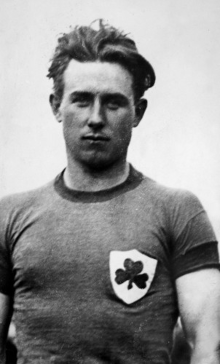
Death of Patrick O’Callaghan, Olympic Gold Medalist

Patrick “Pat” O’Callaghan, Olympic gold medalist and world record holder, dies on December 1, 1991, in Clonmel, County Tipperary.

O’Callaghan is born on September 15, 1905, at Derrygallon, Kanturk, County Cork. He attends the Royal College of Surgeons in Ireland (RCSI) in Dublin and qualifies as a doctor at the age of 20. He joins the Royal Air Force Medical Services in 1926 on a short-service engagement, before moving to Clonmel in 1931 to work as an assistant medical officer in St. Luke’s Hospital, later setting up as a general practitioner in the town. He continues to practise there until the late 1980s.

While in university, O’Callaghan develops an interest in the hammer, having seen the country’s top hammer-throwers practise at the University College Dublin (UCD) grounds, then at Terenure College. At home in Cork for the summer, he does not have access to a hammer, so he collects an old cannon ball from Macroom Castle which he feels might approximate to the required 16 lb. (7.25 kg) weight, has it drilled at a foundry in Mallow and fitted with a handle and wire, and uses it to train at the family farm. In 1926 he wins the Munster title in the 56 lb. (25.4 kg) shot and follows that with an Irish hammer title in 1927. Victory the following year in that same championship qualifies him for the 1928 Summer Olympics in Amsterdam, which he enters as a complete unknown with a previous best of 166 ft. 11 in. (50.87 m), as against three other contenders who have each thrown well over 170 ft. (51.8 m). The hammer event is staged on July 30, 1928, and, lying third after four rounds, he throws 168 ft. 7 in. (51.38 m) with his penultimate attempt, to defeat the Swedish favourite, Ossian Skiöld, by 4 inches (10 cm), with the American contenders Edmund Black and Frank Conner, still further behind. He becomes the first athlete from the Irish Free State to be crowned Olympic champion. Less than a fortnight later, he wins the Tailteann Games with an Irish record throw of 170 ft. 2 in. (51.87 m).

Over the following years O’Callaghan wins events across Ireland and Europe and continues to achieve pioneering feats, not least in 1931, when he wins six Irish titles in one afternoon: hammer, shot put, discus, high jump, 56 lbs. without follow, and 56 lbs. over-the-bar. On August 1, 1932, he defends his Olympic title at the 1932 Summer Olympics in Los Angeles. With just one throw left in the competition, he trails second behind the Finnish champion, Ville Pörhölä. With his last throw, he claims the event with a distance of 176 ft. 11 in. (53.92 m), becoming the only Irish person in history to win two gold medals at the Olympic games. He seems in prime condition to defend his title for a third time at the 1936 Summer Olympics in Berlin, but a dispute in the athletics world brings the suspension of the National Athletic and Cycling Association of Ireland (NACAI) by the International Amateur Athletic Federation (IAAF). The subsequent decision not to send a team to Berlin by the Irish Olympic Council denies him the opportunity to win a hat-trick of gold medals.

O’Callaghan remains a dominant force in athletic circles, however. In 1934 he sets the record for the hammer on European soil with a throw of 186 ft. 10 in. (56.95 m) at Enniscorthy, County Wexford. He later achieves an unofficial world record in the hammer in 1937 in Fermoy, County Cork, with a remarkable throw of 195 ft. 5 in. (59.55 m), breaking the old record by more than 6 ft. (1.83 m). As the IAAF still refuses to sanction the NACAI, the record is not ratified, ensuring that the then twenty-four-year-old record of his compatriot, Patrick Ryan, who competes for the United States, remains in place. In total, as well as his two Olympic gold medals, he also wins six Irish championships in the hammer, four Irish championships in the 56 lb. shot, three Irish championships throwing the 56 lb. weight over-the-bar, and one Irish championship in the discus. He also wins the American hammer championship in 1933 and the British championship in the same event the following year. Despite his size, he jumps 6 ft. 2 in. (1.88 m) in the high jump and is Irish champion on three consecutive occasions (1929–31).

After an accident in which a child is killed by a flying hammer, O’Callaghan emigrates to the United States just before World War II and takes up professional wrestling. Attempts are made to set up a match with world wrestling champion Dan O’Mahoney, but this never occurs. He has a high profile, however. Samuel Goldwyn offers him the film role of Tarzan and he plays handball with Bing Crosby before returning home to Clonmel, where he becomes a prominent member of Clonmel Commercials Gaelic football club and manages that club’s senior team to three county championships (1965–67). He is later chairman and honorary president of the club. In 1984 he is made a Freeman of Clonmel, a town where he is known as “the doc” or “Dr. Pat” and revered as a humble, charming, jovial man, with a reputation for particular kindness to his poorer patients. At 6 ft. 1 in. (1.855 m) and sixteen stone (101.6 kg), he is a larger-than-life figure and the focal point of innumerable stories confirming his status as a living legend. In 1960 he is the first person voted into the newly conceived Texaco Hall of Fame. He lives for many years at Roseville, Western Road, Clonmel, and dies there on December 1, 1991.

O’Callaghan is survived by three sons and one daughter. His younger brother Con represents Ireland in the decathlon at the 1928 Olympic games and wins that event at the third Tailteann games in 1932.

(From: “O’Callaghan, Patrick (‘Pat’)” by Paul Rouse, Dictionary of Irish Biography, http://www.dib.ie)


Leave a comment

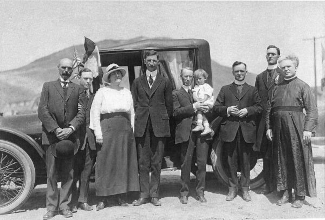
Éamon de Valera Visits Butte, Montana During His American Tour

President Éamon de Valera visits Butte, Montana, on July 25, 1919, during his American Tour of 1919-20. Montana Lieutenant Governor W. W. McDowell meets his train and rides with de Valera through the streets to where de Valera then addresses over 10,000 people who have come out to hear him. The next day, de Valera addresses a joint session of the Montana State Legislature.

De Valera’s eventful 1919 begins in Lincoln Jail and ends in New York City’s Waldorf Astoria, the largest and most luxurious hotel in the world. Smuggled aboard the SS Lapland in Liverpool in June, he sails for the United States during the closing stages of the Paris Peace Conference. As London’s Sunday Express complains in August 1919, “there is more Irish blood in America than in Ireland,” making the United States the obvious destination for a sustained propaganda and fundraising mission.

After his highly-publicised American debut at New York’s Waldorf Astoria, the self-styled “President of the Irish Republic” embarks on the first leg of what is to be an eighteen-month tour of the United States. The purpose of his mission is twofold: to gain formal recognition of the Irish Republic and to raise funds via a bond issue to support the independence movement and the newly established Dáil Éireann.

Between July and August 1919, de Valera and his entourage travel over 6,000 miles from New York to San Francisco, addressing enormous crowds at dozens of venues. He fills Madison Square Garden to capacity and receives a thirty-minute standing ovation from 25,000 people in Chicago’s Wrigley Field. Twice as many people fill Boston’s Fenway Park on June 29, cheering the arrival of the “Irish Lincoln.” The Sinn Féin envoys also visit less obvious Irish communities of the period, such as Scranton, Savannah, New Orleans and Kansas City. For de Valera’s personal secretary, Seán Nunan, the public meeting in Butte, Montana is like “an election meeting at home – there were so many first-generation Irishmen working on the mines – mainly from around Allihies in West Cork.” In San Francisco de Valera dedicates a statue of Robert Emmet by Irish-born sculptor Jerome Connor in Golden Gate Park, a replica of which stands sentinel in St. Stephen’s Green in Dublin. This is one of many symbolic gestures linking the American and Irish struggles for independence played out before the flashing bulbs of the ubiquitous press photographers. On August 15, The Cork Examiner notes that the enthusiastic American exchanges “indicate that few public missionaries from other lands – possibly only Mr. Parnell – have ever had such receptions as were accorded to the Sinn Féin leader.”

De Valera’s team deserves credit for the incredible logistical triumph that is the U.S. tour. As chief organiser, Liam Mellows travels ahead to each city, ensuring a suitable reception is prepared and a venue secured for a mass meeting. Seán Nunan is de Valera’s fastidious personal secretary and Harry Boland, Sinn Féin TD for South Roscommon and Irish Republican Brotherhood (IRB) envoy, is at his side troubleshooting, speechmaking and shaking hands. As the tour progresses, de Valera’s supporting cast expands to include Kerry-born Kathleen O’Connell who becomes de Valera’s full-time personal secretary from 1919.

The next stage of de Valera’s American odyssey begins on October 1, 1919, in Philadelphia, a city with a rich Irish heritage and rife with symbolism of America’s struggle for independence. Over the next three weeks, de Valera and his team travel from the Atlantic to the Pacific seaboard and back again, delivering seventeen major public speeches and a host of smaller ones to aggregate crowds of over half a million.

The pace is relentless as the Irish team makes its way through middle America. De Valera is received as a visiting dignitary at multiple state legislatures and presented with honorary degrees from six American universities. In line with his secondary objective to foster the interest of “wealthy men of the race in the industrial development of Ireland,” he addresses the Chambers of Commerce in a number of cities and arranges a personal meeting with Henry Ford, the son of an Irish emigrant, during his visit to Detroit in October. In the same month in Wisconsin, he is made a Chief of the Chippewa Nation, an honour he later says meant more to him than all the freedoms of all the cites he was ever given. It is not surprising that by the time they reach Denver on October 30, The Irish World reports that “the President looked tired.” Still, he musters the energy to make high profile visits to Portland, Los Angeles and San Diego before beginning the return journey to New York at the end of November.

After a short break for Christmas, the Irish team prepares for the launch of the Bond Certificate Drive. A week-long frenzy of publicity kicks off on January 17 at New York City Hall where Mayor John F. Hylan presents de Valera with the Freedom of the City. During the spring of 1920, de Valera addresses the Maryland General Assembly at Annapolis before making the swing through the southern states of America.

It is not all plain sailing for the Sinn Féin representatives in America. The tour of the west coast in late 1919 sees increasing tensions with American patriotic bodies who are critical of de Valera’s perceived pro-German stance during World War I. He is heckled during a speech in Seattle and a tricolour is ripped from his car in Portland by members of the American Legion. The trip through the southern states in the spring of 1920 coincides with rising American anti-immigration and anti-Catholic nativism. A small number of counter demonstrations are organised by right-wing Americans. Most notably, members of the Ku Klux Klan make unwelcome appearances at several rallies in the American south, making clear their opposition to de Valera’s presence.

The Irish envoys also contend with antagonism from the leaders of Friends of Irish Freedom (FOIF), the broad-based popular front of Clan na Gael headed by veteran Fenian John Devoy and Judge Daniel Cohalan. The FOIF uses its significant resources to finance de Valera’s tour and facilitate the Bond Certificate Drive, but behind the scenes there are significant personality clashes and tensions over tactics.

The increasingly public dispute comes to a head in a row over strategies at the Republican National Convention in Chicago in June 1920. Drawing on his influential political contacts, Cohalan persuades the Republican Party to include Irish self-determination in their election platform. However, much to Cohalan’s fury, de Valera leads a separate delegation to the Convention and insists on a resolution calling for recognition of the Irish Republic. The result is that two resolutions are submitted to the Platform Committee, which indicates dissension in the Irish ranks and gives the Committee the excuse to include neither in the final platform. After de Valera also fails to secure the endorsement of the Democratic convention in San Francisco in June, it is clear that the Irish question will not be a significant factor in the ensuing presidential election. Relations between the FOIF and de Valera reach a new low. In November 1920, de Valera makes the final break with the FOIF and sets up a new organisation, the American Association for the Recognition of the Irish Republic.

De Valera is in Washington, D.C. on October 25 when Terence MacSwiney dies after 74 days on hunger strike. Six days later, at the last great meeting of the American tour, 40,000 people fill New York’s Polo Grounds to commemorate MacSwiney’s death. By late November, de Valera knows that it is time to return to Ireland. Smuggled aboard SS Celtic in New York harbour on December 10, he prepares for the nine-day journey home. He had failed to obtain the recognition of the United States Government for the Republic, but his cross-continental tour and associated press coverage raised international awareness and over $5 million for the Irish cause.

(From: An article by Helene O’Keeffe that was first published in the Irish Examiner on March 24, 2020 | Photo: Eamon de Valera, center, president of the Provisional Government of the Irish Republic, in Butte, Montana, in 1919 to encourage support for Ireland’s fight for independence. Courtesy of Butte-Silver Bow Public Archives)


Leave a comment

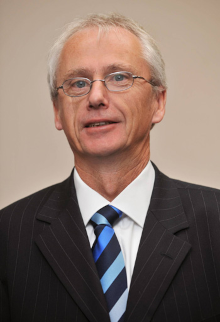
Birth of John Treacy, Olympian & Former Athlete

John Treacy, Irish Olympian and former athlete, now a sporting administrator, is born in Villierstown, County Waterford, on June 4, 1957.

Treacy attends St. Anne’s Post-Primary School in Cappoquin, County Waterford, running more than seven miles to school every morning. He graduates from Providence College in Providence, Rhode Island. In 1978 and 1979 he wins the IAAF World Cross Country Championships in Glasgow, Scotland and Limerick respectively.

Treacy is known as a tenacious runner who does not have an especially sharp final kick in track races. In the 1978 European Athletics Championships in Prague, he places 11th in the fast 10,000-metre race and fourth in the slow and tactical 5,000-metre race, losing to Italy‘s Venanzio Ortis by just three tenths of a second. In the 5,000-metre final, he lingers behind Great Britain‘s Nick Rose on the final back straight just after Rose drops from the lead group.

In the 1980 Summer Olympics in Moscow, Treacy collapses in his 10,000-metre heat with only 200 metres left, a victim of heat paralysis and dehydration. Because he was running in fourth place when he collapses and because only the top four runners qualify directly for the final from the three heats, his collapse allows Finnish four-time Olympic champion Lasse Virén, who had been trailing him, to qualify directly for the final. Having recovered from his heat-induced collapse, Treacy places seventh in the 5,000-metre final of those Olympics.

In the 1983 World Championships in Athletics in Helsinki, Finland, Treacy is eliminated in the 10,000-metre heats.

In the 1984 Summer Olympics in Los Angeles, California, Treacy places ninth in the 10,000-metre final before crowning his athletics career with a silver medal in the men’s marathon. Winner Carlos Lopes of Portugal is largely unchallenged for much of the race, with Treacy down the field until entering the top six around the 20-kilometre mark. He continues to work his way up the rankings until entering Los Angeles Memorial Coliseum just behind second-place English athlete Charlie Spedding. He overtakes Spedding with 150m to go, during which the Irish television commentary of Jimmy Magee lists the previous Irish Olympic medal winners up to that time, before culminating, “And for the 13th time, an Olympic medal goes to John Treacy from Villierstown in Waterford, the little man with the big heart.” His silver medal places Ireland 33rd on the medals table.

After the Los Angeles Olympics, Treacy runs competitively until 1995, retiring following a road race held in his honour in Waterford, attended by the other two medalists from the 1984 Olympic marathon, Carlos Lopes and Charlie Spedding. While he does not win any more major international championships medals, he does win the 1992 Los Angeles Marathon. At the 1986 European Athletics Championships in Stuttgart, he places sixth in the 10,000-metre race. In the 1987 World Championships in Athletics in Rome, he places twenty-sixth in the 10,000-metre race and thirteenth in the 5,000-metre final. He fails to finish the marathon at the 1988 Summer Olympics in Seoul and places 51st in his final Olympic games, the 1992 Summer Olympics in Barcelona in 1992. He wins the 1993 Dublin Marathon.

Treacy is currently chief executive of Sport Ireland, a statutory authority that oversees, and partly funds, the development of sport within Ireland . He is married to Fionnuala and they have four children: Caoimhe, Deirdre, Sean, and Conor.


Leave a comment

Birth of Stephen Clegg Rowan, Vice Admiral in the U.S. Navy

Stephen Clegg Rowan, a vice admiral in the United States Navy, who serves during the Mexican–American War and the American Civil War, is born in Dublin on December 25, 1808. He has a 63-year career, which is one of the longest in the history of the United States Navy.

Rowan comes to the United States at the age of ten and lives in Piqua, Ohio. He is a graduate of Miami University and is appointed as a midshipman in the U.S. Navy on February 1, 1826, at the age of seventeen. Later, he takes an active role in the Mexican–American War, serving as executive officer of the sloop-of-war USS Cyane during the capture of Monterey, California on July 7, 1846, and in the occupation of both San Diego and Los Angeles. In January 1847 he leads a provisional battalion, with the nominal rank of major, of seven companies of naval infantry (along with a company of artillery and a company of sappers and miners) for the recapture of Los Angeles.

Captain of the steam sloop USS Pawnee at the outbreak of the American Civil War, he attempts to relieve Fort Sumter and burn the Norfolk Naval Shipyard. In the fall of 1861, he assists in the capture of the forts at Hatteras Inlet. Then, taking command of a flotilla in the North Carolina sounds, he cooperates in the capture of Roanoke Island in February 1862. Promoted simultaneously to captain and commodore for gallantry, he then supports the capture of Elizabeth City, Edenton, and New Bern. During the summer of 1863, he commands the broadside ironclad USS New Ironsides on blockade duty off Charleston, South Carolina and the following August assumes command of Federal forces in the North Carolina sounds. During this time the rebel semi-submersible CSS David attacks the USS New Ironsides with a spar torpedo. In the ensuing explosion, one man is killed, and a large hole is torn into the ironclad, but she continues her blockading duties.

Commissioned rear admiral on July 25, 1866, Rowan serves as commandant of the Norfolk Naval Shipyard until 1867, when he assumes command of the Asiatic Squadron. Returning in 1870, he is appointed vice admiral, following the death of Admiral David Farragut and the promotion of Vice Admiral David Dixon Porter in August of that year. In December 1870 he reaches the mandatory retirement age of 62 but, like admirals Farragut and Porter before him, he is allowed to remain on active duty.

Rowan serves as commandant of the New York Navy Yard from 1872 to 1876, as governor of the Philadelphia Naval Asylum at Philadelphia, Pennsylvania, in 1881, and as superintendent of the United States Naval Observatory, Washington, D.C., from 1882 until his retirement in 1889.

In 1882 Rowan is elected as a First Class Companion of the District of Columbia Commander of the Military Order of the Loyal Legion of the United States (MOLLUS). He is assigned MOLLUS insignia number 2510. His son, Hamilton Rowan, an officer in the United States Army, is elected as a Second Class Companion of MOLLUS and becomes a First Class Companion upon his father’s death.

Rowan dies at the age of 81 in Washington, D.C. on March 31, 1890.


Leave a comment

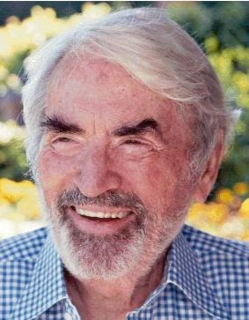
Death of Irish American Actor Gregory Peck

Actor Gregory Peck dies at his home in Los Angeles, California, from bronchopneumonia at the age of 87 on June 12, 2003.

Peck is born in La Jolla, California on April 5, 1916, to Bernice Mary (Ayres) and Gregory Pearl Peck, a chemist and pharmacist in San Diego. Through his Irish-born paternal grandmother, Catherine Ashe, Peck is related to Thomas Ashe, who takes part in the Easter Rising fewer than three weeks after Peck’s birth and dies while on hunger strike in 1917.

Peck’s parents divorce when he is five years old. An only child, he is sent to live with his grandmother. He never feels as though he has a stable childhood. His fondest memories are of his grandmother taking him to the movies every week and of his dog, which follows him everywhere.

At the age of ten Peck is sent to a Catholic military school, St. John’s Military Academy in Los Angeles. While he is a student there, his grandmother dies. At 14, he moves back to San Diego to live with his father and attends San Diego High School. After graduating he enrolls for one year at San Diego State Teacher’s College (now known as San Diego State University).

Peck studies pre-med at the University of California, Berkeley and while there is bitten by the acting bug and decides to change the focus of his studies. He enrolls in the Neighborhood Playhouse School of the Theatre in New York City and debuts on Broadway after graduation. His debut is in Emlyn Williams‘ play The Morning Star (1942). By 1943, he is in Hollywood, where he debuts in the RKO Pictures film Days of Glory (1944).

Stardom comes with Peck’s next film, The Keys of the Kingdom (1944), for which he is nominated for an Academy Award. Peck’s screen presence displays the qualities for which he becomes well known. He is tall, rugged and heroic, with a basic decency that transcends his roles. He appears in Alfred Hitchcock‘s Spellbound (1945) as an amnesia victim accused of murder. In The Yearling (1946), he is again nominated for an Academy Award and wins the Golden Globe Award. He is especially effective in westerns and appears in such varied fare as David O. Selznick‘s critically blasted Duel in the Sun (1946), the somewhat better received Yellow Sky (1948) and the acclaimed The Gunfighter (1950). He is nominated again for the Academy Award for his roles in Gentleman’s Agreement (1947), which deals with antisemitism, and Twelve O’Clock High (1949), a story of high-level stress in an Air Force bomber unit in World War II.

With a string of hits to his credit, Peck makes the decision to only work in films that interest him. He continues to appear as the heroic, larger-than-life figures in such films as Captain Horatio Hornblower R.N. (1951) and Moby Dick (1956). He works with Audrey Hepburn in her debut film, Roman Holiday (1953).

Peck finally wins the Oscar, after four nominations, for his performance as lawyer Atticus Finch in To Kill a Mockingbird (1962). In the early 1960s, he appears in two darker films than he usually makes, Cape Fear (1962) and Captain Newman, M.D. (1963), which deal with the way people live. He also gives a powerful performance as Captain Keith Mallory in The Guns of Navarone (1961), one of the biggest box-office hits of that year.

In the early 1970s, Peck produces two films, The Trial of the Catonsville Nine (1972) and The Dove (1974), when his film career stalled. He makes a comeback playing, somewhat woodenly, Robert Thorn in the horror film The Omen (1976). After that, he returns to the bigger-than-life roles he is best known for, such as MacArthur (1977) and the monstrous Nazi Dr. Josef Mengele in the huge hit The Boys from Brazil (1978). In the 1980s, he moves into television with the miniseries The Blue and the Gray (1982) and The Scarlet and the Black (1983). In 1991, he appears in the remake of his 1962 film, playing a different role, in Martin Scorsese‘s Cape Fear (1991). He is also cast as the progressive-thinking owner of a wire and cable business in Other People’s Money (1991).

In 1967, Peck receives the Academy’s Jean Hersholt Humanitarian Award. He has also been awarded the Presidential Medal of Freedom. Always politically progressive, he is active in such causes as anti-war protests, workers’ rights and civil rights. In 2003, Peck’s portrayal of Atticus Finch is named the greatest film hero of the past 100 years by the American Film Institute.

Peck dies in his sleep at his home in Los Angeles, California from bronchopneumonia at the age of 87 on June 12, 2003. He is entombed in the Cathedral of Our Lady of the Angels mausoleum in Los Angeles. His eulogy is read by Brock Peters, whose character, Tom Robinson, was defended by Peck’s Atticus Finch in To Kill a Mockingbird.