In February 1975, the Provisional Irish Republican Army and the British Government enter into a truce and restart negotiations. For the duration of the truce, the IRA agrees to halt its attacks on the British security forces, and the security forces mostly end their raids and searches. However, there are dissenters on both sides. There is a rise in sectarian killings during the truce, which “officially” lasts until February 1976.
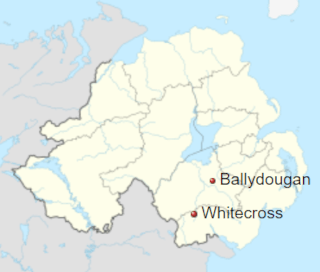
At about 6:10 p.m., at least three masked men enter the home of the Reaveys, a Catholic family, in Whitecross, through a door that had been left unlocked. Brothers John (24), Brian (22) and Anthony Reavey (17) are alone in the house and are watching television in the sitting room. The gunmen open fire on them with two 9mm Sterling submachine guns, a 9mm Luger pistol and a .455 Webley revolver. John and Brian are killed outright. Anthony manages to run to the bedroom and take cover under a bed. He is shot several times and is left for dead. After searching the house and finding no one else, the gunmen leave. Badly wounded, Anthony crawls about 200 yards to a neighbour’s house to seek help. He dies of a brain haemorrhage on January 30. Although the pathologist says the shooting played no part in his death, Anthony is listed officially as a victim of the Troubles. A brother, Eugene Reavey, says “Our entire family could have been wiped out. Normally on a Sunday, the twelve of us would have been home, but that night my mother took everybody [else] out to visit my aunt.” Neighbours claim there had been two Royal Ulster Constabulary (RUC) checkpoints set up — one at either end of the road — around the time of the attack. These checkpoints are to stop passers-by from seeing what is happening. The RUC denies having patrols in the area at the time but says there could have been checkpoints manned by the British Army‘s Ulster Defence Regiment (UDR).
At about 6:20 p.m., three masked men burst into the home of the O’Dowds, another Catholic family, in Ballydougan, about fifteen miles away. Sixteen people are in the house for a family reunion. The male family members are in the sitting room with some of the children, playing the piano. The gunmen spray the room with bullets, killing Joseph O’Dowd (61) and his nephews Barry (24) and Declan O’Dowd (19). All three are members of the Social Democratic and Labour Party (SDLP) and the family believes this is the reason they are targeted. Barney O’Dowd, Barry and Declan’s father, is also wounded by gunfire. The RUC concludes that the weapon used is a 9mm Sterling submachine gun, although Barney believes a Luger pistol with a suppressor was also used. The gunmen had crossed a field to get to the house, and there is evidence that UDR soldiers had been in the field the day before.
The following day, gunmen stop a minibus carrying ten Protestant workmen near Whitecross and shoot them dead by the roadside. This becomes known as the Kingsmill massacre. The South Armagh Republican Action Force (SARAF) claims responsibility, saying it is retaliation for the Reavey and O’Dowd killings. Following the massacre, the British Government declares County Armagh to be a “Special Emergency Area” and announces that the Special Air Service (SAS) is being sent into South Armagh.
Some of the Reavey family come upon the scene of the Kingsmill massacre while driving to the hospital to collect the bodies of John and Brian. Some members of the security forces immediately begin a campaign of harassment against the Reavey family and accuse Eugene Reavey of orchestrating the Kingsmill massacre. On their way home from the morgue, the Reavey family are stopped at a checkpoint. Eugene claims the soldiers assaulted and humiliated his mother, put a gun to his back, and danced on his dead brothers’ clothes. The harassment would later involve the 3rd Battalion, Parachute Regiment. In 2007, the Police Service of Northern Ireland (PSNI) apologises for the “appalling harassment suffered by the family in the aftermath at the hands of the security forces.”
After the killings of the Reavey brothers, their father makes his five surviving sons swear not to retaliate or to join any republican paramilitary group.
In 1999, Democratic Unionist Party (DUP) leader Ian Paisley states in the House of Commons that Eugene Reavey “set up the Kingsmill massacre.” In 2010, a report by the police Historical Enquiries Team clears Eugene of any involvement. The Reavey family seeks an apology, but Paisley refuses to retract the allegation and dies in 2014.
During the mid-1970s, the most violent decade of the Troubles in Northern Ireland, the monitoring of the border between south County Armagh and the Republic of Ireland by the British Army is carried out from several static observation posts. The main goal of these observation posts is to prevent attacks launched from beyond the border. These part-time manned positions are highly vulnerable to attack, as proved by a 1974 bomb attack which claims the lives of two Royal Marines at the outpost of Drummuckavall, a townland 3 kilometers southeast of Crossmaglen close to the border.
It is not until 1986, when the first surveillance watchtowers are erected in operations Condor and Magistrate that the British Army tries to regain the initiative in the region from the IRA.
The intelligence and control over the area relies until then, and for a lapse of ten years, mostly on mobile posts comprising small, uncovered infantry sections.
A section of four soldiers from the Royal Regiment of Fusiliers, coming from Crossmaglen, mount an observation post at 2:00 a.m. on November 21, 1975. The observation post is on a slope at Drummuckavall behind bushes overlooking a small stream that runs along the border. Unknown to them, locals had spotted their position and informed the IRA. At 4:20 p.m. the next day, an IRA unit of up to twelve members attacks the observation post. Heavy gunfire kills three of the Fusiliers and disables their communications equipment. A later inquest finds that the IRA unit had fired from two positions inside the Republic. Those killed are James Duncan (19), Peter McDonald (19), and Michael Sampson (20). The only fusilier on guard duty is McDonald, who is manning a light machine gun. The other soldiers are resting or taking a meal. The lance corporal in charge of the party, Paul Johnson, survives the first burst unscathed. He remains flat on the ground but is seriously injured on the wrist, side and back by a second burst of automatic fire after the IRA unit calls on him to surrender. A second call to surrender is made, followed by more gunfire. The IRA unit then withdraws across the border. According to Johnson, they were shouting “Up the ‘RA!” and laughing. Johnson manages to slip away by crawling 25 yards toward a nearby road, where British troops eventually airlift him to safety in a helicopter.
Shortly after the attack, Merlyn Rees, Secretary of State for Northern Ireland, issues a famous statement dubbing South Armagh Bandit Country. The next year, the British Government declares it is deploying the Special Air Service (SAS) in Northern Ireland, although they had already been deployed unofficially for a number of years. The secretive and undercover nature of this elite force means they are considered the best choice to infiltrate the South Armagh area, after the official report on the action exposes several flaws in the layout of the observation post.
As a complement to the SAS operations, the British Army also changes tactics. Major GeneralRichard Trant establishes small teams of troops, called COPs (Close Observation Platoons), to gather information, often in plain clothes or camouflaged in the landscape. They are also able to set up ambushes, like the ill-fated Operation Conservation on May 6, 1990.
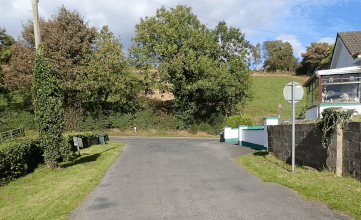
(Pictured: The Drummuckavall border crossing as viewed from the Irish Republic side of the border. At the border the unnamed road crosses a culverted stream to join the Dundalk Road. Photo by Eric Jones and licensed for reuse under Creative Commons License)
Father Des Wilson, Irish Catholic priest and church dissident who in the course of the Northern IrelandTroubles embraces ideas and practice associated, internationally, with liberation theology, dies in his native Belfast on November 5, 2019. He believes the Word of God can never be silent in the face of oppression, injustice and suffering. He seeks to apply the ideas of liberation theology to the North, supporting and empowering marginalised communities, and acting as a voice for the voiceless.
Wilson is born in Belfast on July 8, 1925, the youngest of five sons to William Wilson, a publican and native of County Cavan, and his wife Emma (née McAvoy), a native of south County Down. He spends his earliest years above his father’s pub in Belfast, before the family moves to a house in the suburbs.
Wilson attends primary school locally, then receives secondary education at St. Malachy’s College. During his time there Belfast is blitzed in April and May 1941. Almost 1,000 are killed. The carnage he sees is a factor in his deciding on the priesthood.
After ordination Wilson serves as chaplain in Belfast’s Mater Infirmorum Hospital, then spends 15 years in St. Malachy’s as spiritual director. Former pupils remember him as fair, and able to play jazz excellently on the organ.
Wilson lives out his beliefs, spending half a century in Belfast’s Ballymurphy estate, among the North’s most deprived, and one of the areas which suffers worst from the Troubles. There he plays a role in community development, establishing projects to provide employment in the area. He suffers, finding himself for years outside the official Catholic Church.
Wilson plays a significant role in providing adult education. He wants an education that does not just provide qualifications and open career paths but is psychologically liberating.
Life changes in 1966 when Wilson is moved to St. John’s Parish in West Belfast as a curate. Having come from a comfortable background in Ballymurphy, he is shocked by the poverty, the poor housing and the treatment of women. Unusual for a priest at the time, he moves into a terraced house in the estate. He finds the Catholic Church unable to respond to the multiple problems people are facing. That inability worsens as the Troubles erupt.
Wilson’s personal probity is so recognised that he is accepted as a mediator in feuds between the Provisional Irish Republican Army and Official Irish Republican Army in the 1970s and is able to broker permanent peace. He also helps bring about the ceasefires in the 1990s.
Wilson does not shirk unpopular stances. In the 1970s he refuses to condemn the Irish Republican Army (IRA). Later he says the conviction of former Real Irish Republican Army leader Michael McKevitt for directing terrorism is unsafe. He also publicly visits and supports a Ballymurphy couple which has a very bitter falling out with Sinn Féin, leading to a picket on their home.
By 1975 relations with his bishop has broken down and Wilson resigns but continues ministering in Ballymurphy. Forbidden to say Mass in a church, his pay cut off, he says Mass in his house. He suffers hardship, living from savings, some earnings from writing, broadcasting and lecturing, and help from Quaker and Presbyterian friends. By the early 1980s his Ballymurphy home becomes too small for the many classes he organises. His classes are rehoused and expanded as the Conway Education Centre in a vacant mill. He is able to offer a range of vocational and non-vocational courses with almost 1,000 students. In the mid-1980s his relationship with the Dioceses of Down and Connor is re-established, and he is allowed to continue his ministry.
Personally, Wilson has great gifts of head and heart and is incapable of rancour. A strong belief is that it is important to share food to talk, as happened in Biblical times. Thus, a lunch would last an afternoon.
Wilson dies on November 5, 2019, in Belfast. Instead of wreaths, he asks mourners to donate to the Ballymurphy Massacre Memorial Garden. The garden is dedicated to the victims of the Ballymurphy massacre of August 1971, which saw the killing in the district of eleven civilians by soldiers of the 1st Battalion, Parachute Regiment. The victims include Fr. Hugh Mullan, who had been a student of Wilson’s at St. Malachy’s. He was shot while going to the aid of a wounded man.
The Provisional IRA, officially known as the Irish Republican Army (Irish: Óglaigh na hÉireann) and informally as the Provos, is an Irish republicanparamilitary force that seeks to end British rule in Northern Ireland, facilitate Irish reunification and bring about an independent republic encompassing all of Ireland. It is the most active republican paramilitary group during the Troubles. It argues that the all-island Irish Republic continues to exist, and it sees itself as that state’s army, the sole legitimate successor to the original IRA from the Irish War of Independence (1919-21). It is designated a terrorist organisation in the United Kingdom and an unlawful organisation in the Republic of Ireland, both of whose authority it rejects.
The Provisional IRA emerges in December 1969, due to a split within the previous incarnation of the IRA and the broader Irish republican movement. It is initially the minority faction in the split compared to the Official IRA but becomes the dominant faction by 1972. The Troubles begin shortly before when a largely Catholic, nonviolent civil rights campaign is met with violence from both Ulster loyalists and the Royal Ulster Constabulary (RUC), culminating in the August 1969 riots and deployment of British soldiers. The IRA initially focuses on defence of Catholic areas, but it begins an offensive campaign in 1970 that is aided by external sources, including Irish diaspora communities within the Anglosphere, and the Palestine Liberation Organization (PLO) and Libyan leader Muammar Gaddafi. It uses guerrilla tactics against the British Army and RUC in both rural and urban areas and carries out a bombing campaign in Northern Ireland and England against military, political and economic targets, and British military targets in mainland Europe. They also target civilian contractors to the British security forces. The IRA’s armed campaign, primarily in Northern Ireland but also in England and mainland Europe, kills over 1,700 people, including roughly 1,000 members of the British security forces and 500–644 civilians.
The Provisional IRA issues the following statement to news media on the morning of July 19, 1997:
“On August 31, 1994, the leadership of Oglaigh na hEireann (Gaelic for Irish Republican Army) announced a complete cessation of military operations as our contribution to the search for a lasting peace.
After 17 months of cessation, in which the British government and the (pro-British Protestant) unionists blocked any possibility of real or inclusive negotiations, we reluctantly abandoned the cessation.
It is the root cause of division and conflict in our country. We want a permanent peace and therefore we are prepared to enhance the search for a democratic peace settlement through real and inclusive negotiations.
So, having assessed the current political situation, the leadership of Oglaigh na hEireann are announcing a complete cessation of military operations from 12 o’clock midday on Sunday the 20th, July 1997.
We have ordered the unequivocal restoration of the ceasefire of August 1994. All IRA units have been instructed accordingly.”
Barry returns to Bandon in early 1919. He describes in his guerilla days in Ireland a Damascus-like conversion to Irish nationalism on hearing of the Easter Rising while with the Mesopotamian expeditionary force, but he is only accepted into the IRA with considerable caution. Initially tested in intelligence and training work, in mid-1920 he takes charge of the new brigade flying column, which is used both to train officers and to stage offensive actions.
Barry adapts his military experience successfully to the demands of guerrilla warfare, becoming the most famed of column leaders during the Irish War of Independence. In his memoirs, he pours scorn on the obsession of many with military titles and orthodox procedure, complaining of a “paper army.” He stresses the need for spontaneity, initiative, and knowledge of local conditions. “The reality,” he writes, “was a group of fellows, mostly in caps and not-too-expensive clothing, wondering how to tackle their job and where they would sleep that night or get their supper.” (The Reality of the Anglo–Irish War (1974)). He well realises that the war’s character does not permit any close control from the IRA’s GHQ in Dublin, hence increasing the importance of local leaders. His tactics put strong emphasis on speed of movement and on the need to attack the enemy at his weakest point. The column’s ambush successes are small in number but among the best-remembered of the war. He admits, however, that his own and his column’s lack of experience with mines frequently weakened their offensives.
The column’s first successful ambush is at Tooreen on October 22, 1920, followed on November 28 by the dramatic ambushing of a patrol of auxiliaries at Kilmichael while travelling from their Macroom base. A column of thirty-six men, divided into three sections, kill sixteen auxiliaries, with one captured and later shot, suffering two fatalities of their own. Controversy has raged since over whether a false surrender by the British force caused the brutality of some of the deaths. Together with the Bloody Sunday killings of a week earlier in Dublin, Kilmichael has a profound effect on the British military and political establishment, with the declaration in December of martial law for much of Munster and the implementation of wide-ranging internment, together with the authorisation of official reprisals.
After a short period in hospital with a heart condition, in early 1921 Barry leads unsuccessful attacks on Kilbrittain, Innishannon, Drimoleague, and Bandon barracks. The seizure of Burgatia House, outside Rosscarbery, in early February, and the successful resistance made there to British troops, wins much publicity but has little military significance. He is a leading figure in the brutal final stage of the war in the first six months of 1921, which sees widespread shooting of suspected spies and destruction of loyalist property. By March 1921, his flying column, with 104 men, is easily the largest in Ireland, and an explosives expert, Capt. McCarthy, has joined them.
The protracted engagement between Barry’s column and encircling British forces at Crossbarry on March 19, 1921, comes at a time when large-scale sweeps are making life increasingly difficult for the IRA. It consists of a daring and courageous breakout. Crossbarry is the largest action of the war, and Barry is to regard it as even more important than Kilmichael. Soon afterwards, Rosscarbery barracks is successfully attacked by a Barry-led party, representing one of the few successful such initiatives in 1921. Isolated triumphs, however, cannot hide the fact that pressure is increasing on the column, and he becomes increasingly critical of inactive regions. He is later to say that all County Kerry does during the war is to shoot one decent police inspector at Listowel Racecourse and a colleague of his. He is strongly critical also of the lack of assistance from GHQ and of the divisionalisation policy. He visits Dublin in May, travels around with Michael Collins, and is present when two American officers demonstrate the Thompson submachine gun. He is more aware than most of his 1st Southern Division colleagues of the scarcity of arms and ammunition at the war’s end.
During the truce, Barry becomes liaison officer for Munster, riling the British by insisting on his military rank, and criticising the IRA liaison men in Dublin for being overly deferential. He joins the overwhelming majority of the Cork IRA in opposing the Anglo–Irish Treaty but plays a characteristically maverick role throughout the treaty split. His independent attitude is heightened by his dislike of Liam Lynch, the republican IRA’s Chief of Staff, and his continuing respect for Michael Collins. He shows impatience at the long-drawn-out peace initiatives. In March 1922, therefore, he advocates armed confrontation with pro-treaty units over the occupation of barracks in Limerick, and on June 18 he submits a resolution, which only narrowly fails, at the army convention, giving British troops seventy-two hours to leave Dublin.
At the beginning of the Irish Civil War, Barry is arrested entering the Four Courts disguised as a woman. He escapes from an internment camp at Gormanston in early September 1922. For the rest of the war his actions mirror its confused nature. In late October 1922, he leads successful raids on the small towns of Ballineen and Enniskean, and later on Inchigeelagh and Ballyvourney. In December his column takes Carrick-on-Suir, demonstrating the weakness of the Free State army, but his talk of advancing on the Curragh and of large-scale actions does not materialise. There is no evidence that he is acting in accordance with any coordinated plan. By February 1923, he realises that the Republican IRA cause is hopeless and he is involved with Fr. Tom Duggan in efforts to get 1st Southern Division to declare a ceasefire. He journeys to Dublin to put pressure on the intransigent Lynch in this connection, telling Lynch, “I did more fighting in one week than you did in your whole life.”
Barry avoids capture in roundups after the war, remaining on the run until 1924. Unlike many republicans, he does not turn to constitutionalism, remaining strongly militaristic. He is always an unreconstructed republican, though by no means a naive one. In 1924 he becomes attached to Cleeves Milk Co., based in Limerick and Clonmel, and from 1927 to retirement in 1965 is general superintendent with the Cork harbour commissioners. He strongly advocates preserving the independence of the IRA army executive during the republican split of 1925–27. He is instrumental in continuing the drilling of IRA members and is a strong supporter of armed opposition to the Blueshirts.
During the 1930s Barry is arrested at various times for possession of arms and seditious utterances. He promotes an attack against a Freemasons’ meeting in Cork in 1936 and gives the orders for the killing on March 4 of that year of Vice-AdmiralHenry Boyle Somerville. He is opposed to the use by Frank Ryan of IRA volunteers to support the republican cause in the Spanish Civil War and to the proposals of Seán Russell for a bombing campaign in England. To maintain the link with traditional republicanism, he is elected IRA chief of staff in 1937. His plan, however, for the seizure of Armagh city, as part of a direct northern offensive, quickly collapses due to a leak of information, and he soon resigns his position. He forcefully attacks the bombing of English cities in 1938, regarding attacks on innocent civilians as immoral and counterproductive. He enlists in the National Army on July 12, 1940, only to be demobilised a month later. In 1946, he stands as an independent candidate in a by-election in the Cork Borough constituency, finishing at the bottom of the poll. He is more comfortable the following year touring the United States on an anti-partition platform.
In 1949 his Guerilla Days in Ireland is published. It proves a best-seller and has frequently been reprinted. It is well written in a forceful and direct style, one memoir needing no assistance from a ghost writer. Age does not mellow him: lawyers and bank managers are threatened by him over matters relating to his own column, and in 1974 he publishes a fierce pamphlet, angry at perceived slights in the Irish War of Independence memoir of Liam Deasy. He does strive to achieve a public reconciliation with Collins’s memory by unveiling the memorial to Collins at Sam’s Cross in 1966. On the outbreak of the Northern Ireland crisis in the late 1960s, he takes a militant line, castigating the argument that the Six Counties can be brought into the Republic by peaceful means, and asking when had peaceful means existed there. At the memorial meeting in Carrowkennedy, County Mayo, in 1971, he claims that there is a perfect right at the opportune time to take the Six Counties by force. He remains opposed to IRA bombing of civilian targets.
Barry dies in Cork on July 2, 1980. He is buried in St. Finbarr’s Cemetery, Cork. Early in the truce of 1921 he marries Leslie Price, one of the most active of Cumann na mBan members during and after the rising. They have no children.
While Barry always remains an influential figure in republican circles, he will be remembered best as the pioneer of guerrilla warfare, the hero of Kilmichael and Crossbarry. His military flair, individualism, and ruthlessness are well suited to the 1919–21 conflict. After that, his strained relations with colleagues and his lack of flexibility reduce his importance. While his life after the revolutionary era appears anti-climactic, he retains much of his charisma. In later years, he is ever willing to remind politicians and historians how far Ireland has retreated from republican ideals. He is often prickly and autocratic yet could be generous to old colleagues of either side of the treaty split. He is arguably the most intelligent but also the most intolerant of the revolutionary leaders.
(From: “Barry, Thomas Bernadine (‘Tom’)” by M. A. Hopkinson, Dictionary of Irish Biography, http://www.dib.ie, October 2009)
Mac Aonghusa is the son of Criostóir Mac Aonghusa, a writer and Irish language activist, and Mairéad Ní Lupain, a nurse and native Irish speaker. The eldest of four siblings, he grows up speaking Irish as his first language and allegedly does not learn English until the age of eleven. His parents are left-wing Irish republicans who support Fianna Fáil and associate with the like-minded Máirtín Ó Cadhain and Peadar O’Donnell. His parents split when he is ten years of age. His mother takes his siblings away to Dublin while he and his father remain in Rosmuc, a remote village and part of the Galway Gaeltacht. As a teenager he is educated at Coláiste Iognáid (also known as St. Ignatius College), a bilingual school in Galway.
Upon leaving school, Mac Aonghusa first works as an actor at the Abbey Theatre in Dublin, performing in Irish language productions. In 1952, he becomes involved in Radio Éireann, first as an actor but later as a reader of short stories before advancing to becoming a newsreader, presenter and interviewer. As he advances his career, he works for RTÉ, UTV and BBC television from the 1960s. In 1962, he begins presenting An Fear agus An Sceal (The Man & his Story) on RTÉ television, an Irish language show which sees him interviewing a different guest of note about their life each episode. That same year he wins a Jacob’s Award for An Fear agus an Sceal, which he continues to host until 1964.
As well as attracting awards, An Fear agus an Sceal also brings controversy. Two interviews, one with Máirtín Ó Cadhain, one with Con Lehane, both criticise the measures practised by the Fianna Fáil government during World War II to suppress and imprison Irish republicans. In response, the Fianna Fáil government intervenes with RTÉ, and those episodes are not aired. This is not to be Mac Aonghusa’s only run-in with the Fianna Fáil government. After he recorded a programme in which he questioned the effectiveness of Ireland’s civil defence measures in the face of nuclear war, then Minister for DefenceKevin Boland has the episode suppressed. He once again runs afoul of the Fianna Fáil government when, after criticising the party in his anonymous weekly political gossip column in the Sunday Independent, then Minister for AgricultureNeil Blaney sees to it that the column is dropped. He is not deterred and returns anonymously as “Gulliver” in The Sunday Press and a gossip column on the back page of The Hibernia Magazine.
The latter half of Mac Aonghusa’s 1960s/70s broadcasting career is primarily associated with the Irish language current events show Féach, which he both presents and edits. He resigns from Féach in 1972 following a bitter dispute with the broadcaster and commentator Eoghan Harris.
In 1959, Mac Aonghusa writes a series of six articles for The Irish Times in which he vehemently opposes the Fianna Fáil government’s proposal to abolish single transferable vote in Ireland in favour of first-past-the-post voting. He contends that first-past-the-post voting gives too much influence to party bosses, while proportional representation gives even small minorities representation, preventing them from feeling excluded by the state such as nationalists in Northern Ireland. In the referendum held on the matter on June 17, 1959, voters reject first past the vote by a margin of 2%. Fianna Fáil attempts to repeal proportional representation again in the late 60s, at which point Mac Aonghusa once again throws himself into the fight, leading a group called “Citizens for PR.” In the referendum of 1968, voters reject the first past the post system by over 20%. He later recalls that his defence of proportional representation his greatest achievement in politics.
In the 1960s, both Mac Aonghusa and his wife, Catherine, join the Sean Connolly branch of the Labour Party in Dublin. The branch had established a reputation as a haven for intellectuals who want a branch to themselves away from the many other Labour branches dominated by trade unionists. The branch comes to advocate for expressly socialist policies combined with on-the-ground grass-roots campaigning. Through the Sean Connolly Branch, both he and his wife begin to develop significant influence over the leader of the Labour party Brendan Corish.
In the 1965 Irish general election, Mac Aonghusa stands on behalf of the Labour party in the Louth constituency but is not elected. In 1966, he publishes a book of speeches by Corish, the speeches themselves mostly having been ghostwritten by his wife Catherine. The introduction of the book proclaims that Corish had developed a “brand of democratic republican socialism … broadened by experience and built firmly on Irish‐Ireland roots” and had rid the party of “do‐nothing backwoodsmen”, thereby becoming the “first plausible and respected Labour leader in Ireland”. It is at this same time that he is elevated to vice-chairman of the party. As vice-chair, he tries to convince Corish to stand in the 1966 Irish presidential election. When he fails to do so, he supports Fine Gael‘s Tom O’Higgins in his bid for the presidency. O’Higgins comes within 0.5% of beating the incumbent, an ageing Éamon de Valera.
It was around this same time that Mac Aonghusa becomes active in the Wolfe Tone Societies, a republican organisation linked almost directly to Sinn Féin. He suggests that republicans with “progressive views” should join the Labour party. In 1966, alongside Máirtín Ó Cadhain and other Gaeilgeoirí, he counter-protests and disrupts the Language Freedom Movement, an organisation seeking the abolition of compulsory Irish in the education system. For this, he and his allies are criticised as acting illiberally, while he maintains that those who oppose the Irish language are “slaves” unworthy of tolerance.
Mac Aonghusa’s open disdain for the conservative and trade union wings of the Labour, as well as his open embrace of republican sensibilities and tendency to make pronouncements on Labour policy without first consulting the party’s structures, bring him many internal enemies. An attempt is made to censure him for backing breakaway trade unions, but he is able to survive this. In 1966, he encourages the formation of the Young Labour League, an unofficial youth wing of the party led by Brian Og O’Higgins, son of former Sinn Féin president Brian O’Higgins. Mirroring his own position, the Youth League are Corish loyalists that openly rebel against the views of Labour’s conservative deputy leader James Tully. When the youth league begins publishing their own weekly newsletter, Labour’s administrative council condemns it after discovering material which is “violently” critical of Tully and other Labour conservatives. An ensuing investigation into the newsletter leads to Mac Aonghusa admitting that he had financed it and written some of the content, but not the anti-Tully material. After he refuses to co-operate with further investigations into the matter, he is expelled on January 12, 1967 for “activities injurious” to the party. In the aftermath, he portrays himself a left-wing martyr purged by a right-wing “Star chamber,” a tactic that garners him sympathy. Nevertheless, his expulsion is confirmed at the October 1967 party conference, despite one last appeal. His wife leaves the party alongside him.
In the aftermath of his expulsion from Labour, Mac Aonghusa expresses an interest in the social democratic wing of Fine Gael, which had been developing under Declan Costello since the mid-1960s. However, he does not join the party and instead runs as an independent candidate in the 1969 Irish general election in Dún Laoghaire–Rathdown. When he is not elected, he begins to refocus on the revival of the Irish language and with nationalist politics rather than being elected himself.
Upon the onset of the Troubles, Mac Aonghusa is initially supportive of Official Sinn Féin, however by 1972 he comes to resent them and, through the Ned Stapleton Cumann, their secret influence over RTÉ. During the Arms Crisis in 1970, he supports Charles Haughey and Neil Blaney, who stand accused of arranging to supply weapons to the Provisional IRA, in the pages of the New Statesman and other left‐wing journals. In this time period, he warns editors not to reprint his material in the Republic of Ireland as there is a de facto ban on him, and indeed, official attempts are made to block the transmission of his telexed reports.
Despite his earlier famed stark criticism of Fianna Fáil, Mac Aonghusa’s defence of Haughey leads to a friendship between the two men which results in him becoming one of Haughey’s loudest defenders throughout the rest of his career. His columns in The Sunday Press and Irish language paper Anois are accused of descending into self-parody in their stringent defences of Haughey.
During the 1970s, Mac Aonghusa writes a number of books covering significant figures in Irish republicanism. In order, he releases books on James Connolly, Patrick Pearse, Wolfe Tone and Éamon de Valera. In his work on De Valera, he emphasises what he perceives as the more radical aspects of the Fianna Fáil founder. During 1974 and 1975, he works as a United Nations Special Representative to the Southern Africa region with Seán MacBride, where they involve themselves in the South African Border War, and during which time Mac Aonghusa becomes involved in setting up a radio station in Namibia, linked to the South West Africa People’s Organisation (SWAPO) nationalist party.
In the 1980s, Haughey twice appoints Mac Aonghusa to the Arts Council as well as naming him president of Bord na Gaeilge (1989-93). This is an issue as Mac Aonghusa is already president of Conradh na Gaeilge. Being head of the main Irish language lobbying body as well as the state body responsible for the Irish language has an obvious conflict of interest. In 1991, following the announcement by Haughey that the government is to fund the creation of an Irish-language television station (launched in 1996 as Teilifís na Gaeilge), an elated Mac Aonghusa suggests that Haughey would be “remembered among the families of the Gael as long as the Gaelic nation shall survive.”
In 1992 there are calls for Mac Aonghusa to step down from Bord na Gaeilge after he pronounces that “every respectable nationalist” in West Belfast should vote for Sinn Féin’s Gerry Adams over the Social Democratic and Labour Party (SDLP) candidate Joe Hendron in the 1992 United Kingdom general election as he considers a defeat for Adams “a victory for British imperialism.” Nevertheless, he simultaneously advises voters in South Down to vote for the SDLP’s Eddie McGrady over Sinn Féin. He rails against his detractors at the Conradh na Gaeilge ardfheis that year, declaring that “The mind of the slave, of the slíomadóir, of the hireling and the vagabond is still fairly dominant in Ireland.”
As of 1995, Mac Aonghusa continues to label himself a socialist. In the foreword to the book, he writes about James Connolly that is released that year, he declares that “the abolition of capitalism is essential if the great mass of the people in all parts of the globe are to be emancipated.”
However, with the recent collapse of the Soviet Union in mind, Mac Aonghusa declares that the Stalinist regimes of Eastern Europe have not been socialist and argues that the social democracies of Scandinavia are what James Connolly had envisioned as the desired socialist society. In the same text, he accuses the Irish education system as well as Ireland’s media of obfuscating Connolly’s views on socialism and nationalism.
Mac Aonghusa battles through ill health in his final years but remains able to continue writing a number of books. His last publication, Súil Tharam (2001), comes just two years before his death in Dublin on September 28, 2003.
In 1955, Mac Aonghusa marries Catherine Ellis, a member of the Church of Ireland from Belfast. For her married name, she chooses to use “McGuinness,” the English language equivalent of Mac Aonghusa. Catherine McGuinness goes on to become a Senator and a Judge of the Circuit Court, High Court and Supreme Court over the course of her legal career. Together they have three children together.
A man with an Irish accent telephones the Press Association with a warning given just six minutes before the device explodes. London police say a recognised IRA codeword is given. The bomb explodes in a corner of Westminster Hall at about 8:30 a.m. on June 17, 1974. The IRA in a telephoned warning says it planted the bomb that weighed approximately 20 lbs. (9.1 kg). The explosion is suspected to have damaged a gas main and a fire spreads quickly through the centuries-old hall in one of Britain’s most security-tight buildings. An annex housing a canteen and a number of offices is destroyed, but the great hall itself receives only light damage. The attack signals the start of a renewed IRA bombing campaign in England that is to last until late 1975 and is to claim the lives of dozens of people. The most notorious attacks of the bombing campaign are the Guildford pub bombings on October 5, 1974, that kill five and injure sixty, and the Birmingham pub bombings on November 21, 1974, which kill twenty-one people and injured one hundred eighty.
The year 1974 ends with the IRA killing twenty-eight people (twenty-three civilians and five British soldiers) in bombing operations in England. Twenty-one people are killed in the Birmingham pub bombings and a further seven are killed in the Guildford and Woolwich Pub bombings. Nearly three hundred people are injured from these bombings alone. The IRA calls off their bombing campaign in February 1975 but restarts it on August 27, 1975, with the Caterham Arms pub bombing which injures over thirty people. A week later, the IRA carries out the London Hilton bombing which kills two and injures over sixty.
The son of a member of the Royal Air Force (RAF), Keenan is born on July 17, 1941, in Swatragh, County Londonderry, Northern Ireland, before his family moves to Belfast. As a teenager, he moves to England to find work, for a time working as a television repairman in partnership with his brother in Corby, Northamptonshire. During this time, he comes to the attention of the police when he damages a cigarette machine, which leads to police having his fingerprints on file. He returns to Northern Ireland when the Troubles begin and starts working at the Grundig factory in the Finaghy area of Belfast where he acquires a reputation as a radical due to his involvement in factory trade union activities.
Despite his family having no history of republicanism, Keenan joins the Provisional Irish Republican Army in 1970 or 1971, and by August 1971 is the quartermaster of the Belfast Brigade. He is an active IRA member, planning bombings in Belfast and travelling abroad to make political contacts and arrange arms smuggling, acquiring contacts in East Germany, Libya, Lebanon and Syria. In 1972, he travels to Tripoli to meet with Libyan leader Muammar Gaddafi in order to acquire arms and finance from his government. In early 1973 he takes over responsibility for control of the IRA’s bombing campaign in England and also becomes IRA Quartermaster General. In late 1973, he is the linchpin of the kidnap of his former employer at Grundig, director Thomas Niedermayer.
In early 1974, Keenan plans to break Gerry Adams and Ivor Bell out of Long Kesh using a helicopter, in a method similar to Seamus Twomey‘s escape from Mountjoy Prison in October 1973, but the plan is vetoed by Billy McKee. He is arrested in the Republic of Ireland in mid-1974 and sentenced to twelve months imprisonment for IRA membership. On March 17, 1975, he is shot and wounded while attempting to lead a mass escape from Portlaoise Prison. While being held in Long Kesh, Gerry Adams helps to devise a blueprint for the reorganisation of the IRA, which includes the use of covert cells and the establishment of a Southern Command and Northern Command. As the architects of the blueprint, Adams, Bell and Brendan Hughes, are still imprisoned, Martin McGuinness and Keenan tour the country trying to convince the IRA Army Council and middle leadership of the benefits of the restructuring plan, with one IRA member remarking “Keenan was a roving ambassador for Adams.” The proposal is accepted after Keenan wins support from the South Derry Brigade, East Tyrone Brigade and South Armagh Brigade, with one IRA member saying, “Keenan was really the John the Baptist to Adams’ Christ.”
In December 1975, members of an IRA unit based in London are arrested following the six-day Balcombe Street siege. The IRA unit had been active in England since late 1974 carrying out a series of bombings, and a few months after his release from prison Keenan visits the unit in Crouch Hill, London, to give it further instructions. In follow-up raids after the siege, police discover crossword puzzles in his handwriting and his fingerprints on a list of bomb parts. A warrant is issued for his arrest.
Garda Síochána informer Sean O’Callaghan claims that Keenan recommended IRA Chief of Staff Seamus Twomey to authorise an attack on Ulster Protestants in retaliation to an increase in sectarian attacks on Catholic civilians by Protestant loyalist paramilitaries, such as the killing of three Catholics in a gun and bomb attack by the Ulster Volunteer Force (UVF) on Donnelly’s Bar in Silverbridge, County Armagh on December 19, 1975. According to O’Callaghan “Keenan believed that the only way, in his words, to put the nonsense out of the Prods [Protestants] was to just hit back much harder and more savagely than them.” Soon after the sectarianKingsmill massacre occurs, when ten Protestant men returning home from their work are ordered out of a minibus they are travelling in and executed en masse with a machine gun on January 5, 1976.
Keenan is arrested on the basis of the 1975 warrant near Banbridge on March 20, 1979, when the Royal Ulster Constabulary (RUC) stopped two cars travelling north on the main road from Dublin to Belfast and is extradited to England to face charges relating to the Balcombe Street Gang‘s campaign in England. His capture is a blow to the IRA, in particular as he was carrying an address book listing his contacts including Palestinian activists in the United Kingdom. The IRA responds by dispatching Bobby Storey and three other members to break Keenan out of prison using a helicopter, but all four are arrested and remanded to Brixton Prison. Keenan stands trial at the Old Bailey in London in June 1980 defended by Michael Mansfield and is accused of organising the IRA’s bombings in England and being implicated in the deaths of eight people including Ross McWhirter and Gordon Hamilton Fairley. He is sentenced to eighteen years imprisonment after being found guilty on June 25, 1980.
Keenan continues to support Gerry Adams while in prison. In August 1982 Adams is granted permission by the IRA’s Army Council to stand in a forthcoming election to the Northern Ireland Assembly, having been refused permission at a meeting the previous month. In a letter sent from Leicester Prison, Keenan writes that he “emphatically” supports the move and endorses the Army Council’s decision.
Keenan is released from prison in June 1993 and by 1996 is one of seven members of the IRA’s Army Council. Following the events after the IRA’s ceasefire of August 1994, he is openly critical of Gerry Adams and the “tactical use of armed struggle,” or TUAS, strategy employed by the republican movement. After the Northern Ireland peace process becomes deadlocked over the issue of the IRA decommissiong its arms, he and the other members of the Army Council authorise the Docklands bombing which kills two people and marks the end of the IRA’s eighteen-month ceasefire in February 1996.
Keenan outlines the IRA’s public position in May 1996 at a ceremony in memory of hunger striker Seán McCaughey at Milltown Cemetery, where he states, “The IRA will not be defeated…Republicans will have our victory…Do not be confused about decommissioning. The only thing the Republican movement will accept is the decommissioning of the British state in this country.” In the same speech he accuses the British of “double-dealing” and denounces the Irish government as “spineless.”
On February 25, 2001, Keenan addresses a republican rally in Creggan, County Armagh, saying that republicans should not fear “this phase” of “the revolution” collapsing should the Good Friday Agreement fail. He confirms his continued commitment to the Armalite and ballot box strategy, saying that both political negotiations and violence are “legitimate forms of revolution” and that both “have to be prosecuted to the utmost.” He goes on to say, “The revolution can never be over until we have British imperialism where it belongs—in the dustbin of history,” a message aimed at preventing rank-and-file IRA activists defecting to the dissident Real IRA.
Keenan plays a key role in the peace process, acting as the IRA’s go-between with the Independent International Commission on Decommissioning (IICD). Gerry Adams remarks, “There wouldn’t be a peace process if it wasn’t for Brian Keenan.” Keenan resigns from his position on the Army Council in 2005 due to ill-health, and is replaced by Bernard Fox, who had taken part in the 1981 Irish hunger strike. On May 6, 2007, he is guest speaker at a rally in Cappagh, County Tyrone, to commemorate the 20th anniversary of the deaths of the so-called “Loughgall Martyrs,” eight members of the IRA East Tyrone Brigade killed by the Special Air Service (SAS) in 1987.
In July 2002, Keenan is diagnosed as suffering from terminal colorectal cancer. It is alleged by the Irish Independent and The Daily Telegraph that Keenan succeeded Thomas “Slab” Murphy as Chief of Staff of the Provisional IRA at some point between the late 1990s and the mid-2000s before he relinquished the role to deal with his poor health caused by cancer.
Keenan’s last years are spent living with his wife in Cullyhanna, County Armagh, where he dies of cancer on May 21, 2008. He is an atheist and receives a secular funeral, representing a major republican show of strength.
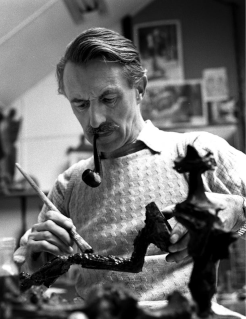
Frederick Edward McWilliamCBERA, Northern Irish surrealistsculptor, dies in London on May 13, 1992. He works chiefly in stone, wood and bronze. His style of work consists of sculptures of the human form contorted into strange positions, often described as modern and surreal.
McWilliam is born in Banbridge, County Down,on April 30, 1909, the son of Dr. William McWilliam, a local general practitioner. Growing up in Banbridge has a great influence on his work. He makes references to furniture makers such as Carson the Cooper and Proctors in his letters to his friend, Marjorie Burnett.
McWilliam attends Campbell College in Belfast and later attends Belfast College of Art from 1926. After 1928, he continues to study at the Slade School of Fine Art in London. He originally intends to become a painter, but influenced by Alfred Horace Gerrard, head of the sculpture department at the Slade, and by Henry Moore whom he meets there, he turns to sculpture. He receives the Robert Ross Leaving Scholarship which enables him and his wife, Beth (née Crowther), to travel to Paris where he visits the studio of Constantin Brâncuși.
During the first year of World War II, he joins the Royal Air Force and is stationed in England for four years where he is engaged in interpreting aerial reconnaissance photographs. He is then posted to India. While there he teaches art in the Hindu Art School in New Delhi.
After his return from India, McWilliam teaches for a year at the Chelsea School of Art. He is then invited by A. H. Gerrard to teach sculpture at the Slade. He continues in this post until 1968.
During the Northern IrelandTroubles McWilliam produces a series of bronzes in 1972 and 1973 known as Women of Belfast in response to the bombing at the Abercorn Tea-Rooms.
In 1964 McWilliam is awarded an Honorary Doctor of Letters from Queen’s University Belfast. In 1966 he is appointed CBE and in 1971 he wins the Oireachtas Gold Medal. He is represented in many public collections, including the Museum of Modern Art in New York City and Tate Britain in London. In 1984 the National Self-Portrait Gallery purchases a McWilliam self-portrait amongst acquisitions from fellow Northerners Brian Ballard, Brian Ferran and T. P. Flanagan.
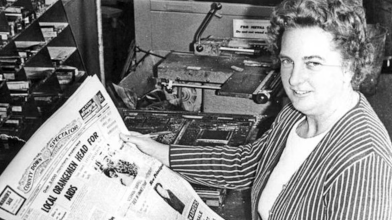
Born Annie Roslyn Roycroft, she is the fifth of six children born to Tom Roycroft of County Cork and Annie Stephens of County Kerry. Her father works in the Royal Irish Constabulary (RIC), which is what prompts the move to County Down. She gets her education at Bangor Central Public Elementary School and Technical College before going on to get a job with the local newspaper, the County Down Spectator in 1941.
Roycroft begins her career with the County Down Spectator as a junior office assistant but shows the instincts of a journalist and learns journalistic skills by typing up the reports dictated by the newspaper’s journalists. She begins submitting local news stories and in 1952 she is taken on as a journalist despite misgivings among the teams locally about a woman working in the field.
Roycroft then takes a break working as a clerk for North Down Borough Council before being asked to return as the editor for the County Down Spectator. A member of the National Union of Journalists, so that she knows how to pay her journalists properly, she has a reputation of standing her ground during reporting of the Troubles. She leaves County Down and her role as editor in 1983 when she marries Joe Stephens and eventually moves to Cork.
Roycroft is very involved in the Church of Ireland. She is a Sunday school teacher from the age of sixteen. When she moves to Cork, she turns her time to working with the church.
Roycroft dies in Beaumont, Cork, on January 11, 2019. She is predeceased by her husband. She writes her memoirs, Memoirs of a Scribbler, in 1995. She is remembered in the book Bangor in the Eighties which is dedicated to her.
(Photo: From “Annie Stephens obituary: One of Ireland’s first female newspaper editors,” The Irish Times, http://www.irishtimes.com, February 16, 2019)