The RHSI is founded with the purpose of encouraging the love and sharing the knowledge of gardening in all its forms, while fostering environmental awareness and building a sense of community. The inaugural meeting takes place at the Rose Tavern, Donnybrook, Dublin, as the Horticultural Society of Ireland with Francis Caulfeild, 2nd Earl of Charlemont, as its patron and Francis Hetherington as its chairman. The new society holds its first flower show on Easter Monday 1817, and flower and fruit show on August 18, 1817. After a number of shows in the intervening years, the society declines, and is re-established with a new committee in 1830. By 1848, the Society becomes known as the Royal Horticultural Society of Ireland.
The RHSI’s membership is made up of both professional and amateur gardeners from all walks of life who are united by a shared passion for gardens, plants, and growing. The members enjoy access to expert insights through the Society’s printed journal, monthly talks, regular bulletins, and visits to over 60 affiliated Partner Gardens across Ireland and abroad.
The RHSI acts as a central hub, proudly affiliated with horticultural, gardening and floral art societies and clubs across Ireland. These connections help support a nationwide exchange of knowledge, experience, and enthusiasm. From heritage landscapes to urban balconies, the RHSI celebrates the richness of gardening across Ireland. The RHSI remains committed to supporting those who grow, teach, study, and care for plants—helping to ensure that gardening continues to thrive for generations to come.
The RHSI celebrated its 200 anniversary in 2016.
In November 2023, the RHSI announces an extraordinary general meeting to consider changing its name by dropping “Royal” from the title.
For more information about the Royal Horticultural Society of Ireland, visit their website at https://rhsi.ie.
O’Toole is the second son among five children of John O’Toole and Bridie O’Toole (née Doran). Of farming stock on both sides, he is educated at the local national school at Ballycumber and at a Dublinsecondary school. When in the mid-1890s he moves to Dublin, he joins the Benburb Gaelic Football Club at Donnybrook, where his teammates include the future nationalist parliamentarian Thomas M. Kettle, who is killed in 1916 near Ginchy, France, during World War I. The proprietor of two newsagents’ shops near his home in Mount Pleasant Square, he soon becomes his club’s delegate to the Dublin county committee of the Gaelic Athletic Association about 1899. Founded in 1884 by Michael Cusack, the GAA by the late 1890s is insolvent and almost moribund, having been riven by rival nationalist factions. However, a group of younger officials which includes O’Toole is determined not to allow the Association to die, and at its annual congress in Thurles on September 22, 1901, stages what is in effect a palace coup. Alderman James Nowlan of Kilkenny, County Kilkenny, a labour activist and Gaelic League enthusiast, is elected president, and in a contest for the post of secretary, O’Toole defeats Cusack.
O’Toole holds the post of chief officer of the GAA until his death almost thirty years later. During this period, despite major political and military turmoil, including the world war, the Irish War of Independence, and the Irish Civil War, he is instrumental in turning the Association into the biggest Irish sports body, and some leading members, such as Michael Collins and Harry Boland, play major political roles between 1913 and 1923. Essentially a backroom administrator, O’Toole rarely appears in public apart from GAA events, one notable exception being on November 25, 1913, at the foundation meeting of the Irish Volunteers at the Rotunda Rink, Dublin, where he is one of the platform party. After the suppression of the 1916 Easter Rising, he goes into hiding temporarily in his native Wicklow. From then until the cessation of hostilities in mid-1921 he manages to evade the notice of the authorities though he is always a close associate of Sinn Féin leaders. He plays a big part in reviving the fortunes of the GAA after the Irish Civil War and is a principal organiser of the Tailteann Games in 1924 and 1928. His career, however, is cut short at the age of 56 by his sudden death at his desk on July 17, 1929.
For most of his life O’Toole resides in a house provided by the GAA beside Croke Park, the Association’s headquarters and principal stadium. He marries Bridget Doyle, a shopkeeper of Dublin. They have four sons and four daughters.
(From: “O’Toole, Luke” by Marcus de Búrca, Dictionary of Irish Biography, http://www.dib.ie, October 2009 | Pictured: Michael Collins, Luke O’Toole and Harry Boland in 1921, Image credit: GAA)
She studies in the school of Old Irish established by Professor Osborn Bergin and is strongly influenced by the Irish Australian professor O’Daly. She later teaches Latin through Irish at Ballingeary and becomes proficient in French, German, Italian and Spanish.
She spends the last £100 of her scholarship on a dowry for her marriage to Sean MacGearailt, later first Accountant General of Revenue in the Irish civil service, with whom she lives originally in Glasnevin and then in Dalkey.
She is a founder member of the radical Craobh an Chéitinnigh, the Keating branch of Conradh na Gaeilge, composed mainly of Dublin-based Kerry people and regarded, by themselves at least, as the intellectual focus of the League.
In August 1904, some six years after the establishment of the earliest women’s hurling teams, the rules of camogie (then called camoguidheacht), first appears in Banba, a journal produced by Craobh an Chéitinnigh. Camogie had come to public attention when it was showcased at the annual Oireachtas (Conradh na Gaeilge Festival) earlier that year, and it differed from men’s hurling in its use of a lighter ball and a smaller playing-field. Ní Chinnéide and Cáit Ní Dhonnchadha, like Ní Chinnéide, an Irish-language enthusiast and cultural nationalist, are credited with having created the game, with the assistance of Ní Dhonnchadha’s scholarly brother Tadhg Ó Donnchadha, who drew up its rules. She is on the first camogie team to play an exhibition match in Navan, County Meath, in July 1904, becomes an early propagandist for the game and, in 1905, is elected president of the infant Camogie Association.
She first visits the Blasket Islands in 1932 with her daughter Niamh, who dies tragically young. In the summer of 1934, she puts the idea into Peig Sayers‘s head to write a memoir. According to a later interview with Ní Chinnéide “she knew and admired her gift for easy conversation, her gracious charm as a hostess, her talent for illustrating a point she was making by a story out of her own experience that was as rich in philosophy and thought as it was limited geographically.” Peig answers that she has “nothing to write.” She had learned only to read and write in English at school and most of it has been forgotten.
Ní Chinnéide suggests Peig should dictate her memoir to her son Micheal, known to everyone on the island as An File (“The Poet”), but Peig “only shook her head doubtfully.” At Christmas, a packet arrives from the Blaskets with a manuscript, she transcribes it word for word and the following summer brings it back to the Blaskets to read it to Peig. She then edits the manuscript for the Talbot Press. Peig becomes well known as a prescribed text on the Leaving Certificate curriculum in Irish.
Ní Chinnéide has an acting part in the first modern play performed in Irish on the stage, Casadh an tSugáin by Douglas Hyde in 1901. She is later author of children’s plays staged by An Comhar Drámuidhachta at the Oireachtas and the Peacock Theatre, of which Gleann na Sidheóg and An Dúthchas (1908) are published. She is a broadcaster in Irish on 2RN, a wholly owned subsidiary of Raidió Teilifís Éireann, after its foundation in 1926 and author of a translation of Grimms’ Fairy Tales (1923). She is president of the Gaelic Players Dramatic group during the 1930s and a founder of the Gaelic Writers Association in 1939.
She soon becomes interested in writing children’s plays, including Gleann na Sidheóg (Fairy Glen, 1905) and Sidheoga na mBláth (Flower Fairies, 1909. Although there is little information available on the staging of her first play, by the time her second children’s play, Sidheóga na mBláth, is published in An Claidheamh Soluis in December 1907, “Éire Óg” (“Young Ireland”) branches of Conradh na Gaeilge have been established in conjunction with adults’ branches. Patrick Pearse in particular voices the expectation that this play will be staged by many “Éire Óg” branches “before the New Year is very old,” thus indicating the immediate take up of such plays. Indeed, a week after the play’s publication, it is staged in the Dominican College in Donnybrook, Dublin, where Ní Chinnéide had spent several years as an Irish teacher.
De Bhaldraithe’s stance on standard forms and spellings is supported by Éamon de Valera despite opposition from traditionalists in the Department of Education, and the work is widely seen as an important benchmark in Irish scholarship.
In 1942, de Bhaldraithe is appointed a professor at the Dublin Institute for Advanced Studies (DIAS) in the department of Celtic Studies. In 1960 he is appointed professor of modern Irish language and literature at University College Dublin (UCD), where he develops an impressive archive of material on Irish dialects. Much of the material in this archive is later used as the basis of Niall Ó Dónaill‘s Foclóir Gaeilge-Béarla, published in 1978, for which he is consulting editor. Also, during the 1970s, de Bhaldraithe translates the Irish language diary of Amhlaoibh Ó Súilleabháin, Cín Lae Amhlaoibh, into English. It is then published by Mercier Press as The Diary of an Irish Countryman.
The language laboratory which de Bhaldraithe sets up in UCD is the first of its kind in any university in Ireland. His interest in seanchas (folklore) leads to his publication of Seanchas Thomáis Laighléis in 1977, while his earlier work includes the ground-breaking study of the Cois Fharraige dialect (a variety of Connacht Irish), Gaeilge Chois Fharraige: Deilbhíocht. In later years he works extensively on the definitive Irish dictionary, Foclóir Stairiúil na Nua-Ghaeilge, which remains unfinished at the time of his death, but which is still in progress today.
De Bhaldraithe dies in Dublin on April 24, 1996, after launching a collection of a friend’s writings entitled The words we use. He marries Vivienne Ní Thoirdhealbhaigh in 1943 and they have nine children.
On January 25, 1947, Mullen makes his formal Irish debut in a 12–8 loss to France. He plays as hooker, winning 25 caps for Ireland from 1947 to 1952. A year later, on January 31, 1948, he plays his first game for Barbarian F.C. in a 9–6 victory over Australia in Cardiff, Wales. After helping Ireland to victory over France on January 1, 1948, at the age of 21, he captains Ireland for the first time, on February 14, 1948, leading them to an 11–10 victory over England at Twickenham Stadium.
Mullen captains the Irish team to their first Grand Slam in the 1948 Five Nations Championship and is one of eight players from that team who live to see the country’s next Grand Slam in 2009.
Ireland retains the triple crown in 1949 by beating Wales 5–0 in Swansea, ending a run of defeats on Welsh soil lasting fourteen years. The following season Ireland suffers from injuries and loses to both England and Wales, the latter securing the triple crown.
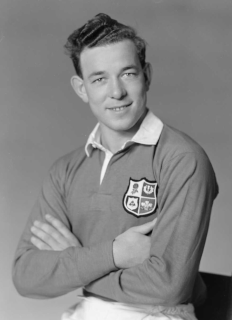
Mullen is selected to captain the 1950 Lions Tour to Australia and New Zealand. After appearing in the first two tests against New Zealand, a 9–9 draw and an 8–0 loss, he sustains an ankle injury in the latter game and concedes his place to Dai Davies of Wales. Returning for the second test against Australia, a resounding 24–3 victory, he also plays in a semi-official “British Isles RFU” team against Ceylon during their return journey in September.
Under Mullen’s captaincy Ireland regains the international championship in 1951. His last cap comes in a 14–3 loss to Wales at Lansdowne Road on March 8, 1952. In twenty-five successive appearances (fifteen as captain), he secured three international championships and two triple crowns for Ireland in four seasons, their most successful haul of the twentieth century.
Mullen is one of eight surviving members of the 1948 team to witness Ireland’s second grand slam on March 21, 2009. Only weeks later, having suffered from a long illness, he dies on April 27, 2009, at his home, Gilltown Lodge, in Kilcullen.
(Pictured: Karl Mullen, captain of the British Lions rugby union team, 1950)
Frederick May, Irish composer and arranger, dies in Dublin on September 8, 1985. His musical career is seriously hindered by a lifelong hearing problem, and he produces relatively few compositions.
May is born on June 9, 1911, into a Dublin Protestant family who lives in the suburb of Donnybrook. His father, also named Frederick, is employed at the Guinness Brewery. He pursues his musical studies at the Royal Irish Academy of Music, where he is taught composition by John Larchet. In 1930, McCullough Pigott and Co. publishes his Irish Love Song. That same year he is awarded the Esposito Cup at the Feis Ceoil and as a result of this he is nominated as the first recipient of a new scholarship prize worth £100 to be spent on the further study of piano. In July 1930, he takes his preliminary examination for the Bachelor of Music at Trinity College Dublin (TCD) before departing Dublin to utilise his scholarship in London. In September he enrolls at the Royal College of Music (RCM) where his teachers include Charles Kitson, Ralph Vaughan Williams, R. O. Morris and Gordon Jacob. He takes his final TCD examination in December 1931 submitting a string quartet and on December 10 his degree is conferred. During 1932 his study is funded by the RCM’s Foli Scholarship and in October he is awarded the Octavia Travelling Scholarship.
May’s compositions are few in number and he produces most of his small output in the 1930s and early 1940s. His first significant work is the Scherzo for Orchestra, written while he is still a student in London. The first orchestral run through of Scherzo for Orchestra takes place on March 17, 1933, and it receives its first public performance on December 1 when it is heard as part of the Patron’s Concert. Between the months of May and October he composes his Four Romantic Songs, which receive their premiere in London at a Macnaghten-Lemare concert on January 22, 1934. At some point, probably in the second half of 1933, he follows in the footsteps of other Octavia Scholarship winners and travels to Vienna to study with Egon Wellesz.
On January 1, 1936, May takes up the position of Director of Music at the Abbey Theatre in Dublin, a position he retains until he is fired in 1948. His duties mainly consist of leading the piano trio which bears the title “The Abbey Orchestra” in music during the intervals of productions. In 1936, he composes what is today his best-known composition, the String Quartet in C Minor, described in the Grove’s Dictionary of Music and Musicians as “one of the most individual statements from an Irish composer in the first half of the 20th century.” He composes the quartet as his hearing is beginning to deteriorate and he later describes it as “an appeal for release.” String Quartet in C Minor is not premiered until 1948 when it is performed by the Martin Quartet in the Wigmore Hall, London. This is followed by Symphonic Ballad (1937), Suite of Irish Airs (1937), Spring Nocturne (1938), Songs from Prison (1941) and Lyric Movement for Strings (1942). He effectively ceases original composition at this point.
Following a long break from composition, May produces what is to be his valedictory work in 1955, the nine-minute orchestral piece Sunlight and Shadows. It is given its first performance on January 22, 1956, by the Radio Éireann Symphony Orchestra at Dublin’s Gaiety Theatre. Although this is his last original work, he does not abandon music completely. He produces arrangements of Irish music for Radio Éireann, which while not perhaps rewarding artistically, does help to alleviate his always precarious financial situation. He also composes a number of songs for voice and piano and a short piece entitled Idyll for violin and piano. The latter is chosen as a set work for the junior violin competition at the Feis Ceoil in 2017.
Throughout his life May suffers from significant mental health issues which result in hospitalisation. He also experiences otosclerosis, as a result of which he gradually becomes increasingly deaf. In addition, he suffers from severe tinnitus with constant ringing noises in his head. In later life he becomes homeless for a time due to alcoholism and sleeps at night in Grangegorman Asylum, Dublin. He is rescued by some friends led by Garech Browne whose record company, Claddagh Records, records the String Quartet in 1974.
Throughout his career May is an advocate of better musical education in Ireland and expresses his views on this and other musical matters through the medium of The Bell, a monthly journal dealing with the arts. He is a co-founder, along with Brian Boydell and Aloys Fleischmann, of the Music Association of Ireland (now “Friends of Classical Music”), set up in 1948 to promote art music as an integral part of the cultural life of Ireland. Later he becomes a member of Aosdána. He lives the last years of his life at Orthopaedic Hospital of Ireland, Clontarf, Dublin. He dies on September 8, 1985, at the age of 74 and is buried in Mount Jerome Cemetery.
When appointed Lord Chancellor of Ireland in 1789, FitzGibbon is granted his first peerage as Baron FitzGibbon, of Lower Connello in the County of Limerick, in the Peerage of Ireland that year. This does not entitle him to a seat in the British House of Lords, only in the Irish House of Lords. His later promotions come mostly in the Peerage of Ireland, being advanced to a Viscountcy in 1793 and the Earldom of Clare in 1795. He finally achieves a seat in the British House of Lords in 1799 when created Baron FitzGibbon, of Sidbury in the County of Devon, in the Peerage of Great Britain.
As Lord Chancellor for Ireland, FitzGibbon is a renowned champion of the Protestant Ascendancy and an opponent of Catholic emancipation. He despises the Parliament of Ireland‘s popular independent Constitution of 1782. He is also personally and politically opposed to the Irish politician Henry Grattan who urges a moderate course in the Irish Parliament and is responsible for defeating Grattan’s efforts to reform the Irish land tithe system under which Irish Catholic farmers (and all non-Anglican farmers) are forced to financially support the minority Anglican Church of Ireland. These are not fully repealed until 1869 when the Church of Ireland is finally disestablished, although Irish tithes are commuted after the Tithe War (1831–1836).
FitzGibbon opposes the Irish Roman Catholic Relief Act 1793 personally but apparently recommends its acceptance in the House of Lords, being forced out of necessity when that Act had been recommended to the Irish Executive by the British Cabinet led by William Pitt the Younger. Pitt expects Ireland to follow the British Roman Catholic Relief Act 1791 and allow Catholics to vote again and hold public offices. At the same time, FitzGibbon apparently denounces the policy this Act embodies, so it is probably safe to say that FitzGibbon’s own beliefs and principles conflict with his obligations as a member of the Irish executive of the time.
FitzGibbon’s role in the recall, soon after his arrival, of the popular pro-Emancipation Lord Lieutenant of Ireland, William Fitzwilliam, 4th Earl of Fitzwilliam, is debatable. Although he is probably politically opposed to the Lord Lieutenant of Ireland, Fitzwilliam is apparently recalled, because of his own independent actions. Fitzwilliam is known to be friendly to the Ponsonby family and is generally a Foxite liberal Whig. His close association with and patronage of Irish Whigs led by Grattan and Ponsonby during his short tenure, along with his alleged support of an immediate effort to secure Catholic emancipation in a manner not authorized by the British cabinet is likely what leads to his recall. Thus, if anyone is to blame in the short-lived “Fitzwilliam episode” it is Henry Grattan and the Ponsonby brothers – presumably William Ponsonby, later Lord Imokilly, and his brother George Ponsonby — not to mention Lord Fitzwilliam himself. Irish Catholics at the time and later naturally see things very differently and blame hardline Protestants such as FitzGibbon.
Irish Catholics and FitzGibbon apparently agree on one point – Irish political and economic union with Great Britain, which eventually takes place in 1801. Pitt wants Union with Ireland concomitantly with Catholic emancipation, commutation of tithes, and the endowment of the Irish Catholic priesthood. Union is opposed by most hardline Irish Protestants, as well as liberals such as Grattan. FitzGibbon is a strong supporter of the Union since 1793 but refuses to have Catholic emancipation with the Union.
In the end, FitzGibbon’s views wins out, leading to the Union of Ireland with Great Britain to form the United Kingdom of Great Britain and Ireland without any concessions for Ireland’s Catholic majority, or for that matter, Catholics in the rest of the new United Kingdom. He later claims that he has been duped by the way in which the Act is passed and is bitterly opposed to any concessions during the short remainder of his life.
FitzGibbon’s role as Lord Chancellor of Ireland during the period of the 1798 rebellion is questionable. According to some, he supports a hardline policy which uses torture, murder and massacre to crush the rebellion, or that as Lord Chancellor, he has considerable influence on military affairs, and that martial law cannot be imposed without his consent. Others allege that as Lord Chancellor, he has no say in military affairs. His former side is displayed by sparing the lives of the captured United Irish leaders in return for their confession of complicity and provision of information relating to the planning of the rebellion. However, this willingness of the prisoners to partake of the agreement is spurred by the execution of the Sheares brothers on July 14, 1798.
In contrast to the leniency shown to the largely upper-class leadership, the full weight of military repression is inflicted upon the common people throughout the years 1797–98 with untold thousands suffering imprisonment, torture, transportation and death. Fitzgibbon ss inclined to show no mercy to unrepentant rebels and in October 1798 he expressed his disgust upon the capture of Wolfe Tone that he had been granted a trial and his belief that Tone should have been hanged as soon as he set foot on land.
FitzGibbon is quick to recognise that sectarianism is a useful ally to divide the rebels and prevent the United Irishmen from achieving their goal of uniting Protestant, Catholic and Dissenter, writing in June 1798, “In the North nothing will keep the rebels quiet but the conviction that where treason has broken out the rebellion is merely popish.”
FitzGibbon is noted by some as a good, improving landlord to both his Protestant and Catholic tenants. Some claim that the tenants of his Mountshannon estate call him “Black Jack” FitzGibbon. However, there is no evidence to support this claim, although there is little to no evidence on his dealings as a landlord. Irish nationalists and others point out that while he might have been interested in the welfare of his own tenants on his own estate, he treats other Irish Catholics very differently. Without further evidence, his role as a Protestant landowner in mainly Catholic Ireland is of little importance against his known dealings as Lord Chancellor.
FitzGibbon dies at his home, 6 Ely Place near St. Stephen’s Green, Dublin, on January 28, 1802, and is buried in the churchyard at St. Peter’s Church, Aungier Street, Dublin. A hero to Protestant hardliners, but despised by the majority Catholic population, his funeral cortege is the cause of a riot and there is a widespread story that a number of dead cats are thrown at his coffin as it departs Ely Place.
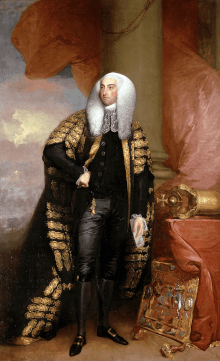
(Pictured: “Portrait of John FitzGibbon, 1st Earl of Clare,” painting by Gilbert Stuart, 1789)
MacEoin is born Vincent O’Rahilly McGuone to Malachy McGuone, owner of the Central Hotel in Pomeroy and a wine and spirit merchant, and Catherine (née Fox). He has three siblings. Both of his parents are nationalists, and name all their children after leaders of the Easter Rising in 1916. Under the First Dáil in 1918, his father is appointed a judge. This results in him being interned on the prison ship Argenta on Larne Lough from 1922 to 1923. The family moves to Dublin after his release. His father dies in 1933, which leads to his wife running a workingmen’s café in East Essex Street. The family later lives on Marlborough Road, Donnybrook.
MacEoin attends boarding school at Blackrock College and is then articled to the architectural practice of Vincent Kelly in Merrion Square. As an active republican, he lives in a house on Northumberland Road from late 1939 to May 1940 where he helps in the production and distribution of an Irish Republican Army (IRA) weekly newspaper, War News. The IRA is banned by the Irish government in 1936, and its bombing campaign in Britain in 1939 is viewed by the government as a threat to Irish neutrality. MacEoin is among a group of republicans arrested in June 1940 and imprisoned in Arbour Hill Prison for a year. Once released, he is rearrested and interned at the Curragh for three years. He is sentenced to 3-months imprisonment in October 1943 for possession of incriminating documents. He is also charged with possession of ammunition, but testifies he was given the rounds against his will and never appears to have engaged in any violence. During his internment, he is taught the Irish language by Máirtín Ó Cadhain and is exposed to the socialist views of his fellow inmates. It is at this time that he adopts the Irish form of his name, Uinseann MacEoin.
While imprisoned in the 1940s, MacEoin continues his studies by correspondence and qualifies as an architect in 1945 at University College Dublin (UCD). His designs for a memorial garden in 1946 to those who died during the Irish War of Independence are commended. In 1959, he designs the site in Ballyseedy, County Kerry, for a monument by Yann Goulet commemorating those killed in the Irish Civil War and members of the IRA from Kerry who died. In 1948, he qualifies in town planning and takes up a position with Michael Scott‘s architectural practice. He works for a short time with Dublin Corporation, with their housing department, before establishing his own practice in 1955.
During the 1950s, MacEoin is a contributing editor on interior design in Hugh McLaughlin‘s magazine Creation, becoming editor of Irish Architect and Contractor in 1955. He enters into a partnership with Aidan Kelly in 1969 as MacEoin Kelly and Associates. In the early 1970s, he designs a shopping and housing development outside Dundalk, called Ard Easmuinn. Throughout the 1960s and 1970s, he continues as an influential architectural journalist, founding and editing Build from 1965 to 1969, and later Plan. His company, Pomeroy Press, publishes Plan along with other serials such as Stream and Field. He writes a large proportion of the copy in these periodicals, much under his own name, but he also uses pseudonyms, in particular in Plan as “Michael O’Brien.” He writes about his strong views on social housing, national infrastructure, and foreign and slum landlords, often libelously.
Despite his republican and socialist views, MacEoin is a staunch advocate for the preservation of Georgian Dublin, and campaigns for their preservation. On this topic, he writes letters to newspapers, takes part in television and radio discussions, writes comment pieces and editorials, speaks at public hearings, and takes part in direct protests such as sit-ins in buildings including those on Baggot Street, Pembroke Street, Hume Street, and Molesworth Street. He is also an active member of the Irish Georgian Society, and he campaigns actively against the road widening schemes in Dublin the 1970s and 1980s.
MacEoin and his wife purchase five Georgian houses on Mountjoy Square and three on Henrietta Street in the 1960s, all almost derelict. They refurbish them and lease them out, under the company name Luke Gardiner Ltd. He renames the 5 Henrietta Street property James Bryson House. His architectural practice moves into one of the Mountjoy Square houses. Along with fellow campaigners, Mariga Guinness and Deirdre Kelly, this demonstrates that these buildings can be salvaged and are not the dangerous structures other architects and developers claim them to be. He also purchases and saves Heath House, near Portlaoise, County Laois, living there toward the end of his life. He offers free conservation and architectural advice to community groups and is a volunteer on the renovation works on projects including Tailors’ Hall.
MacEoin remains politically active, joining Clann na Poblachta, the Wolfe Tone Societies (WTS), the Dublin Civic Group, the Northern Ireland Civil Rights Association (NICRA) and the Irish Anti-Apartheid Movement. To what extent he is involved in republican or IRA activities after 1945 is not clear. However, in March 1963, he is called a witness to a case in Scotland involving a Glasgowbookmaker by the name of Samuel Docherty and the Royal Bank of Scotland. Docherty claims the bank owes him £50,000. MacEoin testifies that in February 1962 he had travelled with £50,000 in cash from Dublin to lodge to Docherty’s account in the Royal Bank of Scotland in Belfast, as a loan. When asked about the origin of this large sum of money, he states it was supplied by another person but does not divulge that person’s name. This immediately triggers the court’s suspicions, and the judge warns MacEoin he will be contempt of court if he does not name the supplier of the money. He is placed in police custody for the day, and eventually he agrees to give the name in writing in confidence to the judge. The judge ultimately rules that Docherty is guilty of attempted fraud and perjury and that MacEoin’s involvement reeks of criminality. However, no further action is ever brought forward against Docherty or MacEoin.
In Sinn Féin‘s 1971 Éire Nua social and economic programme, MacEoin writes the chapter on “Planning,” and attends meetings in Monaghan in the early 1970s on the Dáil Uladh, a parliament for the 9-county Ulster province. In 1981, during the republican hunger strikes, one of his Mountyjoy Square houses is used as the national headquarters of the National H-Block Committee. Following the 1986 Sinn Féin split, he supports Republican Sinn Féin. He is a founding member of the Constitutional Rights Campaign in 1987, a group which aims to protect the rights of Irish citizens in the European Economic Community (EEC), having campaigned against Ireland joining the EEC in the early 1970s. In 1978, he is sentenced to two weeks in Mountjoy Prison for non-payment of a fine issued for not having a television licence. He had refused to buy one to protest the lack of Irish language programming.
As an environmentalist, MacEoin opposes private car ownership, and advocates for cycleways and the redevelopment of the railway lines. He writes about the “greenhouse effect” as early as 1969. As a hill walker and mountaineer, he claims to be the first Irishman to register successful climbs of all 284 Scottish peaks, known as the Munros, in 1987. He also climbs in the Alps and the Pyrenees.
MacEoin writes three books on his memories, and those of his former comrades: Survivors (1980), on the lives of leading Irish republicans, Harry (1986), a part biography part autobiography of Harry White, and The IRA in the twilight years 1923–48 (1997). He also publishes a novel, Sybil: a tale of innocence (1992) with his publishing house, Argenta, under the name Eoin O’Rahilly. He also interviews and records dozens of Republicans as part of his research for his books. These recordings are later converted into a digital oral history archive held in trust by the Irish Defence Forces.
MacEoin marries Margaret Russell in 1956 in Navan, County Meath. They have a daughter and two sons.
MacEoin dies in a nursing home in Shankill, Dublin, on December 21, 2007. His estate at the time of his death is valued at over €3 million. His son, Nuada, takes over his father’s architectural practice.
Dowling is born in Kimmage, Dublin, on September 7, 1929, the sixth of four sons and three daughters of William Dowling, a ship’s captain, and his wife Mary (née Kelly). His father is violent toward the family and leaves when he is a toddler. Helped by money provided by a priest, the Dowlings move in 1934 from the basement of his maternal uncle’s flat in Merrion Square, Dublin, to a house in Mount Merrion, County Dublin. In 1942, financial necessity forces the family’s move to a smaller residence in Marlborough Road, Donnybrook, Dublin.
Dowling is educated at St. Mary’s College in Rathmines, Dublin, having previously attended KilmacudNational School and CBS Dún Laoghaire, both in County Dublin. He is a bright student, but with his fees in arrears, the dean of studies induces him to leave school early in September 1945 for a clerkship with the Standard Life Assurance Company. A few years later, he finds his vocation when he accompanies a girlfriend to the academy of acting run by Brendan Smith. He signs up in 1948 for a two-year course during which he performs in and stage-manages academy plays and stage-manages for Smith’s professional company. Upon quitting Standard Life in June 1950, he spends a year touring Ireland with Smith’s company, both as an actor and the touring group’s manager.
Dowling comes to prominence in the 1950s for his role as Christy Kennedy in the long-running radio soap opera, The Kennedys of Castleross, and as a member of the Abbey Theatre company. He returns to the Abbey as artistic director from 1987 to 1990.
Following two months in the United States in 1969 lecturing and directing at Loyola University Chicago, he spends periods during 1972–74 directing for the Missouri Repertory Theatre and lecturing and directing at the University of Missouri – Kansas City. On extended leave from the Abbey, he directs in various American theatres throughout 1975, the year he married Olwen O’Herlihy, daughter of the Irish actor Dan O’Herlihy. After his request for six months leave each year is refused, he quits the Abbey in 1976, having done over a hundred major roles for the company.
Dowling marries actress Brenda Doyle in 1952. They have four daughters, including actress Bairbre Dowling, before divorcing in 1975. In 1975, he marries Olwen O’Herlihy, with whom he has a son.
Politician Richard Boyd Barrett is the biological son of Dowling and recording artist and actress Sinéad Cusack from a 1966 relationship while both are at the Abbey Theatre. Boyd Barrett is adopted as an infant. Dowling contacts Boyd Barrett after his connection with Cusack is publicly revealed in 2007. Their relationship is made known after his death.
Dowling dies on May 10, 2013, in Massachusetts General Hospital due to complications arising from surgery. Following a funeral service at the First Congregational Church of Chester, his remains are interred in the nearby cemetery.
Dowling receives honorary doctorates from Westfield State University in Massachusetts, and from Kent State University, John Carroll University and the College of Wooster, all in Ohio. His papers, from 1976 onward, are housed at the Kent State University and John Carroll University libraries.
Reynolds is educated at Summerhill College in Sligo, County Sligo and works for a state transport company before succeeding at a variety of entrepreneurial ventures, including promoting dances and owning ballrooms, a pet-food factory, and newspapers. In 1974 he is elected to the Longford County Council as a member of Fianna Fáil. He enters Dáil Éireann, lower house of the Oireachtas, the Irish parliament, in 1977 as a member representing the Longford-Westmeath parliamentary constituency and becomes Minister for Posts and Telegraphs in Haughey’s Fianna Fáil government (1979–81). He is subsequently Minister of Industry and Commerce (1987–88) and Minister for Finance (1988–91) in Haughey’s third and fourth governments. He breaks with Haughey in December 1991. On January 30, 1992, Haughey retires as leader of Fianna Fáil at a parliamentary party meeting. Reynolds easily defeats his rivals Mary O’Rourke and Michael Woods in the party leadership election and succeeds Haughey as Taoiseach on February 11, 1992.
The Fianna Fáil–Progressive Democratscoalition that Reynolds inherits breaks up in November 1992 but, after the general election later that month, he surprises many observers by forming a new coalition government with the Labour Party in January 1993. He plays a significant part in bringing about a ceasefire between the Irish Republican Army (IRA) and unionist paramilitary groups in Northern Ireland in 1994, but he is less effective in maintaining his governing coalition. When this government founders in November 1994, he resigns as Taoiseach and as leader of Fianna Fáil, though he remains acting prime minister until a new government is formed the following month. He unsuccessfully seeks his party’s nomination as a candidate for the presidency of Ireland in 1997. He retires from public life in 2002.




 seamus dubhghaill