seamus dubhghaill

Promoting Irish Culture and History from Little Rock, Arkansas, USA


Leave a comment

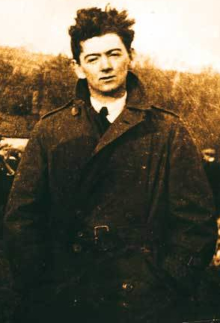
Birth of Seán McCaughey, Militant & Irish Republican Activist

Seán McCaughey (Irish: Seán Mac Eóchaidh), Irish militant and Republican activist, is born on June 8, 1915, in Aughnacloy, County Tyrone. He is an Irish Republican Army (IRA) leader in the 1930s and 1940s and a hunger striker.

In 1921, McCaughey’s family moves to the Ardoyne district in north Belfast. Hus father is a founding member of the Irish republican Dungannon Clubs and organizes the first branch of Sinn Féin in County Tyrone. As a teenager he joins the Gaelic League and Sinn Féin and also becomes a long time student and teacher of the Irish language in the Glens of Antrim. He joins the IRA in 1935 and in 1938 is promoted to Officer Commanding (O/C) of its Northern Command, headquartered near the town of Carrickmore, County Tyrone, which is the ancestral home of Joseph McGarrity and Patrick McCartan, both leaders of the Irish republican organization Clan na Gael. In December 1939, he is arrested and imprisoned at the Curragh Camp. After being released in 1940 he returns to the Northern Command of the IRA. He is held in high regard and is considered to be one of the best officers of the northern IRA. At the time of his arrest in Rathmines, Dublin, on September 2, 1941, he is acting Chief of Staff.

In September 1941, McCaughey is found guilty by a Dublin court of having detained and assaulted Stephen Hayes, IRA Chief of Staff, who was accused of being a spy for the Irish Free State government. Hayes escapes and later testifies against him at a Military Court. He is sentenced to death by firing squad. His sentence is commuted to a life sentence of penal servitude.

Imprisoned in Portlaoise Prison on July 24, 1941, McCaughey joins other IRA prisoners in the ongoing blanket protest. Refusing to wear a criminal’s prison clothes, he is kept in solitary confinement and spends nearly five years naked except for a blanket. This form of resistance by Irish republican prisoners is also used in the 1980s blanket protests in the Maze prison (also known as “Long Kesh”) and the HM Prison Armagh (women’s prison) in Northern Ireland. He and other Irish republican prisoners endure years of hardships. Sitting month after month, year after year in bleak solitary cells, they are taken out once a week for a bath, and for the rest of the week live the life of an animal trapped in a burrow. That they do not go mad is a remarkable comment on mans capacity for survival. During his almost five years in Portlaoise, he Is never permitted to have visitors.

McCaughey commences a hunger strike on April 19, 1946. After ten days, he stops taking water and dies on May 11, 1946, the twenty-third day of his protest. An inquest is held in the prison at which the prison doctor admits that during his over four and a half years of imprisonment that McCaughey had never been allowed out in the fresh air or sunlight and that “he would not treat his dog the way Seán McCaughey had been treated in Portlaoise.”

Sean McCaughey’s funeral cortege passes through large crowds in the streets of Dublin and proceeds north to Belfast where it is met by thousands of mourners at Holy Cross Church, Ardoyne. He Is buried in a family grave in Milltown Cemetery, which is under the care of the National Graves Association, Belfast.

McCaughey is the last person to die on hunger strike in the Irish state. There is a long history of hunger striking in Ireland – within the 20th century a total of 22 Irish republicans die on hunger strike with survivors suffering long-term health and psychological effects. Four men die during the 1920 Cork hunger strike. The largest hunger strike in Irish history is the 1923 Irish hunger strikes, during which five men die. Ten men die during the 1981 Irish hunger strike.

(Pictured: Seán McCaughey (right) and Charlie McGlade, O’Connell Street, Dublin, 1941)


Leave a comment

Birth of Andrew O’Connor, American-Irish Sculptor

Andrew O’Connor, an American-Irish sculptor, is born in Worcester, Massachusetts, on June 7, 1874. His work is represented in museums in the United States, Ireland, Britain, and France.

O’Connor’s father, Andrew O’Connor (1846–1924), of Lanarkshire, Scotland, is a stonecutter who becones a professional sculptor. As a teenager, he apprentices to his father, helping him to design monuments for cemeteries.

For a time, O’Connor is in the London studio of the painter John Singer Sargent, and later works for the architects McKim, Mead & White in America and with the sculptor Daniel Chester French. Settling in Paris in the early years of the 20th century, he exhibits annually at the Paris Salon. In 1906 he is the first foreign sculptor to win the Second Class medal for his statue of General Henry Ware Lawton, now in Garfield Park in Indianapolis, Indiana. In 1928 he achieves a similar distinction by being awarded the Gold Medal for his Tristan and Iseult, a marble group now in the Brooklyn Museum. His work is also part of the sculpture event in the art competition at the 1928 Summer Olympics in Amsterdam.

A number of his plaster casts are in the Hugh Lane Gallery, Dublin, and there are works in Tate Britain, the Walters Art Museum, Baltimore, the Corcoran Gallery of Art, the Metropolitan Museum of Art and the Musée d’Art Moderne, Paris.

O’Connor is involved in a minor controversy in 1909 when he is commissioned to design a statue for Commodore John Barry, of the American Revolutionary-era navy. His first design is heatedly attacked by Irish American groups. He submits a second version, but it too is ultimately rejected, and the sculptor John J. Boyle received the commission.

O’Connor dies in Dublin on June 9, 1941.


Leave a comment

Death of Caitlín Maude, Poet, Actress & Language Revival Activist

Caitlín MaudeIrish language poetlanguage revival activist, and actress, dies in County Dublin on June 6, 1982. She is also well-known for her campaigns to improve the lives of women in Ireland.

Maude is born on May 22, 1941, in CaslaCounty Galway, and reared in the Irish language. Her mother, Máire Nic an Iomaire, is a school teacher, and she receives her primary education from her on a small island off the coast of Rosmuc. Her father, John Maude, is from Cill Bhriocáin township near Rosmuc. She attends secondary school at Coláiste Chroí Mhuire, Spiddal, an all-Irish language school in County Galway. She later credits one of her Irish language teachers there, Sister Ailbhe, as an early influence in cultivating her writing confidence.

Maude attends University College Galway, where she studies English, Irish, French, and Mathematics. She becomes a teacher, working in schools in Counties KildareMayo, and Wicklow. She also works in other capacities in London and Dublin.

Maude begins writing modern literature in Irish in secondary school and develops a rhythm of poetry closely attuned to the rhythms of the Conamara Theas dialect of Connacht Irish, spoken in her native district. Though not conventionally religious, she admits in an interview that she has a deep interest in spirituality and that this has left its mark on her poetry. She is noted as a highly effective reciter of her own verse. Géibheann is the best-known of her poems, and is studied at Leaving Certificate Higher Level Irish in the Republic of Ireland. A posthumous collected edition, Caitlín Maude, Dánta, is published in 1984, Caitlín Maude: file in 1985 in Ireland and Italy, and Coiscéim in 1985.

Maude is widely known as an actress. She acts at the university, at An Taibhdhearc in Galway and the Damer Theatre in Dublin, and is particularly successful in a production of An Triail by Máiréad Ní Ghráda at the Damer Theatre in 1964. She plays the protagonist, Máire Ní Chathasaigh, an unmarried mother who experiences family rejection, a stay in a Magdalene laundry, and ultimately murders her infant child followed by suicide. In 2017, Former Irish Minister For Justice Máire Geoghegan-Quinn cites this performance as “pathbreaking”: “Caitlín Maude played the role, when nobody talked about the issue and when, as we know, women were still devalued, still caricatured, still incarcerated and disenfranchised if they became mothers out of wedlock.” Maude herself is a playwright and co-authors An Lasair Choille with poet Michael Hartnett.

Maude is very active in the  Celtic Revival. She founds An Bonnán Buí, an Irish-speaking social club in the 1970s in Dublin. As a member of the Dublin Metropolitan Gaelgeoir community, she is active in many direct action campaigns by the language revival organization Gluaiseacht Chearta Sibhialta na Gaeltachta, including the campaign that forces the Irish State to establish a Gaelscoil (Irish-medium primary schoolScoil Santain in the suburb of Tallaght, County Dublin. A second Irish language school, Scoil Chaitlin Maude, opens in Tallaght in 1985 shortly after her death. It begins as a two-room school with 35 children and has grown to a 16 room new building serving 345 children as of 2023.

Maude is also a distinguished sean-nós singer. She makes one album in this genre, Caitlín, released in 1975 on Gael Linn Records and now available as a CD. It contains both traditional songs and a selection of readings of her poetry.

Maude marries Cathal Ó Luain in 1969. They have one child Caomhán, their son.

Maude dies of complications from cancer on June 6, 1982, at the age of 41. She is buried in Bohernabreena graveyard, which overlooks the city from the Wicklow Mountains.

In 2001, a new writers’ centre in Galway is named after her: Ionad Scríbhneoirí Chaitlín Maude, Gaillimh.

Since Maude’s death, critics in several languages have continued to study her literary works. Irish writer and The Irish Times columnist Michael Harding cites her as one of a few examples of groundbreaking women to “spin the hurt and wound of their oppression, and weave new loves songs and laments.” Irish Studies professor Sarah McKibben notes that Maude’s innovation in the poem represents an instance of recent Irish writers transgressing “literary, nationalistic, sociolinguistic and gender norms to craft new ways of writing in Irish.”

According to Louis de Paor, “Although no collection of her work was published during her lifetime, Caitlín Maude had a considerable influence on Irish language poetry and poets, including Máirtín Ó DireáinMicheál Ó hAirtnéideTomás Mac Síomóin, and Nuala Ní Dhomhnaill. That influence is a measure of the dramatic force of her personality, her exemplary ingenuity and commitment to the language, and her ability as a singer to embody the emotional disturbance at the heart of a song. Her collected poems are relatively slight, including incomplete drafts and fragments, but reveal a poetic voice confident of its own authority, drawing on the spoken language of the Connemara Gaeltacht but rarely on its conventions of oral composition or, indeed, on precedents in Irish poetry in either language. The best of her work is closer to the American poetry of the 1960s in its use of looser forms that follow the rhythms of the spoken word and the sense of the poem as direct utterance without artifice, a technique requiring a high degree of linguistic precision and formal control.”

Maude’s work has also been translated into English and Spanish. Spanish language critic Pura Coloma notes that Maude’s work played a role in preserving Connemaran culture, as she “utilizes her own style to replicate the deep rhythms and tonalities of the regional voice.”


Leave a comment

Birth of Irish Actor F. J. McCormick

F. J. McCormick (real name Peter Christopher Judge), an Irish actor who becomes known for his work at Dublin‘s Abbey Theatre, is born in Skerries, County Dublin, on June 1, 1890. He acquires the stage name “F.J. McCormick” to disguise his identity from his current and future employers, and to avoid parental disapproval. He joins the Abbey at age 19, and acts in some 500 productions there. He is especially remembered for his work in the plays of Seán O’Casey.

After living in Skerries in his early years, at age ten McCormick moves to Dublin and proceeds to live there for the majority of the duration of his life. He is educated locally in Skerries. His father, Michael Judge, is a maltser and later becomes a brewery manager. He is of medium height, with “expressive eyes” and thick brown hair. As a young man, he begins writing by contributing articles to the press. He works briefly as a post office clerk in London but returns to Dublin to work as a junior clerk in the Civil Service. He resigns from his public service career in 1918 and decides to embrace acting as a full-time career as a member of the Abbey Theatre at age 19.

McCormick’s mother dies when he is 2 years old. He and his family move to Dublin when he is 10 or 12 years old. He is raised in Skerries and attends the Holy Faith Convent for primary education. He describes his childhood in Skerries “as a very happy one.” He marries Eileen Crowe on December 2, 1925, in Rathdown. They meet at the Abbey where Crowe is also an actor. In describing their performances together, Seamus De Burca writes, “F. J. McCormick and Eileen Crowe lived a life together of perfect bliss.” The couple has two children, a son, David, and a daughter, Marie.

After moving briefly to London, McCormick returns to Dublin, where he works in the Civil Service. He also takes acting roles in the Workmen’s Club on York Street, and for the first time under the pseudonym by which he becomes known for roles with the Queen’s Theatre, Dublin. By May 1919, he has a leading role in an independent production of The Curate of St. Chad’s by Constance Powell Anderson at the Abbey Theatre. An attack on Irish acting by Edward Martyn is answered by McCormick in the pages of the journal Banba in June 1921.

McCormick acts in over 500 plays at the Abbey Theatre, becoming particularly associated with the plays of Sean O’Casey staged there. From 1923 to 1925, he is also stage manager at the Abbey. Of his performance as Seumus Sheilds in The Shadow of a Gunman, O’Casey says that the actor created a character greater than that which he had written. He plays Capt. Brennan in the filmed version of O’Casey’s The Plough and the Stars but it is his return to film in Carol Reed‘s Odd Man Out (1947) that sees him singled out for praise in contemporaneous reviews. The Irish Times writes that “the acting of the Irish players was unremittingly professional, and, in the case of F. J. McCormick, as Shell, a weak-minded and elderly corner-boy, quite outstanding.” The Times of London finds “it is Mr. F. J. McCormick as a sly, bird-like creature, who stops just the right side of informing, who catches most surely at the imagination.”

In their review of the film Hungry Hill (1947), The New York Times writes, “As the butler who served John Brodrick, his sons, and their sons in turn, the late F. J. McCormick is truly magnificent, giving an even more subtle portrayal of Irish character than he did as the wily tramp in Odd Man Out.”

In the last five years of McCormick’s life he continues to work in the Abbey where he acts in over 70 plays before his death. He only stars in one play in the theatre in the final year of his life, the play They Got What They Wanted playing the role of Bartley Murnaghan. He secures more leading roles in the film industry. He dies in Dublin at the age of 56 from a brain tumour on April 24, 1947. He is buried in Dean’s Grange Cemetery, Deansgrange, County Dublin. He continues to work right up until his death.

It is said that people regarded McCormick as one of the greatest actors in his era. This comes from his work in 500 plays and 4 films over his career. A year after his death, Barry Fitzgerald says he only knew of two actors with the gift that McCormick had and they were Charles Laughton and Charlie Chaplin.

There are many popular plays and films that McCormick is part of which are still remembered to this day by many, some of them include the original The Plough and the Stars in 1926 where he originates the role of Commandant Jack Clitheroe. He also plays the role of Captain Brennan in the John Ford film version of the play in 1936. In his appreciation for McCormick, Gabriel Fallon remembers him as both a great actor and a great man.

It is said that McCormick was one of the most versatile actors of his generation, his early death was a huge loss to the Irish arts and more specifically the Abbey Theatre where he carried most of his work.


Leave a comment

Death of Edward Hutchinson Synge, Irish Physicist

Irish physicist Edward Hutchinson Synge dies in a Dublin nursing home on May 26, 1957. He publishes a complete theoretical description of the near-field scanning optical microscope, an instrument used in nanotechnology, several decades before it is experimentally developed. He never completes university yet does significant original research in both microscopy and telescopy. He is the first to apply the principle of scanning in imaging, which later becomes important in a wide range of technologies including television, radar, and scanning electron microscopy.

Synge is born on June 1, 1890, in south Dublin, to Edward Synge and Ellen Frances Price. He is familiarly known as “Hutchie.” He is the nephew of playwright John Millington Synge and the older brother of distinguished mathematician and theoretical physicist John Lighton Synge who edits the collected works of Sir William Rowan Hamilton at Synge’s urging. He and brother John are great-great-great-grandsons of Irish bishop Hugh Hamilton. He is also the uncle of the mathematician Cathleen Synge Morawetz. Throughout his life he is very physically active, pursuing walking, cycling, swimming and sailing. In his later life, he takes up painting and is quite good at it.

In 1908, Synge enters Trinity College Dublin (TCD) to study Mathematics and Old Irish. For three years he is a brilliant student and wins several prizes and a Foundation Scholarship in mathematics in 1910. At the end of his third year, he comes into an inheritance from his uncle John Millington Synge, and in 1913 he drops out of university.

Starting in 1928, with encouragement from Albert Einstein, Synge launches on a period of intense productivity during which he lays the foundation for new kinds of microscopes and telescopes. Nobody, including his famous brother John, appreciates his achievements at the time. His work is overlooked for decades, but is now better-known thanks to the book The Life and Works of Edward Hutchinson Synge published by Living Edition in 2012.

On April 22, 1928, Synge writes to Einstein about an idea he has for a new microscopic imaging method in which an optical field scattered from a tiny gold particle can be used as a radically new light source. Einstein replies that although Synge’s method appears essentially unworkable, the basic ideas seem correct and he should publish his research.

There follows a remarkable period from 1928 to 1932 in which Synge produces all of his key works which he publishes in the Dublin Philosophical Magazine and Journal of Science. Remarkably, he does all of this work alone, without a laboratory, and while living at his home in Dundrum in the suburbs of Dublin. By 1932 he has laid out the theory of the near-field microscope and his description is incredibly accurate.

The idea is ahead of its time. In 1956, a similar theory is developed by John A. O’Keefe and in 1972, Eric Ash gives the first experimental demonstration of the technique using electromagnetic radiation. It is not until Synge’s original papers re-emerge in the 1980s that his priority is finally recognised.

Synge proposes a design for very large astronomical telescopes, based on multiple mirrors, an idea realised much later in Tucson, Arizona, and elsewhere. He also invents a new kind of remote sensing technique using searchlights. Today this is known as Lidar and uses pulsed lasers.

According to the people who know him best, Synge suffers from what today would be called Asperger syndrome. Becoming increasingly socially isolated, he drops out of university in 1913 and works alone without any support from the academic community until all work stops in 1932. In 1936, he has a mental breakdown and is committed to a Dublin nursing home where he remains until his death on May 26, 1957. He is buried with his parents in Dublin’s Mount Jerome Cemetery, with only a few relatives attending. It is much later that his niece, Cathleen Synge Morawetz, arranges to have “Scientist and Inventor” inscribed on the gravestone.


Leave a comment

Birth of Gerald Boland, Fianna Fáil Politician

Gerald Boland, an Irish Fianna Fáil politician, is born in Manchester, England, on May 25, 1885.

Boland is the son of James Boland and Kate Boland (née Woods). He is the second child and eldest son among three sons (including Harry Boland) and two daughters of the couple. His family on both sides are staunch Irish Nationalists. His father is a Fenian in his younger days, a devout follower of Charles Stewart Parnell, and later a member of the Irish Republican Brotherhood (IRB). His father also has ties to the Irish National Invincibles, and his association with them causes him to have to flee to New York City for a time.

After his national school education, Boland attends the O’Brien Institute in Fairview, Dublin. He leaves school at fifteen and becomes an apprentice fitter at Broadstone railway station. Instead of attending his studies to secure an engineering diploma, he takes Irish language and history classes at night. Despite this, he passes his engineering exams.

Boland is enrolled in the IRB along with his younger brothers Harry in 1904, following in the footsteps of his father. He and his brothers Harry and Ned subsequently join the Irish Volunteers when that organisation is established in 1913, serving in the same company as Arthur Griffith. When news breaks out of the Easter Rising in 1916 he immediately leaves his job, however, he is bitterly disappointed when he finds out that the order has been countermanded. When the rebellion begins in earnest on Easter Monday, he makes his way to Jacob’s Mill where he fights under Thomas MacDonagh. Following the official surrender, he is arrested and interned at Frongoch internment camp in Wales, where he comes into contact with other notable revolutionary leaders, including his brother Harry’s friend Michael Collins.

Boland is released after a general amnesty in December 1916, however, he remains involved in revolutionary circles, although he declines to rejoin the IRB, believing the organisation is no longer needed. He is arrested and imprisoned in Belfast from May to December 1918 for practising military drills in the Dublin Mountains. Meanwhile, a number of his colleagues secure their release by winning seats in the 1918 United Kingdom general election.

During the Irish War of Independence, Boland is Battalion Commandant of 7 Battalion, Dublin Brigade, Irish Republican Army (IRA) and is known as “Trotsky” for his left-wing views.

Boland and his brothers are opposed to the Anglo-Irish Treaty of 1921. He is Battalion Commandant of 3 Battalion, 2 Dublin Brigade (South Dublin) in BlessingtonCounty Wicklow, but is captured early on in the Irish Civil War on July 7, 1922, and is interned until his release in July 1924. On the outside, his brother Harry dies some days after being shot, in August 1922, after two National Army officers attempt to arrest him at the Grand Hotel in Skerries, County Dublin. Boland applies to the Irish government for a service pension under the Military Service Pensions Act of 1934 and is awarded 11 and 5/12 years of service at Grade C for his service with the Irish Volunteers and the IRA between April 1, 1916 and September 30, 1923.

Following the end of the Irish Civil War, Boland helps to build up Sinn Féin as the main Republican party. While still imprisoned, he is selected to stand for Dáil Éireann as the Teachta Dála (TD) for Roscommon, Harry’s old seat, for the 1923 Irish general election, in which he is successful. He is among those in Kilmainham Gaol who go on hunger strike in October 1923. The hunger strike does not result in his release and he credits his practice of yoga with keeping him alive at the time.[3]

Boland is eventually released from the custody of the state in July 1924. Upon his release, he becomes secretary of Sinn Féin and stands on the executive of the party.

Boland is among the first in Sinn Féin to call for an end to the party’s abstentionism from Dáil Éireann, believing it to be a political dead end. Party leader Éamon de Valera proposes that the party abandon this policy and take their seats in the Dáil if changes are made to the oath of allegiance to the British monarch. His proposal is defeated and de Valera and his supporters, including Boland, leave Sinn Féin. Shortly after this split, a new party emerges called Fianna Fáil, with de Valera acting as leader and the other disillusioned Republican TDs joining. Boland is vital in transferring many members from Sinn Féin to Fianna Fáil. Fianna Fáil briefly also has an abstentionist policy but in 1927 a new law forces Fianna Fáil TDs to take the oath of allegiance and take their seats in the Dáil. Fianna Fáil dismisses the oath as “an empty formula.”

Boland works alongside Seán Lemass in building up Fianna Fáil’s grassroots support and organisation, giving particular attention to the party’s rural apparatus. In the September 1927 Irish general election Fianna Fáil comes within four seats of the ruling Cumann na nGaedheal party. The latter forms a coalition of sorts with the Farmers’ Party and returns to government.

Following the 1932 Irish general election, Fianna Fáil forms a new government. Boland is appointed Government Chief Whip, a position which allows him to attend cabinet meetings but not vote at them.

Fianna Fáil remains in power with an increased mandate following the 1933 Irish general election and Boland is promoted to the position of Minister for Posts and Telegraphs. Despite being the Minister in charge of the postal service, he does not own a telephone until some time later. During his tenure, the postal service makes considerable progress. It is also during this time that the Post Office becomes a paying concern. During his time as minister, he oversees a major expansion of the telephone service in Ireland, improvements in the transmission capacity of Radio Éireann, and construction of new provincial post offices and a new central postal sorting office.

Boland is acting Minister for Justice briefly for a time when P. J. Ruttledge is ill. It is during this time that he declares the Irish Republican Army a proscribed organisation.

A cabinet reshuffle in 1936 sees Boland become Minister for Lands. The Land Act 1939 reforms land distribution, broadening the criteria by which the state can take control over undeveloped land while offering the tenant of the land more favourable terms of compensation. He is critical of the policy of the Minister for Industry and Commerce, Seán Lemass, of centralising industrial development in Dublin. He instead wishes to see a more decentralised economy based around food production. The differing viewpoint causes a rift between Boland and Lemass, but despite this Boland favoured Lemass’s policy of state intervention in the economy over Seán MacEntee‘s more laissez-faire approach.

In 1937 Boland is highly vocal during the drafting of a new constitution of Ireland by Fianna Fáil against any word which would give the Catholic Church special status, something heavily considered at the time. He declares that if the constitution elevates the position of the Catholic Church above others, it would be sectarian, anti-republican, and a hindrance to any prospects of Irish reunification. As a compromise, the term “special position” is used in the approved text of the Constitution.

Following the outbreak of World War II in 1939, known in Ireland as the Emergency, there is a cabinet reshuffle, and Boland is appointed as Minister for Justice. He takes over at a time when the IRA has once again declared war against the British state and has begun their Sabotage Campaign. He is charged with the task of crushing the organisation and preventing the IRA from drawing the Irish state into conflict with the United Kingdom. Although he always considers himself a republican, he takes a hardline against the IRA and uses his powers to order the internment of hundreds of IRA members before introducing military courts and special criminal courts.

In 1940, several imprisoned IRA members go on hunger strike but Boland refuses to grant their release. Two of the men eventually die, one of whom is the nephew of one of his Fianna Fáil colleagues. Tony D’Arcy dies at the age of 32 on April 16, 1940, as a result of a 52-day hunger strike, and Jack McNeela dies three days later after 55 days on hunger strike. These deaths spark reprisals by the IRA on the Garda Síochána. Boland subsequently introduces tougher measures by setting up a military court with the death penalty and no provision for appeal except for a review by the government. In all, twelve men are found guilty with six of them facing death and the remaining six having their sentences changed to imprisonment. Among those executed is Charlie Kerins, an acting Chief of Staff of the IRA.

As Minister of Justice, Boland is also asked to enforce policies of wartime censorship, however, finding the idea of the state censorship distasteful he establishes a censorship board to avoid accusations of bias.

During the Emergency, Boland is also responsible for the detention of several foreign agents in pursuit of Ireland’s strict policy of neutrality. During this time some 500 individuals are interned and 600 are sentenced under the newly introduced Offences against the State Act, 1939. By 1943 the IRA is in disarray, particularly after the Chief of Staff is arrested and imprisoned, leaving the organisation without leadership. Boland and Fianna Fáil feel their hardline is backed by the electorate following strong returns for the party at the 1944 Irish general election.

In 1947, Boland is among four leading Fianna Fáil figures (including de Valera) involved in the “Locke’s Distillery Scandal”, an accusation brought by Oliver J. Flanagan that foreign businessmen are bribing members of Fianna Fáil to gain the right to purchase the distillery. A tribunal of inquiry finds no evidence to support the claims, but the event taints the public’s view of Fianna Fáil.

By 1948, Fianna Fáil has been in government for an uninterrupted 16 years. With World War II finally over, the electorate seeks change and a fresh start. Arising to meet this desire is the new political party Clann na Poblachta. Led by Seán MacBride, this new party seeks to kick off a new post-war political era in Ireland, and to do this means removing Fianna Fáil from power. Many in Clann na Poblachta have republican backgrounds and in some ways, the party can be partially described as an organic reaction to Fianna Fáil and Boland’s hardline stance during the war years. Many in political circles, including inside Fianna Fáil, believe Clann na Poblachta can be a new force to reckon with.

However, de Valera always holds a reputation for being cunning in selecting the dates of general elections, and he once again cements that notion, when he calls for a general election in early 1948 before Clann na Poblachta is completely ready to contest a national election. At the 1948 Irish general election Clann na Poblachta and other Fianna Fáil opponents do well, but not as well as expected. To remove Fianna Fáil from government, every single party in the Dáil and several independents have to form the unwieldy “First Inter-Party Government.” The coalition sees Clann na Poblachta forced to work with Fine Gael, considered the traditional “enemy” of Irish republicanism. By 1951, the coalition collapses and Fianna Fáil returns to government following that year’s election, with Boland re-appointed Minister for Justice.

Boland does not seek ministerial office in 1957 when Fianna Fáil returns to power after its defeat in 1954. However, his son, Kevin, is appointed to the cabinet as Minister for Defence at the beginning of his first term in the Dáil. By this stage, Boland is beginning to be seen as an aging warhorse, with his base in Roscommon starting to slip and Fianna Fáil unhappy that he is unable to get a Fianna Fáil running mate elected alongside himself.

At the 1961 Irish general election, Boland is defeated for the first time in fourteen general election campaigns. Despite losing his Dáil seat, he subsequently secures election to Seanad Éireann. Four years later in 1965, he returns to the Seanad, this time as a nominee by the Taoiseach Seán Lemass.

In 1970, the outbreak of the Arms Crisis sees Kevin Boland resign as a Minister and as Secretary of Fianna Fáil in protest at the government’s policy on Northern Ireland and in response to the sackings of Charles Haughey and Neil Blaney from the cabinet over allegations they had arranged for weapons to be provided to the Provisional IRA. Gerald Boland, in a similar protest, resigns as a vice president and as a trustee of Fianna Fáil, although he remains a member of the party. He also articulates his loss of confidence in the leadership of Taoiseach Jack Lynch.

Boland dies in Dublin at the age of 87 on January 5, 1973. He is buried in the republican plot in Glasnevin Cemetery, Glasnevin, County Dublin. His wife, Annie Boland, predeceases him in 1970. He is survived by his three daughters and four sons.


Leave a comment

Death of Cathal Gannon, Harpsichord Maher & Fortepiano Restorer

Cathal Gannonharpsichord maker, a fortepiano restorer and an amateur horologist, dies on May 23, 1999.

Gannon is born on August 1, 1910, in Harold’s Cross, Dublin, into a craftsmen family of carpenters, many of whom worked in the famous Guinness Brewery. His education, in two local schools, is rudimentary and at the age of fifteen he starts working as an apprentice carpenter in the Guinness Brewery. His apprenticeship involves learning to make office furniture and attending evening classes in nearby colleges, where he is able to improve his education in a more congenial atmosphere. A love of music and the arts had been encouraged by two maiden aunts. His parents subsequently purchase an upright piano and he learns to play it at the Read Pianoforte School. When his apprenticeship is completed and he is on the dole for some years, he spends much of his spare time buying pictures, books, antiques and old clocks and watches in the various auction rooms and antique shops in Dublin.

During the mid-1930s, Gannon becomes a member of several Dublin-based societies, most notably the Old Dublin Society, and there befriends well-known people such as Grace Plunkett (née Gifford), the widow of Joseph Mary Plunkett, who had been executed following the Easter Rising of 1916. At around this time, he is also introduced to Carl Hardebeck, an arranger of Irish traditional music. At a later stage in his life, he meets Desmond Guinness and his wife Mariga, founders of the Irish Georgian Society, which he subsequently joins.

While reading a series of articles about Tibet in a magazine, Gannon stumbles across an article, which, he believes, is by Violet Gordon-Woodhouse, a British harpsichordist and clavichord player of the period. The article is about the revival of the harpsichord, which interests him. He asks permission to examine the harpsichords on display in the National Museum of Ireland, Dublin, but is given no encouragement by the staff. He is finally allowed to see the instruments when he is in his early twenties. Dismayed, he concludes that they are too expensive to buy and too complicated to make.

While on holidays in Glengarriff in the Beara Peninsula of County Cork during August 1936, Gannon meets his future wife, Margaret Key from Harrow, London. They marry in 1942.

In London with Margaret, who is visiting her parents, Gannon goes to the Benton Fletcher collection of keyboard instruments, which is then in Chelsea, and measures a harpsichord by Jacob and Abraham Kirckman. Back home, he makes a copy of the instrument in a tiny conservatory at the back of his house in the Dublin suburb of Rialto. The harpsichord is played by John S. Beckett for the first time in public in 1959 as the continuo for Johann Sebastian Bach‘s St. Matthew Passion and is praised in the national press. Beckett subsequently persuades the authorities in the Guinness Brewery to provide Gannon with a special workshop, in which he makes five harpsichords and restores several antique pianos. The first harpsichord made in the Brewery is donated to the Royal Irish Academy of Music in Dublin. The second is sold to Harrods of London, and the third is sold to Ireland’s national radio and television station RTÉ. This third instrument is used regularly by the RTÉ Symphony and Concert orchestras and also by the well-known composer and performer of Irish traditional music, Seán Ó Riada.

Gannon continues to make many more harpsichords and restore more pianos during the years to come. In all, he completes twenty harpsichords during his lifetime – the final four are completed by a friend, Patrick Horsley, in England. One of the harpsichords made by Gannon-Horsley returns to Ireland and is presented to NUI Maynooth. A piano of note that he restores is a Broadwood square piano owned by the poet and composer, Thomas Moore, which belonged to Lord and Lady Elveden (later Iveagh).

Gannon is the subject of several RTÉ radio programmes, three RTÉ television programmes (including The Late Late Show) and a television programme, Gallery, made by BBC Northern Ireland. He befriends a great many people, including the artist, writer and conservationist Peter Pearson, and regular musical evenings are held at the family home in Bryan Guinness‘s grounds in the suburbs of Dublin. Because of his interest in antique clocks and watches, he becomes a member of the Irish branch of the Antiquarian Horological Society, founded by his friend William Stuart.

In 1978, Trinity College Dublin (TCD) gives Gannon an honorary MA degree for his contribution to the authentic performance of early music in Ireland. Two years later, he is invited to travel with the New Irish Chamber Orchestra to China, where he tunes and maintains one of his harpsichords and celebrates his seventieth birthday. In 1989, a second honorary MA is given to him, this time by NUI Maynooth.

Following Gannon’s 80th birthday, which is attended by fifty people, he finally settles down to retirement. A series of minor strokes follow, which eventually lead to dementia and ultimately to his death, aged 88, on May 23, 1999.

The Cathal Gannon Early Music Room is opened in the Royal Irish Academy of Music in May 2003. It contains a harpsichord and clavichord made by Gannon, a Broadwood grand piano restored by him, and a square piano.

Part of a transmitted RTÉ programme, Nationwide (January 17, 2007), features archive footage of Gannon and his instruments. Three RTÉ radio programmes, Bowman: Sunday Morning, broadcast in November 2006, feature a 1983 interview with Gannon.


Leave a comment

Birth of Josepha Madigan, Fine Gael Politician

Josepha Madigan, former Fine Gael politician, is born in Dublin on May 21, 1970. She serves as Chair of the Committee on Budgetary Oversight from July 2016 to November 2017, Minister for Culture, Heritage, and the Gaeltacht from November 2017 to June 2020, and as Minister of State at the Department of Education from July 2020 to March 2024. She serves as a Teachta Dála (TD) for the Dublin Rathdown constituency from 2016 to 2024.

Madigan attends Mount Anville Secondary School and Trinity College Dublin (TCD). She is married to Finbarr Hayes, and they have two children. Her father, Patrick Madigan, was a Fianna Fáil County Councillor in Dublin, and her mother, Patricia Madigan, was a barrister who had a background in Fine Gael. She and her family live in Mount Merrion, Dublin. She is a survivor of sexual assault.

Madigan is a qualified solicitor, who practises in family law for twenty years, prior to her election to Dáil Éireann. She is also certified as a mediator by the Mediators’ Institute of Ireland (MII) and is a previous Council member of the MII. She is a former Specialist Liaison Officer for Family Mediation in the MII.

Madigan is the author of the first book in Ireland on mediation: Appropriate Dispute Resolution in Ireland, a handbook for family lawyers and their clients (Jordan Publishing, 2012). She has also self-published a novel called Negligent Behaviour.

Madigan serves as a councillor for the local electoral area of Stillorgan on Dún Laoghaire–Rathdown County Council, from May 2014 until her election as a TD in 2016.

Madigan issues a leaflet in 2014 claiming that providing accommodation for Travellers in her constituency would be “a waste of valuable resources.” When asked about this later, she claims, “Some people won’t want to live beside people in halting sites […] there might be more crime, that there might be anti-social behaviour.”

Madigan is elected to the 32nd Dáil at the 2016 Irish general election as a Fine Gael TD for the Dublin Rathdown constituency, defeating sitting Fine Gael TD Alan Shatter by nearly 1,000 votes. She is appointed Chair of the Committee on Budgetary Oversight in July 2017. She is a member of the Public Accounts Committee. She introduces a private member’s bill to reduce the waiting time for divorce in Ireland from four years to two, which is passed by the Dáil.

On November 30, 2017, Madigan is appointed to the cabinet as Minister for Culture, Heritage and the Gaeltacht, in a reshuffle following the resignation of the Tánaiste Frances Fitzgerald.

On March 29, 2018, Fine Gael leader Leo Varadkar appoints Madigan as the coordinator for the party’s Yes campaign in the referendum to repeal the Eighth Amendment.

In 2019, Madigan receives widespread coverage for her role in the personal injury legal claim of Fine Gael politician, Maria Bailey. It is alleged that her law practice, Madigan Solicitors, advised Bailey on her claim, however, Madigan refuses to make any comments on this citing client-solicitor confidentiality. In July 2019, an internal unpublished Fine Gael probe into the affair clears Madigan of any wrongdoing in regard to the claim. In late July 2019, the Irish Independent reports that “it is now known that she advised Ms. Bailey in the early stages of the claim.” It is also reported that her firm would earn €11,500 in fees if the Maria Bailey case were successful.

Madigan is re-elected at the 2020 Irish general election, taking the third seat behind Green Party Deputy Leader Catherine Martin and party colleague Neale Richmond. On July 1, 2020, she is appointed by the new government as Minister of State at the Department of Education with special responsibility for special education and inclusion. On January 14, 2021, she comes under fire for describing children without additional needs as “normal” while speaking in the Dáil. “We all know that even for normal children remote teaching is difficult but for children who have additional needs it is particularly difficult,” she says. Later that day on Twitter, she says she “sincerely apologises for the language she used. It is absolutely not what I meant to say.”

On January 20, 2021, speaking on RTÉ‘s Today with Claire Byrne, Madigan compares children with additional needs not attending school to the mother and baby homes. “We’ve spent the last week talking about mother and baby homes, where our most vulnerable were left to their own devices in less than satisfactory conditions and we’re now allowing further anxiety and upset to be placed on the shoulders of parents whose children desperately need to go back to school.” The Final Report of the Commission of Investigation into Mother and Baby Homes and Related Matters is published the week prior to her comments. She later apologises in a statement: “I am, as are all involved in supporting these children [children with additional needs], passionate about vindicating their rights and in reaching for an analogy I chose poorly. I apologise fully.”

Shortly after the first report of the Creeslough explosion on October 7, 2022, Madigan tweets that she hopes “they find the culprits” and, after being criticised as irresponsible and insensitive, she quickly deletes the tweet.

On March 22, 2024, Madigan announces that she will resign as Minister of State and will not contest the next general election.


Leave a comment

Death of Robert Weston, Civil Lawyer & Lord Chancellor of Ireland

Robert Weston of Lichfield, Staffordshire, England, an English civil lawyer, who is Dean of the Arches and Lord Chancellor of Ireland in the time of Queen Elizabeth I, dies in Ireland on May 20, 1573.

Weston is born in Hampshire, England, in 1515, the third son of John Weston, of Weeford, Staffordshire, and Cecilia Neville, daughter of Ralph Neville, 3rd Earl of Westmorland, and sister of Ralph Neville, 4th Earl of Westmorland. His nephew is Knight Simon Weston, son of his brother James Weston, MP for Lichfield.

The Weston family of Gloucestershire, who produce another senior Irish judge in William Weston, are probably cousins of Robert. He enters All Souls College, Oxford and is elected Fellow in 1536. He studies Civil Law and attains the degree of Bachelor of Civil Law (BCL) on February 17, 1538 and Doctor of Civil Law (DCL) on July 20, 1556. 

From 1546 to 1549, Weston is a principal of Broadgates Hall (afterwards Pembroke College), and at the same time deputy reader in civil law at the university, under Dr. John Story. He is not a clergyman, and his later appointment to two lucrative deaneries greatly troubles his conscience.

Weston is elected Member of Parliament for Exeter in March 1553 and for Lichfield in 1558 and 1559.

On January 12, 1559, Weston is created Dean of the Arches and is a commissioner for administering the oaths required of ecclesiastics under the Act of Uniformity 1558. He is consulted in regard to the Queen’s Commission issued on December 6, 1559, for confirming Matthew Parker as Archbishop of Canterbury and is included in a commission issued on November 8, 1564, to inquire into complaints of piratical depredations committed at sea on the subjects of the King of Spain.

The Lord Deputy of Ireland, Sir Henry Sidney, requests that Weston be nominated for the post of Lord Chancellor of Ireland in succession to Hugh CurwenArchbishop of Dublin, in April 1566. After a year, on June 10, 1567, Queen Elizabeth I tells Sidney that after good deliberation she has made the “choice for the supply of room of Chancellor by naming thereunnto our trusty well-beloved Doctor Weston, dean of the arches here, a man for his learning and approved integrity thoroughly qualified to receive and possess the same” and “that for some increase of his living whilst he remaineth in our service there she was pleased to give unto him the Deanery of St. Patrick’s, whereof the Bishop of ArmaghAdam Loftus, is now dean and yet to leave it at our order, as we know he will.”

Weston arrives in Dublin early in August and is sworn into office on August 8, 1567. He is conscientious in performing his duties, and greatly respected for his integrity, although ill-health (he is plagued by gout and gallstones) hampers his effectiveness. He is appalled by the laziness and inefficiency of many of the Irish judges and urges Elizabeth I to replace them with Englishmen wherever possible. He is equally shocked at the poverty and ignorance of many of the Protestant clergy in Ireland. His zeal for reform leads him, though a layman, to become an effective leader of the Church of Ireland for a few years. He cooperates with Adam Loftus, now Archbishop of Dublin, in purging the Archdiocese of Dublin of crypto-Catholics, but is opposed to the persecution of the Roman Catholic majority, or any efforts to forcibly convert them.

Weston and Sir William FitzWilliam, the Vice-Treasurer of Ireland, are sworn Lords Justices in Christ Church Cathedral, Dublin on October 14, and he becomes a member of the Privy Council of Ireland. He addresses the Irish Parliament when it is summoned on January 17, 1568. In addition to being Dean of St. Patrick’s, he is Dean of Wells from 1570 to 1573, but his health is failing.

Weston dies on May 20, 1573, and is buried beneath the altar in St. Patrick’s Cathedral, Dublin, “leaving behind him an excellent character for uprightness, judgment, learning, courtesy, and piety.”

Weston marries Alice Jenyngs, daughter of Richard Jenyngs of Great Barr, Staffordshire. They have a son, John, and three daughters, of whom most of known of Alice, who marries firstly Hugh BradyBishop of Meath, by whom she has numerous children including Luke and Nicholas, and secondly Sir Geoffrey Fenton, by whom she is the mother of Catherine, who marries Richard Boyle, 1st Earl of Cork, and of Sir William Fenton.

Weston is the 7th great-grandfather of the American firearms industrialist Daniel B. Wesson, who cofounds Smith & Wesson with Horace Smith. Hus great-grandson, John Wesson, immigrates to the Massachusetts Bay Colony around 1644 and settles in Reading, Massachusetts.


Leave a comment

Death of Garret FitzGerald, Eighth Taoiseach of Ireland

Garret Desmond FitzGerald, Fine Gael politician, economist and barrister who serves twice as Taoiseach (1981-82 and 1982-87), dies at the age of 85 at the Mater Private Hospital in Dublin on May 19, 2011, after suffering from pneumonia. He serves as Senator for the Industrial and Commercial Panel from 1965 to 1969, a Teachta Dála (TD) from 1969 to 1992, Minister for Foreign Affairs from 1973 to 1977, Leader of Fine Gael from 1977 to 1987 and twice Leader of the Opposition between 1977 and 1982.

FitzGerald is born into a very politically active family in Ballsbridge, Dublin, on February 9, 1926, during the infancy of the Irish Free State. His father, Desmond FitzGerald, is the Free State’s first Minister for External Affairs. He is educated at the Jesuit Belvedere CollegeUniversity College Dublin (UCD) and King’s Inns, Dublin, and qualifies as a barrister. Instead of practicing law, however, in 1959 he becomes an economics lecturer in the department of political economy at UCD, and a journalist.

FitzGerald joins Fine Gael, attaching himself to the liberal wing of the party. and in 1969 is elected to Dáil Éireann, the lower house of the Oireachtas, the Irish parliament. He later gives up his university lectureship to become Minister for Foreign Affairs in the coalition government of Liam Cosgrave (1973–77). When the coalition government is resoundingly defeated in the 1977 Irish general election, Cosgrave yields leadership of Fine Gael to FitzGerald. In his new role as Leader of the Opposition and party leader, he proceeds to modernize and strengthen the party at the grass roots. He briefly loses power in 1982 when political instability triggers two snap elections.

By the time of the 1981 Irish general election, Fine Gael has a party machine that can easily match Fianna Fáil. The party wins 65 seats and forms a minority coalition government with the Labour Party and the support of a number of Independent TDs. FitzGerald is elected Taoiseach on June 30, 1981. To the surprise of many, FitzGerald excludes Richie RyanRichard Burke and Tom O’Donnell, former Fine Gael stalwarts, from the cabinet.

In his prime ministry, FitzGerald pushes for liberalization of Irish laws on divorceabortion, and contraception and also strives to build bridges to the Protestants in Northern Ireland. In 1985, during his second term, he and British Prime Minister Margaret Thatcher sign the Anglo-Irish (Hillsborough) Agreement, giving Ireland a consultative role in the governing of Northern Ireland. After his party loses in the 1987 Irish general election, he resigns as its leader and subsequently retires in 1992.

On May 5, 2011, it is reported that FitzGerald is seriously ill in a Dublin hospital. Newly elected Fine Gael Taoiseach Enda Kenny sends his regards and calls him an “institution.” On May 6 he is put on a ventilator. On May 19, after suffering from pneumonia, he dies at the Mater Private Hospital in Dublin at the age of 85.

In a statement, Irish President Mary McAleese hails FitzGerald as “a man steeped in the history of the State who constantly strove to make Ireland a better place for all its people.” Taoiseach Enda Kenny pays homage to “a truly remarkable man who made a truly remarkable contribution to Ireland.” Henry Kissinger, the former United States Secretary of State, who serves as an opposite number to FitzGerald in the 1970s, recalls “an intelligent and amusing man who was dedicated to his country.”

FitzGerald’s death occurs on the third day of Queen Elizabeth II‘s state visit to the Republic of Ireland, an event designed to mark the completion of the Northern Ireland peace process that had been “built on the foundations” of FitzGerald’s Anglo-Irish Agreement with Margaret Thatcher in 1985. In a personal message, the Queen offers her sympathies and says she is “saddened” to learn of FitzGerald’s death.

On his visit to Dublin, United States President Barack Obama offers condolences on FitzGerald’s death. He speaks of him as “someone who believed in the power of education; someone who believed in the potential of youth; most of all, someone who believed in the potential of peace and who lived to see that peace realised.”

FitzGerald is buried at Shanganagh Cemetery in Shankill, Dublin.

FitzGerald is the author of a number of books, including Planning in Ireland (1968), Towards a New Ireland (1972), Unequal Partners (1979), All in a Life: An Autobiography (1991), and Reflections on the Irish State (2003).