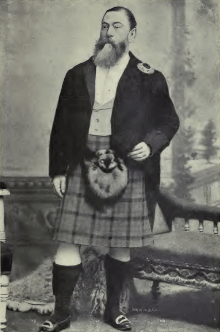
Cameron is the son of Captain Ewen Cameron of Scotland and Belinda Smith of County Cavan. He is descended from Clan Cameron of Lochiel. He receives his early education in chemistry and pharmaceutical chemistry in Dublin. In 1852 he is elected professor to the newly founded Dublin Chemical Society while continuing to study medicine at several schools and hospitals in Dublin. In 1854 he goes to Germany where he graduates in philosophy and medicine. While there he publishes his translations of German poems and songs.
Upon his return to Ireland, Cameron becomes scientific advisor to the British government in Ireland in criminal cases and over the years takes part in many notable trials, including those relating to the Phoenix Park Murders. In 1862, he becomes public analyst for the City of Dublin, a position which is later extended to 23 counties in Ireland. In 1867, he is elected Professor of Hygiene in the Royal College of Surgeons in Ireland (RCSI). He is also lecturer in chemistry in Dr. Steevens’ Hospital and the Ledwich School of Medicine, succeeding Dr. Maxwell Simpson, and retains these positions until 1874. In 1875 he is appointed Professor of Chemistry at the Royal College of Surgeons in Ireland.
From 1858 to 1863, Cameron is editor and part proprietor of the Agricultural Review, in which he writes hundreds of articles on various subjects. In 1860–62, he is also editor of the Dublin Hospital Gazette and afterward publishes many reports on public health to the Dublin Journal of Medical Science. At this time, he is in contact with many agricultural associations both in Ireland and abroad and receives a number of awards and tributes.
In 1874, Cameron becomes Co-Medical Officer of Health for Dublin Corporation and two years later becomes Chief Medical Officer. Being in charge of the Public Health Department of Dublin City means that he is always in the public eye, and due to the level of poverty and disease in the city at the time his work is cut out for him. He makes many recommendations for improving the sanitation of dwellings and sees to it that unsanitary housing is either improved or closed down. He publishes numerous sanitary reports, papers on hygiene, the social life of the very poor and proper eating habits, those of the very poor in particular. On the other hand, he is in a position to meet the major figures of the day, from the monarchy and the government downward. He is a member of several clubs in the city and dines with local and visiting celebrities alike, which he describes in his reminiscences.
In 1884, Cameron becomes vice-president of the Royal College of Surgeons of Ireland, and the following year becomes president. He is knighted in 1885 in consideration of “his scientific researches, and his services in the cause of public health.” In 1886, he publishes his History of the Royal College of Surgeons in Ireland, and of the Irish Schools of Medicine. This work contains nearly 300 biographies of the most eminent medical men in Ireland.
Cameron marries Lucie Macnamara of Dublin in 1862, who dies in the early 1880s. They have eight children. His eldest son, Captain Charles J. Cameron, dies in a boating accident in Athlone in 1913, while another son, Lieutenant Ewen Henry Cameron, shoots himself in a train in Newcastle in 1915 while on the way to the Western Front. Two sons, Edwin and Mervyn, die of pulmonary tuberculosis in their 20s.
Cameron is a leading Freemason in Dublin, serving as Deputy Grand Master of the Grand Lodge of Ireland (1911–20), Deputy Grand Master of the Great Priory of Ireland, Sovereign Grand Commander of the Supreme Council of the 33rd degree (Ancient and Accepted Rite for Ireland). He is first initiated as a member of Fidelity Lodge No. 125 in 1858 and is also a member of the Duke of York Lodge No. 25, serving as its secretary for over 50 years.
Cameron dies at his home on Raglan Road in Dublin on February 27, 1921, and is interred in Mount Jerome Cemetery. At his death he leaves a son, Ernest Stuart Cameron, and two daughters, Lucie Gerrard and Helena Stanley.
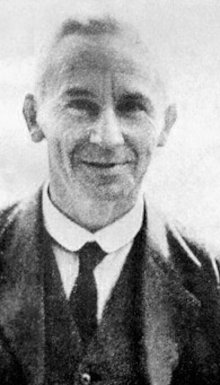
Orr is the son of James Orr, who farms a few acres and is a linen weaver. His mother’s name is unknown. They live in the small village of Ballycarry, in the parish of Broadisland, County Antrim. He is an only child, born when his parents are middle-aged. They are unwilling to risk sending him to school, so they carefully educate him at home, his father having been very well educated. A near-contemporary source George Pepper (1829), claims that the youngster is something of a prodigy, able to read Spectator essays at the age of six. Later in life, partly thanks to membership of a local reading society, he is remarkably well read. Handloom weavers are reputedly one of the most literate and politically radical groups in the period, and he certainly fits the stereotype. Pepper also claims that William Orr is James Orr’s uncle, and that the younger man lives for three years with William Orr and his family, where his literary talents are nurtured and where he develops an interest in radical politics. Other sources do not support this account, but if there is a relationship it might explain an almost morbid interest in assizes, executions, and gallows, evident in several poems. This also might have been prompted by witnessing William Orr’s trial and execution.
Pepper “heard from good authority” that Orr in 1797 is secretary to the Antrim Association, of which William Orr is president; presumably this means the Society of United Irishmen. He sings a patriotic song called “The Irishman,” one of his most celebrated compositions, at a meeting of that body. The earliest publications traced are poems published pseudonymously (1796–97) in the Northern Star newspaper. This paper, edited by Samuel Neilson, is sympathetic to United Irish views, and it is clear that Orr, like many of his neighbours, is actively involved in the 1798 rebellion. Several poems dealing with the events of June 1798, provide a rare participant’s perspective. He takes part in the skirmish at Donegore, and flees after the defeat at the Battle of Antrim. Local sources record his successful efforts to prevent cruelty and looting by his colleagues. He goes into hiding in an Irish-speaking area, perhaps in the Glens of Antrim or in the Sperrin Mountains. After a short time, he escapes to the United States, but unlike many of his former comrades he finds himself unable to settle there, and very soon returns home to Ballycarry, and thenceforth makes his living as a weaver. In 1800, he seeks to join the militia set up to counter a feared Napoleonic invasion, but the local gentry in command rejects his application because of his United Irish associations.
Orr’s first verses are composed at meetings of a local singing school, where rival versifiers produce impromptu verses for the company to sing to the psalm tunes being practised, and he later writes songs for masonic meetings. He publishes poems in the Belfast newspapers. A few carefully written essays on morality and education, signed “Censor, Ballycarry,” are apparently also his work. A collection of poems is published in 1804, with almost 400 subscribers, and another selection is published in 1817 after his death by his friend Archibald McDowell. Orr had requested that the proceeds should go to help the poor of Ballycarry. His poems are an excellent source of information about the life and concerns of a fairly humble stratum of late eighteenth-century Ulster society.
Many of Orr’s best poems deal with subjects of interest to his community – weaving, social life, and farming – and are written in the Scots language still widely spoken in the area. He expertly uses Scots stanza forms, and joyously participates in the almost competitive composition of verse typical of the Scots tradition. Several of his poems rework themes found in Robert Burns or other earlier writers. His An Irish Cottier’s Death and Burial is derived from a Burns poem, The Cottier’s Saturday Night, but later critics acknowledge that the Orr poem is much more successful. He and his friend Samuel Thomson are pioneers in the use of written Scots in Ulster and are regarded as the two most skillful Scots poets in Ulster. Both are celebrated in their day, and their work in Scots has been rediscovered in the twentieth-century revival of interest in the traditional literature and history of the north of Ireland.
Orr’s verse in standard English is equally competent, even more ambitious and almost as interesting. The best of his work, particularly in Scots, is characterised by pleasing cadences and assured control of tone and technique. His novel and generally impressive experiments with soliloquies, verse epistles, and versified direct speech, in English and Scots, parallel his interest in extending the registers in which he could use the vernacular Scots language. He seems not to have known of William Wordsworth‘s poetry, but, apparently independently and arguably more successfully, produces verse written in “the language really used by men” (Wordsworth, preface to Lyrical Ballads (1798)). As well as fascinating foreshadowings of romanticism, his work more often reveals the influence of the enlightenment and of New Light presbyterianism. He is a member of the congregation of the Rev. John Bankhead, whose theological views are decidedly liberal, tending even towards unitarianism. His poems provide a great deal of evidence on his reading, interests, radical aspirations and convictions; and in them and in the prose essays, the reader encounters a humane and generous personality. Like many other United Irishmen, he is an enthusiastic freemason, and believes that freemasonry and education will help to usher in a peaceful millennium. His poetry reveals humanitarian concerns, not yet common in the period. He opposess slavery and cruelty to animals and children and expresses support for a contemporary popular rising in Haiti. In 1812, he signs a petition in favour of Catholic emancipation.
Orr never marries. His friend McDowell believes that the resulting lack of domestic comforts drives the poet to socialise in taverns, and it is said that local fame and popularity encourages his excessive drinking. He suffers from ill health in later life. A neglected cold in 1815 leads to tuberculosis. He dies on April 24, 1816, and is buried in the old Templecorran graveyard at Ballycarry. Some years later, freemasons erect an impressive monument over the grave.
Orr’s poems are republished by a group of local enthusiasts in 1935. Another selection appears in 1992. A plaque put up by the local district council commemorates “the bard of Ballycarry,” probably the most significant eighteenth-century English-language poet in Ulster.
(From: “Orr, James” by Linde Lunney, Dictionary of Irish Biography, http://www.dib.ie, October 2009)
Kavanagh’s mother insists that he be brought up and have opportunities like any other child and places him in the care of the doctor Francis Boxwell, who believes that an armless and legless child can live a productive life. Kavanagh learns to ride horses at the age of three by being strapped to a special saddle and managing the horse with the stumps of his arms. With the help of the surgeon Sir Philip Crampton, Lady Harriet has a mechanical wheelchair constructed for her son, and encourages him to ride horses and engage in other outdoor activities. He also goes fishing, hunting, draws pictures and writes stories, using mechanical devices supplementing his physical capacities. His mother teaches him how to write and paint holding pens and brushes in his mouth.
In 1846, Lady Harriet takes three of her children, Thomas, Harriet and Arthur, traveling to the Middle East for two years. Kavanagh nearly drowns in the Nile when he falls in while fishing and is rescued by a local antiquities salesman who dives in to pull him out.
In 1849, Kavanagh’s mother discovers that he has been having affairs with girls on the family estate, so she sends him into exile to Uppsala, and then to Moscow with his brother and a clergyman, whom he comes to hate. He travels extensively in Egypt, Anatolia, Persia, and India between 1846 and 1853. In India, his letter of credit from his mother is cancelled when she discovers that he has spent two weeks in a harem, so he persuades the East India Company to hire him as a despatch rider. Other sources say that this is due to the death of his eldest brother, Charles, of tuberculosis in December 1851, which leaves him with only 30 shillings.
Kavanagh dies of pneumonia in London at the age of 58 on December 25, 1889. He is buried in Ballicopagan cemetery. He is succeeded in the title of The MacMurrough by his son, Walter MacMurrough Kavanagh, who also serves as MP for County Carlow from 1908 to 1910. The 1901 novel The History of Sir Richard Calmady, written by Lucas Malet (pseudonym of Mary St. Leger Kingsley), is based on his life.
Kavanagh marries his cousin, Mary Frances Forde-Leathley, in 1855. Assisted by his wife, he is a philanthropic landlord, active county magistrate, and chairman of the board of guardians. Together, they have seven children.
O’Hegarty comes from a family with strong nationalist roots. His parents are John, a plasterer and stucco worker, and Katherine (née Hallahan) Hegarty. His elder brother is Patrick Sarsfield O’Hegarty, the writer. His parents’ families emigrated to the United States after the Great Famine, and his parents married in Boston. His father is a member of the Irish Republican Brotherhood (IRB). In 1888, his father dies of tuberculosis at the age of 42, and his mother has to work to support the family.
O’Hegarty is educated at the Christian BrothersNorth Monastery school in Cork. By 1902, he has left school to work as a sorter in the local post office, rising to post office clerk. He is a supporter of the Gaelic revival, Irish traditional music, and Gaelic games. A committed sportsman, in his twenties he is captain of the Post Office HQ’s hurling team. He follows his brother Patrick into Conradh na Gaeilge and eventually the Irish Volunteers and the Irish Republican Brotherhood. He is a member of the Celtic Literary Society by 1905 and founds the Growney branch of Conradh na Gaeilge in 1907. A puritanical character by nature, he is a non-smoker and never drinks.
O’Hegarty is a founder of the local branch of the Irish Volunteers in Cork in December 1913. In June of the following year, he is appointed to the Cork section of the Volunteer Executive, and then to the Military Council. In October, the Dublin government discovers his illegal activities, and he is dismissed. Excluded from Cork under the Defence of the Realm Act (DORA) regulations, he moves to Ballingeary, where he works as a labourer. From there he moves to Enniscorthy, County Wexford, where he lives with Larry de Lacy. On February 24, 1915, he is arrested and tried under the Defence of the Realm Act for putting up seditious posters. But for this and a second charge of “possession of explosives” he is discharged. The explosives belonged to de Lacy.
The Volunteers appoint O’Hegarty as Commandant of Ballingeary and Bandon. During the Easter Rising, he is stationed in Ballingeary when visited by Michael McCarthy of Dunmanway to propose an attack on a Royal Irish Constabulary (RIC) post at Macroom. But their strength is fatally weakened and, having no reserves, they call off the attempt. In 1917, he becomes Vice-commandant of No.1 Cork Brigade. He works as a storekeeper at the workhouse but is intimidating, and clashes with the Poor Law Guardians.
During the Irish War of Independence, O’Hegarty is one of the most active in County Cork. Like others, he is exasperated with Tomás Mac Curtain’s inactivity and refusal to be more bellicose. One such is battalion commander Richard Langford, who joins with O’Hegarty’s unit to make an unauthorized raid on the RIC post at Macroom. Langford is court-martialed, but O’Hegarty continues to rise in the ranks. When a RIC Inspector is murdered, Mac Curtain condemns the shootings and calls for their end. On March 19, 1920, Mac Curtain is shot and killed in his home in Cork. The coroner blames the British establishment in Dublin, but the police never make any attempt to investigate the killings. Shortly after these events General Hugh Tudor begins the policy of official reprisals.
In January 1920, an inquiry is held into corruption alleged against “Hegarty’s Mob” or “Hegarty’s Crowd” running Cork City. O’Hegarty blames the former mayors for the charges of incompetence but remains on good terms with them.
In a raid on Cork City Hall on August 12, 1920, the British manage to net all the top brass of the IRA in Cork. In an incredible failure of intelligence, they do not identify the leadership as their prisoners. They are all released, including Liam Lynch, and O’Hegarty. Only Terence MacSwiney, the new Lord Mayor of Cork, is kept in custody and sent to England.
On February 25, 1921, the Coolavokig ambush is carried out by the 1st Cork Brigade under O’Hegarty at Ballyvourney village, on the road between Macroom and Ballyvourney. The IRA suffers no casualties; however, the number of British casualties has been disputed to this day.
The brigade commanders in the southern division retain a residual lingering resentment of Dublin GHQ’s lack of leadership and supplies. Seán Moylan, commandant of No. 2 Cork Brigade, thinks good communications with No.1 Brigade are to be vital, but little of this is seen via the organizer, Ernie O’Malley, at GHQ. At a meeting set up for April 26, 1921, when the manual of Infantry Training 1914 is produced, the document raises great anger. The meeting ends in uproar when O’Hegarty, who is “a master of invective, tore the communication and its authors to ribbons.”
O’Malley and Liam Lynch, the general, meet with O’Hegarty in the mountains of West Cork, near a deserted farmhouse, just off the main road. In the retreat that follows, the Irish take heavy casualties and leave their wounded to the good care of the British. These are the “Round-ups” in which the Irish sleep outside in order to avoid being at home when the Army calls. They are told by the Brigade to learn the national anthem of England to avoid arrest.
In East Cork brigade, O’Hegarty uncovers a spy ring. He is ruthless in the treatment of Georgina Lindsay and her chauffeur, who give away information to the Catholic clergy, but is remarkably lenient on brigade traitors within. He is allegedly not too bothered about evidence but is reminded that all executions of a traitor have to be approved by Dublin first.
O’Hegarty becomes more and more aggressive toward the establishment, using tough language to impose his will over the area. He attempts to force the civilian Teachtai Dála (TDs) for Cork to stand down, to give way to military candidates, telling the Dáil in December 1921, that any TD voting for the treaty will be guilty of treason. But Éamon de Valera is decided and overrules any interference with the Civil Government. Like the commanders, de Valera rejects the treaty but has already been defeated in the Dáil on a vote by W. T. Cosgrave‘s majority.
On February 1, 1922, O’Hegarty marries Maghdalen Ni Laoghaire, a prominent member of Cumann na mBan.
O’Hegarty is on the IRA’s Executive Council, but when there is a meeting on April 9, 1922, it is proposed that the Army should oppose the elections by force. As a result, Florence O’Donoghue and Tom Hales join him in resigning. In May, he and Dan Breen enter into negotiations with Free Stater Richard Mulcahy. A statement is published in the press asking for unity and acceptance of the Treaty. During this time, the republicans become very demoralized and ill-disciplined, but they have to gain strength before announcing independence from Dublin. The debate amongst the anti-Treaty IRA command is increasingly rancorous.
The bitter divisions split the anti-treatyites into two camps. Two motions are debated at the Army Convention on June 18, 1922. At first, the motion to oppose the treaty by force is passed. These men include Tom Barry, Liam Mellows, and Rory O’Connor, who are all in favour of continuing the fight until the British are driven out of Ireland altogether. However, one brigade’s votes have to be recounted, and then the motion is narrowly defeated. Joe McKelvey is appointed the new chief of staff, but the IRA is in chaos. While he strongly opposes the Anglo-Irish Treaty, O’Hegarty takes a neutral role in the Irish Civil War and tries to avert hostilities breaking out into full-scale civil war. He emerges as a leader of the “Neutral IRA” with O’Donoghue. This is a “loose” confederation of 20,000 men who have taken part in the pre-truce wars but have remained neutral during the Civil War from January 1923. Over 150 persons attend its convention in Dublin on February 4, 1923. By April 1923, O’Malley is imprisoned in Mountjoy Prison. In a letter to Seamus O’Donovan on April 7, he blames Hegarty for all this compromise and “peace talk.”
It has been alleged by the author Gerard Murphy that O’Hegarty had a role in the assassination of the Commander-in-Chief, Michael Collins, in August 1922, along with Florrie O’Donoghue and Joe O’Connor. It is alleged that as members of the 1st Southern Division Cork, they are actually feigning claims of neutrality but remain part of the IRB in order to set up talks towards peace and the cessation of hostilities at the start of the Irish Civil War.
Although probably an atheist during the Irish War of Independence, O’Hegarty returns to the Catholic church later in life. On forming the Neutral Group of the IRA in December 1922, he tries to unify differences in the volunteers between Republicans and the Free Staters. He communicates with the Papal Nuncio during the inter-war years in an attempt to have Bishop of CorkDaniel Cohalan‘s excommunication bill lifted. Instead, he turns to commemoration as a way to earn favour in Rome, with the dedication of a Catholic church at St. Finbarr’s Cemetery. After his wife’s passing, he becomes a close friend with Florence O’Donoghue until his own death.
Tone is born Martha Witherington in Dublin on June 17, 1769. She is the eldest daughter of merchant William Witherington and his wife Catherine (née Fanning). Her father is listed as a woolen draper on Grafton Street, Dublin, from 1768 to 1784, as a wine merchant from 1784 to 1788, and finally as a merchant from 1788 to 1793. It is claimed that he is a lieutenant in the Royal Navy and sits on the merchants’ guild on Dublin’s common council from 1777 to 1783. Her mother is a housekeeper to her father after he is widowed.
Tone receives a good education and maintains an interest in drama and literature throughout her life. Katherine Wilmot visits her in Paris in 1802 and comments on the books she has by French, Italian and English authors. When she is fifteen years old, she gets to know Wolfe Tone through her older brother. He is still a student in Trinity College Dublin, and it is he that renames her Matilda. They marry when she is just sixteen, on July 21, 1785, in St. Ann’s Church, Dublin, honeymooning in Maynooth. Upon their return they live with the Witheringtons, though they are not on good terms, and then with Wolfe Tone’s parents in Bodenstown, County Kildare.
The Tone’s first child, Maria, is born before October 1786. She is followed by a son, Richard, who is named for their neighbour Richard Griffith, who dies in infancy. Tone stays with her husband’s family while he is studying for the bar in London from 1787 to 1788. When he returns, the couple has two more sons: William Theobald Wolfe Tone, born on April 29, 1791, and Francis Rawdon Tone, born on June 23, 1793. Francis is known as Frank and is named after Francis Rawdon-Hastings. William is born in Dublin and Frank is probably born in Bodenstown. By this time, the family has a cottage in Bodenstown which Wolfe Tone had inherited from his uncle Jonathan Tone, which the family jokingly refers to as Château Boue. They live there until May 1795, when they leave for Princeton, New Jersey, due to political reasons.
Tone and her children come back to Europe to join Wolfe Tone in France eighteen months later. The family settles in Paris, at first living with Colonel Henry Shee at Nanterre, later moving to the suburb, Chaillot. She educates her children at home. Very few of her letters survive, but many of her husband’s letters and diaries are addressed or intended for her. From these and her letter to her friend Eliza Fletcher, it is clear she shares her husband’s interest in politics. Following her husband’s death in November 1798, she moves to a small apartment at 51 Rue Saint-Jacques in the Latin Quarter of Paris. This is to be close to her son William, who is attending Lycée Louis-le-Grand. She is awarded a pension of 1,200 francs for herself and 400 for each of her children after the expiration of the Treaty of Amiens on May 1, 1803.
Tone’s daughter Maria dies in April 1803, and then her son Frank dies in 1807, both of tuberculosis. William is displaying symptoms of the disease as well, which prompts her to move to the United States in 1807. From there, they attempt to sort out her husband’s affairs, which had been entrusted to James Reynolds. They retrieve only a few of Wolfe Tone’s pre-1795 diaries, and all of the post-1795 letters and diaries, which they add to the autobiography she already has in her possession. When William enters the Cavalry School at Saint-Germain-en-Laye in November 1810 as a cadet, she moves to be close to him, living at the Hôtel de la Surintendance. By approaching Napoleon in 1811, who knew Wolfe Tone, she ensures that her son receives French citizenship and the privileged status of “élève du gouvernement.” In January 1813, when William begins his service, she returns to Paris to live on the Rue de Lille and later moves to the Latin Quarter.
Following the defeat of Napoleon in June 1815, William is refused entry to Ireland or to visit Britain. This leads to both mother and son returning to the United States. Before she leaves Paris, she marries her old friend Thomas Wilson on August 19, 1816. Wilson is a Scottish businessman and advocate who has taken care of her financial affairs after the death of her husband. The couple visit Scotland, and then move to New York City in 1817, and finally to Georgetown, District of Columbia, around 1820. She lives there until her death and calls herself Matilda Tone-Wilson.
Starting in 1824, The New Monthly Magazine begins the unauthorised publication of extracts from Wolfe Tone’s autobiography. In response, Tone decides to publish all of Wolfe Tone’s papers and writing, including the autobiography, pamphlets and diaries, edited by their son William. What results is two large volumes entitled the Life of Theobald Wolfe Tone, published in May 1826. She adds a memoir of her own life in Paris following his death in 1798. The book is a best-seller, and ensures the legacy of Wolfe Tone, as well as being an important contemporary document of both Irish and French revolutionary politics.
William Tone dies in 1828, after which Tone lives more privately. She dies in Georgetown on March 18, 1849. Thomas Wilson predeceases her in 1824. Just two weeks prior to her death she is interviewed by a Young Irelander, Charles Hart. She is initially buried near William Tone at Marbury burying-ground, Georgetown. After that cemetery is sold, she is reinterred in Green-Wood Cemetery, Brooklyn, New York, on October 31, 1891, by her great-grandchildren. A new monument is dedicated to her, which is later restored in 1996.
Esther Johnson, an Englishwoman known as “Stella” and known to be a close friend of Jonathan Swift, dies on January 28, 1728. Whether or not she and Swift are secretly married, and if so, why the marriage is never made public, is a subject of debate.
Johnson is born in Richmond, Surrey, England, on March 13, 1681, and spends her early years at Moor Park, Farnham, home of Sir William Temple, 1st Baronet. Here, when she is about eight, she meets Swift, who is Temple’s secretary. He takes a friendly interest in her from the beginning and apparently supervises her education.
Johnson’s parentage has been the subject of much speculation. The weight of evidence is that her mother acts as companion to Temple’s widowed sister, Martha, Lady Giffard, and that Johnson, her mother and her sister Anne are regarded as part of the family. Her father is said to have been a merchant who died young. Gossip that she is Temple’s illegitimate daughter seems to rest on nothing more solid than the friendly interest he shows in her. There are similar rumours about his supposed relationship with Swift.
When Swift sees Johnson again in 1696, he considers that she has grown into the “most beautiful, graceful and agreeable young woman in London.” Temple, at his death in 1699, leaves her some property in Ireland, and it is at Swift’s suggestion that she move to Ireland in 1702 to protect her interests, but her long residence there is probably due to a desire to be close to Swift. She generally lives in Swift’s house, though always with female companions like Rebecca Dingley, a cousin of Temple whom she has known since childhood. She becomes extremely popular in Dublin and an intellectual circle grows up around her, although it was said that she finds the company of other women tedious and only enjoys the conversation of men.
In 1704, their mutual friend, the Reverend William Tisdall, tells Swift that he wishes to marry Johnson, much to Swift’s private disgust, although his letter to Tisdall, which outlines his objections to the marriage, is courteous enough, making the practical point that Tisdall is not in a position to support a wife financially. Little is known about this episode, other than Swift’s letter to Tisdall. It is unclear if Tisdall actually proposes to her. If he does, he seems to have been met with a firm rejection, and he marries Eleanor Morgan two years later. He and Swift, after a long estrangement, become friends once more after Johnson’s death.
Johnson’s friendship with Swift becomes fraught after 1707 when he meets Esther Vanhomrigh, daughter of the Dutch-born Lord Mayor of Dublin, Bartholomew Van Homrigh. Swift becomes deeply attached to her and invents for her the name “Vanessa.” She in turn becomes infatuated with him and after his return to Ireland follows him there. The uneasy relationship between the three of them continues until 1723 when Vanessa, who is by now seriously ill from tuberculosis, apparently asks Swift not to see Johnson again. This leads to a violent quarrel between them, and Vanessa, before her death in June 1723, destroys the will she had made in Swift’s favour, leaving her property to two men, George Berkeley and Robert Marshall, who though eminent in their respective callings are almost strangers to her.
Whether Swift and Johnson are married has always been a subject of intense debate. The marriage ceremony is allegedly performed in 1716 by St. George Ashe, Bishop of Clogher, with no witnesses present, and it is said that the parties agree to keep it secret and live apart. Johnson always describes herself as a “spinster” and Swift always refers to himself as unmarried. Rebecca Dingley, who lives with Johnson throughout her years in Ireland, says that Johnson and Swift were never alone together. Those who know the couple best are divided on whether a marriage ever took place. Some, like Mrs. Dingley and Swift’s housekeeper Mrs. Brent laugh at the idea as “absurd.” On the other hand, Thomas Sheridan, one of Swift’s oldest friends, believes that the story of the marriage is true. He reportedly gives Johnson herself as his source. Historians have been unable to reach a definite conclusion on the truth of the matter. Bishop Ashe dies before the story first becomes public, and there are no other witnesses to the supposed marriage.
A collection of Johnson’s witticisms is published by Swift under the titles of “Bon Mots de Stella” as an appendix to some editions of Gulliver’s Travels. A Journal to Stella, a collection of 65 letters from Swift to Johnson, is published posthumously.
In 1722, Martha, Lady Giffard, dies and leaves money to Johnson and Swift’s sister, Mrs. Fenton, who had been her companion in 1711.
Johnson’s health begins to fail in her mid-forties. In 1726, she is thought to be dying and Swift rushes back from London to be with her but finds her better. The following year it becomes clear that she is gravely ill. After sinking slowly for months, she dies on January 28, 1728, and is buried in St. Patrick’s Cathedral, Dublin. Swift is inconsolable at her death and writes The Death of Mrs. Johnson in tribute to her. When Swift dies in October 1745, he is buried beside her at his own request. A ward in St. Patrick’s University Hospital is named “Stella” in her memory.
In the 1994 film Words Upon the Window Pane, based on the play by William Butler Yeats, Johnson is played by Bríd Brennan. The plot turns on a séance in Dublin in the 1920s, where the ghosts of Swift, Johnson and Vanessa appear to resume their ancient quarrel.
Clarke is born in Dublin on March 17, 1889, the younger son and third child of Joshua Clarke and Brigid Clarke (née MacGonigal). Church decorator Joshua Clarke moves to Dublin from Leeds, West Yorkshire, England, in 1877 and starts a decorating business, Joshua Clarke & Sons, which later incorporates a stained-glass division. Through his work with his father, Clarke is exposed to many schools of art but Art Nouveau in particular.
Clarke is educated at the Model School in Marlborough Street, Dublin, and Belvedere College, which he leaves in 1905. After his mother’s death in 1903, he is apprenticed into his father’s studio and attends evening classes in the Metropolitan College of Art and Design. His The Consecration of St. Mel, Bishop of Longford, by St. Patrick wins the gold medal for stained-glass work in the 1910 Board of Education National Competition. At the art school in Dublin, he meets fellow artist and teacher Margaret Crilley. They marry on October 31, 1914.
Clarke moves to London to seek work as a book illustrator. Picked up by London publisher George G. Harrap and Co., he starts with two commissions which are never completed. Difficulties with these projects makes Fairy Tales by Hans Christian Andersen his first printed work, in 1916. It includes 16 colour plates and more than 24 halftone illustrations. This is followed by illustrations for an edition of Edgar Allan Poe‘s Tales of Mystery and Imagination, the second version of which, published in 1923, makes his reputation as a book illustrator. His work can be compared to that of Aubrey Beardsley, Kay Nielsen, and Edmund Dulac. His final book, Selected Poems of Algernon Charles Swinburne, is published in 1928.
Clarke also continues to work in stained-glass, producing more than 130 windows. His glass is distinguished by the finesse of its drawing and his use of rich colours. He is especially fond of deep blues. His use of heavy lines in his black-and-white book illustrations echoes his glass techniques.
Clarke is plagued with ill health, in particular respiratory problems. He is diagnosed with tuberculosis in 1929 and goes to a sanatorium in Davos, Switzerland. Fearing that he will die abroad, he begins his journey back to Dublin in 1931, but dies on this journey on January 6, 1931, in Chur where he is buried. A headstone is erected but local law requires that the family pledge to maintain the grave 15 years after the death. This is not explained to the Clarke family and Harry Clarke’s remains are disinterred in 1946 and reburied in a communal grave.
Duffy is born in 1809 probably in County Cavan, at either Shercock or Kingscourt, and is educated locally at a hedge school. He has at least two brothers and two sisters. He first makes a living as a pedlar in County Cavan and County Meath, dealing with Bryan Geraghty, a bookseller in Anglesea Street, Dublin, with whom he exchanges Irish manuscripts for Catholicprayer books. He also buys up Bibles distributed in Ireland by Protestant missionaries for resale in Great Britain. When aged about thirty he sets up in business in Anglesea Street as a publisher, printer and bookseller, specialising in low-priced Catholic books, such as A pocket missal for the use of the laity (1838) and a new edition of the Catechism (1848) by Andrew Donlevy, made possible by the invention of the stereotype. He moves his business to Wellington Quay in 1846. He also prints and distributes public statements by Catholic prelates, and is able to call himself “bookseller to the cardinal archbishop of Dublin.”
At the request of the editor of The Nation, Charles Gavan Duffy (to whom he is not related), he republishes an anthology of nationalistic ballads, The spirit of the nation (1843; 59th ed., 1934), a successful venture that links him to the Young Ireland movement and expands into the publication of numerous popular historical writings, beginning with Gavan Duffy’s Library of Ireland series. He publishes several periodicals for Catholic readers, which combine pietism and patriotism with hagiography: Duffy’s Irish Catholic Magazine (1847–8), Duffy’s Fireside Magazine (1850–54), and Duffy’s Hibernian Magazine (1860–64).
Judged by the distinction of his authors (who include William Carleton, Thomas Davis, John Mitchel, James Clarence Mangan and Richard Robert Madden, the number and popularity of his productions, and their formative influence on Catholic popular opinion, he can be considered the most important Irish publisher in the middle decades of the nineteenth century. He is particularly significant in providing the Young Ireland movement with a cheap and reliable publisher for the dissemination of their writings. Charles Gavan Duffy describes him as “a man of shrewd sense and sly humour but without cultivation or judgment in literature.” He never takes a holiday and, though a kindly employer, never allows his staff to take holidays. The Irish American newspaper Irish American Weekly credits him with providing employment for 500 people and with having bought enough land to give him an income of £5,000 a year. It also notes that his ruthlessness had made him unpopular within his trade.
In 1840 Duffy marries Frances Lynch in Kingscourt, County Cavan. They have five sons and five daughters. The family susceptibility to pulmonary illnesses takes a dreadful toll: none of the sons live beyond the age of twenty-three, three dying from tuberculosis, while one of his daughters dies of pneumonia at the age of fourteen and another two daughters succumb as relatively young adults to tuberculosis.
Duffy dies at the age of 62 on July 4, 1871, at his home at Clontarf, Dublin. He is buried at Glasnevin Cemetery. His will, which disposes of an estate worth almost £25,000, is contested unsuccessfully in court by the younger of his two surviving sons. His son-in-law, Edmund Burke, becomes managing director of James Duffy and Company Limited, but after his death in 1901 the company passes out of the control of its founder’s family.
(From: “Duffy, James” by C. J. Woods, Dictionary of Irish Biography, http://www.dib.ie, October 2009)
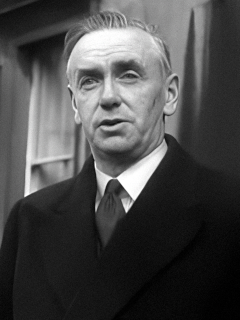
Costello is the younger son of John Costello senior, a civil servant, and Rose Callaghan. He is educated at St. Joseph’s, Fairview, and then moves to O’Connell School, for senior classes, and later attends University College Dublin (UCD), where he graduates with a degree in modern languages and law. He studies at King’s Inns to become a barrister, winning the Victoria Prize there in 1913 and 1914. He is called to the Irish Bar in 1914, and practises as a barrister until 1922.
In 1922, Costello joins the staff at the office of the Attorney General in the newly established Irish Free State. Three years later he is called to the inner bar, and the following year, 1926, he becomes Attorney General of Ireland, upon the formation of the Cumann na nGaedheal government, led by W. T. Cosgrave. While serving in this position he represents the Free State at Imperial Conferences and League of Nations meetings.
Costello is also elected a Bencher of the Honourable Society of King’s Inns. He loses his position as Attorney General of Ireland when Fianna Fáil comes to power in 1932. The following year, however, he is elected to Dáil Éireann as a Cumann na nGaedheal TD. Cumann na nGaedheal soon merges with other parties to form Fine Gael.
During the Dáil debate on the Emergency Powers Act 1939, Costello is highly critical of the Act’s arrogation of powers, stating that “We are asked not merely to give a blank cheque, but to give an uncrossed cheque to the Government.” He loses his seat at the 1943 Irish general election but regains it when Éamon de Valera calls a snap election in 1944. From 1944 to 1948, he is the Fine Gael front-bench Spokesman on External Affairs.
In 1948, Fianna Fáil has been in power for sixteen consecutive years and has been blamed for a downturn in the economy following World War II. The 1948 Irish general election results show Fianna Fáil short of a majority, but still by far the largest party, with twice as many seats as the nearest rival, Fine Gael. It appears that Fianna Fáil is headed for a seventh term in government. However, the other parties in the Dáil realise that between them, they have only one seat fewer than Fianna Fáil, and if they band together, they would be able to form a government with the support of seven Independent deputies. Fine Gael, the Labour Party, the National Labour Party, Clann na Poblachta and Clann na Talmhan join to form the first inter-partygovernment in the history of the Irish state.
While it looks as if cooperation between these parties will not be feasible, a shared opposition to Fianna Fáil and Éamon de Valera overcomes all other difficulties, and the coalition government is formed.
Since Fine Gael is the largest party in the government, it has the task of providing a suitable candidate for Taoiseach. Naturally, it is assumed that its leader, Richard Mulcahy, will be offered the post. However, he is an unacceptable choice to Clann na Poblachta and its deeply republican leader, Seán MacBride. This is due to Mulcahy’s record during the Irish Civil War. Instead, Fine Gael and Clann na Poblachta agree on Costello as a compromise candidate. Costello had never held a ministerial position nor was he involved in the Civil War. When told by Mulcahy of his nomination, Costello is appalled, content with his life as a barrister and as a part-time politician. He is persuaded to accept the nomination as Taoiseach by close non-political friends.
During the campaign, Clann na Poblachta had promised to repeal the Executive Authority (External Relations) Act 1936 but does not make an issue of this when the government is being formed. However, Costello and his Tánaiste, William Norton of the Labour Party, also dislike the act. During the summer of 1948, the cabinet discusses repealing the act, however, no firm decision is made.
In September 1948, Costello is on an official visit to Canada when a reporter asks him about the possibility of Ireland leaving the British Commonwealth. For the first time, he declares publicly that the Irish government is indeed going to repeal the External Relations Act and declare Ireland a republic. It has been suggested that this is a reaction to offence caused by the Governor General of Canada at the time, Harold Alexander, 1st Earl Alexander of Tunis, who is of Northern Irish descent and who allegedly arranges to have placed symbols of Northern Ireland in front of Costello at an official dinner. Costello makes no mention of these aspects on the second reading of the Republic of Ireland Bill on November 24 and, in his memoirs, claims that Alexander’s behaviour had in fact been perfectly civil and could have had no bearing on a decision which had already been made.
The news takes the Government of the United Kingdom and even some of Costello’s ministers by surprise. The former had not been consulted and following the declaration of the Republic in 1949, the UK passes the Ireland Act that year. This recognises the Republic of Ireland and guarantees the position of Northern Ireland within the United Kingdom for so long as a majority there want to remain in the United Kingdom. It also grants full rights to any citizens of the Republic living in the United Kingdom. Ireland leaves the Commonwealth on April 18, 1949, when The Republic of Ireland Act 1948 comes into force. Frederick Henry Boland, Secretary of the Department of External Affairs, says caustically that the affair demonstrates that “the Taoiseach has as much notion of diplomacy as I have of astrology.” The British envoy, John Maffey, 1st Baron Rugby, is equally critical of what he calls a “slipshod and amateur” move.
Many nationalists now see partition as the last obstacle on the road to total national independence. Costello tables a motion of protest against partition on May 10, 1949, without result.
In 1950, the independent-minded Minister for Health, Noël Browne, introduces the Mother and Child Scheme. The scheme would provide mothers with free maternity treatment and their children with free medical care up to the age of sixteen, which is the normal provision in other parts of Europe at that time. The bill is opposed by doctors, who fear a loss of income, and Roman Catholic bishops, who oppose the lack of means testing envisaged and fear the scheme could lead to birth control and abortion. The cabinet is divided over the issue, many feeling that the state cannot afford such a scheme priced at IR£2,000,000 annually. Costello and others in the cabinet make it clear that in the face of such opposition they will not support the Minister. Browne resigns from the government on April 11, 1951, and the scheme is dropped. He immediately publishes his correspondence with Costello and the bishops, something which had hitherto not been done. Derivatives of the Mother and Child Scheme are introduced in Public Health Acts of 1954, 1957 and 1970.
The Costello government has a number of noteworthy achievements. A new record is set in housebuilding, the Industrial Development Authority and Córas Tráchtála are established, and the Minister for Health, Noel Browne, with the then new Streptomycin, bring about an advance in the treatment of tuberculosis. Ireland also joins a number of organisations such as the Organization for European Economic Co-operation and the Council of Europe. However, the government refuses to join NATO, allegedly because the British remain in Northern Ireland. The scheme to supply electricity to even the remotest parts of Ireland is also accelerated.
While the “Mother and Child” incident does destabilise the government to some extent, it does not lead to its collapse as is generally thought. The government continues; however, prices are rising, a balance of payments crisis is looming, and two TDs withdraw their support for the government. These incidents add to the pressure on Costello and so he decides to call a general election for June 1951. The result is inconclusive but Fianna Fáil returns to power. Costello resigns as Taoiseach. It is at this election that his son Declan is elected to the Dáil.
Over the next three years while Fianna Fáil is in power a dual-leadership role of Fine Gael is taking place. While Richard Mulcahy is the leader of the party, Costello, who has proved his skill as Taoiseach, remains as parliamentary leader of the party. He resumes his practice at the Bar. In what is arguably his most celebrated case, the successful defence of The Leader against a libel action brought by the poet Patrick Kavanagh, dates from this period. Kavanagh generously praises Costello’s forensic skill, and the two men become friends.
At the 1954 Irish general election Fianna Fáil loses power. A campaign dominated by economic issues results in a Fine Gael-Labour Party-Clann na Talmhan government coming to power. Costello is elected Taoiseach for the second time.
The government can do little to change the ailing nature of Ireland’s economy, with emigration and unemployment remaining high, and external problems such as the Suez Crisis compounding the difficulty. Measures to expand the Irish economy such as export profits tax relief introduced in 1956 would take years have sizable impact. Costello’s government does have some success with Ireland becoming a member of the United Nations in 1955, and a highly successful visit to the United States in 1956, which begins the custom by which the Taoiseach visits the White House each St. Patrick’s Day to present the U.S. President with a bowl of shamrock. Although the government has a comfortable majority and seems set for a full term in office, a resumption of Irish Republican Army (IRA) activity in Northern Ireland and Great Britain causes internal strains. The government takes strong action against the republicans.
In spite of supporting the government from the backbenches, Seán MacBride, the leader of Clann na Poblachta, tables a motion of no confidence, based on the weakening state of the economy and in opposition to the government’s stance on the IRA. Fianna Fáil also tables its own motion of no confidence, and rather than face almost certain defeat, Costello again asks PresidentSeán T. O’Kelly to dissolve the Oireachtas. The general election which follows in 1957 gives Fianna Fáil an overall majority and starts another sixteen years of unbroken rule for the party. Some of his colleagues questioned the wisdom of his decision to call an election. The view is expressed that he was tired of politics and depressed by his wife’s sudden death the previous year.
Following the defeat of his government, Costello returns to the bar. In 1959, when Richard Mulcahy resigns the leadership of Fine Gael to James Dillon, he retires to the backbenches. He could have become party leader had he been willing to act in a full-time capacity. He remains as a TD until 1969, when he retires from politics, being succeeded as Fine Gael TD for Dublin South-East by Garret FitzGerald, who himself goes onto to become Taoiseach in a Fine Gael-led government.
During his career, Costello is presented with a number of awards from many universities in the United States. He is also a member of the Royal Irish Academy from 1948. In March 1975, he is made a freeman of the city of Dublin, along with his old political opponent Éamon de Valera. He practises at the bar until a short time before his death at the age of 84, in Ranelagh, Dublin, on January 5, 1976. He is buried at Dean’s Grange Cemetery in Dublin.
Cooney is the second of three children of John Cooney and Mary Ann Cooney (née Gleeson), middling farmers. While his grandfather, Patrick Cooney, from nearby Garrykennedy, is reputed to have been a member of the Irish Republican Brotherhood (IRB) and an Irish National Land League activist, his father does not have any inclination towards radical politics. He is educated at Lissenhall national school and St. Joseph’s CBS, Nenagh. In October 1916, he commences studies in medicine at University College Dublin (UCD) just as the Irish War of Independence is getting underway. He plays briefly with the College’s hurling club.
In 1917, Cooney joins the Third Battalion of the Dublin Brigade of the Irish Republican Army (IRA). A year later he is jailed for two months in Mountjoy Prison and Crumlin Road Gaol, Belfast, for illegal drilling. Joining the IRB at the end of 1918, he assists in the December 1918 election by protecting candidates and acts as a guard at sittings of the First Dáil. On June 26, 1920, he plays a major role in the attack on BorrisokaneRoyal Irish Constabulary (RIC) barracks. He takes part in the Bloody Sunday operations of November 21, 1920, at 28 Upper Pembroke Street where a number of British agents are killed and attends Croke Park afterwards. He then goes on the run as a full-time Volunteer and serves with the Dublin Brigade active service unit (ASU).
After the Anglo-Irish truce of July 1921, Cooney is appointed Officer Commanding (O/C) of the 1st Kerry Brigade, IRA, reorganising it and forming a flying column. Opposing the Anglo-Irish Treaty of 1921, he does not immediately break with GHQ, who sends him to organise the 1st Eastern Division. Later in January 1922, the Chief of Staff, Eoin O’Duffy, asks him to become O/C of the 3rd Eastern Division, but later rescinds the appointment. In March 1922 he is appointed O/C of the 1st Eastern Division of the anti-Treaty IRA during the Irish Civil War.
That same year he is captured by Free State forces and interned in Mountjoy Prison, where he becomes O/C of the prisoners in C Wing. He accepts responsibility for an attempted escape bid on October 10, 1922, in which a fellow prisoner, Peadar Breslin, is killed and another man is wounded. After sojourns in Newbridge and Arbour Hill Prison, he is moved with the other leaders to Kilmainham Gaol, where he spends forty-one days on hunger strike. Removed to Harepark Camp, the Curragh, on January 1, 1924, he is among the last to be released on May 29, 1924.
Cooney succeeds Frank Aiken as Chief of Staff of the IRA on November 18, 1925. Central to the reorganisation scheme he puts in place is the need to secure American funds for the IRA and to combat Frank Aiken’s fundraising work in the United States since December 1925 on behalf of the embryo Fianna Fáil organisation. Receiving permission on April 21, 1926, he departs on a fund-raising trip to the United States but returns to Ireland in October. He resigns as chief of staff in favour of Maurice Twomey but retains his position as chairman of the IRA executive until November 21, 1927, when he obtains leave to complete his medical studies.
After internship in the Mater Hospital, Dublin, Cooney finds temporary employment in London, but remains in touch with GHQ. On September 27, 1929, he marries the German-educated Frances (‘Frank’) Brady, daughter of a wealthy Belfast linen family and former Cumann na mBan activist and hunger-striker. The marriage is not a success. Failing to secure employment due to police harassment and the loyalty test then in force, he and his wife are obliged to emigrate to London, where he practises as a GP, still maintaining his IRA links. Their only child, Seán, is born there in 1931. He returns to Ireland in August 1932, after Fianna Fáil’s accession to power.
An intimate friend of Maurice Twomey, who is still Chief of Staff, Cooney remains in the upper echelons of the IRA and attends its conventions. Signifying his standing in republican circles, he is chosen to unveil, inter alia, the Fenian memorial in Glasnevin Cemetery and the Seán Treacy plaque in Talbot Street, Dublin, and is a regular speaker at commemorations. In March 1940, he attempts to intercede with Éamon de Valera on behalf of hunger-striking republicans, and is later arrested, but released.
After the discovery of a German spy ring in the hospitals commission’s subsidiary, the Dublin Hospitals Bureau, Cooney is forced to resign in April 1942 on refusing to take a loyalty pledge to the state. He returns to private practice. He becomes active in the unsuccessful campaign to save Charlie Kerins, Chief of Staff, from being hanged in 1944. In anticipation of emigrating, he finally resigns from the IRA in 1944, though military and police surveillance continue until March 1945.
In August 1945, Cooney joins the United Nations Relief and Rehabilitation Administration, working with displaced persons in the American zone in Germany, and gains rapid promotion. After joining the International Refugee Organisation (UNRRA’s successor) on July 1, 1947, he becomes the chief medical officer of an area including the American sector of Berlin and containing 150,000 displaced persons. He later holds a similar post in Bavaria.
Appointed a part-time member of the hospitals commission by the inter-party government in September 1949 and in severe financial straits, Cooney emigrates alone to the United States on December 2, 1950, and never returns. While employed in a tuberculosissanatorium in New Jersey, he obtains by examination his licence to practise medicine in Maryland on January 14, 1954. Admitted a member of the American College of Chest Physicians, again by examination, on November 23, 1954, he secures, at the age of 57, his first ever permanent post in medicine, in a similar hospital in Pikesville, Maryland. His republican activities continue through Clan na Gael during his U.S. years, and he is a frequent speaker at commemorative events.
(Pictured: Liam Lynch with some of his Divisional Staff and Officers of the Brigades, including the 1st Southern Division, who attend as delegates to the Army Convention at the Mansion House, Dublin, on April 9, 1922. Cooney is first on the right in the 3rd row back.)






 seamus dubhghaill