seamus dubhghaill

Promoting Irish Culture and History from Little Rock, Arkansas, USA


Leave a comment

Birth of Pat Eddery, Flat Racing Jockey & Trainer

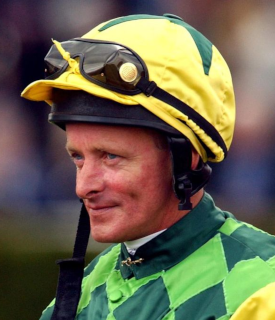
Patrick (Pat) James John Eddery, flat racing jockey and trainer, is born on March 18, 1952, in Newbridge, County Kildare, near the Curragh Racecourse. He is the fifth of twelve children of Jimmy Eddery, a jockey who is Irish Flat Champion in 1954 and 1955, and who rides Panaslipper to win the Irish Derby in 1955. His mother, Josephine, is the daughter of Jack Moylan, also a jockey. His brother Paul goes on to become a successful jockey also. He initially attends the Patrician Brothers’ Primary School in Newbridge, later enrolling in Oatlands Primary School in Stillorgan when the family moves to Blackrock, Dublin.

Devoted from his earliest years to riding horses, Eddery has little interest in school. He begins his career on his fourteenth birthday as an apprentice jockey in Ireland (1966–67) with the stable of Seamus McGrath. In 1967, he moves to England where he is apprenticed to Frenchie Nicholson until 1972. After riding for more than a season without success, he records his first win on April 24, 1969, at Epsom Downs Racecourse on a horse named Alvaro, trained by Major Michael Pope. Alvaro provides Eddery with six wins in succession during the 1969 season.

Eddery finishes the 1971 season as champion apprentice with seventy-one winners, and in 1972 has his first Derby ride, the 50–1 chance Pentland Firth, who finishes third behind Roberto and Rheingold. In 1972 he also has his first victory in a Group 1 race via Erimo Hawk, when awarded the Ascot Gold Cup following the disqualification of Rock Roi for interference.

Eddery rides for the Newmarket trainer Geoffrey Barling in 1972 before becoming the stable jockey for leading trainer, Peter Walwyn, later that year. For Walwyn, he wins his first two English classic races on Polygamy (Oaks) and Grundy (Derby) and is Champion Jockey in four consecutive seasons from 1974 to 1977. While under retainer with Walwyn, he clinches the first of these titles when just twenty-two years old, a record in the post-war era. In 1975, after winning the Irish Derby on Grundy, he rides the horse to a hard-fought victory over Bustino in the King George VI and Queen Elizabeth Stakes at Ascot in what is described by many at the time as “the race of the century.”

Eddery remains as stable jockey to Walwyn for eight years, before joining the Ballydoyle racehorse training facility of legendary Irish trainer Vincent O’Brien, for whom he rides a string of big-race winners, including the brilliant Golden Fleece, owned by Robert Sangster, in the 1982 Epsom Derby.

The O’Brien–Eddery combination experiences controversial defeat in the 1984 Epsom Derby when Eddery rides then unbeaten 2000 Guineas Stakes-winner El Gran Senor and seems to be cruising to victory in the final furlong, only to be caught on the line and beaten by a short head by Secreto, trained by O’Brien’s son David. He later admits that he should have won the race, but when the horses in front of him fell away early in the straight he was left in front too soon and was unable to repel Secreto’s late challenge. He later wins the Irish Derby on El Gran Senor, beating the subsequent Prix de L’Arc de Triomphe winner, Rainbow Quest. During 1984, he also partners the O’Brien-trained and subsequent outstanding stallion, Sadler’s Wells, to two of his three Group 1 successes.

The 1980s represent the pinnacle of Eddery’s career and include victories in the 1983 Arlington Million in Chicago on Tolomeo, the 1985 Breeders’ Cup Turf at Aqueduct Racetrack, New York, on Pebbles, and the 1986 Japan Cup on Jupiter Island, the latter two horses being trained by Clive Brittain. He also has four victories in the Prix de l’Arc de Triomphe: on Detroit in 1980, Rainbow Quest in 1985, the great Dancing Brave, on whom he also wins the King George VI and Queen Elizabeth Stakes in 1986, and Trempolino in 1987. The field for the 1986 ‘Arc’ is extremely strong and Dancing Brave’s late winning run a thrilling spectacle. The race is voted “the greatest ever horserace” in a poll conducted by the Racing Post in 2022.

Rainbow Quest and Dancing Brave are both owned by the Saudi Prince Khalid Abdullah, whose Juddmonte Farms is by then one of the world’s largest racing and breeding organisations. In 1987, Eddery becomes Abdullah’s retained jockey. Highlights of their association, which lasts until 1994, include Quest for Fame winning the 1990 Epsom Derby, and Zafonic, winner of the 1993 2000 Guineas Stakes.

Meanwhile, Eddery continues to win the jockeys’ championships, a task made easier by being retained by Juddmonte in England rather than commuting regularly to Ireland to ride for Vincent O’Brien. His highest seasonal total of wins is 209 in 1990, which is the first time a jockey has exceeded 200 since Sir Gordon Richards in 1952. His epic battle for the championship in 1987 with American Steve Cauthen is particularly intense, with Cauthen securing the title with 197 winners and Eddery coming close at 195. The title would have been shared at 196 winners apiece but for a successful objection by the rider of the third horse to the winner after the last definitive race between Eddery and Cauthen when they finished first and second, respectively. In 1988, Eddery retains the title with 183 winners from just over 480 rides, a remarkable strike rate of over thirty-eight per cent. He wins the championship for the eleventh and final time in 1996. His final classic win is on Silver Patriarch in the St. Leger Stakes of 1997.

Eddery rides major winners outside Europe and the United States, including Jupiter Island in the 1986 Japan Cup, and French Glory in the Canadian International Stakes. He teams up with Lester Piggott, Joe Mercer and French jockeys Freddie Head and Yves Saint-Martin to take part in a series of challenge races under the Ritz Club Challenge Trophy at Singapore and other Asian cities starting in 1983 for several years. His overall total of winners in the UK, Ireland, mainland Europe and overseas, exceeds 6,000. Although fiercely competitive on the racetrack, he is popular with fellow jockeys, trainers, owners and racegoers, who respond to his good-natured personality, courtesy and sense of humour.

Eddery has a distinctive riding style that is not classically elegant but undoubtedly effective and strong in a finish. He rides a number of truly outstanding racehorses including Dancing Brave, El Gran Senor and Pebbles, but maintains that the brilliant and undefeated Derby winner, Golden Fleece, is the greatest of all the horses he partnered throughout his career.

Eddery continues to ride into his fifties, finally retiring in 2003. He is appointed an honorary Order of the British Empire (OBE) in 2005. He sets up an owners’ syndication business and takes out a training licence but has difficulty adjusting to life out of the saddle and becomes increasingly dependent upon alcohol. His training career meets with limited success, though he does train Hearts of Fire to win the Group 1 Gran Criterium of Italy in 2009.

Eddery marries Carolyn Mercer in November 1978. She is the daughter of flat jockey Manny Mercer, niece of jockey Joe Mercer, and granddaughter of jockey Harry Wragg. They have two daughters, Nichola and Natasha, and a son Harry. He has a son from an extramarital relationship, Toby Atkinson, who also becomes a jockey. The marriage with Carolyn breaks down in 2008 and the couple divorces in 2009.

Shortly after his marriage breaks down, Eddery begins living with Emma Owen, a former stable employee, at his 100-acre Musk Hill stud farm near Aylesbury, Buckinghamshire. He becomes progressively estranged from his children due to his continued alcoholism.

Eddery dies of a heart attack at the age of 63 on November 10, 2015. He leaves his £1.3 million estate to Emma Owen. His funeral takes place on December 8, 2015, and his remains are cremated at Oxford. Throughout his career, Eddery rode the winners of 4,632 British flat races, a figure exceeded only by Sir Gordon Richards and was UK Champion Jockey on eleven occasions and Irish Champion Jockey once. A plaque in his honour is unveiled by his children Nichola, Natasha and Harry at Ascot Racecourse in 2016, where he had been champion jockey at the Royal meeting on six occasions. He is inducted into the Qipco British Champions Series Hall of Fame in 2021, the second jockey after Lester Piggott to be so honoured.

(From: “Eddery, Patrick (Pat) James John” by P. Gerry McKenna, Dictionary of Irish Biography, http://www.dib.ie, September 2022)


Leave a comment

Birth of George Berkeley, Anglican Bishop of Cloyne

George Berkeley, Bishop of Cloyne of the Anglican Church of Ireland known as Bishop Berkeley, is born at his family home, Dysart Castle, near Thomastown, County Kilkenny, on March 12, 1685. He is an Anglo-Irish philosopher whose primary achievement is the advancement of a theory he calls “immaterialism” (later referred to as “subjective idealism” by others). This theory denies the existence of material substance and instead contends that familiar objects like tables and chairs are ideas perceived by the mind and, as a result, cannot exist without being perceived. He is also known for his critique of abstraction, an important premise in his argument for immaterialism.

Berkeley is the eldest son of William Berkeley, a cadet of the noble family of Berkeley whose ancestry can be traced back to the Anglo-Saxon period and who had served as feudal lords and landowners in Gloucester, England. Little is known of his mother. He is educated at Kilkenny College and attends Trinity College Dublin, where he is elected a Scholar in 1702, being awarded BA in 1704 and MA and a Fellowship in 1707. He remains at Trinity College after completion of his degree as a tutor and Greek lecturer.

Berkeley’s earliest publication is on mathematics, but the first that brings him notice is his An Essay Towards a New Theory of Vision, first published in 1709. In the essay, he examines visual distance, magnitude, position and problems of sight and touch. While this work raises much controversy at the time, its conclusions are now accepted as an established part of the theory of optics.

The next publication to appear is A Treatise Concerning the Principles of Human Knowledge in 1710, which has great success and gives him a lasting reputation, though few accept his theory that nothing exists outside the mind. This is followed in 1713 by Three Dialogues between Hylas and Philonous, in which he propounds his system of philosophy, the leading principle of which is that the world, as represented by our senses, depends for its existence on being perceived.

For this theory, the Principles gives the exposition and the Dialogues the defence. One of his main objectives is to combat the prevailing materialism of his time. The theory is largely received with ridicule, while even those such as Samuel Clarke and William Whiston, who do acknowledge his “extraordinary genius,” are nevertheless convinced that his first principles are false.

Shortly afterwards, Berkeley visits England and is received into the circle of Joseph Addison, Alexander Pope and Richard Steele. In the period between 1714 and 1720, he intersperses his academic endeavours with periods of extensive travel in Europe, including one of the most extensive Grand Tours of the length and breadth of Italy ever undertaken. In 1721, he takes holy orders in the Church of Ireland, earning his doctorate in divinity, and once again chooses to remain at Trinity College Dublin, lecturing this time in Divinity and in Hebrew. In 1721-22 he is made Dean of Dromore and, in 1724, Dean of Derry.

In 1723, following her violent quarrel with Jonathan Swift, who had been her intimate friend for many years, Esther Vanhomrigh names Berkeley her co-heir along with the barrister Robert Marshall. Her choice of legatees causes a good deal of surprise since she does not know either of them well, although Berkeley as a very young man had known her father. Swift says generously that he does not grudge Berkeley his inheritance, much of which vanishes in a lawsuit in any event. A story that Berkeley and Marshall disregarded a condition of the inheritance that they must publish the correspondence between Swift and Vanhomrigh is probably untrue.

In 1725, Berkeley begins the project of founding a college in Bermuda for training ministers and missionaries in the colony, in pursuit of which he gives up his deanery with its income of £1100.

In 1728, Berkeley marries Anne Forster, daughter of John Forster, Chief Justice of the Irish Common Pleas, and his first wife Rebecca Monck. He then goes to America on a salary of £100 per annum. He lands near Newport, Rhode Island, where he buys a plantation at Middletown – the famous “Whitehall.” He purchases several enslaved Africans to work on the plantation. He also brings John Smibert to New England, the Scottish artist he “discovered” in Italy, who is generally regarded as the founding father of American portrait painting. Meanwhile, he draws up plans for the ideal city he plans to build on Bermuda. He lives at the plantation while he waits for funds for his college to arrive. The funds, however, are not forthcoming and he leaves America and returns to London in 1732.

Berkeley and his wife have four children who survive infancy: Henry, George, William and Julia, and at least two other children who die in infancy. William’s death in 1751 is a great cause of grief to his father.

Berkeley is nominated to be the Bishop of Cloyne in the Church of Ireland on January 18, 1734. He is consecrated as such on May 19, 1734. He is the Bishop of Cloyne until his death on January 14, 1753, although he dies at Oxford.

While living in London’s Saville Street, Berkeley takes part in efforts to create a home for the city’s abandoned children. The Foundling Hospital is founded by royal charter in 1739, and Berkeley is listed as one of its original governors.

Berkeley’s last two publications are Siris: A Chain of Philosophical Reflexions and Inquiries Concerning the Virtues of Tarwater, And divers other Subjects connected together and arising one from another (1744) and Further Thoughts on Tar-water (1752). Pine tar is an effective antiseptic and disinfectant when applied to cuts on the skin, but he argues for the use of pine tar as a broad panacea for diseases. His 1744 work on tar-water sells more copies than any of his other books during Berkeley’s lifetime.

Berkeley remains at Cloyne until 1752, when he retires. With his wife and daughter Julia, he goes to Oxford to live with his son George and supervise his education. He dies soon afterwards and is buried in Christ Church Cathedral, Oxford. His affectionate disposition and genial manners make him much loved and held in warm regard by many of his contemporaries. Anne outlives her husband by many years, dying in 1786.

(Pictured: “Bishop George Berkeley,” oil on canvas portrait by John Smibert, c. 1727)


Leave a comment

Giovanni Battista Rinuccini, Nuncio to Ireland, Returns to Rome

Giovanni Battista Rinuccini, an Italian Roman Catholic archbishop in the mid-seventeenth century, returns to Rome on February 23, 1649, after spending just over three years in Ireland supporting Catholics with arms, money, and diplomacy.

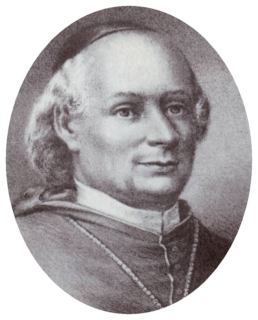
Rinuccini is born in Rome on September 15, 1592. He is educated by the Jesuits in Rome and studies law at the Universities of Bologna and Perugia. In due course, he is ordained a priest, having at the age of twenty-two obtained his doctor’s degree from the University of Pisa. He is named a camariere (chamberlain) by Pope Gregory XV and in 1625 becomes Archbishop of Fermo. In 1631 he carefully refuses an offer to be made Archbishop of Florence.

On September 15, 1644, a new pope, Pope Innocent X, is elected. He decides to step up the help for the Irish Catholic Confederates. He sends Rinuccini as nuncio to Ireland to replace the envoy Friar Pierfrancesco Scarampi, who had been sent to Ireland by his predecessor, Pope Urban VIII, in 1643.

Rinuccini departs France from Saint-Martin-de-Ré near La Rochelle on October 18, 1645, on the frigate San Pietro and arrives in Kenmare, County Kerry, on October 21, 1645, with a retinue of twenty-six Italians, several Irish officers, and the Confederation’s secretary, Richard Bellings. He proceeds to Kilkenny, the Confederate capital, where Richard Butler, 3rd Viscount Mountgarret, the president of the Confederation, receives him at the castle. He speaks Latin to Montgarret, but all the official business of the Confederates is done in English. He asserts in his discourse that the object of his mission is to sustain the King, but above all to help the Catholic people of Ireland in securing the free and public exercise of their religion, and the restoration of the churches and church property to the Catholic Church.

Rinuccini had sent ahead arms and ammunition: 1,000 braces of pistols, 4,000 cartridge belts, 2,000 swords, 500 muskets and 20,000 pounds of gunpowder. He arrives twelve days later with a further two thousand muskets and cartridge-belts, four thousand swords, four hundred braces of pistols, two thousand pike-heads, and twenty thousand pounds of gunpowder, fully equipped soldiers and sailors and 150,658 livres tournois to finance the Irish Catholic war effort. These supplies give him a huge input into the Confederate’s internal politics because he doles out the money and arms for specific military projects, rather than handing them over to the Confederate government, or Supreme Council.

Rinuccini hopes that by doing so he can influence the Confederates’ strategic policy away from making a deal with Charles I and the Royalists in the English Civil War and towards the foundation of an independent Catholic-ruled Ireland. In particular, he wants to ensure that churches and lands taken in the rebellion would remain in Catholic hands. This is consistent with what happened in Catholic-controlled areas during the Thirty Years’ War in Germany. His mission can be seen as part of the Counter-Reformation in Europe. He also has unrealistic hopes of using Ireland as a base to re-establish Catholicism in England. However, apart from some military successes such as the Battle of Benburb on June 5, 1646, the main result of his efforts is to aggravate the infighting between factions within the Confederates.

The Confederates’ Supreme Council is dominated by wealthy landed magnates, predominantly of “Old English” origin, who are anxious to come to a deal with the Stuart monarchy that will guarantee them their land ownership, full civil rights for Catholics, and toleration of Catholicism. They form the moderate faction, which is opposed by those within the Confederation, who want better terms, including self-government for Ireland, a reversal of the land confiscations of the plantations of Ireland and establishment of Catholicism as the state religion. A particularly sore point in the negotiations with the English Royalists is the insistence of some Irish Catholics on keeping in Catholic hands the churches taken in the war. Rinuccini accepts the assurances of the Supreme Council that such concerns will be addressed in the peace treaty negotiated with James Butler, 1st Duke of Ormond, negotiated in 1646, now known as the First Ormond Peace.

However, when the terms are published, they grant only the private practice of Catholicism. Alleging that he had been deliberately deceived, Rinuccini publicly backs the militant faction, which includes most of the Catholic clergy and some Irish military commanders such as Owen Roe O’Neill. On the other side there are the Franciscans Pierre Marchant, and later Raymond Caron. In 1646, when the Supreme Council tries to get the Ormond Peace ratified, Rinuccini excommunicates them and helps to get the Treaty voted down in the Confederate General Assembly. The Assembly has the members of the Supreme Council arrested for treason and elects a new Supreme Council.

However, the following year, the Confederates’ attempts to drive the remaining English (mainly Parliamentarian) armies from Ireland meets with disaster at the battles of Dungan’s Hill on August 8, 1647 and Knocknanuss on November 13, 1647. As a result, the chastened Confederates hastily conclude a new deal with the English Royalists to try to prevent a Parliamentarian conquest of Ireland in 1648. Although the terms of this second deal are better than those of the first one, Rinuccini again tries to overturn the treaty. However, on this occasion, the Catholic clergy are split on whether to accept the deal, as are the Confederate military commanders and the General Assembly. Ultimately, the treaty is accepted by the Confederacy, which then dissolves itself and joins a Royalist coalition. Rinuccini backs Owen Roe O’Neill, who used his Ulster army to fight against his former comrades who had accepted the deal. He tries in vain to repeat his success of 1646 by excommunicating those who support the peace. However, the Irish bishops are split on the issue and so his authority is diluted. Militarily, Owen Roe O’Neill is unable to reverse the political balance.

Despairing of the Catholic cause in Ireland, Rinnuccini leaves the country on February 23, 1649, embarking at Galway on the ship that had brought him to Ireland, the frigate San Pietro. In the same year, Oliver Cromwell leads a Parliamentarian re-conquest of the country, after which Catholicism is thoroughly repressed. Roman Catholic worship is banned, Irish Catholic-owned land is widely confiscated east of the River Shannon, and captured Catholic clergy are executed.

Rinuccini returns to Rome, where he writes an extensive account of his time in Ireland, the Commentarius Rinuccinanus. His account blames personal vainglory and tribal divisions for the Catholic disunity in Ireland. In particular, he blames the Old English for the eventual Catholic defeat. The Gaelic Irish, he writes, despite being less civilised, are more sincere Catholics.

Rinuccini returns to his diocese in Fermo in June 1650 and dies there on December 13, 1653.


Leave a comment

Birth of Cecil King, Painter & Collector

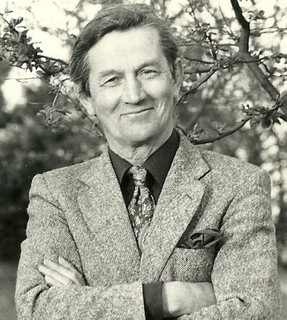
Cecil King, painter and collector, is born on February 22, 1921, at Rathdrum, County Wicklow.

King is the son of Henry King, businessman, of Rathdrum, and Susan King (née Crowe). He is educated at the Church of Ireland Ranelagh School, Athlone, and at Mountjoy School, Clontarf, Dublin (1936–39). Subsequently he joins the printing firm of W. & S. McGowan in Dundalk, where he goes on to become a director. During the 1940s his interest in amateur drama leads him to take classes at the Gaiety School of Acting in Dublin, where his fellow students include Milo O’Shea and Eamonn Andrews. Around this time, he is also involved in An Óige (the Irish Youth Hostel Association), in which he serves as honorary national secretary and honorary treasurer. This involvement leads him to travel extensively from the late 1940s around Europe, where he visits many major art museums and galleries.

King begins to acquire works of art, by both European and Irish artists, and by the mid-1950s he has amassed one of the most important collections of modern art in Ireland. Around 1954 he himself begins to paint, under the guidance of Barbara Warren and the English artist Neville Johnson. In his early work he focuses on urban scenes, often based on the area of Ringsend, Dublin, where he uses subdued tones to produce poetic images of a sombre mood. Even here his interest in the formal qualities of painting – such as the flatness of the picture surface and the juxtaposition of areas of colour on it, which becomes a defining feature of his art – is evident. In 1964 he leaves his successful business career behind in order to devote himself entirely to art, a bold move considering the limited audience for modern art that exists in Ireland at the time. In his own words he recalls how “Painting was what I wanted to do, I realised I didn’t need a car. I could do without an awful lot of things.” (Sunday Independent, November 7, 1982)

By this time, King is working in a fully abstract style. However, he still draws his inspiration from the external world, particularly the milieu of the circus. A painting such as Trapeze (1976; Allied Irish Bank collection) shows how he responds to acrobatic performance, not in any literal or figurative sense, but to the tensions and balances inherent within it. The overall effect is to convey to the viewer the essence of anticipation of the performance. Indeed, his works can create an almost physical sense of involvement on the part of the viewer. This is especially true of his Berlin Suite, a series of screen-prints produced as a result of a visit to East Berlin and published by Editions Alecto of London (1970). He is also inspired to produce a number of paintings on this theme of the claustrophobia of the divided city. Ultimately, he aspires to create works which, with their economy and restraint, achieve a meticulously balanced harmony. This concern leads him, in such works as the Baggot Street Series, to move away from even the most veiled figurative references, evidence for the fact that he constantly strives to further his artistic explorations.

King often works seven days a week. This quiet determination contributes in no small part to the international standing he soon achieves, as does his prolific record as an exhibitor. Writing a foreword to an exhibition of his work at Kilkenny in 1975, the critic William Packer finds that King’s art “confounds the expectations we might have of Irish art, for it is far from local in ambition, accomplishment, and seriousness.” He mounts over twenty-five one-man exhibitions and contributes to a large number of group shows in Ireland and abroad. A significant proportion of his output is to be found in galleries in Europe and the United States, including the Museum of Modern Art, New York, and the Tate Gallery, London. He is also represented in the major public and corporate collections in Ireland, such as the Irish Museum of Modern Art, Ulster Museum, Trinity College Dublin (TCD), Crawford Municipal Gallery, Dublin City Gallery The Hugh Lane, Arts Council, Aer Lingus, Bank of Ireland, Allied Irish Bank, and ESB. In fact, King, with his hard-edge abstract style, is one of the very few artists working in Ireland at the time whose work is comparable to that of the major (principally American) international exponents of abstraction. The term “hard-edge,” applied to King’s style, may however belie the subtlety he could achieve in terms of his handling of colour and texture. This is particularly true of his works in the media of pastel and tapestry, while his last paintings show a tendency towards more expressive brushwork and a more complex approach to colour.

King enjoys a happy relationship with Oliver Dowling from 1960 to the time of his death, at Dún Laoghaire, County Dublin, on April 7, 1986, having suffered a heart attack just three days before an exhibition of his work is due to open in Dublin at the Oliver Dowling Gallery. His legacy is not alone artistic: he also makes a significant contribution to the promotion of modern art in Ireland in his capacity as a member of the organising committee for the Rosc exhibition since its inception in the 1960s, where his wide knowledge of international art is much respected. A member of Aosdána, he twice serves as commissioner for the Department of Foreign Affairs cultural committee. He is also generous in his encouragement of young artists, whose work he regularly adds to his own collection.

(From: “King, Cecil” by Rebecca Minch, Dictionary of Irish Biography, http://www.dib.ie, May 2012 | Pictured: Abstract, Oil on Canvas by Cecil King)


Leave a comment

Birth of Joseph Devlin, Journalist & Influential Nationalist Politician

Joseph Devlin, journalist and nationalist leader, is born on February 13, 1871, at Hamill Street in the Lower Falls area of Belfast, fourth son of Charles Devlin, car driver, and Elizabeth Devlin (née King), both recent migrants from the Lough Neagh area of east County Tyrone. He is educated at St. Mary’s Christian Brothers’ Grammar School in Divis Street until he is twelve. He proceeds to employment in Kelly’s Cellars public house near the city centre. From this unpromising background, he rises through a combination of ability, connections, and ambition to journalism with The Irish News (1891–93) and Freeman’s Journal (1895) and political position.

In his early years, Devlin is active in various local debating societies, where his associates include Cathal O’Byrne, who he retains a personal friendship despite later political differences. A committee member of the Belfast branch of the Irish National League (INL) in 1890, he joins the anti-Parnellite faction during the O’Shea divorce scandal (1891), becoming local secretary of the Irish National Federation (INF). His political model at this time is Thomas Sexton, MP for Belfast West, whose campaign he organises at the 1892 United Kingdom general election.

Although Healyism is strong in Catholic Ulster, Devlin aligns himself with the faction led by John Dillon and, from 1899, with the United Irish League (UIL), founded by William O’Brien. From the late 1890s this brings Devlin into conflict with the Belfast Catholic Association of Dr. Henry Henry, bishop of Down and Connor (1895–1908). This organisation, though sometimes regarded as Healyite, is essentially based on the view that mass nationalist political mobilisation in Belfast can only bring trouble and ostracism, and that Catholic interests are best represented by allowing a small group of lay and clerical notables to broker concessions from the unionist majority. After a series of local election contests in Catholic wards and controversies between the pro-Devlin weekly Northern Star and the clerically controlled The Irish News, Devlin succeeds in marginalising the politically maladroit Henry by 1905. In the process, however, he takes on some of the qualities of his “Catholic establishment” opponents. At the same time, he moves onto the national political stage.

Returned unopposed for North Kilkenny (1902–06), Devlin is appointed secretary of the United Irish League of Great Britain in 1903, and of the parent body in Dublin in 1904. A speaking tour of the United States in 1902–03 convinces him of the organisational potential of Catholic fraternal organisations, and in 1905 he takes over the presidency of the Board of Erin faction of the Ancient Order of Hibernians (AOH), a specifically Catholic body which he proceeds to develop as an organisational arm of the Nationalist Party. Under his tutelage the AOH expands from 10,000 members in 1905 to 60,000 in 1909, despite opposition from some Catholic bishops who distrust it because of its close affiliation to Dillonism, its secrecy, and its habit of staging dances and other entertainments without paying what they regard as due deference to local priests. His AOH also faces opposition from a rival separatist body, the Irish-American Alliance AOH. Though far less numerous, this group is able to draw on the support of separatists within the American AOH and hinder Devlin’s attempts to mobilise the American organisation in his support. The AOH expands further after 1910 and is strengthened by becoming an approved society under the National Insurance Act 1911.

Belfast is where Devlin’s political career begins and where it ends. Organisational skill contributes substantially to his hold on the largely working-class seat of Belfast West, which he wins in 1906 on a platform that seeks to transcend religious boundaries by combining labour issues with the home rule demand. A lifelong bachelor, though short in stature, he is apparently highly attractive to women, and takes a special interest in their problems, no doubt mindful of the influence they might have on the political behaviour of their spouses. He founds a holiday home for working-class women. When the scholar Betty Messenger interviews former Belfast linen workers in the late 1960s and early 1970s, she is startled to discover the extent to which Devlin is remembered as a champion of the workers decades after his death. This image persists among Protestant workers as well as Catholics, and he is generally credited with various ameliorations of workplace conditions even when he had not been responsible for them.

Possessed of great oratorical skills and even greater organisational ability, Devlin effectively becomes the key organiser of the Nationalist Party from the early years of the twentieth century, relieving the party leader, John Redmond, of a great deal of the administrative burden of party affairs, and becoming well known abroad through fund-raising trips, especially in North America. His personal geniality makes him a great favourite at Westminster, and Irish socialists are dismayed at the willingness of British Labour Party MPs to accept him as an authentic Labour representative. Several MPs elected after 1906 can be identified as his protégés, and groups of Hibernian strong-arm men uphold the party leadership in such contests as the 1907 North Leitrim by-election and the 1909 “baton convention” which witnesses the final departure of William O’Brien and his supporters from the UIL. He is the only post-Parnellite MP to be admitted to the tight leadership group around Redmond. In 1913 he is a leading organiser of the National Volunteers.

When William O’Brien embarks on his personal initiative to deal with the Ulster problem through conciliation in the early Edwardian period, he finds a stern critic in Devlin and in turn demonises the “Molly Maguires” as sectarian corruptionists. Personally non-sectarian, Devlin, like other party leaders, endorses the shibboleth that home rule will prove a panacea for Ireland’s problems, including Ulster, and uses his credentials as a labour representative to dismiss popular unionism as a mere product of elite manipulation. In a period when the Vatican‘s Ne Temere decree on religiously mixed marriages is heightening Protestant fears about the “tyranny” of Rome, he seems to be oblivious to how his integration of Hibernianism and nationalism is exacerbating that problem. As the third home rule bill passes through Parliament and the Ulster Volunteer Force (UVF) mobilises, he encourages the Irish party leaders in the view that the Ulster unionist campaign is a gigantic bluff, dismissing contrary opinions even when held by other nationalist MPs. During these years the AOH clashes with the Irish Transport and General Workers’ Union (ITGWU) during the Dublin lock-out, and from late 1913 the AOH spearheads the Redmondite attempt to take over and dominate the Irish Volunteers.

Devlin endorses Redmond’s support for the British war effort and engages in extensive recruiting activity. He seems to be motivated, at least in part, by the belief that after the war nationalist ex-soldiers can be used to overawe the Ulster unionists by the threat of force. According to Stephen Gwynn, Devlin wishes to apply for an officer’s commission but is asked not to do so by Redmond on the grounds that the party needs his organisational skills.

Devlin’s career is decisively shaped by his decision to use his influence to persuade northern nationalists to accept temporary partition, in fulfilment of the flawed agreement arrived at between David Lloyd George, Sir Edward Carson, and Redmond in the aftermath of the 1916 Easter Rising. He later claims he has been decisively influenced by the prospect that under this agreement the excluded area would be governed directly from Westminster, rather than by a local, Orange-dominated parliament. He forces the agreement through a Belfast-based convention despite protests from west Ulster nationalists, but the proposal collapses after it transpires that Lloyd George has made incompatible commitments to nationalists and unionists. Northern nationalism immediately splits between west and south Ulster dissidents and Devlin’s loyalists predominant in Belfast and east Ulster, and the next year sees massive secessions of AOH members outside Ulster to Sinn Féin. Although he retains a core of loyal supporters, he is reduced from a national to a sectional leader. As a member of the Irish convention (1917–18) he sides with Bishop Patrick O’Donnell against Redmond on the issue of seeking a compromise settlement with southern unionists on the basis of home rule without fiscal autonomy. He is offered the leadership of the Nationalist Party on Redmond’s death in 1918, but concedes the honour to his long-standing mentor, John Dillon.

Devlin holds Belfast West until 1918 and easily sweeps aside an attempt by Éamon de Valera to displace him from the Falls division of Belfast at the general election of that year, though the electoral decimation of the Nationalist Party elsewhere leaves him leading a rump of only seven MPs. In the ensuing parliament he is an outspoken critic of government policy towards Ireland and highlights sectarian violence against northern nationalists. Clearly discouraged and with boundary changes militating against retention of the Falls seat, he unsuccessfully contests the Liverpool Exchange constituency as an Independent Labour candidate in 1922. Elected for Antrim and Belfast West to the Parliament of Northern Ireland in 1921, he eventually takes his seat in 1925, holding it until 1929, when he combines representation for Belfast Central with that for Fermanagh and South Tyrone at Westminster.

Only after the boundary commission ends the border nationalists’ hopes of speedy incorporation in the Irish Free State is Devlin able to assert leadership of northern nationalism as a whole on the basis of attendance at the northern parliament. Even then he is considerably handicapped by recriminations over the events of 1916–25. He embarks on his last significant political campaign in 1928, when he seeks to unite minority politics through the agency of the National League of the North (NLN). The initiative, emphasising social reform, is unsuccessful. His own political baggage is a hindrance to the unity of the factions that minority politics had thrown up over the previous ten years, while the minority community itself is politically demoralised by the fate that has overtaken it, and the unionist government shows itself unwilling to make concession to him. The project, moreover, coincides with the onset of the gastric illness, exacerbated by heavy smoking, that takes his life on January 18, 1934. For some time before his death he ceases to attend the Northern Ireland parliament.

Devlin’s political career is one of great promise only partially fulfilled, its ultimate realisation undermined firstly by the fallout from the Easter Rising that destroyed the vehicle of his political ambitions, and secondly by the sequence of events that led to the creation of a constitutional entity so constructed that all nationalist politicians, regardless of talent, were effectively denied a route to power. Only at his death does the unionist regime adequately acknowledge his political stature. His funeral is attended by at least three Northern Ireland cabinet ministers, together with representatives of the government of the Irish Free State. Northern nationalism never again produces a leader of his ability in the Stormont era. His ability to use Westminster to promote the interests of Ulster nationalists is comparable to John Hume‘s use of Europe for the same purpose from the mid 1970s. After his death the nationalist party in Belfast grows increasingly reliant on middle-class leadership and is eventually displaced by nationalist labour splinter groups, some of whose prominent activists, such as Harry Diamond, had begun their careers as election workers for Devlin.

A portrait of Devlin by Sir John Lavery is held by the Ulster Museum, Belfast. His papers are in the Public Record Office of Northern Ireland (PRONI).

(From: “Devlin, Joseph” by James Loughlin, Dictionary of Irish Biography, http://www.dib.ie, October 2009)


Leave a comment

Death of Sir Charles Algernon Parsons, Anglo-Irish Engineer & Scientist

Sir Charles Algernon Parsons, Anglo-Irish engineer and scientist best known for his invention of the compound steam turbine, dies on February 11, 1931, on board the steamship Duchess of Richmond while on a cruise with his wife.

Parsons is born in London on June 13, 1854, the youngest among eleven children of the famous astronomer William Parsons, 3rd Earl of Rosse, of Parsonstown (now Birr), King’s County (now County Offaly) and Mary Parsons (née Field), a Yorkshire heiress. Only four sons survive to adulthood. He is strongly influenced by his father, who encourages him to use the workshops at the Birr Castle observatory, and he is tutored at home by some of the assistant astronomers before entering Trinity College Dublin in 1871. He transfers to St. John’s College, Cambridge, and upon graduation in 1877 as eleventh wrangler in a class of thirty-six studying mathematics, he takes the unusual step for the son of an earl, of becoming a premium apprentice at the Elswick Engine and Ordnance Works of Sir William George Armstrong at Newcastle upon Tyne. In the period following this he develops a unique high-speed steam engine, and a torpedo which is powered by a gas turbine. He joins Clarke Chapman at Gateshead as a partner in 1884. In a matter of months he files patents for the world’s first effective steam turbine. These embody many novelties, but the key feature is an electricity generator rated at 6 kW and designed to run, directly coupled, at the astonishing speed of 18,000 rpm.

Parsons is not satisfied that his partners’ efforts to promote turbine development are sufficiently aggressive, and in 1889 he leaves to establish his own company, C. A. Parsons & Company, at Heaton near Newcastle upon Tyne. The price of this impetuous action is the loss of access to his original patents. He quickly establishes alternative designs and by 1892 he has built a turbo-alternator with an output of 100 kW for the Cambridge Electricity Company. Exhausting to a condenser, it has a steam consumption comparable with the best steam engines. Even his 1884 patents envisage applying turbines to marine propulsion, but it is 1893 before he can embark on the design of a suitable demonstration boat of 40 tons. By using careful tests on models, he perfects the hull shape and predicts the power requirements. At this time he recovers his 1884 patents and even wins the very rare prize of an extension for five years, which is a measure of the perceived national importance of his invention.

A syndicate is formed to raise the capital necessary to build Parsons’s turbine-powered vessel Turbinia. At the Spithead Fleet Review in 1897 she speeds among the ships of the world’s navies at 34.5 knots. In 1905 the Royal Navy decides to adopt turbines for its future warships. This example is followed by navies worldwide, from the United States to Japan. Builders of mercantile vessels follow quickly and the turbines of the Cunard liner RMS Mauretania (1906), each developing 26,000 kW, are the largest in existence at the time. The Mauretania holds the Blue Riband for the speediest Atlantic crossing until 1929, a fact that keeps Parsons’s name before the public.

The firm of C. A. Parsons (1889), which builds turbines for use on land, is privately owned, but the Parsons Marine Steam Turbine Company (1897) is a public company. Parsons also earns income from over 300 patents through the Parsons Foreign Patents Co. (1899). He readily licenses others to use his patents but he avoides costly litigation, the ruin of many inventors.

Parsons inherits an interest in optical instruments from his father. In 1890 he develops a cost-effective method for manufacturing searchlight mirrors, using sheets of plate glass and an iron mold heated in a gas furnace. During World War I he supplies most of the national requirements. In 1921 he acquires the optical instrument manufacturers Ross Ltd. and the Derby Crown Glass Company, makers of optical quality glass. In 1925 the firm of Howard Grubb, which makes large optical telescopes, is rescued from insolvency by Parsons. He believes that it is of national importance to maintain the industrial capacity to make optical equipment. Not all of his projects are commercially profitable, as for example his acoustic amplifier, dubbed the “Auxetophone,” or his attempts at synthesising diamonds, which absorbs much time and effort. In the development of his many inventions, he displays great tenacity in the face of reverses and always employs a meticulously scientific approach.

The supply of power on a large scale is revolutionised by the steam turbine. During the twenty years following the building of his first turbogenerator, Parsons remains at the forefront of promoting, building, and selling ever larger and more efficient turbines. He is not only a scientific engineer and inventor, but also a successful manufacturer and businessman. Modest and retiring in manner, his chief weakness lay in a lack of skill in managing interpersonal relationships, though this is compensated to a large extent by his integrity and loyalty. He seeks out the ablest men to run his businesses, among them several Fellows of the Royal Society (FRS). He is elected FRS himself in 1898 and is knighted in 1911. In 1927 he becomes the first engineer to be awarded the Order of Merit for his outstanding contributions to society. He is honoured by many universities and institutions in Europe and the United States.

Parsons marries Katharine Bethell, a Yorkshire woman, in 1883. They have one daughter and a son who dies on active service in 1918. He keeps a residence in London and in Northumbria.

Parsons dies on February 11, 1931, on board the steamship Duchess of Richmond while on a cruise with his wife. The cause of death is given as neuritis. A memorial service is held at Westminster Abbey on March 3, 1931. He is buried in the parish church of St. Bartholomew’s in Kirkwhelpington in Northumberland. His estate is valued at £1,214,355 gross.

A portrait of Parsons, painted by Maurice Codner, hangs in the Institution of Mechanical Engineers, London. There is also a portrait by Sir William Orpen in the Laing Art Gallery, Newcastle upon Tyne, and a portrait by Walter Stoneman in the National Portrait Gallery, London.

(From: “Parsons, Sir Charles Algernon” by W. Garrett Scaife, Dictionary of Irish Biography, http://www.dib.ie, October 2009)


Leave a comment

Premiere of Oliver Goldsmith’s Play “The Good-Natur’d Man”

The Good-Natur’d Man, a play written by Oliver Goldsmith in 1768, is first performed at Central London’s Covent Garden on January 29, 1768. The play is written in the form of a comedy with Mary Bulkley as Miss Richland. It is released at the same time as Hugh Kelly‘s False Delicacy, staged at Drury Lane Theatre. The two plays go head-to-head, with Kelly’s proving the more popular. Goldsmith’s play is a middling success, and the printed version of the play becomes popular with the reading public.

Although his birth date and year and birthplace are not known with any certainty, it is believed that Goldsmith is born on November 10, 1728, in Kilkenny West, County Westmeath. He is an Anglo-Irish essayist, poet, novelist, dramatist, and eccentric, made famous by such works as the series of essays The Citizen of the World, or, Letters from a Chinese Philosopher (1762), the poem The Deserted Village (1770), the novel The Vicar of Wakefield (1766), and the play She Stoops to Conquer (1773).

Goldsmith is the son of an Anglo-Irish clergyman, the Rev. Charles Goldsmith, curate in charge of Kilkenny West. At about the time of his birth, the family moves into a substantial house at nearby Lissoy, where he spends his childhood. Much has been recorded concerning his youth, his unhappy years as an undergraduate at Trinity College Dublin, where he received the BA degree in February 1749, and his many misadventures before he leaves Ireland in the autumn of 1752 to study in the medical school at Edinburgh. By this time his father has died, but several of his relations support him in his pursuit of a medical degree. Later on, in London, he comes to be known as Dr. Goldsmith, Doctor being the courtesy title for one who holds the Bachelor of Medicine, but he takes no degree while at Edinburgh nor, so far as anyone knows, during the two-year period when, despite his meagre funds, which are eventually exhausted, he somehow manages to make his way through Europe. The first period of his life ends with his arrival in London, bedraggled and penniless, early in 1756.

Goldsmith’s rise from total obscurity is a matter of only a few years. He works as an apothecary‘s assistant, school usher, physician, and as a hack writer, reviewing, translating, and compiling. Much of his work is for Ralph Griffiths‘s Monthly Review. It remains amazing that this young Irish vagabond, unknown, uncouth, unlearned, and unreliable, is yet able within a few years to climb from obscurity to mix with aristocrats and the intellectual elite of London. Such a rise is possible because he has one quality, soon noticed by booksellers and the public, that his fellow literary hacks do not possess – the gift of a graceful, lively, and readable style.

Goldsmith’s rise begins with the Enquiry into the Present State of Polite Learning in Europe (1759), a minor work. Soon he emerges as an essayist, in The Bee and other periodicals, and above all in his Chinese Letters. These essays are first published in the journal The Public Ledger and are collected as The Citizen of the World in 1762. The same year brings his The Life of Richard Nash. Already he is acquiring those distinguished and often helpful friends whom he alternately annoys and amuses, shocks and charms – Samuel Johnson, Sir Joshua Reynolds, Thomas Percy, David Garrick, Edmund Burke, and James Boswell.

The obscure drudge of 1759 becomes in 1764 one of the nine founder-members of the famous The Club, a select body, including Reynolds, Johnson, and Burke, which meets weekly for supper and talk. Goldsmith can now afford to live more comfortably, but his extravagance continually runs him into debt, and he is forced to undertake more hack work. He thus produces histories of England and of ancient Rome and Greece, biographies, verse anthologies, translations, and works of popular science.

Goldsmith’s premature death on April 4, 1774, may be partly due to his own misdiagnosis of a kidney infection. He is buried in Temple Church in London. A monument is originally raised to him at the site of his burial, but this is destroyed in an air raid in 1941. A monument to him survives in the centre of Ballymahon, also in Westminster Abbey with an epitaph written by Samuel Johnson.

Among Goldsmith’s papers is found the prospectus of an encyclopedia, to be called the Universal dictionary of the arts and sciences. He wishes this to be the British equivalent of the Encyclopédie and it is to include comprehensive articles by Samuel Johnson, Edmund Burke, Adam Smith, Edward Gibbon, Sir Joshua Reynolds, Sir William Jones, Charles James Fox and Dr. Charles Burney. The project, however, is not realised due to Goldsmith’s death.

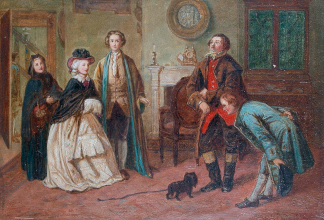
(Pictured: “Mr Honeywell introduces the bailiffs to Miss Richland as his friends,”a scene from the play “The Good-Natur’d Man” by Oliver Goldsmith, oil on panel by William Powell Frith)


Leave a comment

Birth of Noël Christopher Browne, Irish politician

Noël Christopher Browne, Irish politician who serves as Minister for Health from 1948 to 1951 and Leader of the National Progressive Democrats from 1958 to 1963, is born at Bath Street in Waterford, County Waterford, on December 20, 1915. He holds the distinction of being one of only seven TDs to be appointed to the cabinet on the start of their first term in the Dáil.

Browne grows up in the Bogside area of Derry. The Browne family also lives in Athlone and Ballinrobe for a period of time. His mother Mary Therese (née Cooney) is born in 1885 in Hollymount, County Mayo. His father Joseph Brown, a Royal Irish Constabulary (RIC) sergeant, later works as an inspector for the National Society for the Prevention of Cruelty to Children and, partly as a result of this work, all of the Browne family becomes infected with tuberculosis. Both parents die of the disease during the 1920s. His father is the first to die, leaving only £100 behind to support a wife and seven children. Fearing that if she and the children remain in Ireland they will be forced into a workhouse, Mary sells all their possessions and takes the family to London. Within two days of their arrival, Mary is dead, later buried in a pauper’s grave. Of her seven children, six contract tuberculosis. Noël is only one of two Browne children to survive into adulthood after those bouts with TB.

In 1929, Browne is admitted free of charge to St. Anthony’s, a preparatory school in Eastbourne, England. He then wins a scholarship to Beaumont College, the Jesuit public school near Old Windsor, Berkshire, where he befriends Neville Chance, a wealthy boy from Dublin. Neville’s father, the eminent surgeon Arthur Chance, subsequently pays Browne’s way through medical school at Trinity College Dublin.

In 1940, while still a student, Browne suffers a serious relapse of tuberculosis. His treatment at a sanatorium in Midhurst, Sussex is paid for by the Chance family. He recovers, passes his medical exams in 1942, and starts his career as a medical intern at Dr. Steevens’ Hospital in Dublin, where he works under Bethel Solomons. He subsequently works in numerous sanatoria throughout Ireland and England, witnessing the ravages of the disease. He soon concludes that politics is the only way in which he can make an attack on the scourge of tuberculosis.

The poverty and tragedy that had shaped Browne’s childhood deeply affects him. He considers both his survival and his level of education a complete fluke, a stroke of random chance that saved him when he was seemingly destined to die unknown and in poverty like the rest of his family. He finds this completely distasteful and is moved to enter politics as a means to ensure no one else would suffer the same fate that had befallen his family.

Browne joins the new Irish republican party Clann na Poblachta and is elected to Dáil Éireann for the Dublin South-East constituency at the 1948 Irish general election. To the surprise of many, party leader, Seán MacBride, chooses him to be one of the party’s two ministers in the new government. He becomes one of the few TDs appointed a Minister on their first day in Dáil Éireann, when he is appointed Minister for Health.

A ‘White Paper’ on proposed healthcare reforms had been prepared by the previous government, and results in the 1947 Health Act. In February 1948, Browne becomes Minister for Health and starts the reforms advocated by the Paper and introduced by the Act.

The health reforms coincide with the development of a new vaccine and of new drugs (e.g., BCG and penicillin) that help to treat a previously untreatable group of medical conditions. Browne introduces mass free screening for tuberculosis sufferers and launches a huge construction program to build new hospitals and sanitoria, financed by the income and accumulated investments from the Department of Health-controlled Hospital Sweeps funds. This, along with the introduction of Streptomycin, helps dramatically reduce the incidence of tuberculosis in Ireland.

As Minister for Health Browne comes into conflict with the bishops of the Catholic Church and the medical profession over the Mother and Child Scheme. This plan, also introduced by the 1947 Health Act, provides for free state-funded healthcare for all mothers and children aged under 16, with no means test, a move which is regarded as radical at the time in Ireland, but not in the rest of Europe. Virtually all doctors in private practice oppose the scheme, because it would undermine the “fee for service” model on which their income depended.

The Church hierarchy, which controls many hospitals, vigorously opposes the expansion of “socialised medicine” in the Irish republic. They claim that the Mother and Child Scheme interferes with parental rights, and fear that the provision of non-religious medical advice to mothers will lead to birth control contrary to Catholic teaching. They greatly dislike Browne, seeing him as a “Trinity Catholic,” one who has defied the Church’s ruling that the faithful should not attend Trinity College Dublin, which had been founded by Protestants and for many years did not allow Catholics to study there.

Under pressure from bishops, the coalition government backs away from the Mother and Child Scheme and forces Browne’s resignation as Minister for Health. Following his departure from government, he embarrasses his opponents by arranging for The Irish Times to publish Taoiseach John A. Costello‘s and MacBride’s correspondence with the Catholic hierarchy, which details their capitulation to the bishops.

The controversy over the Mother and Child Scheme leads to the fall of the coalition government in which Browne had served as a Minister. But Church opposition to socialised medicine continues under the subsequent Fianna Fáil-led government. The hierarchy does not accept a no-means-test mother-and-infant scheme even when Fianna Fáil reduces the age limit from sixteen years to six weeks, and the government again backs down.

After his resignation as Minister for Health, Browne leaves Clann na Poblachta, but is re-elected to the Dáil as an Independent TD from Dublin South-East in the subsequent election.

Browne joins Fianna Fáil in 1953 but loses his Dáil seat at the 1954 Irish general election. He fails to be selected as a candidate for the 1957 Irish general election and he resigns from the party. He is re-elected at that election for Dublin South-East as an Independent TD.

In 1958, Browne founds the National Progressive Democrats with Jack McQuillan. He holds onto his seat at the 1961 Irish general election, but in 1963, he and McQuillan join the Labour Party, disbanding the National Progressive Democrats. However, he loses his seat at the 1965 Irish general election.

Browne is re-elected as a Labour Party TD at the 1969 Irish general election, again for Dublin South-East. He does not seek a nomination by the Labour Party for the 1973 Irish general election but instead wins a seat in Seanad Éireann for Dublin University. He remains in the Seanad until the 1977 Irish general election, when he gains the Dublin Artane seat as an Independent Labour TD, having again failed to get the Party nomination.

In 1977 Browne is the first Irish parliamentarian to call for law reforms in regard to homosexuality, which is illegal at the time, and in 1979 is one of the few Irish politicians to attend the opening of the Hirschfeld Centre, Dublin’s first full-time LGBT community space.

Upon its formation, Browne joins the new Socialist Labour Party and is briefly its only TD, securing election for Dublin North-Central at the 1981 Irish general election. He retires from politics at the February 1982 Irish general election.

In 1990, a number of left-wing representatives within the Labour Party, led by Michael D. Higgins, approach Browne and suggest that he should be the party’s candidate in the presidential election due later that year. Though in failing health, Browne agrees. However, the offer horrifies party leader Dick Spring and his close associates for two reasons. Firstly, the leadership had secretly decided to run Mary Robinson, a barrister and former senator. Secondly, many around Spring are “appalled” at the idea of running Browne, believing he has “little or no respect for the party” and is “likely in any event to self-destruct as a candidate.” When Spring informs Browne by telephone that the party’s Administrative Council has chosen Robinson over him, Browne hangs up the telephone.

Browne spends the remaining seven years of his life constantly criticising Robinson who had gone on to win the election, thus becoming the seventh President of Ireland, and who is considered highly popular during her term. During the campaign he also indicates support for the rival Fine Gael candidate, Austin Currie.

After retiring from politics, Browne moves with his wife Phyllis to Baile na hAbhann, County Galway. He dies at the age of 81 in the Regional Hospital, Galway, on May 21, 1997. He is buried in a small graveyard near Baile na hAbhann.


Leave a comment

Birth of Criostóir Mac Aonghusa, Teacher, Author, & Campaigner for Irish Language

Criostóir Mac Aonghusa, teacher, author, critic, and campaigner for the Irish language, is born on December 13, 1905, in Gort an Ghabhainn, Banagher, King’s County (now County Offaly), son of Francis McGuiness (surname thus on his birth certificate), farmer, and his wife, Rosanna (née Egan). He is educated at La Sainte Foi, Banagher, Reachra national school, Shannonbridge, and Naas CBS. He qualifies as a primary school teacher from De La Salle Training College, Waterford, in 1926 and has the distinction of being the first person to sit all exams through the medium of Irish. He graduates BA at University College Galway (UCG) in 1933 and his further education includes a diploma in Spanish literature from University of Barcelona and an MA on the Irish scholar Tomás Ó Máille.

Mac Aonghusa’s teaching career begins in 1926 when he becomes headmaster on Inis Treabhair, County Galway, spending fourteen months there. Afterwards he transfers to Gort Mór, Rosmuc, County Galway, where he continues teaching until 1962. He remains an active member of Cumann na Múinteoirí Náisiúnta throughout his life. Between 1962 and 1972 he is employed as an ad-hoc examiner at the civil service commission. An active member of Fianna Fáil, he helps to organise the party in County Galway in the 1920s and 1930s and is elected a member of Galway County Council in 1934.

Mac Aonghusa is a prominent advocate of the Irish language and together with his close friend Máirtín Ó Cadhain and another Connemara schoolteacher, Seosamh Mac Mathúna, founds Cumann na Gaeltachta to agitate for the civil rights of the Gaeltacht communities and of Irish speakers in general. He is one of the main campaigners for the establishment of the Rath Carn Gaeltacht in County Meath and forms part of the delegation that meets Éamon de Valera on November 11, 1932, and receives from him a promise to provide land in County Meath for that purpose. The Gaeltacht is established in 1935. Mac Aonghusa continues to support the project throughout his life and is involved in further campaigns relating to the area, including the recognition of Rath Carn’s Gaeltacht status. He is also an active member of Conradh na Gaeilge in the 1940s and is later involved in the campaign for the establishment of an Irish-language television broadcasting service.

Mac Aonghusa is a prolific writer and begins publishing short stories and articles from 1926 onward. His contributions appear in An tÉireannach, An Phoblacht, The Irish Tribune, An Stoc, and Ar Aghaidh. From 1948, he is a regular contributor to Feasta and his essays and reviews on Máirtín Ó Cadhain’s works appear in Comhar. He is a member of several literary organisations, including Cumann na Scríbhneoirí and the Galway Literary Society. His first book, An Cladóir agus scéalta eile, appears in 1952. Between 1963 and 1972 he is a contributor to The Irish Press and works also as a literary journalist. An essay on Pádraic Ó Conaire earns him a prize from Acadamh Liteartha na hÉireann.

Mac Aonghusa speaks a number of European languages including German, Spanish, French, Romanian, and Greek and travels widely throughout Europe. In the early 1970s he lives in Russia, and a collection of essays entitled Ó Rosmuc go Rostov is published in 1972. For health reasons he lives in Málaga, Spain, from the middle of the 1970s until 1987. While there, RTÉ produces a documentary on his life entitled Ó Ros Muc go Malaga.

Mac Aonghusa dies on April 9, 1991, in Portiuncula General Hospital, Ballinasloe, County Galway, and is interred in Clonmacnoise. In 1930 he marries Mairéad Ní Lupain, a nurse from Annaghvane in Connemara, and has four children, Proinsias (1933), Micheál (1937), Róisín (1939), and Máirín (1944). The couple separates in the 1940s. Proinsias follows in his father’s footsteps as a writer and journalist and becomes president of Conradh na Gaeilge and chairman of Bord na Gaeilge.

(From: “Mac Aonghusa, Criostóir” by Lesa Ní Mhunghaile, Dictionary of Irish Biography, http://www.dib.ie, October 2009)


2 Comments

Death of Patrick O’Callaghan, Olympic Gold Medalist

Patrick “Pat” O’Callaghan, Olympic gold medalist and world record holder, dies on December 1, 1991, in Clonmel, County Tipperary.

O’Callaghan is born on September 15, 1905, at Derrygallon, Kanturk, County Cork. He attends the Royal College of Surgeons in Ireland (RCSI) in Dublin and qualifies as a doctor at the age of 20. He joins the Royal Air Force Medical Services in 1926 on a short-service engagement, before moving to Clonmel in 1931 to work as an assistant medical officer in St. Luke’s Hospital, later setting up as a general practitioner in the town. He continues to practise there until the late 1980s.

While in university, O’Callaghan develops an interest in the hammer, having seen the country’s top hammer-throwers practise at the University College Dublin (UCD) grounds, then at Terenure College. At home in Cork for the summer, he does not have access to a hammer, so he collects an old cannon ball from Macroom Castle which he feels might approximate to the required 16 lb. (7.25 kg) weight, has it drilled at a foundry in Mallow and fitted with a handle and wire, and uses it to train at the family farm. In 1926 he wins the Munster title in the 56 lb. (25.4 kg) shot and follows that with an Irish hammer title in 1927. Victory the following year in that same championship qualifies him for the 1928 Summer Olympics in Amsterdam, which he enters as a complete unknown with a previous best of 166 ft. 11 in. (50.87 m), as against three other contenders who have each thrown well over 170 ft. (51.8 m). The hammer event is staged on July 30, 1928, and, lying third after four rounds, he throws 168 ft. 7 in. (51.38 m) with his penultimate attempt, to defeat the Swedish favourite, Ossian Skiöld, by 4 inches (10 cm), with the American contenders Edmund Black and Frank Conner, still further behind. He becomes the first athlete from the Irish Free State to be crowned Olympic champion. Less than a fortnight later, he wins the Tailteann Games with an Irish record throw of 170 ft. 2 in. (51.87 m).

Over the following years O’Callaghan wins events across Ireland and Europe and continues to achieve pioneering feats, not least in 1931, when he wins six Irish titles in one afternoon: hammer, shot put, discus, high jump, 56 lbs. without follow, and 56 lbs. over-the-bar. On August 1, 1932, he defends his Olympic title at the 1932 Summer Olympics in Los Angeles. With just one throw left in the competition, he trails second behind the Finnish champion, Ville Pörhölä. With his last throw, he claims the event with a distance of 176 ft. 11 in. (53.92 m), becoming the only Irish person in history to win two gold medals at the Olympic games. He seems in prime condition to defend his title for a third time at the 1936 Summer Olympics in Berlin, but a dispute in the athletics world brings the suspension of the National Athletic and Cycling Association of Ireland (NACAI) by the International Amateur Athletic Federation (IAAF). The subsequent decision not to send a team to Berlin by the Irish Olympic Council denies him the opportunity to win a hat-trick of gold medals.

O’Callaghan remains a dominant force in athletic circles, however. In 1934 he sets the record for the hammer on European soil with a throw of 186 ft. 10 in. (56.95 m) at Enniscorthy, County Wexford. He later achieves an unofficial world record in the hammer in 1937 in Fermoy, County Cork, with a remarkable throw of 195 ft. 5 in. (59.55 m), breaking the old record by more than 6 ft. (1.83 m). As the IAAF still refuses to sanction the NACAI, the record is not ratified, ensuring that the then twenty-four-year-old record of his compatriot, Patrick Ryan, who competes for the United States, remains in place. In total, as well as his two Olympic gold medals, he also wins six Irish championships in the hammer, four Irish championships in the 56 lb. shot, three Irish championships throwing the 56 lb. weight over-the-bar, and one Irish championship in the discus. He also wins the American hammer championship in 1933 and the British championship in the same event the following year. Despite his size, he jumps 6 ft. 2 in. (1.88 m) in the high jump and is Irish champion on three consecutive occasions (1929–31).

After an accident in which a child is killed by a flying hammer, O’Callaghan emigrates to the United States just before World War II and takes up professional wrestling. Attempts are made to set up a match with world wrestling champion Dan O’Mahoney, but this never occurs. He has a high profile, however. Samuel Goldwyn offers him the film role of Tarzan and he plays handball with Bing Crosby before returning home to Clonmel, where he becomes a prominent member of Clonmel Commercials Gaelic football club and manages that club’s senior team to three county championships (1965–67). He is later chairman and honorary president of the club. In 1984 he is made a Freeman of Clonmel, a town where he is known as “the doc” or “Dr. Pat” and revered as a humble, charming, jovial man, with a reputation for particular kindness to his poorer patients. At 6 ft. 1 in. (1.855 m) and sixteen stone (101.6 kg), he is a larger-than-life figure and the focal point of innumerable stories confirming his status as a living legend. In 1960 he is the first person voted into the newly conceived Texaco Hall of Fame. He lives for many years at Roseville, Western Road, Clonmel, and dies there on December 1, 1991.

O’Callaghan is survived by three sons and one daughter. His younger brother Con represents Ireland in the decathlon at the 1928 Olympic games and wins that event at the third Tailteann games in 1932.

(From: “O’Callaghan, Patrick (‘Pat’)” by Paul Rouse, Dictionary of Irish Biography, http://www.dib.ie)