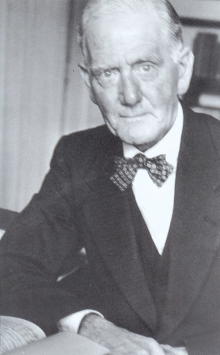
Twysden is born in Kent, in the South East England region, on September 7, 1713, the third son of Sir William Twysden, 5th Baronet of Roydon Hall, East Peckham, Kent, by his wife (and distant cousin) Jane Twisden.
By his second wife, Twysden has two children: Mary, who dies in infancy, and a posthumous daughter named Frances (1753–1821). Frances, later Countess of Jersey, is one of the many mistresses of King George IV when he is Prince of Wales.
Twysden dies on November 2, 1752, at home in Jermyn Street, St. James’s, London. However, according to ecclesiastical historian and author Henry Cotton, he dies at Roydon Hall, East Peckham, his father’s country house. He is buried in the south chancel of St. Michael’s Church, East Peckham, under a plain stone with no inscription.
A story grows up that, having been made bankrupt, Twysden is shot while attempting to rob a stagecoach. The location of his alleged attempted career as a highwayman is either Hounslow Heath (west of London) or Wrotham Heath in Kent.
(Pictured: The Cathedral of St Eunan, Raphoe, the episcopal seat of the pre-Reformation and Church of Ireland bishops of Raphoe)
Shiels is born on June 24, 1881, in Milltown, Ballybrakes, near Ballymoney, County Antrim, one of seven sons of Robert Shiels, a railway worker, and Eliza Shiels (née Sweeney), who also has one daughter. The family soon moves to Castle Street, Ballymoney, where he attends the local Roman Catholicnational school. His elder brothers emigrate to the United States when young. With there being no chance of further schooling even if he wanted it, he leaves Ireland when he is 19 years old. He works as a casual labourer in many places in western North America: as a farmworker and miner in Idaho and Montana, and as a lumber camp worker in British Columbia, Canada. In 1904 he is employed by the Canadian Pacific Railway to supervise a gang of workers who are building a stretch of railway in Saskatchewan. In a serious accident, he is badly injured. Despite surgery on his back, he is never able to walk again, and he receives a disability pension from the railway company.
After a long convalescence in Canada, Shiels returns to his mother’s house in Ballymoney around 1908. He sets up in business in Main Street as a shipping agent and as an agent for the Canadian Pacific Railway, taking bookings from intending emigrants. He is encouraged by his parish priest, Fr. John Hasson, by a local solicitor, Jack Pinkerton, and by James Pettigrew, a teacher, to write short stories. To try to preserve anonymity in a small community, he at first uses the pseudonym “George Morshiel,” and is successful with Western stories and other short fiction. His friends urge him to try writing dramas, and in 1918 Away from the Moss is produced by the Ulster Literary Theatre in Belfast.
After further success there with two short plays in which Shiels is learning his craft, the Abbey Theatre in Dublin accepts a one-act play, Bedmates, which is performed in January 1921. With great regularity for the next twenty years, he writes twenty-two plays for the Abbey Theatre. His work forms the basis of the repertoire in the 1920s and 1930s and attracts large audiences. Plays such as The New Gossoon (1930) provide Dublin theatregoers with entertainment, but also help form the style of acting and production which for many years characterises the Abbey and its actors. Three of his plays, Paul Twyning (1922), Professor Tim (1925) and The New Gossoon, are later performed in theatres in London and are also published in a 1945 volume, which is twice reprinted. Professor Tim, produced by the touring Abbey Theatre, receives enthusiastic reviews in Philadelphia, and The New Gossoon appears successfully on Broadway in New York City in 1932, 1934, and 1937.
Shiels’s earlier work is perhaps easiest for audiences to enjoy. Comedies such as Moodie in Manitoba (1918) portray characters so realistic that north Antrim people believe with some alarm that it might be possible to identify who Shiels had in mind when he created them, and he is at first somewhat less than popular in Ballymoney. He superbly reproduces local language and thoroughly understands the local way of life. Plays he writes late in his career are first performed by the Group Theatre in Belfast, and in these productions (and in the radio versions broadcast by the BBC) his work becomes widely known, almost beloved, in the north of Ireland. During the first half of the twentieth century amateur drama groups throughout Ireland are much more important in local life than they have been since the advent of television. Probably all such societies have at some time staged a Shiels play, and this tradition continues. His plays contain amusing dialogue, carefully crafted plots, and usually more or less happy endings.
However, Shiels’s later works, notably The Passing Day (1936), first broadcast as a radio play, and The Rugged Path (1940), which breaks all records at the Abbey Theatre in a run of three months, tackle darker subject matter and feature characters still less sympathetic even than the rogues and hypocrites of the earlier work. In The Rugged Path and its sequel, The Summit (1941), he explores the moral crisis facing Ireland after the political changes of the 1920s. One critic sees in it an allegory for the contemporary struggle against Adolf Hitler. His view of life in the small towns and farms of Ireland is never in the slightest rosy-tinted, but in the symbolism of The Passing Day, he achieves “bitter intensity” (The Irish Times review, quoted by Casey).
Shiels’s modesty leads him to refuse an honorary doctorate from Queen’s University Belfast (QUB), in 1931. He is reticent about his experiences and beliefs and does little to foster his own reputation. In one early interview he expresses the belief that Ulster theatre needs dramatic material that reflects the psychology and setting of the region. His own work, at its best, achieves this and more. The very qualities which make his work popular in the north of Ireland permit some metropolitan literary critics to dismiss his plays as “kitchen comedies.” However, with the passage of time, his importance as a chronicler of a vanishing way of life can be set alongside the recognition due to him as a prolific and gifted dramatist.
Shiels suffers from a lengthy illness, and though he undergoes an operation in Ballymoney in 1949, dies soon afterwards at his house, New Lodge, in Carnlough, County Antrim, on September 19, 1949. He is buried in the graveyard of Our Lady and St. Patrick in Ballymoney. In the month that he dies, the Group Theatre and Garvagh Young Farmers’ Club are both rehearsing Shiels plays, and there have since been many productions of his plays in the north and elsewhere. Ballymoney Drama Festival presents a portrait of Shiels to the Abbey Theatre, and a new production of The Passing Day is staged there to celebrate his centenary in 1981.
On the foundation of the Sunday Tribune in 1980, Kennedy joins it as the paper’s political correspondent. The paper’s publisher, John Mulcahy, had become familiar with Kennedy when she had contributed to his journal, The Hibernia Magazine. When the Tribune briefly ceases production, she moves to the Sunday Press.
In 1982, Kennedy’s telephone, along with those of two other journalists, is tapped by former Minister for JusticeSeán Doherty. Early in 1987, she successfully sues the incumbent Charles Haughey-led Fianna Fáil government for illegally tapping her phone. The revelation in 1992 that Charles Haughey had personally ordered the phone taps leads to Haughey’s resignation as Taoiseach.
Kennedy stands in the 1987 Irish general election as a candidate for the newly formed Progressive Democrats party in Dún Laoghaire. She comes in third in the poll, winning 9.4% of the first-preference vote. She is one of fourteen Progressive Democrat TDs elected to Dáil Éireann in that election, a feat the party never achieves again. She is appointed the party’s spokesperson for foreign affairs.
She stands again in the 1989 Irish general election and wins 9% of the first-preference vote but fails to retain her seat.
Following her election defeat, Kennedy returns to The Irish Times, then edited by Conor Brady, whom she had worked with at the Tribune when he was the editor. She avoids party-political journalism for several years, but she returns to covering politics in the early 1990s and becomes the political editor of The Irish Times in 1999. She becomes the newspaper’s first female editor upon the departure of Brady in late 2002. One of her rivals for the editor’s chair is the paper’s high-profile columnist, Fintan O’Toole.
Kennedy is paid more than the editor of Britain’s top non-tabloid newspaper The Daily Telegraph, which has a circulation of about nine times that of The Irish Times. Later columnist Fintan O’Toole tells the Sunday Independent, “We as a paper are not shy of preaching about corporate pay and fat cats but with this there is a sense of excess. Some of the sums mentioned are disturbing. This is not an attack on Ms. Kennedy, it is an attack on the executive level of pay. There is double standard of seeking more job cuts while paying these vast salaries.”
In September 2006, Kennedy approves the publication of an article in The Irish Times giving confidential details of investigations being made into payments purported to have been made in 1993 to Taoiseach Bertie Ahern. She refuses, upon request of the investigating Mahon Tribunal, to provide details of the source of the printed information. She responds that the documents have since been destroyed. Her refusal causes the Tribunal to seek High Court orders compelling her to provide details of the source. On October 23, 2007, the High Court grants the orders compelling her to go before the Tribunal and answer all questions. In its judgment, the High Court, criticising her decision to destroy the documents, says it was an “astounding and flagrant disregard of the rule of law.” In 2009, however, the Supreme Court of Ireland overturns this ruling, holding that the High Court had not struck the correct balance between the journalists’ right to protect their source and the tribunal’s right to confidentiality.
Kennedy announces on March 12, 2011, her intention to retire from The Irish Times by September, after a nine-year term as editor. She actually retires in June and is succeeded by news editor Kevin O’Sullivan on June 23, 2011.
In August 2012, Kennedy is appointed Adjunct Professor of Journalism at the University of Limerick. She has been awarded five honorary doctorates from Irish universities.
Larchet is born on July 13, 1884, at Sandymount, Dublin, the son of John Edward Larchet, manager of a wine business, and his wife Isabella Emily (née Farmar). Educated at the Catholic University School in Leeson Street, Dublin, he subsequently commences study under Michele Esposito at the Royal Irish Academy of Music (RIAM) in Dublin, winning many prizes for composition, theory, harmony, and counterpoint from 1903 to 1912. As a student at Trinity College Dublin (TCD), he obtains his Bachelor of Music in 1915 and Doctor of Music in 1917 and comes to dominate the music profession in Dublin over the next forty years, moulding the composers, teachers, and conductors of the next generation, while developing an Irish school of music based on folk tradition but writing in the modern idiom. A senior professor at the RIAM by 1920, the following year he is appointed professor of music at University College Dublin (UCD), where he remains until 1958, successfully establishing music as a serious discipline within the university. He is director of music examinations for Irish secondary schools (1907–34) and succeeds in raising standards of teaching, particularly with regard to rectifying weakness in the teaching of the theory of music.
Along with Aloys Fleischmann and composer Frederick May, Larchet keeps discourse on music in the public domain during the 1930s and 1940s, frequently addressing the need for a national school of music and a system of music education that would raise standards of musical appreciation and nurture a school of Irish composers.
Appointed music director at the Abbey Theatre in 1907, he is closely associated with Lady Gregory and W. B. Yeats, establishing a tradition of music at the theatre that delights critics. A popular myth at the time is that there are some who leave the theatre during the acts and return to enjoy Larchet’s music during the intervals. Appointed musical adviser to the army in 1923, he introduces a new philharmonic pitch, and serves as president of the Dublin Grand Opera Society for many years.
A fellow of the RIAM, Larchet also conducts the Dublin Amateur Orchestra Society, is choir master of the Jesuit church in Gardiner Street, Dublin, and organises annual orchestral concerts at the Royal Dublin Society (RDS). He is also involved in preparing a report for the commission on vocational organisation on behalf of the Musical Association of Ireland. The products of his own creative endeavour are mostly orchestral and choral works including An Ardglass Boat Song, Pádraic the Fiddler, and Diarmuid’s Lament.
Perhaps the main challenge facing Larchet in the 1920–50 period is the divide between “colonial” and “native” which has characterised the history of music in Ireland. A gentle-mannered, kindly man who is acutely aware of the lack of a national policy for music, he is a persuasive advocate of the European aesthetic and his main aim is said to have been “a reconciliation between the cultural chauvinism of Ireland as an emergent nation state and the central value (artistic as well as educational) of music as a vital dynamic in Irish cultural affairs.”
Although it can be argued that Larchet is not possessed of a uniquely original voice, with his authority coming rather from his enormous workload and his essential contribution as a teacher, it is no exaggeration to claim that the majority of Irish composers who emerge in the decades after the 1940s are influenced by his guidance, including Frank Llewellyn Harrison, Frederick May, Joan Trimble and Brian Boydell.
Larchet dies in Dublin on August 10, 1967. He is survived by his wife, Madeleine Moore, a well-known musician, and their two daughters and son, also musicians. His daughter, Sheila Larchet Cuthbert, is an Irish harpist and author. She publishes The Irish Harp Book: A Tutor and Companion (Dublin, 1975).
(From: “Larchet, John Francis” by Diarmaid Ferriter, Dictionary of Irish Biography, http://www.dib.ie, October 2009)
In London, developing his interest in the theatre, Johnston abandons plans for a legal and political career.
Johnston is a protégé of W. B. Yeats and George Bernard Shaw, and has a stormy friendship with Seán O’Casey. He is a pioneer of television and war reporting. He works as a lawyer in the 1920s and 1930s before joining the BBC as a writer and producer, first in radio and then in the fledgling television service. His broadcast dramatic work includes both original plays and adaptation of the work of many different writers.
Johnston’s first play, The Old Lady Says “No!”, helps establish the worldwide reputation of Dublin’s Gate Theatre. His second play, The Moon in the Yellow River, has been performed around the globe in numerous productions featuring such storied names as James Mason, Jack Hawkins, Claude Rains, Barry Fitzgerald, James Coco and Errol Flynn. Later plays deal with the life of Jonathan Swift, the 1916 Rebellion, the pursuit of justice, and the fear of death. He writes two opera libretti and a pageant.
“Passionate in his radical skepticism and loathing of what he saw as the pernicious influence of the Roman Catholic Church,” at the end of 1933, Johnston joins the trade unionistJohn Swift, the Dublin novelistMary Manning, and fellow northerner, the libertarian socialistJack White, in forming The Secular Society of Ireland. “Convinced that clerical domination in the community is harmful to advance,” the society seeks “to establish in this country complete freedom of thought, speech and publication, liberty for mind, in the widest toleration compatible with orderly progress and rational conduct.” Among other things it aims to terminate the clerically-dictated ban on divorce, the Censorship of Publications Act and the system of clerical management, and consequent sectarian teaching, in schools.
This is at a time of heightened clerical militancy and as soon the meeting place of the Society (from which it distributed the British journal The Freethinker) is exposed, it has to shift to private houses outside of Dublin. In 1936, Johnston and the other members disband the society and donate the proceeds to the government of the beleaguered Spanish Republic. He has become a recognised man of the left. In 1930 he joins the Irish Friends of Soviet Russia, and though never a party member, until as late as the 1950s he professes faith in a communist future.
Johnston dies on August 8, 1984, at Ballybrack, County Dublin, and is buried in St. Patrick’s Cathedralclose. His epitaph is a quotation from The Old Lady Says “No!” – Emmet’s lines praising Dublin “the strumpet city.”
The Denis Johnston Playwriting Prize is awarded annually by Smith College Department of Theatre for the best play, screenplay or musical written by an undergraduate at Smith College, Mount Holyoke College, Amherst College, Hampshire College and the University of Massachusetts Amherst. The prize is endowed by his former student at Smith, Carol Sobieski.
Horniman is born at Surrey Mount, Forest Hill, London, on October 3, 1860, the elder child of Frederick John Horniman and his first wife Rebekah (née Emslie). Her father is a tea merchant and the founder of the Horniman Museum. Her grandfather is John Horniman who founds the family tea business of Horniman and Company. She and her younger brother Emslie are educated privately at their home. Her father is opposed to the theatre, which he considers sinful, but their Germangoverness takes her and Emslie secretly to a performance of The Merchant of Venice at The Crystal Palace when she is fourteen years old.
Horniman’s father allows her to enter the Slade School of Fine Art in 1882. Here she discovers that her talent in art is limited but she develops other interests, particularly in the theatre and opera. She takes great pleasure in Richard Wagner‘s Der Ring des Nibelungen and in Henrik Ibsen‘s plays. She cycles in London and twice over the Alps, smokes in public and explores alternative religions. The “lonely rich girl” has become “an independent-minded woman.” In 1890 she joins the occult society, the Hermetic Order of the Golden Dawn, where she remains a member until disagreements with its leaders lead to her resignation in 1903. During this time she meets and becomes a friend of W. B. Yeats, acting as his amanuensis for some years. Their friendship endures. Frank O’Connor recalls that on the day Yeats hears of her death, he spends the entire evening speaking of his memories of her.
Horniman’s first venture into the theatre is in 1894 and is made possible by a legacy from her grandfather. She anonymously supports her friend Florence Farr in a season of new plays at the Royal Avenue Theatre, London. This includes a new play by Yeats, The Land of Heart’s Desire, and the première of George Bernard Shaw’s play Arms and the Man. In 1903 Yeats persuades her to go to Dublin to back productions by the Irish National Theatre Society. Here she discovers her skill as a theatre administrator. She purchases a property and develops it into the Abbey Theatre, which opens in December 1904. Although she moves back to live in England, she continues to support the theatre financially until 1910. Meanwhile, in Manchester she purchases and renovates the Gaiety Theatre in 1908 and develops it into the first regional repertory theatre in Britain.
At the Gaiety, Horniman appoints Ben Iden Payne as the director and employs actors on 40-week contracts, alternating their work between large and small parts. The plays produced include classics such as Euripides and Shakespeare, and she introduces works by contemporary playwrights such as Ibsen and Shaw. She also encourages local writers who form what becomes known as the Manchester School of dramatists, the leading members of which are Harold Brighouse, Stanley Houghton and Allan Monkhouse. The Gaiety company undertakes tours of the United States and Canada in 1912 and 1913. Horniman becomes a well-known public figure in Manchester, lecturing on subjects which include women’s suffrage and her views about the theatre. In 1910 she is awarded the honorary degree of MA by the University of Manchester. During World War I the Gaiety continues to stage plays but financial difficulties lead to the disbandment of the permanent company in 1917, following which productions in the theatre are by visiting companies. In 1921 she sells the theatre to a cinema company.
As a result of her tea connection, Horniman is known as “Hornibags.” She holds court at the Midland Hotel, wearing exotic clothing and openly smoking cigarettes, which is considered scandalous at the time. She introduces Manchester to what is called at the time “the play of ideas.” The theatre critic James Agate notes that her high-minded theatrical ventures have “an air of gloomy strenuousness” about them.
Horniman dies, unmarried, on August 6, 1937, while visiting friends in Shere, Surrey. Her estate amounts to a little over £50,000. The Annie Horniman Papers are held in the John Rylands Research Institute and Library at the University of Manchester. Her portrait, painted by John Butler Yeats in 1904, hangs in the public area of the Abbey Theatre.
She meets the Robertson commission in 1901 on behalf of St. Mary’s Dominican convent, Eccles Street, Dublin, where, as well as presenting the results of a questionnaire survey of women graduates, compiles in conjunction with Agnes O’Farrelly and Hanna Sheehy-Skeffington, she argues for the right of women to receive education on the same terms as men and in the same colleges, and to be employed by the universities on identical conditions (which is not realised until the Irish Universities Act of 1908). Along with Sheehy-Skeffington, she is a key figure in the formation of the Irish Association of Women Graduates in 1902, which concerns itself with various questions regarding women graduates’ employment in government departments, hospitals, and schools, as well as attempting to influence public policy in relation to sex discrimination.
After the passage of the Irish Universities Act in 1908, Hayden is appointed a member of both the senate of the National University of Ireland (NUI) and the governing body of the new University College Dublin (UCD), the first woman to hold such positions. In November 1909 she is appointed a lecturer in history, and in July 1911 first professor of modern Irish history at UCD, a position she holds until her retirement in 1938.
Hayden’s last major public campaign, at the age of 75, is in the lead-up to the referendum on the 1937 Constitution of Ireland, in opposition to articles 40, 41, and 45 concerning the status of women. Reversing her lifelong non-party-political stance, she helps to form the Women’s Social and Progressive League as a political party committed to opposing the constitution and any regressive consequences it would entail.
Hayden receives an honorary doctorate from the NUI in 1935, three years before her retirement. A dedicated cyclist and swimmer, she is fluent in Irish, Greek, and Hindustani, and after retirement devotes her efforts to improving the welfare of Dublin children through her newly formed social club. She dies on July 12, 1942, at her residence in Rathmines, Dublin. Her unpublished diaries are deposited in the NLI.
A biography of Hayden, Mary Hayden: Irish Historian and Feminist, by Joyce Padbury is published by Arlen House in 2020.
O’Brien is the eldest child of a Roman Catholic church musician. In 1885, he first appears in a public piano recital and, later in the year, becomes the organist of Rathmines parish church, a position he holds until 1888. He holds another organist’s position at the Dublin Carmelite church from 1897 to 1899 but is chiefly known as organist and choir director of Dublin’s largest Roman Catholic Church, St. Mary’s Pro-Cathedral, between 1903 and 1946. In 1898, he is the founder and first director of the Palestrina Choir, originally all-male, which is still active, and which is financed for many years by Edward Martyn.
O’Brien studies with Robert Prescott Stewart at the Royal Irish Academy of Music (1888-90), where he is the first winner of the Coulson Scholarship and frequently performs as both tenor singer, piano accompanist, and organist in many public concerts during the 1890s. As a church musician, he becomes particularly involved in the Cecilian Movement, conducting works by Michael Haller and others, and also pursuing their artistic ideals in his own sacred choral compositions.
O’Brien is the founding conductor of the Dublin Oratorio Society (1906), the Brisan Opera Company (1916) and conducts at many ad hoc events. In 1925, he becomes the first music director of Radio Éireann (originally called 2RN), a position he holds until 1941. He singles out his work as music director for the 31st International Eucharistic Congress in Dublin (1932) as his most prized personal achievement. As late as 1945, he founds Our Lady’s Choral Society, a large oratorio choir still in existence, which originally is recruited mainly from the various Roman Catholic church choirs in Dublin.
Among his teaching positions, O’Brien teaches at the diocesan seminary at Holy Cross College, is Professor of Gregorian Chant at the missionary seminary of All Hallows College from 1903, and Professor of Music at the Ladies’ Teacher-Training College at Carysfort Park, Blackrock, County Dublin, from 1908 until his death in Dublin on June 21, 1948. As a much-demanded vocal coach, he teaches at his home, his best-known pupils including John McCormack, Margaret Burke Sheridan and James Joyce. He performs the piano accompaniments for McCormack’s first gramophone recordings and accompanies him during his 1913–14 Australasian tour of 60 performances in three months, during which he also gives organ recitals at the Irish-dominated Catholic cathedrals of Sydney and Melbourne.
Of his two sons, Oliver O’Brien (1922–2001) largely follows in his father’s footsteps, as organist and director of the Palestrina Choir, of Our Lady’s Choral Society, music teacher at Carysfort College and as teacher in various Dublin schools. His other son, Colum O’Brien, is organist in the Pro-Cathedral.
Before his work for the Palestrina Choir, O’Brien’s musical interests are very broad, culminating in 1893 in the composition of the full-scale opera Hester. As a church music composer, he follows Cecilian ideals, with a number of hymns, motets and other choral works. He also composes a number of songs for voice and piano, with The Fairy Tree (1930) being a particular favourite of John McCormack’s.
Donleavy grows up in the Bronx. His father is a firefighter, and his mother comes from a wealthy background. He has a sister, Mary Rita, and a younger brother. He declares himself to be an atheist at the age of fourteen. He receives his education at various schools in the United States, then serves in the United States Navy during World War II. After the war ends, he moves to Ireland and becomes an Irish citizen. In 1946 he begins studying bacteriology at Trinity College Dublin but leaves in 1949 before taking a degree.
Donleavy’s first published work is a short story entitled A Party on Saturday Afternoon, which appears in the Dublin literary periodical Envoy, A Review of Literature and Art in 1950. He gains critical acclaim with his first novel, The Ginger Man (1955), which is one of the Modern Library 100 best novels. The novel, of which his friend and fellow writer Brendan Behan is the first person to read the completed manuscript, is banned in Ireland and the United States by reason of obscenity. The lead character, Sebastian Dangerfield, is in part based on Trinity College companion Gainor Crist, an American Navy veteran also studying at Trinity College on the G.I. Bill, whom Donleavy once describes in an interview as a “saint,” though of a Rabelaisian kind.
In 1946, Donleavy marries Valerie Heron. The couple has two children: Philip (born in 1951) and Karen (born in 1955). They divorce in 1969, and he remarries in 1970 to Mary Wilson Price. That union ends in divorce in 1989. In 2011, it is reported that he had not fathered his two children with Price. A DNA test in the early 1990s confirms that Rebecca is the daughter of brewing scion Kieran Guinness, and Rory is the son of Kieran’s older brother Finn, whom Price marries after her divorce from Donleavy. “My interest is only to look after the welfare of the child,” Donleavy tells The Times, “and after a certain stage, you can’t worry about their parentage.”
Donleavy lives at Levington Park, a country house on 200 acres directly on Lough Owel, near Mullingar, County Westmeath, from 1972. Throughout much of his life, he is known as Mike by close friends, though the origins of this nickname are unclear.
Donleavy dies in Mullingar at the age of 91 on September 11, 2017.
Wilde is born in March 1815 at Kilkeevin, near Castlerea, County Roscommon, the youngest of the three sons and two daughters of a prominent local medical practitioner, Thomas Wills Wilde, and his wife, Amelia Flynne. His family are members of the Church of Ireland, and he is descended from a Dutchman, Colonel de Wilde, who came to Ireland with King William of Orange‘s invading army in 1690, and numerous Anglo-Irish ancestors. He receives his initial education at the Elphin Diocesan School in Elphin, County Roscommon. In 1832, he is bound as an apprentice to Abraham Colles, the pre-eminent Irish surgeon of the day, at Dr. Steevens’ Hospital in Dublin. He is also taught by the surgeons James Cusack and Sir Philip Crampton and the physician Sir Henry Marsh. He also studies at the private and highly respected school of anatomy, medicine, and surgery in Park Street (later Lincoln Place), Dublin. In 1837, he earns his medical degree from the Royal College of Surgeons in Ireland. In the same year, he embarks on an eight-month-cruise to the Holy Land with a recovering patient, visiting various cities and islands throughout the Mediterranean. Porpoises are flung on board the ship, Crusader, and Wilde dissects them. Taking notes, he eventually composes a two-volume book on the nursing habits of the creatures. Among the places he visits on this tour is Egypt. In a tomb he finds the mummified remains of a dwarf and salvages the torso to bring back to Ireland. He also collects embalmed ibises.
Wilde runs his own hospital, St. Mark’s Ophthalmic Hospital for Diseases of the Eye and Ear, in Dublin and is appointed to serve as Oculist-in-ordinary to Queen Victoria. At one point, he performs surgery on the father of another famous Irish dramatist, George Bernard Shaw.
Wilde had a very successful medical practice and is assisted in it by his natural son, Henry Wilson, who had been trained in Dublin, Vienna, Heidelberg, Berlin, and Paris. Wilson’s presence enables him to travel, and he visits Scandinavia, where he receives an honorary degree from Uppsala University, and is welcomed in Stockholm by Anders Retzius, among others. King Charles XV of Sweden confers on him the Nordstjärneorden (Order of the Polar Star). In 1853, he is appointed Surgeon Occulist in Ordinary to the Queen in Ireland, the first position of its kind, probably created for him.
Wilde is awarded a knighthood in a ceremony at Dublin Castle on January 28, 1864, more for his involvement with the Irish census than for his medical contributions, although he had been appointed medical commissioner to the Irish census in 1841. In 1845, he becomes editor of the Dublin Journal of Medical & Chemical Science, to which he contributes many articles.
Wilde marries the poet Jane Francesca Agnes Elgee on November 12, 1851, who writes and publishes under the pen name of Speranza. The couple has two sons, William (Willie) and Oscar, and a daughter, Isola Francesca, who dies in childhood.
In addition to his children with his wife, Wilde is the father of three children born out of wedlock before his marriage: Henry Wilson, born in 1838, and Emily and Mary Wilde, born in 1847 and 1849, respectively, of different parentage to Henry. He acknowledges paternity of his illegitimate children and provides for their education, but they are reared by his relatives rather than with his wife and legitimate children. Emily and Mary both die in 1871 following a Halloween party at which their dresses accidentally catch fire.
From 1855 until his death in 1876, Wilde lives at 1 Merrion Square, now the headquarters of American College Dublin. The building is named Oscar Wilde House after William Wilde’s son, who also lives at the address from 1855 until 1878. There is a plaque at 1 Merrion Square dedicated to him.
Wilde’s reputation suffers when Mary Travers, a long-term patient of his and the daughter of a colleague, claims that he had seduced her two years earlier. She writes a pamphlet crudely parodying Wilde and Lady Wilde as Dr. and Mrs. Quilp, and portraying Dr. Quilp as the rapist of a female patient anaesthetised under chloroform. She distributes the pamphlets outside the building where Wilde is about to give a public lecture. Lady Wilde complains to Mary’s father, Robert Travers, which results in Mary bringing a libel case against her. Mary Travers wins her case but is awarded a mere farthing in damages by the jury. Legal costs of £2,000 are awarded against Lady Wilde. The case is the talk of all Dublin, and Wilde’s refusal to enter the witness box during the trial is widely held against him as ungentlemanly behaviour.
From this time onwards, Wilde begins to withdraw from Dublin to the west of Ireland, where he had started in 1864 to build what becomes Moytura, his house overlooking Lough Corrib in Connemara, County Galway. His health deteriorates in 1875. He dies, likely of cancer, at the age of 61 on April 19, 1876. He is buried in Mount Jerome Cemetery in Dublin.
(Pictured: Sketch of William Wilde by J.H. Maguire, 1847)