Power is born to Henry Power, a watchmaker, and Mary (née Atkins), an embroideress. He has one older brother, and one younger sister. He attends a Christian Brothersnational school in North Brunswick Street. As a child he plays in local clay brickyards and sculpts busts of his friends. After finishing his primary school education, he trains with a firm of sculptors run by Edward Smyth. In 1884, he enrolls as an evening pupil at the Dublin Metropolitan School of Art (DMSA), later attending as a full-time student from 1906 to 1911. During his time at the DMSA he is taught and strongly influenced by John Hughes, Oliver Sheppard and William Orpen. He wins a number of prizes during his time at the DMSA, including medals, three scholarships, book prizes, and the national gold medal for the best modeling of a nude figure, in Ireland, Scotland, and the Channel Islands in 1911.
Power marries Agnes Kelly in 1903. The couple has ten children, four daughters and six sons, including May and James who also become sculptors.
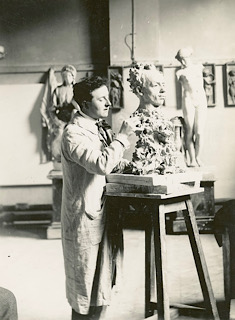
Power establishes his own stone-carving business in 1912 from his new home at 18 Geraldine Street, Phibsborough, Dublin. As the firm grows, it moves to premises nearby at 15 Berkeley Street from 1930. He executes a wide range of works, including monuments and architectural features in bronze, marble, and stone. Among his notable works are the figure of “Science” designed by Sheppard from the façade of the new Royal College of Science for Ireland (later Government Buildings) on Merrion Street, Dublin, carved motifs and sphinxes for the Gresham Hotel, O’Connell Street, and four statues on the dome of Christ the King church, Carndonagh, County Donegal.
Power is considered the leading Irish sculptor of the 1920s and 1930s. He is a nationalist and promotes the use of Irish materials such as limestone from Durrow and Connemara marble. He is noted for his academic realist style. He exhibits regularly with the Royal Hibernian Academy from 1906, becoming an associate member in 1911, and a full member in 1919. Among those he models sculptures for are James Stephens (1913), W. B. Yeats (1918), and Lord Dunsany (1920). Among his patrons are Oliver St. John Gogarty, and through Gogarty he is commissioned to model a number of prominent Irish nationalists. Gogarty asks him to carve a portrait of Terence MacSwiney in 1920, while MacSwiney is on hunger strike in HM Prison Brixton, London. Smuggled into the prison to do a thumbnail sketch, Power then carves a portrait in the form of a life mask.
On Gogarty’s recommendation, Power is commissioned by the Irish Free State government to create portraits of a number of leading politicians including Arthur Griffith (1922), Michael Collins (1936), and Austin Stack (1939). He is also privately commissioned to execute a portrait of Éamon de Valera in 1944. Among his monumental works are sculptures of Tom Kettle (1919) at St. Stephen’s Green, Dublin, Christ the King in Gort, County Galway, (1933), Pádraic Ó Conaire (1935) at Eyre Square, Galway, and W. B. Yeats (1939) at Sandymount Green, Dublin. He is one of the artists invited to submit designs for the new coinage of the Irish Free State in 1928.
Power dies in Dublin on July 10, 1945, following complications from a double hernia. His is buried in Glasnevin Cemetery, Dublin.
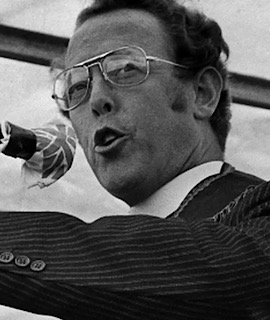
The gunmen, who are wearing workmen’s overalls, escape in a car afterward, killing Ken Campbell, a caretaker, as they leave. The people with whom Bradford had been meeting, most of them elderly, dive under tables for cover, and dozens of teenagers dancing nearby break into hysterical tears, but there are no injuries.
The killing is part of an escalation of IRA violence, both in London and in Northern Ireland, after the collapse of the prison hunger strike the previous month. The previous night an IRA bomb damages the London home of Britain’s Attorney General for Northern Ireland, Michael Havers. The home is empty and no one is seriously injured.
Bradford, a 40-year-old Methodist minister who is married and has a 6-year-old daughter, is shot several times, according to witnesses, and he dies almost immediately. His brother, Roy, who lives near the scene of the killing, in South Belfast, is at his side within moments. “But he was unconscious when I reached him, and he only lived for about a minute,” Roy Bradford says. News of the killing arouses fears of a Protestant reaction that could lead to serious civil unrest in Northern Ireland.
John “Jack” Hermon, the Chief Constable of the Royal Ulster Constabulary, issues an appeal to both the Protestant majority and the Roman Catholics to show “good sense and restraint.” He says security is being tightened in the province as a precautionary measure. He orders a wide-ranging search for the gunmen, who number at least three and possibly four, a point upon which the witnesses differ.
Bradford, who has been in Parliament since 1974, is an outspoken critic of the Irish nationalist guerrillas. He repeatedly calls for the reimposition of capital punishment in the province and for other strong deterrent measures.
With the Rev. Ian Paisley, another hard-line Member of Parliament, Bradford had planned to visit the United States In early 1982 to counteract the publicity of the IRA, which depends heavily on the money it receives from its American sympathizers. “There is a need for Americans to recognize that Ulster is not an occupied country,” Bradford says the previous month, “and that our political history is one of which we can be proud.”
The IRA, in a statement claiming responsibility for the killing, calls Bradford “one of the key people responsible for winding up the loyalistparamilitarysectarian machine in the North.” All twelve of Northern Ireland’s Members of Parliament – ten Protestants and two Catholics – are considered likely targets in the sectarian struggle that has claimed 2,100 lives in the province since 1969.
Whelan is awarded many prizes in the Royal Dublin Society (RDS) Taylor art competitions, including one in 1912 for a portrait of his sister Lena, entitled On the Moors, rendered in a strongly academic technique. In 1916, he wins the Taylor scholarship for the Royal Hibernian Academy (RHA) schools for his finest early work, The Doctor’s Visit, an adroitly executed composition of contrasting shadows and light. Typical of many of his genre interiors, the painting depicts a room in the family home, with relatives as models: Whelan’s mother sits by the bed watching over his ill cousin, while his sister, dressed in a Mater hospital nurse’s uniform, is in the background opening the door for the doctor. The subtly evoked atmosphere of restrained emotion foreshadowed a hallmark of his mature style.
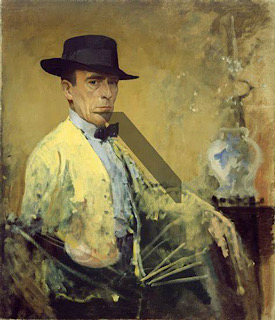
Whelan exhibits annually at the RHA for forty-five years (1911–56), averaging six works per year. He is elected an RHA associate in 1920, becoming a full member in 1924. He participates in the Exposition d’art irlandais at the Galerie Barbazanges in Paris in 1922. A visiting teacher at the RHA schools in 1924, he also teaches in the DMSA for a time. He has studios at 64 Dawson Street (1914–27) and 7 Lower Baggot Street (1931–56). Beginning in the 1910s, he receives regular commissions for portraits, constituting his primary source of income. Having become the family’s main breadwinner following his parents’ deaths in the 1920s, he concentrates most of his production on this lucrative activity, portraying numerous leading figures in the spheres of politics, academia, religion, society, medicine, and law.
Situated securely in the academic tradition, in most of his portraits Whelan favours a sombre, restricted palette, with the sitter placed, in grave demeanour, against a monotone background with few accessories. In a 1943 interview he asserts that twentieth-century portraiture suffers from the drabness of modern costume, for which the artist must compensate by careful rendition of the subject’s hands. He tends to depart from his prevailing portrait style when painting women, whom he characteristically depicts in meticulously observed interiors, a notable example being his portrait of Society hostess Gladys Maccabe (c.1946; NGI).
Whelan’s commercial concentration on portraiture notwithstanding, he expresses his true talent in genre compositions, especially kitchen interiors, in which he emulates the technique of the Dutch painter Johannes Vermeer. Two of the most accomplished of these depict his sister Frances in the basement kitchen of the family home: The Kitchen Window (1927; Crawford Art Gallery, Cork) demonstrates a particularly skillful use of light, while Interior of a Kitchen (1935) is notable for the dexterous handling of objects of varied shapes and textures. His genre works include both urban and rural scenes, with a distinctive interest in portraying occupations and other activities. Gypsy (1923), an Orpenesque composition of a shawled woman in a west-of-Ireland landscape with a caravan in the background, receives wide contemporary critical acclaim. Jer (c.1925), depicting a man seated by the fire in a cottage interior, is reproduced in J. Crampton Walker’s Irish Art and Landscape (1927). The Fiddler (c.1932), a naturalistic, sensitively characterised study, is first shown at an Ulster Academy exhibition at Stranmillis, Belfast. A Kerry Cobbler is reproduced in Twelve Irish Artists (1940), introduced by Thomas Bodkin, as among the works denoting the development of a distinctively Irish school of painting.
In 1929, Whelan designs the first Irish Free State commemorative stamp, a portrait of Daniel O’Connell for the centenary of Catholic emancipation. Commissioned by the Thomas Haverty trust to paint an incident from the life of Saint Patrick for the 1932 Eucharistic Congress, he executes The Baptism by St. Patrick of Ethna the Fair and Fedelmia the Ruddy, Daughters of the Ard Rí Laoghaire, a work highly conservative in style. He rapidly completes an oil study of the papal legate, Lorenzo Lauri, also for the Eucharistic Congress. He is represented in the art competitions at the 1932 Summer Olympics in Los Angeles. His depiction of Saint Brigid, shown at the Academy of Christian Art exhibition (1940), becomes a familiar image owing to the wide circulation of reproductions.
Whelan’s political portraits are influential in creating a strong, assured image of the newly formed Irish state, and thus retain an historical significance. His posthumous portrait, The Late General Michael Collins, exhibited at the RHA in 1943 and now held in Leinster House, is an iconic, heroic image of the fallen leader. His portraits of Arthur Griffith and Kevin O’Higgins – commissioned posthumously, as is the Collins, by Fine Gael – also hang in Leinster House, while that of John A. Costello, exhibited at the RHA in 1949, is now held in the King’s Inns, Dublin. He paints two presidents, Douglas Hyde and Seán T. O’Kelly, both works currently in Áras an Uachtaráin. A portrait of Éamon de Valera, painted in 1955 when the sitter is Leader of the Opposition, is in Leinster House. In 1954, he designs a second commemorative stamp, picturing a reproduction of a portrait bust of John Henry Newman, to mark the centenary of the Catholic University of Ireland.
Whelan is elected an honorary academician of both the Ulster Academy of Arts (1931), and the Royal Ulster Academy (1950). He becomes a member of the United Arts Club in 1934. As a representative of the RHA, he sits on the board of governors of the National Gallery of Ireland for many years, and is on the advisory committee of the Municipal Gallery of Modern Art. Unmarried, he resides until his death at the Eccles Street address, with two sisters who continue to manage the family hotel. He dies on November 6, 1956, from leukemia at the Mater private nursing home in Dublin. He is buried in Glasnevin Cemetery.
(From: “Whelan, (Michael) Leo,” by Carmel Doyle, Dictionary of Irish Biography, http://www.dib.ie, October 2009)
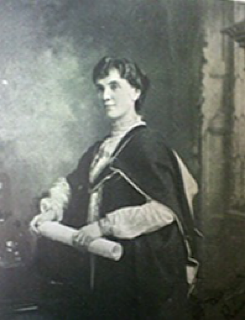
Concannon is educated by the Loreto nuns in Coleraine, County Londonderry. In 1897, she studies modern languages at the Royal University of Ireland on a three-year scholarship. She studies abroad during these years as in 1899, she travels to Germany and studies German in Berlin University accompanied by her friend, Mary Macken. She then travels to France to study French at Sorbonne University. In 1900, she graduates Bachelor of Arts with first class honours and goes on to study Master of Arts in 1902 at the Royal University of Ireland. She is fortunate to being one of the first generation of educated women.
In 1906, Concannon marries Tomás Bán Ó Conceanainn, who she met in 1900 when he arrived home from the United States. They settle down in County Galway where they share the same love for the Irish language and write many Irish texts. They have no children. In Galway, she is a professor at University College Galway where she teaches history, which mainly involves the history of Irish women. In 1909, she is offered a lectureship at University College Dublin, in Italian, but the offer is then withdrawn before she can accept it, so she decides to pursue a writing career.
Concannon produces over twenty books, including works on religion, the history of Ireland and Irish women’s history. Her works are highly impacted by her political and nationalist views. Her analyses of Irish history is based on Catholicism and patriotism. She is also an advocate of Irish language restoration. Her first writings are love poems to her husband. These poems are ”simple, sensuous and passionate.”
Concannon also produces a number of imaginative historical text for children. She uses her married name for her publications and her first book, entitled A Garden of girls, or the famous schoolgirls of former days, is published in 1914. It is about “school life and education of real little girls” Her next well known piece is the Life of St. Columban in 1915, which is a study about the Irish ancient monastic life and a biography of a sixth-century saint.
Two of Concannon’s books, Daughters of Banba (1922) and St. Patrick (1932), receive the Tailteann Medal for Literature, and The Poor Clares in Ireland (1929) wins the National University Prize, a D.Litt. higher doctorate degree for historical research.
Concannon’s most common publication, Women of ‘Ninety Eight, is dedicated to all the dead women and all the living ones who have given their loved ones. This book emerges on the ideologies of Catholicism and patriotism “praising the devotion of Irish nationalist women while emphasising the centrality of women’s spiritual and domestic role in the home to the well-being of the nation.” As this work is written during the time of the Irish War of Independence, she stresses the importance of women help during the rebellion as “they acted as messengers and intelligence officers,” and in some cases, they fought as any men.
Concerning the Land Purchase (Guarantee Fund) Bill 1935, which according to George Cecil Bennett will negatively impact the rural middle class of which he is a representative, Bennett accuses Concannon and her fellow Dublin men of not caring about the people of the country. Concannon goes on to vote that the Dáil should disagree with the Seanad Éireann-proposed bill with 71 others.
Though Concannon is a TD as a university representative, she votes with her party to remove university representation from the Dáil, leading one TD to say, “I am very much surprised to see such a distinguished scholar and such a great contributor to Irish literature as Deputy Mrs. Concannon voting for the disfranchisement of the University that she has so well and so ably represented.”
Concannon speaks on behalf of Irish women in the Dáil in 1936. She speaks on how Irish women play a fundamental role in Ireland’s agricultural economy and therefore more money should be put toward educating these women.
Concannon is one of the minority voices against the role appointed to women in Éamon de Valera‘s constitution. She does not contest the Dáil election of 1937.
After the adoption of the Constitution of Ireland in 1937, the National University of Ireland constituency is reconstituted in the new Seanad Éireann. The first election takes place in 1938, and Concannon is elected. She is a popular figure and is re-elected each election in the Seanad until she dies in office on February 27, 1952.
Clery is the son of Arthur Clery (who also uses the names Arthur Patrick O’Clery and Arthur Ua Cléirigh), a barrister, and Catherine Moylan. His father, who practises in India, publishes books on early Irish history.
Clery’s principal themes include the difficulties of Roman Catholic graduates seeking professional employment, dramatic criticism (he hails Lady Gregory‘s play Kincora as the Abbey Theatre‘s first masterpiece but is repulsed by the works of John Millington Synge), Catholic-Protestant rivalry, tension within the Dublin professional class, and the vagaries of the Gaelic revival movement.
Clery advocates partition on the basis of a two nations theory, first advanced in 1904–1905, possibly in response to William O’Brien‘s advocacy of securing Home Rule through compromise with moderate Unionists. Several of his articles on the subject are reprinted in his 1907 essay collection, The Idea of a Nation.
Clery derives this unusual view for a nationalist from several motives, including a belief that arguments for Irish nationalists’ right to self-determination can be used to justify Ulster Unionists’ right to secede from Ireland, fear that it might be impossible to obtain Home Rule unless Ulster is excluded, and distaste for both Ulster Protestants and Ulster Catholics, whom he sees as deplorably anglicised. He remains a partitionist for the rest of his life. He is not particularly successful as a barrister, but on the establishment of University College Dublin (UCD) in 1909, he is appointed to the part-time post of Professor of the Law of Property.
Clery does not take his seat and does not contest the September 1927 Irish general election since new legislation obliges candidates to pledge in advance that they will take their seat. He is one of the lawyers who advises Éamon de Valera that the Irish Free State is not legally obliged to pay the Land Annuities which had been agreed in the Anglo-Irish Treaty of 1922.
Clery was a close friend of Tom Kettle, with whom he founds a dining club, the “Cui Bono.” Hugh Kennedy is also a lifelong friend. As Auditor of the L & H, he tries to prevent James Joyce from reading a paper praising Henrik Ibsen, asserting that “the effect of Henrik Ibsen is evil,” but Joyce succeeds in reading it after he argues his case with the college president. The principal influence on Clery is the Irish Ireland editor D. P. Moran, to whose weekly paper, The Leader, Clery becomes a frequent contributor. In addition to The Idea of a Nation, he publishes Dublin Essays (1920) and (as Arthur Synan) The coming of the king.
Palmer’s music includes at least three operas, a number of choral pieces and many songs. His strong interest in opera comes during a politically difficult period in Irish history. Ireland is struggling for independence, and cultural politicians often regard opera (and classical music in general) as alien to Irish culture. Initially, however, he is successful, his earliest stage work being Finn Varra Maa (a transliteration from the Gaelic meaning “good Finbar”), subtitled The Irish Santa Claus. It survives as a libretto only, published in a drama series by Talbot Press, Dublin, in 1917. Contrary to what the (sub-)title may suggest, the work is a political satire that is much criticised for its nationalism. Sruth na Maoile (“The Sea of Moyle”) is first performed in July 1923 and restaged by the O’Mara Opera Company in the cultural by-programme of the Tailteann Games in August 1924. Its story is based on the legend of the Children of Lir, while the music relies on numerous references to Irish traditional music, including the song Silent O Moylefrom Thomas Moore‘s Irish Melodies. A third work, Grania Goes (1924), conceived as a light, comic opera, cannot be performed in the years following Irish independence. The manuscript scores of the Sruth na Maoile and Grania Goes are in the National Library of Ireland.
Between 1925 and 1930, Palmer embarks on a cycle of three full-scale operas on the Cuchullain cycle to words by William Mervyn Crofton. In one of them, Deirdre of the Sorrows (1925), Crofton acknowledges Palmer’s “beautiful music.” Despite this, Palmer’s illness prevents the completion of the score, which is later handed over to the composer Staf Gebruers (1902–70), but they are never performed. The manuscript scores of the operas Cuchullain and Deirdre of the Sorrows composed by Gebruers are held by his son Adrian. Unfortunately, despite extensive searching, the score of The Wooing of Emer has not been located, though it is referenced in Gebruers’ own inventories and mentioned as being of three hours duration. In addition, there is a copy of The King’s Song, also composed by Gebruers with lyrics by Crofton and described as from Act 1 of The Black Hag, but whether or not this has any connection with Palmer is unknown.
Palmer is mainly known as the composer of light songs and ballads, often in a folkloristic style, that find publishers in England and are frequently performed. “They show a skilled hand with a talent for vocal harmony but little originality.” His choral music is mainly on a similar miniature scale, an exception being the early cantataThe Abbot of Innisfallen (1909). There are some isolated examples of orchestral music performed by the orchestra of Radio Éireann, but the surviving references may not give a full picture of his output.
In the last decades of his life, Palmer was confined to a wheelchair and depends upon the care of his two sisters, who were running Hillcourt, a private girls’ boarding school in Glenageary, near their home in Sandycove (south Dublin). Palmer dies in Dublin on November 29, 1957.
Against his father’s wishes, Neligan joins the Dublin Metropolitan Police (DMP) – also in 1917. Picking up travel documentation from the local Royal Irish Constabulary barracks, he declines a suggestion that he enlist in this armed rural force. After service as a uniformed constable with the DMP, he is promoted to Detective and transferred into the Department’s widely hated counterintelligence and anti-political-subversion unit, the G Division, in 1919. In May 1920, his elder brother Maurice (1895–1920), an Irish Republican Army (IRA) member and friend of Michael Collins, persuades him to resign from the DMP.
After his resignation, Neligan returns to his native County Limerick with the intention of joining the Limerick IRA. Shortly afterward, Maurice is killed in a motorcycle accident, near their home in Templeglantine. In the meantime, Neligan also receives word from a family friend that Michael Collins wishes to meet with him in Dublin. Collins is outraged that Neligan has been allowed to resign and persuades him to rejoin the DMP as a mole for the intelligence wing of the IRA. Along with Detectives Eamon Broy and James McNamara, Neligan acts as a highly valuable agent for Collins and passes on reams of vital information. He leaks documents about the relative importance of police and military personnel and also warns insurgents of upcoming raids and ambushes. There are unconfirmed rumors that Neligan might be a double agent working for British interests.
In 1921, Collins orders Neligan to let himself be recruited into MI5 and he uses the opportunity to memorise their passwords and the identities of their agents. All of this is passed on to Collins. After Broy and McNamara are dismissed in 1921, Neligan becomes Collins’ most important mole inside Dublin Castle.
In 1924, Neligan hands over his post to the youthful Colonel Michael Joe Costello and takes command of the DMP, which still continues as a force separate from the newly established Garda Síochána, with the rank of Chief Superintendent. The next year he transfers to the Garda when the two police forces are amalgamated, and is instrumental in the foundation of the Garda Special Branch. When Éamon de Valera becomes head of government in 1932, his republican followers demand Neligan’s dismissal. Instead, Neligan is transferred to an equivalent post in the Irish Civil Service. In June 1935, he is married to fellow civil servant Sheila Maeve Rogan. They have one son and three daughters, and reside at 15 St. Helen’s Road, Booterstown, Dublin.
Neligan draws pensions from the DMP, the British MI5, the Garda Síochána and the Irish Civil Service. He also receives an “Old IRA” pension through the Department of Defence.
Kettle is one among six children of Thomas Kettle, a prosperous farmer, and his wife, Alice (née Kavanagh). His maternal grandmother, Mary O’Brien, had smuggled arms to United Irishmen in the district in 1798, while her future husband, Billy Kavanagh, had been a senior figure in the movement. He is educated at Ireland’s most prestigious Catholicboarding school, Clongowes Wood College. His education is cut short when he is called to help full-time on the farm. Though an autodidact and always a forceful writer, he is beset later by an exaggerated sense of his “defective education and want of talking powers.” Fascinated by politics, he enjoys the repeal excitement of 1841–44 and in his late teens speaks once or twice at Tenant Right League meetings in Swords. Through the 1850s and most of the 1860s he sets about expanding the family farm into a composite of fertile holdings in Swords, St. Margaret’s, Artane, and Malahide (c.150 acres). Getting on well with the Russell-Cruise family of Swords, his first landlords, he benefits from a favourable leasehold arrangement on their demesne in the early 1860s. The farm is mostly in tillage, though Kettle also raises some fat cattle and Clydesdale horses, which he eventually sells to Guinness’s.
Kettle first enters politics in 1867, when he disagrees with John Paul Byrne of Dublin Corporation in public and in print over the right of graziers to state aid during an outbreak of cattle distemper. In 1868, he joins an agricultural reform group initiated by Isaac Butt. He becomes friendly with Butt and later claims to have converted him to support tenant-right. His memoirs, which are somewhat egocentric, contain a number of such questionable claims. It is, however, the case that he habitually writes up, for his own use, cogent summaries of the direction of current political tendencies, which sometimes become useful confidential briefs for Butt and later Charles Stewart Parnell. He is among the published list of subscribers to the Home Rule League in July 1870.
In 1872, disappointed by the Landlord and Tenant (Ireland) Act 1870, Kettle organises a Tenants’ Defence Association (TDA) in north County Dublin, soon sensing the need for a central body to coordinate the grievances of similar groups around the country. The Dublin TDA effectively acts as this central body, under his guidance as honorary secretary. At the 1874 United Kingdom general election in Ireland, the Dublin TDA decides to challenge the electoral control of certain corporation interests in County Dublin. Kettle secures the cautious approval of CardinalPaul Cullen for any candidate supporting the principle of denominational education. He is also one of a deputation to ask Parnell to fight the constituency, which the latter loses. He becomes closely acquainted with Parnell, who frequently attends Dublin TDA meetings after his election for Meath in April 1875.
Taking a sombre view of the threat of famine in the west of Ireland after evidence of crop failure appears in early summer 1879, Kettle calls a conference of TDA delegates at the European Hotel in Bolton Street, Dublin, in late May. After a heated debate in which a proposal for a rent strike is greatly modified, Parnell comes to seek Kettle’s advice on whether to become involved in the evolving land agitation in County Mayo. Kettle urges him to go to the Westport meeting set for June 8, 1879, and claims later to have stressed in passing that “if you keep in the open you can scarcely go too far or be too extreme on the land question.” If the incident is correctly recounted, this is a most important statement, which virtually defines Parnell’s oratorical strategy throughout the land war. In October 1879, Kettle agrees to merge the TDA with a new Irish National Land League, set up at a meeting in the Imperial Hotel, Dublin, chaired by Kettle. As honorary secretary of the Land League, Kettle frankly admits that he is able to attend meetings without “the necessity of working.” His attendance is, however, among the most regular of all League officers, with him taking part in 73 of 107 meetings scheduled between December 1879 and October 1881.
In March 1880, Kettle disputes Michael Davitt‘s reluctance to use League funds in the general election. He canvasses vigorously together with Parnell in Kildare, Carlow, and Wicklow and is later pressed by his party leader into standing for election in County Cork, though aware that the local tenant movement has already prepared their own candidates. His association with Parnell antagonises the catholic hierarchy in Munster, who issues a condemnation of his candidacy. The hurly-burly of this election creates the persistent impression that Kettle is anti-clerical in politics, and he is defeated by 151 votes.
On a train journey to Ballinasloe in early April 1880, Kettle confides to Parnell his idea that land purchase can be facilitated by the recovery of tax allegedly charged in excess on Ireland by the British government since the act of union. At League meetings in June and July 1880, he advances his “catastrophist” plan: to cease attempts to prevent the development of an irresistible crisis among the Irish smallholding population, by diverting the application of League funds from general relief solely to the aid of evicted tenants, who might be temporarily housed “encamped like gypsies and the land lying idle,” in the belief that the British government will thereby be compelled to introduce radical remedial legislation. Smallholders do not have enough faith in either League or parliamentary politicians to listen.
At a meeting of the League executive in London and in Paris, before and after Davitt’s arrest on February 3, 1881, Kettle presents his plan that the parliamentary party should, if faced with coercive legislation, withdraw from Westminster, “concentrate” in Ireland, and call a general rent strike. Republicans on the League executive continually find themselves embarrassed by Kettle’s radical calls to action motivated solely by the project of agrarian reform. Parnell is later supposed to have lamented party failure to execute the plan at this juncture.
Kettle is arrested in June 1881 for calling for a collective refusal of rent. After two weeks in Naas jail he is transferred to Kilmainham Gaol, where in October he is, with some misgivings, one of the signatories to the No Rent Manifesto. Discharged from Kilmainham in late December 1881 owing to poor health, he returns principally to work on the family farm for most of the 1880s, though he claims to have formulated a draft solution for the plight of the agricultural labourer and “pushed it through” in correspondence with Parnell. He reemerges in 1890 to defend Parnell after the divorce scandal breaks. Attempting to establish a new ”centre” party independent of extreme Catholic and Protestant interests, he stands for election as a Parnellite at the 1891 County Carlow by-election, where he is comprehensively beaten, having endured weeks of insinuating harangues by Tim Healy, and raucous mob insults to the din of tin kettles bashed by women and children at meetings around the county. He is intermittently involved in County Dublin politics in the 1890s and 1900s and maintains a brusque correspondence on matters of the day in the national press.
Kettle dies on September 22, 1916, at his residence, St. Margaret’s, County Dublin, anguished by the death on September 9 of his brilliant son, Tom Kettle, near the village of Ginchy during the Battle of the Somme. He is buried at St. Colmcille’s cemetery, Swords.
Kettle marries Margaret McCourt, daughter of Laurence McCourt of Newtown, St. Margaret’s, County Dublin, farmer and agricultural commodity factor. They have five sons and six daughters.
In March 1917, Ryan passes his final medical examinations. That June he sets up medical practice in Wexford. In 1921, he moves to Dublin where he opens a doctor’s practice at Harcourt Street, specialising in skin diseases at the Skin and Cancer Hospital on Holles Street. He leaves medicine in 1925, after he purchases Kindlestown, a large farm near Delgany, County Wicklow. He lives there and it remains a working farm until his death.
In July 1919, Ryan marries Máirín Cregan, originally from County Kerry and a close friend of Sinéad de Valera throughout her life. Cregan, like her husband, also fought in the Easter Rising and is subsequently an author of children’s stories in Irish. They have three children together.
While studying at university in 1913, Ryan joins the Gaelic League at Clonmel. The company commander recruits the young Catholicnationalist, who becomes a founder-member of the Irish Volunteers and is sworn into the Irish Republican Brotherhood (IRB) the following year. In 1916, he goes first to Cork to deliver a message from Seán Mac Diarmada to Tomás Mac Curtain that the Easter Rising is due to happen on Easter Sunday, then to Cork again in a 12-hour journey in a car to deliver Eoin MacNeill‘s cancellation order, which attempts to stop the rising. When he arrives back on Tuesday, he serves as the medical officer in the General Post Office (GPO) and treats many wounds, including James Connolly‘s shattered ankle, a wound which gradually turns gangrenous. He is, along with Connolly, one of the last people to leave the GPO when the evacuation takes place. Following the surrender of the garrison, he is deported to HM Prison Stafford in England and subsequently Frongoch internment camp. He is released in August 1916.
Ryan rejoins the Volunteers immediately after his release from prison, and in June 1917, he is elected Commandant of the Wexford Battalion. His political career begins the following year when he is elected as a Sinn Féin candidate for the constituency of South Wexford in the 1918 United Kingdom general election in Ireland. Like his fellow Sinn Féin MPs, he refuses to attend the Westminster Parliament. Instead he attends the proceedings of the First Dáil on January 21, 1919. As the Irish War of Independence goes on, he becomes Brigade Commandant of South Wexford and is also elected to Wexford County Council, serving as chairman on one occasion. In September 1919, he is arrested by the British and interned on Spike Island and later Bere Island. In February 1921, he is imprisoned at Kilworth Internment Camp, County Cork. He is later moved on Ballykinlar Barracks in County Down and released in August 1921.
In 1926, Ryan is among the Sinn Féin TDs who follow leader Éamon de Valera out of the party to found Fianna Fáil. They enter the Dáil in 1927 and spend five years on the opposition benches.
In 1947, after spending fifteen years as Minister for Agriculture, Ryan is appointed to the newly created positions of Minister for Health and Minister for Social Welfare. Following Fianna Fáil’s return to power at the 1951 Irish general election, he returns as Minister for Health and Social Welfare. Following the 1954 Irish general election, Fianna Fáil loses power and he moves to the backbenches once again.
Following the 1957 Irish general election, Fianna Fáil are back in office and de Valera’s cabinet has a new look to it. In a clear message that there will be a change to economic policy, Ryan, a close ally of Seán Lemass, is appointed Minister for Finance, replacing the conservative Seán MacEntee. The first sign of a new economic approach comes in 1958, when Ryan brings the First Programme for Economic Development to the cabinet table. This plan, the brainchild of T. K. Whitaker, recognises that Ireland will have to move away from self-sufficiency toward free trade. It also proposes that foreign firms should be given grants and tax breaks to set up in Ireland.
When Lemass succeeds de Valera as Taoiseach in 1959, Ryan is re-appointed as Minister for Finance. Lemass wants to reward him for his loyalty by also naming him Tánaiste. However, the new leader feels obliged to appoint MacEntee, one of the party elders to the position. Ryan continues to implement the First Programme throughout the early 1960s, achieving a record growth rate of 4 percent by 1963. That year an even more ambitious Second Programme is introduced. However, it overreaches and has to be abandoned. In spite of this, the annual growth rate averages five percent, the highest achieved since independence.
Ryan does not stand in the 1965 Irish general election, after which he is nominated by the Taoiseach to Seanad Éireann, where he joins his son, Eoin Ryan Snr. At the 1969 dissolution he retires to his farm at Kindlestown, County Wicklow, where he dies at age 77 on September 25, 1970. He is buried at Redford Cemetery, Greystones, County Wicklow. His grandson, Eoin Ryan Jnr, serves in the Oireachtas from 1989 to 2007 and later in the European Parliament from 2004 to 2009.
Moran’s parents are Patrick and Alicia Cullen Moran. Of his three sisters, two become nuns, one of whom dies nursing cholera patients. His parents die by the time he is 11 years old. In 1842, at the age of twelve, he leaves Ireland in the company of his uncle, Paul Cullen, rector of the Pontifical Irish College in Rome. There he studies for the priesthood, first at the minor seminary and then at the major seminary.
Moran is considered so intellectually bright that he gains his doctorate by acclamation. By The age of 25 he speaks ten languages, ancient and modern. He focuses on finding and editing important documents and manuscripts related to Irish ecclesiastical history. Some editions of his works remain important source materials to this day.
Moran is appointed vice-rector at the Pontifical Irish College and also takes the chair of Hebrew at Congregation for the Evangelization of Peoples (CEP). He is also some-time vice-rector of the Scots College in Rome. In 1866, he is appointed secretary to his mother’s half-brother, Cardinal Paul Cullen of Dublin. He is also appointed professor of scripture at Holy Cross College, Dublin. He founds the Irish Ecclesiastical Record (on which he later models the Australasian Catholic Record).
In 1869, Moran accompanies Cardinal Cullen to the First Vatican Council, a council also attended by Melbourne‘s then-first archbishop, James Alipius Goold. According to Michael Daniel, it is generally agreed that the definition of the Catholic doctrine of papal infallibility is based on Cullen’s proposal, and Ayres suggests that there is strong evidence that Cullen’s proposal is largely drafted by Moran. While in Rome and Ireland he is very active politically in opposing English Benedictine plans for monastic foundations undergirding the Catholic Church in Australia.
Moran is appointed coadjutor bishop of Ossory on December 22, 1871, and is consecrated on March 5, 1872 in Dublin by his uncle, Cardinal Paul Cullen. On the death of Bishop Edward Walsh, he succeeds as Bishop of Ossory on August 11, 1872. He champions Home Rule and is consulted by William Ewart Gladstone prior to the introduction of his Home Rule Bills.
Moran is personally chosen and promoted by Pope Leo XIII to head the Archdiocese of Sydney – a clear policy departure from the previous English Benedictine incumbents, John Bede Polding and Roger Vaughan, who were experiencing tension leading the predominantly Irish Australian Catholics. In the archbishop’s farewell audience with Leo XIII, it is evident that the intrigues of parties, the interference of government agencies and the influence of high ecclesiastics had made the matter almost impossible to decide by Propaganda. In the presence of others, the Pope says clearly: “We took the selection into our own hands. You are our personal appointment.” Moran is appointed to Australia on January 25, 1884, and arrives on September 8, 1884. He is created cardinal-priest on July 27, 1885, with the title of St. Susanna. The new Irish Australian cardinal makes it his business to make his presence and leadership felt.
Moran begins transforming the SydneySaint Patrick’s Day festivities by inaugurating the celebration of a Solemn Mass at St. Mary’s Cathedral on Saint Patrick’s Day 1885. Over time the day’s events change from an Irish nationalist and political day into an occasion “for the demonstration of Irish Catholic power and respectable assimilation” as well as “for the affirmation of Irish Catholic solidarity.”
In 1886, it is estimated that Moran travels 2,500 miles over land and sea, visiting all the dioceses of New Zealand. In 1887, he travels 6,000 miles to consecrate fellow Irishman Matthew Gibney at Perth. He also travels to Ballarat, Bathurst, Bendigo, Hobart, Goulburn, Lismore, Melbourne and Rockhampton for the consecration of their cathedrals. Following the 1891 encyclical Rerum Novarum, he supports the right of labourers to better their conditions.
During his episcopate, Moran consecrates 14 bishops (he is the principal consecrator of William Walsh, Michael Verdon, Patrick Vincent Dwyer, Armand Olier and also assists in consecrating Patrick Clune, among others). He ordains nearly 500 priests, dedicates more than 5,000 churches and professes more than 500 nuns. He makes five journeys to Rome on church business between 1885 and 1903, but does not participate in the papal conclave of 1903 because of the relatively short notice and the distance, making it impossible for him to reach Rome within 10 days of the death of Pope Leo.
Moran is a strong supporter of Federation, and in November 1896 attends the People’s Federal Convention in Bathurst. In March 1897, he stands as a candidate election of ten delegates from New South Wales to the Australasian Federal Convention. Although he states he will not attend the Convention in any official capacity, but in a solely individual one, his candidacy sparks a sectarian reaction. Twenty-nine per cent of voters give one of their ten votes to Moran, but he comes only thirteenth in number of total votes and is not elected.
From 1900 to 1901, Moran’s leadership survives a crisis when his personal secretary, Denis O’Haran, is named as co-respondent in the divorce case of the cricketer Arthur Coningham. Moran vigorously defends O’Haran and a jury finds in his favour.
Moran dies in Manly, Sydney, on August 16, 1911, aged 80. A quarter of a million people, the largest crowd ever to gather in Australia prior to that date, witness his funeral procession through the centre of Sydney. He is buried in St. Mary’s Cathedral, Sydney.



 seamus dubhghaill