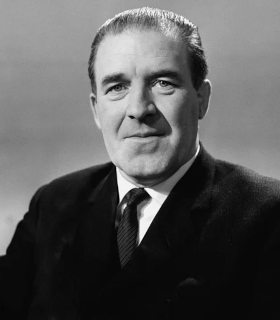
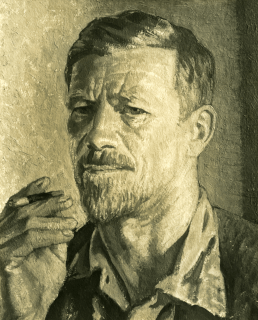
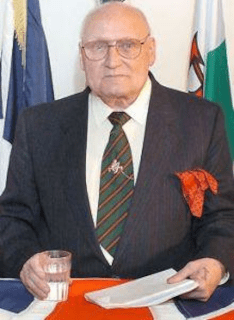
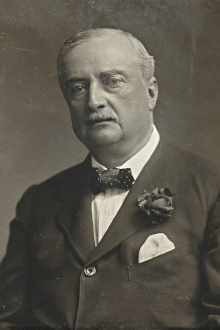
Blaney is first elected to Dáil Éireann for the Donegal East constituency in a by-election in December 1948, following the death of his father from cancer. He also becomes a member of the Donegal County Council. He remains on the backbenches for a number of years before he is one of a group of young party members handpicked by Seán Lemass to begin a re-organisation drive for the party following the defeat at the 1954 Irish general election. Within the party he gains fame by running the party’s by-election campaigns throughout the 1950s and 1960s. His dedicated bands of supporters earn the sobriquet “the Donegal Mafia,” and succeed in getting Desmond O’Malley and Gerry Collins elected to the Dáil.
Following Fianna Fáil’s victory at the 1957 Irish general election, Éamon de Valera, as Taoiseach, brings new blood into the Cabinet in the shape of Blaney, Jack Lynch, Kevin Boland and Mícheál Ó Móráin. Blaney is appointed Minister for Posts and Telegraphs however he moves to the position of Minister for Local Government at the end of 1957 following the death of Seán Moylan. He retains the post when Lemass succeeds de Valera as Taoiseach in 1959. During his tenure it becomes possible to pay rates by installment and he also introduces legislation which entitles non-nationals to vote in local elections.
In 1966 Lemass resigns as Taoiseach and Fianna Fáil leader. The subsequent leadership election sees Cork politician Jack Lynch become party leader and Taoiseach. In the subsequent cabinet reshuffle Blaney is appointed Minister for Agriculture and Fisheries.
In 1969, when conflict breaks out in Northern Ireland, Blaney is one of the first to express strong Irish republican views, views which contradict the policy of the Irish Government, in support of Northern nationalists. From around late 1968 onwards, he forms and presides over an unofficial Nationalist group in Leinster House popularly known as “the Letterkenny Table.” The group is dominated by Blaney up until his death.
There is general surprise when, in an incident known as the Arms Crisis, Blaney, along with Charles Haughey, is sacked from Lynch’s cabinet amid allegations of the use of the funds to import arms for use by the IRA. Lynch asks for their resignations but both men refuse, saying they did nothing illegal. Lynch then advises President de Valera to sack Haughey and Blaney from the government. Haughey and Blaney are subsequently tried in court but are acquitted. However, many of their critics refuse to recognise the verdict of the courts. Although Blaney is cleared of wrongdoing, his ministerial career is brought to an end.
Lynch subsequently moves against Blaney so as to isolate him in the party. When Blaney and his supporters try to organise the party’s national collection independently, Lynch acts and in 1972 Blaney is expelled from Fianna Fáil for “conduct unbecoming.”
Following his expulsion from Fianna Fáil, Kevin Boland tries to persuade Blaney to join the Aontacht Éireann party he is creating but Blaney declines. Instead, he contests all subsequent elections for Independent Fianna Fáil – The Republican Party, an organisation that he built up. Throughout the 1970s there are frequent calls for his re-admittance to Fianna Fáil but the most vocal opponents of this move are Fianna Fáil delegates from County Donegal.
O’Brien is a ship builder and designer, and his notable boats include the Kelpie (used for gun running in 1914), the Saoirse (in which he circumnavigates the globe) and the Ilen (a Falkland Islands service ship).
O’Brien is credited with two buildings in his lifetime: the Co-operative Hall in County Donegal and the People’s Hall in County Limerick. He is also known as a naval architect, having designed two ships, the Saoirse and the llen. He later captains both of these ships himself.
In Saoirse, a 20-ton, 42-foot ketch designed and built in 1922 in Baltimore, County Cork, he and three crew members circumnavigate the globe between 1923 and 1925 – the first recorded by an amateur skipper from west to east, the first yacht circumnavigation by way of the three great capes: Cape Horn, Cape of Good Hope and Cape Leeuwin, and the first boat flying the Irish tri-colour to enter many of the world’s ports and harbours. His voyage begins and ends at the Port of Foynes, County Limerick, where he lives. His account of the voyage, Across Three Oceans, (1927) becomes one of the classics of maritime literature.
Up until O’Brien’s circumnavigation, this route is the preserve of square-rigged grain ships taking part in the grain race from Australia to England via Cape Horn (also known as the clipper route).
O’Brien’s seagoing experiences are put to use in his design of the Ilen, which is built for the Falkland Islands as a service boat and launched in the spring of 1926. In 1998, Ilen returns to the site where she was first built, on the River Ilen near Baltimore, County Cork, where she undergoes a full restoration and is re-launched in May 2018. This task provides work-based learning for the students of the Ilen School.
O’Brien has some involvement with gun running in 1914 on behalf of the Irish Volunteers, for political reasons and because he has experience in sailing. On July 26, 1914, nine hundred guns are brought to Howth harbour aboard Erskine Childers‘ yacht Asgard. As part of the same operation, O’Brien transports arms on his yacht, Kelpie. The guns on Kelpie are transshipped to another yacht, Chotah, owned by Sir Thomas Myles, before being landed at Kilcoole in County Wicklow on August 1, 1914. After the gun running incidents, he serves in the Royal Naval Volunteer Reserve.
In 1928, O’Brien marries a well-known artist, Kathleen Francis, the youngest daughter of Sir George Clausen, RA. The couple thereafter moves to Ibiza, where they live on the Saoirse until Kathleen’s death in 1936. They have no children. Relocating to Cornwall, where he lives with his sister, he writes books on sailing and works of fiction for children. Although too old for active service when war with Germany breaks out in 1939, he assists the British war effort by serving in the Small Ships Pool, which delivers support vessels across the Atlantic and brings food supplies from the United States in private yachts.
In 1940 O’Brien sells Saoirse to the Royal Cornwall Yacht Club. The boat remains in use until 1980, when it is lost off the Jamaican coast. After the war he retires to another sister’s home in Foynes, County Limerick, where he lives and continues to write books for children until his death on April 18, 1952.
Plunkett’s only grown sibling, a younger brother, from whom he is estranged from about 1916, for reasons not fully clear but connected to his mother’s will, is the noted British naval officer Sir Reginald Drax. Another younger brother dies in infancy.
The title passes to Plunkett at his father’s death in 1899 at a fairly young age. The young Lord Dunsany returns to Dunsany Castle in 1901 after war duty. In that year he is also confirmed as an elector for the Representative Peers for Ireland in the House of Lords.
In 1903, Plunkett meets Lady Beatrice Child Villiers (1880–1970), youngest daughter of Victor Child Villiers, 7th Earl of Jersey, who is then living at Osterley Park. They marry in 1904. Their one child, Randal, is born in 1906. Lady Beatrice is supportive of her husband’s interests and helps him by typing his manuscripts, selecting work for his collections, including the 1954 retrospective short story collection, and overseeing his literary heritage after his death.
The Plunketts are socially active in Dublin and London and travel between homes in Meath, London and Kent, other than during the First and Second World Wars and the Irish War of Independence. He circulates with many literary figures of the time. To many of these in Ireland he is first introduced by his uncle, the co-operative pioneer Sir Horace Plunkett, who also helps to manage his estate and investments for a time. He is friendly, for example, with George William Russell, Oliver St. John Gogarty, and for a time, W. B. Yeats. He also socialises at times with George Bernard Shaw and H. G. Wells and is a friend of Rudyard Kipling.
In 1910 Plunkett commissions a two-story extension to Dunsany Castle, with a billiard room, bedrooms and other facilities. The billiard room includes the crests of all the Lords Dunsany up to the 18th.
Plunkett serves as a second lieutenant in the Coldstream Guards in the Second Boer War. Volunteering in World War I and appointed Captain in the Royal Inniskilling Fusiliers, he is stationed for a time at Ebrington Barracks in Derry, Northern Ireland. Hearing while on leave of disturbances in Dublin during the Easter Rising of 1916, he drives in to offer help and is wounded by a bullet lodged in his skull. After recovery at Jervis Street Hospital and what is then the King George V Hospital (now St. Bricin’s Military Hospital), he returns to duty. His military belt is lost in the episode and later used at the burial of Michael Collins. Having been refused forward positioning in 1916 and listed as valuable as a trainer, he serves in the later war stages in the trenches and in the final period writing propaganda material for the War Office with MI7b. There is a book at Dunsany Castle with wartime photographs, on which lost members of his command are marked.
During the Irish War of Independence, Plunkett is charged with violating the Restoration of Order in Ireland Act 1920, tried by court-martial on February 4, 1921, convicted, and sentenced to pay a fine of 25 pounds or serve three months in prison without labour. The Crown Forces had searched Dunsany Castle and had found two double-barreled shotguns, two rook rifles, four Very pistols, an automatic pistol and a large quantity of pistol ammunition, along with shotgun and rifle ammunition.
During World War II, Plunkett signs up for the Irish Army Reserve and the British Home Guard, the two countries’ local defence forces, and is especially active in Shoreham, Kent, the English village bombed most during the Battle of Britain.
Plunkett’s fame arises chiefly from his prolific writings. He is involved in the Irish Literary Revival. Supporting the Revival, he is a major donor to the Abbey Theatre, and he moves in Irish literary circles. He is well acquainted with W. B. Yeats, Lady Gregory, Percy French, George “AE” Russell, Oliver St. John Gogarty, Padraic Colum and others. He befriends and supports Francis Ledwidge, to whom he gives the use of his library, and Mary Lavin.
Plunkett makes his first literary tour to the United States in 1919 and further such visits up to the 1950s, in the early years mostly to the eastern seaboard and later, notably, to California. His own work and contribution to the Irish literary heritage are recognised with an honorary degree from Trinity College Dublin.
In 1940, Plunkett is appointed Byron Professor of English in the University of Athens in Greece. Having reached Athens by a circuitous route, he is so successful that he is offered a post as Professor of English in Istanbul. However, he has to be evacuated due to the German invasion of Greece in April 1941, returning home by an even more complex route, his travels forming a basis for a long poem published in book form (A Journey, in 5 cantos: The Battle of Britain, The Battle of Greece, The Battle of the Mediterranean, Battles Long Ago, The Battle of the Atlantic, special edition January 1944). Olivia Manning‘s character Lord Pinkrose in her novel sequence the Fortunes of War is a mocking portrait of Dunsany in that period.
In 1947, Plunkett transfers his Meath estate in trust to his son and heir and settles in Kent at his Shoreham house, Dunstall Priory, not far from the home of Rudyard Kipling. He visits Ireland only occasionally thereafter and engages actively in life in Shoreham and London. He also begins a new series of visits to the United States, notably California, as recounted in Hazel Littlefield-Smith’s biographical Dunsany, King of Dreams.
In 1957, Plunkett becomes ill while dining with the Earl and Countess of Fingall at Dunsany, in what proves to be an attack of appendicitis. He dies in hospital in Dublin, at the age of 79, on October 25, 1957. He is buried in the churchyard of the ancient church of St. Peter and St. Paul, Shoreham, Kent. His funeral is attended by many family members, representatives of his old regiment and various bodies in which he had taken an interest, and figures from Shoreham. A memorial service is held at Kilmessan in County Meath, with a reading of “Crossing the Bar,” which coincides with the passing of a flock of geese.
Beatrice survives Plunkett, living mainly at Shoreham and overseeing his literary legacy until her death in 1970. Their son Randal succeeds to the barony and is in turn succeeded by his grandson, the artist Edward Plunkett. Plunkett’s literary rights pass from Beatrice to Edward.
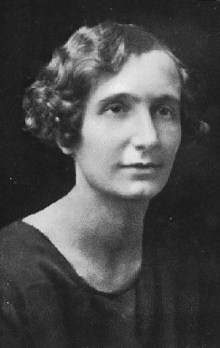
Duffy is born in Nice, France, on July 17, 1884, the daughter of the Irish nationalist Sir Charles Gavan Duffy, one of the founders of The Nation and his third wife, Louise (née Hall) from Cheshire, England. Her mother dies when she is four. She is then raised in Nice by her Australian half-sisters from her father’s second marriage. It is a well-to-do and culturally vibrant home where she is exposed to political figures and ideas.
Duffy’s first visit to Ireland is in 1903, at the age of 18, when her father dies and is buried in Glasnevin Cemetery. This is when she first hears Irish spoken. She finds a grammar book in a bookshop and becomes curious. Her father was not an Irish speaker, though her grandmother in the early 1800s was likely fluent.
Duffy spends the years between 1903 and 1907 between France and England. She takes courses through Cusack’s College in London so that she can matriculate.
Duffy decides to continue her studies in Dublin but cannot afford to move until she receives a small inheritance from her grandmother on the Hall side of the family. Once in Ireland in 1907, at the age of 23, she begins her university studies, taking arts. She lives in the Women’s College, Dominican Convent, as women are not allowed to attend lectures in the Royal University of Ireland. She goes occasionally to the Gaeltacht to learn Irish. Graduating in 1911 with a Bachelor of Arts from University College Dublin (UCD), she is one of the first women to do so.
Given the lack of teachers, even without a full qualification, Duffy then teaches in Patrick Pearse‘s St. Ita’s school for girls in Ranelagh. She studies with the Dominicans again in Eccles Street, gaining a Teaching Diploma from Cambridge University.
A supporter of women’s suffrage, Duffy speaks at a mass meeting in Dublin in 1912 in favour of having the Home Rule bill include a section to grant women the vote. She also joins the Irish republican women’s paramilitary organisation Cumann na mBan, as a founding member in April 1914, serving on the provisional committee with Mary Colum, as a co-secretary.
Duffy is aware that being a suffragist and a nationalist are not necessarily the same thing, realising her involvement in Cumann na mBan is in support of nationalism. When St. Ita’s closes due to funding problems in 1912, she takes the opportunity to complete her qualifications. After receiving her Cambridge teacher’s diploma in 1913, she returns to UCD to study for a Master of Arts degree.
Duffy is in fact working on her master’s thesis during the Easter break in 1916 when the rumour comes to her that the Rising has begun in Dublin city centre. She walks to the Rebel headquarters in the GPO where she tells Pearse, one of the leaders, that she does not agree with the violent uprising.
Duffy spends all of Easter week working in the GPO kitchens with other volunteers like Desmond FitzGerald and a couple of captured British soldiers, ensuring the volunteers are cared for. The women in the GPO are given the opportunity to leave under the protection of the Red Cross on the Thursday as the shelling of the building has caused fires, but almost all of them refuse. In the end, she is among the second group of the people to leave the GPO on the Friday, tunnelling through the walls of the buildings to avoid coming under fire.
Duffy’s group makes it to Jervis Street Hospital where they spend the night. The next day, Saturday, Pearse formally surrenders. She heads for Jacob’s Biscuit Factory, another volunteer position, on the morning after the surrender, to see what is happening. There she finds a holdout of volunteers who are unaware of the surrender or that the fighting is over.
After 1916 Duffy is elected to the Cumann na mBan’s executive and in 1918 is one of the signatories to a petition for self-determination for Ireland which is presented to President Woodrow Wilson by Hanna Sheehy-Skeffington. During her time in the GPO, she had collected names of the volunteers and promised to take messages to their families. This possibly influences her in being involved in the National Aid Association and Volunteers Dependants Fund. In the aftermath of the rebellion there are 64 known dead among the volunteers, while 3,430 men and 79 women are arrested. Families need support. These organisations are able to arrange funding from the United States.
In 1917, Duffy co-founds and runs Scoil Bhríde, as a secondary school for girls in Dublin through the medium of Gaelic. It is still in operation as a primary school. Her co-founder is Annie McHugh, who later marries Ernest Blythe. The end of the Rising leads to the Irish War of Independence (1919-21). During this time, she is mostly focused on the school. However, it is raided by the military and Duffy later admits it is in fact used for rebel meetings and to safeguard documents. In October 1920, the Irish leader Michael Collins meets Archbishop Patrick Clune there in secret. In an effort to support the nationwide boycott of the police, the Royal Irish Constabulary (RIC), in 1920, she has a leaflet sent to all branches of Cumann na mBan which states in part that the RIC are the “eyes and ears of the enemy. Let those eyes and ears know no friendship.”
The war ends with the Anglo-Irish Treaty in 1921. The result is the Irish Civil War which lasts until 1923. Duffy is a supporter of the Treaty, which her brother had signed, and as such she leaves Cumann na mBan and joins Cumann na Saoirse, in which she is instrumental in founding as an Irish republican women’s organisation which supports the Pro-Treaty side.
Once the civil war is over, Duffy leaves the political arena and returns to education. She especially needs to focus on funding in the early years of the school. She works with UCD’s Department of Education from 1926, once Scoil Bhríde is recognised as a teacher training school. She publishes educational documents like School Studies in The Appreciation of Art with Elizabeth Aughney and published by UCD in 1932.
Until her retirement, Duffy also lectures on the teaching of French. She retires as principal in 1944.
Recognising the importance of her first-hand experience and with a good political understanding, Duffy records her memories of the events in which she has taken part. In 1949, she gives an account of her life in relation to nationalist activities to the Bureau of Military History. She is involved in a Radio Éireann broadcast in 1956 about the women in the Rising. In 1962, she takes part in the RTÉ TV program Self Portrait broadcast on March 20, 1962. In March 1966 she gives a lecture in UCD to mark the 50th anniversary of the Rising which is published in The Easter rising, 1916, and University College Dublin (1966).
Duffy dies, unmarried, on October 12, 1969, aged 85, and is interred in the family plot in Glasnevin Cemetery.
In 2014, An Post issues a stamp to commemorate the centenary of the founding of Cumann na mBan. In 2016, for the centenary, a documentary is produced, discussing seven of the women, including Duffy, who were involved in the Easter Rising.
Spence, the sixth of seven children, is born and raised in the Shankill Road area of West Belfast in Northern Ireland, the son of William Edward Spence, a member of the Ulster Volunteers who fought in World War I, and Isabella “Bella” Hayes. The family home is 66 Joseph Street in an area of the lower Shankill known colloquially as “the Hammer.” He is educated at the Riddel School on Malvern Street and the Hemsworth Square school, finishing his education at the age of fourteen. He is also a member of the Church Lads’ Brigade, a Church of Ireland group, and the Junior Orange Order. His family has a long tradition of Orange Order membership.
Spence takes various manual jobs in the area until joining the British Army in 1957 as a member of the Royal Ulster Rifles. He rises to the rank of Provost Sergeant (battalion police). He is stationed in Cyprus and sees action fighting against the forces of Colonel Georgios Grivas. He serves until 1961 when ill-health forces him to leave. He then finds employment at the Harland & Wolff shipyard in Belfast, where he works as a stager (builder of the scaffolding in which the ships are constructed), a skilled job that commands respect among working class Protestants and ensures for him a higher status within the Shankill.
From an early age Spence is a member of the Prince Albert Temperance Loyal Orange Lodge, where fellow members include John McQuade. He is also a member of the Royal Black Institution and the Apprentice Boys of Derry. Due to his later involvement in a murder, he is expelled from the Orange Order and the Royal Black Institution. The Reverend Martin Smyth is influential in his being thrown out of the Orange Order.
Spence’s older brother Billy is a founding member of Ulster Protestant Action (UPA) in 1956, and he is also a member of the group. He is frequently involved in street fights with republicans and garners a reputation as a “hard man.” He is also associated loosely with prominent loyalists such as Ian Paisley and Desmond Boal and is advised by both men in 1959 when he launches a protest against Gerry Fitt at Belfast City Hall after Fitt had described Spence’s regiment as “murderers” over allegations that they had killed civilians in Cyprus. He, along with other Shankill Road loyalists, break from Paisley in 1965 when they side with James Kilfedder in a row that follows the latter’s campaigns in Belfast West. Paisley intimates that Kilfedder, a rival for the leadership of dissident unionism, is close to Fine Gael after learning that he had attended party meetings while a student at Trinity College Dublin (TCD). The Shankill loyalists support Kilfedder and following his election as MP send a letter to Paisley accusing him of treachery during the entire affair.
Spence claims that he is approached in 1965 by two men, one of whom was an Ulster Unionist Party MP, who tells him that the Ulster Volunteer Force is to be re-established and that he is to have responsibility for the Shankill. He is sworn in soon afterward in a ceremony held in secret near Pomeroy, County Tyrone. Because of his military experience, he is chosen as the military commander and public face of the UVF when the group is established. However, RUC Special Branch believes that his brother Billy, who keeps a much lower public profile, is the real leader of the group. Whatever the truth of this intelligence, Spence’s Shankill UVF team is made up of only around 12 men on its formation. Their base of operations is the Standard Bar, a pub on the Shankill Road frequented by Spence and his allies.
On May 7, 1966, a group of UVF men led by Spence petrol bomb a Catholic-owned pub on the Shankill Road. Fire also engulfs the house next door, killing the elderly Protestant widow, Matilda Gould (77), who lives there. On May 27, he orders four UVF men to kill an Irish Republican Army (IRA) member, Leo Martin, who lives on the Falls Road. Unable to find their target, the men drive around in search of any Catholic instead. They shoot dead John Scullion (28), a Catholic civilian, as he walks home. Spence later writes “at the time, the attitude was that if you couldn’t get an IRA man you should shoot a Taig, he’s your last resort.” On June 26, the same gang shoots dead Catholic civilian Peter Ward (18) and wounds two others as they leave a pub on Malvern Street in the lower Shankill. Two days later, the government of Northern Ireland uses the Special Powers Act to declare the UVF illegal. Shortly after, Spence and three others are arrested.
In October 1966, Spence is sentenced to life imprisonment for the murder of Ward, although he has always claimed his innocence. He is sent to Crumlin Road Prison. During its July 12, 1967, march, the Orange lodge to which he belongs stops outside the prison in tribute to him. This occurs despite him having been officially expelled from the Orange Order following his conviction. His involvement in the killings gives him legendary status among many young loyalists and he is claimed as an inspiration by the likes of Michael Stone. Tim Pat Coogan describes Spence as a “loyalist folk hero.” The murder of Ward is, however, repudiated by Paisley and condemned in his Protestant Telegraph, sealing the split between the two.
Spence appeals against his conviction and is the subject of a release petition organised by the Ulster Constitution Defence Committee, although nothing comes of either initiative. Despite the fact that control of the UVF lay with his closest ally, Samuel “Bo” McClelland, from prison he is often at odds with the group’s leadership, in particular with regards to the 1971 McGurk’s Bar bombing. Spence now argues that UVF members are soldiers and soldiers should not kill civilians, as had been the case at McGurk’s Bar. He respects some Irish republican paramilitaries, who he feels also live as soldiers, and to this end he writes a sympathetic letter to the widow of Official IRA leader Joe McCann after he is killed in 1972.
Spence is granted two days leave in early July 1972 to attend the wedding of his daughter Elizabeth to Winston Churchill “Winkie” Rea. The latter had formally asked Spence for his daughter’s hand in marriage during a prison visit. Met by two members of the Red Hand Commando upon his release, Spence is informed of the need for a restructuring within the UVF and told not to return to prison. He initially refuses and goes on to attend his daughter’s wedding. Afterward a plot is concocted where Jim Curry, a Red Hand Commando member, will drive Spence back to prison but the car is to be stopped and Spence “kidnapped.” As arranged, the car in which he is a passenger is stopped in Springmartin and he is taken away by UVF members. He remains at large for four months and during that time gives an interview to ITV‘s World in Action in which he calls for the UVF to take an increased role in the Northern Ireland conflict against the Provisional IRA. At the same time, he distances himself from any policy of random murders of Catholics. He also takes on responsibility for the restructuring, returning the UVF to the same command structure and organisational base that Edward Carson had utilised for the original UVF, with brigades, battalions, companies, platoons and sections. He also directs a significant restocking of the group’s arsenal, with guns mostly taken from the security forces. He gives his permission for UVF brigadier Billy Hanna to establish the UVF’s Mid-Ulster Brigade in Lurgan. His fugitive status earns him the short-lived nickname the “Orange Pimpernel.” He is arrested along with around thirty other men at a UVF drinking club in Brennan Street, but after giving a false name, he is released.
Spence’s time on the outside comes to an end on November 4 when he is captured by Colonel Derek Wilford of the Parachute Regiment, who identifies him by tattoos on his hands. He is sent directly to Long Kesh Detention Centre soon afterward, where he shares a cell with William “Plum” Smith, one of the Red Hand Commandos whom he had met upon his initial release and who had since been jailed for attempted murder.
Spence soon becomes the UVF commander within the Long Kesh Detention Centre. He runs his part of Long Kesh along military lines, drilling inmates and training them in weapons use while also expecting a maintenance of discipline. As the loyalist Long Kesh commander, he initially also has jurisdiction over the imprisoned members of the Ulster Defence Association (UDA), although this comes to an end in 1973 when, following a deterioration in relations between the two groups outside the prison walls, James Craig becomes the UDA’s Maze commander. By this time Spence polarises opinion within the UVF, with some members fiercely loyal to a man they see as a folk hero and others resenting his draconian leadership and increasing emphasis on politics, with one anonymous member even labelling him “a cunt in a cravat.”
Spence begins to move toward a position of using political means to advance one’s aims, and he persuades the UVF leadership to declare a temporary ceasefire in 1973. Following Merlyn Rees‘ decision to legalise the UVF in 1974, Spence encourages them to enter politics and support the establishment of the Volunteer Political Party (VPP). However, his ideas are abandoned as the UVF ceasefire falls apart that same year following the Ulster Workers’ Council strike and the Dublin and Monaghan bombings. The carnage of the latter shocks and horrifies Spence. Furthermore, the VPP suffers a heavy defeat in West Belfast in the October 1974 United Kingdom general election, when the DUP candidate, John McQuade, captures six times as many votes as the VPP’s Ken Gibson.
Spence is increasingly disillusioned with the UVF, and he imparts these views to fellow inmates at Long Kesh. According to Billy Mitchell, Spence quizzes him and others sent to Long Kesh about why they are there, seeking an ideological answer to his question. When the prisoner is unable to provide one, Spence then seeks to convince them of the wisdom of his more politicised path, something that he accomplishes with Mitchell. David Ervine and Billy Hutchinson are among the other UVF men imprisoned in the mid-1970s to become disciples of Spence. In 1977, he publicly condemns the use of violence for political gain, on the grounds that it is counterproductive. In 1978, he leaves the UVF altogether. His brother Bobby, also a UVF member, dies in October 1980 inside the Maze, a few months after the death of their brother Billy.
Released from prison in 1984, Spence soon becomes a leading member of the UVF-linked Progressive Unionist Party (PUP) and a central figure in the Northern Ireland peace process. He initially works solely for the PUP but eventually also sets up the Shankill Activity Centre, a government-supported scheme to provide training and leisure opportunities for unemployed youths.
Spence is entrusted by the Combined Loyalist Military Command (CLMC) to read out their October 13, 1994, statement that announces the loyalist ceasefire. Flanked by his PUP colleagues Jim McDonald and William Plum Smith, as well as Ulster Democratic Party (UDP) members Gary McMichael, John White and David Adams, he reads the statement from Fernhill, a former Cunningham family home on their former Glencairn estate in Belfast’s Glencairn area. This building had been an important training centre for members of Edward Carson’s original UVF. A few days after the announcement, he makes a trip to the United States along with the PUP’s David Ervine and Billy Hutchinson and the UDP’s McMichael, Adams and Joe English. Among their engagements is one as guests of honour of the National Committee on American Foreign Policy. He goes on to become a leading advocate for the Good Friday Agreement.
In August 2000, Spence is caught up in moves by Johnny Adair‘s “C” Company of the UDA to take control of the Shankill by forcing out the UVF and other opponents. Due to his involvement in the peace process and the eventual Good Friday Agreement, the authorities insist against his wishes to install additional security measures to the doors and windows. As a result, when Adair’s men try to force their way into Spence’s Shankill home, they only manage to push a long stick through a partially open window of the bungalow and dislodge a few of his military frames off the opposite wall. There is no other damage and other than that small disruption no one is able to gain any physical entry into the property. When Spence’s wife dies three years later, he says that C Company is responsible for her death, as the events had taken on her health.
On May 3, 2007, Spence reads out the statement by the UVF announcing that it will keep its weapons but put them beyond the reach of ordinary members. The statement also includes a warning that activities could “provoke another generation of loyalists toward armed resistance.” He does not specify what activities or what is being resisted.
Spence marries Louie Donaldson, a native of the city’s Grosvenor Road, on June 20, 1953, at Wellwood Street Mission, Sandy Row. The couple has three daughters, Elizabeth (born 1954), Sandra (1956) and Catherine (1960). Louie dies in 2003. Spence, a talented footballer in his youth with Old Lodge F.C., is a lifelong supporter of Linfield F.C.
Spence dies in a Belfast hospital at the age of 78 on September 25, 2011. He had been suffering from a long-term illness and was admitted to hospital 12 days prior to his death. He is praised by, among others, PUP leader Brian Ervine, who states that “his contribution to the peace is incalculable.” Sinn Féin‘s Gerry Kelly claims that while Spence had been central to the development of loyalist paramilitarism, “he will also be remembered as a major influence in drawing loyalism away from sectarian strife.”
However, a granddaughter of Matilda Gould, a 74-year-old Protestant widow who had died from burns sustained in the UVF’s attempted bombing of a Catholic bar next door to her home, objects to Spence being called a “peacemaker” and describes him as a “bad evil man.” The unnamed woman states, “When you go out and throw a petrol bomb through a widow’s window, you’re no peacemaker.”
Spence’s funeral service is held in St. Michael’s Church of Ireland on the Shankill Road. Notable mourners include Unionist politicians Dawn Purvis, Mike Nesbitt, Michael McGimpsey, Hugh Smyth and Brian Ervine, UVF chief John “Bunter” Graham and UDA South Belfast brigadier Jackie McDonald. In accordance with his wishes, there are no paramilitary trappings at the funeral or reference to his time in the UVF. Instead, his coffin is adorned with the beret and regimental flag of the Royal Ulster Rifles, his former regiment. He is buried in Bangor, County Down.
Together with his brother Norman, Leslie’s early education begins at home where a German governess, Clara Woelke, is their first teacher. As children the brothers have more contact with servants than they have with their parents. His own daughter, Anita, says, “In my parents’ view schools performed the same functions that kennels did for dogs. They were places where pets could be conveniently deposited while their owners travelled.”
Leslie is educated at Ludgrove School, then Eton College and King’s College, Cambridge. While at Cambridge University he becomes a Roman Catholic and a supporter of Irish Home Rule. He adopts an anglicised Irish variant of his name (“Shane”). Not overly impressed by Eton, as a lower boy he and his roommates occupy “an old, battered warren betwixt the chapel cemetery and Wise’s horse yard … [T]he food was wretched and tasteless … As for thrashings which tyrannised rather than disciplined our house, they were excessive. Bullying was endemic and Irish boys were ridiculed, especially on St Patrick’s Day.”
Leslie refuses to send his own sons to Eton. They are educated at Roman Catholic Benedictine schools: Jack at Downside School and Desmond at Ampleforth College.
During the war Leslie is in a British Ambulance Corps, until invalided out. He is then sent to Washington, D.C. to help the British Ambassador, Sir Cecil Spring Rice, soften Irish American hostility toward England and obtain American intervention in the war in the aftermath of the 1916 Easter Rising in Dublin and the execution of its leaders. But he also looks to Ireland for inspiration when writing and edits a literary magazine that contains much Irish verse. He becomes a supporter of the ideals of Irish nationalism, although not physical force republicanism.
In the 1918 United Kingdom general election in Ireland, the Irish Parliamentary Party loses massively to Sinn Féin, putting an end to Leslie’s political career, but as the first cousin of Winston Churchill he remains a primary witness to much that is said and done outside the official record during the negotiation of the Anglo-Irish Treaty of 1921. Disappointed, he feels unwanted in Ireland and abandoned by the British. Like many members of the landed gentry from the 1880s who were obliged to turn to other occupations, he can no longer rely on income from landholdings.
Leslie writes extensively, in a wide range of styles, in verse, prose, and polemic, over several decades. His writings include The End of a Chapter (1916), while hospitalised during World War I, The Oppidan (1922), a roman à clef about his life and contemporaries at Eton, an edition of the Letters of Herbert Cardinal Vaughan to Lady Herbert of Lea (1942), and a biography Mrs. Fitzherbert: a life chiefly from unpublished sources (1939), together with an edition of her letters (with Maria Anne Fitzherbert), The letters of Mrs. Fitzherbert and connected papers; being the second volume of the life of Mrs. Fitzherbert (1944). He also writes Mark Sykes: His Life and Letters (1923), a biography of the English traveler, Conservative Party politician and diplomatic advisor. He advises budding novelist Scott Fitzgerald on the title of his first novel, they share correspondence with the future Mnsg. William A. Hemmick, who is Fitzgerald’s teacher at the Newman School.
A passionate advocate of reforestation, Leslie finds the business of running an estate uncreative and boring, and transfers the estate entailed to him to his eldest son, John Norman Leslie, who succeeds as the 4th Baronet. He transfers St. Patrick’s Purgatory on Lough Derg to the Roman Catholic Bishop of Clogher, Eugene O’Callaghan.
The wealth of the Leslies wanes by the 1930s following the Wall Street crash of 1929 and a farm that is loss making. In his unpublished memoirs, Leslie writes “a gentleman’s standing in his world was signalled by his list of clubs and it was worth paying hundreds of pounds in subs.” They continue to maintain their lifestyle, involving attendance at the London season and the entertainment of distinguished visitors, including Anthony Eden at Glaslough. At the outbreak of World War II in 1939 he joins the Home Guard. He spends the remainder of his life between Glaslough and London.
Leslie’s first wife, Marjorie, dies on February 8, 1951. On May 30, 1958, at the Catholic Church of St. Peter & Edward, Westminster, he marries Iris Carola Frazer, who is the daughter of Charles Miskin Laing and Etheldreda Janet Laing.
Several of Redmond’s relatives are politicians. He takes over control of the minority IPP faction loyal to Charles Stewart Parnell after Parnell dies in 1891. He is a conciliatory politician who achieves the two main objectives of his political life: party unity and, in September 1914, the passing of the Irish Home Rule Act.
The Irish Home Rule Act grants limited self-government to Ireland, within the United Kingdom. However, implementation of Home Rule is suspended by the outbreak of the World War I. Redmond calls on the National Volunteers to join Irish regiments of the New British Army and support the British and Allied war effort to restore the “freedom of small nations” on the European continent, thereby to also ensure the implementation of Home Rule after a war that is expected to be of short duration. However, after the Easter Rising of 1916, Irish public opinion shifts in favour of militant republicanism and full Irish independence, resulting in his party losing its dominance in Irish politics.
In sharp contrast to Parnell, Redmond lacks charisma. He works well in small committees but has little success in arousing large audiences. Parnell had always chosen the nominees to Parliament. Now they are selected by the local party organisations, giving Redmond numerous weak MPs over whom he has little control. He is an excellent representative of the old Ireland but grows increasingly old-fashioned because he pays little attention to the new forces attracting younger Irishmen, such as Sinn Féin in politics, the Gaelic Athletic Association in sports, and the Gaelic League in cultural affairs.
Redmond never tries to understand the unionist forces emerging in Ulster. He is further weakened in 1914 by the formation of the Irish Volunteers by Sinn Féin members. His enthusiastic support for the British war effort alienates many Irish nationalists. His party has been increasingly hollowed out, and a major crisis, notably the Easter Rising, is enough to destroy it.
Redmond is increasingly eclipsed by ill-health after 1916. An operation in March 1918 to remove an intestinal obstruction appears to progress well initially, but he then suffers heart failure. He dies a few hours later at a Londonnursing home on March 6, 1918.
Condolences and expressions of sympathy are widely expressed. After a funeral service in Westminster Cathedral his remains are interred, as requested in a manner characteristic of the man, in the family vault at the old Knights Templars‘ chapel yard of Saint John’s Cemetery, Wexford, amongst his own people rather than in the traditional burial place for Irish statesmen and heroes in Glasnevin Cemetery. The small, neglected cemetery near the town centre is kept locked to the public. His vault, which has been in a dilapidated state, has been only partially restored by Wexford County Council.
On December 5, 2011, Pringle delivers a televised address to the nation, representing the technical group of TDs in Dáil Éireann. He does so in response to TaoiseachEnda Kenny‘s address to the nation of the previous evening. Later that month, he calls on people for support in a campaign not to pay a new household charge brought in as part of the latest austerity budget and announces that he will not register for the tax or pay it.
In February 2012, Pringle publishes his expenses online. He is elected leader of the technical group in Dáil Éireann in March 2012.
In May 2012, Pringle brings an unsuccessful High Court challenge over the 2012 European Fiscal Compact referendum and the European Stability Mechanism (ESM) Treaty which is appealed to the Supreme Court in July 2012. In July 2012, the Irish Supreme Court decides to refer three questions to the Court of Justice of the European Union (CJEU) arising out of his challenge of the European Stability Mechanism Treaty and doubts about the ESM’s legality under the Treaties of the European Union. The CJEU holds an oral hearing on the referral on October 23, 2012. It is the first time that the full court sits to hear a reference from a member state of the Union. The 27 judges hear oral arguments from the counsel for Pringle, Ireland, nine other member states, the Commission, the Council, and the European Parliament. On November 27, 2012, the EU Court of Justice dismisses Pringle’s arguments and rules that the ESM is in accordance with the Treaties.
In the 2016 Irish general election, after a re-drawing of constituency boundaries, Pringle campaigns in the new five-seater Donegal constituency. He is re-elected to the final seat by a margin of just 184 votes over Sinn Féin’s Pádraig Mac Lochlainn. During negotiations to form a government, Pringle says he is glad not to have signed up to the Independent Alliance, after that group enters talks with Taoiseach Enda Kenny. He says that unless Kenny or Fianna Fáil leader Micheál Martin sign up to Right2Change, he will not support either as Taoiseach.
As of April 2016, Pringle had become a member of the Independents 4 Change technical group in the Dáil.
In May 2016, Pringle introduces legislation designed to retain water in public ownership and avoid further privatisation.
Pringle puts forward a bill calling on the government to end public spending from fossil fuels, which passes, making Ireland the first country to fully divest public money from fossil fuels. In June 2022, he puts forward a bill proposing a referendum on lowering the voting age to sixteen.
Geraldine Dorothy Cummins, spiritualist medium, novelist and playwright, dies in Cork, County Cork, on August 24, 1969. She begins her career as a creative writer, but increasingly concentrates on mediumship and “channelled” writings, mostly about the lives of Jesus and Saint Paul, though she also publishes on a range of other topics. Her novels and plays typically document Irish life in a naturalist manner, often exploring the pathos of everyday life.
Cummins is born in Cork, on January 24, 1890, the daughter of the physician Ashley Cummins, professor of medicine at the National University of Ireland and sister to Mary Hearn and Iris Cummins. In her youth she is an athlete, becoming a member of the Irish Women’s International Hockey Team. She is also active as a suffragette. Her desire to follow her father in a medical career is vetoed by her mother, so she begins a literary career as a journalist and creative writer. From 1913 to 1917 she writes three plays for the Abbey Theatre in collaboration with Suzanne R. Day, the most successful of which is the comedy Fox and Geese (1917). She publishes the novel The Land they Loved in 1919, a naturalistic study of working class Irish life.
As she concentrates on mediumship, Cummins’s literary work tails off. However, she continues to publish creative literature in her later years. Her solo-written play, Till Yesterday Comes Again, is produced by the Chanticleer Theatre, London, in 1938. She also publishes another novel, Fires of Beltane (1936) and a short-story collection Variety Show (1959).
Literary critic Alexander G. Gonzalez says that Cummins work tries to encompass the full range of Irish social life, from the aristocracy to the lower classes. In this respect she is influenced by Somerville and Ross. Gonzalez considers her short story The Tragedy of Eight Pence to be the “finest” of her writings, the tale of a “happily married woman trying to shield her ill husband from the knowledge that his death will leave her penniless.”
Cummins begins to work as a medium following prompting from Hester Dowden and E. B. Gibbes. She receives alleged messages from her spirit-guide “Astor” and is an exponent of automatic writing. Her books are based on these communications. In 1928 she publishes The Scripts of Cleophas, which provides channelled material on early Christian history complementing Acts of the Apostles and St. Paul’s writings, supposed to have been communicated by the spirit of Cleophas, one of Paul’s followers. This is later supplemented by Paul in Athens (1930) and The Great Days of Ephesus (1933).
Cummins’s next work describes human progress through spiritual enlightenment. The Road to Immortality (1932) provides a glowing vision of the afterlife. Its contents are purportedly communicated from the “other side” by the psychologist and psychic researcher Frederic W. H. Myers. Unseen Adventures (1951) is a spiritual autobiography. She also publishes several books of spiritually-derived knowledge about details of the life of Jesus.
During World War II Cummins allegedly works as a British agent, using her personal contacts to identify pro-Nazi factions within the Irish Republican movement. She also employs her psychic activities to support the Allied cause, sending channelled messages from sympathetic spirits to Allied leaders to support the war effort. This includes information from Theodore Roosevelt, Arthur Balfour and Sara Roosevelt, Franklin D. Roosevelt‘s mother.
In the 1940s and 50s Cummins works with psychiatrists to develop a model for using spiritualism to treat mental illness, ideas she explores in Perceptive Healing (1945) and Healing the Mind (1957). She collaborates with a psychiatrist who uses the pseudonym R. Connell on both books. Their method is for her to “read” an object associated with the patient and thus identify either childhood traumas or experiences of ancestors which have created the problem. This includes treating a patient who is concerned about his homosexual desires by discovering that this derives from the fact that his Huguenot ancestors were humiliated by Catholics in the 18th century.
Cummins’s biography of writer and spiritualist Edith Somerville is published in 1952. She also writes The Fate of Colonel Fawcett (1955) which offers her psychic insights into the disappearance of the explorer Percy Fawcett in Brazil in 1925. She claims she had received psychic messages from Fawcett in 1936. He was still alive at that time, informing her that he had found relics of Atlantis in the jungle, but was ill. In 1948 she has a message from Fawcett’s spirit reporting his death. Her last book is an account of her conversations with the spirit of Winifred Coombe Tennant, Swan on a Black Sea; a Study in Automatic Writing; the Cummins-Willett Scripts (1965).
The automatic writing and alleged channeled material from Cummins have been examined and have been described by some psychical researchers to be the product of her own subconscious. For example, Harry Price, who studies various mental mediums including Cummins, writes that “there is no question that most of the automatic writing which has been published is the product of the subconscious.” Paranormal researcher Hilary Evans notes that unlike most spiritualists, Cummins does not accept the phenomena at face value and questions the source of the material.
According to the psychical researcher Eric Dingwall information published in Cummins’ scripts allegedly from Winifred Coombe Tennant are discovered to be erroneous. Biographer Rodger Anderson writes that although spiritualists consider Cummins completely honest “some suspected that she occasionally augmented her store of knowledge about deceased persons by normal means if by doing so she could bring comfort to the bereaved.”
Cummins’ book The Fate of Colonel Fawcett (1955), contains her automatist scripts allegedly from the spirit of Colonel Fawcett. Spiritualists claim the scripts are evidence for survival. However, the psychical researcher Simeon Edmunds notes that before his disappearance Fawcett had written articles for The Occult Review. Cummins also contributes articles to the same review and Edmunds suggests it is likely she had read the work of Fawcett. Edmunds concludes the scripts are a case of subliminal memory and unconscious dramatization.
Other researchers such as Mary Rose Barrington have suspected fraud as Cummins had long standing connections with friends and families of the deceased that she claimed to have contacted and could have easily obtained information by natural means. The classical scholar E. R. Dodds writes that Cummins worked as a cataloguer at the National Library of Ireland and could have taken information from various books that would appear in her automatic writings about ancient history. Her writings were heavily influenced by literature and religious texts. Dodds also studies her book Swan on a Black Sea which was supposed to be an account of spirit conversation but writes there is evidence suggestive of fraud as Cummins had received some of the information by natural means.
An earlier “Fianna” is organised “to serve as a Junior Hurling League to promote the study of the Irish Language” on June 26, 1902, at the Catholic Boys’ Hall, Falls Road, in West Belfast, the brainchild of Bulmer Hobson. Hobson, a Quaker influenced by suffragism and nationalism, joins the Irish Republican Brotherhood in 1904 and is an early member of Sinn Féin during its monarchist-nationalist period, alongside Arthur Griffith and Constance Markievicz. Hobson later relocates to Dublin and the Fianna organisation collapses in Belfast. Markievicz, inspired by the rapid growth of Robert Baden-Powell‘s Boy Scouts, forms sometime before July 1909 the Red Branch Knights, a Dublin branch of Irish National Boy Scouts. After discussions involving Hobson, Markievicz, suffragist and labour activist Helena Molony and Seán McGarry, the Irish National Boy Scouts change their name to Na Fianna Éireann at a meeting in 34 Lower Camden Street, Dublin, on August 16, 1909, at which Hobson is elected as president, thus ensuring a strong IRB influence, Markievicz as vice-president and Pádraig Ó Riain as secretary. Seán Heuston is the leader of the Fianna on Dublin’s north side, while Cornelius “Con” Colbert is the leader on the south side. The Fianna forms as a Nationalist alternative to Powell’s Scouts with the aim to achieve the full independence of Ireland by training and teaching scouting and military exercises, Irish history, and the Irish language.
The Fianna finds its first years difficult and by 1912 has barely 1,000 members and a skeleton structure outside of the cities of Dublin, Cork, Belfast and Galway. But in the next couple of years the momentum of events carries the Fianna forward. It is involved in initiating the militarisation of the IRB, the launch of the Irish Volunteers and showing solidarity with the striking Irish Transport and General Workers’ Union (ITGWU). It is also crucial to the success of the Howth and Kilcoole gun-running operations. Alongside these headline-grabbing activities, the Fianna continues with classes, drilling, camps and protests and reaps the benefits of an expanding membership and structure. When the fighting starts, the Fianna are not found wanting either. In 1916, Na Fianna members are present in all areas that mobilise and fight alongside all the other Republican organisations. They continue to fight throughout the Irish War of Independence and Irish Civil War. Seeing comrades being killed in action or executed or suffering imprisonment does not dim their enthusiasm for the fight. In Na Fianna Éireann’s March 1922 Árd Fheis, the 187 delegates representing 30,000 members vote unanimously to reject the Anglo-Irish Treaty.
The Fianna are declared an illegal organisation by the government of the Irish Free State in 1931. This is reversed when Fianna Fáil comes to power in 1932 but re-introduced in 1938. During the splits in the Republican movement of the later part of the 20th century, the Fianna and Cumann na mBan support Provisional Sinn Féin in 1969 and Republican Sinn Féin in 1986. The Fianna have been a proscribed organisation in Northern Ireland since 1920.
While the events in which the Fianna members are involved over the revolutionary years have a special place in Irish history, the specific role of the Fianna is absent from most written histories. This, allied with the failure to adequately commemorate the organisation’s centenary, marks a kind of revisionism of omission.